Article

Genetic Dissection of Petal Abscission Rate in Strawberry Unveils QTLs and Hormonal Pathways for Gray Mold Avoidance


Hubei Key Laboratory of Vegetable Germplasm Enhancement and Genetic Improvement, Institute of Industrial Crops, Hubei Academy of Agricultural Sciences, Wuhan 430064, China
*
Author to whom correspondence should be addressed.
Horticulturae 2025, 11(12), 1525; https://doi.org/10.3390/horticulturae11121525
Submission received: 19 November 2025 / Revised: 12 December 2025 / Accepted: 12 December 2025 / Published: 16 December 2025
(This article belongs to the Section Genetics, Genomics, Breeding, and Biotechnology (G2B2))

Abstract

Gray mold, caused by Botrytis cinerea, is a devastating disease of strawberry, with petal abscission rate (PAR) being a critical disease-avoidance trait. Rapid petal abscission removes a key infection site for the pathogen, thereby reducing disease incidence. To dissect the genetic basis of PAR, a segregating F1 population was constructed from a cross between ‘Benihoppe’ (rapid abscission) and ‘Sweet Charlie’ (slow abscission). Utilizing BSR-Seq analysis of extreme bulks, five high-confidence quantitative trait loci (QTLs) were identified on chromosomes Fvb2-2, Fvb4-4, and Fvb6-3. These QTLs encompassed 672 candidate genes, with enrichment in “Plant hormone signal transduction” pathway. Integrated analysis of gene expression and SNPs identified 16 candidate genes, including those involved in flowering time (e.g., ELF3, HUA2 and AGL62) and plant hormone (e.g., ANT, RTE (ethylene), NDL2, FPF1 (auxin), and CYP707A7, ABF2 (abscisic acid) signaling, as well as calcium transport (ACA1, ECA3). Fourteen Kompetitive Allele-Specific PCR (KASP) markers were developed from candidate genes, with four markers showing significant correlations with PAR. This study provides the first genetic mapping of PAR in strawberry, revealing candidate genes and molecular markers that will facilitate the breeding of cultivars with improved gray mold resistance through enhanced petal abscission.

1. Introduction

Strawberry (Fragaria × ananassa Duch.), a member of the Rosaceae family, is a highly prized fruit crop cultivated worldwide for its appealing flavor, aroma, and nutritional richness. However, strawberry productivity and economic returns are severely constrained by fungal diseases, among which gray mold, caused by Botrytis cinerea, ranks as one of the most destructive fungal plant pathogens [1]. B. cinerea is a necrotrophic fungal pathogen with a remarkably broad host range, capable of infecting over 1400 plant species, including nearly all fruit and vegetable crops [1,2,3]. It preferentially colonizes soft tissues such as fruits, flowers, and leaves, causing massive crop losses both pre- and post-harvest [4]. Under favorable conditions such as high humidity and moderate temperatures, yield losses can range from 10% to 30%, and may exceed 50% in severe cases [5]. Globally, gray mold is responsible for estimated annual economic losses ranging from $10 billion to $100 billion, underscoring its significant threat to agricultural productivity and food security worldwide [3,5].
B. cinerea often begins as a saprophyte on senescing tissues before switching to a pathogenic lifestyle, rendering traditional gene-for-gene resistance ineffective [6]. Additionally, no plant has shown complete resistance against B. cinerea, though pattern-triggered plant immune responses can significantly reduce disease progression [7]. Therefore, breeding efforts have shifted toward partial resistance and disease avoidance traits—morphological or phenological characteristics that reduce the probability of infection without directly inhibiting pathogen growth [8]. A critical avoidance trait is the petal abscission rate (PAR). Senescing floral organs, particularly petals, serve as a primary nutrient source and a bridgehead for B. cinerea to invade the developing fruit [9,10]. The pathogen produces copious conidia on these aging tissues, which are then splashed by rain or irrigation onto the fruit surface [9]. Our foundational research, corroborated by other studies [11], has demonstrated a significant negative correlation between PAR and gray mold incidence [12]. Cultivars whose petals abscise rapidly after anthesis leave a smaller “window of opportunity” for the pathogen to establish and spread to the fruit receptacle. In contrast, cultivars with slow PAR retain this potential inoculum source in close proximity to the fruit, markedly increasing infection risk [11,12]. Consequently, PAR represents a highly valuable and heritable trait for breeding programs aimed at avoiding infection by B. cinerea [12].
The rate of petal abscission is fundamentally a manifestation of the underlying molecular abscission machinery. In plants generally, organ abscission is governed by conserved signaling modules, hormonal crosstalk, and transcriptional networks, all finely tuned by developmental and environmental cues. Abscission occurs at specialized regions called abscission zones (AZs), where cell separation is triggered by a complex interplay of hormonal and peptide signaling. The IDA-HAE/HSL2 pathway is central: the peptide hormone INFLORESCENCE DEFICIENT IN ABSCISSION (IDA) and its receptors HAESA (HAE) and HAESA-LIKE2 (HSL2)—where mutations in either IDA or its receptors effectively block organ separation activating a MAP kinase cascade that leads to cell wall remodeling and organ detachment [13,14,15,16,17,18,19,20,21,22,23]. Ethylene promotes abscission, while auxin inhibits it; their balance, along with other hormones such as jasmonic acid, modulates the timing and extent of abscission [15,16,24,25,26,27]. Therefore, translating this molecular understanding into innovative strategies is key to managing uncontrolled abscission—which causes significant yield losses—and to implementing targeted manipulations, such as breeding for reduced seed shattering or applying abscission inhibitors, for optimized harvest efficiency [15,18,26,27,28,29,30].
Despite the established correlation between PAR and gray mold incidence [12], the genetic and molecular mechanisms controlling petal abscission in strawberry remain largely elusive. Therefore, we constructed a segregating population using parents with contrasting rapid and slow petal abscission rates. By BSR-Seq mapping, we identified genetic loci and candidate genes associated with PAR. Furthermore, we developed KASP markers for these loci. This work provides genetic targets for breeding strawberry cultivars with enhanced petal abscission, a trait that promises to improve resistance to gray mold.

2. Materials and Methods

2.1. Plant Materials and Experimental Populations

To identify strawberry accessions with divergent petal abscission rates (PAR), a total of 103 accessions originating from America (40), Europe (24), Asia (38), and Oceania (1) were planted at the National Strawberry Germplasm Repository in Nanjing, China (32.06° N, 118.78° E). Among them, we identified the Japanese cultivar ‘Benihoppe’, which exhibited rapid petal abscission with a PAR exceeding 76.5% at 7 days post-anthesis (DPA), and the American cultivar ‘Sweet Charlie’, which showed slower abscission with a PAR below 31.9% at 7 DPA [12]. To develop mapping populations, we performed reciprocal crosses between these two cultivars: ‘Benihoppe’ as the female parent and ‘Sweet Charlie’ as the male parent produced the BSF1 population (133 individuals), while the reciprocal cross using ‘Sweet Charlie’ as the female parent and ‘Benihoppe’ as the male parent produced the SBF1 population (18 individuals). For marker validation, a panel of 51 genotypes with documented PAR phenotypes was assembled, comprising 17 BSF1 individuals, 18 SBF1 individuals, and 16 commercially released cultivars. Both the BSF1 and SBF1 populations as well as 16 cultivars used for marker validation were planted in an experimental field in Wuhan, China (30.48° N, 114.32° E). All plants planted in Nanjing and Wuhan were cultivated using standard commercial practices, including raised beds with plastic mulch, supplemented with drip irrigation and fertilizer management according to local protocols.

2.2. Phenotypic Assessment of Petal Abscission Rate

Phenotypic evaluation was conducted during the peak flowering season from March to April. For each genotype across both germplasm and mapping populations, five newly emerged, unopened flower buds at uniform developmental stages were randomly selected and tagged. Petal counts were recorded at full flower opening (1–2 days after tagging, designated Day 0, with subsequent daily evaluations to document retained petals. The Petal Abscission Rate (PAR) at 4 and 7 days post-anthesis (DPA) was calculated using the formula: PAR (%) = [(Initial Petal Count—Retained Petal Count at Time T)/Initial Petal Count] × 100. The mean value from five flowers represented the genotype’s phenotypic score. For BSR-Seq analysis, extreme pools from the BSF1 population were constructed: a slow-abscission bulk (SB) containing eight individuals with PAR at 7 DPA <62.5% and <50% at 4 DPA (BSF1-1, BSF1-49, BSF1-53, BSF1-66, BSF1-74, BSF1-83, BSF1-127, BSF1-141, BSF1-148, BSF1-159, BSF1-163 from Table S2), and a rapid-abscission bulk (RB) comprising eleven individuals with PAR at 4 DPA >80% and >93.3% at 7 DPA, (BSF1-21, BSF1-85, BSF1-93, BSF1-100, BSF1-131, BSF1-162, BSF1-170, BSF1-176 from Table S2).

2.3. BSR-Seq

Total RNA was isolated from young leaf and floral tissues of the two parental lines (‘Benihoppe’ and ‘Sweet Charlie’) and the two extreme bulks (RB and SB) using the RNAprep Pure Plant Kit (DP432, Tiangen Biotech, Beijing, China). RNA quality was verified using an Agilent 2100 Bioanalyzer, confirming that all samples had RNA Integrity Numbers (RIN) exceeding 7.0. Following library construction with the Illumina TruSeq Stranded mRNA LT Sample Prep Kit (Illumina, San Diego, CA, USA) and quality assessment using an Agilent 2100 Bioanalyzer (Agilent Technologies, Santa Clara, CA, USA), eligible cDNA libraries were sequenced on an Illumina HiSeq X Ten platform at Beijing Biomarker Technologies Co., Ltd. (Beijing, China).

2.4. Bioinformatics Analysis

Raw sequencing reads were processed to obtain clean reads by removing adapter-contaminated reads, ribosomal RNA sequences, paired-end reads with over 10% undefined bases (N), and low-quality reads where more than 50% of bases had a Q-value ≤ 10. The resulting high-quality clean reads from each library were aligned to the octoploid F. × ananassa reference genome v1.0.a1 [31] using the STAR aligner (v2.4.0, https://github.com/alexdobin/STAR accessed on 19 November 2025). Single nucleotide polymorphisms (SNPs) were identified using GATK according to the recommended workflow for RNA-seq data [32]. Duplicate reads were marked using Picard (v3.8, https://sourceforge.net/projects/picard/ accessed on 19 November 2025), followed by local realignment and base quality score recalibration. Raw SNPs were filtered using GATK and further screened to exclude SNPs within 5 bp of an indel or in clustered regions (≥2 SNPs within 5 bp), yielding a final set of high-confidence SNPs.
SNP-trait association analysis was performed using both the Euclidean Distance (ED) algorithm [33] and the SNP-index method [34,35]. The ED values were calculated and subsequently raised to the 5th power to reduce background noise [33]. A significance threshold was set at the median + 3SD of the fitted ED values (0.21). Simultaneously, the SNP-index method was applied to calculate allele frequency differences (ΔSNP-index) between the bulks. Since no regions exceeded the 90% confidence interval, the 99th percentile of the fitted ΔSNP_index values (0.29) was used as an exploratory threshold [36]. A 1 Mb window with a 100 kb step size was used to smooth the ΔSNP-index and ED values across the genome. Genomic regions consistently identified by both methods were designated as high-confidence QTLs.
Genes physically located within the high-confidence QTL intervals were extracted, and their functional annotations were retrieved from the reference genome annotation file. Kyoto Encyclopedia of Genes and Genomes (KEGG) pathway enrichment analysis was performed using the KOBAS-i server, with a corrected p-value (False Discovery Rate, FDR) < 0.05 considered statistically significant. Gene expression levels were quantified and normalized using the Fragments Per Kilobase of transcript per Million mapped reads (FPKM) method [36]. Differential expression analysis between the parental lines and between the constructed bulks was performed using the DESeq2 package (v1.26.0) in R [37], which employs a negative binomial distribution model. Genes with an absolute log2 fold change (|LFC|) ≥ 1 were considered for significance testing. The statistical significance of differential expression was assessed using the Wald test implemented in DESeq2 (v1.26.0). The resulting p-values were adjusted for multiple testing using the Benjamini–Hochberg false discovery rate (FDR) correction procedure. Genes meeting the dual thresholds of (|LFC|) ≥ 1 and an FDR-adjusted p-value < 0.01 were classified as differentially expressed genes (DEGs).

2.5. Candidate Gene Identification

Candidate genes were identified as follows: all genes located within the five consensus QTL regions identified by both Euclidean Distance and ΔSNP-index methods (672 genes in total) were firstly extracted. Then, we retained genes that were differentially expressed (absolute log2FC ≥ 1, FDR < 0.01) in at least one comparison—either between parents (‘Benihoppe’ vs. ‘Sweet Charlie’) or between the extreme bulks (RB vs. SB). Thirdly, we further narrowed the list by prioritizing genes annotated to key biological pathways relevant to abscission, such as “Plant hormone signal transduction” and “Flowering time regulation” (KEGG enrichment). Finally, we focused on genes containing non-synonymous SNPs (or synonymous SNPs in strong linkage with phenotypic variation) that were also supported by KASP marker validation. A comprehensive summary table cross-referencing the locations, expression profiles, and SNP information has been included in the Supplementary Materials (Table S6).

2.6. KASP Marker Development and Genotyping

Thirteen non-synonymous SNPs and one synonymous SNP from candidate genes were selected for Kompetitive Allele-Specific PCR (KASP) marker development. For each SNP, genomic sequences flanking the SNP site (~100 bp on each side) were submitted to LGC Genomics (UK) for KASP primer design. The designed allele-specific forward primers contained unique 5′ tail sequences corresponding to standard FRET cassettes labelled with FAM or HEX fluorescent dyes. KASP genotyping was performed in a 1 µL reaction volume on a 1536-well plate using a Meridian liquid handler. Each reaction contained 5–10 ng of genomic DNA and KASP-TF V4.0 2× KASP Master Mix (LGC Biosearch Technologies, Hoddesdon, UK, Cat# KBS-1050-102). The thermal cycling protocol on a Bio-Rad C1000 Touch thermocycler was as follows: initial denaturation at 94 °C for 15 min; 10 touchdown cycles of 94 °C for 20 s and 61–55 °C for 60 s (decreasing by 0.6 °C per cycle); followed by 26 amplification cycles of 94 °C for 20 s and 55 °C for 60 s. Endpoint fluorescence was detected using a BMG LABTECH PHERAstar FS plate reader (BMG Labtech, Ortenberg, Germany), and allele calling was performed automatically with the KlusterCaller software (v 2.22.0.5, LGC Biosearch Technologies, Hoddesdon, UK). Marker-trait associations were evaluated using Spearman’s correlation in SPSS (v 22.0, IBM Corp., Armonk, NY, USA).

3. Results

3.1. Phenotypic Variation in Petal Abscission Rate Across a Diverse Strawberry Germplasm Collection

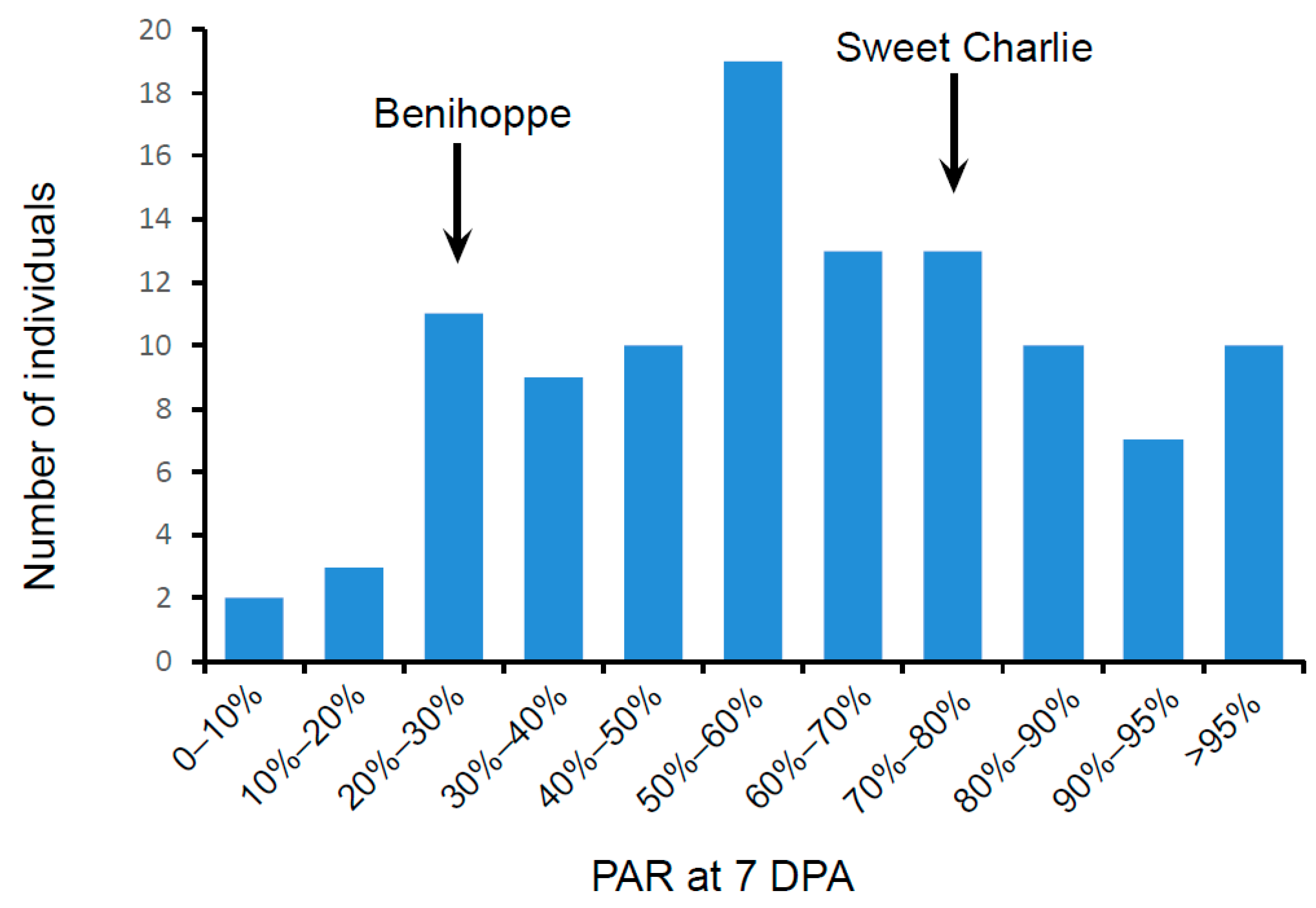
To identify strawberry accessions with divergent petal abscission rates (PAR), we initially evaluated this trait across a diverse collection of 103 accessions, comprising 40 from America, 24 from Europe, 38 from Asia, and one from Oceania (Figure 1; Table S1). PAR values measured at 7 days post-anthesis (DPA) exhibited a continuous and wide spectrum, ranging from 3.33% in ‘Karina’ to 100% in accessions such as ‘Hong hua’, ‘Reiko’, and ‘Yun Xiang’. The distribution was moderately skewed toward rapider abscission, with 27 accessions (26.2%) showing PAR values greater than 80%. This extensive phenotypic variation confirms the quantitative nature of PAR and establishes a valuable germplasm resource for genetic dissection of this key disease-avoidance trait.

3.2. Population Construction and Petal Abscission Rates Identification

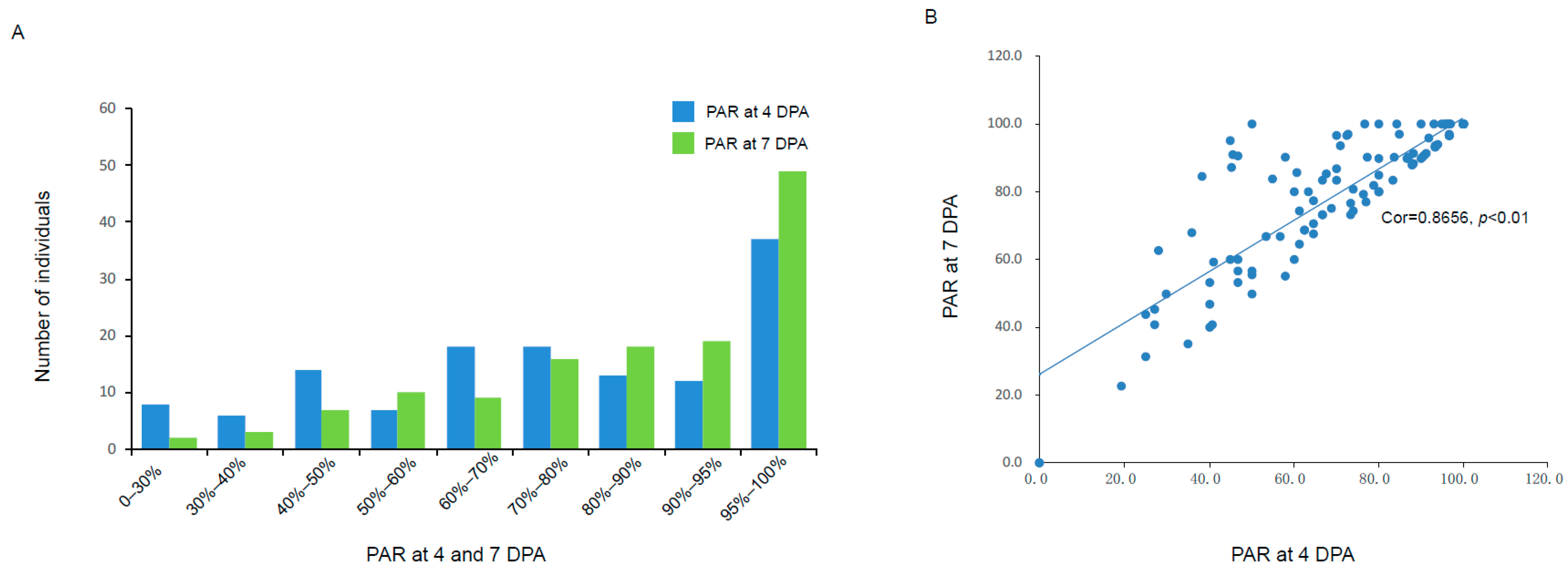
Two strawberry cultivars, ‘Benihoppe’ and ‘Sweet Charlie’, were selected as representative cultivars with rapid and slow petal abscission rates, respectively, as previously documented [12]. ‘Benihoppe’ exhibited PAR at 7 DPA of 88.1%, 76.5%, and 78.5% in 2013, 2014, and 2015, while ‘Sweet Charlie’ showed 26.0%, 3.8%, and 31.9% over the corresponding years (Figure 1). Therefore, a segregating BSF1 population, consisting of 133 individuals, was generated by crossing cultivar ‘Benihoppe’ with ‘Sweet Charlie’ for genetic analysis. Phenotypic evaluation of BSF1 population revealed a wide distribution of PAR at both 4 and 7 DPA (Figure 2; Table S2). A substantial proportion of individuals exhibited rapid petal abscission, with 36.8% (49 individuals) showing PAR exceeding 90% at 4 DPA, and 51.1% reaching this level by 7 DPA. In contrast, only 21.1% (28 individuals) and 9.2% (12 individuals) displayed slower abscission, with PAR below 50% at 4 and 7 DPA, respectively. A highly significant positive correlation (r = 0.865, p < 0.01) was observed between PAR values measured at the two time points (Figure 2B), indicating consistent relative abscission speeds among genotypes throughout the early post-anthesis period. Two contrasting bulks for BSR-Seq analysis were defined by PAR levels at 4 and 7 DPA: a rapid-abscission bulk (RB, n = 11) with PAR at 4 DPA >80% and >93.3% at 7 DPA, and a slow-abscission bulk (SB, n = 8) with PAR at 7 DPA <62.5% and <50% at 4 DPA.

3.3. High-Quality Sequencing and SNP Discovery for BSA

Sequencing of two parents (‘Benihoppe’, ‘Sweet Charlie’) and two contrasting bulks (RB, SB) produced a total of 41.53 Gb of clean data, with Q30 scores consistently above 94.09% (Table 1). Specifically, the clean data amounts for the samples were 6.91 Gb for H, 7.70 Gb for T, 12.89 Gb for RB, and 14.03 Gb for SB. Alignment to the reference genome was efficient, with over 83% of reads mapping and ~65% mapping to unique locations. The high mapping rate and balanced strand specificity confirm the quality of the RNA-seq libraries. SNP calling across the four samples yielded a total of 643,206 raw SNPs, with the numbers identified in ‘Benihoppe’, ‘Sweet Charlie’, RB and SB being 489,835, 497,255, 560,969 and 570,278, respectively. After applying stringent filters for quality, depth, and segregation pattern, a final set of 51,268 high-quality, informative SNPs was obtained for BSA mapping.

3.4. BSR-Seq Analysis Integrating Euclidean Distance (ED) and ΔSNP-Index Methods

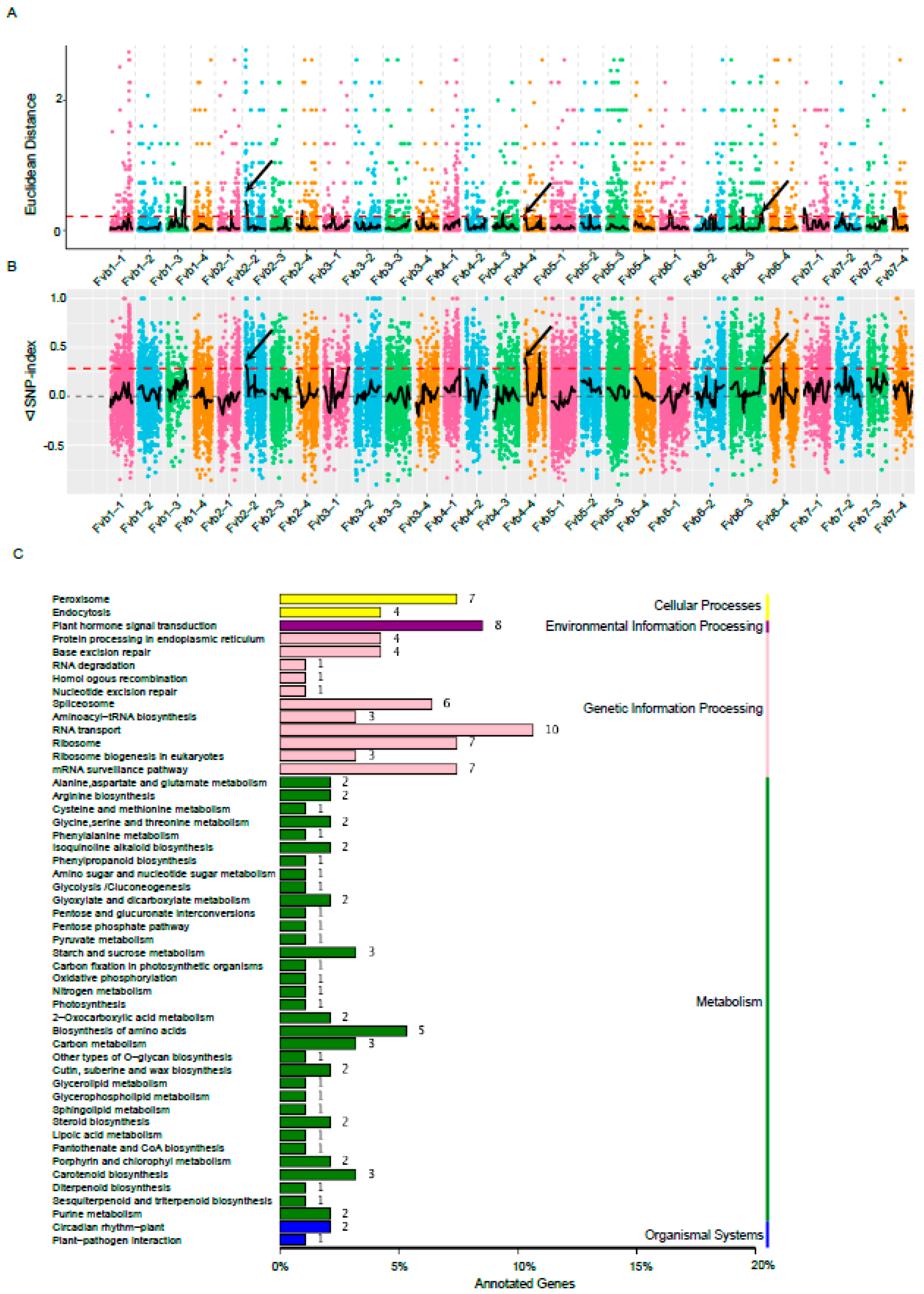
Genome regions associated with petal abscission rate (PAR) were identified using both the Euclidean Distance (ED) and ΔSNP-index methods. In the ED analysis, a significance threshold was defined as the median plus three standard deviations (median + 3SD) of the fitted values across all SNPs, which was calculated to be 0.21. Based on this threshold, 34 associated regions were detected, with a total length of 24.48 Mb (Figure 3; Table S3). These regions harbored 3388 genes, including 953 nonsynonymous SNPs. The threshold for the ΔSNP-index analysis was set at the 99th percentile of the fitted values (0.29). This approach identified 13 genomic regions spanning 7.96 Mb, which contained 1317 genes, 429 of which carried nonsynonymous SNPs (Figure 3; Table S4). Finally, five consensus loci were identified from both methods, and they were located at: 0–2.01 Mb on chromosome 2-2, 0.14–0.64 Mb on chromosome 4-4, 39.16–40.22 Mb on chromosome 6-3, 40.36–40.40 Mb on chromosome 6-3, and 40.66–40.68 Mb on chromosome 6-3 (Figure 3; Table 2). These five critical regions encompass 672 genes, which represent high-confidence candidates for regulating petal abscission rates in strawberry. Furthermore, we analyzed the KEGG pathway of these 672 genes (Figure 3C). The pathway “RNA transport” was the most enriched, followed by “Plant hormone signal transduction”, “Endocytosis”, “Ribosome” and “mRNA surveillance pathway”. The numbers of genes in these five pathways were 10, 8, 7, 7, and 7, respectively. The eight genes included in the “Plant hormone signal transduction” pathway (FDR < 0.05) were: ABF2 (ABA-responsive transcription factor), PYL2 (ABA receptor), CYCD3-3 (cyclin involved in cell cycle, regulated by cytokinin, auxin, sucrose), HAB1 (PP2C phosphatase, negative regulator of ABA signaling), GID2.1 and GID2.2 (F-box protein in gibberellin signaling), EIN4 (ethylene receptor), and ERF1B (ethylene-responsive transcription factor) (Table 2).

3.5. Combining Gene Expression to Identify Candidate Genes

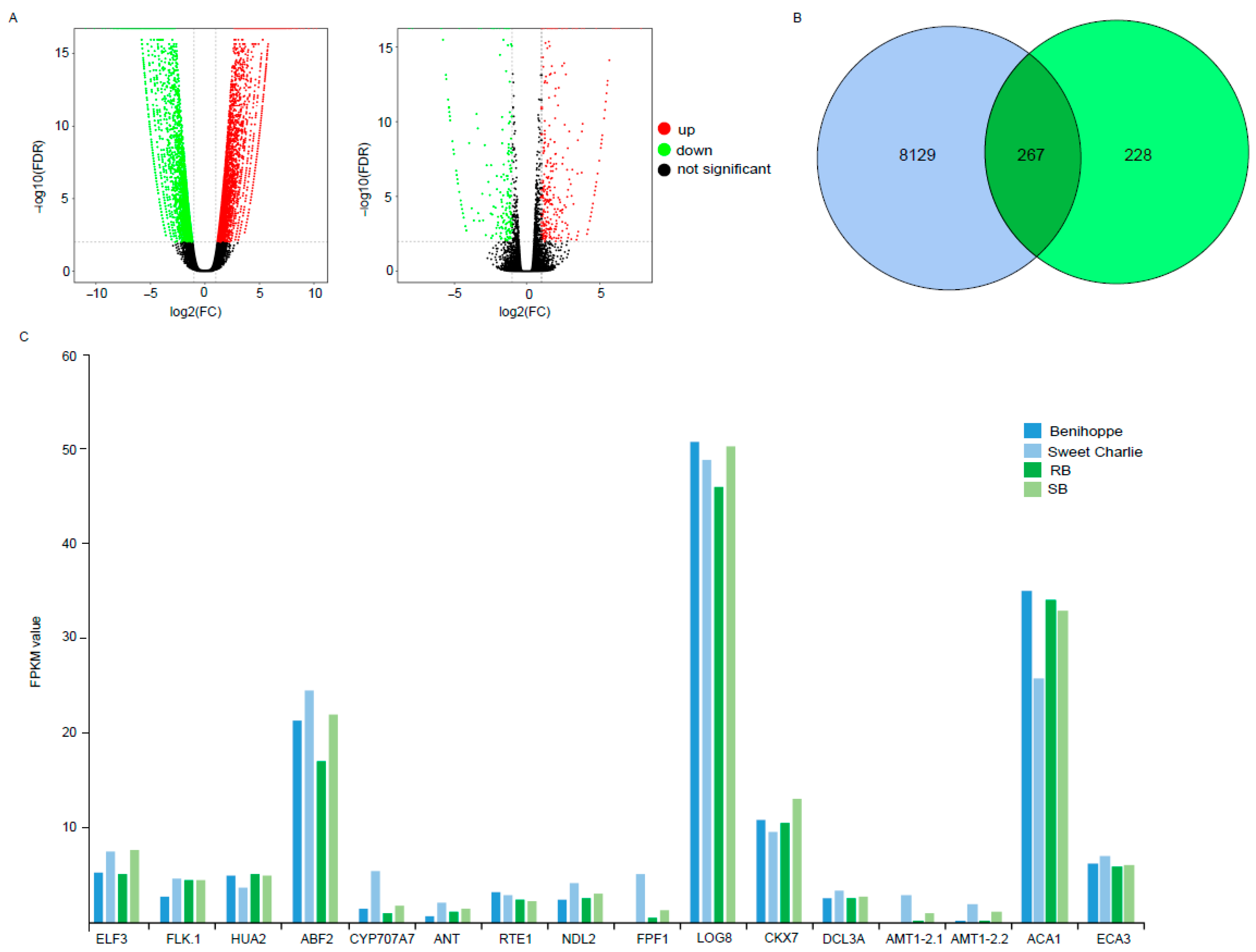
A total of 72,378 genes were quantified (Table S5). Using the criteria of Fold Change ≥ 2 and FDR < 0.01 for screening differentially expressed genes (DEGs), a total of 8396 DEGs were identified between the two parental lines, among which 4806 were up-regulated and 3590 were down-regulated (Figure 4). Meanwhile, 495 DEGs were detected between the two bulks, with 307 up-regulated and 188 down-regulated genes. There were 267 common DEGs between the two parents and the two bulks. Sixteen candidate genes involved in flowering and plant hormone signal transduction were identified as potential regulators of strawberry petal abscission rate based on a comprehensive analysis of expression patterns—showing consistent trends in both parental and bulk comparisons—coupled with functional annotations (Table S6). Among the identified candidate genes, those involved in flowering time regulation (e.g., ELF3, FLK.1, HUA2) displayed distinct expression trends: ELF3 and HUA2 were consistently upregulated in rapid-abscission materials, whereas FLK.1 showed up-regulation only in the rapid-abscission parent. Hormonal pathway analysis revealed that ethylene-responsive ANT was down-regulated in rapid-abscission genotypes, while RTE1 expression remained relatively stable. Auxin-related genes (NDL2, FPF1) and ABA-associated genes (ABF2, CYP707A7) were markedly suppressed in rapid-abscission materials, indicating coordinated down-regulation of auxin and ABA signaling during accelerated abscission. Cytokinin pathway genes exhibited more complex patterns: LOG8 expression differed between parents and bulks, whereas CKX7 was consistently higher in rapid-abscission genotypes. These expression profiles suggest that enhanced petal abscission is linked to suppressed auxin and ABA signaling, modulated ethylene responses, and intricate hormonal crosstalk. Other functionally diverse genes further supported these trends. Ammonium transporters (AMT1-2.1, AMT1-2.2) were down-regulated in rapid-abscission materials, with AMT1-2.1 transcripts not detected. In contrast, the calcium-transporting ATPase gene ACA1 was upregulated, implying a potential role of calcium homeostasis in promoting abscission. By comparison, DCL3A and the calcium transporter gene ECA3 showed only minor suppression and remained relatively stable across materials.

3.6. Development and Validation of KASP Markers

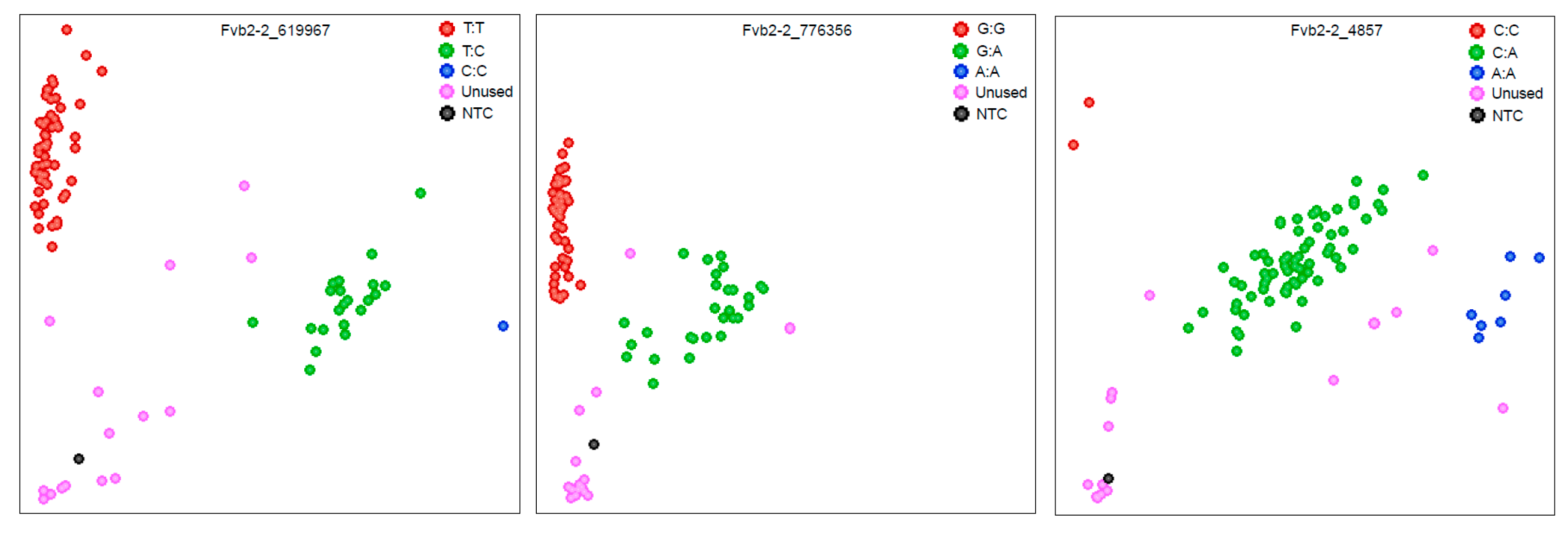
A total of 51 strawberry breeding lines were employed to validate KASP Marker. Among the 16 candidate genes, fourteen SNP loci were selected as a target site for KASP primer design (Table 2; Figure 5; Tables S7 and S8). Amplification was successful for 10 KASP primers. The correlation analysis between KASP markers and PAR at 4 and 7 DPA revealed significant associations with non-synonymous mutations, particularly those located on Fvb2-2. Fvb2-2_619967 (aGt/aAt) exhibited the strongest negative correlations with PAR at both time points (r = −0.703 at 4 DPA and r = −0.649 at 7 DPA). Similarly, Fvb2-2_776356 (cAg/cGg) and Fvb2-2_4857 (Tgt/Ggt) also showed significant negative correlations (r = −0.599 to −0.398). Among the significantly associated KASP markers, ACA1 (Fvb2-2_619967) explained the highest proportion of phenotypic variation in petal abscission rate (R2 = 0.517), demonstrating its strong potential utility for marker-assisted breeding in strawberry (Table 3).
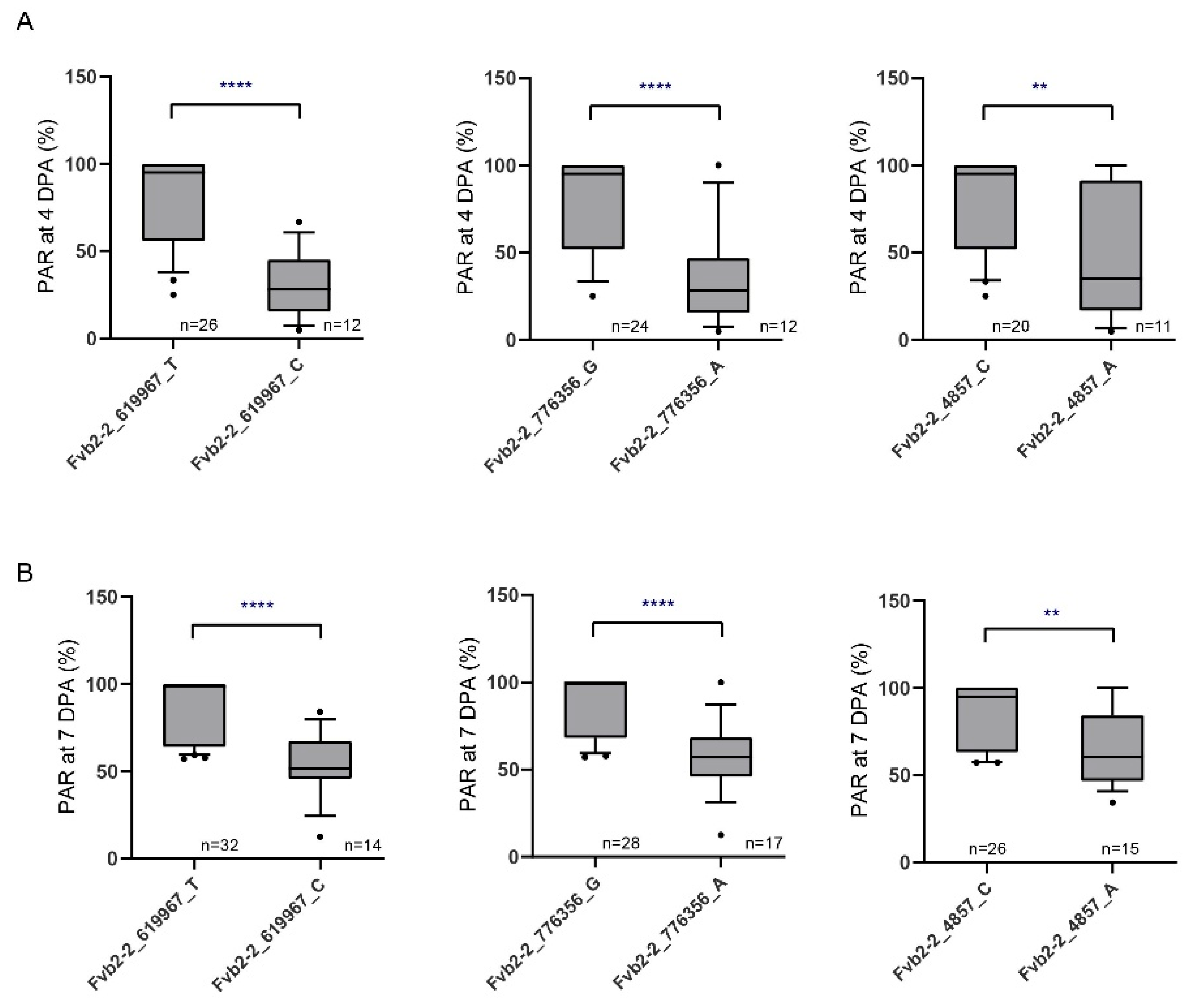
Genotypic analysis across all three KASP loci revealed a significant correlation with PAR, showing that strawberry accessions carrying favorable alleles (Fvb2-2_619967_T, Fvb2-2_776356_G, Fvb2-2_4857_C) had significantly higher PAR at both 4 and 7 DPA compared to those with the alternative alleles (Figure 6). Specifically, accessions with the Fvb2-2_619967_T allele exhibited average PAR values of 80.40% and 85.75% at 4 and 7 DPA, respectively, whereas those with the Fvb2-2_619967_C allele showed values of 30.00% and 53.57%. Similarly, accessions carrying the Fvb2-2_776356_G allele had average PAR values of 78.95% and 86.97%, compared to 35.00% and 57.28% for those with the Fvb2-2_776356_A allele. For the Fvb2-2_4857_C allele, the corresponding values were 78.51% and 83.64%, versus 40.78% and 65.51% for the alternative allele.

4. Discussion

4.1. Genetic Loci Controlling Plant Organ Abscission

Research into the mechanisms of plant organ abscission carries profound implications for understanding fundamental principles of plant developmental biology and holds direct relevance for improving crop yield and quality in agricultural production. While traditional breeding often faces challenges in modifying such complex traits, forward genetics has emerged as a powerful and indispensable approach in this field. Large-scale genetic screens in model systems such as Arabidopsis and various crops have successfully identified a series of core regulatory components essential for abscission [32,33,34,35,36,37,38]. These include IDA and its receptors HAE and HSL2 [21,22,39,40], transcription factors such as BLADE-ON-PETIOLE1/2 (BOP1/2) and TALE homeodomain proteins (e.g., ATH1, KNAT6, KNAT2) [41] as well as ZINC FINGER PROTEIN2 (AtZFP2), SARP1, and the jasmonic acid receptor COI1 [42,43,44]. Furthermore, genes such as MSD2 illustrate how environmental stimuli and reactive oxygen species (ROS) are integrated into the abscission process [45]. QTL mapping and transcriptome studies in crops like citrus, pearl millet, and lupine have further expanded the repertoire of abscission-associated genomic regions and genes, many involved in cell wall remodeling and hormone signaling pathways [46,47,48,49]. However, the genetic basis and molecular mechanisms underlying PAR which has been inferred to contribute to disease avoidance based on prior established correlations between rapid petal abscission and reduced gray mold incidence in strawberry, have remained largely unexplored. In this study, we applied a forward genetics approach combined with BSR-Seq to identify five high-confidence consensus loci distributed across chromosomes Fvb2-2, Fvb4-4, and Fvb6-3. This represents the first genetic mapping of PAR loci in strawberry and provides a robust foundation for mechanistic studies. Moreover, the development of KASP markers from these loci will facilitate efficient marker-assisted selection for optimal PAR in strawberry breeding programs, offering practical tools for improving fruit quality and yield through reduced disease susceptibility. However, it is important to acknowledge the limitations of BSR-Seq in the octoploid strawberry genome. Homeology among subgenomes may introduce mapping ambiguities that can affect SNP calling and allele frequency estimation. Although stringent filters and a high-confidence reference genome were used to enhance reliability, the identified QTL intervals should be regarded as high-confidence genomic regions containing candidate genes rather than precisely mapped causal variants.

4.2. Plant Organ Abscission Is Synchronized with Flowering

The identification of sixteen candidate genes, including three flowering time regulators (ELF3, FLK.1, HUA2), with distinct expression patterns in rapid-abscission materials provides compelling evidence that the genetic programs governing floral transition and organ detachment are deeply intertwined. The consistent up-regulation of ELF3 and HUA2 across both parental and bulk comparisons suggests these genes may act as core integrators linking photoperiod/circadian clock pathways to abscission initiation, while the genotype-specific expression of FLK.1 indicates genetic background modulates this coordination. This genetic interconnection is further supported by previous studies showing that key flowering time regulators simultaneously influence abscission timing. CONSTANS (CO), a major flowering time regulator, promotes flower senescence and abscission by enhancing JA signaling [50], while AUXIN RESPONSE FACTOR1/2 (ARF1/2) influences both flowering onset and floral organ abscission independently of ethylene [51]. The BnaBPs gene in Brassica napus provides another example of genetic integration, simultaneously regulating flowering time and abscission [52]. Transcription factors (e.g., ATH1) and peptide hormone maturation enzymes also modulate the timing and execution of abscission in concert with flowering [53]. The synchronization mechanism extends beyond individual genes to encompass conserved signaling modules, such as the IDA-HAE/HSL2 pathway that responds to flowering cues [20,21,54] and the BOP1/2-TALE boundary genes that coordinate abscission zone activity [41]. This intricate genetic coordination ensures that resource allocation is optimized throughout the reproductive phase, with abscission timed to occur only after successful pollination and seed development, thereby maximizing reproductive success.

4.3. Hormonal Crosstalk in Regulating Petal Abscission

Plant organ abscission is orchestrated by a complex interplay of hormone signaling pathways. Ethylene serves as a primary promoter of organ abscission, initiating cell separation in the AZ by activating cell wall-degrading enzymes such as polygalacturonases and cellulases, which dissolve the middle lamella and facilitate organ detachment [55,56]. Its action is often preceded by a decrease in auxin levels, which enhances AZ sensitivity to ethylene [57]. Key components of ethylene biosynthesis and signaling—including EIN2, EIN3, EILs, and ERFs—are essential for timely abscission, as evidenced by delayed abscission in ethylene-insensitive mutants [58,59]. Recent studies indicate that ethylene can activate the IDAHAEHSL2 peptide signaling pathway [21,60]. Complete inhibition of abscission typically requires disruption of both ethylene and IDA pathways [16]. In strawberry, the ethylene-responsive gene ANT was markedly upregulated in rapid-abscission genotypes, further supporting the conserved role of ethylene in promoting petal abscission.
Auxin, particularly indole-3-acetic acid (IAA), acts as a central inhibitor of abscission by maintaining a specific gradient and signaling activity within the AZ. Depletion or disruption of auxin transport is a key trigger for organ abscission [61]. Auxin influx (AUX/LAX) and efflux (PIN) carriers are critical for sustaining this gradient; their disruption alters auxin distribution, increases ethylene sensitivity, and accelerates abscission [62,63]. Transcription factors such as ARFs and regulatory modules including SlGATA6 and SlBEL11 fine-tune auxin signaling and transport, integrating developmental and environmental cues [64,65]. In strawberry, rapid-abscission materials showed downregulation of auxin pathway genes (NDL2, FPF1), reinforcing the antagonistic relationship between auxin and ethylene. A decrease in auxin flux or response sensitizes the AZ to ethylene, leading to activation of cell wall-modifying enzymes and organ separation [66,67].
ABA plays a complex and context-dependent role in abscission. In species such as yellow lupine, ABA promotes flower abscission by enhancing ethylene biosynthesis and signaling [68,69]. However, ABA alone is often insufficient to trigger abscission and may function indirectly by promoting senescence or stress responses that precede organ separation [70,71]. Under certain conditions, such as salt stress in citrus, ABA can even reduce abscission by mitigating stress-induced ethylene production [72]. In strawberry, our data show that key ABA pathway components, including the catabolic gene CYP707A7 and the transcription factor ABF2, were downregulated in rapid-abscission genotypes. This suggests that suppression of the ABA pathway may facilitate petal abscission. Genetic evidence further supports a role for CYP707A7: a specific SNP (Fvb2-2_4857) showed a significant negative correlation with abscission rates. Strawberry accessions carrying the C allele exhibited rapid abscission rates of 78.51% and 83.64%, compared to 40.78% and 65.51% in those with the alternative allele. Since CYP707A enzymes catalyze ABA catabolism [73,74], the observed downregulation likely leads to local ABA accumulation and abscission suppression. Totally, the enrichment of “Plant hormone signal transduction” among candidate genes and the correlation of KASP markers with PAR underscore the polygenic and hormonally integrated nature of this trait in strawberry.

4.4. Emerging Roles of Calcium Signaling in Petal Abscission

Calcium ions (Ca2+) serve as ubiquitous second messengers in plant development and stress responses. Our findings also implicate calcium signaling in strawberry PAR. Calcium ions (Ca2+) serve as ubiquitous second messengers in plant development and stress responses. We identified the calcium-transporting ATPase ACA1 as significantly upregulated in rapid-abscission materials and found that ECA3 localizes within our QTL intervals. Notably, SNPs in ACA1 (Fvb2-2_619967) and ECA3 (Fvb2-2_776356) exhibited strong negative correlations with PAR. Mechanistically, Ca2+ is essential for ethylene-induced abscission, where it acts downstream of the hormone to regulate cell wall-degrading enzymes and gene expression in the AZ [17]. The peptide signal IDA triggers cytosolic Ca2+ release, linking developmental cues to cell separation [75]. These signals are decoded by calcium-dependent protein kinases (CDPKs) and calmodulin-like proteins, which relay information to targets involved in cell wall remodeling [76,77]. Functional studies in other plants support the roles of ACA1 and ECA3 in calcium homeostasis and signaling [78,79,80]. Integrating our observation of ACA1 upregulation with established mechanisms, we propose a model whereby enhanced Ca2+ efflux to the apoplast or into intracellular stores, potentially mediated by ACA1 and ECA3, promotes the activation of cell wall-modifying enzymes and reinforces ethylene-mediated signals to drive cell separation in the strawberry petal AZ.

Supplementary Materials

The following supporting information can be downloaded at: https://www.mdpi.com/article/10.3390/horticulturae11121525/s1, Table S1: Petal abscission rates (PAR) at 7 days post-anthesis (DPA) of 103 strawberry germplasm resources; Table S2: PAR at 4 and 7 DPA of 103 individuals in BSF1 population; Table S3: QTLs identified by Euclidean distance method; Table S4: QTLs identified by ΔSNP-index method. Table S5: Gene expression levels quantified by FPKM; Table S6: FPKM and SNPs of candidate genes; Table S7: KASP marker development: target sequences and primers. Table S8: PAR at 4 and 7 DPA and genotypes of 51 strawberry accessions.

Author Contributions

Conceptualization, Y.H. and G.X.; methodology, G.X., D.Z. and X.Z.; software, G.X.; validation, G.X. and D.Z.; formal analysis, G.X.; investigation, G.X., X.Z. and D.Z.; resources, Y.H.; data curation, G.X.; writing—original draft preparation, G.X.; writing—review and editing, Y.H. and G.X.; visualization, G.X.; supervision, Y.H.; project administration, Y.H.; funding acquisition, Y.H. and G.X. All authors have read and agreed to the published version of the manuscript.

Funding

This research was supported by the national natural science foundation of China (32372498), Hubei provincial natural science foundation (2025AFA041), the Hubei Province Key R&D Program (2025BBB001), the Agricultural Science and Technology Innovation Center Program of Hubei Province (2025-620-000-001-008).

Data Availability Statement

The raw BSR-Seq data generated in this study have been deposited in the National Center for Biotechnology Information (NCBI) Sequence Read Archive (SRA) under the BioProject accession number PRJNA1357028. All other data supporting the findings of this study are available within the paper and its Supplementary Information files.

Conflicts of Interest

All authors declare that there is no conflict of interest that could be perceived as prejudicial to the impartiality of the reported research.

Abbreviations

The following abbreviations are used in this manuscript:
B. cinereaBotrytis cinerea
PARPetal abscission rate
KASPKompetitive allele-specific PCR
KEGGKyoto Encyclopedia of Genes and Genomes
CDPKsCalcium-dependent protein kinases
QTLsQuantitative trait loci
F PKMFragments Per Kilobase of transcript per Million mapped reads
FDRFalse discovery rate
DEGsDifferentially expressed genes
SBSlow-abscission bulk
RBRapid-abscission bulk
DPAPost-anthesis
IDAInflorescence deficient in abscission
HAEHAESA
HSL2HAESA-LIKE2
BOP1/2Blade-on-petiole1/2
ROSReactive oxygen species
ABAAbscisic acid
JAJasmonic acid
GAGibberellins
IAAIndole-3-acetic acid
BRsBrassinosteroids
AZsAbscission zones
EDEuclidean distance
RINRNA integrity numbers
SNPsSingle nucleotide polymorphisms

References

  1. Dean, R.; Van Kan, J.A.; Pretorius, Z.A.; Hammond-Kosack, K.E.; Di Pietro, A.; Spanu, P.D.; Rudd, J.J.; Dickman, M.; Kahmann, R.; Ellis, J.; et al. The Top 10 fungal pathogens in molecular plant pathology. Mol. Plant Pathol. 2012, 13, 414–430. [Google Scholar] [CrossRef] [PubMed]
  2. Chen, T.; Zhang, Z.; Chen, Y.; Li, B.; Tian, S. Botrytis cinerea . Curr. Biol. 2023, 33, R460–R462. [Google Scholar] [CrossRef] [PubMed]
  3. Fillinger, S.; Elad, Y. Botrytis–the Fungus, the Pathogen and Its Management in Agricultural Systems; Springer: Cham, Switzerland, 2016. [Google Scholar]
  4. Feliziani, E.; Romanazzi, G. Postharvest decay of strawberry fruit: Etiology, epidemiology, and disease management. J. Berry Res. 2016, 6, 47–63. [Google Scholar] [CrossRef]
  5. Elad, Y.; Pertot, I.; Cotes Prado, A.M.; Stewart, A. Plant Hosts of Botrytis spp. In Botrytis–the Fungus, the Pathogen and Its Management in Agricultural Systems; Fillinger, S., Elad, Y., Eds.; Springer: Cham, Switzerland, 2016; pp. 413–486. [Google Scholar]
  6. Choquer, M.; Fournier, E.; Kunz, C.; Levis, C.; Pradier, J.M.; Simon, A.; Viaud, M. Botrytis cinerea virulence factors: New insights into a necrotrophic and polyphageous pathogen. FEMS Microbiol. Lett. 2007, 277, 1–10. [Google Scholar] [CrossRef]
  7. Bi, K.; Liang, Y.; Mengiste, T.; Sharon, A. Killing softly: A roadmap of Botrytis cinerea pathogenicity. Trends Plant Sci. 2023, 28, 211–222. [Google Scholar] [CrossRef]
  8. Herzog, K.; Schwander, F.; Kassemeyer, H.H.; Bieler, E.; Dürrenberger, M.; Trapp, O.; Töpfer, R. Towards sensor-based phenotyping of physical barriers of grapes to improve resilience to Botrytis bunch rot. Front. Plant Sci. 2022, 12, 808365. [Google Scholar] [CrossRef]
  9. Bristow, P.R.; McNicol, R.J.; Williamson, B. Infection of strawberry flowers by Botrytis cinerea and its relevance to grey mould development. Ann. Appl. Biol. 1986, 109, 545–554. [Google Scholar] [CrossRef]
  10. Jarvis, W.R. The infection of strawberry and raspberry fruits by Botrytis cinerea Fr. Ann. Appl. Biol. 1962, 50, 569–575. [Google Scholar] [CrossRef]
  11. Mertely, J.C.; Chandler, C.K.; Xiao, C.L.; Legard, D.E. Resistance of strawberry cultivars to botrytis fruit rot. Proc. Fla. State Hort. Soc. 2002, 115, 158–161. [Google Scholar]
  12. Han, Y.; Wang, X.; Wang, K.; Wang, X.; Li, F. Correlation between petal abscission rate and grey mould incidence in strawberry. J. Phytopathol. 2015, 163, 670–673. [Google Scholar]
  13. Galindo-Trigo, S.; Gray, J.E.; Smith, A.G. A multifaceted kinase axis regulates plant organ abscission through conserved signaling mechanisms. Curr. Biol. 2024, 34, 3020–3030.E7. [Google Scholar] [CrossRef] [PubMed]
  14. Kim, J.; Dotson, B.; Rey, C.; Lindsey, J.; Bleecker, A.B.; Patterson, S.E.; Binder, B.M. Transcriptional regulation of abscission zones. Plants 2019, 8, 154. [Google Scholar] [CrossRef] [PubMed]
  15. Lu, L.; Li, S.; Liu, H.; Wang, J.; Wang, Y.; Liu, J.; Li, X.; Li, S.; Ma, L. Involvement of IDA-HAE Module in natural development of tomato flower abscission. Plants 2023, 12, 185. [Google Scholar] [CrossRef] [PubMed]
  16. Meir, S.; Philosoph-Hadas, S.; Riov, J.; Kochanek, B.; Salim, S.; Shtein, I. Re-evaluation of the ethylene-dependent and -independent pathways in the regulation of floral and organ abscission. J. Exp. Bot. 2019, 70, 1461–1470. [Google Scholar] [CrossRef]
  17. Meng, X.; Zhou, J.; Tang, J.; Li, B.; de Oliveira, M.V.V.; Chai, J.; He, P.; Shan, L. Ligand-induced receptor-like kinase complex regulates floral organ abscission in Arabidopsis. Cell Rep. 2016, 14, 1330–1338. [Google Scholar] [CrossRef]
  18. Nakano, T.; Ito, Y. Molecular mechanisms controlling plant organ abscission. Plant Biotechnol. 2013, 30, 209–216. [Google Scholar] [CrossRef]
  19. Patharkar, O.R.; Walker, J.C. Advances in understanding the mechanism of plant organ abscission. Plant Physiol. 2018, 176, 1355–1364. [Google Scholar]
  20. Santiago, J.; Brandt, B.; Wildhagen, M.; Hohmann, U.; Hothorn, L.A.; Butenko, M.A.; Hothorn, M. Mechanistic insight into a peptide hormone signaling complex mediating floral organ abscission. ELife 2016, 5, e15075. [Google Scholar] [CrossRef]
  21. Shi, C.; Stenvik, G.E.; Vie, A.K.; Bones, A.M.; Pautot, V.; Butenko, M.A. Control of Organ Abscission and Other Cell Separation Processes by Evolutionary Conserved Peptide Signaling. Plants 2019, 8, 225. [Google Scholar] [CrossRef]
  22. Taylor, I.W.; Li, R.; Breda, A.S.; Li, M.; Mittermeier, V.M.; Drapek, C.; Zhang, J.; Liu, K.Y.; Yu, L.Y.; Liu, X.; et al. Arabidopsis uses a molecular grounding mechanism and a biophysical circuit breaker to limit floral abscission signaling. Proc. Natl. Acad. Sci. USA 2024, 121, e2401583121. [Google Scholar] [CrossRef]
  23. Tranbarger, T.J.; Tadeo, F.R.; Drakakaki, G.; Caceres, M.E.I.; Pinedo, I.T.; Lers, A.L.; Latche, A.; Pech, J.C. The PIP Peptide of INFLORESCENCE DEFICIENT IN ABSCISSION enhances populus leaf and Elaeis guineensis fruit abscission. Plants 2019, 8, 143. [Google Scholar] [CrossRef]
  24. Liu, X.; Zhang, Y.; Yang, X.; Wang, Y.; Li, S.; Wang, Y.; Li, H.; Zhao, J.; Ma, L. The HD-Zip transcription factor SlHB15A regulates abscission by modulating jasmonoyl-isoleucine biosynthesis. Plant Physiol. 2022, 189, 906–920. [Google Scholar] [CrossRef]
  25. Reichardt, S.; Piepho, H.P.; Stintzi, A.; Schaller, A. Peptide signaling for drought-induced tomato flower drop. Science 2020, 367, 1482–1485. [Google Scholar] [CrossRef] [PubMed]
  26. Sawicki, M.; Aït Barka, E.; Clément, C.; Vaillant-Gaveau, N.; Jacquard, C. Cross-talk between environmental stresses and plant metabolism during reproductive organ abscission. J. Exp. Bot. 2015, 66, 1707–1719. [Google Scholar] [CrossRef] [PubMed]
  27. Shi, Y.Z.; Zhang, X.M.; Li, W.C.; Zhang, J.B.; Li, K.T.; Liu, X.J. Molecular regulatory events of flower and fruit abscission in horticultural plants. Hortic. Plant J. 2023, 9, 881–898. [Google Scholar] [CrossRef]
  28. Estornell, L.H.; Agustí, J.; Merelo, P.; Talón, M.; Tadeo, F.R. Elucidating mechanisms underlying organ abscission. Plant Sci. 2013, 199–200, 48–60. [Google Scholar] [CrossRef]
  29. Galindo-Trigo, S.; Perez Amador, M.A.; Smith, A.G. Dissection of the IDA promoter identifies WRKY transcription factors as abscission regulators in Arabidopsis. J. Exp. Bot. 2024, 75, 2934–2949. [Google Scholar] [CrossRef]
  30. Patharkar, O.R.; Walker, J.C. Advances in abscission signaling. J. Exp. Bot. 2018, 69, 733–740. [Google Scholar] [CrossRef]
  31. Edger, P.P.; Poorten, T.J.; VanBuren, R.; Hardigan, M.A.; Colle, M.; McKain, M.R.; Smith, R.D.; Teresi, S.J.; Nelson, A.D.L.; Wai, C.M.; et al. Origin and evolution of the octoploid strawberry genome. Nat. Genet. 2019, 51, 541–547. [Google Scholar] [CrossRef]
  32. McKenna, A.; Hanna, M.; Banks, E.; Sivachenko, A.; Cibulskis, K.; Kernytsky, A.; Garimella, K.; Altshuler, D.; Gabriel, S.; Daly, M.J.; et al. The Genome Analysis Toolkit: A MapReduce framework for analyzing next-generation DNA sequencing data. Genome Res. 2010, 20, 1297–1303. [Google Scholar] [CrossRef]
  33. Hill, J.T.; Demarest, B.L.; Bisgrove, B.W.; Gorsi, B.; Su, Y.C.; Yost, H.J. MMAPPR: Mutation mapping analysis pipeline for pooled RNA-seq. Genome Res. 2013, 23, 687–697. [Google Scholar] [CrossRef]
  34. Abe, A.; Kosugi, S.; Yoshida, K.; Natsume, S.; Takagi, H.; Kanzaki, H.; Matsumura, H.; Yoshida, K.; Mitsuoka, C.; Tamiru, M.; et al. Genome sequencing reveals agronomically important loci in rice using MutMap. Nat. Biotechnol. 2012, 30, 174–178. [Google Scholar] [CrossRef] [PubMed]
  35. Takagi, H.; Abe, A.; Yoshida, K.; Kosugi, S.; Natsume, S.; Mitsuoka, C.; Uemura, A.; Utsushi, H.; Tamiru, M.; Takuno, S.; et al. QTL-seq: Rapid mapping of quantitative trait loci in rice by whole genome resequencing of DNA from two bulked populations. Plant J. 2013, 74, 174–183. [Google Scholar] [CrossRef] [PubMed]
  36. Trapnell, C.; Williams, B.A.; Pertea, G.; Mortazavi, A.; Kwan, G.; van Baren, M.J.; Salzberg, S.L.; Wold, B.J.; Pachter, L. Transcript assembly and quantification by RNA-Seq reveals unannotated transcripts and isoform switching during cell differentiation. Nat. Biotechnol. 2010, 28, 511–515. [Google Scholar] [CrossRef] [PubMed]
  37. Love, M.I.; Huber, W.; Anders, S. Moderated estimation of fold change and dispersion for RNA-seq data with DESeq2. Genome Biol. 2014, 15, 550. [Google Scholar] [CrossRef]
  38. Yangyang, D.; Jianqi, L.; Songfeng, W.; Yunping, Z.; Fuchu, H. Integrated nr database in protein annotation system and its localization. J. Comput. Sci. Technol. 2006, 32, 71–74. [Google Scholar]
  39. Butenko, M.A.; Patterson, S.E.; Grini, P.E.; Stenvik, G.E.; Amundsen, S.S.; Mandal, A.; Aalen, R.B. INFLORESCENCE DEFICIENT IN ABSCISSION controls floral organ abscission in Arabidopsis and identifies a novel family of putative ligands in plants. Plant Cell 2003, 15, 2296–2307. [Google Scholar] [CrossRef]
  40. Cho, S.K.; Larue, C.T.; Chevalier, D.; Wang, H.; Jinn, T.L.; Zhang, S.; Walker, J.C. Regulation of floral organ abscission in Arabidopsis thaliana. Proc. Natl. Acad. Sci. USA 2008, 105, 15629–15634. [Google Scholar] [CrossRef]
  41. Crick, J.; Tameshige, T.; Breda, A.S.; Prát, T.; Ragni, L. Floral organ abscission role of BOP1/2-TALE boundary genes. J. Exp. Bot. 2022, 73, 5182–5196. [Google Scholar]
  42. Cai, S.; Lashbrook, C.C. Stamen abscission zone transcriptome profiling reveals new candidates for abscission control: Enhanced retention of floral organs in transgenic plants overexpressing Arabidopsis ZINC FINGER PROTEIN2. Plant Physiol. 2008, 146, 1305–1321. [Google Scholar] [CrossRef]
  43. Kim, J.; Dotson, B.; Rey, C.; Lindsey, J.; Bleecker, A.B.; Patterson, S.E.; Binder, B.M. New clothes for the jasmonic acid receptor COI1: Delayed abscission, meristem arrest and apical dominance. PLoS ONE 2013, 8, e66507. [Google Scholar] [CrossRef]
  44. Yun, J.; Wang, Y.; Wang, Y.; Zhang, Y.; Chen, R.; Wang, X.; Li, H.; Liu, X.; Ma, L.; Li, S. The single RRM domain-containing protein SARP1 is required for establishment of the separation zone in Arabidopsis. New Phytol. 2024, 242, 1969–1984. [Google Scholar] [CrossRef]
  45. Lee, J.; Park, J.H.; Lee, H.J.; Kim, S.G. MSD2-mediated ROS metabolism fine-tunes the timing of floral organ abscission in Arabidopsis. New Phytol. 2022, 233, 2209–2225. [Google Scholar] [CrossRef] [PubMed]
  46. Xu, Y.; Li, W.; Li, K.; Liu, X.; Zhang, J.; Wang, Y.; Li, T. High-density genetic map construction and identification of QTLs controlling leaf abscission trait in Poncirus trifoliata. Int. J. Mol. Sci. 2021, 22, 5723. [Google Scholar] [CrossRef] [PubMed]
  47. Poncet, V.; Lamy, F.; Devos, K.M.; Gale, M.D.; Sarr, A.; Robert, T. Genetic control of domestication traits in pearl millet (Pennisetum glaucum L., Poaceae). Theor. Appl. Genet. 2000, 100, 147–159. [Google Scholar] [CrossRef]
  48. Glazińska, P.; Wojciechowski, W.; Wilmowicz, E.; Zienkiewicz, A.; Frankowski, K.; Kopcewicz, J. De novo transcriptome profiling of flowers, flower pedicels and pods of Lupinus luteus (yellow lupine) reveals complex expression changes during organ abscission. Front. Plant Sci. 2017, 8, 2158. [Google Scholar] [CrossRef]
  49. Merelo, P.; Agustí, J.; Arbona, V.; Costa, M.L.; Estornell, L.H.; Gómez-Cadenas, A.; Coimbra, S.; Gómez, M.D.; Pérez-Amador, M.A.; Domingo, C.; et al. Cell wall remodeling in abscission zone cells during ethylene-promoted fruit abscission in Citrus. Front. Plant Sci. 2017, 8, 126. [Google Scholar]
  50. Serrano-Bueno, G.; De Los Reyes, P.; Chini, A.; Ferreras-Garrucho, G.; De Medina-Hernández, V.; Boter, M.; Solano, R.; Valverde, F. Regulation of floral senescence in Arabidopsis by coordinated action of CONSTANS and jasmonate signaling. Mol. Plant 2022, 15, 1467–1483. [Google Scholar] [CrossRef]
  51. Ellis, C.; Nagpal, P.; Young, J.; Hagen, G.; Guilfoyle, T.; Reed, J. AUXIN RESPONSE FACTOR1 and AUXIN RESPONSE FACTOR2 regulate senescence and floral organ abscission in Arabidopsis thaliana. Development 2005, 132, 4563–4574. [Google Scholar] [CrossRef]
  52. Yu, J.; Xue, Y.; Sarwar, R.; Wei, S.; Geng, R.; Zhang, Y.; Mu, J.; Tan, X. The BnaBPs gene regulates flowering time and leaf angle in Brassica napus. Plant Direct. 2024, 8, e70018. [Google Scholar] [CrossRef]
  53. Schardon, K.; Hohl, M.; Graff, L.; Pfannstiel, J.; Schulze, W.; Stintzi, A.; Schaller, A. Precursor processing for plant peptide hormone maturation by subtilisin-like serine proteinases. Science 2016, 354, 1594–1597. [Google Scholar] [CrossRef] [PubMed]
  54. Ventimilla, D.; Velázquez, K.; Ruiz-Ruiz, S.; Terol, J.; Perez-Amador, M.; Vives, M.; Guerri, J.; Talón, M.; Tadeo, F. IDA (INFLORESCENCE DEFICIENT IN ABSCISSION)-like peptides and HAE (HAESA)-like receptors regulate corolla abscission in Nicotiana benthamiana flowers. BMC Plant Biol. 2021, 21, 310. [Google Scholar] [CrossRef] [PubMed]
  55. Chersicola, M.; Kladnik, A.; Hrženjak, A.; Kocjan, D.; Fellner, M. 1-Aminocyclopropane-1-carboxylate oxidase induction in tomato flower pedicel phloem and abscission related processes are differentially sensitive to ethylene. Front. Plant Sci. 2017, 8, 1125. [Google Scholar] [CrossRef] [PubMed]
  56. Brown, K.M. Ethylene and Abscission. Physiol. Plant. 1997, 100, 567–576. [Google Scholar] [CrossRef]
  57. Gao, Y.; Liu, Y.; Liang, Y.; Lu, J.; Jiang, C.; Fei, Z.; Jiang, C.-Z.; Ma, C.; Gao, J. Rosa hybrida RhERF1 and RhERF4 mediate ethylene- and auxin-regulated petal abscission by influencing pectin degradation. Plant J. 2019, 99, 1159–1173. [Google Scholar] [CrossRef]
  58. Chakrabarti, M.; Mukherjee, A.; Datta, S.; Datta, S. Role of EIN2-mediated ethylene signaling in regulating petal senescence, abscission, reproductive development, and hormonal crosstalk in tobacco. Plant Sci. 2023, 336, 111847. [Google Scholar] [CrossRef]
  59. Ma, X.; He, Z.; Yuan, Y.; Liang, Z.; Zhang, H.; Lalun, V.O.; Liu, Z.; Zhang, Y.; Huang, Z.; Huang, Y.; et al. The transcriptional control of LcIDL1-LcHSL2 complex by LcARF5 integrates auxin and ethylene signaling for litchi fruitlet abscission. J. Integr. Plant Biol. 2024, 66, 1019–1036. [Google Scholar] [CrossRef]
  60. Butenko, M.A.; Stenvik, G.E.; Alm, V.; Saether, B.; Patterson, S.E.; Aalen, R.B. Ethylene-dependent and -independent pathways controlling floral abscission are revealed to converge using promoter::reporter gene constructs in the IDA abscission mutant. J. Exp. Bot. 2006, 57, 4187–4200. [Google Scholar] [CrossRef]
  61. Basu, M.M.; González-Carranza, Z.H.; Azam-Ali, S.; Tang, S.; Shahid, A.A.; Roberts, J.A. The manipulation of auxin in the abscission zone cells of Arabidopsis flowers reveals that indoleacetic acid signaling is a prerequisite for organ shedding. Plant Physiol. 2013, 162, 96–106. [Google Scholar] [CrossRef]
  62. Fan, L.; Liu, J.; Liu, D.; Zhao, Y.; Ma, H.; Li, Y.; Qin, L.; Wu, Y.; Liu, Y.; Zhang, M. Deciphering the auxin-ethylene crosstalk in petal abscission through auxin influx carrier IpAUX1 of Itoh peony ‘Bartzella’. Postharvest Biol. Technol. 2024, 216, 112980. [Google Scholar] [CrossRef]
  63. Sun, Y.; Li, W.; Ma, Z.; Cui, M.; Li, J.; Wang, Y.; Liu, X.; Ma, L.; Li, S. Auxin efflux carrier PsPIN4 identified through genome-wide analysis as vital factor of petal abscission. Front. Plant Sci. 2024, 15, 1427826. [Google Scholar] [CrossRef] [PubMed]
  64. Liu, X.; Ma, L.; Li, S.; Wang, Y.; Li, H.; Zhao, J.; Zhang, Y. A KNOTTED1-LIKE HOMEOBOX PROTEIN1–interacting transcription factor SlGATA6 maintains the auxin-response gradient to inhibit abscission. Sci. Adv. 2025, 11, eadt1891. [Google Scholar] [CrossRef] [PubMed]
  65. Dong, X.; Liu, X.; Wang, Y.; Li, S.; Ma, L.; Li, H.; Zhang, Y. SlBEL11 regulates flavonoid biosynthesis, thus fine-tuning auxin efflux to prevent premature fruit drop in tomato. J. Integr. Plant Biol. 2024, 66, 1571–1587. [Google Scholar] [CrossRef] [PubMed]
  66. Liang, Y.; Jiang, C.; Liu, Y.; Gao, Y.; Lu, J.; Aiwaili, P.; Fei, Z.; Jiang, C.-Z.; Ma, C.; Gao, J. Auxin regulates sucrose transport to repress petal abscission in Rose (Rosa hybrida). Plant Cell 2020, 32, 3485–3499. [Google Scholar] [CrossRef]
  67. Ma, X.; Yuan, Y.; Li, C.; Wu, Q.; He, Z.; Li, J.; Zhao, M. Brassinosteroids suppress ethylene-induced fruitlet abscission through LcBZR1/2-mediated transcriptional repression of LcACS1/4 and LcACO2/3 in litchi. Hortic. Res. 2021, 8, 105. [Google Scholar] [CrossRef]
  68. Wilmowicz, E.; Frankowski, K.; Kucko, A.; Kesy, J.; Kopcewicz, J. The influence of abscisic acid on the ethylene biosynthesis pathway in the functioning of the flower abscission zone in Lupinus luteus. J. Plant Physiol. 2016, 204, 54–62. [Google Scholar] [CrossRef]
  69. Kućko, A.; Wilmowicz, E.; Alché, J.D.D.; de Dios, A.; Kesy, J.; Kopcewicz, J. Abscisic acid- and ethylene-induced abscission of yellow lupine flowers is mediated by jasmonates. J. Plant Physiol. 2023, 290, 154119. [Google Scholar] [CrossRef]
  70. Finkelstein, R.; Rock, C. Abscisic Acid Biosynthesis and Response. Arab. Book 2002, 1, e0058. [Google Scholar] [CrossRef]
  71. Gulfishan, M.; Jahan, A.; Bhat, T.A.; Sahab, D. Plant Senescence and Organ Abscission. In Senescence Signalling and Control in Plants; Academic Press: Cambridge, MA, USA, 2019; pp. 269–284. [Google Scholar]
  72. Gómez-Cádenas, A.; Mehouachi, J.; Tadeo, F.R.; Primo-Millo, E.; Talon, M. Hormonal regulation of fruitlet abscission induced by carbohydrate shortage in Citrus. Planta 2000, 210, 636–643. [Google Scholar] [CrossRef]
  73. Kushiro, T.; Okamoto, M.; Nakabayashi, K.; Yamagishi, K.; Kitamura, S.; Asami, T.; Hirai, N.; Koshiba, T.; Kamiya, Y.; Nambara, E. The Arabidopsis cytochrome P450 CYP707A encodes ABA 8′-hydroxylases: Key enzymes in ABA catabolism. EMBO J. 2004, 23, 1647–1656. [Google Scholar] [CrossRef]
  74. Okamoto, M.; Kuwahara, A.; Seo, M.; Kushiro, T.; Asami, T.; Hirai, N.; Kamiya, Y.; Koshiba, T.; Nambara, E. CYP707A1 and CYP707A2, which encode abscisic acid 8′-hydroxylases, are indispensable for proper control of seed dormancy and germination in Arabidopsis. Plant Physiol. 2006, 141, 97–107. [Google Scholar] [CrossRef]
  75. Lalun, V.O.; Breiden, M.; Stenvik, G.-E.; Butenko, M.A.; Aalen, R.B. A dual function of the ida peptide in regulating cell separation and modulating plant immunity at the molecular level. Elife 2019, 8, e44589. [Google Scholar]
  76. Aldon, D.; Mbengue, M.; Mazars, C.; Galaud, J.-P. Calcium signalling in plant biotic interactions. Int. J. Mol. Sci. 2018, 19, 665. [Google Scholar] [CrossRef]
  77. Zou, J.-J.; Wei, F.-J.; Wang, C.; Wu, J.-J.; Ratnasekera, D.; Liu, W.-X.; Wu, W.-H. Arabidopsis calcium-dependent protein kinase CPK10 functions in Abscisic Acid- and Ca2+-mediated stomatal regulation in response to drought stress. Plant Physiol. 2010, 154, 1232–1243. [Google Scholar] [CrossRef]
  78. Ishka, M.R.; Brown, E.; Rosenberg, A.; Romanowsky, S.M.; Davis, J.A.; Choi, W.G.; Harper, J.F. Arabidopsis Ca2+-ATPases 1, 2, and 7 in the endoplasmic reticulum contribute to growth and pollen fitness. Plant Physiol. 2021, 186, 1856–1872. [Google Scholar]
  79. Mills, R.F.; Doherty, M.L.; López-Marqués, R.L.; Weimar, T.; Dupree, P.; Palmgren, M.G.; Pittman, J.K.; Williams, L.E. ECA3, a Golgi-localized P2A-type ATPase, plays a crucial role in manganese nutrition in Arabidopsis. Plant Physiol. 2008, 146, 116–128. [Google Scholar] [CrossRef]
  80. Li, X.; Chanroj, S.; Wu, Z.; Romanowsky, S.M.; Harper, J.F.; Sze, H. A distinct endosomal Ca2+/Mn2+ pump affects root growth through the secretory process. Plant Physiol. 2008, 147, 1675–1689. [Google Scholar] [CrossRef]
Figure 1. Petal abscission rates (PAR) at 7 days post-anthesis (DPA) of 103 strawberry germplasm resources.
Horticulturae 11 01525 g001
Figure 2. Distribution and correlation of PAR in the BSF1 population at 4 and 7 DPA. (A) Frequency distribution of PAR values; (B) Correlation analysis between PAR at 4 DPA and 7 DPA.
Horticulturae 11 01525 g002
Figure 3. Genome regions associated with petal abscission rate (PAR) identified by both the Euclidean Distance (ED) (A) and ΔSNP−index (B) methods in the BSF1 Population. The black arrows indicated the five consensus loci mapped by both methods. (C) The enriched KEGG pathways of genes in five consensus loci.
Horticulturae 11 01525 g003
Figure 4. Gene expression analysis. (A) The volcano plot of differentially expressed genes between the two parents (left) and the two bulks (right); (B) A Venn diagram illustrating the overlap of DEGs, with the blue and green circles corresponding to the two-parent and two-bulk comparisons, respectively; (C) Expression levels of the 16 candidate genes.
Horticulturae 11 01525 g004
Figure 5. Genotyping results of three KASP markers (Fvb2-2_619967, Fvb2-2_776356 and Fvb2-2_4857) highly significantly associated with PAR in 51 strawberry breeding lines.
Horticulturae 11 01525 g005
Figure 6. PAR at 4 DPA (A) and 7 DPA (B) of strawberry accessions containing different alleles. Significant differences were analyzed with a two-tailed t-test. ****: p < 0.0001; **: p < 0.01.
Horticulturae 11 01525 g006
Table 1. Data of BSR-Seq.
SampleTotal ReadsClean ReadsClean Bases (Gb)Q30 (%)GC (%)Mapped ReadsUniq Mapped ReadsSNPs Number
Benihoppe46,435,35223,217,6766.9194.5146.5838,693,94929,996,254489,835
Sweet Charlie51,735,39025,867,6957.7094.0946.7943,689,70934,029,307497,255
RB86,388,97043,194,48512.8994.6846.6472,298,80056,113,460560,969
SB94,267,39647,133,69814.0394.6046.8079,015,59260,926,844570,278
Table 2. Five consensus QTLs identified by both Euclidean Distance and ΔSNP-index methods for PAR.
ChromosomeStartEndSize (Mb)Gene NumberHormone-Related Genes
Fvb2-202,010,0002.01386ABF2, PYL2, CYCD3-3, HAB1, GID2.1, GID2.2
Fvb4-4140,000640,0000.583
Fvb6-339,160,00040,220,0001.06191EIN4, ERF1B
Fvb6-340,360,00040,400,0000.046
Fvb6-340,660,00040,680,0000.026
Total---672
Table 3. Correlation relationship between KASP marker and PAR.
LocationGenePathwayCodon ChangeEffect of MutationCorrelation with PAR at 4 DPAR2 for PAR at 4 DPA Correlation with PAR at 7 DPAR2 for PAR at 7 DPA
Fvb2-2_4857CYP707A7ABATgt/GgtNon Synonymous−0.484 *0.271−0.398 *0.154
Fvb2-2_67062ABF2ABAAaa/GaaNon Synonymous0.221 0.225
Fvb2-2_619967ACA1Calcium SignalingaGt/aAtNon Synonymous−0.703 **0.517−0.649 **0.429
Fvb2-2_776356ECA3Calcium SignalingcAg/cGgNon Synonymous−0.599 **0.386−0.609 **0.392
Fvb2-2_892961ANTEthyleneGtt/CttNon Synonymous- -
Fvb2-2_1068552ELF3FloweringcCt/cTtNon Synonymous- -
Fvb2-2_1208392NDL2AuxinCgt/TgtNon Synonymous−0.169 −0.047
Fvb2-2_1263512RTE1EthyleneAaa/GaaNon Synonymous0.264 0.327
Fvb2-2_1428328LOG8CytokinintaT/taCSynonymous0.09 0.128
Fvb2-2_1725514CKX7CytokininTcc/AccNon Synonymous−0.05 0.002
Fvb2-2_1835395FPF1AuxinGaa/AaaNon Synonymous- -
Fvb4-4_400296HUA2FloweringcAc/cGcNon Synonymous−0.123 −0.22
Fvb6-3_39197804AGL62FloweringgAt/gigotNon Synonymous- -
Fvb6-3_39578228AMT1-2.2Ammonium transportergAc/gCcNon Synonymous−0.168 −0.181
Note: ** p < 0.01; * p < 0.05.
Disclaimer/Publisher’s Note: The statements, opinions and data contained in all publications are solely those of the individual author(s) and contributor(s) and not of MDPI and/or the editor(s). MDPI and/or the editor(s) disclaim responsibility for any injury to people or property resulting from any ideas, methods, instructions or products referred to in the content.