Article

Vine Water Status Modulates the Physiological Response to Different Apical Leaf Removal Treatments in Sangiovese (Vitis vinifera L.) Grapevines


by
Vincenzo Tosi
1,*,†,
Giacomo Palai
1,†,
Carmine Mattia Verosimile
1,
Antonio Pompeiano
2 and
Claudio D’Onofrio
1
1
Department of Agriculture Food and Environment, University of Pisa, Via del Borghetto 80, 56124 Pisa, Italy
2
Department of Forest Botany, Dendrology and Geobiocoenology, Faculty of Forestry and Wood Technology, Mendel University in Brno, Zemědělská 1/1665, 613 00 Brno, Czech Republic
*
Author to whom correspondence should be addressed.
These authors contributed equally to this work.
Horticulturae 2025, 11(12), 1524; https://doi.org/10.3390/horticulturae11121524
Submission received: 31 October 2025 / Revised: 10 December 2025 / Accepted: 13 December 2025 / Published: 16 December 2025
(This article belongs to the Section Viticulture)

Abstract

Modulating the vine source–sink relationship is a proposed strategy to mitigate the detrimental effect of climate change frequently induced by elevated temperatures and water deficit conditions. In this regard, apical leaf removal could represent a reliable technique, even though its effects on grapevines subjected to different irrigation regimes are unexplored. This study aimed to clarify the effects of apical leaf removal applied before the onset of veraison (ELR) and during berry ripening (LLR, 16 °Brix) on grapevine physiology in vines subjected to full irrigation and water deficit conditions. The irrigation regimes prominently affected the vine physiological parameters over the leaf removal treatments. Both ELR and LLR vines showed transient increases in stem water potential only after the leaf removal. Consistently, the vine transpiration rate was similar between the leaf removal treatments, and even higher water consumption was measured in ELR well-watered vines, associated with new lateral growth. Significant increases in leaf gas-exchange parameters following ELR and LLR were observed only on the measurement dates immediately after the treatment application. However, both ELR and LLR vines consistently exhibited higher daytime net photosynthetic rates than the control, particularly in the afternoon and in the later stages of the season. These conditions led to a significant increase in the leaf total soluble solid concentration in LLR vines subjected to water deficit, which was also associated with a high carbon export rate. Our findings suggest that although apical leaf removal has a limiting effect on reducing the impact of water deficit on vine physiology, it can be an effective agronomic strategy to boost leaf carbon fixation and exportation, particularly when applied during ripening.

1. Introduction

Grapevines (Vitis vinifera L.) are exposed to suboptimal conditions that cause environmental stress [1]. In recent years, we have been facing a long-term and ongoing increase in air temperature, and different scenarios developed for the end of the 21st century estimate a further increase that spans a range of 1.4–4.4 °C [2]. Increasing global temperatures also modify water cycles. Changes in the frequency, intensity, and total volume of precipitation are projected in some viticultural regions [3], especially in Africa, Australia, South America, and Europe, which will show average reductions of 12%, 8%, 14%, and 10%, respectively [4]. The negative effects of high temperatures and water shortages on grapevines have been well documented. A primary effect of increasing temperature is the shrinkage of phenological stages [5,6,7], which can lead to detrimental conditions for the plant. Earlier budbreak increases the risk of late frost damage [8,9], whereas earlier and faster ripening is anticipated in a period of less favorable climatic conditions for the proper biosynthesis and accumulation of compounds that contribute to grape quality, such as anthocyanins and volatile organic compounds [4,10]. Additionally, increases in air temperature can negatively affect photosynthesis. If the optimum photosynthetic efficiency ranges between 20 °C and 30 °C, above this threshold, photosynthetic activity progressively declines [11,12] until 40–45 °C, above which permanent damage to PSII and RuBisCO has been reported [13,14]. As for high temperatures, water shortage can threaten grapevine physiology, affecting vegetative growth and grape quality. The regulation of stomatal aperture mediated by abscisic acid (ABA) is the primary physiological response activated in grapevines under declining soil water availability, leading to reduced net photosynthesis and carbon assimilation [1,15,16,17]. Carbon and energetic limitations, along with the direct effect of water shortage, have a huge impact on berry and cluster size and consequently on fruit yield [18,19,20]. Berry secondary metabolism is often triggered by regulated water stress, especially during specific phenological stages, whereas the opposite effects are observed under excessive water stress levels or prolonged water deficit conditions [19,21,22]. Several strategies have been developed to cope with the detrimental effects of rising temperatures and water deficit conditions in viticulture. In a previous review, three different strategies were proposed: (i) changing the establishment of vineyards, (ii) changing plant material, and (iii) adapting different viticultural techniques [23]. As grapevines are perennial crops, shifting the vineyard’s location or changing the plant material are long-term perspectives. The development of specific viticultural techniques could offer reliable short-term strategies that are adaptable to different vineyard conditions. Among these practices, vine source–sink manipulation is a low-cost and reliable approach that includes various agronomic techniques. In particular, the total leaf area is a pivotal parameter in regulating whole-vine evapotranspiration losses [24], and its modulation represents a reliable strategy to improve vine water status [25]. Based on this principle, different canopy management techniques, such as shoot trimming and apical leaf removal, have been developed to alleviate water and heat stress. In previous research, Santesteban et al. [26] reported that Tempranillo vines that were severely shoot-trimmed at pea size had higher stem water potential and lower δ13C than control vines, a key parameter that reflects a greater stomatal opening and consequently higher transpiration. Testing pre-veraison apical leaf removal on Chardonnay and Pinot Noir, Upton et al. [27] reported a decrease of δ13C values from 0.95 ‰ to 1.48 ‰ in Chardonnay grapevines with respect to control vines, but the same result was not observed in Pinot Noir. In addition, the same authors reported that apical leaf removal significantly decreased the incidence of heat damage in one year of the experiment for both cultivars. Similarly, by applying post-veraison apical leaf removal on Tempranillo and Bobal grapevines, Buesa et al. [28] measured higher stem water potential in defoliated vines than in the control, even though the effect was more pronounced in Bobal than in Tempranillo. Testing different late-season source limitation practices in two consecutive seasons on Cabernet Sauvignon, Pallotti et al. [29] reported that post-veraison apical leaf removal was able to improve water status only in the first part of the study. In a recent study on Sauvignon Blanc grapevines subjected to two different irrigation regimes, water-stressed vines subjected to apical leaf removal showed a faster recovery of stomatal conductance after rewatering than the control ones [30]. Although the existing literature proposes a certain efficacy of the apical leaf removal technique in modulating vine water status, comprehensive data on its effects on key physiological and vegetative parameters under different irrigation regimes remain limited. Furthermore, the interactive effects of water availability and apical leaf removal at different phenological stages on vine physiological parameters have yet to be comprehensively characterized.
In the present study, we tested apical leaf removal in Sangiovese grapevines as a possible agronomic practice to mitigate the effects of water deficit conditions. Given that the physiological response to canopy manipulation may be strongly influenced by the vine’s water status at the time of application, the interaction between treatment timing and vine water status was considered critical. Accordingly, this study aimed to evaluate the effects of apical leaf removal applied at the pre- and post-veraison stages on vine water relations, transpiration, leaf gas exchange, and leaf sugar accumulation under contrasting irrigation regimes maintained throughout the growing season.

2. Materials and Methods

2.1. Plant Material and Experimental Conditions

The experiment was carried out from March to September 2024 at the experimental farm of the Department of Agriculture, Food, and Environment of the University of Pisa (43.732153 N; 10.465836 E) in a potted vineyard of 12-year-old Sangiovese (clone CCL 2000/3) grapevines (Vitis vinifera L.) grafted on 110 Richter (Vitis berlandieri L. × Vitis rupestris L.). Vines were grown in 50 L containers (40% peat and 60% silty loam soil) in north–south-oriented rows and spaced at 4.2 m × 0.9 m distance. The containers were covered with a 200 μm-thick HDPE plastic film from the beginning of the irrigation differentiation to minimize soil water evaporation and exclude rainfall. All vines were trained in accordance with the unilateral Guyot system with one spur with two buds and one cane with six to eight buds per vine. Before budbreak, the cane was fixed on the training wire positioned at 0.9 m from the soil, and during springtime, shoots were vertically positioned within three pairs of galvanized steel catch wires. Fertilization was supplied twice before anthesis, distributing 50 g per vine of NPK 20-20-20 soluble fertilizer to the soil, and repeated once per month with the same product in foliar form during summer. The main phenological stages were established using the BBCH scale [31]. Climatic conditions were monitored using a WatchDog (Spectrum Technologies, Aurora, IL, USA) weather station located on-site.

2.2. Irrigation Regimes and Leaf Removal Treatments

All vines were irrigated using drip lines (two emitters per container, providing 2 L/h) with water characterized by a pH of 7.3 and an electrical conductivity (EC) below 1 mS cm−1. Vines were maintained under full irrigation conditions until the berries reached the pea-size stage (BBCH 75) 29 days after anthesis (DAA). From 29 DAA, two different irrigation treatments were imposed: (i) well-watered vines (WW), irrigated with three irrigation shifts of 45 min (4.5 L per day), and (ii) water deficit vines (WD), irrigated once per day for 45 min (1.5 L per day).
Three different canopy manipulations treatments were established in both WW and WD vines: (i) a control (not defoliated) treatment (CTR), (ii) an apical early leaf removal treatment (ELR), where at 44 DAA (BBCH 79, cluster-closure stage) all the leaves of the main and lateral shoots were manually removed in the distal 40 cm of the canopy, and (iii) an apical late leaf removal treatment (LLR) that consisted of the same leaf removal as ELR, but applied at 78 DAA when berry sugar content reached approximately 16 °Brix. This resulted in a two-factor experimental design of six distinct treatments (two water regimes and three leaf removal treatments). Each treatment was imposed on 12 completely randomized vines in the three central rows of the potted vineyard for a total of 72 vines.

2.3. Canopy Measurement and Yield Estimation

Leaf area per vine was periodically measured from 29 DAA, counting the number of main leaves and lateral shoots of each vine included in the experiment. At each sampling date, a random sample of 100 main leaves and 50 lateral shoots was collected, and their leaf areas were calculated (ImageJ, U. S. National Institutes of Health, Bethesda, MD, USA). The leaf area of the main shoot (primary leaf area, PLA) was obtained by multiplying the number of main leaves by the average main leaf area, as well as lateral leaf area (LLA) by multiplying the number of laterals by the average lateral area. Hence, the total leaf area (TLA) was calculated as the sum of PLA and LLA. Once the leaf area was calculated, the TLA integral was quantified as follows:
T L A i = i = 0 n 1 k i ( T L A i + 1 + T L A i ) / 2
where TLAi is the value of TLA at i-date of measurement and ki is the interval of days between i and i + 1 date of measurement. Analogously, the PLA and LLA integrals were calculated as follows:
P L A i = i = 0 n 1 k i ( P L A i + 1 + P L A i ) / 2
L L A i = i = 0 n 1 k i ( L L A i + 1 + L L A i ) / 2
At harvest, fixed for each treatment at the berry sugar content threshold of 21°Brix, main shoots and bunches were counted on nine vines per treatment, excluding nonhomogeneous plants. Fruit yield was estimated using a scale. The average berry weight was obtained by dividing the cluster’s berry weight by the number of berries in the same cluster. From 29 DAA, the berry diameter was periodically estimated using a digital caliper. Berry diameter was measured for nine berries in three different clusters per vine (27 berries per vine equally distributed in the apical, medial, and distal parts of the cluster). Berry weight was then calculated using the equation obtained between berry diameter and berry weight estimated in the laboratory on a 500-berry sample (y = 0.0005x3 + 0.0026x2 − 0.0035x − 0.0154; R2 = 0.9917). The number of berries per vine multiplied by the berry weight calculated from berry diameter allowed for a nondestructive estimation of the fruit yield during berry development, and a seasonal pattern of leaf area-to-fruit yield ratio was built. The pruning weight was determined in winter and used to calculate the Ravaz index as the ratio between fruit yield and pruning weight.

2.4. Leaf Gas Exchange and Leaf Total Soluble Solids

Leaf gas-exchange parameters were assessed weekly from 44 to 99 DAA on nine fully expanded leaves per treatment using a portable open system CIRAS-3 (PP Systems, Amesbury, MA, USA). Measurements were carried out on cloudless days between 09:00 am and 11:00 am. The chamber size was 4.5 cm2 (25 × 18 mm). To maintain uniform conditions, artificial light was set to 1500 μmol m−2 s−1, CO2 to 410 ppm, and the air flow rate was held at 300 cc min−1. At 70 and 99 DAA, a daily relief campaign was conducted. Fully expanded leaves were selected on the east side of the canopy from nine vines for each treatment. Every 2 h from 8:00 am to 1:00 pm, leaf gas-exchange measurements were performed, whereas from 2:00 pm to 7:00 pm, the same procedure was repeated on nine leaves per treatment belonging to the west side of the canopy. At 70 and 99 DAA, leaf total soluble solids (TSSs) were monitored during the day from three vines per treatment, sampling the superior lobe of a fully expanded leaf from the east side of the canopy at 6:00 am and 12:00 pm and from the west side of the canopy at 6:00 pm and 12:00 am. The samples were collected in a chilly bag and promptly transported in a −20 °C fridge for long-term storage. Gas-exchange parameters were measured on the same portion of the leaf immediately before sampling. Subsequently, 100 mg FW was taken from the leaf samples and ground into a fine powder using liquid nitrogen. Soluble carbohydrates were then extracted and quantified using coupled enzymatic assay methods to ascertain the increase in A340, as described by Pompeiano et al. [32]. The accuracy of the method was validated using known concentrations of standard solutions. To assess extraction efficiency, a spike-and-recovery test was performed on separate aliquots of the same samples, in which known amounts of glucose (Glc), fructose (Fru), and sucrose (Suc) standards were added prior to extraction. This test was carried out exclusively to estimate extraction efficiency, and no standards were added to the aliquots used for determining endogenous soluble carbohydrate concentrations. The recovery rates ranged from 97% to 104% depending on the sugar type. The final soluble carbohydrate concentrations were therefore calculated only from unspiked aliquots, adjusted based on the recovery results, and expressed as µmol hexose equivalents per gram of FW. The carbon export rate (CER) was calculated using a mass-balance approach, as described by Gersony et al. [33]:
C E R = ( P n i + 6 + P n i ) 2 ( C i + 6 C i ) 6 3600
where Pni is the net photosynthesis at i-hour, Ci is the TSS content calculated at i-hour, and 6 indicates the period of 6 h between the two measurements.

2.5. Vine Water Status and Transpiration

Vine water status was estimated on five vines per treatment through Ψstem, assessed every 7–10 days from 29 DAA. The leaf was enclosed and sealed in a non-transpiring shaded bag to block transpiration. After 60 min, the leaf was sampled to determine Ψstem once the potential reached equilibrium with the xylem in accordance with the methods reported by Shackel [34]. Ψstem was evaluated on five vines per treatment (one leaf per vine) between 12:00 and 2:00 p.m. Leaves were excised with a razor blade and immediately placed in a chamber cylinder (PMS Instruments, Albany, OR, USA) and pressurized with nitrogen gas. Whole-vine transpiration was continuously measured using a custom-built weighing system installed in the field. Three vines per treatment were monitored from 35 DAA until after harvest. Each potted vines rested on a flat, perforated plate that allowed for water drainage. Three load cells were positioned in an equilateral triangle beneath each plate to ensure uniform weight distribution and precise measurements. Vine weight was continuously recorded and transmitted to a single-board microcontroller (Arduino Mega, Arduino, Monza, Italy) every ten minutes. The sensor’s signal was converted into weight units using a calibration curve developed in the laboratory with known reference weights. Load cells had an accuracy of ±0.001 kg. Daily transpiration was given by the difference in weight at the same time (12:00 am) of two consequent days adjusted for irrigation amount and water leakage.

2.6. Statistical Analysis

Statistical analysis was performed using R (R Foundation for Statistical Computing, Vienna, Austria) version 4.4.3 in the Rstudio environment (R Core Team 2025, PBC, Boston, MA, USA). All data were tested for normality and homoscedasticity through Shapiro–Wilk and Levene’s tests. When skew distribution was present, data were square root- or log-transformed. Significant differences between treatments were determined by two-way ANOVA (p ≤ 0.05). Statistically different means in the response variables were identified by Tukey’s HSD via the multcomp package, with probability levels lower than 0.05 considered significant. the R package ggplot2 [35] was used for data visualization. To assess the global effects, relationships between Ei and the leaf area integral indices were evaluated using a factorial analysis of covariance (ANCOVA). Model normality, homoscedasticity, and linearity were checked through residual analysis. Group-specific slopes of LAi were estimated using emmtrends (emmeans package), with significance tested against zero. Pairwise comparisons of slopes were performed, providing post hoc identification of significant differences between groups. To analyze the relationships between experimental conditions based on the overall data collected, a multiple factorial analysis (MFA) was conducted using the FactoMineR R package [36]. Following the two-step method outlined by Vaníčková et al. [37], individual datasets were mapped onto the global analysis to assess both communalities and discrepancies. Traits that contributed significantly to the MFA dimensions (leaf carb., leaf g.e., veget., and water) were used.

3. Results

3.1. Climatic Conditions and Vine Phenology

The experimental season was characterized by a wet spring, a hot and dry early/mid-summer, and a wet late summer (Figure S1). In particular, June experienced a reduction in rainfall and an increase in temperature: 2 days before the differentiation of irrigation regime (18/06), for the first time in the season, the temperature exceeded 30 °C. July was hot and dry, with only 1.8 mm of cumulative rainfall, average daytime temperature of 25.5 °C, and the maximum temperature exceeded 30 °C on 28 days. August was hot and dry in the first half, reaching a temperature of 38.2 °C, the maximum of the season. In the second half, temperatures remained elevated but interspersed by rainfall (58 mm). During September, after a first week of warm climate, temperatures started to decrease and rainfall was abundant.
No phenological differences among treatments were observed up to veraison (Table 1). The budbreak (BBCH 09) occurred on 27 March in all the treatments, as well as the anthesis (BBCH 65), which was reached on 22 May. Veraison (BBCH 81) occurred on 25 July (64 DAA) in CTR-WW and LLR-WW, six days later (70 DAA) in ELR-WW, ten days later (74 DAA) in CTR-WD and LLR-WD, and fifteen days later (79 DAA) in ELR-WD. As a result, ripening was affected by treatment. The harvest threshold was reached by CTR-WW and CTR-WD at 112 DAA, five days later in ELR-WW and LLR-WD (117 DAA), and at 125 DAA in ELR-WD and LLR-WW.

3.2. Vine Vegetative Characteristics and Yield Parameters

All the treatments displayed the same shoot number, real bud fertility, and number of clusters (Table 2).
WW vines showed significantly higher fruit yield (+46%, regardless of leaf removal treatment), whereas no significant differences were observed between leaf removal treatments. Similarly, average cluster weight was influenced by water availability, but not by leaf removal treatment, ranging 236–292 g in WD vines and 333–376 g in WW vines (Table 2). Also, WW vines displayed 18% higher berry weight than WD (average between leaf removal treatments). WD vines showed a lower pruning weight (−27% than WW, regardless of leaf removal treatment), even though no statistical differences between treatments in the Ravaz index was found. The pattern of PLA during the season was affected both by water availability and leaf removal treatment (Figure 1A). PLA began to differ after the first leaf removal treatment: ELR vines had 37.8% less than CTR vines (average between irrigation regimes). 32 days after irrigation differentiation (61 DAA), WD vines showed a PLA of 20.6% less than WW vines (regardless of leaf removal treatment). After late leaf removal, LLR vines showed a PLA reduction of 29.4% compared to CTR plants. These differences were maintained till the last monitoring date (99 DAA). The development trend of LLA was quite similar: treatments began to differ at 41 DAA, 12 days after irrigation differentiation, when WD vines reduced their LLA to half compared to WW ones (regardless of leaf removal treatments) (Figure 1B). At 46 DAA, after the early leaf removal, ELR vines showed an LLA value of 0.31 m2 per vine lower than CTR vines. On subsequent monitoring dates, before applying LLR, LLA remained stable across treatments, except for ELR-WW, for which there was an increase of 15% from 75 DAA. After both LLR treatments were imposed, LLR vines showed an LLA 44% lower than CTR. The leaf area-to-fruit yield ratio (LA:FY) decreased over the season from initial values ranging between 2.0–3.0 m2/kg per vine and reaching values of 1.2–0.4 m2/kg (Figure S2).
The differences between treatments were mainly related to the leaf removal treatments. The LA:FY ratio in CTR was 47% higher than in ELR from 47 DAA until harvest. Similarly, after the late leaf removal treatments, at 96 DAA, LA:FY in CTR vines was 43.7% higher than LLR vines, which remained higher by 41.1% until harvest.

3.3. Leaf Gas Exchange and Daily Leaf TSS Evolution

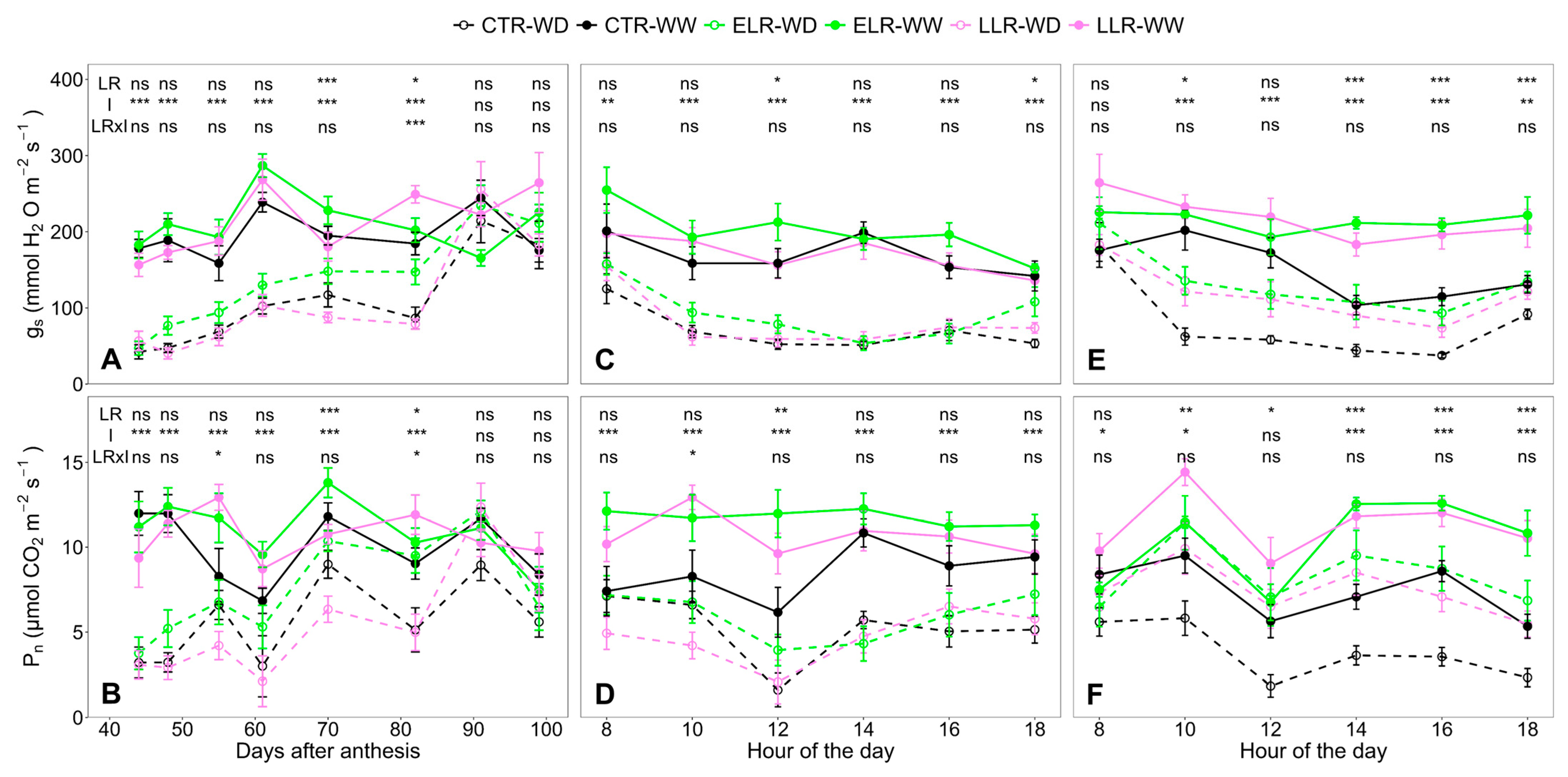
Leaf gas-exchange parameters were deeply influenced by different water regimes and leaf removal over all the season (Figure 2). Stomatal conductance (gs) had higher values in WW vines from the first monitoring date (44 DAA), showing an average of 172 mmol H2O m−2s−1, almost fourfold that of the mean of WD vines (48 mmol H2O m−2s−1, average between leaf removal treatments). Differences between gs values in WW and WD vines progressively reduced during the season until 91 DAA, when a similar level was reached. Leaf removal treatments also had a significant impact on gs. After leaf removal at 48 DAA, ELR vines showed a 13.6% increase in gs compared to CTR (average between irrigation regimes).
Similarly, the LLR vines had higher values of gs compared to CTR, even though this difference was significant only at 99 DAA (+24% over CTR vines, average between irrigation regime). Net photosynthesis values followed a similar seasonal pattern with respect to gs. WW vines always showed higher levels of Pn with respect to WD vines except for 91 DAA, when this was significant only the interaction with the leaf removal treatments. The maximum Pn value (12.1 µmol CO2 m−2s−1) was recorded in WW vines at 70 DAA (average between leaf removal treatments), and in WD vines at 91 DAA (11.0 µmol CO2 m−2s−1). During the season, the Pn differential between WW and WD vines decreased, shifting from 3.23-fold to 1.32-fold (average between leaf removal treatments). After leaf removal, Pn was affected significantly in almost all the rest of the measuring dates, but with different patterns among water regimes. After leaf removal, ELR-WD vines maintained Pn values 25.6% higher than CTR-WD (average between dates), whereas ELR-WW was only 10.9% higher than CTR-WW (average between dates). Similarly, after LLR application, LLR-WD vines had Pn values 18.9% higher than CTR-WD ones, while LLR-WW had Pn values 6.6% higher than CTR-WW.
The daily gas-exchange measurements at 70 DAA showed a diurnal decline in gs, from values of over 200 to 150 mmol H2O m−2 s−1 in WW vines and from 150 to 50 mmol H2O m−2 s−1 in WD vines (Figure 2C,D). Notably, ELR-WD vines exhibited stomatal reopening in the late afternoon, with gs exceeding 100 mmol H2O m−2 s−1. In WW vines, Pn remained relatively stable (>10 µmol CO2 m−2 s−1), except for lower morning values in CTR vines. In contrast, WD vines showed a midday decline in Pn followed by partial recovery (6–7 µmol CO2 m−2 s−1), particularly in ELR-treated vines. At 99 DAA, WW vines maintained stable gs values (~200 mmol H2O m−2 s−1) throughout the day in both leaf removal treatments, while CTR vines exhibited a 50% reduction from morning to afternoon (Figure 2E,F). WD vines showed a steep decline in gs between 8 and 10 a.m., stabilizing at lower levels in CTR (~30–40 mmol H2O m−2 s−1) compared to ELR and LLR. Across all treatments, Pn followed a similar diurnal trend: stable or slightly increasing until 10 a.m., decreasing until noon, peaking at 4 p.m., then declining towards evening. In WW conditions, ELR and LLR consistently showed higher Pn than CTR (+38.5% and +50.9%, respectively), especially in the afternoon. Similarly, under WD, ELR and LLR maintained higher Pn than CTR throughout the day (+54.5% and +48.2%, respectively). Leaf TSSs were measured at 6 h intervals throughout the day at 70 and 99 DAA, revealing significant variations under different irrigation/leaf removal treatments.
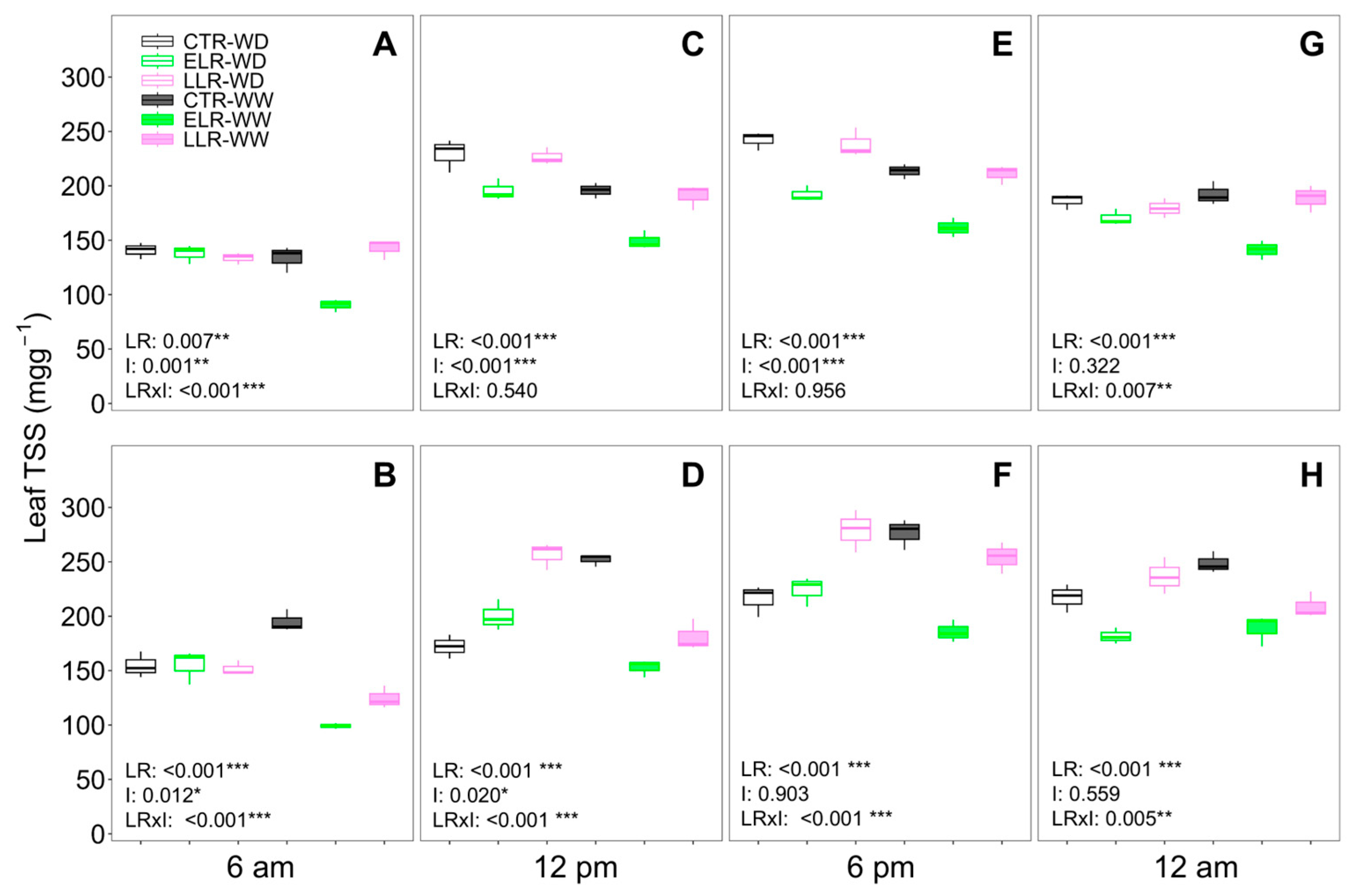
Leaf TSS concentrations on 70 DAA were higher under WD compared to WW conditions, with increases of +30% and +7%, respectively (Figure 3). No significant differences among leaf removal treatments were detected at dawn or midnight. However, during daylight hours, ELR vines showed significantly lower TSSs than CTR vines (−26.6% on average across irrigation regimes). Under WW, ELR consistently reduced leaf TSSs across all time points—including dawn and midnight—resulting in an average 26.8% decrease over the full diurnal cycle.
On 99 DAA, leaf TSS concentrations increased compared to 70 DAA across all treatments (Figure 3), with a more pronounced rise under WW (+18%) than under WD (+8% on average). Regardless of leaf removal treatment, TSSs remained higher in WD vines than in WW vines (+24% on average). CTR vines under WD consistently showed the lowest TSS values throughout the day. The LLR treatment exhibited the highest diurnal fluctuation in leaf TSSs under both irrigation regimes (+33% on average), indicating a stronger sensitivity to daily light–dark cycles. Under WD, ELR showed a TSS pattern similar to CTR, while under WW, ELR maintained persistently lower TSS levels throughout the 24 h cycle, averaging 78% of CTR values.
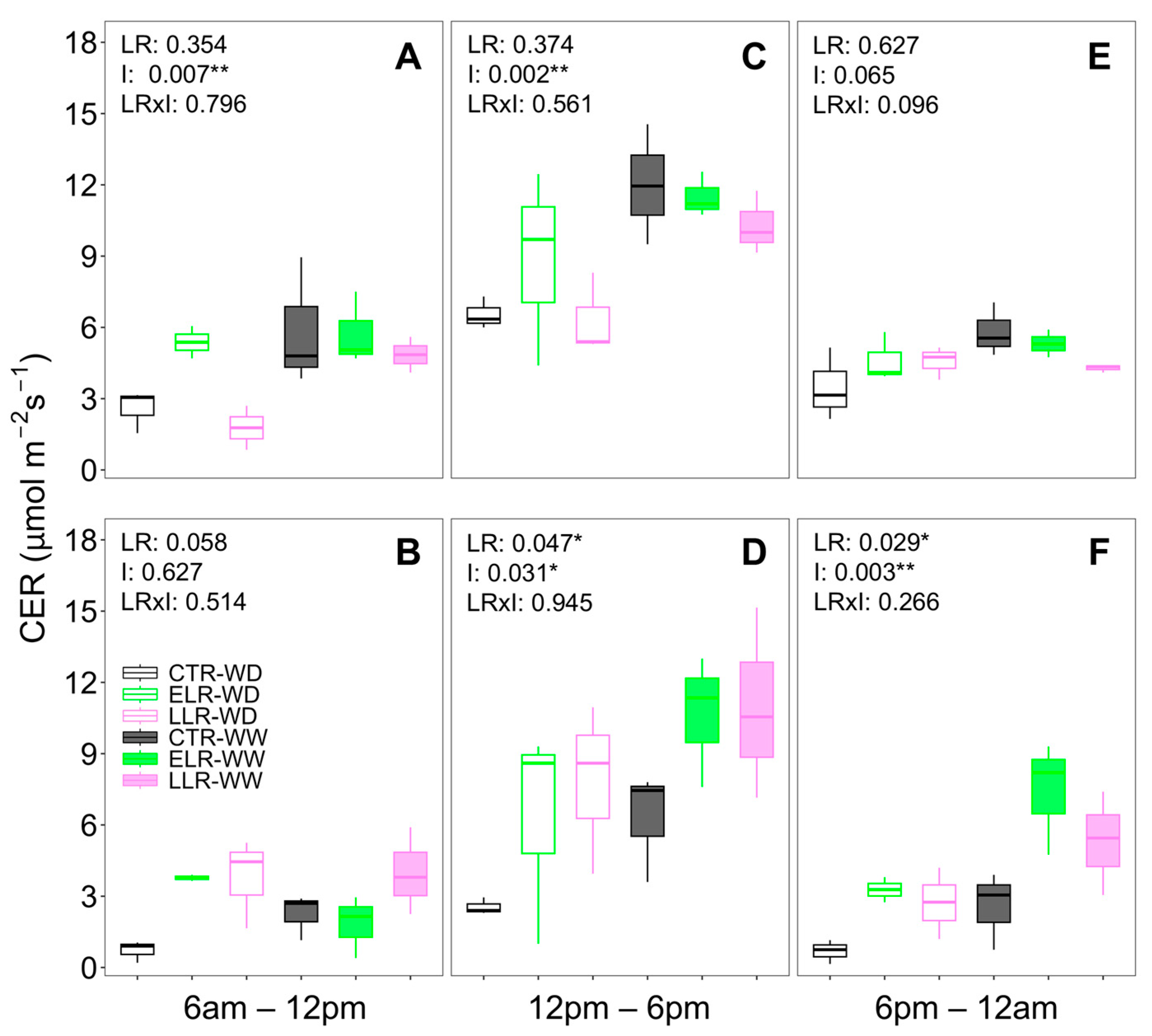
Differences in CER were observed between irrigation regimes and leaf removal treatments (Figure 4). At 70 DAA, CER was higher under WW conditions than in WD (+57.6%, average between leaf removal treatments and sampling point). Similarly, at 99 DAA, WW vines had CER values +75.6% higher than WD vines (average between leaf removal treatments and sampling hour). The effect of leaf removal treatments on CER values varied depending on the period (Figure 4). At 70 DAA, ELR boosted CER only of 9% with respect to CTR (average between irrigation regimes and sampling hour), whereas at 99 DAA, when both leaf removal treatments were applied, ELR and LLR increased CER by 104% and 129% over CTR, respectively.

3.4. Vine Water Relations

The course of Ψstem was deeply affected by irrigation treatments (Figure 1C). WW vines maintained consistent Ψstem values throughout the season, varying between −0.6 and −0.4 MPa, whereas after irrigation differentiation, WD vines ranged between −1.47 and −0.93 MPa (average between leaf removal treatments). The leaf removal treatments differently influenced Ψstem based on irrigation regimes. Under the WW condition, after treatment, the ELR vines had higher Ψstem than CTR, +17.5% (average between measurement dates). Similarly, after treatment, LLR vines had higher Ψstem values with significant differences compared to the CTR vines (up to +26.1%). Under WD conditions, after the leaf removal, Ψstem increased in ELR and LLR vines by up to +26.8% and +42.7%, respectively, compared with CTR-WD (Figure 1C). The pairwise comparison showed significant differences between LLR-WW and CTR-WW only at 82 DAA, 4 days after LLR treatment, whereas it was significant at 91 DAA in WD vines.
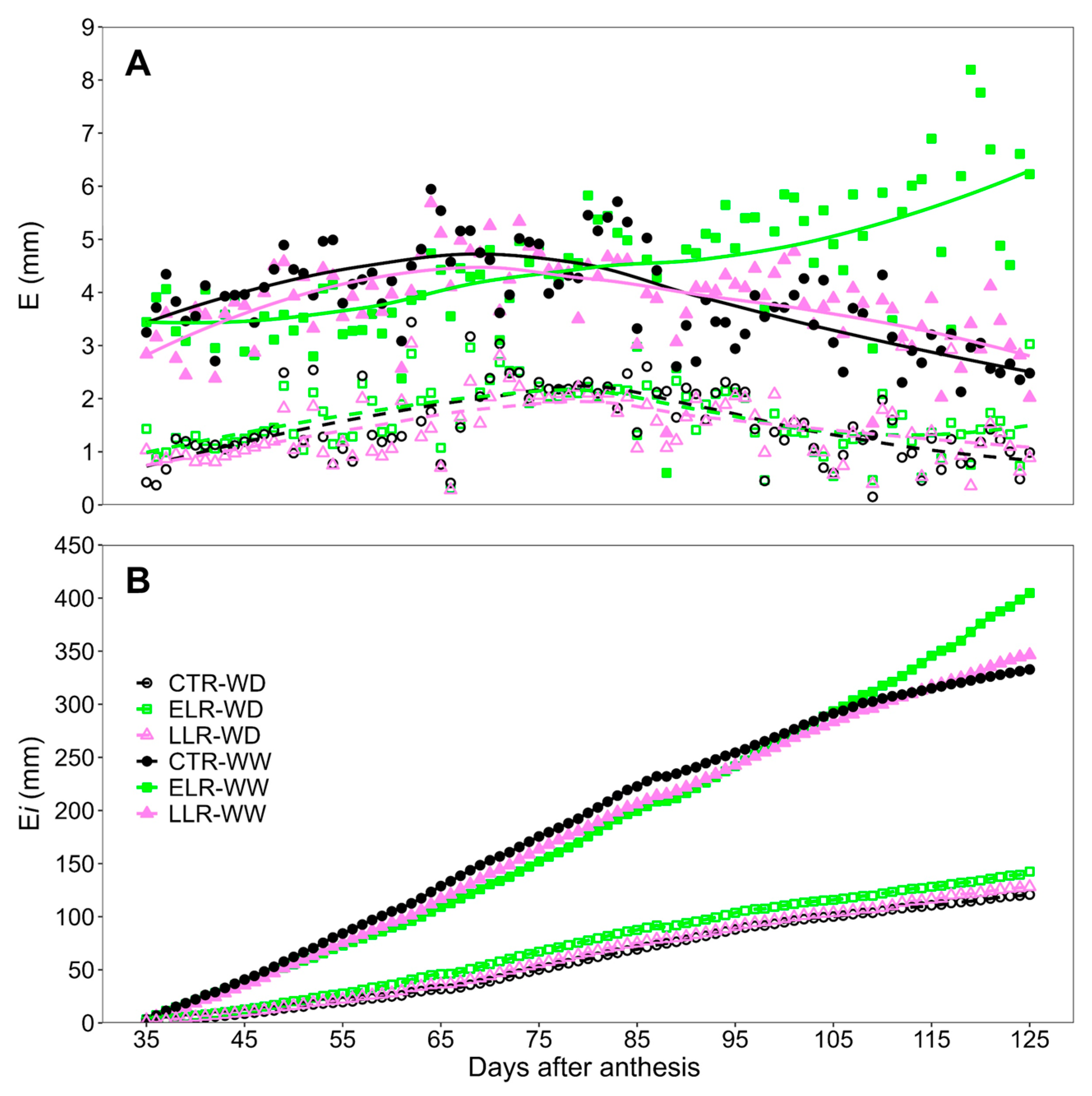
Daily and cumulative vine transpiration displayed different patterns between irrigation regimes (Figure 5).
The seasonal course of daily vine transpiration measured in all treatments showed an increment until a peak around 80 DAA followed by a continuous decrease until harvest, except for ELR-WW, which continued to increase water transpiration late in the season (Figure 5A). The vine transpiration integral (Ei) in WW vines ranged between 333 and 405 mm, whereas in WD plants it ranged between 121 and 142 mm H2O (Figure 5B). The effect of leaf removal varied between irrigation regimes. By the end of the monitoring period, Ei in ELR-WD vines was 18.0% higher than in CTR-WD, while LLR-WD vines showed only a 6.1% increase. Under WW conditions, Ei was also higher in ELR (+21.6%) and LLR (+6.1%) compared to CTR. Notably, ELR vines exhibited lower Ei than CTR until 104 DAA.
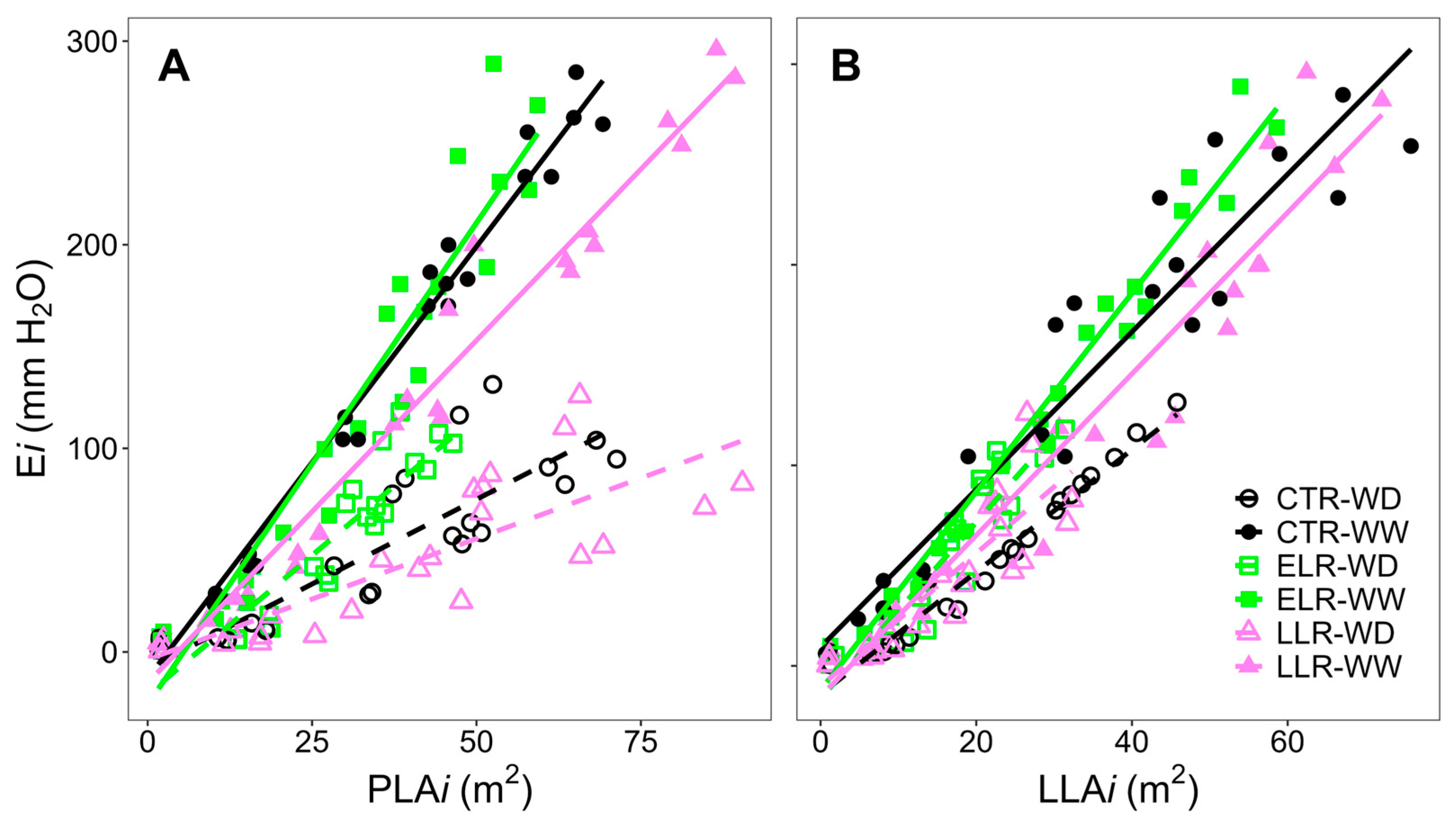
Figure 6 shows the linear correlations between Ei and either PLAi or LLAi. All treatments displayed strong correlations (R2 = 0.67–0.98). The ANCOVA revealed a highly significant effect of PLAi and LLAi on Ei (F = 2033.3, p < 0.0001; Table 3), confirming a positive relationship between canopy development and vine water use. Both irrigation treatments and Lai significantly affected Ei, and all two-way interactions with LAi were also significant (Table 3). The emmtrends results reported in Table 4 highlight that the slopes of the Ei–LAi regressions differed between PLAi and lateral LLAi and that this divergence varied among irrigation treatments.
Under WW conditions, both PLAi and LLAi showed steep slopes, suggesting a coupling between canopy development and transpiration. In WD vines, however, the slope decreased more sharply in LLAi than in PLAi, indicating a possible stronger stomatal limitation to transpiration in the laterals. The pairwise comparisons of slopes (Table S2) confirmed that the effect of LAi on Ei differed between PLAi and LLAi and across irrigation treatments, also supporting the patterns observed in the three-way interaction reported in Table 3.

3.5. Multiple-Factor Analysis (MFA)

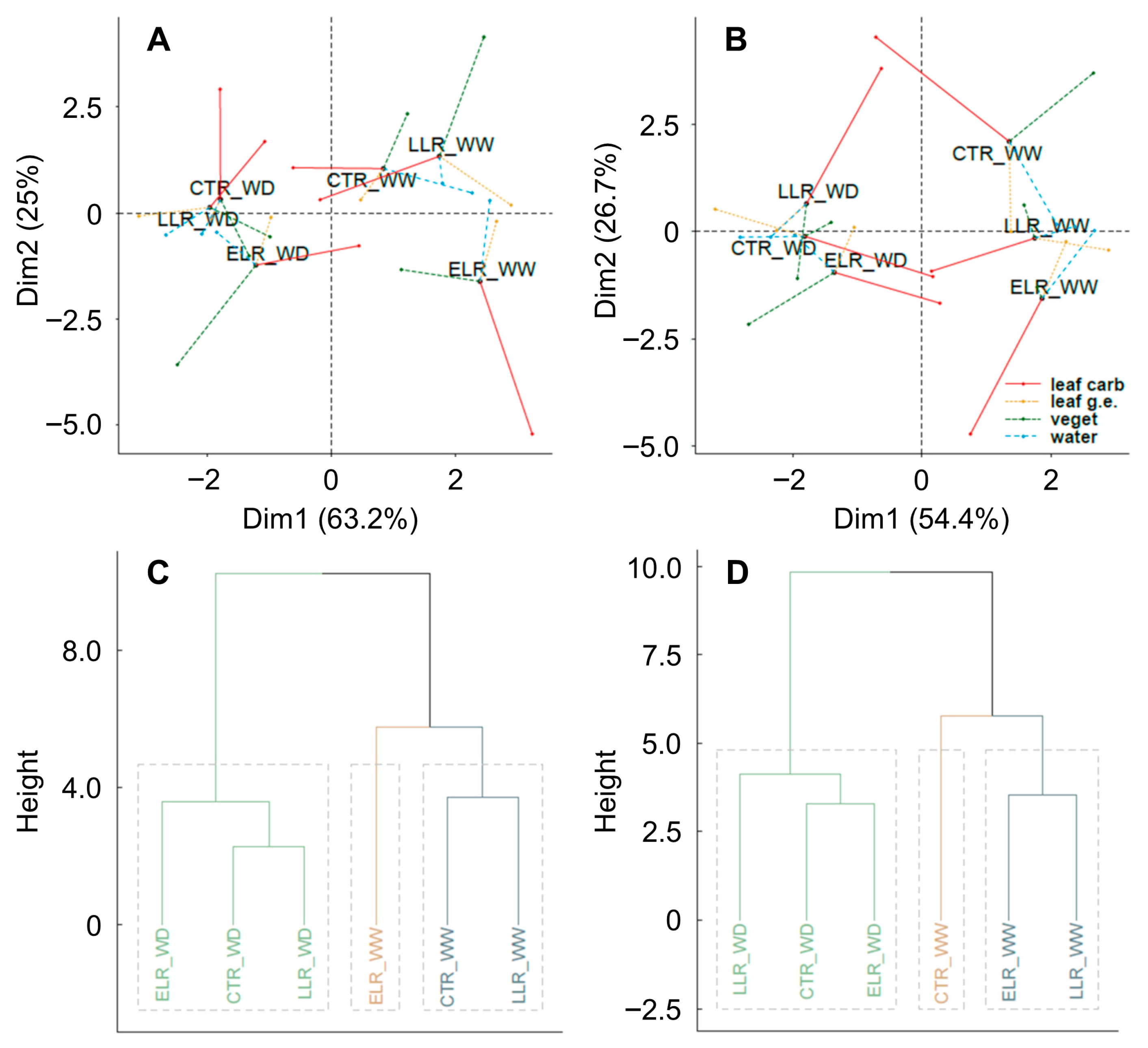
The MFA performed on the vegetative features, water and gas-exchange parameters, and leaf TSSs on two different sampling dates of the season give an overview on the effect of water availability and leaf removal treatments. In July (Figure 7A), principal component 1 (dim1) explained the 63.2% of total variance clearly separating the two levels of water availability.
Principal component 2 (dim2) explained the 25% total variance separating ELR vines by the CTR and LLR ones. Among the single factors, water features were the main differentiating factor between the two irrigation regimes, whereas TSSs differentiated ELR by other treatments. In the dendrogram of Figure 7C, WD and WW treatments are separated at the first level, whereas the secondary level of differentiation more clearly distinguishes the ELR treatment from the others. In the dendrogram analysis describing 99 DAA (Figure 7B), principal component 1 (dim1) explained 54.4% of total variance, again separating the two levels of water availability. Principal component 2 (dim2) explained the 26.7% total variance discriminating the three leaf removal treatments, though with a different grade based on water availability. Indeed, differences between leaf removal treatments are more pronounced in the WW treatments compared to the WD ones. Focusing on the single factor, once again water features are the best factor to discriminate between the two irrigation regimes, whereas the pattern is less clear observing the leaf removal treatments. For instance, leaf carbohydrates clearly separated the leaf removal treatments in WW conditions, but under WD conditions were able to differentiate LLR by the CTR, not ELR.

4. Discussion

Apical leaf removal has been proposed as a reliable canopy management technique to adapt grapevine cultivation to warmer and dryer conditions emerging with climate change [27], as well as to delay berry ripening, favoring optimal grape quality [38]. In this regard, it is paramount to evaluate this technique under different water availability conditions, considering the physiological implications related to the vine leaf area and water status, which could potentially lead to opposite effects on vine physiology.
The analysis of the main vegetative and physiological features consistently described the effects induced by the irrigation regimes and the leaf removal treatments and by their interaction as well. The WD condition reduced vine Ψstem and generally doubled values compared to WW. The leaf removal treatments also contributed to mitigating the effect of water deficit conditions, increasing Ψstem values even by 42.7% in LLR vines with respect to CTR. This finding is partially consistent with previous studies on the combined effect of source–sink modulation with different irrigation regimes. Buesa et al. [28], applying a late apical leaf removal on Bobal and Tempranillo, measured significant differences in Ψstem values between leaf removal treatments, albeit the irrigation differentiation was the main factor that determined the vine water status. In contrast, Herrera et al. [39] investigating the effect of two different canopy heights in combination with two different irrigation regimes in Merlot grapevines, reported that Ψstem values were –0.4 MPa in irrigated plants and –1.2 MPa in deficit-irrigated plants, albeit no different Ψstem values were observed between the different canopy heights. It is well known that lower leaf areas are usually associated with reduced evapotranspiration [40,41]. Nevertheless, in our experiment the conditions of higher water availability per leaf area induced by the leaf removal treatments did not necessarily correspond to a decrease in vine transpiration under WD conditions. Indeed, whilst immediately after ELR treatment the cumulated daily transpiration in ELR-WW vines was lower than CTR-WW, in ELR-WD vines it increased by 9% compared to CTR-WD, especially in the first 15 days after treatment. This finding can be explained by the stomatal conductance measured in the field: after the early leaf removal treatment, ELR-WW vines increased gs by 8% with respect to CTR-WW whereas ELR-WD vines had gs values 21% higher than CTR-WD (average between measurement dates). Later on in the season, the ELR-WW vines were the only ones that maintained a sustained high daily transpiration rate and did not show the decrease measured in the other treatments. This evidence can be supported by the fact that ELR-WW vines were the only ones that maintained active lateral shoot development even late in the season, as confirmed by the increase of 15% in LLA after 75 DAA. The higher number of young lateral shoots that developed had a greater impact than the main leaves on the cumulated transpiration rate per vine, contributing to explaining the transpiration pattern observed in ELR-WW vines. In addition, the regression lines of the single treatments shown in Figure 6 suggest further consideration about the incidence of the main and secondary leaves on vine transpiration. In particular, the slopes associated with PLAi varied more widely among treatments than those associated with LLAi, suggesting that the PLA has a greater impact on cumulated transpiration with respect to LLA, although further research separately quantifying the contributions of the main and lateral shoots to total transpiration is needed to confirm these findings.
It is well known that under water deficit conditions, vines tend to reduce stomata opening, reducing transpiration and net photosynthesis [42,43]. We observed reduced leaf gas exchange already at the beginning of the monitoring, 15 days after the irrigation differentiation, when gs and Pn values were 3.6- and 3.2-fold higher in WW than in WD vines, respectively. These differences persisted until 82 DAA, after which gs no longer differed significantly among treatments, and no consistent patterns in Pn were observed across leaf removal treatments or irrigation regimes. This result was expected, as the correlation between leaf gas exchange and vine water status varies based on the phenological stage. After veraison, the vine physiological plasticity changes and a decrease in the sensitivity of leaf gas exchange to different water conditions in favor of the fruit ripening occurs [44,45]. In addition, after 87 DAA, there was a drop in air temperature (−5 °C) that changed the mean daily vapor pressure deficit, one of the main factors that significantly affect gs and Pn, even in vines with comparable water status [46,47].
Both leaf removal treatments significantly affected gas-exchange parameters as well, a main consequence of the compensation effect after source–sink adjustment. In previous research, Petrie et al. [48] reported an increase in net photosynthesis per leaf area after early basal leaf removal on Sauvignon Blanc. Poni et al. [49], investigating the effect of early (pre-veraison) and late (post-veraison at 12 °Brix of TSSs) apical leaf removal showed similar results, with an increase of 28.5% of net photosynthesis per leaf area unit (average between treatments). The gs and Pn values that we measured revealed that differences between ELR and CTR vines were significant on several measuring dates throughout the season, whereas differences between LLR and CTR vines were significantly only on the measuring date immediately after leaf removal. This finding could be partially explained by the less limiting climatic conditions occurring in the late season in terms of solar radiation and air temperature and the beginning of leaf senescence possibly induced by the photoperiod. However, it seems relevant to also take into account the different strength of the sink organs in the late part of berry development. As shown in Figure S2, the LA:FY, which is a good proxy of the source–sink relationship, decreased steadily during the season. At 47 DAA, immediately after ELR application, the LA:FY was 2.01 m2/kg, while it was 0.87 m2/kg after LLR (average between all treatments). Hence, with increased sink organ strength, it is conceivable that stomatal adjustment mechanisms tend to be less effective, due to the necessity of the plant to guarantee a continuous flux of sugars and metabolites to the berries [44].
From the two daily gas-exchange reliefs emerged a common course of Pn and gs during the day, but on a different scale between irrigation regimes and leaf removal treatments. As already observed, both parameters had higher values through the day under WW conditions [50], whereas WD vines showed a decrease around midday, especially for Pn, which could be associated with the lower photon flux intercepted by leaves at noon, as previously reported by Intrigliolo and Lakso [51]. Leaf removal treatments affected gs and Pn, but differently between the two dates: at 70 DAA, with higher mean air temperature, the maximum gs and Pn differential between leaf-removed vines and CTR vines was reached at noon due to the limiting temperatures and high VPD values, whereas at 99 DAA it was measured at noon in WD vines and in the afternoon in WW ones. Different factors control the daily leaf gas-exchange regulation, but it is conceivable that when the environmental conditions were less limiting as late in the season at 99 DAA, the WW vines stomatal adjustments remained more effective through the day, showing differences between the leaf removal treatments only in the afternoon.
The leaf TSS concentration was affected by both irrigation regimes and leaf removal treatments. At 70 DAA, leaf TSSs showed higher concentrations in the leaves of WD vines than in the leaves of WW vines, in contrast with what was expected considering the Pn values measured on the same leaves. In a recent study, Perry et al. [52] investigating the effect of water stress and rewatering on grapevine leaf TSS, reported only a minimal reduction in leaf sugar content under drought, especially considering the significant reduction of net photosynthesis measured on the same vines. The authors suggested that leaves from vines under drought conditions tend to retain high sugar concentration in order to maintain a reliable solute potential. Hence, we can hypothesize that the higher level of TSSs found in WD vines are associated with an osmotic function. At 70 DAA, we also measured a lower concentration of TSSs in ELR leaves compared to CTR. It is conceivable that with a reduced leaf area, but similar carbon needed to sustain similar fruit yields, there was a higher export rate in ELR leaves than CTR to translocate the sugars in the sinks. Moreover, an additional need for carbon was required, especially by ELR-WW vines, to sustain the new lateral shoot growth that was observed. At 99 DAA, the daily course of leaves TSS displayed a more complex pattern. Differently, with respect to 70 DAA, a similar leaf TSS course was observed in WW vines, albeit with lower TSS concentrations in LLR and ELR leaves due to the reduced leaf area. In contrast, under WD conditions, leaves from LLR vines showed a higher accumulation of TSSs throughout the day with respect to CTR and LLR vines. The differences observed between LLR and CTR may be explained by gas-exchange measurements, which indicated greater photosynthetic efficiency in LLR leaves, likely resulting from the increased carbon demand placed on a reduced leaf area required to support a similar sink strength. Considering that ELR and LLR leaves showed similar Pn values before sampling, the differences in leaf TSSs observed between these treatments could be associated with differences in the amount of sugars exported through the phloem, related to the timing of leaf removal treatment. In ELR vines, the leaf removal occurred earlier in the season, before the beginning of grape ripening, shoot lignification, and the beginning of starch accumulation in the storage organs. On the contrary, in LLR vines, the leaves were removed at half ripening, when all these processes partially occurred. Considering the higher CER measured in ELR and LLR vines, we can hypothesize that the retrieval of photosynthesized compounds by the sink organs was higher in ELR than LLR vines, determining a lower concentration of leaves TSSs. Higher sink strength increases phloem load, as described in the conceptual model proposed by Keller et al. [53], whereby a sink-triggered rise in phloem inflow sustained both expansive growth and solute accumulation in the fruit.
As expected, the fruit yield parameters were deeply influenced by irrigation regimes and to a lesser extent by leaf removal treatments. The literature reports higher fruit yield under higher water availability conditions [54,55,56,57]. The common cause that emerged was the increase in the weight of the grapes and therefore of the clusters due to the water supply, which is also consistent with our results. On the contrary, we did not observe any significant effects on fruit yield parameters caused by the source–sink manipulation following the leaf removal treatments. This result is consistent with previous studies on apical leaf removal. Poni et al. [49], applying apical leaf removal on Sangiovese potted vines, reported no differences in fruit yield or cluster weight. Similarly, Palliotti et al. [23], after applying mechanically late apical leaf removal on Sangiovese field-grown grapevines, did not observe any significant difference in fruit yield parameters.

5. Conclusions

Water availability leads to major modifications to grapevine physiology, overhanging physiological adaptations induced by apical leaf removal treatment. Both ELR and LLR treatments mitigated the effect of WD conditions only transiently, slightly increasing vine Ψstem after treatment application. The cumulated vine transpiration confirmed the similar water loss between treatments, and rather, a higher water consumption was measured in ELR-WW vines compared to CTR, which was also caused by the development of new laterals that remained photosynthetically efficient late in the season. The leaf gas-exchange parameters significantly increased by leaf removal treatments for a few days after treatment, although ELR and LLR leaves showed a higher net photosynthesis rate during the day compared to CTR, especially in the afternoon and late in the season. A result worth noting was that these conditions led to a significant increase in leaf TSS concentration in LLR vines, especially under WD conditions, which was also associated with a high carbon export rate.
In conclusion, our findings suggest that apical leaf removal mitigates the water deficit effects on vine physiology to a limited extent, but can represent a proper agronomic technique to increase leaf carbon fixation and exportation by promoting a more active photosynthetic canopy and a more effective translocation of assimilates toward the ripening clusters. In this regard, further research is needed, especially to verify these findings in field-grown conditions and also to evaluate the effects on berry metabolism.

Supplementary Materials

The following supporting information can be downloaded at: https://www.mdpi.com/article/10.3390/horticulturae11121524/s1, Figure S1: Seasonal climatic conditions at the experimental site; Figure S2: Seasonal evolution of leaf area to fruit yield ratio; Table S1: Leaf glucose, fructose, sucrose and TSS concentration; Table S2: LSMeans and Tukey results of ANCOVA.

Author Contributions

V.T.: conceptualization, data curation, investigation, methodology, formal analysis, software, writing—original draft and editing. G.P.: conceptualization, investigation, methodology, formal analysis, software, supervision, writing—review and editing. C.M.V.: data curation, investigation, software. A.P.: formal analysis, writing—review and editing. C.D.: conceptualization, resources, supervision, validation, writing—review and editing. All authors have read and agreed to the published version of the manuscript.

Funding

This research was supported by Fondazione Banfi, Banfi srl, and academic funds from the University of Pisa.

Data Availability Statement

The original contributions presented in this study are included in the article/Supplementary Material. Further inquiries can be directed to the corresponding authors.

Acknowledgments

The authors thank Tommaso Innocenti for his technical support.

Conflicts of Interest

The authors declare no conflicts of interest.

References

  1. Keller, M. The Science of Grapevines, 3rd ed.; Elsevier: Amsterdam, The Netherlands; Academic Press: Burlington, ON, Canada, 2020. [Google Scholar]
  2. Calvin, K.; Dasgupta, D.; Krinner, G.; Mukherji, A.; Thorne, P.W.; Trisos, C.; Romero, J.; Aldunce, P.; Barrett, K.; Blanco, G.; et al. IPCC: Climate Change 2023: Synthesis Report. Contribution of Working Groups I, II and III to the Sixth Assessment Report of the Intergovernmental Panel on Climate Change; Core Writing Team; Lee, H., Romero, J., Eds.; IPCC: Geneva, Switzerland, 2023. [Google Scholar] [CrossRef]
  3. Douville, H.; Raghavan, K.; Renwick, J.; Allan, R.P.; Arias, P.A.; Barlow, M.; Cerezo-Mota, R.; Cherchi, A.; Gan, T.; Gergis, J. Water Cycle Changes; IPCC: Geneva, Switzerland, 2021; Available online: https://www.ipcc.ch/report/ar6/wg1/downloads/report/IPCC_AR6_WGI_Chapter08.pdf (accessed on 22 May 2025).
  4. Martínez-Lüscher, J.; Matus, J.T.; Gomès, E.; Pascual, I. Toward understanding grapevine responses to climate change: A multi-stress and holistic approach. J. Exp. Bot. 2024, 76, 2949–2969. [Google Scholar] [CrossRef] [PubMed]
  5. Sadras, V.O.; Monzon, J.P. Modelled wheat phenology captures rising temperature trends: Shortened time to flowering and maturity in Australia and Argentina. Field Crops Res. 2006, 99, 136–146. [Google Scholar] [CrossRef]
  6. Webb, L.; Whetton, P.; Bhend, J.; Darbyshire, R.; Briggs, P.R.; Barlow, E.W.R. Earlier wine-grape ripening driven by climatic warming and drying and management practices. Nat. Clim. Change 2012, 2, 259–264. [Google Scholar] [CrossRef]
  7. García de Cortázar-Atauri, I.; Duchêne, E.; Destrac-Irvine, A.; Barbeau, G.; de Rességuier, L.; Lacombe, T.; Parker, A.K.; Saurin, N.; van Leeuwen, C. Grapevine phenology in France: From past observations to future evolutions in the context of climate change. OENO One 2017, 51, 115–126. [Google Scholar] [CrossRef]
  8. Leolini, L.; Moriondo, M.; Fila, G.; Costafreda-Aumedes, S.; Ferrise, R.; Bindi, M. Late spring frost impacts on future grapevine distribution in Europe. Field Crops Res. 2018, 222, 197–208. [Google Scholar] [CrossRef]
  9. Faralli, M.; Mallucci, S.; Bignardi, A.; Varner, M.; Bertamini, M. Four decades in the vineyard: The impact of climate change on grapevine phenology and wine quality in northern Italy. OENO One 2024, 58, 1–21. [Google Scholar] [CrossRef]
  10. Van Leeuwen, C.; Destrac-Irvine, A. Modified grape composition under climate change conditions requires adaptations in the vineyard. OENO One 2017, 51, 147–154. [Google Scholar] [CrossRef]
  11. Kriedemann, P.E. Photosynthesis in vine leaves as a function of light intensity, temperature and leaf age. Vitis 1968, 7, 213–220. [Google Scholar] [CrossRef]
  12. Greer, D.H.; Weedon, M.M. Modelling photosynthetic responses to temperature of grapevine (Vitis vinifera cv. Semillon) leaves on vines grown in a hot climate. Plant Cell Environ. 2012, 35, 1050–1064. [Google Scholar] [CrossRef]
  13. Medrano, H.; Escalona, J.M.; Cifre, J.; Bota, J.; Flexas, J. A ten-year study on the physiology of two Spanish grapevine cultivars under field conditions: Effects of water availability from leaf photosynthesis to grape yield and quality. Funct. Plant Biol. 2003, 30, 607–619. [Google Scholar] [CrossRef]
  14. Zhang, K.; Chen, B.; Hao, Y.; Yang, R.; Wang, Y. Effects of short-term heat stress on PSII and subsequent recovery for senescent leaves of Vitis vinifera L. cv. Red Globe. J. Integr. Agric. 2018, 17, 2683–2693. [Google Scholar] [CrossRef]
  15. Flexas, J.; Escalona, J.M.; Medrano, H. Water stress induces different levels of photosynthesis and electron transport rate regulation in grapevines. Plant Cell Environ. 1999, 22, 39–48. [Google Scholar] [CrossRef]
  16. Lovisolo, C.; Perrone, I.; Carra, A.; Ferrandino, A.; Flexas, J.; Medrano, H.; Schubert, A. Drought-induced changes in development and function of grapevine (Vitis spp.) organs and in their hydraulic and non-hydraulic interactions at the whole-plant level: A physiological and molecular update. Funct. Plant Biol. 2010, 37, 98–116. [Google Scholar] [CrossRef]
  17. Marusig, D.; Tombesi, S. Abscisic Acid Mediates Drought and Salt Stress Responses in Vitis vinifera—A Review. Int. J. Mol. Sci. 2020, 21, 8648. [Google Scholar] [CrossRef]
  18. Gómez del Campo, M.; Ruiz, C.; Lissarrague, J.R. Effect of Water Stress on Leaf Area Development, Photosynthesis, and Productivity in Chardonnay and Airén Grapevines. Am. J. Enol. Vitic. 2002, 53, 138–143. [Google Scholar] [CrossRef]
  19. Ojeda, H.; Andary, C.; Creaba, E.; Carbonneau, A.; Deloire, A. Influence of pre-and postveraison water deficit on synthesis and concentration of skin phenolic compounds during berry growth of Vitis vinifera var. Shiraz. Am. J. Enol. Vitic. 2002, 53, 261–267. [Google Scholar]
  20. Buesa, I.; Pérez, D.; Castel, J.; Intrigliolo, D.S.; Castel, J.R. Effect of deficit irrigation on vine performance and grape composition of Vitis vinífera L. cv. Muscat of Alexandria. Aust. J. Grape Wine Res. 2017, 23, 251–259. [Google Scholar] [CrossRef]
  21. Savoi, S.; Wong, D.C.J.; Degu, A.; Herrera, J.C.; Bucchetti, B.; Peterlunger, E.; Fait, A.; Mattivi, F.; Castellarin, S.D. Multi-Omics and integrated network analyses reveal new insights into the systems relationships between metabolites, structural genes, and transcriptional regulators in developing grape berries (Vitis vinifera L.) exposed to water deficit. Front. Plant Sci. 2017, 8, 1124. [Google Scholar] [CrossRef]
  22. Palai, G.; Caruso, G.; Gucci, R.; D’Onofrio, C. Water deficit before veraison is crucial in regulating berry VOCs concentration in Sangiovese grapevines. Front. Plant Sci. 2023, 14, 1117572. [Google Scholar] [CrossRef]
  23. Palliotti, A.; Tombesi, S.; Silvestroni, O.; Lanari, V.; Gatti, M.; Poni, S. Changes in vineyard establishment and canopy management urged by earlier climate-related grape ripening: A review. Sci. Hortic. 2014, 178, 43–54. [Google Scholar] [CrossRef]
  24. Ding, J.; Johnson, E.A.; Martin, Y.E. Optimization of leaf morphology in relation to leaf water status: A theory. Ecol. Evol. 2020, 10, 1510–1525. [Google Scholar] [CrossRef]
  25. Devin, S.R.; Prudencio, Á.S.; Mahdavi, S.M.E.; Rubio, M.; Martínez-García, P.J.; Martínez-Gómez, P. Orchard Management and Incorporation of Biochemical and Molecular Strategies for Improving Drought Tolerance in Fruit Tree Crops. Plants 2023, 12, 773. [Google Scholar] [CrossRef] [PubMed]
  26. Santesteban, L.G.; Miranda, C.; Urrestarazu, J.; Loidi, M.; Royo, J.B. Severe trimming and enhanced competition of laterals as a tool to delay ripening in Tempranillo vineyards under semiarid conditions. OENO One 2017, 51, 191–203. [Google Scholar] [CrossRef]
  27. Upton, S.; Bossuat, C.; Nicolas, S.; Rega, M.; Chaugny, A.; Noret, L.; Gavrilescu, C.; Santoni, A.; Mathieu, O.; Alexandre, H.; et al. Consequences of apical leaf removal on grapevine water status, heat damage, yield and grape ripening on Pinot n. and Chardonnay. In IVES Conference Series, Proceedings of the 22nd GiESCO International Meeting, Ithaca, NY, USA, 7 July 2023; GiESCO: Montpellier, France, 2023. Available online: https://ives-openscience.eu/34739/ (accessed on 22 May 2025).
  28. Buesa, I.; Caccavello, G.; Basile, B.; Merli, M.C.; Poni, S.; Chirivella, C.; Intrigliolo, D.S. Delaying berry ripening of Bobal and Tempranillo grapevines by late leaf removal in a semi-arid and temperate-warm climate under different water regimes. Aust. J. Grape Wine Res. 2019, 25, 70–82. [Google Scholar] [CrossRef]
  29. Pallotti, L.; Partida, G.; Laroche-Pinel, E.; Lanari, V.; Pedroza, M.; Brillante, L. Late-season source limitation practices to cope with climate change: Delaying ripening and improving colour of Cabernet-Sauvignon grapes and wine in a hot and arid climate. OENO One 2025, 59, 1–17. [Google Scholar] [CrossRef]
  30. Wegher, M.; Niedrist, G.; Tagliavini, M.; Asensio, D.; Giuliani, N.; Andreotti, C. Impact of leaf removal on recovery of young grapevines under heatwave conditions: A study in an ecotron environment. OENO One 2025, 59, 1–14. [Google Scholar] [CrossRef]
  31. Lorenz, D.H.; Eichhorn, K.W.; Bleiholder, H.; Klose, R.; Meier, U.; Weber, E. Phenological growth stages of the grapevine (Vitis vinifera L. ssp. vinifera)—Codes and descriptions according to the extended BBCH scale. Aust. J. Grape Wine Res. 1995, 1, 100–103. [Google Scholar] [CrossRef]
  32. Pompeiano, A.; Vita, F.; Alpi, A.; Guglielminetti, L. Arundo donax L. response to low oxygen stress. Environ. Exp. Bot. 2015, 111, 147–154. [Google Scholar] [CrossRef]
  33. Gersony, J.T.; Hochberg, U.; Rockwell, F.E.; Park, M.; Gauthier, P.P.G.; Holbrook, N.M. Leaf Carbon Export and Nonstructural Carbohydrates in Relation to Diurnal Water Dynamics in Mature Oak Trees. Plant Physiol. 2020, 183, 1612–1621. [Google Scholar] [CrossRef] [PubMed]
  34. Shackel, K. A plant-based approach to deficit irrigation in trees and vines. HortScience 2011, 46, 173–177. [Google Scholar] [CrossRef]
  35. Wickham, H. ggplot2: Elegant Graphics for Data Analysis; Springer: New York, NY, USA, 2009. [Google Scholar] [CrossRef]
  36. Lê, S.; Josse, J.; Husson, F. FactoMineR: An R Package for Multivariate Analysis. J. Stat. Softw. 2008, 25, 1–18. [Google Scholar] [CrossRef]
  37. Vaníčková, L.; Pompeiano, A.; Maděra, P.; Massad, T.J.; Vahalík, P. Terpenoid profiles of resin in the genus Dracaena are species specific. Phytochemistry 2020, 170, 112197. [Google Scholar] [CrossRef] [PubMed]
  38. Palliotti, A.; Panara, F.; Silvestroni, O.; Lanari, V.; Sabbatini, P.; Howell, G.S.; Gatti, M.; Poni, S. Influence of mechanical postveraison leaf removal apical to the cluster zone on delay of fruit ripening in Sangiovese (Vitis vinifera L.) grapevines. Aust. J. Grape Wine Res. 2013, 19, 369–377. [Google Scholar] [CrossRef]
  39. Herrera, J.; Bucchetti, B.; Sabbatini, P.; Comuzzo, P.; Zulini, L.; Vecchione, A.; Peterlunger, E.; Castellarin, S.D. Effect of water deficit and severe shoot trimming on the composition of Vitis vinifera L. Merlot grapes and wines: Water deficit and severe trimming effect on Merlot. Aust. J. Grape Wine Res. 2015, 21, 254–265. [Google Scholar] [CrossRef]
  40. Gomez-del-Campo, M.; Ruiz, C.; Sotés, V.; Lissarrague, J.R. Water consumption in grapevines: Influence of leaf area and irrigation. Acta Hortic. 1999, 493, 279–286. [Google Scholar] [CrossRef]
  41. Williams, L.E.; Ayars, J.E. Grapevine water use and the crop coefficient are linear functions of the shaded area measured beneath the canopy. Agric. For. Meteorol. 2005, 132, 201–211. [Google Scholar] [CrossRef]
  42. Keller, M.; Romero, P.; Gohil, H.; Smithyman, R.P.; Riley, W.R.; Casassa, L.F.; Harbertson, J.F. Deficit irrigation alters grapevine growth, physiology, and fruit microclimate. Am. J. Enol. Vitic. 2016, 67, 426–435. [Google Scholar] [CrossRef]
  43. Buckley, T.N. How do stomata respond to water status? New Phytol. 2019, 224, 21–36. [Google Scholar] [CrossRef]
  44. Chaves, M.M.; Zarrouk, O.; Francisco, R.; Costa, J.M.; Santos, T.; Regalado, A.P.; Rodrigues, M.L.; Lopes, C.M. Grapevine under deficit irrigation: Hints from physiological and molecular data. Ann. Bot. 2010, 105, 661–676. [Google Scholar] [CrossRef]
  45. Palai, G.; Gucci, R.; Caruso, G.; D’Onofrio, C. Physiological changes induced by either pre- or post-veraison deficit irrigation in ‘Merlot’ vines grafted on two different rootstocks. Vitis 2021, 60, 153–161. [Google Scholar] [CrossRef]
  46. Perrone, I.; Pagliarani, C.; Lovisolo, C.; Chitarra, W.; Roman, F.; Schubert, A. Recovery from water stress affects grape leaf petiole transcriptome. Planta 2012, 235, 1383–1396. [Google Scholar] [CrossRef]
  47. Shtai, W.; Asensio, D.; Kadison, A.E.; Schwarz, M.; Raifer, B.; Andreotti, C.; Hammerle, A.; Zanotelli, D.; Haas, F.; Niedrist, G.; et al. Soil water availability modulates the response of grapevine leaf gas exchange and PSII traits to a simulated heat wave. Plant Soil 2024, 501, 537–554. [Google Scholar] [CrossRef]
  48. Petrie, P.R.; Trought, M.C.T.; Howell, G.S.; Buchan, G.D. The effect of leaf removal and canopy height on whole-vine gas exchange and fruit development of Vitis vinifera L. Sauvignon Blanc. Funct. Plant Biol. 2003, 30, 711. [Google Scholar] [CrossRef]
  49. Poni, S.; Gatti, M.; Bernizzoni, F.; Civardi, S.; Bobeica, N.; Magnanini, E.; Palliotti, A. Late leaf removal aimed at delaying ripening in cv. Sangiovese: Physiological assessment and vine performance. Aust. J. Grape Wine Res. 2013, 19, 378–387. [Google Scholar] [CrossRef]
  50. Moutinho-Pereira, J.; Correia, C.; Gonçalves, B.; Bacelar, E.A.; Torres-Pereira, J.M. Leaf Gas Exchange and Water Relations of Grapevines Grown in Three Different Conditions. Photosynthetica 2004, 42, 81–86. [Google Scholar] [CrossRef]
  51. Intrigliolo, D.S.; Lakso, A.N. Effects of light interception and canopy orientation on grapevine water status and canopy gas exchange. Acta Hortic. 2011, 889, 99–104. [Google Scholar] [CrossRef]
  52. Perry, A.; Sperling, O.; Rachmilevitch, S.; Hochberg, U. Carbon Dynamics Under Drought and Recovery in Grapevine’s Leaves. Plant Cell Environ. 2025, 48, 3379–3390. [Google Scholar] [CrossRef]
  53. Keller, M.; Zhang, Y.; Shrestha, P.M.; Biondi, M.; Bondada, B.R. Sugar demand of ripening grape berries leads to recycling of surplus phloem water via the xylem. Plant Cell Environ. 2015, 38, 1048–1059. [Google Scholar] [CrossRef] [PubMed]
  54. Intrigliolo, D.S.; Pérez, D.; Risco, D.; Yeves, A.; Castel, J.R. Yield components and grape composition responses to seasonal water deficits in Tempranillo grapevines. Irrig. Sci. 2012, 30, 339–349. [Google Scholar] [CrossRef]
  55. Romero, P.; Muñoz, R.G.; Fernández-Fernández, J.I.; del Amor, F.M.; Martínez-Cutillas, A.; García-García, J. Improvement of yield and grape and wine composition in field-grown Monastrell grapevines by partial root zone irrigation, in comparison with regulated deficit irrigation. Agric. Water Manag. 2015, 149, 55–73. [Google Scholar] [CrossRef]
  56. Pérez-Álvarez, E.P.; Intrigliolo Molina, D.S.; Vivaldi, G.A.; García-Esparza, M.J.; Lizama, V.; Álvarez, I. Effects of the irrigation regimes on grapevine cv. Bobal in a Mediterranean climate: I. Water relations, vine performance and grape composition. Agric. Water Manag. 2021, 248, 106772. [Google Scholar] [CrossRef]
  57. Palai, G.; Caruso, G.; Gucci, R.; D’Onofrio, C. Deficit irrigation differently affects aroma composition in berries of Vitis vinifera L. (cvs Sangiovese and Merlot) grafted on two rootstocks. Aust. J. Grape Wine Res. 2022, 28, 590–606. [Google Scholar] [CrossRef]
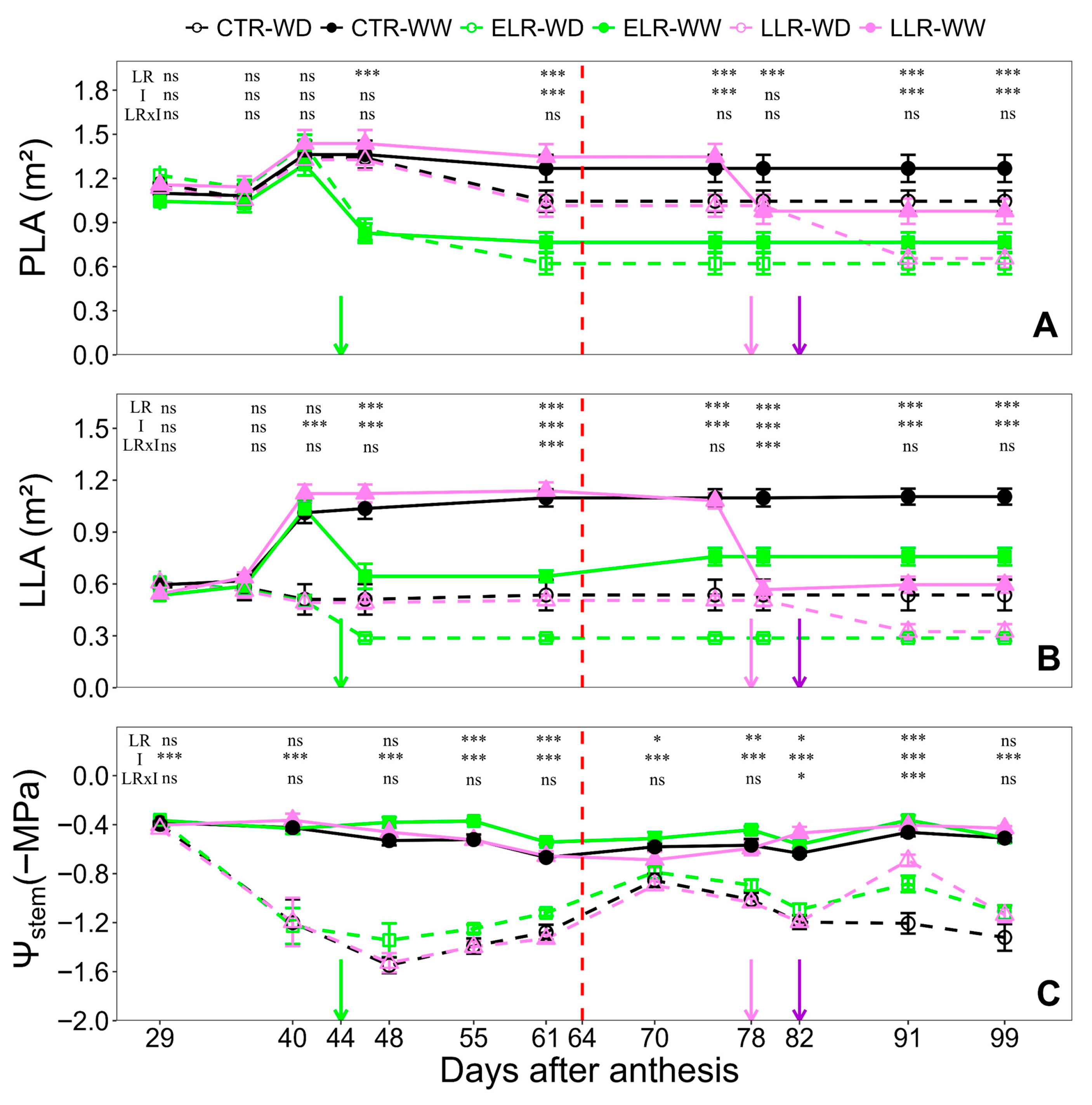
Figure 1. Primary leaf area (PLA; (A)), lateral leaf area (LLA; (B)) and stem water potential (Ψstem; (C)) of Sangiovese grapevines (Vitis vinifera L.) subjected to two different irrigation regimes (WW: well-watered; WD: water deficit) and three different canopy manipulations (CTR: untreated control; ELR: early apical leaf removal; LLR: late apical removal). The arrows indicate the dates of leaf removal treatment (green: ELR-WW and ELR-WD, purple: LLR-WW, violet: LLW-WD). Red dashed line indicates veraison date of CTR-WW. Values are means of nine replicates per treatment ± standard error. Statistical analysis of data was performed using two-way ANOVA. ns indicates p-value > 0.05, * p-value < 0.05, ** p-value < 0.01, *** p-value < 0.001.
Horticulturae 11 01524 g001
Figure 2. Seasonal (A,B) and daily (CF) evolution of stomatal conductance (gs) and net photosynthesis (Pn) measured on 70 DAA (C,D) and 99 DAA (E,F) in Sangiovese grapevines (Vitis vinifera L.) subjected to two different irrigation regimes (WW: well-watered, solid line; WD: water deficit, dashed line) and three different canopy manipulations (CTR: untreated control; ELR: early apical leaf removal; LLR: late apical removal). Values are means of nine replicates per treatment ± standard error. Statistical analysis of data was performed using two-way ANOVA. ns indicates p-value > 0.05, * p-value < 0.05, ** p-value < 0.01, *** p-value < 0.001.
Horticulturae 11 01524 g002
Figure 3. Leaf total soluble solids measured at 70 DAA (A,C,E,G) and at 99 DAA (B,D,F,H) in Sangiovese grapevines (Vitis vinifera L.) subjected to two different irrigation regimes (WW: well-watered; WD: water deficit) and three different canopy manipulations (CTR: untreated control; ELR: early apical leaf removal; LLR: late apical removal). p-values after ANOVA for each date and hour of measurement are reported. * Indicates p-value < 0.05, ** p-value < 0.01, *** p-value < 0.001.
Horticulturae 11 01524 g003
Figure 4. Leaf carbon export rate (CER) measured at 70 DAA (A,C,E) and 99 DAA (B,D,F) in Sangiovese grapevines (Vitis vinifera L.) subjected to two different irrigation regimes (WW, well-watered, WD, water deficit) and three different canopy manipulations (CTR, untreated control, ELR early apical leaf removal, LLR, late apical removal). p-values after ANOVA for each date and hour of measurement are reported. * Indicates p-value < 0.05, ** p-value < 0.01.
Horticulturae 11 01524 g004
Figure 5. Daily transpiration values (A) and transpiration integral (B) of Sangiovese grapevines (Vitis vinifera L.) subjected to two different irrigation regimes (WW: well-watered, solid line; WD: water deficit, dashed line) and three different canopy manipulations (CTR: untreated control; ELR: early apical leaf removal; LLR: late apical removal).
Horticulturae 11 01524 g005
Figure 6. Linear correlations between PLAi (A) and LLAi (B) and integral transpiration (Ei) in Sangiovese grapevines (Vitis vinifera L.) subjected to two different irrigation regimes (WW: well-watered, solid line; WD: water deficit, dashed line) and three different canopy manipulations (CTR: untreated control; ELR: early apical leaf removal; LLR: late apical removal). R2 of Ei–PLAi correlation. CTR-WD: 0.78; CTR-WW: 0.98; ELR-WD: 0.86; ELR-WW: 0.92; LLR-WD:0.67; LLR-WW: 0.92. R2 of Ei–LLAi correlation. CTR-WD: 0.98; CTR-WW: 0.92; ELR-WD: 0.87; ELR-WW: 0.98; LLR-WD: 0.77; LLR-WW: 0.93.
Horticulturae 11 01524 g006
Figure 7. MFA and cluster dendrogram at DAA 70 (A,C) and 99 (B,D) of Sangiovese grapevines (Vitis vinifera L.) subjected to two different irrigation regimes (WW: well-watered; WD: water deficit) and three different canopy manipulations (CTR: untreated control; ELR: early apical leaf removal; LLR: late apical removal).
Horticulturae 11 01524 g007
Table 1. Day of the year of the main phenological stages (BBCH scale) determined in Sangiovese grapevines (Vitis vinifera L.) subjected to two different irrigation regimes (WW, well-watered; WD, water deficit) and three canopy manipulation treatments (CTR, untreated control; ELR, early apical leaf removal; LLR, late apical removal).
TreatmentBudbreak (BBCH 09)Flowering (BBCH 65)Veraison (BBCH 81)Harvest (BBCH 89)
CTR-WD87143217255
CTR-WW87143207255
ELR-WD87143222268
ELR-WW87143213260
LLR-WD87143217260
LLR-WW87143207268
Table 2. Vegetative and yield parameters measured in Sangiovese grapevines (Vitis vinifera L.) subjected to two different irrigation regimes (WW, well-watered; WD, water deficit) and three canopy manipulation treatments (CTR, untreated control; ELR, early apical leaf removal; LLR, late apical removal). LR indicates leaf removal treatments, I irrigation regimes, LRxI their interaction. Values are means of nine replicates per treatment ± standard error. Statistical analysis of data was performed using two-way ANOVA. Different letters indicate that means are different p < 0.05 after Tukey’s HSD test.
TreatmentShoots (n)Clusters (n)Real FertilityFruit Yield (kg/vine)Average Cluster Weight (g)Average Berry Weight (g)Pruning Weight (g/vine)Ravaz Index
CTR-WD8.4 ± 0.48.4 ± 0.41.0 ± 0.12.0 ± 0.2 b236 ± 14 b1.83 ± 0.07 b294 ± 14 b7.0 ± 0.7
CTR-WW8.4 ± 0.48.3 ± 0.31.0 ± 0.13.0 ± 0.3 a366 ± 33 a2.21 ± 0.08 a468 ± 33 a6.8 ± 0.9
ELR-WD8.4 ± 0.38.7± 0.41.0 ± 0.12.3 ± 0.2 b264 ± 18 b1.81 ± 0.06 b299 ± 38 b9.0 ± 1.8
ELR-WW8.0 ± 0.49.4 ± 0.41.2 ± 0.13.2 ± 0.4 a333 ± 36 a2.31 ± 0.07 a385 ± 50 a8.9 ± 1.3
LLR-WD7.7 ± 0.37.9 ± 0.41.0 ± 0.12.3 ± 0.2 b376 ± 26 b1.86 ± 0.05 b338 ± 23 b6.7 ± 0.5
LLR-WW8.1 ± 0.58.9 ± 0.51.1 ± 0.13.4 ± 0.4 a292 ± 33 a2.21 ± 0.04 a416 ± 55 a9.2 ± 1.3
LRnsnsnsnsnsnsnsns
Insnsns<0.001<0.001<0.001<0.001ns
LRxInsnsnsnsnsnsnsns
Table 3. Analysis of covariance (ANCOVA) parameters testing the effects of the leaf area integral, LAi type (PLAi vs. LLAi), treatment (CTR-WW, CTR-WD, ELR-WW, ELR-WD, LLR-WW, LLR-WD), and interactions on the integral transpiration per vine (Ei).
FactorDFSum of SquaresF RatioProb > F
LAi1769,236.682033.297<0.001
TypeLAi152,126.35137.7838<0.001
Treatment5147,039.0477.7326<0.001
TypeLAi*LAi114,667.2338.7694<0.001
Treatment*TypeLAi512,302.426.5037<0.001
Treatment*LAi562,423.7933.0005<0.001
TypeLAi*LAi* Treatment513,423.567.0964<0.001
Table 4. Estimated slopes of LAi on Ei for each combination of TypeLAi and Treatments obtained using emmtrends. Slopes are presented with their standard errors (SEs), t-ratios, and significance testing against zero. Significant slopes indicate a measurable effect of LAi on Ei within each group.
TypeLAiTreatmentSlopeSEt.ratiop-Value
LLAiCTR-WD3.050.30210.078<0.001
PLAiCTR-WD1.660.1858.98<0.001
LLAiCTR-WW3.930.17322.739<0.001
PLAiCTR-WW4.240.1823.519<0.001
LLAiELR-WD4.390.4829.118<0.001
PLAiELR-WD2.730.3029.033<0.001
LLAiELR-WW4.950.22122.373<0.001
PLAiELR-WW4.730.21821.691<0.001
LLAiLLR-WD3.310.4098.109<0.001
PLAiLLR-WD1.190.1567.601<0.001
LLAiLLR-WW4.020.17423.147<0.001
PLAiLLR-WW3.360.14323.607<0.001
Disclaimer/Publisher’s Note: The statements, opinions and data contained in all publications are solely those of the individual author(s) and contributor(s) and not of MDPI and/or the editor(s). MDPI and/or the editor(s) disclaim responsibility for any injury to people or property resulting from any ideas, methods, instructions or products referred to in the content.