Article

The Combined Effect of Late Pruning and Apical Defoliation After Veraison on Kékfrankos (Vitis vinifera L.)


1
Institute of Viticulture and Enology, Faculty of Natural Sciences, Eszterházy Károly Catholic University, Leányka út 12, H-3300 Eger, Hungary
2
Food and Wine Research Institute, Research and Development Center, Eszterházy Károly Catholic University, Leányka út 6, H-3300 Eger, Hungary
*
Author to whom correspondence should be addressed.
Horticulturae 2025, 11(12), 1450; https://doi.org/10.3390/horticulturae11121450
Submission received: 15 September 2025 / Revised: 27 October 2025 / Accepted: 30 October 2025 / Published: 30 November 2025
(This article belongs to the Section Viticulture)

Abstract

This study evaluated the effects of late pruning and late apical leaf removal on grapevine phenology, fruit composition, yield parameters, xylem sap carbohydrate content, and grape skin polyphenol levels over two consecutive vintages (2022 and 2023). As expected, delayed pruning shifted the phenological stages, with more pronounced delays observed in 2022 than in 2023. However, by August, all the treatments had reached the berry-softening stage, indicating a convergence in ripening. The grape juice composition showed no significant differences in sugar content in 2022; however, in 2023, the °Brix was notably reduced in control vines subjected to late apical defoliation. The titratable acidity and pH remained stable across treatments and years, while the malic acid concentrations were consistently higher in the late-pruned treatments, particularly LP2 (late pruning 2 was performed when the control vines had reached the eight-leaves-folded development stage). Late pruning significantly reduced the yield and bunch size, especially for the 2023 LP2 treatment. In contrast, late apical defoliation had minimal impact on the yield components. Vegetative growth, as assessed by cane diameter and weight, also declined under late pruning. Despite this, the xylem sap analysis revealed no significant changes in the glucose, fructose, or myo-inositol levels, suggesting that the carbohydrate reserves remained unaffected. Notably, LP2 consistently resulted in the highest total polyphenol content in the grape skins across both years, indicating enhanced phenolic maturity. Although the polyphenol concentrations were generally higher in 2023, the treatment effects varied more widely, likely due to the differing environmental conditions. These findings suggest that late pruning—particularly LP2—can be a valuable tool for improving grape phenolic quality, albeit at the cost of reduced yield and vine vigor. This study highlights the importance of site- and season-specific canopy management strategies in balancing fruit quality with productivity under variable climatic conditions.

1. Introduction

1.1. Impacts of Climate Change

The impacts of climate change on viticulture are deep and complex [1,2]. Among others, rising temperatures, altered precipitation patterns, and accelerated water loss are leading to earlier phenological stages, reduced yields, and changes in grape composition, ultimately affecting wine quality [3,4,5]. One of the most serious changes in the chemical composition of grape berries is elevated sugar concentrations, which culminate in wines with a high alcohol content and reduced acidity, ultimately leading to a loss of balance. There is also the problem that phenolic maturity cannot occur with a sudden rise in sugar concentration, leading to increased quality loss, especially in the case of red wines, which rely on fully developed phenolics—like tannins and anthocyanins—for their color, structure, and aging potential [6]. Increased temperatures also advance the key phenological stages and lead to earlier budburst, which increases the risk of late-spring frost damage and accelerates the ripening process [7].

1.2. Viticultural Strategies Against Climate Change

Numerous studies have focused on a number of short-term adaptation strategies for mitigating the adverse effects of climate change on viticulture [8,9]. Two such strategies (late pruning and apical defoliation after veraison) form the subject of this study, as both are simple, cost-effective, and quick to implement. They can be applied to address a range of problems and mitigate the negative impacts of climate change [7,10,11]. The practice of late pruning can enhance wine composition by reducing the speed of sugar maturation while reducing the yield, making it a strategic choice for viticulturists aiming for premium wine production. In late pruning, plants are pruned back to the lower buds left dormant by apical dominance, forcing the vine to budbreak a second time and thus delaying the start of vegetation and slowing down the phenological stages. This may allow for ripening during cooler periods, potentially enhancing grape quality [12]. However, it is very important to find the best time to apply such a technique; if applied too late, the yield loss can be significant [13,14,15,16]. Late apical defoliation greatly differs from classical bunch zone leaf removal, because it is performed at an advanced phenological stage and at an upper position on the shoot. The intervention aims are also dissimilar. The purpose of classical bunch zone leaf removal was to perform defoliation between fruit set and veraison, mainly affecting the bunch zone [17]. This technique was used to improve the microclimate of the canopy, reduce humidity, achieve better pesticide utilization and to better expose the bunches to sunlight. Depending on the timing and location of the intervention, the effects on the berry quality parameters can be very different. This is not to mention the different varieties, training systems and terroirs, all of which are variables that influence the specific foliar treatment outcomes [18]. In addition, climate change and increasing UV values have increased the risk of sunburn; as such, and especially in warm and hot climate vine-growing areas, bunch zone defoliation is applied with great caution. Several studies have found that post-veraison leaf removal above the bunch zone has the potential to reduce sugar content while having minimal effect on acidity or pH and secondary metabolites [19,20,21]. Delayed sugar ripening is attributed to reduced carbohydrate supply to the berries, which slows down the accumulation of soluble solids. The removed apical leaves were still photosynthetically highly active, leading to a decrease in the vine’s overall carbon assimilation capacity [20]. During late defoliation, removing about 30% of the leaves above the bunch zone is advisable [10,11].

1.3. Experimental Objectives

The subject of our experiment was the Kékfrankos variety (syn. Blaufränkisch, Lemberger), an autochthonous grape variety in the Carpathian Basin and the most widespread wine grape in Hungary [22]. Because of its late ripening and reliable viticultural characteristics, it will continue to play an important role in the future, despite changing climatic conditions. It is therefore important to understand which short-term adaptation techniques can help maintain quality and typicity in extreme vintages. Moreover, the study and evaluation of local varieties has recently become more valuable in light of climate change [23,24]. The current research is novel, in that we investigated late apical defoliation and late pruning both individually and in combination, assessing their effects on the quantitative and qualitative parameters of the Kékfrankos grape. To evaluate potential impacts on vine condition, xylem sap was also analyzed to determine whether the treatments induced nutrient reserve-related stress. It is hypothesized that late pruning and late apical leaf removal can mitigate the effects of climate change on Kékfrankos by delaying ripening and sugar accumulation, preserving acidity, and improving the balance between technological and phenolic maturity. Furthermore, it can be assumed that the combination of these two practices will have an additive effect.

2. Materials and Methods

2.1. Experimental Conditions

The Kékfrankos (clone A 4-1) vineyard is located in the Eger wine region, Kőlyuktető (owned by Eszterházy Károly Catholic University), Hungary (lat. 47°52′01.3″ N, long. 20°23′00.1″ E). It was planted in 2003 in brown forest soil (rhyolite tuff bedrock), with good water and nutrient supply and high clay content. The vines are cordon-trained with a single arm, grafted onto Teleki-Fuhr SO4 rootstock. The spacing between rows is 2.4 m, and within rows it is 1 m. Four spurs with two nodes (a total of eight buds) were left during pruning. Pruning was carried out manually, and all lateral shoots were removed throughout the season. Vertical shoot positioning was applied. The bunch zone was defoliated on both sides at the start of veraison, and bunch thinning was not performed. Different vines were used in 2022 and 2023 to avoid possible carry-over effects, although this effect could have been seemingly negligible in late pruning [25].

2.2. Experimental Design

Two short-term adaptation strategies were tested on Kékfrankos: late pruning (LP) and apical defoliation after veraison (F). Based on previous experience, the timing of late pruning treatments was chosen when effects of the application were more pronounced [26]. In total, six treatments were set up: C, CF, LP1, LP1F, LP2, and LP2F (Table 1). The experimental area was arranged in randomized blocks across two adjacent rows. A total of 180 vines were included in the experiment, arranged in three completely randomized blocks (meaning 60 plants per block) (Figure 1). In each block, all five treatments, as well as the control, were included; in total, 10 plants per treatment were present in each. The edges of the rows were omitted to avoid the border effect, and harvest/sampling began when the °Brix of the control grapes reached between 22.5 and 23.

2.3. Climatic Data

The data used to describe the vintage were gathered by an automatic meteorological station (Boreas Ltd., Érd, Hungary), situated about 150 m from the experimental rows.

2.4. Vine Phenology

The phenological growth stages of the grapevine (BBCH scale) were identified using corresponding codes and descriptions [27]. Three vines per block (nine in total/treatment) were assessed to determine their developmental status, and the results were averaged to represent the typical phenological growth stages at that time.

2.5. Standard Chemical Analysis

Standard analytical grape juice measurements were conducted following the recommended guidelines [28]. Briefly, °Brix (sugar content)—refractometry, Rebelein method; pH—pH meter; titratable acidity—titration with a base (NaOH); malic acid—enzymatic assay.

2.6. Yield Components

A total of 15 vines (5 from each of the three blocks for all treatments) were randomly selected to determine the average number of bunches per vine. Bunches were collected separately from each treatment in all three blocks; they were not mixed, but evaluated separately, to count as repetitions. To calculate the average bunch weight, one bunch was taken from each of the 15 vines. Additionally, a total of 100 berries were collected and weighed from the 15 harvested bunches for each treatment. Berries were sampled from the upper, lower, and middle parts of the bunches, and the same 15 vines were used to determine the pruning weight and measure the yield. The total cane weight for each vine was measured separately, and one cane per vine was randomly selected to measure the diameter, resulting in 15 canes per treatment. The average diameter of the canes was assessed in the middle third of their total length.

2.7. Xylem Sap Collection

In the spring following the experimental vintages, xylem sap was collected at the wool stage (BBCH-05) into plastic centrifugal tubes. Four vines were sampled for each treatment. One cane per vine was left after pruning to facilitate sap collection, with the tubes being hermetically sealed to prevent evaporation. A fresh pruning wound was made before tube attachment, and sap was collected for eight hours. The collected samples were frozen (−18 °C) within one hour and stored until use.

2.8. Xylem Sap Analysis

High-performance liquid chromatography (HPLC; Agilent 1200) coupled with evaporative light scattering detection (ELSD; Agilent 1260 Infinity II) was used to analyze individual sugars (glucose, fructose) and polyol (myo-inositol) in xylem sap samples. The analysis was carried out on a Prevail Carbohydrate ES column (250 mm × 4.6 m, 5 µm) with gradient elution of acetonitrile:water with a 0.8 mL/min flow rate. The column temperature was set to 40 °C and the injection volume was 10 µL. The ELSD was operated at an evaporator temperature of 90 °C, using a 1.6 SLM nitrogen flow rate. We analyzed external standards (glucose, fructose, myo-inositol) in 62.5 mg/L to 1000 mg/L to identify and quantify the analyte concentration. Standard solutions were prepared in acetonitrile–ultrapure water (3:7). Sample preparation was carried out following the method of Zheng et al. (2020) [29], modified as follows: 15 mL of xylem sap was freeze-dried and then the pellet was diluted in 3 mL ultrapure water. The diluted sample was vortexed, followed by centrifuged at 12,000 rpm for three minutes. The supernatant and standard solutions were filtered through a 0.22 µm cellulose membrane.

2.9. Extraction of Grape Skins for Total Polyphenol (TPC) Assay

Frozen Kékfrankos grape berries (four replicates, 10 berry/replicate) were used to to determine the skin/flesh weight ratio and total polyphenol (TPC) contents. One sample consisted of ten berries. These were manually peeled while frozen using forceps. Skins were measured at an analytical scale before being transferred to a porcelain mortar for immediate extraction. Peeled flesh was also weighed at an analytical scale before being discarded. The extraction materials and steps were assembled to model grape maceration and punch-down during vinification over a relatively short period (4 h). The extraction medium was made of oxalic acid dihydrate a. r. (WVR AnalAR Normapur, EU) in distilled water at a concentration of 0.4 M (50.7 g/L). Oxalic acid is a proven solvent for determining total polyphenol content [30]; it was portioned to the grape skins immediately after transferal to the porcelain mortar, before they were rubbed/broken for 30 s. The solvent dosage was 1 mL per 1 g of grape skins. The mixture provided after rubbing in the aqueous oxalic acid was transferred to 50 mL plastic centrifuge tubes (VWR, EU), capped and then stored at 4 °C in the dark. Once an hour, it was stirred up with a glass rod, with movements imitating grape punch-down. After four hours, the extract was separated from the skins via pipetting. Filtering was not applied, as both filter papers and syringe filter discs adsorb anthocyanins. Extracts were stored at 4 °C overnight and photometric assays performed.

2.10. Total Polyphenol Content (TPC) Determination

Folin and Ciocalteu’s assay was conducted following Patonay et al.’s method (2019) [31] for highly acidic extracts prepared from berry skins. According to the protocol, 1 mL of 2 N Folin–Ciocalteu reagent (WVR, Germany) was added to 5 mL deionized water (15 MΩ, on spot, using an Elga PureLab Option ion exchanger), followed by 200 μL of sample and, immediately thereafter, 2 mL of saturated Na2CO3 (WVR, Germany) solution (30.72 g anhydrous salt/100 mL water). After 60 min, absorption spectra were collected in a 1 cm quartz cuvette between 200 and 800 nm, with water as a reference. Absorption maxima at 765 ± 1 nm were used for calculations, and the results are given as mg gallic acid equivalents (GAE) per 1 kg berry skins. For instrumentation, we used a two-beam UV-VIS spectrophotometer, Shimadzu UV-1800. Calibration was carried out between 0 and 250 mg/L GAE with gallic acid a.r. (BioChemika, EU), and all measurements were performed in triplicate.

2.11. Statistics

Statistical analyses were performed using GraphPad Prism version 9.5 for Windows (GraphPad Software, San Diego, CA, USA). One-way ANOVA was conducted, followed by Tukey’s HSD post hoc test for mean separation (p < 0.05). One-way ANOVA was chosen, as the aim was to compare the effects of treatments within a given year, rather than to compare the effects of vintage.

3. Results and Discussion

3.1. Vintage Analysis

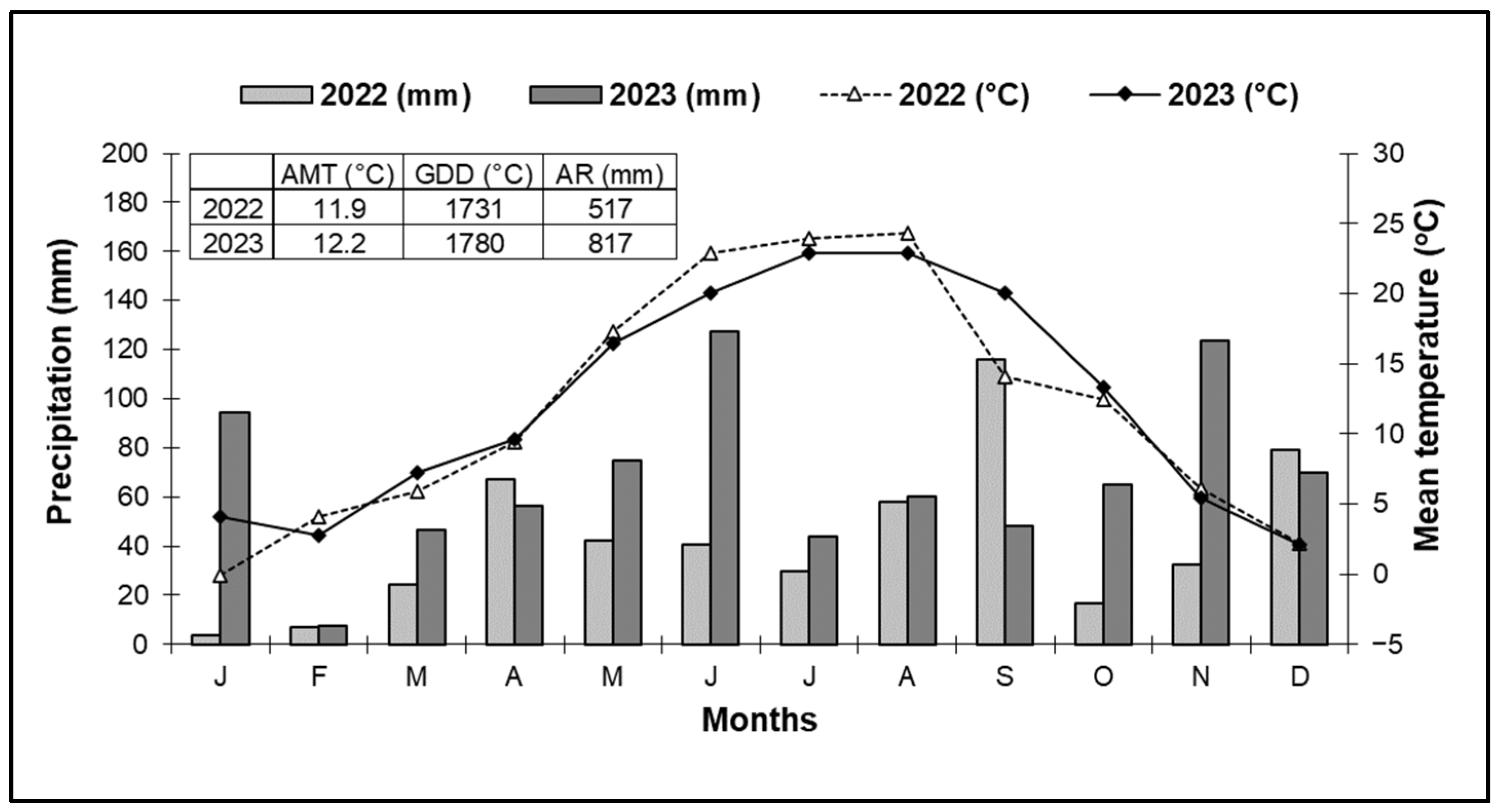
Both vintages deviated from the 60-year average for the area (Figure 2). Since the meteorological data were not subjected to statistical analysis, we cannot confirm whether these differences were significant. In the Kőlyuktető area, meteorological data has been collected every year since 1963. Average annual temperatures in 2022 (11.9 °C) and 2023 (12.2 °C) were both above the 60-year average (10.8 °C). However, the growing degree days (2022: 1731 °C; 2023: 1780 °C) showed no difference between the two years’ growing seasons (April to October). Annual precipitation was distinct (2022: 517 mm; 2023: 817 mm) compared to that of recent decades (591 mm). In addition to total precipitation, the monthly rainfall distribution is a critical factor in assessing growing conditions. In 2022, an unusually wet September created favorable conditions for Botrytis cinerea development. However, no significant issues were observed, as Kékfrankos is relatively resistant to bunch rot. In contrast, 2023 experienced above-average rainfall in May and June, complicating plant protection efforts. Nevertheless, effective vineyard management and timely phytosanitary interventions successfully mitigated disease and pest pressure in both seasons. The meteorological and experimental data presented below highlight the substantial influence of weather patterns—typical of the temperate continental climate—on vegetative development, yield quantity, and fruit quality.

3.2. Phenology

As expected, the later the pruning, the later the phenological stages occurred [7]. It is noteworthy that the difference between the two treatments was only a few days in 2023 compared to 2022. Nevertheless, the overall trends observed in both control and treated plants remained consistent across years. In 2022 (Table 2), the first late pruning (LP1) delayed the eight-leaves-folded stage by 14 days, while the second late pruning (LP2) caused a 21-day delay. The difference was also evident at the start of flowering, with LP1 and LP2 resulting in a 14-day and 21-day delay in this phenological stage, respectively. The developmental differences disappeared with veraison. In 2023 (Table 3), both late pruning treatments caused a delay of approximately two weeks in early phenology (beginning of bud burst, where green shoot tips are just visible and eight leaves are folded) and flowering. Between the control and treatments (LP1 and LP2), the differences disappeared only in full veraison.
These results demonstrate that late pruning significantly delays early vine development and, later on, this phenological stage postponing effect gradually diminishes. Late pruning is therefore proven to be a viable vineyard management tool to postpone the sensitive early phenological stage—involving budburst and flowering—to reduce spring frost risks [7]. However, this study deals with the effect of late pruning on analytical berry parameters and yield response.

3.3. Grape Juice Analysis

The grape juice results are presented in Table 4. In the 2022 vintage, neither late pruning, late apical leaf removal, nor their combination resulted in a significant difference in sugar content. There are also late pruning studies where sugar content remained unchanged, but these are a minority [32,33]. A significant decrease in °Brix values was only observed in the 2023 vintage, which was caused by the late apical defoliation of the control grapevines (CF). We also recorded minimal sugar reduction in LP1 and LP2F treatments. In other studies, late defoliation has also been shown to slow down sugar production [20,34,35,36], while some show no changes in this regard [11,37]. The results of the current study and the controversies amongst recent publications suggest that it is worth investigating the further impacts of this technique in forthcoming vintages and with other varieties. Titratable acidity and pH remained unchanged in both years after each treatment. This phenomenon is generally observed with leaf removal [19,20,35,38], but late pruning often resulted in higher titratable acidity values [7]. Data also show an increasing trend, especially in 2023, but these differences were not statistically significant. When examining malic acid, it is evident that this parameter was sensitive to certain treatments. In both vintages, the highest malic acid concentrations were measured in LP2. This phenomenon has already been observed with late pruning [12,15,26]. Interestingly, in 2023, the LP2 treatment combined with late apical leaf removal further increased malic acid levels, and the same was true for the 2022 CF treatment. There is a contradiction here, because several studies have shown a decrease in malic acid concentration in late defoliation treatments [37,39]. The contradictory effects of late pruning and defoliation on malic acid levels in grapevines can be attributed to interacting factors, such as the timing and severity of canopy interventions affecting vine source–sink balance and berry development [40]. Furthermore, environmental variability (e.g., temperature, sunlight) influences malate metabolism, cultivar-specific physiological responses, and the treatment time maturity stage’s modulation of subsequent malic acid biosynthesis or respiration, highlighting the complex and context-dependent nature of these practices on grape composition [41]. In any case, higher malic acid levels can give the wine more freshness, which is definitely positive in terms of quality [42]. At the same time, it should also be mentioned that higher malic acid content in red wines can lead to excessive acidity, resulting in a sharp or sour taste and an unbalanced mouthfeel [43]. This also increases the need for malolactic fermentation, which carries a risk of spoilage or off-flavors and may reduce wine stability due to malic acid’s susceptibility to microbial degradation [44].

3.4. Changes in Yield and Cane Parameters, and the Evolution of the Carbohydrate Content of the Xylem Sap

In the 2023 LP2 treatment, the effect of late pruning on bunch number per vine only resulted in a negative change (Table 5). Bunch size was not affected by leaf removal, but late pruning resulted in smaller bunches in both years (Table 5). Yield loss with late pruning has been shown in many studies [6,14,15,45,46], but some recorded no changes in this respect [25,47]. No clear berry size trend can be detected as a result of the treatments. In both years, there are decreasing trends in cane diameter and weight (Table 5) due to late pruning, something which is supported by other observations [12]. This negative trend raised the question of whether treatments affect the amount of grape carbohydrate reserves. The simplest method for determining this was xylem sap analysis. In the spring following the experimental years, canes were therefore left on the selected plants and xylem sap was collected by making a fresh pruning wound. During this process, the concentrations of three carbohydrates—glucose, fructose and myo-inositol—were determined. It should be mentioned that the experimental plants were not identical over the two years, because this study was designed to assess treatment effects within a given vintage, without considering inter-vintage variation. However, as far as we know, the carry-over effect from repeated late pruning is insignificant [25]. Based on the obtained results (shown in Table 6), it can be concluded that none of the treatments affected the carbohydrate levels in the plant, since the concentration of the measured compounds remained unchanged in the xylem sap in both years.

3.5. Grape Skin Total Phenolic Content

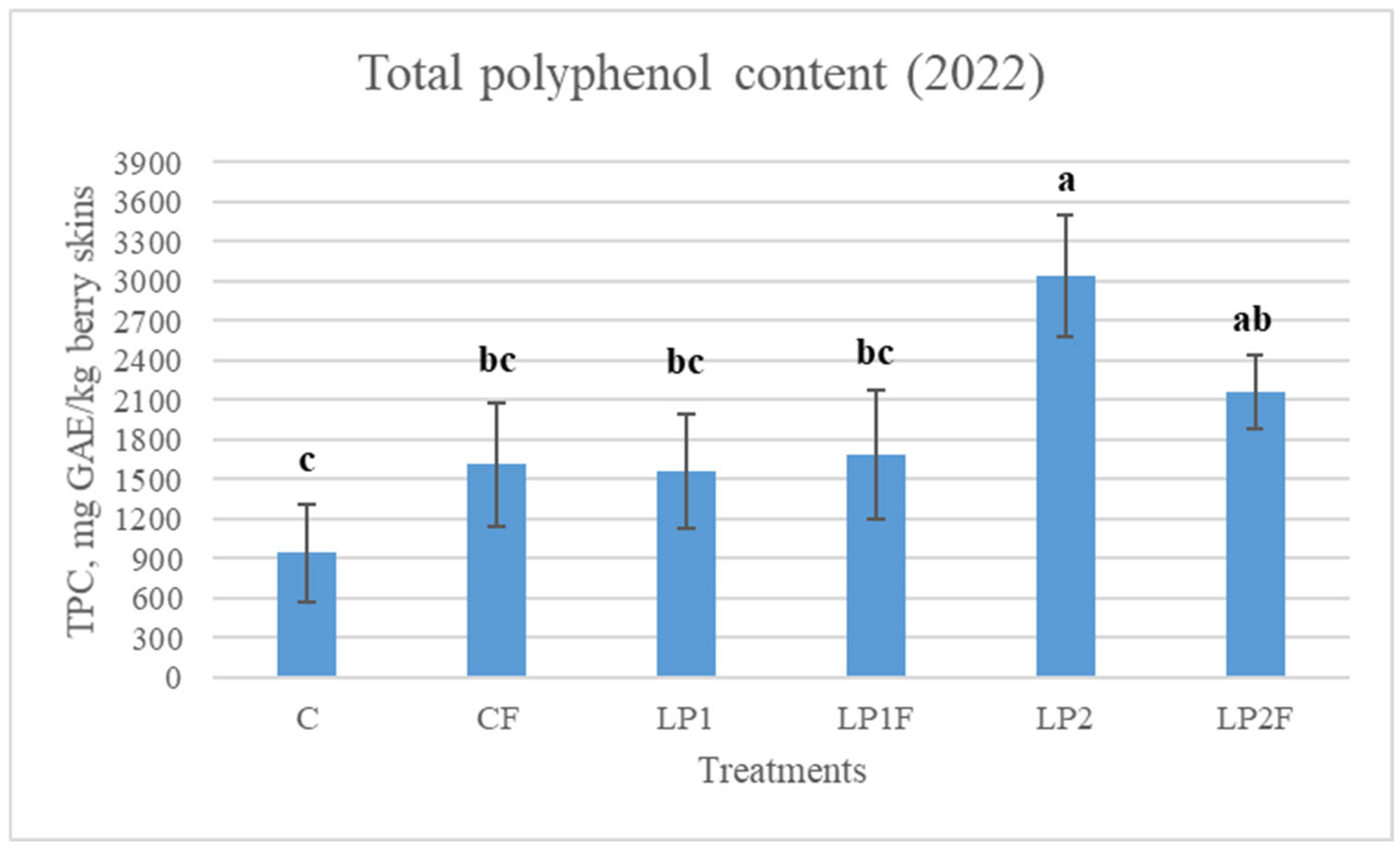
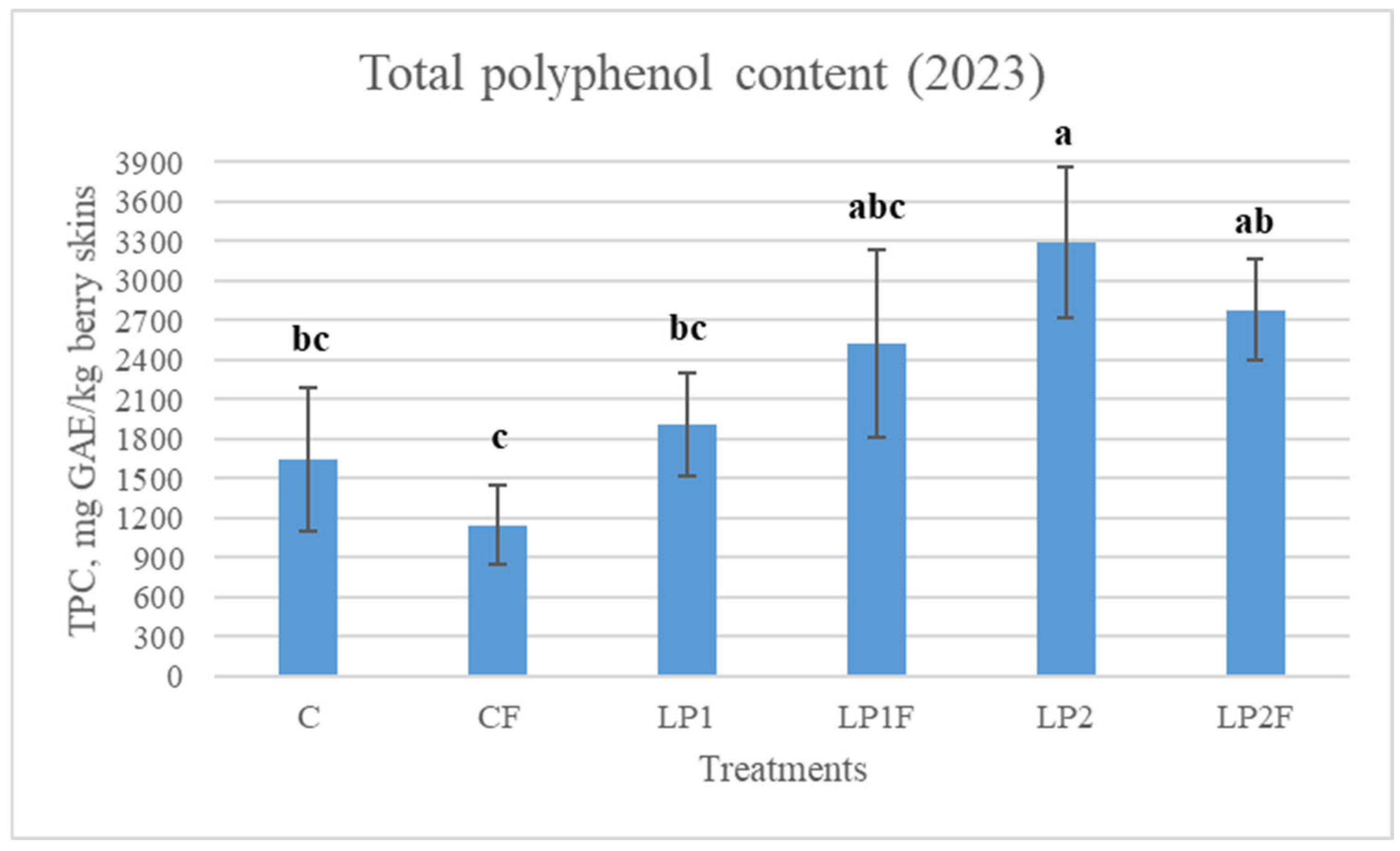
One of the most important results of this research is the total polyphenol content analysis, which reveals clear patterns and notable variations across different treatments and vintages (Figure 3 and Figure 4). In both 2022 and 2023, the LP2 treatment consistently resulted in the highest polyphenol concentrations, confirming that late pruning can act as a very effective technique in reaching a higher level of maturity and in trying to even out the imbalance between sugar and phenolic maturity during warm and extreme seasons. This finding is supported by a number of other studies [13,15,25,45,47,48,49]. Late pruning treatments can enhance polyphenol accumulation by delaying ripening, which extends berry development under cooler conditions favoring phenolic biosynthesis and reduces degradation [50]. This phenological shift allows for greater expression of key enzymes in the phenylpropanoid and flavonoid biosynthetic pathways (e.g., phenylalanine ammonia-lyase, chalcone synthase and flavonoid 3′-hydroxylase), promoting the synthesis and retention of anthocyanins, flavonols, and tannins during an extended biosynthetic window [51]. Even if veraison timing converges across treatments, late pruning can still modify the microclimatic and physiological context of berry development and impact ripening in ways that affect polyphenol biosynthesis. Late pruning temporarily limits leaf area expansion and photosynthetic activity early in the season. This modifies carbohydrate availability, hormonal signaling, and berry growth kinetics—effects that persist even after phenological synchronization. Although veraison timing appears similar, the metabolic state of berries and source–sink dynamics thus differ [47]. In 2022, only LP2F had higher polyphenol concentration than the control and in 2023, none of defoliation treatments differed from the control. Many studies demonstrate that total polyphenol levels are not affected by late leaf removal [19,21,34,52]. This can be confirmed with experimental results. Overall, polyphenol levels were higher in 2023 across most treatments, suggesting a positive influence from environmental or seasonal factors, though this year also showed greater variability, indicating less consistency in treatment responses. Finally, it is important to note that no difference was found in the berry skin to flesh ratio.

4. Conclusions

This study demonstrates that late canopy management practices—particularly late pruning 2 and late apical leaf removal—have notable effects on grapevine phenology, fruit composition, yield, and grape skin polyphenol content across two vintages. Late pruning consistently delayed phenological development, though developmental gaps narrowed by berry softening (BBCH-85), indicating seasonal compensation. While sugar content remained mostly unaffected, late defoliation reduced °Brix in 2023, and malic acid levels increased significantly under LP2, suggesting potential for acid retention in warmer climates. Yield and cane size were negatively affected by LP2, confirming trade-offs between reproductive and vegetative growth; however, xylem sap analysis revealed no significant carbohydrate reserve depletion. Most notably, LP2 treatment consistently enhanced total polyphenol content, supporting its role in improving phenolic maturity without increasing sugar levels—an important consideration under climate change. However, inter-annual and treatment variability points to strong environmental interactions. This study demonstrates LP2 and late apical defoliation as promising treatments for enhancing grape composition under current climatic conditions. However, to fully understand their potential and limitations, future research should evaluate their performance across multiple vintages, including those characterized by atypically warm or cold conditions. Additionally, examining the sensory attributes of wines produced under such treatments will provide critical insight into their commercial and consumer relevance. Long-term studies incorporating both viticultural and enological assessments will be essential in validating the consistency and robustness of these techniques across diverse environmental scenarios.

Author Contributions

Conceptualization, S.V.; methodology, S.V., K.P. and M.K.; software, S.V., K.P. and M.K.; validation, K.P. and M.K.; formal analysis, K.P. and M.K.; investigation, S.V.; resources, S.V.; data curation, K.P. and M.K.; writing—original draft preparation, S.V.; writing—review and editing, Z.Z.; supervision, Z.Z. All authors have read and agreed to the published version of the manuscript.

Funding

This research was funded by the “Research and development to improve sustainability and climate resilience of viticulture and oenology at the Eszterházy Károly Catholic University” (TKP2021-NKTA-16) grant from the National Research, Development, and Innovation Office.

Data Availability Statement

The original contributions presented in this study are included in the article. Further inquiries can be directed to the corresponding author.

Conflicts of Interest

The authors declare no conflicts of interest.

References

  1. van Leeuwen, C.; Destrac-Irvine, A.; Dubernet, M.; Duchêne, E.; Gowdy, M.; Marguerit, E.; Pieri, P.; Parker, A.; de Rességuier, L.; Ollat, N. An update on the impact of climate change in viticulture and potential adaptations. Agronomy 2019, 9, 514. [Google Scholar] [CrossRef]
  2. Santos, J.A.; Fraga, H.; Malheiro, A.C.; Moutinho-Pereira, J.; Dinis, L.-T.; Correia, C.; Moriondo, M.; Leolini, L.; Dibari, C.; Costafreda-Aumedes, S.; et al. A review of the potential climate change impacts and adaptation options for European viticulture. Appl. Sci. 2020, 10, 3092. [Google Scholar] [CrossRef]
  3. Dominguez, D.L.E.; Cirrincione, M.A.; Deis, L.; Martínez, L.E. Impacts of climate change-induced temperature rise on phenology, physiology, and yield in three red grape cultivars: Malbec, Bonarda, and Syrah. Plants 2024, 13, 3219. [Google Scholar] [CrossRef]
  4. Faralli, M.; Mallucci, S.; Bignardi, A.; Varner, M.; Bertamini, M. Four decades in the vineyard: The impact of climate change on grapevine phenology and wine quality in northern Italy. OENO One 2024, 58. [Google Scholar] [CrossRef]
  5. Wood, A.; Vargas Soto, S.; Gambetta, G.; Schober, D.; Jeffers, E.; Coulson, T. Modelling the climate changing concentrations of key red wine grape quality molecules using a flexible modelling approach. OENO One 2024, 58. [Google Scholar] [CrossRef]
  6. Allegro, G.; Pastore, C.; Valentini, G.; Filippetti, I. Post-budburst hand finishing of winter spur pruning can delay technological ripening without altering phenolic maturity of Merlot berries. Aust. J. Grape Wine Res. 2020, 26, 139–147. [Google Scholar] [CrossRef]
  7. Poni, S.; Sabbatini, P.; Palliotti, A. Facing spring frost damage in grapevine: Recent developments and the role of delayed winter pruning—A review. Am. J. Enol. Vitic. 2022, 73, 211–226. [Google Scholar] [CrossRef]
  8. Gutiérrez-Gamboa, G.; Zheng, W.; Martínez de Toda, F. Current viticultural techniques to mitigate the effects of global warming on grape and wine quality: A comprehensive review. Food Res. Int. 2021, 139, 109946. [Google Scholar] [CrossRef]
  9. Sun, Q.; Granco, G.; Groves, L.; Voong, J.; Van Zyl, S. Viticultural manipulation and new technologies to address environmental challenges caused by climate change. Climate 2023, 11, 83. [Google Scholar] [CrossRef]
  10. Vercesi, A.; Gabrielli, M.; Garavani, A.; Poni, S. Effects of apical, late-season leaf removal on vine performance and wine properties in Sangiovese grapevines (Vitis vinifera L.). Horticulturae 2024, 10, 929. [Google Scholar] [CrossRef]
  11. Pallotti, L.; Partida, G.; Laroche-Pinel, E.; Lanari, V.; Pedroza, M.; Brillante, L. Late-season source limitation practices to cope with climate change: Delaying ripening and improving colour of Cabernet-Sauvignon grapes and wine in a hot and arid climate. OENO One 2025, 59. [Google Scholar] [CrossRef]
  12. Gatti, M.; Pirez, F.J.; Chiari, G.; Tombesi, S.; Palliotti, A.; Merli, M.C.; Poni, S. Phenology, canopy aging and seasonal carbon balance as related to delayed winter pruning of Vitis vinifera L. cv. Sangiovese grapevines. Front. Plant Sci. 2016, 7, 659. [Google Scholar] [CrossRef]
  13. Palliotti, A.; Frioni, T.; Tombesi, S.; Sabbatini, P.; Cruz-Castillo, J.G.; Lanari, V.; Silvestroni, O.; Gatti, M.; Poni, S. Double-pruning grapevines as a management tool to delay berry ripening and control yield. Am. J. Enol. Vitic. 2017, 68, 412–421. [Google Scholar] [CrossRef]
  14. Petrie, P.R.; Brooke, S.J.; Moran, M.A.; Sadras, V.O. Pruning after budburst to delay and spread grape maturity. Aust. J. Grape Wine Res. 2017, 23, 378–389. [Google Scholar] [CrossRef]
  15. Gatti, M.; Pirez, F.J.; Frioni, T.; Squeri, C.; Poni, S. Calibrated, delayed-cane winter pruning controls yield and significantly postpones berry ripening parameters in Vitis vinifera L. cv. Pinot Noir. Aust. J. Grape Wine Res. 2018, 24, 305–316. [Google Scholar] [CrossRef]
  16. Ghiglieno, I.; Facciano, L.; Valenti, L.; Amari, F.; Cola, G. Evaluation of the impact of vine pruning periods on grape production and composition: An integrated approach considering different years and cultivars. OENO One 2025, 59. [Google Scholar] [CrossRef]
  17. Reta, K.; Netzer, Y.; Lazarovitch, N.; Fait, A. Canopy management practices in warm environment vineyards to improve grape yield and quality in a changing climate. A review A vademecum to vine canopy management under the challenge of global warming. Sci. Hortic. 2025, 341, 113998. [Google Scholar] [CrossRef]
  18. Poni, S.; Frioni, T.; Gatti, M. Summer pruning in Mediterranean vineyards: Is climate change affecting its perception, modalities, and effects? Front. Plant Sci. 2023, 14, 1227628. [Google Scholar] [CrossRef] [PubMed]
  19. Palliotti, A.; Panara, F.; Silvestroni, O.; Lanari, V.; Sabbatini, P.; Howell, G.S.; Gatti, M.; Poni, S. Influence of mechanical postveraison leaf removal apical to the cluster zone on delay of fruit ripening in Sangiovese (Vitis vinifera L.) grapevines. Aust. J. Grape Wine Res. 2013, 19, 369–377. [Google Scholar] [CrossRef]
  20. Caccavello, G.; Giaccone, M.; Scognamiglio, P.; Forlani, M.; Basile, B. Influence of intensity of post-veraison defoliation or shoot trimming on vine physiology, yield components, berry and wine composition in Aglianico grapevines. Aust. J. Grape Wine Res. 2017, 23, 226–239. [Google Scholar] [CrossRef]
  21. Zhang, P.; Wu, X.; Needs, S.; Liu, D.; Fuentes, S.; Howell, K. The influence of apical and basal defoliation on the canopy structure and biochemical composition of Vitis vinifera cv. Shiraz grapes and wine. Front. Chem. 2017, 5, 48. [Google Scholar] [CrossRef] [PubMed]
  22. National Council of the Wine Communities. 2025. Available online: https://djrowwfyvvz5i.cloudfront.net/production/documents/magyarorszag---borszolovel-beultetett-terulet-20250731.pdf (accessed on 27 October 2025).
  23. Frioni, T.; Romanini, E.; Pagani, S.; Del Zozzo, F.; Lambri, M.; Vercesi, A.; Gatti, M.; Poni, S.; Gabrielli, M. Reintroducing autochthonous minor grapevine varieties to improve wine quality and viticulture sustainability in a climate change scenario. Aust. J. Grape Wine Res. 2023, 2023, 1482548. [Google Scholar] [CrossRef]
  24. Baltazar, M.; Castro, I.; Gonçalves, B. Adaptation to climate change in viticulture: The role of varietal selection—A review. Plants 2025, 14, 104. [Google Scholar] [CrossRef]
  25. Moran, M.A.; Sadras, V.O.; Petrie, P.R. Late pruning and carry-over effects on phenology, yield components and berry traits in Shiraz. Aust. J. Grape Wine Res. 2017, 23, 390–398. [Google Scholar] [CrossRef]
  26. Villangó, S.; Szekeres, A.; Végvári, G.; Ficzek, G.; Simon, G.; Zsófi, Z. First experience of late pruning on Kékfrankos grapevine (Vitis vinifera L.) in Eger wine region (Hungary). Horticulturae 2024, 10, 1223. [Google Scholar] [CrossRef]
  27. Lorenz, D.H.; Eichhorn, K.W.; Bleiholder, H.; Klose, R.; Meier, U.; Weber, E. Growth stages of the grapevine: Phenological growth stages of the grapevine (Vitis vinifera L. ssp. vinifera)—Codes and descriptions according to the extended BBCH scale†. Aust. J. Grape Wine Res. 1995, 1, 100–103. [Google Scholar] [CrossRef]
  28. OIV. Compendium of International Methods of Wine and Must Analysis International Organisation of Vine and Wine. 2023. Available online: https://www.oiv.int/standards/compendium-of-international-methods-of-wine-and-must-analysis (accessed on 27 October 2025).
  29. Zheng, T.; Haider, M.S.; Zhang, K.; Jia, H.; Fang, J. Biological and functional properties of xylem sap extracted from grapevine (cv. Rosario Bianco). Sci. Hortic. 2020, 272, 109563. [Google Scholar] [CrossRef]
  30. Kontoudakis, N.; Esteruelas, M.; Fort, F.; Canals, J.M.; Zamora, F. Comparison of methods for estimating phenolic maturity in grapes: Correlation between predicted and obtained parameters. Anal. Chim. Acta 2010, 660, 127–133. [Google Scholar] [CrossRef] [PubMed]
  31. Patonay, K.; Szalontai, H.; Csugány, J.; Szabó-Hudák, O.; Kónya, E.P.; Németh, É.Z. Comparison of extraction methods for the assessment of total polyphenol content and in vitro antioxidant capacity of horsemint (Mentha longifolia (L.) L.). J. Appl. Res. Med. Aromat. Plants 2019, 15, 100220. [Google Scholar] [CrossRef]
  32. Persico, M.J.; Smith, D.E.; Centinari, M. Delaying budbreak to reduce freeze damage: Seasonal vine performance and wine composition in two Vitis vinifera cultivars. Am. J. Enol. Vitic. 2021, 72, 346–357. [Google Scholar] [CrossRef]
  33. Bustos Morgani, M.; Fanzone, M.; Perez Peña, J.E.; Sari, S.; Gallo, A.E.; Gómez Tournier, M.; Prieto, J.A. Late pruning modifies leaf to fruit ratio and shifts maturity period, affecting berry and wine composition in Vitis vinífera L. cv. ‘Malbec’ in Mendoza, Argentina. Sci. Hortic. 2023, 313, 111861. [Google Scholar] [CrossRef]
  34. Poni, S.; Gatti, M.; Bernizzoni, F.; Civardi, S.; Bobeica, N.; Magnanini, E.; Palliotti, A. Late leaf removal aimed at delaying ripening in cv. Sangiovese: Physiological assessment and vine performance. Aust. J. Grape Wine Res. 2013, 19, 378–387. [Google Scholar] [CrossRef]
  35. Lu, H.-C.; Wang, Y.; Cheng, C.-F.; Chen, W.; Li, S.-D.; He, F.; Duan, C.-Q.; Wang, J. Distal leaf removal made balanced source-sink vines, delayed ripening, and increased flavonol composition in Cabernet Sauvignon grapes and wines in the semi-arid Xinjiang. Food Chem. 2022, 366, 130582. [Google Scholar] [CrossRef]
  36. Jahnke, G.; Szőke, B.Á.; Steckl, S.; Szövényi, Á.P.; Knolmajerné Szigeti, G.; Németh, C.; Jenei, B.G.; Nyitrainé Sárdy, D.Á. Delay in the ripening of wine grapes: Effects of specific phytotechnical methods on harvest parameters. Agronomy 2023, 13, 1963. [Google Scholar] [CrossRef]
  37. Tessarin, P.; Parpinello, G.P.; Rombolà, A.D. Physiological and enological implications of postveraison trimming in an organically-managed Sangiovese vineyard. Am. J. Enol. Vitic. 2018, 69, 59–69. [Google Scholar] [CrossRef]
  38. Assefa, M.K.; Creasy, G.L.; Hofmann, R.W.; Parker, A.K. Changes in total soluble solids concentration, fruit acidity, and yeast assimilable nitrogen in response to altered leaf area to fruit weight ratio in Pinot noir. OENO One 2024, 58. [Google Scholar] [CrossRef]
  39. Gatti, M.; Garavani, A.; Krajecz, K.; Ughini, V.; Parisi, M.G.; Frioni, T.; Poni, S. Mechanical mid-shoot leaf removal on Ortrugo (Vitis vinifera L.) at pre- or mid-veraison alters fruit growth and maturation. Am. J. Enol. Vitic. 2019, 70, 88–97. [Google Scholar] [CrossRef]
  40. Martínez-Lüscher, J.; Kurtural, S.K. Same season and carry-over effects of source-sink adjustments on grapevine yields and non-structural carbohydrates. Front. Plant Sci. 2021, 12, 695319. [Google Scholar] [CrossRef] [PubMed]
  41. Bertamini, M.; Faralli, M. Late pruning and forced vine regrowth in Chardonnay and Pinot Noir: Benefits and drawbacks in the Trento DOC Basin (Italy). Agronomy 2023, 13, 1202. [Google Scholar] [CrossRef]
  42. Michelini, S.; Tomada, S.; Kadison, A.E.; Pichler, F.; Hinz, F.; Zejfart, M.; Iannone, F.; Lazazzara, V.; Sanoll, C.; Robatscher, P.; et al. Modeling malic acid dynamics to ensure quality, aroma and freshness of Pinot blanc wines in South Tyrol (Italy). OENO One 2021, 55, 159–179. [Google Scholar] [CrossRef]
  43. Volschenk, H.; van Vuuren, H.J.J.; Viljoen-Bloom, M. Malic acid in wine: Origin, function and metabolism during vinification. S. Afr. J. Enol. Vitic. 2006, 27, 123–136. [Google Scholar] [CrossRef]
  44. Vicente, J.; Baran, Y.; Navascués, E.; Santos, A.; Calderón, F.; Marquina, D.; Rauhut, D.; Benito, S. Biological management of acidity in wine industry: A review. Int. J. Food Microbiol. 2022, 375, 109726. [Google Scholar] [CrossRef]
  45. Frioni, T.; Tombesi, S.; Silvestroni, O.; Lanari, V.; Bellincontro, A.; Sabbatini, P.; Gatti, M.; Poni, S.; Palliotti, A. Postbudburst spur pruning reduces yield and delays fruit sugar accumulation in Sangiovese in central Italy. Am. J. Enol. Vitic. 2016, 67, 419–425. [Google Scholar] [CrossRef]
  46. Silvestroni, O.; Lanari, V.; Lattanzi, T.; Palliotti, A. Delaying winter pruning, after pre-pruning, alters budburst, leaf area, photosynthesis, yield and berry composition in Sangiovese (Vitis vinifera L.). Aust. J. Grape Wine Res. 2018, 24, 478–486. [Google Scholar] [CrossRef]
  47. Zheng, W.; García, J.; Balda, P.; Martínez de Toda, F. Effects of late winter pruning at different phenological stages on vine yield components and berry composition in La Rioja, North-central Spain. OENO One 2017, 51, 363. [Google Scholar] [CrossRef]
  48. Moran, M.A.; Bastian, S.E.; Petrie, P.R.; Sadras, V.O. Late pruning impacts on chemical and sensory attributes of Shiraz wine. Aust. J. Grape Wine Res. 2018, 24, 469–477. [Google Scholar] [CrossRef]
  49. Buesa, I.; Yeves, A.; Sanz, F.; Chirivella, C.; Intrigliolo, D.S. Effect of delaying winter pruning of Bobal and Tempranillo grapevines on vine performance, grape and wine composition. Aust. J. Grape Wine Res. 2021, 27, 94–105. [Google Scholar] [CrossRef]
  50. Yamane, T.; Jeong, S.T.; Goto-Yamamoto, N.; Koshita, Y.; Kobayashi, S. Effects of temperature on anthocyanin biosynthesis in grape berry skins. Am. J. Enol. Vitic. 2006, 57, 54–59. [Google Scholar] [CrossRef]
  51. Rienth, M.; Torregrosa, L.; Sarah, G.; Ardisson, M.; Brillouet, J.-M.; Romieu, C. Temperature desynchronizes sugar and organic acid metabolism in ripening grapevine fruits and remodels their transcriptome. BMC Plant Biol. 2016, 16, 164. [Google Scholar] [CrossRef]
  52. Assefa, M.K.; Creasy, G.L.; Hofmann, R.W.; Parker, A.K. Asynchronous accumulation of sugar and phenolics in grapevines following post-veraison leaf removal. OENO One 2025, 59. [Google Scholar] [CrossRef]

Figure 1. Experimental design. Different blocks with all treatments randomly allocated within two adjacent rows. Each plot (replicate) contains 10 vines, meaning 30 total vines for each treatment. Treatments: C (control); CF (late apical defoliation); LP1 (late pruning 1); LP1F (late pruning 1 + late apical defoliation); LP2 (late pruning 2); LP2F (late pruning 2+late apical defoliation).
Horticulturae 11 01450 g001
Figure 2. Evolution of monthly mean temperatures and precipitation totals at the experiment site in 2022 and 2023. AMT: annual mean temperature (°C); GDD: growing degree days during the growing season (April to October) (°C); AR: annual rainfall (mm).
Horticulturae 11 01450 g002
Figure 3. Effect of treatments on the total polyphenol content of grape skin (2022). Each value represents the average ± standard error of three replicates (p < 0.05). Values marked with different Roman letters mean significant differences between treatments. Treatments: C (control); CF (late apical defoliation); LP1 (late pruning 1); LP1F (late pruning 1 + late apical defoliation); LP2 (late pruning 2); LP2F (late pruning 2 + late apical defoliation).
Horticulturae 11 01450 g003
Figure 4. Effect of treatments on the total polyphenol content of grape skin (2023). Each value represents the average ± standard error of 3 replicates (p < 0.05). Values marked with different Roman letters mean significant differences between treatments. Treatments: C (control); CF (late apical defoliation); LP1 (late pruning 1); LP1F (late pruning 1 + Late apical defoliation); LP2 (late pruning 2); LP2F (late pruning 2 + late apical defoliation).
Horticulturae 11 01450 g004
Table 1. Treatment summary.
Treatment
Abbreviation
Treatment
Description
TreatmentDetails
Late
Pruning 1
Late
Pruning 2
Late
Apical
Defoliation
CControl Pruning was performed at dormancy (BBCH-00)
No apical defoliation was applied
CFLate apical defoliation Late apical defoliation was carried out when the berries reached about 16 °Brix in both years
LP1Late pruning 1 Late pruning 1 was performed when the control vines reached BBCH-14: four leaves folded
LP1FLate pruning 1 +
Late apical defoliation
Combination of LP1 and CF
LP2Late pruning 2 Late pruning 2 was carried out when the control vines reached BBCH-18: eight leaves folded
LP2FLate pruning 2 +
Late apical defoliation
Combination of LP2 and CF
Table 2. Evolution of phenological stages (BBCH scale) in relation to late pruning (2022).
2022DOYPrincipal Growth Stages (BBCH-Code) for Each Treatment
CLP1LP2
8 April981 (Beginning of bud swelling)00
13 April1033 (End of bud swelling)00
29 April11911 (First leaf unfolded)33
5 May (Late pruning 1)12514 (Four leaves unfolded)55
12 May (Late pruning 2)13218 (Eight leaves unfolded)95
19 May13955 (Inflorescence swelling)1611
26 May14657 (Inflorescences fully developed)1814
02 June15360 (First flowerhoods detached from the receptacle)5318
10 June16168 (80% of flowerhoods fallen)5753
20 June17173 (Groat-sized berries)6963
30 June18175 (Pea-sized berries)7169
11 July19277 (Beginning of berry touch)7573
22 July20379 (Berry touch complete)7775
4 August21681 (Beginning of ripening)8181
12 August22485 (Softening of berries)8383
19 August23185 (Softening of berries)8585
The row in bold shows when both late pruning treatments outperformed the control in development. DOY (day of year); C (control); LP1 (late pruning 1); LP2 (late pruning 2).
Table 3. Evolution of phenological stages (BBCH scale) in relation to late pruning (2023).
2023DOYPrincipal Growth Stages (BBCH-Code) for Each Treatment
CLP1LP2
4 April941 (Beginning of bud swelling)00
11 April1013 (End of bud swelling)00
17 April1077 (Beginning of bud burst)00
28 April1188 (Bud burst)11
2 May (Late pruning 1)12214 (Four leaves unfolded)33
9 May (Late pruning 2)12918 (Eight leaves unfolded)73
18 May13853 (Inflorescences clearly visible)129
26 May14655 (Inflorescences swelling)1412
1 June15257 (Inflorescences fully developed)1814
9 June16061 (Beginning of flowering: 10% of flowerhoods fallen)5753
14 June16565 (Full flowering: 50% of flowerhoods fallen)6157
19 June17068 (80% of flowerhoods fallen)6360
23 June17471 (Fruit set)6863
3 July18475 (Berries pea-sized)7371
10 July19177 (Berries beginning to touch)7573
20 July20179 (Majority of berries touching)7775
2 August21479 (Majority of berries touching)7977
8 August22081 (Beginning of ripening)7979
14 August22683 (Berries developing colour)8181
21 August23385 (Softening of berries)8383
30 August24285 (Softening of berries)8585
The row in bold shows when both late pruning treatments outperformed the control in development. DOY (day of year); C (control); LP1 (late pruning 1); LP2 (late pruning 2).
Table 4. Grape juice parameters.
ParameterVintageTreatment
CCFLP1LP1FLP2LP2F
°Brix202222.4 ± 0.8 a21.9 ± 0.4 a22.6 ± 0.4 a22.2 ± 1.6 a22.7 ± 0.4 a23.1 ± 0.7 a
202323.0 ± 0.9 a20.7 ± 0.3 b22.2 ± 0.4 ab22.3 ± 0.4 a22.5 ± 0.7 a22.2 ± 0.5 ab
Titratable acidity (g/L)20224.6 ± 0.3 a4.2 ± 0.3 a4.5 ± 0.3 a4.8 ± 0.5 a4.7 ± 0.3 a4.8 ± 0.3 a
20236.8 ± 0.5 a6.8 ± 0.5 a7.3 ± 0.9 a6.9 ± 1.2 a8.2 ± 0.6 a8.5 ± 0.8 a
pH20223.22 ± 0.04 a3.25 ± 0.08 a3.30 ± 0.05 a3.19 ± 0.05 a3.25 ± 0.05 a3.28 ± 0.08 a
20233.19 ± 0.09 a3.26 ± 0.06 a3.17 ± 0.08 a3.17 ± 0.12 a3.09 ± 0.01 a3.07 ± 0.07 a
Malic acid (g/L)20221.0 ± 0.2 c1.5 ± 0.1 ab1.1 ± 0.3 bc1.1 ± 0.2 bc2.0 ± 0.1 a2.0 ± 0.2 a
20232.5 ± 0.2 c2.7 ± 0.1 bc2.8 ± 0.2 bc2.6 ± 0.2 c3.3 ± 0.5 ab3.7 ± 0.2 a
Each value represents the average ± standard error of three replicates (p < 0.05). Values marked with different Roman letters mean significant differences between treatments. Treatments: C (Control); CF (Late apical defoliation); LP1 (Late pruning 1); LP1F (Late pruning 1 + Late apical defoliation); LP2 (Late pruning 2); LP2F (Late pruning 2+Late apical defoliation).
Table 5. Grapevine yield parameters.
ParameterVintageTreatment
CCFLP1LP1FLP2LP2F
Bunch/vine202213.2 ± 3.3 a 14.9 ± 3.5 a 12.6 ± 5.1 a
20239.3 ± 3.0 a 7.9 ± 1.7 a 5.5 ± 1.4 b
Bunch weight (g)2022188 ± 88 ab218 ± 58 a106 ± 30 c147 ± 33 abc117 ± 34 bc118 ± 59 bc
2023298 ± 102 a248 ± 83 ab189 ± 100 bc126 ± 43 cd81 ± 38 d102 ± 54 d
Weight of 100 berries (g)20221.61 ± 0.30 bc1.30 ± 0.28 d1.53 ± 0.29 c1.50 ± 0.26 c1.69 ± 0.29 ab1.77 ± 0.29 a
20231.90 ± 0.40 a1.92 ± 0.32 a2.03 ± 0.30 a1.71 ± 0.37 b1.52 ± 0.41 c1.51 ± 0.36 c
Cane diameter (mm)20228.24 ± 0.93 a7.62 ± 1.05 ab7.03 ± 1.25 b6.98 ± 0.98 b6.81 ± 1.18 b6.58 ± 1.17 b
20237.56 ± 1.28 a7.60 ± 0.95 a6.64 ± 0.78 ab6.92 ± 1.08 ab6.09 ± 0.65 b6.02 ± 0.88 b
Cane weight/vine (kg)20220.41 ± 0.08 a0.36 ± 0.06 abc0.29 ± 0.07 bc0.37 ± 0.05 ab0.31 ± 0.07 abc0.24 ± 0.02 c
20230.37 ± 0.05 a0.34 ± 0.05 a0.24 ± 0.03 bc0.29 ± 0.06 ab0.19 ± 0.01 c0.23 ± 0.04 bc
Each value represents the average ± standard error of 15 replicates (p < 0.05). Values marked with different Roman letters mean significant differences between treatments. Treatments: C (control); CF (late apical defoliation); LP1 (late pruning 1); LP1F (late pruning 1+late apical defoliation); LP2 (late pruning 2); LP2F (late pruning 2+late apical defoliation).
Table 6. Xylem sap analysis.
ParameterVintageTreatment
CCFLP1LP1FLP2LP2F
Glucose (mg/L)2022256.6 ± 32.9293.1 ± 50.5222.3 ± 57.9226.8 ± 38.0206.1 ± 126.9244.9 ± 6.1
2023181.0 ± 66.7244.4 ± 86.3198.0 ± 74.1204.8 ± 139.3214.7 ± 63.3260.6 ± 10.1
Fructose (mg/L)202238.0 ± 5.345.4 ± 6.933.8 ± 10.843.4 ± 23.737.8 ± 6.243.5 ± 10.1
202331.0 ± 1.939.3 ± 21.837.0 ± 5.253.4 ± 13.337.8 ± 11.250.9 ± 10.1
Myo-inositol (mg/L)202247.7 ± 8.356.4 ± 10.759.2 ± 16.535.2 ± 8.941.4 ± 28.136.8 ± 10.1
202319.7 ± 5.526.6 ± 14.422.5 ± 9.123.4 ± 2.321.1 ± 3.430.4 ± 10.1
Each value represents the average ± standard error of four replicates (p < 0.05). There was no significant statistical difference between any of the treatments in any vintage. Treatments: C (control); CF (late apical defoliation); LP1 (late pruning 1); LP1F (late pruning 1 + late apical defoliation); LP2 (late pruning 2); LP2F (late pruning 2 + late apical defoliation).
Disclaimer/Publisher’s Note: The statements, opinions and data contained in all publications are solely those of the individual author(s) and contributor(s) and not of MDPI and/or the editor(s). MDPI and/or the editor(s) disclaim responsibility for any injury to people or property resulting from any ideas, methods, instructions or products referred to in the content.