Article

The Transcription Factor CaMADS1 Regulates Anthocyanin Biosynthesis in Pepper Leaves

Key Laboratory of Vegetable Biology of Yunnan Province, College of Landscape and Horticulture, Yunnan Agricultural University, Kunming 650201, China
*
Authors to whom correspondence should be addressed.
These authors contributed equally to this work.
Horticulturae 2025, 11(11), 1399; https://doi.org/10.3390/horticulturae11111399
Submission received: 17 October 2025 / Revised: 5 November 2025 / Accepted: 18 November 2025 / Published: 19 November 2025
(This article belongs to the Special Issue Genomics and Genetic Diversity in Vegetable Crops)

Abstract

The MADS-box transcription factor family is involved in regulating plant root germination, flowering, fruit development, maturation, and the biosynthesis of secondary metabolites. To investigate the role of MADS-box transcription factors in anthocyanin biosynthesis, this study utilized the pepper cultivar ‘CS03’ as experimental material. A transcription factor, CaMADS1, was selected from our previous transcriptome data for cloning and bioinformatic analysis. The results revealed that the CaMADS1 protein is localized to the nucleus. Quantitative real-time PCR analysis demonstrated that CaMADS1 is predominantly expressed in leaves. In CaMADS1-silenced plants, anthocyanin accumulation in the leaves decreased, which was consistent with the downregulated expression of structural genes in the biosynthesis pathway. In CaMADS1-overexpressing plants, both anthocyanin accumulation and the expression of these structural genes were elevated. Yeast one-hybrid and Dual-luciferase assays confirmed the interaction between CaMADS1 and the promoter of CaC4H, which encodes a key enzyme in anthocyanin biosynthesis. These results demonstrate that CaMADS1 positively regulates anthocyanin biosynthesis in pepper by directly binding to the promoter of the CaC4H gene.

1. Introduction

Capsicum annuum L., an annual or biennial species within the Solanaceae family, was introduced to China during the late Ming and early Qing dynasties. Its dissemination followed a defined trajectory: initially entering along Lingnan region, then spreading through Guizhou to establish cultivation hubs in Sichuan and Hunan provinces. This migration pattern ultimately formed the Yangtze River mid-upper basin as a primary cultivation zone [1]. Since then, it has taken root, flourished, and exerted a profound impact on China’s economic and social development. Peppers are utilized in various sectors such as medical, food, and industrial fields. Additionally, they possess significant edible, economic, and social value, earning widespread popularity among consumers both domestically and internationally [2]. The purple pepper is a variety highly valued for its ornamental appeal, possessing excellent comprehensive resistance. Its plants exhibit traits such as heat tolerance, drought resistance, and disease resistance, making them suitable for potted ornamental use, landscape design, culinary purposes, and as raw material for natural pigment extraction [3,4]. The leaves of purple peppers are rich in anthocyanins, polyphenols, and vitamins, which contribute to their high nutritional value. Their mineral content—including calcium, iron, and zinc—is significantly higher than that of common vegetable leaves, and they are also abundant in dietary fiber. This makes purple pepper a highly promising new functional vegetable resource [5,6].
Anthocyanins belong to an important class of flavonoid compounds [7]. In agricultural production, the vibrant colors imparted by flavonoids—the major pigments for red, blue, and purple hues—are not only visually appealing but also ecologically significant for attracting pollinators, thereby granting plants considerable ornamental and economic value [8]. Functionally, high anthocyanin content protects plants from excessive light stress through chemical scavenging, which involves exerting antioxidant activity to eliminate reactive oxygen species [9]. In addition to their role in abiotic stress resistance, anthocyanins also contribute to plant defense against biotic stresses. For example, anthocyanins extracted from rice leaves have been shown to inhibit the growth of Xanthomonas oryzae, thereby supporting normal plant development [10]. In processing applications, as natural polyphenols, anthocyanins exhibit strong antioxidant capacity and can help prevent various diseases [11]. Consequently, research on anthocyanins has attracted increasing attention and has become a hotspot in the field of plant secondary metabolism. Compared to common peppers, purple peppers contain significantly higher levels of anthocyanins, which is the key reason for the purple coloration of their stems, leaves, flowers, and immature fruits [12]. This characteristic makes purple peppers an ideal material for studying the synthesis and regulation of anthocyanins [13]. Elucidating the anthocyanin biosynthesis pathway in their leaves will open up new research directions for the genetic improvement and quality breeding of peppers. The biosynthesis of anthocyanins in plants is regulated by transcription factors that respond to the environment and activate/repress structural genes [14]. The well-characterized anthocyanin pathway initiates from phenylalanine and proceeds through the phenylpropanoid pathway (catalyzed by phenylalanine ammonia-lyase (PAL) and cinnamate 4-hydroxylase (C4H)) and the flavonoid pathway (involving chalcone synthase (CHS), chalcone isomerase (CHI), flavanone 3-hydroxylase (F3H), dihydroflavonol 4-reductase (DFR), anthocyanidin synthase (ANS), and UDP-glucose:flavonoid 3-O-glucosyltransferase (UFGT)) to produce diverse anthocyanin derivatives [15]. At the transcriptional level, the metabolic regulation of anthocyanins primarily depends on the binding of specific transcription factors to the promoters of structural genes or the formation of protein complexes through interactions, thereby activating downstream regulatory networks. A key regulator is the MBW complex, consisting of R2R3-MYB, bHLH, and WD40 proteins. For instance, in roses, distinct MBW complexes formed by RcMYB1, RcbHLH42, and RcTTG1 have been shown to modulate anthocyanin accumulation [16]. Similarly, studies in persimmon fruit have demonstrated that the MBW complex directly binds to the promoter of the ANR gene, precisely regulating the biosynthesis of proanthocyanidins [17]. Furthermore, the regulatory complexity is underscored by findings in grape, where the transcription factor VvWRKY26 interacts with the canonical MBW complex under salicylic acid induction, forming a VvMYBPA1/PA2-VvWDR1-VvMYC2-VvWRKY26 complex that significantly enhances the transcriptional activity of the proanthocyanidin biosynthesis pathway [18]. Notably, this regulatory capacity can even extend to repression, as demonstrated in Tartary buckwheat, where FtMYB22 integrates into an MBW complex to negatively regulate anthocyanin synthesis [19]. Beyond the core MBW machinery, anthocyanin biosynthesis is fine-tuned by other transcription factor families and environmental signals, which often act by modulating the MBW complex itself. For instance, in apple, the bZIP protein MdHY5 upregulates MdMYB10 to enhance anthocyanin production [20], while in citrus, CitWRKY75 activates CitRuby1 expression, thereby expanding the known regulatory network for anthocyanin biosynthesis [21]. Similarly, studies in pear have demonstrated that PpWRKY44 promotes anthocyanin biosynthesis through direct regulation of PpMYB10 expression [22]. These examples collectively illustrate that auxiliary TFs frequently operate either upstream of the MBW complex—by controlling the expression of its key components—or through parallel pathways that ultimately integrate with this central regulatory network. Furthermore, environmental cues such as light, temperature, sugars, and hormones are integrated into this regulatory network [23]. In eggplant, a light-dependent jasmonate signaling pathway enables SmMYB5 to interact with SmTT8, synergistically activating genes like SmF3H and SmANS [24]. Similarly, under low-temperature stress in tomato seedlings, the bZIP factor SlAREB1 regulates anthocyanin biosynthesis via the ABA-dependent pathway by binding to promoters of SlDFR and SlF3′5′H [25]. Collectively, these studies demonstrate that anthocyanin biosynthesis in horticultural crops is orchestrated by a hierarchical and interactive network. The MBW complex constitutes the central regulatory module, whose activity is precisely calibrated by a suite of auxiliary transcription factors and environmental signal transduction pathways.
MADS-box transcription factors are involved in multiple biological processes of plant growth and development, including rooting, germination, flowering, fruit set, and fruit ripening. They play crucial regulatory roles throughout the plant life cycle. Studies have shown that MADS-box transcription factors participate in the regulation of fruit color transition, including both positive and negative control of anthocyanin biosynthesis. For instance, FcMADS9 in fig and IbMADS10 in sweet potato have been reported to promote anthocyanin accumulation in calli [26,27]. The SQUAMOSA-like MADS-box transcription factor VmTDR4 plays an important role in anthocyanin accumulation during normal blueberry fruit ripening, likely by directly or indirectly regulating transcription factors belonging to the R2R3 MYB family [28]. In contrast, ectopic expression of strawberry FaMADS6 inhibits anthocyanin biosynthesis in both tobacco and Arabidopsis [29]. FaMADS6 acts as a repressor of anthocyanin accumulation in strawberry fruit ripening by directly downregulating the expression of FaMYB10 and ABA biosynthesis [30]. In cineraria (Pericallis hybrida), MADS-box transcription factors ScAG and ScAGL11 have been found to repress anthocyanin synthesis in ray florets, thereby influencing the formation of flower color patterns [31].
While the roles of MADS-box transcription factors in anthocyanin biosynthesis have been well-established in species such as tomato and apple, their specific regulatory mechanisms in pepper (Capsicum annuum) are an emerging field of research. Therefore, based on combined transcriptome and metabolome analysis, this study identified and cloned the CaMADS1 gene from the pepper cultivar CS03 and performed bioinformatic analysis of its encoded protein. The research further investigated the mechanism by which CaMADS1 regulates anthocyanin biosynthesis in pepper, aiming to provide a basis for subsequent functional characterization of CaMADS1 and to establish a theoretical framework for understanding the molecular mechanisms underlying CaMADS1-mediated leaf coloration in pepper.

2. Materials and Methods

2.1. Plant Materials

The plant material used in this study was the pepper (Capsicum annuum) cultivar ‘CS03’. Seeds were sown in plastic cell trays containing a standard potting mix and germinated under complete darkness at a constant temperature of 28 °C. Following germination, seedlings were transferred to a greenhouse facility at Yunnan Agricultural University (Kunming City, Yunnan Province, China), where they were cultivated under standard growth conditions (natural light, 25–28 °C, relative humidity 60–70%). The sowing was conducted in February 2025, and the seedlings were subsequently transplanted to the experimental field at the College of Landscape Architecture and Horticulture, Yunnan Agricultural University in May 2025. Field planting adhered to standard agronomic practices, including routine water–fertilizer management.

2.2. Cloning and Sequencing of the CaMADS1 Gene

Total RNA was extracted from CS03 pepper leaves using a commercial kit (Huayueyang Biotechnology Co., Ltd., Beijing, China), and cDNA was synthesized via reverse transcription with a corresponding kit (Yeasen Biotechnology Co., Ltd., Shanghai, China), followed by storage at –20 °C for subsequent use. Using the synthesized cDNA as a template, PCR amplification was performed with CaMADS1 (Capana04g000272). The amplified product was separated by 1% agarose gel electrophoresis, and the DNA fragment of the expected size was sent to Tsingke Biotechnology Co., Ltd. (Beijing, China) for sequencing to confirm the accuracy of the cloned target sequence. All the primer sequences are listed in Table S1.

2.3. Bioinformatic Analysis of CaMADS1

Homologous genes of CaMADS1 were retrieved from NCBI (https://www.ncbi.nlm.nih.gov, accessed on 15 July 2025), and protein sequences from 10 species were aligned using DNAMAN version 6.0. A phylogenetic tree was constructed with MEGA11.0 software and visualized using iTOL (https://itol.embl.de, accessed on 15 July 2025).

2.4. Subcellular Localization of CaMADS1

Using cDNA from CS03 leaves as the template, specific primers containing homologous arms were designed for PCR cloning. All the primer sequences are listed in Table S1. The gel-purified CaMADS1 PCR product was inserted into the plant transient fluorescent expression vector to generate the recombinant plasmid. The pCaMADS1-Cambia1300-GFP construct and the pCambia1300-GFP empty vector (as a control) were separately co-transformed with a vector containing the red fluorescent protein mCherry (as a nuclear marker) into tobacco leaves. After incubation under low-light conditions for 8–10 h, the subcellular localization of CaMADS1 was observed using a confocal laser scanning microscope (Japan, manufacturer: Nikon, equipment model: A1 MP+).

2.5. CaMADS1 Expression in Different Tissues

Root, stem, leaf, flower, and fruit tissues of pepper cultivar CS03 were sampled. Total RNA was extracted from each tissue using a commercial kit (Beijing Lanbolide Biotechnology Co., Ltd. Beijing, China) and reverse-transcribed into cDNA. Gene-specific primers for CaMADS1 were designed using the online tool Primer-blast. All the primer sequences are listed in Table S1. Quantitative real-time PCR (qRT-PCR) was performed to determine the expression levels of CaMADS1 across the different organs. For each tissue type, three biological replicates were included, and each replicate was assayed in three technical repetitions. The Actin gene was used as an internal reference, and the relative expression levels were calculated using the 2−∆∆ct method.

2.6. Gene Silencing and Overexpression of CaMADS1

A highly efficient and specific silencing fragment for CaMADS1 was identified using the SGN VIGS Tool (https://vigs.solgenomics.net, accessed on 15 July 2025), and specific primers were designed to amplify the fragment with restriction enzyme sites. This silencing fragment was inserted into the pTRV2 vector to generate pTRV2::CaMADS1. For overexpression, another pair of primers was used for PCR amplification. The resulting product was subsequently cloned into the p1301 vector to construct the p1301::CaMADS1 overexpression vector. When the cotyledons of CS03 plants were fully expanded, the abaxial sides of the leaves were infiltrated with Agrobacterium tumefaciens cultures harboring the following constructs: pTRV2::CaMADS1, pTRV2::00 (empty vector control for silencing), pTRV2::CaPDS (positive control for silencing), p1301::00 (empty vector control for overexpression), and p1301::CaMADS1. Infiltration was performed using a sterile syringe. After infiltration, the plants were first kept in a dark room for 48 h and then transferred to a growth chamber with a 16-h light/8-h dark cycle at a constant temperature. Tissue samples were collected from silenced plants showing visible phenotypic changes for subsequent experiments. All the primer sequences are listed in Table S1.

2.7. Determination of Anthocyanin Content

The anthocyanin content was measured following the instructions of the BoxBio-AKPL021C Plant Anthocyanin Content Assay Kit (Beijing Boxbio Science & Technology Co., Ltd., Beijing, China). Briefly, 0.1 g of plant leaf tissue was homogenized into a fine powder in liquid nitrogen. Extraction buffer was added, and the mixture was incubated at 60 °C for 30 min, followed by centrifugation at 12,000× g for 10 min at room temperature. The resulting supernatant was collected as the sample for analysis. The absorbance was measured at 530 nm and 700 nm. The anthocyanin content in pepper leaves was calculated using the formula provided by the kit’s protocol.

2.8. Yeast One-Hybrid Assay

The CDS of CaMADS1 was amplified using specific primers containing restriction sites and subsequently cloned into the pB42AD. Using genomic DNA extracted from CS03 leaves, a promoter fragment of CaC4H (Capana06g000272) was amplified with specific primers and inserted into the pLacZi to obtain the bait vector. All the primer sequences are listed in Table S1. The prey vector and bait vector plasmids were co-transformed into EGY48 yeast competent cells (Shanghai Weidi Biotechnology Co., Ltd., Shanghai, China). To assess the specific interaction between CaMADS1 and the CaC4H promoter, a negative control was included by co-transforming the pB42AD empty vector with the bait vector. A positive control, consisting of the pB42AD Control Vector and pLacZi Control Vector, was also set up to validate the experimental system. The transformed yeast cells were plated on SD/-Ura-Trp medium and incubated at 30 °C for 48 to 96 h. Subsequently, colonies were collected and spotted onto SD/-Ura-Trp plates containing Galactose/Raffinose and X-gal. After incubation at 30 °C for 24–48 h, the development of blue color was monitored to indicate a positive protein-DNA interaction.

2.9. Dual-Luciferase Assay

The coding sequence of CaMADS1 was amplified using specific primers cloned into the pGreenII-62-SK to generate the effector construct. The promoter sequence of CaC4H was amplified with primers and inserted into the pGreenII-0800-LUC vector to create the reporter construct. Both constructs were verified by sequencing and then transformed into Agrobacterium tumefaciens strain GV3101. Healthy leaves of Nicotiana benthamiana were selected and divided into four sectors. Each sector was infiltrated with one of the following four bacterial combinations: (1) effector empty vector + reporter empty vector, (2) effector empty vector + CaC4H-LUC, (3) CaMADS1 effector + reporter empty vector, and (4) CaMADS1 effector + CaC4H-LUC reporter. After infiltration, the plants were kept in the dark for 24 h followed by a 16-h light period. The infiltrated leaf areas were then sprayed with a 2.5 mM D-luciferin solution, adapted in the dark for 15 min, and finally subjected to in vivo imaging analysis.

2.10. Statistical Analysis

All data were analyzed using GraphPad Prism version 9.0 software. Significant differences between two groups were determined using an unpaired Student’s t-test. For comparisons among more than two groups, one-way analysis of variance was performed. A probability value (p-value) of less than 0.05 was considered statistically significant, and different lowercase letters above the bars in the figures denote significant differences (p < 0.05).

3. Results

3.1. Expression Analysis of CaMADS1

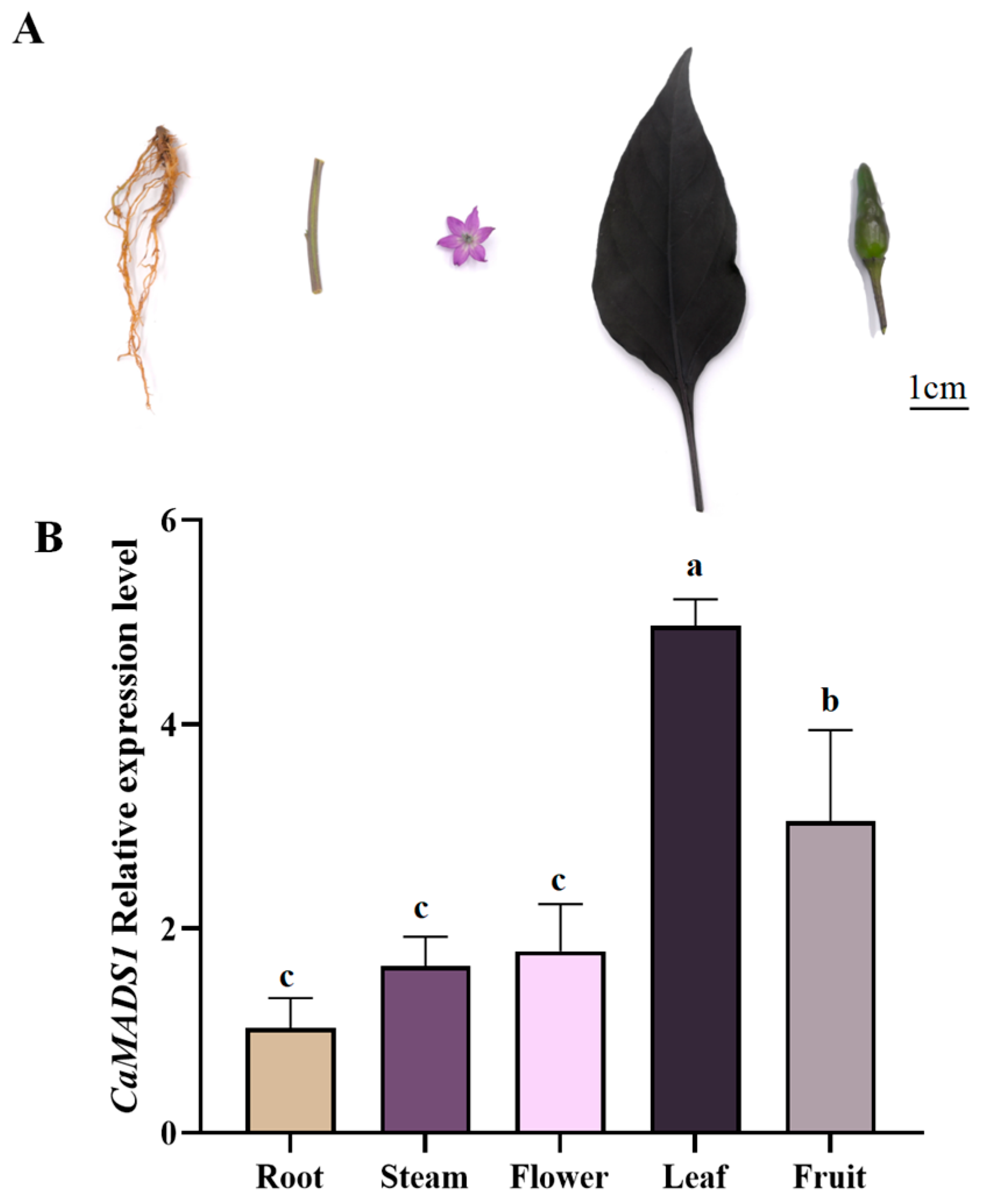
The expression levels of CaMADS1 in various tissues were quantified by qRT-PCR using pepper Actin as the reference gene and root expression values for calibration. Tissue-specific analysis indicated that CaMADS1 was expressed in roots, stems, leaves, flowers, and fruits, with its expression being significantly highest in mature leaves, including fruits (Figure 1). Based on these findings, subsequent experiments utilized pepper leaves as material and employed Agrobacterium-mediated transient transformation to investigate phenotypic changes in leaves following CaMADS1 silencing and overexpression.

3.2. Bioinformatics Analysis of CaMADS1

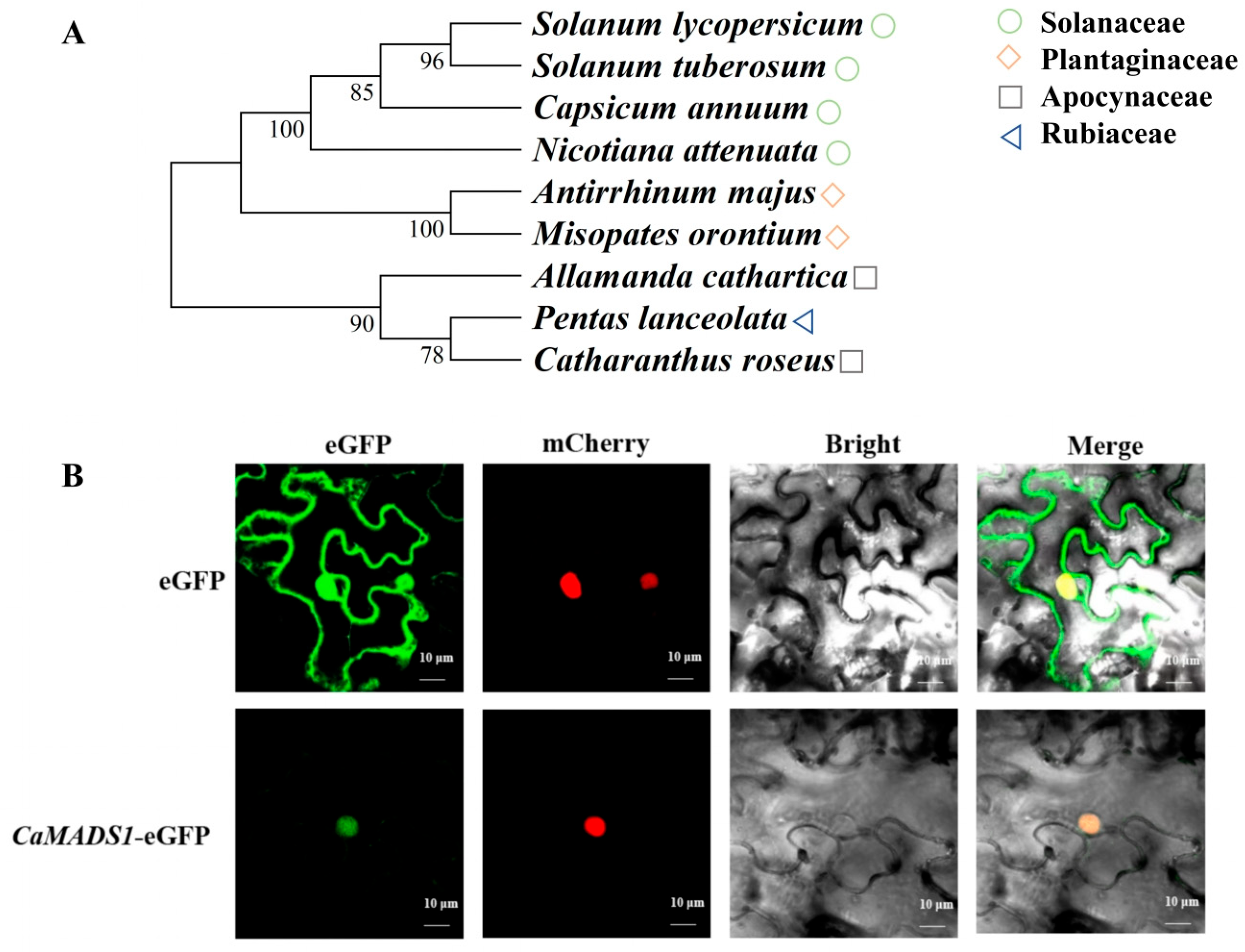
Using ‘CS03’ as experimental material, the CaMADS1 gene was amplified from pepper cDNA templates via PCR. Electrophoretic verification of PCR products confirmed a 681-bp coding sequence (CDS), encoding 226 amino acids. Using NCBI BLAST (1.4.0), we curated 18 amino acid sequences spanning five plant families, including the target CaMADS1 sequence. Phylogenetic reconstruction was performed with the maximum-likelihood method algorithm in MEGA11, with tree visualization refined using iTOL. Phylogenetic analysis revealed that CaMADS1 shares the closest evolutionary relationship with Solanum bycopersicum, while exhibiting the most distant relationship with Pentas lanceolata of the Rubiaceae family.
The pCaMADS1-Cambia1300-GFP fluorescent expression vector was constructed using homologous recombination technology and introduced into tobacco for subcellular localization. Confocal laser scanning microscopy results (Figure 2) showed that the empty vector control group exhibited green fluorescence distributed in the cytoplasm, nucleus, and cell membrane of tobacco cells. In contrast, the fluorescence of the pCaMADS1-Cambia1300-GFP and mCherry fusion proteins was predominantly localized in the nuclear region. This indicates that the CaMADS1 protein is localized in the nucleus and functions as a transcription factor.

3.3. Silencing of CaMADS1 Gene Reduces Anthocyanin Synthesis in Pepper Leaves

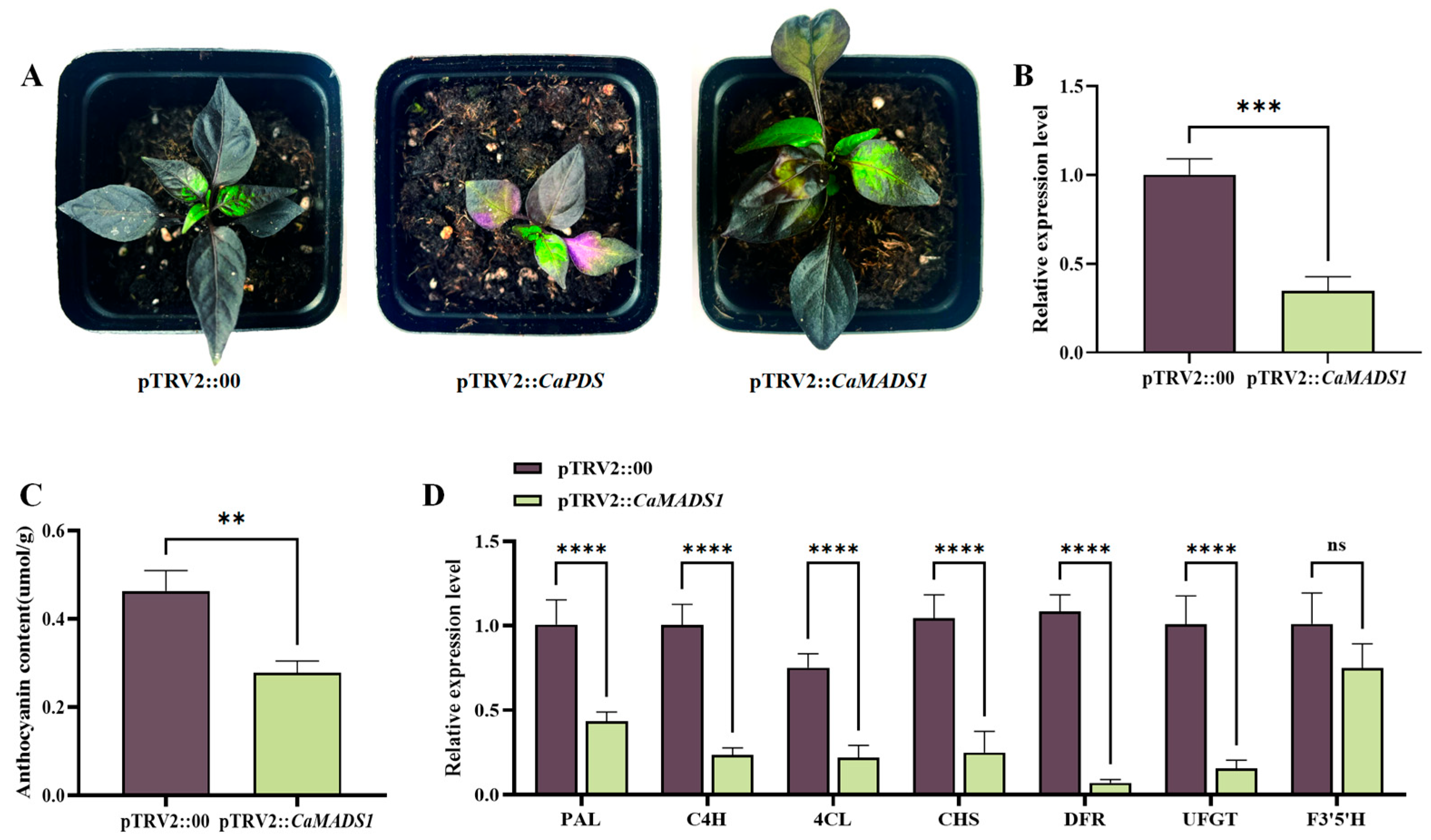
To investigate the function of CaMADS1 in anthocyanin biosynthesis in pepper leaves, gene silencing technology was employed to treat CS03 seedlings. At 30 days post-infiltration, CaPDS-silenced plants exhibited a distinct bleaching phenotype, confirming the effectiveness of the silencing system. Compared to the purple leaves of pTRV2::00 empty vector plants, CaMADS1-silenced plants showed a noticeable lightening of leaf purple coloration (Figure 3A). To validate the silencing efficiency, qRT-PCR analysis was performed on CaMADS1-silenced plants (Figure 3B). Both silenced lines displayed significantly downregulated CaMADS1 expression compared to pTRV2::00 plants. Furthermore, anthocyanin content and the expression levels of key biosynthetic structural genes—including CaPAL, CaC4H, Ca4CL, CaCHS, CaUFGT, and CaDFR—were significantly reduced.

3.4. Transient Overexpression of CaMADS1 Induces Anthocyanin Synthesis in Pepper Leaves

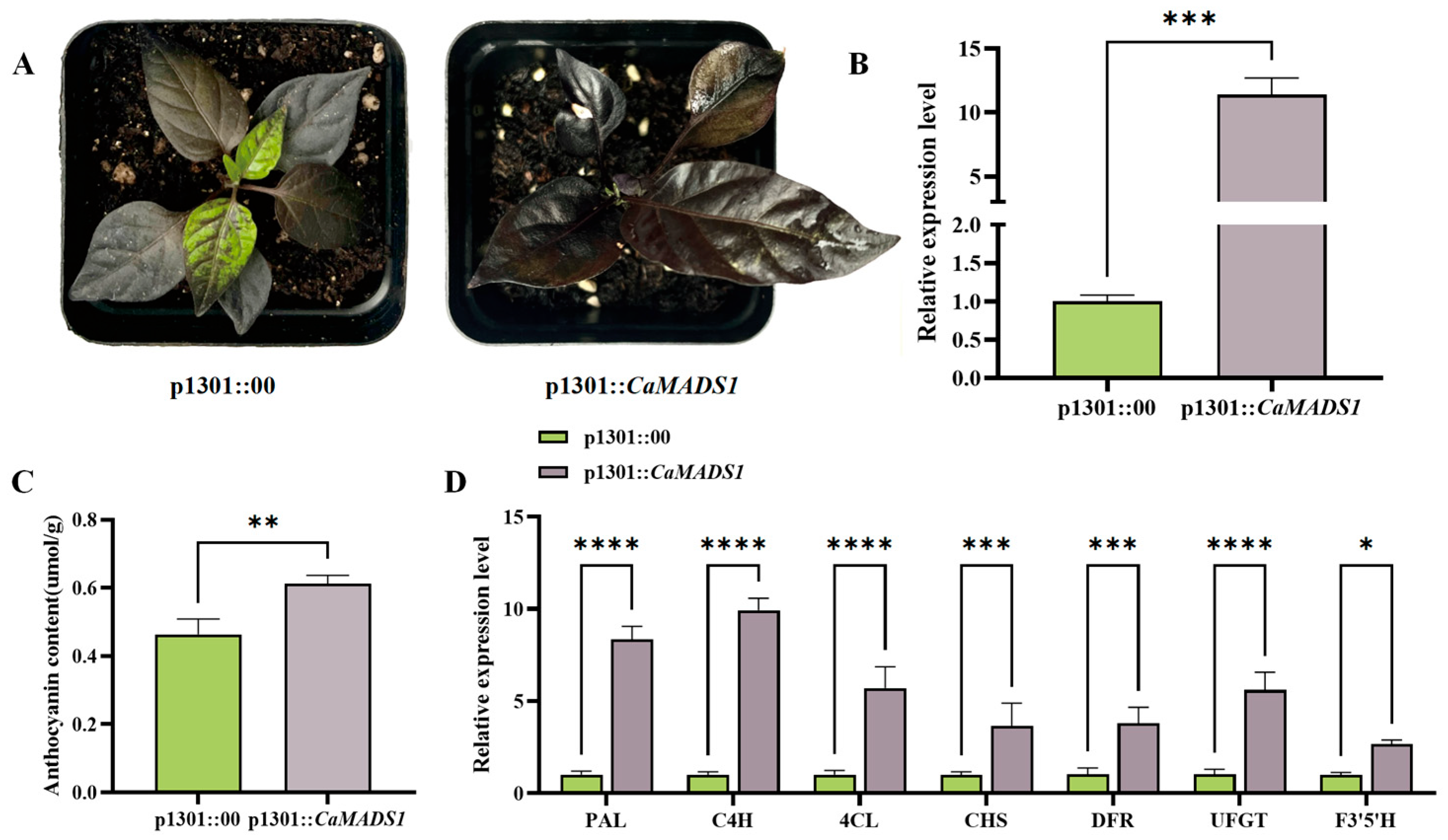
To further verify the function of CaMADS1, Agrobacterium-mediated transient overexpression was performed in pepper leaves. At 30 days post-infiltration, the experimental group exhibited deeper purple coloration compared to the control group. Samples from plants showing distinct phenotypic changes were collected and analyzed for CaMADS1 expression levels and anthocyanin content. The results showed significantly elevated levels of both CaMADS1 expression and anthocyanin accumulation compared to the control group. The expression levels of structural genes in the anthocyanin biosynthesis pathway revealed that CaPAL, CaC4H and CaCHS were markedly elevated in the leaves (Figure 4). These results demonstrate that CaMADS1 likely regulates anthocyanin biosynthesis by modulating the expression of these critical enzyme genes.

3.5. Yeast One-Hybrid and Dual-Luciferase Assay Results

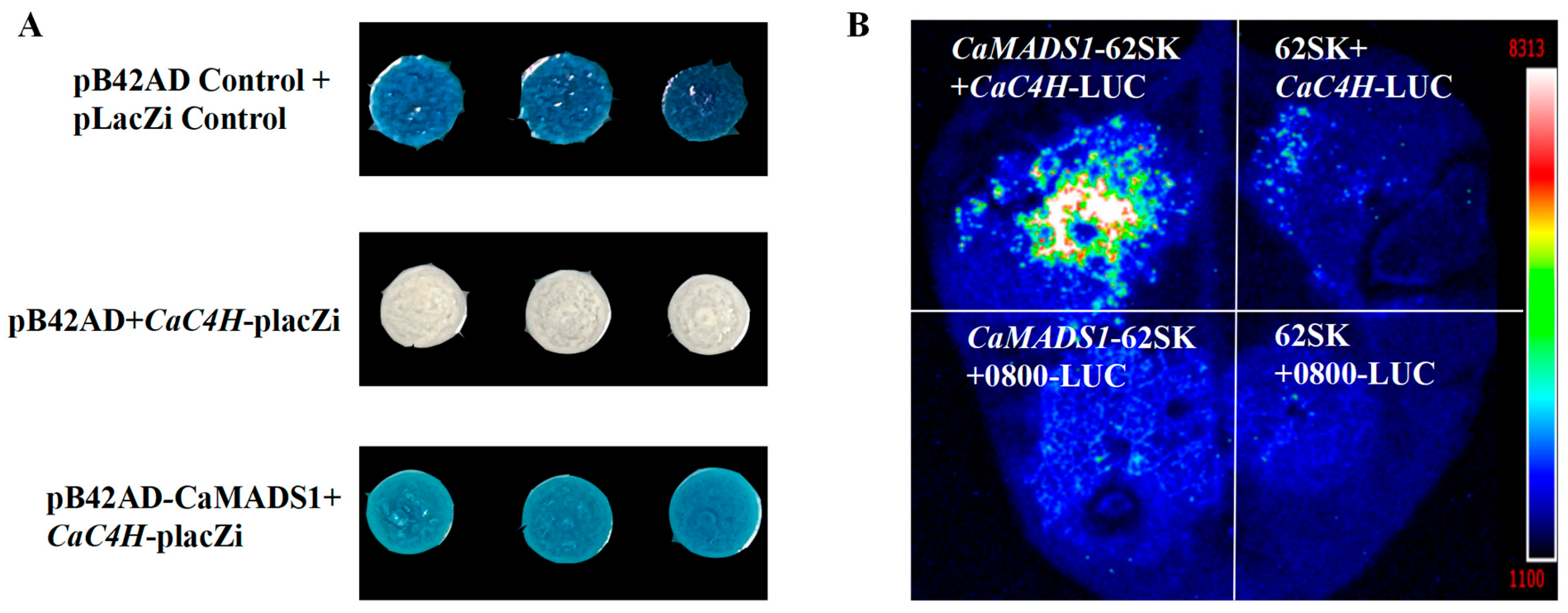
Overexpression or silencing of CaMADS1 resulted in significant alterations in the expression of structural genes associated with anthocyanin biosynthesis in pepper leaves compared to the control. To further investigate the regulatory role of CaMADS1 on these structural genes, yeast one-hybrid and dual-luciferase assays were performed. As shown in Figure 5, yeast colonies co-transformed with pB42AD-CaMADS1 and placZi-CaC4H turned blue, in contrast to those co-transformed with the empty pB42AD vector. Results from the dual-luciferase imaging system showed weak fluorescence intensity in tobacco cells for both negative controls. However, when the effector containing CaMADS1 was co-injected with the reporter containing CaC4H, enhanced fluorescence intensity was observed. These findings collectively demonstrate that CaMADS1 binds to the promoter of CaC4H.

4. Discussion

Anthocyanins, a class of water-soluble flavonoids widely distributed in the plant kingdom, play roles that extend far beyond providing vibrant pigmentation to flowers and fruits [32,33]. It is hypothesized that their primary evolutionary significance may lie in their protective functions within leaves, with their role in reproductive organs representing a later adaptive development [34]. This perspective aligns with our observations in the purple pepper variety studied herein, where leaves transition from green at the juvenile stage to an intense purple under sufficient light exposure. The MADS-box family of transcription factors is renowned for its critical roles in governing various aspects of plant growth and development [35]. While previous research in pepper has elucidated the role of MADS-RIN in regulating carotenoid biosynthesis during fruit ripening by directly binding to the promoters of carotenoid biosynthetic genes, including PSY1 and CCS, as well as to the promoter of DIVARICATA1 [36], the function of MADS-box genes in pepper anthocyanin metabolism remains less explored. In this study, we identified and characterized a novel MADS-box gene, CaMADS1, from pepper. Bioinformatics analysis revealed that CaMADS1 encodes a nuclear-localized protein with typical characteristics of this family. Expression profile analysis indicated that CaMADS1 is constitutively expressed across all examined tissues, with the highest abundance detected in leaves, prompting us to focus on its function in this organ.
The functional characterization of transcription factors using VIGS and overexpression approaches is a well-established strategy in pepper research, consistently revealing their critical roles in regulating diverse biological processes. For instance, the B-box transcription factor CaBBX10 was confirmed through VIGS and overexpression to promote the accumulation of both chlorophyll and carotenoid pigments in pepper fruit [37]. Similar to CaBBX10, functional studies showed that silencing CaBBX20 led to reduced capsanthin accumulation and downregulated expression of a key biosynthetic gene [38]. Additionally, functional studies of NAC transcription factors highlight the precision of this regulatory network: CaNAC035 functions as a positive regulator of cold stress tolerance. Silencing CaNAC035 resulted in increased susceptibility to cold, salt, and osmotic stress in pepper seedlings, as evidenced by more pronounced damage phenotypes [39]. Whereas CaNAC083 acts as a negative regulator of heat stress response, silencing CaNAC083 resulted in enhanced thermotolerance in pepper plants, as evidenced by reduced leaf damage after heat stress [40]. In our study, functional validation through VIGS and transient overexpression in pepper leaves provided compelling evidence for the role of CaMADS1. Our results unequivocally demonstrate that silencing CaMADS1 led to a significant reduction in both anthocyanin content and the transcript levels of key structural genes in the anthocyanin biosynthesis pathway (e.g., PAL, C4H, DFR, UFGT). Conversely, transient overexpression of CaMADS1 produced the opposite effect, enhancing anthocyanin accumulation and upregulating the expression of these structural genes. The experimental data establish CaMADS1 as a positive regulator of anthocyanin biosynthesis in pepper leaves. This functional specificity becomes evident when comparing CaMADS1 to other transcriptional regulators: it plays a role analogous to CaNAC035 in promoting cold tolerance, but opposite to CaNAC083, which suppresses the heat stress response. Thus, the concordance of our functional evidence with these well-defined regulatory paradigms substantiates the conclusion regarding CaMADS1.
The regulation of anthocyanin biosynthesis in pepper involves a complex network of transcription factors that precisely control pigment accumulation by binding to the promoters of their downstream target genes [41]. Previous research has demonstrated that the transcription factor CaMYB5 can directly bind to the promoter of the Phenylalanine ammonia-lyase (PAL) gene, a key entry-point enzyme into the phenylpropanoid pathway, thereby activating its expression [12]. The novel gene CaAN3, encoding an R2R3-MYB transcription factor, directly regulates the gene expression of DFR to regulate fruit-specific anthocyanin accumulation [42]. In addition, CaHY5, identified as the causal gene in a chemically induced green hypocotyl mutant, modulates anthocyanin biosynthesis by regulating the expression of anthocyanin biosynthesis-related genes, such as CaCHS, CaF3H, CaF3′5′H [43]. In pepper leaves, CaMYB12 suppresses anthocyanin production by binding to and activating the promoters of key flavonol biosynthetic genes, thereby competing for shared precursors required for anthocyanin formation [44]. Conversely, the CaMYBA–CaMYC–CaTTG1 complex promotes anthocyanin accumulation in leaves by enhancing the transcription of structural genes involved in anthocyanin synthesis. Among these, the expression level of CaMYC determines the functionality of the MBW complex, and CaMYBA can activate CaMYC expression by binding to its promoter [45]. Furthermore, CaMYB113 directly binds to the promoter regions of the anthocyanin pathway genes CaCHS and CaDFR, thereby modulating anthocyanin accumulation in pepper cotyledons [46]. Our work shifts the focus to leaves and identifies CaMADS1, a MADS-box transcription factor, as a novel positive regulator. To elucidate the molecular mechanism underlying this regulation, we investigated the direct targets of CaMADS1. Yeast one-hybrid screening revealed an interaction between CaMADS1 and the promoter of CaC4H, which encodes a pivotal early enzyme in the phenylpropanoid pathway, a precursor pathway to anthocyanin synthesis. This specific binding was further confirmed by dual-luciferase reporter assays, which showed that CaMADS1 could significantly activate the transcription of the CaC4H promoter. This finding directly links CaMADS1 to the transcriptional activation of a core structural gene, revealing a precise mechanism whereby CaMADS1 modulates the anthocyanin biosynthetic pathway—through direct binding and transactivation of the CaC4H promoter. While this study has elucidated the role of CaMADS1 in regulating anthocyanin biosynthesis in leaves, an intriguing question arises regarding its potential function in pepper fruits, which hold significant economic and ornamental value. Future research should focus on elucidating the broader regulatory network of CaMADS1, including its interactions with the canonical MBW complex or other novel targets.

5. Conclusions

In conclusion, CaMADS1 is a nuclear-localized MADS-box transcription factor that positively regulates anthocyanin biosynthesis in pepper. Virus-induced gene silencing and transient overexpression assays demonstrated that CaMADS1 promotes anthocyanin accumulation in pepper leaves. Yeast one-hybrid and dual-luciferase assays further revealed that CaMADS1 activates anthocyanin biosynthesis by directly binding to the promoter of the key structural gene CaC4H. These findings provide insights into the molecular mechanism underlying anthocyanin regulation in pepper and offer a theoretical basis for cultivating novel varieties with enhanced pigmentation.

Supplementary Materials

The following supporting information can be downloaded at: https://www.mdpi.com/article/10.3390/horticulturae11111399/s1, Table S1: Primers used in this study.

Author Contributions

Conceptualization, J.L. and M.D.; methodology, Z.L.; validation, Z.L., G.F. and M.L.; formal analysis, Z.L.; investigation, X.C.; resources, G.F.; data curation, M.L.; writing—original draft preparation, writing—review and editing, visualization and supervision, Q.D. and X.C.; project administration, J.L.; funding acquisition, J.L. and M.D. All authors have read and agreed to the published version of the manuscript.

Funding

This research was funded by the National Natural Science Foundation of China (32160708, 32360744), the Project of Yunnan Science and Technology Plan (202502AE090018, 202205AR070001, 202204BI090004, 202301BD070001-016), and the “Xingdian talent supportplan” of Yunnan Province (yfgrc202424).

Data Availability Statement

The original contributions presented in this study are included in the article/supplementary materials. Further inquiries can be directed to the corresponding author(s).

Conflicts of Interest

The authors declare no conflicts of interest.

References

  1. Liu, F.; Zhao, J.; Sun, H.; Xiong, C.; Sun, X.; Wang, X.; Wang, Z.; Jarret, R.; Wang, J.; Tang, B.; et al. Genomes of cultivated and wild Capsicum species provide insights into pepper domestication and population differentiation. Nat. Commun. 2023, 14, 5487. [Google Scholar] [CrossRef]
  2. Zou, Z.; Zou, X. Geographical and Ecological Differences in Pepper Cultivation and Consumption in China. Front. Nutr. 2021, 8, 718517. [Google Scholar] [CrossRef]
  3. Cheng, G.-X.; Li, R.-J.; Wang, M.; Huang, L.-J.; Khan, A.; Ali, M.; Gong, Z.-H. Variation in leaf color and combine effect of pigments on physiology and resistance to whitefly of pepper (Capsicum annuum L.). Sci. Hortic. 2018, 229, 215–225. [Google Scholar] [CrossRef]
  4. Sadilova, E.; Stintzing, F.C.; Carle, R. Anthocyanins, colour and antioxidant properties of eggplant (Solanum melongena L.) and violet pepper (Capsicum annuum L.) peel extracts. Z. Naturforsch C J. Biosci. 2006, 61, 527–535. [Google Scholar] [CrossRef] [PubMed]
  5. Mohd Ali, M.; Khalid, N.I.; Wondi, M.H.; Haris, N.I.N.; Megat Ahmad Azman, P.N. Exploring the nutritional values, volatile compounds, health benefits, and potential food products of chilli (Capsicum annuum): A comprehensive review. Food Chem. 2025, 490, 145091. [Google Scholar] [CrossRef]
  6. Liu, Y.; Tikunov, Y.; Schouten, R.E.; Marcelis, L.F.M.; Visser, R.G.F.; Bovy, A. Anthocyanin Biosynthesis and Degradation Mechanisms in Solanaceous Vegetables: A Review. Front. Chem. 2018, 6, 52. [Google Scholar] [CrossRef]
  7. Koes, R.; Verweij, W.; Quattrocchio, F. Flavonoids: A colorful model for the regulation and evolution of biochemical pathways. Trends Plant Sci. 2005, 10, 236–242. [Google Scholar] [CrossRef]
  8. Winkel-Shirley, B. Flavonoid Biosynthesis. A Colorful Model for Genetics, Biochemistry, Cell Biology, and Biotechnology. Plant Physiol. 2001, 126, 485–493. [Google Scholar] [CrossRef] [PubMed]
  9. Cerqueira, J.V.A.; de Andrade, M.T.; Rafael, D.D.; Zhu, F.; Martins, S.V.C.; Nunes-Nesi, A.; Benedito, V.; Fernie, A.R.; Zsögön, A. Anthocyanins and reactive oxygen species: A team of rivals regulating plant development? Plant Mol. Biol. 2023, 112, 213–223. [Google Scholar] [CrossRef]
  10. Padmavati, M.; Sakthivel, N.; Thara, K.V.; Reddy, A.R. Differential sensitivity of rice pathogens to growth inhibition by flavonoids. Phytochemistry 1997, 46, 499–502. [Google Scholar] [CrossRef]
  11. Pourcel, L.; Routaboul, J.M.; Cheynier, V.; Lepiniec, L.; Debeaujon, I. Flavonoid oxidation in plants: From biochemical properties to physiological functions. Trends Plant Sci. 2007, 12, 29–36. [Google Scholar] [CrossRef]
  12. Zhou, H.; Deng, Q.; Li, M.; Cheng, H.; Huang, Y.; Liao, J.; Mo, Y.; Zhao, K.; Xie, Q.; Ma, Y.; et al. R2R3-MYB transcription factor CaMYB5 regulates anthocyanin biosynthesis in pepper fruits. Int. J. Biol. Macromol. 2025, 308, 142450. [Google Scholar] [CrossRef] [PubMed]
  13. Tan, H.; Li, L.; Tie, M.; Lu, R.; Pan, S.; Tang, Y. Transcriptome analysis of green and purple fruited pepper provides insight into novel regulatory genes in anthocyanin biosynthesis. PeerJ 2024, 12, e16792. [Google Scholar] [CrossRef]
  14. Hichri, I.; Barrieu, F.; Bogs, J.; Kappel, C.; Delrot, S.; Lauvergeat, V. Recent advances in the transcriptional regulation of the flavonoid biosynthetic pathway. J. Exp. Bot. 2011, 62, 2465–2483. [Google Scholar] [CrossRef]
  15. Jaakola, L. New insights into the regulation of anthocyanin biosynthesis in fruits. Trends Plant Sci. 2013, 18, 477–483. [Google Scholar] [CrossRef]
  16. He, G.; Zhang, R.; Jiang, S.; Wang, H.; Ming, F. The MYB transcription factor RcMYB1 plays a central role in rose anthocyanin biosynthesis. Hortic. Res. 2023, 10, uhad080. [Google Scholar] [CrossRef]
  17. Gil-Muñoz, F.; Sánchez-Navarro, J.A.; Besada, C.; Salvador, A.; Badenes, M.L.; Naval, M.d.M.; Ríos, G. MBW complexes impinge on anthocyanidin reductase gene regulation for proanthocyanidin biosynthesis in persimmon fruit. Sci. Rep. 2020, 10, 3543. [Google Scholar] [CrossRef]
  18. Zhang, P.; Feng, Y.; Du, X.; Hao, Z.; Liang, J.; Wen, P. The VvWRKY26-MBW Complex Induced by Salicylic Acid Promotes the Accumulation of Proanthocyanidins in Grape. Plants 2025, 14, 3272. [Google Scholar] [CrossRef]
  19. Zhao, H.; Liu, L.; Chen, Y.; Li, C.; Wu, H.; Wang, T.; Shan, Z.; Wang, X.; Wu, Q. Transcription factors FtMYB22 negatively regulates anthocyanin synthesis by forming an MBW ternary complex in Tartary buckwheat. Crop Sci. 2024, 64, 853–869. [Google Scholar] [CrossRef]
  20. An, J.P.; Qu, F.J.; Yao, J.F.; Wang, X.N.; You, C.X.; Wang, X.F.; Hao, Y.J. The bZIP transcription factor MdHY5 regulates anthocyanin accumulation and nitrate assimilation in apple. Hortic. Res. 2017, 4, 17023. [Google Scholar] [CrossRef]
  21. Lu, Z.; He, J.; Fu, J.; Huang, Y.; Wang, X. WRKY75 regulates anthocyanin accumulation in juvenile citrus tissues. Mol. Breed. 2024, 44, 52. [Google Scholar] [CrossRef]
  22. Alabd, A.; Ahmad, M.; Zhang, X.; Gao, Y.; Peng, L.; Zhang, L.; Ni, J.; Bai, S.; Teng, Y. Light-responsive transcription factor PpWRKY44 induces anthocyanin accumulation by regulating PpMYB10 expression in pear. Hortic. Res. 2022, 9, uhac199. [Google Scholar] [CrossRef] [PubMed]
  23. Shi, L.; Li, X.; Fu, Y.; Li, C. Environmental Stimuli and Phytohormones in Anthocyanin Biosynthesis: A Comprehensive Review. Int. J. Mol. Sci. 2023, 24, 16415. [Google Scholar] [CrossRef] [PubMed]
  24. Li, S.; Dong, Y.; Li, D.; Shi, S.; Zhao, N.; Liao, J.; Liu, Y.; Chen, H. Eggplant transcription factor SmMYB5 integrates jasmonate and light signaling during anthocyanin biosynthesis. Plant Physiol. 2024, 194, 1139–1165. [Google Scholar] [CrossRef]
  25. Xu, Z.; Wang, J.; Ma, Y.; Wang, F.; Wang, J.; Zhang, Y.; Hu, X. The bZIP transcription factor SlAREB1 regulates anthocyanin biosynthesis in response to low temperature in tomato. Plant J. 2023, 115, 205–219. [Google Scholar] [CrossRef]
  26. Li, J.; Ma, N.; An, Y.; Wang, L. FcMADS9 of fig regulates anthocyanin biosynthesis. Sci. Hortic. 2021, 278, 109820. [Google Scholar] [CrossRef]
  27. Lalusin, A.G.; Nishita, K.; Kim, S.H.; Ohta, M.; Fujimura, T. A new MADS-box gene (IbMADS10) from sweet potato (Ipomoea batatas (L.) Lam) is involved in the accumulation of anthocyanin. Mol. Genet. Genom. 2006, 275, 44–54. [Google Scholar] [CrossRef] [PubMed]
  28. Jaakola, L.; Poole, M.; Jones, M.O.; Kämäräinen-Karppinen, T.; Koskimäki, J.J.; Hohtola, A.; Häggman, H.; Fraser, P.D.; Manning, K.; King, G.J.; et al. A SQUAMOSA MADS box gene involved in the regulation of anthocyanin accumulation in bilberry fruits. Plant Physiol. 2010, 153, 1619–1629. [Google Scholar] [CrossRef]
  29. Zhang, Y.; Zhou, J.; Qiu, W.; Sun, Y.; Hu, Y.; Zhao, J.; Fang, C.; Xie, X. Ectopic expression of strawberry FaMADS6 represses anthocyanin biosynthesis in both tobacco and Arabidopsis thaliana. Plant Physiol. Biochem. 2025, 227, 110139. [Google Scholar] [CrossRef]
  30. Zhang, Y.; Wang, S.; Wang, X.; Qian, T.; Sun, Y.; Jaudal, M.; Atkinson, R.G.; Zhao, J.; Zheng, G.; Sun, P.; et al. FaMADS6 negatively regulates anthocyanin accumulation in strawberry by inhibiting FaMYB10 expression and ABA biosynthesis. Hortic. Plant J. 2025, in press. [Google Scholar] [CrossRef]
  31. Qi, F.; Liu, Y.; Luo, Y.; Cui, Y.; Lu, C.; Li, H.; Huang, H.; Dai, S. Functional analysis of the ScAG and ScAGL11 MADS-box transcription factors for anthocyanin biosynthesis and bicolour pattern formation in Senecio cruentus ray florets. Hortic. Res. 2022, 9, uhac071. [Google Scholar] [CrossRef]
  32. Springob, K.; Nakajima, J.; Yamazaki, M.; Saito, K. Recent advances in the biosynthesis and accumulation of anthocyanins. Nat. Prod. Rep. 2003, 20, 288–303. [Google Scholar] [CrossRef]
  33. Grünig, N.; Horz, J.M.; Pucker, B. Diversity and Ecological Functions of Anthocyanins. Preprints 2024. [Google Scholar] [CrossRef]
  34. Marin-Recinos, M.F.; Pucker, B. Genetic factors explaining anthocyanin pigmentation differences. BMC Plant Biol. 2024, 24, 627. [Google Scholar] [CrossRef] [PubMed]
  35. Zhang, Z.; Zou, W.; Lin, P.; Wang, Z.; Chen, Y.; Yang, X.; Zhao, W.; Zhang, Y.; Wang, D.; Que, Y.; et al. Evolution and Function of MADS-Box Transcription Factors in Plants. Int. J. Mol. Sci. 2024, 25, 13278. [Google Scholar] [CrossRef]
  36. Wang, Y.; Li, X.; Qiu, H.; Chen, R.; Xiong, A.; Xu, Z.; Miao, W.; Chen, R.; Wang, P.; Hou, X.; et al. The MADS-RIPENING INHIBITOR-DIVARICATA1 module regulates carotenoid biosynthesis in nonclimacteric Capsicum fruits. Plant Physiol. 2025, 197, kiaf013. [Google Scholar] [CrossRef] [PubMed]
  37. Wang, J.; Shan, Q.; Yuan, Q.; Pan, L.; Wang, M.; Zhao, P.; Yu, F.; Dai, L.; Xie, L.; Wang, Z.; et al. The transcription factor CaBBX10 promotes chlorophyll and carotenoid pigment accumulation in Capsicum annuum fruit. Plant Physiol. 2025, 197, kiae592. [Google Scholar] [CrossRef]
  38. Ma, J.; Dai, J.; Liu, X.; Lin, D. The transcription factor CaBBX20 regulates capsanthin accumulation in pepper (Capsicum annuum L.). Sci. Hortic. 2023, 314, 111907. [Google Scholar] [CrossRef]
  39. Zhang, H.; Ma, F.; Wang, X.; Liu, S.; Saeed, U.H.; Hou, X.; Zhang, Y.; Luo, D.; Meng, Y.; Zhang, W.; et al. Molecular and Functional Characterization of CaNAC035, an NAC Transcription Factor From Pepper (Capsicum annuum L.). Front. Plant Sci. 2020, 11, 14. [Google Scholar] [CrossRef]
  40. Hu, H.; Wang, Z.; Pan, X.; Chen, N.; Zhang, H.; Chen, R. Response of pepper transcription factor CaNAC083 to high temperature stress. J. Northwest A&F Univ. 2023, 51, 121–131. (In Chinese) [Google Scholar] [CrossRef]
  41. Tang, B.; Li, L.; Hu, Z.; Chen, Y.; Tan, T.; Jia, Y.; Xie, Q.; Chen, G. Anthocyanin Accumulation and Transcriptional Regulation of Anthocyanin Biosynthesis in Purple Pepper. J Agric. Food Chem. 2020, 68, 12152–12163. [Google Scholar] [CrossRef]
  42. Byun, J.; Kim, T.G.; Lee, J.H.; Li, N.; Jung, S.; Kang, B.C. Identification of CaAN3 as a fruit-specific regulator of anthocyanin biosynthesis in pepper (Capsicum annuum). Theor. Appl. Genet. 2022, 135, 2197–2211. [Google Scholar] [CrossRef]
  43. Zhang, X.; Mo, Y.; Zhou, H.; Li, M.; Cheng, H.; Li, P.; Zhang, R.; Huang, Y.; Wang, Y.; Xu, J.; et al. CaHY5 Mediates UV-B Induced Anthocyanin Biosynthesis in Purple Pepper. Agronomy 2025, 15, 28. [Google Scholar] [CrossRef]
  44. Wu, Y.; Popovsky-Sarid, S.; Tikunov, Y.; Borovsky, Y.; Baruch, K.; Visser, R.G.F.; Paran, I.; Bovy, A. CaMYB12-like underlies a major QTL for flavonoid content in pepper (Capsicum annuum) fruit. New Phytol. 2023, 237, 2255–2267. [Google Scholar] [CrossRef] [PubMed]
  45. Ma, X.; Liang, G.; Xu, Z.; Lin, C.; Zhu, B. CaMYBA-CaMYC-CaTTG1 complex activates the transcription of anthocyanin synthesis structural genes and regulates anthocyanin accumulation in pepper (Capsicum annuum L.) leaves. Front. Plant Sci. 2025, 16, 1538607. [Google Scholar] [CrossRef]
  46. Liu, S.; Yang, H.; Zhang, H.; Liu, J.; Ma, S.; Hui, H.; Wang, L.; Cheng, Q.; Shen, H. Phenotypic, genetic, variation, and molecular function of CaMYB113 in pepper (Capsicum annuum L.). Int. J. Biol. Macromol. 2024, 281, 136300. [Google Scholar] [CrossRef]
Figure 1. Expression Analysis of CaMADS1. (A) Phenotypes of ‘CS03’. Scale bar, 1 cm. (B) CaMADS1 expression in different tissues of pepper. One-way analysis of variance (ANOVA) testing was performed and different lowercase letters were used to represent statistically significant difference (p < 0.05).
Horticulturae 11 01399 g001
Figure 2. Analysis of CaMADS1. (A) Analysis of amino acid sequence evolution tree between CaMADS1 and other substances. (B) Subcellular localization results of CaMADS1. (Green fluorescence indicates the signal from eGFP. Red fluorescence indicates the signal from the nuclear-localized mCherry marker. Yellow signal in the merged panels).
Horticulturae 11 01399 g002
Figure 3. VIGS of CaMADS1 reduces anthocyanin accumulation in pepper leaves. (A) CaMADS1 silenced plant phenotype. (B) Expression level of silenced positive plants. (C) Total anthocyanin content. (D) Expression level of anthocyanin structural gene, pTRV2::00: pepper plants inoculated with pTRV2 empty vector strain, pTRV2::CaMADS1: CaMADS1 silenced plants. Asterisks indicate significant differences based on the Student’s t-test of 2log transformed data (ns p > 0.05; ** p < 0.01; *** p < 0.001; **** p < 0.0001).
Horticulturae 11 01399 g003
Figure 4. Transient overexpression of CaMADS1 increases anthocyanin accumulation in pepper leaves. (A) CaMADS1 overexpressed plant phenotype. (B) Expression level of overexpressed positive plants. (C) Total anthocyanin content. (D) Expression level of anthocyanin structural gene, p1301::00: pepper plants inoculated with p1301 empty vector strain, p1301::CaMADS1: CaMADS1 transient overexpressed plants. Asterisks indicate significant differences based on the Student’s t-test of 2log transformed data (* p < 0.05; ** p < 0.01; *** p < 0.001; **** p < 0.0001).
Horticulturae 11 01399 g004
Figure 5. CaMADS1 interact with the promoter of CaC4H to activate its transcription. (A) The Y1H analysis of CaMADS1 binding to the CaC4H promoter. (B) Dual-luciferase fluorescence imaging of CaMADS1 and CaC4H. Color scale indicates LUC signal intensity (red, strong; blue, weak).
Horticulturae 11 01399 g005
Disclaimer/Publisher’s Note: The statements, opinions and data contained in all publications are solely those of the individual author(s) and contributor(s) and not of MDPI and/or the editor(s). MDPI and/or the editor(s) disclaim responsibility for any injury to people or property resulting from any ideas, methods, instructions or products referred to in the content.