Siberian Tarragon: A Promising Source of Flavone O-Glycosides and Methylated Flavanone Aglycones in North Asian Accessions of Artemisia dracunculus



Abstract
1. Introduction
2. Materials and Methods
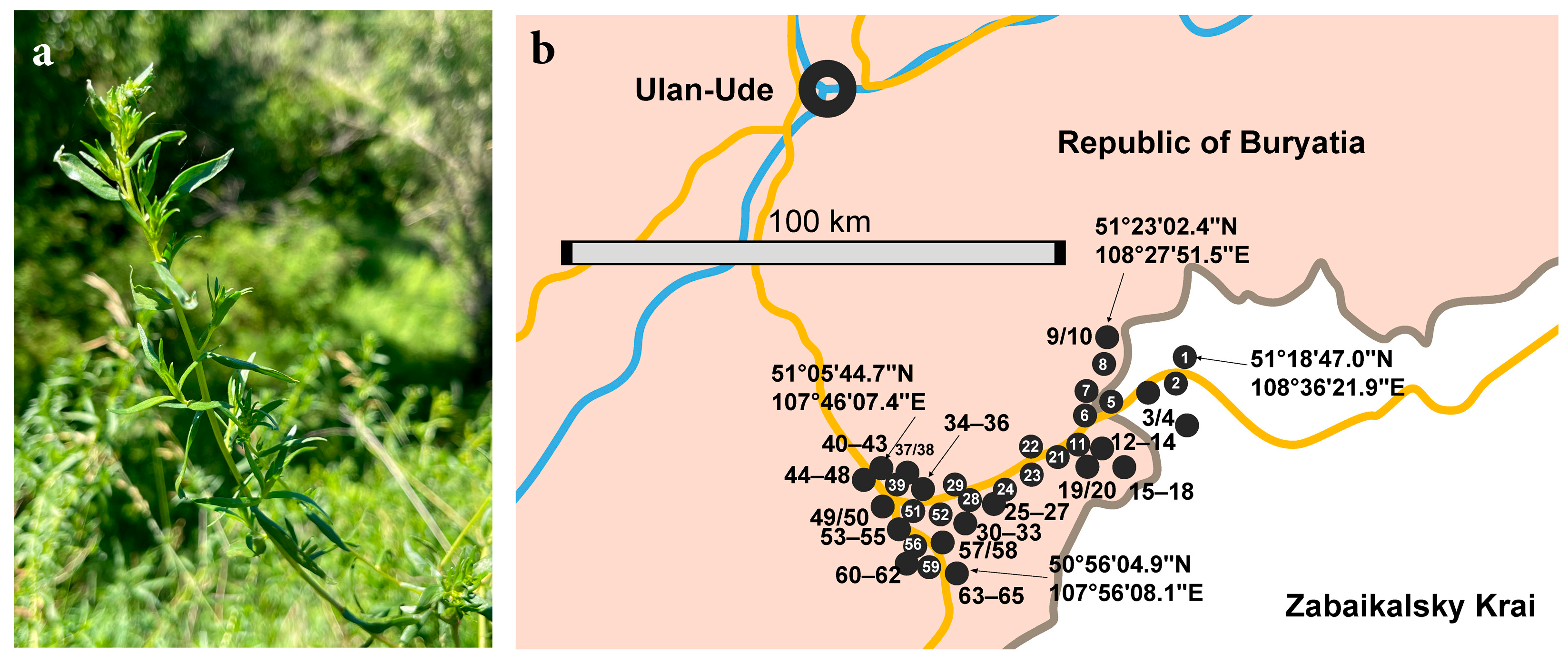
2.1. Plant Material
2.2. Sample Preparation
2.3. High-Performance Liquid Chromatography with Photodiode Array and Ion Trap–Time-of-Flight Mass Spectrometric Detection (HPLC-PDA-IT-TOF-MS)
2.4. Statistical Analysis
3. Results and Discussion
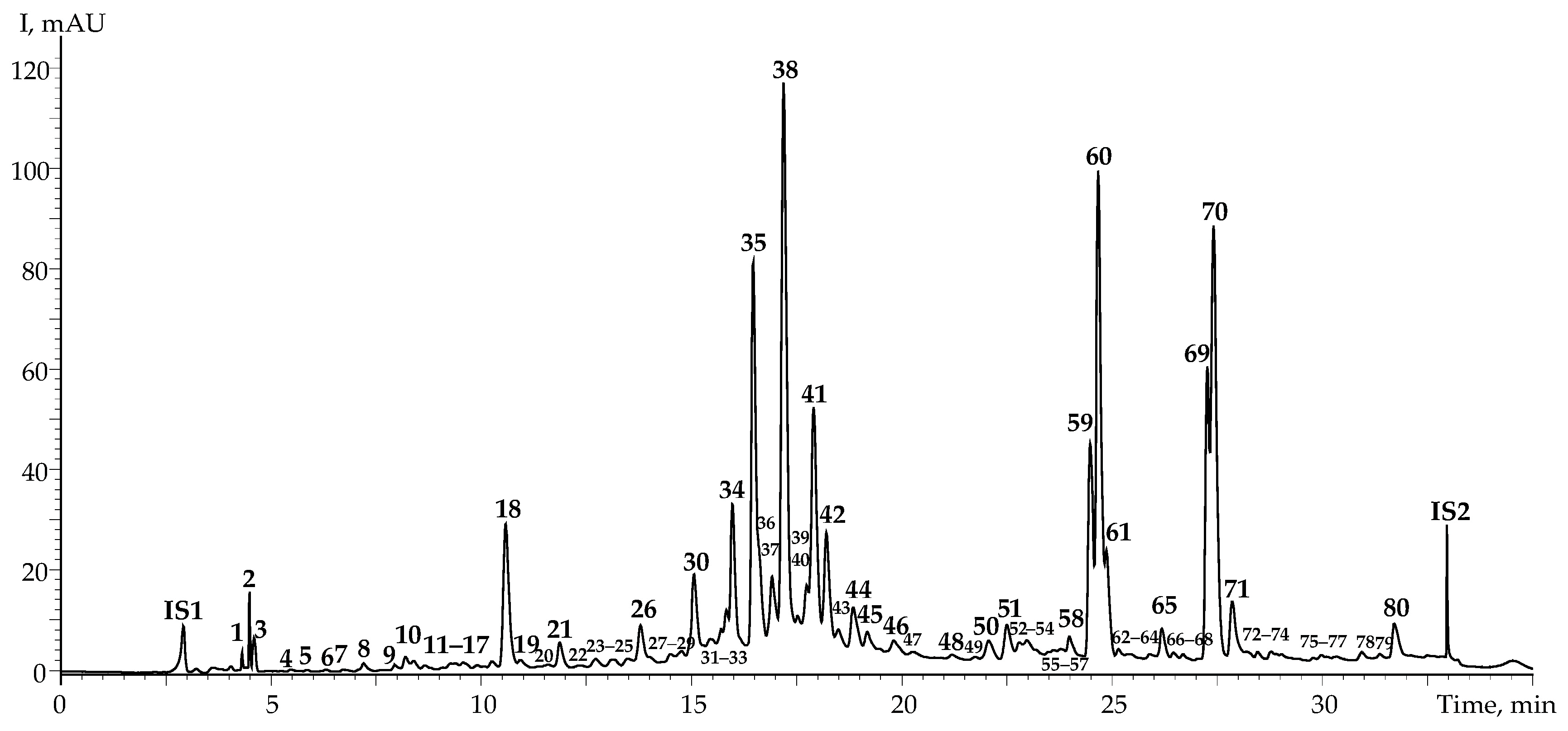
3.1. LC-MS Profiling of Phenolic Compounds in A. dracunculus from Siberian Accessions
3.1.1. Hydroxycinnamates
3.1.2. Coumarins
3.1.3. Flavone Aglycones and Glycosides
3.1.4. Flavanone Aglycones and Glycosides
3.1.5. Various Flavonoids
3.1.6. Occurrence of Compounds in A. dracunculus Population
3.2. Comparison of Global and Siberian Populations of A. dracunculus
3.3. Phenolic Compound Content in A. dracunculus from Siberian Accessions
3.4. Recommendations and Future Perspectives
4. Conclusions
Supplementary Materials
Author Contributions
Funding
Data Availability Statement
Acknowledgments
Conflicts of Interest
Abbreviations
| CQA | Caffeoyl quinic acid |
| DCQA | Dicaffeoyl quinic acid |
| DW | Dry weight |
| FQA | Feruloyl quinic acid |
| FlAs | Flavonoid aglycones |
| FlGs | Flavonoid glycosides |
| HCys | Hydroxycinnamates |
| HPLC-PDA-IT-TOF-MS | High-performance chromatography with photodiode array and ion trap–time-of-flight mass spectrometry detection |
| TCQA | Tricaffeoyl quinic acid |
| TPC | Total phenolic content |
| UV | Ultraviolet |
References
- Khoshbakht, K.; Hammer, K. How many plant species are cultivated? Genet. Resour. Crop Evol. 2008, 55, 925–928. [Google Scholar] [CrossRef]
- Chrysargyris, A.; Baldi, A.; Lenzi, A.; Bulgari, R. Wild plant species as potential horticultural crops: An opportunity for farmers and consumers. Horticulturae 2023, 9, 1193. [Google Scholar] [CrossRef]
- Kam, M.Y.Y. Hidden hunger: From a plant biologist’s perspective. J. Sci. Food Agricult. 2025, 105, 6287. [Google Scholar] [CrossRef]
- Abbas, F.; Zhou, Y.; O’Neill Rothenberg, D.; Alam, I.; Ke, Y.; Wang, H.-C. Aroma components in horticultural crops: Chemical diversity and usage of metabolic engineering for industrial applications. Plants 2023, 12, 1748. [Google Scholar] [CrossRef]
- Obolskiy, D.; Pischel, I.; Feistel, B.; Glotov, N.; Heinrich, M. Artemisia dracunculus L. (tarragon): A critical review of its traditional use, chemical composition, pharmacology, and safety. J. Agricult. Food Chem. 2011, 59, 11367–11384. [Google Scholar] [CrossRef]
- Deans, S.G.; Svoboda, K.P. Antibacterial activity of French tarragon (Artemisia dracunculus Linn.) essential oil and its constituents during ontogeny. J. Hortic. Sci. 1988, 63, 503–508. [Google Scholar] [CrossRef]
- Lopes-Lutz, D.; Alviano, D.S.; Alviano, C.S.; Kolodziejczyk, P.P. Screening of chemical composition, antimicrobial and antioxidant activities of Artemisia essential oils. Phytochemistry 2008, 69, 1732–1738. [Google Scholar] [CrossRef] [PubMed]
- Pino, J.A.; Rosado, A.; Correa, M.T. Chemical composition of the essential oils of Artemisia dracunculus L. from Cuba. J. Essent. Oil Res. 1996, 8, 563–564. [Google Scholar] [CrossRef]
- Sayyah, M.; Nadjafnia, L.; Kamalinejad, M. Anticonvulsant activity and chemical composition of Artemisia dracunculus L. essential oil. J. Ethnopharmacol. 2004, 94, 283–287. [Google Scholar] [CrossRef] [PubMed]
- Curini, M.; Epifano, F.; Genovese, S.; Tammaro, F.; Menghini, L. Composition and antimicrobial activity of the essential oil of Artemisia dracunculus “Piemontese” from Italy. Chem. Nat. Compd. 2006, 42, 738–739. [Google Scholar] [CrossRef]
- Tunmann, P.; Mann, E. Über Inhaltsstoffe von Gewürzdrogen. Z. Lebensm. Unters. Forch. 1968, 138, 146–150. [Google Scholar] [CrossRef]
- Vienne, M.; Braemer, R.; Paris, M.; Couderc, H. Chemotaxonomic study of two cultivars of Artemisia dracunculus L.: (“French” and “Russian” tarragon). Biochem. Syst. Ecol. 1989, 17, 373–374. [Google Scholar] [CrossRef]
- Greger, H.; Bohlmann, F. 8-Hydroxycapillarin—Ein neues Isocumarin aus Artemisia dracunculus. Phytochemistry 1979, 18, 1244–1245. [Google Scholar] [CrossRef]
- Engelmeier, D.; Hadacek, F.; Hofer, O.; Lutz-Kutschera, G.; Nagl, M.; Wurz, G.; Greger, H. Antifungal 3-butylisocoumarins from Asteraceae-Anthemideae. J. Nat. Prod. 2004, 67, 19–25. [Google Scholar] [CrossRef]
- Greger, H.; Bohlmann, F.; Zdero, C. Neue isocumarine aus Artemisia dracunculus. Phytochemistry 1977, 16, 795–796. [Google Scholar] [CrossRef]
- Minda, D.; Ghiulai, R.; Banciu, C.D.; Pavel, I.Z.; Danciu, C.; Racoviceanu, R.; Soica, C.; Budu, O.D.; Muntean, D.; Diaconeasa, Z. Phytochemical profile, antioxidant and wound healing potential of three Artemisia species: In vitro and in ovo evaluation. Appl. Sci. 2022, 12, 1359. [Google Scholar] [CrossRef]
- Truzzi, E.; Bertelli, D.; Catellani, B.; Jazi, D.D.; Benvenuti, S. Recovery of bioactive compounds from the biomass of aromatic plants after distillation using NADES: A sustainable alternative extraction method. Molecules 2025, 30, 1120. [Google Scholar] [CrossRef]
- Majdan, M.; Kiss, A.K.; Hałasa, R.; Granica, S.; Osinska, E.; Czerwinska, M.E. Inhibition of neutrophil functions and antibacterial effects of tarragon (Artemisia dracunculus L.) infusion—Phytochemical characterization. Front. Pharmacol. 2020, 11, 947. [Google Scholar] [CrossRef]
- Silva, B.N.; Cadavez, V.; Caleja, C.; Pereira, E.; Calhelha, R.C. Chemical profiles and bioactivities of polyphenolic extracts of Lavandula stoechas L., Artemisia dracunculus L. and Ocimum basilicum L. Food Chem. 2024, 451, 139308. [Google Scholar] [CrossRef]
- Oliveira, A.S.; Ribeiro-Santos, R.; Ramos, F. UHPLC-DAD multi-method for determination of phenolics in aromatic plants. Food Anal. Methods 2018, 11, 440–450. [Google Scholar] [CrossRef]
- Țicolea, M.; Pop, R.M.; Pârvu, M.; Usatiuc, L.-O.; Uifălean, A.; Ranga, F.; Pârvu, A.E. Phytochemical composition antioxidant and anti-inflammatory activity of Artemisia dracunculus and Artemisia abrotanum. Antioxidants 2024, 13, 1016. [Google Scholar] [CrossRef]
- Nikitin, E.; Fitsev, I.; Egorova, A.; Logvinenko, L.; Terenzhev, D.; Bekmuratova, F.; Rakhmaeva, A.; Shumatbaev, G.; Gatiyatullina, A.; Shevchuk, O. Five different Artemisia L. species ethanol extracts’ phytochemical composition and their antimicrobial and nematocide activity. Int. J. Mol. Sci. 2023, 24, 14372. [Google Scholar] [CrossRef]
- Kurkin, V.A.; Zapesochnaya, G.G.; Avdeeva, E.V. Structure and properties of estragonoside—A new flavonoid from the epigeal part of Artemisia dracunculus. Chem. Nat. Compd. 1997, 33, 46–49. [Google Scholar] [CrossRef]
- Onuchak, L.A.; Kurkin, V.A.; Minakhmetov, R.A. HPLC analysis of Artemisia dracunculus extracts. Chem. Nat. Compd. 2000, 36, 144–147. [Google Scholar] [CrossRef]
- Greger, H. Aromatic acetylenes and dehydrofalcarinone derivatives within the Artemisia dracunculus group. Phytochemistry 1979, 18, 1319–1322. [Google Scholar] [CrossRef]
- Mumivand, H.; Babalar, M.; Tabrizi, L. Antioxidant properties and principal phenolic phytochemicals of Iranian tarragon (Artemisia dracunculus L.) accessions. Hortic. Environ. Biotechnol. 2017, 58, 414–422. [Google Scholar] [CrossRef]
- Rahmani, H.; Asili, J.; Tayarani-Najaran, Z.; Kharbach, M.; Segers, K. Functional and metabolomic profiling of Artemisia dracunculus and Allium ampeloprasum: A combined UPLC-QTOF-MS/MS and GC-MS approach. Biocatal. Agricult. Biotechnol. 2025, 68, 103731. [Google Scholar] [CrossRef]
- Güvenalp, Z.; Özbek, H.; Dursunoğlu, B. α-Amylase and α-glucosidase inhibitory activities of the herbs of Artemisia dracunculus L. and its active constituents. Med. Chem. Res. 2017, 26, 3209–3215. [Google Scholar] [CrossRef]
- Chumbalov, T.K.; Mukhamed’yarova, M.M.; Fadeeva, O.V. The flavonoids of Artemisia dracunculus. Chem. Nat. Compd. 1969, 5, 273. [Google Scholar] [CrossRef]
- Chumbalov, T.K.; Mukhamed’yarova, M. Flavonoids of Artemisia dracunculus. II. Chem. Nat. Compd. 1970, 6, 645. [Google Scholar] [CrossRef]
- Bhutia, T.D.; Vetschera, K. Chemodiversity of Artemisia dracunculus L. from Kyrgyzstan: Isocoumarins, coumarins, and flavonoids from aerial parts. Nat. Prod. Commun. 2008, 3, 1289–1292. [Google Scholar] [CrossRef]
- Mallabaev, A.; Saitbaeva, I.M.; Sidyakin, G.P. Structure of the isocoumarin artemidin. Chem. Nat. Compd. 1970, 6, 549–551. [Google Scholar] [CrossRef]
- Mallabaev, A.; Yagudaev, M.R.; Saitbaeva, I.M. The isocoumarin artemidin from Artemisia dracunculus. Chem. Nat. Compd. 1970, 6, 479. [Google Scholar] [CrossRef]
- Mallabaev, A.; Saitbaeva, I.M.; Sidyakin, G.P. The isocoumarin artemidinal from Artemisia dracunculus. Chem. Nat. Compd. 1971, 7, 248–249. [Google Scholar] [CrossRef]
- Mallabaev, A.; Sidyakin, G.P. Artemidiol—A new isocoumarin from Artemisia dracunculus. Chem. Nat. Compd. 1974, 10, 743–745. [Google Scholar] [CrossRef]
- Jakupovic, J.; Tan, R.X.; Bohlmann, F.; Jia, Z.J.; Huneck, S. Acetylenes and other constituents from Artemisia dracunculus. Planta Med. 1991, 57, 450–453. [Google Scholar] [CrossRef]
- Chen, L.; Abudureheman, B.; Anwar, O.; Abdugini, E.; Zhang, J.; Tang, R.; Gao, Z.; Pan, H.; Ye, X. Extraction, purification, component analysis and bioactivity of polyphenols from Artemisia dracunculus L. Foods 2025, 14, 1823. [Google Scholar] [CrossRef]
- Balza, F.; Towers, G.H.N. Dihydroflavonols of Artemisia dracunculus. Phytochemistry 1984, 23, 2333–2337. [Google Scholar] [CrossRef]
- Balza, F.; Jamieson, L.; Towers, G.H.N. Chemical constituents of the aerial parts of Artemisia dracunculus. J. Nat. Prod. 1985, 48, 339–340. [Google Scholar] [CrossRef]
- Yu, Y.; Simmler, C.; Kuhn, P.; Poulev, A.; Raskin, I.; Ribnicky, D.; Floyd, Z.E.; Pauli, G.F. The DESIGNER approach helps decipher the hypoglycemic bioactive principles of Artemisia dracunculus (Russian tarragon). J. Nat. Prod. 2019, 82, 3321–3329. [Google Scholar] [CrossRef]
- Vandanmagsar, B.; Yu, Y.; Simmler, C.; Dang, T.N.; Kuhn, P.; Poulev, A.; Ribnicky, D.M.; Pauli, G.F.; Floyd, Z.E. Bioactive compounds from Artemisia dracunculus L. activate AMPK signaling in skeletal muscle. Biomed. Pharmacother. 2021, 143, 112188. [Google Scholar] [CrossRef]
- Eisenman, S.E.; Poulev, A.; Struwe, L.; Raskin, I.; Ribnicky, D.M. Qualitative variation of anti-diabetic compounds in different tarragon (Artemisia dracunculus L.) cytotypes. Fitoterapia 2011, 82, 1062–1074. [Google Scholar] [CrossRef] [PubMed]
- Talbi, M.; Saadali, B.; Boriky, D.; Bennani, L.; Elkouali, M.; Ainane, T. Two natural compounds—A benzofuran and a phenylpropane—From Artemisia dracunculus. J. Asian Nat. Prod. Res. 2016, 18, 724–729. [Google Scholar] [CrossRef] [PubMed]
- Jaiswal, R.; Matei, M.F.; Glembockyte, V.; Patras, M.A.; Kuhnert, N. Hierarchical key for the LC−MSn identification of all ten regio- and stereoisomers of caffeoylglucose. J. Agric. Food Chem. 2014, 62, 9252–9265. [Google Scholar] [CrossRef] [PubMed]
- Olennikov, D.N.; Chirikova, N.K. Phenolic compounds of six unexplored Asteraceae species from Asia: Comparison of wild and cultivated plants. Horticulturae 2024, 10, 486. [Google Scholar] [CrossRef]
- Olennikov, D.N. Acylglycosides and acylquinic acids from roots of Panax ginseng. Chem. Nat. Compd. 2020, 56, 1044–1047. [Google Scholar] [CrossRef]
- Nakaoki, T.; Morita, N.; Nagata, Y.; Oguri, H. Studies on the medicinal resources. XIX Flavonoid of the leaves of Nelumbo nucifera Gaertn., Cosmos bipinnatus Cav., and Foeniculum vulgare Miller. Yakugaku Zasshi 1961, 81, 1158–1159. [Google Scholar] [CrossRef]
- Xu, X.; Xia, M.; Han, Y.; Tan, H.; Chen, Y.; Song, X.; Yuan, S.; Zhang, Y.; Su, P.; Huang, L. Highly promiscuous flavonoid di-O-glycosyltransferases from Carthamus tinctorius L. Molecules 2024, 29, 604. [Google Scholar] [CrossRef]
- Shen, Z.; Theander, O. Flavonoid glycosides from needles of Pinus massoniana. Phytochemistry 1985, 24, 155–158. [Google Scholar] [CrossRef]
- Chirikova, N.K.; Olennikov, D.N.; Grigor’ev, R.O.; Klyushin, A.G.; Nosov, A.M. Acylquinic acids, flavonoids, and maltol O-glucoside from Panax vietnamensis. Chem. Nat. Compd. 2019, 55, 1161–1163. [Google Scholar] [CrossRef]
- Olennikov, D.N. New benzofuran lignans from Nepeta multifida. Chem. Nat. Compd. 2021, 57, 818–822. [Google Scholar] [CrossRef]
- Olennikov, D.N.; Kazanchyan, A.N.; Shamilov, A.A. Acylation of flavone O-glycosides from two Anthriscus species. Chem. Nat. Compd. 2025, 61, 911–915. [Google Scholar] [CrossRef]
- Yang, M.H.; Son, N.T.; Bastos, J.K.; Luyen, N.D.; Linh, N.N.; Ahn, K.S. Eriodictyol 5-O-methyl ether inhibits prostate cancer progression through targeting STAT3 signaling and inducing apoptosis and paraptosis. Arch. Biochem. Biophys. 2025, 766, 110331. [Google Scholar] [CrossRef]
- Olennikov, D.N. New flavonoids from Artemisia frigida. Chem. Nat. Compd. 2020, 56, 623–627. [Google Scholar] [CrossRef]
- Kashchenko, N.I.; Olennikov, D.N. Flavonoids and lignans of Nepeta multifida (Lamiaceae) leaves and their biological activity. Russ. J. Bioorg. Chem. 2023, 49, 1689–1698. [Google Scholar] [CrossRef]
- Alipieva, K.I.; Kostadinova, E.P.; Evstatieva, L.N.; Stefova, M.; Bankova, V.S. An iridoid and a flavonoid from Sideritis lanata L. Fitoterapia 2009, 80, 51–53. [Google Scholar] [CrossRef]
- Dong, L.; Guo, W.; Zhou, L.L. Chemical constituents of Polygonum cuspidatum. Chem. Nat. Compd. 2017, 53, 368–370. [Google Scholar] [CrossRef]
- Olennikov, D.N.; Jafarova, G.; Isaev, D. New acacetin glycosides from the genus Dracocephalum. Chem. Nat. Compd. 2025, 61, 452–458. [Google Scholar] [CrossRef]
- Olennikov, D.N.; Chirikova, N.K. Arcapillin 4′-O-acetate from Artemisia scoparia. Chem. Nat. Compd. 2024, 60, 819–822. [Google Scholar] [CrossRef]
- Ekiert, H.; Świątkowska, J.; Knut, E.; Klin, P.; Rzepiela, A.; Tomczyk, M.; Szopa, A. Artemisia dracunculus (tarragon): A review of its traditional uses, phytochemistry and pharmacology. Front. Pharmacol. 2021, 12, 653993. [Google Scholar] [CrossRef]
- Beszterda, M.; Frański, R. Electrospray ionisation mass spectrometric behaviour of flavonoid 5-O-glucosides and their positional isomers detected in the extracts from the bark of Prunus cerasus L. and Prunus avium L. Phytochem. Anal. 2021, 32, 433–439. [Google Scholar] [CrossRef] [PubMed]
- Li, Q.; Wang, L.; Dai, P.; Zeng, X.; Qi, X.; Zhu, L.; Yan, T.; Wang, Y.; Lu, L.; Hu, M.; et al. A combined strategy of mass fragmentation, post-column cobalt complexation and shift in ultraviolet absorption spectra to determine the uridine 5′-diphospho-glucuronosyltransferase metabolism profiling of flavones after oral administration of a flavone mixture in rats. J. Chromatogr. A 2015, 1395, 116–128. [Google Scholar] [CrossRef]
- Bilbao, M.L.M.; Andrés-Lacueva, C.; Jáuregui, O.; Lamuela-Raventós, R.M. Determination of flavonoids in a Citrus fruit extract by LC-DAD and LC-MS. Food Chem. 2007, 101, 1742–1747. [Google Scholar] [CrossRef]
- Plants of the World Online Artemisia dracunculus, L. Accepted Infraspecifics. Available online: https://powo.science.kew.org/taxon/urn:lsid:ipni.org:names:307848-2#children (accessed on 14 October 2025).
- Stompor, M. A review on sources and pharmacological aspects of sakuranetin. Nutrients 2020, 12, 513. [Google Scholar] [CrossRef]
- Khazaal, H.T.; El-Sayed, E.K.; Mansour, Y.E.; Ibrahim, R.R.; Bishr, M.; El Dib, R.A.; Soliman, H.S.M. Neuroprotective activity of Colocasia esculenta (L.) Schott leaves against monosodium glutamate-induced excitotoxicity in rats: Phytochemical and molecular docking study. Nat. Prod. Res. 2025, 39, 3495–3503. [Google Scholar] [CrossRef]
- Khattulanuar, F.S.; Sekar, M.; Fuloria, S.; Gan, S.H.; Rani, N.N.I.M.; Ravi, S.; Chidambaram, K.; Begum, M.Y.; Azad, A.K.; Jeyabalan, S. Tilianin: A potential natural lead molecule for new drug design and development for the treatment of cardiovascular disorders. Molecules 2022, 27, 673. [Google Scholar] [CrossRef]
- Hufnagel, M.; Rademaekers, A.; Weisert, A.; Häberlein, H.; Franken, S. Pharmacological profile of dicaffeoylquinic acids and their role in the treatment of respiratory diseases. Front. Pharmacol. 2024, 15, 1371613. [Google Scholar] [CrossRef]
- Zhang, S.; Wang, Y.; Sun, Y.; Zhao, G.; Wang, J.; Liu, L.; Liu, F.; Wang, P.; Xu, X. 4,7-Di-O-methylnaringenin (DMNG), a naringenin derivative, activates p53 signal pathway through down-regulating MDM2. J. Funct. Foods 2022, 89, 104962. [Google Scholar] [CrossRef]
- Kozłowska, J.; Potaniec, B.; Żarowska, B.; Anioł, M. Synthesis and biological activity of novel O-alkyl derivatives of naringenin and their oximes. Molecules 2017, 22, 1485. [Google Scholar] [CrossRef]
- Guo, R.; Shi, A.M.; Deng, L.; Li, L.; Wang, L.C.; Oteng, A.B.; Wei, M.P.; Zhao, Z.H.; Hooiveld, G.; Zhang, C.; et al. Flavonoid-like components of peanut stem and leaf extract promote sleep by decreasing neuronal excitability. Molec. Nutr. Food Res. 2022, 66, 2100210. [Google Scholar] [CrossRef] [PubMed]
- Shin, J.H.; Shin, S.H. A comprehensive review of naringenin, a promising phytochemical with therapeutic potential. J. Microbiol. Biotechnol. 2024, 34, 2425–2438. [Google Scholar] [CrossRef]
- Flores-Peña, R.; Monroy-Ramirez, H.C.; Caloca-Camarena, F.; Arceo-Orozco, S.; Salto-Sevilla, J.A.; Galicia-Moreno, M.; Armendariz-Borunda, J. Naringin and naringenin in liver health: A review of molecular and epigenetic mechanisms and emerging therapeutic strategies. Antioxidants 2025, 14, 979. [Google Scholar] [CrossRef] [PubMed]
- Zeng, X.; Shi, J.; Zhao, M.; Chen, Q.; Wang, L.; Jiang, H. Regioselective glucuronidation of diosmetin and chrysoeriol by the interplay of glucuronidation and transport in UGT1A9-overexpressing HeLa cells. PLoS ONE 2016, 11, e0166239. [Google Scholar] [CrossRef]
- Murata, T.; Miyase, T.; Yoshizaki, F. Cyclic spermidine alkaloids and flavone glycosides from Meehania fargesii. Chem. Pharm. Bull. 2010, 58, 696–702. [Google Scholar] [CrossRef]
- Asghari, B.; Salehi, P.; Sonboli, A.; Ebrahimi, S.N. Flavonoids from Salvia chloroleuca with α-amylsae and α-glucosidase inhibitory effect. Iran. J. Pharm. Res. 2015, 14, 609–615. [Google Scholar] [PubMed]
- Bouyahya, A.; Taha, D.; Benali, T. Natural sources, biological effects, and pharmacological properties of cynaroside. Biomed. Pharmacother. 2023, 161, 114337. [Google Scholar] [CrossRef]
- Tian, L.; Wang, L.; Yang, F.; Zhou, T.; Jiang, H. Exploring the modulatory impact of isosakuranetin on Staphylococcus aureus: Inhibition of sortase A activity and α-haemolysin expression. Virulence 2023, 14, 2260675. [Google Scholar] [CrossRef] [PubMed]
- Drira, R.; Sakamoto, K. Isosakuranetin, a 4′-O-methylated flavonoid, stimulates melanogenesis in B16BL6 murine melanoma cells. Life Sci. 2015, 143, 43–49. [Google Scholar] [CrossRef]
- Ijaz, M.U.; Shahid, H.; Hayat, M.F.; Khan, H.A.; Al-Ghanim, K.A.; Riaz, M.N. The therapeutic potential of isosakuranetin against perfluorooctane sulfonate instigated cardiac toxicity via modulating Nrf-2/Keap-1 pathway, inflammatory, apoptotic, and histological profile. Cell Biochem. Funct. 2024, 42, e4060. [Google Scholar] [CrossRef]
- Erdoğan, S.; Işın, D.O. A DFT study on OH radical scavenging activities of eriodictyol, isosakuranetin and pinocembrin. J. Biomolec. Struct. Dynam. 2022, 40, 10802–10811. [Google Scholar] [CrossRef] [PubMed]



| Country: Locality | C/W 1 | Group of Phenolics Identified in A. dracunculus (Principal Compounds and Content, mg/g DW). Total Phenolic Content (TPC; mg/g DW) 2 | Ref. |
|---|---|---|---|
| Europe | |||
| France: Milly la Foret | C | Flavonol glycosides: rutin, quercetin 3-O-robinobioside, isoquercitrin, patuletin 3-O-rutinoside, patuletin 3-O-robinobioside, patulitrin. Lipophilic aglycones: quercetin | [12] |
| Germany: Würzburg | C | Coumarins: herniarin, scoparone, scopoletin. Isocoumarins: capillarin, 8-hydroxycapillarin, capillarin isovalerate, artemidinol, 8-hydroxyartemidin, 3-butenylisocoumarin, 3-butenyl-5/8-hydroxyisocoumarins | [11,13,14,15] |
| Greece | C | Benzoic acids: gentisic acid. Cinnamic acids: caffeic acid, ferulic acid. Caffeoylquinic acids: 5-CQA. Flavonol glycosides: rutin, isoquercitrin, quercitrin. Lipophilic aglycones: kaempferol, quercetin, luteolin, apigenin | [16] |
| Italy: Sestola, Modena | C | Benzoic acids: protocatechuic acid hexose. Caffeoylquinic acids. Coumaroylquinic acids. Feruloylquinic acid. Flavonol glycosides: rutin, nicotiflorin. Flavone glycosides: scolymoside. TPC < 10 | [17] |
| Poland: Warsaw | C | Benzoic acids: protocatechuic/syringic acid hexosides. Cinnamic acids: ferulic acid hexoside. Caffeoylquinic acids. Flavonol glycosides: isoquercitrin, hyperoside, quercetin/patuletin/isorhamnetin glycosides. Flavone glycosides: vicenin-2. Chalcones: davidigenin, 2′,4′-dihydroxy-4-methoxydihydrochalcone. Lipophilic aglycones: sakuranetin, quercetin | [18] |
| Portugal: Bragança | C | Cinnamic acids: ferulic acid hexoside (0.43–0.65), caftaric acid (0.89–1.26). Caffeoylquinic acids: 5-CQA (6.69–8.56), 4-CQA (0.64–1.14), 4,5-DQCA (1.52–3.39), 3,4-DQCA (0.56–2.75), 1,3,5-TCQA (5.87–7.86). Flavanone glycosides: naringenin-O-hexoside (0–0.21). Flavonol glycosides: rutin (3.55–9.88), narcissin (0–0.11). Flavone glycosides: cynaroside (0.80–1.09). Lignans: medioresinol-O-hexoside (0.10–0.34). TPC 25.05–45.27 (in extracts) | [19] |
| Portugal: Coimbra, Lisbon | C | Phenols: eugenol (0.08). Benzoic acids: protocatechuic acid (0.02). Cinnamic acids: p-coumaric acid (0.10), ferulic acid (1.23). Caffeoylquinic acids: 5-CQA (3.95). Stilbenes: resveratrol (0.01) | [20] |
| Romania: Cluj-Napoca | C | Benzoic acids: α-resorcylic acid (0.04). Caffeoylquinic acids: 5-CQA (3.26), 3,5-DCQA (1.64), 4,5-DQCA (1.40). Feruloylquinic acids: 5-FQA (1.44). Feruloyl-caffeoylquinic acids: 4-O-feruloyl-5-O-caffeoylquinic acid (0.17). Flavonol glycosides: rutin (0.61). Flavone glycosides: apigenin-glucosyl-arabinoside (0.20), apigenin-arabinosyl-glucoside (0.03). Lipophilic aglycones: 6,7,4′-trimethoxy-galetin (0.06), 6,7,3′,4′-tetramethoxy-quercetagetin (0.04). TPC 14.57 | [21] |
| Russia: Crimea, cv. Smaragd | C | Benzoic acids: gentisic acid. Coumarins: fraxidin, isofraxidin. Caffeoylquinic acids: 5-CQA. Feruloylquinic acids: 3-FQA. Flavonol glycosides: rutin, narcissin, isoquercitrin. Flavone glycosides: cynaroside. Lipophilic aglycones: quercetin, isorhamnetin, luteolin, eupatolitin, chrysosplenol D, cirsilineol, casticin | [22] |
| Russia: Samara, cv. Gribovskii | C | Flavone glycosides: estragonoside. Flavanone glycosides: pinocembrin 7-O-glucoside. Lipophilic aglycones: annagenin, pinocembrin (0.35–0.38), naringenin | [23,24] |
| Switzerland: Vienna | C | Isocoumarins: capillarin, 8-hydroxycapillarin, artemidin, 8-hydroxyartemidin, artemidinol, artemidiol | [25] |
| West Siberia | |||
| Russia: Novosibirsk | C | Isocoumarins: artemidin, dracumerin | [14] |
| West Asia | |||
| Iran: University of Tehran, Karaj | C | Benzoic acids: syringic acid (0.03–0.29), vanillic acid (0–0.26). Cinnamic acids: p-coumaric acid (0–0.32), caffeic acid (0.03–0.25), ferulic acid (0–0.57). Caffeoylquinic acids: 5-CQA (0.06–0.37). Coumarins: coumarin (0–0.40), herniarin (0.33–0.94). Lipophilic aglycones: naringenin (0–0.06), luteolin (0.54–5.62), apigenin (0–0.001), quercetin (0–0.01). TPC 40.91–96.52 (in extracts) | [26] |
| Iran | C | Flavonol glycosides: rutin, quercitrin | [27] |
| Turkey: Erzurum | C | Phenylpropanoids: 4-(1′,1′,2′,2′-tetramethylpropyl)-1,2-benzenediol, 3-(p-methoxyphenyl)-1,2-propanediol. Coumarins: herniarin. Flavonol glycosides: rutin | [28] |
| Central Asia | |||
| Kasakhstan | W | Flavonol glycosides: rutin, bioquercetin, hyperoside, isorhamnetin 7-O-(p-hydroxybenzoyl)-galactoside. Lipophilic aglycones: kaempferol, quercetin, luteolin. | [29,30] |
| Kyrgyzstan | W | Coumarins: herniarin, scoparone. Isocoumarins: dracumerin, artemidin. Lipophilic aglycones: naringenin 7-O-methyl ester, eriodictyol 7-O-methyl ester, eriodyctiol 7,3′-di-O-methyl ester | [31] |
| Uzbekistan | W | Isocoumarins: artemidin, artemidinal, artemidiol | [32,33,34,35] |
| Uzbekistan | C | Isocoumarins: 2′-methoxydihydroartemidin, (-)-(R,S)-epoxyartemidin, (+)-(R)-(E)-3′-hydroxyartemidin | [14] |
| East Asia | |||
| Mongolia: Bulgan Aimak | W | Phenols: eugenol 4-O-glucoside. Cinnamic acids: p-hydroxyphenylethyl-O-glucoside 6′-O-caffeate. Isocoumarins: capillarin. Lignans. Lipophilic aglycones: naringenin, eriodictyol, hesperetin | [36] |
| China: Tianshan Mountains, Aksu | C | Benzaldehydes: protocatechuic aldehyde (0.08). Benzoic acids: protocatechuic acid (1.34). Cinnamic acids: caffeic acid (0.31). Catechins: catechin (0.52). Flavonol glycosides: rutin (0.88), isoquercitrin (0.87), astragalin (0.76). Chalcones: phloretin (0.001). Lipophilic aglycones: kaempferol (0.07), quercetin (0.06), isorhamnetin (0.03), luteolin (0.13), apigenin (0.04), naringenin (0.006), taxifolin (0.27), aromadendrin (0.01). TPC 5.67 | [37] |
| North America | |||
| Canada: Lytton, British Columbia | W | Coumarins: scoparone. Isocoumarins: capillarin. Lipophilic aglycones: aromadendrin 7-O-methyl ester, taxifolin 7,3′-di-O-methyl ester, naringenin, eriodyctiol 7,4′-di-O-methyl ester | [36,38,39] |
| Canada: New Brunswick, NJ | C | Chalcones: 4-O-methyldavidigenin, 4′-O-methyldavidigenin, 2′,4′-dihydroxy-4-methoxydihydrochalcone, 2′,4-dihydroxy-4′-methoxydihydrochalcone. Lipophilic aglycones: sakuranetin | [40,41] |
| USA: states California, Colorado, Nevada, Utah, Wyoming | W | Caffeoylquinic acids: 5-CQA, 4,5-DQCA. Chalcones: davidigenin, 2′,4′-dihydroxy-4-methoxydihydrochalcone. Lipophilic aglycones: sakuranetin | [42] |
| North Africa | |||
| Morocco: Salé | W | Coumarins: herniarin. Phytoalexins: 5-acetyl-6-hydroxy-2-(1-hydroxy- 1-methylethyl)benzofuran. Prestragols: 3-(4′-methoxyphenyl)-prop-1,2-diol | [43] |
| No | tR, min | Compound | MF (Error, ppm) | MS, [M-H]−, m/z | MS2, m/z | UVP 1 | IL 2 | Previously Found in A. dracunculus [ref.] | Occurrence of Compound 3, % |
|---|---|---|---|---|---|---|---|---|---|
| 1 | 3.38 | 1-O-Caffeoyl-quinic acid, trans-isomer | C16H18O9 (1.2) | 353 | 179 | C1 | 1 (CF, 99121, 98) | No | 90.7 |
| 2 | 4.33 | O-Caffeoyl hexose | C15H18O9 (0.8) | 341 | 179 | C1 | 2 [44] | No | 98.4 |
| 3 | 4.48 | Caffeoyl-quinic acid, cis-isomer | C16H18O9 (1.9) | 353 | 179 | C2 | 2 [45] | No | 76.9 |
| 4 | 4.56 | O-Caffeoyl hexose | C15H18O9 (0.5) | 341 | 179 | C1 | 2 [44] | No | 78.4 |
| 5 | 5.49 | Caftaric acid, trans-isomer | C13H12O9 (0.5) | 311 | 179 | C1 | 1 (CF, 00384, 98) | Yes [19] | 76.9 |
| 6 | 5.92 | 2-O-Feruloyl β-glucose | C16H20O9 (1.1) | 355 | 193 | C1 | 1 (LC, [46], 92) | No | 84.6 |
| 7 | 6.41 | O-Caffeoyl hexose | C15H18O9 (1.8) | 341 | 179 | C1 | 2 [44] | No | 87.6 |
| 8 | 7.72 | Caftaric acid, cis-isomer (tent.) | C13H12O9 (0.9) | 311 | 179 | C2 | 2 [45] | No | 95.3 |
| 9 | 7.99 | 4-O-Feruloyl β-glucose | C16H20O9 (1.7) | 355 | 193 | C1 | 1 (LC, [46], 92) | No | 93.8 |
| 10 | 8.27 | 4-O-Caffeoyl-quinic acid, trans-isomer | C16H18O9 (1.0) | 353 | 179 | C1 | 1 (SA, 65969, 98) | Yes [19] | 100 |
| 11 | 8.45 | 1-O-Caffeoyl β-glucose | C15H18O9 (0.8) | 341 | 179 | C1 | 1 (MCE, W416228, 97) | No | 100 |
| 12 | 8.73 | 1,4-Di-O-caffeoyl-quinic acid | C25H24O12 (1.9) | 515 | 353 | C1 | 1 (CF, 99122, 98) | No | 95.3 |
| 13 | 9.22 | 1-O-Feruloyl β-glucose | C16H20O9 (1.0) | 355 | 193 | C1 | 1 (Sy, FG509, 98) | No | 100 |
| 14 | 9.43 | O-Caffeoyl hexose | C15H18O9 (0.9) | 341 | 179 | C1 | 2 [44] | No | 89.2 |
| 15 | 9.52 | 6-O-Feruloyl β-glucose | C16H20O9 (2.2) | 355 | 193 | C1 | 1 (Sy, FG129, 98) | No | 100 |
| 16 | 9.93 | Quercetin O-hexoside-O-hexuronide | C27H28O18 (1.8) | 639 | 477, 301 | F1 | 2 [47] | No | 80 |
| 17 | 10.26 | Scopoletin 7-O-glucoside (scopolin) | C16H18O9 (1.8) | 353 | 191 | Co | 1 (SA, PHL82649, 95) | No | 100 |
| 18 | 10.67 | 5-O-Caffeoyl-quinic acid, trans-isomer | C16H18O9 (1.0) | 353 | 179 | C1 | 1 (SA, 94419, 98) | Yes [22,60] | 100 |
| 19 | 11.14 | 3-O-Caffeoyl-quinic acid, trans-isomer | C16H18O9 (0.5) | 353 | 179 | C1 | 1 (MCE, N0055, 99) | No | 100 |
| 20 | 11.51 | Umbelliferone 7-O-glucoside (skimmin) | C15H16O8 (1.1) | 323 | 161 | Co | 1 (MCE, N2263, 99) | No | 96.9 |
| 21 | 11.90 | Apigenin-6,8-di-C-glucoside (vicenin 2) | C27H30O15 (1.1) | 593 | 503, 473, 413, 383, 353 | F2 | 1 (SA, 03980585, 98) | Yes [22,60] | 100 |
| 22 | 12.46 | 5-O-Caffeoyl-quinic acid, cis-isomer | C16H18O9 (1.4) | 353 | 179 | C2 | 1 (CR, 2063256, 95) | No | 100 |
| 23 | 12.72 | Caffeic acid | C9H8O4 (0.3) | 179 | C1 | 1 (SA, C06025, 98) | Yes [60] | 92.3 | |
| 24 | 13.09 | Apigenin-6-C-glucoside (isovitexin) | C21H20O10 (1.5) | 431 | 383, 353 | F2 | 1 (SA, 17804, 98) | No | 100 |
| 25 | 13.17 | Eriodictyol O-hexoside (tent. eriodictyol 5-O-glucoside) | C21H22O11 (0.9) | 449 | 287 | F3 | 2 [48] | No | 100 |
| 26 | 13.88 | Eriodictyol 7-O-glucoside (pyracanthoside) | C21H22O11 (0.8) | 449 | 287 | F3 | 1 (SA, 19474, 99) | No | 100 |
| 27 | 14.03 | Apigenin-8-C-glucoside (vitexin) | C21H20O10 (1.0) | 431 | 383, 353 | F2 | 1 (SA, 00840595, 98) | No | 89.2 |
| 28 | 14.55 | 4-O-Feruloyl-quinic acid, trans- | C17H20O9 (1.2) | 367 | 193 | C1 | 1 (MCE, N6598, 99) | No | 100 |
| 29 | 14.97 | Luteolin 5-O-glucoside (galuteolin) | C21H20O11 (1.1) | 447 | 285 | F4 | 1 (MCE, N2008, 97) | No | 92.3 |
| 30 | 15.11 | 5-O-Feruloyl-quinic acid, trans- | C17H20O9 (0.9) | 367 | 193 | C1 | 1 (CF, 92889, 98) | Yes [21] | 100 |
| 31 | 15.53 | Diosmetin 7,3′-di-O-glucuronide | C28H28O18 (0.5) | 651 | 475, 299 | F4 | 1 (Sy, DD399, 95) | No | 100 |
| 32 | 15.89 | Eriodictyol O-hexoside (tent. eriodictyol 3′- or 4′-O-glucoside) | C21H22O11 (1.2) | 449 | 287 | F3 | 2 [49] | No | 100 |
| 33 | 16.02 | 1,5-Di-O-caffeoyl-quinic acid | C25H24O12 (1.8) | 515 | 353 | C1 | 1 (CF, 90937, 98) | No | 100 |
| 34 | 16.06 | Luteolin 7-O-glucoside (cynaroside) | C21H20O11 (0.6) | 447 | 285 | F4 | 1 (SA, 49968, 96) | Yes [22] | 100 |
| 35 | 16.55 | Chrysoeriol 7-O-glucoside (thermopsoside) | C22H22O11 (0.3) | 461 | 299 | F4 | 1 (BC, 3796, 98) | No | 100 |
| 36 | 16.90 | Luteolin 4′-O-glucoside (juncein) | C21H20O11 (0.9) | 447 | 285 | F4 | 1 (MCE, N8309, 99) | No | 100 |
| 37 | 16.92 | 3,4-Di-O-caffeoyl-quinic acid | C25H24O12 (1.1) | 515 | 353 | C1 | 1 (SA, SMB00224, 90) | Yes [19] | 100 |
| 38 | 17.25 | 3,5-Di-O-caffeoyl-quinic acid | C25H24O12 (0.5) | 515 | 353 | C1 | 1 (SA, SMB00131, 95) | Yes [60] | 100 |
| 39 | 17.57 | Eriodictyol O-hexoside (tent. eriodictyol 3′- or 4′-O-glucoside) | C21H22O11 (1.0) | 449 | 287 | F3 | 2 [49] | No | 100 |
| 40 | 17.78 | 4,5-Di-O-caffeoyl-quinic acid | C25H24O12 (0.7) | 515 | 353 | C1 | 1 (SA, SMB00221, 95) | Yes [60] | 100 |
| 41 | 17.95 | Acacetin 7-O-glucoside (tilianin) | C22H22O10 (0.9) | 445 | 283 | F2 | 1 (MCE, N2555, 99) | No | 100 |
| 42 | 18.29 | Diosmetin 7-O-glucuronide | C22H20O12 (1.1) | 475 | 299 | F4 | 1 (Sy, DD601, 95) | No | 100 |
| 43 | 18.49 | Homoeriodictyol 7-O-glucoside | C22H24O11 (1.0) | 463 | 301 | F3 | 1 (CF, 98463, 98) | No | 93.8 |
| 44 | 18.92 | Apigenin 7-O-glucuronide | C21H18O11 (1.6) | 445 | 269 | F2 | 1 (CF, 98500, 98) | No | 100 |
| 45 | 19.21 | Diosmetin 3′-O-glucuronide | C22H20O12 (1.0) | 475 | 299 | F4 | 1 (Sy, DD321, 95) | No | 100 |
| 46 | 19.87 | 3-O-Feruloyl-4-O-caffeoyl-quinic acid | C26H26O12 (1.9) | 529 | 353, 367 | C1 | 1 (MCE, N10044, 95) | No | 100 |
| 47 | 20.26 | 3-O-Feruloyl-5-O-caffeoyl-quinic acid | C26H26O12 (1.2) | 529 | 353, 367 | C1 | 1 (LC, [50], 90) | No | 90.7 |
| 48 | 21.19 | Apigenin 4′-O-glucuronide | C21H18O11 (1.4) | 445 | 269 | F2 | 1 (LGC, A72613, 90) | No | 92.3 |
| 49 | 21.82 | Pinocembrin 7-O-glucoside | C21H22O9 (0.8) | 417 | 255 | F3 | 1 (MCE, N6615, 99) | Yes [23,24] | 90.7 |
| 50 | 22.09 | Eriodictyol | C15H12O6 (0.9) | 287 | F3 | 1 (CF, 99719, 98) | No | 100 | |
| 51 | 22.51 | Pinocembrin 7-O-glucuronide | C21H20O10 (1.4) | 431 | 255 | F3 | 1 (PB, 37180005, 90) | No | 100 |
| 52 | 22.70 | Luteolin 7-O-(6″-O-acetyl)-glucoside | C23H22O12 (1.1) | 489 | 447, 285 | F4 | 1 (LC, [51], 90) | No | 100 |
| 53 | 22.98 | Luteolin 7-O-(2″,6″-di-O-malonyl)-glucoside (anthriscoside C) | C27H24O17 (0.4) | 619 | 533, 447, 285 | F4 | 1 (LC, [52], 93) | No | 100 |
| 54 | 23.08 | Eriodictyol methyl ester (tent. eriodictyol 5-O-methyl ester) | C16H14O6 (1.7) | 301 | 287 | F3 | 2 [53] | No | 100 |
| 55 | 23.41 | Chrysoeriol 7-O-(2″-O-acetyl)-glucoside (2″-O-acetylthermopsoside) | C24H24O12 (1.2) | 503 | 461, 299, 285 | F4 | 1 (LC, [54], 92) | No | 89.2 |
| 56 | 23.52 | Luteolin 7-O-(3″,6″-di-O-acetyl)-glucoside | C25H24O13 (0.9) | 531 | 489, 447, 285 | F4 | 1 (LC, [55], 95) | No | 92.3 |
| 57 | 23.69 | Chrysoeriol 7-O-(6″-O-acetyl)-glucoside (6″-O-acetylthermopsoside) | C24H24O12 (1.7) | 503 | 461, 299, 285 | F4 | 1 (LC, [54,56], 90) | No | 92.3 |
| 58 | 23.99 | Eriodictyol 7-O-methyl ester (sternbin) | C16H14O6 (1.0) | 301 | 287 | F3 | 1 (CF, 78833, 98) | Yes [60] | 100 |
| 59 | 24.54 | Naringenin | C15H12O5 (0.4) | 271 | F3 | 1 (CF, 98742, 98) | Yes [60] | 100 | |
| 60 | 24.75 | Naringenin 7-O-methyl ester (sakuranetin) | C16H14O5 (0.7) | 285 | 271 | F3 | 1 (Ex, 1247S, 99) | Yes [60] | 100 |
| 61 | 24.87 | Naringenin 5,7-di-O-methyl ester | C17H16O5 (1.2) | 299 | 285, 271 | F3 | 1 (Cy, BP2362, 95) | No | 100 |
| 62 | 25.04 | Diosmetin (luteolin 4′-O-methyl ester) | C16H12O6 (1.5) | 299 | 285 | F4 | 1 (SA, PHL82526, 95) | No | 90.7 |
| 63 | 25.51 | Pinobanksin | C15H12O5 (1.0) | 271 | F5 | 1 (SA, 68530, 95) | No | 84.6 | |
| 64 | 25.97 | Eriodictyol 4′-O-methyl ester (hesperetin) | C16H14O6 (0.9) | 301 | 287 | F3 | 1 (SA, W431300, 95) | Yes [36] | 89.2 |
| 65 | 26.25 | Eriodictyol 7,4′-di-O-methyl ester (persicogenin) | C17H16O6 (1.7) | 315 | 301, 287 | F3 | 1 (BC, 7744, 98) | Yes [60] | 100 |
| 66 | 26.51 | Chrysoeriol (luteolin 3′-O-methyl ester) | C16H12O6 (1.0) | 299 | 285 | F4 | 1 (CF, 98785, 98) | No | 100 |
| 67 | 26.59 | Pinobanksin 5-O-methyl ester | C16H14O5 (1.0) | 285 | 271 | F5 | 1 (CF, 89500, 98) | No | 81.5 |
| 68 | 26.97 | Luteolin 7,4′-di-O-methyl ester | C17H14O6 (1.7) | 313 | 299, 285 | F4 | 1 (ACB, X210855, 97) | No | 89.2 |
| 69 | 27.32 | Naringenin 4′-O-methyl ester (isosakuranetin) | C16H14O5 (0.9) | 285 | 271 | F3 | 1 (Ex, 1122S, 99) | No | 100 |
| 70 | 27.49 | Naringenin 7,4′-di-O-methyl ester | C17H16O5 (1.6) | 299 | 285, 271 | F3 | 1 (Cy, EBA42496, 95) | No | 100 |
| 71 | 27.92 | Pinocembrin | C15H12O4 (0.7) | 255 | F3 | 1 (CF, 98740, 98) | Yes [60] | 100 | |
| 72 | 28.33 | Luteolin 7,3′,4′-tri-O-methyl ester (gonzalitosin I) | C18H16O6 (0.4) | 327 | 313, 299, 285 | F4 | 1 (MCE, N7012, 98) | No | 90.7 |
| 73 | 28.52 | Pinocembrin 5-O-methyl ester (alpinetin) | C16H14O4 (1.4) | 269 | 255 | F3 | 1 (CF, 98489, 98) | No | 95.3 |
| 74 | 28.90 | Acacetin (apigenin 4′-O-methyl ester) | C16H12O5 (1.1) | 283 | 269 | F2 | 1 (CF, 98744, 98) | No | 96.9 |
| 75 | 29.94 | Eriodictyol 7,3′-di-O-methyl ester | C17H16O6 (1.0) | 315 | 301, 287 | F3 | 1 (CF, 89533, 98) | Yes [60] | 90.7 |
| 76 | 30.02 | Eriodictyol trimethyl ester | C18H18O6 (1.7) | 329 | 315, 301, 287 | F3 | 2 [57] | No | 98.4 |
| 77 | 30.33 | Pinocembrin 7-O-methyl ester (pinostrobin) | C16H14O4 (0.7) | 269 | 255 | F3 | 1 (Ex, 1095, 95) | No | 93.8 |
| 78 | 31.01 | Eriodictyol 7,3′,4′-tri-O-methyl ester | C18H18O6 (2.0) | 329 | 315, 301, 287 | F3 | 1 (CF, 89491, 98) | No | 95.3 |
| 79 | 31.48 | Naringenin 5,7,4′-tri-O-methyl ester | C18H18O5 (2.2) | 313 | 299, 285, 271 | F3 | 1 (CF, 98616, 98) | No | 100 |
| 80 | 31.78 | Pinocembrin 5,7-di-O-methyl ester | C17H16O4 (1.7) | 283 | 269, 255 | F3 | 1 (Ex, 1296, 95) | No | 100 |
| Phenolic Group | Presence in Global Populations | Presence in the Siberian Population |
|---|---|---|
| Phenols | Europe [20], East Asia [36] | Not found |
| Benzaldehydes | East Asia [37] | Not found |
| Benzoic acids | Europe [16,17,18,20,21,22], West Asia [26], East Asia [37] | Not found |
| Cinnamic acids | Europe [16,18,19,20], West Asia [26], East Asia [36,37] | Detected |
| Hydroxycinnamoylquinic acids | Europe [16,17,18,19,20,21,22], West Asia [26], North America [42] | Detected |
| Coumarins | Europe [11,13,14,15,22], West Asia [26,28], Central Asia [31], North America [36,38], North Africa [43] | Trace |
| Isocoumarins | Europe [11,13,14,15,25], Central Asia [14,31,32,33,34,35], East Asia [36], North America [36,38] | Not found |
| Flavonol glycosides | Europe [12,16,17,19,21], West Asia [27,28], Central Asia [29,30], East Asia [1] | Trace |
| Flavone glycosides | Europe [17,19,21,22,23,24] | Detected |
| Flavanone glycosides | Europe [18,19,23,24] | Detected |
| Catechins | East Asia [37] | Not found |
| Chalcones | Europe [18], East Asia [37], North America [40,41,42] | Not found |
| Lignans | Europe [19] | Not found |
| Stilbenes | Europe [20] | Not found |
| Lipophilic aglycones | ||
| flavones | Europe [16,23], West Asia [26], Central Asia [29,30], East Asia [37] | Detected |
| flavonols | Europe [12,16,18,22], West Asia [26], Central Asia [29,30], East Asia [37] | Not found |
| flavanones | Europe [18,23,24], West Asia [26], East Asia [36,37], North America [40,41,42] | Detected |
| flavanonols | East Asia [37] | Traces |
| methoxylated flavonols | Europe [21,22] | Not found |
| methoxylated flavones | Europe [22] | Detected |
| methoxylated flavanones | Central Asia [31], East Asia [36], North America [36,38] | Detected |
| methoxylated flavanonols | North America [36,38] | Not found |
| Phenolic Group | Min, mg/g DW | Max, mg/g DW | Median, mg/g DW | S.D. |
|---|---|---|---|---|
| Flavonoid glycosides | ||||
| Apigenin glucosides | 1.81 | 2.58 | 2.22 | 0.28 |
| Acacetin glucosides | 14.21 | 15.98 | 15.14 | 0.40 |
| Luteolin glucosides | 6.83 | 8.17 | 7.44 | 0.41 |
| Diosmetin glucosides | 7.08 | 8.63 | 8.00 | 0.40 |
| Chrysoeriol glucosides | 15.02 | 16.04 | 15.52 | 0.29 |
| Pinocembrin glucosides | 1.08 | 1.59 | 1.39 | 0.14 |
| Eriodictyol glucosides | 0.87 | 1.79 | 1.41 | 0.30 |
| Homoeriodictyol glucosides | 0.26 | 0.53 | 0.45 | 0.08 |
| Total flavone glucosides | 45.53 | 50.65 | 48.32 | 1.41 |
| Total flavanone glucosides | 2.23 | 3.80 | 3.25 | 0.49 |
| Total flavonoid glycosides | 48.29 | 54.44 | 51.57 | 1.90 |
| Flavonoid aglycones | ||||
| Flavone methyl esters | <0.01 | 0.07 | 0.02 | 0.02 |
| Nonmethylated flavanone aglycones | 7.83 | 10.59 | 9.12 | 0.64 |
| Pinocembrin methyl esters | 0.12 | 0.57 | 0.43 | 0.10 |
| Naringenin methyl esters | 34.71 | 41.38 | 38.78 | 1.99 |
| Eriodictyol methyl esters | 0.30 | 0.76 | 0.53 | 0.15 |
| Flavanone methyl esters | 35.22 | 42.43 | 39.74 | 2.23 |
| Total flavonoid aglycones | 43.06 | 52.53 | 48.90 | 2.70 |
| Total flavonoids | 92.00 | 106.97 | 100.46 | 4.61 |
| Hydroxycinnamates | ||||
| Monocaffeoyl-quinic acids | 2.54 | 3.76 | 3.30 | 0.40 |
| Dicaffeoyl-quinic acids | 12.32 | 14.51 | 13.57 | 0.56 |
| Feruloyl-quinic acids | 1.4 | 1.97 | 1.78 | 0.16 |
| Feruloyl-caffeoyl-quinic acids | 0.88 | 1.31 | 1.13 | 0.12 |
| Caffeoyl glucoses/hexoses | 0.22 | 0.7 | 0.51 | 0.16 |
| Feruloyl glucoses | <0.01 | 0.09 | 0.05 | 0.03 |
| Caffeoyl tartaric acids | 0.05 | 0.14 | 0.10 | 0.02 |
| Total caffeoyl-quinic acids | 14.86 | 17.98 | 16.87 | 0.96 |
| Total hydroxycinnamoyl-quinic acids | 17.32 | 21.06 | 19.79 | 1.20 |
| Total hydroxycinnamoyl glucoses/hexoses | 0.23 | 0.77 | 0.56 | 0.17 |
| Total hydroxycinnamic acid derivatives | 17.61 | 21.84 | 20.46 | 1.40 |
| Trace compounds | ||||
| Coumarins | <0.01 | <0.01 | <0.01 | — |
| Flavonol glucosides | <0.01 | <0.01 | <0.01 | — |
| Flavanonol methyl esters | <0.01 | <0.01 | <0.01 | — |
| Total phenolics | 109.61 | 128.81 | 120.93 | 6.00 |
| Content in A. dracunculus, % | Compound | Reported Bioactivity [Ref.] |
|---|---|---|
| 1.5–1.7 | Naringenin 7-O-methyl ester (sakuranetin) | Anticancer, antiviral, antioxidant, antimicrobial, anti-inflammatory, antiparasitic, antimutagenic, antiallergic [65] |
| 1.5–1.6 | Chrysoeriol 7-O-glucoside (thermopsoside) | Neuroprotective [66] |
| 1.4–1.6 | Acacetin 7-O-glucoside (tilianin) | Anticancer, antidiabetic, anti-inflammatory, antioxidant, anti-depressant, cardioprotective, neuroprotective [67] |
| 1.0–1.2 | 3,5-Di-O-caffeoyl-quinic acid | Anticancer, antioxidative, cardioprotective, antibacterial, antiviral, hypoglycemic, hepatoprotective, anti-inflammatory, neuroprotective [68] |
| 1.0–1.2 | Naringenin 7,4′-di-O-methyl ester | Anticancer [69], antimicrobial, antifungal [70], sleep-promoting [71] |
| 0.7–0.9 | Naringenin | Anticancer, antidiabetic, antiatherosclerosis, hypoglycemic, anti-neurodegenerative, antioxidant [72,73] |
| 0.6–0.8 | Diosmetin 7-O-glucuronide | Anticancer [74], hyaluronidase inhibitor [75], α-amylase/α-glucosidase inhibitor [76] |
| 0.6–0.7 | Luteolin 7-O-glucoside (cynaroside) | Anticancer, antibacterial, antifungal, antileishmanial, antioxidant, hepatoprotective, antidiabetic, anti-inflammatory [77] |
| 0.5–0.7 | Naringenin 4′-O-methyl ester (isosakuranetin) | Antibacterial [78], stimulates melanogenesis [79], cardioprotective [80], antioxidant [81] |
| 0.4–0.5 | Naringenin 5,7-di-O-methyl ester | No data |
Disclaimer/Publisher’s Note: The statements, opinions and data contained in all publications are solely those of the individual author(s) and contributor(s) and not of MDPI and/or the editor(s). MDPI and/or the editor(s) disclaim responsibility for any injury to people or property resulting from any ideas, methods, instructions or products referred to in the content. |
© 2025 by the authors. Licensee MDPI, Basel, Switzerland. This article is an open access article distributed under the terms and conditions of the Creative Commons Attribution (CC BY) license (https://creativecommons.org/licenses/by/4.0/).
Share and Cite
Olennikov, D.N.; Kashchenko, N.I.; Chirikova, N.K. Siberian Tarragon: A Promising Source of Flavone O-Glycosides and Methylated Flavanone Aglycones in North Asian Accessions of Artemisia dracunculus. Horticulturae 2025, 11, 1393. https://doi.org/10.3390/horticulturae11111393
Olennikov DN, Kashchenko NI, Chirikova NK. Siberian Tarragon: A Promising Source of Flavone O-Glycosides and Methylated Flavanone Aglycones in North Asian Accessions of Artemisia dracunculus. Horticulturae. 2025; 11(11):1393. https://doi.org/10.3390/horticulturae11111393
Chicago/Turabian StyleOlennikov, Daniil N., Nina I. Kashchenko, and Nadezhda K. Chirikova. 2025. "Siberian Tarragon: A Promising Source of Flavone O-Glycosides and Methylated Flavanone Aglycones in North Asian Accessions of Artemisia dracunculus" Horticulturae 11, no. 11: 1393. https://doi.org/10.3390/horticulturae11111393
APA StyleOlennikov, D. N., Kashchenko, N. I., & Chirikova, N. K. (2025). Siberian Tarragon: A Promising Source of Flavone O-Glycosides and Methylated Flavanone Aglycones in North Asian Accessions of Artemisia dracunculus. Horticulturae, 11(11), 1393. https://doi.org/10.3390/horticulturae11111393