Article

Genome-Wide Characterization of the Role of WRKY and VQ Gene Families in Pecan and Their Expression Profile During Development and in Response to Abiotic Stresses


1
State Key Laboratory for Development and Utilization of Forest Food Resources, Nanjing Forestry University, Nanjing 210037, China
2
Co-Innovation Center for Sustainable Forestry in Southern China, Nanjing Forestry University, Nanjing 210037, China
3
College of Horticulture and Landscape Architecture, Yangzhou University, Yangzhou 225009, China
*
Author to whom correspondence should be addressed.
These authors contributed equally to this work.
Horticulturae 2025, 11(11), 1370; https://doi.org/10.3390/horticulturae11111370
Submission received: 9 October 2025 / Revised: 7 November 2025 / Accepted: 12 November 2025 / Published: 14 November 2025
(This article belongs to the Section Biotic and Abiotic Stress)

Abstract

Pecan is an important oilseed tree species valued for its nutrient-rich nuts. WRKY and VQ proteins play crucial roles in plant growth, development, and stress response. However, few WRKY and VQ genes in pecan have been functionally analyzed due to functional redundancy caused by gene duplication. In this study, 89 CiWRKYs and 47 CiVQs were identified in pecan genome, which were unevenly distributed across chromosomes. Gene structure and conserved motif analyses revealed high diversity among members. Duplication analysis indicated that segmental duplication was the major factor of family expansion of CiWRKY and CiVQ. Ka/Ks ratios revealed that most duplicated gene pairs underwent purifying selection. Promoter analysis identified numerous cis-acting elements associated with light response, hormone regulation, and abiotic stress, implying their potential regulatory roles in development and stress response. Expression data across six tissues demonstrated tissue-specific patterns, with several genes highly expressed in flowers and roots. Transcriptome analysis revealed that 63 CiWRKY and 27 CiVQ genes were significantly upregulated under drought stress. qRT-PCR validation confirmed that CiPaw.10G165200 and CiPaw.04G072500 were highly induced by salt treatment, with expression levels increasing over 100-fold at 8 d. Moreover, CiPaw.10G165200 was also highly expressed under ABA treatment, which indicated it might play a key role in the response to abiotic stresses. Our results provide valuable insights into the evolutionary patterns and functional roles of WRKY and VQ genes in pecan and lay a foundation for improving stress tolerance and molecular breeding in this economically important nut tree.

1. Introduction

Pecan (Carya illinoinensis) is a diploid species of the Juglandaceae family and is one of the most economically valuable nut trees worldwide. Its cultivars are highly valued for the high content of healthy fats, protein, vitamins, and antioxidants of the nuts [1]. Native to North America, pecans are now widely cultivated, and their fruits are widely used in candy making, baking, and direct consumption [2]. However, pecan production is being severely threatened by abiotic stresses such as drought, salinity, extreme temperatures, and nutrient deficiencies that can significantly affect tree growth, nut yield, and quality [3,4]. Considering its long juvenile period, improving the stress resilience of pecan through breeding or genetic methods is critical to achieving sustainable production.
Plants have evolved complex molecular mechanisms to adapt to environmental stresses, with transcription factors (TFs) playing central roles by regulating the expression of stress-responsive genes. Among the multiple plant transcription factor families, the WRKY family is one of the largest and most intensively studied [5]. WRKY proteins are characterized by the conserved WRKYGQK motif and a zinc-finger structure (C2H2 or C2HC), enabling specific recognition of W-box cis-elements (TTGACC/T) in the promoters of target genes [6]. Based on the differences in the number of WRKY domains and zinc-finger, this family is classified into three major groups [7]. Functional studies in model plants such as Arabidopsis (Arabidopsis thaliana) and rice (Oryza sativa) have revealed that WRKY transcription factors are key regulators of abiotic stress responses such as drought, salinity, and high and low temperatures. For example, AtWRKY25 and AtWRKY33 enhance heat tolerance in Arabidopsis [8], while OsWRKY45 improves drought tolerance in rice [9]. In addition, WRKY genes are also involved in developmental processes such as seed germination, leaf senescence, and fruit ripening [10,11]. Moreover, the WRKY genes also play crucial roles in plant immunity by activating or repressing defense-related genes in response to pathogen infection [5,6].
Another important TF-related gene family in plants is the VQ family, named by the conserved FxxxVQxLTG motifs [12]. Unlike WRKY transcription factors, the VQ proteins lack DNA-binding domains, and instead function as co-regulators through direct interactions with WRKY proteins [13]. This interaction between WRKY and VQ proteins can activate or repress WRKY-mediated transcription, which depends on the specific WRKY-VQ combination and the cellular environment. For example, AtVQ9 positively regulates salt stress response by interacting with AtWRKY8, whereas AtVQ29 negatively regulates defense response by repressing WRKY activity [14]. The WRKY-VQ regulatory module has become a key mechanism in plant development and stress signaling. Recent studies have demonstrated that VQ proteins can finely regulate WRKY activity by competitive binding, altering subcellular localization, or regulating protein stability [15]. With the development of high-throughput sequencing technology, whole genome sequencing and transcriptome analysis have become powerful tools for gene family identification in non-model species. The recent completion of the pecan genome provides an important resource for genome-wide identification of the WRKY and VQ gene families [16]. Although several gene families have been characterized in pecan, such as protein kinase families, comprehensive studies on TF families remain limited [1]. In particular, the WRKY and VQ genes have been intensively studied in Arabidopsis, rice, and fruit trees such as apple and grape; however, such dual-family (WRKY-VQ) interaction analysis has not been reported in pecan [13,17].
Previous studies about pecan have mainly focused on agronomic traits such as nut size, oil content, and disease resistance, whereas molecular level studies on abiotic stress tolerance mechanisms are limited [18,19,20]. Considering the increasing frequency of extreme weather due to climate change, analyzing the regulatory mechanisms of pecan to cope with drought, salinity, and temperature fluctuations is of great importance for breeding stress-tolerant cultivars. Furthermore, the expression regulation of WRKY and VQ genes at key developmental stages of pecan (e.g., flowering and nut formation) remains to be elucidated. This study aims to perform a comprehensive characterization of the WRKY and VQ gene families in pecan and investigate their mechanisms in development and stress adaptation. Our results will not only expand the knowledge of molecular biology of pecan but also provide candidate gene resources for molecular breeding programs.

2. Materials and Methods

2.1. Identification of the WRKY and VQ Gene Family Members in Pecan

The protein sequences of Carya illinoinensis ‘Pawnee’ v1.1 were downloaded from the Phytozome database (https://phytozome-next.jgi.doe.gov/info/CillinoinensisPawnee_v1_1 (accessed on 18 March 2025)) [16]; the Hidden Markov Model (HMM) files of the conserved WRKY (PF03106) and VQ (PF05678) domain were downloaded from the InterPro database (https://www.ebi.ac.uk/interpro/ (accessed on 18 March 2025)), and the two HMM profiles were searched against the pecan genome using HMMER 3.4 (http://www.hmmer.org/ (accessed on 18 March 2025)) with an E-value cut-off of <1.0 × 10⁻⁵. Finally, the candidate WRKY and VQ proteins were further validated using SMART (https://smart.embl.de/ (accessed on 18 March 2025)) to confirm the presence of conserved domains.

2.2. Sequence Properties and Subcellular Localization Prediction

The sequence properties of pecan WRKY and VQ proteins were analyzed using the ExPASy website (https://www.expasy.org/ (accessed on 18 March 2025)) [21]. Subcellular localization of pecan WRKY and VQ family members was predicted using the online tool CELLO (https://cello.life.nctu.edu.tw/ (accessed on 18 March 2025)) [22].

2.3. Multiple Sequence Alignment and Phylogenetic Tree Construction

The protein sequences of Arabidopsis (Arabidopsis thaliana), grape (Vitis vinifera), poplar (Populus trichocarpa), and rice (Oryza sativa) were retrieved from Phytozome database, and the walnut (Juglans regia) protein sequences were downloaded from the Genomic Data of Juglans [23]. Multiple sequence alignment of the WRKY and VQ sequences was performed using the MUSCLE program by MEGA11 [24]. The phylogenetic tree was constructed by the maximum-likelihood (ML) method using FastTree version 2.1.9 (www.microbesonline.org/fasttree/ (accessed on 18 March 2025)) with default parameters [25]. Evolview software v3 was applied to improve the graphical presentations of the phylogenetic trees [26].

2.4. Chromosomal Distribution Analysis

The chromosomal locations of pecan WRKY and VQ genes were obtained from the pecan genome database (https://phytozome.jgi.doe.gov/ (accessed on 18 March 2025)). The WRKY and VQ genes were then mapped and visualized using TBtools software (V1.0971) [27].

2.5. Gene Structure and Conserved Motif Analysis

The genomic DNA sequences and coding sequences of WRKY and VQ genes were obtained from the pecan genome database. Then, the Gene Structure View tool of TBtools was applied to analyze the exon/intron structures of the WRKY and VQ genes in pecan. The conserved motifs were identified using MEME with the default parameters (https://meme-suite.org/meme/tools/meme (accessed on 18 March 2025)).

2.6. Cis-Acting Element Analysis

The 2 kb upstream sequences in the promoter regions of the WRKY and VQ genes from the pecan genome were retrieved and submitted to the PlantCARE online website (https://bioinformatics.psb.ugent.be/webtools/plantcare/html/ (accessed on 18 March 2025)) for cis-acting element prediction [28]. The results were visualized using TBtools.

2.7. Duplication Events and Ka/Ks Calculation

Multiple Collinearity Scan toolkit (MCScanX) software was used to identify the collinear blocks of CiWRKYs and CiVQs [29]. For analyzing the selection pressure of the duplication events in pecan WRKY and VQ families, the coding sequences of duplicated gene pairs were aligned by ClustalW v2.0 [30]. The synonymous substitution rate (Ks) and non-synonymous substitution rate (Ka) of duplication events were calculated by DnaSP version 5 [31].

2.8. Transcriptome Data Analysis

The expression levels of pecan WRKY and VQ genes in six tissues (male flowers, female flowers, roots, leaves, fruits, and seeds) were obtained from the transcriptome data with the accession number PRJNA799663 [32]. Expression data of pecan WRKYs and VQs under drought treatment were retrieved from our previous study with the accession number GSE179336 [33]. DESeq2 was employed to identify differentially expressed genes (DEGs), using a threshold of |log2FC| ≥ 1 and FDR < 0.05 for statistical significance. The R package (v4.0.3) pheatmap was employed to generate the heatmaps.

2.9. Co-Expression Network Construction

To investigate the topological relationships between pecan WRKYs and VQs, the co-expression networks were constructed using the Pearson correlation coefficient (PCC) based on their expression data. The PCC analysis was performed using SPSS 24 (https://www.ibm.com/products/spss (accessed on 18 March 2025)). The expression levels of pecan WRKY and VQ genes with an absolute PCC > 0.9 were selected for network construction. The resulting networks were visualized by Cytoscape 3.10 (https://cytoscape.org/ (accessed on 18 March 2025)).

2.10. Plant Materials, Growth Conditions, and Treatments

One-year-old pecan seedlings (average height 85 cm, average ground diameter 15 mm) were selected as plant materials. These seedlings were cultured in the growth chamber at Nanjing Forestry University with a temperature of 25 °C and a humidity of 70%. For NaCl treatment, seedlings were irrigated with 200 mM NaCl solution, and leaf samples were collected at 0, 8, 16, and 24 days after treatment. For ABA treatment, seedlings were sprayed with 100 μM ABA solution, and leaf samples were collected at 0, 6, and 12 h after treatment. At each time point, at least three biological replicates were presented, with each replicate derived from at least three seedlings. All samples were frozen in liquid nitrogen and stored at −80 °C for further analysis.

2.11. RNA Isolation, cDNA Synthesis, and qRT-PCR Analysis

A 100 mg of frozen sample was ground into a powder in liquid nitrogen. Total RNA was extracted using the FastPure® Plant Total RNA Isolation Kit (Vazyme, Nanjing, China). Subsequently, the RNA quality was determined using the NanoDrop 2000 (Thermo Scientific, Wilmington, DE, USA). The first-strand cDNA was synthesized using the HiScript®III RT SuperMix for qPCR Reverse Transcription Kit (Vazyme, Nanjing, China), and the cDNA samples were stored at −20 °C.
For the quantitative real-time PCR (qRT-PCR) analysis, the Actin gene (CiPaw.03G124400) was used as a reference gene. qRT-PCR was carried out on an ABI 7500 real-time PCR system (Applied BiosystemsTM, Foster City, CA, USA) using SYBR qPCR Master Mix (Vazyme, Nanjing, China) [34]. The PCR reaction conditions comprised an initial denaturation at 95 °C for 30 s, followed by 40 cycles of 95 °C for 5 s and 60 °C for 15 s. Each reaction contained 10 μL SYBR, 1 μL cDNA, 1 μL specific primer, and additional H2O to a total volume of 20 μL. Three technical replicates were performed for each sample, values were means ± SE from three biological replicates, and the relative quantitative analysis of genes was calculated using the 2−∆∆Ct method [35]. Specific primers were designed using the IDT PrimerQuest online tool (https://sg.idtdna.com/Primerquest/Home (accessed on 18 March 2025)).

2.12. Statistical Analysis

Statistical analysis was performed by SPSS Statistics v24. The results were presented as means ± SE of three replicates. The significant differences were determined by Duncan’s multiple range test at p < 0.05 using SPSS Statistics v24.

3. Results

3.1. Annotation and In Silico Characterization of WRKYs and VQs in Pecan

A total of 89 WRKY transcription factors were identified in the pecan genome after the redundant sequences were excluded (Supplementary Table S1). These genes exhibited considerable variation in their molecular characteristics. The lengths of the encoded WRKY proteins ranged from 152 amino acids (CiPaw.11G005300) to 747 amino acids (CiPaw.11G211300), with molecular weights ranging from 17,655.77 Da to 80,303.24 Da. The theoretical isoelectric points (pI) of WRKY proteins ranged from 4.89 to 9.94, with 49 WRKY proteins (55.1%) having pI < 7, indicating that most CiWRKY proteins tend to be acidic.
Moreover, 47 VQs were found in pecan (Supplementary Table S2). The encoded VQ proteins ranged from 71 amino acids (CiPaw.07G070200) to 470 amino acids (CiPaw.04G098500). The molecular weights of pecan VQs ranged from 7930.02 Da to 50026.8 Da, and their pI values varied from 4.58 to 10.98.
Subcellular localization predictions revealed all CiWRKY proteins and 95.74% of CiVQ proteins were localized to the nucleus. This nuclear localization supported the hypothesis that WRKY and VQ proteins in pecan function in the regulation of gene expression.

3.2. Gene Structure and Conserved Motif Composition of CiWRKYs and CiVQs

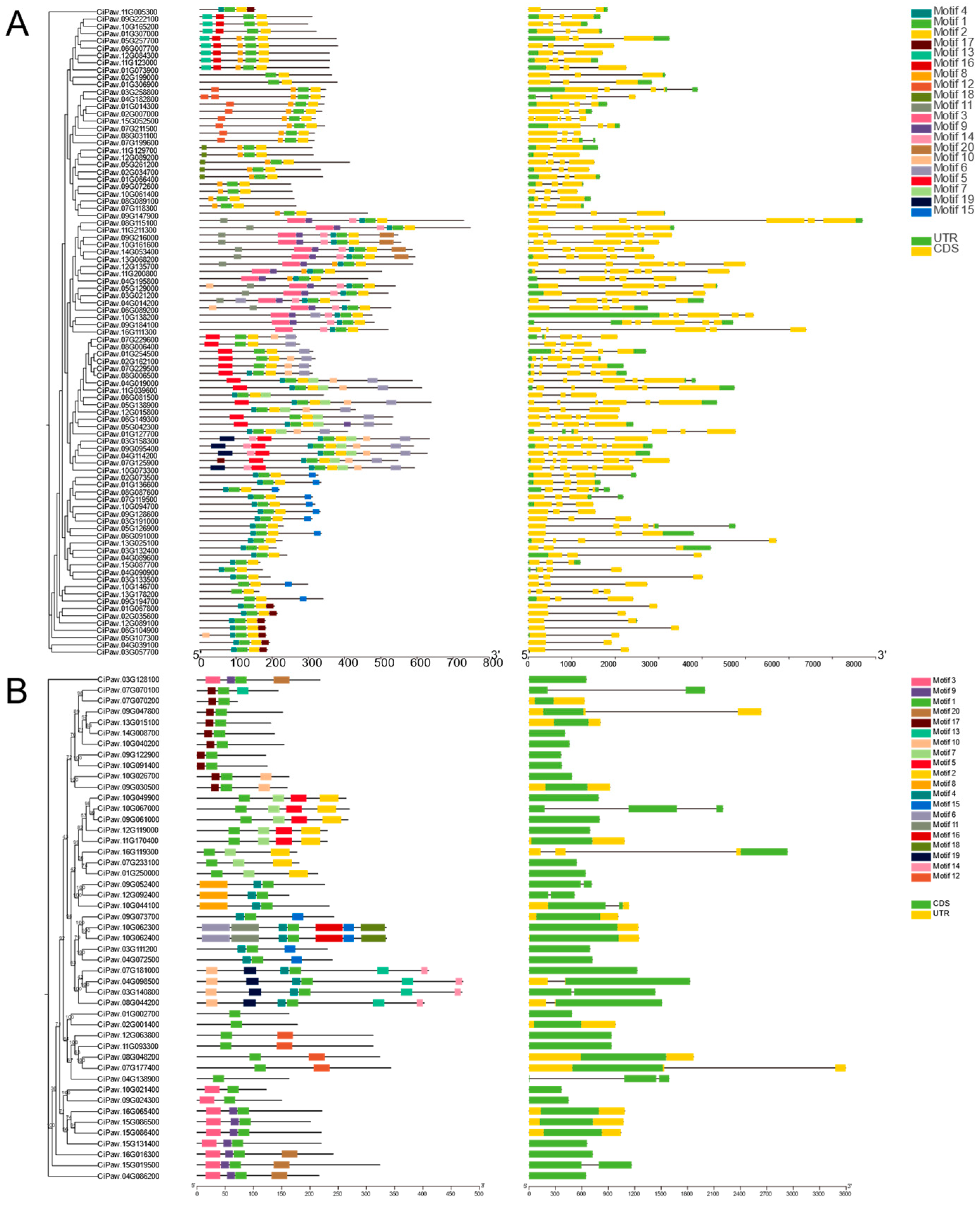
The conserved motifs of WRKY and VQ proteins of pecan were analyzed. A total of twenty distinct motifs were identified among CiWRKY proteins (Figure 1). Notably, all CiWRKY proteins contained motif1 and motif2, suggesting that these two motifs were essential for the core functions of WRKY transcription factors in pecan. Furthermore, genes clustered within the same phylogenetic subgroups exhibited similar motif compositions. For example, all eight proteins containing motif 12 were grouped in clade III, which was consistent with the phylogenetic tree result. Similarly, 20 conserved motifs were identified in VQ proteins. Most VQ proteins contained motif 1, indicating that it may be a potentially essential feature of this family. Comparable to WRKY proteins, VQ proteins within the same subgroup tended to share similar motif patterns. For instance, the five VQs containing motif 5 were all classified in clade III. However, diversity in motif type and number was observed among different clades, suggesting functional divergence among family members. The conservation of core WRKY and VQ motifs indicated that their DNA-binding and interaction functions have been evolutionarily maintained.
Gene structure analysis revealed distinctions between the two gene families. Among the CiWRKY genes, the number of introns ranged from one to six, and 34 CiWRKYs contained two introns. Only one CiWRKY gene contained six introns, and 10 members contained one intron. In contrast, most genes in the CiVQ family contained zero to two introns. Specifically, only three genes including CiPaw.04G138900, CiPaw.10G067000, and CiPaw.16G119300 contained two introns, and 10 CiVQs contained one intron. All remaining CiVQ genes were intronless, which reflected a relatively conserved gene structure within the VQ family.

3.3. Conserved Domain Analysis and Phylogenetic Relationships of CiWRKY and CiVQ Proteins

Analysis of the WRKY domain sequences in pecan revealed that all WRKY proteins contained the highly conserved core sequence “WRKYGQK”, which is a hallmark of WRKY transcription factors (Supplementary Figure S1). Similarly, conserved domain analysis of the CiVQ proteins demonstrated that nearly all members contained the FxxxVQx(L/F/V)TG motif, with the exception of CiPaw.10G062300 and CiPaw.10G062400, which lacked the valine (V) and glutamine (Q) residues. Among the conserved motif variants, 35 proteins exhibited the LTG terminal pattern, followed by FTG (7 proteins) and VTG (3 proteins), reflecting moderate sequence diversity within this family.
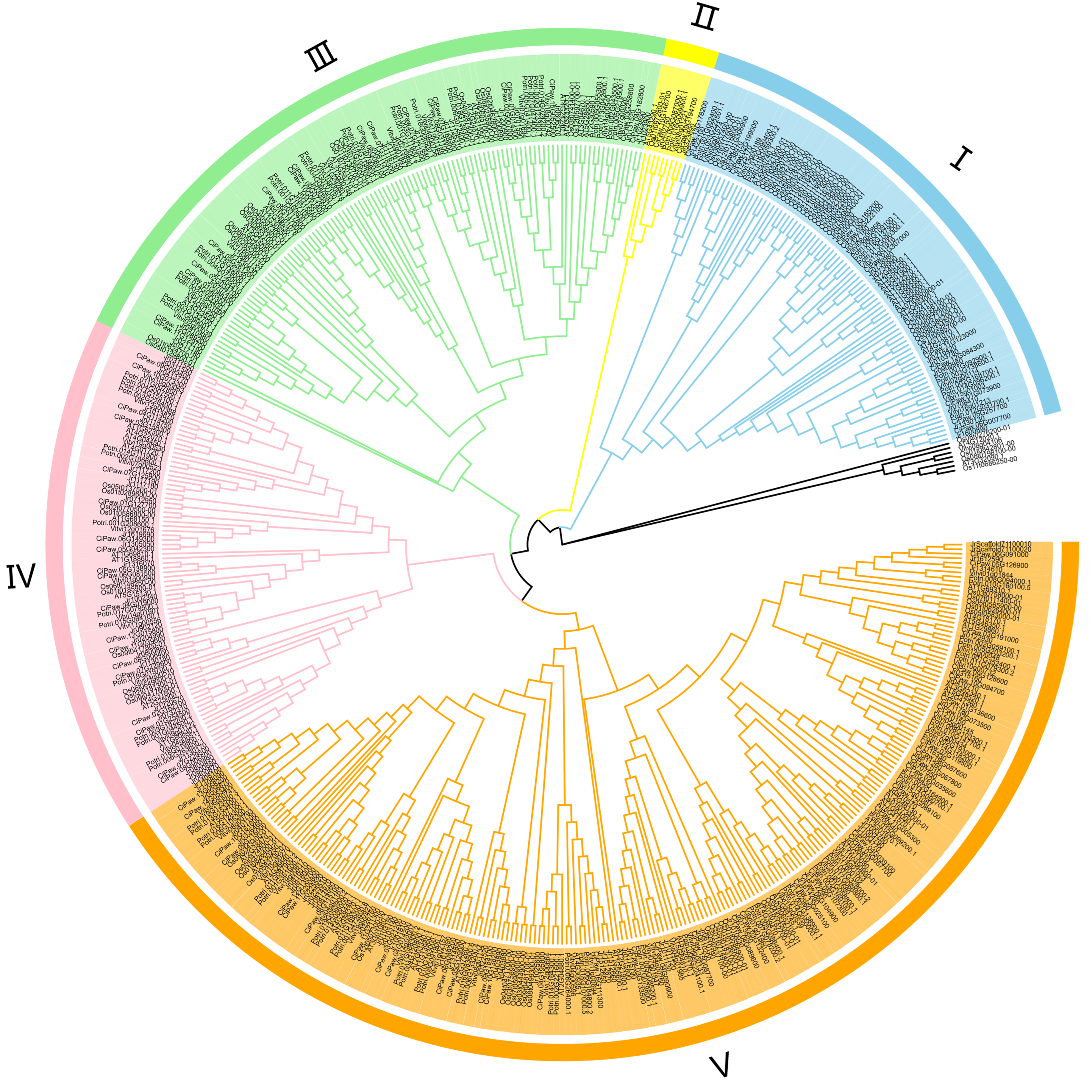
To investigate the evolutionary relationships of the WRKY gene family, a phylogenetic tree was constructed using WRKY protein sequences from six plant species including Arabidopsis thaliana (73), Carya illinoinensis (89), Oryza sativa (86), Populus trichocarpa (98), Juglans regia (117), and Vitis vinifera (64). These species included model herbaceous plants (Arabidopsis thaliana and Oryza sativa), woody perennials (Populus trichocarpa, Juglans regia, and Carya illinoinensis), and a basal eudicot (Vitis vinifera), allowing for the comparison of WRKY gene evolution across monocots and dicots. These WRKY proteins were clustered into five major subfamilies (I–V) based on sequence homology (Figure 2). Subfamily V was the largest, comprising 221 members, while subfamily II was the smallest with only nine members. Notably, most WRKY proteins from pecan clustered closely with walnut WRKYs in the phylogenetic tree, which highlighted the close evolutionary relationship between the two Juglandaceae species. The evolutionary conservation of WRKY and VQ proteins across multiple species indicated that these members share a common ancestral origin and have retained essential regulatory roles throughout evolution, respectively. However, the diversification of gene structures and motifs indicates potential functional divergence.
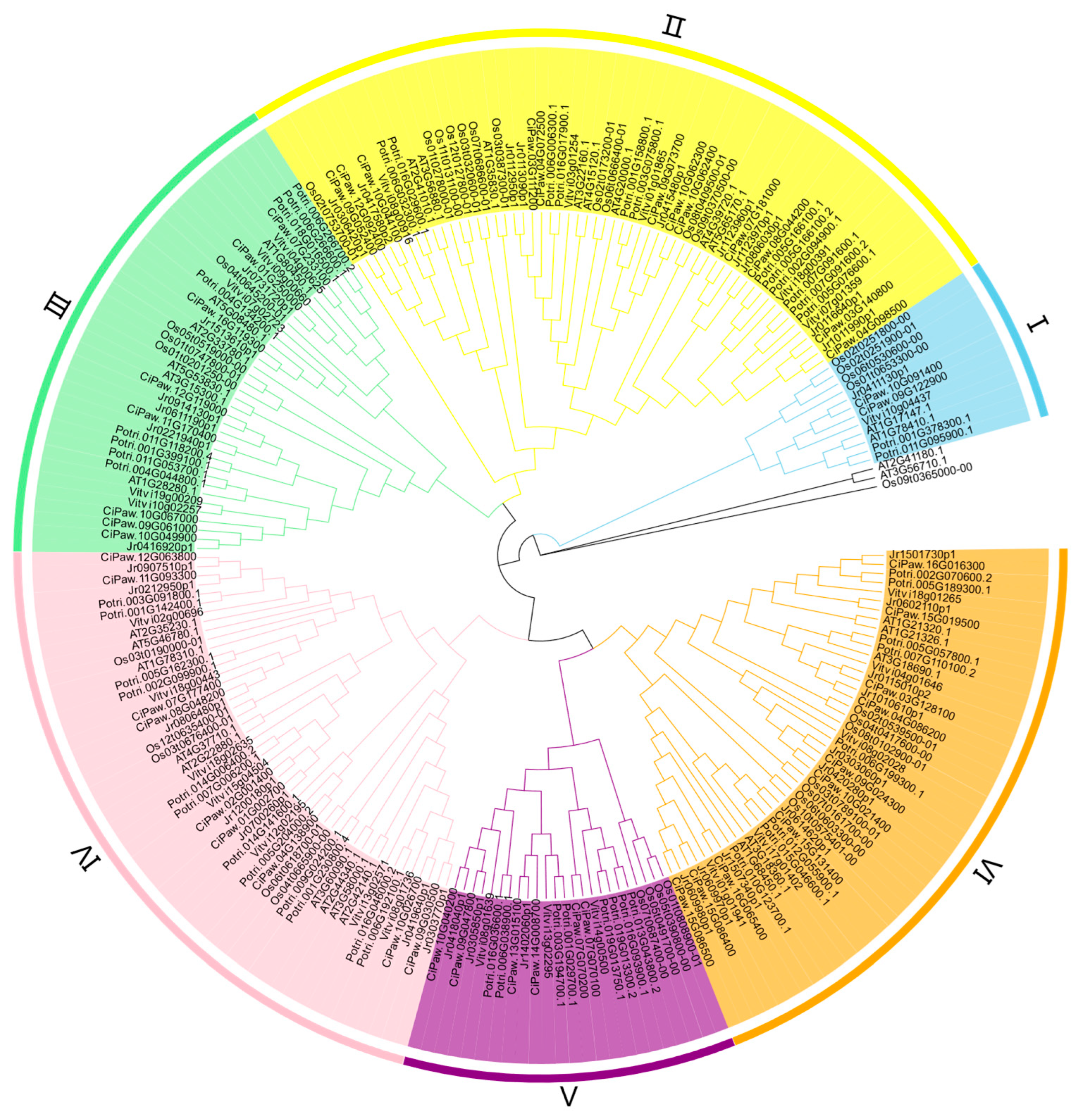
A similar approach was used to analyze the VQ gene family. Phylogenetic analysis was conducted using VQ domain-containing proteins from the same species. Based on sequence similarities, these VQ proteins were classified into six subfamilies (I–VI) (Figure 3). Among them, subfamily II contained the highest number of members (58), while subfamily I was the smallest, with only 12 members. Consistent with the WRKY analysis, CiVQ proteins clustered closely with walnut VQs, reflecting the phylogenetic proximity of the two species. These results provide important insights into the evolutionary conservation and divergence of WRKY and VQ gene families across plant lineages.

3.4. Chromosomal Localization of CiWRKY and CiVQ Genes

Chromosomal distribution analysis revealed that the 89 CiWRKY genes were unevenly distributed across all 16 chromosomes (Chr1–Chr16) (Supplementary Figure S2). Chromosome 1 (Chr1) harbored the largest number of CiWRKY genes, with nine genes, whereas Chr14 and Chr16 each contained only one CiWRKY gene.
Similarly, the 47 CiVQ genes were distributed unevenly across 14 chromosomes, except Chr5 and Chr6. The highest number of CiVQ genes (nine genes) was observed on Chr10, while only one gene was found on Chr2, Chr13, and Chr14, respectively.
Notably, no significant correlation was observed between chromosome length and the number of genes mapped to each chromosome for either the CiWRKY or CiVQ gene family, indicating that gene distribution may be influenced by other genomic or evolutionary factors rather than chromosome size alone. These factors may include segmental duplication events, chromosomal rearrangements, or transposable element insertions among chromosomes.

3.5. Duplication Events and Ka/Ks Analysis of CiWRKY and CiVQ Genes in Pecan

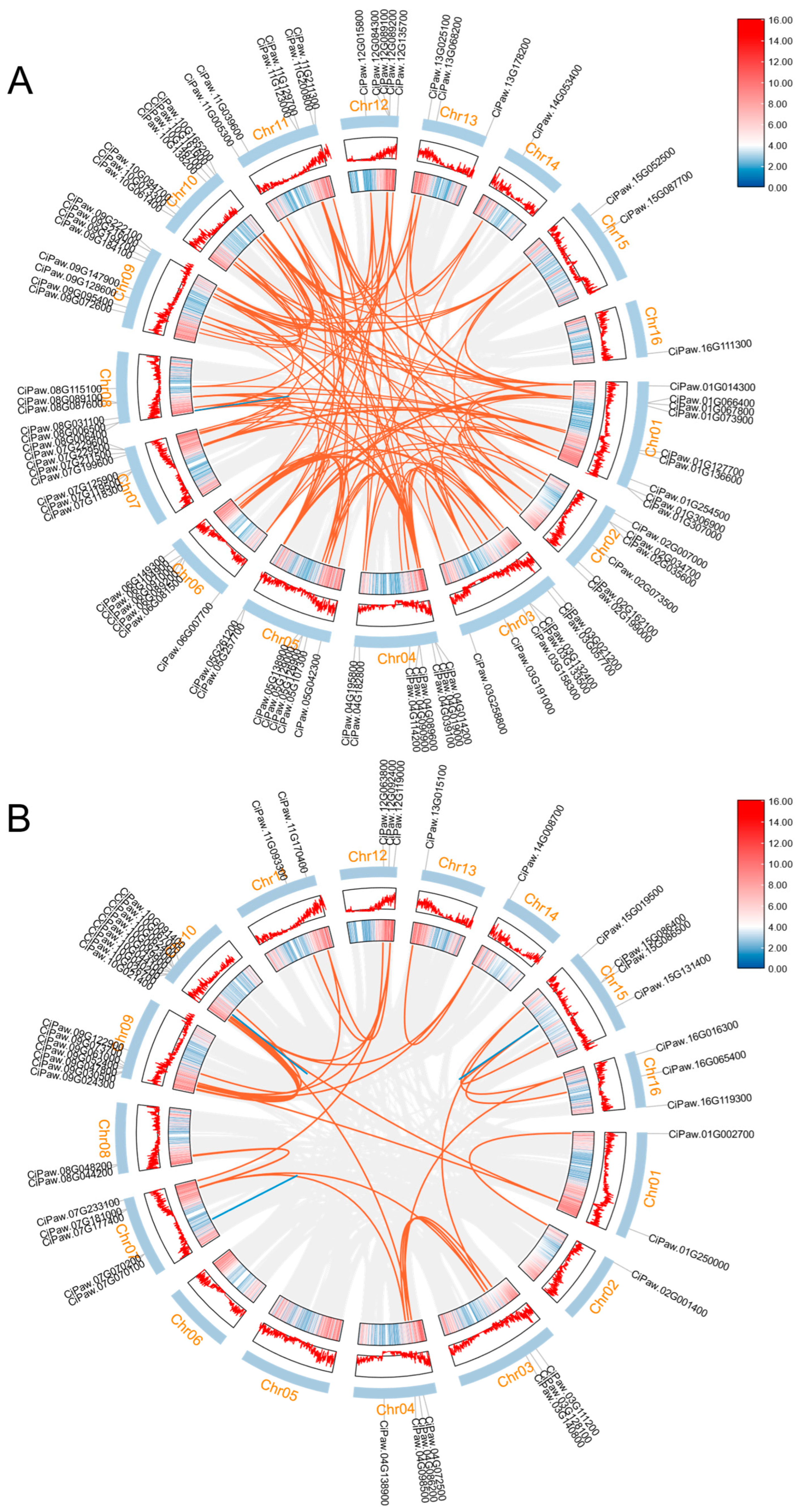
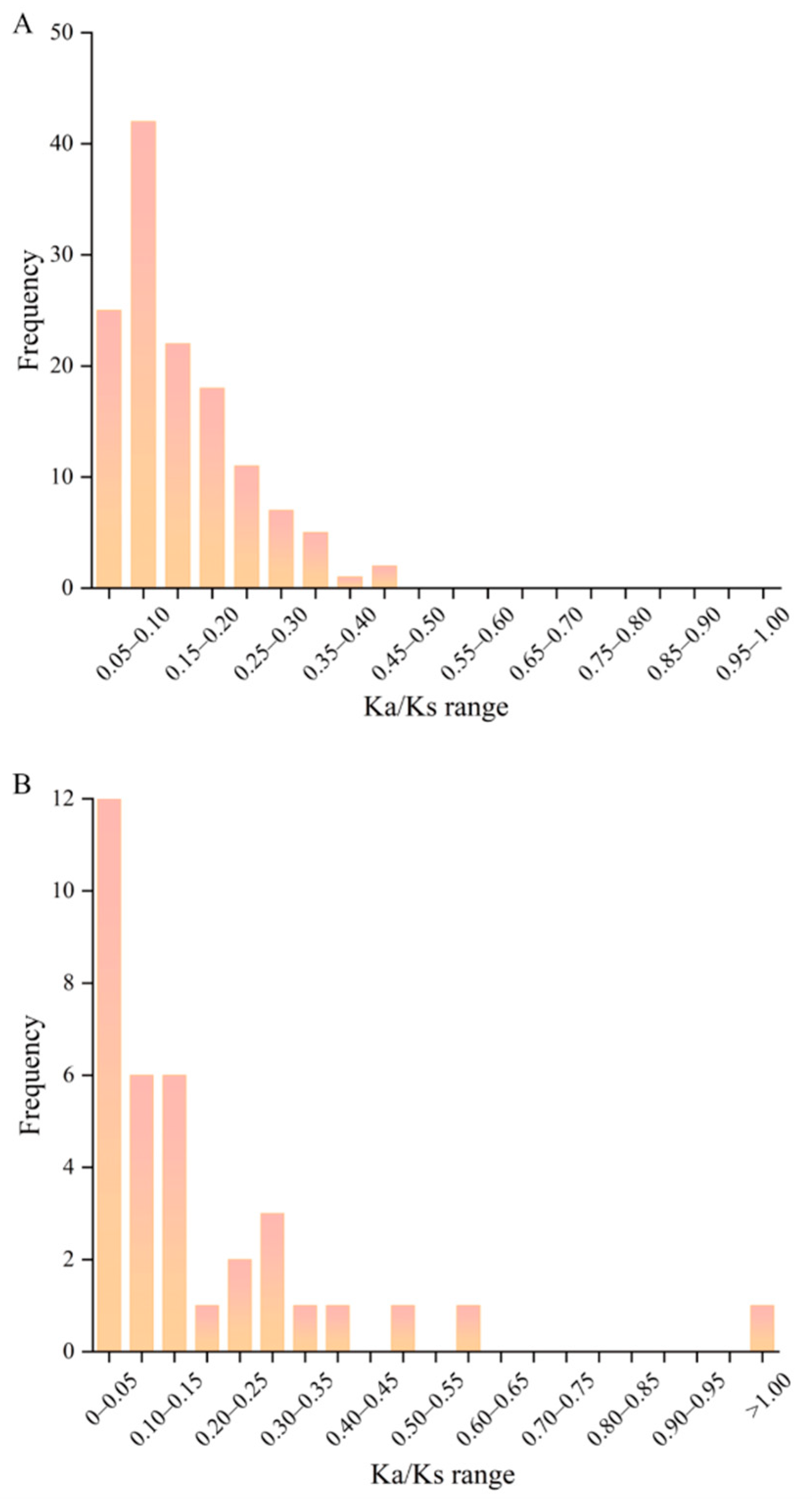
To investigate the evolutionary forces underlying the expansion of CiWRKY and CiVQ gene families, duplication events were systematically analyzed (Figure 4). In the CiWRKY gene family (Figure 4A), a total of 132 segmental duplication events and one tandem duplication event were identified, suggesting that segmental duplication is the major contributor driving the expansion of the CiWRKY gene family (Supplementary Table S3). Furthermore, 32 segmental duplication events and three tandem duplication events were identified in the CiVQ gene family (Figure 4B). These results indicated that segmental duplication also played a pivotal factor in the expansion of CiVQ genes. The mean Ka/Ks value for CiWRKY gene pairs from segmental duplication was 0.13 ± 0.09, and that for CiVQ gene pairs was 0.13 ± 0.14; this result indicated that both families have evolved under strong purifying selection. The predominance of segmental duplication events indicated that the large-scale genome duplications, rather than tandem duplications, have primarily driven the expansion of WRKY and VQ families in pecan.
To further investigate the selection pressures among duplicated gene pairs, the synonymous substitution rates (Ks) and non-synonymous substitution rates (Ka), as well as the Ka/Ks ratio were calculated (Figure 5). A Ka/Ks ratio < 1 indicates negative selection, a Ka/Ks ratio > 1 indicates positive selection, and a Ka/Ks ratio = 1 indicates neutral selection. The Ka/Ks values of both tandem and segmental duplication events in the pecan WRKY gene family ranged from 0 to 0.45, indicating that these genes may have experienced strong negative selection (Figure 5A). In the CiVQ gene family (Figure 5B), the Ka/Ks values ranged from 0 to 0.60, with only one gene pair (CiPaw.10G062300 and CiPaw.10G062400) exhibiting a Ka/Ks value greater than 1, indicating positive selection (Supplementary Table S3). These findings indicated that the two gene families primarily evolved under purifying selection.

3.6. Cis-Acting Element Analysis in the Promoters of CiWRKY and CiVQ Genes in Pecan

To investigate the potential regulatory roles of CiWRKY and CiVQ genes in pecan, cis-acting elements were identified within the 2000 bp upstream promoter regions of genes in both families (Supplementary Figure S3). A total of 2626 cis-acting elements belonging to 36 types were identified in the promoter regions of the 89 CiWRKY genes. Besides the core promoter elements CAAT-box and TATA-box, these elements were classified into three functional categories including plant growth and development, hormone-responsive, and abiotic stress-responsive. The largest group was associated with plant growth and development, accounting for 1677 elements, with light-responsive elements being the most prevalent. A total of 761 hormone-responsive elements were detected, among which those responsive to methyl jasmonate (MeJA, 290 elements) and abscisic acid (ABA, 289 elements) were the most abundant. Furthermore, 188 abiotic stress-responsive elements were identified, including those associated with drought and low temperature responses. These results suggested that CiWRKY genes may play essential roles in regulating plant growth and development, hormone signaling, and stress adaptation in pecan.
Similarly, 1377 cis-acting elements representing 37 types were identified in the promoters of 47 CiVQ genes. Among them, 853 elements were related to growth and development, with light-responsive elements as the dominant type. A total of 429 hormone-responsive elements were detected, with MeJA (168 elements) and ABA (141 elements) responses being most prominent. A total of 95 abiotic stress-related elements were identified. These results indicated that CiVQ genes, similar to CiWRKY genes, were likely regulated by complex physiological and environmental signals and might contribute to diverse biological processes in pecan.

3.7. Expression and Co-Expression Analysis of Pecan WRKY and VQ Genes in Various Tissues

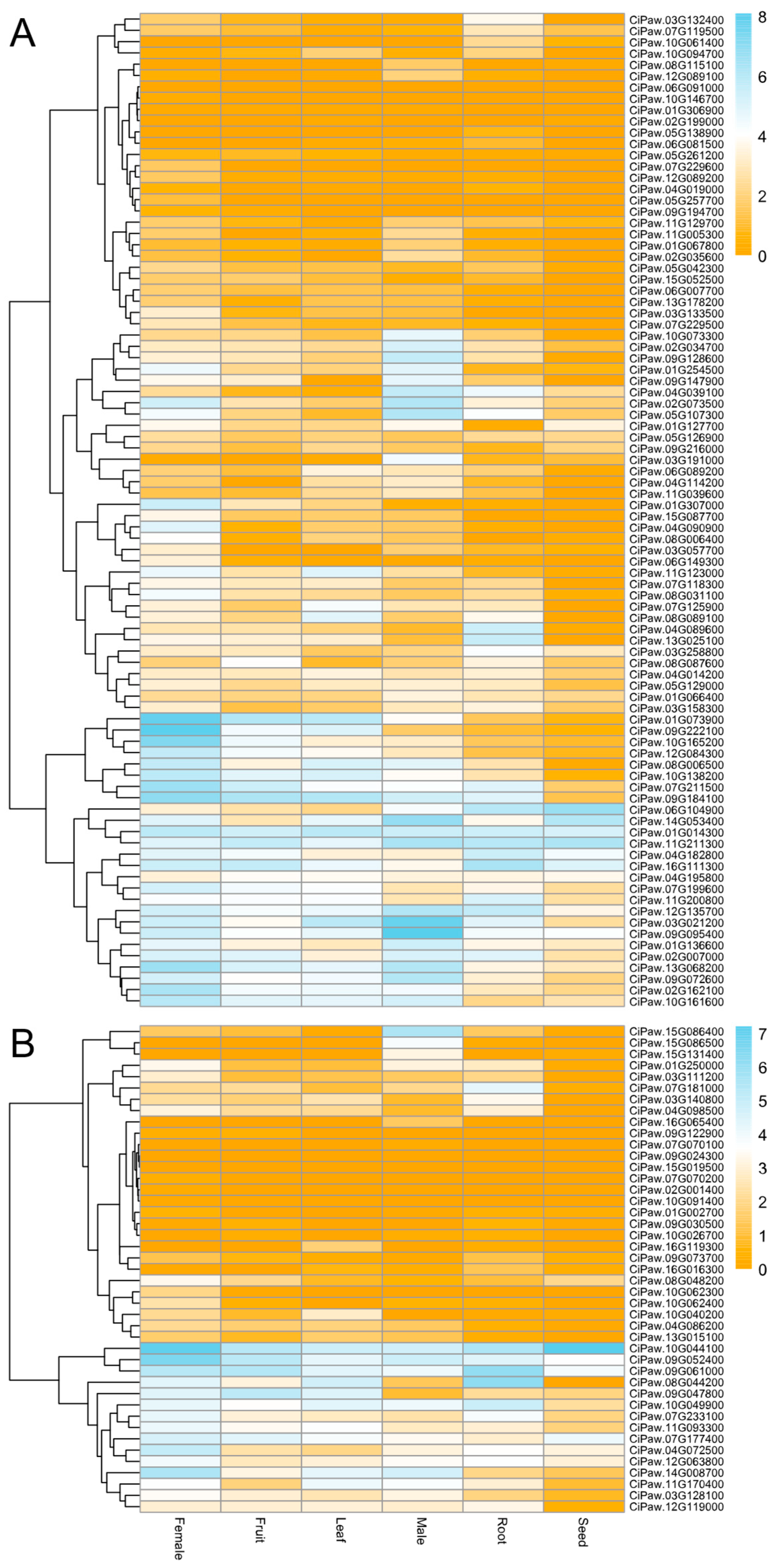
To investigate the expression patterns of CiWRKY and CiVQ genes in six pecan tissues (female flowers, male flowers, fruits, leaves, roots, and seeds), previous transcriptome datasets were analyzed (Figure 6). The results revealed significant variation in the expression levels of CiWRKY and CiVQ genes among different tissues, showing tissue-specific expression characteristics.
Among the 89 CiWRKY genes (Figure 6A), CiPaw.01G014300 and CiPaw.11G211300 exhibited high expression in all six tissues, suggesting that they might be involved in regulating the growth and development of multiple organs in pecan. Several genes, including CiPaw.01G073900, CiPaw.07G211500, CiPaw.08G006500, CiPaw.09G184100, CiPaw.09G222100, CiPaw.10G138200, CiPaw.10G165200, and CiPaw.12G084300 exhibited higher expression levels in female flowers, whereas CiPaw.02G034700, CiPaw.09G128600, CiPaw.09G147900, and CiPaw.10G073300 were specifically highly expressed in male flowers, indicating their potential roles in floral organ development. In addition, CiPaw.04G089600 and CiPaw.13G025100 were predominantly expressed in root tissues, while CiPaw.01G306900, CiPaw.02G199000, CiPaw.06G091000, and CiPaw.10G146700 were lowly expressed across all tissues.
Among the 47 CiVQ genes (Figure 6B), CiPaw.10G044100 was highly expressed in all six tissues, whereas CiPaw.15G086400 and CiPaw.07G181000 were specifically expressed in male flowers and root tissues, respectively. Conversely, a few VQ genes performed very low or no expression in all tissues.
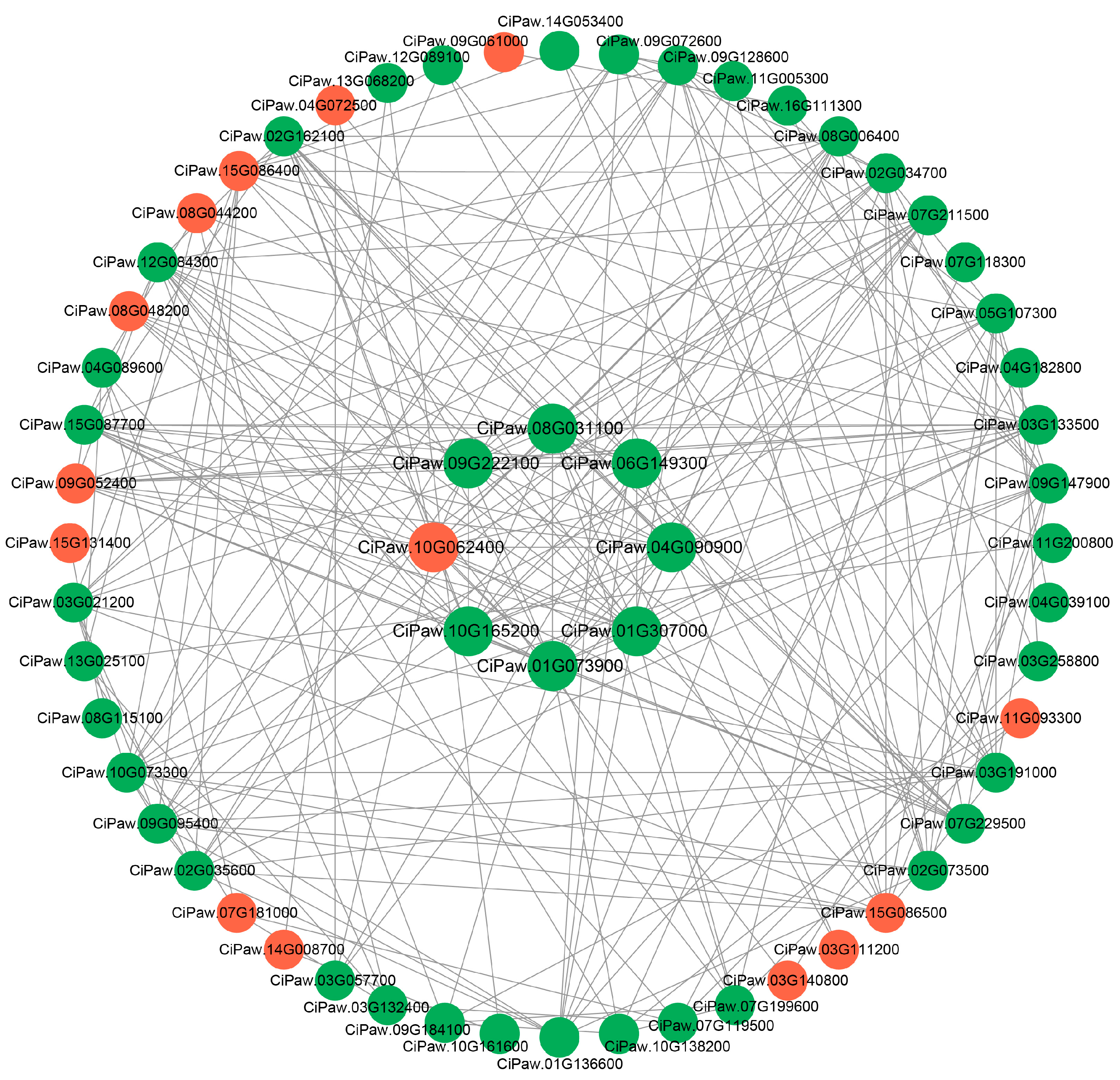
A tissue specific co-expression network of the CiWRKY and CiVQ genes was further constructed (Figure 7). The network contained 60 nodes (46 WRKYs and 14 VQs) and 253 edges, among which 8 nodes had more than 15 edges, suggesting strong interaction potential. CiPaw.01G073900 and CiPaw.06G149300 were identified as hub genes, each having the largest number of edges, connecting with 16 WRKYs and 2 VQs, and 13 WRKYs and 5 VQs, respectively.

3.8. Expression Patterns and Co-Expression Analysis of Pecan WRKY and VQ Genes Under Drought Treatment

Recent studies have demonstrated that plant WRKY and VQ genes play critical roles in response to abiotic stresses. RNA-Seq data were used to analyze the expression profiles of pecan WRKY and VQ genes under drought stress (Supplementary Figure S4). Among the 89 CiWRKY genes, 63 were significantly upregulated, 8 genes such as CiPaw.01G014300, CiPaw.01G073900, and CiPaw.04G014200 showed relatively low expression levels under drought treatment. In contrast, 17 genes including CiPaw.01G006400, CiPaw.01G136600, and CiPaw.14G053400 were gradually upregulated under drought treatment, with their expression levels peaking at 15 days of stress, suggesting that these genes may participate in drought adaptation.
Similarly, diverse expression patterns were observed among the 47 VQ genes under drought stress, 27 of them were significantly upregulated (Supplementary Figure S4). Eight genes, such as CiPaw.04G138900, maintained relatively low expression levels, while a subset, including CiPaw.03G128100 and CiPaw.04G072500, were gradually upregulated and peaked at 15 days of drought stress. Conversely, other members, such as CiPaw.08G044200, showed a continuous decrease in expression.
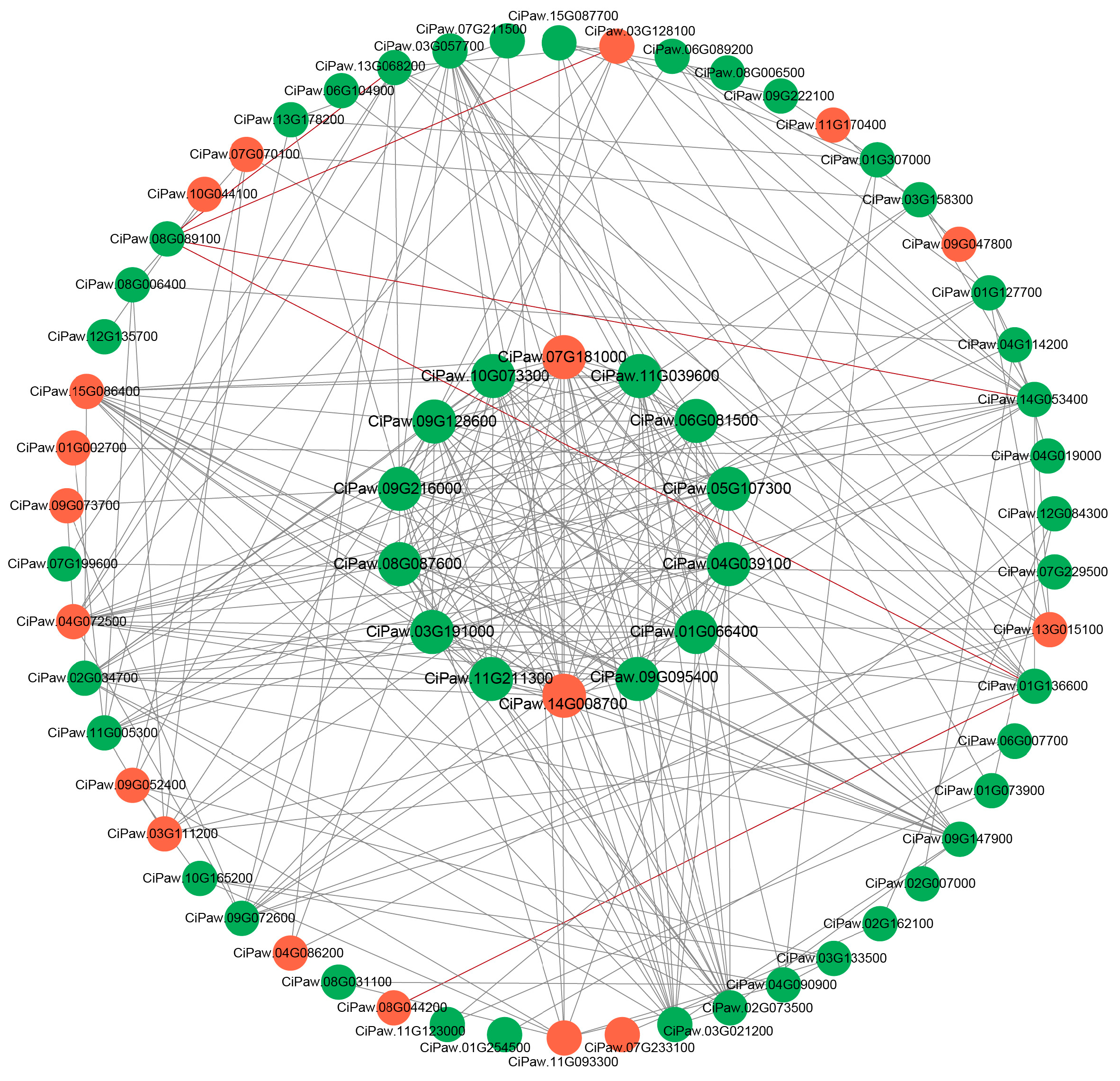
A co-expression network was further constructed to investigate the relationships between WRKY and VQ genes under drought conditions (Figure 8). The network contained 68 nodes (50 WRKYs and 18 VQs) and 279 edges, among which 14 nodes had more than 15 edges, indicating strong interconnections. Four hub nodes (CiPaw.04G039100, CiPaw.09G095400, CiPaw.09G216000, and CiPaw.14G008700) were identified with the highest numbers of 20 edges, suggesting their central regulatory role in the network. Among the 279 co-expression events, 274 exhibited significant positive correlations, whereas only 5 showed significant negative correlations.

3.9. Response and Expression Pattern of Pecan WRKY and VQ Genes Under Salt and ABA Treatments

Based on the transcriptome analysis of pecan WRKY and VQ genes under drought stress, five WRKY genes and five VQ genes showing differential expression under drought were selected as candidate genes. Their expression patterns in response to salt and ABA treatments were further investigated using qRT-PCR.
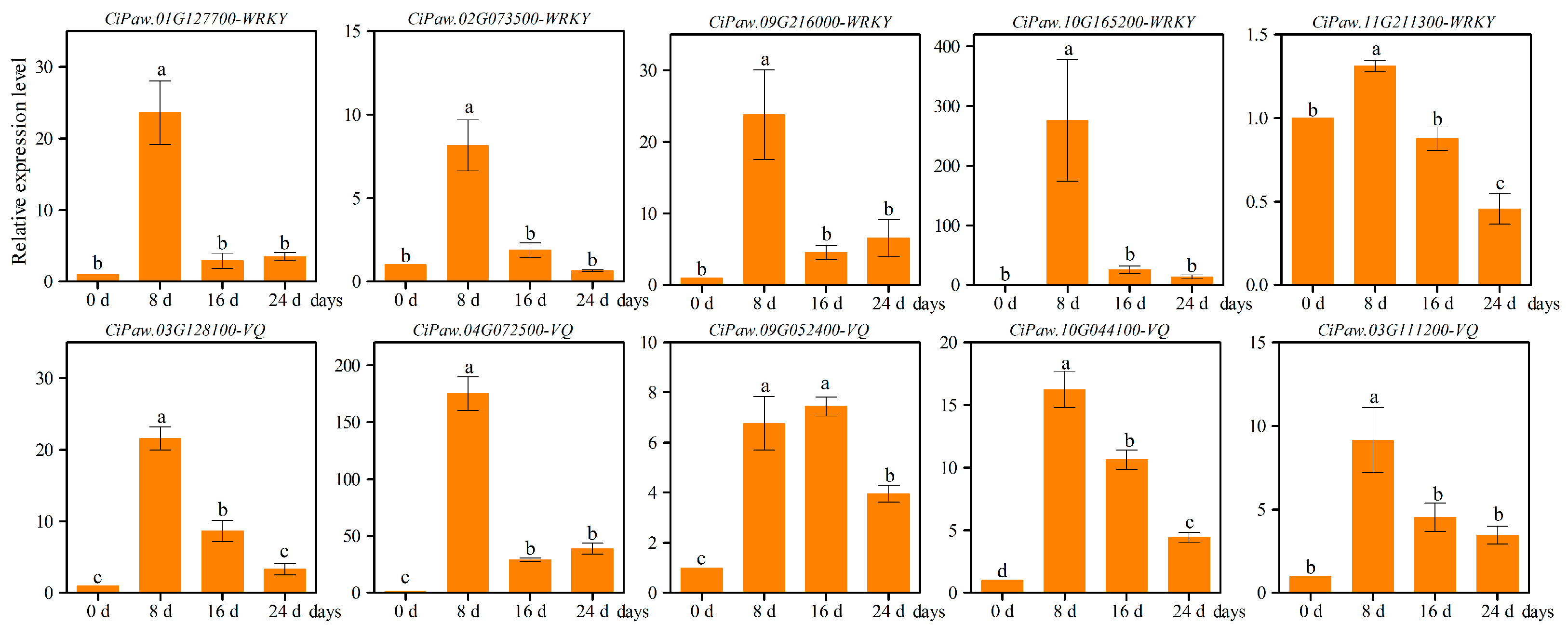
Under salt stress, the expression levels of WRKY genes (CiPaw.01G127700, CiPaw.02G073500, CiPaw.09G216000, CiPaw.10G165200, and CiPaw.11G211300) displayed a trend of initial upregulation followed by downregulation, peaking at 8 days. The VQ genes exhibited a similar expression pattern, with CiPaw.03G128100, CiPaw.04G072500, CiPaw.10G044100, and CiPaw.03G111200 peaking at 8 days, whereas CiPaw.09G052400 peaked at 16 days (Figure 9). CiPaw.10G165200 and CiPaw.04G072500 were both strongly induced by salt stress, with the expression level increasing over 100-fold after 8 d compared with 0 d.
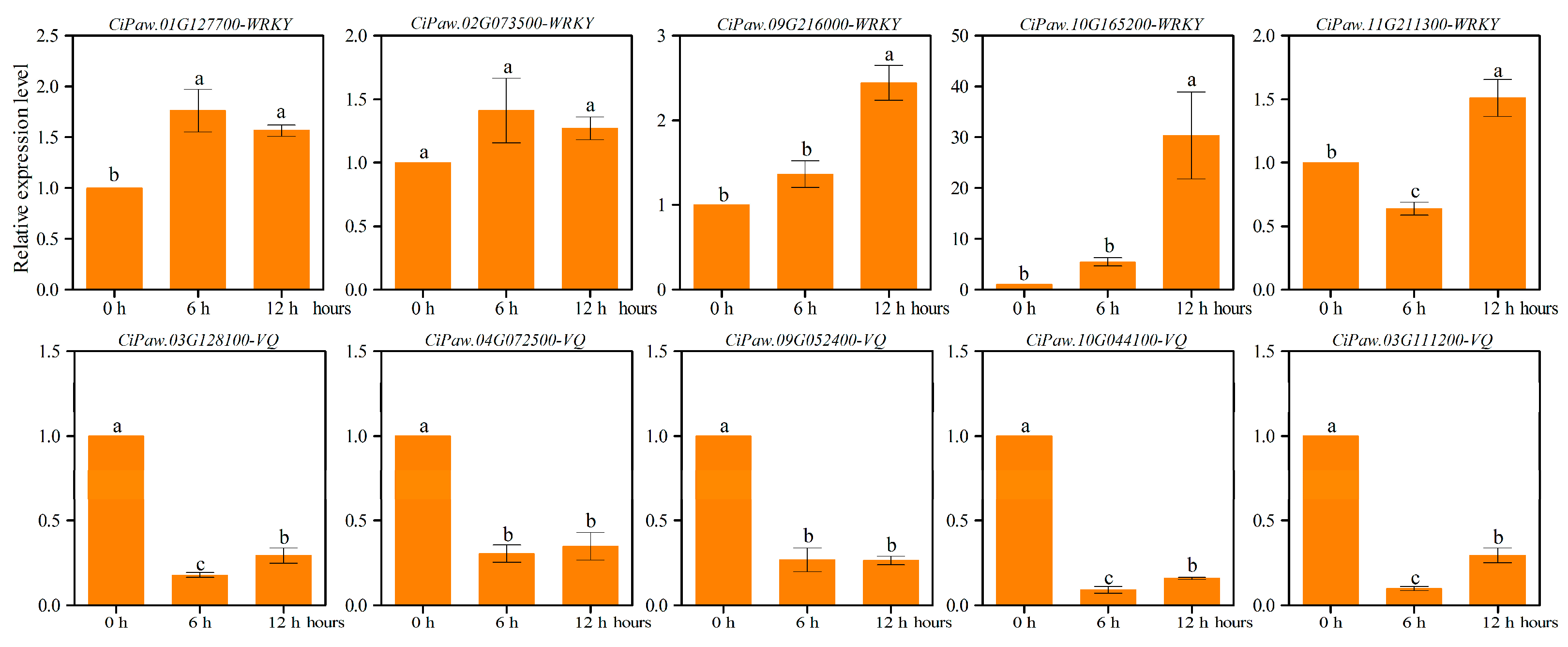
Under ABA treatment, CiPaw.09G216000 and CiPaw.10G165200 demonstrated a continuous increase and peaked at 12 h; while CiPaw.11G211300 showed a biphasic pattern of downregulation followed by upregulation, reaching its maximum at 12 h. In contrast, the VQ genes (CiPaw.03G128100, CiPaw.04G072500, CiPaw.09G052400, CiPaw.10G044100, and CiPaw.03G111200) were consistently downregulated, which indicated ABA represses their expression (Figure 10). Moreover, CiPaw.10G165200 exhibited a more than 20-fold increase after 12 h of ABA treatment, which suggested this gene might play an important role in regulating pecan response to abiotic stresses.

4. Discussion

WRKY and VQ proteins play important roles in regulating plant growth, development, and responses to biotic and abiotic stresses through transcriptional networks and protein–protein interactions [36]. Characterizing the genomic features, duplication patterns, and expression data of these two families in pecan provides novel insights into their evolutionary history and stress response mechanisms.
A total of 89 CiWRKYs and 47 CiVQs were identified in the pecan genome (Figure 1). Compared with other woody plants such as walnut (117 WRKYs) and poplar (98 WRKYs), the number of WRKY genes in pecan was comparable, indicating the evolutionary conservation of this transcription factor family, which has preserved essential regulatory functions across species (Figure 2). However, grapevine harbored only 59 WRKY genes [37]. Similarly, the number of VQ genes (47) in pecan was comparable to those in Arabidopsis (34), grapevine (26), and walnut (37), indicating that the expansion of the VQ gene family in pecan is consistent with other angiosperms [38]. Gene structure analysis revealed that most CiWRKY genes contain 2–5 introns, which is consistent with results in Arabidopsis and grapevine [37,39]. This structural conservation indicates that WRKY genes are evolutionarily stable, which may help maintain their regulatory functions [40]. In contrast, most CiVQ genes are intronless, a typical feature also reported in Arabidopsis and rice. Some intronless genes have been reported to exhibit rapid transcriptional responses to environmental changes and play key roles in stress signaling pathways. Therefore, the intronless structure of most CiVQ genes may facilitate their rapid transcriptional responses to stress [13,41]. Motif analysis further confirmed the conservation of WRKY and VQ proteins. The WRKY domains with the core sequence WRKYGQK and zinc-finger motifs (C2H2/C2HC) were highly conserved, similar to findings in cucumber and peanut [42,43]. For CiVQ proteins, the hallmark FxxxVQxhTG motif was highly conserved, consistent with results in other plants [44]. The conservation of these domains in WRKYs and VQs highlights their essential role in DNA binding and protein–protein interactions [45].
Gene duplication plays a key role in the expansion and functional diversification of gene families [46]. Segmental duplication, derived from whole-genome duplication, is considered as an evolutionarily advantageous mechanism, which enables the retention of multiple regulatory genes within duplicated chromosomal blocks [32,46]. In pecan, 132 segmental duplication events and one tandem duplication event were identified in CiWRKYs, while 32 segmental and three tandem duplications were detected in CiVQs. These results suggest that segmental duplication is the predominant mechanism driving the expansion of both families, consistent with studies in grapevine and apple [12,37,47]. Ka/Ks analysis demonstrated that most duplicated gene pairs had Ka/Ks ratios < 1, indicating that purifying selection is the main evolutionary force (Figure 5). Similar selection patterns have been reported in plant WRKYs and VQs [17,48,49]. Interestingly, one CiVQ gene pair showed a Ka/Ks > 1, suggesting that while most members underwent negative selection, a few may have undergone positive selection, possibly acquiring novel functions [50]. This balance between conservation and innovation has been widely reported in transcription factor families. These results indicate that the expansion of WRKY and VQ genes in pecan is mainly driven by segmental duplications and maintained under strong purifying selection, which ensures functional conservation while allowing limited diversification [51,52]. Divergent expression profiles among duplicated WRKY and VQ gene pairs revealed possible subfunctionalization or neo-functionalization, which reflect adaptive diversification following genome duplication.
Expression data could help investigate the complex regulatory pathways and gene functions [53]. WRKYs regulate multiple development processes, including seed germination, flowering, and morphogenesis in plants [10,17]. The expression analysis revealed tissue-specific patterns of CiWRKY and CiVQ genes (Figure 6). Some CiWRKYs were ubiquitously expressed, suggesting fundamental roles in plant growth and development, while others were specifically expressed in flowers or roots, indicating specialized functions in reproductive development and nutrient acquisition. Most VQ genes showed low or tissue-specific expression, consistent with the notion that VQ proteins act as regulatory interacting with WRKYs. For example, in Arabidopsis, WRKY2 and WRKY34 modulated pollen development via interacting with VQ20 [54]. In addition to VQs, WRKYs also regulate development processes by interacting with other transcription factors. For example, ApWRKY26 is involved in anthocyanin accumulation in Acer palmatum via interaction with ApMYB2 [55].
Cis-element analysis revealed that most CiWRKY and CiVQ promoters harbored abundant stress-related cis-elements, including ABRE, MBS, and LTR, suggesting regulation by ABA and other stress signals [56]. Plant growth and development were influenced by abiotic stresses, such as drought and salinity [57,58]. These results confirm that cis-elements are crucial in regulating the transcriptional response of WRKY and VQ genes under abiotic stresses [12]. Consistent with this, several CiWRKY and CiVQ genes exhibited stress-responsive expression, peaking at 15 days under drought treatment (Supplementary Figure S4). The co-expression network analysis revealed that specific WRKY and VQ members formed highly connected modules, suggesting cooperative regulation (Figure 8). This is consistent with findings in grape and rice [12,59]. PoVQ31 positively modulated drought tolerance in Paeonia ostii, and the PoVQ31-silenced lines performed more drought sensitivity [60]. Salt and ABA treatments confirmed the responsiveness of selected candidate WRKY and VQ genes using qRT-PCR. Under salt stress, both WRKY and VQ genes showed expression patterns peaking at 8 or 16 days (Figure 9). Under ABA treatment, WRKY genes were induced, while most VQs were suppressed (Figure 10). This indicates that WRKYs may function as positive regulators in ABA-mediated stress responses, consistent with previous studies in Arabidopsis [61]. By integrating bioinformatic analysis and qRT-PCR validation, several CiWRKY and CiVQ genes were predicted as key genes involved in stress adaptation. Among them, CiPaw.10G165200 was highly induced by both drought and ABA treatments, indicating the central role in response to drought stress.
Collectively, our findings not only deepen the understanding of the regulatory roles of WRKY and VQ genes in pecan but also provide valuable gene resources for molecular breeding. Furthermore, the identified key WRKY and VQ genes offer potential targets for improving drought and salt tolerance through genetic engineering.

5. Conclusions

Our study provided a genome-wide characterization of the WRKY and VQ gene families in pecan. The results demonstrated that a total of 89 CiWRKY and 47 CiVQ genes were identified, showing conserved structural features and motif compositions. Duplication analysis revealed that both gene families had expanded mainly through segmental duplication under purifying selection. Expression and co-expression analyses indicated that CiWRKY and CiVQ genes played important roles in development and stress responses, especially under drought, salt, and ABA treatments. CiPaw.10G165200 was identified as a key stress-responsive gene, which might be involved in abiotic stress signaling pathways. These findings not only expand our understanding of the molecular evolution and functional diversification of WRKY and VQ families in woody plants but also identify candidates that could be targeted in molecular breeding and genetic engineering programs aimed at improving pecan stress tolerance.

Supplementary Materials

The following supporting information can be downloaded at: https://www.mdpi.com/article/10.3390/horticulturae11111370/s1. Table S1: Sequence characteristic of pecan WRKYs. Table S2: Sequence characteristic of pecan VQs. Table S3: Duplication events and related Ka/Ks values of pecan WRKYs and VQs. Table S4: Overview of duplication events in pecan WRKY and VQ families. Table S5: Specific primers of pecan WRKY and VQ genes for qRT-PCR analysis. Figure S1: Domain analysis of pecan WRKY (A) and VQ (B) proteins. Figure S2: Chromosomal distribution of WRKY (A) and VQ (B) genes in pecan. Figure S3: Cis-acting element analysis in the promoter regions of WRKY (A) and VQ (B) genes in pecan. Figure S4: The expression levels of CiWRKYs and CiVQs in pecan under drought stress.

Author Contributions

Conceptualization, K.Z. and F.P.; methodology, Y.W. and J.Z.; formal analysis, M.W. and H.S.; investigation, W.J. and P.T.; writing—original draft preparation, K.Z. and Y.W.; writing—review and editing, G.W. and K.Z.; visualization, Y.W.; funding acquisition, K.Z. All authors have read and agreed to the published version of the manuscript.

Funding

This research was financially supported in part by the National Natural Science Foundation of China (No. 32301627), the China Postdoctoral Science Foundation (No. 2020M681628), and the Postdoctoral Research Funding Program of Jiangsu Province (No. 2020Z219).

Data Availability Statement

The raw data supporting the conclusions of this article will be made available by the authors on request.

Conflicts of Interest

The authors declare no conflicts of interest.

References

  1. Zhu, K.; Fan, P.; Liu, H.; Zhao, J.; Tan, P.; Mo, Z.; Peng, F. Pecan Kinome: Classification and Expression Analysis of All Protein Kinases in Carya illinoinensis. For. Res. 2021, 1, 14. [Google Scholar] [CrossRef] [PubMed]
  2. Maciel, L.G.; Ribeiro, F.L.; Teixeira, G.L.; Molognoni, L.; Nascimento Dos Santos, J.; Larroza Nunes, I.; Mara Block, J. The Potential of the Pecan Nut Cake as an Ingredient for the Food Industry. Food Res. Int. 2020, 127, 108718. [Google Scholar] [CrossRef]
  3. Zhang, J.; Jiao, Y.; Sharma, A.; Shen, D.; Wei, B.; Hong, C.; Zheng, B.; Pan, C. Transcriptomic Analysis Reveals Potential Pathways Associated with Salt Resistance in Pecan (Carya illinoensis K. Koch). J. Biotechnol. 2021, 330, 17–26. [Google Scholar] [CrossRef]
  4. Yang, B.; Yang, C.; Chen, J.; Ren, H.; Wang, K.; Liu, L.; Yao, X. CiNAC2 Positively Regulates Drought Stress Tolerance by Promoting Superoxide Dismutase Activity in Pecan (Carya illinoinensis). Hortic. Plant J. 2025, 11, 133–144. [Google Scholar] [CrossRef]
  5. Rushton, P.J.; Somssich, I.E.; Ringler, P.; Shen, Q.J. WRKY Transcription Factors. Trends Plant Sci. 2010, 15, 247–258. [Google Scholar] [CrossRef]
  6. Wani, S.H.; Anand, S.; Singh, B.; Bohra, A.; Joshi, R. WRKY Transcription Factors and Plant Defense Responses: Latest Discoveries and Future Prospects. Plant Cell Rep. 2021, 40, 1071–1085. [Google Scholar] [CrossRef]
  7. Dai, W.-S.; Peng, T.; Wang, M.; Liu, J.-H. Genome-Wide Identification and Comparative Expression Profiling of the WRKY Transcription Factor Family in Two Citrus Species with Different Candidatus Liberibacter Asiaticus Susceptibility. BMC Plant Biol. 2023, 23, 159. [Google Scholar] [CrossRef] [PubMed]
  8. Cheng, Z.; Luan, Y.; Meng, J.; Sun, J.; Tao, J.; Zhao, D. WRKY Transcription Factor Response to High-Temperature Stress. Plants 2021, 10, 2211. [Google Scholar] [CrossRef] [PubMed]
  9. Tao, Z.; Kou, Y.; Liu, H.; Li, X.; Xiao, J.; Wang, S. OsWRKY45 Alleles Play Different Roles in Abscisic Acid Signalling and Salt Stress Tolerance but Similar Roles in Drought and Cold Tolerance in Rice. J. Exp. Bot. 2011, 62, 4863–4874. [Google Scholar] [CrossRef]
  10. Wang, H.; Chen, W.; Xu, Z.; Chen, M.; Yu, D. Functions of WRKYs in Plant Growth and Development. Trends Plant Sci. 2023, 28, 630–645. [Google Scholar] [CrossRef]
  11. Rehman, S.; Bahadur, S.; Xia, W. Unlocking Nature’s Secrets: The Pivotal Role of WRKY Transcription Factors in Plant Flowering and Fruit Development. Plant Sci. 2024, 346, 112150. [Google Scholar] [CrossRef]
  12. Wang, M.; Vannozzi, A.; Wang, G.; Zhong, Y.; Corso, M.; Cavallini, E.; Cheng, Z.-M. A Comprehensive Survey of the Grapevine VQ Gene Family and Its Transcriptional Correlation with WRKY Proteins. Front. Plant Sci. 2015, 6, 417. [Google Scholar] [CrossRef]
  13. Zhong, Y.; Guo, C.; Chu, J.; Liu, H.; Cheng, Z.-M. Microevolution of the VQ Gene Family in Six Species of Fragaria. Genome 2018, 61, 49–57. [Google Scholar] [CrossRef]
  14. Hu, Y.; Chen, L.; Wang, H.; Zhang, L.; Wang, F.; Yu, D. Arabidopsis Transcription Factor WRKY 8 Functions Antagonistically with Its Interacting Partner VQ 9 to Modulate Salinity Stress Tolerance. Plant J. 2013, 74, 730–745. [Google Scholar] [CrossRef] [PubMed]
  15. Cheng, Y.; Zhou, Y.; Yang, Y.; Chi, Y.-J.; Zhou, J.; Chen, J.-Y.; Wang, F.; Fan, B.; Shi, K.; Zhou, Y.-H.; et al. Structural and Functional Analysis of VQ Motif-Containing Proteins in Arabidopsis as Interacting Proteins of WRKY Transcription Factors. Plant Physiol. 2012, 159, 810–825. [Google Scholar] [CrossRef] [PubMed]
  16. Lovell, J.T.; Bentley, N.B.; Bhattarai, G.; Jenkins, J.W.; Sreedasyam, A.; Alarcon, Y.; Bock, C.; Boston, L.B.; Carlson, J.; Cervantes, K.; et al. Four Chromosome Scale Genomes and a Pan-Genome Annotation to Accelerate Pecan Tree Breeding. Nat. Commun. 2021, 12, 4125. [Google Scholar] [CrossRef]
  17. Tian, J.; Zhang, J.; Francis, F. The Role and Pathway of VQ Family in Plant Growth, Immunity, and Stress Response. Planta 2024, 259, 16. [Google Scholar] [CrossRef] [PubMed]
  18. Atanasov, A.G.; Sabharanjak, S.M.; Zengin, G.; Mollica, A.; Szostak, A.; Simirgiotis, M.; Huminiecki, Ł.; Horbanczuk, O.K.; Nabavi, S.M.; Mocan, A. Pecan Nuts: A Review of Reported Bioactivities and Health Effects. Trends Food Sci. Technol. 2018, 71, 246–257. [Google Scholar] [CrossRef]
  19. Xiao, L.; Yu, M.; Zhang, Y.; Hu, J.; Zhang, R.; Wang, J.; Guo, H.; Zhang, H.; Guo, X.; Deng, T.; et al. Chromosome-Scale Assembly Reveals Asymmetric Paleo-Subgenome Evolution and Targets for the Acceleration of Fungal Resistance Breeding in the Nut Crop, Pecan. Plant Commun. 2021, 2, 100247. [Google Scholar] [CrossRef]
  20. Jia, X.; Xu, M.; Tan, W.; Wang, Z.; Guo, Z.; Yang, X.; Liu, C. Proteomic and Transcriptomic Analyses Provide New Insights into the Mechanism Underlying Lipid Deterioration in Pecan Kernels during Storage. J. Agric. Food Chem. 2024, 72, 10127–10137. [Google Scholar] [CrossRef]
  21. Gasteiger, E. ExPASy: The Proteomics Server for in-Depth Protein Knowledge and Analysis. Nucleic Acids Res. 2003, 31, 3784–3788. [Google Scholar] [CrossRef]
  22. Yu, C.; Chen, Y.; Lu, C.; Hwang, J. Prediction of Protein Subcellular Localization. Proteins 2006, 64, 643–651. [Google Scholar] [CrossRef] [PubMed]
  23. Zhang, J.; Zhang, W.; Ji, F.; Qiu, J.; Song, X.; Bu, D.; Pan, G.; Ma, Q.; Chen, J.; Huang, R.; et al. A High-quality Walnut Genome Assembly Reveals Extensive Gene Expression Divergences after Whole-genome Duplication. Plant Biotechnol. J. 2020, 18, 1848–1850. [Google Scholar] [CrossRef]
  24. Tamura, K.; Stecher, G.; Kumar, S. MEGA11: Molecular Evolutionary Genetics Analysis Version 11. Mol. Biol. Evol. 2021, 38, 3022–3027. [Google Scholar] [CrossRef]
  25. Price, M.N.; Dehal, P.S.; Arkin, A.P. FastTree: Computing Large Minimum Evolution Trees with Profiles Instead of a Distance Matrix. Mol. Biol. Evol. 2009, 26, 1641–1650. [Google Scholar] [CrossRef]
  26. Subramanian, B.; Gao, S.; Lercher, M.J.; Hu, S.; Chen, W.-H. Evolview v3: A Webserver for Visualization, Annotation, and Management of Phylogenetic Trees. Nucleic Acids Res. 2019, 47, W270–W275. [Google Scholar] [CrossRef]
  27. Chen, C.; Wu, Y.; Li, J.; Wang, X.; Zeng, Z.; Xu, J.; Liu, Y.; Feng, J.; Chen, H.; He, Y.; et al. TBtools-II: A “One for All, All for One” Bioinformatics Platform for Biological Big-Data Mining. Mol. Plant 2023, 16, 1733–1742. [Google Scholar] [CrossRef]
  28. Lescot, M. PlantCARE, a Database of Plant Cis-Acting Regulatory Elements and a Portal to Tools for in Silico Analysis of Promoter Sequences. Nucleic Acids Res. 2002, 30, 325–327. [Google Scholar] [CrossRef] [PubMed]
  29. Wang, Y.; Li, J.; Paterson, A.H. MCScanX-Transposed: Detecting Transposed Gene Duplications Based on Multiple Colinearity Scans. Bioinformatics 2013, 29, 1458–1460. [Google Scholar] [CrossRef] [PubMed]
  30. Larkin, M.A.; Blackshields, G.; Brown, N.P.; Chenna, R.; McGettigan, P.A.; McWilliam, H.; Valentin, F.; Wallace, I.M.; Wilm, A.; Lopez, R.; et al. Clustal W and Clustal X Version 2.0. Bioinformatics 2007, 23, 2947–2948. [Google Scholar] [CrossRef]
  31. Librado, P.; Rozas, J. DnaSP v5: A Software for Comprehensive Analysis of DNA Polymorphism Data. Bioinformatics 2009, 25, 1451–1452. [Google Scholar] [CrossRef]
  32. Zhu, K.; Fan, P.; Liu, H.; Tan, P.; Ma, W.; Mo, Z.; Zhao, J.; Chu, G.; Peng, F. Insight into the CBL and CIPK Gene Families in Pecan (Carya illinoinensis): Identification, Evolution and Expression Patterns in Drought Response. BMC Plant Biol. 2022, 22, 221. [Google Scholar] [CrossRef] [PubMed]
  33. Zhu, K.; Wei, L.; Ma, W.; Hu, X.; Zhao, J.; Tan, P.; Liu, H.; Feng, G.; Fan, P.; Peng, F. Transcriptome Analysis of Pecan (Carya illinoinensis) Differentially Expressed Genes in Response to Drought Stress. Forests 2023, 14, 608. [Google Scholar] [CrossRef]
  34. Wei, G.; Chen, Y.; Wang, M.; Xi, Y.; Xu, Y.; Hussain, H.; Zhu, K.; Xu, Y.; Bai, M.; Wang, J.; et al. Integrative Application of Metabolomics and Transcriptomics Provides New Insights into Carotenoid Biosynthesis during Rosa rugosa Hips Ripening. Food Biosci. 2024, 60, 104422. [Google Scholar] [CrossRef]
  35. Livak, K.J.; Schmittgen, T.D. Analysis of Relative Gene Expression Data Using Real-Time Quantitative PCR and the 2−ΔΔCT Method. Methods 2001, 25, 402–408. [Google Scholar] [CrossRef]
  36. Khoso, M.A.; Hussain, A.; Ritonga, F.N.; Ali, Q.; Channa, M.M.; Alshegaihi, R.M.; Meng, Q.; Ali, M.; Zaman, W.; Brohi, R.D.; et al. WRKY Transcription Factors (TFs): Molecular Switches to Regulate Drought, Temperature, and Salinity Stresses in Plants. Front. Plant Sci. 2022, 13, 1039329. [Google Scholar] [CrossRef]
  37. Wang, M.; Vannozzi, A.; Wang, G.; Liang, Y.-H.; Tornielli, G.B.; Zenoni, S.; Cavallini, E.; Pezzotti, M.; Cheng, Z.-M. Genome and Transcriptome Analysis of the Grapevine (Vitis vinifera L.) WRKY Gene Family. Hortic. Res. 2014, 1, 14016. [Google Scholar] [CrossRef]
  38. Liu, Y.; Liu, X.; Yang, D.; Yin, Z.; Jiang, Y.; Ling, H.; Huang, N.; Zhang, D.; Wu, J.; Liu, L.; et al. A Comprehensive Identification and Expression Analysis of VQ Motif-Containing Proteins in Sugarcane (Saccharum spontaneum L.) under Phytohormone Treatment and Cold Stress. Int. J. Mol. Sci. 2022, 23, 6334. [Google Scholar] [CrossRef]
  39. Guo, C.; Chen, Y.; Wu, L.; Jin, Y.; Huang, X.; Gu, Q.; Cao, F.; Ke, P.; Wang, Y.; Li, Y. Genome-Wide Identification of WRKY Transcription Factors in Lagerstroemia indica and Their Involvement in Color Formation. Physiol. Plant. 2025, 177, e70328. [Google Scholar] [CrossRef]
  40. Khuman, A.; Arora, S.; Makkar, H.; Patel, A.; Chaudhary, B. Extensive Intragenic Divergences amongst Ancient WRKY Transcription Factor Gene Family Is Largely Associated with Their Functional Diversity in Plants. Plant Gene 2020, 22, 100222. [Google Scholar] [CrossRef]
  41. Tian, J.; Zhang, J.; Francis, F. Large-Scale Identification and Characterization Analysis of VQ Family Genes in Plants, Especially Gymnosperms. Int. J. Mol. Sci. 2023, 24, 14968. [Google Scholar] [CrossRef]
  42. Ling, J.; Jiang, W.; Zhang, Y.; Yu, H.; Mao, Z.; Gu, X.; Huang, S.; Xie, B. Genome-Wide Analysis of WRKY Gene Family in Cucumis sativus. BMC Genom. 2011, 12, 471. [Google Scholar] [CrossRef] [PubMed]
  43. Song, H.; Wang, P.; Lin, J.-Y.; Zhao, C.; Bi, Y.; Wang, X. Genome-Wide Identification and Characterization of WRKY Gene Family in Peanut. Front. Plant Sci. 2016, 7, 534. [Google Scholar] [CrossRef]
  44. Wang, Y.; Lu, X.; Fu, Y.; Wang, H.; Yu, C.; Chu, J.; Jiang, B.; Zhu, J. Genome-Wide Identification and Expression Analysis of VQ Gene Family under Abiotic Stress in Coix lacryma-jobi L. BMC Plant Biol. 2023, 23, 327. [Google Scholar] [CrossRef]
  45. Dong, X.; Yu, L.; Zhang, Q.; Yang, J.; Gong, Z.; Niu, X.; Li, H.; Zhang, X.; Liu, M.; Jin, C.; et al. Structural Basis for the Regulation of Plant Transcription Factor WRKY33 by the VQ Protein SIB1. Commun. Biol. 2024, 7, 561. [Google Scholar] [CrossRef]
  46. Panchy, N.; Lehti-Shiu, M.; Shiu, S.-H. Evolution of Gene Duplication in Plants. Plant Physiol. 2016, 171, 2294–2316. [Google Scholar] [CrossRef]
  47. Dong, Q.; Zhao, S.; Duan, D.; Tian, Y.; Wang, Y.; Mao, K.; Zhou, Z.; Ma, F. Structural and Functional Analyses of Genes Encoding VQ Proteins in Apple. Plant Sci. 2018, 272, 208–219. [Google Scholar] [CrossRef]
  48. Wang, Q.; Wang, M.; Zhang, X.; Hao, B.; Kaushik, S.K.; Pan, Y. WRKY Gene Family Evolution in Arabidopsis thaliana. Genetica 2011, 139, 973–983. [Google Scholar] [CrossRef] [PubMed]
  49. Zhang, L.; Wang, K.; Han, Y.; Yan, L.; Zheng, Y.; Bi, Z.; Zhang, X.; Zhang, X.; Min, D. Genome-Wide Analysis of the VQ Motif-Containing Gene Family and Expression Profiles during Phytohormones and Abiotic Stresses in Wheat (Triticum aestivum L.). BMC Genom. 2022, 23, 292. [Google Scholar] [CrossRef] [PubMed]
  50. Roth, C.; Liberles, D.A. A systematic search for positive selection in higher plants (Embryophytes). BMC Plant Biol. 2006, 6, 12. [Google Scholar] [CrossRef]
  51. Cannon, S.B.; Mitra, A.; Baumgarten, A.; Young, N.D.; May, G. The Roles of Segmental and Tandem Gene Duplication in the Evolution of Large Gene Families in Arabidopsis thaliana. BMC Plant Biol. 2004, 4, 10. [Google Scholar] [CrossRef]
  52. Brunet, T.D.P.; Doolittle, W.F.; Bielawski, J.P. The Role of Purifying Selection in the Origin and Maintenance of Complex Function. Stud. Hist. Philos. Sci. Part A 2021, 87, 125–135. [Google Scholar] [CrossRef]
  53. Jamil, A.; Riaz, S.; Ashraf, M.; Foolad, M.R. Gene Expression Profiling of Plants under Salt Stress. Crit. Rev. Plant Sci. 2011, 30, 435–458. [Google Scholar] [CrossRef]
  54. Lei, R.; Li, X.; Ma, Z.; Lv, Y.; Hu, Y.; Yu, D. Arabidopsis WRKY 2 and WRKY 34 Transcription Factors Interact with VQ 20 Protein to Modulate Pollen Development and Function. Plant J. 2017, 91, 962–976. [Google Scholar] [CrossRef] [PubMed]
  55. Chen, Z.; Shah, F.A.; Lu, X.; Zhu, L.; Wei, G.; Meng, X.; Ma, Q.; Ren, J. The ApWRKY26/ApERF4-ApMYB2 module regulates anthocyanin accumulation for the seasonal leaf color transition in Acer palmatum. Hortic. Res. 2025, 13, uhaf257. [Google Scholar] [CrossRef]
  56. Gómez-Porras, J.L.; Riaño-Pachón, D.M.; Dreyer, I.; Mayer, J.E.; Mueller-Roeber, B. Genome-Wide Analysis of ABA-Responsive Elements ABRE and CE3 Reveals Divergent Patterns in Arabidopsis and Rice. BMC Genom. 2007, 8, 260. [Google Scholar] [CrossRef]
  57. Zhu, J.-K. Plant Salt Tolerance. Trends Plant Sci. 2001, 6, 66–71. [Google Scholar] [CrossRef] [PubMed]
  58. Wei, G.; Chen, Y.; Wang, J.; Feng, L. Molecular Cloning and Characterization of Farnesyl Diphosphate Synthase from Rosa Rugosa Thunb Associated with Salinity Stress. PeerJ 2024, 12, e16929. [Google Scholar] [CrossRef]
  59. Li, N.; Li, X.; Xiao, J.; Wang, S. Comprehensive Analysis of VQ Motif-Containing Gene Expression in Rice Defense Responses to Three Pathogens. Plant Cell Rep. 2014, 33, 1493–1505. [Google Scholar] [CrossRef]
  60. An, H.; Luan, Y.; Zhao, D.; Tao, J. The VQ Motif-Containing PoVQ31 Protein Positively Modulates Drought Stress Tolerance in Paeonia ostii ‘FengDan’. Ornam. Plant Res. 2024, 4, e017. [Google Scholar] [CrossRef]
  61. Rushton, D.L.; Tripathi, P.; Rabara, R.C.; Lin, J.; Ringler, P.; Boken, A.K.; Langum, T.J.; Smidt, L.; Boomsma, D.D.; Emme, N.J.; et al. WRKY Transcription Factors: Key Components in Abscisic Acid Signalling. Plant Biotechnol. J. 2012, 10, 2–11. [Google Scholar] [CrossRef] [PubMed]
Figure 1. Phylogenetic relationships, gene structures, and conserved motifs of CiWRKYs and CiVQs. The phylogenetic tree on the left includes 89 CiWRKY proteins (A) and 47 CiVQ proteins (B). The conserved motifs are represented by boxes of different colors. Exon/intron structures of CiWRKY and CiVQ genes are also shown. Yellow boxes indicate exons; black lines indicate introns; green boxes indicate untranslated regions.
Horticulturae 11 01370 g001
Figure 2. Phylogenetic relationships of WRKY proteins from six plant species. The WRKY proteins from Carya illinoinensis, Arabidopsis thaliana, Oryza sativa, Populus trichocarpa, Juglans regia, and Vitis vinifera were analyzed. The WRKY gene family in pecan was classified into five groups. Different colors indicate distinct groups in the phylogenetic tree.
Horticulturae 11 01370 g002
Figure 3. Phylogenetic relationships of VQ proteins from six plant species. The VQ proteins from Carya illinoinensis, Arabidopsis thaliana, Oryza sativa, Populus trichocarpa, Juglans regia, and Vitis vinifera were analyzed. The VQ gene family in pecan was classified into six groups, and groups are highlighted with different colors.
Horticulturae 11 01370 g003
Figure 4. Collinearity relationship between WRKY (A) and VQ (B) genes in pecan. The blue line represents tandem duplication event, and the orange line represents segmental duplication event. The rectangle in the upper right corner indicates the gene density scale.
Horticulturae 11 01370 g004
Figure 5. Ka/Ks analysis of WRKY (A) and VQ (B) genes in pecan. The X-axis denotes the average Ka/Ks, and the Y-axis denotes frequency.
Horticulturae 11 01370 g005
Figure 6. Expression levels of CiWRKY and CiVQ genes across six pecan tissues. (A) Heatmap of CiWRKY genes. (B) Heatmap of CiVQ genes. Hierarchical clustering was performed using R based on log2 (FPKM + 1) values. A color scale indicates the expression value.
Horticulturae 11 01370 g006
Figure 7. Co-expression network of CiWRKY and CiVQ proteins among six pecan tissues. Green nodes represent WRKY proteins, red nodes represent VQ proteins, and edges represent significant co-expression between proteins.
Horticulturae 11 01370 g007
Figure 8. The co-expression network between CiWRKY and CiVQ proteins under drought stress. Green nodes represent WRKY proteins, red nodes represent VQ proteins, gray lines represent positive correlations, and red lines indicate negative correlations.
Horticulturae 11 01370 g008
Figure 9. Expression analysis of CiWRKY and CiVQ genes in pecan under salt treatment. The actin gene CiPaw.03G124400 was used for normalization. Primer sequences are listed in Supplementary Table S5. Lowercase letters indicate significant differences according to Duncan’s multiple range test (p < 0.05). Error bars represent mean ± SE obtained from three biological replicates.
Horticulturae 11 01370 g009
Figure 10. Expression analysis of CiWRKY and CiVQ genes in pecan under ABA treatment. The actin gene CiPaw.03G124400 was used for normalization. Lowercase letters indicate significant differences according to Duncan’s multiple range test (p < 0.05). Error bars represent mean ± SE obtained from three biological replicates.
Horticulturae 11 01370 g010
Disclaimer/Publisher’s Note: The statements, opinions and data contained in all publications are solely those of the individual author(s) and contributor(s) and not of MDPI and/or the editor(s). MDPI and/or the editor(s) disclaim responsibility for any injury to people or property resulting from any ideas, methods, instructions or products referred to in the content.