

Article

Effects of Cadmium Stress on Mycelial Growth and Antioxidant Systems in Agaricus subrufescens Peck

1
Institute of Edible Fungi, Shanghai Academy of Agricultural Sciences, Shanghai 201403, China
2
College of Food Science and Technology, Shanghai Ocean University, Shanghai 201306, China
3
Xincun Township Rural Revitalization Service Center, Chongming District, Shanghai 202172, China
*
Authors to whom correspondence should be addressed.
These authors contributed equally to this work.
Horticulturae 2025, 11(11), 1361; https://doi.org/10.3390/horticulturae11111361
Submission received: 28 September 2025 / Revised: 22 October 2025 / Accepted: 11 November 2025 / Published: 12 November 2025
(This article belongs to the Special Issue Cultivation, Preservation and Molecular Regulation of Edible Mushroom)

Abstract

Agaricus subrufescens Peck is a nutrient-rich edible fungi with a distinctive flavor, but most varieties are sensitive to cadmium (Cd), making cadmium contamination common during cultivation. Currently, excessive fertilizer uses and increased solid waste are exacerbating cadmium contamination in soils. Since A. subrufescens utilize agricultural residues like straw and livestock manure as cultivation substrates, Cd can be adsorbed readily, leading to secondary accumulation. In this study, the toxic effects of and response mechanisms to different Cd concentrations with respect to mycelial growth, heavy metal accumulation, and antioxidant systems of A. subrufescens were systematically investigated. The results indicated that the mycelia exhibited Cd accumulation capacity, with accumulation levels positively correlated with stress concentration. At a Cd concentration of 5 mg/L, the intracellular Cd concentration in the mycelia reached approximately 800 mg/kg. As the Cd concentration increased, the efficiency of Cd uptake by mycelia correspondingly decreased. Cadmium stress (≥0.5 mg/L) significantly inhibited mycelial growth and induced morphological abnormalities, with the mycelia exhibiting yellowing. Furthermore, Cd induced dose-dependent oxidative stress. Hydrogen peroxide and MDA levels peaked at a Cd concentration of 2 mg/L, reaching 2.26 μmol/g and 8.98 nmol/g, respectively, indicating heightened lipid peroxidation. Low concentrations of Cd (≤2 mg/L) promoted increases in ASA and GSH activity. SOD, POD, GR, and APX activities significantly increased, with the ASA-GSH cycle synergistically scavenging ROS. CAT activity remained persistently inhibited, APX/GR activity was suppressed, and total sugar metabolism was disrupted, leading to the collapse of antioxidant defenses. In summary, depending on the Cd concentration, A. subrufescens mycelia exhibit markedly different responses at low versus high concentrations. This study provides a foundation for further research into the application of edible fungi in heavy metal-resistant cultivation.

1. Introduction

Agaricus subrufescens Peck, commonly known as the Brazilian mushroom, is a higher fungus with both culinary and medicinal value. Native to Brazil, Peru, and other regions, it is now extensively cultivated in areas such as Fujian and Shandong in China. Its fruiting body features a brownish-red cap and a robust stem, reaching a diameter of 5–15 cm at maturity [1,2]. A. subrufescens, a prized edible and medicinal fungus, has attracted significant attention because of its rich nutritional profile and pronounced biological activity. It contains diverse bioactive constituents, including polysaccharides, sterols, nucleic acids, unsaturated fatty acids, and dietary fiber. Within the fields of medicine and health promotion, A. subrufescens is extensively utilized for enhancing immunity, improving nutritional status, and exerting antitumor effects [3,4]. Multiple studies have confirmed its antitumor efficacy as the foremost factor among various medicinal fungi, demonstrating unique value in the field of tumor adjuvant therapy [5,6,7]. Experimental studies have indicated that A. subrufescens polysaccharides significantly enhance cellular immune function and promote the activity of immune cells [8]. In liver cancer model studies, although A. subrufescens polysaccharides exhibit no direct cytotoxicity in vitro, the supernatant obtained after cocultivation with mouse spleen cells demonstrated an inhibition rate of 39.65% against Bel-7402 liver cancer cells and induced apoptosis in 21.68% of tumor cells. In vivo experiments further demonstrated a tumor suppression rate of 45.83% against transplantable H22 ascites-type liver cancer in mice. Research has confirmed that A. subrufescens aqueous extract significantly reduces tumor weight and improves the carcass index by enhancing T-cell activity within the peritoneal tumor microenvironment [9]. Currently, extensive cultivation occurs across regions such as Yunnan, Guangxi, Chongqing, Jilin, Guizhou, and Fujian in China. For instance, in 2020, Tianlin County added 500 new shiitake mushroom cultivation greenhouses in Langping town and Pingtang township. Annual production is projected to reach 2800 tonnes of fresh shiitake mushrooms, generating an output value of 25 million yuan. This initiative has provided employment for approximately 270 households and more than 600 individuals, establishing itself as a key project driving rural revitalization.
Spatial and temporal variations in soil heavy metal contamination across China are greater in the east and lower in the west. Soils in the economically developed southeast and mineral-rich central regions contain elevated heavy metal levels, with particularly severe pollution observed in the Yangtze River Delta, Pearl River Delta, and the Hubei, Guizhou, and Guangdong-Guangxi regions. The epicenter of contamination is gradually shifting from the central-eastern region to the southwestern region. Human activities have significantly intensified the accumulation of cadmium (Cd) in agricultural soils [10]. Cd is widely recognized as one of the most toxic heavy metals, exhibiting complex toxicological mechanisms with profound and far-reaching adverse effects [11]. Upon entering the human body through the food chain, Cd can disrupt endocrine system function, triggering teratogenic, carcinogenic, and mutagenic effects. Prolonged exposure to low-dose Cd leads to its accumulation in organs such as the kidneys and liver, causing renal impairment, osteoporosis, and an increased risk of cardiovascular disease. Of particular concern is the half-life of Cd (10 to 30 years), rendering it a persistent health hazard [12]. A. subrufescens is a saprophytic fungus primarily cultivated using agricultural residues such as crop straw (e.g., rice straw and wheat straw) and livestock manure (e.g., cattle dung and chicken manure) as substrate materials. Should soil become contaminated with Cd during crop growth—through industrial wastewater irrigation or prolonged application of Cd-containing phosphate fertilizers—Cd may accumulate within the straw residues. Should animal feed contain Cd—whether from certain additives or contaminated feed ingredients—a portion of this Cd may persist in manure after passing through the digestive system. During fermentation and mycelial growth, A. subrufescens mycelia secretes organic acids and other substances that activate and dissolve immobilized Cd within the cultivation substrate. This Cd is then absorbed and transported into the mycelia, where it is stored for later fruiting body formation. Covering the substrate with soil is an indispensable step for A. subrufescens fruiting, as it helps to retain moisture, stimulate fruiting, and provide structural support for the fruiting bodies. However, covering materials (such as paddy soil or peat) are frequently heavily contaminated with Cd. If the paddy fields or farmland from which the soil is sourced have been impacted by industrial emissions, mining activities, vehicle exhaust fumes, or historical pesticide use (such as Cd-containing phosphate fertilizers), the soil may contain elevated Cd levels [13]. The fruiting bodies of A. subrufescens exhibit exceptionally high Cd bioaccumulation factors. Even if the Cd content in the covering soil does not exceed the limit specified for the soil itself in the ‘Soil Environmental Quality Standard for Pollution Risk Control of Agricultural Land’, the Cd content in the fruiting bodies after bioaccumulation by A. subrufescens may still far exceed the limit for edible fungi (0.2 mg/kg) stipulated in the ‘National Food Safety Standard: Maximum Contaminant Levels in Food’ (GB 2762-2022) [14]. The potent Cd enrichment capacity of A. subrufescens has become a critical constraint on industrial development. The exceptional affinity of this large fungus for environmental Cd results in fruiting bodies containing Cd levels far exceeding those of typical agricultural crops [15].
A. subrufescens exhibits tissue-specific Cd accumulation, with the majority of Cd incorporated into cellular structures. At the subcellular level, Cd is predominantly located within cell wall components, accounting for 82.9% to 95.8% of the total Cd content. This is followed by soluble components and organelles. This distribution pattern reflects the fungus’s heavy metal tolerance mechanism and indicates that conventional washing treatments are ineffective in removing Cd contamination [16,17,18]. Chen et al. [19]. investigated the absorption behavior of A. subrufescens by exposing it to varying Cd concentrations in the culture medium and established a linear relationship between the external Cd content and that within the fruiting bodies. By adding varying concentrations of the heavy metal Cd to the culture medium, the Cd absorption patterns of A. subrufescens were investigated. A linear relationship was established between the exogenous Cd content and the Cd concentration within the fruiting bodies of A. subrufescens. Liu et al. [20] conducted a systematic investigation into the effects of exogenous Cd concentration on Cd content in A. subrufescens strains J37 and J1 through bag cultivation experiments with added Cd. In practical testing, Cd levels in shiitake mushrooms frequently exceed permissible limits, posing a serious threat to food safety and consumer health. Trace Cd present in cultivation substrates, originating from natural raw materials or environmental contamination, accumulates to hazardous levels in fruiting bodies through biomagnification. Consequently, products from many regions cannot enter international markets because of excessive Cd content, resulting in economic losses [21]. Moreover, consumer concerns regarding the safety of edible fungi are growing, leading to a decline in market confidence [22]. Therefore, addressing Cd accumulation is not only a matter of food safety but is also crucial for the sustainable development of A. subrufescens.
When subjected to Cd stress, A. subrufescens initiates a series of complex physiological response mechanisms, with the antioxidant system playing a crucial protective role. High Cd concentrations induce oxidative stress, disrupting the balance of reactive oxygen species (ROS) within cells. This leads to damage to cell membranes, protein denaturation, and deoxyribonucleic acid (DNA) injury. Such oxidative damage further impairs the growth, development, and synthesis of bioactive compounds in A. subrufescens, thereby reducing quality and yield [20]. Malondialdehyde (MDA) serves as the optimal indicator for assessing cell membrane damage, whereas the antioxidant enzyme system is regarded as the primary defense against oxidative stress. Research has indicated that as Cd concentrations increase, the content of MDA, the activity of antioxidant enzymes, and the concentration of the small-molecule antioxidant ascorbic acid (ASA) within morel mushrooms—a type of edible fungus—exhibit a pattern of initial increase followed by subsequent decline [23]. Cd induces ROS, compromising cell membrane integrity and function. To counter this challenge, A. subrufescens activates its endogenous antioxidant enzyme system, including superoxide dismutase (SOD), peroxidase (POD), and catalase (CAT). These enzymes act synergistically to form a crucial intracellular ROS-scavenging network [24,25]. In addition to its antioxidant activity, A. subrufescens employs subcellular compartmentalization strategies to limit the toxicity of Cd to functional cellular compartments [26]. As previously stated, the majority (82.9–95.8%) of Cd entering cells is sequestered within the cell wall, where it is immobilized via carboxyl binding sites in polysaccharide components such as pectin and cellulose. The small amount of Cd entering the cytoplasm is chelated by plant chelating peptides (PCs) or metallothioneins (MTs), forming low-toxicity complexes that are stored in vacuoles, thereby reducing damage to organelles caused by free Cd2+. Cd stress also induces metabolic reprogramming in A. subrufescens. Research has indicated that exogenous selenium (Se) supplementation significantly enhances the antioxidant capacity of Antrodia camphorata [27]. Nontargeted metabolomics studies have indicated that Cd exposure significantly alters the metabolic profile of A. subrufescens fruiting bodies, particularly in pathways associated with organic acid synthesis [28].
Although some progress has been made in research on the mechanisms underlying Cd accumulation and tolerance in A. subrufescens, these studies remain incomplete and insufficiently thorough. While A. subrufescens has a strong capacity for Cd accumulation, the underlying mechanisms have yet to be fully elucidated. Concurrently, most prior studies have focused primarily on Cd accumulation within the fruiting bodies of A. subrufescens, with a lack of systematic observations of the patterns of Cd uptake during the mycelial stage. Therefore, in this study, Cd stress was simulated at varying concentrations, and the mycelial growth rate, mycelial morphology, mycelial MDA concentration, H2O2 concentration, total sugar content, and several antioxidant enzyme activities and antioxidant contents were analyzed. This study aims to elucidate the physiological mechanisms by which Cd stress causes damage to A. subrufescens mycelia, thereby providing a basis for A. subrufescens production, the development of green foods, and the formulation of standards.

2. Materials and Methods

2.1. Test Materials

The A. subrufescens strain 51148 used in the experiments was obtained from the Beijing Edible Fungi Research Centre (Beijing, China). All kits employed in the experiments were purchased from Suzhou Keming Biotechnology Co., Ltd. (Suzhou, China). Information of the instruments, equipment and the reagents used in the experiment were showed in Appendix A (Table A1 and Table A2).

2.2. Experimental Design

Six Cd treatments were designed: 0, 0.5, 1, 1.5, 2, and 5 mg/L. According to the experimental design, a Cd stock solution with a concentration of 100 mg/L was prepared using cadmium chloride (CdCl2·2.5H2O). Subsequently, 0, 500, 1000, 1500, 2000, and 5000 µL of this Cd stock solution were added to 100 mL of growth substrate, respectively. Each treatment group should have three replicates.

2.3. Mycelial Culture

Solid medium was prepared using DifcoTM Potato Dextrose Agar (PDA; Becton, Dickinson and Company, Franklin Lakes, NJ, USA) synthetic medium, with preprepared Cd stock solutions added to achieve Cd2+ concentrations of 0, 0.5, 1, 1.5, 2, and 5 mg/L. The samples were sealed with cling film secured by rubber bands and then autoclaved at 121 °C for 20 min. Plates were poured in a laminar flow hood, with three parallel replicates established for each strain and concentration treatment. The center of each solid medium plate was inoculated with an A. subrufescens mushroom plug (d = 0.9 mm). The samples were incubated at 25 °C in a constant-temperature incubator.
Liquid medium was prepared using synthetic DifcoTM Potato Dextrose Broth (PDB; Becton, Dickinson and Company, Franklin Lakes, NJ, USA) medium, with preprepared Cd stock solutions added to achieve concentrations of 0, 0.5, 1, 1.5, 2, and 5 mg/L. The samples were sealed with rubber bands and autoclaved at 121 °C for 20 min. Inoculation was performed in a laminar flow hood, with three parallel replicates established for each strain and concentration treatment. Liquid medium was inoculated into crushed A. subrufescens mushroom blocks. One hundred milliliters of PDB medium (without heavy metals) was added to one 21-day-old solid culture and then crushed. The samples were incubated in a shaking incubator at 25 °C and 150 rpm for 21 days. The liquid culture was filtered to obtain mycelia, which were quickly frozen in liquid nitrogen and stored at −80 °C for future use.

2.4. Measurement of the Mycelial Growth Rate

A. subrufescens solid agar plates treated with varying concentrations of Cd were incubated in a constant-temperature incubator at 25 °C. Streaks were drawn at 7 days and 14 days postincubation, after which the distance between the two streaks was measured. Plate photographs were taken at 14 days, and the average growth rate of the solid agar plates of A. subrufescens treated with different Cd concentrations was calculated.

2.5. Determination of Cd Concentrations in Mycelia and Supernatant

Determination of Cd Content by Atomic Absorption Spectroscopy Reference: National Food Safety Standard: Determination of Cd in Foodstuffs GB5009.15-2014 [29].
Atomic absorption method for determining the Cd concentration: solid mycelia were freeze-dried and ground using a mortar and pestle. A total of 0.3–0.5 g of sample was weighed into a 150 mL conical flask; for the supernatant samples, 5 mL was measured into the flask. Concentrated nitric acid and perchloric acid were added at a 5:1 ratio to the solvent flask (nitric acid was added first, followed by perchloric acid). Fifteen mL of the mixed acid was pipetted into the conical flask. The samples were digested in two stages: Stage 1 at 120 °C for 0.5–1 h and Stage 2 at 180 °C for 2–4 h (Stage 3 may be elevated to 200–220 °C). Each sample was digested until approximately 0.5 mL remained, resulting in a clear, transparent liquid. The solution was dissolved, diluted to 25 mL in a volumetric flask, filtered through a 0.22 μm microporous membrane. The Cd concentration in the sample was determined using atomic absorption-flame spectrophotometry, and the operating conditions of the instrument are shown in Table 1. Standard curve solution was prepared by Cd standard sample (1000 ppm Cadmium for AA HNO3) with concentrations of 0, 0.2, 0.4 and 0.8 mg/L, respectively. The R2 of the standard curve for Cd was 0.9994. In order to verify the accuracy of the method, recovery experiment was carried out. Six samples of 0.5 g Cd-stressed mycelia were weighed, three of which were added with 0.5, 0.2 and 1 mg/L Cd standard solution respectively, and the other three were not added with Cd standard solution. The concentration of Cd was measured according to the above method, and the spiked recovery was calculated. The recovery rate was in the range of 97.2–100.4%. The results showed that the method had good repetition, high accuracy and was simple and rapid.

2.6. Determination of the MDA Concentration, H2O2 Concentration, Total Sugar Content, Antioxidant Content, and Antioxidant Enzyme Activity in the Mycelia

According to the methos of Velikova et al. [30]. A total of 0.1 g of sample stored at −80 °C was accurately and rapidly weighed. Acetone (1 mL) was added, and the sample was homogenized thoroughly using an ice-bath homogenizer. The homogenate was centrifuged at 8000× g for 10 min at 4 °C. The supernatant was removed, the pellet was discarded, and the samples were placed on ice before analysis. An assay kit was used to determine the H2O2 concentration, SOD activity, glutathione peroxidase (GPX) activity, ascorbate peroxidase (APX) activity, and glutathione reductase (GR) activity.
According to the method of Mirza et al. [31]. A total of 0.1 g of sample stored at −80 °C was accurately and rapidly weighed. Extraction solution (1 mL) was added, and the sample was homogenized thoroughly using an ice-bath homogenizer, followed by centrifugation at 8000× g for 10 min at 4 °C. The supernatant was removed, the pellet was discarded, and the samples were placed on ice before analysis. The MDA concentration, total sugar content, ASA concentration, CAT activity, POD activity, glutathione reductase (GSH) concentration, and glutathione disulfide (GSSG) concentration were measured using the appropriate kits.

2.7. Data Processing

Each experiment was repeated three times. Significant differences between groups were analyzed using IBM SPSS Statistics version 27.0 software (SPSS Inc., Chicago, IL, USA). The normality of the distribution was checked by Shapiro–Wilk test, and all the data of each indicator conform to a normal distribution (p > 0.05). The least significant difference (LSD) at a 0.05 probability level was performed to detect the differences between treatments. Graphing was completed using GraphPad Prism 8.0 software.

3. Results

3.1. Effects of Different Concentrations of Cd on the Mycelial Growth of A. subrufescens

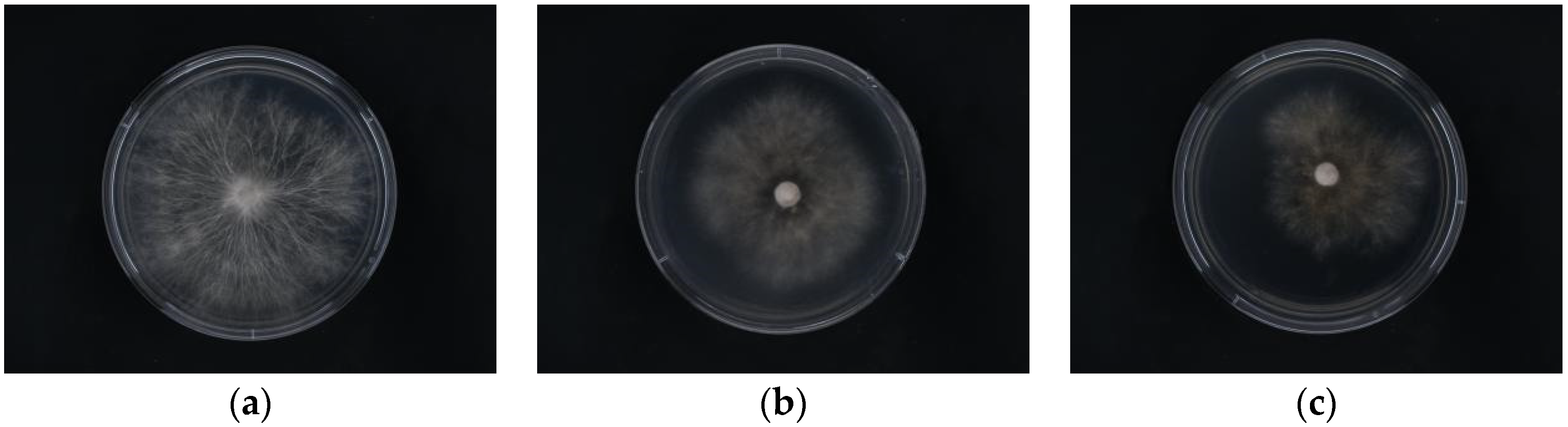
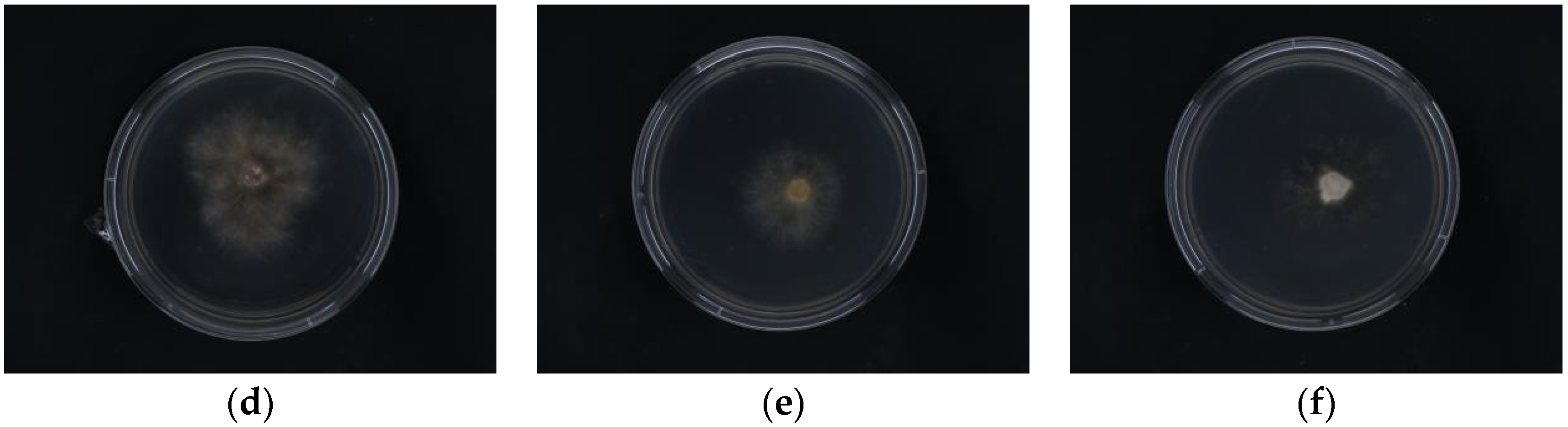
Observations of mycelial morphology directly reveal the damage inflicted by heavy metal stress upon the growth and structure of mycelial cells. The growth state of mycelia under Cd stress is illustrated in Figure 1. In the absence of Cd, the mycelia appeared pure white, robust, and uniform, indicating favorable growth conditions. As the Cd concentration progressively increased, its inhibitory effect on hyphal growth became increasingly pronounced, accompanied by yellowing of the hyphae. Consequently, Cd stress markedly inhibited the growth of A. subrufescens hyphae.
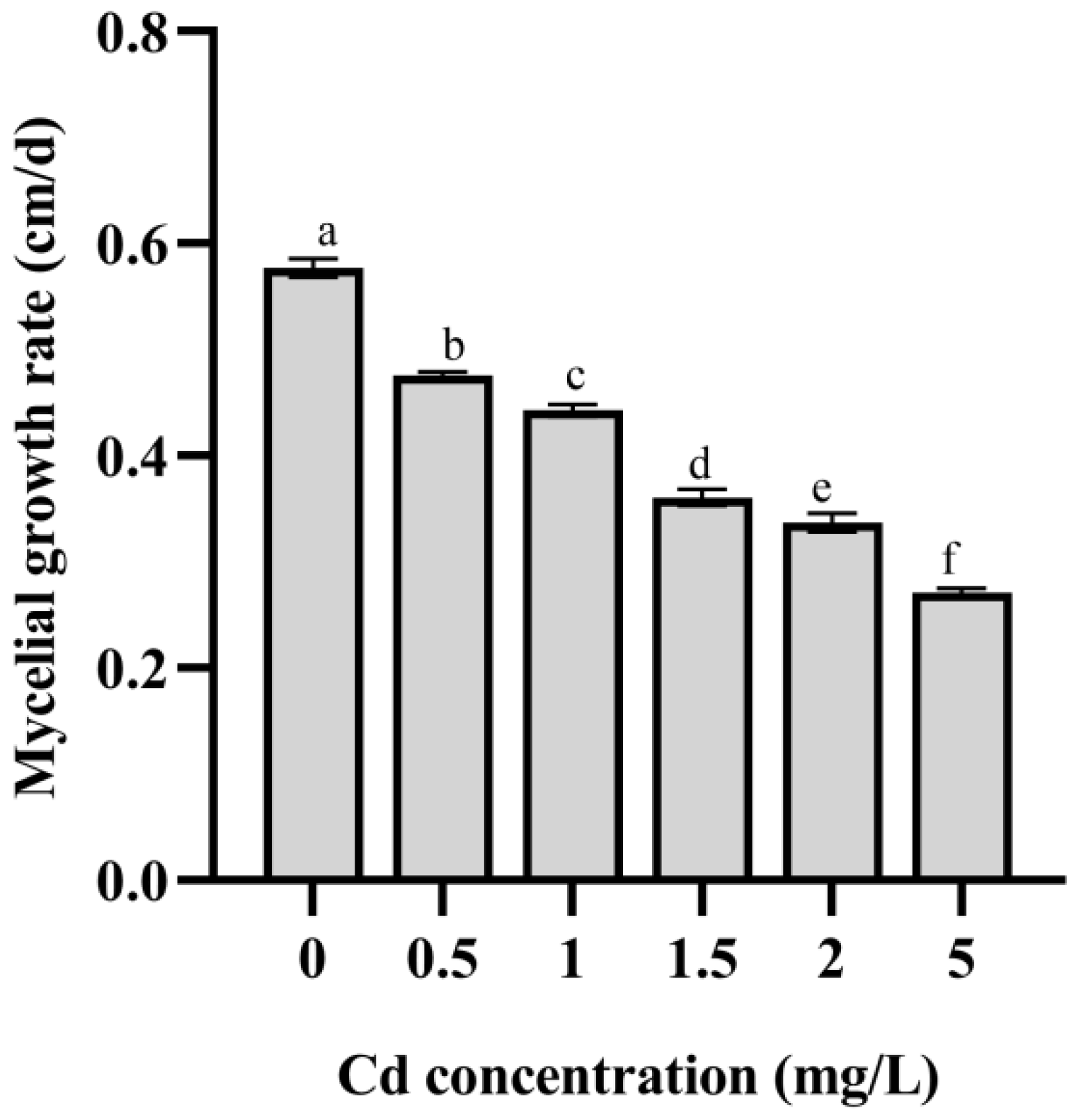
The effects of Cd stress on the mycelial growth rate of A. subrufescens are shown in Figure 2. As the Cd concentration increased, the mycelial growth rate gradually decreased. The greater the Cd concentration is, the more pronounced the decline in the growth rate. At a Cd concentration of 5 mg/L, the mycelial growth rate was 0.271 cm/d. The difference between the heavy metal treatment group and the control group was significant (p < 0.05), with an inhibition rate of 51%, indicating that Cd stress significantly suppressed the growth rate of A. subrufescens mycelia.

3.2. Effects of Cd Stress at Different Concentrations on Cd Concentration in A. subrufescens Mycelia

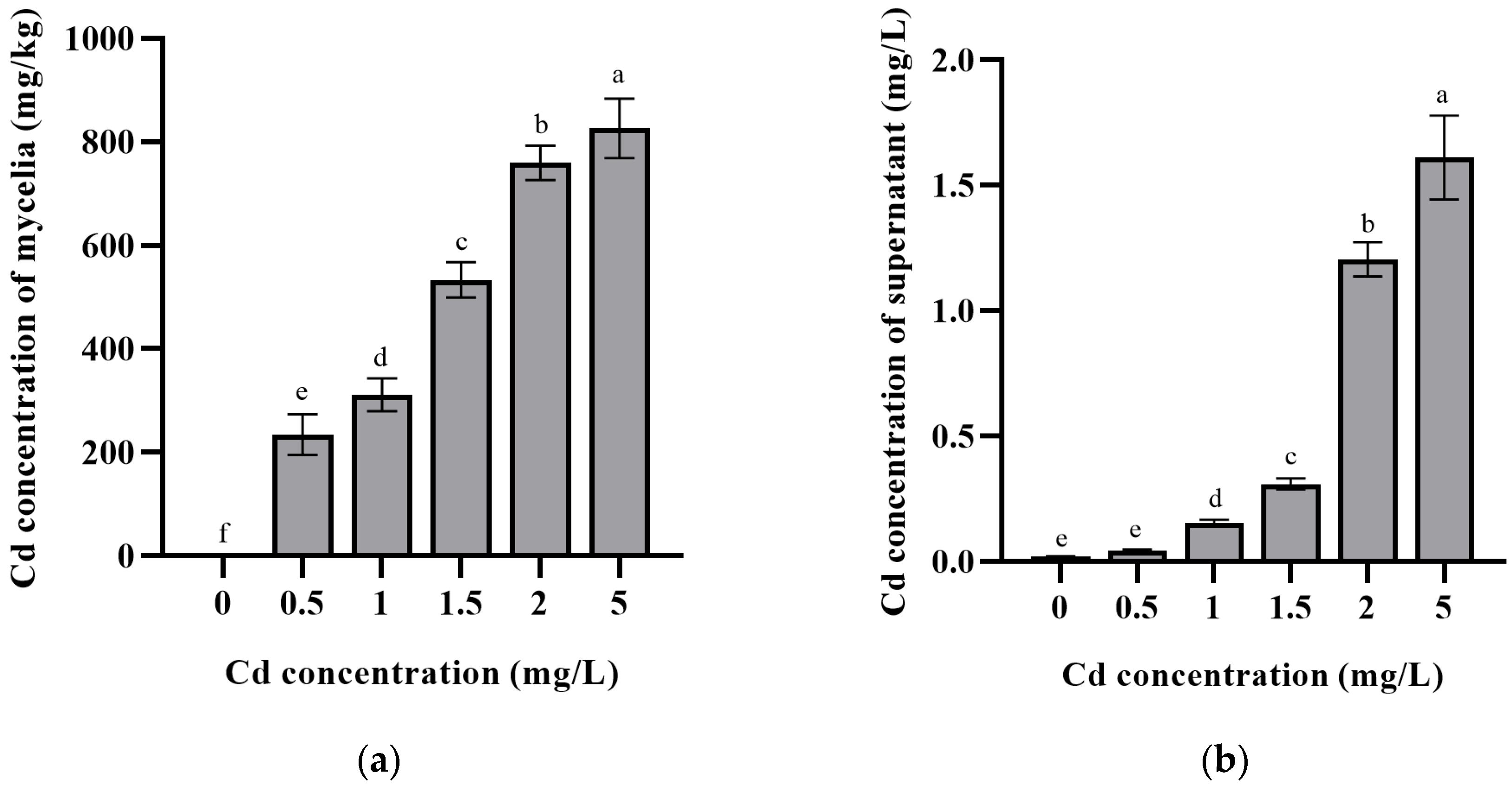
The effects of Cd stress at different concentrations on the Cd concentration in the mycelia and culture broth of A. subrufescens are shown in Figure 3. As depicted in Figure 3a, the Cd concentration within the mycelia tended to increase with increasing Cd concentration. At Cd concentrations ranging from 0 to 5 mg/L, the mycelial Cd concentration significantly increased from 0.03 mg/kg to 825.95 mg/L (p < 0.05). These findings indicate that increased Cd concentrations in the culture medium promote Cd accumulation within A. subrufescens mycelia, with higher concentrations in the medium leading to greater Cd accumulation within the mycelia. As shown in Figure 3b, the Cd concentration in supernatant also increased significantly with increasing Cd concentration. The absorption rates for the Cd treatments at 0.5, 1, 1.5, 2, and 5 mg/L were 96%, 89%, 77%, 41%, and 70%, respectively, and tended to decrease with increasing Cd concentration. The uptake rate decreased from 96% at 0.5 mg/L to 70% at 5 mg/L, reaching a minimum of 41% at 2 mg/L. Since lower Cd concentrations yield greater mycelia biomass than higher concentrations do, the absorption rate of exogenous Cd decreases with increasing Cd concentration. These findings indicate that A. subrufescens mycelia can accumulate exogenously added Cd, with distinct adaptive responses observed across different Cd concentrations.

3.3. Oxidative Damage to A. subrufescens Mycelia Caused by Cd Stress at Different Concentrations

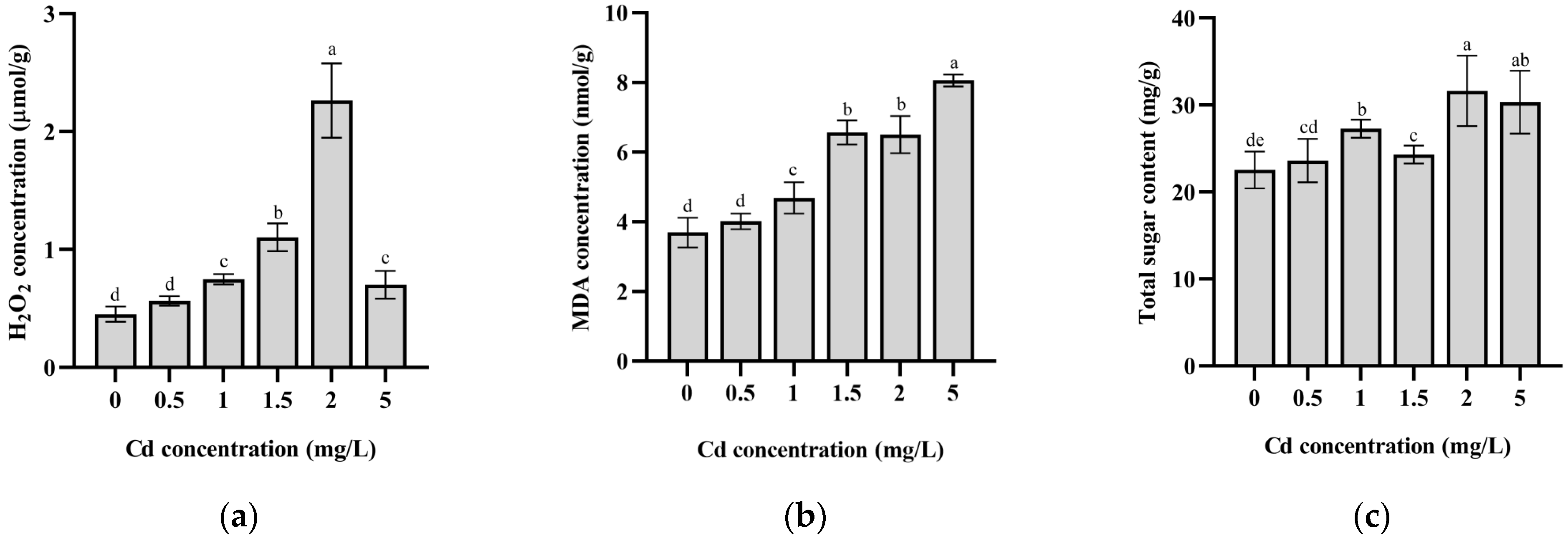
The effects of Cd stress on H2O2 in A. subrufescens mycelia are shown in Figure 4a. As depicted in Figure 4a, with increasing Cd concentration, the H2O2 concentration in A. subrufescens mycelia generally tends to first increase but then decrease. The maximum value (2.26 μmol/g) was attained at a Cd concentration of 2 mg/L, which was 4.08-fold that of the control group. When the Cd concentration further increased to 5 mg/L, the H2O2 concentration decreased to 0.70 μmol/g (p < 0.05). The effects of varying Cd concentrations on the MDA levels within the mycelia are shown in Figure 4b. The MDA concentration in the mycelia increased with increasing Cd concentration, indicating that Cd stress induces oxidative damage to the cell membranes of A. subrufescens mycelia, thereby generating MDA. Changes in the total sugar content within A. subrufescens mycelia following Cd addition are depicted in Figure 4c. As evident from Figure 4c, the total sugar content in the mycelia gradually increased with increasing Cd concentration. At a Cd concentration of 2 mg/L, the total sugar content reached its maximum value of 31.63 mg/g. In summary, compared with other concentrations, 2 mg/L Cd causes more severe oxidative damage to the cell membrane.

3.4. Response of A. subrufescens Mycelia Antioxidants to Cd Stress at Different Concentrations

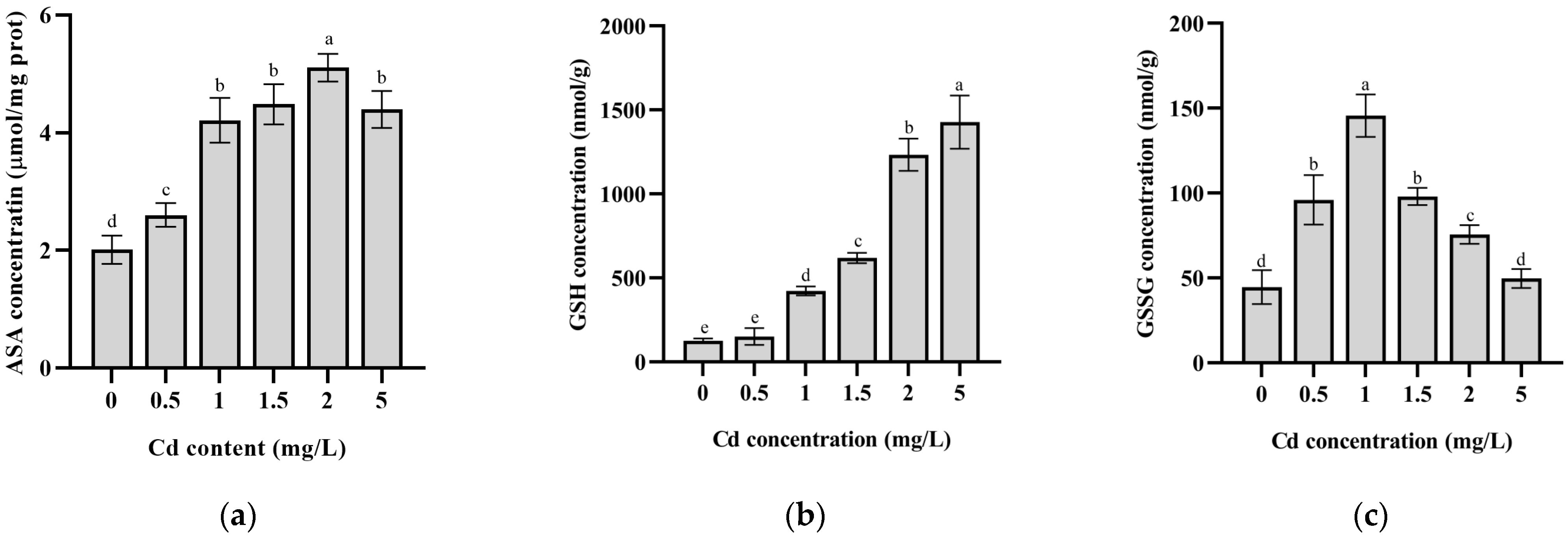
The effect of Cd stress on the mycelial ASA concentration is illustrated in Figure 5a. When the Cd concentration ranged from 0–2 mg/L, the mycelial ASA concentration tended to increase with increasing Cd concentration from 2.01 μmol/mg prot to 5.11 μmol/mg prot. With increasing Cd concentration, the ASA concentration began to decrease. The experimental results indicate that Cd stress can promote ASA production in mycelia. The variation in the concentration of GSH within the mycelia is shown in Figure 5b. As the Cd concentration increased, the GSH levels within the mycelia tended to increase. The greatest increase occurred at a Cd concentration of 2 mg/L, where the GSH concentration reached 0.94-fold that observed at a Cd concentration of 1.5 mg/L. Thus, Cd stress promotes GSH production, with the stimulatory effect becoming more pronounced at higher Cd concentrations. The effects of Cd stress on oxidized glutathione concentrations in the mycelia are depicted in Figure 5c. As shown, the GSSG concentration in the mycelia initially increased but then decreased with increasing Cd concentration. At a Cd concentration of 1 mg/L, GSSG reached a maximum of 145.62 nmol/g, which was 3.02-fold the value for the control group. When the Cd concentration increased to 5 mg/L, the GSSG concentration in the mycelia did not significantly differ from that in the control group (p < 0.05). Thus, Cd promotes GSSG production at low concentrations.

3.5. Response of Antioxidant Enzymes in A. subrufescens Mycelia to Cd Stress at Different Concentrations

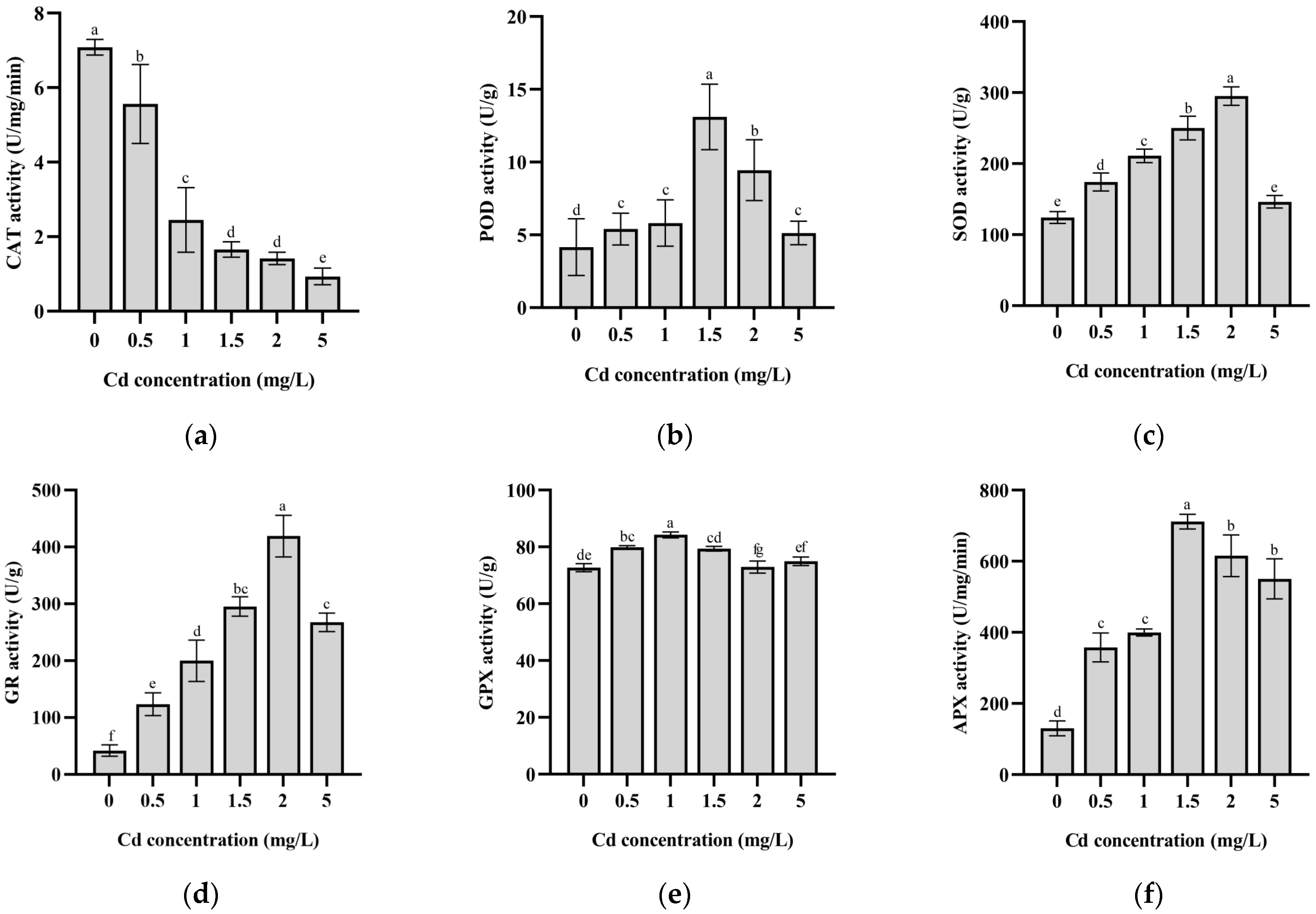
The effect of Cd stress on mycelial CAT activity is shown in Figure 6a. As the Cd concentration increased, the CAT activity continuously decreased. At a Cd concentration of 5 mg/L, CAT activity reached its lowest value of 0.93 U/mg/min, which was 0.14-fold that of the control group. Consequently, Cd reduces mycelial CAT activity, exerting an inhibitory effect. The data in Figure 6b,f reveal that increasing Cd concentrations initially increased POD and ascorbate APX activity in the mycelia before causing subsequent declines. At a Cd concentration of 1.5 mg/L, the mycelial POD activity and APX activity reached maximum values of 13.11 U/g and 711.52 U/mg/min, respectively. At Cd concentrations of 2 mg/L and 5 mg/L, POD and APX activities decreased significantly (p < 0.05). Thus, low Cd concentrations promote mycelial POD and APX activities, whereas high concentrations inhibit them. The experimental results shown in Figure 6c,d reveal that increasing Cd concentrations cause SOD and GR activities in mycelia to initially rise before declining. At a Cd concentration of 2 mg/L, the mycelial SOD activity and GR activity peaked at 295.19 U/g and 419.35 U/g, respectively. Compared with that in the control group, the SOD activity in the group treated with a Cd concentration of 5 mg/L did not significantly differ (p > 0.05). These findings indicate that low Cd concentrations promote SOD activity, whereas high concentrations inhibit its activity. Glutathione reductase activity increased ninefold compared with that in the control group, indicating a significant difference (p < 0.05). Thus, Cd promotes GR activity at low concentrations but inhibits it at high concentrations. As shown in Figure 6e, the GPX activity in the mycelia first increased but then decreased with increasing Cd concentration. GPX activity peaked at 84.27 U/g at a Cd concentration of 1 mg/L. Overall, Cd stress at different concentrations had little effect on GPX activity.

4. Discussion

In this study, the effects of varying concentrations of Cd stress on the mycelial growth, morphology, and antioxidant system of A. subrufescens were investigated. The findings indicate that mycelial Cd accumulation is positively correlated with stress concentration, whereas absorption rates decrease as concentrations increase. This finding aligns with the observations reported by Liu et al. in A. subrufescens fruiting bodies [20]. High Cd concentrations (≥2 mg/L) cause hyphal yellowing and a 51% reduction in the growth rate. These findings directly corroborate the conclusion proposed by Huang et al. that Cd inhibits hyphal division [32]. This growth inhibition is due to disruption of cellular redox homeostasis caused by Cd. Cd ions (Cd2+) can directly induce ROS generation via Fenton-like reactions and indirectly lead to a burst of ROS accumulation by disrupting the mitochondrial electron transport chain and inhibiting antioxidant enzyme activities [33,34], thereby damaging cellular structures and inhibiting cell division and elongation.
MDA and H2O2 levels serve as crucial indicators for assessing oxidative damage to cell membranes. Elevated concentrations of Cd stress induce substantial accumulation of MDA within the organism. MDA can undergo chain reactions with enzyme proteins, leading to polymerization and subsequent denaturation of the membrane system, thereby inhibiting growth [35,36]. At a Cd concentration of 2 mg/L, the mycelial H2O2 concentration peaked before it abruptly decreased, whereas the MDA concentration continued to increase with increasing Cd concentration. These findings suggest that high Cd concentrations may disrupt the H2O2 production pathway in A. subrufescens mycelia, while lipid peroxidation (MDA) is irreversible. Furthermore, at a Cd concentration of 2 mg/L, the total sugar content in the mycelia briefly increased before it decreased. This finding indicates a potential disruption in total sugar metabolism. This initial increase in total sugar could be a positive physiological response: soluble sugars act as important osmoregulatory substances to help maintain cellular water balance under stress; simultaneously, they can serve as energy substrates and carbon skeletons to support the synthesis of antioxidant molecules like GSH, thus indirectly participating in antioxidant metabolism [37]. However, the subsequent decline means the failure of compensatory mechanisms and the severe disruption of carbon metabolism. In this study, the peak-shaped variation in total sugar metabolism of mycelia was first observed, whereas studies on fruiting bodies predominantly report a sustained decrease in sugars under heavy metal stress [38]. These findings indicate that mycelia and fruiting bodies may exhibit differential total sugar metabolism under Cd stress.
Cd stress induced damage to A. subrufescens mycelia is a dynamic process. When exposed to low concentrations of Cd stress (0.5 mg/L), the mycelia of A. subrufescens activate SOD, whose activity gradually increases. Concurrently, intracellular CAT activity remains elevated, with cells primarily relying on CAT to scavenge ROS. At this stage, the ASA and GSH levels are low, and the ASA-GSH cycle has not yet been fully activated. The coordinated action of SOD, CAT, and POD constitutes the primary defense line against oxidative damage in fungi. The differential response of SOD and CAT activities observed at low Cd concentrations in this study is contrary to findings in Pleurotus ostreatus and Stropharia rugosoannulata, in which a more synergistic activation of SOD and CAT is reported [39,40], indicating species-specific antioxidant strategies among fungi. However, the accumulation ability of these two species for Cd is lower than that of A. subrufescens and the difference in their antioxidant defense mechanisms might be the main reason for this.
As the Cd concentration increases, CAT activity is persistently inhibited, which is consistent with the observations of Kalaras et al. that mushroom CAT is susceptible to inactivation by heavy metals [41]. This may be the pivotal factor in the breakdown of the primary antioxidant defenses. At this point, SOD activity is elevated and substantial amounts of H2O2 have accumulated. This in turn drives GPX, GR, and APX activity to higher levels, thereby activating the ASA-GSH cycle [42]. At this stage, GPX, GR, and APX act in concert with ASA and GSH to convert H2O2 into H2O, thereby eliminating intracellular free radicals and singlet oxygen. The enzymatic activities of SOD, POD, and APX peaked at Cd concentrations of 1–2 mg/L. This trend aligns with findings observed in other macrofungi. For instance, SOD and POD activities were significantly increased after long-term exposure to metals, especially to Cd [43], and the activation of the intracellular antioxidant system is recognized as a common defense strategy in macrofungi against cadmium [44].
However, when the Cd concentration exceeded the critical threshold of 2 mg/L, the activities of SOD, POD, and APX began to decrease comprehensively, marking the collapse of the entire antioxidant system. This may be attributed to Cd2+ exhibiting high biological affinity, enabling it to directly bind with the active sites of enzyme proteins. This binding alters three-dimensional structure, leading to enzyme inactivation. Furthermore, the excessive amounts of ROS generated by high Cd concentrations may react with these enzymes, causing their inactivation [37,45]. Similar comprehensive suppression of the antioxidant enzyme system under severe heavy metal stress has been reported in medicinal fungi like Pleurotus ostreatus and Pleurotus eryngii, suggesting this might be a common response in macro-fungi facing intense metal toxicity [39,46].
In summary, the complex antioxidant defense network observed in A. subrufescens mycelia under low Cd stress indicates a degree of tolerance. Even at a low Cd exposure (0.5 mg/L), the Cd concentration in the mycelia can exceed 200 mg/kg, demonstrating its extremely high Cd accumulation capacity. However, its practical potential for cultivation in slightly contaminated soils must be critically evaluated and specific regulatory measures would be essential to mitigate Cd uptake. For instance, adding trace elements like Selenium (Se) or Zinc (Zn) to substrates could exploit their antagonistic effects against Cd, potentially reducing Cd content in the fruiting bodies by competing for absorption and transport pathways, as reported in studies on other edible fungi and plants [47,48,49]. This approach would require rigorous field validation to establish soil Cd thresholds and determine Cd absorption/transfer factors within specific soil-cultivation systems, ensuring strict compliance with food safety standards (GB 2762-2022, China Standard) [14]. On the other hand, leveraging its pronounced Cd accumulation trait, A. subrufescens could be explored as a candidate for phytoremediation of moderately heavy metal-contaminated soils. This mycoremediation strategy has been documented for species like Pleurotus ostreatus and Stropharia rugosoannulata [39,40]. As Cd accumulation capacity of A. subrufescens surpasses that of these fungi, it might offer advantages over some existing mycoremediation materials, potentially achieving shorter remediation cycles and higher efficiency. Future research should focus on enhancing its metal tolerance and sequestration capabilities through genetic improvement or targeted nutrient management and on screening strains specifically—both high-accumulators for remediation purposes and low-accumulators for safer cultivation in risk-prone areas. This dual-path strategy would provide crucial scientific support for the sustainable development of the A. subrufescens industry.

5. Conclusions

In this study, A. subrufescens mycelia were subjected to Cd stress at concentrations of 0, 0.5, 1, 1.5, 2, and 5 mg/L. The effects of varying Cd concentrations on the mycelial growth rate, morphology, MDA concentration, H2O2 concentration, total sugar content, and activity of various antioxidant enzymes and antioxidants were investigated. The results indicated that Cd stress significantly inhibited the growth of A. subrufescens mycelia. With increasing Cd concentration, the mycelial Cd concentration increased from 0.03 mg/L to 825.95 mg/L. The increase in Cd concentration prompted the H2O2 and ASA concentrations within the mycelia to initially increase before they decreased. Furthermore, the activity of SOD, GR, and APX stimulated by H2O2 initially increased but then decreased. Conversely, CAT activity exhibited a sustained decline. Under low Cd concentrations, the A. subrufescens mycelia likely relied on increased CAT activity to scavenge ROS. Under high Cd stress, the mycelia likely relies primarily on the combined action of various enzymes within the ASA-GSH cycle to eliminate cellular ROS. This study investigated only the effects of varying Cd concentrations on A. subrufescens mycelial growth and antioxidant systems. Subsequent research could further examine changes in relevant genes and proteins at the genetic and protein levels in response to Cd stress.

Author Contributions

Conceptualization, J.M. and Y.Z.; methodology, J.M. and Q.D.; software, S.H.; validation, J.M. and S.H.; formal analysis, J.M., S.H. and Q.D.; investigation, C.Y., L.Y., Q.G. and L.Z.; resources, Q.G., L.Z. and Y.Z.; data curation, J.M., C.Y. and L.Y.; writing—original draft preparation, J.M. and S.H.; writing—review and editing, Q.D. and Y.Z.; visualization, J.M. and Q.D.; supervision, Y.Z.; project administration, Y.Z.; funding acquisition, Y.Z. All authors have read and agreed to the published version of the manuscript.

Funding

This research was funded by National Key R&D Program of China, grant number 2024YFD1200204.

Data Availability Statement

The original contributions presented in this study are included in the article. Further inquiries can be directed to the corresponding authors.

Conflicts of Interest

The authors declare no conflicts of interest.

Appendix A

Table A1. Information of the instruments and equipment used in the experiment.
NameSpecificationManufacturer
Atomic absorption spectrometerZA3000Hitachi, Ltd. (Tokyo, Japan)
Enzyme-linked immunosorbent assay readerINFINITE 200PROTecan Group Ltd. (Männedorf, Switzerland)
Freeze dryerPro9105Nanjing Jinshi Instrument Equipment Co., Ltd. (Nanjing, China)
High-speed centrifugeRC-6Thermo Fisher Scientific Inc. (Waltham, MA, USA)
OscillatorKMC-13000VShanghai Sishin Biotechnology Co., Ltd. (Shanghai, China)
Table A2. Information of the reagents used in the experiment.
NameManufacturer
Nitric acidSinopharm Chemical Reagent Co., Ltd. (Shanghai, China)
Pperchloric acidSinopharm Chemical Reagent Co., Ltd. (Shanghai, China)
Cd standard reference materialInorganic Ventures (Lakewood, NJ, USA)
Total sugar assay kitSuzhou Keming Biotechnology Co., Ltd. (Suzhou, China)
Maldodicarboxaldehyde (MDA) assay kitSuzhou Keming Biotechnology Co., Ltd. (Suzhou, China)
Ascorbic acid (ASA) test kitSuzhou Keming Biotechnology Co., Ltd. (Suzhou, China)
Reduced glutathione (GSH) assay kitSuzhou Keming Biotechnology Co., Ltd. (Suzhou, China)
Oxidised glutathione (GSSG) assay kitSuzhou Keming Biotechnology Co., Ltd. (Suzhou, China)
Catalase (CAT) assay kitSuzhou Keming Biotechnology Co., Ltd. (Suzhou, China)
Peroxidase (POD) assay kitSuzhou Keming Biotechnology Co., Ltd. (Suzhou, China)
Superoxide dismutase (SOD) assay kitSuzhou Keming Biotechnology Co., Ltd. (Suzhou, China)
Glutathione reductase (GR) assay kitSuzhou Keming Biotechnology Co., Ltd. (Suzhou, China)
Glutathione peroxidase (GPX) assay kitSuzhou Keming Biotechnology Co., Ltd. (Suzhou, China)
Ascorbic acid peroxidase (APX) assay kitSuzhou Keming Biotechnology Co., Ltd. (Suzhou, China)
Hydrogen peroxide (H2O2) test kitSuzhou Keming Biotechnology Co., Ltd. (Suzhou, China)
DifcoTM Potato Dextrose AgarBecton, Dickinson and Company (Franklin Lakes, NJ, USA)
DifcoTM Potato Dextrose BrothBecton, Dickinson and Company (Franklin Lakes, NJ, USA)

References

  1. Ji, Z.H.; He, S.; Xie, W.Y.; Zhao, P.S.; Ren, W.Z.; Gao, W.; Yuan, B. Agaricus blazei Polysaccharide Alleviates DSS-Induced Colitis in Mice by Modulating Intestinal Barrier and Remodeling Metabolism. Nutrients 2023, 15, 4877. [Google Scholar] [CrossRef]
  2. Cicero, I.; Mirabile, G.; Venturella, G. Potential Medicinal Fungi from Freshwater Environments as Resources of Bioactive Compounds. J. Fungi 2025, 11, 54. [Google Scholar] [CrossRef] [PubMed]
  3. Yu, R.; Li, X.; Yi, P.; Wen, P.; Wang, S.; Liao, C.; Song, X.; Wu, H.; He, Z.; Li, C. Isolation and Identification of Chemical Compounds from Agaricus blazei Murrill and Their In Vitro Antifungal Activities. Molecules 2023, 28, 7321. [Google Scholar] [CrossRef]
  4. Ghahremani-majd, H.; Mumivand, H.; Khanizadeh, P.; Bakhshipoor, F.; Argento, S. Optimizing Ergothioneine Biosynthesis and Antioxidant Activity in Agaricus spp. Through Amino Acid Supplementation and Yeast–Peptone Mixtures. Horticulturae 2025, 11, 348. [Google Scholar] [CrossRef]
  5. Hong, J.-H.; Kim, S.J.; Ravindra, P.; Youn, K.-S. Antitumor Activities of Spray-dried Powders with Different Molecular Masses Fractionated from the Crude Protein-bound Polysaccharide Extract of Agaricus blazei Murill. Food Sci. Biotechnol. 2007, 16, 600–604. [Google Scholar]
  6. Delgado, B.M.B.; Harue, U.S.; André, B.; do Valle, J.S.; Andrea, L.G.; Barros, C.N. Mycelial antineoplastic activity of Agaricus blazei. World J. Microbiol. Biotechnol. 2014, 30, 2307–2313. [Google Scholar] [CrossRef]
  7. Mizuno, T.; Inagaki, R.; Kanao, T.; Hagiwara, T.; Nakamura, T.; Ito, H.; Shimura, K.; Sumiya, T.; Asakura, A. Antitumor Activity and Some Properties of Water-insoluble Hetero-glycans from “Himematsutake”, the Fruiting Body of Agaricus blazei Murill. Agric. Biol. Chem. 2014, 54, 2897–2905. [Google Scholar]
  8. Xu, Y.; Xu, T.; Huang, C.; Liu, L.; Kwame, A.W.; Zhu, Y.; Ren, J. Preventive intervention with Agaricus blazei murill polysaccharide exerts anti-tumor immune effect on intraperitoneal metastasis colorectal cancer. Int. J. Biol. Macromol. 2024, 282, 136810. [Google Scholar] [CrossRef]
  9. Yue, L.; Cui, H.; Li, C.; Lin, Y.; Sun, Y.; Niu, Y.; Wen, X.; Liu, J. A polysaccharide from Agaricus blazei attenuates tumor cell adhesion via inhibiting E-selectin expression. Carbohydr. Polym. 2012, 88, 1326–1333. [Google Scholar] [CrossRef]
  10. Cao, M.; Tang, Q.; Gai, N.; Ma, S.; Liu, J.; Wang, F. Contamination characteristics, source apportionment, and risk assessment of heavy metals and metalloids in the soil-crop-human system within the typical high geological background region of the Yangtze River Delta. J. Environ. Manag. 2025, 391, 126443. [Google Scholar] [CrossRef] [PubMed]
  11. Parin, S.; Myoung-Soo, K.; Kyoung-Woong, K.; Penradee, C. Human health risk assessment of cadmium exposure through rice consumption in cadmium-contaminated areas of the Mae Tao sub-district, Tak, Thailand. Environ. Geochem. Health 2020, 42, 2331–2344. [Google Scholar]
  12. Yang, J.; Kim, E.-C.; Shin, D.-C.; Jo, S.-J.; Lim, Y.-W. Human exposure and risk assessment of cadmium for residents of abandoned metal mine areas in Korea. Environ. Geochem. Health 2015, 37, 321–332. [Google Scholar]
  13. Malloch, D. Agaricus Brunnescens: The Cultivated Mushroom. Mycologia 2018, 68, 910–919. [Google Scholar] [CrossRef]
  14. GB 2762-2022; National Food Safety Standard: Maximum Levels of Pollutants in Foods*. The National Health Commission of the People’s Republic of China: Beijing, China, 2022; Volume 28. (In Chinese)
  15. Zhao, X.; Chen, L.; Li, X.; Dong, H.; Bai, B.; Zhou, C. Recent Advances in Research on Heavy Metals in Edible Fungi. Acta Edulis Fungi 2019, 26, 135–140. [Google Scholar]
  16. Okumuş, E.; Canbolat, F.; Acar, İ. Evaluation of antioxidant activity, anti-lipid peroxidation effect and elemental impurity risk of some wild Agaricus species mushrooms. BMC Plant Biol. 2025, 25, 476. [Google Scholar] [CrossRef]
  17. Sarwar, A.; Gagosh, N.B.; Humayun, I.; Pervez, A.; Noshaba, O.; Maryam, A. Mycofiltration of Heavy Metals (Pb, Cd, Hg) from Aqueous Solution by Living Biomass of Two Mushrooms Pleurotus ostreatus and Agaricus bisporus as Biosorbents. J. Water Chem. Technol. 2023, 45, 599–606. [Google Scholar] [CrossRef]
  18. He, H.; Zhang, D.; Gao, J. Bioaccumulation and physiological changes in the fruiting body of Agaricus bisporus (Large) sing in response to cadmium. Sci. Rep. 2022, 12, 20079. [Google Scholar] [CrossRef]
  19. Shi, C.; Guoping, P.; Juan, Z. The absorption and accumulation patterns of cadmium in the culture medium by Agaricus blazei. Agric. Fujian 2015, 5, 106–107. [Google Scholar]
  20. Liu, P.; Chen, H.; Li, B.; Wang, Y.; Weng, B. The effect of cadmium stress on physiological indicators and cadmium absorption of Agaricus blazei mycelium. Agro-Environ. Sci. 2020, 39, 1675–1682. [Google Scholar]
  21. Boonyingsathit, K.; Sridonpai, P.; Trachootham, D.; Sungayuth, N.; Judprasong, K. Toxic elements levels and risk assessment in lung and Bhutan oyster mushrooms and their cultivation matrices. J. Agric. Food Res. 2025, 22, 102151. [Google Scholar] [CrossRef]
  22. Hlerema, I.N.; Eiasu, B.K.; Koch, S.H. Pineapple (Ananas comusus) Plant Material as Supplement for Maize Residue-based Oyster Mushroom Substrate and Reduction of Cadmium Soil Contamination. HortScience 2017, 52, 667–671. [Google Scholar] [CrossRef]
  23. Xu, H.; Xie, Z.; Guo, J.; Men, Q. Morphological changes and bioaccumulation in response to cadmium exposure in Morchella spongiola, a fungus with potential for detoxification. Can. J. Microbiol. 2021, 67, 789–798. [Google Scholar] [CrossRef]
  24. Wang, L.; Li, H.; Wei, H.; Wu, X.; Ke, L. Identification of cadmium-induced Agaricus blazei genes through suppression subtractive hybridization. Food Chem. Toxicol. 2014, 63, 84–90. [Google Scholar] [CrossRef] [PubMed]
  25. Fedorova, D.G.; Nazarova, N.M.; Ukenov, B.S. Activity of photosynthetic pigments and the antioxidant system in sunflower under drought stress. Proc. Appl. Bot. Genet. Breed. 2024, 185, 71–77. [Google Scholar] [CrossRef]
  26. Zhang, Y. Study on Mechanisms of Cadmium Enrichmentand Cadmium Stress Response in Agaricus blazei. Master’s Thesis, Hunan Agricultural University, Changsha, China, 2022. [Google Scholar]
  27. Ferrari, A.B.S.; Oliveira, G.A.d.; Russo, H.M.; Bertozo, L.d.C.; Bolzani, V.d.S.; Zied, D.C.; Ximenes, V.F.; Zeraik, M.L. Pleurotus ostreatus and Agaricus subrufescens: Investigation of chemical composition and antioxidants properties of these mushrooms cultivated with different handmade and commercial supplements. Int. J. Food Sci. Technol. 2020, 56, 452–460. [Google Scholar] [CrossRef]
  28. Lihong, X.; Shali, H.; Yingmiao, W.; Changwen, Y.; Yongzhi, Z.; Gangjun, W. Study on the absorption and accumulation patterns of harmful heavy metals cadmium by Matsutake mushrooms and control technologies. Chin. J. Food Sci. 2010, 10, 152–158. [Google Scholar]
  29. GB 5009.15-2023; National Food Safety Standard: Determination of Cadmium in Food. The National Health Commission of the People’s Republic of China: Beijing, China, 2023; Volume 12.
  30. Velikova, V.; Yordanov, I.; Edreva, A. Oxidative stress and some antioxidant systems in acid rain-treated bean plants. Plant Sci. 2000, 151, 59–66. [Google Scholar] [CrossRef]
  31. Mirza, H.; Anwar, H.M.; Masayuki, F. Exogenous selenium pretreatment protects rapeseed seedlings from cadmium-induced oxidative stress by upregulating antioxidant defense and methylglyoxal detoxification systems. Biol. Trace Elem. Res. 2012, 149, 248–261. [Google Scholar]
  32. Xiaohui, H.; Chunhui, W.; Ning, X.; Yunxiang, P.; Xingjian, J.; Fenglan, H. Study on the tolerance and accumulation characteristics of four heavy metals by golden needle mushrooms and oyster mushrooms. North. Hortic. 2019, 143–150. [Google Scholar]
  33. Su, Y.-Q.; Zhao, Y.-J.; Wu, N.; Chen, Y.-E.; Zhang, W.-J.; Qiao, D.-R.; Cao, Y. Chromium removal from solution by five photosynthetic bacteria isolates. Appl. Microbiol. Biotechnol. 2018, 102, 1983–1995. [Google Scholar]
  34. Belozerskaya, T.A.; Gessler, N.N. Reactive oxygen species and the strategy of antioxidant defense in fungi: A review. Appl. Biochem. Microbiol. 2007, 43, 506–515. [Google Scholar] [CrossRef]
  35. Çevık, B.; Arslan, H.; Ekinci, D. Effects of Heavy Metal Stress on Seedling Growth and Antioxidant System in Sorghum (Sorghum bicolor (L.) Moench). Protein J. 2025, 44, 308–316. [Google Scholar] [CrossRef] [PubMed]
  36. El-Amier, Y.; Elhindi, K.; El-Hendawy, S.; Al-Rashed, S.; Abd-ElGawad, A.; Elansary, H.O. Antioxidant System and Biomolecules Alteration in Pisum sativum under Heavy Metal Stress and Possible Alleviation by 5-Aminolevulinic Acid. Molecules 2019, 24, 4194. [Google Scholar] [CrossRef] [PubMed]
  37. Kchikich, A.; Amraoui, B.E.; Nhhala, N.; Krid, A.; Kchikich, A.; Kounnoun, A.; Ouahmane, L.; Nhiri, M.; Nhiri, N. Mitigating heavy metals toxicity in sorghum using arbuscular mycorrhizal fungi: Enhancing photosynthesis and antioxidant defense. Protoplasma, 2025; ahead of print. [Google Scholar]
  38. Marijana, K.; Branislav, R.; Aleksandar, R.; Tatjana, S. Evaluation of metal contents and bioactivity of two edible mushrooms Agaricus campestris and Boletus edulis. Emir. J. Food Agric. 2017, 29, 98–103. [Google Scholar] [CrossRef]
  39. Li, X.; Wang, Y.; Pan, Y.; Yu, H.; Zhang, X.; Shen, Y.; Jiao, S.; Wu, K.; La, G.; Yuan, Y.; et al. Mechanisms of Cd and Cr removal and tolerance by macrofungus Pleurotus ostreatus HAU-2. J. Hazard. Mater. 2017, 330, 1–8. [Google Scholar] [CrossRef]
  40. Qin, D.; Mingjie, C.; Yaru, Z.; Panpan, S.; Huanling, Y.; Yan, Z.; Changxia, Y.; Lei, Z. Integrated physiologic and proteomic analysis of Stropharia rugosoannulata mycelia in response to Cd stress. J. Hazard. Mater. 2022, 441, 129877. [Google Scholar] [CrossRef]
  41. Kalaras, M.D.; Richie, J.P.; Calcagnotto, A.; Beelman, R.B. Mushrooms: A rich source of the antioxidants ergothioneine and glutathione. Food Chem. 2017, 233, 429–433. [Google Scholar] [CrossRef]
  42. Lei, F.; Xin, J.; Hiroaki, K.; Xiangyou, W.; Yanyin, G.; Ling, L.; Haipeng, L.; Yufen, W.; Jia, W. Characterization of bioactive films loaded with melatonin and regulation of postharvest ROS scavenging and ascorbate-glutathione cycle in Agaricus bisporus. Postharvest Biol. Technol. 2022, 194, 112107. [Google Scholar] [CrossRef]
  43. Xu, H.; Song, P.; Gu, W.; Yang, Z. Effects of heavy metals on production of thiol compounds and antioxidant enzymes in Agaricus bisporus. Ecotoxicol. Environ. Saf. 2011, 74, 1685–1692. [Google Scholar] [CrossRef]
  44. Haiyan, H.; Dan, Z. Tolerance mechanism of macrofungi to cadmium: A review. Chin. J. Appl. Environ. Biol. 2023, 29, 1270–1278. [Google Scholar]
  45. Mohammadhasani, F.; Ahmadimoghadim, A.; Aarar, Z.; Mohammadi, S.Z. Antioxidative activity and differential response of fungus (Agaricus bisporus) to heavy metals. Plant Cell Biotechnol. Mol. Biol. 2017, 18, 163–170. [Google Scholar]
  46. Huang, X.-H.; Xu, N.; Feng, L.-G.; Lai, D.-N.; Wu, F.; Xu, D.; Guo, X. The Activity and Gene Expression of Enzymes in Mycelia of Pleurotus eryngii under Cadmium Stress. Sustainability 2022, 14, 4125. [Google Scholar] [CrossRef]
  47. Zheng, S.; Xu, C.; Zhu, H.; Huang, D.; Wang, H.; Zhang, Q.; Li, X.; Zhu, Q. Foliar application of zinc and selenium regulates cell wall fixation, physiological and gene expression to reduce cadmium accumulation in rice grains. J. Hazard. Mater. 2024, 480, 136302. [Google Scholar] [CrossRef] [PubMed]
  48. Luo, N.; Wang, B.; Yu, R.; Chen, G. Effects of selenium nanoparticles on cadmium uptake, selenium transformation, and metabolomics in Agaricus blazei murill. Sci. Rep. 2025, 15, 20380. [Google Scholar] [CrossRef]
  49. Sun, X.; Zhang, L.; Gu, Y.; Wang, P.; Liu, H.; Qiang, L.; Huang, Q. Nutrient-Element-Mediated Alleviation of Cadmium Stress in Plants: Mechanistic Insights and Practical Implications. Plants 2025, 14, 3081. [Google Scholar] [CrossRef]
Figure 1. Effects of Cd stress on the growth morphology of A. subrufescens mycelia. (a) 0 mg/L; (b) 0.5 mg/L; (c) 1 mg/L; (d) 1.5 mg/L; (e) 2 mg/L; (f) 5 mg/L.
Horticulturae 11 01361 g001aHorticulturae 11 01361 g001b
Figure 2. Effects of Cd stress on the growth rate of A. subrufescens mycelia. Different letters indicate p < 0.05.
Horticulturae 11 01361 g002
Figure 3. Cd concentrations in (a) mycelia and (b) supernatant of A. subrufescens under Cd stress. Different letters indicate p < 0.05.
Horticulturae 11 01361 g003
Figure 4. Oxidative damage caused by stress from different concentrations of Cd on A. subrufescens mycelia. (a) H2O2 concentration; (b) MDA concentration; (c) total sugar content. Different letters indicate p < 0.05.
Horticulturae 11 01361 g004
Figure 5. Response of antioxidants in A. subrufescens mycelia to Cd stress at different concentrations. (a) ASA concentration; (b) GSH concentration; (c) GSSG concentration. Different letters indicate p < 0.05.
Horticulturae 11 01361 g005
Figure 6. Response of antioxidant enzymes in A. subrufescens mycelia to Cd stress at different concentrations. (a) CAT activity; (b) POD activity; (c) SOD activity; (d) GR activity; (e) GPX activity; (f) APX activity. Different letters indicate p < 0.05.
Horticulturae 11 01361 g006
Table 1. Elemental analysis conditions.
ElementWavelength
(nm)
Lamp Current
(mA)
Air Flow
(L/min)
Acetylene Flow
(L/min)
Slot Width (nm)Background Calibration
(Tritium Lamp)
Cd228.87.5151.80.7On
Disclaimer/Publisher’s Note: The statements, opinions and data contained in all publications are solely those of the individual author(s) and contributor(s) and not of MDPI and/or the editor(s). MDPI and/or the editor(s) disclaim responsibility for any injury to people or property resulting from any ideas, methods, instructions or products referred to in the content.