Article

Sustainable and Innovative Postharvest Management of Anthracnose Disease in Guavas Through Modulated UV-C Light Treatment

1
Graduate Program in Food Science, Federal University of Bahia (UFBA), Salvador 40170-110, BA, Brazil
2
Embrapa Environment, Brazilian Agricultural Research Corporation, Jaguariuna 13918-110, SP, Brazil
3
Postharvest Technology Laboratory, School of Agricultural Engineering (FEAGRI), State University of Campinas (UNICAMP), Zeferino Vaz University Campus, Barão Geraldo, Campinas 13083-970, SP, Brazil
4
Embrapa Instrumentation, Brazilian Agricultural Research Corporation, Sao Carlos 13561-206, SP, Brazil
*
Authors to whom correspondence should be addressed.
Horticulturae 2025, 11(11), 1351; https://doi.org/10.3390/horticulturae11111351
Submission received: 29 September 2025 / Revised: 29 October 2025 / Accepted: 4 November 2025 / Published: 10 November 2025

Abstract

Anthracnose, caused by the Colletotrichum sp. gloeosporioides complex, severely affects guava quality, highlighting the need for sustainable alternatives to synthetic postharvest fungicides. This study is the first to evaluate modulated UV-C radiation as an innovative approach to controlling postharvest diseases and extending guava shelf-life. The modulation frequency significantly influenced mycelial growth and conidial germination, following a quadratic model (R2 = 0.98), with maximum efficacy at ~30 Hz, reducing germination to 5.3 × 10⁴ CFU per plate. In vivo, the combinations of 0.99 kJ m−2/30 Hz and 0.66 kJ m−2/45 Hz inhibited anthracnose incidence and severity. Most physicochemical parameters remained unaffected after seven days of storage. However, treated fruits showed a higher hue angle (h) and lower a*, indicating the maintenance of shades closer to green due to slower chlorophyll degradation, and firmness was preserved, suggesting delayed ripening. Modulated UV-C also significantly reduced the respiration rate, lowering the climacteric peak. These findings demonstrate that anthracnose control depends on the modulation frequency, with 0.99 kJ m−2/30 Hz being particularly effective. Modulated UV-C radiation represents a promising, sustainable, and effective strategy for improving guava postharvest quality and shelf-life.

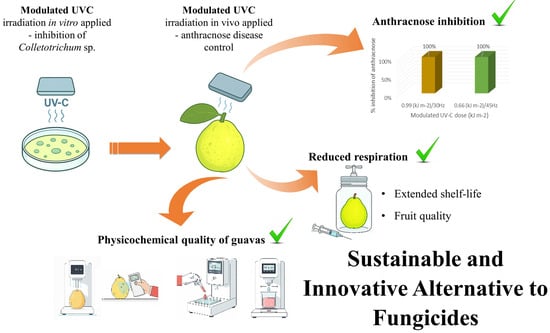
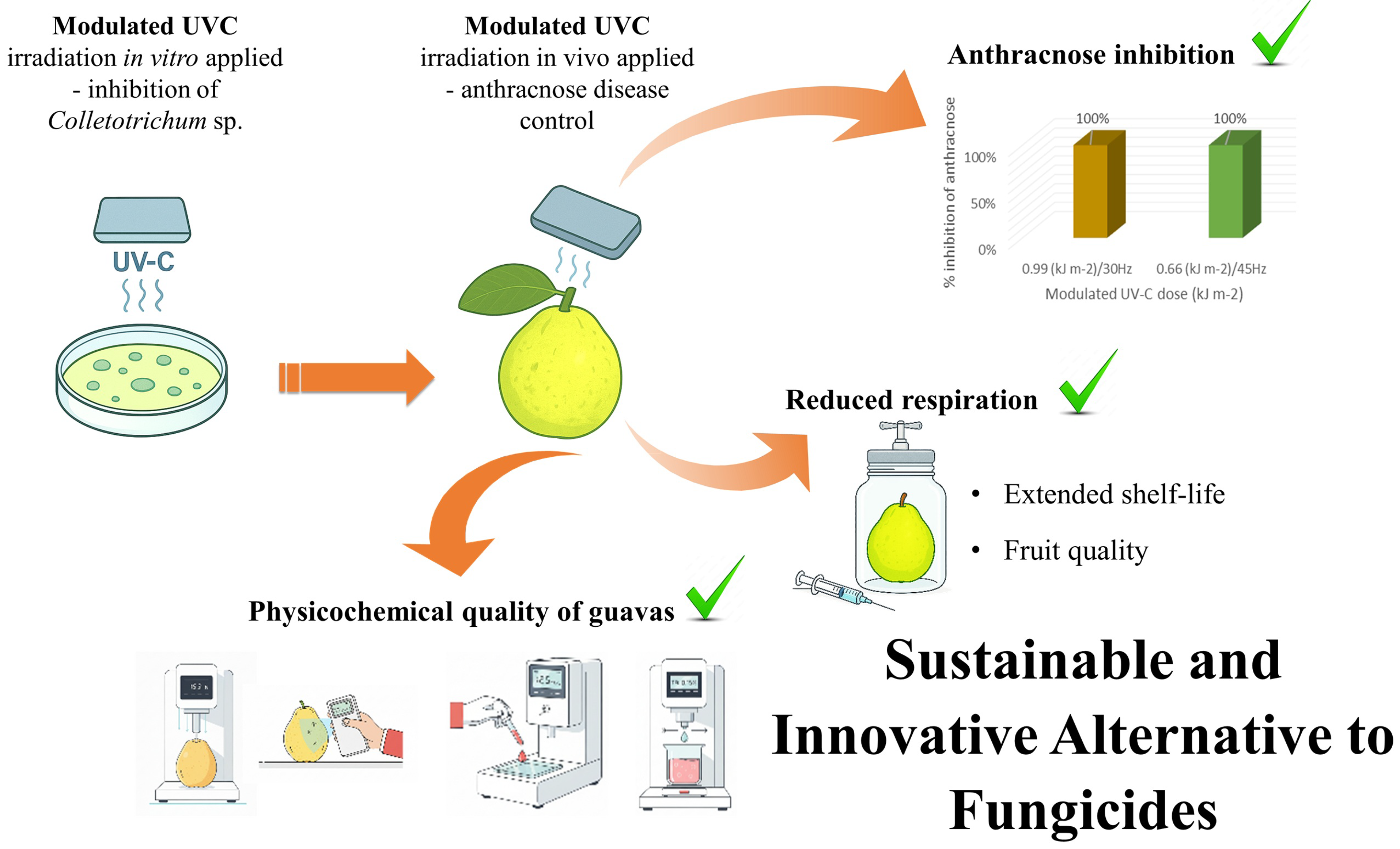
Graphical Abstract

1. Introduction

Guava (Psidium guajava L.) is a tropical fruit of great economic and nutritional value, appreciated for its high vitamin C content, phenolic compounds, and dietary fiber. It is estimated that, in 2023, Brazil produced approximately 2.11 million tons of this fruit, making it the world’s sixth largest producer [1]. However, the fruit’s high perishability compromises its quality and postharvest marketability [2].
Because guava is a climacteric fruit with high postharvest respiration rates, ripening and senescence occur rapidly, resulting in a short shelf-life. Furthermore, its preservation is compromised by its susceptibility to anthracnose, a fungal postharvest disease caused by species belonging to the Colletotrichum gloeosporioides complex (sensu lato), particularly Colletotrichum gloeosporioides (Penz.) Penz & Sacc. and Colletotrichum acutatum J.H. Simmonds [3,4]. This phytopathology manifests externally on the fruit’s skin through dark-colored lesions, usually black or brown. Although the infection typically remains confined to the epidermis, the pathogen can reach the pulp through insect injuries, improper handling, or mechanical damage during transport [5]. The interaction between physiological changes and infestations by phytopathogens in these fruits, combined with inefficient postharvest practices, contributes to high postharvest losses, estimated at between 20% and 40% of total guava production in developing countries [6].
Traditionally, pathogen control in guavas has been predominantly achieved through synthetic chemical pesticides, particularly fungicides, which constitute the primary strategy for managing postharvest rots. Treatment is typically achieved by immersing or spraying fruit in a fungicide solution immediately after harvest, followed by drying and refrigerated storage. However, the intensive and sometimes indiscriminate use of these compounds has resulted in toxic chemical residues in the fruit, raising concerns about impacts on human health and the environment. Furthermore, this practice can favor the selection of resistant microbial populations, compromising the effectiveness of conventional treatments. As a result, there is growing interest in environmentally friendly alternative control methods capable of reducing guava postharvest losses sustainably without relying on synthetic chemicals [7].
In this context, ultraviolet (UV) radiation, especially in the C band (UV-C), has been established as a promising non-thermal technology for microbiological control in fruits. This technique stands out for its low implementation cost, operational simplicity, reduced maintenance requirements, and lower environmental impact, in addition to the preservation of the sensorial characteristics and nutritional properties of fruits [8]. Two types of UV-C light applications are commonly used to inactivate microorganisms in food, including fruits: continuous and pulsed. Continuous light is characterized by constant emission over time, while pulsed light operates through short, intense flashes with high-power peaks. Due to its high pulse frequency, the latter is expected to be more effective for microbial inactivation, generating localized photothermal effects without causing significant thermal damage to fruits [9,10].
In the present study, we present, for the first time, a new type of UV-C radiation developed by Embrapa, modulated UV-C, as an innovative approach to postharvest microbial control of fruits. This technique allows the dynamic adjustment of radiation intensity and frequency, enabling more precise control of the product’s interaction with the light. The light is emitted in a square wave format, with the duration of each pulse corresponding to half the total period, with energy and modulation frequency being the main operational parameters. In this application, the energy absorbed by the chromophores on the fruit surface is converted into heat, triggering the photoinactivation of the microorganisms present. The modulation frequency, in turn, directly causes the depth of the fruit layer to be heated, since the heating volume is inversely proportional to the applied frequency. The scientific hypothesis is that UV-C light offers significant advantages over continuous and pulsed light methods by providing effective thermal control, reducing light energy losses, and optimizing the germicidal fungal effect, thereby minimizing unwanted impacts on the quality of the treated fruit, especially epidermal damage [9].
Several studies have demonstrated the effectiveness of UV-C radiation in inhibiting the growth of Colletotrichum spp. in fruits such as lime, mango, and papaya [8,9]. However, research on the use of this technology in guava postharvest diseases is still limited, especially applications of modulated UV-C light. Therefore, the objective of this study was to quantify, for the first time, the effects of modulated UV-C light on the incidence and severity of the Colletotrichum sp. gloeosporioides complex in guava, as well as the impacts on their physicochemical characteristics and respiration rate during fruit storage.

2. Materials and Methods

2.1. Fungal Isolate

The fungal isolate of the Colletotrichum sp. gloeosporioides complex (CMAA 1966) was obtained from the Collection of Microorganisms of Agricultural and Environmental Importance at Embrapa Environment (Jaguariuna, São Paulo, Brazil).

2.2. Instrumentation

Modulated Embrapa developed UV-C Light Equipment to evaluate the effectiveness of modulated UV-C radiation in controlling diseases such as anthracnose in fruits.
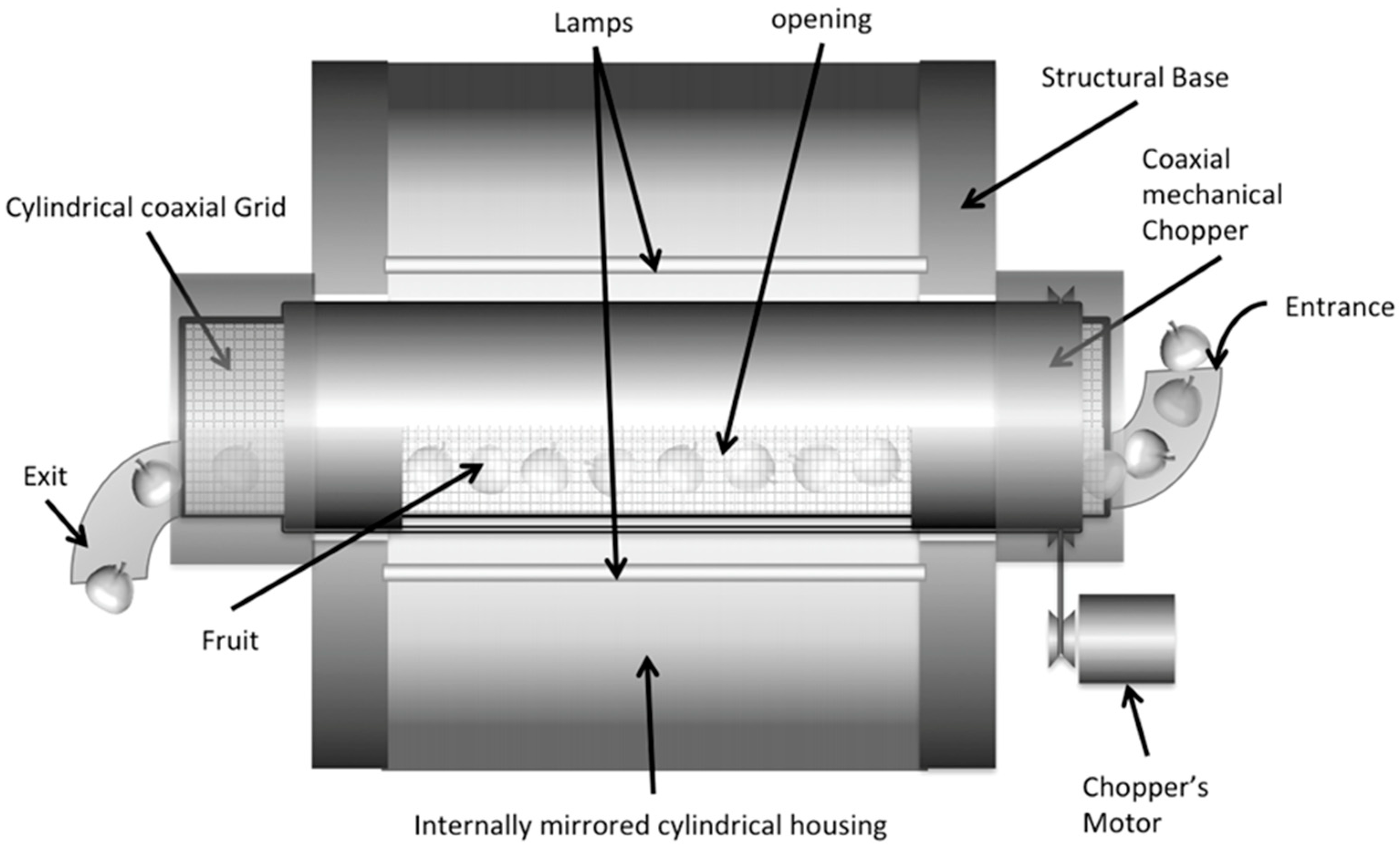
A schematic diagram of the modulated light instrument and its main components is presented in Figure 1.
The system consists of an internally mirrored cylindrical housing containing three internal UV-C germicidal lamps (TUV 36W/T5 HE, 254 nm, Philips, Pila, Poland), a cylindrical coaxial grid, a coaxial mechanical chopper with three openings, an electric motor to drive the chopper, and an electronic circuit controlling and activating the lamps and the motorization system.
The tubular fluorescent lamp emits light rays primarily perpendicular to its surface, creating a cylinder of light. The lamp is strategically placed inside a cylindrical mirror. One side of the lamp faces the fruit, while the other side reflects onto the cylindrical mirror. The light reflected from the mirror returns to the fruit; this ensures that the fruit is illuminated by the maximum possible amount of light emitted by the lamp, which is used for the disinfection process. This instrumental design optimizes the use of the tubular lamp to reduce energy loss. The mirrored surface has a reflectance factor above 85%; therefore, light energy losses are low.
This system provides uniform radiant power and modulated (periodically interrupted) incident light. Figure 2 shows a sketch of the modulation light as a square wave. When the light is on, the fruit receives light for T/2, and then the light is off alternately.

2.3. Calculation to Determine the Total Dose of Modulated UV-C Energy Applied to the Guava

The sequence of calculations required to determine the total dose of modulated UV-C energy applied in the experiment is described below. Some important definitions for understanding the calculations are described in Appendix A (Table A1).

2.3.1. Modulation Frequency (fch)

The light modulation is obtained as follows:
f c h = n · S p e e d 60
where the following abbreviations are used:
n = number of chopper openings (3);
Speed (RPM) = rotations per minute of the chopper’s AC electric motor;
60 = conversion factor to Hz (pulses per second);
fch =1/T.

2.3.2. Simplified Modulation Frequency (fch)

Considering n = 3 (number of chopper openings), Equation (1) becomes
f c h = S p e e d 20

2.3.3. Energy Emitted in Half a Cycle (ET/2)

The chopper’s configuration, with symmetrical openings and the same width, causes it to produce a square wave with period T, as seen in the figure above. Thus, the energy emitted (kJ m−2) in each T/2 interval is expressed as follows:
E T / 2 = 1 2 E f c h = 10 · E S p e e d
where the following abbreviation is used:
E′ (Wm−2) = light irradiance.

2.3.4. Number of Pulses in the ton Interval (NT/2)

The radiant power transferred by a lamp depends on the time, tON, that the lamp remains ON, as follows:
N T / 2 = t o n T = t o n · f c h = S p e e d 20 t O N
where the following abbreviations are used:
ton (s) = time the lamps remain ON;
T = period of the square wave;
NT/2 = number of half cycles.

2.3.5. Total Energy Transferred (ER)

The total energy transferred (kJ m−2) to the fruit is proportional to the energy emitted in each half cycle (ET/2) and the number of these cycles (NT/2):
E R = N T / 2 · E T / 2 = 1 2 E · t o n
The direct incident irradiance on the surface of the fruits, at a distance of 25 cm from the lamps, was estimated at 2.21 mW/cm2 (equivalent to 22.1 W/m2) per lamp [11]. Two lamps were used in the experiments.
The incident irradiance (or fluence rate) on the fruit surface was determined using a digital radiometer (Genuv—MG-07.1 GUVX-T1XGS7.1-LA9) equipped with a UV-C sensor. The sensor was positioned in the same plane and at the same distance as the fruit exposed to the lamps, ensuring that equivalent experimental conditions were achieved. Readings were taken after the stabilization of the light output, with the average irradiance value recorded expressed in mW cm−2 and later converted to W/m2 for comparison in the total radiation dose calculations.
The photothermal effect was assessed indirectly by monitoring temperature variation with a digital thermometer (THU-200 Thermohygrometer, Unity) installed inside the equipment during fruit exposure to UV-C radiation. Measurements were recorded every minute throughout the treatment.

2.4. Influence of the Modulated UV-C on Germination of Colletotrichum sp. (In Vitro Experiment)

This influence was quantified via an in vitro experiment. A spore suspension was prepared from an actively growing Colletotrichum sp. culture, with the spore concentration adjusted to 1 × 10³ spores mL−1, using a Neubauer chamber.
A volume of 100 µL of this suspension was deposited onto each Petri dish (experimental unit) containing PDA. The dishes were further exposed to four treatments of modulated UV-C radiation for 45 s (0.99 kJ m−2) at frequencies of 15, 30, and 45 Hz, respectively. The experimental design used was completely randomized, with four replications. The number of colony-forming units (CFU) in each experimental unit was recorded daily for 3 days.

2.5. Influence of the Modulated UV-C on Colletotrichum sp. Mycelial Growth (In Vivo Experiment)

2.5.1. Plant Raw Material

Red-fleshed guavas of the “Suprema” variety (Psidium guajava L.) were harvested at a guava farm (22.854° S, 47.0519° W, 696 m a.s.l., Campinas, São Paulo, Brazil) and carefully packed in plastic boxes right after harvest. The guavas were transported to the postharvest laboratory at Embrapa Environment (Jaguariúna, São Paulo, Brazil) on the same day. They were washed with mild detergent, air-dried on absorbent paper towels, and then sorted to ensure uniform ripeness and the absence of signs of disease or mechanical damage.
Based on the maturation visual scale proposed by Cavalini et al. [12], we only used guavas with a peel color indicating ripeness (ripeness stage 3), which is described as the maturation stage characterized by the initial development of yellow skin coloration and is popularly known among farmers as the “coloring” stage.

2.5.2. Inoculation

Guavas were wounded with a 1 mm wide needle in the equatorial region (3 mm deep), where 10 µL of the spore suspension (1 × 10⁵ spores mL−1) was deposited, and incubated for 24 h in a humid chamber (25 °C).

2.5.3. UV-C Irradiation

The experiment was carried out using a completely randomized design with seven treatments and five replications. The treatments consisted of a control treatment (without UV-C application) and combinations of two UV-C doses (0.66 kJ m−2 and 0.99 kJ m−2), corresponding to 30 and 45 s exposition times, with three frequency levels (15, 30, and 45 Hz), thus comprising a 2 × 3 factorial arrangement with an additional treatment.

2.6. Physicochemical Analysis

Guavas were subjected to modulated UV-C radiation at a dose of 0.99 kJ m−2 at 30 Hz. They were then stored in a cold chamber (20 ± 2 °C and 80 ± 2% relative humidity) and evaluated before UV-C application at days 4 and 7 after application.
A Texturometer (TA500, Lloyd Instruments, Bognor Regis, UK) equipped with a 5 kg load cell and a flat-tipped probe with a 2 mm diameter was used for firmness analysis. The following parameters were applied: pre-test of 2 mm s1, speed of 2 mm s1, post-test of 10 mm s1, and penetration depth of 10 mm. The probe was inserted into the equatorial region of both sides of the fruit, through the skin, and the force required to pierce the fruit was recorded in Newtons (N).
Skin color was measured using a colorimeter (Model CM-700d, Konica Minolta, Tokyo, Japan), with a standard D65 illuminant (daylight, 6500 K) and a 10° standard observer angle. Measurements were recorded in the CIELab color space and converted to the CIEL*C*h system [13] according to Equations (6) and (7). In this system, L* represents lightness (0 = black, 100 = white), a* corresponds to the green (−)-to-red (+) axis, and b* corresponds to the blue (−)-to-yellow (+) axis. From these values, C* (chroma) indicates color saturation, and h (hue angle) represents the color tone:
C *   =   ( a * ) 2   +   ( b * ) 2
h = t a n 1   a * b *
The sample was then grated and pressed to extract the juice, which was used to determine soluble solids, titratable acidity, and pH. The guava was peeled for juice extraction, and then a 4 cm wide section was collected from the equatorial region, removing the seeds.
Soluble solids were determined using a digital refractometer (Model: MA871, Milwaukee Instruments, Rocky Mount, NC, USA), and the results were expressed in °Brix. Titratable acidity was determined according to the methodology recommended by Instituto Adolfo Lutz [14]. For this purpose, 5 mL of guava juice was diluted in 50 mL of distilled water and titrated with a 0.1 N sodium hydroxide (NaOH) solution (Labsynth Produtos para Laboratórios, 99% purity) that had been standardized with potassium biphthalate (Vetec Química, 99.5% purity), until reaching a pH of 8.1. The result was expressed as a percentage of citric acid. The pH of the juice was measured with a benchtop pH meter (Model: 2500, Cole-Parmer, Vernon Hills, IL, USA), previously calibrated with solutions supplied at pH 4.0, 7.0, and 10.0.
Weight loss was quantified in percentage terms (%), calculated as the difference between the initial weight and the weight at each storage interval divided by the initial weight and multiplied by 100.
The experiment for physicochemical analysis was conducted in a completely randomized design, with a control group (no treatment) and a group treated with modulated UV-C light (30 Hz for 45 s, corresponding to a dose of 0.99 kJ m−2). There were 10 replicates per treatment for each analysis day.

2.7. Respiration Analysis

Guavas irradiated with modulated UV-C light at a dose of 0.99 kJ m−2 and at a frequency of 30 Hz were placed in uncapped glass vials (1000 mL) and stored at 20 ± 2 °C for 9 days. Sample collection and analysis followed the methodology described by Frighetto et al. [15], with some adaptations.
A static system was used in which the glass vials, already containing fruit, were hermetically sealed to allow gas accumulation. After two hours of incubation, 60 mL of the internal atmosphere of the vials was collected using a sterile syringe (60 mL, Luer lock, BD) equipped with a three-way stopcock. The analyses were performed using a gas chromatograph (Model: Trace 1310, Thermo Scientific, Waltham, MA, USA), fitted with a split injector (3:1) at 120 °C, a 250 µL loop, and a megabore PLOT-Q capillary column (30 m × 0.53 mm × 25 µm; Agilent), operating at temperatures of 150 °C (injector) and 80 °C (column). The system had two detectors in series: thermal conductivity (TCD, 200 °C) and flame ionization (FID, 300 °C), allowing the simultaneous quantification of CO2 and ethylene, respectively. The carrier gas used was N2 (99.999%) at a flow rate of 25 mL min−1. OpenLab CDS software, version 2.8, was used for data acquisition and processing. Certified CO2 (9.96% mol/mol) and ethylene (10.8 µmol/mol) standards were supplied by Air Liquide. The detection limit of ethylene was 0.08 ppm. The analysis time per sample was 5 min, and the respiration rate was expressed in mL kJ kg−1 h−1.
Respiration analyses were conducted in a completely randomized design, with a control group (no treatment) and a group treated with modulated UV-C light (30 Hz for 45 s, corresponding to a dose of 0.99 kJ m−2). There were five replicates for each treatment.

2.8. Statistical Analysis

2.8.1. Assessment of Colletotrichum sp. Germination via CFU (In Vitro Experiment)

In the in vitro experiment, the influence of the modulation frequency on spore germination inhibition was quantified via CFU by fitting a polynomial quadratic regression model (Equation (8)). Two model versions were fit: one using the original response variable CFU and another using the response variable expressed as decimal logarithms (log10 CFU per plate).
The polynomial model is represented as follows:
y i j = α + β x j + γ x j 2 + ε i j
where yij is the number of colony formation units (CFUs per plate) or log10 (CFUs), depending on the model version, for the modulation frequency j (j = 0, 15, 30, and 45 Hz) and replication i (i = 1, 2, 3, and 4). The coefficients α, β, and γ correspond to the model parameters, intercept, slope, and quadratic coefficient, respectively, and εij represents the random error associated with yij.
Model fitting was achieved using the Regression Procedure (PROC REG) in SAS/STAT®, version 9.4 [16]. The model parameters’ significance was assessed via F-tests. The estimated mean CFUs for each treatment, their respective standard errors, and the model’s goodness-of-fit measures were also calculated. The best model version was selected, considering parsimony, ease of interpretation, and goodness-of-fit measures.

2.8.2. Incidence, Severity, and AUDPC of the Disease Agent Colletotrichum spp. in Guavas (In Vivo Experiment)

In the in vivo experiment, the effect of modulated UV-C on the anthracnose incidence, a binary variable, was investigated using lower-sided Fisher’s exact test for comparing the UV-C treatments with Control, assuming that the incidence would decrease as the UV-C dose increased; consequently, the differences between the mean severity corresponding to a particular dose and the previous one were expected to be negative. In this case, the usual chi-squared tests for binomial data were inadequate due to the anticipated presence of zero absolute frequencies in the treatment x disease status (yes, no) contingency table.
The continuous variables, the mean diameter of disease lesions, and the area under the disease progress curve (AUDPC) were tested for normality and variance homogeneity assumptions before being subjected to analysis of variance (ANOVA), unless they presented with zero variance for any treatment. Such a configuration can occur under two possible scenarios: (a) at least one treatment is highly effective, leading to no disease infection in any of its replications or (b) at least one treatment is innocuous, leading to higher disease infection. In these zero-variance cases, the continuous variables were subjected to tests, such as the Kruskal–Wallis, followed by the nonparametric version of the lower-sided Dunnett’s test for comparing the UV-C treatments with the control. The tests were performed using the R packages kruskal test and nparcomp (version 4.5.0). Test, respectively [17]. The significance level adopted was 0.05.

2.8.3. Guava Physicochemical Quality and Respiration Rate

As in these studies, there were only two treatments (control and UV-C); the Student t-test was used for comparing means. The lower-tailed version of the test was used for the variable respiration rate, because it was expected that this rate would be lower in the UV-C treatment; for the quality variables, the bilateral version was used, as no superiority or inferiority was assumed for the expected means in the UV-C treatment. The Levene test for homogeneity of variances was performed for each response variable; whenever homogeneity was rejected, a t-test assuming different variances was used. The analyses were performed using the TTEST procedure in the statistical software SAS®/STAT, version 9.4 (SAS® Institute Inc., Santa Clara, CA, USA, 2023). The significance level adopted was 0.05.

3. Results

3.1. Influence of the Modulated UV-C on Colletotrichum sp. Germination (In Vitro Experiment)

The application of modulated UV-C radiation had distinct influences on the germination of the anthracnose causative agent (Colletotrichum spp.). Although radiation exposure reduced germination compared to the untreated control, the degree of inhibition varied according to the modulation frequency used. The most significant reduction in the number of CFU occurred around 30 Hz, indicating a more pronounced inhibitory effect on germination. At lower and higher frequencies, the radiation was less effective.
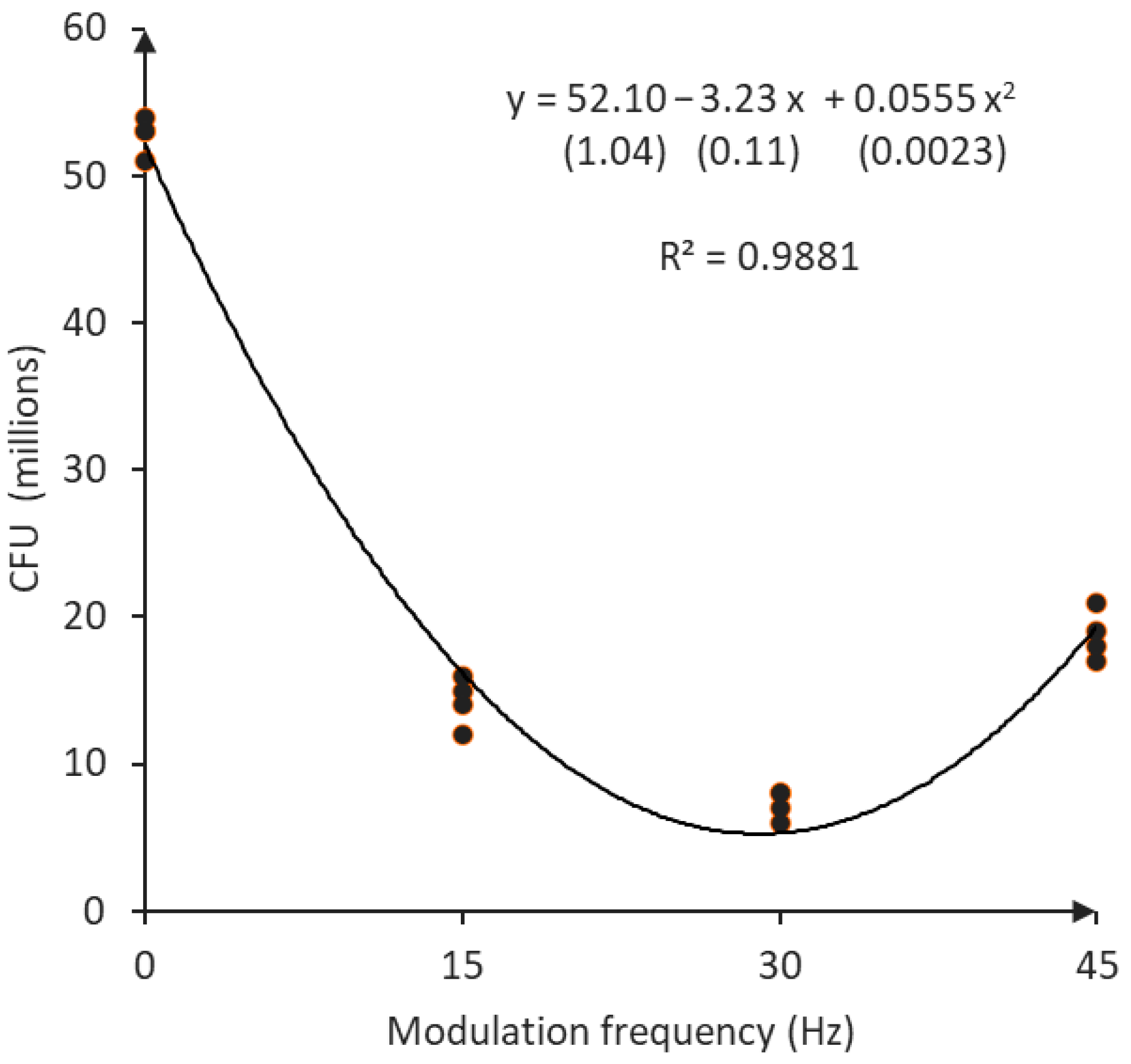
The model using the non-transformed response variable (CFU) performed slightly better than the version using log10 (CFU), showing a negligible R2 and more straightforward interpretation (Table 1). As both models performed well, the log-transformed model could also be used if the objective were to evaluate the influence of frequency on the magnitude of CFU (expressed as the power of the CFU counting) instead of the CFU counting itself (Table 1). The chosen quadratic model (Figure 2) showed an excellent goodness-of-fit, expressed by its very high determination coefficient (R2 = 0.98), low root-mean-squared error (RMSE = 2.12 × 10⁴ CFU per plate), and standardized residuals ranging from −2.13 to 1.38, with almost all values within the recommended interval of −2.0 to +2.0. The low experimental error led to low uncertainty of the model’s parameter estimates as measured using their respective standard errors (Table 1).
The influence of modulation frequency on the germination of the causal agent of anthracnose (Colletotrichum spp.) followed a parabolic pattern (F test, p < 0.001) with an optimum frequency at 29.02 Hz (~30 Hz) corresponding to an estimated CFU of 5.3 × 10⁴ CFU per plate. Consequently, the germination rate decreases as the frequency increases from 0 to 30 Hz and increases afterwards (30–45 Hz) (Figure 3).

3.2. Influence of Modulated UV-C Radiation on Colletotrichum sp. Incidence and the Severity of Anthracnose in Guava (In Vivo Experiment)

By monitoring the temperature, it was observed that increasing the modulation frequency resulted in lower heating rates, indicating a progressive reduction in the photothermal effect (15 Hz > 30 Hz > 45 Hz). In summary, higher modulation frequencies minimize radiation-induced surface heating.
The empirical evidence for anthracnose incidence inhibition in guavas due to the application of modulated-frequency UV-C radiation was significant (lower-sided Fisher exact test, p < 0.05) only for two treatments: the frequency/dose combinations (expressed in time) 30 Hz/45 s and 45 Hz/30 s. The estimated inhibition based on the control treatment was 100% for both combinations (Table 2).
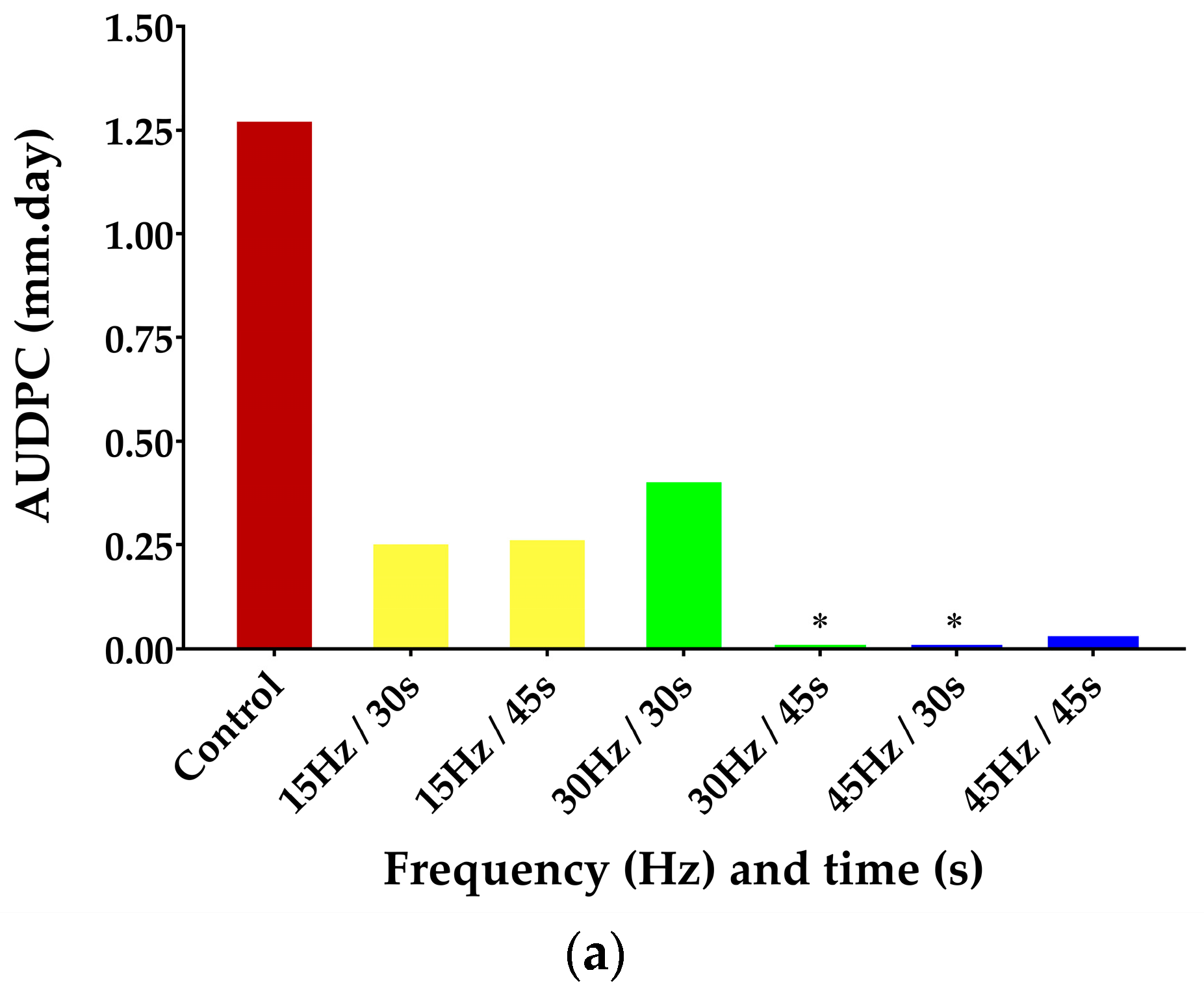
The reduction in anthracnose severity over time in guavas, as summarized by the AUDPC, due to the application of modulated UV-C radiation frequency, was also only significant for two treatments (nonparametric version of the lower-sided Dunnett test, p < 0.05). They correspond to the same frequency/dose combinations that were effective for incidence inhibition: 30 Hz/45 s and 45 Hz/30 s. The estimated reduction in AUDPC based on the control treatment was 100% for both combinations (Figure 4).
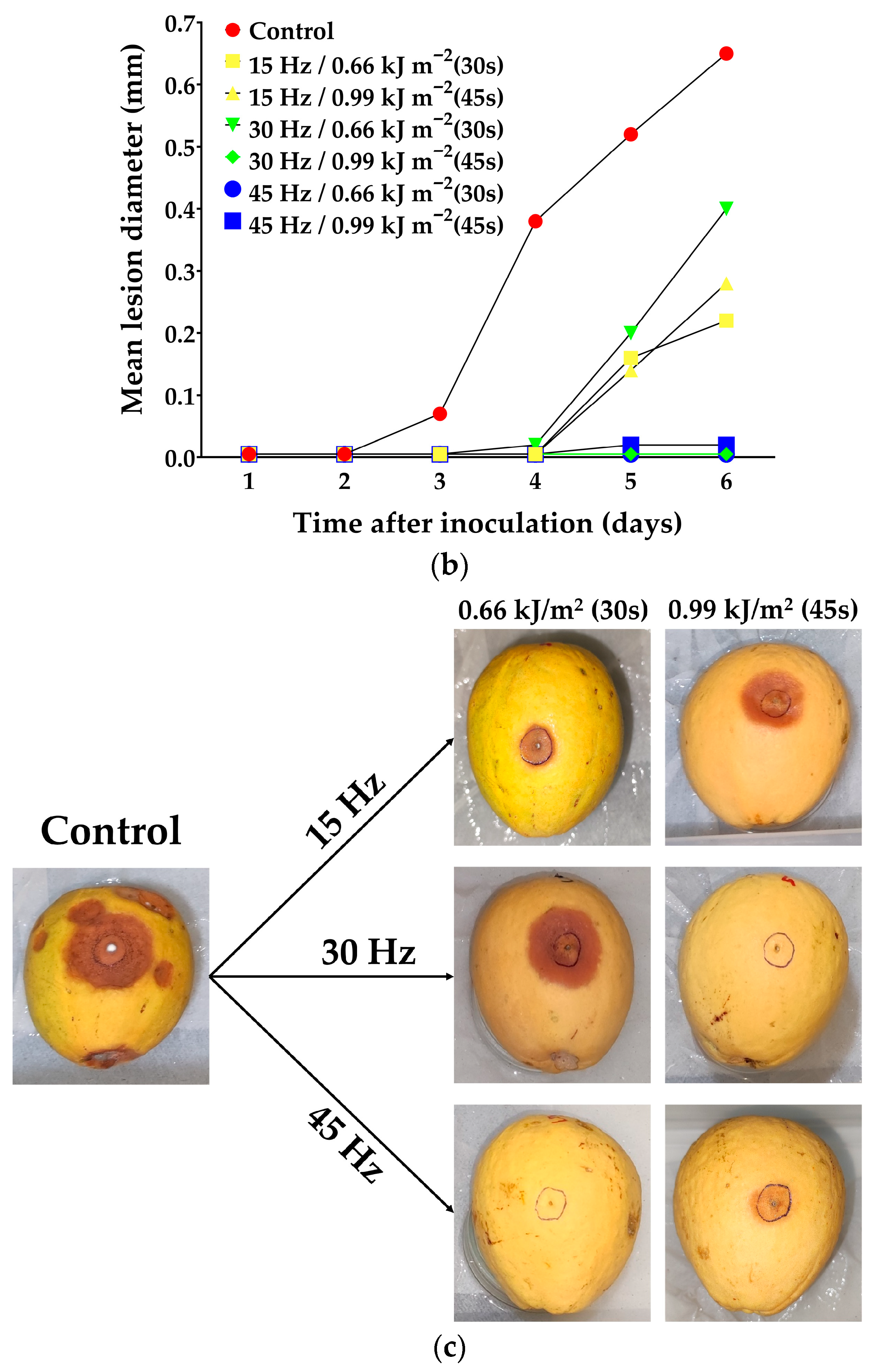
The application of UV-C radiation significantly influenced the progression of anthracnose disease. As expected, the control group exhibited marked lesion progression over the six days. In contrast, treatments 30 Hz/45 s and 45 Hz/30 s were highly effective, completely suppressing lesion growth. The lesions are illustrated in Figure 4c.

3.3. Physicochemical Analyses

The application of modulated UV-C radiation had a significant effect on color development in guava peels, as evidenced by specific parameters, such as the variable a*, which, for the UV-C group, showed significantly lower values on both days 4 and 7 compared to the control group. This result suggests that UV-C treatment delayed red color development in fruits (Table 3).
Complementing the a* result, the hue angle (h), which indicates the color hue (where higher values tend toward yellow (90°) and green (180°), was significantly greater in the UV-C group compared to the control on both days of analysis, reinforcing the notion that the control treatment increased the intensity of the yellowish hue of the peel in both periods (Table 3).
The parameters L*, b*, and C* were not significantly affected by the UV-C treatment on any of the days. Similarly, soluble solids (SS), pH, titratable acidity (TA), and fruit weight loss did not show significant differences between treatments (Student t-test, p > 0.05; Table 3).
On the other hand, fruit firmness, a crucial indicator of fruit quality, was significantly higher in UV-C-treated fruits on day 7 after storage. In contrast, on the same day, the SS/TA ratio was considerably lower for irradiated fruits, indicating less acid degradation and/or a lower concentration of soluble solids over time, complementing the indication that UV-C delays ripening (Table 3).

3.4. Respiration Analysis

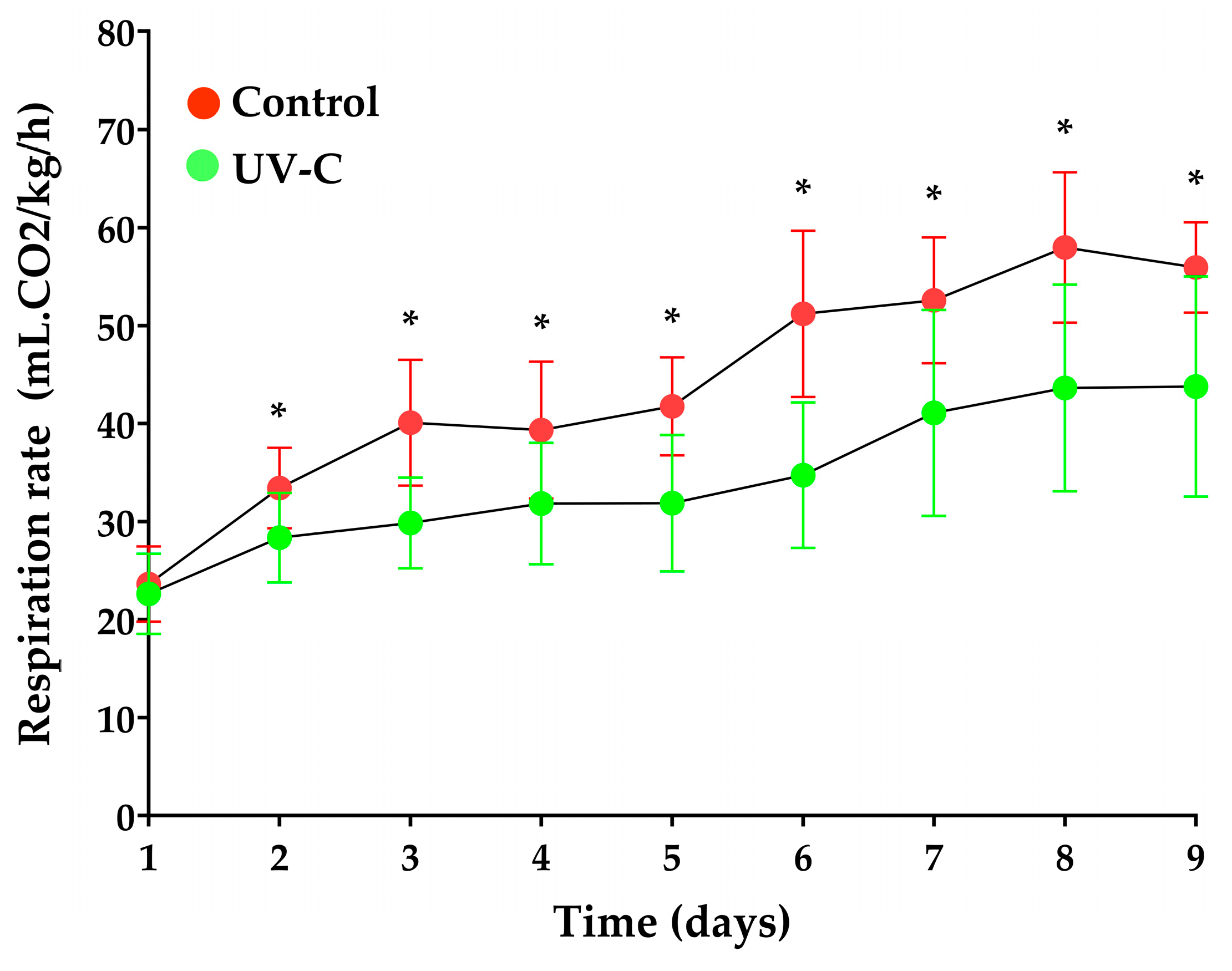
UV-C radiation significantly impacted the guavas’ respiration rate over the nine days. Modulated UV-C treatment significantly reduced CO2 emissions (mL−1 kg−1 h−1) throughout the storage period after the second measurement day. Furthermore, UV-C treatment delayed the climacteric peak on day 8 for the control group fruits but only on day 9 for the irradiated fruits (Figure 5). Ethylene was not detected in any of the guavas analyzed.

4. Discussion

4.1. Influence of the Modulated UV-C on Colletotrichum sp. (Germination) Colony-Forming Units (In Vitro Experiment)

The results demonstrated that the modulation frequency of UV-C radiation had a significant in vitro effect in reducing the germination of Colletotrichum spp., following a highly significant parabolic pattern (F test, p < 0.001). The adjusted quadratic polynomial model showed excellent goodness of fit, with a high coefficient of determination (R2 = 0.98), low root-mean-squared error (RMSE = 2.12 × 10⁴ CFU per plate), and standardized residuals distributed primarily within the recommended range of −2.0 to +2.0. The estimated optimal frequency was 29.02 Hz (~30 Hz), corresponding to a minimum germination of approximately 5.3 × 10⁴ CFU per plate, which confirms that the response is nonlinear, with a progressive reduction in the fungal population up to 30 Hz, followed by a partial recovery at 45 Hz (Figure 3).
The more pronounced reduction in the fungal population at 30 Hz suggests that modulated UV-C radiation enhances the germicidal effect at intermediate frequencies, possibly by inducing a greater accumulation of photochemical damage to fungal DNA and cellular membrane alterations, which results in greater impairment to spore viability. Previous studies have indicated that the antimicrobial effect of UV-C radiation can be enhanced when applied intermittently or modulated, as pulsed exposure allows for periods of cumulative oxidative stress, increasing the rate of irreversible damage [9,10].
The increase in colony counts at 45 Hz, in turn, suggests a possible tolerance threshold of spores to modulation. Very high frequencies may reduce germicidal efficacy due to the shorter duration of effective pulses or the stimulation of cellular repair mechanisms, such as photoreactivation and the activation of antioxidant enzymes, which have already been described in various fungal species [18].
Recent investigations using pulsed or modulated UV-C systems have confirmed that non-continuous irradiation can achieve greater microbial inactivation compared to continuous exposure, mainly due to alterations in photobiological damage kinetics and transient recovery intervals that amplify oxidative stress [19]. Furthermore, responses of Colletotrichum (isolate-dependent) to pulsed UV-C light have been documented, highlighting that modulation frequency and pulse width may define specific susceptibility thresholds [20]. These findings reinforce the hypothesis that the optimal response observed near 30 Hz points to the frequency where the accumulated photochemical damage exceeds the fungal repair capacity, before tolerance mechanisms become predominant at higher frequencies.
Our results confirm that the effectiveness of UV-C light against Colletotrichum spp. depends on the accumulated dose and the modulation frequency applied. The identification of ~30 Hz as the most effective condition highlights the importance of considering dynamic radiation parameters in developing postharvest control technologies and may represent a promising strategy for reducing the use of synthetic fungicides in preserving guavas and other highly perishable tropical fruits.

4.2. Influence of the Modulated UV-C on Colletotrichum sp. Incidence and Mycelial Growth (In Vivo Experiment)

The results of this study robustly demonstrate the effectiveness of our modulated UV-C radiation technique in controlling postharvest anthracnose in guava. Statistical analysis confirmed that only two combinations of frequency and exposure time—30 Hz/45 s and 45 Hz/30 s—were significantly effective in inhibiting disease incidence (Fisher exact test, p < 0.05), achieving 100% control compared to the control treatment (Table 2). These same treatments also excelled in reducing anthracnose severity over time, as measured by the AUDPC, with 100% reductions compared to the control (Conover’s test, p < 0.10), highlighting their potential as consistent strategies for postharvest phytopathology management (Figure 4).
Our findings align with previous reports indicating the potential of UV-C irradiation in inhibiting phytopathogens in tropical fruits. For example, in ‘Nam Dok Mai Si Thong’ mangoes, a UV-C treatment (0.94 kJ m−2) increased antioxidant activity and delayed deterioration caused by postharvest diseases, even without completely controlling anthracnose [21]. Similarly, in papaya, UV-C irradiation increased the antioxidant capacity of the peel and pericarp, suggesting a light-induced defensive response [22]. Menaka et al. (2024) reported that moderate UV-C exposure enhanced the antioxidant defense system and extended shelf-life in guavas [23], corroborating the findings presented herein.
The scarcity of published studies directly comparing the effectiveness of modulated and continuous UV-C radiation in guavas reinforces the relevance of this study to plant pathology and postharvest technology.
The effectiveness of the modulated radiation technique demonstrated in this study lies in its ability to deliver the total energy dose intermittently, making it more effective for pathogen control than continuous application. Modulated irradiation at a frequency of 45 Hz/30 s at a relatively low dose of 0.66 kJ m−2 promoted complete disease control with an efficiency that would require approximately twice the fluence for continuous light. Thus, modulation reduced the required fluence while minimizing photothermal burn damage to the fruit skin. Evidence shows that high-intensity pulses can cause more microbial damage than continuous irradiation [24]. In a study comparing UV-C LEDs in continuous and pulsed modes, it was observed that bacterial spore inactivation was achieved with significantly lower fluence in pulsed mode (365 J/m2) than in continuous mode (665 J/m2), with higher inactivation constants [25].
The results demonstrate that modulated UV-C radiation represents a promising and effective alternative for sustainable anthracnose control in guavas. Specific combinations of frequency and exposure time are crucial in treatment efficacy, and modulation stands out as a technique that not only suppresses the disease but also minimizes the risk of fruit damage. Future studies could focus on optimizing these combinations for different guava varieties and long-term storage, as well as the technique’s results in other fruits.
These findings are consistent with previous studies reporting that the effectiveness of UV-C in reducing microorganisms is directly related to the total energy applied and exposure time, as cumulative damage to DNA and cellular structures leads to growth inhibition [8,26]. Furthermore, modulated UV-C can optimize the antimicrobial effect, minimizing potential negative impacts on the quality of the treated product, which is relevant to postharvest applications and pathogen control in fresh foods [27].

4.3. Guava Postharvest Quality and Shelf-Life

Upon arrival at the laboratory and before treatment, the guavas displayed physicochemical characteristics indicative of an early ripening stage, with average firmness values of 2.55 N and a soluble solid content of 9.03°Brix. The titratable acidity was 0.54%, and the pH was 3.00, resulting in an SS/AT ratio of 17.22. Peel color assessed using the CIELab and CIEL*C*h systems showed a lightness (L*) of 70.16, a* of −2.00, b* of 40.58, and a hue angle (h) of 92.86, consistent with ripening stage 3, which is the beginning of yellow color development, popularly known as the “coloring stage” [12].
The results demonstrated that the application of UV-C modulated at a frequency of 30 Hz for 45 s (dose of 0.99 kJ m−2) at 4 and 7 days after treatment did not significantly affect most of the internal and external quality parameters of “Suprema” guavas. The absence of differences in L*, b*, C*, soluble solids, pH, and titratable acidity is consistent with studies on ‘Tahitian’ limes, in which pre-storage treatments with UV-C did not affect weight loss, soluble solids, or titratable acidity during storage at 10 °C [28]. The recent literature also reports that the effects of UV-C on basic quality parameters vary with dose, cultivar, and conditions and can be distinct under certain conditions [29]. Thus, the stability of these parameters observed in the present study suggests that the radiation did not trigger an intense metabolic response that significantly altered the metabolism of sugars and organic acids.
The results clearly indicate that modulated UV-C irradiation significantly impacted color development, delaying the fruit’s transition to the typical color of full ripeness. This delay is evidenced by two complementary parameters: the a* value and the hue angle (h). In both evaluation periods, the UV-C group consistently presented significantly lower a* values (Table 3) compared to the control. This result demonstrates that the treatment allowed the yellow hue to remain predominant for longer.
The progressive decrease in hue angle (h) from 92.86° at harvest to 75.89° (UV-C) and 72.09° (control) after 7 days indicates the gradual loss of guava initial pigmentation (green) and the development of an intense yellow tone typical of the “Suprema” guava during ripening to senescence. Nonetheless, the hue angle (h) was significantly higher in UV-C-treated guavas at both analysis times (Table 3). In fruit color systems, maintaining a higher h value is intrinsically linked to the slower degradation of chlorophyll, the primary pigment responsible for the green hue. This correlation has been well documented in guava ripening studies, where a progressive decrease in hue angle is observed as ripening progresses, indicating the loss of the green hue [12].
The maintenance of lower a* and higher h in UV-C-treated fruits is a defense mechanism frequently reported in the literature [23,29]. UV-C radiation acts as an abiotic stressor that can induce the production of protective compounds and slow metabolic processes, including the breakdown of chlorophyll, as has been observed in peaches, where UV-C delays softening and senescence while maintaining structural homeostasis [30], and in UVB-treated limes [31]. Therefore, the combination of the a* and h results provides robust evidence that treatment with modulated UV-C irradiation effectively delays the guava ripening process, extending their shelf-life in terms of color attributes.
Although the higher hue angle (h) observed in UV-C-treated fruits suggests delayed degradation of chlorophyll, this study did not include biochemical or molecular analyses (e.g., chlorophyllase activity or gene expression) to confirm senescence retardation beyond colorimetric assessment. Future research integrating these biochemical markers, as well as sensory analysis, may provide deeper insights into the physiological mechanisms underlying the delayed ripening effect induced by modulated UV-C irradiation.
UV-C radiation did not affect guava weight loss (Table 3), indicating that the treatment did not alter fruit dehydration during storage. In contrast, firmness was preserved in fruits subjected to UV-C: a statistically significant increase in firmness was observed on day 7 post-treatment (Student t-test, p < 0.05; Table 3), suggesting that the applied dose (0.99 kJ m−2) may contribute to texture maintenance. It is important to emphasize that this significant difference was isolated (only on day 7), so the higher numerical values in the treated group indicate a beneficial trend but require confirmation through studies evaluating the persistence and consistency of this effect over time. Studies with fresh vegetables, such as cut lettuce, have suggested that moderate doses of UV-C can curb weight loss even without causing significant physical changes [32]. This indicates that the dose and application protocol (continuous or modulated) are crucial in achieving observable effects in terms of firmness and weight.
The significant difference in the soluble solids/titratable acidity ratio between control and UV-C-irradiated fruits, with a lower ratio in the UV-C group, suggests a different ripening pattern to the control, indicating a slowdown in postharvest ripening dynamics.
It is also important to note that UV-C irradiation at a dose of 0.99 kJ m−2 and a frequency of 30 Hz did not cause visible damage to the guava skin, such as burns. This observation is crucial, as maintaining visual integrity is essential in consumer acceptance at the point of sale. The absence of injuries was confirmed via visual evaluation, although this parameter was not subjected to statistical analysis.
Analysis of the respiration rate demonstrated that modulated UV-C light had a significant and beneficial effect on the guava ripening process. The lower respiration intensity observed in UV-C-treated fruits compared to the control group indicates that radiation delayed the metabolic physiological activity associated with ripening. The control fruits reached their climacteric peak one day earlier than the irradiated ones (day 8 of storage) and with a significantly higher value, clearly indicating that modulated UV-C light slowed the fruit’s metabolism without compromising its natural ripening pattern, thus increasing the shelf-life of the irradiated fruit.
A reduction in respiration rate following UV-C light exposure has been reported in several species, such as mango [28] and peach [33], and is often attributed to the modulation of enzymatic activity and the induction of defense mechanisms that stabilize oxidative processes. According to Chen et al. (2024) [27], respiration is a process that involves the decomposition of complex organic matter into smaller molecular substances, such as CO2 and H2O, releasing energy and heat. Modulated UV-C contributed to slower and more controlled guava ripening by slowing this process.
Consistent with the results obtained in this study, Shen et al. [23] also observed that applying UV-C radiation to guavas extended the shelf-life of the fruits by activating antioxidant systems and defense mechanisms. This response is directly related to a reduction in metabolic rate and, consequently, a decrease in respiration, contributing to maintaining postharvest quality. Thus, the findings show that applying UV-C, whether continuous or modulated, effectively slows down the accelerated physiological processes of ripening, leading to greater stability during storage.
In summary, the results reinforce the potential of modulated UV-C technology as a postharvest tool for highly perishable fruits such as guava. Technology significantly increases self-life by reducing respiratory intensity, which is of great importance commercially and in relation to food safety. However, it is essential to consider the ideal ripeness point and the postharvest quality of the fruit (especially with low inoculum potential) to determine the correct timing to apply UV-C radiation and thus ensure disease control.

5. Conclusions

The application of modulated UV-C light at a frequency of 30 Hz for 45 s (0.99 kJ/m2) proved effective in reducing the germination of Colletotrichum sp. spores and controlling anthracnose in guava postharvest. The treatment also preserved the fruit’s physicochemical quality and reduced its respiration rate, extending its shelf-life.
These results indicate that this innovative technology represents a promising and sustainable alternative to using chemical fungicides in the postharvest management of guava and other fruits.

Author Contributions

I.S.: conceptualization, analyses, validation, and writing—original draft preparation. D.T.: analyses, acquired inputs, planned activities, validation, and writing—original draft preparation. A.S.: analyses, writing—review and editing. W.M.: building the prototype for applying modulated UV-C light, validation, and writing—original draft preparation. J.F.: writing—original draft preparation. A.M.: statistical analysis and writing—original draft preparation. E.F.: resources, funding acquisition, and writing—review and editing. A.B.: conceptualization, planned activities, acquired inputs, resources, funding acquisition, writing—original draft preparation, writing—review and editing, and supervision. All authors have read and agreed to the published version of the manuscript.

Funding

This research was funded by Fundação de Amparo à Pesquisa do Estado de São Paulo (FAPESP), grant number: FAPESP, 2018/25318-7, Coordenação de Aperfeiçoamento de Pessoal de Nível Superior (CAPES) grant number: PDPG: 88881.708195/2022-01. The APC was funded by Federal University of Bahia (PRPPG/UFBA).

Data Availability Statement

The data generated in this study are available from the corresponding author and may be requested, if necessary, via email at aline.biasoto@embrapa.br (A.B.) or ederlan.ferreira@ufba.br (E.F.).

Acknowledgments

The authors express their deep gratitude to the Coordenação de Aperfeiçoamento de Pessoal de Nível Superior (CAPES, nº 88887.674564/2022-00) for financial support in the form of a doctoral scholarship, the family of “Suprema” guava growers at Sítio Maracujá, Campinas, São Paulo, to the staff of the FEAGRI/UNICAMP laboratories: Rosa Helena Aguiar, Adriana Naomi Owada Ono, and Leandro Moraisand to the employees of the EMBRAPA laboratories: Rosely dos Santos Nascimento, Bruno Rafael da Silva, Melissa Baccan and Viviane Cristina, for their assistance with laboratory analyses.

Conflicts of Interest

Authors Daniel Terao, Washington Melo, Aline Maia and Aline Biasoto are employed by the Brazilian Agricultural Research Corporation (Embrapa). The remaining authors declare that the research was conducted in the absence of any commercial or financial relationships that could be construed as a potential conflict of interest.

Abbreviations

The following abbreviations are used in this manuscript:
AUDPCArea under the disease progress curve
CFUColony-forming units
SSSoluble solids
TATitratable acidity
UV-CUltraviolet radiation C band

Appendix A

Table A1. Definitions of terms important for understanding the calculations of the total dose of modulated UV-C energy [34].
DefinitionsExplanation
Source Radiant Power (ψ)The radiant power (W) emitted in all directions by a radiant energy source.
Irradiance (E)The total radiant power from all directions incident on an infinitesimal element of surface area dS, divided by dS. The SI unit of irradiance is W/m2 or mW/cm2. For the position r from a point source.
Intensity radiant (I)The power emitted from a point source into a small solid angle dΩ steradians (sr) about a given direction from the source. The SI of I is W/sr. For a point source, ψ=4πI, where I does not decrease with distance in a non-absorbing medium.
Fluence rate (E’)The radiant power passing from all directions through an infinitesimally small sphere of cross-sectional area dA, divided by dA. The SI unit of fluence rate is W/m2, but μW/cm2 or mW/cm2 are in use. The fluence rate and irradiance are the same units but conceptually different terms. However, fluence and irradiance are the same for a collimated light beam.
UV Dose or Fluence (H)The total radiant energy from all directions passing through an infinitesimally small sphere of cross-sectional area dA, divided by dA. The SI unit of UV dose is J/m2 or as mJ/cm2.

References

  1. FAO—Food and Agriculture Organization of the United Nations. FAOSTAT: Statistical Database-Production (Crops and Livestock Products); FAO: Rome, Italy, 2024; Available online: https://www.fao.org/faostat/en/#data (accessed on 14 July 2025).
  2. Costa, L.C.; Santos, L.R.; França, R.; Davini, G.; Shirai, M.A. Aplicação de diferentes revestimentos comestíveis na conservação pós-colheita de goiabas (Psidium guajava L.). Braz. J. Food Res. 2017, 8, 16–31. [Google Scholar] [CrossRef][Green Version]
  3. Peres, N.A.R.; Kuramae, E.E.; Dias, M.S.C.; Souza, N.L. Identification and characterization of Colletotrichum spp. Affecting fruit after harvest in Brazil. J. Phytopathol. 2002, 150, 128–134. [Google Scholar] [CrossRef]
  4. Soares, W.R.O.; Vieira, W.A.S.; Reis, A.; Miller, R.N.G.; Santos, M.D.M.; Costa, E.C.; Câmara, M.P.S.; Café-Filho, A.C. Diversity of Colletotrichum causing anthracnose on Psidium guajava in varied Brazilian physiographic regions. Plant Pathol. 2024, 73, 1213–1228. [Google Scholar] [CrossRef]
  5. Fernandes, K.F.D.; Oliveira, K.Á.R.; Cirilo, Í.F.; Lima, M.C.; Câmara, M.P.S.; Souza, E.L. A novel coating formulated with sodium alginate loaded with a mixed lactic acid bacteria culture to control anthracnose in guava and mango. Food Control 2025, 175, 111341. [Google Scholar] [CrossRef]
  6. Yadav, A.; Kumar, N.; Upadhyay, A.; Fawole, O.A.; Mahawar, M.K.; Jalgaonkar, K.; Chandran, D.; Rajalingam, S.; Zengin, G.; Kumar, M.; et al. Recent Advances in Novel Packaging Technologies for Shelf-Life Extension of Guava Fruits for Retaining Health Benefits for Longer Duration. Plants 2022, 11, 547. [Google Scholar] [CrossRef]
  7. Peralta-Ruiz, Y.; Rossi, C.; Grande-Tovar, C.D.; Chaves-López, C. Green Management of Postharvest Anthracnose Caused by Colletotrichum gloeosporioides. J. Fungi 2023, 9, 623. [Google Scholar] [CrossRef]
  8. Zhao, Y.; Zuo, J.; Yuan, S.; Shi, W.; Shi, J.; Feng, B.; Wang, Q. UV-C Treatment Maintains the Sensory Quality, Antioxidant Activity and Flavor of Pepino Fruit during Postharvest Storage. Foods 2021, 10, 2964. [Google Scholar] [CrossRef]
  9. Scolfaro, F.P.; Benato, E.A.; Melo, W.L.B.; Sigrist, J.M.M.; Vitali, A.A.; Cia, P.; Castro, M.F.P.M.; Bueno, G.C. Uso da luz Branca Intensa Modulada para Controle de Doenças em Frutos Pós-Colheita; Embrapa: São Carlos, Brazil, 2007. [Google Scholar]
  10. Oster, A.H.; Silva, E.O.; Bordallo, P.N.; Zocolo, G.; Silveira, M.R.S.; Filho, F.O.; Araújo, A.A.C. Luz Ultravioleta Pulsada no Controle de Podridão Pós-Colheita e na Qualidade de Melão para Exportação; ResearchGate: Berlin, Germany, 2018; Available online: https://www.infoteca.cnptia.embrapa.br/handle/doc/1098235 (accessed on 1 August 2025).
  11. Philips Lighting, 2022. UV-C Disinfection Lamps: Product Catalog [WWW Document]. Signify. Available online: https://www.assets.signify.com/is/content/Signify/Assets/philips-lighting/global/20210322-philips-uvc-disinfection-lamps-catalog.pdf (accessed on 3 July 2025).
  12. Cavalini, F.C.; Jacomino, A.P.; Lochoski, M.A.; Kluge, R.A.; Ortega, E.M.M. Maturity indexes for ‘Kumagai’ and ‘Paluma’ guavas. Rev. Bras. Frutic. 2006, 28, 176–179. [Google Scholar] [CrossRef]
  13. Konica Minolta. Color Spaces; Learning Center; Konica Minolta Sensing Americas Inc.: Ramsey, NJ, USA, 2024; Available online: https://sensing.konicaminolta.us/us/learning-center/color-measurement/color-spaces/ (accessed on 8 August 2025).
  14. Instituto Adolfo Lutz. Métodos Físico-Químicos para Análise de Alimentos, 4th ed.; Instituto Adolfo Lutz: São Paulo, Brazil, 2008. [Google Scholar]
  15. Frighetto, R.T.S.; Terao, D.; Sasaki, F.F.C.; Cerqueira, T.S. Quantificação da Respiração e de Etileno em Vegetais por Cromatografia Gasosa com Detectores em Série; Embrapa Meio Ambiente: Jaguariúna, Brazil, 2018. [Google Scholar]
  16. SAS Institute Inc. The Regression Procedure (PROC REG) of the SAS/STAT® Software, Version 15.3; SAS Institute Inc.: Cary, NC, USA, 2024. [Google Scholar]
  17. R Core Team. R: A Language and Environment for Statistical Computing; R Foundation for Statistical Computing: Vienna, Austria, 2025; Available online: https://www.r-project.org/ (accessed on 8 August 2025).
  18. Duque-Sarango, P.; Delgado-Armijos, N.; Romero-Martínez, L.; Cruz, D.; Pinos-Vélez, V. Advancing waterborne fungal spore control: UV-LED disinfection efficiency and post-treatment reactivation analysis. Water 2025, 17, 922. [Google Scholar] [CrossRef]
  19. Rufyikiri, A.S.; Martinez, R.; Addo, P.W.; Wu, B.-S.; Yousefi, M.; Malo, D.; Orsat, V.; Vidal, S.M.; Fritz, J.H.; MacPherson, S.; et al. Germicidal efficacy of continuous and pulsed ultraviolet-C radiation on pathogen models and SARS-CoV-2. Photochem. Photobiol. Sci. 2024, 23, 339–354. [Google Scholar] [CrossRef]
  20. Baek, I.; Jang, J.H.; Lim, S.; Wang, Z.; Cha, M.; Magill, C.; Kim, L.S.; Meinhardt, L.W.; Sunchung, P.; Ahn, E. Differential responses of Cacao pathogens Colletotrichum gloeosporioides and Pestalotiopsis sp. to UVB 305 nm and UVC 275 nm. Sci. Rep. 2025, 15, 36256. [Google Scholar] [CrossRef] [PubMed]
  21. Zaw, M.M.; Setha, S.; Naradisorn, M. Comparison of hot water and UV-C treatments in controlling postharvest disease and maintaining postharvest quality of ‘Nam Dok Mai Si Thong’ mango. Acta Hortic. 2022, 1336, 149–158. [Google Scholar] [CrossRef]
  22. González-Aguilar, G.A.; Villegas-Ochoa, M.A.; Martínez-Téllez, M.A.; Gardea, A.A.; Ayala-Zavala, J.F. Improving Antioxidant Capacity of Fresh-Cut Mangoes Treated with UV-C. J. Food Sci. 2007, 72, 197–202. [Google Scholar] [CrossRef]
  23. Menaka, M.; Asrey, R.; Vinod, B.R.; Ahamad, S.; Meena, N.K.; Bhan, C.; Goswami, A.K. UV-C Irradiation Enhances the Quality and Shelf-Life of Stored Guava Fruit via Boosting the Antioxidant Systems and Defense Responses. Food Bioprocess Technol. 2024, 17, 3704–3715. [Google Scholar] [CrossRef]
  24. Itani, N.; Fadel, M.E. Microbial inactivation kinetics of UV LEDs and effect of operating conditions: A methodological critical analysis. Sci. Total Environ. 2023, 885, 163727. [Google Scholar] [CrossRef] [PubMed]
  25. Nyangaresi, P.O.; Qin, Y.; Chen, G.; Zhang, B.; Lu, Y.; Shen, L. Comparative performance of pulsed and continuous UV-C-LED irradiation in the inactivation of bacteria. Water Res. 2019, 157, 218–227. [Google Scholar] [CrossRef]
  26. Cheng, L.; Zhang, M.; Bai, H.; Yang, F.; Zhang, X.; Ren, D.; Du, Y. Combined ultraviolet-C radiation and L-cysteine treatment improves the postharvest quality and volatile compounds of edible Lanzhou lily bulbs (Lilium davidii var. unicolor) by regulating reactive oxygen species metabolism. Food Chem. X 2024, 24, 101813. [Google Scholar] [CrossRef]
  27. Chen, N.; Wei, W.; Yang, Y.; Chen, L.; Shan, W.; Chen, J.; Lu, W.; Kuang, J.; Wu, C. Postharvest Physiology and Handling of Guava Fruit. Foods 2024, 13, 805. [Google Scholar] [CrossRef]
  28. Pristijono, P.; Bowyer, M.C.; Papoutsis, K.; Scarlett, C.J.; Vuong, Q.V.; Stathopoulos, C.E.; Golding, J.B. Improving the storage quality of Tahitian limes (Citrus latifolia) by pre-storage UV-C irradiation. J. Food Sci. Technol. 2019, 56, 1438–1444. [Google Scholar] [CrossRef]
  29. Sonntag, F.; Liu, H.; Neugart, S. Nutritional and Physiological Effects of Postharvest UV Radiation on Vegetables: A Review. J. Agric. Food Chem. 2023, 71, 9951–9972. [Google Scholar] [CrossRef] [PubMed]
  30. Kan, J.; Gao, M.; Dong, W.; Tang, C.; Qian, C.; Liu, J. Impact of Ultraviolet-C Light on Softening and Senescence During Storage of Peach Fruit. J. Food Biochem. 2025, 2025, 5341034. [Google Scholar] [CrossRef]
  31. Srilaong, V.; Aiamla-or, S.; Soontornwat, A.; Shigyo, M.; Yamauchi, N. UV-B irradiation retards chlorophyll degradation in lime (Citrus latifolia Tan.) fruit. Postharvest Biol. Technol. 2011, 59, 110–112. [Google Scholar] [CrossRef]
  32. Artés-Hernández, F.; Robles, P.A.; Gómez, P.A.; Tomás-Barberán, F.A.; Artés, F. Low UV-C illumination for keeping overall quality of fresh-cut watermelon. Postharvest Biol. Technol. 2009, 51, 143–150. [Google Scholar] [CrossRef]
  33. Yang, Z.; Cao, S.; Su, X.; Jiang, Y. Respiratory activity and mitochondrial membrane associated with fruit senescence in postharvest peaches in response to UV-C treatment. Food Chem. 2014, 161, 16–21. [Google Scholar] [CrossRef] [PubMed]
  34. Bolton, J.R. Calculation of ultraviolet fluence rate distributions in an annular reactor: Significance of refraction and reflection. Water Res. 2000, 34, 3315–3324. [Google Scholar] [CrossRef]
Figure 1. A schematic diagram of the UVC modulated light instrument and principal components.
Horticulturae 11 01351 g001
Figure 2. A sketch of the modulated UV-C light application as a square wave.
Horticulturae 11 01351 g002
Figure 3. A polynomial quadratic model adjusted (continuous line) to describe the relationship between the modulation frequency of UV-C radiation (dose of 0.99 kJ m−2) and the germination of the anthracnose causal agent Colletotrichum sp. gloeosporioides complex, expressed as colony-forming units (CFU per plate), quantified in vitro. The dots correspond to the observed CFU values. The values in brackets correspond to standard errors of the model parameter estimates, intercept (α), linear coefficient (β), and quadratic coefficient (γ), respectively.
Horticulturae 11 01351 g003
Figure 4. The area under the anthracnose progress curve (AUDPC) (a), the progress curve of anthracnose severity in “Suprema” guavas based on the mean lesion diameter measured in fruits (b), and pictures representing anthracnose lesions in guavas, according to the treatment applied, after 6 days of storage (c). The treatments were combinations of different modulated UV-C radiation doses [0.66 kJ m−2 (30 s) and 0.99 kJ m−2 (45 s)] and modulation frequencies (15, 30, and 45 Hz), plus the control group (no UV-C application), over six days of storage. In (a), the columns topped with the asterisk (*) indicate UV-C treatments that differ from Control according to the nonparametric version of the lower-sided Dunnett test at a 0.05 significance level.
Horticulturae 11 01351 g004aHorticulturae 11 01351 g004b
Figure 5. The mean respiration rate (mL CO2 kg−1 h−1) of “Suprema” guavas corrected for the experimental temperature (Rc) for the fruit treated with modulated UV-C radiation (dose 0.99 kJ m−2 and frequency 30 Hz) and the non-treated fruit (control, without UV-C treatment), stored at 20 °C ± 2, for 9 days. Dots marked with * correspond to the respiration ratio, significantly different from those observed in the control treatment according to the Student t-test at a 0.05 significance level.
Horticulturae 11 01351 g005
Table 1. Parameter estimates of the regression models fitted to represent the relationship between the modulation frequency of UV-C application and the in vitro germination of the causal agent of anthracnose measured via CFU.
Response VariableModel ParameterParameter EstimateStandard Error 1p-Value 2R2 (%) 3
Nº of colony-forming units (CFU per plate)Intercept52.101.04<0.0001
Slope3.220.11<0.000198.81
Quadratic coefficient0.05560.0023<0.0001
Log10 (CFU per plate)Intercept5.740.03<0.0001
Slope−0.00300.0002<0.000196.10
Quadratic coefficient2.74 × 10−61.91 × 10⁻⁷<0.0001
1 The standard error of the model parameter estimates; 2 nominal significance value of the t-test for the null hypothesis associated with each model parameter; and 3 model determination coefficient: percentage of the total variability explained by the modulation frequency (Hz).
Table 2. Inhibition of anthracnose incidence at six days post-inoculation in “Suprema” guava fruits exposed to modulated UV-C irradiation *.
Treatment (UV-C) Modulated UV-C
Dose (kJ m−2)
Nº Infected Fruit/Nº Total FruitAnthracnose
Incidence (%) 1
Incidence
Inhibition (%)
Frequency (Hz)Time (s)
--0.004/580 ± 17.89 -
15300.661/520 ± 17.89 75
15450.991/520 ± 17.89 75
30300.661/520 ± 17.89 75
30450.990/50 ± 0.00 *100
45300.660/50 ± 0.00 *100
45450.991/520 ± 0.00 75
1 Means ± standard errors (n = 6) followed by by asterisk (*) differ from the Control according to the lower-sided Fisher exact test at a 0.05 significance level.* Conditions: storage in 20 ± 2 °C to 80 ± 2% relative humidity.
Table 3. Weight loss, color, and physicochemical characteristics of “Suprema” guava fruits exposed (UV-C) or not (control) to modulated UV-C irradiation at 4 and 7 days after inoculation.
VariableTreatmentTime After Storage 1
4 Days7 Days
Mean ± SEp-Value 2Mean ± SEp-Value 2
L*Control69.15 ± 0.85 a0.425967.51 ± 0.83 a0.1059
UV-C70.22 ± 0.85 a69.51 ± 0.83 a
a*Control10.64 ± 0.85 a0.000113.72 ± 0.83 a0.0011
UV-C7.74 ± 0.85 b11.24 ± 0.83 b
b*Control43.74 ± 0.85 a0.633042.74 ± 1.30 a0.1995
UV-C43.16 ± 0.85 a45.19± 1.30 a
C*Control45.04 ± 0.82 a0.564444.93 ± 1.28 a0.3723
UV-C43.88 ± 0.82 a46.59 ± 1.28 a
h*Control76.31 ± 0.60 a0.000772.09 ± 0.65 a0.0006
UV-C79.77 ± 0.60 b75.90 ± 0.65 b
SS (°Brix)Control9.53 ± 0.32 a0.28599.45 ± 0.28 a0.3956
UV-C8.63 ± 0.32 a9.11± 0.28 a
pHControl3.36 ± 0.05 a0.28593.24 ± 0.06 a0.2260
UV-C3.38 ± 0.05 a3.13 ± 0.06 a
TA (% citric acid)Control0.59 ± 0.03 a0.92120.50 ± 0.03 a0.0946
UV-C0.58 ± 0.03 a0.58 ± 0.03 a
Firmness (N)Control0.39 ± 0.08 a0.56440.33 ± 0.11 a0.0400
UV-C0.46 ± 0.08 a0.70 ± 0.11 b
SS/TAControl17.64 ± 1.43 a0.285919.43 ± 1.10 a0.0420
UV-C15.42 ± 1.43 a16.01 ± 1.10 b
Weight loss (%)Control0.63 ± 0.04 a0.28590.97 ± 0.16 a0.5529
UV-C0.59 ± 0.04 a0.83 ± 0.16 a
1 Mean and standard error (n = 10) followed by different letters in the same column, for each variable, indicate a significant difference between treatments according to the Student t-test for two independent samples at a 0.05 significance level. 2 Nominal significance level of the Student t-test. L*, luminosity (lightness/darkness); C*, chroma (saturation and vividness); h*, hue or tonal angle (red, yellow, green, or blue); SS, soluble solids; TA, titratable acidity. Conditions: control (not exposed to UV-C irradiation) and modulated UV-C (frequency of 30 Hz and dose of 0.99 kJ m−2 by 45 s); storage in 20 ± 2 °C to 80 ± 2% relative humidity.
Disclaimer/Publisher’s Note: The statements, opinions and data contained in all publications are solely those of the individual author(s) and contributor(s) and not of MDPI and/or the editor(s). MDPI and/or the editor(s) disclaim responsibility for any injury to people or property resulting from any ideas, methods, instructions or products referred to in the content.