Article

Customized Nutrient Standards to Diagnose Nutrient Imbalance in Fertigated ‘Nanica’ Banana Groves

by
Antonio João de Lima Neto
1,*,
José Aridiano Lima de Deus
2,
Danilo Eduardo Rozane
3,
Márcio Cleber de Medeiros Corrêa
1,
William Natale
4,
Essi Parent
5 and
Léon Etienne Parent
5
1
Department of Plant Science, Federal University of Ceará (UFC), Fortaleza 60356-000, CE, Brazil
2
Rural Development Institute of Paraná-IAPAR-EMATER, Paranaguá 83221-006, PR, Brazil
3
Department of Agronomy and Natural Resources, São Paulo State University (Unesp), Registro 11900-000, SP, Brazil
4
Brazilian Agricultural Research Corporation (Embrapa-Agroindustry Tropical), Fortaleza 60511-110, CE, Brazil
5
Department of Soils and Agrifood Engineering, Université Laval, Québec, QC G1V 0A6, Canada
*
Author to whom correspondence should be addressed.
Horticulturae 2025, 11(11), 1327; https://doi.org/10.3390/horticulturae11111327
Submission received: 14 September 2025 / Revised: 20 October 2025 / Accepted: 29 October 2025 / Published: 4 November 2025

Abstract

Banana (Musa spp.) is an important fruit production in Brazil, but crop productivity is still too low. The ‘Nanica’ cultivar and fertigation have been introduced, but more accurate guidelines are needed to support fertilization decisions at the orchard scale. This study aimed to develop customized nutrient standards for fertigated ‘Nanica’. A commercial ‘Nanica’ orchard provided 129 observations on yield and foliar nutrient concentrations from 2010 to 2017 in eight groves of 3.26 ha each. Plant density averaged 1479 plants ha−1. The diagnostic leaf was analyzed for 13 elements. Concentration values were transformed into centered log ratios (clr), weighted log ratios (wlr), and isometric log ratios (ilr) to account for nutrient interactions and normalize the data. Yield cutoff between low- and high yielders was set at 27 t ha−1 semester−1. The XGBoost classification models relating yield to tissue composition returned an area under curve averaging 0.715 for log ratio expressions. Nutrient standards were expressed as clr, wlr, and raw concentration means and standard deviations of performing specimens. The clr and wlr diagnoses of a low-yielding and imbalanced specimen against a benchmark specimen (Euclidean distance = 2.5) or the performing subpopulation (Mahalanobis distance = 37.6, p < 0.01) indicated Mn shortage and Na excess. Sufficiency concentration ranges may not agree with log ratio diagnoses, especially for Mn. The clr and wlr nutrient standards were site-specific, supporting precision farming. The concept developed in this paper is applicable to endogenous research conducted by stakeholders in orchards worldwide.

1. Introduction

Banana (Musa spp.) is a typical fruit of tropical regions. Brazil offers favorable climatic conditions for its establishment, development, and production [1]. Brazil is the sixth largest banana producer worldwide. The cultivated area is 456,000 hectares, the annual production is 6.9 million tons, but the average national productivity of 15 t ha−1 is too low [2]. The ‘Nanica’ cultivar that belongs to the ‘Cavendish’ subgroup is the most widely cultivated and commercialized in the world [3,4]. Cultivars of the ‘Cavendish’ subgroup are widespread in Brazil because they present higher performance than cultivars of the other subgroups, good adaptability to most soil and climate conditions, and resistance to diseases such as ‘Panama disease’ caused by the soil-borne fungus Fusarium oxysporum f. sp. Cubense [3,5,6].
Soil acidity, aluminum toxicity, and the low natural fertility are primary factors for the low productivity of banana orchards in Brazil [7,8]. Intensive cropping of bananas using ammonia-based fertilizers decreases the soil acid-buffering capacity even more via ammonia-oxidizing bacteria [9]. Soil acidity is neutralized by lime in the upper soil layer, and aluminum toxicity is tackled by gypsum in lower soil layers [10,11,12]. Neutral to slightly alkaline pH that impacts nutrient bioavailability in the rhizosphere also decreases the severity of ‘Panama disease’ (Fusarium wilt) in banana roots [13].
The banana plant is nutrient demanding. Because Brazil is highly dependent on imported fertilizers, representing 97% of the N, 72% of the P2O5, and 97% of the K2O [14], each kg of applied fertilizer must be optimized. However, national recommendations are based on a few trials conducted decades ago [15]. Present fertilizer guidelines based on those trials are thus obsolete for the fertigated banana. While fertilizer trials are expensive and time-consuming, observational data can be collected by stakeholders to support fertilization decisions for the intensive production of banana.
Fertigation of ‘Nanica’ can be adjusted locally to meet plants’ nutrient requirements, considering banana nutrient exports, the requirements being highest for K and N, and the amount of nutrients left on soil surface as plant residues following harvest [16,17]. After harvesting, the banana plant is replaced by other members of the family (daughter, granddaughter, etc.) grown concomitantly in the orchard. The biomass of pruned parents contributes to plant nutrition [16,18]. Adequate plant nutrition not only involves nutrient supply but also an adequate water supply and temperature to support nutrient transfers by ion diffusion and convection in the soil [19,20] and by short- and long-distance transport in the plant [21]. Local guidelines are thus needed to customize the fertigation of ‘Nanica’, a knowledge gap for precision farming.
Tissue tests are thought to integrate all factors that have interacted to affect plant growth, including nutrient availability [22]. However, nutrient interactions distort the interpretation of raw concentration values [23]. Indeed, components constrained to the closed space of a measurement unit cannot be interpreted without relating each of them to other components [24]. Nutrient interactions are interpreted in terms of the chemical stoichiometry required to maintain homeostasis with respect to the environment [25]. Nutrient interactions in plant tissues are thus expressed as dual ratios [26]. Because any nutrient interacts with more than one nutrient, several nutrient ratios should be considered simultaneously to identify the most limiting nutrient [26,27,28].
Dual nutrient ratios expressed as functions were first added up to indices by projecting them onto bisectors in the diagnosis and recommendation integrated system (DRIS) [29]. The log transformation of ratios needed to conduct statistical analyses [30] was used advantageously to run DRIS [31]. Log ratios have an additional advantage over untransformed dual ratios and ordinary log-transformed dual ratios of being additive as centered log ratios (clr) [32]. Compositional nutrient diagnosis (CND) integrated dual log ratios (dlr) into a clr expression to compute nutrient standards [33]. The clr is the average across dlrs. However, each dlr may bear a different importance for the target variable depending on the nature of database and the yield cutoff between high- and low-performing crops selected by stakeholders or derived statistically. A gain ratio coefficient was thus assigned to each dlr to generate the weighted log ratio (wlr) [27]. A subpopulation of high-yielding and nutritionally balanced specimens can be set apart to compute clr and wlr standards. Alternatively, a high-yielding and nutritionally balanced specimen of equal-length composition can also be selected as a reference for comparison with a defective specimen under the ceteris paribus assumption in a comparable agroecosystem [34].
We hypothesized that observational data collected by stakeholders in a ‘Nanica’ orchard return a consistent nutrient diagnosis across nutrient expressions (concentrations, log ratios). The objectives of this study were to (1) elaborate clr, wlr, and raw concentration standards to manage ‘Nanica’ nutrition at a local scale and (2) diagnose the composition of a low-yielding and nutritionally imbalanced specimen across nutrient expressions as a check for consistency across nutrient expressions. We introduce Euclidean distance as measure of difference between two equal-length tissue compositions in an otherwise comparable environment, and the multivariate Mahalanobis distance to support the statistical significance of clr and wlr nutrient indices computed from local standards.

2. Materials and Methods

2.1. Database and Study Region

The research was conducted in partnership with Sítio Barreiras Fruticultura LTDA located in Missão Velha, Ceará state, Brazil (7°35′90″ south latitude and 39°21′17″ west longitude; altitude = 442 m). Soils were predominantly sandy, of low natural fertility, pedologically weakly developed, and classified as Typic Quartzipsamment [35]. The cultivar was ‘Nanica’ (AAA group, Cavendish subgroup). The age of banana orchards ranged from 6 to 19 years. Plant density averaged 1479 plants ha−1 and remained the same throughout the experimental period. Data on fruit yield were collected in eight groves of 3.26 ha each.
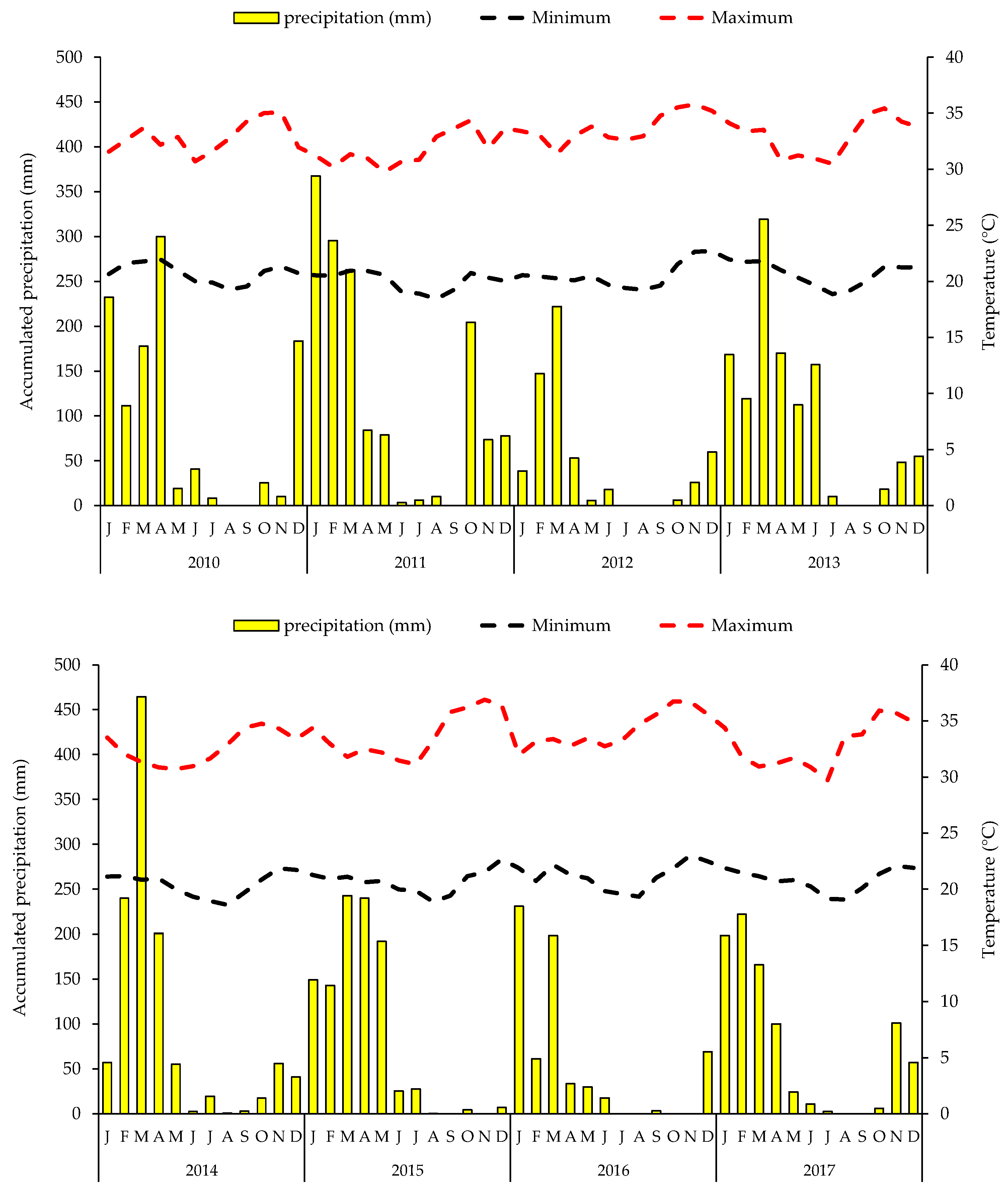
According to the Köppen–Geiger classification, the tropical regional climate is Aw with a dry season in winter and rains concentrated in the summer. During the experimental period, maximum temperature ranged from 31 to 35 °C, and minimum temperature varied from 19 to 21 °C. Annual precipitation averaged 1006 mm [36]. Consecutive precipitation peaks occurred in 2010–2011 and 2013–2014. Meteorological data are presented in Figure 1. While minimum and maximum temperature varied little across years, irrigation was required to stabilize yield across seasons.
Management of clumps or families corresponding to mother and daughter plants is maintained across generations. On average, one bunch per plant is expected to be harvested each year. The production cycle can shorten or lengthen depending on climate, tree spacing, and nutrient management. Fruits are harvested every week, but the number of harvested bunches varies over time. In the northeast, the first semester (January to June) is the rainy season, and the second one (July to December) is the dry season (Figure 1). Even with irrigation, differences in semestral production levels are still noticeable.
Plants were fertigated weekly [37]. The nitrogen (N) fertilization, supplied mainly as urea (45% N) and complemented by monoammonium phosphate (11% N), ranged from 440 to 600 kg N ha−1 year−1. Potassium (K) was supplied as potassium chloride (60% K2O) at rates ranging from 1100 to 1700 kg K2O ha−1 year−1. Phosphate (P) was applied at planting as reactive natural phosphate (27% P2O5) followed by fertigation with monoammonium phosphate (48% P2O5) for total rate of 160 kg P2O5 ha−1 year−1. Micronutrients were supplied entirely via fertigation as follows: manganese sulfate fertilizer (26% Mn) applied at a rate of 60 kg ha−1 year−1, zinc sulfate fertilizer (20% Zn) applied at a rate of 96 kg ha−1 year−1, and boric acid fertilizer (17% B) applied at rates of 20 to 30 kg ha−1 year−1.

2.2. Soil and Tissue Analyses

Soil and leaves were collected twice a year from 2010 to 2017 in June and December, totaling 129 observations. The soil was sampled in the 0–20 cm layer, air-dried, ground, and analyzed [38]. The pH was measured in the volumetric soil/water ratio of 1:2.5. Soil P and K were extracted using the Mehlich-1 method. Soil Ca, Mg, and Al were extracted using 1 N KCl. Potential acidity (H + Al) was extracted using 0.5 M calcium acetate at pH 7.0. Elements were quantified by inductively coupled plasma optical emission spectroscopy. While soil test values varied widely in the orchard, precision fertigation offers the possibility to adjust nutrient supply spatially.
Cation exchange capacity (CEC) was calculated as the sum of the exchangeable cations (K, Ca, Mg) and potential acidity. Total carbon as determined by Walkley–Black oxidation was multiplied by 1.724 to obtain soil organic matter content. Soil test results are presented in Table 1. The sum of mean values of cationic species differed from the mean sum of cations due to non-normal distributions of cationic species, impacting mean CEC and base saturation.
The 3rd leaf from the plant apex was sampled, removing 10 to 15 cm of the inner median part of the leaf blade and discarding the central vein [39]. Tissues were dried at 60 °C, ground to less than 1 mm and analyzed for nitrogen (N), phosphorus (P), potassium (K), calcium (Ca), magnesium (Mg), sulfur (S), boron (B), copper (Cu), iron (Fe), manganese (Mn), zinc (Zn), sodium (Na), and aluminum (Al) [38].

2.3. CND Standards

The sample space S d of tissue composition was defined as follows [33]:
S d = N , P , R d :   N > 0 , P > 0 , K > 0 , x D > 0 ,   N + P + K + + x D = 10 3   g k g 1
where c i is concentration of the ith nutrient and x D is a filling value representing unquantified elements and computed by difference as follows:
x D = 10 3 i = 1 d c i
The centered log ratio for component i ( c l r i ) was computed as follows:
c l r i = l n x i / G
G = N × P × K × × x D   1 D
where G is the geometric mean across components and D is total number of components. The sum of the c l r i values is zero due to symmetry about G. The c l r i is the average across the D dual log ratios [40], as follows for N:
l n N G = l n N N × N P × N K × N C a × N M g × N S × N B × N C u × N Z n × N M n × N F e × × N x D 1 D = 1 D l n N N + l n N P + + l n N x D
The clr, computed as an average across dual log ratios, does not account for the importance of each dual ratio regarding the target variable. Each dual log ratio was thus weighted by its gain ratio φ j to compute the weighted log ratio (wlr) as follows:
w l r x i = 1 D j = 1 D φ j l n x i x j ,   i j  
where x i and x j are components. The gain ratio in a machine learning classification is a metric indicating the efficiency of a dual log ratio in partitioning yields in the database about the selected cutoff value [27]. The gain ratio is thus agronomically meaningful for the database under study. If all φ j = 1 , w l r x i = c l r x i . Because 1 D is common to all w l r x i variables, 1 D can be removed without affecting the results of statistical analysis. To compute wlr, nutrient x i is maintained as the numerator across dual log ratios. If x i is the denominator in the dual log ratio expression, it is moved to the numerator by multiplying the dlr by −1, i.e., l n x j x i = l n x i x j .
Nutrient indices for clr and wlr were computed as follows for c l r x i [33]:
I n d e x   c l r x i   =   c l r x i c l r x i * s c l r x i *
where c l r i refers to the diagnosed specimen and the asterisk indicates the corresponding means and standard deviations for a high-yielding and nutritionally balanced subpopulation. The sum of clr and wlr variables is zero in conformity with the concept of nutrient balance.
The clr variables have Euclidian geometry [32] as does the wlr variable. The Euclidian distance ( ε ) is computed between two equal-length D-part compositions [32], as follows for clr:
ε = i D c l r i c l r i * 2
where the asterisk indicates the reference specimen. The Euclidian distance is useful to compare a deficient to a compositionally close-performing specimen located in an otherwise similar environment in the orchard. Nutrient indices computed as ( c l r i c l r i * ) can be displayed in a histogram to illustrate relative nutrient shortage, sufficiency, or excess.

2.4. Mahalanobis Distance

Isometric log ratios are orthonormal variables arranged as ‘balances’ among groups of components. There are D-1 ilrs, i.e., the exact number of degrees of freedom available in a composition [41]. The ilr avoids computing singular matrices. The i l r i is a log ratio expression that contrasts pre-defined groups of components as follows [42]:
i l r i = r s r + s l n g r g s
where r is the number of components in subset r, s is the number of components in subset s, g r is the geometric mean across components in subset r, and g s is the geometric mean across components in subset s. The ilr can be conceptualized in a simplified SBP contrasting any component with the remainder (Table 2).
The Mahalanobis distance ( M ) is a metric measuring the distance between a composition and the centroid of a distribution. Using ilr variables, M is computed as follows:
M = i l r i i l r i * T C O V 1 i l r i i l r i *
where i l r i is the ith ilr, i l r i * is the centroid of the reference population (the ilr means of the high-yielding and nutritionally balanced subpopulation), C O V 1 is the inverse covariance matrix of the reference population, and T indicates a transposed matrix. Because orthogonal variables may be correlated to each other, the covariance matrix is required to provide a statistically robust test [43]. The M 2 is distributed like a χ D 1 2 variable and can thus be tested statistically. The significance level is selected by stakeholders, not necessarily the 0.05 or the 0.01 levels [44]. Nutrient indices are t-tests as Mahalanobis distances for single components weighted by their variance.

2.5. Statistical Analysis

Descriptive statistics were computed as mean, maximum and minimum values, standard deviation, and coefficient of variation. As a normality test, data distribution was classified as symmetrical where skewness was between −0.5 and +0.5, while skewness was high if less than −1 or greater than +1 [45]. Relationships among components were visualized as biplots using Codapack vs. 2.03.01. A two-dimensional loadings plot was drawn using D-1 clr variables (excluding the filling value) to illustrate the size and direction of the relationships among nutrients.
Non-parametric ML classification models set apart the subpopulation of nutritionally balanced and imbalanced specimens in a confusion matrix. Random forest is the classical ML model. Gradient boosting combines weak learners into a stronger learner by minimizing the loss function. The hyperparameters were those suggested by the software. For random forest, there were ten trees and at least five subsets per split. For XGBoost, hyperparameters were 100 trees, with a learning rate of 0.300, replicable training, six individual trees as limit depth, 1.00 as fractions of training instances, features for each tree, features for each level, and features for each split.
Cross-validation is a procedure that averages the splits of mutually exclusive subsets (folds). Classification ML models were run using the Orange Data Mining freeware (University of Ljubljana, Slovenia). The target variable was fruit yield. Yield was reported as the sum of harvests per plot from January to June (rainy season), and from July to December (dry season), respectively, and converted into kg ha−1 semester−1.
Yield cutoff can be selected by stakeholders or derived statistically using variance ratios [29], a cumulative variance ratio function [46] or a subpopulation of nutritionally balanced and high-yielding specimens set apart in a confusion matrix [47]. To derive yield cutoff, the cumulative variance ratio function of clr variables was computed [46] after removing outliers [48].
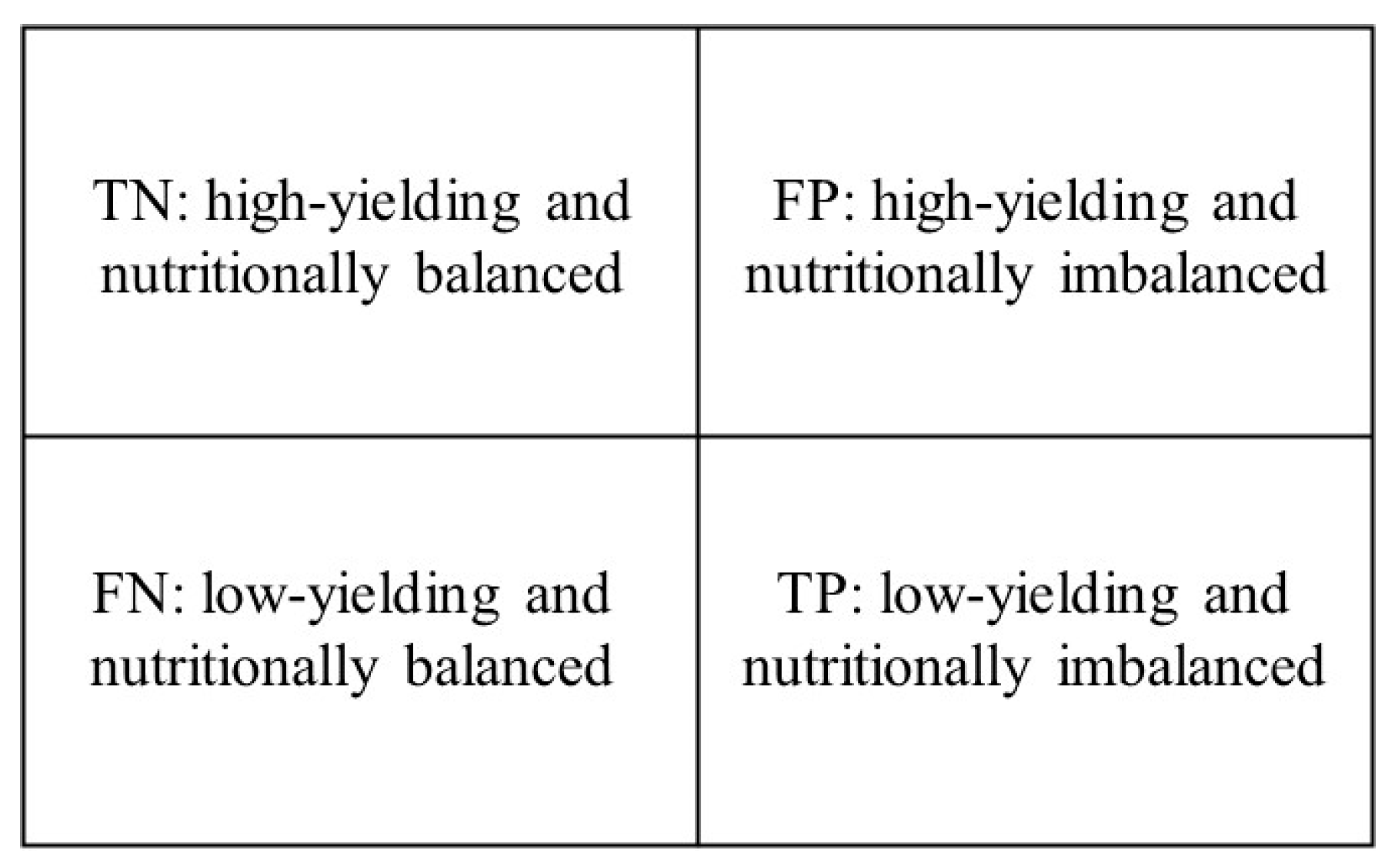
The data were stratified to avoid model overfitting by resampling the same category (year and semester) to avoid model overfitting. Soil and tissue compositional variables were analyzed statistically as raw, clr- or wlr-transformed data. The ML classification models classified specimens into four categories in a confusion matrix [47] as follows (Figure 2):
  • True negative quadrant (TN): high-performing and nutritionally balanced specimens (upper left quadrant), likely no response to correcting measures.
  • False negative quadrant (FN): low-performing but nutritionally balanced specimens (lower left quadrant), search needed to identify a limiting variable not documented in the database.
  • False positive quadrant (FP): high-performing but nutritionally imbalanced specimens (upper right quadrant), requiring adjusting at least one variable out of target but not limiting crop performance.
  • True positive quadrant (TP): low-performing and nutritionally imbalanced specimens (lower right quadrant), correct at least for one variable limiting crop performance.
Model accuracy is computed as follows:
A c c u r a c y = T N + T P T N + T P + F N + F P
The area under curve (AUC) separates signals from noise in binary classification models. Separation is null if AUC = 0.5, little informative if AUC is between 0.5 and 0.7, moderately informative if AUC is between 0.7 and 0.9, very informative if AUC is >0.9, and perfect if AUC = 1 [49].
Proximate concentration ranges were computed as the means and standard deviations of nutrient concentrations in the high-yielding and nutritionally balanced subpopulation set apart in a confusion matrix by the machine learning (ML) classification model [50]. Five classes of nutrient status were suggested as a distance from the centroid of the high-yielding and nutritionally balanced subpopulation as follows [51]: shortage < centroid −4/3sd; trend toward shortage = centroid −4/3sd to centroid −2/3sd; sufficiency = centroid −2/3sd to centroid +2/3sd; trend toward excess = centroid +2/3sd to centroid +4/3sd; excess > centroid +4/3sd.

3. Results

3.1. Seasonal Variations in Banana Yields

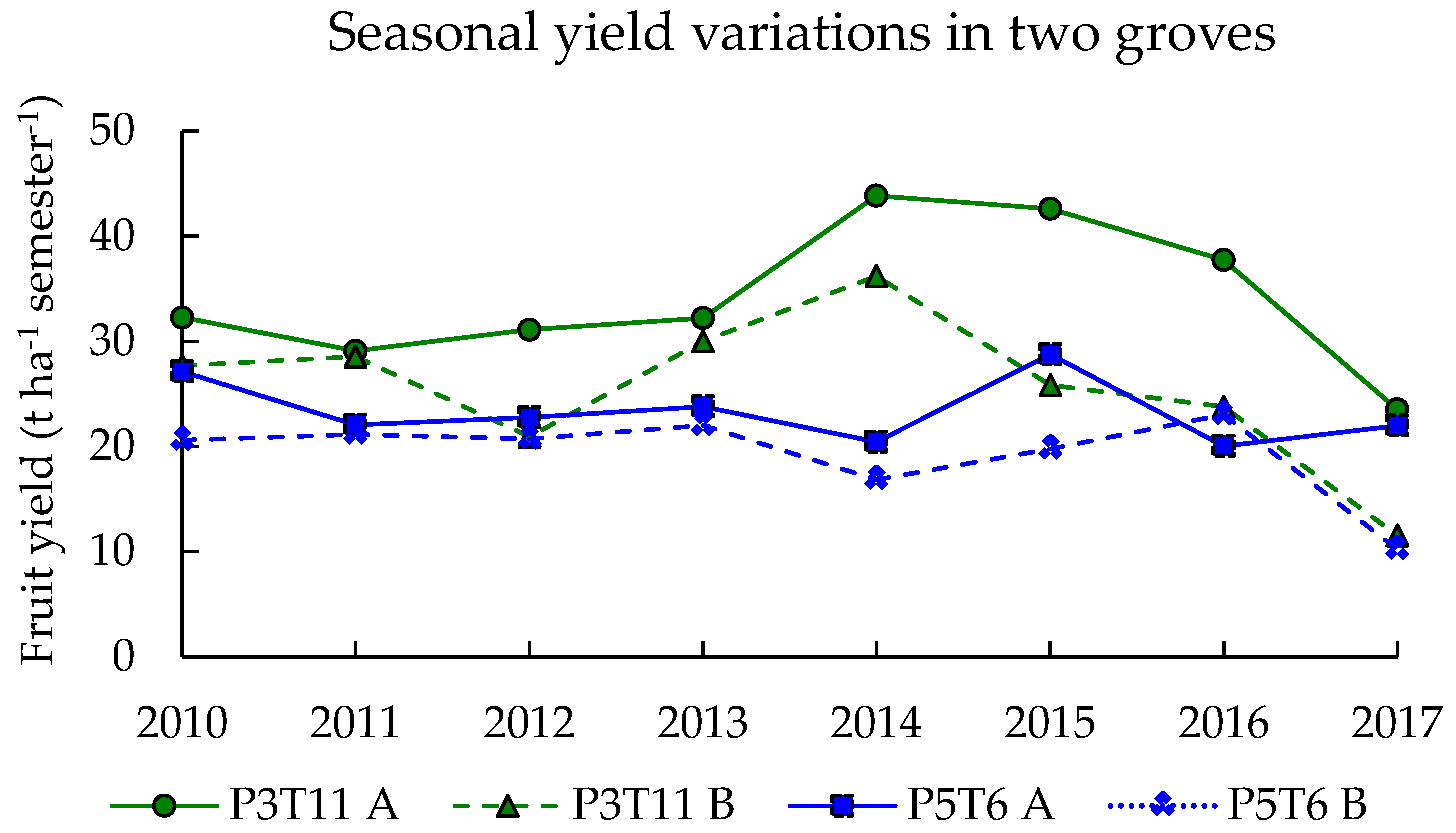
The patterns of yield variations were grove- and season-specific (Figure 3). Yields were higher during the rainy season (Figure 1). Fertigation and irrigation did not totally offset the negative effects of the dry season, especially in 2017, which was preceded by a dry year in 2016. During the 2010 to 2016 period, yields were closer between dry and rainy seasons in the less productive grove compared to the more productive one, indicating site-specific constraints. Because nutrient standards are derived from a high-yield and nutritionally balanced subpopulation, nutrient diagnosis may not improve crop productivity substantially unless other stresses have been relieved.

3.2. Yield Cutoff

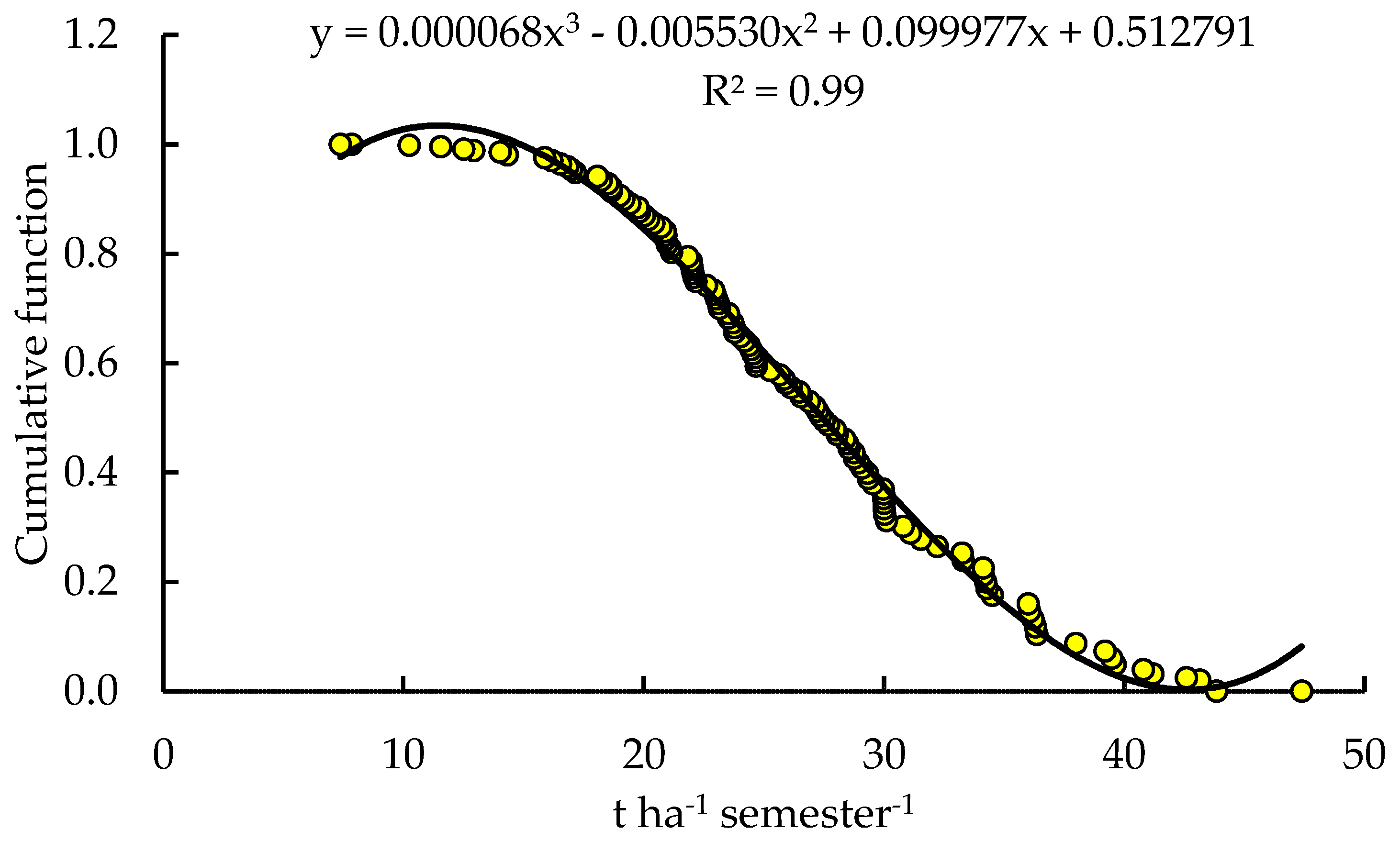
Yield averaged 52.0 ± 11.9 t ha−1 year−1, 29.4 ± 6.5 t ha−1 year−1 during the first semester (rainy season), and 22.8 ± 7.3 t ha−1 year−1 during the second semester (dry season). Yield cutoff was determined using a cumulative variance ratio function after excluding 11 outliers. Yield at the inflection point of the cubic curve was 27.1 t ha−1 semester−1 (Figure 4). There were 50 high-yielding specimens averaging 33.0 t ha−1 semester−1.

3.3. Gain Ratios

The Na/Mn dual log ratio showed the highest gain ratio (0.050) at a yield cutoff of 27 t ha−1 semester−1 (Appendix A Table A1). Gain ratios for Cu/Fe, K/Mn, Fe/Mn, B/Mn, Mn/xD, S/Mn, Ca/Mn, N/Mn, N/Na, Ca/Fe, Mg/Mn, Mn/Al, Mn/Zn, B/Cu, Mg/xD, Cu/Mn, Ca/S, Ca/Zn, Ca/Al, Na/xD, and P/Na varied between 0.035 and 0.020, while others were lower down to 0.000 for K/S, indicating the agronomically variable importance of dual ratios for the banana database at the selected yield cutoff. The gain ratios were intermediate for N/K and N/P, and small for K/Ca and K/Mg.

3.4. Machine Learning Models

Machine learning classification models set apart the nutritionally balanced and high-yielding subpopulation concerning yield cutoff. Gradient boosting (XGBoost) was more accurate than random forest. Results for XGBoost are presented in Table 3. Raw concentrations showed the lowest AUC and accuracy. Models showed areas under curve averaging 0.715 and were moderately informative. There were 34–35 TN specimens across nutrient expressions to compute nutrient standards, excluding 22–23 high-yielding but nutritionally imbalanced FP specimens.
The means and standard deviations of nutrient expressions for the high-yielding and nutritionally balanced subpopulation are presented in Table 4. As shown by foliar concentrations, K and N were the most required. There was evidence of distortion in the statistical analysis of raw concentrations. While the measurement unit was 1000 g kg−1, the sum of the means of raw components was 1280 g kg−1. In contrast, the unbiased clr and wlr means added up to zero due to symmetry about geometric means.
The TN and TP subpopulations were compared statistically across nutrient expressions (Table 4). There were significant differences in raw concentration values between the means of TN and TP subpopulations: concentrations were too low for P and too high for Na and Al in TP specimens. The clr values that considered interactions among elements showed that Cu and Mn levels were significantly too low and B and Na levels were significantly too high in TP specimens. The wlr values impacted even more the difference between TN and TP specimens: the K, Ca, S, B, Fe, and Na levels were too high, while the Mn level was too low in TP specimens. Differences were highly significant for Mn and Na across nutrient expressions.

3.5. Nutrient Diagnosis of a TP Specimen

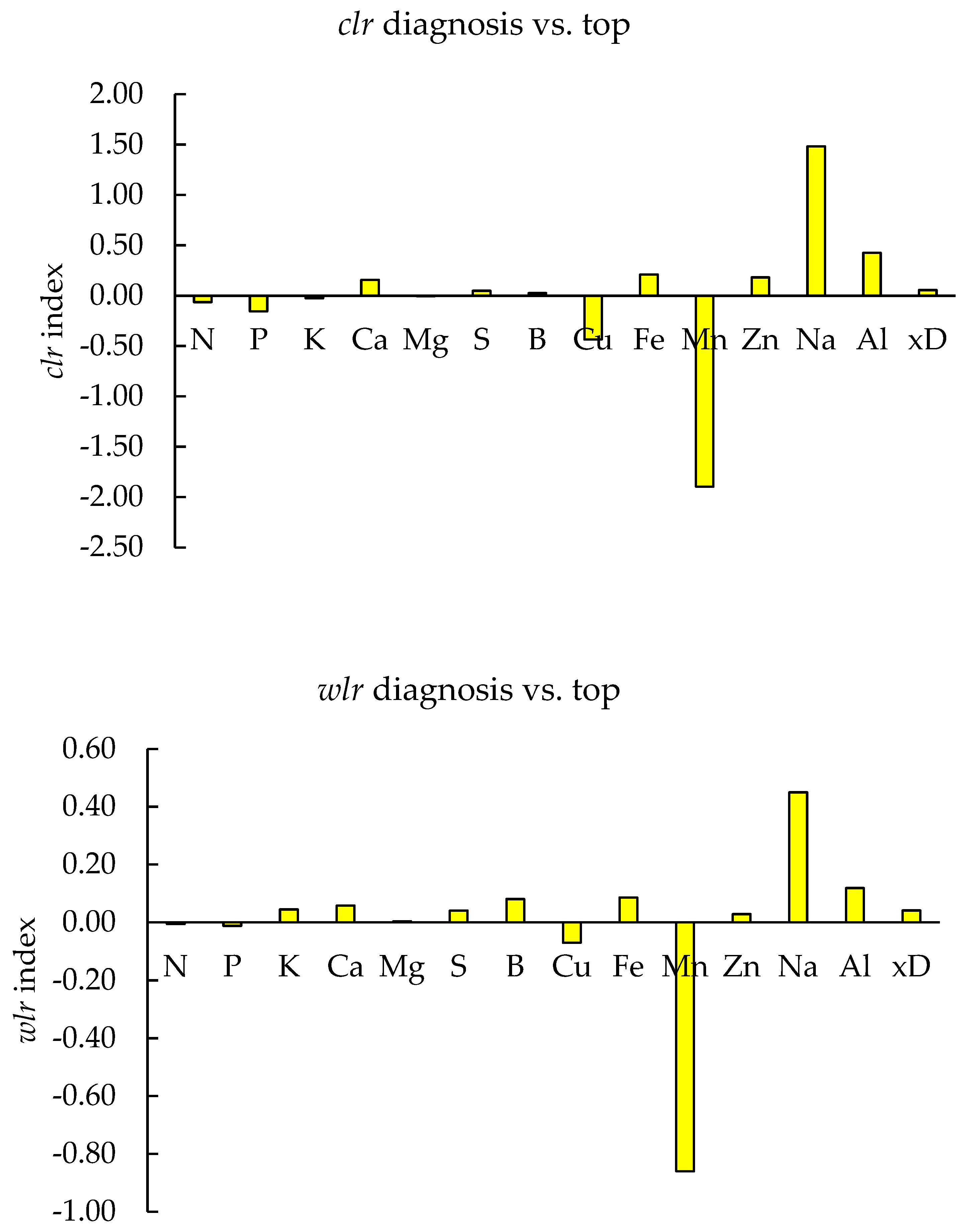
A low-yielding grove (24.2 t ha−1) was compared to a productive and nutritionally balanced and compositionally close grove (43.9 t ha−1). The Euclidean distance was 2.5. Nutrient indices were displayed on a histogram (Figure 5). The clr and wlr diagnoses showed a similar distribution of nutrient indices. Mn and Na were the most imbalanced nutrients. Tissue Mn should apparently be increased and tissue Na abated. A statistical check was also conducted using the Mahalanobis distance and clr and wlr indices.
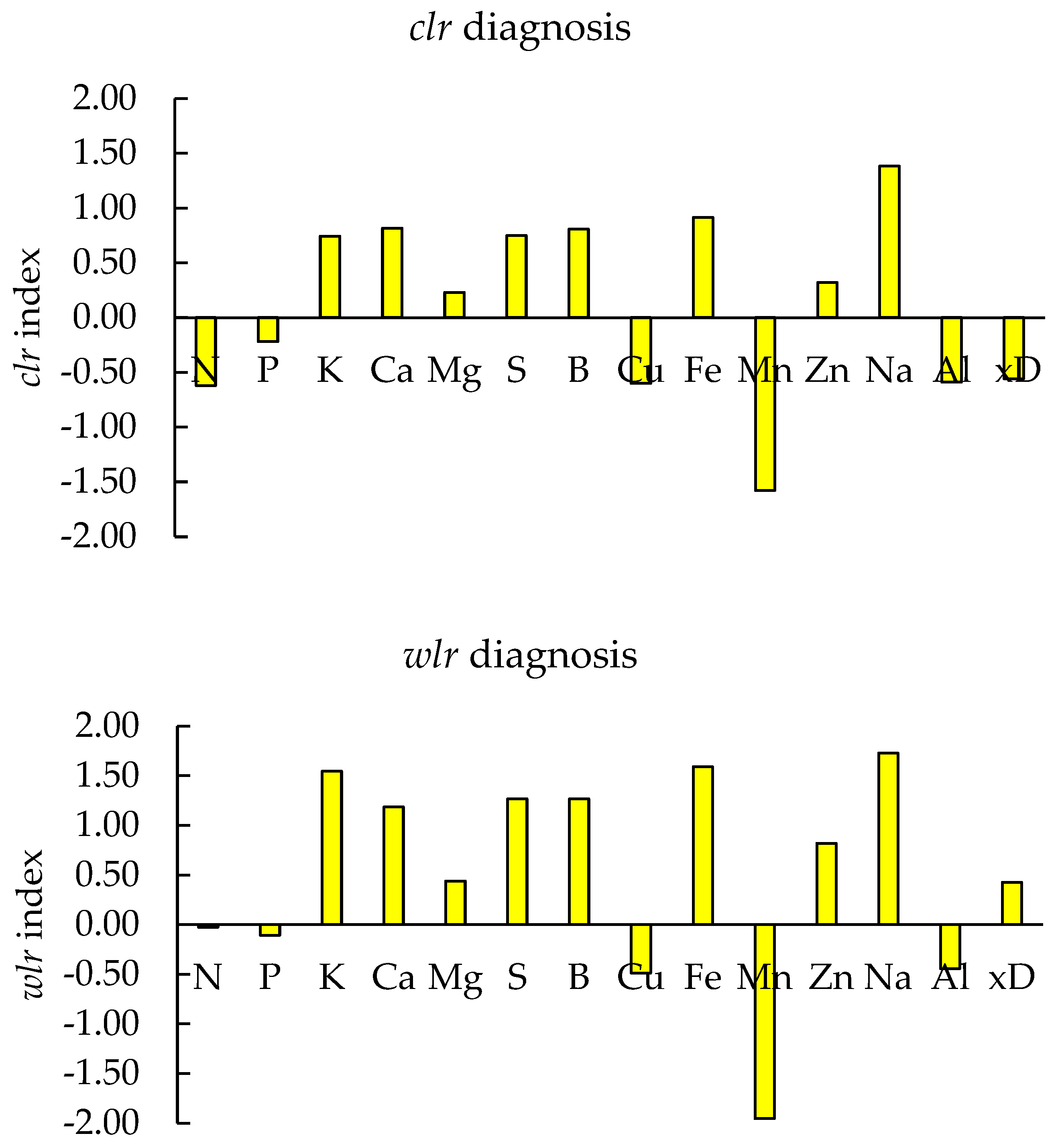
At the population level, the TP specimen was compared to the distribution of nutritionally balanced and high-yielding subpopulation. The means and covariance matrix of ilr-transformed composition of the nutritionally balanced and high-yielding specimen (TN) and the ilr-transformed composition of the nutritionally imbalanced and tissue composition of the low-yielding specimen (TP) are presented in Table 5. The M 2 was 37.6 (p < 0.01). Nutrient indices were thus statistically reliable. The clr and wlr diagnoses (Figure 6) were like the nutrient indices presented in Figure 5. Compared to clr, the wlr diagnosis showed differences in Mn and Na status significant at the 0.10 level, indicating a more sensitive diagnosis after considering the gain ratios associated with each dlr. The Mn and Na were the most imbalanced elements. The Mn was in relative shortage and Na in relative excess. Other elements except N, P, Cu, and Al showed some relative excess compared to the centroid of the high-yielding and nutritionally balanced subpopulation.
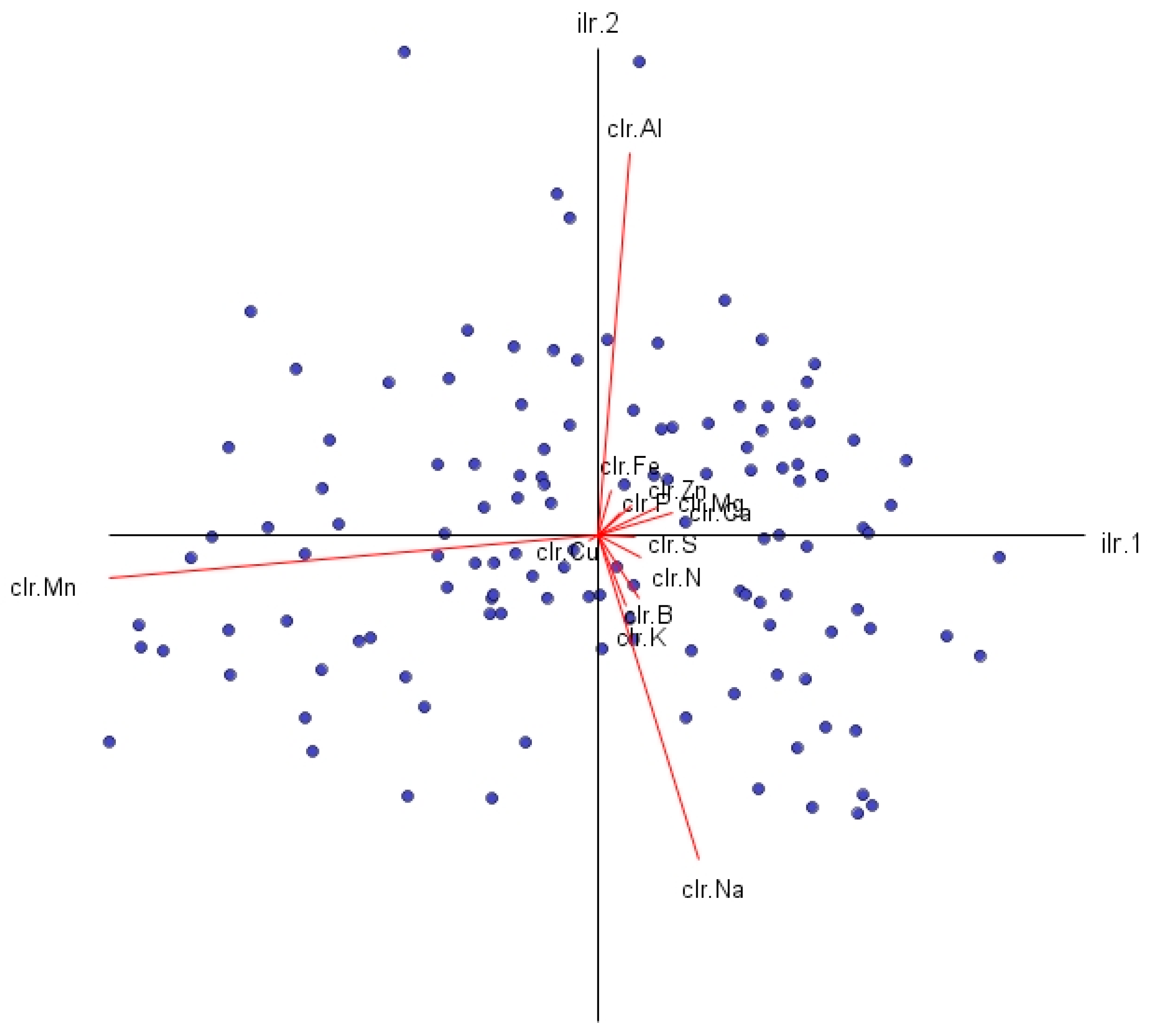
Results presented in Figure 5 and Figure 6 are supported by relationships shown in the biplot (Figure 7). The Mn, Na, and Al loaded the most. Al and Na showed opposite directions on the ilr.2 axis. Na is an indicator of soil alkalinity, while Al reflects some acidification in the rhizosphere. Mn loaded in a different direction along axis ilr.1 where it surpassed all other nutrients. However, the nutrient imbalance specific to the TP specimen involved primarily Mn and Na.

3.6. Proximate Sufficiency Ranges

Sufficiency ranges (Table 6) were computed as raw concentration means and standard deviations of the nutritionally balanced and high-yielding specimens (Table 4). Sufficiency ranges were wide for Mn (39.4–158.0 mg kg−1 for Mn) and narrower for Na (28.4–57.1 mg kg−1 for Na).
Compared to clr and wlr, which diagnosed Mn shortage and Na excess in the TP specimen, the sufficiency range diagnosis (SRD) indicated Mn sufficiency and Na excess. Indeed, the distribution of tissue Mn concentrations in the TN subpopulation was highly skewed (1.27), indicating non-normal distribution of tissue Mn concentrations compared to clr Mn (−0.39). In contrast, the distribution of Na concentrations in the TN subpopulation was moderately skewed (0.92) compared to clr Na that showed symmetrical distribution (0.49). While SRD disagreed with the clr and wlr for Mn diagnosis, it agreed for Na.

4. Discussion

4.1. Nutrient Interactions

Ninety-one dual log ratios were computed to derive wlr variables. In comparison, 117 interactions have been reported between macro- and micronutrients for different agricultural crops [52]. In the database under study, Mn and Na were associated with the highest gain ratios. Plant-specific interactions have been documented physiologically between Mn and P, B, Ca, Mg, Zn, Fe, and Al [53,54,55,56] and between Na and K [57]. The importance of each dual log ratio can vary widely depending on the nutrient network or ‘ionome’ [58] in the database documented by stakeholders and the selected yield cutoff.

4.2. Mn Shortage and Na Excess

Soil organic matter and available nutrients are soil-quality attributes [59]. Soil organic matter content was highly variable in the orchard, indicating a wide variation in soil quality. Soil pH varied widely between 6.5 and 7.8. Neutral to slightly alkaline pH aims to decrease the severity of the root Panama disease in banana roots but impacts nutrient availability in the soil [13]. Mn availability is limited in soils subject to over-liming, especially in weakly buffered coarse-textured Quartzipsamments [60]. Exchangeable forms of Mn occur at pH less than 5.0 but are redistributed among less available organic and oxide fractions as pH increases above 5.8 [61]. On the other hand, the intensive cropping of bananas can decrease the soil acid-buffering capacity in the rhizosphere via ammonia-oxidizing bacteria [9]. The negative relationship between Al and Na in the biplot (Figure 7) apparently indicated an opposition between acidification and alkalinization. Urea hydrolyzed into ammonia likely acidified the rhizosphere in the application zone, impacting Al availability in microsites.
Excess Na is generally attributed to salinity buildup in the soil. Salts can accumulate unequally in the orchard due to natural phenomena and the even fertilization of groves despite spatially uneven yields. The cause of groundwater salinization in the semiarid regions of Bahia state, south of Ceará and at comparable altitude and distance from the seashore, was attributed to local geology and salt concentration due to evaporation rather than to sea sprays [62]. In Juazeiro, Bahia, average rainfall was 800 mm during seven to nine months, including long periods of drought, compared to 1006 mm for Missão Velha, Ceará. Na salts can be partly leached during heavy rainfall. As anticipated by the balance concept, correcting the Mn shortage could increase yield and dilute tissue Na. Mn shortage can be corrected by combining foliar fungicides and fertilizer sprays [63].

4.3. Customized Nutrient Standards

Nutrient variability measured by the coefficient of variation (CV) was greater for micro- than macro-nutrients in the orchard under study, as also reported in India [64] and Equator [65]. In Brazil, the main banana production areas showed wide variations of nutrient concentrations in soils and foliar tissues due in part to heavy or variable applications of fertilizers [7,8,66,67]. New nutrient standards should thus be developed as cultivar and orchard management change and yield potential increases [7,68]. Moreover, nutrient standards developed at the orchard scale are unprecedented because present state fertilization guidelines do not provide state-wide tissue standards to interpret banana tissue tests [15].
The semestral orchard productivity averaging 33 t ha−1 semester−1 across high-yielders was much higher than the Brazilian average of 15 t ha−1 year−1 [2]. K deficiency is generally the most limiting nutrient in Brazil [66,67]. However, K and N did not appear to limit banana yield in the orchard under study. Using customized nutrient standards to test nutrient balance in a low-yielding grove, nutrient expressions reached different conclusions. The SRD diagnosis is interpreted as shortage, sufficiency, and excess rather than physiologically verified deficiency, transition zone, adequacy, luxury consumption, excess, or toxicity [69,70]. Log ratio diagnoses are interpreted in relative terms. The log ratio diagnoses disagreed with SRD on Mn status.
The Mn paradox is due to the noisy and non-normally distributed raw concentration values compared to the Mn clr values. The high coefficient of variation of tissue Mn concentration is impacted both by nutrient interactions and the skewed distribution of Mn concentration values. Indeed, Mn is one of the most variable nutrients in the foliar tissues of fruit trees, making Mn concentration very difficult to interpret [71]. Mn availability is related to soil pH [70] and to a plant’s own ability to accumulate large amounts of Mn [64]. Adding Mn may rebalance tissue composition through interactions with other nutrients, and the dilution of nutrients present in relative excess as biomass production increases. Nevertheless, agronomic Mn fertilization trials should be conducted to validate the effect of Mn additions on tissue Mn status, nutrient rebalancing, and crop yield.
Stakeholders did not anticipate that Na could be a potential yield-limiting element in the soil of the orchard under study. Tissue Na may reach excessive levels in banana tissues where the electrical conductivity (EC) of irrigation water exceeds 1.1 dS m−1 [37]. Tissue Na diagnosis should be cross-checked for the quality of irrigation water and by soil salinity tests especially in low landscape positions that promote salt accumulation. Soil lixiviation may be needed as a local correcting measure to abate soil Na.

4.4. Universality of Nutrient Standards

Nutrient standards specific to the orchard under study differed from CND standards for the Cavendish subgroup in Santa Catarina state, southern Brazil [72], and for the cultivars Robusta and Ney Poovan in India [64], using the same CND methodology. There were also differences between nutrient sufficiency ranges for ‘Nanica’ in northeastern Brazil, measured in the present study, and for ‘Nanica’ using the DRIS methodology in São Paulo state [73] and for ‘Cavendish’ using the CND methodology in Santa Catarina state [72]. Nutrient standards thus depend on region, management, and cultivar and are not universal. Nutrient standards should be regionalized [51,74,75] because site-specific nutrient standards depend on unique combinations of cultivar, technological level, management, soil, and climate [73,76], avoiding the heroic ceteris paribus assumption behind ‘universal’ nutrient standards. The clr and wlr nutrient standards were site-specific, supporting precision farming.

4.5. Multivariate Distances

Plants are nutritionally more balanced and high-yielding as the multivariate distance between diagnosed and reference compositions approaches zero. Although higher multivariate distances are generally associated with nutritionally imbalanced and low-yielding crops as shown for banana [77] and other fruit crops [51], the relationship may also be weak due to yield-limiting factors other than nutrients [65,73]. The FN subpopulation indicates that factors other than nutrients must limit yield. The FP subpopulation indicates luxury consumption of nutrients or suboptimal concentrations. Tissue composition of a TP specimen could be compared one to one to a compositionally close TN specimen growing in otherwise similar conditions. The Euclidean distance between two compositions and nutrient indices showed the pattern of nutrient imbalance. The significance of the difference between two equal-length compositions can be further tested statistically using the Mahalanobis distance across ilr-transformed data and clr or wlr indices.

4.6. Nutrient Sufficiency Ranges Are Intrinsically Distorted

Sufficiency ranges are risky to elaborate using a small dataset and statistically distorted raw compositions. The SRD and CND could disagree due to the noise injected by nutrient interactions and the non-normal data distribution in SRD. This is why log ratio transformations were found to be more appropriate than raw concentration values to process compositional data [32] like tissue data.

4.7. Decision-Making Flowchart

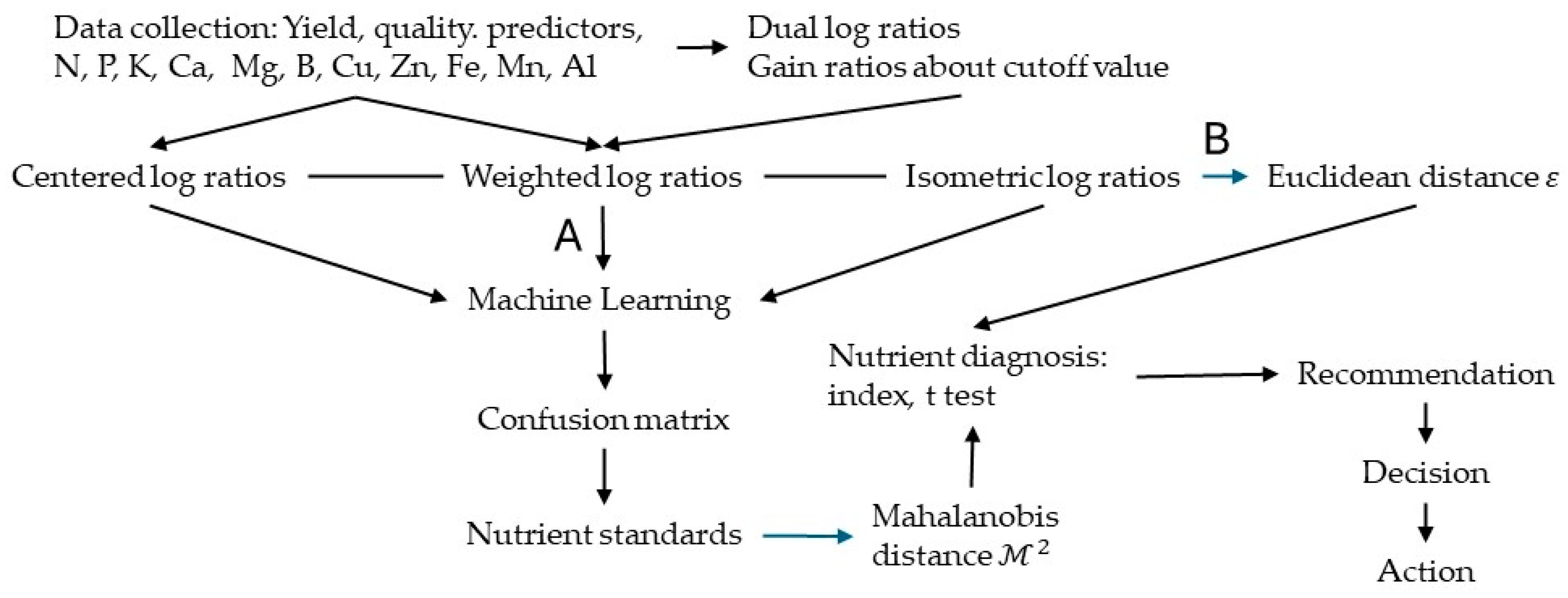
A flowchart for a fertilization decision is summarized in Figure 8. Path A requires that a well-documented database allows computing nutrient standards. When Path B is followed, two equal-length compositions are compared using the Euclidean distance between a defective composition and a benchmark composition under otherwise similar environmental conditions. The ML model integrates the explanatory variables assembled in a database by stakeholders to predict yield.
The diagnosis identifies the most limiting nutrients. The recommendation selects limiting nutrients that must be addressed as a priority by fertilization and other means, given that a change in any nutrient level must impact the level of others. Adding nutrients in relative shortage to stimulate plant growth may correct nutrients in relative excess through dilution. The decision to fertilize includes nutrient source, dosage, placement, timing and associated risks, and the practices required to correct the problem identified by stakeholders. Actions are taken using the appropriate technologies.

5. Conclusions

Current guidelines to adjust banana fertilization at the orchard scale in northeastern Brazil may not be appropriate at the orchard scale. The compositional nutrient diagnosis (CND) method made it possible to elaborate nutrient standards for ‘Nanica’ banana down to the grove scale using a small dataset collected by stakeholders. Log ratio diagnoses such as clr and wlr showed relative Mn shortage and Na excess in a low-yielding grove significantly imbalanced in the orchard under study. Concentration ranges for Mn were large due to skewed data distribution and noisy nutrient interactions that inflated the variance of concentration values. Nutrient diagnosis using clr or wlr transformations should thus guide any diagnosis using concentration ranges familiar to stakeholders to avoid misinterpreting SRD.
A multivariate distance can be computed as the difference between two equal-length compositions because log ratios are additive. Compared to the Euclidean distance computed across clr variables, the Mahalanobis distance computed across ilr variables has the additional advantage of providing a statistic ( χ D 1 2 ) supporting fertilization decisions based on nutrient indices. The correction of any one nutrient through fertilization or another profitable measure may impact other nutrients by rebalancing the whole tissue system.

Author Contributions

Conceptualization, A.J.d.L.N., J.A.L.d.D., D.E.R., M.C.d.M.C., W.N. and L.E.P.; methodology, A.J.d.L.N. and L.E.P.; software, E.P. and L.E.P.; validation, A.J.d.L.N., D.E.R., W.N., E.P. and L.E.P.; formal analysis, J.A.L.d.D. and M.C.d.M.C.; investigation, J.A.L.d.D. and M.C.d.M.C.; resources, A.J.d.L.N. and W.N.; data curation, A.J.d.L.N., J.A.L.d.D. and M.C.d.M.C.; writing—original draft preparation, A.J.d.L.N. and L.E.P.; writing—review and editing, A.J.d.L.N., D.E.R., W.N., E.P. and L.E.P.; visualization, J.A.L.d.D. and M.C.d.M.C.; supervision, W.N.; project administration, A.J.d.L.N. and W.N.; funding acquisition, A.J.d.L.N. and W.N. All authors have read and agreed to the published version of the manuscript.

Funding

This research was funded by Conselho Nacional de Desenvolvimento Científico e Tecnológico (CNPq), grant number 155610/2018–0.

Data Availability Statement

The original contributions presented in the study are included in the article, further inquiries can be directed to the corresponding author.

Acknowledgments

Authors are thankful to the Sítio Barreiras Fruticultura Ltda. for all the field assistance and research support.

Conflicts of Interest

Author William Natale was employed by the company Brazilian Agricultural Research Corporation (Embrapa-Agroindustry Tropical). The remaining authors declare that the research was conducted in the absence of any commercial or financial relationships that could be construed as a potential conflict of interest.

Abbreviations

The following abbreviations are used in this manuscript:
clrCentered log ratio
dlrDual log ratio
wlrWeighted log ratio
ilrIsometric log ratio
MLMachine learning
TNTrue negative
FNFalse negative
FPFalse positive
TPTrue positive
DRISDiagnosis and recommendation integrated
CNDCompositional nutrient diagnosis

Appendix A

Table A1. Gain ratios associated with the 91 nutrient log ratios in banana ‘Nanica’ foliar tissues at yield cutoff set at 27 t ha−1 semester−1.
Log RatioGain RatioLog RatioGain RatioLog RatioGain RatioLog RatioGain Ratio
N/P0.012P/Al0.012Ca/Mg0.022S/xD0.003
N/K0.011P/xD0.016Ca/S0.012B/Cu0.023
N/Na0.025K/Na0.010Ca/B0.014B/Fe0.006
N/Ca0.004K/Ca0.007Ca/Cu0.012B/Mn0.041
N/Mg0.001K/Mg0.003Ca/Fe0.024B/Zn0.006
N/S0.016K/S0.000Ca/Mn0.029B/Al0.013
N/B0.015K/B0.014Ca/Zn0.020B/xD0.009
N/Cu0.005K/Cu0.007Ca/Al0.020Cu/Fe0.046
N/Fe0.005K/Fe0.003Ca/xD0.010Cu/Mn0.022
N/Mn0.028K/Mn0.035Mg/S0.008Cu/Zn0.004
N/Zn0.007K/Zn0.005Mg/B0.010Cu/Al0.008
N/Al0.025K/Al0.014Mg/Cu0.003Cu/xD0.010
N/xD0.012K/xD0.004Mg/Fe0.001Fe/Mn0.035
P/K0.010Na/Ca0.013Mg/Mn0.022Fe/Zn0.001
P/Na0.020Na/Mg0.019Mg/Zn0.003Fe/Al0.019
P/Ca0.018Na/S0.020Mg/Al0.015Fe/xD0.004
P/Mg0.009Na/B0.005Mg/xD0.022Mn/Zn0.024
P/S0.008Na/Cu0.014S/B0.013Mn/Al0.025
P/B0.029Na/Fe0.019S/Cu0.011Mn/xD0.034
P/Cu0.012Na/Mn0.050S/Fe0.010Zn/Al0.033
P/Fe0.010Na/Zn0.017S/Mn0.034Zn/xD0.004
P/Mn0.028Na/Al0.008S/Zn0.001Al/xD0.010
P/Zn0.003Na/xD0.022S/Al0.010--

References

  1. Coltro, L.; Karaski, T.U. Environmental indicators of banana production in Brazil: Cavendish and Prata varieties. J. Clean. Prod. 2019, 207, 363–378. [Google Scholar] [CrossRef]
  2. FAO. Crops and Livestock Products. Food and Agriculture Organization of the United Nations 2023. Available online: http://www.fao.org/faostat/en/#data/QCL (accessed on 18 March 2025).
  3. Napoleão, G.M.; Jesus, P.R.R.; Leonel, S. Cultivar diversification of banana production in Brazil. Agron. Sci. Biotechnol. 2021, 7, 1–14. [Google Scholar] [CrossRef]
  4. Soto, M. Situación y avances tecnológicos en la producción bananera mundial. Rev. Bras. Frutic. 2011, 33, 13–28. [Google Scholar] [CrossRef]
  5. Maymon, M.; Sela, N.; Shpatz, U.; Galpaz, N.; Freeman, S. The origin and current situation of Fusarium oxysporum f. sp. cubense tropical race 4 in Israel and the Middle East. Sci. Rep. 2020, 10, 1590. [Google Scholar] [CrossRef] [PubMed]
  6. Maseko, K.H.; Regnier, T.; Meiring, B.; Wokadala, O.C.; Anyasi, T.A. Musa species variation, production, and the application of its processed flour: A review. Sci. Hortic. 2024, 325, 112688. [Google Scholar] [CrossRef]
  7. Deus, J.A.L.; Neves, J.C.L.; Corrêa, M.C.M.; Parent, S.-É.; Natale, W.; Parent, L.E. Balance design for robust foliar nutrient diagnosis supervising the fertigation of banana “Prata” (Musa spp.). Sci. Rep. 2018, 8, 15040. [Google Scholar] [CrossRef]
  8. Guimarães, G.G.F.; Deus, J.A.L. Diagnosis of soil fertility and banana crop nutrition in the State of Santa Catarina. Rev. Bras. Frutic. 2021, 43, e-124. [Google Scholar] [CrossRef]
  9. Fan, P.; Xing, B.; Wu, X.; Chen, Y.; Chen, S.; Ruan, Y. Intensive monocropping of bananas decreases the soil acid buffering capacity via ammonia-oxidizing bacteria. Chem. Biol. Technol. Agric. 2024, 11, 179. [Google Scholar] [CrossRef]
  10. Matos, A.P.; Matias, S.S.R.; Nóbrega, J.C.A.; Nunes, T.P.M. Spatial distribution of soil attributes and macronutrients in banana leaves under the application of limestone. Rev. Ciênc. Agron. 2022, 53, e20207293. [Google Scholar] [CrossRef]
  11. Matos, A.P.; Matias, S.S.R.; Pires, M.F.M.; Costa, R.M.; Oliveira Neto, C.J.; Ferreira, M.V.L.; Batista, R.A. Spatial distribution of nutrients in banana leaves under the effect of liming. Rev. Bras. Eng. Agríc. Ambient. 2025, 29, e293164. [Google Scholar] [CrossRef]
  12. Guimarães, G.G.F.; Beltrame, A.B.; Trevisan, L. Agronomic efficiency of gypsum for soil conditioning and yield in banana plantations. Commun. Soil Sci. Plant Anal. 2025, 56, 1614–1623. [Google Scholar] [CrossRef]
  13. Were, E.; Viljoen, A.; Rasche, F. Back to the roots: Understanding banana below-ground interactions is crucial for effective management of Fusarium wilt. Plant Pathol. 2023, 72, 19–38. [Google Scholar] [CrossRef]
  14. ANDA. Anuário Estatístico do Setor de Fertilizantes 2024; Associação Nacional de Difusão de Adubos: São Paulo, Brazil, 2025. [Google Scholar]
  15. Aquino, A.B.; Aquino, B.F.; Hernandez, F.F.F.; Holanda, F.J.M.; Freire, J.M.; Cristostomo, L.A.; Costa, R.I.; Uchôa, S.C.P.; Fernandes, V.L.B. (Eds.) Recomendações de Adubação e Calagem Para o Estado do Ceará, 1st ed.; UFC: Fortaleza, Brazil, 1993. [Google Scholar]
  16. Deus, J.A.L.; Neves, J.C.L.; Lima Neto, A.J.; Natale, W.; Alvarez, V.V.H.; Albuquerque, F.M.R. Partitioning of macronutrients and nutritional efficiency in fertigated prata banana. Rev. Bras. Frutic. 2020, 42, e-611. [Google Scholar] [CrossRef]
  17. Xavier, F.A.; Pereira, B.L.S.; Souza, E.A.; Borges, A.L.; Coelho, E.F. Irrigation systems, fertigation and mulch: Effects on the physical, chemical and biological attributes of the soil with banana crop in Northeastern Brazil. Commun. Soil Sci. Plant Anal. 2020, 51, 2592–2605. [Google Scholar] [CrossRef]
  18. Oliveira, C.T.; Rozane, D.E.; Pavaron, L.G.F.; Akamine, H.S.; Silva, S.H.M.G.; Lima, J.D. Nutritional demand of ‘Grande Naine’ and ‘Prata Comum’ banana bunches in two growing seasons. Rev. Bras. Frutic. 2022, 44, e430. [Google Scholar] [CrossRef]
  19. Barber, S.A. Soil Nutrient Bioavailability: A Mechanistic Approach; Wiley: New York, NY, USA, 1995. [Google Scholar]
  20. Nye, P.H.; Tinker, P.B. Solute Movement in Soil-Root System; Blackwell Sci. Publisher: Oxford, UK, 1977. [Google Scholar]
  21. Marschner, H. Mineral Nutrition of Higher Plants; Academic Press: London, UK, 1995. [Google Scholar]
  22. Munson, R.D.; Nelson, W.L. Principles and Practices in Plant Analysis. In Soil Testing and Plant Analysis; Westerman, R.L., Ed.; Soil Science Society of America Book Series No. 3; Soil Science Society of America: Madison, WI, USA, 1990; pp. 359–387. [Google Scholar]
  23. Bates, T.E. Factors affecting critical nutrient concentrations in plants and their environment: A review. Soil Sci. 1971, 112, 116–130. [Google Scholar] [CrossRef]
  24. Tolosana-Delgado, R.; van den Boogart, K.G. Linear models with compositions in R. In Compositional Data Analysis: Theory and Applications, 1st ed.; Pawlowsky-Glahn, V., Buccianti, A., Eds.; John Wiley and Sons: New York, NY, USA, 2011; pp. 356–371. [Google Scholar] [CrossRef]
  25. López-Sepulcre, A.; Amaral, J.R.; Gautam, N.; Mohamed, A.; Naik, S. The eco-evolutionary dynamics of stoichiometric homeostasis. Trends Ecol. Evol. 2024, 39, 1111–1118. [Google Scholar] [CrossRef]
  26. Sumner, M.E. Interpretation of nutrient ratios in plant tissue. Commun. Soil Sci. Plant Anal. 1978, 9, 335–345. [Google Scholar] [CrossRef]
  27. Parent, L.E. Compositional and machine learning tools to model plant nutrition: Overview and perspectives. Horticulturae 2025, 11, 161. [Google Scholar] [CrossRef]
  28. Parent, L.E. Networking 13 berry minerals to sustain a high yield of firm cranberry fruits. Horticulturae 2025, 11, 705. [Google Scholar] [CrossRef]
  29. Beaufils, E.R. Diagnosis and recommendation integrated system (DRIS). In Soil Science Bulletin 132; University of Natal: Pietermaritzburg, South Africa, 1973. [Google Scholar]
  30. Steel, R.G.D.; Torrie, J.H. Principles and Procedures of Statistics. A Biometrical Approach; McGraw-Hill: New-York, NY, USA, 1980. [Google Scholar]
  31. Beverly, R.B. Modified DRIS method for simplified nutrient diagnosis of “Valencia” oranges. J. Plant Nutr. 1987, 10, 1401–1408. [Google Scholar] [CrossRef]
  32. Aitchison, J. The Statistical Analysis of Compositional Data; Chapman and Hall: London, UK, 1986. [Google Scholar]
  33. Parent, L.E.; Dafir, M.A. Theoretical Concept of Compositional Nutrient Diagnosis. J. Am. Soc. Hortic. Sci. 1992, 117, 239–242. [Google Scholar] [CrossRef]
  34. Parent, S.É. Why we should use balances and machine learning to diagnose ionomes. Authorea 2020, 10, 1–13. [Google Scholar] [CrossRef]
  35. Santos, H.G.; Jacomine, P.K.T.; Anjos, L.H.C.; Oliveira, V.A.; Lumbreras, J.F.; Coelho, M.R.; Almeida, J.A.; Araújo Filho, J.C.; Oliveira, J.B.; Cunha, T.J.F. (Eds.) Sistema Brasileiro de Classificação de Solos, 5th ed.; Embrapa: Brasília, Brazil, 2018. [Google Scholar]
  36. INMET. Banco de Dados Meteorológicos para Ensino e Pesquisa–Série Histórica–Dados Mensais. In Figshare; Instituto Nacional de Meteorologia: Brasilia, Brazil, 2025. Available online: https://tempo.inmet.gov.br/TabelaEstacoes/A001# (accessed on 28 October 2025).
  37. Borges, A.L.; Coelho, E.F.; Costa, E.L.; Teixeira, A.H.C. Irrigação e fertirrigação na cultura da banana. In Irrigação e Fertirrigação em Fruteiras e Hortaliças; Sousa, V.F., Marouelli, W.A., Coelho, E.F., Pinto, J.M., Coelho Filho, M.A., Eds.; Embrapa: Brasilia, Brazil, 2011; pp. 369–397. [Google Scholar]
  38. Silva, F.C. (Ed.) Manual de Análises Químicas de Solos, Plantas e Fertilizantes, 2nd ed.; Embrapa Informação Tecnológica: Brasília, Brazil, 2009. [Google Scholar]
  39. Martin-Prével, P. Bananier. In L’analyse Végétale Dans le Contrôle de L’alimentation des Plantes Tempérées et Tropicales, 1st ed.; Martin-Prével, P., Gagnard, J., Gautier, P., Eds.; Tec&Doc: Paris, France, 1984; pp. 715–751. [Google Scholar]
  40. Greenacre, M.; Gunsky, E.; Bacon-Shone, J.; Erb, I.; Quinn, T. Aitchison’s Compositional Data Analysis 40 Years On: A Reappraisal. Stat. Sci. 2023, 38, 386–410. [Google Scholar] [CrossRef]
  41. Aitchison, J. Principles of compositional data analysis. In Multivariate Analysis and Its Applications; Institute of Mathematical Statistics Lecture Notes—Monograph Series; Institute of Mathematical Statistics: Waite Hill, OH, USA, 1994; Volume 24, pp. 73–81. [Google Scholar] [CrossRef]
  42. Egozcue, J.J.; Pawlowsky-Glahn, V. Groups of parts and their balances in compositional data analysis. Math. Geol. 2005, 37, 795–828. [Google Scholar] [CrossRef]
  43. Rodgers, J.L.; Nicewander, A.; Toothaker, L. Linearly independent, orthogonal, and uncorrelated variables. Am. Stat. 1984, 38, 133–134. [Google Scholar] [CrossRef]
  44. Amrhein, V.; Greenland, S.; McShane, B. Scientists rise up against statistical significance. Nature 2019, 567, 305–307. [Google Scholar] [CrossRef] [PubMed]
  45. Hatem, G.; Zeidan, J.; Goossens, M.; Moreira, C. Normality testing methods and the importance of skewness and kurtosis in statistical analysis. BAU J.-Sci. Technol. 2022, 3, 7. [Google Scholar] [CrossRef]
  46. Khiari, L.; Parent, L.-É.; Tremblay, N. Selecting the high-yield subpopulation for diagnosing nutrient imbalance in crops. Agron. J. 2001, 93, 802–808. [Google Scholar] [CrossRef]
  47. Parent, S.É.; Parent, L.E.; Rozane, D.E.; Natale, W. Plant ionome diagnosis using sound balances: Case study with mango (Mangifera Indica). Front. Plant Sci. 2013, 4, 449. [Google Scholar] [CrossRef]
  48. Parent, L.E.; Natale, W.; Ziadi, N. Compositional nutrient diagnosis of corn using the Mahalanobis distance as nutrient imbalance index. Can. J. Soil Sci. 2009, 89, 383–390. [Google Scholar] [CrossRef]
  49. Swets, J.A. Measuring the accuracy of diagnosis system. Science 1988, 240, 1285–1293. [Google Scholar] [CrossRef] [PubMed]
  50. Parent, L.E.; Quinche, M. Micronutrient Soil and Tissue Test Interpretation for Vegetable Crops in Eastern Canada. J. Hortic. Sci. For. 2021, 3, 101. [Google Scholar]
  51. Rozane, D.E.; Paula, B.V.; Melo, G.W.B.; Santos, E.M.H.; Trentin, E.; Marchezan, C.; Silva, L.O.S.; Tassinari, A.; Dotto, L.; Oliveira, F.N.; et al. Compositional Nutrient Diagnosis (CND) applied to grapevines grown in subtropical climate region. Horticulturae 2020, 6, 56. [Google Scholar] [CrossRef]
  52. Rietra, R.P.; Heinen, M.; Dimkpa, C.O.; Bindraban, P.S. Effects of nutrient antagonism and synergism on yield and fertilizer use efficiency. Commun. Soil Sci. Plant Anal. 2017, 48, 1895–1920. [Google Scholar] [CrossRef]
  53. Merchant, S.S. The elements of plant micronutrients. Plant Physiol. 2010, 154, 512–515. [Google Scholar] [CrossRef]
  54. Long, Y.; Peng, J. Interaction between boron and other elements in plants. Genes 2023, 14, 130. [Google Scholar] [CrossRef]
  55. Obeng, S.K.; Kulhánek, M.; Balík, J.; Černý, J.; Sedlář, O. Manganese: From soil to human health—A comprehensive overview of its biological and environmental significance. Nutrients 2024, 16, 3455. [Google Scholar] [CrossRef]
  56. Muhammad, N.; Hameed, A.; Shamsi, I.H.; Attia, K.A.; Mohammad, A.H.; Kimiko, I.; Shah, T.A.; Zhang, G. Biochemical mechanism regulating antagonistic interactions between aluminum and manganese combine applications in two barley genotypes. Plant Physiol. Biochem. 2025, 221, 109586. [Google Scholar] [CrossRef]
  57. Raddatz, N.; Morales de los Ríos, L.; Lindahl, M.; Quintero, F.J.; Pardo, J.M. Coordinated transport of nitrate, potassium, and sodium. Front. Plant Sci. 2020, 11, 247. [Google Scholar] [CrossRef]
  58. Baxter, I. Ionomics: Studying the social network of mineral nutrients. Curr. Opin. Plant Biol. 2009, 12, 381–386. [Google Scholar] [CrossRef] [PubMed]
  59. Bünemann, E.K.; Bongiorno, G.; Bai, Z.; Creamer, R.E.; De Deynb, G.; Goedeb, R.; Fleskens, L.; Geissen, V.; Kuyper, T.W.; Mäder, P.; et al. Soil quality—A critical review. Soil Biol. Biochem. 2018, 120, 105–125. [Google Scholar] [CrossRef]
  60. Pinheiro Junior, C.R.; Tavares, T.R.; Pereira, M.G.; Furquim, S.A.C.; Terra, F.S.; Anjos, L.H.C.; Demattê, J.A.M.; Azevedo, A.C.; Oliveira, F.S. Pedogenesis on Jurassic formations in the Araripe Basin, northeastern Brazil: Weathering and parent material. CATENA 2023, 223, 106952. [Google Scholar] [CrossRef]
  61. Sims, J.T. Soil pH effects on the distribution and plant availability of manganese, copper, and zinc. Soil Sci. Soc. Am. J. 1986, 50, 367–373. [Google Scholar] [CrossRef]
  62. Silva, A.M.; Campos, V.P.; Domingues, R.S.; Cruz, L.P.S.; Santana, F.O. Influence of the Transport of Sea Spray on the Salinization of the Semiarid Region Waters (Bahia, Brazil). J. Braz. Chem. Soc. 2017, 28, 2402–2411. [Google Scholar] [CrossRef]
  63. Rezende, V.P.; Santos, E.; Almeida, E.; Silva, H.J.F.A.; Brandão, J.R.; Montanha, G.S.; Sansos, F.R.; Carvalho, H.W.P. Reviewing manganese and zinc foliar fertilization approaches and results through a quantitative metadata analysis. ACS Agric. Sci. Technol. 2025, 5, 1792–1802. [Google Scholar] [CrossRef]
  64. Raghupathi, H.B.; Reddy, B.M.C.; Srinivas, K. Multivariate diagnosis of nutrient imbalance in banana. Commun. Soil Sci. Plant Anal. 2002, 33, 2131–2143. [Google Scholar] [CrossRef]
  65. Villasenor, D.; Prado, R.M.; Silva, G.P.; Carrillo, M.; Durango, W. DRIS norms and limiting nutrients in banana cultivation in the South of Ecuador. J. Plant Nutr. 2020, 43, 2785–2796. [Google Scholar] [CrossRef]
  66. Oliveira, B.A.; Campos, L.P.; Matias, S.S.R.; Silva, T.S.; Vogado, R.F. Fertility variability in a Latosol cultivated with fertigated banana. Rev. Cienc. Agron. 2022, 53, e20218111. [Google Scholar] [CrossRef]
  67. Oliveira, C.T.; Rozane, D.E.; Lima Neto, A.J.; Natale, W. Nutrient parameters limiting banana plant development in Vale do Ribeira, São Paulo State, Brazil. Ciênc. Rural 2024, 54, e20220410. [Google Scholar] [CrossRef]
  68. Oliveira Junior, M.A.; Rozane, D.E.; Cantuarias-Avilés, T.; Silva, S.R. CND and DRIS Methods for Nutritional Diagnosis in ‘Hass’ Avocado Production. Horticulturae 2025, 11, 621. [Google Scholar] [CrossRef]
  69. Macy, P. The Quantitative Mineral Nutrient Requirements of Plants. Plant Physiol. 1936, 11, 749–764. [Google Scholar] [CrossRef]
  70. Ulrich, A.; Hills, F.J. Principles and practices of plant analysis. In Soil Testing and Plant Analysis, Part II; Stelly, M., Hamilton, H., Eds.; Soil Science Society of America: Madison, WI, USA, 1967; pp. 11–24. [Google Scholar]
  71. Righetti, T.L.; Wilder, K.L.; Cummings, G.A. Plant Analysis as an aid in fertilizing orchards. In Soil Testing and Plant Analysis; Westerman, R.L., Ed.; Soil Science Society of America, Inc.: Madison, WI, USA, 1990; pp. 563–601. [Google Scholar]
  72. Guimarães, G.G.F.; Deus, J.A.L.; Rozane, D.E. Calagem, adubações e valores de referência de nutrientes na cultura da banana. In Atualização Sobre Calagem e Adubação em Frutíferas, 1st ed.; Brunetto, G., Melo, G.W.B., Girotto, E., Tassinari, A., Krug, A.V., Marques, A.C.R., Paula, B.V., Marchezan, C., Betemps, D.L., Trentin, E., et al., Eds.; Núcleo Regional Sul da Sociedade Brasileira de Ciência do Solo: Porto Alegre, Brazil, 2020; pp. 77–89. [Google Scholar]
  73. Oliveira, C.T.; Rozane, D.E.; Deus, J.A.L.; Lima, J.D.; Lopes, M.D.C.; Souza, W.J.O. Establishment of DRIS standards and sufficiency range for ‘‘Nanica’’ banana trees in Vale do Ribeira. Acta Sci. Agron. 2024, 46, e67171. [Google Scholar] [CrossRef]
  74. Wairegi, L.W.; Van Asten, P.V. Norms for multivariate diagnosis of nutrient imbalance in the East African highland bananas (Musa spp. AAA). J. Plant Nutr. 2011, 34, 1453–1472. [Google Scholar] [CrossRef]
  75. Rozane, D.E.; Toselli, M.; Brunetto, G.; Baldi, E.; Natale, W.; Paula, B.V.; Lima, J.D.; Medeiros, F.C.; Ayres, G.; Gobi, S.F. Proposal of Nutritional Standards for the Assessment of the Nutritional Status of Grapevines in Subtropical and Temperate Regions. Plants 2025, 14, 698. [Google Scholar] [CrossRef] [PubMed]
  76. Guimarães, G.G.F.; Deus, J.A.L.; Lima Neto, A.J. Boundary line method to update critical soil phosphorus and potassium levels in banana plantations in Santa Catarina. Rev. Bras. Frutic. 2023, 45, e-979. [Google Scholar] [CrossRef]
  77. Ndabamenye, T.; Van Asten, P.J.A.; Blomme, G.; Vanlauwe, B.; Uzayisenga, B.; Annandale, J.G.; Barnard, R.O. Nutrient imbalance and yield limiting factors of low input East African highland banana (Musa spp. AAA-EA) cropping systems. Field Crops Res. 2013, 147, 68–78. [Google Scholar] [CrossRef]
Figure 1. Precipitation, minimum temperature, and maximum temperature at Missão Velha, Ceará, during the 2010–2017 period. The rainy season lasts from January to July.
Horticulturae 11 01327 g001
Figure 2. Confusion matrix to set apart specimens in four categories.
Horticulturae 11 01327 g002
Figure 3. Seasonal variations in banana yield in representative groves during the rainy season (A) between January and July and the dry (B) season from July to December.
Horticulturae 11 01327 g003
Figure 4. Cubic relationship between the cumulative variance ratio and the yield of ‘Nanica’.
Horticulturae 11 01327 g004
Figure 5. The clr and wlr diagnoses of a problematic grove during the first semester of 2017 (xD = filling value) using a compositionally close true negative specimen as reference.
Horticulturae 11 01327 g005
Figure 6. The clr and wlr diagnoses of a true positive (TP) specimen showing M 2 = 37.6 (p < 0.01). xD = filling value between the measurement unit and the sum of quantified elements.
Horticulturae 11 01327 g006
Figure 7. The biplot showing the relationships among clr variables.
Horticulturae 11 01327 g007
Figure 8. Flowchart of a decision-making process based on log ratio diagnosis following path A (nutrient standards) or path B (benchmark composition). The action requires that nutrient sources, dosage, placement, timing and associated risks, and practices and technologies are well understood by after quality with a comma.
Horticulturae 11 01327 g008
Table 1. Descriptive statistics of soil test results (0–20 cm) over the experimental period.
Soil Fertility AttributesMinimumMaximumMeanStandard Deviation
pHwater6.57.87.30.3
g kg−1
Organic matter content5.036.018.06.5
mg dm−3
P37.0220.0115.944.3
K50.8449.6155.198.3
cmolc dm−3
Ca1.915.34.73.1
Mg0.33.01.00.7
Exchangeable acidity0.41.81.026.1
Sum of the cations2.518.96.24.0
Cation exchange capacity3.319.87.24.0
%
Base saturation66.896.283.16.8
Table 2. Sequential binary partition shown by 13 contrasts between 14 tissue components (plus sign for component at numerator and minus sign for components at denominator).
ilrNPKCaMgSBCuFeMnZnNaAlxDrs
11−1−1−1−1−1−1−1−1−1−1−1−1−1113
201−1−1−1−1−1−1−1−1−1−1−1−1112
3001−1−1−1−1−1−1−1−1−1−1−1111
40001−1−1−1−1−1−1−1−1−1−1110
500001−1−1−1−1−1−1−1−1−119
6000001−1−1−1−1−1−1−1−118
70000001−1−1−1−1−1−1−117
800000001−1−1−1−1−1−116
9000000001−1−1−1−1−115
100000000001−1−1−1−114
1100000000001−1−1−113
12000000000001−1−112
130000000000001−111
Table 3. Area under curve (AUC), accuracy, and numbers of true negative (TN), true positive (TP), false negative (FN), and false positive (FP) specimens totaling 129 specimens in the confusion matrix.
AUCAccuracyTNTPFNFP
Raw concentration
0.6840.59731492326
Centered log ratio (clr)
0.7170.68235531922
Weighted log ratio (wlr)
0.7130.67434531923
Table 4. Nutrient clr and wlr standards (mean and standard deviation as sd) of the high-yielding and nutritionally balanced specimens at yield cutoff of 27.1 t ha−1 semester−1. Statistical differences with the TP means indicated following the sd values.
ComponentclrwlrRaw Concentration
MeansdMeansdMeansd
----g kg−1----
N3.6640.113 ns0.7370.027 ns21.81.9 ns
P1.1050.138 ns0.2750.034 ns1.70.3 *
K4.1740.207 ns0.6440.032 *37.07.5 ns
Ca2.6960.167 ns0.742 0.039   8.41.7 ns
Mg1.5480.150 ns0.1560.025 ns2.60.4 ns
S1.0330.124 ns0.2790.028 *1.60.2 ns
----mg kg−1----
B−4.2270.475 **−0.8650.095 **9.504.31 ns
Cu−4.5590.238 *−0.6890.048 ns6.012.02 ns
Fe−2.1140.110 ns−0.1370.031 *67.7110.35 ns
Mn−1.5130.650 **−0.6380.249 **155.8696.02 **
Zn−3.5470.178 ns−0.3660.031 ns16.263.40 ns
Na−2.6100.473 **−0.7590.125 **41.919.6 **
Al−3.0770.469 ns−0.6690.114 ns25.2212.29 *
xD7.4260.118 ns1.2890.026 *926.519.29 ns
ns, †, *, **: nonsignificant and significant at the 0.10, 0.05, and 0.01 levels, respectively.
Table 5. Statistics to compute the Mahalanobis distance between the ilr-transformed TN tissue compositional data and that of a TP specimen. Arrangements of ilr 1 to 13 isometric log ratios (ilr) are shown in the sequential binary partition in Table 2.
ilr1ilr2ilr3ilr4ilr5ilr6ilr7ilr8ilr9ilr10ilr11ilr12ilr13
Mean of the ilr-transformed composition of the nutritionally balanced and high-yielding specimens (TN)
1.0996160.4463921.5189191.2025331.0141051.003872−1.195872−0.341005−1.199372−0.465335−2.749738−3.395556−10.574180
ilr-transformed composition of a nutritionally imbalanced and low-yielding specimen (TP)
1.0735310.4225871.5516041.2695771.0240791.040595−1.246025−0.290038−1.173491−1.045245−2.613914−2.799243−10.714404
(TP-TN) ilr difference
−0.026085−0.0238050.0326840.0670440.0099740.036723−0.0501530.0509670.025881−0.5799100.1358230.596313−0.140224
Inverse of the covariance matrix of the ilr-transformed composition of the nutritionally balanced and high-yielding specimens
−1171.485630−425.140449470.097385 23.976591119.75492088.297282142.716638−24.2663444.5766143.931754−13.423271
10.37922075.051196−72.335434−14.77467225.92506876.4710977.408502−22.216753−37.6387563.6432410.999374−0.5544550.191546
488.476936171.485995−231.181443−58.346272−88.1637684.497523−34.265432−50.809648−92.31876613.767308−0.044168−1.7768095.087421
−92.406487−671.181843248.49266333.739819−46.9692468.160745−9.95345162.124006116.660360−13.309471−4.9737162.223179−0.126761
−4055.300828−3027.9877402369.438311−222.508045−422.58336684.495000109.855424430.454426892.243446−101.177562−15.66003113.866356−31.924611
−2373.579880−1864.7990411393.270266−160.475097−264.75768543.77118591.575737380.303606469.797523−57.212075−5.2517887.925890−20.912940
2154.0597231106.106202−1036.67159291.393120172.793767−35.965676−80.473550−185.097747−345.70139553.992235−4.261817−8.90337023.254971
692.3442231151.770760−546.06901083.74039197.789662−52.781080−20.531540−146.482121−225.14354615.7226783.4087362.8931826.487391
360.043159361.591845−287.75956022.61077050.916168−10.185511−9.604703−44.869764−82.4805389.2361088.278468−1.4971222.534541
−352.584983−461.623083233.436104−37.770377−39.62732520.96200210.91283158.23931394.192434−2.846327−1.0065821.416291−3.055273
−997.250893−757.105915621.461183−53.751257−111.06437323.97857132.405248104.199722191.497415−26.779499−1.5203144.595450−7.918040
−480.275563−940.641288433.303316−62.506876−78.33346240.67844912.820739108.310374175.094179−16.669098−3.8378673.678854−4.197692
−844.533126−539.219695427.946520−44.310979−70.55986719.76857630.46820286.615010146.779649−20.773302−0.9123663.320854−6.286117
Table 6. Sufficiency ranges of elements in ‘Nanica’ foliar tissues excluding outliers.
ElementShortageTrend to Shortage SufficiencyTrend to ExcessExcess
g kg−1
N<19.319.3–20.520.5–23.123.1–24.3>24.3
P<1.31.3–1.51.5–1.91.9–2.1>2.1
K<27.027.0–32.032.0–42.042.0–47.0>47.0
Ca<6.16.1 –7.3 7.3–9.59.5–10.7>10.7
Mg<2.12.1–2.32.3–2.92.9–3.1>3.1
S<1.31.3–1.51.5–1.71.7–1.9>1.9
mg kg−1
B<3.83.8–6.66.6–12.412.4–15.2>15.2
Cu<3.33.3–4.74.7–7.47.4–8.7>8.7
Fe<53.953.9–60.860.8–74.674.6–81.5>81.5
Mn<27.827.8–91.891.8–219.9219.9–283.9>283.9
Zn<11.711.7–14.014.0–18.518.5–20.8>20.8
Na<15.815.8–28.828.8–55.055.0–68.0>68.0
Al<8.88.8–17.017.0–33.433.4–41.6>41.6
Disclaimer/Publisher’s Note: The statements, opinions and data contained in all publications are solely those of the individual author(s) and contributor(s) and not of MDPI and/or the editor(s). MDPI and/or the editor(s) disclaim responsibility for any injury to people or property resulting from any ideas, methods, instructions or products referred to in the content.