Article

Development of Inter-Retrotransposon Amplified Polymorphism (IRAP) Markers and DNA Fingerprinting of Blueberry Accessions


1
Key Laboratory of Plant Resources Conservation and Germplasm Innovation in Mountainous Region (Ministry of Education), Institute of Agro-Bioengineering, College of Life Sciences, Guizhou University, Guiyang 550025, China
2
Botanic Garden of Guizhou Province, Guiyang 550004, China
*
Author to whom correspondence should be addressed.
Horticulturae 2025, 11(11), 1319; https://doi.org/10.3390/horticulturae11111319
Submission received: 8 September 2025 / Revised: 24 October 2025 / Accepted: 28 October 2025 / Published: 3 November 2025
(This article belongs to the Section Genetics, Genomics, Breeding, and Biotechnology (G2B2))

Abstract

Blueberries (Vaccinium spp.) are valued for their nutritional benefits but face challenges in germplasm identification, phylogenetic analysis, and breeding due to their complex genetic background. Long Terminal Repeat Retrotransposons (LTR-RTs), major drivers of plant genetic diversity, offer a basis for the Inter-Retrotransposon Amplified Polymorphism (IRAP) system, which excels in germplasm identification, diversity assessment, and relatedness studies. Here, we developed a blueberry IRAP system using Ty1-copia reverse transcriptase sequences. From 25 core primers, we obtained 266 polymorphic loci (average PIC = 0.866). These IRAP markers fingerprinted 112 accessions and revealed relationships through Nei’s diversity index (H = 0.361), Shannon’s index (I = 0.533), AMOVA (9.33% among regions; 90.67% within populations; Nm = 1.50), UPGMA dendrograms (three clusters at 0.615 similarity), and PCoA, indicating weak geographic structure across Guiyang, Qiandongnan, and Bijie consistent with Nm = 1.50 (homogenizing gene flow). The dendrogram and PCoA indicate among-accession heterogeneity with weak geographic structuring across Guiyang, Qiandongnan, and Bijie, consistent with the AMOVA and gene-flow estimates. We also built a Molecular IDs database for differentiation. IRAP proved highly efficient for identification and analysis, matching SSR/SNP polymorphism levels while offering advantages like low-cost agarose gel resolution for detecting subtle clonal variants in polyploids—outperforming SSRs in field triage and complementing SNPs’ high throughput. This supports IP protection and breeding. Together with established SSR/SNP platforms, this IRAP approach can support IP protection and breeding as a complementary, cost-effective option.

1. Introduction

Blueberries (Vaccinium spp.) are perennial shrubs in the Ericaceae family, valued for their nutrient-rich fruits containing bioactive compounds like anthocyanins and phenolic acids, with broad applications in food, medicine, and healthcare [1,2]. Decades of selective breeding have domesticated superior cultivars from lowbush (Vaccinium angustifolium), rabbiteye (Vaccinium ashei), and highbush (Vaccinium corymbosum) blueberries, forming core germplasm for the industry [3]. However, blueberry development relies heavily on wild domestication and conventional hybridization [4]—a process further complicated by their intricate genomes (e.g., ~670–700 Mb for highbush blueberry) and frequent interspecific hybridization [5]. Genetic complexity, combined with environmental adaptability variations across ecotypes [6], hinders rapid and accurate germplasm identification and breeding based solely on phenotypic traits.
Molecular markers have revolutionized blueberry genetic studies since the 1990s, with simple sequence repeats (SSRs) emerging as the gold standard for cultivar identification due to high polymorphism, codominance, and standardized panels [7]. For example, Boches et al., achieved full discrimination using 28 SSRs in highbush blueberries [7], and the USDA-ARS repository applies a 10-SSR panel across thousands of accessions [8]. Recent extensions to multiple Vaccinium species further underscore SSR utility [1,9]. Yet, in autotetraploid blueberries, SSRs face challenges like allele dosage ambiguities in polyploids and the need for costly capillary electrophoresis [10]. Thus, complementary low-cost, dominant markers (resolvable on agarose gels)—ideal for rapid field screening of large cohorts—remain valuable for germplasm triage, diversity surveys, and molecular-ID generation.
Long Terminal Repeat Retrotransposons (LTR-RTs), recognized as the most prevalent mobile genetic elements in plant genomes, transpose via RNA intermediates. This process facilitates genetic recombination, modifies genomic ploidy, enhances the environmental adaptability of plants, and drives their evolution [11]. LTR-RTs are extensively distributed across eukaryotic genomes, comprising 40% to 90% of their genetic content [12]. Structurally, retrotransposons (RTs) are categorized into two main types: LTR and non-LTR, with LTR-RTs further divided into two superfamilies, namely Gypsy and Copia [13]. Owing to their high abundance, significant sequence heterogeneity, and polymorphic insertion sites, LTR-RTs serve as excellent targets for the development of molecular markers, e.g., IRAP [14], Sequence-Specific Amplified Polymorphism (SSAP) [15], Retrotransposon-Microsatellite Amplified Polymorphism (REMAP) [16], Retrotransposon-Based Insertion Polymorphism (RBIP) [17], and Inter-Primer Binding Site (IPBS) [18], all of which have been established as highly sensitive, high-resolution methodologies for plant genetic diversity elucidation, genetic linkage map construction, germplasm identification, and molecular breeding.
Among the molecular marker systems developed from LTR-RTs, IRAP is particularly attractive because of its technical advantages [19]. Previous studies have established a significant positive correlation between the size of a species genome and the abundance of retrotransposons, including LTR and LINE (Long Interspersed Nuclear Elements) elements [20]. In species characterized by larger genomes, particularly polyploid species, retrotransposons can comprise 30% to 50% of the genome [21]. The frequent insertion and deletion events associated with these elements contribute to the formation of high-density polymorphic regions. The high abundance of retrotransposons generates numerous polymorphic sites, providing IRAPs with ample amplification targets [22]. This characteristic allows for efficient development and application of the technology without necessitating prior acquisition of genome sequences. For example, IRAPs have been used to accurately identify genotypes of Brazilian and Japanese rice [23]. Recently, IRAP markers have been utilized across various species, including peas [24], sweet oranges [14], and masson pines [25].
To date, however, an IRAP system has not been established for blueberry germplasm identification or phylogenetic analysis of blueberry, consequently constraining the protection of intellectual property rights and genetic breeding in this fruit tree. With the advancement of molecular marker methodology, DNA markers have emerged as the primary approach for genetic analysis, as well as the construction of fingerprint maps [26]. DNA fingerprinting effectively illustrates the genetic variations among individuals, this technology exhibits high specificity and stability, exhibit high specificity and stability, facilitating accurate individual identification [27]. Due to its rapidity and precision, this technology not only efficiently verifies the authenticity and purity of varieties but also plays a crucial role in phylogenetic analysis. It provides essential technical support for the registration of new cultivars and the protection of germplasm intellectual property [28]. Practical applications have demonstrated that DNA fingerprinting significantly enhances the traceability of germplasms by analyzing genetic markers. It has yielded remarkable results in the protection of biodiversity and intellectual property, as evidenced by research conducted on various species, including asparagus [29], sugar beet [30], and Polygonatum sibiricum [31].
To address the technological gap in blueberry genetic research, we have currently developed an IRAP marker system based on the Ty1-copia LTR-RT sequences of blueberries, using which we identified highly specific and stable IRAP molecular markers according to the genomic characteristics of blueberries. Subsequently, we constructed a Molecular Identifier (ID) database for blueberry accessions using these IRAP markers, which provides valuable references for the protection of their intellectual property rights. Furthermore, we have also elucidated the genetic relationships among the main blueberry germplasms in China using this marker system, which may facilitate the genetic improvement of this fruit crop.

2. Materials and Methods

2.1. Plant Accessions and DNA Extraction

A total of 112 blueberry accessions (Supplementary Table S1) were primarily sourced from the southwestern region of China: 28 samples of northern highbush blueberries, 34 samples of rabbiteye blueberries, and 50 samples of southern highbush blueberries. Young leaves from these accessions were collected for subsequent genomic DNA extraction. Healthy young leaves were wrapped in aluminum foil and immediately transported in liquid nitrogen to the laboratory, where they were quickly transferred to a −80 °C ultra-low-temperature freezer for long-term storage. Genomic DNA was extracted using the DP320 Plant Genomic DNA Extraction Kit (TianGen Biotechnology, Beijing, China). DNA integrity was confirmed by 1% agarose gel electrophoresis, and its concentration and purity were measured using a spectrophotometer (Thermo Fisher Scientific, Waltham, MA, USA). DNA samples meeting the experimental standards were stored at −20 °C for subsequent analysis. The 112 accessions were collected between 2022 and 2023 from three independent commercial nurseries/production bases and one experimental block in Guizhou Province. Specifically, the samples were sourced from the following locations in Guizhou Province, China: Nursery/Station 1—the Yongle Township Germplasm Resources Conservation Base, Guizhou Botanical Garden (Guiyang); Nursery/Station 2—the Yinzhi Achievement Demonstration Base (Majiang County, Qiandongnan Prefecture); Nursery/Station 3—Dawanzi Miaochong, Qijiawan Sub-district, Nayong County, Bijie City (also known as the Hezhang Baiguo Blueberry Orchard); and the experimental block—the Jifeng Technology Blueberry Plantation (Majiang County, Qiandongnan Prefecture).

2.2. IRAP Primer Design

The genome of Vaccinium corymbosum (highbush blueberry, HB) was downloaded from NCBI (https://www.ncbi.nlm.nih.gov/datasets/genome/GCA_014504835.1/, accessed on 24 December 2023) under the assembly accession number GCA_014504835.1. LTR retrotransposons in the blueberry genome were identified using LTRharvest v1.6.2 [32] and LTR_Finder v1.07 [33]. The identified elements were then filtered using LTR_Retriever [34] following a previously described protocol in our laboratory [35], yielding a high-quality dataset. The filtered LTR retrotransposons were classified and structurally annotated using TEsorter v1.4.0 [36]. For IRAP primer design, the reverse transcriptase (RT) domain of high-copy LTR retrotransposons belonging to the Ale subfamily (Ty1-copia superfamily) was targeted—this selection ensured specific amplification of LTR-anchored sequences—resulting in 80 unidirectional primers (Supplementary Table S2). All IRAP primers were synthesized by Sangon Biotech (Shanghai, China).

2.3. Establishment of IRAP-PCR System

To develop the IRAP marker system, PCR reaction conditions were optimized using an L16 (43) orthogonal experimental design (Table 1), considering three factors: PCR premix (containing Taq DNA polymerase, deoxy ribonucleotide triphosphates, reaction buffer, and magnesium ions; Thermo Fisher Scientific, USA), IRAP primer concentration, and template DNA amount. During optimization, we compared three total cycle numbers (30, 35, and 37 cycles); all final genotyping reactions used 37 cycles. Based on the optimal system, DNA from 8 randomly selected accessions was used as templates to screen the best primers from the 80 candidates. PCR products were resolved on 2.0% agarose in 1× TAE at 120 V for 50 min and imaged on a gel documentation system (Syngene, Cambridge, UK) using GelRed; images were saved as 16-bit TIFFs. To generate fingerprints and assess the phylogenetic relationships of the germplasm, the selected IRAP primers were applied to amplify DNA from 112 accessions, with each primer tested in three technical replicates. For all final genotyping reactions after optimization, the PCR program was set as follows: 4 min initial denaturation at 94 °C; 30 s denaturation at 94 °C, 30 s annealing at 57 °C (uniform across all primers), and 1 min extension at 72 °C for a total of 37 cycles; final extension at 72 °C for 7 min.

2.4. Data Analysis

The electrophoresis profiles of IRAP-PCR products were examined using a gel imaging system. Loci meeting the criteria of “high brightness, distinct band contours, and no blurred trailing” were strictly defined as “effectively amplified loci”. Each band was scored as “1” if present and “0” if absent. The original scoring data were preliminarily collated and standardized using Microsoft Excel 2019 to ensure the consistency and accuracy of data formatting. Based on the results of three independent biological replicates of IRAP-PCR assays, a binary data matrix encompassing 112 accessions was finally constructed following data integration and validation, which provides foundational data for subsequent analyses.
Genetic diversity parameters were analyzed using POPGENE 1.32 [37], including the number of alleles (Na), effective number of alleles (Ne), Nei’s genetic diversity index (H) [38], Shannon’s information index (I) [39], total genetic diversity (Ht), gene diversity within populations (Hs), coefficient of gene differentiation (Gst), and gene flow (Nm). Additionally, analysis of molecular variance (AMOVA) was performed using Arlequin v3.5.2.2 [40] to quantify the percentage of genetic variation among and within populations. Unless otherwise noted, all diversity, population structure, and clustering analyses (PIC, H, I, AMOVA, UPGMA, PCoA, STRUCTURE) were performed using the full 25-primer dataset; the 22-primer subset was used exclusively for Molecular ID generation.
Genetic clustering based on Euclidean distances was performed using the INTERVAL subroutine in NTSYS-pc 2.10, followed by cluster analysis in MEGA 11.0.13. The clustering results were further visualized and enhanced using iTOL (https://itol.embl.de/, accessed on 5 November 2024). Additionally, Principal Coordinate Analysis (PCoA) was conducted using the DCENTER and EIGEN programs in NTSYS-pc2.10. Cluster definition and labeling were performed as follows: Pairwise Dice similarities among the 112 accessions were computed from the 266 IRAP loci, and the accessions were clustered using UPGMA. Groups I–III were defined by cutting the dendrogram at a similarity coefficient S = 0.615 (distance = 1 − S = 0.385). These group labels were then used to color the points in the PCoA plot; no de novo clustering was performed in the PCoA space. The number of genetic groups was also evaluated with STRUCTURE; the ΔK method supported K = 3.
The population structure was analyzed using the model-based software STRUCTURE (version 2.3.4; developed by Pritchard’s Lab at Stanford University, California), which incorporates both the mixed model and population-level allele frequencies [41]. The number of subpopulations (K) was determined using a statistical method based on the log probability difference (ΔK) between consecutive K values [42]. For K values ranging from 1 to 10, five independent runs were performed per K, with a burn-in period of 10,000 iterations followed by 50,000 Monte Carlo Markov Chain (MCMC) steps—parameters consistent with standard practices in population structure analysis [41,42]. The results were then imported into the online tool StructureSelector (https://lmme.ac.cn/StructureSelector/FAQ.html, accessed on 12 November 2024) to calculate ΔK and identify the optimal number of clusters [43].
At the same time, core primers were selected based on the polymorphism information content (PIC) and the principle of maximizing germplasm discrimination efficiency with the fewest primers. First, the presence or absence of amplified bands from the primers was converted into a presence/absence binary matrix (1 = present; 0 = absent). Specifically, this binary matrix was used to generate IRAP-based fingerprint profiles, enabling the creation of a unique fingerprint code for each germplasm. Molecular IDs were generated using a barcode and QR code generator (http://QR-batch.com, accessed on 26 November 2024), encoding the unique fingerprint data and accession numbers to provide standardized identifiers for each germplasm accession.
The PIC value for each locus was calculated using the following formula: PICi = 2fi (1 − fi), where PICi represents the PIC value of loci i, and fi represents the frequency of the amplified bands. The PIC for each primer was calculated by taking the average of the PIC values for all loci.

3. Results

3.1. Development of the IRAP Marker System

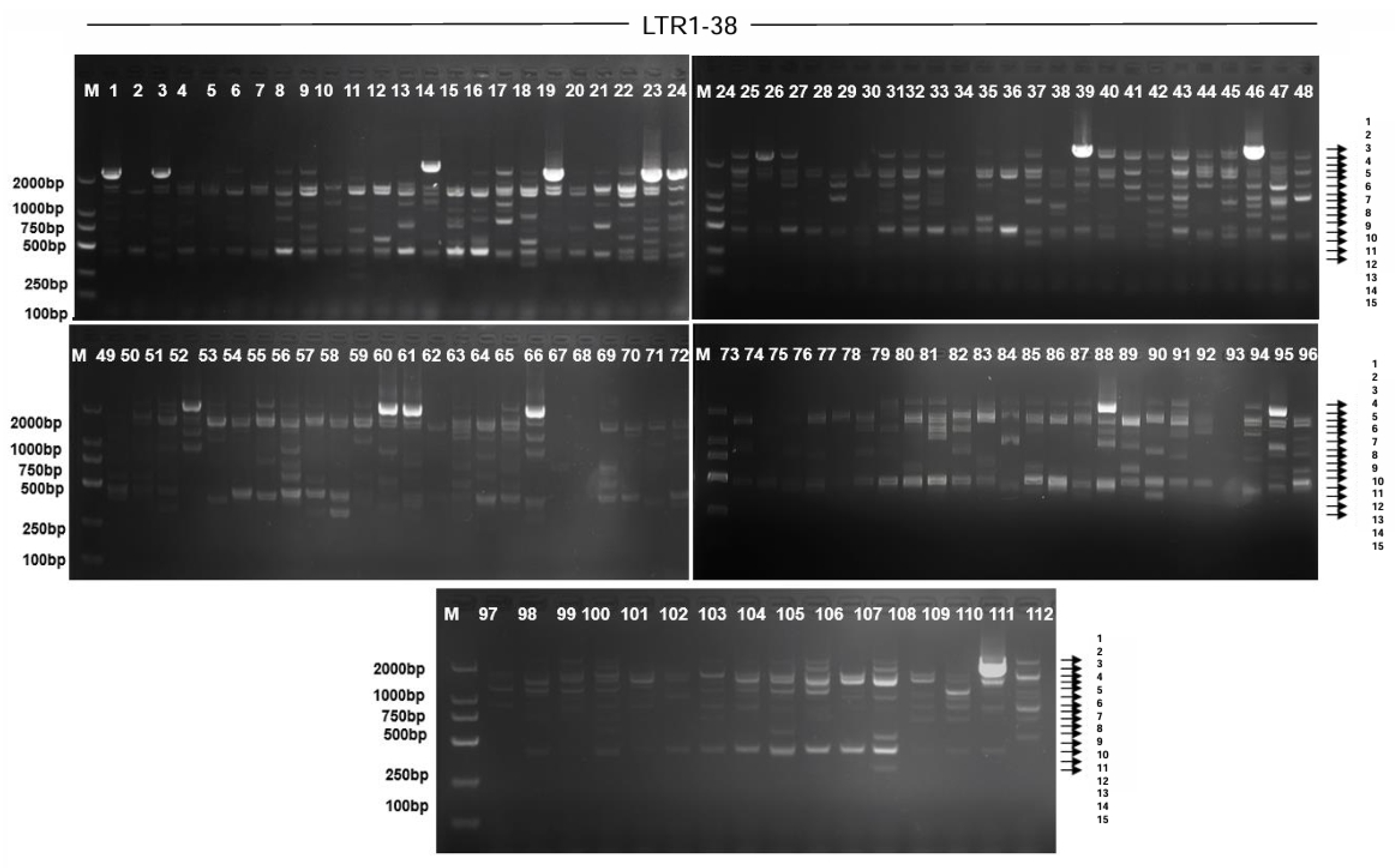
The PCR system optimization was performed using a 3-factor orthogonal design (L16 (43)) with three gradient cycle numbers (30, 35, and 37 cycles), evaluating PCR Mix concentration, IRAP primer concentration, and template DNA amount. Electrophoresis results showed no visible bands at 30 cycles, while 35 and 37 cycles yielded clear bands in most lanes, with 37 cycles providing brighter and more distinct bands. System performance was evaluated and ranked based on band intensity, clarity, and polymorphism scores. Therefore, 37 cycles were determined to be optimal. Based on the number, brightness, and clarity of the bands in the 16 lanes at 37 cycles, the system performance was ranked as follows: 7, 11, 14, 3, 10, 6, 2, 12, 8, 13, 9, 5, 1, 15, 4, 16. A comparison of the three factors across the 16 treatments revealed that the concentrations of PCR Mix and IRAP primers were the primary factors affecting band quantity and clarity. Considering reagent cost and overall performance, System 7 was selected as the optimal 10 μL IRAP-PCR system (see Methods for composition and cycling conditions). Among the 80 synthesized primers, 25 exhibited high polymorphism, clear bands, and good reproducibility, with their optimal annealing temperatures determined (Table 2). Using these 25 selected primers, three independent biological replicates of IRAP-PCR analysis were performed on 112 accessions, generating IRAP fingerprinting maps via agarose gel electrophoresis, with partial primer screening results shown in Figure 1.

3.2. Genetic Diversity of Blueberry Accessions as Revealed by IRAPs

The presence/absence binary matrix obtained from IRAP scoring was processed using POPGENE 1.32. The results showed that the number of alleles per primer ranged from 1.875 (LTR1-3) to 2.000, with an average allele number of 1.988 (Table 3). The effective number of alleles varied from 1.136 (LTR1-3) to 1.895 (LTR1-42), with a mean value of 1.629. Nei’s gene diversity (H) ranged from 0.113 (LTR1-3) to 0.470 (LTR1-42), with an average of 0.361. The Shannon information index varied from 0.216 (LTR1-3) to 0.662 (LTR1-42), with an average value of 0.533. The polymorphic information content (PIC) ranged from 0.795 (LTR1-3) to 0.921 (LTR1-42), with an average value of 0.866.

3.3. Genetic Relationship Among the Blueberry Accessions

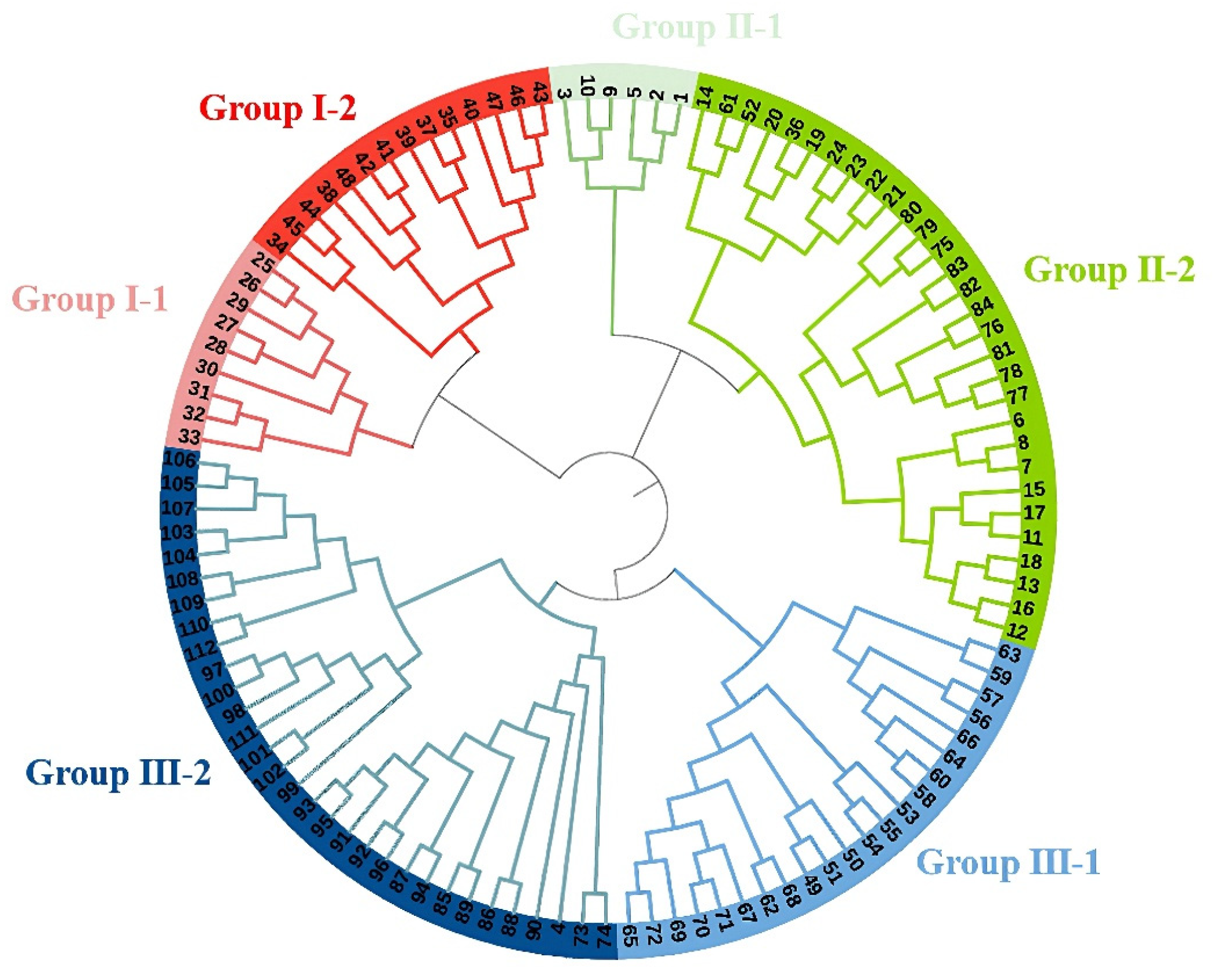
The genetic similarity coefficients (DICE coefficient) for 112 blueberry accessions were calculated using NTSYS 2.10e software, with values ranging from 0.358 to 0.875 and an average of 0.719. At a genetic similarity coefficient of 0.615, the 112 accessions were clustered into three groups. Applying a cut at Dice similarity S = 0.615 to the UPGMA dendrogram defined three top-level clusters (I–III), which we used as group labels in subsequent visualizations. This three-group structure is consistent with the STRUCTURE result (K = 3; maximum ΔK). Group I consisted of 23 accessions, including LM33, LM34, LM48, and LM38; Group II contained 36 accessions; and Group III, the largest group, comprised 53 accessions, such as LM71, LM85, and LM89. Across the three clusters, accessions from Guiyang, Qiandongnan, and Bijie were broadly intermingled; while some subclusters showed local enrichments, regional partitioning was weak overall (Figure 2). Concordance across UPGMA, PCoA, and STRUCTURE analyses supports the three-group pattern while indicating weak geographic structure.

3.4. Genetic Relationships Among Blueberry Germplasms Based on Cluster Analysis

The table presents the genetic parameters of the studied populations, categorized by their collection sources. Among the three populations (categorized by collection source), the average observed number of alleles (Na) and effective number of alleles (Ne) were 3.04 and 2.16, respectively. Group I exhibited the highest Na (3.25) and Ne (2.36)—11.7% higher Na and 21.0% higher Ne than the overall average—while Group III showed the lowest Na (2.69) and Ne (1.95), which were 11.5% and 9.7% lower than the average, respectively. Nei’s gene diversity (H) ranged from 0.43 (Group III) to 0.75 (Group I), with a mean of 0.62 across all populations. Additionally, Shannon’s information index (I) ranged from 0.51 (Group III) to 0.68 (Group I) across the three populations, with an average of 0.58 (Table 4).

3.5. Principal Component Analysis of Blueberry Accessions

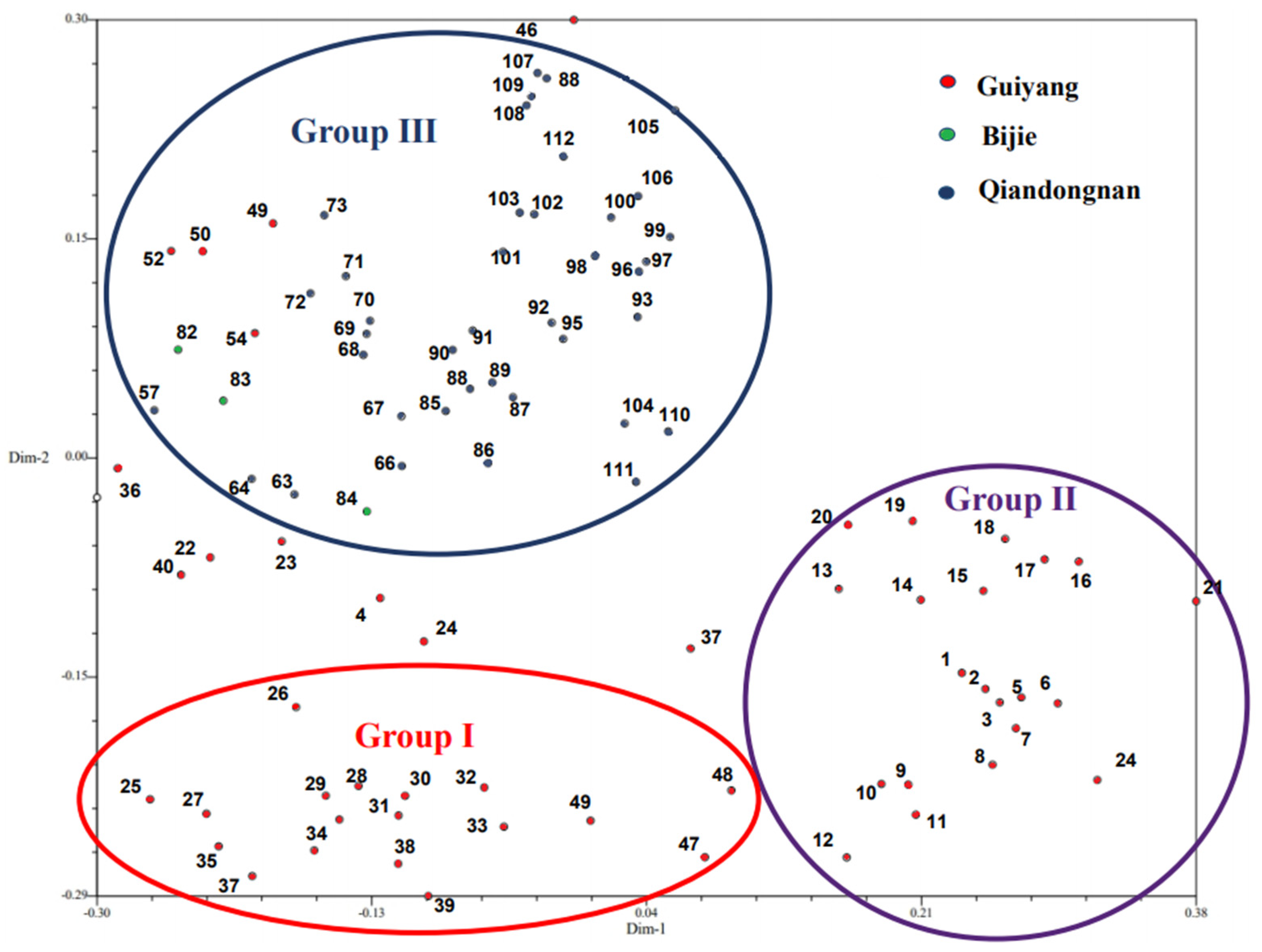
Based on the IRAPs, the 112 accessions were divided into three groups. The accessions within each group were relatively complex, indicating that clustering did not strictly follow their geographic origins. Principal component analysis (PCA) was performed using the first principal component (PC1) and the second principal component (PC2) as the x- and y-axes, respectively. The proximity of samples in the PCA plot indicates their genetic relatedness. In the PCA plot, point colors correspond to groups I–III carried over from the UPGMA cut at S = 0.615; the PCA served for ordination/visualization only and no clustering was performed in the PCA space.
Specifically, the first group comprised 18 accessions, including 8 in subcluster I-1 and 10 in subcluster I-2. The second group included 21 accessions, encompassing 6 in subcluste II-1 and 15 in subcluste II-2. The third group consisted of 46 accessions, including 14 in subcluster III -1 and 32 in subcluster III-2 from the cluster analysis. (Figure 3). A comprehensive integration of principal component analysis (PCA) and UPGMA clustering results demonstrated high consistency in the distribution of specific accessions at the group level. The mutual corroboration between the two methods further enhanced the reliability of the research findings. Consistent with AMOVA and Nm = 1.50, PC1/PC2 showed extensive overlap among regions, indicating weak among-region structure.

3.6. Population Structure of Blueberry Accessions

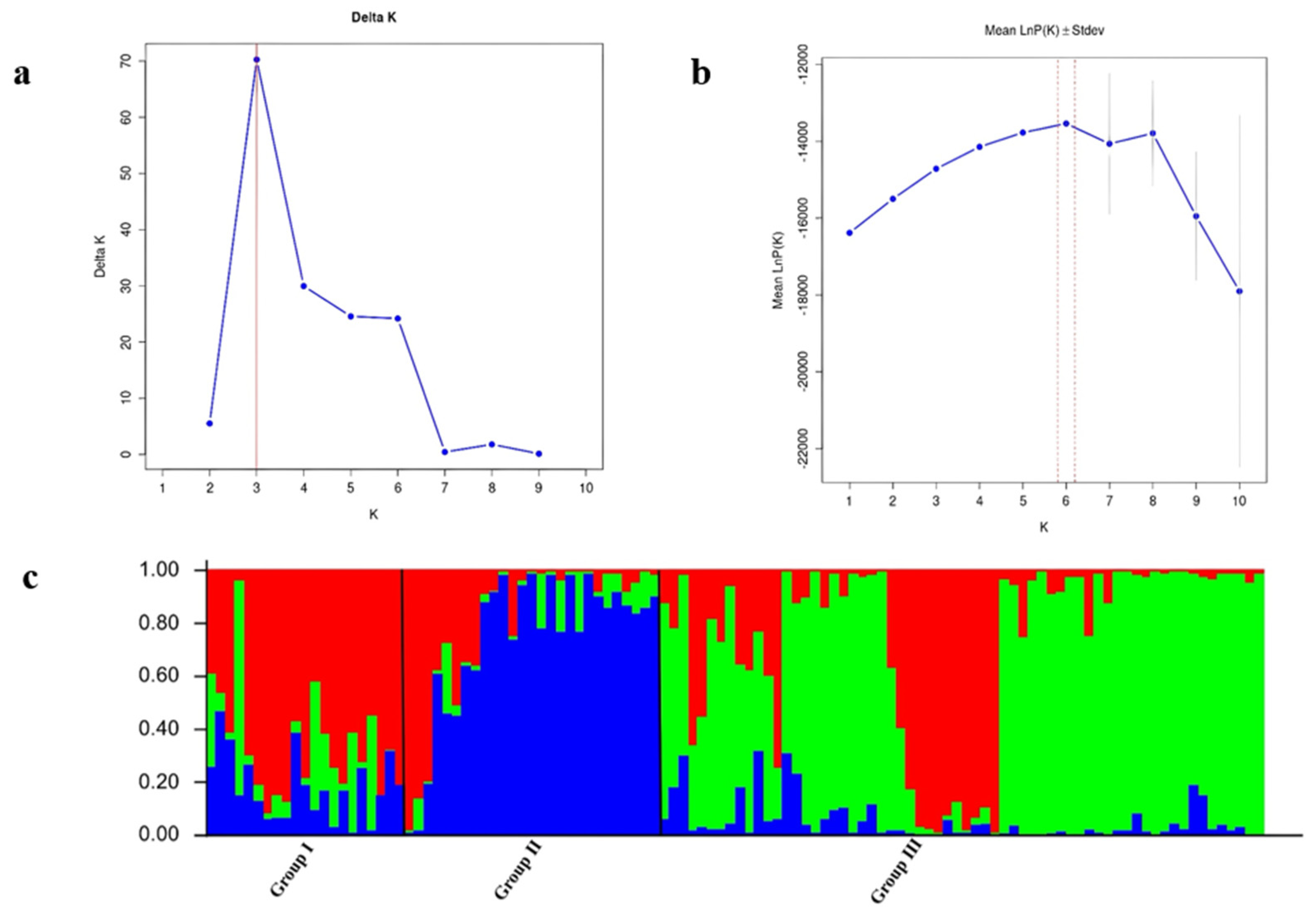
Using STRUCTURE v2.3.4 (model-based population structure software) combined with the 25 selected IRAP core primers, a population structure analysis was performed on 112 blueberry accessions to determine population clustering and the genetic component composition of each individual. The results showed that the ΔK value (a statistic for determining optimal K) reached its maximum at K = 3 (Figure 4a), indicating that the tested germplasms could be divided into 3 distinct genetic clusters. Analysis of the LNP (K) curve (log probability of data for each K) further validated this result: at K = 3, the standard error of the five independent runs was the smallest (Figure 4b), confirming good repeatability and result reliability. The structure bar plot (Figure 4c) clearly presented the ancestral component characteristics of each group: Group I was dominated by the “red” ancestral component (with the highest proportion), Group II was dominated by the “blue” ancestral component, and Group III mainly contained the “green” ancestral component. In addition, there were obvious signs of gene flow among different subgroups, indicating that this batch of germplasms had complex genetic backgrounds and wide-ranging origins. The above population structure classification results were highly consistent with the group division obtained by UPGMA clustering analysis, confirming the reliability of the classification.

3.7. Analysis of Molecular Variance (AMOVA)

Analysis of molecular variance (AMOVA) revealed modest genetic differentiation among regions (9.33%) relative to within-population variation (90.67%), which is consistent with the previously observed weak geographic structure (Table 5). This pattern confirms that the primary source of genetic diversity in the studied blueberry populations stems from within-population variation—consistent with conclusions from prior genetic diversity analyses (e.g., Nei’s H and Shannon’s I assessment).

3.8. Genetic Differentiation Analysis of Blueberry Populations

For the three blueberry populations, the within-population gene diversity (Hs) is 0.2156, and the total gene diversity (Ht) is 0.2875. The coefficient of genetic differentiation among populations (Gst) is 0.2500. These data indicate that the genetic variation in the three blueberry populations mainly originates from within the populations. The number of migrants per generation (Nm) is 1.5000. Since Nm is greater than 1, it suggests a relatively high level of gene flow among the populations, which can effectively reduce the genetic differentiation among populations as caused by genetic drift, resulting in a low degree of differentiation among the populations (Table 6).

3.9. IDs Construction of Blueberry Accessions Using IRAP Markers

By using molecular marker technology to capture the unique genetic traits of germplasms, fingerprinting maps can accurately distinguish the genetic backgrounds of different accessions, effectively preserving the diversity of genetic resources. At the same time, fingerprint profiles provide a unique “genetic ID” for germplasms, clarifying their origin and specificity, and ensuring their legitimacy. This technology enables the effective identification and differentiation of blueberry germplasms, which can aid in protecting intellectual property and advancing genetic breeding.
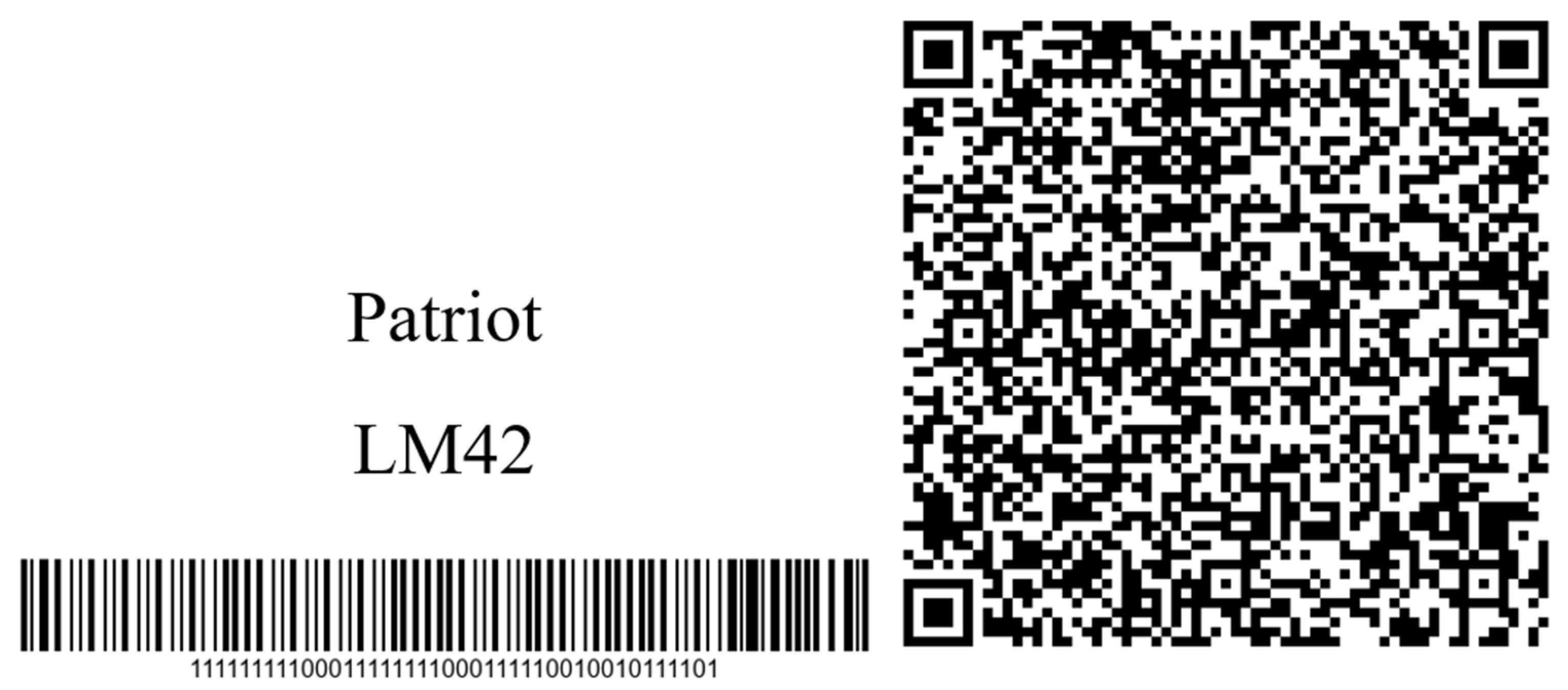
Based on the IRAP genotype matrix (266 loci × 112 accessions), we generated unique fingerprint profiles and constructed standardized Molecular IDs for all accessions. For Molecular ID construction only, we selected 22 of the 25 primers (Na = 2.000) to form a compact barcode panel (Table 7); all diversity and relatedness analyses in this study were performed using the full 25-primer dataset. The primer LTR1-42, with the highest PIC value (0.921) and the highest germplasm identification rate, was selected as the core primer. In combination with primers LTR1-26 and LTR1-38, these were used to distinguish the 112 blueberry accessions. The fingerprint code was generated directly from the binary matrix (per-locus presence/absence profiles) produced by each primer, along with the combinations of sampling locations (Supplementary Table S3). For instance, the fingerprint code for accession LM42 was “11111111100011111111000111110010010111101,” where the barcode represents the binary fingerprint code, and the QR code contains detailed information such as the accession name, accession type, sampling location, fingerprint code (Figure 5).

4. Discussion

4.1. IRAP Marker System and the Molecular IDs for Blueberry

Since Kalendar et al. first developed IRAP markers for barley, this technology has effectively distinguished between barley varieties and generated species-specific fingerprint profiles [44]. Its successful application has clarified the distribution and organizational patterns of transposons within the genome, thereby providing new insights for comprehensive analyses of plant genome structure and evolutionary mechanisms [45]. Additionally, this marker system has been extensively used for germplasm identification in various fruit tree species, including plum [46], grape [47], and sweet orange [14].
The reproducibility of the IRAP marker system is one of its key advantages in plant genetic studies. Through triplicate PCR validation, all primer combinations in this study showed highly consistent banding patterns, with a reproducibility rate exceeding 95%, attributed to the use of longer primers (~20 bp) and conserved LTR sequences, which mitigate sensitivity to PCR conditions unlike random primers in RAPD [48]. This high reproducibility ensures the reliability of the Molecular IDs database, even under varying laboratory conditions. However, the results are dependent on sample quality, such as DNA purity and integrity. In the optimization experiments of Results 3.1, low-quality DNA templates (concentration < 20 ng/μL or A260/280 < 1.8) led to blurred or missing bands, underscoring the importance of high-quality DNA extraction [49]. This indicates that while IRAP is efficient, standardized sample preparation is essential to minimize variability. Compared to other fingerprinting platforms, IRAP, as a dominant marker, provides high resolution in blueberry polyploid genomes but lacks the codominance of SSRs for precise allele dosage parsing [50]. For instance, in blueberry cultivar indexing, ISSR (a dominant marker similar to IRAP) outperforms SSR in rapid screening of large cohorts, while SSR requires capillary electrophoresis and incurs higher costs [50]. The IRAP system in this study complements SSR limitations, particularly in resource-constrained field screenings, achieving 100% cultivar discrimination, yet with more economical agarose gel resolution. Overall, IRAP and SSR are complementary: the former captures transposon polymorphisms, the latter microsatellite variations, and their integration could enhance comprehensive blueberry genetic fingerprinting. Accordingly, we frame IRAP as an adjunct to—not a substitute for—SSR/SNP systems in cultivar identification, IP protection, and breeding pipelines.
In this study, an IRAP marker system was first developed for blueberry. Through an L16 (43) orthogonal experiment, the optimal conditions for a 10 μL blueberry IRAP-PCR reaction were determined. Replicate experiments identified PCR Master Mix concentration and IRAP primer concentration as the primary factors influencing PCR outcomes: insufficient concentrations of these components resulted in fewer and fainter amplification bands, potentially introducing errors [49]. Conversely, excessively high IRAP primer concentrations promoted primer dimer formation, increasing the likelihood of non-specific amplification and base mismatches. Additionally, the number of cycles emerged as a critical parameter, showing a significant positive correlation with PCR product concentration: inadequate cycles led to insufficient yields, while excessive cycles generated non-specific products [51]. Accordingly, 37 cycles were selected for the optimized 10 μL IRAP-PCR system, balancing the accuracy of experimental results with cost-efficiency.
Precise identification in plant germplasms is essential for both intellectual property protection and genetic breeding. Abdollahi Mandoulakani et al. employed ten IRAP primer combinations to evaluate 80 alfalfa genotypes from eight populations, resulting in the amplification of 66 polymorphic bands with a polymorphism rate of 65.30% [52]. Similarly, Carvalho et al. utilized five IRAP primers to generate 103 polymorphic bands across 48 Portuguese bread wheat cultivars [9]. Abbasi Holasou et al. identified 49 bread wheat cultivars using nine IRAP primers, yielding 74 polymorphic bands [53]. Branco et al. applied 22 IRAP primers to 51 rice varieties, resulting in the identification of 156 polymorphic bands [23]. In the current case, IRAP markers proved effective in distinguishing blueberry accessions. Totally, 266 polymorphic bands, yielding from the 25 primers, were successfully used to precisely differentiate the 112 accessions including those from rabbiteye blueberries and highbush blueberries. An accession can be identified with the combinations of distinct DNA markers from the core primers if genetic variations, indicated by marker patterns, are detected at individual DNA loci (fragments). Across the 266 polymorphic markers, the average PIC value of IRAPs was 0.866, with 24 primers (96.00%) exhibiting PIC values exceeding 0.800, ranging from 0.806 to 0.921 (Table 3). It was suggested that primers with PIC values greater than 0.700 are suitable for constructing genetic fingerprints [54]. IRAP markers are effective for detecting intraspecific genetic variations in blueberries. The efficacy may be a ascribed to the widespread distribution, extensive sequence polymorphisms, and frequent insertion polymorphisms of retrotransposons, which are inherited both horizontally and vertically [22]. Accordingly, the Molecular IDs database was constructed based on the specific IRAPs herein (Supplementary Table S3), which may considerably facilitate the intellectual property protection of blueberries.
‘Star’, a typical representative of southern highbush blueberries, was developed via FL80-31 × ‘O’Neal’ by the University of Minnesota in 1995. It closely resembled its parent ‘O’Neal’ in morphological characteristics, leading to being difficult to precisely differentiate them using conventional phenotypic identification. Currently, the two cultivars may be effectively differentiated using IRAPs yielding from LTR 1-26, LTR 1-38, and LTR 1-42 (Table 7); moreover, ‘Star’ (LM45) from Guiyang exhibited significant genetic differentiation from ‘O’Neal’ (LM10) of the same population and ‘O’Neal’ (LM68) from Qiandongnan, as it failed to cluster into the same branch (Figure 2), which further justified the effectiveness of IRAPs in germplasm identification [55]. These findings explain why not all accessions with the same name showed completely identical banding patterns: they may represent different clones carrying minor mutations, or nursery labeling inconsistencies. This indicates that while IRAP markers are suitable for fingerprinting and identity verification, they also have the resolution to reveal subtle clonal differences within a named variety.

4.2. Intravarietal (Clonal) Differentiation in Blueberries: How IRAP Compares with SSR and RAPD

Multiple platforms have been employed to detect within-cultivar (clonal) variation in blueberry. Using a minimal SSR marker panel (CA344, CA421, NA1040), Miteca et al. validated cultivar identification across a large sample set and documented a low yet non-negligible frequency of spontaneous allelic variants (~0.6% among ~3000 samples), with the CA421 marker proving particularly informative for detecting intracultivar polymorphisms. This finding demonstrates that standardized SSRs can not only serve as reliable genetic indices for named varieties but also sensitively capture sporadic clonal variants in nursery propagation pipelines [56]. Earlier, Martínez et al. utilized RAPD markers (eight Operon primers) to assess genotypic quality in both tissue-cultured and field-grown plants. Their results showed reproducible fingerprinting within clones, effective discrimination between cultivars (e.g., ‘Misty’, ‘O’Neal’), and the capacity to flag off-type materials that clustered separately—indicating that RAPD can reveal intracultivar genetic differences or instances of cultivar mislabeling when such issues exist [57].
Against this backdrop, our IRAP panel generated 266 polymorphic loci from 25 primers (mean PIC = 0.866) and achieved complete discrimination of 112 accessions. We also observed band pattern variations among some samples sharing the same cultivar designation. Given that IRAP is a dominant, transposon-anchored marker system, we cautiously interpret these variations as putative intracultivar variants (e.g., somatic LTR-RT insertion polymorphisms) or nursery mislabeling, rather than definitively asserting clonal divergence. Practically, we propose a two-tier workflow: (i) low-cost preliminary screening using our 22-primer IRAP barcode panel (or the three high-yield primers LTR1-26/-38/-42) on agarose gels to flag suspect materials; (ii) confirmatory genotyping with a standardized SSR set (e.g., CA344/CA421/NA1040 or the USDA 10-SSR panel) prior to any legal or cultivar registration procedures. In this context, IRAP serves as a complement to—rather than a replacement for—SSR and RAPD platforms for resolving clonal variation in polyploids.

4.3. Genetic Structure of Blueberry Populations

Genetic diversity is a fundamental concern in biological research, serving as the foundation for the survival and evolution of species [58]. It plays a critical role in assessing the environmental adaptability of species and elucidating the genetic structure of populations [59]. In the present study, the mean values for Na, Ne, He and I of blueberry populations are 3.04, 2.16, 0.62, and 0.58, respectively (Table 4), indicating substantial within-population diversity. Because all sampling sites are within Guizhou, we refrain from attributing the observed variation to karst-driven microclimatic heterogeneity per se. The karst terrain provides a plausible hypothesis that warrants testing, but our data do not include environmental covariates or a comparative non-karst sampling frame; accordingly, any landscape–genetic link should be considered provisional. Significant differences in genetic diversity were also observed among the three populations, with the hierarchy being Group I > Group II > Group III, which is primarily ascribed to the habitat heterogeneity of the sampling sites, because the terrain in the southwestern regions ares complex due to widespread karstic landforms [60], with substantial differences in environmental factors [9]. The microhabitat diversity has resulted in various genetic variations within the same blueberry species.
The analysis of molecular variance (AMOVA) revealed that only 9.33% of the genetic diversity was attributed to differences among populations, while a significant 90.67% of the genetic variation existed within populations (Table 5). This finding suggests that genetic differentiation among blueberry populations is relatively minimal, with the majority of genetic diversity residing within each population. Glémin et al. highlighted that the population genetic differentiation coefficient (e.g., Gst) is influenced by various factors, including pollen and seed dispersal modes, life history traits, and geographic distribution, making it a crucial parameter for assessing population genetic structure [61]. Furthermore, Karnosky et al. identified the breeding system and the extent of gene flow as the most significant factors affecting population genetic structure [44]. In general, self-pollinating plants exhibit higher Gst value than the outcrossing ones. Crawford et al. reported Gst values of 0.197 for the outcrossing plants, 0.510 for the self-pollinating species, and 0.216 for the mixed-mating ones [62], while Nybom proposed Gst values of 0.270 for the outcrossing plants, 0.650 for the self-pollinating species, and 0.400 for the mixed-mating ones [63]. Currently, the Gst value for blueberries is 0.250, which falls from 0.216 to 0.270, indicating that the 112 blueberry germplasms collected in this study primarily adopt an outcrossing reproductive strategy.
The number of migrant individuals per generation (Nm), which quantifies the level of gene exchange between populations, is a crucial factor influencing the genetic structure of these populations [64]. Previously, it was indicated that as Nm > 4, gene exchange is abundant, resulting in minimal genetic differentiation [65,66]. In scenarios where 1 < Nm ≤ 4, gene flow serves a homogenizing function, characterized by a relatively high frequency of gene exchange that effectively mitigates the genetic differentiation as caused by genetic drift, leading to a low degree of genetic differentiation among populations [67,68]. Conversely, when Nm < 1, gene exchange is limited, and the genetic differentiation resulting from genetic drift becomes more pronounced [69]. In this study, the Nm value among blueberry populations exceeds 1, indicating active gene exchange and a relatively high level of genetic interchange. This gene exchange enhances genetic variation within populations by introducing new alleles, thereby reducing the genetic differentiation among different populations.
The frequent gene exchange among populations may be influenced by their reproductive strategies and geographical distances. Species in the family Ericaceae (e.g., blueberries) possess seeds capable of long-distance dispersal, and the mature pollens can also be dispersed by wind. These two characters likely serve as the primary means for gene exchange. There is a generally positive correlation between the genetic diversity of a species and its environmental adaptability [70]. As members of genus Vaccinium with specific habitat requirements, blueberries exhibit rich genetic diversity that underpins their adaptation to the complex geographical environments of the southwestern region [71]. However, the germplasms of blueberries have been steadily declining due to human interference and genetic factors [72], leading to a downward trend in their genetic diversity. Clustering and STRUCTURE patterns more closely tracked cultivar type than collection region, and regional structure was weak, consistent with AMOVA (9.33% among-region variance) and Nm = 1.50. This pattern, while possibly coincidental due to balanced sampling, highlights IRAP’s sensitivity in uncovering subtle structural ties in polyploid systems. Future expanded studies could clarify these linkages, guiding targeted conservation amid ongoing germplasm erosion. Therefore, it is imperative to systematically protect the blueberry germplasms and their genetic diversity, which is essential for further genetic improvement in future.

5. Conclusions

This research focuses on blueberry germplasms and aims to develop a novel molecular marker system for constructing unique Molecular IDs and elucidating the genetic relationship among the accessions. Based on Ty1-copia retrotransposons of blueberry, an IRAP system was developed, and 25 core primers were obtained, by which, 266 polymorphic loci were scored. Subsequently, the IRAPs were employed to identify the 112 accessions, as well as to unravel their genetic relationship. Furthermore, a Molecular IDs database was constructed using IRAPs, and the “genetic identity card” was also established for each accession based on the polymorphic markers, which may effectively differentiate the germplasms. The results indicated that IRAP system is highly efficient and accurate for blueberry germplasm identification and genetic relationship elucidation, which facilitate the protection for the intellectual property of the germplasms as well as the genetic improvement of this fruit crop.

Supplementary Materials

The following supporting information can be downloaded at: https://www.mdpi.com/article/10.3390/horticulturae11111319/s1, Table S1: Blueberry accessions used for IRAP identification; Table S2: Information of 80 polymorphic IRAP primers; Table S3: Molecular fingerprint database of blueberry germplasm resources.

Author Contributions

Conceptualization, X.C., H.C., Y.M., Y.L., Y.H., G.W., S.W. and X.W.; Data curation, X.C., Y.H. and S.W.; Formal analysis, X.C. and S.W.; Funding acquisition, X.W.; Investigation, X.C. and Y.M.; Methodology, X.C. and Y.L.; Project administration, X.W.; Resources, H.C. and G.W.; Supervision, X.W.; Writing—original draft, X.C.; Writing—review and editing, X.W.; All authors have read and agreed to the published version of the manuscript.

Funding

The project was supported by grants from Core Program of Guizhou Province, P. R. China (Qiankehezhongdazhuanxiang [2024]028-1), as well as Guizhou Provincial Science and Technology Projects of China (YQK[2023]008).

Data Availability Statement

The raw data supporting the conclusions of this article will be made available by the authors on request.

Acknowledgments

We sincerely thank our classmates for their support and assistance during the experiment. We are also grateful to the dedicated teachers and friends who have cared for, supported, and helped us throughout this process. Finally, we extend our heartfelt gratitude to the experts who took time out of their busy schedules to review this article and provide valuable feedback.

Conflicts of Interest

The authors declare that they have no conflicts of interest associated with this work.

References

  1. Debnath, S.C.; Bhatt, D.; Goyali, J.C. DNA-Based Molecular Markers and Antioxidant Properties to Study Genetic Diversity and Relationship Assessment in Blueberries. Agronomy 2023, 13, 1518. [Google Scholar] [CrossRef]
  2. Cabezas, D.; De Bem Oliveira, I.; Acker, M.; Lyrene, P.; Munoz, P.R. Evaluating Wild Germplasm Introgression into Autotetraploid Blueberry. Agronomy 2021, 11, 614. [Google Scholar] [CrossRef]
  3. Cvetković, M.; Kočić, M.; Dabić Zagorac, D.; Ćirić, I.; Natić, M.; Hajder, Đ.; Životić, A.; Fotirić Akšić, M. When Is the Right Moment to Pick Blueberries? Variation in Agronomic and Chemical Properties of Blueberry (Vaccinium corymbosum) Cultivars at Different Harvest Times. Metabolites 2022, 12, 798. [Google Scholar] [CrossRef]
  4. Michalska, A.; Łysiak, G. Bioactive Compounds of Blueberries: Post-Harvest Factors Influencing the Nutritional Value of Products. Int. J. Mol. Sci. 2015, 16, 18642–18663. [Google Scholar] [CrossRef]
  5. Podwyszynska, M.; Mynett, K.; Markiewicz, M.; Pluta, S.; Marasek-Ciolakowska, A. Chromosome Doubling in Genetically Diverse Bilberry (Vaccinium myrtillus L.) Accessions and Evaluation of Tetraploids in Terms of Phenotype and Ability to Cross with Highbush Blueberry (V. corymbosum L.). Agronomy 2021, 11, 2584. [Google Scholar] [CrossRef]
  6. Cappai, F.; Benevenuto, J.; Ferrão, L.F.V.; Munoz, P. Molecular and Genetic Bases of Fruit Firmness Variation in Blueberry—A Review. Agronomy 2018, 8, 174. [Google Scholar] [CrossRef]
  7. Boches, P.; Bassil, N.V.; Rowland, L. Genetic Diversity in the Highbush Blueberry Evaluated with Microsatellite Markers. J. Am. Soc. Hortic. Sci. 2006, 131, 674–686. [Google Scholar] [CrossRef]
  8. Bassil, N.; Bidani, A.; Nyberg, A.; Hummer, K.; Rowland, L.J. Microsatellite markers confirm identity of blueberry (Vaccinium spp.) plants in the USDA-ARS National Clonal Germplasm Repository collection. Genet. Resoure Crop. Evol. 2020, 67, 393–409. [Google Scholar] [CrossRef]
  9. Carvalho, M.; Matos, M.; Crespí, A.; Lopes, V.R.; Carnide, V. Genetic Diversity and Identification of Vaccinium Species Through Microsatellite Analysis. Plants 2024, 13, 3488. [Google Scholar] [CrossRef]
  10. Boches, P.S.; Bassil, N.V.; Rowland, L.J. Microsatellite markers for Vaccinium from EST and genomic libraries. Mol. Ecol. Notes 2005, 5, 657–660. [Google Scholar] [CrossRef]
  11. Hassan, A.H.; Mokhtar, M.M.; El Allali, A. Transposable elements: Multifunctional players in the plant genome. Front. Plant Sci. 2024, 14, 1330127. [Google Scholar] [CrossRef]
  12. Mukherjee, S.; Sharma, D.; Upadhyaya, K.C. Differential transcriptional activation of copia family of different plant retrotransposons. J. Plant Biochem. Biotechnol. 2022, 31, 915–924. [Google Scholar] [CrossRef]
  13. Papolu, P.K.; Ramakrishnan, M.; Mullasseri, S.; Kalendar, R.; Wei, Q.; Zou, L.H.; Ahmad, Z.; Vinod, K.K.; Yang, P.; Zhou, M. Retrotransposons: How the continuous evolutionary front shapes plant genomes for response to heat stress. Front. Plant Sci. 2022, 13, 1064847. [Google Scholar] [CrossRef]
  14. Zanganeh, F.; Sheidai, M. Population genetic diversity and genetic affinity analyses of sweet orange cultivars (Citrus sinensis (L.) Osbeck) by using IRAP molecular markers. Genet. Resour. Crop Evol. 2022, 69, 2437–2446. [Google Scholar] [CrossRef]
  15. Zong, Y.; Kang, H.; Fang, Q.; Chen, X.; Zhou, M.; Ni, J.; Zhang, Y.; Wang, L.; Zhu, Y.; Guo, W. Phylogenetic relationship and genetic background of blueberry (Vaccinium spp.) based on retrotransposon-based SSAP molecular markers. Sci. Hortic. 2019, 247, 116–122. [Google Scholar] [CrossRef]
  16. Leśniowska-Nowak, J.; Okoń, S.; Wieremczuk, A. Molecular diversity analysis of genotypes from four Aegilops species based on retrotransposon–microsatellite amplified polymorphism (REMAP) markers. Cereal Res. Commun. 2021, 49, 37–44. [Google Scholar] [CrossRef]
  17. Meng, Y.; Su, W.; Ma, Y.; Liu, L.; Gu, X.; Wu, D.; Shu, X.; Lai, Q.; Tang, Y.; Wu, L.; et al. Assessment of genetic diversity and variety identification based on developed retrotransposon-based insertion polymorphism (RBIP) markers in sweet potato (Ipomoea batatas (L.) Lam.). Sci. Rep. 2021, 11, 17116. [Google Scholar] [CrossRef]
  18. Kizilgeci, F.; Bayhan, B.; Türkoğlu, A.; Haliloglu, K.; Yildirim, M. Exploring genetic diversity and Population structure of five Aegilops species with inter-primer binding site (iPBS) markers. Mol. Biol. Rep. 2022, 49, 8567–8574. [Google Scholar] [CrossRef] [PubMed]
  19. EI zayat, M.A.S.; Hassan, A.H.; Nishawy, E.; Ali, M.; Amar, M.H. Patterns of genetic structure and evidence of Egyptian Citrus rootstock based on informative SSR, LTR-IRAP and LTR-REMAP molecular markers. J. Genet. Eng. Biotechnol. 2021, 19, 29. [Google Scholar] [CrossRef]
  20. Piskurek, O.; Nishihara, H.; Okada, N. The evolution of two partner LINE/SINE families and a full-length chromodomain-containing Ty3/Gypsy LTR element in the first reptilian genome of Anolis carolinensis. Gene 2009, 441, 111–118. [Google Scholar] [CrossRef]
  21. He, J.; Yu, Z.; Jiang, J.; Chen, S.; Fang, W.; Guan, Z.; Liao, Y.; Wang, Z.; Chen, F.; Wang, H. An Eruption of LTR Retrotransposons in the Autopolyploid Genomes of Chrysanthemum nankingense (Asteraceae). Plants 2022, 11, 315. [Google Scholar] [CrossRef]
  22. Dongare, M.D.; Alex, S.; Soni, K.B.; Sindura, K.P.; Nair, D.S.; Stephen, R.; Jose, E. Cross-species transferability of IRAP retrotransposon markers and polymorphism in black pepper (Piper nigrum L.). Genet. Resour. Crop Evol. 2023, 70, 2593–2605. [Google Scholar] [CrossRef]
  23. Branco, C.J.S.; Vieira, E.A.; Malone, G.; Kopp, M.M.; Malone, E.; Bernardes, A.; Mistura, C.C.; Carvalho, F.I.F.; Oliveira, C.A. IRAP and REMAP assessments of genetic similarity in rice. J. Appl. Genet. 2007, 48, 107–113. [Google Scholar] [CrossRef] [PubMed]
  24. Ahmad, S.; Kaur, R.; Lefsrud, M.; Singh, J. Investigation of IRAP transposon-based molecular markers for analysis of genetic diversity in pea germplasm. Legume Res. Int. J. 2018, 41, 822–827. [Google Scholar] [CrossRef]
  25. Fan, F.; Cui, B.; Zhang, T.; Ding, G.; Wen, X. LTR-retrotransposon activation, IRAP marker development and its potential in genetic diversity assessment of masson pine (Pinus massoniana). Tree Genet. Genomes 2013, 10, 213–222. [Google Scholar] [CrossRef]
  26. Bai, X.; Zhang, S.; Wang, W.; Chen, Y.; Zhao, Y.; Shi, F.; Zhu, C. Genetic Relationships of 118 Castanea Specific Germplasms and Construction of Their Molecular ID Based on Morphological Characteristics and SSR Markers. Plants 2023, 12, 1438. [Google Scholar] [CrossRef]
  27. Bos, M.P.; Sánchez, M.M.; Remijas, L.; van Houdt, R.; Peters, E.J.G.; Budding, A.E. Performance of Molecular Culture ID in diagnosis of bacterial pericarditis. Eur. J. Clin. Microbiol. Infect. Dis. 2025, 247, 116–122. [Google Scholar] [CrossRef]
  28. Diao, B.; Xu, Z.; Liu, M.; Zhang, G.; Wang, G.; Zhang, Y.; Tian, X. Establishment and application of a SNP molecular identification system in Grifola frondosa. Front. Microbiol. 2024, 15, 1417014. [Google Scholar] [CrossRef]
  29. Ahmad, N.; Tian, R.; Lu, J.; Li, G.; Sun, J.; Lin, R.; Zhao, C.; Zhou, C.; Chang, H.; Zhao, S.; et al. DNA fingerprinting and genetic diversity analysis in Asparagus officinalis L. cultivars using microsatellite molecular markers. Genet. Resour. Crop Evol. 2023, 70, 1163–1177. [Google Scholar] [CrossRef]
  30. Liang, X.-M.; Pi, Z.; Wu, Z.-D.; Li, S.-N. Constructing DNA Fingerprinting and Evaluating Genetic Diversity Among Sugar Beet (Beta vulgaris L.) Varieties Based on Four Molecular Markers. Sugar Tech 2023, 25, 1361–1373. [Google Scholar] [CrossRef]
  31. He, Y.; Wang, H.; Leng, Y.; Chen, X.; Zhou, K.; Min, Y.; Wen, X. Development of inter-retrotransposon amplified polymorphism (IRAP) markers and germplasm DNA fingerprinting of Polygonatum sibiricum: A well-known medicinal species in China. Genet. Resour. Crop Evol. 2024, 72, 5939–5952. [Google Scholar] [CrossRef]
  32. Ellinghaus, D.; Kurtz, S.; Willhoeft, U. LTRharvest, an efficient and flexible software for de novo detection of LTR retrotransposons. BMC Bioinform. 2008, 9, 18. [Google Scholar] [CrossRef]
  33. Xu, Z.; Wang, H. LTR_FINDER: An efficient tool for the prediction of full-length LTR retrotransposons. Nucleic Acids Res. 2007, 35, 265–268. [Google Scholar] [CrossRef] [PubMed]
  34. Ou, S.; Jiang, N. LTR_retriever: A Highly Accurate and Sensitive Program for Identification of Long Terminal Repeat Retrotransposons. Plant Physiol. 2018, 176, 1410–1422. [Google Scholar] [CrossRef]
  35. Wen, S.; Zhao, H.; Qiao, G.; Shen, X. Identification and characterization of genome-wide long terminal repeat retrotransposons provide an insight into elucidating the trait evolution of five Rhododendron species. Plant Biol. 2023, 25, 813–828. [Google Scholar] [CrossRef] [PubMed]
  36. Zhang, R.G.; Li, G.Y.; Wang, X.L.; Dainat, J.; Wang, Z.X.; Ou, S.; Ma, Y. TEsorter: An accurate and fast method to classify LTR-retrotransposons in plant genomes. Hortic. Res. 2022, 19, 017. [Google Scholar] [CrossRef] [PubMed]
  37. Yeh, F.C.; Yang, R.C.; Boyle, T.B.J.; Ye, Z.H.; Mao, J.X. POPGENE, the User-Friendly Shareware for Population Genetic Analysis; Molecular Biology and Biotechnology Centre, University of Alberta: Edmonton, AB, Canada, 1997. [Google Scholar]
  38. Nei, M. Analysis of gene diversity in subdivided populations. Proc. Natl. Acad. Sci. USA 1973, 70, 3321–3323. [Google Scholar] [CrossRef]
  39. Shannon, C.E. A mathematical theory of communication. Bell Syst. Tech. J. 1948, 27, 379–423. [Google Scholar] [CrossRef]
  40. Excoffier, L.; Lischer, H.E. Arlequin suite ver 3.5: A new series of programs to perform population genetics analyses under Linux and Windows. Mol. Ecol. Resour. 2010, 10, 564–567. [Google Scholar] [CrossRef]
  41. Shiferaw, E.; Pè, M.E.; Porceddu, E.; Ponnaiah, M. Exploring the genetic diversity of Ethiopian grass pea (Lathyrus sativus L.) using EST-SSR markers. Mol. Breed. 2012, 30, 789–797. [Google Scholar] [CrossRef]
  42. Pritchard, J.K.; Stephens, M.; Donnelly, P. Inference of population structure using multilocus genotype data. Genetics 2000, 155, 945–959. [Google Scholar] [CrossRef]
  43. Li, Y.L.; Liu, J.X. StructureSelector: A web-based software to select and visualize the optimal number of clusters using multiple methods. Mol. Ecol. Resour. 2018, 18, 176–177. [Google Scholar] [CrossRef]
  44. Kalendar, R.; Grob, T.; Regina, M.; Suoniemi, A.; Schulman, A. IRAP and REMAP: Two new retrotransposon-based DNA fingerprinting techniques. Theor. Appl. Genet. 1999, 98, 704–711. [Google Scholar] [CrossRef]
  45. Vicient, C.M.; Casacuberta, J.M. Additional ORFs in Plant LTR-Retrotransposons. Front. Plant Sci. 2020, 11, 555. [Google Scholar] [CrossRef]
  46. Wang, G.; Li, R.; Wu, M.; Ren, F.; Wang, L.; Qiao, G. Assessment of genetic diversity of Prunus salicina ‘Shazikongxinli’ by morphological traits and molecular markers. Genet. Resour. Crop Evol. 2023, 70, 2727–2739. [Google Scholar] [CrossRef]
  47. Strioto, D.K.; Kuhn, B.C.; Nagata, W.S.L.; Marinelli, G.; Oliveira-Collet, S.A.; Mangolin, C.A.; Machado, M.d.F.P.S. Development and use of retrotransposons-based markers (IRAP/REMAP) to assess genetic divergence among table grape cultivars. Plant Genet. Resour. 2019, 17, 272–279. [Google Scholar] [CrossRef]
  48. Bhattacharyya, P.; van Staden, J. Molecular insights into genetic diversity and population dynamics of five medicinal Eulophia species: A threatened orchid taxa of Africa. Physiol. Mol. Biol. Plants 2018, 24, 631–641. [Google Scholar] [CrossRef]
  49. Garafutdinov, R.R.; Galimova, A.A.; Sakhabutdinova, A.R. The influence of quality of primers on the formation of primer dimers in PCR. Nucleosides Nucleotides Nucleic Acids 2020, 39, 1251–1269. [Google Scholar] [CrossRef]
  50. Garriga, M.; Parra, P.A.; Caligari, P.D.S.; Retamales, J.B.; Carrasco, B.A.; Lobos, G.A.; García-Gonzáles, R. Application of inter-simple sequence repeats relative to simple sequence repeats as a molecular marker system for indexing blueberry cultivars. Can. J. Plant Sci. 2013, 93, 913–921. [Google Scholar] [CrossRef]
  51. Serpieri, R.; Franchi, F. Resilience of DNA chains to molecular fracture after PCR heating cycles and implications on PCR reliability. Q. Rev. Biophys. 2024, 57, e8. [Google Scholar] [CrossRef]
  52. Abdollahi Mandoulakani, B.; Piri, Y.; Darvishzadeh, R.; Bernoosi, I.; Jafari, M. Retroelement Insertional Polymorphism and Genetic Diversity in Medicago sativa Populations Revealed by IRAP and REMAP Markers. Plant Mol. Biol. Report. 2011, 30, 286–296. [Google Scholar] [CrossRef]
  53. Abbasi Holasou, H.; Rahmati, F.; Rahmani, F.; Imani, M.; Talebzadeh, Z. Elucidate Genetic Diversity and Population Structure of Bread Wheat (Triticum Aestivum L.) Cultivars Using IRAP and REMAP Markers. J. Crop Sci. Biotechnol. 2019, 22, 139–151. [Google Scholar] [CrossRef]
  54. Modise, T.J.; Maleka, M.F.; Fouché, H.; Coetzer, G.M. Genetic diversity and differentiation of South African cactus pear cultivars (Opuntia spp.) based on simple sequence repeat (SSR) markers. Genet. Resour. Crop Evol. 2024, 71, 373–384. [Google Scholar] [CrossRef]
  55. Monpara, J.K.; Chudasama, K.S.; Vekaria, M.L.; Patel, V.J.; Thaker, V.S. Molecular marker studies on Balanites aegyptiaca and allied species for species delimitation, identification, and authentication. Tree Genet. Genomes 2023, 19, 17. [Google Scholar] [CrossRef]
  56. Miteca, H.; Castro, M.H.; Meneses, M.; Prat, L.; Muñoz, C.; Hinrichsen, P. Validation of a Minimal Panel of Microsatellite Markers for Blueberry Cultivar Identification and Frequency of Spontaneous Mutations. Chil. J. Agric. Res. 2024, 84, 28–42. [Google Scholar] [CrossRef]
  57. Martínez, M.C.; Plata Tamayo, M.I.; Hopp, H.E. Molecular Identification of Genetic Patterns in Different Blueberry (Vaccinium sp.) Samples. Rev. Investig. Agropecu. 2007, 36, 3–15. [Google Scholar]
  58. Bhatt, D.S.; Debnath, S.C. Genetic Diversity of Blueberry Genotypes Estimated by Antioxidant Properties and Molecular Markers. Antioxidants 2021, 10, 458. [Google Scholar] [CrossRef] [PubMed]
  59. Vega-Polo, P.; Cobo, M.M.; Argudo, A.; Gutierrez, B.; Rowntree, J.; Torres, M.d.L. Characterizing the genetic diversity of the Andean blueberry (Vaccinium floribundum Kunth.) across the Ecuadorian Highlands. PLoS ONE 2020, 15, e0243420. [Google Scholar] [CrossRef]
  60. Kulkarni, K.P.; Vorsa, N.; Natarajan, P.; Elavarthi, S.; Iorizzo, M.; Reddy, U.K.; Melmaiee, K. Admixture Analysis Using Genotyping-by-Sequencing Reveals Genetic Relatedness and Parental Lineage Distribution in Highbush Blueberry Genotypes and Cross Derivatives. Int. J. Mol. Sci. 2021, 22, 163. [Google Scholar] [CrossRef]
  61. Glémin, S.; Bazin, E.; Charlesworth, D. Impact of mating systems on patterns of sequence polymorphism in flowering plants. Proc. R. Soc. B Biol. Sci. 2006, 273, 3011–3019. [Google Scholar] [CrossRef]
  62. Crawford, D.J.; Ruiz, E.; Stuessy, T.F.; Tepe, E.; Aqeveque, P.; Gonzalez, F.; Jensen, R.J.; Anderson, G.J.; Bernardello, G.; Baeza, C.M.; et al. Allozyme diversity in endemic flowering plant species of the Juan Fernandez Archipelago, Chile: Ecological and historical factors with implications for conservation. Am. J. Bot. 2001, 88, 2195–2203. [Google Scholar] [CrossRef]
  63. Nybom, H. Comparison of different nuclear DNA markers for estimating intraspecific genetic diversity in plants. Mol. Ecol. 2004, 13, 1143–1155. [Google Scholar] [CrossRef]
  64. Samuk, K.; Noor, M.A.F. Gene flow biases population genetic inference of recombination rate. G3 Genes Genomes Genet. 2022, 12, 236. [Google Scholar] [CrossRef]
  65. Bittner, T.D.; King, R.B. Gene flow and melanism in garter snakes revisited: A comparison of molecular markers and island vs. coalescent models. Biol. J. Linn. Soc. 2003, 79, 389–399. [Google Scholar] [CrossRef][Green Version]
  66. Banerjee, A.K.; Hou, Z.; Lin, Y.; Lan, W.; Tan, F.; Xing, F.; Li, G.; Guo, W.; Huang, Y. Going with the flow: Analysis of population structure reveals high gene flow shaping invasion pattern and inducing range expansion of Mikania micrantha in Asia. Ann. Bot. 2020, 125, 1113–1126. [Google Scholar] [CrossRef] [PubMed]
  67. Kaňuch, P.; Kiehl, B.; Cassel-Lundhagen, A.; Laugen, A.T.; Low, M.; Berggren, Å. Gene flow relates to evolutionary divergence among populations at the range margin. PeerJ 2020, 8, 10036. [Google Scholar] [CrossRef] [PubMed]
  68. Chieu, H.D.; Premachandra, H.K.A.; Powell, D.; Knibb, W. Genome-wide SNP analyses reveal a substantial gene flow and isolated-genetic structure of sea cucumber Holothuria leucospilota populations in Western Central Pacific. Fish. Res. 2023, 264, 106718. [Google Scholar] [CrossRef]
  69. Pereira, E.; Mateus, C.S.; Alves, M.J.; Almeida, R.; Pereira, J.; Quintella, B.R.; Almeida, P.R. Connectivity patterns and gene flow among Chelon ramada populations. Estuar. Coast. Shelf Sci. 2023, 281, 108209. [Google Scholar] [CrossRef]
  70. Zhou, C.; Yu, Y.; Liu, Y.; Yang, S.; Chen, Y. Gradual pollen presentation in Vaccinium corymbosum ‘Bluecrop’: An adaptive mechanism to improve pollination efficiency and outcrossing. PeerJ 2024, 12, e17273. [Google Scholar] [CrossRef]
  71. Rodriguez-Saona, C.; Cloonan, K.R.; Sanchez-Pedraza, F.; Zhou, Y.; Giusti, M.M.; Benrey, B. Differential Susceptibility of Wild and Cultivated Blueberries to an Invasive Frugivorous Pest. J. Chem. Ecol. 2018, 45, 286–297. [Google Scholar] [CrossRef]
  72. Gumbrewicz, R.; Calderwood, L. Fertility Effects on Blueberry Gall Midge (Diptera: Cecidomyiidae) in Wild Blueberry (Vaccinium angustifolium; Ericales: Ericaceae). J. Econ. Entomol. 2022, 115, 783–791. [Google Scholar] [CrossRef] [PubMed]
Figure 1. Electrophoretic profiles for blueberry accessions as scored by IRAP-PCR using primer LTR1-38. Note: M, D2000 DNA marker (Tiangen Biological Company, Beijing, China). The lanes corresponding to the accessions (Supplementary Table S1) are marked on the top of the gel map. The small arrows marked on the right side of the gel electrophoresis image correspond to the effective amplification sites of primer LTR1-38.
Horticulturae 11 01319 g001
Figure 2. Dendrogram of 112 blueberry accessions based on IRAP bands genetic relationships among the accessions by IRAP markers. Groups I–III are defined by cutting the UPGMA dendrogram at a Dice similarity of S = 0.615. Note: 1–112 consecutively stand for the accession codes LM01-LM112 given in Supplementary Table S1.
Horticulturae 11 01319 g002
Figure 3. Principal coordinate analysis (PCA) of 112 blueberry accessions using IRAP markers (Two-dimensional map). Note: Small circles represent accessions, which are shown in Supplementary Table S1. The three distinct colors denote accessions collected from different regions, with further details in the upper right corner of Figure 3.
Horticulturae 11 01319 g003
Figure 4. STRUCTURE analysis of IRAP markers in blueberry accessions. Note: (a) The peak ∆K value occurred at K = 3, indicating the optimal number of genetic clusters; (b) Mean LnP(K) curve; (c) Population genetic structure of 112 blueberry accessions at K = 3 (sorted by Q-value).
Horticulturae 11 01319 g004
Figure 5. A molecular ID card of barcode (left) and QR code (right) for blueberry ‘Patriot’.
Horticulturae 11 01319 g005
Table 1. The orthogonal design for IRAP-PCR reaction mixture (total volume: 10 μL).
No.Template DNA (30 ng/μL)PCR Mix (μL)IRAP Primers (μL)
10.53.00.6
20.54.01.0
30.55.01.4
40.56.01.8
51.03.00.6
61.04.01.0
71.05.01.4
81.06.01.8
91.53.00.6
101.54.01.0
111.55.01.4
121.56.01.8
132.03.00.6
142.04.01.0
152.05.01.4
162.06.01.8
Note: PCR Mix = PCR premix.
Table 2. List of IRAP primers selectively used for germplasm identification.
No.PrimerPrimer Sequence
1LTR1-3ATCACTGAATCATACTTGGGATCTTGT
2LTR1-7ATCAAACACAATCCTGATGGTACTCT
3LTR1-11ATTTTCTCCAGTTGCCAAGCT
4LTR1-13TCTCTGAGACCATTTATATGGCTTAACC
5LTR1-14AGATTGTTTGAGGCCATAGATAGACTT
6LTR1-18AGATTGTTTGAGGCCATAGATAGACTT
7LTR1-19CGTAGACTACAAGAATCACAATACCAGTA
8LTR1-20TGTCAATCCCTGTAACGACAATATCA
9LTR1-22GAACAGAGGTGACGGATTAATATCTGAA
10LTR1-23AAACTTCGGTATTTTCTCGGCATT
11LTR1-25GCCACTTCAATGCCGAGAAAATA
12LTR1-26CTATGTCTTTCAAGAGATCGAGAGTGTATTTT
13LTR1-33AAGACATAGGTTATCTTGGTTCTAAACC
14LTR1-36TTTCTCAAAGCCATGTTGAGATTTGGATA
15LTR1-38GAGATGAGAAAAAACCCAGTGGAATAG
16LTR1-41CATGGCTTTGAGAAACCTGTCAAA
17LTR1-42CAAGAGGAGGTTTACATGGAGC
18LTR1-47CTTTATGAAGCCGACATACCTGATT
19LTR1-53ACTTTTTAGGTATTGAAGTGGCCAG
20LTR1-55ATCTCCAAGATGAAGTATATATGGAGCAAC
21LTR1-59AATTTGGTATGAAGCGTTGTCATTGT
22LTR1-61AAGATCAAAAAACATTCAGATGGGTCTATAG
23LTR1-71AGAAAAGCATTTGAGACATCAAGCTG
24LTR1-75TTTTTAACATCCAACTGAAAGAGAGGC
25LTR1-79ATTCTCATTTCTTTAGCTGCGAGTC
Table 3. Genetic parameters generated by 25 IRAP markers on 112 blueberry accessions.
No.PrimeABPBP%NaNeHIPIC
1LTR1-38787.50 1.875 1.136 0.113 0.216 0.795
2LTR1-71010100.00 2.000 1.731 0.417 0.607 0.877
3LTR1-1188100.00 2.000 1.830 0.452 0.644 0.857
4LTR1-131010100.00 2.000 1.766 0.417 0.577 0.873
5LTR1-141010100.00 2.000 1.816 0.437 0.624 0.874
6LTR1-1888100.00 2.000 1.834 0.451 0.643 0.841
7LTR1-19121191.67 1.917 1.516 0.306 0.462 0.851
8LTR1-201111100.00 2.000 1.541 0.336 0.513 0.855
9LTR1-221212100.00 2.000 1.319 0.214 0.353 0.892
10LTR1-231313100.00 2.000 1.436 0.288 0.454 0.902
11LTR1-251212100.00 2.000 1.271 0.185 0.315 0.892
12LTR1-261212100.00 2.000 1.891 0.468 0.660 0.907
13LTR1-3388100.00 2.000 1.678 0.386 0.565 0.846
14LTR1-3677100.00 2.000 1.847 0.455 0.646 0.815
15LTR1-381515100.00 2.000 1.632 0.373 0.554 0.907
16LTR1-411414100.00 2.000 1.679 0.388 0.571 0.902
17LTR1-421414100.00 2.000 1.895 0.470 0.662 0.921
18LTR1-471414100.00 2.000 1.574 0.350 0.529 0.901
19LTR1-531313100.00 2.000 1.563 0.329 0.496 0.891
20LTR1-5510990.00 1.900 1.516 0.308 0.465 0.824
21LTR1-5977100.00 2.000 1.791 0.435 0.625 0.819
22LTR1-6199100.00 2.000 1.707 0.397 0.578 0.866
23LTR1-711010100.00 2.000 1.720 0.399 0.578 0.865
24LTR1-7599100.00 2.000 1.480 0.311 0.485 0.806
25LTR1-791313100.00 2.000 1.562 0.330 0.497 0.863
26Total269266
27Mean10.8 10.6 98.77 1.988 1.629 0.361 0.533 0.866
Note: AB = Amplified bands; PB = Polymorphic bands; P% = polymorphism percentage; Na = Number of alleles observed; Ne = Number of effective alleles; H = Nei’s gene diversity; I = Shannon information index; Pic = polymorphism information content. Primers with Na = 2.000: LTR1-7, -11, -13, -14, -18, -20, -22, -23, -25, -26, -33, -36, -38, -41, -42, -47, -53, -59, -61, -71, -75, -79.
Table 4. Summary of different blueberry population diversity statistics averaged over the 25 IRAP loci.
PopulationNaNeHI
Group I3.252.360.750.68
Group III3.172.170.690.54
Group III2.691.950.430.51
Mean3.042.160.620.58
Table 5. Analysis of molecular variance among and within the 112 blueberry accessions.
SourcedfSSMSEst. Var.ΦstpPercentage
Among Populations2376.39962 188.19981 4.80594 0.09326<0.0019.33%
Within Individual1095093.02896 46.72504 46.72504 90.67%
Total1115469.42857 51.53097 100.00%
Note: df = Degree of freedom; SS = Sum of squares; Est. Var = Estimated variance; Φst = Phi-statistic (measure of genetic differentiation); p = Probability value, where p < 0.001 indicates extremely significant statistical difference.
Table 6. Analysis of Genetic Diversity in Three Blueberry Groups.
Nei’s (Genetic Diversity Index)
Hs (Gene diversity within populations)0.2156
Ht (Total genetic diversity)0.2875
Hs/Ht (The percentage of gene diversity within populations) 0.7499
Gst (Coefficient of gene differentiation)0.2500
Nm (Gene flow)1.5000
Note: Gst = 1 − Hs/Ht; Nm = 0.5 × (1 − Gst)/Gst.
Table 7. Performance of the 22-primer barcode panel used for Molecular ID (germplasm number and identification rate per primer).
No.Primer Accession Number IdentifiedIdentification
Ratio
No.Primer Accession Number IdentifiedIdentification
Ratio
1LTR1-425952.68%12LTR1-72118.75%
2LTR1-265750.89%13LTR1-591715.18%
3LTR1-384439.29%14LTR1-111513.39%
4LTR1-413430.36%15LTR1-331513.39%
5LTR1-472724.11%16LTR1-181412.50%
6LTR1-712623.21%17LTR1-231210.71%
7LTR1-252522.32%18LTR1-13119.82%
8LTR1-612421.43%19LTR1-2298.04%
9LTR1-792421.43%20LTR1-3698.04%
10LTR1-532219.64%21LTR1-7598.04%
11LTR1-202219.64%22LTR1-1476.25%
Disclaimer/Publisher’s Note: The statements, opinions and data contained in all publications are solely those of the individual author(s) and contributor(s) and not of MDPI and/or the editor(s). MDPI and/or the editor(s) disclaim responsibility for any injury to people or property resulting from any ideas, methods, instructions or products referred to in the content.