Article

The Effects of Hypoxic Stress on the Growth and Lignocellulose-Degrading Capacity of Pleurotus ostreatus

1
International Cooperation Research Center of China for New Germplasm Breeding of Edible Mushrooms, Jilin Agricultural University, Changchun 130118, China
2
Engineering Research Center of Edible and Medicinal Fungi, Ministry of Education, Jilin Agricultural University, Changchun 130118, China
3
College of Chemistry and Life Sciences, Changchun University of Technology, Changchun 130012, China
*
Authors to whom correspondence should be addressed.
Horticulturae 2025, 11(11), 1298; https://doi.org/10.3390/horticulturae11111298
Submission received: 19 September 2025 / Revised: 19 October 2025 / Accepted: 22 October 2025 / Published: 29 October 2025
(This article belongs to the Special Issue Advances in Propagation and Cultivation of Mushroom)

Abstract

To achieve synchronous regulation of growth and lignocellulose degradation in Pleurotus ostreatus (PO-01) during fungal residue biorefining, we systematically evaluated O2 gradients (5%, 20%, 40%) and N2/CO2 regarding mycelial development, lignocellulose degradation, and bioethanol potential. A total of 20% O2 emerged as the critical threshold, balancing mycelial growth (which was faster than that under 5% O2) and lignocellulose degradation (with lignin degradation rate reaching 15.29%). Metabolomics identified 53 aromatic derivatives related to lignin degradation, with their abundance correlating with actual lignin degradation rates. Meanwhile, it clarified the synergistic degradation mechanism and bioinformatics characteristics of key lignin-degrading enzymes and confirmed the AA9 gene associated with cellulose degradation at the molecular level. Measurements of polysaccharide content and ethanol yield revealed that the 20% O2 environment led to a remarkably high ethanol yield of 101.90 L·ha−1. In contrast, 5% and 40% O2 concentrations not only reduced the polysaccharide content but also inhibited bioethanol production, highlighting O2 as a crucial factor in regulating the synergy between growth and degradation. After comprehensive analysis, this study designated 20% O2 as the optimal parameter for the integrated biorefining of fungal residues, offering a gas-phase solution to overcome industrial bottlenecks in biofuel production.

1. Introduction

Rapid global industrialization and urbanization have driven overreliance on fossil fuels, leading to severe air pollution and climate change. Amid growing energy demands and urgent sustainable development imperatives, bioethanol—a promising renewable energy source—has garnered significant attention. This bio-based alternative, intended to replace fossil fuels and waste plastics, embodies the sustainability of the bio-circular economy [1]. Bioethanol, derived from biomass, is more environmentally friendly than fossil fuels. It not only reduces greenhouse gas emissions but also helps alleviate the energy shortage problem. Typically, the production of bioethanol relies on food crops such as corn [2] and sugarcane [3]. However, this practice triggers food–energy competition, and large-scale monocropping risks environmental degradation. Thus, identifying alternative biomass feedstocks for bioethanol production is critical [4].
The production of biofuels from agro-forestry waste biomass, such as fungal residue, has long been a focus in the agricultural and environmental fields [5]. Fungal residue, one of the by-products from edible mushroom cultivation, was often discarded or incinerated in the past. This not only caused environmental pollution but also led to resource waste [6]. According to the data on the global edible fungi industry scale and distribution from 2020 to 2023 released by the China Edible Fungi Association, in 2021–2022 in the US, the total sales volume of mushroom crops was 702 million pounds, with a revenue of 1.02 billion dollars. The Netherlands, a major producer, has an annual output of about 300,000 metric tons. Poland’s edible mushroom industry is also notable, with an export volume of 280,000 metric tons in 2019. Meanwhile, China accounts for 70% of global output and produces about 6 million metric tons of fungal residues annually, making it key for agro-forestry waste biomass (fungal residues) utilization. Pleurotus ostreatus residue, with 40–60% organic matter post-harvest, provides polysaccharides and lignocellulose for first- and second-generation bioethanol, which is significant for resource recycling and environmental protection [7,8].
Lignocellulose, consisting of lignin, cellulose, and hemicellulose, possesses numerous functional groups and biodegradability. Lignin is divided into three types: guaiacyl lignin (G-lignin), syringyl lignin (S-lignin), and p-hydroxyphenyl lignin (H-lignin). Lignin creates a protective barrier around cellulose and hemicellulose, hindering enzymes from accessing and breaking down these polysaccharides [9]. As a white-rot fungus, P. ostreatus secretes extracellular enzymes (e.g., laccase, lignin peroxidase, manganese peroxidase) to decompose lignin, exposing cellulose and hemicellulose for degradation and improving conversion efficiency in saccharification and glucose fermentation into ethanol. Lytic polysaccharide monooxygenase (LPMO), a copper-dependent oxidase, oxidizes and cleaves crystalline polysaccharides in lignocellulose, providing more binding sites for glycoside hydrolases and enhancing degradation efficiency through synergy. In the CAZy database, LPMOs are classified into seven auxiliary activity (AA) families (AA9AA11, AA13AA16), with fungal AA9 being the core subfamily for cellulose degradation. AA9 oxidizes cellulose β-1,4 glycosidic bonds, and its gene expression is induced by lignocellulose substrates or environmental oxygen. Analyzing AA9’s molecular characteristics and regulatory mechanisms is critical for optimizing lignocellulose bioconversion [10,11,12,13].
The O2 concentration and gas composition (CO2, N2) in the growth environment are crucial for the mycelial and fruiting body growth and metabolism of edible mushrooms. O2, necessary for aerobic respiration, provides energy for growth and enzyme secretion. Increasing the O2 concentration can accelerate mycelial growth and promote lignocellulose pyrolysis [14]. Moreover, gas components like CO2 and N2 also have a significant impact on the physiological activities of edible mushrooms. Research has revealed that high CO2 concentration can restrain the stipe growth and sexual reproduction process of P. ostreatus [15].
Despite the potential of P. ostreatus-inoculated fungal residue for bioethanol production, the effects of O2 concentration and gas composition on lignocellulose degradation and bioethanol yield remain unclear. Based on this, this study proposes the hypothesis that 20% O2, as a critical threshold, can induce P. ostreatus to secrete lignocellulolytic enzymes under mild oxidation conditions. This serves as a survival mechanism to simultaneously promote mycelial growth and lignocellulose degradation, thereby enabling efficient bioethanol production. Conversely, a hypoxic (5% O2) environment may inhibit enzyme production due to energy limitations, while a hyperoxic (40% O2) environment may impede enzyme synthesis due to excessive oxidative stress. To test this hypothesis, this study sets the following objectives: (1) Identify strains, optimize culture conditions (pH, O2, carbon/nitrogen sources) for activation and propagation, and select the optimal substrate type and ratio from 16 options. (2) Assess mycelial and fruiting body growth and eight agronomic traits under varying O2 concentrations and gas compositions (CO2, N2). (3) Using metabolomics and bioinformatics, screen differential metabolites/pathways in lignin degradation and elucidate G/H/S-type lignin degradation mechanisms. (4) Validate the presence of the cellulose-degrading AA9 gene in strain PO-01 and characterize the structure/function of its expressed protein. (5) Evaluate lignin/cellulose/hemicellulose degradation rates in P. ostreatus-inoculated fungal residue and theoretical bioethanol yield.

2. Materials and Methods

2.1. Materials

2.1.1. Tested Strains

The tested PO-01 strain was collected by our research team in Jilin Province, China, in 2024, and our team was responsible for the isolation and purification of this strain. A part of the purified strain was used in this experiment, while the remaining strain was registered and preserved in the culture collection of the Engineering Research Center of Edible and Medicinal Fungi, Ministry of Education, Jilin Agricultural University.

2.1.2. Main Reagents and Instruments

Cryogenic High-throughput Tissue Grinder (Sakezi, Hefei, China, Model 48LR), PCR Amplifier (Heal Force, Shanghai, China, Model T960), Electrophoresis Apparatus (Dongfang Ruili, Beijing, China, Model DYY-300D), Ultra-micro Spectrophotometer (Quawell, Sunnyvale, CA, USA, Model Q5000), Automatic High-pressure Sterilizer (Zealway, Xiamen, China, Model GR85DA), Multiskan SkyHigh Microplate Spectrophotometer (Thermo Fisher Scientific, Shanghai, China, Model A51119500C), High-speed Centrifuge (Eppendorf, Shanghai, China, Model 5425 R), Vortex Mixer (Servicebio, Wuhan, China, Model MV-100), Constant Temperature/Oscillating Metal Bath (Novogene, Beijing, China, Model STP05), Illumination Incubator (CIMO, Shanghai, China, Model GZX-400BSH-III), N2/CO2/O2 Gas Cylinder (Jilin Shengtai, Changchun, China, Model 40L), Gas Control Device (Peijia, Hangzhou, China, Model OMS-100A), and Single-row Single-control Three-hole Water Bath (Changzhou Guoyu, Changzhou, China, Model HH-3A).
Sodium Dodecyl Sulfate (SDS), Sodium Acetate (CH3COONa), Ethylenediaminetetraacetic Acid (EDTA), Sodium Chloride (NaCl), Perchloric Acid (HClO4), Glacial Acetic Acid (C2H4O2), Absolute Ethanol (C2H6O), Acetone (C3H6O), Concentrated Sulfuric Acid (H2SO4), and Phenol (C6H6O). All these chemical reagents were purchased from Tianjin Xinbote Chemical Co., Ltd. (Tianjin, China) and Tianjin Guangfu Technology Development Co., Ltd. (Tianjin, China).

2.1.3. Medium, Mushroom Cultivation Bags, and Sterilization Conditions

PDA (Potato Dextrose Agar) medium: Peeled potatoes 200 g, glucose 20 g, agar 15–20 g, distilled water 1000 mL, pH 6.0. Adjust the grams of each material proportionally according to the demand.
PDB (Potato Dextrose Broth) medium: Peeled potatoes 200 g, glucose 20 g, distilled water 1000 mL, pH 6.0. Calculate the grams of each component proportionally according to the demand.
Synthetic medium: Designed according to the different experimental protocols in Tables S1 and S2.
Cultivation medium: Prepared at a ratio of 55% water and 45% dry materials (the composition of dry materials is as shown in different experimental protocols in Tables S3 and S4).
Mushroom cultivation bags: Prepared at a ratio of 55% water and 45% dry materials (78% wood chips, 20% wheat bran, 1% lime, 1% gypsum).
Sterilization conditions: For sterilization, the high-pressure steam sterilization method was adopted. Specifically, the sterilization conditions for the medium were set as “121 °C for 30 min”, while the sterilization conditions for the mushroom cultivation bags were specified as “121 °C for 3 h”.

2.2. Methods

2.2.1. Isolation, Identification, and Phylogenetic Tree Construction of PO-01 Strain

Isolation of PO-01 Strain
The strain was isolated using the tissue isolation method. In a clean bench (operating voltage: 220 V, air velocity: 0.30–0.45 m/s) that had been sterilized by ultraviolet radiation for more than 30 min, the fruiting bodies were disinfected with 75% ethanol. A tissue block of approximately 0.5 cm × 0.5 cm was excised using a scalpel sterilized by high-pressure steam (121 °C for 30 min) and inoculated onto PDA medium. Subsequently, the cultures were incubated in a constant-temperature incubator (power: 1900 W, volume: 400 L, illuminance: 0–25,000 Lx) at 25 °C. Once white mycelia grew around the tissue block, the edge mycelia were immediately picked for purification and propagation. This process was repeated three times. Finally, purified mycelia were obtained and numbered as PO-01 for subsequent use.
Molecular Biological Identification and Construction of Phylogenetic Tree
Genomic DNA of PO-01 mycelia was extracted via the High Salt and Low pH Method [16]. Briefly, 0.5 g mycelia was placed in a 1.5 mL centrifuge tube, ground with a cryogenic grinder, then mixed with 1 mL 65 °C preheated extraction buffer (containing 1.4% SDS, 100 mmol/L sodium acetate, 50 mmol/L EDTA, 500 mmol/L NaCl) and incubated at 65 °C for 30 min. After centrifugation at 10,000× g for 10 min, 500 μL supernatant was mixed with 1.5 volumes of 2.5 mol/L potassium acetate (pH 4.8), incubated at 0 °C for 30 min, and centrifuged at 10,000× g (4 °C) for 10 min to precipitate proteins. Another 500 μL supernatant was mixed with 1.5 volumes of pre-chilled isopropanol (−20 °C, 0.5–2 h). The pellet was washed with 70% ethanol, air-dried, resuspended in 500 μL ddH2O, and stored at −20 °C. Using the genomic DNA as a template, PCR amplification was performed with the universal fungal ITS primers ITS5 and ITS4. The total PCR reaction mixture volume was 25 μL. After verification by 1% agarose gel electrophoresis (70 V, 45 min), the target PCR products were excised from the gel and sent to Sangon Biotech (Shanghai) Co., Ltd. (Shanghai, China) for sequencing.
The obtained ITS sequences were assembled and edited using Sequencher software 5.4.5. After removing primer sequences and low-quality regions, the processed sequences were submitted to the NCBI database, and homology searches were conducted against known sequences using BLAST (https://blast.ncbi.nlm.nih.gov/Blast.cgi, accessed on 21 October 2025). ITS sequences of related strains with high homology were downloaded. A phylogenetic tree was constructed using MEGA11 software with the Neighbor-Joining (NJ) method. Bootstrap analysis with 1000 replicates was performed to assess the reliability of tree branches, which clarified the phylogenetic relationship between this strain and other related strains. Based on these results and morphological analysis, PO-01 was identified as Pleurotus ostreatus.

2.2.2. Screening of Optimal Conditions for Activation and Propagation of PO-01 Strain

Single-Factor Experiment
To screen optimal conditions for PO-01 activation, propagation and cultivation, a single-factor design (four factors, five levels each) was used. Each group had six replicates (measuring longitudinal and transverse mycelial length) to test carbon sources, nitrogen sources, pH, and O2 concentrations (five levels per factor in Table S1). For carbon/nitrogen sources, control groups (CK) without the respective nutrients were set; pH/O2 had no extra CK, with groups serving as mutual controls. Following the single-variable principle (other parameters fixed per basic medium), activated PO-01 was inoculated into different media with the same inoculum size and cultured at an appropriate temperature. Mycelial length and density were measured regularly; cultivation ended when mycelia fully covered the medium, with results photographed.
Orthogonal Experiment
Based on the results of the previous single-factor experiment, three optimal levels were selected from the five levels of each factor to construct an orthogonal experiment with four factors and three levels [L9(34)]. Each group included six replicates (with measurements of both longitudinal and transverse mycelial length). The definitions of factors and levels, as well as the specific experimental protocols, are detailed in Table S2. This experiment aimed to clarify the degree of influence of each factor on mycelial growth rate and screen out the optimal combination of levels.

2.2.3. Screening of Optimal Culture Substrate and Its Ratio for Cultivation of PO-01 Strain

To screen PO-01’s optimal culture substrate, two single-factor experiments (16 groups total) were conducted. First, seven substrates (single or wood chip–wheat bran combinations) were tested, with “78% wood chips and 20% wheat bran” being optimal. Second, four wood chip–wheat bran ratios (all with 1% lime and 1% gypsum) were optimized, yielding “78% wood chips, 20% wheat bran, 1% lime, 1% gypsum” as best. Activated strains were inoculated into materials (same inoculum size, six replicates per group) and cultured under appropriate conditions. Mycelial length/density were monitored; cultivation ended when mycelia fully covered the medium, with results photographed (Table S3 for details).

2.2.4. Mycelia Cultivation Under Different O2 Concentrations and Gas Compositions

The mycelia of the PO-01 strain were selected as experimental subjects. Initially, they were inoculated into PDA medium for strain activation. Subsequently, the activated mycelia were transferred to the cultivation medium to observe mycelial growth under varying oxygen (O2) concentrations and gas compositions, with three to six replicates per group. The experiment on different O2 concentrations was divided into three groups: the high-O2 group (40% O2), the low-O2 group (5% O2), and the normal-O2 concentration group (Ctrl1). The experiment on different gas compositions was divided into five groups: the CO2-only group (CO2), the N2-only group (N2), the group with O2 restored after 3-day CO2 ventilation (FYCO2), the group with O2 restored after 3-day N2 ventilation (FYN2), and the normal air-ventilation group (Ctrl2) (Table S4).
During mycelia cultivation, a gas controller precisely regulated O2/gas in sealed incubators, with a gas analyzer monitoring in real time. Aseptic operation prevented contamination. Daily mycelial growth was recorded; cultivation stopped when medium was covered, with length measured via cross-method to calculate growth rate.

2.2.5. Fruiting Body Cultivation Under Different Gas Compositions

In a clean bench, the activated PO-01 strain was inoculated into the mushroom cultivation bags prepared according to the ratio of 55% water and 45% dry materials (78% wood chips, 20% wheat bran, 1% lime, 1% gypsum) and sterilized. During the cultivation process, conditions such as temperature and humidity were strictly controlled. After the mycelia fully covered the bags, mushroom-fruiting management was carried out, with 5–6 repeated inoculations for each group. When the first-flush and second-flush mushrooms in the modeling groups (CO2 group, N2 group, Ctrl2 group) and the O2-restoration groups (FYCO2 group, FYN2 group) were mature, morphometric parameters (cap length, cap width, cap thickness), yield components (biological efficiency, yield, water content), and petal number and pattern length (stipe length) were determined.

2.2.6. Analysis of Differential Metabolites and Metabolic Pathways of Mycelia

In this study, ultra-high-performance liquid chromatography-high resolution mass spectrometry (UHPLC-HRMS) was used to detect metabolites in mycelia. Five groups of mycelia samples of P. ostreatus were selected (CO2 group, N2 group, Ctrl2 group, FYCO2 group, FYN2 group). Three replicate samples were randomly collected from each group; differential metabolite analysis of the mycelia was carried out. Through detailed analysis of the up-/down-regulation patterns of differential metabolites and KEGG pathway enrichment across seven comparison groups (Ctrl vs. CO2, Ctrl vs. FYCO2, Ctrl vs. FYN2, Ctrl vs. N2, FYCO2 vs. CO2, FYN2 vs. N2, N2 vs. CO2), 53 aromatic derivatives associated with three lignin types [guaiacyl (G), p-hydroxyphenyl (H), and syringyl (S)] were identified. The value changes in their up-/down-regulation were statistically calculated. The up-/down-regulation profiles of 12 lignin-related metabolites were analyzed to elucidate the degradation pathway.

2.2.7. Determination of Lignocellulose Contents (Cellulose, Lignin, Hemicellulose) in P. ostreatus-Inoculated Residue

To evaluate the degradation ability of P. ostreatus mycelia on lignocellulose in residue during the growth process, we collected the remaining fungal residue after mycelia cultivation. The collected residues were crushed using a pulverizer (220 V, 550 W, 35,000 r/min, 50 Hz), then sieved through a 40-mesh sieve. The powdered residue samples were collected for subsequent experiments to determine the contents of three different lignocellulosic components. To assess the effect of O2 concentration on the degradation of lignocellulose in fungal residue, the samples were divided into four groups, NO group, 40% O2 group, 5% O2 group, and Ctrl1 group, with three replicate experiments for each group. To evaluate the effect of different gas compositions on the degradation of lignocellulose in fungal residue, the samples were divided into six groups, the NO group, CO2 group, N2 group, FYCO2 group, FYN2 group, and Ctrl2 group, and each group also had three replicate experiments. Data are presented as mean ± standard error (SE) of three independent experiments.
Determination of the Percentage Content of Lignin
The phenolic hydroxyl groups in lignin are acetylated to yield acetylated lignin, which exhibits a characteristic absorption peak at 280 nm. Based on this property, an acetylation-based method was employed for the quantitative determination of lignin content; specific experimental procedures are shown in Table S16 [17] and combined with the aromatic derivatives of corresponding lignin types screened in the aforementioned metabolomics analysis to illustrate the impact of different gas conditions on lignin degradation.
Degradation Mechanisms of Four Lignin-Degrading Enzymes and Their Bioinformatics Analysis
To investigate the structure–function characteristics of lignin peroxidase (LiP, EC 1.11.1.14), manganese peroxidase (MnP, EC 1.11.1.13), laccase (Lac, EC 1.10.3.2), and versatile peroxidase (VP, EC 1.11.1.16), we retrieved and screened experimentally validated protein sequences from the model white-rot fungal organisms Sporotrichum pruinosum, Coriolus versicolor, and Pleurotus eryngii via the UNIPROT database (https://www.uniprot.org/, accessed on 21 October 2025). Based on the ProtParam module of the ExPASy proteomics platform (https://web.expasy.org/protparam/, accessed on 21 October 2025), systematic evaluations were performed on physicochemical parameters of the enzymes, including molecular weight, isoelectric point, and amino acid composition. SignalP 6.0 (https://services.healthtech.dtu.dk/services/SignalP-6.0/, accessed on 21 October 2025) was used for the prediction of cleavage sites of secretory signal peptides. Three-dimensional (3D) spatial conformations were constructed using the SWISS-MODEL homology modeling server (https://swissmodel.expasy.org/, accessed on 21 October 2025). Additionally, bioinformatics identification of N-linked glycosylation modification sites was conducted via NetNGlyc 1.0 (https://services.healthtech.dtu.dk/services/NetNGlyc-1.0/, accessed on 21 October 2025). Meanwhile, using the “Functional Protein Association Networks” module of the STRING database (https://cn.string-db.org/, accessed on 21 October 2025), a systematic protein–protein interaction network analysis was performed on three lignin-degrading enzymes—MnP, Lac, and VP—in the PC15 strain of P. ostreatus (NCBI: txid1137138).
Determination of the Percentage Content of Cellulose
The cellulose content was determined using the acid hydrolysis–anthrone method. Under acidic conditions, cellulose undergoes hydrolysis to β-D-glucose, which is subsequently dehydrated in a strongly acidic environment to form β-furfural derivatives. These derivatives further react with anthrone through dehydration–condensation to produce a blue–green chromogenic compound. It is detected that it has a characteristic absorption peak at 620 nm, and the cellulose content is calculated; specific experimental procedures are shown in Table S16 and Figure S3 [18].
Sequence Alignment of AA9 Genes in the LPMOS Gene Family and Bioinformatics Analysis of the Protein
For the AA9 protein sequence from the PC9 strain of P. ostreatus (GenBank: KAF7440563.1), the NCBI BLAST tool was used to align it with the experimentally validated protein sequence from S. pruinosum (GenBank: BAL43430.1), thereby preliminarily inferring the function of this protein. Based on the AA9 gene sequence of P. ostreatus available in NCBI (Gene ID: 59370750), primers were designed to preliminarily verify the presence of the corresponding AA9 gene in our sample PO-01 strain. Furthermore, using the ProtParam module of ExPASy (https://web.expasy.org/protparam/, accessed on 21 October 2025), SignalP 6.0, NetNGlyc 1.0, and the SWISS-MODEL homology modeling server, the physicochemical parameters of the protein (including molecular weight, isoelectric point, and amino acid composition) were evaluated. Meanwhile, the cleavage sites of secretory signal peptides and N-linked glycosylation modification sites were predicted, and its three-dimensional spatial conformation was constructed.
Determination of the Percentage Content of Hemicellulose
The hemicellulose content was determined using the DNS (3,5-dinitrosalicylic acid) colorimetric method. Hemicellulose was first acid-hydrolyzed to reduce sugars, which subsequently reacted with DNS reagent under alkaline conditions to form a reddish-brown chromogenic complex. It was detected that it had a characteristic absorption peak at 540 nm, and the hemicellulose content was calculated; specific experimental procedures are shown in Table S16 and Figure S4 [19].

2.2.8. Determination of Polysaccharide Content in P. ostreatus-Inoculated Residue and Analysis of Coupled Bioethanol Yield

In this section, the total polysaccharide content in P. ostreatus-inoculated residue was first extracted and determined using the phenol-sulfuric acid method (Figure S5): after crushing the fungal residue through a 40-mesh sieve, 1 g of residue dry powder was weighed. The water extraction and alcohol precipitation method (liquid–solid ratio of 40:1, water bath at 90 °C for 3 h, followed by precipitation with three volumes of 95% ethanol at 4 °C for 24 h) was utilized to extract total polysaccharides. Under the action of sulfuric acid, polysaccharides were hydrolyzed into monosaccharides, which were rapidly dehydrated to form furfural derivatives. These derivatives further reacted with phenol to generate an orange–yellow compound, and the sugar content in 1 g of fungal residue was calculated according to the experimental dilution factor [20].
Subsequently, the bioethanol yield was analyzed based on the two theoretical formulas in Table S16: referring to the research findings of the Japan Institute of Energy in 2006, the ethanol yields (unit: L·ha−1) from the conversion of polysaccharides, cellulose, and hemicellulose in fungal residues to ethanol were calculated via the formulas, respectively. All data were expressed as mean ± standard error (SE) [21].

3. Results

3.1. Isolation, Identification, and Phylogenetic Tree Construction

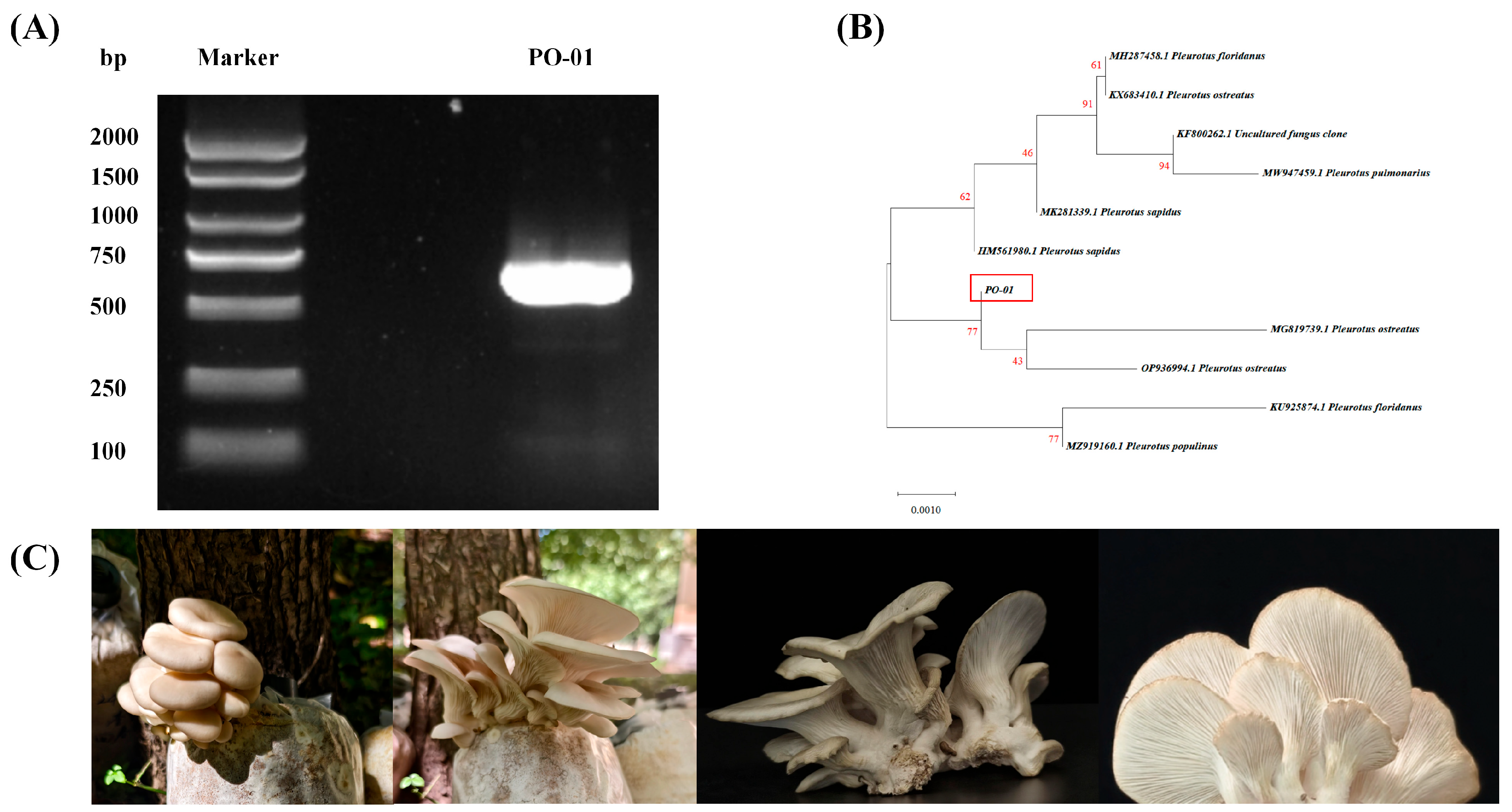
The genomic DNA of the sample was extracted by the High Salt and Low pH Method. Then, a Quawell Q5000 ultramicro spectrophotometer was used to quantify and analyze the purity of the extracted DNA. The results showed a DNA concentration of 209.450 ng/μL, with A260/A280 and A260/A230 absorbance ratios of 1.905 and 1.832, respectively, indicating high DNA purity with minimal contamination and impurities and meeting the requirements of subsequent molecular biology experiments. Moreover, agarose gel electrophoresis analysis of the PCR amplification products showed a single, bright specific band for strain PO-01 between 500 bp and 750 bp, demonstrating that the ITS4/5 primers could efficiently and specifically amplify the ITS sequence fragment of this strain (Figure 1A).
The ITS sequence of sample PO-01 showed 99.83% similarity to P. ostreatus sequences (MG819739.1 and OP936994.1) in the NCBI database, with an E-value near zero. The full-length ITS sequence of PO-01 was 667 bp, and 585 bp after removing primer sequences and low-quality regions. Ten sequences with >99% similarity from NCBI were selected, and a phylogenetic tree of PO-01 was constructed using the Neighbor-Joining method in MEGA11. Based on the tree and morphological photos, PO-01 clustered with two P. ostreatus strains. In fruiting body morphology, it had a clustered distribution, milky-white fan-shaped to subcircular pilei with regular margins, and laterally attached stipes with adherent bases. These characteristics were consistent with the white phenotype of P. ostreatus, validating molecular identification results. Thus, the PO-01 strain was identified as Pleurotus ostreatus (Figure 1B,C).

3.2. Screening of Optimal Conditions, Culture Substrates, and Ratios for Strain Activation, Propagation, and Cultivation

3.2.1. Single-Factor Experiments for Strain Activation and Propagation

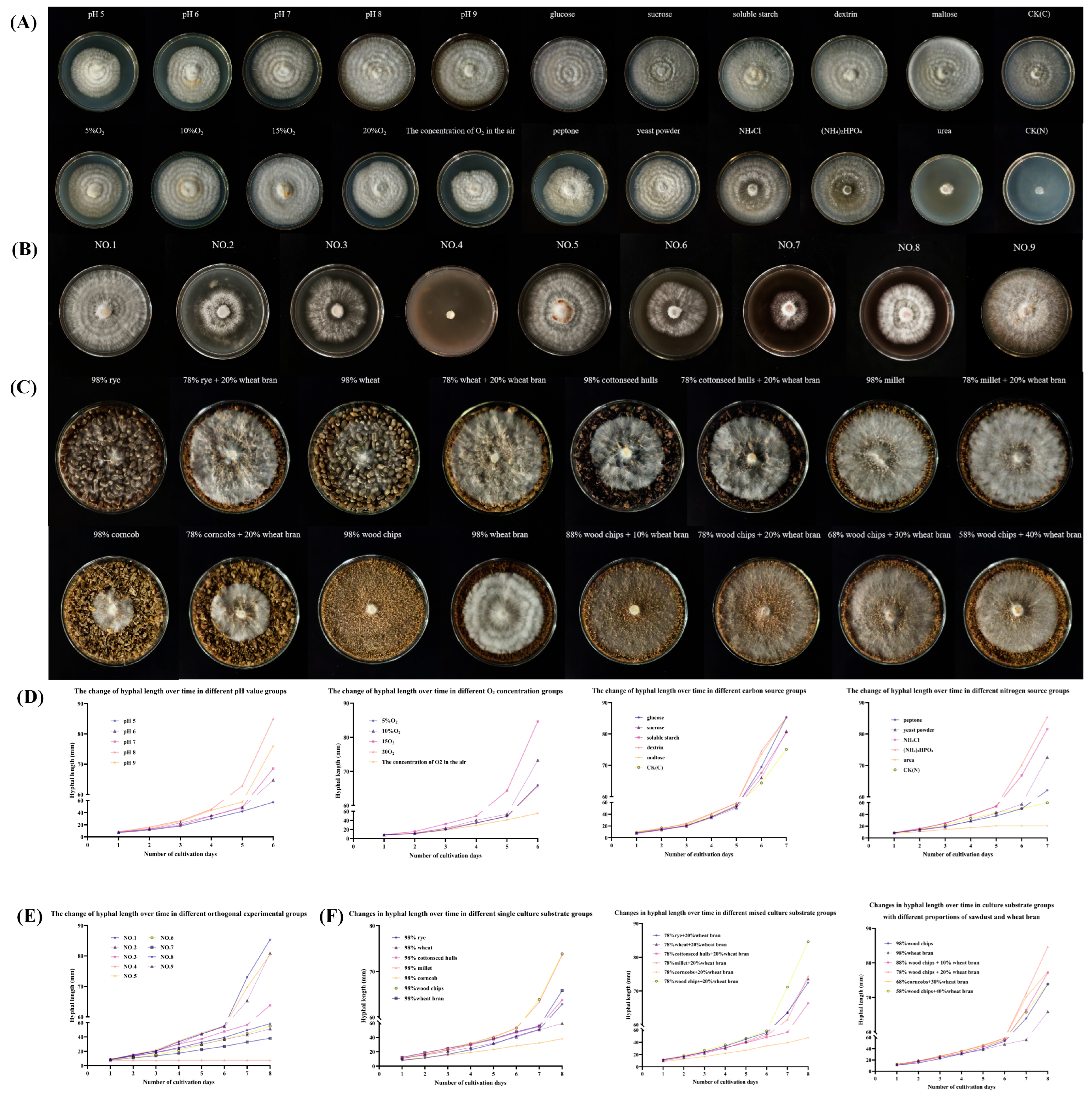
Based on mycelial growth measurements and image analysis, P. ostreatus grew better in neutral-to-slightly alkaline environments (pH: 8 > 9 > 7) than acidic conditions, inhibiting acidophilic contaminants and buffering metabolic organic acids. A 15% O2 concentration was more conducive to growth than normal air (meeting respiratory needs while avoiding oxidative damage), with optimal O2 levels of 15% > 10% > 5% (screened in 10 experiments). Carbon sources impacted growth less than nitrogen sources (minor mycelial length/density differences). Nitrogen deficiency severely inhibited growth; P. ostreatus had low urea utilization, while (NH4)2HPO4 showed the strongest promotion. Through screening in 12 groups of experiments, the optimal levels were identified as follows. Carbon sources: glucose, dextrin, maltose; nitrogen sources: (NH4)2HPO4, NH4Cl, yeast powder (Figure 2A,D; Tables S6–S9 and S24–S27).

3.2.2. Orthogonal Experiments for Strain Activation and Propagation

A L9(34) orthogonal test analyzed pH, O2 concentration, and carbon and nitrogen sources’ effects on P. ostreatus mycelial growth. Results showed nitrogen source (R = 38.98) and O2 concentration (R = 22.94) had much higher range values than carbon source (R = 19.79) and pH (R = 19.10), making them key growth factors. The theoretical optimal combination was “pH 7, 15% O2, glucose, yeast powder”. The discrepancy from single-factor experiments reflected the O2 interaction with other factors—e.g., in Group No. 4 (low O2 (5%), pH 8, (NH4)2HPO4, dextrin), and mycelia did not grow, remaining at 7.51 mm. Since O2 is regulable and its interaction affects growth, subsequent studies will take O2 as the starting point to explore different O2 concentrations’ mechanism (Figure 2B,E; Tables S5, S10 and S28).

3.2.3. Screening of Optimal Culture Substrates and Ratios for Mycelial Cultivation

Based on single-factor experiments and mycelial growth photos, “78% wood chips and 20% wheat bran” was identified as the optimal culture substrate—here, mycelia fully covered the medium first and had high density. Comparing seven single substrates (98%) and six mixed combinations (78% substrate and 20% wheat bran), adding wheat bran significantly enhanced mycelial density and growth rate. The 98% wheat bran and 98% wood chips groups showed the most obvious density difference, confirming wheat bran’s promotion. Thus, “78% wood chips, 20% wheat bran, 1% lime, 1% gypsum” was selected. Among four wood chip–wheat bran ratios, 88% wood chips and 10% wheat bran performed worst, while 78% and 20% was best, so this combination was used for subsequent experiments on O2/gas effects on mycelial growth, fruiting body development, and lignocellulose degradation (Figure 2C,F; Tables S11 and S29–S31).

3.3. Agronomic Trait Analysis of P. ostreatus Mycelia and Fruiting Bodies Under Different O2 Concentrations and Gas Conditions

3.3.1. Mycelial Growth Under Different O2 Concentrations and Gas Compositions

In previous experiments, the impact of O2 on strain activation and propagation using synthetic medium as the substrate drew our attention. However, unlike synthetic medium, the effects of oxygen concentration (high or low oxygen levels) and gas composition (N2 or CO2) on mycelial growth of P. ostreatus in its cultivation substrate (78% wood chips, 20% wheat bran, 1% lime, 1% gypsum) remain unclear. Thus, this experiment aims to conduct in-depth investigations into these two key gas factors.
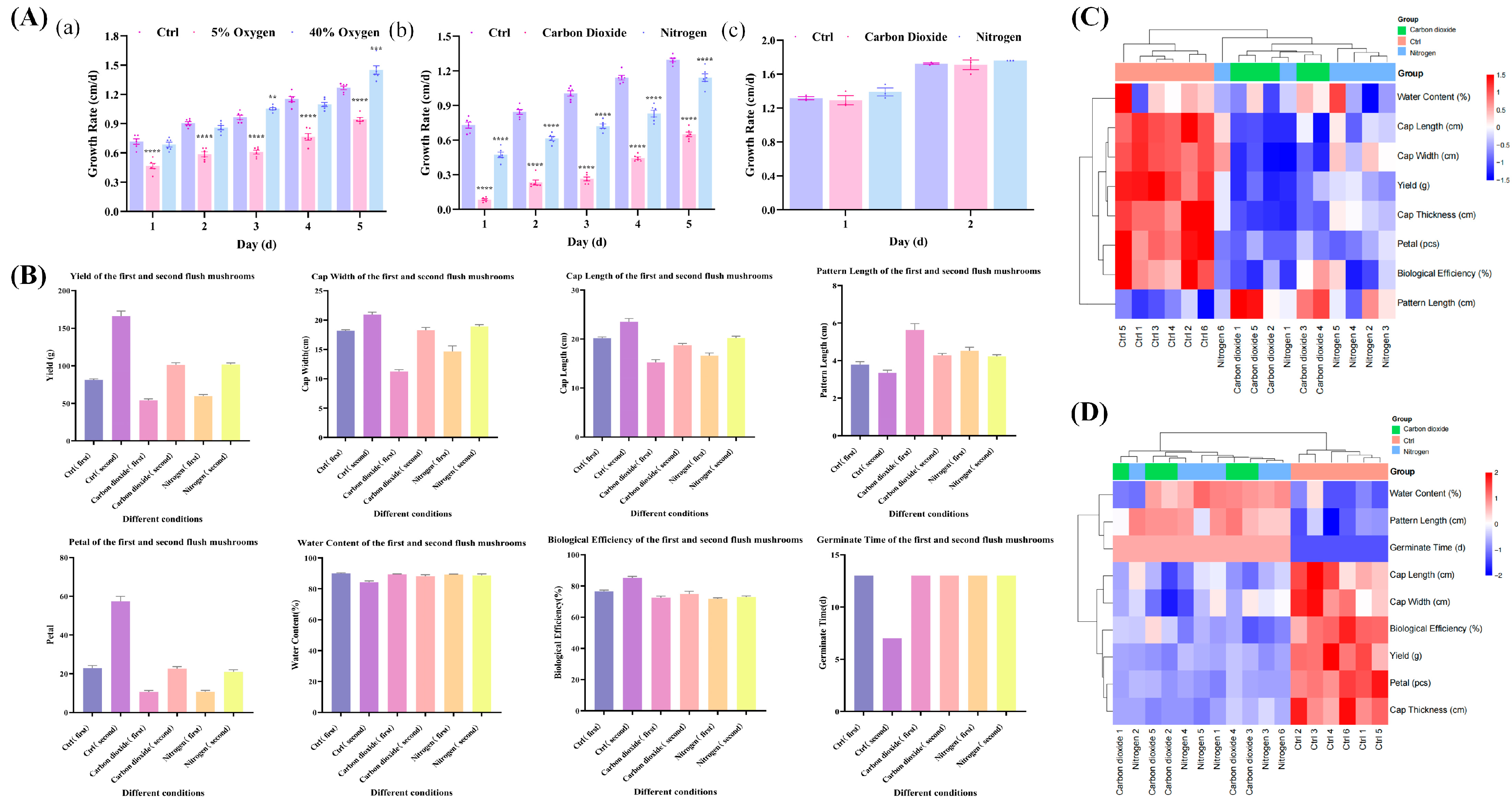
O2 concentration had a significant impact on the growth rate of P. ostreatus mycelia at different cultivation times. From day 1 to day 5, the mycelial growth rate was slow under 5% O2, which was significantly lower than that in the Ctrl1 group and the 40% O2 group. In the first two days, the growth rates of mycelia in the Ctrl1 group and the 40% O2 group were close, and both were higher than that in the 5% O2 group. From day 3 to day 5, the mycelial growth rate in the 40% O2 group remained at a high level, especially on the 5th day; its growth rate was significantly higher than other groups. The growth rate of mycelia in the Ctrl1 group also showed an increasing trend during the cultivation process, but the increase was smaller compared to that in the 40% O2 group. In conclusion, low-oxygen treatment inhibited P. ostreatus mycelial growth rate, while high-oxygen promoted it—contrasting with our prior finding that low O2 favored growth in synthetic medium. This is likely because synthetic medium has simple nutrients and low metabolic demand: moderate low O2 avoids oxidative damage to match this demand. In contrast, complex substrates (wood chips, wheat bran) require lignocellulose degradation, relying on lignocellulolytic enzyme synthesis/metabolism (e.g., laccase, cellulase). High O2 provides energy for enzyme processes and compensates for insufficient O2 diffusion in substrates, supporting degradation. Low O2 fails to meet high energy/O2 demands, inhibiting growth. This reflects a substrate-driven adaptation: mycelia adjust O2 response, low O2 avoids oxidative stress in simple substrates, and high O2 ensures efficient degradation in complex ones (Figure 3A(a)).
As observed from Figure 3A(b), during the 1–5 days, the mycelial growth rate of the Ctrl2 group was markedly higher than the N2 and CO2 groups. Notably, on the 5th day, the mycelia in the Ctrl2 group fully covered the culture medium first, indicating that natural air is the most beneficial for the growth of P. ostreatus mycelia. In contrast, in the treatment groups with N2 or CO2 ventilation, the mycelial growth was slower, and their growth rates were consistently lower than the Ctrl2 group within 5 days. This implies that a single high concentration of N2 or CO2 inhibits the growth of P. ostreatus mycelia, with CO2 exerting a stronger inhibitory effect. After 3-day ventilation of N2 or CO2 followed by 2-day restoration of O2 ventilation, the mycelial growth rate changed. At this point, the differences in mycelial growth rates between the FYCO2 and FYN2 groups and the Ctrl2 group diminished, suggesting that after the initial exposure to an adverse gas environment, restoring O2 ventilation can promote mycelial growth (Figure 3A(c)).

3.3.2. The Growth of Fruiting Body with Different Gas Compositions

Comprehensive analysis of the eight groups of bar graphs in Figure 3B revealed that the effects of different gas compositions on the agronomic traits of P. ostreatus fruiting bodies exhibited a regular pattern. In terms of yield, both for the first flush and the second flush of mushrooms, the fruiting body yield in the Ctrl group was significantly higher than that in the CO2 group and N2 group. The change trends of cap width and cap length were consistent with those of yield, as the caps in the CO2 group and N2 group were narrower and shorter than those in the control group. In contrast, stipe length showed an opposite pattern, with the stipe length in the CO2 group and N2 group being significantly longer than that in the control group. The petal number in each treatment group decreased. There was no significant difference in fruiting body water content among all groups. Biological efficiency in the treatment groups was lower than that in the Ctrl group, while no obvious change in germinate time was observed among the groups.
In the heatmap of the first-flush mushrooms, the CO2 and N2 treatment groups exhibited cool-color regions, showing negative correlations with morphological parameters, yield components, and petal number, but positive correlations with stipe length. This indicates that high concentrations of CO2 or N2 inhibited the fruiting body formation of P. ostreatus, specifically manifested as abnormal cap morphology, excessive stipe elongation, and reduced reproductive output. Such inhibition may result from dysregulation of fungal respiratory metabolism and nutrient allocation. In contrast, the normal air group displayed warm-color regions, showing positive correlations with most indicators, except for stipe length [22]. The heatmap of the second-flush mushrooms showed a similar yet distinct trend. At the second flush stage, the inhibitory effect of high-concentration CO2 or N2 was alleviated. The normal air group displayed positive correlations with six indicators and exhibited a significant promoting effect, indicating that normal air continuously provided suitable growth conditions. In summary, normal air conditions are conducive to the growth of P. ostreatus, and the two types of gas stress have similar negative impacts on P. ostreatus; from a statistical perspective, it also suggests that the resource allocation of P. ostreatus under gas stress is biased (Figure 3C,D).

3.3.3. Relationship Between Experimental Treatments and Agronomic Traits

Through the above-mentioned experimental analysis, appropriately increasing the O2 concentration can promote mycelial growth, while high-concentration N2 or CO2 inhibits mycelial growth and fruiting body development. During the cultivation process, precisely regulating the gas environment according to different growth stages (mycelia, first-flush mushrooms, second-flush mushrooms, etc.) and exploring the effects of different gas–concentration combinations and a dynamically changing gas environment on the growth and development of P. ostreatus are of great significance for improving the yield and quality of P. ostreatus.

3.4. Metabolomic Analysis

3.4.1. Quality Control of QC Samples and Verification of Data Reliability

In this study, metabolites in mycelia were detected using ultra-high-performance liquid chromatography-high resolution mass spectrometry (UHPLC-HRMS). After metabolite extraction and instrumental analysis, the quality control results showed that the retention time and response intensity of internal standards in QC samples exhibited good stability; no obvious peaks of internal standards were detected in blank samples, indicating controllable cross-contamination; QC samples showed good clustering in the PCA score plot, with the one-dimensional distribution of PCA-X falling within ±2 standard deviations (STD); high correlation was observed; and the median relative standard deviation (RSD) of internal standard responses was ≤10%. In summary, the sample quality, experimental methodology, and system stability were all satisfactory (Figure S1).

3.4.2. Analysis of Differential Mycelial Metabolites and Metabolic Pathways

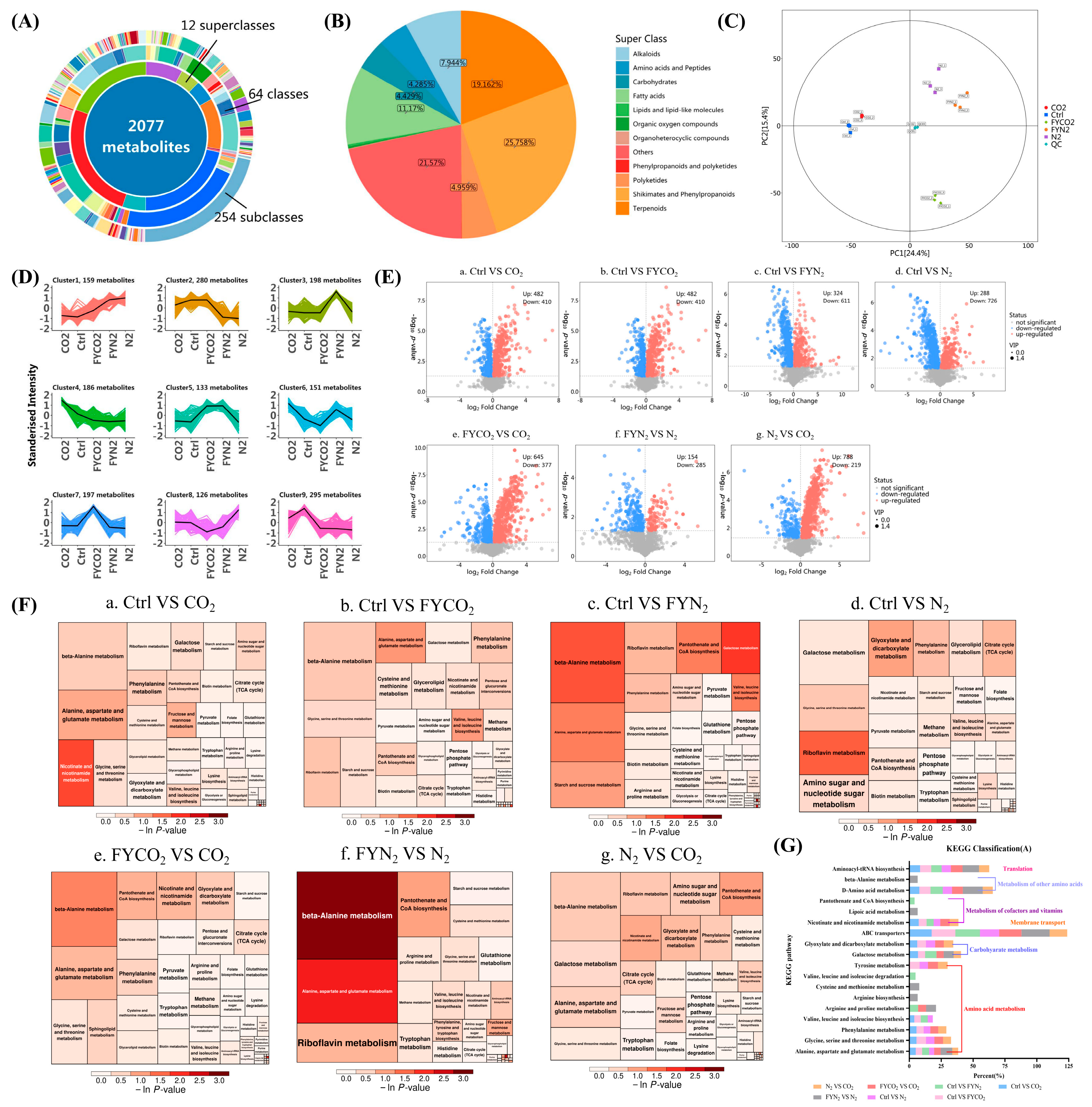
A differential analysis was performed on mycelia metabolites in different gas compositions. Five sample groups (CO2, Ctrl2, FYCO2, FYN2, N2) were set up, with three biological replicates each, making 15 samples in total. Metabolomics technology was used for comprehensive analysis, and seven sets of metabolite comparative analyses were conducted: Ctrl2 vs. CO2, Ctrl2 vs. FYCO2, Ctrl2 vs. FYN2, Ctrl2 vs. N2, FYCO2 vs. CO2, FYN2 vs. N2, and N2 vs. CO2. Differential metabolite analysis identified 2077 samples in 12 Super Classes. The relative expression levels of metabolites differed among sample groups. Using K-Means clustering, differential metabolites were divided into nine clusters. Metabolites in each cluster exhibited specific normalized content variation trends across the five groups (Figure 4A,B,D). The Ctrl2 group was similar to the CO2 group in metabolite types and contents, and the N2 group was similar to the FYN2 group, but there was a large metabolic difference compared to the FYCO2 group (Figure 4C). Then, a detailed analysis of differential metabolites and their correlations was carried out, and differential metabolites like vanillic acid and ferulic acid, closely related to lignin metabolite transformation, were screened (Figure 4E).
Using Figure 4F,G and Figure S2, and Table S12, we analyzed P. ostreatus mycelial metabolic pathways. “Carbohydrate metabolism” (including “Galactose metabolism” and “Glyoxylate and dicarboxylate metabolism”) is key, providing energy, carbon sources, and supporting growth, material transformation, and cell structure [23,24,25]. “Amino acid metabolism” is highly enriched, critical for growth, development, protein synthesis, enzyme production, and signal transduction [26]. “Membrane transport” involves “ABC transporters” for nutrient uptake and waste excretion, ensuring intracellular stability [27,28]. Nicotinic acid and nicotinamide in “Metabolism of cofactors and vitamins” assist enzymatic reactions [29]. “D-Amino acid metabolism” aids cell wall synthesis and signal transduction [30]. “Aminoacyl-tRNA biosynthesis” is vital for protein translation. “Global and overview maps” reflect metabolic complexity and diversity. Grouped pathway analysis based on Figure 4F revealed the regulatory patterns of environmental stress: under CO2/N2 stress, the enrichment levels of pathways such as carbohydrate metabolism (e.g., galactose metabolism) and amino acid metabolism significantly decreased (as indicated by lighter colors and smaller squares). This indicated that energy and carbon flow were impeded, directly hindering the synthesis of substances related to lignin degradation and energy supply. In contrast, under O2 recovery treatments (FYCO2/FYN2), metabolic processes including β-alanine metabolism were significantly activated, which offset the inhibition of amino acid synthesis to maintain enzymatic reactions and promoted the oxidation of lignin derivatives (e.g., up-regulation of salicylic acid). Comparisons between treatments (e.g., FYCO2vsCO2, FYN2vsN2) revealed that the recovery of pathways such as “amino sugar and nucleotide sugar metabolism” and “glycolysis-gluconeogenesis” further confirmed that O2 can reverse the inhibitory effects of CO2/N2.

3.4.3. Metabolomics Data Analysis of Multiple Derivatives During Degradation of Three Types of Lignin (G-Lignin, S-Lignin, H-Lignin)

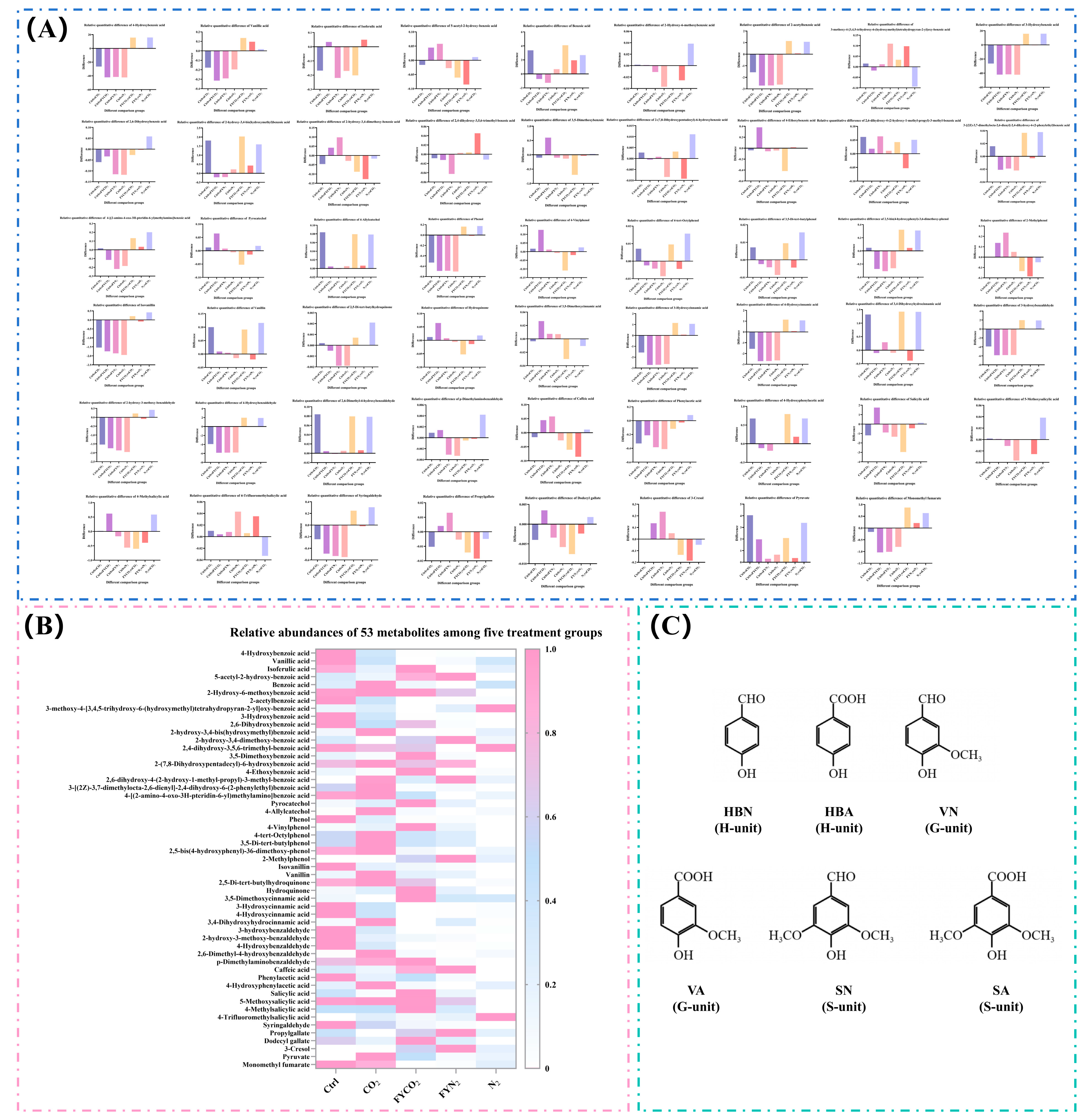
Lignin, a core aromatic polymer in plant cell walls formed by three phenylpropane monomers (guaiacyl, syringyl, and p-hydroxyphenyl) into a three-dimensional network via β-O-4 ether and C-C bonds, gives plants mechanical strength but hinders biomass conversion. Thus, elucidating efficient lignin degradation is key for high-value biomass utilization. White-rot fungi fully mineralize lignin by secreting laccase (Lac), manganese peroxidase (MnP), and lignin peroxidase (LiP), which break lignin’s aromatic rings and bonds via free radical reactions to produce aromatic derivatives. We analyzed metabolomics data from seven comparison groups. The chemical structures of six typical aromatic derivatives produced during lignin degradation are presented in Figure 5C and Table S13. Additionally, 53 aromatic derivatives related to the degradation of three types of lignin were selected for comparative study [31]. The heatmap visually illustrates the differences in relative abundance of 53 types of aromatic metabolites among different treatment groups via normalized relative quantitative analysis. Observing metabolite-related content in bar graphs and heatmaps, most aromatic derivatives in non-control groups (e.g., CO2, N2) decreased, while those in the Ctrl group were higher. This suggests gas regulation (high CO2/N2) may weaken lignin degradation key steps (e.g., aromatic ring epoxidation, β-O-4 ether bond cleavage) by inhibiting white-rot fungi’s degrading enzyme activity. Reduced lignin degradation efficiency lowered downstream aromatic derivatives (e.g., 4-Hydroxybenzoic acid, vanillic acid), making treatment groups’ metabolite content much lower than the Ctrl group. In summary, gas regulation inhibited lignin degradation and reduced aromatic derivative accumulation (Figure 5A,B, Tables S14, S15 and S32).
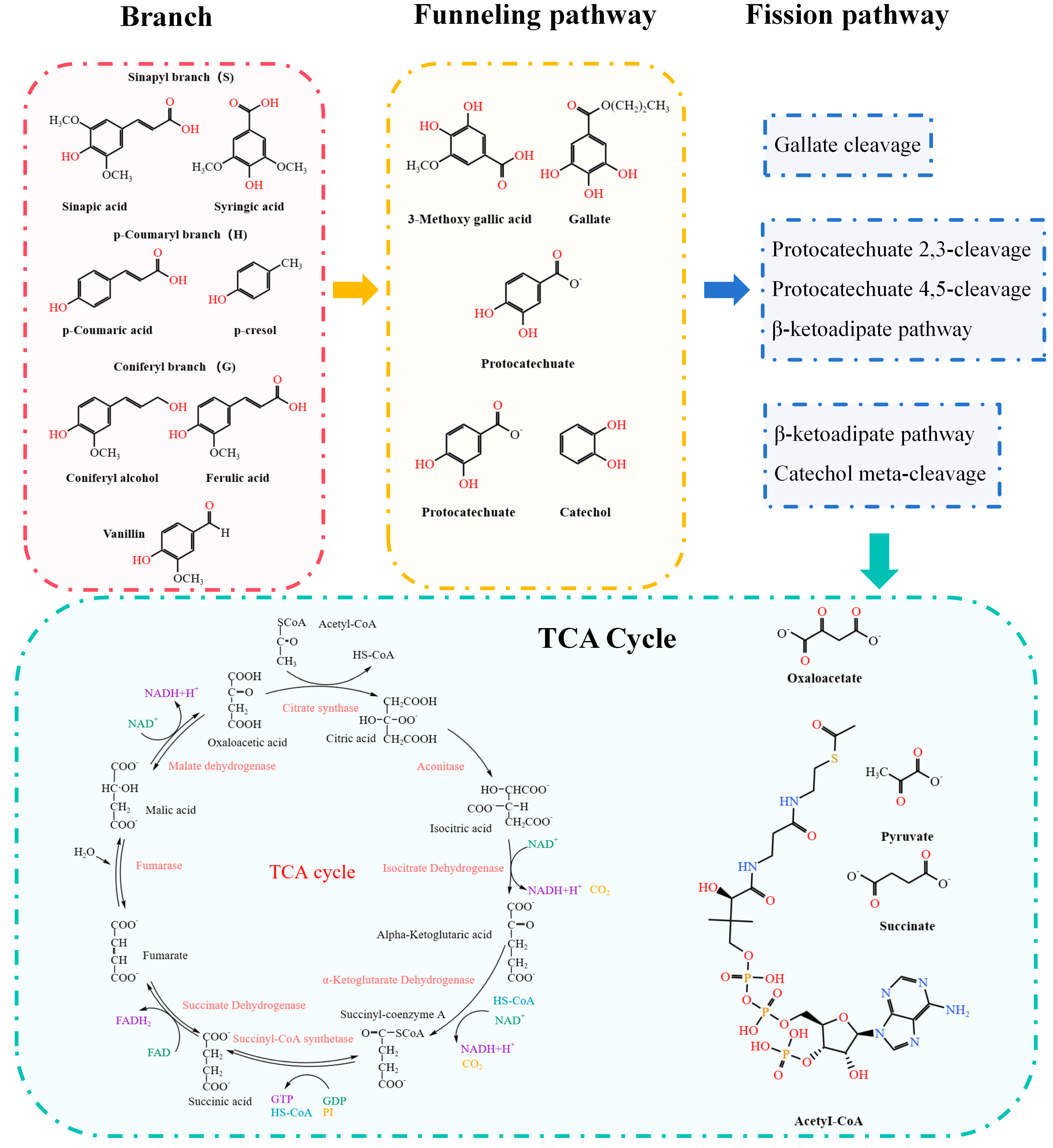
Figure 6 illustrates lignin’s metabolic mechanism via three hierarchical processes (branch metabolism, funneling, fission pathway) integrated into the tricarboxylic acid (TCA) cycle. The differential abundance of 53 aromatic metabolites across treatments is explained by this cascade: First, structurally diverse lignin-derived metabolites (e.g., p-coumaric acid, ferulic acid) in branch metabolism cause initial abundance variations. Then, the funneling pathway channels them into core intermediates (e.g., protocatechuate, catechol). Next, the fission pathway uses multiple aromatic ring-cleavage routes to break these intermediates into small molecules, which finally enter the TCA cycle for energy production or precursor synthesis. This cascade explains how treatments (e.g., O2, CO2, N2 regulation) modulate aromatic metabolite abundance [32,33,34].

3.5. Effects of Different O2 Concentrations and Gas Compositions on the Degradation of Lignocellulose in P. ostreatus-Inoculated Residue

The degradation efficacy of P. ostreatus on three lignocellulose components (cellulose, hemicellulose, and lignin) in fungal residue under varying O2 concentrations and gas compositions was systematically evaluated based on quantitative analysis.

3.5.1. Effects on Lignin Degradation

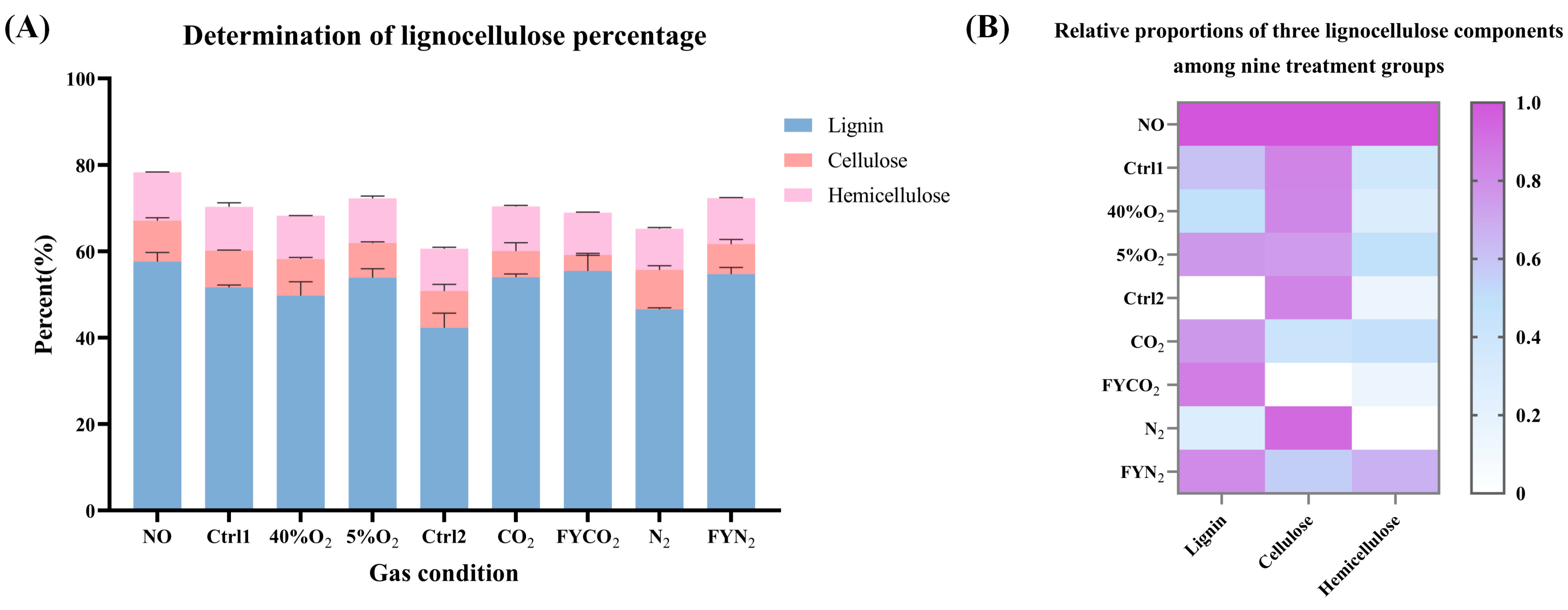
Compared with the NO group (non-inoculated), all groups inoculated with P. ostreatus had lower lignin content in fungal residue, confirming that P. ostreatus effectively decomposes lignin. Among inoculated groups with different gases, lignin content changes varied significantly: the Ctrl2 group showed the largest decrease (57.62% → 42.33%), indicating its gas environment best supports P. ostreatus’ lignin-degrading ability. This aligns with downregulated lignin degradation products in metabolomics data (Tables S14 and S15; Figure 5A,B), likely because the gas meets P. ostreatus’ optimal growth and enzyme secretion needs. The 40% O2 and N2 groups also had significant decreases (7.87% and 11.01%, respectively), showing that high oxygen or single N2 benefits lignin decomposition. In contrast, 5%O2, CO2, FYCO2, and FYN2 groups had smaller decreases—low oxygen/high CO2 may limit P. ostreatus’ respiration, enzyme activity, and metabolism, with early gas impacts persisting post-O2 restoration (Figure 7; Table 1).
Mechanisms of Action of Enzymes During Lignin Degradation
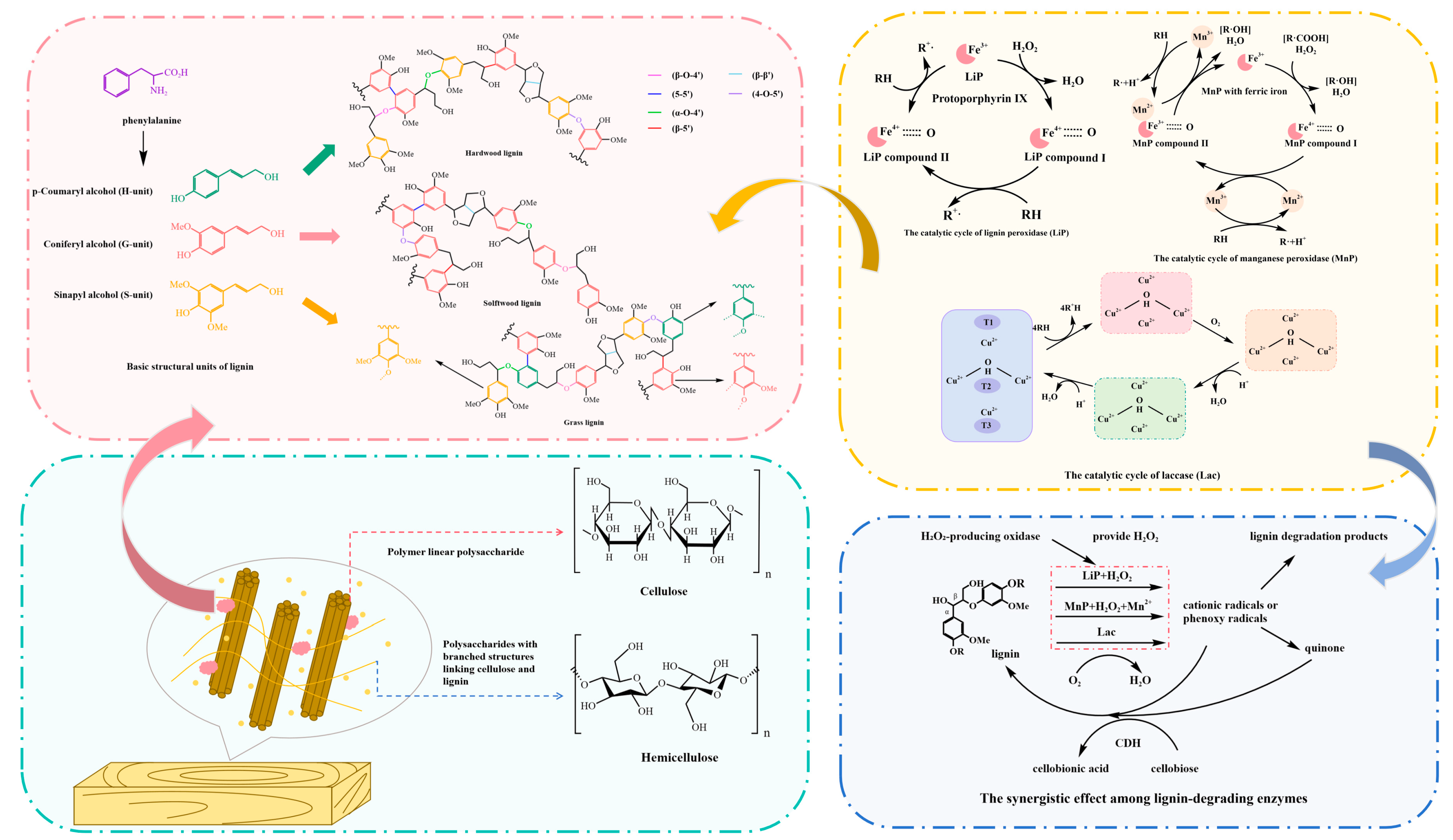
Previous studies showed that gas environment regulates P. ostreatus’ lignin degradation efficiency by affecting its secreted lignin-degrading enzymes (LiP, MnP, Lac, VP; Figure 8). LiP, a heme-based enzyme, starts peroxidase-catalyzed oxidation with H2O2: H2O2 oxidizes LiP to 2-electron-losing LiP Compound I, which oxidizes aromatic substrates and gains 1 electron to form LiP Compound II, which then gains another electron to return LiP to its initial state. MnP, a glycosylated ferroheme protein (key for lignin degradation), oxidizes lignin’s aromatic rings via H2O2. It oxidizes Mn2+ to Mn3+, which complexes with carboxylic acids to degrade phenolics. Lac, a blue copper-containing monomeric glycoprotein, catalyzes O2-centered redox reactions via four consecutive single-electron oxidations. Electrons transfer to O2 to form water, with no reactive oxygen radicals, and Lac reverts to initial state. VP, a new heme peroxidase, fuses MnP and LiP functions. It has unique binding/catalytic sites and low-redox-potential substrate sites (breaking substrate limits), important for lignin degradation and refractory pollutant treatment [35,36,37,38,39,40,41,42].
Bioinformatics Characterization of Lignin-Degrading Enzymes as Biological Macromolecules
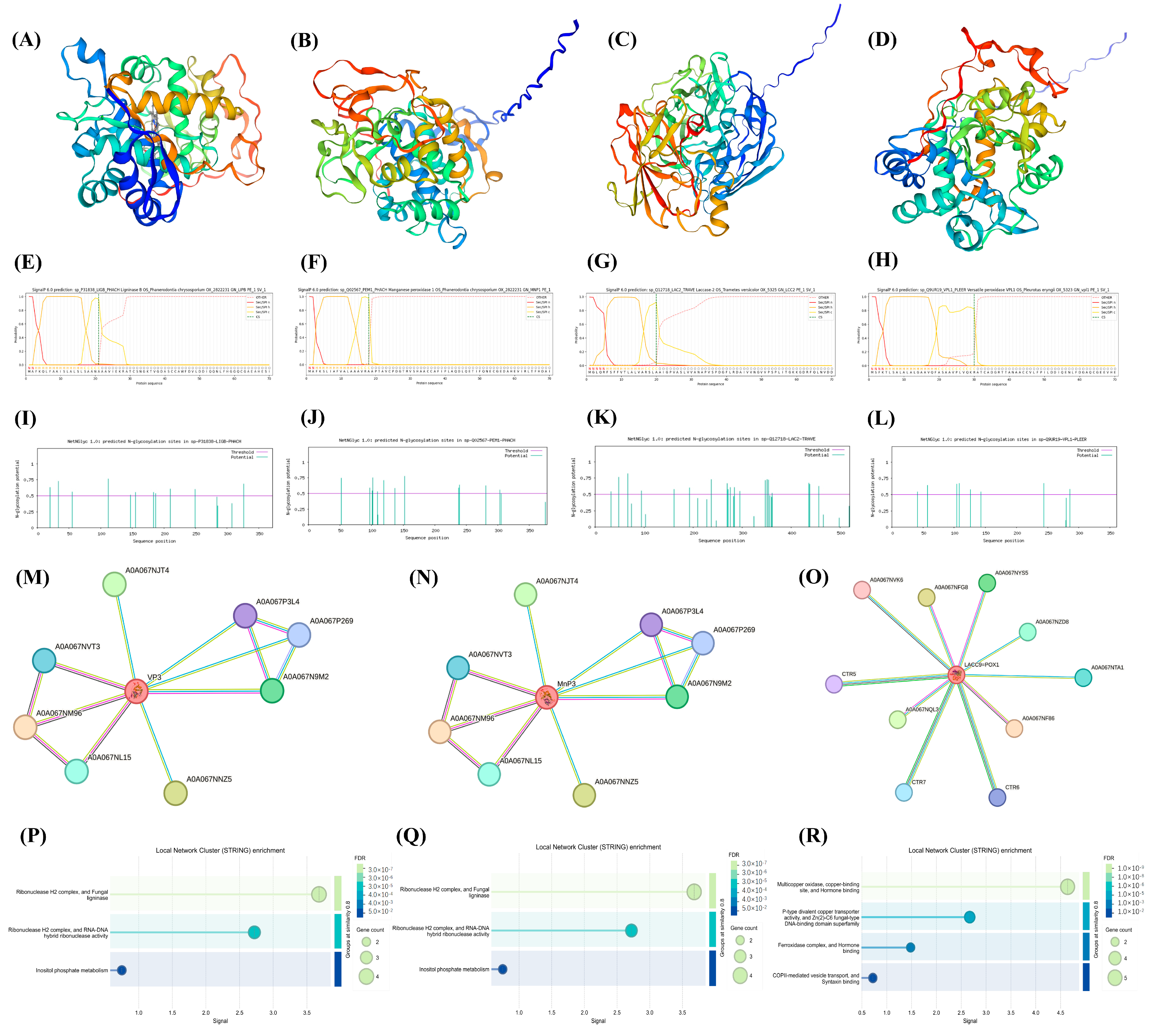
Integrating bioinformatics results, the four lignin-degrading enzymes exhibit high structural and functional synergism and substrate adaptability (Tables S17 and S18). LiP’s hydrophilicity facilitates liquid-phase diffusion, while MnP, Lac, and VP’s hydrophobicity enhances binding to solid lignocellulose. Lac’s high structural stability and multi-copper center support lignin and phenolics oxidation. Functional site analysis shows LiP’s Fe3+-binding site, MnP’s Mn2+-binding pocket, Lac’s multi-copper centers, and VP’s metal–heme composite binding site are catalytic cycle cores. Their three-dimensional arrangement optimizes substrate binding and electron transfer, forming a “metal dependence-structural adaptation-substrate specificity” degradation mechanism (Tables S19 and S20; Figure 9A–D). Signal peptide and N-glycosylation predictions explain enzyme secretion and function maintenance. All four have Sec/SPI-type signal peptides, secreted extracellularly via the Sec pathway (fitting “extracellular lignin degradation”), and N-glycosylation sites ensure activity by enhancing secretion stability, protecting catalytic centers, and strengthening substrate adsorption (Figure 9E–L). Figure 9M–R shows VP3 and MnP3 have similar protein interaction networks (overlapping core proteins) and rely on RNA metabolism-related proteins to clear RNA-DNA hybrids and regulate physiology via phosphatidylinositol [43]. LACC9 = POX1’s unique network involves lignin degradation, enzyme homeostasis, copper transporters, and vesicle transport (multi-system regulation), complementing VP3/MnP3 to build a multi-dimensional lignin degradation network.

3.5.2. Effects on Cellulose Degradation

Compared with the NO group (non-inoculated, cellulose content 9.46%), all P. ostreatus-inoculated groups had lower cellulose content in fungal residue (3.69–9.07%), confirming P. ostreatus can decompose cellulose (Figure 7; Table 1). Gas environment significantly affected its cellulose-degrading ability: FYCO2 and CO2 groups showed the most significant decrease, most conducive to cellulose decomposition—likely due to CO2 environment and subsequent O2 restoration enhancing cellulolytic enzyme secretion and activity [44]. The N2 group had cellulose content similar to the NO group; a single N2 environment restricted P. ostreatus’ metabolic activities, hindering its decomposing ability. Among groups with different O2 concentrations, the 5% O2 group had a more significant cellulose decrease, indicating O2 concentration changes affect P. ostreatus’ respiratory metabolism and enzyme activity, thereby promoting cellulose decomposition. In summary, inoculation with P. ostreatus reduced cellulose content in fungal residue.
PCR and Protein Alignment-Based Functional Analysis of the AA9 Gene
Differences in degradation rates across groups show that gases (especially O2) can regulate lignocellulose degradation activity by affecting mycelial growth and lignocellulose derivative metabolism. AA9, a copper-dependent redox enzyme in the lytic polysaccharide monooxygenase family (auxiliary activity family 9), mediates filamentous fungal lignocellulose degradation. It activates O2/H2O2, couples with electron donors to catalyze cellulose C1/C4 oxidative cleavage, enhancing lignin–cellulose complex degradation efficiency [45].
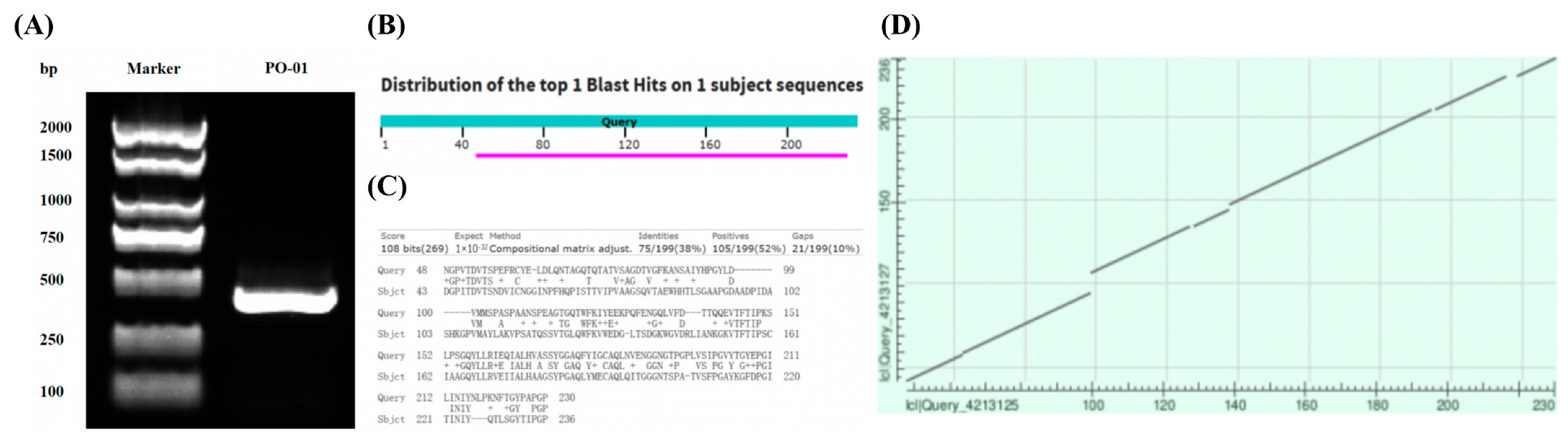
To analyze the molecular basis of AA9 family polysaccharide monooxygenases in P. ostreatus, we investigated the P. ostreatus PC9 strain, whose whole-genome sequencing has been completed. An AA9 gene retrieved from NCBI was named PC9H_000909 (Gene ID: 59370750; encodes 310 amino acids, full-length 1565 bp). To confirm this gene in strain PO-01, PCR primers were designed targeting its 363 bp conserved functional domain: forward (F: 5′-GCCTATCACCGATGTCACTTC-3′), reverse (R: 5′-CACTTGCCATCAGAGGTAAGAC-3′), Tm 55 °C, expected product 294 bp. Results showed a single bright specific band (250–500 bp) in PO-01, matching the expected length. This proved PC9 F/R primers efficiently amplified the target, preliminarily verifying the AA9 gene (for cellulose degradation) in PO-01 at the molecular level (Figure 10A). To investigate AA9 family protein function in P. ostreatus, this study used NCBI BLAST to align PC9 strain’s AA9 protein (GenBank: KAF7440563.1) with S. pruinosum’s validated AA9 (GenBank: BAL43430.1) (Table S17). Results showed that their core functional domain (amino acids 43–236) is significantly conserved: purple bands in alignment scores cover key catalytic regions (a conservation hotspot); sequence identity is 38% (75/199); and positivity rate 52% (105/199). Despite amino acid differences, similar chemical properties maintain catalytic center spatial conformation (e.g., copper-binding motifs), supporting lytic polysaccharide monooxygenase function. Alignment dot plots showed high-density matching sites concentrate at amino acids 100–200, verifying polysaccharide degradation function conservation (Figure 10B–D).
Bioinformatics Analysis of the AA9 Protein
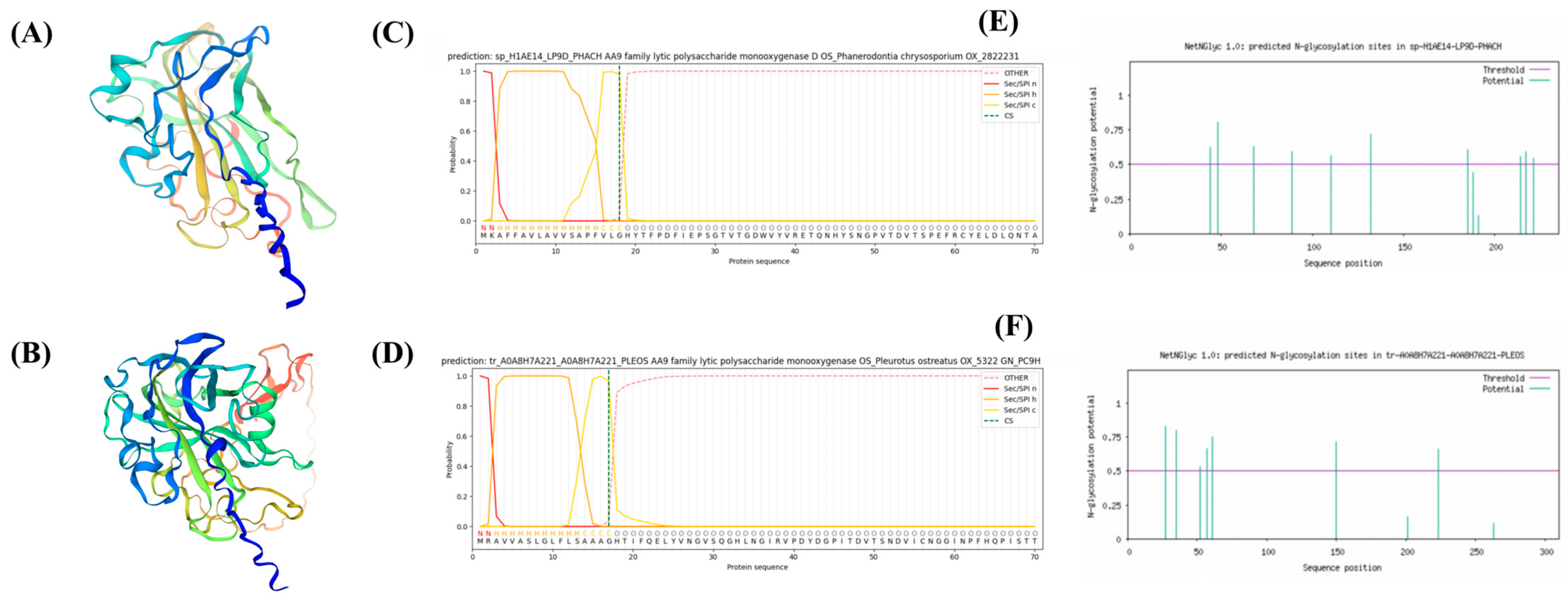
Bioinformatics analysis of the AA9 proteins from S. pruinosum and P. ostreatus was performed (Table S17). Functional site annotation revealed that S. pruinosum AA9 contains binding sites for Cu2+ (positions 19/94/178) and O2 (positions 167/176), which mediate metal ion binding and monooxygenase activity, thereby participating in cellulose decomposition. Although the functional sites of P. ostreatus AA9 are not fully annotated, annotations related to “cellulase activity” and “cellulose binding” suggest convergence in their catalytic mechanisms. Physicochemical property analysis showed interspecific differentiation; differences in molecular weight and hydrophilicity/hydrophobicity of S. pruinosum AA9 may be related to preferences for lignin substrate types. Three-dimensional structure prediction revealed that both proteins adopt an α/β fold as the core conformation. SignalP 6.0 prediction indicated that both AA9 proteins contain Sec/SPI-type signal peptides (with a probability > 0.999), with cleavage sites located at positions 17–18 (P. ostreatus) and 18–19 (S. pruinosum), respectively, suggesting efficient secretion extracellularly via the Sec pathway. NetNGlyc 1.0 prediction found that P. ostreatus AA9 scored > 0.5 at positions such as 27/35/57, while S. pruinosum AA9 showed high scores at positions such as 44/48/68. These potential N-glycosylation sites may regulate enzymatic activity (Figure 11A–F; Tables S21 and S22).

3.5.3. Effects on Hemicellulose Degradation

When comparing the NO group with each inoculated group, the hemicellulose content in the non-inoculated group was 11.17%, while that in each treatment group after inoculation with P. ostreatus fluctuated between 9.56% and 10.64%, with a decrease ranging from 0.53% to 1.61%. Specifically, the content in the Ctrl2 group, FYCO2 group, and N2 group decreased by 1.38%, 1.39%, and 1.61%, respectively. Although the decrease in these groups was slightly larger than that in other groups, the advantage was not prominent. This indicates that P. ostreatus has limited ability to decompose the hemicellulose in fungal residue, and its decomposition effect on hemicellulose is weaker than that on lignin. This may be more determined by its own physiological characteristics and basic metabolic mechanisms rather than changes in gas conditions (Figure 7 and Table 1).

3.6. Effects of Gas Environment on Polysaccharide Accumulation and Bioethanol Potential in P. ostreatus-Inoculated Residue

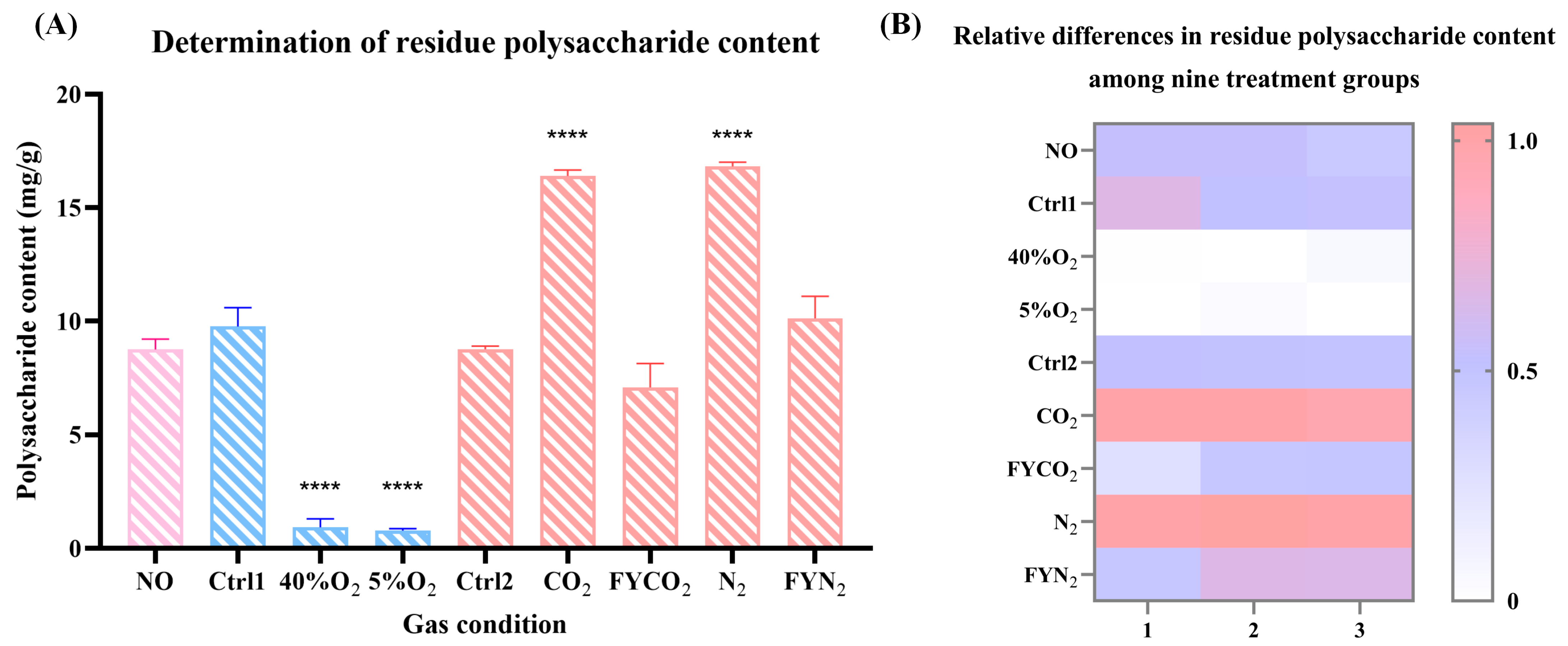
Taking the NO group’s fungal residue polysaccharide content (8.76 mg/g) as a reference, the N2 and CO2 groups had significantly higher content (16.82 mg/g, 16.41 mg/g). After O2 restoration, FYN2 and FYCO2 groups decreased by 6.68 mg/g and 9.31 mg/g, indicating high N2/CO2 promote polysaccharide accumulation (possibly stimulating synthesis/inhibiting decomposition [46]). The Ctrl1 group rose to 9.77 mg/g, while Ctrl2 remained stable (8.78 mg/g). Though 40% O2 and 5% O2 groups’ data were out of range, O2’s effect on P. ostreatus metabolism (altering polysaccharide content) led to their inclusion in subsequent bioethanol yield calculation (Figure 12; Table 2 and Table S33).
Polysaccharides in fungal residue are key for bioethanol, whose content impacts yield. This experiment calculated ethanol yields from cellulose, hemicellulose, and polysaccharides in residue via formulas (Table S16). The residue, once non-recyclable after P. ostreatus cultivation, can produce bioethanol after treatment/optimization, broadening raw material sources for agro-forestry waste utilization [47,48]. Residues in different gas groups showed significant indicator fluctuations: bioethanol yield ranged 73.63–105.70 L·ha−1, with FYCO2 lowest, N2 highest, and Ctrl1/Ctrl2/FYN2 similar—due to conversion efficiencies of cellulose, hemicellulose, and polysaccharides (the FYCO2 group had high cellulose and hemicellulose decomposition but polysaccharide conversion problems, while the N2 group had balanced components and high efficiency) [49,50]. Figure S6 and Table S23 show P. ostreatus’ advantages in ethanol fermentation: as a white-rot fungus, it secretes enzymes to ferment monosaccharides into ethanol via consolidated bioprocessing (CBP), eliminating the need for exogenous glycosidases and reducing costs to enable a more economical route [51].

4. Discussion

In this study, the PO-01 strain was identified as P. ostreatus to ensure experimental material reliability. Through single-factor and orthogonal experiments, optimal culture conditions and substrates were screened to establish a stable experimental system. Optimized parameters eliminated nutritional limitations for accurate evaluation of gas effects on fungal physiology. Moderate oxygenation (e.g., 40%O2) accelerates mycelial growth by promoting aerobic respiration and energy production, consistent with oxygen’s role in enzyme secretion and redox reactions. For example, LiP initiates the oxidation cycle via electron transfer, Lac transfers electrons to O2 to generate water, and AA9 proteins activate oxygen and oxidize cellulose. In contrast, high N2/CO2 concentrations disrupt gas exchange and metabolic balance, inhibit mycelial and fruiting body development, and cause abnormal cap, elongated stipes, and reduced reproductive output. This shows the need for stage-specific gas management: increase oxygen during mycelial colonization and avoid inhibitory gases during fruiting body formation to maximize biomass and enzyme production.
Metabolomics analysis showed the up- and down-regulation trends of 53 aromatic derivatives during G/H/S-lignin degradation, focusing on 12 key metabolites’ regulation and pathways. The down-regulation of key metabolites like vanillic acid in the N2/CO2 group suggested that gas stress reduced lignin degradation efficiency. Mechanistically, it aligns with bioinformatics analysis of lignin-degrading enzymes (LiP, MnP, Lac, VP), which rely on metal-driven catalytic cycles and Sec pathway secretion. Their conserved functional sites and N-glycosylation modifications emphasize the importance of gas conditions for enzyme structure and activity. It is worth discussing the paradox where the N2 group has a high lignin degradation rate and the highest ethanol yield, yet metabolomics shows down-regulation of aromatic derivatives. We propose that the core mechanism is the synergistic interaction between lignin degradation and downstream metabolism: under N2 conditions, lignin degrades, producing aromatic intermediate metabolites. These metabolites do not accumulate but are decomposed via central metabolic pathways like the TCA cycle, and the carbon flux is directed towards ethanol synthesis. In subsequent studies, we will measure key TCA cycle enzyme activity and conduct isotope tracing experiments on aromatic metabolites to verify the metabolic flow and carbon flux distribution rules.
To systematically integrate the differential regulatory mechanisms of gas signals on enzyme systems, we propose a gas signal-mediated differential regulation model of enzyme systems. Fungi perceive gas signals (e.g., low O2, high N2/CO2) and initiate signaling through changes in intracellular redox homeostasis, heme-dependent oxygen-sensing proteins, or key metabolic intermediate concentrations. Then, the initial signal is transduced by activating relevant signaling and ion concentration-dependent pathways to regulate specific transcription factor activity. For lignin-degrading enzymes (e.g., LiP, MnP, Lac, VP), their metal ion-dependent catalytic cycles and protein secretion are sensitive to intracellular redox balance and energy supply. Under low O2, cellular aerobic respiration efficiency drops, energy production is limited, and metal ion homeostasis is disrupted, impairing enzyme catalytic core stability or secretion efficiency and downregulating their synthesis and secretion. Future studies will focus on validating key model links, such as identifying core components for gas signal perception in fungi, dissecting key transcription factors and their target genes, and clarifying the molecular mechanisms of gas signal transduction and differential enzyme system regulation.
Beyond lignin degradation, exploring cellulose mechanisms enriches understanding of fungal metabolic responses to gas. AA9 (copper-dependent LPMO) oxidizes C1/C4 to enhance cellulose accessibility, synergizing with lignin-degrading enzymes—explaining higher cellulose degradation in FYCO2/FYN2 post-reoxygenation. Hemicellulose degradation is limited (<1.61%, needing pretreatment). Gas regulates polysaccharides to affect bioethanol potential; P. ostreatus integrates enzyme production, hydrolysis, and fermentation, simplifying industrial processes [6,52,53]. Future research will focus on dynamic gas regulation, metabolic engineering, and combined pretreatment. The phased gas regulation strategy in this study is feasible: in the initial stage, high O2 (e.g., 40% O2) promotes mycelial growth and lignin degradation, preparing for later fermentation; in the final stage, microaerobic conditions like N2 shift carbon flux to polysaccharide metabolism and ethanol synthesis. This dynamic approach suits different physiological stages, and subsequent studies will verify its effect on ethanol yield via phased regulation experiments.

5. Conclusions

In conclusion, strain PO-01, isolated by tissue—cultured and identified as P. ostreatus—has been comprehensively studied. Optimal propagation conditions (pH 7, 15% O2, glucose, yeast powder) and cultivation substrate formula (78% wood chips and 20% wheat bran) were determined through single-factor and orthogonal experiments. Oxygen concentration gradient (5%, 20%, 40%) and N2/CO2 regulation experiments indicated that moderate oxygenation benefits mycelial growth, while high concentrations of N2/CO2 are inhibitory to mycelial development and fruiting body formation. Metabolomics identified 53 aromatic derivatives related to G/H/S-lignin degradation and further clarified the metabolic pathways of G/H/S-lignin. Lignin degradation, which relies on the synergistic action of LiP, MnP, Lac, and VP, reached a rate of 15.29%, while cellulose degradation rate was 5.77% and the presence of a cellulose-degradation-related AA9 gene was confirmed by PCR amplification. Hemicellulose degradation is relatively weak at 1.61%. Oxygen concentrations of 5% and 40% significantly inhibit polysaccharide content and ethanol yield, while the N2 group enables efficient ethanol production due to balanced substrate conversion. Specifically, a two-stage gas regulation strategy—first utilizing moderate oxygen to boost biomass accumulation and lignin pretreatment, then switching to N2 to direct metabolic flux toward fermentation—shows great potential for enhancing bioethanol production.

Supplementary Materials

The following supporting information can be downloaded at: https://www.mdpi.com/article/10.3390/horticulturae11111298/s1, Table S1: Single-factor experimental setup for screening optimal activation, propagation, and cultivation conditions of PO-01; Table S2: Definition of orthogonal factors and levels, and experimental design; Table S3: Single-factor experimental setup for screening optimal culture substrate and its ratio for cultivation of PO-01; Table S4: Mycelia culture materials and different treatment conditions; Table S5: Orthogonal experiment analysis of conditions for mycelial growth (mean ± SD); Table S6: Changes in mycelial length over time under different pH conditions (mean ± SD); Table S7: Changes in mycelial length over time under different O2 concentrations (mean ± SD); Table S8: Changes in mycelial length over time under different carbon sources (mean ± SD); Table S9: Changes in mycelial length over time under different nitrogen sources (mean ± SD); Table S10: Changes in mycelial length over time under different orthogonal experimental groups (mean ± SD); Table S11: Changes in mycelial length over time under different single/mixed culture substrates (mean ± SD); Figure S1: (A) Extracted ion chromatogram (EIC) of internal standard in positive ion mode for all quality control (QC) samples; (B) extracted ion chromatogram (EIC) of internal standard in negative ion mode for all QC samples; (C) extracted ion chromatogram (EIC) of internal standard in positive ion mode for blank samples and QC samples; (D) extracted ion chromatogram (EIC) of internal standard in negative ion mode for blank samples and QC samples; (E) PCA score plot. Green dots represent QC samples, and blue dots represent formal experimental samples; (F) one-dimensional distribution plot of PCA-X for QC samples; (G) correlation analysis of QC samples; Figure S2: KEGG classification maps of differential metabolites in global and overview maps; Table S12: KEGG enrichment analysis of differential metabolites (%); Table S13: Chemical structures of six characteristic markers of lignin degradation; Table S14: Content analysis of multiple depolymerization derivatives for three lignin units; Table S15: Relative quantitative values of up-regulation and down-regulation of 53 derivatives in seven different comparative groups; Table S16: Determination methods for the contents of lignin, cellulose, and hemicellulose, and calculation of theoretical ethanol yield; Figure S3: Glucose standard curve in the determination of cellulose content; Figure S4: D-xylose standard curve in the determination of hemicellulose content; Figure S5: Glucose standard curve in the determination of polysaccharide content; Table S17: Sequence characteristics of expressed proteins; Table S18: Candidate interacting protein IDs and their names and descriptions; Table S19: Summary of key sites and functional information of four lignin-degrading enzymes in white-rot fungi; Table S20: Comparison of physicochemical properties of four lignin-degrading enzymes in white-rot fungi; Table S21: Summary of key sites and functional information of AA9 family lytic polysaccharide monooxygenases in S. pruinosum and P. ostreatus; Table S22: Comparison of physicochemical properties of AA9 family lytic polysaccharide monooxygenases in S. pruinosum and P. ostreatus; Figure S6: Schematic diagram of using P. ostreatus-inoculated residue for bioethanol production; Table S23: Comparison of different lignocellulosic ethanol production processes; Table S24: Statistical significance of mycelium covering the medium on the 6th day under different pH conditions; Table S25: Statistical significance of mycelium covering the medium on the 6th day under different O2 conditions; Table S26: Statistical significance of mycelium covering the medium on the 7th day under different carbon source conditions; Table S27: Statistical significance of mycelium covering the medium on the 7th day under different nitrogen source conditions; Table S28: Statistical significance of mycelium covering the medium on the 8th day under different orthogonal experimental groups; Table S29: Statistical significance of mycelium covering the medium on the 8th day under different single (98%) cultivation substrate groups; Table S30: Statistical significance of mycelium covering the medium on the 8th day under different mixed (78% and 20%) cultivation substrate groups; Table S31: Statistical significance of mycelium covering the medium on the 8th day under groups of cultivation substrates with different proportions (sawdust and wheat bran); Table S32: Statistical significance of measured values of 53 metabolites in different comparison groups; Table S33: Statistical significance of determined values of polysaccharides in fungal residues among different treatment groups; Table S34: Figure legends for main text figures.

Author Contributions

Conceptualization, W.L. and C.L.; Data Curation, W.L.; Formal Analysis, W.L. and Z.L.; Funding Acquisition, C.L.; Investigation, Y.D.; Methodology, W.L., M.L., and Y.S.; Project Administration, C.L. and Y.L.; Resources, C.L. and Y.L.; Software, S.X.; Supervision, S.X. and G.Z.; Validation, W.L., M.L. and Z.L.; Visualization, Y.D.; Writing—Original Draft, W.L. and M.L.; Writing—Review and Editing, S.X. and G.Z. All authors have read and agreed to the published version of the manuscript.

Funding

This research was supported by the earmarked fund for CARS20, the earmarked fund for JLARS (JLARS-2025-060101), the Project of “Tiānchí Yīngcái” Talent Introduction Program of Xinjiang Uygur Autonomous Region, and NYGG.

Data Availability Statement

The original contributions presented in this study are included in the article/Supplementary Materials. Further inquiries can be directed to the corresponding authors.

Acknowledgments

The authors sincerely thank the teachers and classmates in the laboratory for their kind assistance. We also appreciate the reviewers for their meticulous inquiries and the editor for their careful review, which have helped improve this paper.

Conflicts of Interest

The authors declare that they have no known competing financial interests or personal relationships that could have appeared to influence the work reported in this paper.

References

  1. Adnane, I.; Taoumi, H.; Elouahabi, K.; Lahrech, K.; Oulmekki, A. Valorization of crop residues and animal wastes: Anaerobic co-digestion technology. Heliyon 2024, 10, e26440. [Google Scholar] [CrossRef] [PubMed]
  2. Sharma, S.; Pradhan, R.; Manickavasagan, A.; Thimmanagari, M.; Dutta, A. Exploration of corn distillers solubles from selective milling technology as a novel source of plant-based ACE inhibitory protein hydrolysates. Food Chem. 2022, 388, 133036. [Google Scholar] [CrossRef]
  3. Zhang, J.; Qi, Y.; Hua, X.; Wang, Y.; Wang, B.; Qi, Y.; Huang, Y.; Yu, Z.; Gao, R.; Zhang, Y.; et al. The highly allo-autopolyploid modern sugarcane genome and very recent allopolyploidization in Saccharum. Nat. Genet. 2025, 57, 242–253. [Google Scholar] [CrossRef] [PubMed]
  4. Abdalla, S.B.; Moghazy, R.M.; Hamed, A.A.; Abdel-Monem, M.O.; El-Khateeb, M.A.; Hassan, M.G. Strain selection and adaptation of a fungal-yeast-microalgae consortium for sustainable bioethanol production and wastewater treatment from livestock wastewater. Microb. Cell Factories 2024, 23, 288. [Google Scholar] [CrossRef]
  5. Yang, X.; Chen, N.; Yu, H.; Liu, X.; Feng, Y.; Xing, D.; Tian, Y. Applying machine learning and genetic algorithms accelerated for optimizing ethanol production. Sci. Total Environ. 2024, 955, 177027. [Google Scholar] [CrossRef]
  6. Liu, L.; Liu, S.; Zhu, S.; Zhou, X.; Ma, Y.; Pan, N.; Li, D.; Li, Y.; Li, C. Effects of different concentrations of biological maturity agents on nitrogen and microbial diversity of Auricularia heimuer residue compost. Bioresour. Technol. 2023, 388, 129641. [Google Scholar] [CrossRef]
  7. Mikulski, D.; Kłosowski, G. Cellulose hydrolysis and bioethanol production from various types of lignocellulosic biomass after microwave-assisted hydrotropic pretreatment. Renew. Energy 2023, 206, 168–179. [Google Scholar] [CrossRef]
  8. Ma, X.; Yan, S.; Wang, M. Spent mushroom substrate: A review on present and future of green applications. J. Environ. Manag. 2025, 373, 123970. [Google Scholar] [CrossRef]
  9. Yu, H.; Zhang, G.; Liu, J.; Liu, P.; Peng, H.; Teng, Z.; Li, Y.; Ren, X.; Fu, C.; Tang, J.; et al. A functional cascading of lignin modification via repression of caffeic acid O-methyltransferase for bioproduction and anti-oxidation in rice. J. Adv. Res. 2025. [Google Scholar] [CrossRef]
  10. Teo, K.S.K.; Kondo, K.; Khattab, S.M.R.; Watanabe, T.; Nagata, T.; Katahira, M. Enhancing Bioethanol Production from Rice Straw through Environmentally Friendly Delignification Using Versatile Peroxidase. J. Agric. Food Chem. 2024, 72, 2657–2666. [Google Scholar] [CrossRef]
  11. Fang, L.; Li, J.; Chen, X.; Xu, X. How lignocellulose degradation can promote the quality and function of dietary fiber from bamboo shoot residue by Inonotus obliquus fermentation. Food Chem. 2024, 451, 139479. [Google Scholar] [CrossRef] [PubMed]
  12. Munzone, A.; Eijsink, V.G.H.; Berrin, J.-G.; Bissaro, B. Expanding the catalytic landscape of metalloenzymes with lytic polysaccharide monooxygenases. Nat. Rev. Chem. 2024, 8, 106–119. [Google Scholar] [CrossRef] [PubMed]
  13. Hall, K.R.; Elisa Rønnekleiv, S.; Gautieri, A.; Lilleås, H.; Skaali, R.; Rieder, L.; Nikoline Englund, A.; Landsem, E.; Emrich-Mills, T.Z.; Ayuso-Fernández, I.; et al. Structure–Function Analysis of an Understudied Type of LPMO with Unique Redox Properties and Substrate Specificity. ACS Catal. 2025, 15, 10601–10617. [Google Scholar] [CrossRef]
  14. Li, J.; Fu, W.; Bai, X.; Lin, X.; Yang, H.; Wang, M.; Liu, G.; Dai, Z. Oxidative pyrolysis characteristics and exothermic heat release effects of cellulose, hemicellulose, and lignin. Fuel 2025, 386, 134212. [Google Scholar] [CrossRef]
  15. Lin, R.; Zhang, L.; Yang, X.; Li, Q.; Zhang, C.; Guo, L.; Yu, H.; Yu, H. Responses of the Mushroom Pleurotus ostreatus Under Different CO2 Concentration by Comparative Proteomic Analyses. J. Fungi 2022, 8, 652. [Google Scholar] [CrossRef]
  16. Zhou, X.; Li, Q.; Zhao, J.; Tang, K.; Lin, J.; Yin, Y. Comparison of rapid DNA extraction methods applied to PCR identification of medicinal mushroom Ganoderma spp. Prep. Biochem. Biotechnol. 2007, 37, 369–380. [Google Scholar] [CrossRef]
  17. Wang, S.; Long, H.; Hu, X.; Wang, H.; Wang, Y.; Guo, J.; Zheng, X.; Ye, Y.; Shao, R.; Yang, Q. The co-inoculation of Trichoderma viridis and Bacillus subtilis improved the aerobic composting efficiency and degradation of lignocellulose. Bioresour. Technol. 2024, 394, 130285. [Google Scholar] [CrossRef]
  18. Kang, Z.; Meng, N.; Liu, M.; Liu, Y.; Jiang, P.; Zhai, X.; Fei, Y.; Wang, L.; Shen, J.; Tan, B. Dynamic high pressure microfluidization modified oat dietary fiber: Texture modulation and its mechanistic in whole grain oat milk. Food Hydrocoll. 2024, 157, 110418. [Google Scholar] [CrossRef]
  19. Wang, Q.; Xiu, J.; Liu, B.; Shen, L.; Wang, H.; Fang, C.; Shan, S. Enhanced fermentation and deconstruction of natural wheat straw by Trichoderma asperellum T-1 and its positive transcriptional response. Bioresour. Technol. 2024, 406, 130971. [Google Scholar] [CrossRef]
  20. Cai, S.; Liu, X.; Yue, M.; Liu, X.; Yuan, Z.; Xu, F.; Cheng, S.; Rao, S. Comparative study on selenium content and nutritional quality of five different varieties of white tea. Food Chem. X 2025, 26, 102282. [Google Scholar] [CrossRef]
  21. Zhao, Y.L.; Dolat, A.; Steinberger, Y.; Wang, X.; Osman, A.; Xie, G.H. Biomass yield and changes in chemical composition of sweet sorghum cultivars grown for biofuel. Field Crops Res. 2009, 111, 55–64. [Google Scholar] [CrossRef]
  22. Koo, D.; Lee, H.G.; Bae, S.H.; Lee, K.; Seo, P.J. Callus proliferation-induced hypoxic microenvironment decreases shoot regeneration competence in Arabidopsis. Mol. Plant 2024, 17, 395–408. [Google Scholar] [CrossRef]
  23. Wei, Z.; Shang, Q.; Fang, L.; Wang, Q.; Zhang, W.; Huang, D.; Pan, X. Transcriptomic and metabolomic approaches reveal the physiological and biochemical alleviation mechanisms of silicon on aluminum stress in Juglans sigillata. Plant Physiol. Biochem. PPB 2025, 221, 109604. [Google Scholar] [CrossRef] [PubMed]
  24. Hao, Y.; Fan, R.; Zhao, Y.; Nie, K.; Wang, L.; Zhao, T.; Zhang, Z.; Tao, X.; Wu, H.; Pan, J.; et al. Intra species dissection of Phytophthora capsici resistance in black pepper. J. Adv. Res. 2024, 74, 121–136. [Google Scholar] [CrossRef]
  25. Yang, H.; Zhou, S. Rewiring the reductive TCA pathway and glyoxylate shunt of Escherichia coli for succinate production from corn stover hydrolysate using a two-phase fermentation strategy. Bioresour. Technol. 2024, 412, 131364. [Google Scholar] [CrossRef]
  26. Liu, P.; Zhang, Z.; Wu, D.; Li, W.; Chen, W.; Yang, Y. The prospect of mushroom as an alterative protein: From acquisition routes to nutritional quality, biological activity, application and beyond. Food Chem. 2025, 469, 142600. [Google Scholar] [CrossRef]
  27. Ye, L.; Zhang, B.; Yang, X.; Huang, Y.; Luo, J.; Zhang, X.; Tan, W.; Song, C.; Ao, Z.; Shen, C.; et al. Metabolomic profiling reveals biomarkers for diverse flesh colors in jelly fungi (Auricularia cornea). Food Chem. 2024, 446, 138906. [Google Scholar] [CrossRef] [PubMed]
  28. Zhang, M.; Zhao, Y.; Nan, T.; Jiao, H.; Yue, S.; Huang, L.; Yuan, Y. Genome-wide analysis of Citrus medica ABC transporters reveals the regulation of fruit development by CmABCB19 and CmABCC10. Plant Physiol. Biochem. PPB 2024, 215, 109027. [Google Scholar] [CrossRef]
  29. Chen, M.; Yuan, L.; Chen, B.; Chang, H.; Luo, J.; Zhang, H.; Chen, Z.; Kong, J.; Yi, Y.; Bai, M.; et al. SLC29A1 and SLC29A2 are human nicotinamide cell membrane transporters. Nat. Commun. 2025, 16, 1181. [Google Scholar] [CrossRef]
  30. Feng, W.; Chittò, M.; Xie, W.; Ren, Q.; Liu, F.; Kang, X.; Zhao, D.; Li, G.; Moriarty, T.F.; Wang, X. Poly(d-amino acid) Nanoparticles Target Staphylococcal Growth and Biofilm Disassembly by Interfering with Peptidoglycan Synthesis. ACS Nano 2024, 18, 8017–8028. [Google Scholar] [CrossRef]
  31. Kato, H.; Miura, D.; Kato, M.; Shimizu, M. Metabolic mechanism of lignin-derived aromatics in white-rot fungi. Appl. Microbiol. Biotechnol. 2024, 108, 532. [Google Scholar] [CrossRef]
  32. Xin, X.; Liu, D.-F.; Liu, S.-C.; Liu, Z.-H.; Yuan, Y.-J.; Li, B.-Z. Redesigned Pathway for De Novo Synthesis of Vanillin and Co-conversion of Multiple Renewable Substrates in Saccharomyces cerevisiae. JACS Au 2025, 5, 1133–1145. [Google Scholar] [CrossRef]
  33. Brink, D.P.; Ravi, K.; Lidén, G.; Gorwa-Grauslund, M.F. Mapping the diversity of microbial lignin catabolism: Experiences from the eLignin database. Appl. Microbiol. Biotechnol. 2019, 103, 3979–4002. [Google Scholar] [CrossRef]
  34. Lankiewicz, T.S.; Choudhary, H.; Gao, Y.; Amer, B.; Lillington, S.P.; Leggieri, P.A.; Brown, J.L.; Swift, C.L.; Lipzen, A.; Na, H.; et al. Lignin deconstruction by anaerobic fungi. Nat. Microbiol. 2023, 8, 596–610. [Google Scholar] [CrossRef] [PubMed]
  35. Fengbei, Z. Screening and Degradation Pathways of Lignin-Degrading Bacteria; Tongfang Knowledge Network (Beijing) Technology Co., Ltd.: Beijing, China, 2022. [Google Scholar] [CrossRef]
  36. Hong, Y. Degradation Mechanisms of Lignin-Degrading Microorganisms and Their Applications; Chemical Industry Press: Beijing, China, 2019. [Google Scholar]
  37. Wang, Y. Study on Enzymatic Hydrolysis of Rice Straw Promoted by Pretreatment with White Rot Fungi. Master’s Thesis, Nanjing Forestry University, Nanjing, China, 2013. [Google Scholar]
  38. Tong, W.; Ruiyu, J.; Qiangqiang, L.; Yezi, Z.; Zhikun, C.; Yingying, R.; Guoqiang, X. Research Progress on White-Rot Fungi in Lignocellulose Enzymatic Hydrolysis. Jiangsu Agric. Sci. 2021, 49, 38–45. [Google Scholar] [CrossRef]
  39. Shijin, Z.; Wenjia, H.; Anxiang, C.; Wenhao, Z.; Dandan, J.; Xia, L. Research progress on biomass-based hard-carbon anode materials for sodium storage. Chin. J. Eng. 2024, 46, 1685–1701. [Google Scholar] [CrossRef]
  40. Yarong, L. Study on the Mechanisms of Molecular Structure of Lignin Affecting Its UV Resistance and Coloration; Tongfang Knowledge Network (Beijing) Technology Co., Ltd.: Beijing, China, 2024. [Google Scholar] [CrossRef]
  41. Jiang, H.; Yi, Z.; Chen, Y.; Li, Y.; Wang, J.; Chen, L.; He, Y.; Wang, N.; Wang, Q.; Chen, Y.; et al. Exogenous laccase drives synergistic immobilization of heavy metals in agriculture waste and soil composting: Deciphering straw degradation-humification-microbial interactions. Chem. Eng. J. 2025, 515, 163595. [Google Scholar] [CrossRef]
  42. Wu, Y.; Xu, Y.; Zeng, X.; Lu, L.; Jiang, J. Research progress in catalytic conversion of lignin to produce liquid fuels. J. Fuel Chem. Technol. 2025, 53, 994–1008. [Google Scholar] [CrossRef]
  43. Zhao, Q.; Liu, X.; Cui, L.; Ma, C. Extraction and bioactivities of the chemical composition from Pleurotus ostreatus: A review. J. Future Foods 2024, 4, 111–118. [Google Scholar] [CrossRef]
  44. Liu, L.; Zhou, Z.; Gong, G.; Wu, B.; Todhanakasem, T.; Li, J.; Zhuang, Y.; He, M. Economic co-production of cellulosic ethanol and microalgal biomass through efficient fixation of fermentation carbon dioxide. Bioresour. Technol. 2024, 396, 130420. [Google Scholar] [CrossRef]
  45. Li, F.; Ma, F.; Zhao, H.; Zhang, S.; Wang, L.; Zhang, X.; Yu, H. A Lytic Polysaccharide Monooxygenase from a White-Rot Fungus Drives the Degradation of Lignin by a Versatile Peroxidase. Appl. Environ. Microbiol. 2019, 85, e02803–e02818. [Google Scholar] [CrossRef] [PubMed]
  46. Li, T.; Wang, Q.; Yang, Y.; Song, D. The mechanism of polysaccharide synthesis of Sanghuangporus sanghuang based on multi-omic analyses and feedback inhibition. Carbohydr. Polym. 2023, 321, 121288. [Google Scholar] [CrossRef] [PubMed]
  47. Mahari, W.A.W.; Peng, W.; Nam, W.L.; Yang, H.; Lee, X.Y.; Lee, Y.K.; Liew, R.K.; Ma, N.L.; Mohammad, A.; Sonne, C.; et al. A review on valorization of oyster mushroom and waste generated in the mushroom cultivation industry. J. Hazard. Mater. 2020, 400, 123156. [Google Scholar] [CrossRef]
  48. Xu, S.; Gao, M.; Peng, Z.; Sui, K.; Li, Y.; Li, C. Upcycling from chitin-waste biomass into bioethanol and mushroom via solid-state fermentation with Pleurotus ostreatus. Fuel 2022, 326, 125061. [Google Scholar] [CrossRef]
  49. Yang, H.; Wang, M.; Bai, X.; Dai, Z.; Zhao, Y.; Hu, Y.; Li, J. Advancing bioethanol production with a new kinetic model based on structure-oriented lumping for cellulose conversion. Fuel 2024, 373, 132302. [Google Scholar] [CrossRef]
  50. Zhao, H.; Jia, Y.; Liang, X.; Hao, J.; Xu, G.; Chen, B.; He, C.; Jiao, Y.; Chang, C. Theoretical and experimental study of 5-ethoxymethylfurfural and ethyl levulinate production from cellulose. Chem. Eng. J. 2024, 480, 148093. [Google Scholar] [CrossRef]
  51. Li, Z.; Waghmare, P.R.; Dijkhuizen, L.; Meng, X.; Liu, W. Research advances on the consolidated bioprocessing of lignocellulosic biomass. Eng. Microbiol. 2024, 4, 100139. [Google Scholar] [CrossRef]
  52. Xu, S.; Hui, C.; Liu, K.; Zhou, X.; Zhang, S.; Kong, W.; Li, C. Formaldehyde-free mycelium composites production from spent mushroom substrates for particleboard substitution: Physical, antimicrobial, and environmental assessments. Chem. Eng. J. 2024, 482, 149170. [Google Scholar] [CrossRef]
  53. Sheer, A.; Sardar, M.F.; Younas, F.; Zhu, P.; Noreen, S.; Mehmood, T.; Farooqi, Z.U.R.; Fatima, S.; Guo, W. Trends and social aspects in the management and conversion of agricultural residues into valuable resources: A comprehensive approach to counter environmental degradation, food security, and climate change. Bioresour. Technol. 2024, 394, 130258. [Google Scholar] [CrossRef] [PubMed]
Figure 1. (A) Agarose gel electrophoresis analysis of PCR amplification products of PO-01 strain using ITS4/5 primers. (B) Phylogenetic tree of PO-01 strain constructed using the Neighbor-Joining method. (C) Morphological photograph of the fruiting body of sample PO-01. Detailed figure legends are provided in Table S34.
Horticulturae 11 01298 g001
Figure 2. (A) Mycelial growth over time under different pH values, O2 concentrations, carbon sources, and nitrogen sources in single-factor experiments with four factors and five levels; (B) mycelial growth over time under nine orthogonal condition groups in orthogonal experiments with four factors and three levels; (C) mycelial growth over time under different culture substrates and ratio conditions in single-factor experiments; (D) length measurements of mycelia under different pH values, O2 concentrations, carbon sources, and nitrogen sources within 6–7 days from inoculation to full coverage of the medium; (E) length measurements of mycelia under different orthogonal conditions within 8 days from inoculation to full coverage of the medium; (F) length measurements of mycelia under different culture substrates and ratio conditions within 8 days in single-factor experiments.
Horticulturae 11 01298 g002
Figure 3. (A) Effects of different O2 concentrations and gas compositions on the mycelial growth rate of P. ostreatus (“**” indicates p < 0.01, “***” indicates p < 0.001, and “****” indicates p < 0.0001). (a) Mycelial growth rates in the 5% O2 group, 40% O2 group, and Ctrl1 group; (b) mycelial growth rates in the CO2 group, N2 group, and Ctrl2 group; (c) mycelial growth rates in the FYCO2 group, FYN2 group, and Ctrl2 group after 3-day ventilation with only N2 or CO2 followed by 2-day O2 ventilation. (B) Effects of different gas compositions on various agronomic traits of fruiting bodies in first-flush and second-flush mushrooms. (C) Correlations between different gases and cap length, cap width, cap thickness, pattern length, number of petals, biological efficiency, yield, and water content in the first-flush mushrooms. (D) Correlations between different gases and cap length, cap width, cap thickness, pattern length, number of petals, biological efficiency, yield, germinate time, and water content in the second-flush mushrooms.
Horticulturae 11 01298 g003
Figure 4. Analysis of differential metabolites and metabolic pathways in P. ostreatus mycelia. (A) Donut plot of metabolite classification; (B) pie plot of 12 Super Classes; (C) score scatter plot for PCA model TOTAL with QC; (D) K-Means analysis for all groups; (E) volcano plots for screening differential metabolites in different groups; (F) depicts the pathway analysis of seven comparative groups via a rectangular tree plot; (G) KEGG classification maps of differential metabolites in pathways other than global and overview maps. Detailed figure legends are provided in Table S34.
Horticulturae 11 01298 g004
Figure 5. Relative quantitative difference analysis of 53 derived aromatic metabolites during the degradation of three types of lignin (G-type, S-type, H-type) and display of chemical structures of six degradation characteristic markers. (A) Differences in relative content of 53 aromatic derivatives among seven comparative treatment groups; (B) relative abundances of 53 metabolites among five treatment groups; (C) diagram of chemical structures of six degradation characteristic markers. Detailed figure legends are provided in Table S34.
Horticulturae 11 01298 g005
Figure 6. Metabolic mechanism of S/H/G-lignin monomers: funneling, aromatic ring fission, and integration with the TCA cycle.
Horticulturae 11 01298 g006
Figure 7. (A) Percentage contents of lignocellulose in P. ostreatus-inoculated residue; (B) relative proportions of three lignocellulose components among nine treatment groups.
Horticulturae 11 01298 g007
Figure 8. Schematic diagram of the mechanisms of action of LiP, MnP, and Lac during lignin degradation. Top right: Catalytic cycles of LiP, MnP, and Lac (dependent on Fe3+, Mn2+, and Cu2+, respectively). Bottom right: Synergistic effect of the three enzymes. Left side: Structural differences of lignin monomers and their binding modes with cellulose/hemicellulose.
Horticulturae 11 01298 g008
Figure 9. Three-dimensional structures and modification predictions of four lignin-degrading enzymes. (AD) Three-dimensional protein structure predictions of LiP, MnP, Lac, and VP, respectively; (EH) corresponding signal peptide prediction plots of the enzymes via SignalP 6.0; (IL) corresponding N-glycosylation site prediction plots of the enzymes via NetNGlyc 1.0; (MO) related protein–protein interaction networks of three enzymes (VP3, MnP3, and LACC9) constructed based on the STRING database; (PR) local network clustering enrichment analysis plots of the three enzymes based on the STRING platform. Detailed figure legends are provided in Table S34.
Horticulturae 11 01298 g009
Figure 10. Agarose gel electrophoresis analysis of PCR amplification products of strain PO-01 using PC9-F/R primers, primer design map for the corresponding gene region, and BLAST analysis plots between the query sequence (AA9 protein from Sporotrichum pruinosum) and the target sequence (AA9 protein from P. ostreatus). (A) The left lane shows the DNA molecular weight marker; the right lane shows the PCR amplification product of strain PO-01 using PC9 F/R as primers. (B) Schematic diagram of the optimal match score distribution of the two sequences in BLAST analysis. (C) Alignment of the two sequences in the amino acid region from positions 43 to 236. (D) BLAST alignment dot plot of the two sequences. Detailed figure legends are provided in Table S34.
Horticulturae 11 01298 g010
Figure 11. Three-dimensional structures and modification predictions of AA9 family lytic polysaccharide monooxygenases from S. pruinosum and P. ostreatus. (A,B) Three-dimensional structure predictions of the AA9 family lytic polysaccharide monooxygenase from the corresponding species; (C,D) SignalP 6.0 signal peptide prediction plots of the AA9 family lytic polysaccharide monooxygenase from the corresponding species; (E,F) NetNGlyc 1.0 N-glycosylation site prediction plots of the AA9 family lytic polysaccharide monooxygenase from the corresponding species. Detailed figure legends are provided in Table S34.
Horticulturae 11 01298 g011
Figure 12. (A) Content of polysaccharide in P. ostreatus-inoculated residue (“****” indicates p < 0.0001); (B) relative differences in residue polysaccharide content among nine treatment groups.
Horticulturae 11 01298 g012
Table 1. Percentage contents of lignocellulose in P. ostreatus-inoculated residue of different groups.
GroupPercentage Contents (%)
LigninCelluloseHemicellulose
NO57.62 ± 2.129.46 ± 0.6711.17 ± 0.10
Ctrl151.65 ± 0.568.49 ± 0.1510.16 ± 0.95
40%O249.75 ± 3.198.45 ± 0.4210.02 ± 0.07
5%O253.93 ± 2.067.96 ± 0.2910.35 ± 0.58
Ctrl242.33 ± 3.378.48 ± 1.559.79 ± 0.37
CO254.02 ± 0.766.03 ± 1.9610.32 ± 0.29
FYCO255.47 ± 3.613.69 ± 0.379.78 ± 0.13
N246.61 ± 0.319.07 ± 1.029.56 ± 0.30
FYN254.73 ± 1.556.95 ± 1.1010.64 ± 0.12
Table 2. Bioethanol yields in P. ostreatus-inoculated residue of different groups.
GroupPercentage Contents (%)Theoretical Yield of Ethanol (L·ha−1)Total
Cellulose and HemicellulosePolysaccharides in Fungal ResidueFrom Cellulose and HemicelluloseFrom Polysaccharides
Ctrl118.65 ± 1.100.98 ± 0.0896.57 ± 5.675.36 ± 0.45101.90 ± 5.38
40%O218.46 ± 0.400.09 ± 0.0495.57 ± 2.070.51 ± 0.2096.09 ± 2.26
5%O218.31 ± 0.380.08 ± 0.0194.79 ± 1.980.43 ± 0.0595.23 ± 2.01
Ctrl218.27 ± 1.870.88 ± 0.0194.61 ± 9.674.82 ± 0.0799.43 ± 9.68
CO216.35 ± 1.731.64 ± 0.0384.67 ± 8.969.00 ± 0.1493.67 ± 8.86
FYCO213.47 ± 0.260.71 ± 0.1069.74 ± 1.363.90 ± 0.5773.63 ± 1.89
N218.63 ± 1.291.68 ± 0.0296.46 ± 6.679.23 ± 0.10105.70 ± 6.77
FYN217.59 ± 0.991.01 ± 0.1091.09 ± 5.115.56 ± 0.5496.65 ± 5.46
Disclaimer/Publisher’s Note: The statements, opinions and data contained in all publications are solely those of the individual author(s) and contributor(s) and not of MDPI and/or the editor(s). MDPI and/or the editor(s) disclaim responsibility for any injury to people or property resulting from any ideas, methods, instructions or products referred to in the content.