
Article

Response Surface Optimization of Pulcherrimin Production by Metschnikowia pulcherrima ELM-GS-3 Using Wheat Germ Pulp as an Oilseed Processing Residue

by
Şükrüye Selin Koyun
and
Gamze Nur Müjdeci
*
Department of Food Engineering, Faculty of Engineering and Natural Sciences, Hitit University, Çorum 19030, Türkiye
*
Author to whom correspondence should be addressed.
Fermentation 2026, 12(9), 420; https://doi.org/10.3390/fermentation12090420
Submission received: 21 July 2026 / Revised: 26 August 2026 / Accepted: 28 August 2026 / Published: 3 September 2026
(This article belongs to the Section Fermentation Process Design)

Abstract

In this study, the potential of oilseed processing residues, namely plum seed pulp, pumpkin seed pulp, pomegranate seed pulp, wheat germ pulp, and coconut pulp, was evaluated as alternative substrates for pulcherrimin production by indigenous yeast strain Metschnikowia pulcherrima ELM-GS-3. Among the tested substrates, wheat germ pulp supported the highest biomass and pulcherrimin concentrations and was therefore selected for process optimization. The effects of temperature, agitation rate, fermentation time, and initial pH on pulcherrimin concentration were investigated using Response Surface Methodology (RSM) based on a Central Composite Rotatable Design (CCRD). The developed quadratic model was statistically significant (p < 0.0001) with an R2 of 0.9441. The numerically selected conditions were determined as 25 °C, 71 rpm, 12 days, and an initial pH of 2 where pulcherrimin concentration reached 5.5 ± 0.3 g/L, representing a 1.79-fold increase compared with the non-optimized process. Bioprocess performance analysis revealed a volumetric productivity (Qp) of 0.459 g/L/day, a specific productivity (qp) of 0.029 g/g/day, and a product yield coefficient (YP/X) of 0.346 g/g biomass. The experimentally obtained value was in good agreement with the model prediction. To the best of our knowledge, this is the first report evaluating wheat germ pulp as a substrate for pulcherrimin production by M. pulcherrima. The results demonstrate the potential of using wheat germ pulp, an oilseed processing residue, as a substrate for natural pigment production and provide a basis for further studies on process sustainability, scale-up, downstream processing, and economic feasibility.

1. Introduction

The continuous growth of global population and industrial activities has resulted in the generation of large quantities of agro-industrial residues, creating significant environmental and economic challenges worldwide [1]. Within this context, the valorization of such residues has emerged as a key strategy in the circular bioeconomy, aiming to convert low-value side streams into high-value bioproducts through sustainable biotechnological processes [2]. Agro-industrial residues are particularly attractive substrates for microbial fermentation due to their content of fermentable carbohydrates, nitrogenous compounds, vitamins, minerals, and organic acids [3,4].
Among these, wheat processing by-products such as wheat germ and wheat germ pulp are generated in substantial amounts and remain largely underutilized despite their rich biochemical composition. It has been reported that global wheat germ production reaches approximately 25 million tons annually, with the majority still being directed toward animal feed applications [5]. Wheat germ is characterized by a high nutritional value, containing approximately 25% protein, 18% sugar, 10–15% oil, and various vitamins [6,7]. Despite their nutritional value, wheat germ and its derivatives are predominantly used for low-value applications, highlighting the need for innovative valorization strategies.
Simultaneously, the demand for natural pigments has significantly increased due to concerns regarding the toxicity, environmental persistence, and potential health risks associated with synthetic dyes [8]. Natural pigments are not only used as colorants but may also possess various bioactive properties, including antioxidant, antimicrobial, and anti-inflammatory activities [9,10,11]. In this regard, microbial pigments have gained particular attention due to their advantages over plant-derived pigments, such as rapid production, scalability, and independence from environmental condition [12].
Among pigment-producing microorganisms, yeasts of the Metschnikowia pulcherrima clade have emerged as promising candidates due to their ability to synthesize pulcherrimin, a reddish iron-chelating pigment formed via the extracellular complexation of pulcherriminic acid with ferric ions [13]. The formation of pulcherrimin is closely linked to iron metabolism, as the sequestration of iron reduces its bioavailability in the environment, thereby inhibiting the growth of competing microorganisms. This iron competition mechanism is considered one of the primary factors underlying the strong antimicrobial and biocontrol activity of M. pulcherrima [14]. In addition to its antimicrobial properties, pulcherrimin plays a crucial role in protecting microbial cells against environmental stress conditions [15,16]. Moreover, pulcherrimin-producing microorganisms exhibit enhanced ecological fitness, allowing them to compete effectively in complex microbial ecosystems [14]. These multifunctional properties make pulcherrimin a valuable target for various biotechnological applications.
From an application perspective, these functional properties provide pulcherrimin with considerable potential in agriculture, food protection, and biotechnology. Pulcherrimin-producing microorganisms have been investigated as biological control agents against postharvest pathogens, while the pigment itself has demonstrated antimicrobial activity against various bacteria, yeasts, and filamentous fungi [17,18,19]. A recent investigation of different M. pulcherrima strains demonstrated their effectiveness against Botrytis cinerea in grapes and showed that pulcherrimin-mediated iron competition contributes to their antagonistic activity together with other strain-dependent mechanisms [19]. Furthermore, pulcherrimin obtained from endophytic M. pulcherrima isolates has been reported to inhibit Gram-positive and Gram-negative bacteria, supporting its potential as a naturally derived antimicrobial pigment [20]. Pulcherrimin has also been associated with biofilm inhibition, antioxidant activity, photoprotection, and controlled nutrient availability, indicating possible applications in postharvest protection, antimicrobial formulations, and agricultural systems [20,21]. Considering these diverse potential applications, the development of efficient and sustainable strategies for pulcherrimin production is of considerable biotechnological importance.
Although M. pulcherrima has been widely investigated for the valorization of various side streams, including fruit residues, lignocellulosic biomass, whey, and industrial by-products, these studies have primarily focused on the production of microbial lipids, single-cell protein (SCP), and other metabolites rather than pigment synthesis [22,23,24,25,26,27]. However, studies on pulcherrimin production from residue-derived media remain scarce. In this context, food residues such as potato peel, onion skin, watermelon rind, and molasses have been explored as alternative substrates for M. pulcherrima ELM-GS-3, with onion skin yielding the highest pulcherrimin production [28]. These findings highlight the potential of food waste streams for pigment production while emphasizing the limited number of studies in this area. Nevertheless, the potential of oilseed processing residues (OSPRs) as substrates for pulcherrimin production has not yet been systematically investigated. In particular, to the best of our knowledge, wheat germ pulp has not previously been evaluated as a fermentation substrate for pulcherrimin production by M. pulcherrima. Therefore, this study aimed to investigate the valorization potential of OSPRs for sustainable pulcherrimin production using the indigenous yeast strain M. pulcherrima ELM-GS-3. For this purpose, plum seed pulp, pumpkin seed pulp, pomegranate seed pulp, wheat germ pulp, and coconut pulp were comparatively screened as alternative fermentation substrates. Following the selection of wheat germ pulp, the effects of temperature, agitation rate, fermentation time, and initial pH were evaluated using Response Surface Methodology (RSM) based on a Central Composite Rotatable Design (CCRD). The selected conditions were experimentally validated, and relevant bioprocess performance parameters were calculated to assess the production process. Thus, the study provides new information on the valorization of wheat germ pulp and establishes a basis for the further development of efficient and sustainable pulcherrimin production strategies.

2. Materials and Methods

2.1. Preparation of OSPR-Based Fermentation Media

In this study, OSPRs were obtained from Naturoil Food and Chemical Industry and Trade Co., Ltd. (Çorum, Türkiye) a vegetable oil production facility. Five different residues, including plum seed pulp, pumpkin seed pulp, pomegranate seed pulp, wheat germ pulp, and coconut pulp, were evaluated as alternative substrates for pulcherrimin production.
Each residue was mixed with distilled water at a ratio of 1:2 (w/v) (residue: water) and subjected to aqueous extraction at 100 °C for 30 min to release soluble nutrients. This simple and standardized procedure was applied to all residues, primarily to recover soluble sugars for microbial growth. After boiling, the mixtures were filtered through cellulose filter paper to remove solid particles and obtain clarified extracts. The resulting filtrates were used directly as fermentation media after sterilization at 121 °C for 15 min [28]. Preliminary screening experiments were conducted to determine the most suitable substrate for microbial growth and pulcherrimin production. Among the tested substrates, wheat germ pulp extract provided the highest biomass and pulcherrimin concentrations and was therefore selected as the primary fermentation substrate for subsequent optimization studies.

2.2. Microorganism and Inoculum Preparation

Pulcherrimin production experiments were carried out using the yeast strain Metschnikowia pulcherrima ELM-GS-3 previously isolated and identified in our earlier study [28]. The same isolate and cultivation approach described in that study were employed to ensure methodological consistency and comparability of results. The inoculum was prepared by transferring a loopful of yeast culture from YM agar slants into 100 mL of sterile Tryptic Soy Broth (Merck, Darmstadt, Germany) medium in a cotton-plugged conical flask and incubating at 28–30 °C for 48 h under shaking conditions (100 rpm) until the exponential growth phase was reached. The actively growing culture was used as the inoculum for all fermentation experiments.

2.3. Fermentation Conditions

Batch fermentations were performed in 500 mL Erlenmeyer flasks containing 200 mL of sterilized wheat germ pulp extract medium. The fermentation medium was supplemented with 0.05% FeCl3 (w/v) to promote pulcherrimin formation through iron chelation. Flasks were inoculated with 10% (v/v) of the prepared inoculum and incubated in a shaking incubator under controlled conditions.

2.4. Determination of Biomass and Pulcherrimin Concentrations

During the substrate screening phase, fermentation was conducted for up to 12 days. A 10 mL culture sample was collected from each fermentation medium every 24 h and centrifuged at 2599× g for 20 min at 4 °C.
For biomass determination, the residue-derived precipitate present at the beginning of fermentation, before microbial growth occurred, was determined gravimetrically. At each sampling point, this initial precipitate mass was subtracted from the total dry mass of the pellet obtained after centrifugation. The corrected biomass concentration was expressed as g/L of fermentation medium.
For pulcherrimin extraction, 99.8% methanol was added to the recovered pellet at a ratio of 50 mL per 10 g of wet yeast biomass, and the mixture was incubated overnight at 4 °C. Following incubation, the yeast cells were collected by centrifugation at 2599× g for 20 min at 4 °C and washed twice with 25 mL of distilled water. The recovered biomass was then suspended in 2 M NaOH and centrifuged again under the same conditions. The pH of the resulting supernatant was adjusted to 1.0 using 4 M HCl, and the mixture was incubated at 100 °C for 30 min. The resulting pigment precipitate was collected by centrifugation at 2599× g for 30 min at 4 °C and washed three times with 25 mL of distilled water. To obtain purified pulcherrimin, the NaOH dissolution and HCl precipitation steps were repeated three times. Finally, the red pigment was recovered by centrifugation and stored at −20 °C until further analysis [29]. Pulcherrimin concentration in each fermentation medium was determined gravimetrically on a dry weight basis and expressed as g/L of fermentation medium [28].

2.5. Statistical Analysis

Biomass and pulcherrimin concentration measurements during the substrate screening experiments were performed in triplicate. SPSS software version 13.0 (SPSS Inc., Chicago, IL, USA) was used to calculate descriptive statistics. The results were expressed as mean ± standard deviation (SD).

2.6. Experimental Design and Optimization of Pulcherrimin Production

The optimization of pulcherrimin production using wheat germ pulp was performed based on the experimental design approach described by Mujdeci [30], with modifications adapted to the selected fermentation substrate. A multivariable experimental design was applied to evaluate the combined effects of key fermentation parameters on pulcherrimin concentration.
Four independent variables were selected as process factors: temperature (X1, °C), agitation rate (X2, rpm), fermentation time (X3, day), and initial pH (X4). Each factor was evaluated at five coded levels: −2, −1, 0, +1, and +2. Pulcherrimin concentration (g/L) was defined as the response variable. The actual levels corresponding to the coded levels −2, −1, 0, +1, and +2 were 22.5, 25.0, 27.5, 30.0, and 32.5 °C for temperature; 70, 100, 130, 160, and 190 rpm for agitation rate; 3, 6, 9, 12, and 15 days for fermentation time; and 1.00, 4.25, 7.50, 10.75, and 14.00 for initial pH, respectively. Thus, the complete experimental domains were 22.5–32.5 °C, 70–190 rpm, 3–15 days, and pH 1–14. A four-factor CCRD with an axial distance of α = 2 was applied to investigate the linear, quadratic, and interaction effects of the process variables on pulcherrimin concentration. The 30-run design comprised 16 factorial points, 8 axial points, and 6 replicated center points. The center point conditions were set at 27.5 °C, 130 rpm, 9 days, and pH 7.5. The center point was replicated six times to estimate pure error and assess model adequacy.
All experiment runs were carried out in 500 mL Erlenmeyer flasks containing 200 mL of wheat germ pulp extract-based fermentation medium. The medium was inoculated with 10% (v/v) of actively growing M. pulcherrima ELM-GS-3 culture and incubated under the specified experimental conditions in a shaking incubator. At the end of each fermentation run, samples were collected for determination of pulcherrimin concentration. Pulcherrimin was extracted and purified according to the method previously described in Section 2.4.
Experimental data obtained from the CCRD were analyzed using RSM to determine the effects of independent variables and their interactions on pulcherrimin production. A second-order polynomial regression model was fitted to the experimental results. Analysis of variance (ANOVA) was performed to evaluate model significance, regression coefficients, and lack-of-fit, with p < 0.05 considered statistically significant. Pure error was estimated from the six replicated center point runs. Three-dimensional response surface plots were generated to visualize the effects of process variables and to determine optimal production conditions. All statistical analyses and graphical evaluations were performed using Stat-Ease 360® Software Trial Version (Stat-Ease Inc., Minneapolis, MN, USA). Numerical optimization was conducted to identify the conditions predicted to provide the highest pulcherrimin concentration within the investigated experimental domain. The numerically selected conditions were subsequently validated in duplicate.

2.7. Bioprocess Performance Evaluation

To provide additional engineering insight into pulcherrimin biosynthesis, several bioprocess performance parameters were calculated under the optimized fermentation conditions.
The volumetric productivity (Qp) was calculated according to Equation (1):
Q p = P t
where P is the final pulcherrimin concentration (g/L) refers to the mass of recovered pulcherrimin per unit volume of fermentation medium and t is the fermentation time (day).
The product yield coefficient based on biomass YP/X was calculated using Equation (2):
Y P / X = P X
where P is the pulcherrimin concentration (g/L) and X is the biomass concentration (g/L).
Specific productivity qp was determined using Equation (3):
q p = P X × t
where P is the pulcherrimin concentration (g/L), X is biomass concentration (g/L), and t is fermentation time (day).
The improvement ratio (IR) obtained after optimization was calculated using Equation (4):
I R = P o p t P i n i t i a l
where Popt is the pulcherrimin concentration obtained under optimized conditions and Pinitial is the concentration obtained during the substrate screening experiments.

3. Results and Discussion

3.1. Selection of the Most Suitable OSPR for Pulcherrimin Production

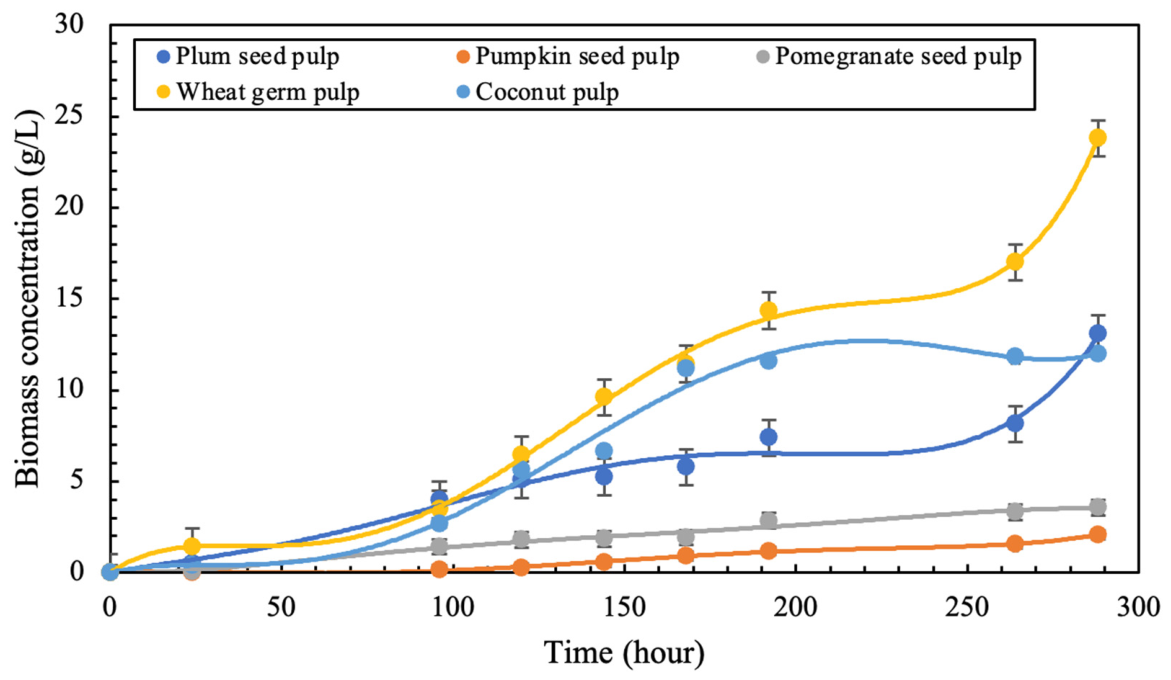
In this study, OSPRs were first evaluated as alternative fermentation substrates for pulcherrimin production by M. pulcherrima ELM-GS-3. Biomass development profiles obtained in different residue-based media are presented in Figure 1. Among the tested substrates, wheat germ pulp supported greater microbial growth than plum seed pulp, pumpkin seed pulp, pomegranate seed pulp, and coconut pulp. Biomass concentration in wheat germ pulp medium reached approximately 24.0 g/L at the end of fermentation, whereas significantly lower values were obtained in coconut pulp (11.8 g/L), plum seed pulp (13.1 g/L), pomegranate seed pulp (3.56 g/L), and pumpkin seed pulp (2.1 g/L).
The superior growth performance observed in wheat germ pulp medium can be attributed to its rich nutritional composition, including residual proteins, amino acids, lipids, and micronutrients that promote yeast metabolism. These nutrients likely enhanced both cellular growth and pulcherrimin biosynthesis by supporting metabolic pathways associated with pulcherriminic acid formation and iron chelation.
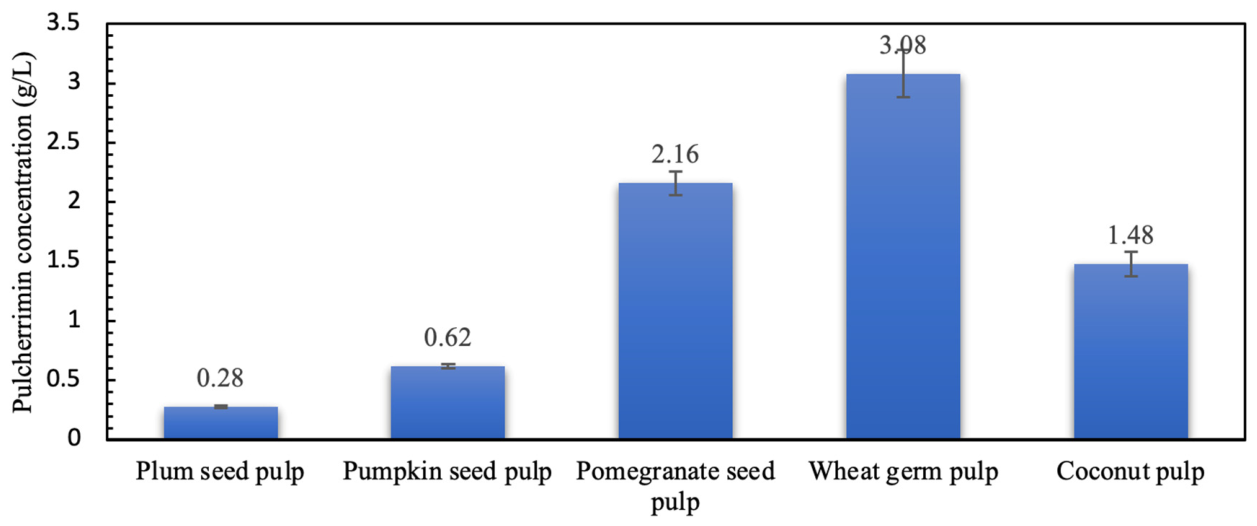
Pulcherrimin production levels obtained in each substrate are shown in Figure 2. Wheat germ pulp provided the highest pulcherrimin concentration (3.1 g/L), followed by pomegranate seed pulp (2.2 g/L), coconut pulp (1.5 g/L), pumpkin seed pulp (0.6 g/L), and plum seed pulp (0.3 g/L). The marked difference among substrates indicates that substrate composition plays a critical role in pigment biosynthesis. Wheat germ residue, being rich in nitrogenous compounds and growth factors, appears to provide a balanced nutrient environment that supports secondary metabolite formation. Based on these findings, wheat germ pulp was selected as the fermentation medium for subsequent optimization experiments.

3.2. Model Development and Statistical Evaluation

The experimental design matrix and corresponding pulcherrimin production results are presented in Table 1. The CCRD consisted of 30 experimental runs, including 16 factorial points, 8 axial points, and 6 replicated center points.
As shown in Table 1, pulcherrimin concentration ranged from 1.4 to 4.3 g/L within the investigated experimental domain. The lowest concentration of 1.4 g/L was obtained at a fermentation time of 3 days, whereas the highest concentration of 4.3 g/L was obtained at fermentation times of 12 and 15 days under different initial pH conditions. These results indicate that the higher experimental responses were primarily associated with extended fermentation time rather than with a specific initial pH range.
The replicated center-point runs (Runs 25–30) showed pulcherrimin concentrations between 2.3 and 2.8 g/L, indicating acceptable experimental reproducibility and allowing reliable estimation of pure error for model validation. Response surface methodology based on a CCRD was applied to evaluate the effects of temperature (X1, °C), agitation speed (X2, rpm), fermentation time (X3, day), and initial pH (X4) on pulcherrimin production. The developed quadratic model for pulcherrimin concentration (Y, g/L) in terms of coded factors is given below:
Y = 2.64 + 0.1542X1 − 0.1042X2 + 0.8792X3 − 0.2208X4 + 0.0938X1X2 + 0.0688X1X3 + 0.0063X1X4 + 0.0813X2X3 + 0.0688X2X4 + 0.0688X3X4 + 0.2735X12 + 0.1235X22 + 0.0235X32 − 0.0640X42
ANOVA demonstrated that the quadratic model was statistically significant (F = 18.09, p < 0.0001), indicating that the selected model adequately describes the relationship between process parameters and pulcherrimin production (Table 2).
The coefficient of determination (R2 = 0.9441) revealed that 94.41% of the variability in pulcherrimin production could be explained by the model. The adjusted R2 of 0.8919 supported the goodness of fit within the investigated factor ranges. However, the lower predicted R2 value of 0.7058 indicates that the predictive performance of the model is more limited than its ability to describe the experimental dataset. The nonsignificant lack of fit (p = 0.0756) indicated that no statistically significant lack of fit was detected relative to the pure error.
Among the tested variables, fermentation time (X3) had the strongest statistically significant positive linear effect on pulcherrimin concentration (p < 0.0001). Initial pH (X4) also had a statistically significant negative linear effect (p = 0.0030), while temperature (X1) showed a significant positive linear effect (p = 0.0259). The quadratic term of temperature (X12) was highly significant (p = 0.0003), indicating significant curvature in the temperature response. In contrast, the linear effect of agitation rate (X2) was not statistically significant within the investigated experimental domain (p = 0.1157).

3.3. Interaction Effects and Interpretation of Response Surface and Contour Plots

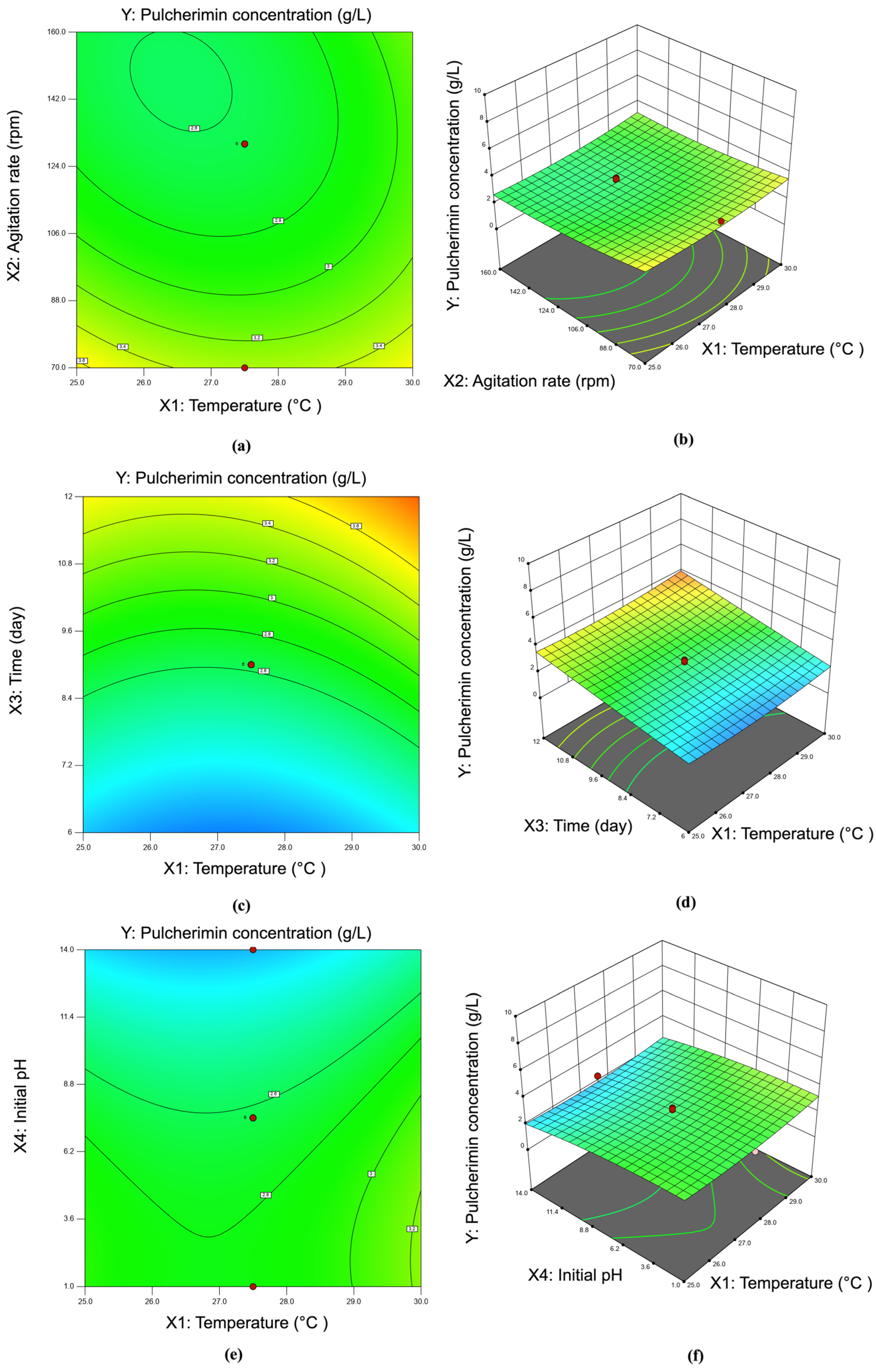
As presented in Figure 3a,b, pulcherrimin concentration varied between approximately 2.6 and 3.6 g/L within the tested temperature (25–30 °C) and agitation rate (70–160 rpm) range. The highest predicted pulcherrimin concentration (approximately 3.6 g/L) was observed at the lower agitation rate (approximately 70 rpm) combined with a temperature close to 25–26 °C.
At 28 °C and with the agitation rate of approximately 80–110 rpm, the pulcherrimin concentration decreased to approximately 2.8–3.2 g/L. The lowest production region (2.6 g/L) was observed at higher agitation rates (approximately 135–160 rpm) combined with temperatures near 26–27 °C, as indicated by the inner contour lines in Figure 3a. The contour plot in Figure 3a shows elliptical patterns, indicating a visual combined trend between temperature and agitation rate. Increasing agitation rate beyond approximately 120 rpm did not enhance pulcherrimin production; instead, it led to a slight decrease. Within the plotted region, the model-predicted response tended to decrease as the agitation rate increased. However, the linear and interaction terms involving agitation rate were not statistically significant.
The response surface and contour plots presented in Figure 3c,d illustrate the combined response pattern of temperature and fermentation time on pulcherrimin concentration. At fermentation times of 6 to 7 days, the predicted concentration ranged from approximately 1.8 to 2.4 g/L, whereas values of approximately 3.0 to 4.0 g/L were predicted at 11 to 12 days. At a constant fermentation time, increasing the temperature from 25 °C to 30 °C was associated with an approximately 0.5 g/L change in the predicted pulcherrimin concentration, depending on the time level.
The three-dimensional surface plot (Figure 3d) confirms that maximum pulcherrimin production is achieved at the upper levels of both variables, particularly approximately 29–30 °C combined with 11–12 days of incubation. The gradual upward slope of the surface indicates a positive interaction, although no sharp optimum peak is observed within the experimental domain. This suggests that the true optimum may lie slightly beyond the tested range, particularly toward longer fermentation times. From a mechanistic perspective, the strong influence of fermentation time can be attributed to pulcherrimin being a secondary metabolite. Its accumulation generally increases during the late exponential and stationary phases of growth. The moderate effect of temperature indicates that the microorganism maintains pigment biosynthesis efficiency across the tested thermal range, but prolonged incubation allows sufficient precursor accumulation and metabolic flux toward pulcherrimin synthesis.
The response surface and contour plots shown in Figure 3e,f illustrate the combined effects of temperature (25–30 °C) and pH (1–14) on pulcherrimin production. Within the tested experimental range, pulcherrimin concentration varied approximately between 2.0 and 3.2 g/L. As observed in Figure 3e, pH exerted a more pronounced effect than temperature. At extremely low pH values (1–2), pulcherrimin concentration remained approximately 2.8–3.2 g/L. Increasing pH toward near-neutral values (6–7) slightly decreased production to approximately 2.7–3.0 g/L. The highest predicted concentration, 3.1–3.2 g/L, was observed at acidic to near-neutral pH levels combined with temperatures close to 29–30 °C. The absence of a sharp peak in the three-dimensional surface plot (Figure 3f) suggests that the true optimum may lie within a relatively narrow pH window rather than at extreme acidic or alkaline values.
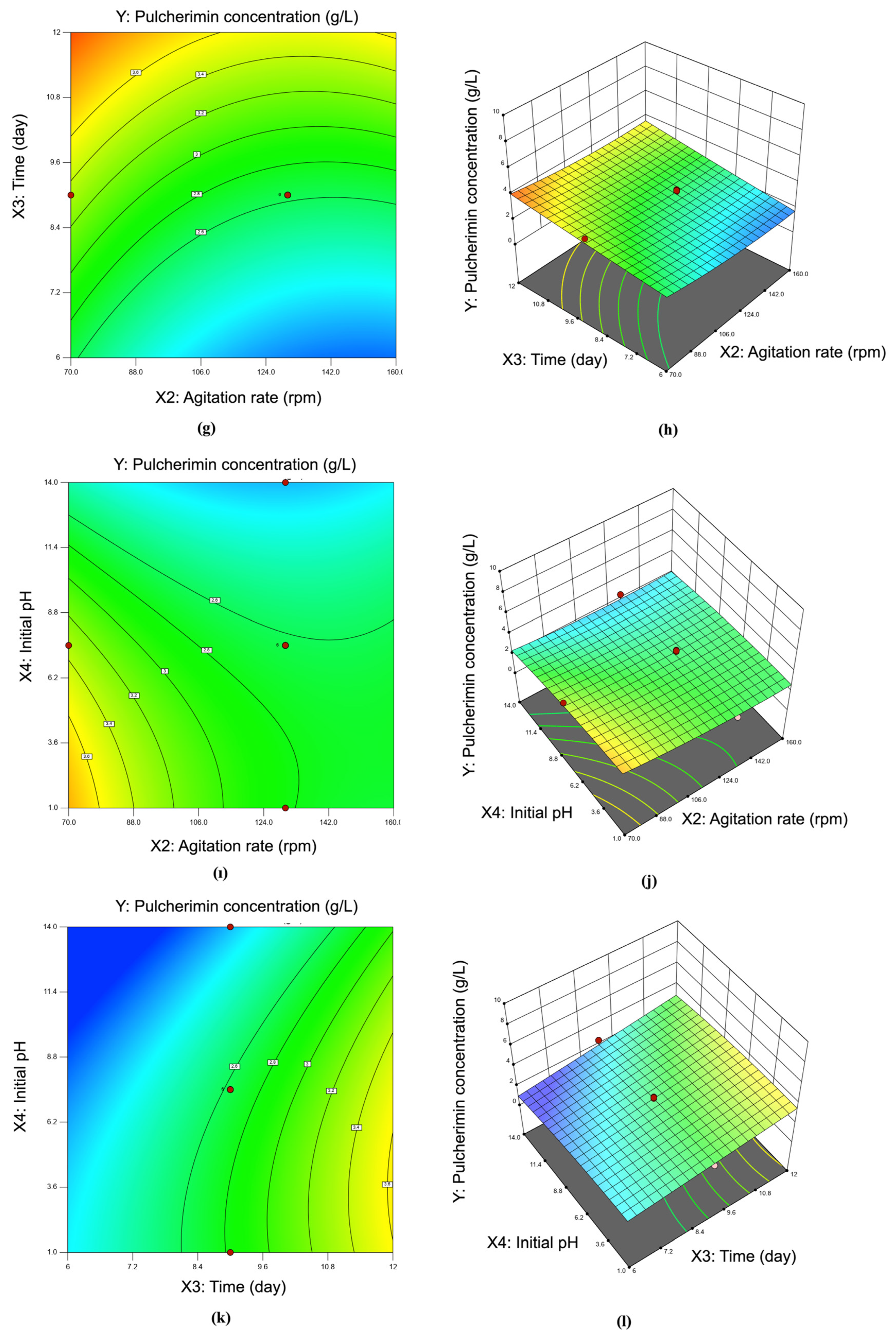
Figure 3g,h presents the response surface and contour plots illustrating the combined effect of agitation rate (X2, 70–160 rpm) and fermentation time (X3, 6–12 days) on pulcherrimin concentration, while temperature (X1 = 27.5 °C) and pH (X4 = 7.5) were kept constant. The contour plot demonstrates that pulcherrimin production increases significantly with increasing fermentation time. At a fermentation time of 6 days, the predicted concentration ranges between 1.7 g/L (160 rpm) and 2.6 g/L (70 rpm). However, at 12 days, the predicted concentration increases to 4.1 g/L at 70 rpm, representing the highest response within the experimental domain. Agitation rate shows an inverse relationship with pulcherrimin concentration. At a fixed fermentation time of 12 days, increasing agitation from 70 rpm to 160 rpm reduces the predicted concentration from 4.1 g/L to 3.6 g/L. The curvature suggests that the effect of agitation becomes more pronounced at longer fermentation durations. Lower agitation rates favor pigment accumulation, possibly due to reduced shear stress and improved iron-pulcherrimin complex stability. The 3D response surface (Figure 3h) confirms this trend, showing a clear gradient toward the region of low agitation (70 rpm) and extended fermentation time (12 days), where the maximum predicted pulcherrimin concentration is achieved.
Figure 3i,j illustrates the combined effect of agitation rate (X2, 70–160 rpm) and pH (X4, 1–14) on pulcherrimin concentration, while temperature (X1 = 27.5 °C) and fermentation time (X3 = 9 days) were kept constant. The contour plot indicates that pulcherrimin production is strongly influenced by pH, particularly at lower agitation rates. The highest predicted concentration (3.8 g/L) was observed at low agitation (70 rpm) and strongly acidic conditions (pH 1). Similarly, at pH 4.4 and 70 rpm, the predicted value remained high at approximately 3.6 g/L. As pH increased toward alkaline conditions, pulcherrimin concentration decreased markedly. At pH 14 and 70 rpm, the predicted concentration dropped to 2.4 g/L. A similar declining trend was observed at higher agitation rates. For instance, at 160 rpm and pH 14, the predicted concentration was approximately 2.1 g/L, while at 160 rpm and pH 1, it was 2.7 g/L. Agitation rate also exhibited a negative effect on pigment production. At a fixed pH of 1, increasing agitation from 70 rpm to 160 rpm reduced the predicted concentration from 3.8 g/L to 2.7 g/L. This confirms that lower shear conditions favor pulcherrimin accumulation. The 3D response surface (Figure 3j) shows a clear maximum region at low agitation and acidic pH, whereas higher agitation combined with alkaline pH results in a flattened, lower response region (2.0–2.5 g/L).
Figure 3k,l presents the response surface and contour plots showing the interaction between fermentation time (X3, 6–12 days) and pH (X4, 1–14), while temperature (X1 = 27.5 °C) and agitation rate (X2 = 130 rpm) were held constant. The contour plot reveals a strong combined influence of fermentation time and pH on pulcherrimin production. The highest predicted concentration (3.6 g/L) was observed at long fermentation time (12 days) and acidic pH (3.5). Similarly, at 12 days and pH 1, the predicted concentration remained high (3.58 g/L), confirming that extended cultivation favors pigment accumulation under acidic conditions. At shorter fermentation times, the response was markedly lower. For instance, at 6 days and pH 14, the predicted concentration dropped to 0.97 g/L, representing the lowest value within the tested region. At 6 days and pH 1, the predicted value was 2.1 g/L, indicating that increasing fermentation time substantially enhances pulcherrimin production even under acidic conditions. The 3D response surface (Figure 3l) clearly shows an upward gradient toward the region of extended fermentation (12 days) combined with acidic pH (1–4), where the maximum pulcherrimin concentration is achieved. In contrast, alkaline conditions (p > 11) consistently resulted in reduced production (<2.0 g/L), particularly at shorter fermentation durations.
The statistical analysis revealed that fermentation time is the most influential parameter affecting pulcherrimin production. The experimental results showed that increasing fermentation time from 3 to 15 days resulted in a substantial increase in pulcherrimin concentration, with values rising from 1.4 g/L to 4.3 g/L. This confirms that pulcherrimin behaves as a typical secondary metabolite, with its synthesis strongly associated with extended incubation and late growth phases. Initial pH was identified as another critical factor, with acidic conditions strongly favoring pulcherrimin production. The highest concentrations were observed within the pH range of 1–4, whereas alkaline conditions resulted in a marked decrease in production, in some cases falling below 2.0 g/L. Temperature showed a statistically significant but less dominant effect, with optimal production occurring within the mesophilic range of 25–30 °C. Agitation rate did not exhibit a significant linear effect; however, response surface analysis indicated that lower agitation levels favor pulcherrimin accumulation. For example, at extended fermentation times, reducing agitation from 160 rpm to 70 rpm increased pulcherrimin concentration from 3.6 g/L to 4.1 g/L, suggesting that lower agitation conditions may favor pigment stability and biosynthesis.
The interaction effects between fermentation time, pH, and agitation further highlight the complexity of pulcherrimin biosynthesis. The highest production levels were achieved under conditions combining extended fermentation time and acidic pH, whereas increasing fermentation time under alkaline conditions did not compensate for the negative effect of pH. This indicates that pH acts as a dominant regulatory factor in the system.

3.4. Optimization and Validation of Pulcherrimin Production

Numerical optimization was carried out to determine the conditions that maximize pulcherrimin production within the experimental ranges. The numerically selected conditions (solution 20/100) predicted by the model were: temperature; 25 °C, agitation speed; 71 rpm, fermentation time; 12 days, and pH; 2.
The numerical optimization procedure predicted a pulcherrimin concentration of 4.6 g/L under the selected conditions. Experimental validation was conducted in duplicate (n = 2), yielding a mean value of 5.5 g/L with a standard deviation of 0.3 g/L. The relatively low standard deviation indicated close agreement between the duplicate validation measurements. The standard error of prediction was 0.5 g/L, and the reported prediction interval ranged from 4.1 to 5.1 g/L. Although the experimental mean was slightly higher than the upper prediction limit, the difference should be interpreted together with the experimental variability and prediction uncertainty. The validation results supported the ability of the selected conditions to enhance pulcherrimin production, while indicating that the quadratic model provided a conservative estimate of the exact response in this region. This deviation may reflect biological variability, heterogeneity of the residue based medium, or local response behavior not fully captured by the second order polynomial model.
Although the experimental value exceeded the predicted response by approximately 20.8%, this positive deviation does not indicate model inadequacy, as it remains within the confidence bounds. Instead, it suggests that the model may have slightly underestimated pigment production near the optimum region, potentially due to minor synergistic effects or local curvature not fully described by the second-order polynomial equation. The absence of large deviation, together with the narrow experimental variability, supports the robustness of the model and confirms that the optimized conditions are reliable for maximizing pulcherrimin production. This study demonstrates that wheat germ oil processing residue is a highly effective substrate for pulcherrimin production by M. pulcherrima ELM-GS-3, significantly outperforming other OSPRs. Among the tested substrates, wheat germ supported the highest biomass formation, reaching 24.0 g/L, and highest pulcherrimin concentration of 3.1 g/L during the screening phase, whereas other residues such as pomegranate seed pulp, coconut pulp, pumpkin seed pulp, and plum seed pulp resulted in substantially lower production levels. These findings clearly indicate that substrate composition is a key determinant of pulcherrimin biosynthesis.
A major contribution of this study is the significant enhancement of pulcherrimin production achieved through process optimization. While the initial substrate screening resulted 3.1 g/L of pulcherrimin using wheat germ residue, optimization via response surface methodology increased the production to 5.5 g/L under the identified optimal conditions. This corresponds to approximately a 1.79-fold improvement compared to the non-optimized system, clearly demonstrating the effectiveness of multivariate optimization in enhancing pigment production. Within the experimental design space, pulcherrimin concentrations ranged from 1.4 g/L to 4.3 g/L, further highlighting the strong influence of process parameters on biosynthesis.
When compared with previously reported studies, the pulcherrimin levels obtained in this work are substantially higher. Li et al. [17] reported a maximum production of 331.17 mg/L using Bacillus licheniformis DW2, while Pawlikowska et al. [18] reported values up to 240 mg/L in Metschnikowia species grown under optimized minimal medium conditions supplemented with glucose, FeCl3, and Tween 80. More recently, metabolic engineering approaches using Bacillus subtilis have achieved higher titers, reaching up to 811 mg/L under optimized bioreactor conditions [31]. The pulcherrimin concentration obtained in the present study was higher than these previously reported values. However, these studies employed different microorganisms, media compositions, cultivation systems, optimization strategies, pigment recovery procedures, and quantification methods. Therefore, the reported concentrations are useful for providing context but do not permit a direct comparison of process performance or demonstrate superiority over engineered systems. The main contribution of the present study is the demonstration that wheat germ pulp can support pulcherrimin production by a nonengineered M. pulcherrima strain under the investigated conditions.
From an application perspective, achieving pulcherrimin concentrations exceeding 5.0 g/L using wheat germ pulp demonstrates its potential as an alternative fermentation substrate and supports further investigation of process scale up and practical applicability. Considering that most previous studies report values below 1.0 g/L, the results obtained in this study clearly surpass the current state of the art. In comparison, the present study achieved 5.5 g/L, which is approximately 6–20 times higher than the values reported in these systems. This substantial increase highlights the effectiveness of combining wheat germ pulp substrate with process optimization strategies. It also suggests that substrate complexity and composition may play a more critical role than previously emphasized in pulcherrimin biosynthesis, particularly when compared to conventional synthetic or minimal media approaches.
Thus, the principal novelty of this study lies not only in the high pulcherrimin concentration achieved, but also in demonstrating wheat germ oil processing residue as an effective substrate for pigment production by a nonengineered M. pulcherrima ELM-GS-3 strain.

3.5. Bioprocess Performance Evaluation Kinetic Interpretation Under Optimized Conditions

Table 3 summarizes the bioprocess performance indicators obtained under the initial screening and optimum conditions. Under the initial conditions, biomass and pulcherrimin concentrations were 24.0 and 3.1 g/L, respectively. The volumetric productivity, specific productivity, and biomass-based product yield coefficient were calculated as 0.257 g/L/day, 0.0107 g/g/day, and 0.128 g/g biomass, respectively. Under the optimum conditions, biomass concentration decreased to 15.9 g/L, while pulcherrimin concentration increased to 5.5 g/L. Volumetric productivity increased to 0.459 g/L/day, corresponding to a 1.79-fold improvement. Specific productivity and the biomass-based product yield coefficient increased to 0.0288 g/g/day and 0.346 g/g biomass, representing approximately 2.69- and 2.70-fold increases, respectively. These results indicate that the conditions selected by RSM improved pulcherrimin formation relative to both cultivation volume and biomass concentration, despite the lower final biomass concentration. Although a detailed kinetic model was not established in the present study, the experimental findings provide valuable insights into the kinetics of pulcherrimin biosynthesis.

4. Conclusions

This study demonstrated the potential of wheat germ pulp as an effective substrate for pulcherrimin production by Metschnikowia pulcherrima ELM-GS-3. Among the OSPRs evaluated, wheat germ pulp exhibited the greatest potential to support both microbial growth and pigment biosynthesis, highlighting its suitability as a renewable feedstock for the production of high-value natural pigments. Process optimization using successfully identified the key factors governing pulcherrimin production and significantly improved process performance. The results confirmed that cultivation conditions play a critical role in pigment biosynthesis and that the combined optimization of environmental parameters can substantially enhance production efficiency. Beyond improving pigment production, this study contributes to the growing body of research on the valorization of OSPRs within a circular bioeconomy framework. The successful conversion of wheat germ pulp into a value-added microbial pigment demonstrates the potential of integrating side-stream management and sustainable biomanufacturing approaches.
Despite these promising findings, several challenges should be addressed in future studies. The heterogeneous composition and sedimentation behavior of wheat germ pulp-based media may affect process reproducibility, while the relatively long fermentation period and pigment recovery requirements may limit practical implementation. Detailed substrate characterization, kinetic analysis, controlled bioreactor experiments, scale-up validation, and optimization of downstream pigment recovery are therefore required. The safety, stability, application performance, economic feasibility, and environmental impacts of the process should also be evaluated.
To the best of our knowledge, this is the first report describing the use of wheat germ pulp for pulcherrimin production by M. pulcherrima. The findings provide a foundation for future investigations focusing on bioreactor-scale production, process intensification, downstream processing, and the exploration of potential applications of pulcherrimin in food, pharmaceutical, agricultural, and biotechnology sectors. Overall, the study provides a basis for further evaluation of sustainable pulcherrimin production systems based on renewable OSPRs.

Author Contributions

Conceptualization, G.N.M.; methodology, G.N.M. and Ş.S.K.; investigation, Ş.S.K.; resources, G.N.M.; data curation, G.N.M.; original draft preparation, Ş.S.K. and G.N.M.; writing, Ş.S.K.; review and editing, G.N.M. All authors have read and agreed to the published version of the manuscript.

Funding

This research received no external funding.

Institutional Review Board Statement

Not applicable.

Informed Consent Statement

Not applicable.

Data Availability Statement

The original contributions presented in this study are included in the article. Further inquiries can be directed to the corresponding author.

Acknowledgments

The author acknowledges the use of ChatGPT (GPT-5; OpenAI, San Francisco, CA, USA) for assistance English language editing. The author confirms that all scientific content, interpretations, and conclusions are their own and take full responsibility for the manuscript.

Conflicts of Interest

The authors declare no conflicts of interest. The author declares that she has no known competing financial interests or personal relationships that could have appeared to influence the work reported in this paper.

References

  1. Nath, P.C.; Ojha, A.; Debnath, S.; Sharma, M.; Sridhar, K.; Nayak, P.K.; Inbaraj, B.S. Biogeneration of Valuable Nanomaterials from Agro-Wastes: A Comprehensive Review. Agronomy 2023, 13, 561. [Google Scholar] [CrossRef] [Scilit]
  2. Gonçalves, A.; de Aguiar Dutra, A.R.; de Andrade Guerra, J.B.S.O.; Dutra, A. Ports and Climate Change: A Systematic Review Aligned with the Sustainable Development Goals. Sustain. Dev. 2026, 34, 390–402. [Google Scholar] [CrossRef] [Scilit]
  3. Saini, P.; Mishra, P. Bioprospecting of Microbial Resources for Agriculture, Environment and Bio-Chemical Industry; Springer Nature: Cham, Switzerland, 2024. [Google Scholar]
  4. Tornuk, F.; Akman, P.K. Recent Developments in the Valorization of Agri-food Waste and Byproducts by Fermentation. J. Sci. Food Agric. 2026, 106, 2567–2577. [Google Scholar] [CrossRef] [Scilit] [PubMed]
  5. Ferreira, D.M.; Coscueta, E.R.; Brassesco, M.E.; Pintado, M. Processing and Valorization of Wheat Bran, Germ and Their Fractions: An Evidence-Graded Review of Composition, Technologies and Applications. Foods 2026, 15, 1455. [Google Scholar] [CrossRef] [Scilit] [PubMed]
  6. Ghafoor, K.; Özcan, M.M.; AL-Juhaımı, F.; Babıker, E.E.; Sarker, Z.I.; Ahmed, I.A.M.; Ahmed, M.A. Nutritional Composition, Extraction, and Utilization of Wheat Germ Oil: A Review. Eur. J. Lipid Sci. Technol. 2017, 119, 1600160. [Google Scholar] [CrossRef] [Scilit]
  7. Sıraj, N. Wheat Germ Oil: A Comprehensive Review. Food Sci. Technol. 2022, 42, e113721. [Google Scholar] [CrossRef] [Scilit]
  8. Li, N.; Wang, Q.; Zhou, J.; Li, S.; Liu, J.; Chen, H. Insight into the Progress on Natural Dyes: Sources, Structural Features, Health Effects, Challenges, and Potential. Molecules 2022, 27, 3291. [Google Scholar] [CrossRef] [Scilit] [PubMed]
  9. Pasdaran, A.; Zare, M.; Hamedi, A.; Hamedi, A. A Review of the Chemistry and Biological Activities of Natural Colorants, Dyes, and Pigments: Challenges, and Opportunities for Food, Cosmetics, and Pharmaceutical Application. Chem. Biodivers. 2023, 20, e202300561. [Google Scholar] [CrossRef] [Scilit] [PubMed]
  10. Masyita, A.; Hardinasinta, G.; Astuti, A.D.; Firdayani, F.; Mayasari, D.; Hori, A.; Nisha, I.N.A.; Nainu, F.; Kuraishi, T. Natural Pigments: Innovative Extraction Technologies and Their Potential Application in Health and Food Industries. Front. Pharmacol. 2025, 15, 1507108. [Google Scholar] [CrossRef] [Scilit] [PubMed]
  11. Belas, J.P.R.; Coelho, C.C.d.S.; Gottschalk, L.M.F.; Cavalcanti, E.d.C.; Freire, D.M.G.; Freitas Silva, O. Pulcherrimin and Beyond: The Multifaceted Role of Metschnikowia pulcherrima in Postharvest Disease Management—A Scoping Review. J. Fungi 2026, 12, 298. [Google Scholar] [CrossRef] [Scilit] [PubMed]
  12. Lopes, F.C.; Ligabue-Braun, R. Agro-Industrial Residues: Eco-Friendly and Inexpensive Substrates for Microbial Pigments Production. Front. Sustain. Food Syst. 2021, 5, 589414. [Google Scholar] [CrossRef] [Scilit]
  13. Sipiczki, M. Metschnikowia pulcherrima and Related Pulcherrimin-Producing Yeasts: Fuzzy Species Boundaries and Complex Antimicrobial Antagonism. Microorganisms 2020, 8, 1029. [Google Scholar] [CrossRef] [Scilit] [PubMed]
  14. Wang, S.; Tan, Z.; Wang, C.; Liu, W.; Hang, F.; He, X.; Ye, D.; Li, L.; Sun, J. Iron Competition as an Important Mechanism of Pulcherrimin-Producing Metschnikowia sp. Strains for Controlling Postharvest Fungal Decays on Citrus Fruit. Foods 2023, 12, 4249. [Google Scholar] [CrossRef] [Scilit] [PubMed]
  15. Angelini, L.L.; dos Santos, R.A.C.; Fox, G.; Paruthiyil, S.; Gozzi, K.; Shemesh, M.; Chai, Y. Pulcherrimin Protects Bacillus subtilis Against Oxidative Stress during Biofilm Development. npj Biofilms Microbiomes 2023, 9, 50. [Google Scholar] [CrossRef] [Scilit] [PubMed]
  16. Charron-Lamoureux, V.; Haroune, L.; Pomerleau, M.; Hall, L.; Orban, F.; Leroux, J.; Rizzi, A.; Bourassa, J.-S.; Fontaine, N.; d’Astous, É.V.; et al. Pulcherriminic Acid Modulates Iron Availability and Protects against Oxidative Stress during Microbial Interactions. Nat. Commun. 2023, 14, 2536. [Google Scholar] [CrossRef] [Scilit] [PubMed]
  17. Li, X.; Wang, D.; Cai, D.; Zhan, Y.; Wang, Q.; Chen, S. Identification and High-Level Production of Pulcherrimin in Bacillus licheniformis DW2. Appl. Biochem. Biotechnol. 2017, 183, 1323–1335. [Google Scholar] [CrossRef] [Scilit] [PubMed]
  18. Pawlikowska, E.; Kolesińska, B.; Nowacka, M.; Kregiel, D. A New Approach to Producing High Yields of Pulcherrimin from Metschnikowia Yeasts. Fermentation 2020, 6, 114. [Google Scholar] [CrossRef] [Scilit]
  19. Liu, Y.; Yan, H.; Yao, J.; Yan, Y.; Zhou, J.; Shi, W. Bioprospection of Metschnikowia pulcherrima as Biocontrol Agents against Gray Mold on Grapes with Their Potential Modes of Action. Int. J. Food Microbiol. 2025, 442, 111383. [Google Scholar] [CrossRef] [Scilit] [PubMed]
  20. Shodieva, D.; Abdulmyanova, L.; Gulyamova, T.; Ruzieva, D.; Kuzieva, N.; Annaev, M.; Siddikova, S.; Mahkamov, S. Pulcherrimin Production by Endophytic Metschnikowia pulcherrima: Fermentation Performance and Antimicrobial Activity. bioRxiv 2026. [Google Scholar] [CrossRef] [Scilit]
  21. Kregiel, D.; Krajewska, A.; Kowalska-Baron, A.; Czarnecka-Chrebelska, K.H.; Nowak, A. Photoprotective Effects of Yeast Pulcherrimin. Molecules 2024, 29, 4873. [Google Scholar] [CrossRef] [Scilit] [PubMed]
  22. Anbarasan, T.; Jayanthi, S.; Ragina, Y. Investigation on Synthesis of Biodiesel from Distillery Spent Wash Using Oleaginous Yeast Metschnikowia pulcherrima. Mater. Today Proc. 2018, 5, 23293–23301. [Google Scholar] [CrossRef] [Scilit]
  23. Sundaram, P.V.; Singaram, J.; Ashokan, T. Detoxification of Food-Waste Hydrolysate to Enhance Lipid Production in an Alternative Feedstock for Biodiesel. Int. J. Environ. Sustain. Dev. 2018, 17, 151. [Google Scholar] [CrossRef] [Scilit]
  24. Abomohra, A.E.; Wang, Q.; Huang, J.; Saad-Allah, K.M. A Sustainable Approach for Bioconversion of Food and Lignocellulosic Wastes into Liquid Biofuel Using a New Metschnikowia pulcherrima Isolate. Int. J. Energy Res. 2021, 45, 3430–3441. [Google Scholar] [CrossRef] [Scilit]
  25. Němcová, A.; Gonová, D.; Samek, O.; Sipiczki, M.; Breierová, E.; Márová, I. The Use of Raman Spectroscopy to Monitor Metabolic Changes in Stressed Metschnikowia sp. Yeasts. Microorganisms 2021, 9, 277. [Google Scholar] [CrossRef] [Scilit] [PubMed]
  26. Liu, J.; Rygała, A.; Zhang, B.; Kręgiel, D. Potential of Metschnikowia Yeasts in Green Applications: A Review. Front. Microbiol. 2025, 16, 1652494. [Google Scholar] [CrossRef] [Scilit] [PubMed]
  27. Perek, Z.; Boruta, T.; Ścigaczewska, A.; Bizukojć, M.; Gutarowska, B. Biotechnological Potential of Metschnikowia pulcherrima Yeasts for Biomass Production in Agricultural Biocontrol. Appl. Sci. 2025, 15, 13236. [Google Scholar] [CrossRef] [Scilit]
  28. Müjdeci, G.N. A Functional Property of a Domestic Apple Isolate: Pulcherrimin Production by Metschnikowia pulcherrima ELM-GS-3 Via Waste Valorization. Gıda 2025, 50, 165–177. [Google Scholar] [CrossRef] [Scilit]
  29. Kregiel, D.; Nowacka, M.; Rygala, A.; Vadkertiová, R. Biological Activity of Pulcherrimin from the Meschnikowia pulcherrima Clade. Molecules 2022, 27, 1855. [Google Scholar] [CrossRef] [Scilit] [PubMed]
  30. Müjdeci, G.N. Experimental Modeling and Optimization of Melanin Production by Aureobasidium Pullulans NBRC 100716 in Carrot Peel Extract. Environ. Prog. Sustain. Energy 2022, 41, e13919. [Google Scholar] [CrossRef] [Scilit]
  31. Chen, T.; Uzunovic, H.; Brul, S.; Hugenholtz, J. Developing Bacillus Subtilis as Cell Factory for the Production of the Natural Biocontrol Compound Pulcherrimin. Bioresour. Technol. 2025, 427, 132433. [Google Scholar] [CrossRef] [Scilit] [PubMed]
Figure 1. Biomass production of M. pulcherrima ELM-GS-3 in different OSPR-based media over 288 h (mean ± SD).
Fermentation 12 00420 g001
Figure 2. Pulcherrimin production by M. pulcherrima ELM-GS-3 using different OSPRs as fermentation substrates (mean ± SD).
Fermentation 12 00420 g002
Figure 3. The interactive effects of temperature (X1), agitation rate (X2), fermentation time (X3), and pH (X4) on pulcherrimin concentration (g/L). Contour plots (a,c,e,g,i,k) and corresponding three-dimensional response surface plots (b,d,f,h,j,l) illustrate the pairwise interactions between process variables, while the remaining factors were kept at their central levels.
Fermentation 12 00420 g003aFermentation 12 00420 g003b
Table 1. CCRD matrix for pulcherrimin production.
RunTemperature
(°C)
Agitation Rate
(rpm)
Fermentation Time
(Day)
Initial pHPulcherrimin Concentration
(g/L)
12510064.252.4
23010064.252.7
32516064.252.0
43016064.252.3
525100124.254.1
630100124.254.2
725160124.253.9
830160124.254.3
925100610.751.7
1030100610.751.6
1125160610.751.5
1230160610.751.6
13251001210.753.5
14301001210.753.6
15251601210.753.2
16301601210.754.3
1722.513097.53.5
1832.513097.54.2
1927.57097.53.7
2027.519097.52.8
2127.513037.51.4
2227.5130157.54.3
2327.5130912.6
2427.51309142.4
2527.513097.52.7
2627.513097.52.8
2727.513097.52.5
2827.513097.52.3
2927.513097.52.8
3027.513097.52.7
Table 2. ANOVA for the quadratic response surface model for pulcherrimin production.
SourceSum of
Squares
Degree of
Freedom
Mean SquareF-Valuep-ValueRemark
Model14.52141.03718.09<0.0001Significant
X1 (Temperature)0.6210.626.320.0259Significant
X2 (Agitation speed)0.2410.242.780.1157Not significant
X3 (Fermentation time)9.2719.2798.54<0.0001Significant
X4 (pH)1.0411.0410.520.0030Significant
X1X20.1410.141.490.2440Not significant
X1X30.0710.070.780.3920Not significant
X1X40.0110.010.120.7360Not significant
X2X30.0810.080.890.3590Not significant
X2X40.0710.070.760.3990Not significant
X3X40.0710.070.750.4030Not significant
X121.8511.8519.670.0003Significant
X220.3110.313.290.0890Not significant
X320.0210.020.210.6530Not significant
X420.1810.181.950.1810Not significant
Residual0.86150.057
Lack of fit0.63100.0632.470.0756Not significant
Pure error0.2350.046
Cor total15.3829
Standard deviation0.239R20.9441
Mean response3.18Adjusted R20.8919
C.V. (%)7.51Predicted R20.7058
Adequate precision13.42
Table 3. Bioprocess performance parameters for pulcherrimin production.
ParameterInitial ConditionsOptimum ConditionsChange (Fold)
Biomass concentration (g/L)24.015.90.66
Pulcherrimin concentration (g/L)3.15.51.79
Volumetric productivity, Qp (g/L/day)0.2570.4591.79
Specific productivity, qp (g/g/day)0.01070.02882.69
Biomass based product yield, YP/X (g/g biomass)0.1280.3462.70
Disclaimer/Publisher’s Note: The statements, opinions and data contained in all publications are solely those of the individual author(s) and contributor(s) and not of MDPI and/or the editor(s). MDPI and/or the editor(s) disclaim responsibility for any injury to people or property resulting from any ideas, methods, instructions or products referred to in the content.