
Xylitol Biomanufacturing: Production Technologies, Industrial Applications and Future Opportunities



Abstract
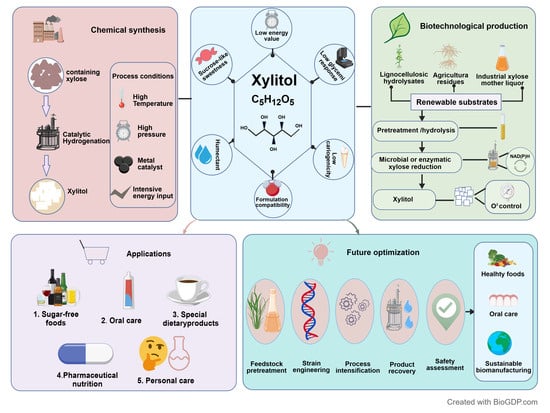
1. Introduction
2. Basic Properties of Xylitol
2.1. Physicochemical Properties and Functional Characteristics
2.2. Comparison of Xylitol with Other Sweeteners and Sugar Alcohols

| Sugar Alcohol | Relative Sweetness | Energy Value/Glycemic Response | Oral-Health Relevance | Processing and Tolerance Characteristics |
|---|---|---|---|---|
| Xylitol | Approximately equivalent to sucrose [37] | Approximately 2.4 kcal/g; low glycemic response [38]. | Not readily fermented by cariogenic bacteria to produce acids; closely associated with studies on Streptococcus mutans, dental plaque, and caries prevention using chewing gum [36,39,40]. | Pronounced cooling sensation; excessive intake may cause bloating and diarrhea; toxic to dogs [41,42]. |
| Sorbitol | Approximately 50–70% as sweet as sucrose [43] | Approximately 2.6 kcal/g; relatively low GI [44]. | Low cariogenicity, although some oral microorganisms may utilize it slowly; frequently used as a reference sugar alcohol. | Strong humectant properties; commonly used in confectionery and oral-care products; gastrointestinal tolerance requires attention [45]. |
| Erythritol | Approximately 60–80% as sweet as sucrose | Nearly 0 kcal/g; GI close to 0 [46]. | Non-cariogenic; generally shows better gastrointestinal tolerance than xylitol [47]. | Most is absorbed in the small intestine and excreted unchanged in urine; cardiovascular risk has also been discussed in recent studies. |
| Maltitol | Approximately 75–90% as sweet as sucrose [48] | Nearly 2.1 kcal/g, but GI is higher than that of most monosaccharide sugar alcohols. | Low cariogenicity, but its postprandial glycemic effect is higher than that of xylitol and erythritol. | Suitable for chocolate, bakery products, and confectionery; excessive intake may have a laxative effect [49]. |
| Mannitol [50] | Approximately 50–70% as sweet as sucrose | About 1.6 kcal/g; glycemic and insulin indices close to 0 [51] | Non-cariogenic; not readily fermented by oral bacteria to produce acids; commonly used in sugar-free chewing gum [52] | Non-reducing and does not readily undergo Maillard reactions, helping preserve product color; improves stability and texture in chewing gum, ice cream, chocolate, and bakery products; generally well tolerated, although excessive intake may cause gastrointestinal discomfort or diarrhea |
| Arabitol | Reported sweetness varies with stereoisomer and formulation; generally regarded as a sweet-tasting pentitol, although standardized relative-sweetness data remain limited. | Its physiological energy value and glycemic response have not been as systematically established as those of commercially established polyols such as xylitol, erythritol, and sorbitol. | Potential non-cariogenic properties have been discussed, but direct clinical and oral-health evidence remains limited compared with xylitol and erythritol [53]. | A five-carbon polyol and stereoisomer of xylitol; can be produced by yeasts and fungi from sugars or renewable carbon sources; currently more relevant as a biotechnological product and platform chemical than as a widely used bulk sweetener. Excess-intake tolerance data remain limited. |
| Lactitol | Approximately 30–40% as sweet as sucrose [54]. | Approximately 2 kcal/g; poorly absorbed in the small intestine and generally produces a low postprandial glycemic response. | Low cariogenic potential because it is not readily fermented to acids by oral microorganisms; may help reduce tooth demineralization when replacing fermentable sugars. | Produced by catalytic hydrogenation of lactose; used as a bulk sweetener, texturizer, and pharmaceutical excipient. Its low hygroscopicity is advantageous in moisture-sensitive products. Excessive intake may cause abdominal discomfort, flatulence, or a laxative effect. |
3. Production Processes of Xylitol
3.1. Chemical Synthesis
3.2. Biotechnological Production
3.3. Comparative Assessment, Industrial Scale-Up, and Downstream Processing
4. Application Fields of Xylitol
4.1. Applications in the Food Sector
4.2. Applications in Oral Care and Dental Caries Prevention
4.3. Applications in Pharmaceutical and Health-Related Fields
4.4. Applications in Other Fields
5. Conclusions and Perspectives
Author Contributions
Funding
Institutional Review Board Statement
Informed Consent Statement
Data Availability Statement
Acknowledgments
Conflicts of Interest
References
- Asănică, A.; Tudor, V.; Teodorescu, R. Distinctive behaviour of some sweet cherry cultivars related to rootstock type. AgroLife Sci. J. 2013, 2, 79–82. [Google Scholar] [CrossRef] [Scilit]
- Ferretti, F.; Malorgio, G. Food policies: Balancing health and market in the era of ubiquitous ultra-processed foods. Agric. Food Econ. 2024, 12, 35. [Google Scholar] [CrossRef] [Scilit]
- Rippe, J.M.; Angelopoulos, T.J. Relationship between added sugars consumption and chronic disease risk factors: Current understanding. Nutrients 2016, 8, 697. [Google Scholar] [CrossRef] [Scilit] [PubMed]
- Thomas, M. The clustering of cardiovascular, renal, adipo-metabolic eye and liver disease with type 2 diabetes. Metabolism 2022, 128, 154961. [Google Scholar] [CrossRef] [Scilit] [PubMed]
- Zhang, S.; Li, H.; Meng, G.; Zhang, Q.; Liu, L.; Wu, H.; Gu, Y.; Zhang, T.; Wang, X.; Zhang, J.; et al. Added sugar intake and its forms and sources in relation to risk of non-alcoholic fatty liver disease: Results from the Tianjin Chronic Low-grade Systemic Inflammation and Health cohort study. Br. J. Nutr. 2023, 129, 2094–2101. [Google Scholar] [PubMed]
- Ma, X.; Nan, F.; Liang, H.; Shu, P.; Fan, X.; Song, X.; Hou, Y.; Zhang, D. Excessive intake of sugar: An accomplice of inflammation. Front. Immunol. 2022, 13, 988481. [Google Scholar] [CrossRef] [Scilit] [PubMed]
- Zhang, G.; Zhang, L.; Ahmad, I.; Zhang, J.; Zhang, A.; Tang, W.; Ding, Y.; Lyu, F. Recent advance in technological innovations of sugar-reduced products. Crit. Rev. Food Sci. Nutr. 2024, 64, 5128–5142. [Google Scholar] [PubMed]
- Dragomir, N.; Grigore, D.-M.; Pogurschi, E.N. Beyond sugar: A holistic review of sweeteners and their role in modern nutrition. Foods 2025, 14, 3182. [Google Scholar] [CrossRef] [Scilit] [PubMed]
- Chen, X.; Jiang, Z.H.; Chen, S.; Qin, W. Microbial and bioconversion production of D-xylitol and its detection and application. Int. J. Biol. Sci. 2010, 6, 834–844. [Google Scholar] [CrossRef] [Scilit] [PubMed]
- Ramsey, I.; Liu, J.; Swiegers, J.H.; Oladokun, O. From sweetness to mouthfeel: A review on overcoming sensory barriers in sugar-free beverages. Int. J. Food Sci. 2025, 2025, 2345722. [Google Scholar] [CrossRef] [Scilit] [PubMed]
- Mota, K.R.; da Silva, J.V.F.; Borges, C.D.; de Marcelos, P.G.; Alvares, P.R.; dos Santos Júnior, V.E. Effectiveness of the use of xylitol chewing gum in prevention of dental caries: A systematic review. J. Indian Soc. Pedod. Prev. Dent. 2021, 39, 113–119. [Google Scholar] [CrossRef] [Scilit] [PubMed]
- Newton, J.T.; Awojobi, O.Y.; Nasseripour, M.; Warburton, F.; Di Giorgio, S.; Gallagher, J.E.; Banerjee, A. A systematic review and meta-analysis of the role of sugar-free chewing gum in dental caries. JDR Clin. Transl. Res. 2020, 5, 214–223. [Google Scholar]
- Arruda, P.V.; Milessi, T.S.; Alves-Ferreira, J.; Sene, L.; Carvalheiro, F.; Duarte, L.C.; Felipe, M.G.A. Applications of xylitol in food, material, health, and medical sectors. In Current Advances in Biotechnological Production of Xylitol: Fermentative Production of Xylitol; Felipe, M.G.A., Chandel, A.K., Eds.; Springer Nature: Cham, Switzerland, 2022; pp. 205–237. [Google Scholar]
- Mathur, S.; Kumar, D.; Kumar, V.; Dantas, A.; Verma, R.; Kuca, K. Xylitol: Production strategies with emphasis on biotechnological approach, scale up, and market trends. Sustain. Chem. Pharm. 2023, 35, 101203. [Google Scholar] [CrossRef] [Scilit]
- Research and Markets. Xylitol Market Size, Competitors, Trends & Forecast to 2034; Research and Markets: Dublin, Ireland, 2026. [Google Scholar]
- Global Market Insights. Xylitol Market Size & Share, Growth Forecasts 2026–2035; Global Market Insights Inc.: Selbyville, DE, USA, 2026. [Google Scholar]
- Pandey, N.; Ahmad, D.; Hasan, M.; Choudhary, D.K.; Kumar, A.; Tripathi, M.K.; Siddiqui, S.A.; Shah, M.A. Current trends in the production of xylitol and paving the way for metabolic engineering in microbes. Biotechnol. Biofuels Bioprod. 2025, 18, 106. [Google Scholar] [CrossRef] [Scilit] [PubMed]
- Hernandez-Perez, A.F.; Antunes, F.A.F.; dos Santos, J.C.; de Almeida Felipe, M.d.G. Valorization of the sugarcane bagasse and straw hemicellulosic hydrolysate through xylitol bioproduction: Effect of oxygen availability and sucrose supplementation as key factors. Biomass Convers. Biorefin. 2022, 12, 4901–4915. [Google Scholar] [CrossRef] [Scilit]
- Umai, D.; Kayalvizhi, R.; Kumar, V.; Jacob, S. Xylitol: Bioproduction and applications—A review. Front. Sustain. 2022, 3, 826190. [Google Scholar] [CrossRef] [Scilit]
- Suhartini, S.; Rohma, N.A.; Mardawati, E.; Kasbawati; Hidayat, N.; Melville, L. Biorefining of oil palm empty fruit bunches for bioethanol and xylitol production in Indonesia: A review. Renew. Sustain. Energy Rev. 2022, 154, 111817. [Google Scholar] [CrossRef] [Scilit]
- Salli, K.; Lehtinen, M.J.; Tiihonen, K.; Ouwehand, A.C. Xylitol’s health benefits beyond dental health: A comprehensive review. Nutrients 2019, 11, 1813. [Google Scholar] [CrossRef] [Scilit] [PubMed]
- Ur-Rehman, S.; Mushtaq, Z.; Zahoor, T.; Jamil, A.; Murtaza, M.A. Xylitol: A review on bioproduction, application, health benefits, and related safety issues. Crit. Rev. Food Sci. Nutr. 2015, 55, 1514–1528. [Google Scholar] [CrossRef] [Scilit] [PubMed]
- Luo, B.W.; Liang, N.L.; Townsend, J.A.; Lo, E.C.M.; Chu, C.H.; Duangthip, D. Sugar substitutes on caries prevention in permanent teeth among children and adolescents: A systematic review and meta-analysis. J. Dent. 2024, 146, 105069. [Google Scholar] [CrossRef] [Scilit] [PubMed]
- Söderling, E.; Pienihäkkinen, K. Specific effects of xylitol chewing gum on mutans streptococci levels, plaque accumulation and caries occurrence: A systematic review. BMC Oral Health 2025, 25, 1275. [Google Scholar] [CrossRef] [Scilit] [PubMed]
- Karia, S.; Baerts, E.; Coventry, H.; Taylor, G. Xylitol in toothpaste: Is it effective in reducing the levels of Streptococcus mutans in high-caries-risk young children? Evid. Based Dent. 2024, 25, 47–48. [Google Scholar] [CrossRef] [Scilit] [PubMed]
- Ruby, J.D.; Momeni, S.S.; Wu, H. The effect of allulose, sucralose, and xylitol on Streptococcus mutans acid production. JADA Found. Sci. 2025, 4, 100052. [Google Scholar] [CrossRef] [Scilit] [PubMed]
- Tiefenbacher, K.F. Technology of main ingredients—Sweeteners and lipids. In Wafer and Waffle; Elsevier: Amsterdam, The Netherlands, 2017; pp. 123–225. [Google Scholar]
- Kong, F.; Kang, S.; Zhang, J.; Zhao, H.; Peng, Y.; Yang, M.; Zheng, Y.; Shao, J.; Yue, X. Whey protein and xylitol complex alleviate type 2 diabetes in C57BL/6 mice by regulating the intestinal microbiota. Food Res. Int. 2022, 157, 111454. [Google Scholar] [CrossRef] [Scilit] [PubMed]
- Kong, F.H.; Zhang, J.; Kang, S.M.; Shen, X.Y.; Liu, A.C.; Zheng, Y.; Shao, J.H.; Yue, X.Q. Effects of axylitol-casein complex on insulin resistance and gut microbiota composition in high-fat-diet + streptozotocin-induced type 2 diabetes mellitus mice. Food Sci. Hum. Wellness 2024, 13, 2741–2753. [Google Scholar] [CrossRef] [Scilit]
- Ahuja, V.; Macho, M.; Ewe, D.; Singh, M.; Saha, S.; Saurav, K. Biological and pharmacological potential of xylitol: A molecular insight of unique metabolism. Foods 2020, 9, 1592. [Google Scholar] [CrossRef] [Scilit] [PubMed]
- Prabhu, A.A.; Thomas, D.J.; Ledesma-Amaro, R.; Leeke, G.A.; Medina, A.; Verma, M.L.; Kumar, V. Biovalorisation of crude glycerol and xylose into xylitol by oleaginous yeast Yarrowia lipolytica. Microb. Cell Fact. 2020, 19, 121. [Google Scholar] [CrossRef] [Scilit] [PubMed]
- Ahuja, V.; Rathour, R.K.; Bhatia, R.K.; Bhatt, A.K. Microbial Utilization of Municipal Solid Waste (Msw) for the Production of Xylitol: A Highly Valuable Product. Life Sci. Int. Res. J. 2017, 4, 56–59. [Google Scholar]
- del Pozo, S.; Gómez-Martínez, S.; Díaz, L.E.; Nova, E.; Urrialde, R.; Marcos, A. Potential effects of sucralose and saccharin on gut microbiota: A review. Nutrients 2022, 14, 1682. [Google Scholar] [CrossRef] [Scilit] [PubMed]
- Nasseripour, M.; Newton, J.T.; Warburton, F.; Awojobi, O.; Di Giorgio, S.; Gallagher, J.E.; Banerjee, A. A systematic review and meta-analysis of the role of sugar-free chewing gum on Streptococcus mutans. BMC Oral Health 2021, 21, 217. [Google Scholar] [CrossRef] [Scilit] [PubMed]
- Wu, Y.-F.; Salamanca, E.; Chen, I.-W.; Su, J.-N.; Chen, Y.-C.; Wang, S.-Y.; Sun, Y.-S.; Teng, N.-C.; Chang, W.-J. Xylitol-containing chewing gum reduces cariogenic and periodontopathic bacteria in dental plaque—Microbiome investigation. Front. Nutr. 2022, 9, 882636. [Google Scholar] [CrossRef] [Scilit] [PubMed]
- Ludovichetti, F.S.; Stellini, E.; Rodella, C.; Sambugaro, M.; Gaja, P.F.; Rizzato, A.; Mazzoleni, S. Effect of xylitol and maltitol chewing gums on plaque reduction and salivary pH modulation: A retrospective study in pediatric patients. Dent. J. 2025, 13, 233. [Google Scholar] [CrossRef] [Scilit] [PubMed]
- Silva, C.F.F.S.d.; Silva, F.E.R.d.; Pauna, H.F.; Hurtado, J.G.G.M.; dos Santos, M.C.J. Symptom assessment after nasal irrigation with xylitol in the postoperative period of endonasal endoscopic surgery. Braz. J. Otorhinolaryngol. 2022, 88, 243–250. [Google Scholar] [CrossRef] [Scilit] [PubMed]
- Flad, E.; Altstädt, A.; Beglinger, C.; Rehfeld, J.F.; Van Oudenhove, L.; Wölnerhanssen, B.K.; Meyer-Gerspach, A.C. Effects of oral xylitol, sucrose, and acesulfame potassium on total energy intake during a subsequent ad libitum test meal: A randomized, controlled, crossover trial in healthy humans. Nutrients 2025, 17, 484. [Google Scholar] [CrossRef] [Scilit] [PubMed]
- Krupa, N.C.; Thippeswamy, H.M.; Chandrashekar, B.R. Antimicrobial efficacy of xylitol, probiotic and chlorhexidine mouth rinses among children and elderly population at high risk for dental caries: A randomized controlled trial. J. Prev. Med. Hyg. 2022, 63, E282–E287. [Google Scholar] [PubMed]
- El-Habashy, L.M.; El Meligy, O.A.E.S.; Hamouda, A.A. Evaluating the effect of xylitol wipes on cariogenic bacteria in infants and toddlers: A longitudinal clinical trial. BMC Oral Health 2026, 26, 631. [Google Scholar] [CrossRef] [Scilit] [PubMed]
- Jiang, R.-S.; Chiang, Y.-F.; Liang, K.-L. Efficacy and safety of xylitol nasal irrigation after functional endoscopic sinus surgery: A randomized controlled study. Biomedicines 2024, 12, 1377. [Google Scholar] [CrossRef] [Scilit] [PubMed]
- Zuo, Q.-L.; Cai, X.; Zheng, X.-Y.; Chen, D.-S.; Li, M.; Liu, Z.-Q.; Chen, K.-Q.; Han, F.-F.; Zhu, X. Influences of Xylitol Consumption at Different Dosages on Intestinal Tissues and Gut Microbiota in Rats. J. Agric. Food Chem. 2021, 69, 12002–12011. [Google Scholar] [CrossRef] [Scilit] [PubMed]
- Qadir, A.M.; Omer, R.A. Safety of sugar alcohols on human health: A review. Int. J. Food Sci. Technol. 2026, 61, vvag012. [Google Scholar]
- McKenzie, E.; Lee, L.; Le, T.M.; Kim, H.; Park, Y.; Lee, J. Sugar reduction methods and their application in confections: A review. Food Sci. Nutr. 2022, 10, 1683–1695. [Google Scholar]
- Sato, T.; Kusuhara, S.; Yokoi, W.; Ito, M.; Miyazaki, K. Prebiotic potential of L-sorbose and xylitol in promoting the growth and metabolic activity of specific butyrate-producing bacteria in human fecal culture. FEMS Microbiol. Ecol. 2017, 93, fiw227. [Google Scholar] [PubMed]
- Bordier, V.; Teysseire, F.; Senner, F.; Schlotterbeck, G.; Drewe, J.; Beglinger, C.; Wölnerhanssen, B.K.; Meyer-Gerspach, A.C. Absorption and metabolism of the natural sweeteners erythritol and xylitol in humans: A dose-ranging study. Int. J. Mol. Sci. 2022, 23, 9867. [Google Scholar] [CrossRef] [Scilit] [PubMed]
- Wölnerhanssen, B.K.; Meyer-Gerspach, A.C.; Beglinger, C.; Islam, S. Metabolic effects of the natural sweeteners xylitol and erythritol: A comprehensive review. Crit. Rev. Food Sci. Nutr. 2019, 60, 1986–1998. [Google Scholar] [CrossRef] [Scilit] [PubMed]
- Ding, S.; Peng, B.; Li, Y.; Yang, J. Evaluation of specific volume, texture, thermal features, water mobility, and inhibitory effect of staling in wheat bread affected by maltitol. Food Chem. 2019, 283, 123–130. [Google Scholar] [CrossRef] [Scilit] [PubMed]
- Thabuis, C.; Herbomez, A.; Desailly, F.; Ringard, F.; Wils, D.; Guérin-Deremaux, L. Prebiotic-like effects of SweetPearl® Maltitol through changes in caecal and fecal parameters. Food Nutr. Sci. 2012, 03, 1375–1381. [Google Scholar] [CrossRef]
- Chen, M.; Zhang, W.; Wu, H.; Guang, C.; Mu, W. Mannitol: Physiological functionalities, determination methods, biotechnological production, and applications. Appl. Microbiol. Biotechnol. 2020, 104, 6941–6951. [Google Scholar] [CrossRef] [Scilit] [PubMed]
- Msomi, N.Z.; Erukainure, O.L.; Islam, M.S. Suitability of sugar alcohols as antidiabetic supplements: A review. J. Food Drug Anal. 2021, 29, 1–14. [Google Scholar] [CrossRef] [Scilit] [PubMed]
- Shen, P.; Walker, G.D.; Yuan, Y.; Reynolds, C.; Reynolds, E.C. Polyols and remineralisation of enamel subsurface lesions. J. Dent. 2017, 66, 71–75. [Google Scholar] [CrossRef] [Scilit] [PubMed]
- Sarris, D.; Sampani, Z.; Rapti, A.; Papanikolaou, S. Valorization of crude glycerol, residue deriving from biodiesel-production process, with the use of wild-type new isolated Yarrowia lipolytica strains: Production of metabolites with pharmaceutical and biotechnological interest. Curr. Pharm. Biotechnol. 2019, 20, 881–894. [Google Scholar] [CrossRef] [Scilit] [PubMed]
- Miller, L.E.; Tennilä, J.; Ouwehand, A.C. Efficacy and tolerance of lactitol supplementation for adult constipation: A systematic review and meta-analysis. Clin. Exp. Gastroenterol. 2014, 7, 241–248. [Google Scholar] [CrossRef] [Scilit] [PubMed]
- Usmani, Z.; Sharma, M.; Gupta, P.; Karpichev, Y.; Gathergood, N.; Bhat, R.; Gupta, V.K. Ionic liquid based pretreatment of lignocellulosic biomass for enhanced bioconversion. Bioresour. Technol. 2020, 304, 123003. [Google Scholar] [CrossRef] [Scilit] [PubMed]
- Rao, L.V.; Goli, J.K.; Gentela, J.; Koti, S. Bioconversion of lignocellulosic biomass to xylitol: An overview. Bioresour. Technol. 2016, 213, 299–310. [Google Scholar] [CrossRef] [Scilit] [PubMed]
- Farias, D.; de Mélo, A.H.F.; da Silva, M.F.; Bevilaqua, G.C.; Ribeiro, D.G.; Goldbeck, R.; Maugeri-Filho, F. New biotechnological opportunities for C5 sugars from lignocellulosic materials. Bioresour. Technol. Rep. 2022, 17, 100956. [Google Scholar] [CrossRef] [Scilit]
- Queiroz, S.S.; Jofre, F.M.; Mussatto, S.I.; Felipe, M.d.G.A. Scaling up xylitol bioproduction: Challenges to achieve a profitable bioprocess. Renew. Sustain. Energy Rev. 2022, 154, 111789. [Google Scholar] [CrossRef] [Scilit]
- Ahuja, V.; Kshirsagar, S.D.; Ghosh, P.; Sarkar, B.; Sutar, A.; More, S.; Dasgupta, D. Process development for detoxification of corncob hydrolysate using activated charcoal for xylitol production. J. Environ. Chem. Eng. 2022, 10, 107097. [Google Scholar] [CrossRef] [Scilit]
- Delgado Arcaño, Y.; Valmaña García, O.D.; Mandelli, D.; Alves Carvalho, W.; Magalhães Pontes, L.A. Xylitol: A review on the progress and challenges of its production by chemical route. Catal. Today 2020, 344, 2–14. [Google Scholar] [CrossRef] [Scilit]
- Jiang, S.; Li, H.; Zhang, L.; Mu, W.; Zhang, Y.; Chen, T.; Wu, J.; Tang, H.; Zheng, S.; Liu, Y.; et al. Generic Diagramming Platform (GDP): A comprehensive database of high-quality biomedical graphics. Nucleic Acids Res. 2025, 53, D1670–D1676. [Google Scholar] [PubMed]
- Audemar, M.; Ramdani, W.; Junhui, T.; Ifrim, A.R.; Ungureanu, A.; Jérôme, F.; Royer, S.; de Oliveira Vigier, K. Selective hydrogenation of xylose to xylitol over Co/SiO2 catalysts. ChemCatChem 2020, 12, 1973–1978. [Google Scholar] [CrossRef] [Scilit]
- Xia, H.; Zhang, L.; Hu, H.; Zuo, S.; Yang, L. Efficient hydrogenation of xylose and hemicellulosic hydrolysate to xylitol over Ni-Re bimetallic nanoparticle catalyst. Nanomaterials 2020, 10, 73. [Google Scholar]
- Ullah, N.; Jérôme, F.; De Oliveira Vigier, K. Hydrogenation of xylose to xylitol in the presence of bimetallic nanoparticles Ni3Fe catalyst in the presence of choline chloride. Catalysts 2022, 12, 841. [Google Scholar] [CrossRef] [Scilit]
- Wu, L.; Ma, X.; Liu, X.; Du, H.; Wang, F. A Phyllosilicate-Derived Cu–Ni Alloy Catalyst for Efficient Hydrogenation of High-Concentration Xylose Aqueous Solution to Xylitol. Ind. Eng. Chem. Res. 2025, 64, 10740–10748. [Google Scholar] [CrossRef] [Scilit]
- Du, H.; Ma, X.; Jiang, M.; Zhao, S.; Fang, Q.; Liu, X.; Zhang, Z.C. Xylitol Production from Xylose by Catalytic Hydrogenation over an Efficient Cu–Ni/SiO2 Bimetallic Catalyst. ACS Sustain. Chem. Eng. 2023, 11, 2115–2126. [Google Scholar] [CrossRef] [Scilit]
- Fujitsuka, H.; Kanomata, R.; Yamaguchi, Y.; Tago, T. Selective xylose hydrogenation to xylitol with Cu@ C prepared from ion exchange resin under relatively low hydrogen pressure. Catal. Surv. Asia 2023, 27, 29–38. [Google Scholar]
- Araujo-Barahona, G.; Goicoechea-Torres, A.; Eränen, K.; Latonen, R.-M.; Tirri, T.; Smeds, A.I.; Murzin, D.; García-Serna, J.; Salmi, T. Kinetic studies of solid foam catalysts for the production of sugar alcohols: Xylitol from biomass resources. Chem. Eng. Sci. 2023, 281, 119130. [Google Scholar] [CrossRef] [Scilit]
- Freitas, V.D.S.; Paez, A.; Fongarland, P.; Philippe, R.; Vilcocq, L. Catalytic hydrogenation of hemicellulosic sugars: Reaction kinetics and influence of sugar structure on reaction rate. ChemCatChem 2023, 15, e202300263. [Google Scholar] [CrossRef] [Scilit]
- Barone, A.; De Liso, B.A.; Grénman, H.; Eränen, K.; Taddeo, F.; Imparato, C.; Aronne, A.; Russo, V.; Di Serio, M.; Salmi, T. Xylose hydrogenation promoted by Ru/SiO2 sol-gel catalyst: From batch to continuous operation. Processes 2024, 12, 27. [Google Scholar] [CrossRef] [Scilit]
- Sadier, A.; Shi, D.; Mamede, A.-S.; Paul, S.; Marceau, E.; Wojcieszak, R. Selective aqueous phase hydrogenation of xylose to xylitol over SiO2-supported Ni and Ni-Fe catalysts: Benefits of promotion by Fe. Appl. Catal. B Environ. 2021, 298, 120564. [Google Scholar] [CrossRef] [Scilit]
- Hilpmann, G.; Steudler, S.; Ayubi, M.M.; Pospiech, A.; Walther, T.; Bley, T.; Lange, R. Combining Chemical and Biological Catalysis for the Conversion of Hemicelluloses: Hydrolytic Hydrogenation of Xylan to Xylitol. Catal. Lett. 2018, 149, 69–76. [Google Scholar] [CrossRef] [Scilit]
- Araujo-Barahona, G.; Shcherban, N.; Eränen, K.; Kopa, I.; Bezverkhyy, I.; Martínez-Klimov, M.; Vajglová, Z.; Aho, A.; García-Serna, J.; Salmi, T.; et al. Ruthenium supported on silicate and aluminosilicate mesoporous materials applied to selective sugar hydrogenation: Xylose to xylitol. Chem. Eng. J. 2024, 485, 150019. [Google Scholar] [CrossRef] [Scilit]
- Ona, J.P.; Latonen, R.M.; Kumar, N.; Eriksson, J.E.; Angervo, I.; Grénman, H. Electrocatalytic hydrogenation of glucose and xylose on electrochemically roughened metal catalysts. ACS Catal. 2023, 13, 14300–14313. [Google Scholar] [CrossRef] [Scilit]
- Hombach, L.; Müller, F.; Varamo, F.; Ogolla, C.O.; Hoffmann, R.; Frohne, J.; Schönherr, H.; Palkovits, R.; Butz, B.; Beine, A.K. Heteropolyacids and ruthenium on covalent triazine frameworks—A bifunctional, recyclable catalyst for bio-based tandem systems. Catal. Sci. Technol. 2025, 15, 1439–1444. [Google Scholar] [CrossRef] [Scilit]
- Shetty, S.R.; Yadav, G.D. Sustainable hydrogenation of xylose to xylitol using nickel-alumina catalysts supported on hexagonal mesoporous silica in water vis-à-vis aqueous isopropanol as solvent. Catal. Today 2025, 446, 115105. [Google Scholar] [CrossRef] [Scilit]
- Aigner, D.J.; Hinterholzer, L.; Almhofer, L.; Bischof, R.H.; Wrodnigg, T. Conversion of xylose into D-xylitol using catalytic transfer hydrogenation with formic acid as H-donor. BioResources 2023, 18, 8631–8652. [Google Scholar] [CrossRef] [Scilit]
- Akpe, S.G.; Choi, S.H.; Ham, H.C. Conversion of cyclic xylose into xylitol on Ru, Pt, Pd, Ni, and Rh catalysts: A density functional theory study. Phys. Chem. Chem. Phys. 2021, 23, 26195–26208. [Google Scholar] [CrossRef] [Scilit] [PubMed]
- Zaykovskaya, A.; Ila, M.; Ginter, M.; Temmel, E.; Schwiderski, M.; Stepanski, M.; Louhi-Kultanen, M. Crystallization-based purification of xylitol produced by biotechnological route. Chem. Eng. Technol. 2026, 49, e70201. [Google Scholar] [CrossRef] [Scilit]
- Silva, D.D.V.; Dussán, K.J.; Idarraga, A.; Grangeiro, L.; Silva, S.S.; Cardona, C.A.; Quintero, J.; Felipe, M.G.A. Production and purification of xylitol by Scheffersomyces amazonenses via sugarcane hemicellulosic hydrolysate. Biofuels Bioprod. Biorefin. 2020, 14, 344–356. [Google Scholar] [CrossRef] [Scilit]
- Santos, J.R.; Diel Rambo, M.K.; Scapin, E. Recent advances in xylitol production in biorefineries from lignocellulosic biomass: A review study. Rev. Bras. Cienc. Ambient. 2024, 59, e1814. [Google Scholar] [CrossRef] [Scilit]
- Kumari, P.; Mathur, P.; Sharma, C.; Chaturvedi, P. Xylitol production from lignocellulosic biowastes. Bioresour. Technol. Rep. 2025, 29, 102025. [Google Scholar] [CrossRef] [Scilit]
- Ahmed, S.F.; Mofijur, M.; Chowdhury, S.N.; Nahrin, M.; Rafa, N.; Chowdhury, A.T.; Nuzhat, S.; Ong, H.C. Pathways of lignocellulosic biomass deconstruction for biofuel and value-added products production. Fuel 2022, 318, 123618. [Google Scholar] [CrossRef] [Scilit]
- Bonfiglio, F.; Cagno, M.; Yamakawa, C.K.; Mussatto, S.I. Production of xylitol and carotenoids from switchgrass and Eucalyptus globulus hydrolysates obtained by intensified steam explosion pretreatment. Ind. Crops Prod. 2021, 170, 113800. [Google Scholar] [CrossRef] [Scilit]
- Hong, E.; Kim, J.; Rhie, S.; Ha, S.-J.; Kim, J.; Ryu, Y. Optimization of dilute sulfuric acid pretreatment of corn stover for enhanced xylose recovery and xylitol production. Biotechnol. Bioprocess Eng. 2016, 21, 612–619. [Google Scholar] [CrossRef] [Scilit]
- Dharmaraja, J.; Shobana, S.; Arvindnarayan, S.; Francis, R.R.; Jeyakumar, R.B.; Saratale, R.G.; Ashokkumar, V.; Bhatia, S.K.; Kumar, V.; Kumar, G. Lignocellulosic biomass conversion via greener pretreatment methods towards biorefinery applications. Bioresour. Technol. 2023, 369, 128328. [Google Scholar] [CrossRef] [Scilit] [PubMed]
- Ashokkumar, V.; Venkatkarthick, R.; Jayashree, S.; Chuetor, S.; Dharmaraj, S.; Kumar, G.; Chen, W.-H.; Ngamcharussrivichai, C. Recent advances in lignocellulosic biomass for biofuels and value-added bioproducts-A critical review. Bioresour. Technol. 2022, 344, 126195. [Google Scholar] [CrossRef] [Scilit] [PubMed]
- da Silva, D.D.V.; Dussán, K.J.; Costa, I.A.L.; Forte, M.B.S.; Felipe, M.G.A. Hydrotalcites as a promising adsorbent for hemicellulose hydrolysate detoxification in xylitol production. Fermentation 2025, 11, 243. [Google Scholar] [CrossRef] [Scilit]
- Bhavana, B.; Mudliar, S.N.; Debnath, S. Life cycle assessment of fermentative xylitol production from wheat bran: A comparative evaluation of sulphuric acid and chemical-free wet air oxidation-based pretreatment. J. Clean. Prod. 2023, 423, 138666. [Google Scholar] [CrossRef] [Scilit]
- Mood, S.H.; Golfeshan, A.H.; Tabatabaei, M.; Jouzani, G.S.; Najafi, G.H.; Gholami, M.; Ardjmand, M. Lignocellulosic biomass to bioethanol, a comprehensive review with a focus on pretreatment. Renew. Sustain. Energy Rev. 2013, 27, 77–93. [Google Scholar] [CrossRef] [Scilit]
- Sarker, T.R.; Pattnaik, F.; Nanda, S.; Dalai, A.K.; Meda, V.; Naik, S. Hydrothermal pretreatment technologies for lignocellulosic biomass: A review of steam explosion and subcritical water hydrolysis. Chemosphere 2021, 284, 131372. [Google Scholar] [CrossRef] [Scilit] [PubMed]
- Woźniak, A.; Kuligowski, K.; Świerczek, L.; Cenian, A. Review of lignocellulosic biomass pretreatment using physical, thermal and chemical methods for higher yields in bioethanol production. Sustainability 2025, 17, 287. [Google Scholar] [CrossRef] [Scilit]
- Walker, D.J.; Gallagher, J.; Winters, A.; Somani, A.; Ravella, S.R.; Bryant, D.N. Process optimization of steam explosion parameters on multiple lignocellulosic biomass using Taguchi method—A critical appraisal. Front. Energy Res. 2018, 6, 46. [Google Scholar] [CrossRef] [Scilit]
- Fan, J.; Lu, Y.; An, N.; Zhu, W.; Li, M.; Gao, M.; Wang, X.; Wu, C.; Wang, Y. Pretreatment Technologies for Lignocellulosic Biomass: Research Progress, Mechanisms, and Prospects. BioResources 2025, 20, 4897. [Google Scholar] [CrossRef] [Scilit]
- Galbe, M.; Wallberg, O. Pretreatment for biorefineries: A review of common methods for efficient utilisation of lignocellulosic materials. Biotechnol. Biofuels 2019, 12, 294. [Google Scholar] [CrossRef] [Scilit] [PubMed]
- Kumar, B.; Bhardwaj, N.; Agrawal, K.; Chaturvedi, V.; Verma, P. Current perspective on pretreatment technologies using lignocellulosic biomass: An emerging biorefinery concept. Fuel Process. Technol. 2020, 199, 106244. [Google Scholar] [CrossRef] [Scilit]
- Sharma, V.; Tsai, M.L.; Chen, C.W.; Sun, P.P.; Patel, A.K.; Singhania, R.R.; Nargotra, P.; Dong, C.D. Deep eutectic solvents as promising pretreatment agents for sustainable lignocellulosic biorefineries: A review. Bioresour. Technol. 2022, 360, 127631. [Google Scholar] [CrossRef] [Scilit] [PubMed]
- Loow, Y.L.; Wu, T.Y.; Yang, G.H.; Ang, L.Y.; New, E.K.; Siow, L.F.; Jahim, J.M.; Mohammad, A.W.; Teoh, W.H. Deep eutectic solvent and inorganic salt pretreatment of lignocellulosic biomass for improving xylose recovery. Bioresour. Technol. 2018, 249, 818–825. [Google Scholar] [CrossRef] [Scilit] [PubMed]
- Yang, J.; Lv, P.; Ma, R.; Ma, H.; Gao, M.; Wang, Y.; Wang, Q. Hydrothermal pretreatment for lignin solubilisation enhances enzymatic hydrolysis of waste cellulose waste. SSRN Electron. J. 2024, 5069551. [Google Scholar] [CrossRef] [Scilit]
- Zdanowicz, M.; Wilpiszewska, K.; Spychaj, T. Deep eutectic solvents for polysaccharides processing. A review. Carbohydr. Polym. 2018, 200, 361–380. [Google Scholar] [CrossRef] [Scilit] [PubMed]
- Balasundaram, G.; Banu, R.; Varjani, S.; Kazmi, A.A.; Tyagi, V.K. Recalcitrant compounds formation, their toxicity, and mitigation: Key issues in biomass pretreatment and anaerobic digestion. Chemosphere 2022, 291, 132930. [Google Scholar] [CrossRef] [Scilit] [PubMed]
- Cámara, E.; Olsson, L.; Zrimec, J.; Zelezniak, A.; Geijer, C.; Nygård, Y. Data mining of Saccharomyces cerevisiae mutants engineered for increased tolerance towards inhibitors in lignocellulosic hydrolysates. Biotechnol. Adv. 2022, 57, 107947. [Google Scholar] [CrossRef] [Scilit] [PubMed]
- Agrawal, R.; Verma, A.; Singhania, R.R.; Varjani, S.; Di Dong, C.; Patel, A.K. Current understanding of the inhibition factors and their mechanism of action for the lignocellulosic biomass hydrolysis. Bioresour. Technol. 2021, 332, 125042. [Google Scholar] [CrossRef] [Scilit] [PubMed]
- Bhatia, S.K.; Jagtap, S.S.; Bedekar, A.A.; Bhatia, R.K.; Patel, A.K.; Pant, D.; Banu, J.R.; Rao, C.V.; Kim, Y.-G.; Yang, Y.-H. Recent developments in pretreatment technologies on lignocellulosic biomass: Effect of key parameters, technological improvements, and challenges. Bioresour. Technol. 2020, 300, 122724. [Google Scholar] [CrossRef] [Scilit] [PubMed]
- Du, J.; Liang, J.; Zhang, X.; Wang, J.; Li, W.; Song, P.; Feng, X. Identifying the negative cooperation between major inhibitors of cellulase activity and minimizing their inhibitory potential during hydrolysis of acid-pretreated corn stover. Bioresour. Technol. 2022, 343, 126113. [Google Scholar] [CrossRef] [Scilit] [PubMed]
- Li, S.; Zhang, J.; Xu, H.; Feng, X. Improved xylitol production from D-Arabitol by enhancing the coenzyme regeneration efficiency of the pentose phosphate pathway in Gluconobacter oxydans. J. Agric. Food Chem. 2016, 64, 1144–1150. [Google Scholar] [CrossRef] [Scilit] [PubMed]
- Francois, J.M.; Alkim, C.; Morin, N. Engineering Microbial Pathways for Production of Bio-Based Chemicals from Lignocellulosic Sugars: Current Status and Perspectives. Biotechnol. Biofuels 2020, 13, 118. [Google Scholar] [CrossRef] [Scilit] [PubMed]
- Domingues, R.; Bondar, M.; Palolo, I.; Queirós, O.; de Almeida, C.D.; Cesário, M.T. Xylose Metabolism in Bacteria—Opportunities and Challenges towards Efficient Lignocellulosic Biomass-Based Biorefineries. Appl. Sci. 2021, 11, 8112. [Google Scholar] [CrossRef] [Scilit]
- Tittmann, K. Sweet Siblings with Different Faces: The Mechanisms of FBP and F6P Aldolase, Transaldolase, Transketolase and Phosphoketolase Revisited in Light of Recent Structural Data. Bioorg. Chem. 2014, 57, 263–280. [Google Scholar] [CrossRef] [Scilit] [PubMed]
- Terebieniec, A.; Chroumpi, T.; Dilokpimol, A.; Aguilar-Pontes, M.V.; Mäkelä, M.R.; de Vries, R.P. Characterization of D-xylose reductase, XyrB, from Aspergillus niger. Biotechnol. Rep. 2021, 30, e00610. [Google Scholar] [CrossRef] [Scilit] [PubMed]
- Meng, J.; Chroumpi, T.; Mäkelä, M.R.; de Vries, R.P. Xylitol production from plant biomass by Aspergillus niger through metabolic engineering. Bioresour. Technol. 2022, 344, 126199. [Google Scholar] [CrossRef] [Scilit] [PubMed]
- Bedő, S.; Fehér, A.; Khunnonkwao, P.; Jantama, K.; Fehér, C. Optimized bioconversion of xylose derived from pre-treated crop residues into xylitol by using Candida boidinii. Agronomy 2021, 11, 79. [Google Scholar] [CrossRef] [Scilit]
- Narisetty, V.; Castro, E.; Durgapal, S.; Coulon, F.; Jacob, S.; Kumar, D.; Awasthi, M.K.; Pant, K.K.; Parameswaran, B.; Kumar, V. High level xylitol production by Pichia fermentans using non-detoxified xylose-rich sugarcane bagasse and olive pits hydrolysates. Bioresour. Technol. 2021, 342, 126005. [Google Scholar] [CrossRef] [Scilit] [PubMed]
- Zhang, J.; Xu, T.; Wang, X.; Jing, X.; Zhang, J.; Hong, J.; Xu, J.; Wang, J. Lignocellulosic xylitol production from corncob using engineered Kluyveromyces marxianus. Front. Bioeng. Biotechnol. 2022, 10, 1029203. [Google Scholar] [CrossRef] [Scilit] [PubMed]
- Ranieri, R.; Candeliere, F.; Moreno-García, J.; Mauricio, J.C.; Rossi, M.; Raimondi, S.; Amaretti, A. Fermentative processes for the upcycling of xylose to xylitol by immobilized cells of Pichia fermentans WC1507. Front. Bioeng. Biotechnol. 2024, 12, 1339093. [Google Scholar] [CrossRef] [Scilit] [PubMed]
- Saha, B.C.; Kennedy, G.J. Optimization of xylitol production from xylose by a novel arabitol limited co-producing Barnettozyma populi NRRL Y-12728. Prep. Biochem. Biotechnol. 2020, 51, 761–768. [Google Scholar] [CrossRef] [Scilit] [PubMed]
- Singh, S.; Arya, S.K.; Krishania, M. Bioprocess optimization for enhanced xylitol synthesis by new isolate Meyerozyma caribbica CP02 using rice straw. Biotechnol. Biofuels Bioprod. 2024, 17, 31. [Google Scholar] [CrossRef] [Scilit] [PubMed]
- Zhang, L.; Chen, Z.; Wang, J.; Shen, W.; Li, Q.; Chen, X. Stepwise metabolic engineering of Candida tropicalis for efficient xylitol production from xylose mother liquor. Microb. Cell Fact. 2021, 20, 105. [Google Scholar] [CrossRef] [Scilit] [PubMed]
- Louie, T.M.; Louie, K.; DenHartog, S.; Gopishetty, S.; Subramanian, M.; Arnold, M.; Das, S. Production of bio-xylitol from D-xylose by an engineered Pichia pastoris expressing a recombinant xylose reductase did not require any auxiliary substrate as electron donor. Microb. Cell Fact. 2021, 20, 50. [Google Scholar] [CrossRef] [Scilit] [PubMed]
- Kaur, S.; Guleria, P.; Yadav, S.K. Evaluation of fermentative xylitol production potential of adapted strains of Meyerozyma caribbica and Candida tropicalis from rice straw hemicellulosic hydrolysate. Fermentation 2023, 9, 181. [Google Scholar] [CrossRef] [Scilit]
- López-Linares, J.C.; Romero, I.; Cara, C.; Castro, E.; Mussatto, S.I. Xylitol production by Debaryomyces hansenii and Candida guilliermondii from rapeseed straw hemicellulosic hydrolysate. Bioresour. Technol. 2018, 247, 736–743. [Google Scholar] [CrossRef] [Scilit] [PubMed]
- Deng, Y.; Luo, X.; Wang, H.; Li, S.; Liang, J.; Pang, Z. Xylitol fermentation characteristics with a newly isolated yeast Wickerhamomyces anomalus WA. Fungal Biol. 2024, 128, 1657–1663. [Google Scholar] [CrossRef] [Scilit] [PubMed]
- Adamczyk, P.A.; Coradetti, S.T.; Gladden, J.M. Non-canonical D-xylose and L-arabinose metabolism via D-arabitol in the oleaginous yeast Rhodosporidium toruloides. Microb. Cell Fact. 2023, 22, 145. [Google Scholar] [CrossRef] [Scilit] [PubMed]
- Ren, L.; Zha, H.; Zhang, Q.; Xie, Y.; Li, J.; Hu, Z.; Tao, X.; Xu, D.; Li, F.; Zhang, B. Altered sterol composition mediates multiple tolerance of Kluyveromyces marxianus for xylitol production. Microb. Cell Fact. 2024, 23, 271. [Google Scholar] [CrossRef] [Scilit] [PubMed]
- Canatar, M.; Yatmaz, H.A.; Turhan, I.; Yatmaz, E. Xylitol production by Barnettozyma populi Y-12728 with different immobilization strategies. Innov. Food Sci. Emerg. Technol. 2024, 97, 103847. [Google Scholar] [CrossRef] [Scilit]
- Ochoa-Chacón, A.; Ramos-Valdivia, A.C.; Poggi-Varaldo, H.M.; Villa-Tanaca, L.; Martinez, A.; Ponce-Noyola, T. Fermentation performance of a Mexican native Clavispora lusitaniae strain for xylitol and ethanol production from xylose, glucose and cellobiose. Enzym. Microb. Technol. 2022, 160, 110094. [Google Scholar] [CrossRef] [Scilit] [PubMed]
- Li, J.; Zhang, L.; Li, C.; He, Z.; Yan, X.; Yang, S. Metabolic engineering of Escherichia coli for xylitol production. Fermentation 2025, 11, 131. [Google Scholar] [CrossRef] [Scilit]
- Regmi, P.; Knesebeck, M.; Boles, E.; Weuster-Botz, D.; Oreb, M. A comparative analysis of NADPH supply strategies in Saccharomyces cerevisiae: Production of D-xylitol from D-xylose as a case study. Metab. Eng. Commun. 2024, 19, e00245. [Google Scholar] [CrossRef] [Scilit] [PubMed]
- Banares, A.B.; Nisola, G.M.; Valdehuesa, K.N.; Lee, W.K.; Chung, W.J. Engineering of xylose metabolism in Escherichia coli for the production of valuable compounds. Crit. Rev. Biotechnol. 2021, 41, 649–668. [Google Scholar] [CrossRef] [Scilit] [PubMed]
- Su, B.; Wu, M.; Zhang, Z.; Lin, J.; Yang, L. Efficient production of xylitol from hemicellulosic hydrolysate using engineered Escherichia coli. Metab. Eng. 2015, 31, 112–122. [Google Scholar] [CrossRef] [Scilit] [PubMed]
- Baptista, S.L.; Cunha, J.T.; Romaní, A.; Domingues, L. Xylitol production from lignocellulosic whole slurry corn cob by engineered industrial Saccharomyces cerevisiae PE-2. Bioresour. Technol. 2018, 267, 481–491. [Google Scholar] [CrossRef] [Scilit] [PubMed]
- Lu, X.; Chang, M.; Li, X.; Cao, W.; Zhuang, Z.; Wu, Q.; Yu, T.; Yu, A.; Tang, H. Metabolic engineering for sustainable xylitol production from diverse carbon sources in Pichia pastoris. Microb. Cell Fact. 2025, 24, 59. [Google Scholar] [CrossRef] [Scilit] [PubMed]
- Kaur, S.; Guleria, P.; Sidana, A.; Yadav, S.K. Efficient process for xylitol production from nitric acid pretreated rice straw derived pentosans by Candida tropicalis GS18. Biomass Bioenergy 2022, 166, 106618. [Google Scholar] [CrossRef] [Scilit]
- Vardhan, H.; Sasamal, S.; Mohanty, K. Xylitol production by Candida tropicalis from areca nut husk enzymatic hydrolysate and crystallization. Appl. Biochem. Biotechnol. 2023, 195, 7298–7321. [Google Scholar] [CrossRef] [Scilit] [PubMed]
- Puentes, J.G.; Mateo, S.; Sánchez, S.; Roberto, I.C.; Moya, A.J. Bioconversion study of olive tree biomass hemicellulosic hydrolysates by Candida guilliermondii at different scales for ethanol and xylitol production. Fermentation 2023, 9, 553. [Google Scholar] [CrossRef] [Scilit]
- Zikou, E.; Chatzifragkou, A.; Koutinas, A.A.; Papanikolaou, S. Evaluating Glucose and Xylose as Cosubstrates for Lipid Accumulation and γ-Linolenic Acid Biosynthesis of Thamnidium elegans. J. Appl. Microbiol. 2013, 114, 1020–1032. [Google Scholar] [CrossRef] [Scilit] [PubMed]
- Gardeli, C.; Athenaki, M.; Xenopoulos, E.; Mallouchos, A.; Koutinas, A.A.; Aggelis, G.; Papanikolaou, S. Lipid Production and Characterization by Mortierella (Umbelopsis) isabellina Cultivated on Lignocellulosic Sugars. J. Appl. Microbiol. 2017, 123, 1461–1477. [Google Scholar] [CrossRef] [Scilit] [PubMed]
- Bonfiglio, F.; Cagno, M.; Núñez, L.; Castro, R.; Botto, E.; Rodríguez, P. Xylitol production by a Wickerhamomyces anomalus strain adapted for enhanced tolerance to sugarcane bagasse hemicellulosic hydrolysate with high content of fermentation inhibitors. Electron. J. Biotechnol. 2024, 71, 37–46. [Google Scholar] [CrossRef] [Scilit]
- Morais, A.R.C.; Duarte, L.C.; Lourenço, P.; Torrado, I.; Brás, T.; Neves, L.A.; Carvalheiro, F. Xylitol production by Debaryomyces hansenii in extracted olive pomace dilute-acid hydrolysate. Fermentation 2023, 9, 1020. [Google Scholar] [CrossRef] [Scilit]
- Infante-Neta, A.A.; de Carvalho, Á.A.O.; D’Almeida, A.P.; Gonçalves, L.R.B.; de Albuquerque, T.L. Xylitol production from passion fruit peel hydrolysate: Optimization of hydrolysis and fermentation processes. Bioresour. Technol. 2024, 414, 131628. [Google Scholar] [CrossRef] [Scilit] [PubMed]
- de Albuquerque, T.L.; Gomes, S.D.L.; da Silva Junior, I.J.; Gonçalves, L.R.B.; Rocha, M.V.P. Xylitol production by different yeasts: Kinetic study and biosynthesis from cashew apple bagasse hydrolysate. Can. J. Chem. Eng. 2023, 101, 3668–3679. [Google Scholar] [CrossRef] [Scilit]
- Dasgupta, D.; Sidana, A.; Sarkar, B.; More, S.; Ghosh, D.; Bhaskar, T.; Ray, A. Process development for crystalline xylitol production from corncob biomass by Pichia caribbica. Food Bioprod. Process. 2022, 133, 45–56. [Google Scholar] [CrossRef] [Scilit]
- Garmaroody, E.R.; Davoodi PahnehKolaei, N.; Ramezani, O.; Hamedi, S. Detoxification approaches of bagasse pith hydrolysate affecting xylitol production by Rhodotorula mucilaginosa. Appl. Biochem. Biotechnol. 2024, 196, 129–144. [Google Scholar] [CrossRef] [Scilit] [PubMed]
- Guzmán-Hernández, D.; Ramos-Valdivia, A.C.; Poggi-Varaldo, H.M.; Barrera-Cortés, J.; Cristiani-Urbina, E.; Ponce-Noyola, T. Ethanol and xylitol co-production by Clavispora lusitaniae growing on saccharified sugar cane bagasse in anaerobic/microaerobic conditions. Fermentation 2025, 11, 344. [Google Scholar] [CrossRef] [Scilit]
- Yuan, X.; Cao, J.; Wang, R.; Han, Y.; Zhu, J.; Lin, J.; Yang, L.; Wu, M. Genetically engineering Escherichia coli to produce xylitol from corncob hydrolysate without lime detoxification. Molecules 2023, 28, 1550. [Google Scholar] [CrossRef] [Scilit] [PubMed]
- Liu, C.-J.; Zhu, N.-N.; Ma, J.-G.; Cheng, P. Toward green production of chewing gum and diet: Complete hydrogenation of xylose to xylitol over ruthenium composite catalysts under mild conditions. Research 2019, 2019, 5178573. [Google Scholar] [CrossRef] [Scilit] [PubMed]
- Ndabankulu, V.O.; Govender, A.; Friedrich, H.B.; Shozi, M.L. The influence of incorporating alkaline metals on alumina for xylitol hydrogenolysis over Ni catalysts. ACS Omega 2026, 11, 28444–28454. [Google Scholar] [CrossRef] [Scilit] [PubMed]
- Mohamad, N.L.; Kamal, S.M.M.; Mokhtar, M.N. Xylitol biological production: A review of recent studies. Food Rev. Int. 2015, 31, 74–89. [Google Scholar] [CrossRef] [Scilit]
- Felipe, M.G.A. Biotechnological production of xylitol from lignocellulosic materials. In Lignocellulose Biodegradation; Saha, B.C., Hayashi, K., Eds.; ACS Symposium Series; American Chemical Society: Washington, DC, USA, 2004; Volume 889, pp. 300–315. [Google Scholar]
- Jin, X.; Yin, B.; Xia, Q.; Fang, T.; Shen, J.; Kuang, L.; Yang, C. Catalytic transfer hydrogenation of biomass-derived substrates to value-added chemicals on dual-function catalysts: Opportunities and challenges. ChemSusChem 2019, 12, 71–92. [Google Scholar] [CrossRef] [Scilit] [PubMed]
- Lugani, Y.; Puri, M.; Sooch, B.S. Recent insights, applications and prospects of xylose reductase: A futuristic enzyme for xylitol production. Eur. Food Res. Technol. 2021, 247, 921–946. [Google Scholar] [CrossRef] [Scilit]
- Jain, V.; Ghosh, S. Biotransformation of lignocellulosic biomass to xylitol: An overview. Biomass Convers. Biorefin. 2023, 13, 9643–9661. [Google Scholar] [CrossRef] [Scilit]
- Zhang, X.-Y.; Zhao, X.-M.; Shi, X.-Y.; Mei, Y.-J.; Ren, X.-J.; Zhao, X.-H. Research progress in the biosynthesis of xylitol: Feedstock evolution from xylose to glucose. Biotechnol. Lett. 2024, 46, 925–943. [Google Scholar] [CrossRef] [Scilit] [PubMed]
- Abiraman, T.; Balasubramanian, K.K.; Narasimhan, S.; Selvam, P. Selective catalytic hydrogenation of reducing and keto sugars to the corresponding alcohols over silica-supported nanoscale nickel catalyst under low hydrogen pressure. Asian J. Org. Chem. 2026, 15, e70386. [Google Scholar] [CrossRef] [Scilit]
- Antunes, F.A.F.; dos Santos, J.C.; da Cunha, M.A.A.; Brumano, L.P.; Milessi, T.S.S.; Terán-Hilares, R.; Peres, G.F.D.; Dussán Medina, K.J.; da Silva, D.D.V.; Dalli, S.S.; et al. Biotechnological production of xylitol from biomass. In Production of Platform Chemicals from Sustainable Resources; Fang, Z., Smith, R.L., Jr., Qi, X., Eds.; Springer: Singapore, 2017; pp. 311–342. [Google Scholar]
- Rivière, M.; Perret, N.; Delcroix, D.; Cabiac, A.; Pinel, C.; Besson, M. Solvent effect in hydrogenolysis of xylitol over bifunctional Ru/MnO/C catalysts under alkaline-free conditions. ACS Sustain. Chem. Eng. 2018, 6, 4076–4085. [Google Scholar] [CrossRef] [Scilit]
- Galvão, D.G.R.; Guilherme, É.P.X.; Chiocchetti, G.D.M.; Macedo, J.A.; Forte, M.B.S. Consolidation and cytotoxicity analysis of a purification strategy for biotechnological xylitol production using fixed-bed column adsorption and nanofiltration membranes. Food Bioprod. Process. 2024, 147, 374–383. [Google Scholar] [CrossRef] [Scilit]
- Banerjee, S.; Pandit, C.; Gundupalli, M.P.; Pandit, S.; Rai, N.; Lahiri, D.; Chaubey, K.K.; Joshi, S.J. Life cycle assessment of revalorization of lignocellulose for the development of biorefineries. Environ. Dev. Sustain. 2024, 26, 16387–16418. [Google Scholar] [CrossRef] [Scilit]
- Shaji, A.; Shastri, Y.; Kumar, V.; Ranade, V.V.; Hindle, N. Sugarcane bagasse valorization to xylitol: Techno-economic and life cycle assessment. Biofuels Bioprod. Biorefin. 2022, 16, 1214–1226. [Google Scholar] [CrossRef] [Scilit]
- Ravella, S.R.; Warren-Walker, D.J.; Gallagher, J.; Winters, A.; Bryant, D.N. Addressing key challenges in fermentative production of xylitol at commercial scale: A closer perspective. In Current Advances in Biotechnological Production of Xylitol: Fermentative Production of Xylitol; Felipe, M.G.A., Chandel, A.K., Eds.; Springer Nature: Cham, Switzerland, 2022; pp. 181–204. [Google Scholar]
- Hernández-Pérez, A.F.; de Arruda, P.V.; Sene, L.; da Silva, S.S.; Chandel, A.K.; Felipe, M.G.A. Xylitol bioproduction: State-of-the-art, industrial paradigm shift, and opportunities for integrated biorefineries. Crit. Rev. Biotechnol. 2019, 39, 924–943. [Google Scholar] [CrossRef] [Scilit] [PubMed]
- Cherubini, F. The biorefinery concept: Using biomass instead of oil for producing energy and chemicals. Energy Convers. Manag. 2010, 51, 1412–1421. [Google Scholar] [CrossRef] [Scilit]
- Sevigné-Itoiz, E.; Mwabonje, O.; Panoutsou, C.; Woods, J. Life cycle assessment (LCA): Informing the development of a sustainable circular bioeconomy? Philos. Trans. R. Soc. A Math. Phys. Eng. Sci. 2021, 379, 20200352. [Google Scholar] [CrossRef] [Scilit] [PubMed]
- Salam, W.Q.; Julian, H.; Kresnowati, M.T.A.P. Fermentation-based sugar-alcohol downstream processing: A review. IOP Conf. Ser. Earth Environ. Sci. 2022, 1034, 012059. [Google Scholar] [CrossRef] [Scilit]
- Bose, S.; Shakya, A.K.; Das, C. Membrane-based enzymatic technique for the synthesis and purification of bioalcohols from agrobiomass: A review. In Agricultural Biomass for the Synthesis of Value-Added Materials; Chakrabortty, S., Nayak, J., Banerjee, S., Shah, M.P., Eds.; CRC Press: Boca Raton, FL, USA, 2024; pp. 346–375. [Google Scholar]
- Ahuja, V.; Dasgupta, D.; Kshirsagar, S.; Ghosh, P.; More, S.; Gupta, P.; Behera, B.; Bhaskar, T. Crystalline xylitol production from corncob biomass with oral toxicity analysis. Ind. Crops Prod. 2022, 187, 115407. [Google Scholar] [CrossRef] [Scilit]
- Kresnowati, M.T.A.P.; Regina, D.; Bella, C.; Wardani, A.K.; Wenten, I.G. Combined ultrafiltration and electrodeionization techniques for microbial xylitol purification. Food Bioprod. Process. 2019, 114, 245–252. [Google Scholar] [CrossRef] [Scilit]
- Marques Júnior, J.E.; Rocha, M.V.P. Development of a purification process via crystallization of xylitol produced for bioprocess using a hemicellulosic hydrolysate from the cashew apple bagasse as feedstock. Bioprocess Biosyst. Eng. 2021, 44, 713–725. [Google Scholar] [CrossRef] [Scilit] [PubMed]
- Zaykovskaya, A.; König, F.; Emmerich, J.; Kaspereit, M.; Schembecker, G. Batch crystallization of xylitol by cooling, evaporative, and antisolvent crystallization. Cryst. Growth Des. 2023, 23, 1283–1295. [Google Scholar] [CrossRef] [Scilit] [PubMed]
- Shibirathna, R.K.G.S.; Srinidhi, S.K.; Prishaa, G.; Ibhiya, N.; Kayalvizhi, R.; Jacob, S. Crystalline xylitol synthesis from de-oiled rice bran hydrolysate using Candida guilliermondii NCIM 3044. J. Food Sci. Technol. 2026, 63, 284–296. [Google Scholar] [CrossRef] [Scilit] [PubMed]
- Singh, S.; Arya, S.K.; Krishania, M. Insights into bioprocessed xylitol crystallization: Physico-chemical and techno-economic perspectives. Sustain. Chem. Pharm. 2024, 40, 101642. [Google Scholar] [CrossRef] [Scilit]
- U.S. Food and Drug Administration. How Sweet It Is: All About Sweeteners; FDA Consumer Updates: Silver Spring, MD, USA, 2023.
- Clauser, N.M.; Fit, C.G.; Cardozo, R.E.; Rivaldi, J.A.; Felissia, F.E.; Area, M.C.; Vallejos, M.E. Technical, economic and environmental assessment of xylitol production in a biorefinery platform toward a circular economy. Sustainability 2024, 16, 10770. [Google Scholar] [CrossRef] [Scilit]
- Asasta, A.R.; Armando, D.W.; Tissadharma, J.C.; Theo, K.A.; Nobelta, N. Sugar alcohol: A comparison of xylitol and sorbitol in food application. J. Glob. Ilm. 2024, 1, 231–239. [Google Scholar] [CrossRef] [Scilit]
- Sasiluksananukul, T.; Punya, N.; Sangpimpa, W.; Srichan, P.; Renaldi, G.; Samakradhamrongthai, R.S. Xylitol substitution in the development of reduced-sugar gummy jelly mixed with Gymnema inodorum (Lour.) Decne leaf powder. Appl. Food Res. 2025, 5, 101011. [Google Scholar] [CrossRef] [Scilit]
- Du, Y.; Guo, Z.; Ma, C.; Zayadan, B.K.; Ban, Q.; Yang, H.; Wang, Z.; Sun, H. Texture–sweetness co-design of dysphagia foods: Research on the textural regulation and sweetener release mechanisms of soy protein gels by sucrose and xylitol. Food Hydrocoll. 2025, 172, 111875. [Google Scholar] [CrossRef] [Scilit]
- Prada, M.; Saraiva, M.; Garrido, M.V.; Rodrigues, D.L.; Lopes, D. Knowledge about sugar sources and sugar intake guidelines in Portuguese consumers. Nutrients 2020, 12, 3888. [Google Scholar] [CrossRef] [Scilit] [PubMed]
- Sun, Q.; Xing, Y.; Xiong, L. Effect of xylitol on wheat dough properties and bread characteristics. Int. J. Food Sci. Technol. 2014, 49, 1159–1167. [Google Scholar] [CrossRef] [Scilit]
- Ding, S.; Yang, J. The effects of sugar alcohols on rheological properties, functionalities, and texture in baked products—A review. Trends Food Sci. Technol. 2021, 111, 670–679. [Google Scholar] [CrossRef] [Scilit]
- Rutkowska, J.; Baranowski, D. Effects of storage of cookies containing xylitol or sucrose on their fluorescent, antioxidative and browning properties. NFS J. 2024, 37, 100202. [Google Scholar] [CrossRef] [Scilit]
- Lemos, J.A.; Palmer, S.R.; Zeng, L.; Wen, Z.T.; Kajfasz, J.K.; Freires, I.A.; Abranches, J.; Brady, L.J. The biology of Streptococcus mutans. Microbiol. Spectr. 2019, 7, GPP3-0051-2018. [Google Scholar] [CrossRef] [Scilit] [PubMed]
- Saheer, P.A.; Parmar, P.; Majid, S.A.; Bashyam, M.; Kousalya, P.S.; Marriette, T.M. Effect of sugar-free chewing gum on plaque and gingivitis among 14–15-year-old school children: A randomized controlled trial. Indian J. Dent. Res. 2019, 30, 61–66. [Google Scholar] [PubMed]
- Nasseripour, M.; Newton, J.T.; Warburton, F.; Awojobi, O.; Di Giorgio, S.; Gallagher, J.E.; Banerjee, A. A systematic review and meta-analysis of the role of sugar-free chewing gum on plaque quantity in the oral cavity. Front. Oral Health 2022, 3, 845921. [Google Scholar] [CrossRef] [Scilit] [PubMed]
- Cocco, F.; Carta, G.; Cagetti, M.G.; Strohmenger, L.; Lingström, P.; Campus, G. The caries preventive effect of 1-year use of low-dose xylitol chewing gum. A randomized placebo-controlled clinical trial in high-caries-risk adults. Clin. Oral Investig. 2017, 21, 2733–2740. [Google Scholar] [CrossRef] [Scilit] [PubMed]
- Takeuchi, K.; Asakawa, M.; Hashiba, T.; Takeshita, T.; Saeki, Y.; Yamashita, Y. Effects of xylitol-containing chewing gum on the oral microbiota. J. Oral Sci. 2018, 60, 588–594. [Google Scholar] [CrossRef] [Scilit] [PubMed]
- Kayalvizhi, G.; Nivedha, D.; Sajeev, R.; Prathima, G.S.; Suganya, M.; Ramesh, V. Evaluating the efficacy of xylitol wipes on cariogenic bacteria in 19-to 35-month-old children: A double-blind randomized controlled trial. Int. J. Clin. Pediatr. Dent. 2017, 11, 13. [Google Scholar] [CrossRef] [Scilit] [PubMed]
- Pienihäkkinen, K.; Hietala-Lenkkeri, A.; Arpalahti, I.; Söderling, E. The effect of xylitol chewing gums and candies on caries occurrence in children: A systematic review with special reference to caries level at study baseline. Eur. Arch. Paediatr. Dent. 2024, 25, 145–160. [Google Scholar] [CrossRef] [Scilit] [PubMed]
- Chi, D.L.; Zegarra, G.; Vasquez Huerta, E.C.; Castillo, J.L.; Milgrom, P.; Roberts, M.C.; Cabrera-Matta, A.R.; Mancl, L.; Merino, A.P. Milk sweetened with xylitol: A proof-of-principle caries prevention randomized clinical trial. J. Dent. Child. 2016, 83, 152–160. [Google Scholar]
- Liang, N.L.; Luo, B.W.; Sun, I.G.; Chu, C.H.; Duangthip, D. Clinical Effects of Sugar Substitutes on Cariogenic Bacteria: A Systematic Review and Meta-Analysis. Int. Dent. J. 2024, 74, 987–998. [Google Scholar] [CrossRef] [Scilit] [PubMed]
- Ortiz-Sáez, B.; Aguilella-Traver, M.; Hernández-Pando, C.; Martínez-Salmerón, E.M.; Muñoz-Barrio, J.E.; Gómez-Moreno, G. Is xylitol effective in the prevention of dental caries? A systematic review. J. Clin. Exp. Dent. 2024, 16, e1307–e1315. [Google Scholar] [CrossRef] [Scilit] [PubMed]
- Gupta, P.; Gupta, N.; Pawar, A.P.; Birajdar, S.S.; Natt, A.S.; Singh, H.P. Role of sugar and sugar substitutes in dental caries: A review. Int. Sch. Res. Not. 2013, 2013, 519421. [Google Scholar] [CrossRef] [Scilit] [PubMed]
- Latifi-Xhemajli, B. Effectiveness of xylitol toothpaste in caries prevention: A review article. Georgian Med. News 2024, 354, 32–35. [Google Scholar]
- Amaly, J.; Ramadoss, R.; Krishnasamy, N.; Sandhya, S.; Selvam, S.P.; Shree, K.H.; Radha, G. Anti-cariogenic potential and pharmacokinetics of Licorice and Xylitol infused chewing gum. J. Oral Biol. Craniofac. Res. 2025, 15, 605–611. [Google Scholar] [CrossRef] [Scilit] [PubMed]
- Söderling, E.; Pienihäkkinen, K. Effects of xylitol chewing gum and candies on the accumulation of dental plaque: A systematic review. Clin. Oral Investig. 2021, 26, 119–129. [Google Scholar] [CrossRef] [Scilit] [PubMed]
- Nayak, P.A.; Nayak, U.A.; Khandelwal, V. The effect of xylitol on dental caries and oral flora. Clin. Cosmet. Investig. Dent. 2014, 6, 89–94. [Google Scholar] [CrossRef] [Scilit] [PubMed]
- El-Marakby, A.M.; Al-Sabri, F.A.; Mohamed, S.G.; Labib, L.M. Anti-cariogenic effect of five-carbon sugar: Xylitol. J. Dent. Oral Health 2017, 3, 081. [Google Scholar]
- Rajasekaran, J.J.; Krishnamurthy, H.K.; Bosco, J.; Jayaraman, V.; Krishna, K.; Wang, T.; Bei, K. Oral microbiome: A review of its impact on oral and systemic health. Microorganisms 2024, 12, 1797. [Google Scholar] [CrossRef] [Scilit] [PubMed]
- Bellanco, A.; Celcar, Š.; Martínez-Cuesta, M.C.; Requena, T. The food additive xylitol enhances the butyrate formation by the child gut microbiota developed in a dynamic colonic simulator. Food Chem. Toxicol. 2024, 187, 114605. [Google Scholar] [CrossRef] [Scilit] [PubMed]
- Calvete-Torre, I.; Sabater, C.; Delgado-Fernández, P.; Muñoz-Labrador, A.; de las Rivas, B.; Muñoz, R.; Corzo, N.; Moreno, F.J.; Margolles, A.; Ruiz, L. Microbiota modulatory properties of novel non-digestible xylitol-derived galacto-oligosaccharides and non-digestible lactulose derived carbohydrate mixtures. LWT 2024, 206, 116580. [Google Scholar] [CrossRef] [Scilit]
- Xiang, S.; Ye, K.; Li, M.; Ying, J.; Wang, H.; Han, J.; Shi, L.; Xiao, J.; Shen, Y.; Feng, X.; et al. Xylitol enhances synthesis of propionate in the colon via cross-feeding of gut microbiota. Microbiome 2021, 9, 62. [Google Scholar] [CrossRef] [Scilit] [PubMed]
- Sabater, C.; Buonaccorsi, M.; Delgado-Fernández, P.; Corzo, N.; de las Rivas, B.; Muñoz, R.; Alba, A.; Utrilla, P.; Moreno, F.J. Enzymatic synthesis of β-galactosylated xylitol derivatives modulates gut microbiota and improves obesity-related metabolic parameters in mice. Food Funct. 2025, 16, 5493–5510. [Google Scholar] [CrossRef] [Scilit] [PubMed]
- Jain, R.; Lee, T.; Hardcastle, T.; Biswas, K.; Radcliff, F.; Douglas, R. The in vitro effect of xylitol on chronic rhinosinusitis biofilms. Rhinology 2016, 54, 323–328. [Google Scholar] [CrossRef] [Scilit] [PubMed]
- Xu, M.L.; Wi, G.R.; Kim, H.J.; Kim, H.-J. Ameliorating effect of dietary xylitol on human respiratory syncytial virus (hRSV) infection. Biol. Pharm. Bull. 2016, 39, 540–546. [Google Scholar] [CrossRef] [Scilit] [PubMed]
- Soler, E.; de Mendoza, A.; Cuello, V.I.; Silva-Vetri, M.G.; Núñez, Z.H.; Ortega, R.G.; Rizvi, S.A.; Sanchez-Gonzalez, M.; Ferrer, G. Intranasal xylitol for the treatment of COVID-19 in the outpatient setting: A pilot study. Cureus 2022, 14, e27182. [Google Scholar] [CrossRef] [Scilit] [PubMed]
- Margulis, I.; Cohen-Kerem, R.; Stein, N.; Roitman, A.; Cohen-Vaizer, M.; Fridman, E.; Gordin, A. Xylitol nasal spray for prevention of recurrent acute otitis media in children: A prospective two-center cohort study. Int. J. Pediatr. Otorhinolaryngol. 2024, 176, 111818. [Google Scholar] [CrossRef] [Scilit] [PubMed]
- Azarpazhooh, A.; Lawrence, H.P.; Shah, P.S. Xylitol for preventing acute otitis media in children up to 12 years of age. Cochrane Database Syst. Rev. 2016, 2016, CD007095. [Google Scholar] [CrossRef] [Scilit] [PubMed]
- Vernacchio, L.; Corwin, M.J.; Vezina, R.M.; Pelton, S.I.; Feldman, H.A.; Coyne-Beasley, T.; Mitchell, A.A. Xylitol syrup for the prevention of acute otitis media. Pediatrics 2014, 133, 289–295. [Google Scholar] [CrossRef] [Scilit] [PubMed]
- Singh, S.; Hornick, D.; Fedler, J.; Launspach, J.L.; Teresi, M.E.; Santacroce, T.R.; Cavanaugh, J.E.; Horan, R.; Nelson, G.; Starner, T.D.; et al. Randomized controlled study of aerosolized hypertonic xylitol versus hypertonic saline in hospitalized patients with pulmonary exacerbation of cystic fibrosis. J. Cyst. Fibros. 2020, 19, 108–113. [Google Scholar] [CrossRef] [Scilit] [PubMed]
- Mäkinen, K.K. Gastrointestinal disturbances associated with the consumption of sugar alcohols with special consideration of xylitol: Scientific review and instructions for dentists and other health-care professionals. Int. J. Dent. 2016, 2016, 5967907. [Google Scholar] [CrossRef] [Scilit] [PubMed]
- Park, E.; Park, M.H.; Na, H.S.; Chung, J. Xylitol induces cell death in lung cancer A549 cells by autophagy. Biotechnol. Lett. 2015, 37, 983–990. [Google Scholar] [CrossRef] [Scilit] [PubMed]
- Szél, E.; Danis, J.; Sőrés, E.; Tóth, D.; Korponyai, C.; Degovics, D.; Prorok, J.; Acsai, K.; Dikstein, S.; Kemény, L.; et al. Protective effects of glycerol and xylitol in keratinocytes exposed to hyperosmotic stress. Clin. Cosmet. Investig. Dermatol. 2019, 12, 323–331. [Google Scholar] [CrossRef] [Scilit] [PubMed]
- Amo, K.; Arai, H.; Uebanso, T.; Fukaya, M.; Koganei, M.; Sasaki, H.; Yamamoto, H.; Taketani, Y.; Takeda, E. Effects of xylitol on metabolic parameters and visceral fat accumulation. J. Clin. Biochem. Nutr. 2011, 49, 1–7. [Google Scholar] [CrossRef] [Scilit] [PubMed]
- Naji, A.H.; Al-Wattar, W.T.; Taqa, G.A. The effect of xylitol on bone alkaline phosphatase serum level and bone defect diameter in rabbits. J. Appl. Vet. Sci. 2022, 7, 6–10. [Google Scholar]
- Witkowski, M.; Nemet, I.; Li, X.S.; Wilcox, J.; Ferrell, M.; Alamri, H.; Gupta, N.; Wang, Z.; Tang, W.H.W.; Hazen, S.L. Xylitol is prothrombotic and associated with cardiovascular risk. Eur. Heart J. 2024, 45, 2439–2452. [Google Scholar] [CrossRef] [Scilit] [PubMed]
- Wölnerhanssen, B.K.; Meyer-Gerspach, A.C.; Arduini, A. Xylitol exposure and cardiovascular risk. Eur. Heart J. 2025, 46, 328. [Google Scholar] [CrossRef] [Scilit] [PubMed]
- Anglenius, H.; Tiihonen, K. Evaluation of xylitol as an agent that controls the growth of skin microbes: Staphylococcus aureus, Staphylococcus epidermidis, and Cutibacterium acnes. Korean J. Microbiol. 2020, 56, 54–58. [Google Scholar]
- Korponyai, C.; Szél, E.; Behány, Z.; Varga, E.; Mohos, G.; Dura, Á.; Dikstein, S.; Kemény, L.; Erős, G. Effects of locally applied glycerol and xylitol on the hydration, barrier function and morphological parameters of the skin. Acta Derm. Venereol. 2017, 97, 182–187. [Google Scholar] [CrossRef] [Scilit] [PubMed]
- Cherian, P.; Bergfeld, W.F.; Belsito, D.V.; Klaassen, C.D.; Liebler, D.C.; Marks, J.G., Jr.; Peterson, L.A.; Shank, R.C.; Slaga, T.J.; Snyder, P.W.; et al. Safety Assessment of Mannitol, Sorbitol, and Xylitol as Used in Cosmetics; Cosmetic Ingredient Review: Washington, DC, USA, 2019. [Google Scholar]
- Mussi, L.; Baby, A.R.; Camargo Junior, F.B.; Padovani, G.; Sufi, B.d.S.; Magalhães, W.V. Propanediol (and) caprylic acid (and) xylitol as a new single topical active ingredient against acne: In vitro and in vivo efficacy assays. Molecules 2021, 26, 6704. [Google Scholar] [CrossRef] [Scilit] [PubMed]
- Páyer, E.; Szabó-Papp, J.; Ambrus, L.; Szöllősi, A.G.; Andrási, M.; Dikstein, S.; Kemény, L.; Juhász, I.; Szegedi, A.; Bíró, T.; et al. Beyond the physico-chemical barrier: Glycerol and xylitol markedly yet differentially alter gene expression profiles and modify signalling pathways in human epidermal keratinocytes. Exp. Dermatol. 2018, 27, 280–284. [Google Scholar] [CrossRef] [Scilit] [PubMed]
- Szél, E.; Polyánka, H.; Szabó, K.; Hartmann, P.; Degovics, D.; Balázs, B.; Németh, I.B.; Korponyai, C.; Csányi, E.; Kaszaki, J.; et al. Anti-irritant and anti-inflammatory effects of glycerol and xylitol in sodium lauryl sulphate-induced acute irritation. J. Eur. Acad. Dermatol. Venereol. 2015, 29, 2333–2341. [Google Scholar] [CrossRef] [Scilit] [PubMed]
- Mattila, P.T.; Pelkonen, P.; Knuuttila, M.L. Effects of a long-term dietary xylitol supplementation on collagen content and fluorescence of the skin in aged rats. Gerontology 2005, 51, 166–169. [Google Scholar] [CrossRef] [Scilit] [PubMed]
- Ammons, M.C.B.; Ward, L.S.; James, G.A. Anti-biofilm efficacy of a lactoferrin/xylitol wound hydrogel used in combination with silver wound dressings. Int. Wound J. 2011, 8, 268–273. [Google Scholar] [CrossRef] [Scilit] [PubMed]
- Katsuyama, M.; Ichikawa, H.; Ogawa, S.; Ikezawa, Z. A novel method to control the balance of skin microflora: Part 1. Attack on biofilm of Staphylococcus aureus without antibiotics. J. Dermatol. Sci. 2005, 38, 197–205. [Google Scholar] [CrossRef] [Scilit]
- Piątek-Hnat, M.; Bomba, K. The influence of of cross-linking process on the physicochemical properties of new copolyesters containing xylitol. Mater. Today Commun. 2020, 22, 100734. [Google Scholar] [CrossRef] [Scilit]
- Boschetto, F.; Zanocco, M.; Kamei, K.; Xu, H.; Marin, E. Xylitol modification of electrospun polymer scaffolds: Impact on physicochemical and antibacterial properties. Polymers 2025, 17, 3024. [Google Scholar] [CrossRef] [Scilit] [PubMed]
- Firoozi, N.; Kang, Y. Immobilization of FGF on poly (xylitol dodecanedioic acid) polymer for tissue regeneration. Sci. Rep. 2020, 10, 10419. [Google Scholar] [CrossRef] [Scilit] [PubMed]
- Xie, M.; Ye, Y.; Yi, J.; Chen, Y.; Yang, Z.; Banwell, M.G.; Lan, P. Synthesis of an homologous series of fatty acid xylitol monoesters and the development of their stabilized oleogels as carriers for β-carotene. Food Res. Int. 2025, 206, 116083. [Google Scholar] [CrossRef] [Scilit] [PubMed]
- Hou, B.; Ren, L.; Fu, D.M.; Jiang, Y.Y.; Zhang, M.; Zhang, H.X. Novel environmentally sustainable xylitol-based plasticizer: Synthesis and application. J. Polym. Res. 2021, 28, 337. [Google Scholar] [CrossRef] [Scilit]
- Shim, Y.J.; Kim, H.; Kim, H.R. Development of bacterial cellulose with enhanced flame retardancy and flexibility by phosphorylation with phytic acid and xylitol. Text. Res. J. 2024, 94, 1484–1500. [Google Scholar] [CrossRef] [Scilit]


| Chemical Approach/Catalytic System | Typical Substrate or Operating Feature | Representative TRY-Related Performance | Main Advantages | Main Limitations | References |
|---|---|---|---|---|---|
| Conventional Raney Ni or Ni-based hydrogenation | Purified or highly concentrated xylose solution; elevated temperature and H2 pressure | High industrial reliability, but detailed public TRY values are often not disclosed for commercial processes | Mature unit operations; relatively low catalyst cost; established scale-up experience | Requires high-pressure H2 and purified xylose; Ni leaching, catalyst deactivation, metal residues, and complex purification remain concerns | [62,63] |
| Co/SiO2 catalytic hydrogenation | Xylose hydrogenation in water over silica-supported cobalt catalyst | Optimized xylitol yield up to 98%; selectivity remained nearly unchanged after four reuse cycles, although moderate deactivation occurred | Uses non-noble cobalt; high yield in water; promising selectivity | Catalyst deactivation and long-term stability require further improvement; validation with real hydrolysates remains limited | [62] |
| Ni-Re/AC bimetallic catalyst | Aqueous-phase xylose hydrogenation; activated-carbon-supported Ni-Re catalyst | Xylitol yield up to 98.0% at 140 °C for 1 h; hemicellulosic hydrolysate gave high xylose conversion and xylitol yield | Re improves Ni dispersion, activity, and leaching resistance; suitable for hydrolysate testing | Re cost, catalyst recyclability, impurity tolerance, and long-term stability need further assessment | [63] |
| Ni3Fe catalyst in choline chloride-based medium | High-concentration xylose/choline chloride system; transition-metal alloy catalyst | Approximately 80% xylitol yield from 76 wt.% xylose under optimized conditions; conversion and yield decreased during recycling | Allows high substrate concentration; avoids precious metals; choline chloride medium may improve substrate handling | Catalyst deactivation by adsorbed organic species; recycling stability limited; solvent recovery and viscosity need evaluation | [64] |
| Cu-Ni/SiO2 bimetallic catalyst | Catalytic hydrogenation of xylose over supported Cu-Ni catalyst | 96% xylose conversion and >99% xylitol selectivity reported under optimized conditions | Non-noble bimetallic system; high selectivity; improved interaction between Cu, Ni, and support | Need long-term continuous testing, metal-leaching data, and evaluation with real hydrolysates | [66] |
| Phyllosilicate-derived Cu-Ni alloy catalyst | High-concentration xylose aqueous solution hydrogenation | Designed for efficient hydrogenation of high-concentration xylose solutions | Enhanced alloy dispersion and catalytic activity; relevant to process intensification | Further data needed on catalyst lifetime, hydrolysate impurities, continuous operation, and TEA/LCA | [65] |
| Electrocatalytic xylose reduction | Electrocatalytic hydrogenation on roughened metal electrodes using electricity and water as hydrogen source | Roughened Cu/Ag-type systems showed xylitol formation, but conversion and selectivity were lower than mature thermal hydrogenation systems; xylitol selectivity up to 67.1% at 30.8% xylose conversion has been reported | Mild temperature and pressure; potential coupling with renewable electricity; avoids external high-pressure H2 | Low current density, Faradaic efficiency, conversion, selectivity, electrode stability, and downstream separation remain major barriers | [74] |
| One-pot hydrolytic hydrogenation of xylan | Bifunctional acid-metal catalytic systems integrating xylan hydrolysis and hydrogenation | PTA_Ru/CTF3 achieved 88% xylan conversion and up to 80% xylitol selectivity, with stability over six recycling runs | Integrates hydrolysis and hydrogenation; may reduce intermediate xylose purification | Requires balance of acid and metal functions; sugar degradation, catalyst leaching, impurity tolerance, and scale-up remain challenging | [75] |
| System Type | Representative Species/Strain | Engineering or Process Strategy | Typical Substrate or Reactor System | Xylitol Titer, Yield, and Productivity | Main Characteristics | Process Implications | References |
|---|---|---|---|---|---|---|---|
| Natural yeast/process optimization | Candida tropicalis/C. tropicalis GS18/MTCC 6192 | Hydrolysate detoxification, fermentation optimization, and oxygen-limited conversion | Rice straw pentosan; areca nut husk enzymatic hydrolysate; mixed agricultural waste hydrolysate | 25.15 g/L in non-detoxified rice straw hydrolysate and 34.21 g/L in detoxified rice straw hydrolysate using C. tropicalis GS18; 2.47–5.88 g/L in other agricultural hydrolysate systems | Strong xylose-reducing capacity and a well-established research basis; suitable for integrated studies on detoxification, fermentation, and crystallization | Suitable for xylose-rich hydrolysates; inhibitor tolerance and oxygen-limited control should be carefully considered | [133,134] |
| Natural yeast/real hydrolysate conversion | Candida guilliermondii FTI 20037 | Reactor-scale fermentation using hemicellulosic hydrolysate | Olive-tree pruning residue hydrolysate | Yield and volumetric productivity of 0.37 kg kg−1 and 0.26 kg m−3 h−1, respectively | Capable of using real hydrolysates for co-production of ethanol and xylitol; suitable for scale-up-related studies | Nutrient supplementation, oxygen transfer, and reactor-scale effects need to be optimized | [135] |
| Natural yeast/intensified process | Pichia fermentans WC1507 | Oxygen-limited fermentation and immobilized-cell/airlift reactor operation | High-concentration xylose medium; free-cell batch and immobilized-cell airlift systems | 79.4 g/L in free-cell batch fermentation; 63.0 g/L in an immobilized-cell/airlift reactor system | High xylitol titers under oxygen-limited, pH-controlled, and appropriate nitrogen-source conditions; cells can be immobilized using alginate or mycelial-pellet carriers | Immobilization supports cell reuse, but mass-transfer limitation should be avoided | [115] |
| Natural filamentous fungus (Zygomycetes) | Thamnidium elegans CCF-1465 | Wild-type fungal fermentation | Commercial D-xylose (100 g/L) in shake-flask culture | 31.1 g/L xylitol after approximately 240 h; xylitol production increased with increasing xylose concentration | Native xylose metabolism with efficient xylitol secretion; simultaneous production of microbial lipids and xylitol | Demonstrates that filamentous fungi can serve as alternative natural xylitol producers and potential chassis for future metabolic engineering | [17,136] |
| Natural filamentous fungus (Zygomycetes) | Mortierella (Umbelopsis) isabellina ATHUM 2935 | Wild-type fungal fermentation | Commercial D-xylose (80 g/L) under nitrogen-limited shake-flask cultivation | 24.0 g/L xylitol; yield ≈ 0.35 g/g xylose consumed | Carbon flux is naturally redirected toward xylitol instead of lipid accumulation during xylose metabolism | Represents a promising non-conventional fungal platform for studying carbon partitioning and future strain improvement | [19,137] |
| Tolerant yeast/adaptive evolution | Wickerhamomyces anomalus Z1/ALE | Adaptive laboratory evolution for hydrolysate-inhibitor tolerance | Sugarcane bagasse hemicellulosic hydrolysate | 13.41 g/L using 75% deacetylated sugarcane bagasse hydrolysate | Adaptive laboratory evolution can improve tolerance to pretreatment-derived inhibitors | Suitable for coupling mild detoxification with tolerant-strain adaptation | [138] |
| Natural yeast/complex hydrolysate conversion | Debaryomyces hansenii | Nanofiltration detoxification and nutrient supplementation | Dilute-acid hydrolysate of olive pomace supplemented with corn steep liquor | 26.3 g/L using nanofiltration-detoxified olive pomace hydrolysate | Shows tolerance to salt and osmotic stress; suitable for conversion of complex hydrolysates | Further work should reduce nutrient supplementation costs and improve production intensity | [139] |
| Natural yeast/mixed-sugar substrate | Kluyveromyces marxianus ATCC 36907/CCA510 | Fermentation of fruit-residue hydrolysates | Passion fruit peel hydrolysate and cashew apple bagasse hydrolysate | 14.97 g/L using passion fruit peel hydrolysate; 17.04 g/L using cashew apple bagasse hydrolysate | Good temperature adaptability and potential for mixed-sugar utilization; suitable for xylitol production or xylitol/ethanol co-production | Glucose repression should be controlled; detoxification and concentration can improve xylose conversion efficiency | [140,141] |
| Natural yeast/high-titer process | Meyerozyma caribbica CP02/Pichia caribbica | Process optimization and activated-carbon detoxification; fermentation linked with crystalline product recovery | Optimized lignocellulosic hydrolysate system; detoxified hydrolysate with product recovery | 124.1 ± 0.45 g/L; yield of 0.80 ± 0.02 g/g; 96.5% purity crystalline xylitol reported after recovery | Newly isolated or non-conventional yeast with strong xylitol-producing potential; links upstream fermentation with downstream crystallization | Can serve as a non-conventional yeast chassis for further screening, process optimization, and strain engineering | [117,142] |
| Natural yeast/detoxification-dependent process | Rhodotorula mucilaginosa | Overliming plus activated-carbon detoxification | Sugarcane bagasse pith hydrolysate | Yield of 0.496 g/g using detoxified hydrolysate | Detoxification strategy strongly affects xylitol production performance; the strain shows potential for tolerating complex substrates | Detoxification cost, pigment removal, and fermentation performance should be balanced | [143] |
| Natural yeast/immobilized fermentation | Barnettozyma populi NRRL Y-12728 | Medium optimization and immobilization strategy | Xylose medium and immobilized fermentation system | 31.2 g/L in optimized medium; 17.84 g/L in an immobilized system | Can limit arabitol by-product formation and is suitable for immobilized fermentation studies | By-product formation should be reduced, and adaptability to real hydrolysates should be improved | [116] |
| Natural yeast/staged oxygen control | Clavispora lusitaniae | Microaerobic fermentation and staged oxygen regulation | Saccharified sugarcane bagasse system | 14.3 g/L under microaerobic conditions | Enables coordinated ethanol and xylitol production under different oxygen-supply stages; microaerobic conditions favor xylitol formation | Suitable for developing a single-reactor biorefinery mode with staged oxygen control | [144] |
| Engineered bacterium/fed-batch process | Recombinant E. coli | Engineered xylose reduction and cofactor regeneration; fed-batch cultivation | Hemicellulosic hydrolysate with co-substrate feeding; fed-batch reactor | 172.4 g/L; approx. 2.2 mol xylitol/mol glucose co-substrate; 1.57 g/L/h | One of the highest reported microbial xylitol titers and productivities | Demonstrates the potential of bacterial chassis for high-productivity xylitol biomanufacturing, but co-substrate strategy and hydrolysate compatibility should be considered | [130] |
| Engineered yeast/industrial chassis | Industrial S. cerevisiae PE-2 GRE3 | Overexpression of endogenous GRE3 xylose reductase; whole-slurry corncob hydrolysate strategy | High-xylose medium and lignocellulosic whole-slurry process | 148.5 g/L; yield of 0.95 g/g | High-titer xylitol production in an industrial yeast background | Provides a robust and scalable yeast chassis, but xylose uptake and redox balance remain important engineering targets | [131] |
| Engineered bacterium/transporter engineering | Engineered E. coli with GlfL445I | XR screening, cofactor engineering, and xylose transporter engineering | Engineered E. coli shake-flask/bioprocess system | 88.4 ± 0.7 g/L; yield of 0.95 g/g | Demonstrated the contribution of transporter engineering to xylose uptake and xylitol yield | Transporter engineering is important under high-xylose or mixed-sugar conditions | [132] |
| Engineered bacterium/non-detoxified hydrolysate | Genetically engineered E. coli mutant | Mutagenesis and strain engineering for non-detoxified hydrolysate utilization | Non-detoxified corncob hydrolysate; 15 L fed-batch bioreactor | 82.0 g/L; 1.04 g/L/h | High titer and productivity from completely non-detoxified hydrolysate | Highlights the importance of inhibitor tolerance and robust chassis construction for reducing detoxification costs | [145] |
| Evaluation Aspect | Chemical Synthesis | Biotechnological Production |
|---|---|---|
| Main conversion principle | Catalytic hydrogenation of xylose to xylitol [146] | Microbial or enzymatic reduction of xylose to xylitol [58] |
| Feedstock requirement | Usually requires purified or highly concentrated xylose solution [147] | Can use xylose-rich lignocellulosic hydrolysates, agricultural residues, or industrial by-products [148] |
| Representative best-reported TRY-related performance | Model-solution studies have reported very high catalytic performance, such as xylitol yield up to 98% over Co/SiO2 or Ni–Re/AC catalysts, approximately 80% xylitol yield from highly concentrated 76 wt.% xylose over Ni3Fe catalysts, and 96% xylose conversion with >99% xylitol selectivity over Cu–Ni/SiO2 catalysts [62,63,64,65,66] | Reported fermentation performance varies widely. High titers include 124.1 ± 0.45 g/L using Meyerozyma caribbica CP02 [104], 79.4 g/L using Pichia fermentans WC1507 [102], and 34.21 g/L using Candida tropicalis GS18 in detoxified rice straw hydrolysate [112]. Reported yields include 0.496 g/g using detoxified sugarcane bagasse pith hydrolysate [120]. |
| Process maturity | Highly mature and widely used in industrial production [149] | Still developing; many studies remain at laboratory or pilot scale [19] |
| Catalyst or biocatalyst stability | Affected by metal leaching, sintering, support instability, poisoning by hydrolysate impurities, and incomplete recyclability [150] | Affected by strain robustness, genetic stability, inhibitor tolerance, oxygen-limited performance, repeated-batch stability, and by-product accumulation [151] |
| Energy consumption | High due to elevated temperature/pressure, H2 supply, xylose purification, concentration, and crystallization [149] | Lower reaction severity, but energy demand may arise from pretreatment, hydrolysate concentration, aeration, agitation, sterilization, and downstream purification [119] |
| Product purity | High-purity xylitol can be obtained after catalyst removal, decolorization, desalting, chromatography, concentration, and crystallization [146] | Recent integrated processes have reported crystalline xylitol purities of approximately 96.5–98% after purification and crystallization [104,106,119] |
| Scalability/TRL | Commercially established; current benchmark for large-scale xylitol production [152] | Promising but generally lower TRL; many studies remain at laboratory, bench, or pilot-oriented scale [153] |
| Operating conditions | Usually requires elevated temperature, high pressure, external hydrogen, and metal catalysts [154] | Usually proceeds under mild temperature and pressure conditions without high-pressure hydrogen [155] |
| Main advantages | Stable process control, high product consistency, established scale-up experience, and reliable commercial output [152] | Better sustainability potential, broader feedstock flexibility, and stronger connection with biomass valorization [153] |
| Main limitations | High energy demand, strict equipment requirements, catalyst cost, possible metal residues, and complex purification [150] | Hydrolysate inhibitors, limited strain robustness, oxygen-transfer control, cofactor imbalance, by-product formation, and costly downstream recovery [151] |
| Downstream processing | Requires catalyst removal, decolorization, desalting, concentration, separation, and crystallization [156] | Requires cell removal, decolorization, desalting, separation of residual sugars and by-products, concentration, and crystallization [157] |
| Environmental implication | Environmental pressure mainly comes from energy input, catalyst use, hydrogen supply, and wastewater treatment [146,149] | Potentially greener, but actual environmental benefit depends on pretreatment, detoxification, fermentation efficiency, and recovery process [148,153] |
| Techno-economic and life-cycle evidence | Chemical synthesis is commercially established, but systematic public TEA/LCA data are less frequently reported because industrial operation data are often proprietary. Environmental burdens are mainly associated with xylose purification, hydrogenation, energy input, catalyst use, and wastewater treatment [146,149] | Recent TEA/LCA studies on lignocellulosic xylitol biorefineries indicate commercial potential but also identify pretreatment, fermentation, downstream recovery, energy input, and co-product allocation as key determinants of cost and environmental performance [158]. For example, sugarcane bagasse-based biorefinery analysis reported a product cost of approximately 230 INR/kg xylitol and cradle-to-gate greenhouse gas emissions of 2.759 kg CO2-eq/kg xylitol [159]. |
| Industrial position | Current industrial benchmark for large-scale xylitol production [14,152] | Promising green manufacturing strategy, but not yet a full replacement for the chemical route [160] |
| Future improvement focus | Lower reaction severity, improve catalyst stability, reduce energy consumption, and simplify purification [146,149,152] | Improve strain performance, inhibitor tolerance, fermentation intensity, product selectivity, and downstream recovery efficiency [147,151] |
| Downstream Strategy | Main Process Features | Reported Purity or Recovery Performance | Advantages | Main Limitations | Industrial Relevance |
|---|---|---|---|---|---|
| Activated carbon detoxification followed by concentration and crystallization | Activated carbon treatment for inhibitor removal, fermentation of concentrated hydrolysate, and crystallization of xylitol | Pichia caribbica produced 124.1 ± 0.45 g/L xylitol with a yield of 0.80 ± 0.02 g/g; crystallized xylitol reached 96.5% purity [142] | Provides an end-to-end bioprocess from corncob hydrolysate to crystalline xylitol; relatively high titer and product purity | Requires effective hydrolysate detoxification and concentration; crystallization performance depends on broth impurity profile | Relevant to biorefinery-based scale-up because it links upstream fermentation with crystalline product recovery |
| Membrane-based filtration followed by crystallization | Membrane-based filtration combined with crystallization after fermentation using a non-conventional aeration strategy | Xylitol yield of 0.86 ± 0.015 g/g and productivity of 0.74 g L−1 h−1; crystals showed approximately 98% purity; 0.584 kg food-grade xylitol crystals were obtained from 3.5 kg corncob biomass [166] | High product purity; reduced agitation energy; provides material balance and toxicity evaluation | Membrane cost, fouling, process control, and scalability still require further validation | Promising for food-grade xylitol production and process-intensified recovery |
| Ultrafiltration combined with electrodeionization | Ultrafiltration removes macromolecular impurities, followed by electrodeionization to reduce ionic impurities | UF–EDI was reported to remove most impurities from microbial xylitol broth; higher current density improved impurity removal [167] | Lower thermal burden than evaporation-intensive purification; useful for desalting and impurity reduction | Crystal purity and crystallization yield are not always directly reported; membrane fouling and electricity consumption need evaluation | Useful as a polishing or pre-crystallization purification step |
| Antisolvent-assisted crystallization of biotechnological xylitol | Fermentation broth concentration followed by antisolvent-assisted crystallization using ethanol, isopropanol, or protic ionic liquid systems | In cashew apple bagasse hydrolysate-derived broth, the best condition used 50% isopropanol and a 0.5 °C/min cooling rate, producing crystals with 84.8% purity and 69.7% crystallization yield [168] | Can enhance crystallization from complex fermentation broths; provides an alternative to direct cooling crystallization | Residual sugars may inhibit crystallization; solvent recovery, safety, and cost must be considered | Suitable for complex hydrolysate-derived broths, but solvent recycling is essential for scale-up |
| Cooling, evaporative, and antisolvent crystallization | Batch crystallization by cooling, evaporation, antisolvent addition, or combined antisolvent–cooling strategies | Recent comparative crystallization studies show that nucleation, viscosity, solvent composition, and supersaturation strongly affect crystal formation and recovery [169] | Provides systematic comparison of crystallization modes; useful for optimizing crystal size and process design | Performance depends strongly on solution composition; model systems may not fully represent fermentation broth | Important for designing robust final crystallization steps |
| Crystallization from agro-industrial hydrolysate fermentation broth | Fermentation of de-oiled rice bran hydrolysate followed by concentration and crystallization | Candida guilliermondii NCIM 3044 produced 64.37 g/L xylitol with a yield of 0.59 g/g xylose; the product was concentrated to 148.2 g/L and crystallized [170] | Demonstrates the use of agro-industrial residues for crystalline xylitol production | Final crystal purity and recovery yield require more detailed reporting and optimization | Supports expansion of xylitol production from low-cost agricultural by-products |
| Crystallization-focused process evaluation and techno-economic perspective | Evaluation of physicochemical factors, crystallization behavior, and process economics for bioprocessed xylitol | Recent reviews emphasize that crystallization can produce high-purity xylitol, but recovery efficiency depends on broth composition, supersaturation, nucleation, impurity removal, and process cost [171] | Provides process-level guidance and techno-economic perspective | Requires validation using real fermentation broths and integrated pilot-scale operation | Useful for identifying industrial bottlenecks and future process design criteria |
Disclaimer/Publisher’s Note: The statements, opinions and data contained in all publications are solely those of the individual author(s) and contributor(s) and not of MDPI and/or the editor(s). MDPI and/or the editor(s) disclaim responsibility for any injury to people or property resulting from any ideas, methods, instructions or products referred to in the content. |
© 2026 by the authors. Licensee MDPI, Basel, Switzerland. This article is an open access article distributed under the terms and conditions of the Creative Commons Attribution (CC BY) license.
Share and Cite
Jia, Y.; Yang, W.; Zhang, L.; Hu, X.; Zhang, H.; Zhang, B. Xylitol Biomanufacturing: Production Technologies, Industrial Applications and Future Opportunities. Fermentation 2026, 12, 366. https://doi.org/10.3390/fermentation12080366
Jia Y, Yang W, Zhang L, Hu X, Zhang H, Zhang B. Xylitol Biomanufacturing: Production Technologies, Industrial Applications and Future Opportunities. Fermentation. 2026; 12(8):366. https://doi.org/10.3390/fermentation12080366
Chicago/Turabian StyleJia, Yanjie, Wanting Yang, Lulu Zhang, Xinkang Hu, Huanhuan Zhang, and Bo Zhang. 2026. "Xylitol Biomanufacturing: Production Technologies, Industrial Applications and Future Opportunities" Fermentation 12, no. 8: 366. https://doi.org/10.3390/fermentation12080366
APA StyleJia, Y., Yang, W., Zhang, L., Hu, X., Zhang, H., & Zhang, B. (2026). Xylitol Biomanufacturing: Production Technologies, Industrial Applications and Future Opportunities. Fermentation, 12(8), 366. https://doi.org/10.3390/fermentation12080366