Article

Pumpkin Seed Protein-Encapsulated Beetroot Pomace Bioactives as Functional Ingredients for Yogurt Fortification


by
Jelena Vulić
1,
Sladjana Stajčić
1,
Olja Šovljanski
1,*,
Dragoljub Cvetković
1,
Sara Brunet
2 and
Vesna Tumbas Šaponjac
3
1
Faculty of Technology Novi Sad, University of Novi Sad, Bulevar cara Lazara 1, 21000 Novi Sad, Serbia
2
BioSense Institute, University of Novi Sad, 21000 Novi Sad, Serbia
3
College of Pharmacy, University of Houston, Houston, TX 77204, USA
*
Author to whom correspondence should be addressed.
Fermentation 2026, 12(7), 330; https://doi.org/10.3390/fermentation12070330
Submission received: 31 May 2026 / Revised: 6 July 2026 / Accepted: 8 July 2026 / Published: 11 July 2026
(This article belongs to the Special Issue Next-Generation Biotics in Fermented and Functional Foods)

Abstract

Beetroot pomace is a valuable food-processing by-product that is rich in betalains and phenolic compounds, but the instability of these bioactives limits their direct use in functional foods. This study aimed to develop a pumpkin seed protein-based encapsulated ingredient from beetroot pomace extract and evaluate its preliminary application in yogurt fortification. Beetroot pomace contained 193.75 ± 3.83 mg GAE/100 g DW of total phenolics and 95.78 ± 1.27 mg/100 g DW of total betalains. Encapsulation was optimized using the response surface methodology, with the wall-to-core ratio, extract dilution, and mixing time as independent variables. The optimal encapsulate showed experimentally confirmed encapsulation efficiencies of 75.37% for phenolics and 84.02% for betalains, containing 196.62 ± 4.37 mg GAE/100 g total phenolics and 53.19 ± 0.90 mg/100 g total betalains. After simulated gastrointestinal digestion, betalains remained detectable at 43.15 ± 1.46 mg/100 g, while total phenolics increased to 726.56 ± 30.59 mg GAE/100 g and DPPH antioxidant activity reached 1472.76 ± 7.58 mg TE/100 g, indicating the improved extractability of phenolics from the protein matrix. The encapsulate showed low water activity and moisture content but high hygroscopicity and very poor flowability, indicating the need for further powder-handling optimization. Yogurt fortification with 3% encapsulate, selected as a preliminary technologically feasible level, improved the bioactive profile during storage at 4 °C for 7 days and −18 °C for 21 days. These results support pumpkin seed protein-encapsulated beetroot pomace bioactives as sustainable multifunctional ingredients for yogurt fortification, while further sensory validation and comparison with free extracts are required.

1. Introduction

Food by-products are important resources in the circular bioeconomy. Their valorization can reduce waste and create new functional ingredients. Agri-food by-products can raise the fiber and phenolic content and antioxidant capacity of foods while maintaining acceptable quality in many formulations [1]. Beetroot by-products are especially relevant because they combine color, antioxidant potential, and technological value [1,2]. Beetroot pomace is generated after juice extraction. It still retains betalains, phenolic compounds, and structural carbohydrates [3,4]. Studies on beetroot pomace extracts and derived microencapsulates have confirmed the meaningful content of polyphenols and betalains, which supports its upcycling into value-added ingredients [2,5]. This is important because pomace is often underused, even though it remains bioactive-rich after processing [1,2]. Betalains are the main red and yellow pigments of beetroot. They include betacyanins and betaxanthins [3]. These compounds are attractive as natural colorants and as functional ingredients. However, they are sensitive to heat, oxygen, light, and pH changes [3]. This instability limits processing tolerance, storage stability, and gastrointestinal survival [3,5]. The phenolic compounds in beetroot also contribute to antioxidant activity, but they can also decline during processing and digestion [2,3,5]. Beetroot betalains and phenolics are linked with several health-relevant bioactivities. Reviews describe antioxidant, anti-inflammatory, cytoprotective, and possible cardiometabolic effects [3,4]. Beetroot is also discussed as a source of compounds associated with vascular support and exercise-related benefits [4]. These findings support the use of beetroot-derived ingredients in functional foods—not only as colorants [3,4]. Encapsulation is a logical response to this limitation. It can reduce degradation and improve the handling, storage, and delivery of labile compounds [5]. In beetroot pomace systems, protein-based encapsulation has already improved storage behavior and gastrointestinal stability [6].
Recent reviews on betalain stabilization also identify encapsulation as a major route to improve practical food use [3]. Protein carriers are especially attractive because they are edible and can interact with phenolics and pigments through multiple binding mechanisms [7]. Pumpkin seed protein is a promising wall material for this purpose. Pumpkin seed proteins are increasingly described as underused plant proteins with balanced amino acids and relevant food functionality [8,9]. Their solubility, foaming, emulsifying, and gelling behavior can be improved by extraction and modification strategies, which broadens the formulation options [8,9]. This is important for encapsulation, because wall materials must combine binding capacity with processability and food compatibility [8,9]. The case for pumpkin seed protein is strengthened by recent carrier studies. Pumpkin seed protein isolate was used to prepare microparticles that protected polyphenol activity under storage and simulated digestion conditions [10]. Pumpkin seed protein was also shown to stabilize astaxanthin and protect it during in vitro digestion [11]. In addition, a pumpkin seed protein hydrolysate was encapsulated into a multilayer system that modulated release and preserved antioxidant activity during simulated gastrointestinal digestion [12]. Together, these studies indicate that pumpkin seed proteins can function as plant-based delivery materials for sensitive bioactives [10,11,12]. Application in fermented dairy systems is also relevant. These matrices are practical carriers for bioactives because they are familiar, widely consumed, and structurally rich in proteins. In stirred yogurt, beet extracts increased antioxidant activity and changed color and compositional traits, while encapsulated forms supported product quality [6]. Beetroot stalk extract also acted as a functional colorant in stirred yogurt beverages and affected the nutritional value and storage stability [7]. Such results show promise, but they also show that matrix effects remain important for syneresis, color retention, and sensory acceptance [6,7].
For the present topic, three literature gaps are clear. First, beetroot pomace remains less explored than whole beetroot or beet juice in fermented product design [2,3,6,7]. Second, available pumpkin seed protein delivery studies focus on polyphenols, astaxanthin, or hydrolysates, rather than beetroot pomace pigments [10,11,12]. Direct published studies on pumpkin seed protein encapsulation in beetroot pomace extracts could not be identified in the screened literature. This detail remains unspecified [10,11,12]. Third, the combined assessment of stability, digestion-related behavior, and technological performance in yogurt or high-protein matrices is still limited [5,6,7,11,12]. Therefore, the present study examines beetroot pomace extract encapsulated in pumpkin seed protein and evaluates its performance in yogurt or high-protein matrices. The selection of pumpkin seed protein was not based only on its underused status but also on previously described techno-functional and biochemical advantages relevant to beetroot pomace bioactives. As a plant-derived protein, it offers a sustainable alternative to conventional animal-based carriers such as whey protein, while also expanding the use of non-soy plant proteins in functional ingredient design. From a biochemical perspective, pumpkin seed proteins contain amino acid side chains capable of interacting with phenolic compounds and betalain pigments through hydrogen bonding, hydrophobic interactions, and electrostatic forces. Such interactions may contribute to the improved retention of labile beetroot bioactives during encapsulation, drying, storage, and gastrointestinal exposure. From a techno-functional perspective, pumpkin seed protein has relevant solubility, emulsifying, foaming, and gelling properties, which are important for the formation of stable encapsulated powders and their subsequent incorporation into semi-solid food matrices such as yogurt. Therefore, pumpkin seed protein was expected to act not only as a passive wall material but also as a functional carrier able to support bioactive protection, food compatibility, and sustainable product development [8,9,10,11,12].
Therefore, the novelty of this study is not only the use of an underexplored plant protein but the targeted application of pumpkin seed protein as a functional carrier whose biochemical affinity toward phenolic compounds and pigments, together with its food-relevant techno-functional properties, may support the stabilization and delivery of beetroot pomace bioactives in yogurt-based products. We hypothesized that pumpkin seed protein could act as an effective plant-based carrier for beetroot pomace bioactives, improving the retention and digestion-related release of betalains and phenolic compounds while enabling their successful incorporation into yogurt as a multifunctional ingredient.

2. Materials and Methods

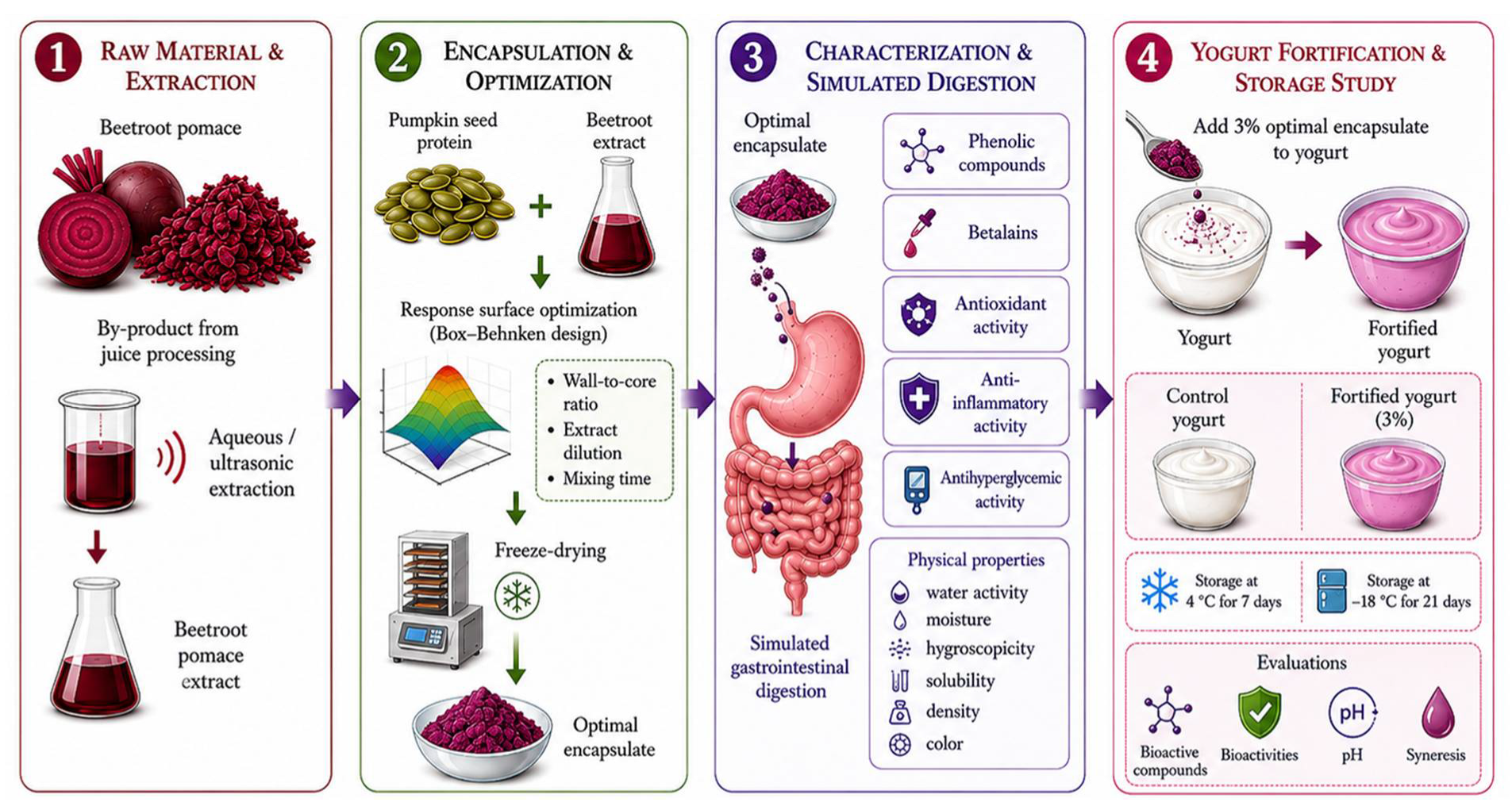
The overall experimental workflow, including beetroot pomace extraction, pumpkin seed protein-based encapsulation, simulated gastrointestinal digestion, and yogurt fortification, is schematically presented in Figure 1.

2.1. Chemicals

Folin–Ciocalteu reagent, 2,2-diphenyl-1-picrylhydrazyl radical (DPPH•), Trolox, and trichloroacetic acid were purchased from Sigma Chemical Co. (St Louis, MO, USA); ferric chloride was obtained from J.T. Baker (Deventer, Holland). All other chemicals and solvents used were of the highest analytical grade.

2.2. Plant Material

Fresh beetroot (Beta vulgaris L.) pomace was obtained after the pressing of pulp as a by-product from the fruit and vegetable processing industry (Zdravo Organic d.o.o., Selenča, Serbia). Pumpkin seed protein was acquired from Granum (Hajdukovo, Serbia).

2.3. Dry Matter Content Determination

Pomace material was dried in an oven (model ST-06, Instrumentaria, Zagreb, Croatia) at 105 °C to a constant weight. Dry matter content was determined by measuring the initial and final weight, and the calculated percentage of dried weight was 17.34%.

2.4. Extraction Procedure

For the preparation of encapsulates, fresh beetroot pomace (200 g) was extracted with distilled water (182 mL) under light protection. The extraction was performed in two repeated cycles. In each cycle, the sample–solvent mixture was first treated in an ultrasonic bath (Sonic 12 GT, VIMS elektrik, Tršić, Serbia; 40 kHz; ultrasonic power: 300 W) at room temperature for 30 min. This was followed by maceration without ultrasonic treatment for 30 min at room temperature. During maceration, the mixture was kept in a closed vessel, protected from light, and manually stirred at regular intervals to maintain contact between the pomace particles and solvent. The same ultrasound-assisted extraction/maceration cycle was then repeated once more, giving a total extraction time of 2 h. The obtained macerate was filtered through Whatman No. 1 filter paper and immediately mixed with pumpkin seed protein as a carrier for encapsulation.

2.5. HPLC Analysis

The quantification of individual phenolic compounds was performed by high-resolution liquid chromatography (high-performance liquid chromatography, HPLC) on Shimadzu Prominence equipment (Shimadzu, Kyoto, Japan), which included an LC-20AT binary pump, CTO-20A thermostat, and SIL-20A automatic dispenser connected to a DAD detector. The separation was performed on a Luna C-18 RP column, 5 µm and 250 × 4.6 mm (Phenomenex, Torrance, CA, USA), which was protected by a C18 precolumn, 4 × 30 mm (Phenomenex, Torrance, CA, USA). A solvent system was used as the mobile phase—A (acetonitrile) and B (1% formic acid)—at a flow rate of 1 mL/min with the following linear gradient: 0–10 min from 10 to 25% A; 10–20 min linear increase to 60% A; and, from 20 to 30 min, a linear increase to 70% A. The column was equilibrated to the initial condition of 10% A for 10 min, with an additional 5 min for stabilization. All samples and solvents were filtered before analysis through 0.45 µm pore size membrane filters (Millipore, Bedford, MA, USA).

2.6. Optimization of Encapsulation

In order to identify optimal conditions for the encapsulation of bioactive compounds (phenolics and betalains) extracted from beetroot pomace, the response surface methodology (RSM) was used, as described by Tumbas Šaponjac et al. [5]. The experimental design adopted was a Box–Behnken design for three variables at three levels. The three independent variables (i.e., conditions of the encapsulation process) were the wall–core ratio (X1), extract dilution (X2), and mixing time (X3). The coded values of the independent variables were –1, 0, and 1. The corresponding coded values of the three independent variables are given in Table 1. The complete design consisted of 15 experimental points, which included three replicates of the central point. The conditions for the encapsulation process were optimized using the multi-response surface methodology in order to obtain the optimal encapsulate with the highest encapsulation efficiency for both phenolics and betalains.
The selected ranges of the independent variables were defined based on previous studies dealing with the protein-based encapsulation of beetroot-derived bioactives, as well as preliminary laboratory trials performed to identify processable mixtures suitable for mixing and freeze drying. The wall-to-core ratio range was chosen to evaluate the effects of carrier availability on phenolic and betalain retention, from a lower protein level that maximized core loading to a higher protein level that could provide more binding sites but also dilute the bioactive fraction. The extract dilution range was selected to assess the influence of the extract concentration on dispersion, viscosity, pigment concentrations, and interactions with pumpkin seed protein. The undiluted extract represented the most concentrated bioactive system, whereas diluted extracts were included to determine whether lower solid and pigment concentrations could improve mixing homogeneity and encapsulation efficiency. The mixing time range was chosen to cover the minimum time required for the complete dispersion of the carrier and extract, as observed in preliminary trials, and a longer contact time that could promote protein–bioactive interactions. At the same time, excessively long mixing was avoided to reduce the unnecessary exposure of betalains and phenolic compounds to oxygen, light, and processing stress. Therefore, the selected Box–Behnken levels reflected both literature-based encapsulation conditions and practical physical constraints related to mixture processability, bioactive stability, and freeze-drying suitability.

2.7. Encapsulation Process

The wall material (pumpkin seed protein) was mixed with different volumes of extract and distilled water using a laboratory shaker (Unimax 1010, Heidolph Instruments GmbH, Kelheim, Germany) at 200 rpm for various periods of time, at room temperature and under light protection, according to the experimental design (Table 1). The mixtures were iced overnight at −20 °C and then freeze-dried at −40 °C and 0.02 mbar for 48 h to ensure complete drying. Collected freeze-dried encapsulates (i.e., powders colored in different shades of purple) were packed in airtight containers and stored at −20 °C until further analysis.

2.8. Content and Encapsulation Efficiency of Phenolics and Betalains

In the beetroot pomace extract, the content of total phenolics was determined spectrophotometrically using a Multiskan GO microplate reader (Thermo Fisher Scientific Inc., Waltham, MA, USA) by the Folin–Ciocalteu (FC) method, adapted to the microscale [13]. Results were expressed as mg gallic acid equivalents (GAE) per 100 g of sample (DW) or per 100 g of yogurt-based product. Moreover, in the beetroot pomace extract, the content of total betalains (sum of total betacyanin and betaxanthin) was determined according to the spectrophotometric method of Von Elbe et al. [14], adapted to the microscale. Results were expressed in mg (i.e., sum of mg vulgaxanthin-I and mg betanin equivalents) per 100 g of sample (DW) or per 100 g of yogurt-based product.
For the determination of the total bioactive compounds, encapsulates were subjected to the extraction procedure described by Sáenz et al. [15], with modifications. In the first step, 200 mg of sample was dispersed in 2 mL ethanol, acetic acid, and water (50:8:42). The mixture was then vortexed for 1 min and subjected to ultrasound for 20 min, again vortexed for 1 min and subjected to ultrasound for 20 min, and centrifuged for 5 min at 4000 rpm, and the supernatant was separated. In the second step, the residue was vortexed with 1 mL of solvent mixture for 1 min and further extracted for 30 min using a laboratory shaker at 400 rpm. The mixture was then subjected to ultrasound for 20 min and centrifuged for 5 min at 4000 rpm, and the supernatant was separated. In the third step, the residue was vortexed with 1 mL of solvent mixture for 0.5 min, subjected to ultrasound for 5 min, and centrifuged for 5 min at 4000 rpm, and the supernatant was separated. The supernatants from all three steps were combined, filtered (0.45 μm filter), and used for the determination of total phenolics (TP) and total betalains (TB). For the determination of surface bioactive compounds, encapsulates were subjected to the extraction procedure described by Carmona et al. [16], with modifications. The sample (100 mg) was dispersed in an ethanol–methanol (1:1) solution (1 mL), shaken for 1 min, and centrifuged at 4000 rpm for 5 min. The supernatants obtained after separation and filtration (0.45 μm filter) were used for the determination of surface phenolics (SP) and surface betalains (SB). The total and surface bioactive compound content was determined spectrophotometrically as described above.
The encapsulation efficiency of phenolics (EE-P) and encapsulation efficiency of betalains (EE-B) were calculated according to Tumbas Šaponjac et al. [5] and Carmona et al. [16], using Equations (1) and (2):
EE-P (%) = 100 × (TP − SP)/TP
EE-B (%) = 100 × (TB − SB)/TB
Simultaneously, corrections for interfering substances originating from the wall material were implemented by preparing control samples in which the encapsulate extract was replaced with a matching concentration of pumpkin seed protein extract prepared in the same way. Control samples containing only pumpkin seed protein, at concentrations matching those used in each encapsulate formulation, were prepared and extracted under the same conditions as for the encapsulate samples. The values obtained for these controls were used as background values and subtracted from the corresponding total and surface phenolic values of the encapsulates before calculating the encapsulation efficiency. For betalain determination, the same controls were used to verify that the wall material did not contribute interfering absorbance at the selected wavelengths.

2.9. Preparation and Characterization of Optimal Encapsulate

The optimal encapsulate (OE) was prepared under the optimal conditions, with the same wall material (WM) and beetroot pomace extract used for the preparation of the encapsulates in the experimental design. In addition, the physical properties and the effects of in vitro simulated gastrointestinal digestion on bioactive compounds and bioactivities were determined for the optimal encapsulate (OE), as well as for the wall material (WM) used for its preparation.

2.10. In Vitro Digestion of Optimal Encapsulate

In vitro simulated gastrointestinal digestion was performed according to the procedure proposed by Minekus et al. [17], with a modification in the sample solid to enzyme ratio to 1:2. The obtained digestates were immediately frozen at −20 °C and freeze-dried [18]. For the determination of the bioactive compound content and biological activity, the optimal encapsulate (OE), the wall material (WM), and their lyophilized digestates were subjected to extraction, performed for the determination of the content of bioactive compounds in the encapsulates, as previously described. The content of bioactive compounds and the bioactivities of the optimal encapsulate (OE) and wall material (WM) determined before and after digestion were compared.

2.11. Bioactivity Analysis

Biological (antioxidant, anti-inflammatory, and antihyperglycemic) activity was determined spectrophotometrically using appropriate methods adapted to the microscale. Antioxidant activity was estimated against stable DPPH radicals (AADPPH) and by the reducing power (RP) ability. The DPPH assay, i.e., the ability of samples to scavenge DPPH•, was evaluated according to the microscale method of Girones-Vilaplana et al. [19]. Reducing power was analyzed according to Oyaizu’s method [20], adapted to the microscale. The results of antioxidant activity tests were expressed in mg Trolox equivalents (TE) per 100 g of sample (DW) or per 100 g of yogurt-based product. Anti-inflammatory activity (AIA) was determined in vitro by a protein denaturation bioassay using egg albumin (from fresh hen’s eggs), according to the method adopted by Ullah et al. [21]. Results were expressed as effects in % inhibition of protein denaturation that produced the applied extract, which corresponded to the appropriate mass of sample. To investigate in vitro antihyperglycemic activity (AHgA), the α-glucosidase inhibitory potential was measured, according to Tumbas Šaponjac et al. [22]. Results were expressed as effects in % inhibition of alfa-glucosidase activity that produced the applied extract, which corresponded to the appropriate mass of sample. Acarbose in the case of antihyperglycemic activity and diclofenac sodium in the case of anti-inflammatory activity were used as positive controls.

2.12. Physical Characterization

The water activity (aw), moisture content, hygroscopicity, solubility, bulk density, tapped density, Carr’s index (CI), Hausner ratio (HR), and color parameters (L*, a*, b*, C* and h°) were determined as described previously [23]. The classification of flowability was performed as described by Shishir et al. [24]. The classification of the encapsulate’s cohesiveness was performed according to Jinapong et al. [25].

2.13. Preparation of Fortified Yogurt

Yogurt fermentation was performed with the commercial thermophilic starter culture Yo-Flex® (Chr. Hansen, Hørsholm, Denmark), according to the supplier’s instructions. Once the process parameters confirmed that fermentation was complete, the yogurt was transferred to the packaging stage. In this stage, the fermented yogurt base was homogenized with the OE of beetroot pomace extract at a concentration of 3% (w/w). To estimate the improvement in bioactive properties achieved by the fortification of yogurt with the OE, the stability of the bioactive compounds and bioactivities in the fortified and control yogurt was monitored during storage periods (at 4 °C for 7 days and at −18 °C for 21 days). After applying the extraction method described by Shori et al. [26], the content of bioactive components (betalains and phenolics) and the bioactivities of the fortified and control yogurt were determined according to previously described methods (in Section 2.8 and Section 2.11). The pH values of yogurt samples were measured with a HI99161 pH meter (Hanna Instruments, Vunsakat, USA). The syneresis values of yogurts were measured according to Żbikowska et al. [27]. The concentration of 3% (w/w) OE was selected as a preliminary, technologically feasible fortification level, based on previous reports on yogurt enrichment with beetroot-derived ingredients and encapsulated bioactives, as well as on preliminary laboratory observations of powder dispersibility, color intensity, and product homogeneity. This level was expected to provide measurable enrichment in betalains, phenolic compounds, and associated bioactivities, while avoiding excessive powder addition that could impair the yogurt’s structure and increase syneresis. No formal sensory evaluation was performed at this stage; therefore, the selected concentration should be considered a functional and technological screening level rather than a final consumer-optimized formulation.

2.14. Statistical Analysis

All experiments were run in triplicate. The results presented are means ± standard deviation (±SD, n = 3). Statistical analyses were performed using the Origin 7.0 SRO software package (OriginLab Corporation, Northampton, MA, USA, 1991–2002) and Microsoft Office Excel 2010 software. Significant differences were calculated by ANOVA (p < 0.05). For the optimization experiments, calculations, and graphs, multi-response optimization was conducted using the Minitab 17 software (Minitab Inc., State College, PA, USA).

3. Results

3.1. Chemical Characterization of Beetroot Pomace Extract

The total phenolics and total betalains determined by spectrophotometric methods for beetroot pomace extract were 193.75 ± 3.83 mg GAE/100 g DW of beetroot pomace and 95.78 ± 1.27 mg/100 g DW of beetroot pomace. The content of individual phenolic compounds in beetroot pomace extract, determined by HPLC analysis, is presented in Table 2. These values were in accordance with the previously reported content of bioactive compounds determined in pomace from various beetroots varieties [5,28].

3.2. Selection of the Optimal Encapsulate

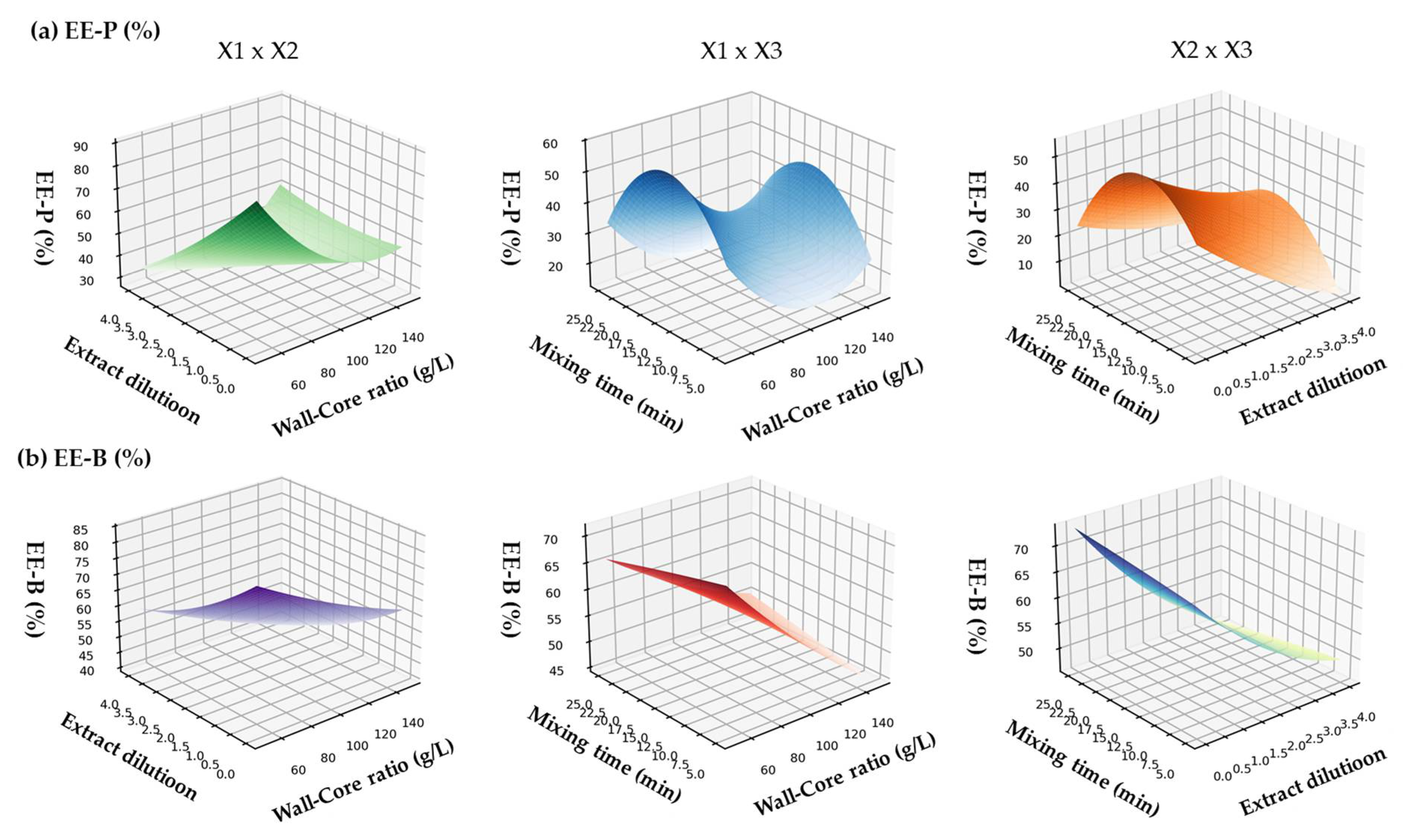
The RSM as an optimization strategy was applied in order to identify the optimal conditions for the encapsulation of bioactive compounds extracted from beetroot pomace with pumpkin seed protein and to obtain the optimal encapsulate (OE), i.e., the encapsulate with the highest encapsulation efficiency for both betalains (EE-B) and phenolic compounds (EE-P). Therefore, as responses, EE-B and EE-P were measured. A Box–Behnken design was used to evaluate the effects of different encapsulation conditions on the responses of the formulated powders (Table 1). The encapsulation parameters, i.e., the wall–core ratio, extract dilution, and mixing time (X1, X2, and X3), were combined in 15 experiments. Encapsulation was achieved with the lyophilization technique. Encapsulation efficiency is a parameter describing the quality of an encapsulation process and is a valuable predictor for product stability [29]. In the prepared encapsulates, EE-P ranged from 0% to 74.37%, while EE-B ranged from 38.64% to 80.75% (Table 1). The highest encapsulation efficiency for both phenolics and betalains (EE-B and EE-P) was observed in the encapsulate prepared with the lowest wall–core ratio, without extract dilution, and by applying a mixing time of 15 min. Figure 2 shows the influence of the independent variables (X1, X2, X3) on the EE-P and EE-B of the encapsulates obtained in experiments 1–15.
Using the multi-response methodology for optimization, and statistical analysis of the data performed with the Minitab 17 software, the highest encapsulation efficiency for both phenolics and betalains (76.73% and 85.42%, respectively) was predicted in the encapsulate prepared with the lowest wall–core ratio, without extract dilution, and by applying a mixing time of 5 min. In order to confirm the optimization model, using the parameters obtained in multi-response optimization and under the same freeze-drying conditions used in experiments 1–15, the OE was prepared and characterized in terms of the encapsulation efficiency for bioactive compounds (phenolics and betalains). In the prepared OE, the encapsulation efficiency for both phenolics and betalains (75.37% and 84.02%, respectively) was in accordance with the result obtained in multi-response optimization, with no statistically significant difference (p < 0.05).

3.3. Characterization and In Vitro Digestion of the Optimal Encapsulate

The optimal encapsulate was chemically characterized in terms of the content of bioactive compounds (phenolics and betalains) and biological (antioxidant, anti-inflammatory and antihyperglycemic) activity (Table 3). In order to compare the bioactive compound content and bioactivities of the optimal encapsulate with those of the wall material, the same characteristics were determined for the wall material used in OE preparation (Table 3).
The content of individual phenolic compounds in the wall material and OE, determined by HPLC analysis, is presented in Table 4.
The effects of in vitro simulated gastrointestinal digestion on the bioactive compounds and bioactivities of the OE and the WM used in its preparation were also investigated (Table 3). After the digestion of the OE, the total betalains was lower, mostly because the level of betacyanins was two-times lower, albeit still present in a significant amount, in relation to the level before digestion. Higher values could be observed for phenolics and antioxidant activity (in both AADPPH and RP assays) after the digestion of the WM and OE. These values were higher in the case of the OE than the WM. After digestion, the OE, in comparison to the WM, showed higher AIA and AHgA. Acarbose, used as a positive control, exhibited a 50% antihyperglycemic effect at content of 31.2 µg in the applied test reaction system. Diclofenac sodium, used as a positive control, exhibited a 50% anti-inflammatory effect at content of 1.67 mg in the applied test reaction system.
In order to characterize the OE and the WM used for its preparation, an analysis of the water activity, moisture content, hygroscopicity, density ratios, flowability, cohesiveness, solubility, and color parameters was conducted (Table 5). The differences in the properties of the OE and WM could be attributed to the beetroot pomace extract and encapsulation process applied.
The optimal encapsulate showed low water activity (0.052) and moisture content (4.70 g/100 g), higher hygroscopicity (24.59 g/100 g), lower bulk and tapped densities (0.18 and 0.29 g/mL), very poor flowability, high cohesiveness, increased solubility (54.59 g/100 g), and a dark red–orange color profile (L* = 24.8, a* = 27.2, b* = 13.2).

3.4. Bioactive Compounds and Bioactivities of Fortified Yogurt

To evaluate the effects of the addition of the OE to yogurt, both fortified and control yogurts were characterized in terms of bioactive compounds and bioactivities during storage at 4 °C and −18 °C (Table 6 and Table 7). The addition of the OE increased the content of bioactive compounds and antioxidant activity (as measured by the DPPH and RP assays) in the fortified yogurt compared with the control yogurt, both after preparation and at each storage time.
Due to the addition of the OE, higher anti-inflammatory and antihyperglycemic activity was also observed in the fortified compared to the control yogurt after preparation and during storage at the tested conditions.
In order to monitor their stability, the bioactive compound content and bioactivities of the fortified and control yogurt after storage were compared in relation to the values determined after the preparation of the products (i.e., at zero time). For the fortified yogurt at the end of the storage period at −18 °C, in comparison to the level at zero time, higher bioactive compound content and bioactivities were observed. For the fortified yogurt at the end of the storage period at 4 °C, in comparison to the level at zero time, similar levels of bioactive compound content were maintained (with the exception of a somewhat lower level of betacyanins), with higher antioxidant activity, although lower anti-inflammatory and antihyperglycemic activity was observed.

4. Discussion

4.1. Encapsulation Performance and Comparison with Previous Studies

Previously, in the study of Čakarević et al. [30], the encapsulation efficiency of phenols in encapsulates of beetroot juice in pumpkin protein isolate prepared by the freeze-and-spray-drying method was 92% and 75%, respectively. The EE of phenolics in encapsulates of beetroot juice and an extract with soy protein obtained by freeze drying at different encapsulation conditions ranged from 60.26% to 85.03% and from 47.79% to 92.47%, respectively [5,31]. The betalain EE (calculated in relation to the betalain content in the feed solution) of beetroot waste extract encapsulates produced by freeze drying with gum arabic and maltodextrin individually was 82% and 88%, respectively, while blends of the carrier agents decreased the betalain EE of the beetroot waste extract encapsulates (64–70%) [32]. Poornima and Sinthiya [33] studied encapsulated beetroot extracts with a combination of maltodextrin and gum arabic at different conditions via spray drying; they reported encapsulation efficiencies for betanin in the range of 96.79% to 99.60%. García-Segovia et al. [34] studied encapsulates of beetroot juice with 3.5% and 7% pea protein, treated by spray drying at 125 and 150 °C. They determined the encapsulation efficiencies for phenols, betacyanins, and betaxanthins and antioxidant activity, which ranged from 45 to 63%, from 40 to 52%, from 16 to 59%, and from 38 to 56%, respectively. Encapsulation efficiency is a key indicator of process quality and product stability. In this study, the optimized protein-based encapsulation system achieved high predicted and experimentally confirmed efficiencies for both phenolics and betalains, supporting the suitability of pumpkin seed protein as a carrier for beetroot pomace bioactives.

4.2. Bioactive Composition and Simulated Gastrointestinal Digestion

Numerous techniques and different encapsulation materials have been used for the encapsulation of beetroot bioactive phenolic and betalain compounds. In an encapsulated beetroot pomace extract with soy protein, obtained via the freeze-drying method, Tumbas Šaponjac et al. [5] determined phenolic content of 326.51 mg GAE/100 g. In another study, Tumbas Šaponjac et al. [31] examined encapsulated beetroot juice with soy protein, again prepared via the freeze-drying method, and reported that the content of total phenolics was 150.71 mg GAE/100 g. Flores-Mancha et al. [35] examined freeze-dried pure beet juice and encapsulates of pure beet juice with maltodextrin and inulin, with phenolic content of 1235.4 mg GAE/100 g, 609.3 mg GAE/100 g and 597.5 mg GAE/100 g, respectively. Antigo et al. [36] revealed phenolic content of 488.87 and 583.11 mg GAE/100 g in maltodextrin- and maltodextrin/xanthan gum-encapsulated red beet juice powders prepared by freeze drying. Mkhari et al. [32] studied an encapsulated beetroot waste extract with maltodextrin, gum arabic, and their blends via a freeze-drying procedure and determined the total phenolic content of the powders, which ranged from 69.78 μg/g to 96.90 μg/g. Bazaria and Kumar [37] studied encapsulates of beetroot juice concentrate with whey protein, obtained at different operational conditions under spray drying, and revealed that the content of phenolics ranged from 16.69 mg GAE/100 g to 25.89 mg GAE/100 g. Moreover, Bazaria and Kumar [38] examined encapsulates of beetroot juice with different ratios of maltodextrin DE10, maltodextrin DE20, and gum arabic under spray drying, with total phenolic content ranging from ~ 19 mg GAE/100 g to 26.36 mg GAE/100 g, and the highest total phenolic content was found for the blend of AG and maltodextrin DE20. García-Segovia et al. [34] observed encapsulates of beetroot juice with 3.5% and 7% pea protein under spray drying at 125 and 150 °C, where the total phenolics ranged from 644 mg GAE/100 g to 896 mg GAE/100 g. Similarly to our study, gallic acid, protocatechuic acid, p-hydroxybenzoic acid, and/or ferulic acid were also determined previously in higher amounts in beetroot extracts [5,28,39,40,41]. Moreover, rutin was among the identified phenolic compounds in red beetroot extract [42]. In pumpkin seeds, phenolic compounds such as gallic acid, p-hydroxybenzoic acid, and ferulic acid were also determined in high levels previously [43]. In the study of Tumbas Šaponjac et al. [5], in an encapsulated beetroot pomace extract, the content of betaxanthins (61.33 mg VE/100 g) did not differ significantly from the content of betacyanins (60.52 mg BE/100 g). Additionally, similar content of betaxanthins (261.55 mg VE/100 g) and betacyanins (259.73 mg BE/100 g) in an encapsulate of beetroot juice was found [31]. Flores-Mancha et al. [35] reported that, in freeze-dried pure beet juice, the content of total betalains was 382.35 mg/100 g (i.e., 219.18 mg/100 g of betacyanins and 163.18 mg/100 g of betaxanthins). The total betalain content in encapsulates with maltodextrin was 15.71 mg/100 g (i.e., 10.00 mg/100 g of betacyanins and 5.72 mg/100 g of betaxanthins) and in those with inulin was 10.11 mg/100 g (i.e., 6.28 mg/100 g of betacyanins and 3.83 mg/100 g of betaxanthins) [35]. In the study of Mkhari et al. [32], the betalain content of beetroot waste extract encapsulates on the basis of maltodextrin, gum arabic, and their blends varied from 2.2 mg/100 g to 3.12 mg/100 g. In an encapsulated beetroot juice concentrate with whey protein, obtained using the spray-drying technique, the total betalain content ranged from 261.96 to 272.54 mg/100 g [37]. Moreover, Bazaria and Kumar [38] reported that the encapsulation of beetroot juice with gum arabic, maltodextrin DE10, maltodextrin DE20, and their blends retained betalains in the range of ~170 mg/100 g DW to 208.06 mg/100 g DW. In another study, Bazaria and Kumar [44] encapsulated beetroot juice concentrate with maltodextrin, gum arabic, and whey protein concentrate and found that the betalain content varied from 158.89 mg/100 g DW to 249.41 mg/100 g DW. In an encapsulated beetroot extract with maltodextrin, inulin, whey protein, and their blends prepared by spray drying, the content of betaxanthins was in the range of 136.86 to 155.37 mg/100 g, while that of betacyanins varied from 211.93 to 230.10 mg/100 g [45]. In the study of Janiszewska [46], beetroot juice was encapsulated using gum arabic, maltodextrin, and a mixture of both (1:1) as carriers via the spray-drying technique, and the content of betaxanthins ranged from 34 to 61 mg/100 g, while the content of betacyanins ranged from 109 to 129 mg/100 g. In microcapsules of beetroot juice with gum arabic obtained by spray drying, the betalain content was 11.98 mg/100 g powder [47]. García-Segovia et al. [34] revealed, in encapsulates of beetroot juice with 3.5% and 7% pea protein obtained by spray drying at 125 mgBE/100 g, betacyanin content in the range of 845 mgBE/100 g to 981 mgBE/100 g and betaxanthin content from 433 mgVE/100 g to 506 mgVE/100 g. In the study of Janiszewska and Włodarczyk [48], in encapsulates of beetroot juice with maltodextrin obtained under different conditions of spray drying, the content of betacyanins, expressed as betanin, ranged from 117 mg/100 g to 123 mg/100 g, while the value of betaxanthins, expressed as vulgaxanthin-I, ranged from 57 mg/100 g to 67 mg/100 g. In beetroot juice encapsulates prepared with maltodextrin as an encapsulating agent and with maltodextrin in combination with chia mucilage and gum arabic (at concentration levels of 10 and 15%), obtained using spray drying, Antigo et al. [49] found content of betacyanins ranging from 141.55 to 212.23 mg/100 g. In a beetroot extract encapsulated with maltodextrin DE10 in different core-to-wall ratios by spray drying, the content of betalains ranged from 90.71 to 135.98 mg/100 g [50]. Do Carmo et al. [51] reported, in encapsulated beetroot juice obtained by spray drying under different temperatures and inulin–whey protein isolate ratios as carrier agents, levels of betacyanins, betaxanthins, and betalains ranging from 157.8 to 193.1 mg/100 g, from 185.8 to 221.8 mg/100 g DW, and from 344.9 to 412.2 mg/100 g dw, respectively. Singh and Hathan [52] studied encapsulates of beetroot juice prepared by spray drying at different feed flow rates (8, 10, and 11 mL/min), processing temperatures (140, 150, and 160 °C), and maltodextrin concentrations (20, 25, and 30%) and determined betalain content ranging from 12.03 to 38.52 mg/100 g. In encapsulates of beetroot extract prepared by spray drying, at different inlet temperatures and ratios of core material to wall material (combination of maltodextrin and gum arabic) of 1:2, 1:4, and 1:6, the betanin content ranged from 0.035 to 0.20 mg/g [33]. These variations in phenolic and betalain content can be attributed to cultivar, maturity, extraction, and encapsulation method differences, as well as other factors [5,32].
Previously, the antioxidant activity of beetroot pomace extract encapsulates determined by the DPPH and RP tests was 1655.36 µmol TE/100 g and 394.95 µmol TE/100 g, respectively [5]. In another study, in the DPPH and RP tests, the antioxidant activity of beetroot juice encapsulates was 1.02 mmol TE/100 g and 1.81 mmol TE/100 g, respectively [31]. Flores-Mancha et al. [35] reported antioxidant activity for freeze-dried pure beet juice and its encapsulates with maltodextrin and inulin ranging from 0.65 to 0.91 mM TE/100 g when using the ABTS test and from 0.21 to 0.45 mM TE/100 g when using the DPPH test. Mkhari et al. [32] studied encapsulates of beetroot waste extract on the basis of maltodextrin, gum arabic, and their blends after freeze drying and reported antioxidant activity according to the DPPH test in the range of 19 to 26 mM TE/g. In the study of do Carmo et al. [45], for spray-dried encapsulates of beetroot extract produced with different wall materials (maltodextrin, inulin, and whey protein isolate and their blends), the antioxidant activity according to the DPPH test ranged from 60.57% to 85.01%. In another study, do Carmo et al. [51] studied encapsulated beetroot juice’s antioxidant activity under the DPPH assay and reported values from 61.5% to 90.8%, and they found that the antioxidant activity was the highest for encapsulates obtained with a higher temperature (170 °C) and a higher inulin concentration in relation to whey protein isolate. García-Segovia et al. [34] studied encapsulates of beetroot juice with pea protein obtained under different conditions by spray drying, where the antioxidant activity in the DPPH assay ranged from 213 mg TE/100 g to 263 mg TE/100 g. Bazaria and Kumar [37] studied encapsulates of beetroot juice concentrate with whey protein, obtained under different operational conditions via spray drying, and revealed that the antioxidant activity under DPPH ranged from 68.85% to 77.29%. Moreover, Bazaria and Kumar [38] examined encapsulates of beetroot juice with gum arabic, maltodextrin DE10, maltodextrin DE20, and their blends, where the antioxidant activity under DPPH ranged from ~63.5 to 67%. Numerous health-promoting properties, including anti-inflammatory, antioxidant, and antidiabetic, have been attributed to beetroot previously [53]. The bioactive properties determined in our study for the encapsulated beetroot waste extract were in accordance with previous reports.
The behavior of the OE after digestion can be attributed to the protective effects of encapsulation on beetroot bioactive compounds. Therefore, the bioactive compounds in the OE may have been partially protected from degradation under simulated gastrointestinal conditions, leading to improved release, extractability, and potential bioaccessibility during in vitro digestion. The behavior of encapsulates in simulated gastrointestinal digestion is dependent on the type and properties of the wall material used for encapsulation and their resistance or susceptibility to digestive enzymes [54]. After the in vitro digestion of encapsulated beetroot juice with pumpkin protein isolate by the freeze-and-spray-drying method, Čakarević et al. [30] reported total phenolic content of 13.24 mg GAE/g and 18.94 mg GAE/g, betaxanthin content of 0.344 mg VE/g and 0.296 mg VE/g, and betacyanin content of 0.298 mg BE/g and 0.248 mg BE/g, respectively. Antioxidant activity was determined after the in vitro digestion of the same encapsulates obtained by the freeze-and-spray-drying method under the DPPH test (84.88 μmol TE/g and 53.63 μmol TE/g, respectively) and ABTS test (16.81 μmol TE/g and 23.01 μmol TE/g, respectively) [30]. Previously, during the digestion of beetroot, it was found that betanin—a major betalain present in beetroot—was highly unstable, with bioaccessibility of 16.2%, probably due to its hydrophilic nature [55]. Similarly, the bioaccessibility of isobetanin and neobetanin was 46%, while the total betacyanin bioaccessibility was 31.3% at the end of gastrointestinal digestion [55]. Additionally, a significant decrease in the antioxidant activity of beetroot, assessed by the oxidative hemolysis inhibition method during the gastric and intestinal phases of in vitro gastrointestinal digestion, was reported [55]. In the study of Vieira Teixeira da Silva et al. [56], after the simulated gastrointestinal digestion of betanin, half of its content was found in the small intestine fluid, but with higher antioxidant activity in relation to the initial values. After simulated digestion, higher betalain content and antioxidant activity, but lower phenolic content, were determined for beetroot juice encapsulates in comparison to the wall material (pumpkin protein isolate) used for their preparation [30]. Tumbas Šaponjac et al. [5] reported lower levels of phenolics after the in vitro digestion of an encapsulated beetroot pomace extract with soy protein in relation to the levels before digestion. Kuhn et al. [57] investigated the simulated gastrointestinal digestion of an encapsulated Bougainvillea glabra bracts extract obtained by freeze drying using the prebiotic fibers polydextrose and inulin as encapsulating materials and observed the maximum release and stability of betacyanins and phenolics in the gastric phase in comparison to the intestinal phase (small intestine); however, the release was slower in powders containing inulin. Wang et al. [58] examined the in vitro gastrointestinal digestion of red beetroot and its jam, observing higher levels of total phenolics, betalains, and antioxidant capacity in the gastric compared to the intestinal phase, while the total flavonoid content was decreased during gastric digestion. Then, an increase after intestinal digestion was observed, as intestinal enzymes and bile salts probably accelerated the release of flavonoids, which combined with the matrix. Since the antioxidant properties of plant extracts are mostly attributed to the presence of phenolic components, the changes that occur during gastrointestinal digestion can alter the chemical structures of the phenolic compounds and lead to varying antioxidant capabilities [59]. The increase in detectable phenolics and antioxidant activity after simulated gastrointestinal digestion can be explained by digestion-induced structural changes in the pumpkin seed protein matrix. In the gastric phase, the low pH and pepsin activity may promote the swelling, partial unfolding, and hydrolysis of the protein wall, weakening the interactions by which phenolic compounds are retained within the encapsulate. Phenolics can interact with proteins through hydrogen bonding, hydrophobic interactions, and electrostatic forces; therefore, the disruption of the protein structure during gastric digestion may increase the extractability of compounds that were previously entrapped or tightly associated with the carrier. In the intestinal phase, the transition to a higher pH, together with pancreatic enzymes and bile salts, may further degrade the protein network and increase the release of bound phenolics from the wall material. These processes can generate a more soluble mixture of free phenolics, peptide-bound phenolics, and antioxidant peptides, all of which may contribute to the higher Folin–Ciocalteu response, DPPH radical-scavenging activity, and reducing power observed after digestion. Therefore, the post-digestion increase should be interpreted primarily as reflecting the improved extractability and potential bioaccessibility of phenolic compounds, accompanied by the contribution of digestion-derived peptides, rather than as the net formation of new phenolic compounds.

4.3. Physical Properties of the Optimal Encapsulate

Physical characteristics, such as water activity, moisture content, and hygroscopicity, are important factors for the storage stability of powder products [60]. Water activity (aw) is defined as the amount of free water available in the food system that is responsible for any biochemical reactions, while moisture content is the amount of water present in a food product [61,62]. The product is considered stable if its water activity level is below 0.4 [63]. Water activity and moisture content are two important indicators of powder quality, since both affect the shelf lives of powder products [61,62]. The water activity of the OE (0.052) could explain its high stability (Table 5). Similarly, its moisture content of 4.7% also contributed to the high stability of the OE (Table 5), since, for freeze-dried powders, values of moisture content within the recommended values (<5%) can grant microbiological stability and inhibit biochemical reactions in the product [32,64]. Previously, the moisture content of beetroot waste extract powder produced with maltodextrin, gum arabic, and their blends was found to be in the range of 3.21–4.99% [32]. In the study of Bazaria and Kumar [38], the moisture content of beetroot juice encapsulates with gum arabic, maltodextrin DE10, maltodextrin DE20, and their blends ranged from 1.26% to 2.88%. Do Carmo et al. [51] studied encapsulated beetroot juice obtained by the spray-drying technique under different temperatures and inulin–whey protein isolate ratios and found moisture content in the range of 1.3 to 2.2%. Guamán-Balcázar et al. [65] studied encapsulates of beet by-product extracts obtained with polyvinylpyrrolidone as a carrier agent by spray drying and determined water activity and moisture content of 0.19 and 6.01%, respectively. Torres et al. [66] examined red beetroot extract encapsulates, prepared using 3%w/v and 5%w/v maltodextrin DE12 via spray-drying technology with varying inlet temperatures and feed flow rates, and found that the moisture content varied from 2.78 to 7.86%. Antigo et al. [49] examined beetroot juice encapsulates on the basis of maltodextrin, as well as maltodextrin in combination with chia mucilage and gum arabic, with moisture content in the range of 4.57 to 4.77 g/100 g. García-Segovia et al. [34] observed, in encapsulates of beetroot juice with pea protein obtained under different conditions by spray drying, moisture content in the range of 3.21 to 4.92 g/100 g. Poornima and Sinthiya [33] studied an encapsulated beetroot extract with a combination of maltodextrin and gum arabic obtained under different conditions by spray drying; they determined moisture content in the range of 1.00 to 3.40%. Singh and Hathan [52] studied encapsulates of beetroot juice prepared with maltodextrin under different conditions by spray drying, with moisture content ranging from 3.95 to 6.50%.
Hygroscopicity is the property of a powder to absorb water in the form of moisture from the environment during storage [65]. It is implicated in storage stability and shelf life, since adsorbed water can affect the oxidation process [32,44,67]. The hygroscopicity value of the OE was 24.59 g/100 g (Table 5). For freeze-dried powder products, high hygroscopicity is a characteristic property [68]. In most cases, a powder with low moisture content has a greater ability to absorb water from its environment, i.e., has greater hygroscopicity [65]. In the study of Mkhari et al. [32], the hygroscopicity of encapsulates of beetroot waste extract on the basis of maltodextrin, gum arabic, and their blends varied from 1.27 to 4.13%. In the study of Bazaria and Kumar [38], the hygroscopicity values of beetroot juice encapsulates with blends of maltodextrin and gum arabic obtained by spray drying varied from 14.09 to 19.33 g/100 g dry solid. Additionally, Bazaria and Kumar [44] revealed hygroscopicity values for encapsulated beetroot juice with maltodextrin, gum arabic, and whey protein concentrate in the range of 15.67 g/100 g to 19.45 g/100 g. Torres et al. [66] examined red beetroot extract encapsulates prepared using maltodextrin, with hygroscopicity in the range of 5.46 to 9.74%. Guamán-Balcázar et al. [65] studied encapsulates of beetroot by-products extracted with polyvinylpyrrolidone and determined hygroscopicity of 15.14%. Antigo et al. [49] examined beetroot juice encapsulates on the basis of maltodextrin, as well as maltodextrin in combination with chia mucilage and gum arabic, with hygroscopicity in the range of 10.01 to 12.22 g/100 g. García-Segovia et al. [34] studied encapsulates of beetroot juice with pea protein prepared under different conditions by spray drying, observing hygroscopicity (after one week of storage at 81% RH) in the range of ~93 to 99 g/100 g. In the study of Cai and Corke [69], the hygroscopic moisture determined after one week of storage at 81% RH in freeze-dried betacyanin powder produced without a wall material was significantly higher (118.3 g/100 g) in comparison to betacyanin powder produced with added maltodextrin (50.7 g/100 g). The difference in hygroscopicity depends on the composition of the dehydrated food, the encapsulant matrix, and the drying technology used [65].
The density of a food product is an important property in terms of processing, packaging, storage, and transport [70]. A lower bulk density necessitates a greater volume for packaging [70]. Additionally, a lower bulk density can increase the possibility of powder product oxidation and reduce its storage stability due to the presence of large amounts of air within the powder [71]. The bulk densities of the OE and WM were 0.18 g/mL and 0.34 g/mL, while their tapped densities were 0.29 g/mL and 0.51 g/mL, respectively (Table 3). Hence, according to calculated Carr’s index (38.65%) and Hausner’s ratio (1.63), the OE is classified as a powder with very poor flow properties and high cohesiveness (Table 5). In the study of Mkhari et al. [32], the bulk density of beetroot waste extracts encapsulated with maltodextrin, gum arabic, and their blends varied from 0.66 to 0.74 g/mL. In the study of Bazaria and Kumar [38], the bulk density values of beetroot juice encapsulates with blends of maltodextrin (DE10 and DE20) and gum arabic ranged from 0.516 to 0.578 g/mL, and an increase in MD dextrose equivalents led to an increase in bulk density. Moreover, Bazaria and Kumar [44] reported the bulk density values of encapsulates of beetroot juice concentrate with maltodextrin, gum arabic, and whey protein concentrate ranging from 0.512 to 0.549 g/mL. Guamán-Balcázar et al. [65] studied encapsulates of beetroot by-product extracts on the basis of polyvinylpyrrolidone and determined a density of 0.42 g/mL after they were hit 100 times from a height of 5 cm. García-Segovia et al. [34] studied encapsulates of beetroot juice with pea protein obtained under different conditions by spray drying and observed densities from 0.36 g/mL to 0.57 g/mL. Singh and Hathan [52] studied encapsulates of beetroot juice prepared with maltodextrin under different conditions by spray drying and observed a packed bulk density (determined after tapping until the volume was reduced and reasonably constant) in the range of 0.618 to 0.747 g/mL.
The solubility of a powder is an important parameter regarding its ability to disintegrate in solutions, which needs to be considered before incorporation into food products [32,72]. For consumers, a desirable property and one of the main quality indicators for powdered products is quick and complete reconstitution [73]. The solubility of the OE was found to be 54.59 g/100 g (Table 3). In the study of Mkhari et al. [32], the solubility of beetroot waste extract encapsulates with maltodextrin, gum arabic, and their blends varied from 34.33% to 51.00%. Guamán-Balcázar et al. [65], in encapsulates of beetroot by-product extracts on the basis of polyvinylpyrrolidone, determined solubility of 84.47%. Antigo et al. [49] examined beetroot juice encapsulates on the basis of maltodextrin, as well as maltodextrin in combination with chia mucilage and arabic gum and found solubility in the range of 87.40 to 93.73 g/100 g. García-Segovia et al. [34] observed encapsulates of beetroot juice with pea protein obtained under different conditions by spray drying and found solubility of 12.4 to 17.9%. Solubility depends on many parameters, such as the nature of the core and carrier materials and the temperature [67,73].
Color is an important property as it may indicate changes in food quality due to processing, storage, and other factors [63]. Moreover, the color of food products is a significant factor in the buying decisions of consumers [32]. Therefore, the application of microencapsulated colorants as natural food colorants has been examined [32,74]. The color of the OE was similar to the natural red color of beetroot, linked to the high betacyanin content in the beetroot pomace extract (Table 3). Čakarević et al. [30], in encapsulates of beetroot juice with pumpkin protein isolate, determined L*, a*, b* color values of 31.18, 13.38, and 5.96 under freeze drying and 72.4, 1.47, and 23.91 under the spray-drying method, respectively. In the study of Mkhari et al. [32], the L*, a*, b* values of beetroot waste extract encapsulates prepared with different wall materials ranged from 31.09, 48.97, and 6.89 to 39.10, 54.08, and 19.59, respectively. In the study of Bazaria and Kumar [38], the L*, a*, b* values of beetroot juice encapsulates with different ratios of maltodextrin and gum arabic ranged from 21.34, 26.17, and 1.98 to 24.89, 39.03, and 3.65, respectively. In the study of Janiszewska [46], in beetroot juice encapsulates with different carriers, the L*, a*, b* values ranged from 45.77, 33.60, and −4.95 to 48.03, 36.92, and 3.50, respectively. In beetroot extract encapsulates prepared with maltodextrin DE10 in different core-to-wall ratios, the L*, a*, b* values ranged from 10.51, 21.71, and −8.12 to 10.92, 23.17, and −8.39, respectively [50]. Antigo et al. [49] found, in beetroot juice encapsulates prepared with different wall materials and core-to-wall ratios, L*, a*, b* values ranging from 31.41, 32.23, and 8.91 to 39.79, 37.08, and 11.11, respectively. Guamán-Balcázar et al. [65], in encapsulates of beetroot by-product extracts, determined L*, a*, b* values of 51.02, 35.36, and 6.67, respectively. García-Segovia et al. [34] studied encapsulates of beetroot juice with pea protein obtained under different conditions by spray drying; they obtained L*, a*, b* values from 23.1, 34.66, and 0.88 to 28.5, 36.80, and 2.73, respectively. Torres et al. [66] studied red beetroot extract encapsulates prepared with maltodextrin DE12 by spray-drying technology under varying conditions and found L*, a*, b* values ranging from 35.1, 38.7, and −11.3 to 39.6, 43.1, and −4.9, respectively.
Despite its favorable bioactive profile, the physical properties of the optimal encapsulate indicate important limitations for industrial application. The high hygroscopicity suggests that the powder may readily absorb moisture from the environment, which can promote particle adhesion, lump formation, caking, and reduced storage stability under uncontrolled humidity conditions. In addition, the very poor flowability and high cohesiveness indicate that the powder may show poor discharge from containers, hoppers, or dosing units; irregular flow during conveying; reduced weighing accuracy; and difficulties in homogeneous dispersion during large-scale food processing. These characteristics are particularly relevant for industrial yogurt fortification, where the accurate dosing and uniform distribution of the functional ingredient are necessary to ensure reproducible product quality. Therefore, the current encapsulate should be considered functionally promising but not yet fully optimized as an industrial powder ingredient.

4.4. Fortified Dairy Products

The betalain content of the fortified yogurt is comparable to the optimal levels of betalains for the fortification of yogurt (from 1.5 mg/100 g to 3 mg/100 g) estimated by Tekin et al. [75]. The phenolic content of the fortified yogurt in our study is in agreement with the levels (from 2.39 mg of GAE/100 g to 6.5 mg of GAE/100 g) found after the fortification of yogurts previously [76,77]. Moreover, the total phenolic content of the control yogurt is in accordance with the values of 1.79 mg GAE/100 g to ~8 mg GAE/100 g previously determined for plain yogurt [76,77,78,79]. The significant total phenolic content of the control yogurt was expected, since phenolic compounds are usually present in considerable amounts in ruminant milk. Most of these compounds are derived from the animal feed, although, to some extent, they may be the products of amino acid catabolism [76]. In addition to phenolic compounds, the Folin–Ciocalteu reactivity of plain yogurt could be a consequence of the presence of low-molecular-weight antioxidants, free amino acids, peptides, and proteins in milk samples [78]. In addition, it is important to note that the total phenolic compounds were quantified in extracts (i.e., supernatants) of yogurt samples, and, in these conditions, only released (free or unbound) polyphenols are determined [78]. It is known that the formation of complexes between phenolic compounds and milk proteins may affect phenolic recovery and activity. Indeed, phenolic compounds may interact with proteins in both ways, reversibly and irreversibly, since hydrogen bonds can be formed between phenolic groups due to the excellent hydrogen donors and carboxyl groups of the protein [76].
To investigate the antioxidant activity of the yogurts, the DPPH radical-scavenging activity and reducing power were examined; they are commonly assessed for foods [77]. In a previous study, the antioxidant activity of the control yogurt and yogurts with extracts of beetroot encapsulated on the basis of maltodextrin and inulin after preparation was 0.114, 0.197, and 0.124 mM TE/100 g, while, after 7 days of storage, it was 0.102, 0.170, and 0.145 mM TE/100 g, respectively [6]. In the study of Abdo et al. [7], the antioxidant activity under the DPPH test, expressed as the IC50 value, of a raspberry-flavored stirred yogurt without and with beetroot stalk water extract added at concentrations of 1, 2, and 5% at day 1 of storage was 78.47, 71.68, 71.5, and 69.18 µL/mL, and, at day 7, the antioxidant activity was 54.70, 57.35, 63.16, and 67.27 µL/mL. Similarly, as in our study, the antioxidant activity of the products was increased after 7 days of storage. The antioxidant activity of the fortified yogurt determined in our study is in agreement with the range of values—namely ~10 mg AAE/100 g to ~100 mg AAE/100 g—determined in yogurt after fortification previously [78,79]. The antioxidant activity of the control yogurt in our study was comparable to the values of ~1 mg AAE/100 g and ~7 mg AAE/100 g obtained by the DPPH and RP assays, respectively, in the study of Fidelis et al. [79], as well as with the values (~1.5 mg AAE/100 g and ~2 mg AAE/100 g by DPPH and RP assays, respectively) estimated by Helal et al. [78]. The anti-inflammatory and antihyperglycemic activity (expressed as effect in %) of the control yogurt were also observed in our study. The inhibition of α-glucosidase activity in the control yogurt was also observed in the study of Hong et al. [80]. Yuan at al. [81] reported that, among three types of dairy foods (milk, yogurt, and cheese), only yogurt intake was linked with lower levels of chronic inflammation. It was determined that the pH value of the fortified yogurt sample (pH = 4.57 ± 0.01) was higher than of the control yogurt (pH = 4.30 ± 0.01). This can be explained by the higher pH value of the added encapsulate in comparison to the yogurt [75]. Syneresis is the process of the separation of a liquid from a gel structure (i.e., whey separation) [82]. It is an important characteristic of yogurt quality, as it happens mainly when the weakened yogurt gel network does not have the ability to trap the liquid phase [82]. The fortified yogurt showed a lower syneresis value (65.90%) in comparison to the control yogurt (71.73%). Similarly, decreased syneresis in yogurts incorporating beetroot extracts encapsulated with maltodextrin and inulin in relation to plain yogurt was reported [6]. This can be explained by the fact that the components of the powders, namely the wall materials, favored water retention due to their contribution to the mesh effect in the three-dimensional network of the yogurt gel structure [6]. It is difficult to compare the syneresis values obtained in various studies, since the level of syneresis could be influenced by the method of determination, as well as by the level of solids content and the type of starter culture [83]. Nevertheless, the syneresis value of the control yogurt determined in our study is in agreement with the plain yogurt syneresis values determined with similar methods previously [82,83,84]. The lower syneresis observed in the fortified yogurt may also be related to interactions between the pumpkin seed protein from the encapsulate and the casein network of the yogurt. In addition to the water retention capacity of the wall material, pumpkin seed protein may participate in the gel matrix through hydrogen bonding, hydrophobic interactions, and electrostatic interactions with milk proteins. These interactions could strengthen the three-dimensional casein network, improve the immobilization of the aqueous phase, and consequently reduce whey separation. Furthermore, the encapsulate particles may behave as dispersed filler-like components within the yogurt gel, contributing to a denser structure and improved physical stability. However, since rheological and microstructural analyses were not performed, this explanation should be considered a plausible mechanism rather than direct evidence.
During the storage of the yogurt samples, an increase in antioxidant activity occurred, which could be attributed to compounds that were formed or released as a consequence of interactions between some components [6]. Moreover, it has been reported that a longer storage period and greater water activity lead to greater antioxidant activity [6]. The total betalain content of yogurts with extracts of beetroot encapsulated on the basis of maltodextrin and inulin after preparation was 18.652 and 12.962 mg/100 g, while, after 7 days of storage, it was 10.240 and 18.024 mg/100 g, respectively [6]. In the study of Abdo et al. [7], the betalain content of a raspberry-flavored stirred yogurt with beetroot stalk water extract added at concentrations of 1, 2, and 5% at day 1 of storage was 44.19, 62.32, and 67.86 mg/L, and, by day 7, the betalain content was almost halved, reaching 27.68, 31.41, and 33.64 mg/L, respectively. The higher stability observed for betaxanthins in relation to betacyanins in yogurt after 7 days of storage at 4 °C is in agreement with the study of Abdo et al. [7]. The total polyphenol content of the control yogurt and yogurts with extracts of beetroot encapsulated on the basis of maltodextrin and inulin after preparation was 8.340, 8.288, and 7.352 mg GAE/g, while, after 7 days of storage, it was 7.413, 7.133, and 7.730 mg GAE/g, respectively [6]. In the study of Abdo et al. [7], the phenolic content of a raspberry-flavored stirred yogurt without and with beetroot stalk water extract added at concentrations of 1, 2, and 5% at day 1 of storage was 95.11, 99.78, 101.20, and 116.55 mg/g, and, at day 7, the phenolic content of the yogurt had increased significantly to 104.18 and 125.45 mg/g, respectively. Meanwhile, the increase in the phenolic content of the control and the yogurt with beetroot extract at a concentration of 2%, reaching 98.83 and 103.97 mg/g, respectively, was insignificant compared with day 1.

4.5. Limitations and Future Perspectives

Although the present study demonstrates the technological and functional potential of pumpkin seed protein-encapsulated beetroot pomace bioactives for yogurt fortification, several limitations should be acknowledged. First, a sensory evaluation was not performed; therefore, consumer acceptance of the fortified yogurt in terms of color, taste, odor, texture, and overall liking remains to be investigated. This is particularly important because beetroot-derived pigments and plant protein-based encapsulates may affect the sensory perception of dairy products. Second, the digestion study was based on an in vitro simulated gastrointestinal model. While this approach provides useful preliminary information about the potential release and stability of bioactive compounds during digestion, it does not fully reproduce the complexity of in vivo digestion, absorption, metabolism, and individual physiological variability. Therefore, future studies should include in vivo or ex vivo validation to better assess the bioavailability and biological relevance of the observed effects. Third, despite the low water activity and moisture content of the optimal encapsulate, its high hygroscopicity and very poor flowability may limit direct industrial handling and scale-up. Further optimization of the powder properties, including the use of carrier blends, anti-caking agents, agglomeration, or alternative drying approaches, should be considered to improve the storage stability, dosing accuracy, and processability under industrial conditions.

5. Conclusions

This study demonstrates that beetroot pomace, an underutilized food-processing by-product, can be converted into a functional ingredient through encapsulation with pumpkin seed protein. The optimized encapsulate showed high, experimentally confirmed encapsulation efficiencies for phenolics and betalains, supporting the suitability of pumpkin seed protein as a plant-based wall material for the protection and delivery of beetroot pomace bioactives. After simulated gastrointestinal digestion, betalains remained detectable, while the increase in total phenolics and antioxidant activity indicated the enhanced extractability and potential bioaccessibility of phenolic compounds from the protein-based matrix.
The application of the optimized encapsulate in yogurt at 3% (w/w) improved the bioactive profile of the product compared with the non-fortified control. The fortified yogurt contained detectable betalains, higher total phenolics, and stronger antioxidant, anti-inflammatory, and antihyperglycemic activity during storage. In addition, reduced syneresis suggested that the encapsulate may contribute to improved physical stability, possibly through water retention and interactions between the pumpkin seed protein and the yogurt gel network.
However, several limitations should be acknowledged. The optimal encapsulate showed high hygroscopicity, very poor flowability, and high cohesiveness, which may limit direct industrial handling, dosing, storage, and scale-up. Future formulation strategies should therefore include powder-engineering approaches such as carrier blending, agglomeration, granulation, anti-caking agents, optimized drying conditions, and moisture-protective packaging. In addition, a sensory evaluation was not performed; therefore, the effects of the 3% encapsulate’s addition on taste, mouthfeel, texture, color acceptability, and overall consumer preference remain unknown. The digestion results were obtained using an in vitro model and should be further validated using ex vivo or in vivo approaches. Finally, future yogurt studies should include a formulation with unencapsulated beetroot pomace extract to distinguish the inherent contribution of beetroot bioactives from the specific technological advantages of encapsulation.
Overall, pumpkin seed protein-encapsulated beetroot pomace bioactives show strong potential as sustainable multifunctional ingredients for yogurt fortification, but further sensory, mechanistic, and process optimization studies are required before industrial application.

Author Contributions

Conceptualization, J.V., S.S. and O.Š.; methodology, J.V., S.S., O.Š. and V.T.Š.; software, S.B. and O.Š.; validation, J.V., S.S., D.C. and V.T.Š.; formal analysis, J.V., S.S., O.Š. and S.B.; investigation, J.V., S.S., O.Š. and S.B.; resources, J.V., D.C. and V.T.Š.; data curation, O.Š., S.B. and J.V.; writing—original draft preparation, O.Š., J.V. and S.S.; writing—review and editing, J.V., S.S., O.Š., D.C., S.B. and V.T.Š.; visualization, O.Š. and S.B.; supervision, J.V. and V.T.Š.; project administration, O.Š. and J.V.; funding acquisition, J.V. and V.T.Š. All authors have read and agreed to the published version of the manuscript.

Funding

This research was funded by the Innovation Fund of the Republic of Serbia, project “Nutritionally and Functionally Dairy Products Using Fruit and Vegetable By-Products”, grant 1148.

Institutional Review Board Statement

Not applicable.

Informed Consent Statement

Not applicable.

Data Availability Statement

The original contributions presented in the study are included in the article; further inquiries can be directed to the corresponding authors.

Acknowledgments

This research has been supported by the Ministry of Science, Technological Development and Innovation (Contracts No. 451-03-34/2026-03/200134, 451-03-33/2026-03/200134, and 451-03-33/2026-03/200358). During the preparation of this manuscript, the authors used Grammarly (version v.1.2.250.1876) to correct the English language throughout the text, as well as BioRender (version Basic) to prepare schematics.

Conflicts of Interest

The authors declare no conflicts of interest.

References

  1. Rațu, R.N.; Veleșcu, I.D.; Stoica, F.; Usturoi, A.; Arsenoaia, V.N.; Crivei, I.C.; Postolache, A.N.; Lipșa, F.D.; Filipov, F.; Florea, A.M.; et al. Application of Agri-Food By-Products in the Food Industry. Agriculture 2023, 13, 1559. [Google Scholar] [CrossRef]
  2. Stoica, F.; Râpeanu, G.; Rațu, R.N.; Stănciuc, N.; Croitoru, C.; Țopa, D.; Jităreanu, G. Red Beetroot and Its By-Products: A Comprehensive Review of Phytochemicals, Extraction Methods, Health Benefits, and Applications. Agriculture 2025, 15, 270. [Google Scholar] [CrossRef]
  3. Fu, Y.; Shi, J.; Xie, S.-Y.; Zhang, T.-Y.; Soladoye, O.P.; Aluko, R.E. Red Beetroot Betalains: Perspectives on Extraction, Processing, and Potential Health Benefits. J. Agric. Food Chem. 2020, 68, 11595–11611. [Google Scholar] [CrossRef] [PubMed]
  4. Hadipour, E.; Taleghani, A.; Tayarani-Najaran, N.; Tayarani-Najaran, Z. Biological Effects of Red Beetroot and Betalains: A Review. Phytother. Res. 2020, 34, 1847–1867. [Google Scholar] [CrossRef] [PubMed]
  5. Tumbas Šaponjac, V.; Čanadanović-Brunet, J.; Ćetković, G.; Jakišić, M.; Djilas, S.; Vulić, J.; Stajčić, S. Encapsulation of Beetroot Pomace Extract: RSM Optimization, Storage and Gastrointestinal Stability. Molecules 2016, 21, 584. [Google Scholar] [CrossRef] [PubMed]
  6. Flores-Mancha, M.A.; Ruíz-Gutiérrez, M.G.; Sánchez-Vega, R.; Santellano-Estrada, E.; Chávez-Martínez, A. Effect of Encapsulated Beet Extracts (Beta vulgaris) Added to Yogurt on the Physicochemical Characteristics and Antioxidant Activity. Molecules 2021, 26, 4768. [Google Scholar] [CrossRef] [PubMed]
  7. Abdo, E.M.; Mansour, H.M.M.; Darwish, A.M.G.; El-Sohaimy, S.A.; Gomaa, M.A.E.; Shaltout, O.E.; Allam, M.G. Beetroot Stalk Extract as a Functional Colorant for Stirred Yogurt Beverages: Effect on Nutritional Value and Stability during Storage. Fermentation 2023, 9, 878. [Google Scholar] [CrossRef]
  8. Sert, D.; Rohm, H.; Struck, S. Ultrasound-Assisted Extraction of Protein from Pumpkin Seed Press Cake: Impact on Protein Yield and Techno-Functionality. Foods 2022, 11, 4029. [Google Scholar] [CrossRef] [PubMed]
  9. Xie, Y.; Wang, Y.; Jin, X.; Zhang, X.; Yang, R. Pumpkin Seed Proteins: The Potentially Alternative Protein Supplements for Food Applications. Foods 2025, 14, 3969. [Google Scholar] [CrossRef] [PubMed]
  10. Yang, C.; Liu, J.; Han, Y.; Wang, B.; Liu, Z.; Hu, H.; Guan, Z.; Yang, Y.; Wang, J. Fabrication of Polyphenol-Pumpkin Seed Protein Isolate (PSPI) Covalent Conjugate Microparticles to Protect Free Radical Scavenging Activity of Polyphenol. Food Biosci. 2023, 55, 102982. [Google Scholar] [CrossRef]
  11. Lelis, C.A.; Andrade, J.C.; Lima, R.C.; Ribeiro, R.A.P.; Pacheco, A.F.C.; Pacheco, F.C.; Leite-Junior, B.R.C.; Paiva, P.H.C.; Álvares, T.S.; Conte-Junior, C.A. Pumpkin Seed Protein as a Carrier for Astaxanthin: Molecular Characterization of Interactions and Implications for Stability. Food Chem. 2025, 468, 142452. [Google Scholar] [CrossRef] [PubMed]
  12. Manjili, Z.N.; Sadeghi Mahoonak, A.; Ghorbani, M.; Shahiri Tabarestani, H. Multi-Layer Encapsulation of Pumpkin (Cucurbita maxima L.) Seed Protein Hydrolysate and Investigating Its Release and Antioxidant Activity in Simulated Gastrointestinal Digestion. Heliyon 2024, 10, e29669. [Google Scholar] [CrossRef]
  13. González-Molina, E.; Moreno, D.A.; García-Viguera, C. Genotype and harvest time influence the phytochemical quality of Fino lemon juice (Citrus limon (L.) Burm. F.) for industrial use. J. Agric. Food Chem. 2008, 56, 1669–1675. [Google Scholar] [CrossRef] [PubMed]
  14. Von Elbe, J.H. Betalains. Curr. Protoc. Food Anal. Chem. 2001, 00, F3.1.1–F3.1.7. [Google Scholar] [CrossRef]
  15. Saénz, C.; Tapia, S.; Chávez, J.; Robert, P. Microencapsulation by spray drying of bioactive compounds from cactus pear (Opuntia ficus-indica). Food Chem. 2009, 114, 616–622. [Google Scholar] [CrossRef]
  16. Carmona, J.C.; Robert, P.; Vergara, C.; Sáenz, C. Microparticles of yellow-orange cactus pear pulp (Opuntia ficus-indica) with cladode mucilage and maltodextrin as a food coloring in yogurt. LWT-Food Sci. Technol. 2021, 138, 110672. [Google Scholar] [CrossRef]
  17. Minekus, M.; Alminger, M.; Alvito, P.; Balance, S.; Bohn, T.; Bourlieu, C.; Carrière, F.; Boutrou, R.; Corredig, M.; Dupont, D.; et al. A standardised static in vitro digestion method suitable for food—An international consensus. Food Funct. 2014, 5, 1113–1124. [Google Scholar] [CrossRef] [PubMed]
  18. Ćetković, G.; Šeregelj, V.; Brandolini, A.; Čanadanović-Brunet, J.; Tumbas Šaponjac, V.; Vulić, J.; Šovljanski, O.; Četojević-Simin, D.; Škrobot, D.; Mandić, A.; et al. Composition, texture, sensorial quality, and biological activity after in vitro digestion of durum wheat pasta enriched with carrot waste extract encapsulates. Int. J. Food Sci. Nutr. 2022, 73, 638–649. [Google Scholar] [CrossRef] [PubMed]
  19. Gironés-Vilaplana, A.; Mena, P.; Moreno, D.A.; García-Viguera, C. Evaluation of sensorial, phytochemical and biological properties of new isotonic beverages enriched with lemon and berries during shelf life. J. Sci. Food Agric. 2014, 94, 1090–1100. [Google Scholar] [CrossRef] [PubMed]
  20. Oyaizu, M. Studies on products of browning reactions: Antioxidative activities of product of browning reaction prepared from glucosamine. Jpn. J. Nutr. Diet. 1986, 44, 307–315. [Google Scholar] [CrossRef]
  21. Ullah, H.M.A.; Zaman, S.; Juhara, F.; Akter, L.; Tareq, S.M.; Masum, E.H.; Bhattacharjee, R. Evaluation of antinociceptive, in-vivo & in-vitro anti-inflammatory activity of ethanolic extract of Curcuma zedoaria rhizome. BMC Complement. Altern. Med. 2014, 14, 346–358. [Google Scholar] [CrossRef] [PubMed]
  22. Tumbas Šaponjac, V.; Gironés-Vilaplana, A.; Djilas, S.; Mena, P.; Ćetković, G.; Moreno, D.A.; Čanadanović-Brunet, J.; Vulić, J.; Stajčić, S.; Krunić, M. Anthocyanin profiles and biological properties of caneberry (Rubus spp.) press residues. J. Sci. Food Agric. 2014, 94, 2393–2400. [Google Scholar] [CrossRef]
  23. Stajčić, S.; Pezo, L.; Ćetković, G.; Čanadanović-Brunet, J.; Mandić, A.; Tumbas Šaponjac, V.; Vulić, J.; Travičić, V.; Belović, M. Antioxidant activity according to bioactive compounds content in dried pumpkin waste. J. Serbian Chem. Soc. 2024, 89, 13–27. [Google Scholar] [CrossRef]
  24. Shishir, M.R.I.; Taip, F.S.; Aziz, N.A.; Talib, R.A. Physical Properties of Spray-dried Pink Guava (Psidium guajava) Powder. Agric. Agric. Sci. Procedia 2014, 2, 74–81. [Google Scholar] [CrossRef]
  25. Jinapong, N.; Suphantharika, M.; Jamnong, P. Production of instant soymilk powders by ultrafiltration, spray drying and fluidized bed agglomeration. J. Food Eng. 2008, 84, 194–205. [Google Scholar] [CrossRef]
  26. Shori, A.B.; Rashid, F.; Hj, B.; Ahmad, S. Effect of the addition of phytomix-3+ mangosteen on antioxidant activity, viability of lactic acid bacteria, type 2 diabetes key-enzymes, and sensory evaluation of yogurt. LWT-Food Sci. Technol. 2018, 94, 33–39. [Google Scholar] [CrossRef]
  27. Żbikowska, A.; Szymańska, I.; Kowalska, M. Impact of Inulin Addition on Properties of Natural Yogurt. Appl. Sci. 2020, 10, 4317. [Google Scholar] [CrossRef]
  28. Vulić, J.; Čanadanović-Brunet, J.; Ćetković, G.; Tumbas, V.; Djilas, S.; Četojević-Simin, D.; Čanadanović, V. Antioxidant and cell growth activities of beet root pomace extracts. J. Funct. Foods 2012, 4, 670–678. [Google Scholar] [CrossRef]
  29. Haas, K.; Obernberger, J.; Zehetner, E.; Kiesslich, A.; Volkert, M.; Jaeger, H. Impact of powder particle structure on the oxidation stability and color of encapsulated crystalline and emulsified carotenoids in carrot concentrate powders. J. Food Eng. 2019, 263, 398–408. [Google Scholar] [CrossRef]
  30. Čakarević, J.; Šeregelj, V.; Tumbas Šaponjac, V.; Ćetković, G.; Čanadanović Brunet, J.; Popović, S.; Hadnađev Kostić, M.; Popović, L. Encapsulation of beetroot juice: A study on the application of pumpkin oil cake protein as new carrier agent. J. Microencapsul. 2020, 37, 121–133. [Google Scholar] [CrossRef] [PubMed]
  31. Tumbas Šaponjac, V.T.; Čanadanović-Brunet, J.M.; Ćetković, G.S.; Jakišić, M.V.; Vulić, J.J.; Stajčić, S.M.; Šeregelj, V.N. Optimisation of beetroot juice encapsulation by freeze-drying. Pol. J. Food Nutr. Sci. 2020, 70, 25–34. [Google Scholar] [CrossRef]
  32. Mkhari, T.; Kaseke, T.; Fawole, O.A. Encapsulation of betalain-rich extract from beetroot postharvest waste using a binary blend of gum Arabic and maltodextrin to promote a food circular bioeconomy. Front. Nutr. 2023, 10, 1235372. [Google Scholar] [CrossRef] [PubMed]
  33. Poornima, K.; Sinthiya, R. Encapsulation of Beetroot Extract using Spray Drying. Int. J. Res. Appl. Sci. Eng. Technol. 2017, 5, 346–352. [Google Scholar] [CrossRef]
  34. García-Segovia, P.; Igual, M.; Martínez-Monzó, J. Beetroot Microencapsulation with Pea Protein Using Spray Drying: Physicochemical, Structural and Functional Properties. Appl. Sci. 2021, 11, 6658. [Google Scholar] [CrossRef]
  35. Flores-Mancha, M.A.; Ruíz-Gutiérrez, M.G.; Sánchez-Vega, R.; Santellano-Estrada, E.; Chávez-Martínez, A. Characterization of betabel extract (Beta vulgaris) encapsulated with maltodextrin and inulin. Molecules 2020, 25, 5498. [Google Scholar] [CrossRef] [PubMed]
  36. Antigo, J.L.D.; Bergamasco, R.C.; Madrona, G.S. Effect of pH on the stability of red beet extract (Beta vulgaris L.) microcapsules produced by spray drying or freeze drying. Food Sci. Technol. 2018, 38, 72–77. [Google Scholar]
  37. Bazaria, B.; Kumar, P. Effect of whey protein concentrate as drying aid and drying parameters on physicochemical and functional properties of spray dried beetroot juice concentrate. Food Biosci. 2016, 14, 21–27. [Google Scholar] [CrossRef]
  38. Bazaria, B.; Kumar, P. Effect of dextrose equivalency of maltodextrin together with Arabic gum on properties of encapsulated beetroot juice. J. Food Meas. Charact. 2017, 11, 156–163. [Google Scholar]
  39. Postružnik, V.; Stajčić, S.; Borjan, D.; Ćetković, G.; Knez, Ž.; Knez Marevci, M.; Vulić, J. Impact of Storage Conditions on Stability of Bioactive Compounds and Bioactivity of Beetroot Extract and Encapsulates. Processes 2024, 12, 1345. [Google Scholar] [CrossRef]
  40. Borjan, D.; Šeregelj, V.; Andrejč, D.C.; Pezo, L.; Šaponjac, V.T.; Knez, Ž.; Vulić, J.; Marevci, M.K. Green Techniques for Preparation of Red Beetroot Extracts with Enhanced Biological Potential. Antioxidants 2022, 11, 805. [Google Scholar] [CrossRef] [PubMed]
  41. Abdo, E.; El-Sohaimy, S.; Shaltout, O.; Abdalla, A.; Zeitoun, A. Nutritional Evaluation of Beetroots (Beta vulgaris L.) and Its Potential Application in a Functional Beverage. Plants 2020, 9, 1752. [Google Scholar] [CrossRef]
  42. Płatosz, N.; Sawicki, T.; Wiczkowski, W. Profile of Phenolic Acids and Flavonoids of Red Beet and Its Fermentation Products. Does Long-Term Consumption of Fermented Beetroot Juice Affect Phenolics Profile in Human Blood Plasma and Urine? Pol. J. Food Nutr. Sci. 2020, 70, 55–65. [Google Scholar] [CrossRef]
  43. Peng, M.; Lu, D.; Liu, J.; Jiang, B.; Chen, J. Effect of Roasting on the Antioxidant Activity, Phenolic Composition, and Nutritional Quality of Pumpkin (Cucurbita pepo L.) Seeds. Front. Nutr. 2021, 8, 647354. [Google Scholar] [CrossRef] [PubMed]
  44. Bazaria, B.; Kumar, P. Comparative analysis of bio-polymers addition on structural and physical properties of spray dried beetroot juice concentrate. J. Food Process. Preserv. 2017, 41, e13232. [Google Scholar] [CrossRef]
  45. do Carmo, E.L.D.; Teodoro, R.A.R.; Félix, P.H.C.; Fernandes, R.V.B.; Oliveira, É.R.; Veiga, T.R.L.A.; Borges, S.V.; Botrel, D.A. Stability of spray-dried beetroot extract using oligosaccharides and whey proteins. Food Chem. 2018, 249, 51–59. [Google Scholar] [CrossRef]
  46. Janiszewska, E. Microencapsulated beetroot juice as a potential source of betalain. Powder Technol. 2014, 264, 190–196. [Google Scholar] [CrossRef]
  47. Pitalua, E.; Jimenez, M.; Vernon-Carter, E.J.; Beristain, C.I. Antioxidative activity of microcapsules with beetroot juice using gum Arabic as wall material. Food Bioprod. Process. 2010, 88, 253–258. [Google Scholar] [CrossRef]
  48. Janiszewska, E.; Włodarczyk, J. Influence of spray drying conditions on beetroot pigments retention after microencapsulation process. Acta Agrophys 2013, 20, 343–356. [Google Scholar]
  49. Antigo, J.L.D.; Stafussa, A.P.; Bergamasco, R.d.C.; Madrona, G.S. Chia seed mucilage as a potential encapsulating agent of a natural food dye. J. Food Eng. 2020, 285, 110101. [Google Scholar] [CrossRef]
  50. Azeredo, H.M.C.; Santos, A.N.; Souza, A.C.R.; Mendes, K.C.B.; Andrade, M.I.R. Betacyanin stability during processing and storage of a microencapsulated red beetroot extract. Am. J. Food Technol. 2007, 2, 307–312. [Google Scholar] [CrossRef]
  51. do Carmo, E.L.; Teodoro, R.A.R.; Campelo, P.H.; Figueiredo, J.D.; Botrel, D.A.; Fernandes, R.V.; Borges, S.V. The use of different temperatures and inulin:whey protein isolate ratios in the spray drying of beetroot juice. J. Food Process. Preserv. 2019, 43, e14113. [Google Scholar] [CrossRef]
  52. Singh, B.; Hathan, B.S. Process optimization of spray drying of beetroot Juice. J. Food Sci. Technol. 2017, 54, 2241–2250. [Google Scholar] [CrossRef] [PubMed]
  53. Karimzadeh, L.; Sohrab, G.; Hedayati, M.; Ebrahimof, S.; Emami, G.; Razavion, T. Effects of concentrated beetroot juice consumption on glycemic control, blood pressure, and lipid profile in type 2 diabetes patients: Randomized clinical trial study. Ir. J. Med. Sci. 2022, 192, 1143–1153. [Google Scholar] [CrossRef] [PubMed]
  54. Ydjedd, S.; Bouriche, S.; López-Nicolás, R.; Sánchez-Moya, T.; Frontela-Saseta, C.; Ros-Berruezo, G.; Rezgui, F.; Louaileche, H.; Kati, D.-E. Effect of in Vitro Gastrointestinal Digestion on Encapsulated and Nonencapsulated Phenolic Compounds of Carob (Ceratonia siliqua L.) Pulp Extracts and Their Antioxidant Capacity. J. Agric. Food Chem. 2017, 65, 827–835. [Google Scholar] [CrossRef] [PubMed]
  55. Igual, M.; Fernandes, Â.; Dias, M.I.; Pinela, J.; García-Segovia, P.; Martínez-Monzó, J.; Barros, L. The In Vitro Simulated Gastrointestinal Digestion Affects the Bioaccessibility and Bioactivity of Beta vulgaris Constituents. Foods 2023, 12, 338. [Google Scholar] [CrossRef] [PubMed]
  56. Vieira Teixeira da Silva, D.; dos Santos Baião, D.; de Oliveira Silva, F.; Alves, G.; Perrone, D.; Mere Del Aguila, E.; M. Flosi Paschoalin, V. Betanin, a Natural Food Additive: Stability, Bioavailability, Antioxidant and Preservative Ability Assessments. Molecules 2019, 24, 458. [Google Scholar] [CrossRef] [PubMed]
  57. Kuhn, F.; Dorneles, M.S.; Noreña, C.P.Z. Accelerated stability testing and simulated gastrointestinal release of encapsulated betacyanins and phenolic compounds from Bougainvillea glabra bracts extract. Food Chem. 2022, 393, 133391. [Google Scholar] [CrossRef] [PubMed]
  58. Wang, T.; Liu, L.; Rakhmanova, A.; Wang, X.; Shan, Y.; Yi, Y.; Liu, B.; Zhou, Y.; Lü, X. Stability of bioactive compounds and in vitro gastrointestinal digestion of red beetroot jam: Effect of processing and storage. Food Biosci. 2020, 38, 100788. [Google Scholar] [CrossRef]
  59. Seke, F.; Manhivi, V.E.; Guerin, M.; Shoko, T.; Akinola, S.A.; Garcia, C.; Remize, F.; Slabbert, R.M.; Sivakumar, D. Antioxidant Activities of Co-Encapsulated Natal Plum (Carissa macrocarpa) Juice Inoculated with Ltp. plantarum 75 in Different Biopolymeric Matrices after In Vitro Digestion. Foods 2022, 11, 2116. [Google Scholar] [CrossRef] [PubMed]
  60. Hussain, S.A.; Hameed, A.; Nazir, Y.; Naz, T.; Wu, Y.; Suleria, H.A.R.; Song, Y. Microencapsulation and the characterization of polyherbal formulation (PHF) rich in natural polyphenolic compounds. Nutrients 2018, 10, 843. [Google Scholar] [CrossRef] [PubMed]
  61. Papoutsis, K.; Golding, J.B.; Vuong, Q.; Pristijono, P.; Stathopoulos, C.E.; Scarlett, C.J.; Bowyer, M. Encapsulation of citrus by-product extracts by spray-drying and freeze-drying using combinations of maltodextrin with soybean protein and ɩ-carrageenan. Foods 2018, 7, 115. [Google Scholar] [CrossRef] [PubMed]
  62. Shadordizadeh, T.; Mahdian, E.; Hesarinejad, M.A. Application of encapsulated Indigofera tinctoria extract as a natural antioxidant and colorant in ice cream. Food Sci. Nutr. 2023, 11, 1940–1951. [Google Scholar] [CrossRef] [PubMed]
  63. Roongruangsri, W.; Bronlund, J.E. Effect of air-drying temperature on physico-chemical, powder properties and sorption characteristics of pumpkin powders. Int. Food Res. J. 2016, 23, 962–972. [Google Scholar]
  64. Mahfoudhi, N.; Hamdi, S. Kinetic degradation and storage stability of β-carotene encapsulated by freeze-drying using almond gum and gum arabic as wall materials. J. Food Process. Preserv. 2014, 39, 896–906. [Google Scholar] [CrossRef]
  65. Guamán-Balcázar, M.d.C.; Montero, M.; Celi, A.; Montes, A.; Carrera, C.; Pereyra, C.; Meneses, M.Á. Encapsulation of Phenolic Compounds Extracted from Beet By-Products: Analysis of Physical and Chemical Properties. Foods 2024, 13, 2859. [Google Scholar] [CrossRef] [PubMed]
  66. Torres, R.C.; Yumang, R.M.G.; Jose, C.K.F.; Canillo, D.C.P. Microencapsulation of Betalain from Philippine Beta vulgaris as stable colorant powder. Open J. Food Nutr. Res. 2019, 1, 17–25. [Google Scholar] [CrossRef]
  67. Santana, A.A.; de Oliveira, R.A.; Telis, V.R.N. Physicochemical characterization of jussara pulp powder by spray-drying. B. Ceppa Curitiba 2016, 34, 123–132. [Google Scholar] [CrossRef]
  68. Nafiunisa, A.; Aryanti, N.; Wardhani, D.H.; Kumoro, A.C. Microencapsulation of natural anthocyanin from purple Rosella calyces by freeze drying. J. Phys. Conf. Ser. 2017, 909, 012084. [Google Scholar] [CrossRef]
  69. Cai, Y.Z.; Corke, H. Production and properties of spray-dried Amaranthus betacianin pigments. J. Food Sci. 2000, 65, 1248–1252. [Google Scholar] [CrossRef]
  70. Cynthia, S.J.; Bosco, J.D.; Bhol, S. Physical and structural properties of spray dried tamarind (Tamarindus indica L.) pulp extract powder with encapsulating hydrocolloids. Int. J. Food Prop. 2015, 18, 1793–1800. [Google Scholar]
  71. Lourenço, S.C.; Moldão-Martins, M.; Alves, V.D. Microencapsulation of Pineapple Peel Extract by Spray Drying Using Maltodextrin, Inulin, and Arabic Gum as Wall Matrices. Foods 2020, 9, 718. [Google Scholar] [CrossRef] [PubMed]
  72. Bajaj, P.R.; Tang, J.; Sablani, S.S. Pea protein isolates: Novel wall materials for microencapsulating flaxseed oil. Food Bioprocess Technol. 2015, 8, 2418–2428. [Google Scholar] [CrossRef]
  73. Oliveira, A.R.; Ribeiro, A.E.C.; Oliveira, É.R.; Garcia, M.C.; Soares Júnior, M.S.; Caliari, M. Structural and physicochemical properties of freeze-dried açaí pulp (Euterpe oleracea Mart.). Food Sci. Technol. 2019, 40, 282–289. [Google Scholar]
  74. Özkan, G.; Bilek, S.E. Microencapsulation of natural food colourants. Int. J. Nutr. Food Sci. 2014, 3, 145–156. [Google Scholar] [CrossRef]
  75. Tekin, I.; Özcan, K.; Ersus, S. Optimization of ionic gelling encapsulation of red beet (Beta vulgaris L.) juice concentrate and stability of betalains. Biocatal. Agric. Biotechnol. 2023, 51, 102774. [Google Scholar] [CrossRef]
  76. Dimitrellou, D.; Solomakou, N.; Kokkinomagoulos, E.; Kandylis, P. Yogurts Supplemented with Juices from Grapes and Berries. Foods 2020, 9, 1158. [Google Scholar] [CrossRef] [PubMed]
  77. Kim, D.H.; Cho, W.Y.; Yeon, S.J.; Choi, S.H.; Lee, C.H. Effects of Lotus (Nelumbo nucifera) Leaf on Quality and Antioxidant Activity of Yogurt during Refrigerated Storage. Food Sci. Anim. Resour. 2019, 39, 792–803. [Google Scholar] [CrossRef] [PubMed]
  78. Helal, A.; Cattivelli, A.; Conte, A.; Tagliazucchi, D. In Vitro Bioaccessibility and Antioxidant Activity of Phenolic Compounds in Coffee-Fortified Yogurt. Molecules 2022, 27, 6843. [Google Scholar] [CrossRef] [PubMed]
  79. Fidelis, M.; de Oliveira, S.M.; Sousa Santos, J.; Bragueto Escher, G.; Silva Rocha, R.; Gomes Cruz, A.; Araújo Vieira do Carmo, M.; Azevedo, L.; Kaneshima, T.; Oh, W.Y.; et al. From byproduct to a functional ingredient: Camu-camu (Myrciaria dubia) seed extract as an antioxidant agent in a yogurt model. J. Dairy Sci. 2020, 103, 1131–1140. [Google Scholar] [CrossRef] [PubMed]
  80. Hong, H.; Lim, J.M.; Kothari, D.; Kwon, S.H.; Kwon, H.C.; Han, S.G.; Kim, S.K. Antioxidant Properties and Diet-Related α-Glucosidase and Lipase Inhibitory Activities of Yogurt Supplemented with Safflower (Carthamus tinctorius L.) Petal Extract. Food Sci. Anim. Resour. 2021, 41, 122–134. [Google Scholar] [CrossRef] [PubMed]
  81. Yuan, M.; Singer, M.R.; Moore, L.L. Yogurt consumption is associated with lower levels of chronic inflammation in the Framingham Offspring Study. Nutrients 2021, 13, 506. [Google Scholar] [CrossRef] [PubMed]
  82. Kourouniotou, E.; Karagianni, N.; Bari, A.; Diseri, A.; Hatziioannou, M.; Giannouli, P. Effects of Guarana Aqua Extracts on Fermentation Kinetics and Quality Properties of Set-Type Yogurts. J. Food Process. Preserv. 2023, 2023, 4504541. [Google Scholar] [CrossRef]
  83. Amatayakul, T.; Sherkat, F.; Shah, N. Syneresis in set yogurt as affected by EPS starter cultures and levels of solids. Int. J. Dairy Technol. 2006, 59, 216–221. [Google Scholar] [CrossRef]
  84. Gonçalves, R.F.S.; Rodrigues, R.; Vicente, A.A.; Pinheiro, A.C. Incorporation of Solid Lipid Nanoparticles into Stirred Yogurt: Effects in Physicochemical and Rheological Properties during Shelf-Life. Nanomaterials 2023, 13, 93. [Google Scholar] [PubMed]
Figure 1. Graphical abstract of beetroot pomace bioactive encapsulation and yogurt fortification.
Fermentation 12 00330 g001
Figure 2. Response surface plots showing influence of encapsulation parameters on (a) EE-P (%) and (b) EE-B (%) of beetroot pomace extract encapsulates.
Fermentation 12 00330 g002
Table 1. Total phytochemicals and encapsulation efficiency of phenolics (EE-P) and betalains (EE-B) in prepared encapsulates.
ExperimentInputsOutputs
Wall–Core
Ratio
(X1, g/L)
Extract Dilution
(X2)
Mixing Time
(X3, min)
Total Phenolics
(mg GAE/100 g
of Encapsulate) *
EE-P
(%)
Total Betalains
(mg/100 g of Encapsulate)
EE-B
(%)
150 (−1)0 (−1)15 (0)127.9874.3753.0480.75
2150 (+1)0 (−1)15 (0)60.1453.4227.3466.10
350 (−1)4 (+1)15 (0)53.7329.8719.5355.30
4150 (+1)4 (+1)15 (0)46.5267.2515.2843.43
550 (−1)2 (0)5 (−1)79.6245.6434.3973.48
6150 (+1)2 (0)5 (−1)28.4910.0316.0938.64
750 (−1)2 (0)25 (+1)71.8848.2233.1371.90
8150 (+1)2 (0)25 (+1)40.0717.1416.6448.32
9100 (0)0 (−1)5 (−1)97.0749.7732.8571.78
10100 (0)4 (+1)5 (−1)29.39017.6552.10
11100 (0)0 (−1)25 (+1)52.6325.1133.8171.29
12100 (0)4 (+1)25 (+1)27.49021.3443.99
13100 (0)2 (0)15 (0)44.0626.0523.7753.69
14100 (0)2 (0)15 (0)59.6242.4022.2658.98
15100 (0)2 (0)15 (0)52.5746.1725.6257.65
* Expressed without total phenolics that originate from wall material.
Table 2. Content of individual phenolic compounds of beetroot pomace extract determined by HPLC method.
Phenolic Compound *Beetroot Pomace Extract
p-Hydroxybenzoic acid12.73 ± 0.45
Gallic acid19.44 ± 0.89
Protocatechuic acid5.65 ± 0.24
Caffeic acidn.d. **
Ferulic acid3.84 ± 0.14
Vanillic acidn.d.
Luteolinn.d.
Rutin5.76 ± 0.04
Total phenolics47.43 ± 1.76
* Expressed in mg per 100 g DW of beetroot pomace; ** n.d.—not detected.
Table 3. Bioactive compounds/bioactivities of wall material (WM) and optimal encapsulate (OE) before and after digestion.
Bioactive Compound/BioactivityBefore DigestionAfter Digestion
WMOEWMOE
Betaxanthins (mg vulgaxanthin-I/100 g) *
Betacyanins (mg betanin/100 g) *
n.d.34.63 ± 0.53n.d.33.44 ± 1.19
n.d.18.56 ± 0.37n.d.9.71 ± 0.27
Betalains (mg/100 g) * n.d.53.19 ± 0.90n.d.43.15 ± 1.46
Total phenolics (mg GAE/100 g) *151.61 ± 3.66196.62 ± 4.37584.35 ± 19.14726.56 ± 30.59
AADPPH (mg TE/100 g) *96.68 ± 2.26266.10 ± 17.58203.82 ± 9.301472.76 ± 7.58
RP (mg TE/100 g) *28.56 ± 1.09128.05 ± 1.7869.02 ± 3.49663.24 ± 42.12
AIA (%) **3.17 ± 0.2265.31 ± 1.80n.d.80.76 ± 0.71
AHgA (%) ***n.d.35.56 ± 5.2050.76 ± 7.8357.00 ± 7.05
The results are represented as the mean ± standard deviation (n = 3). n.d.—not detected. * Expressed per 100 g of wall material (WM) and optimal encapsulate (OE); ** expressed as effect of 50 mg of WM and OE and their lyophilized digestates; *** expressed as effect of 1 mg of WM and OE and their lyophilized digestates.
Table 4. Content of individual phenolic compounds of wall material (WM) and optimal encapsulate (OE) determined by HPLC method.
Phenolic Compound *WMOE
p-Hydroxybenzoic acid12.23 ± 0.5943.69 ± 2.10
Gallic acid20.76 ± 0.8085.72 ± 3.59
Protocatechuic acid8.00 ± 0.3123.43 ± 1.01
Caffeic acid1.73 ± 0.10n.d.
Ferulic acidn.d. **14.54 ± 0.56
Vanillic acid4.34 ± 0.03n.d.
Luteolin2.63 ± 0.021.76 ± 0.01
Rutinn.d.6.22 ± 0.05
Total phenolics49.69 ± 1.85175.35 ± 7.32
* Expressed in mg per 100 g DW of beetroot pomace; ** n.d.—not detected.
Table 5. Physical properties of wall material (WM) and optimal encapsulate (OE).
CharacteristicWMOE
Water activity (aw)0.306 ± 0.0030.052 ± 0.002
Moisture content (g/100 g)6.00 ± 0.144.70 ± 0.10
Hygroscopicity (g/100 g)8.01 ± 0.2024.59 ± 0.40
Bulk density (g/mL)0.34 ± 0.010.18 ± 0.00
Tapped density (g/mL)0.51 ± 0.010.29 ± 0.00
Carr’s index, CI (%)33.06 ± 0.4838.65 ± 0.17
Hausner ratio, HR1.49 ± 0.011.63 ± 0.00
FlowabilityVery poorVery, very poor
CohesivenessHighHigh
Solubility (g/100 g)11.94 ± 0.4354.59 ± 0.89
CIE Lab
L*63.124.8
a*−5.927.2
b*26.813.2
C*27.4430.23
h°102.425.89
The results are represented as the mean ± standard deviation (n = 3). Flowability classification based on Carr’s index and Hausner ratio was performed according to Shishir et al. [24]. Cohesiveness classification was performed according to Jinapong et al. [25].
Table 6. Bioactive compound content and bioactivities of fortified (with 3% OE) and control yogurt after preparation and during storage at −18 °C.
Bioactive Compound/
Bioactivity
After PreparationAfter
7 Days of Storage
After
14 Days of Storage
After
21 Days of Storage
Fortified
Yogurt
Control
Yogurt
Fortified
Yogurt
Control
Yogurt
Fortified
Yogurt
Control
Yogurt
Fortified
Yogurt
Control Yogurt
Betaxanthins
(mg VE/100 g yogurt) *
0.89 ± 0.04 A,a0.00 ± 0.00 B0.88 ± 0.05 A,a0.00 ± 0.00 B1.03 ± 0.02 A,b0.00 ± 0.00 B2.04 ± 0.04 A,c0.00 ± 0.00 B
Betacyanins
(mg BE/100 g yogurt) *
0.50 ± 0.02 A,a0.00 ± 0.00 B0.64 ± 0.04 A,b0.00 ± 0.00 B0.58 ± 0.01 A,c0.00 ± 0.00 B1.16 ± 0.02 A,d0.00 ± 0.00 B
Betalains
(mg/100 g yogurt) *
1.39 ± 0.06 A,a0.00 ± 0.00 B1.53 ± 0.09 A,ab0.00 ± 0.00 B1.60 ± 0.03 A,b0.00 ± 0.00 B3.21 ± 0.07 A,c0.00 ± 0.00 B
Total phenolics
(mg GAE/100 g yogurt) *
8.41 ± 0.41 A,a4.64 ± 0.11 B,a9.81 ± 0.48 A,b4.42 ± 0.21 B,a10.08 ± 0.47 A,bc4.51 ± 0.15 B,a11.96 ± 0.28 A,d4.61 ± 0.20 B,a
DPPH
(mg TE/100 g yogurt) *
9.69 ± 0.42 A,a0.48 ± 0.02 B,a9.71 ± 0.47 A,a2.31 ± 0.08 B,b9.69 ± 0.44 A,a1.84 ± 0.06 B,c11.21 ± 0.44 A,b1.85 ± 0.07 B,c
RP (mg TE/100 g yogurt) *14.72 ± 0.41 A,a6.13 ± 0.14 B,a14.22 ± 0.55 A,a5.57 ± 0.08 B,b14.69 ± 0.08 A,a5.97 ± 0.09 B,a17.78 ± 0.33 A,b4.50 ± 0.03 B,c
AIA (%) **5.69 ± 0.74 A,a1.21 ± 0.07 B,a0.62 ± 0.02 A,b0.00 ± 0.00 B,b6.52 ± 0.51 A,a3.50 ± 0.11 B,c9.48 ± 1.10 A,c5.28 ± 0.76 B,d
AHgA (%) ***15.66 ± 0.35 A,a10.92 ± 0.90 B,a6.93 ± 0.41 A,b1.27 ± 0.00 B,b16.13 ± 0.31 A,a10.56 ± 0.05 B,a17.42 ± 0.70 A,c10.51 ± 0.02 B,a
The results are represented as the mean ± standard deviation (n = 3). Different capital letters for each time point during storage indicate significant differences (p < 0.05) between mean values of fortified and control yogurt; different lowercase letters indicate significant differences (p < 0.05) between mean values estimated during storage of each yogurt. * Expressed as vulgaxanthin-I, betanin, gallic acid, and Trolox equivalents (i.e., VE, BE, GAE, and TE, respectively) per 100 g of control or fortified yogurt. ** Expressed as the effect of the extract, which corresponds to 2.4 g of yogurt. *** Expressed as the effect of the extract, which corresponds to 24 mg of yogurt.
Table 7. Bioactive compound content and bioactivities of fortified (with 3% OE) and control yogurt after preparation and during storage at 4 °C.
Bioactive Compound/
Bioactivity
After
Preparation
After
7 Days of Storage
Fortified YogurtControl YogurtFortified YogurtControl Yogurt
Betaxanthins (mg VE/100 g yogurt) *0.89 ± 0.04 A,a0.00 ± 0.00 B0.91 ± 0.04 A,a0.00 ± 0.00 B
Betacyanins (mg BE/100 g yogurt) *0.50 ± 0.02 A,a0.00 ± 0.00 B0.44 ± 0.01 A,b0.00 ± 0.00 B
Betalains (mg/100 g yogurt) *1.39 ± 0.06 A,a0.00 ± 0.00 B1.35 ± 0.05 A,a0.00 ± 0.00 B
Total phenolics (mg GAE/100 g yogurt) *8.41 ± 0.41 A,a4.64 ± 0.11 B,a8.28 ± 0.18 A,a4.73 ± 0.06 B,a
DPPH (mg TE/100 g yogurt) *9.69 ± 0.42 A,a0.48 ± 0.02 B,a11.21 ± 0.44 A,b1.98 ± 0.07 B,b
RP (mg TE/100 g yogurt) *14.72 ± 0.41 A,a6.13 ± 0.14 B,a18.17 ± 0.35 A,b7.30 ± 0.05 B,b
AIA (%) **5.69 ± 0.74 A,a1.21 ± 0.07 B,a2.42 ± 0.04 A,b0.59 ± 0.03 B,b
AHgA (%) ***15.66 ± 0.35 A,a10.92 ± 0.90 B,a8.92 ± 0.21 A,b3.11 ± 0.08 B,b
The results are represented as the mean ± standard deviation (n = 3). Different capital letters for each time during storage indicate significant differences (p < 0.05) between mean values of fortified and control yogurt; different lowercase letters indicate significant differences (p < 0.05) between mean values estimated during storage of each yogurt. * Expressed as vulgaxanthin-I, betanin, gallic acid, and Trolox equivalents (i.e., VE, BE, GAE, and TE, respectively) per 100 g of control or fortified yogurt. ** Expressed as the effect of the extract, which corresponds to 2.4 g of yogurt. *** Expressed as the effect of the extract, which corresponds to 24 mg of yogurt.
Disclaimer/Publisher’s Note: The statements, opinions and data contained in all publications are solely those of the individual author(s) and contributor(s) and not of MDPI and/or the editor(s). MDPI and/or the editor(s) disclaim responsibility for any injury to people or property resulting from any ideas, methods, instructions or products referred to in the content.