1. Introduction
Milk kefir has increasingly become a focal point in global functional food research, driven by its complex microbial flora and proven health-promoting properties [
1]. Kefir is a traditional fermented dairy beverage produced through the symbiotic fermentation of milk by a complex microbiota of lactic acid bacteria (LAB), acetic acid bacteria, and yeasts embedded within a polysaccharide–protein matrix known as kefir grains [
2,
3]. The predominant bacterial genera reported in kefir grains include
Lactobacillus,
Lactococcus,
Leuconostoc, and
Streptococcus, while
Saccharomyces,
Kluyveromyces, and
Kazachstania represent the dominant yeast populations [
4,
5,
6]. Regular consumption of kefir has been linked to a range of health benefits, including improved lactose tolerance, modulation of the gut microbiota, anti-inflammatory and antioxidant activity, and a possible role in the management of metabolic and gastrointestinal disorders [
3,
7,
8].
In parallel, consumer demand for probiotic dairy foods has continued to grow, and kefir has become a relevant product in this expanding market [
9,
10]. The enrichment of fermented dairy with well-characterized probiotic strains is therefore an active area of research.
At the industrial scale, kefir production increasingly relies on commercial direct-vat-inoculation (DVI) starter cultures composed of defined mixtures of LAB and, in some cases, yeasts, rather than traditional kefir grains [
11,
12]. DVI starters offer reproducibility and ease of application, but the resulting products often show lower microbial diversity and different sensory profiles than grain-fermented kefir [
11,
13,
14]. Yeast-free DVI cultures, in particular, can give a more limited aroma profile because metabolites such as ethanol, CO
2, and yeast-derived volatiles are reduced [
11,
15]. This has motivated work on adjunct probiotic cultures that may help to recover the sensory and functional features of grain-fermented kefir.
Saccharomyces boulardii (taxonomically classified as
Saccharomyces cerevisiae var.
boulardii) is probiotic yeast originally isolated from lychee and mangosteen fruit skins, which has been extensively studied for its biotherapeutic properties [
16,
17]. Unlike bacterial probiotics,
S. boulardii possesses several intrinsic advantages: it is inherently resistant to all classes of antibiotics, remains viable over a broad pH range (2–8), exhibits an optimal growth temperature of 37 °C that coincides with human body temperature, and demonstrates robust survival through the gastrointestinal tract [
16,
18,
19]. Clinically,
S. boulardii CNCM I-745 has been widely prescribed for the prevention and treatment of antibiotic-associated diarrhea,
Clostridioides difficile infection, acute gastroenteritis, and traveler’s diarrhea, with its efficacy confirmed through numerous randomized controlled trials and meta-analyses [
17,
20]. The mechanisms underlying its probiotic action include pathogen adhesion inhibition, toxin neutralization via a 54-kDa serine protease, immunoglobulin A stimulation, anti-inflammatory signaling through NF-
B pathway modulation, and trophic effects on intestinal brush-border enzymes [
16,
18,
19].
Beyond its clinical applications,
S. boulardii has attracted increasing interest as a functional ingredient in fermented dairy products. Although this yeast cannot ferment lactose directly; it can metabolize lactic acid, acetic acid, and other organic acids produced by LAB during fermentation, thereby stabilizing the pH environment and creating favorable conditions for sustained LAB growth and viability during cold storage [
21,
22,
23]. Several studies have demonstrated that
S. boulardii supplementation stimulates
Lactobacillus spp. proliferation in yogurt and fermented milk systems, with the yeast maintaining viable counts within the range of
–
CFU/g commonly proposed as the minimum level for probiotic foods, although the precise minimum is strain- and product-dependent throughout the product shelf life [
21,
23,
24]. For kefir specifically, regulatory criteria are defined by both the Turkish Food Codex Fermented Milk Products Communiqué [
25] and the Codex Alimentarius Standard for Fermented Milks (CXS 243-2003) [
26]. Both standards specify a minimum of
CFU/g for any “additional microorganism declared on the label” as a supplement to the specific starter culture—a category that explicitly applies to probiotic adjuncts such as
S. boulardii when claimed in the product labeling. The kefir-specific yeast minimum differs slightly between the two standards:
CFU/g in the Turkish Food Codex and
CFU/g in the Codex Alimentarius. The
CFU/g threshold for labeled adjunct microorganisms is therefore the regulatory benchmark most directly relevant to
S. boulardii-supplemented kefir formulations. Furthermore,
S. boulardii has been reported to positively influence the sensory quality of fermented dairy products by contributing to flavor complexity through the production of volatile compounds such as ethyl alcohol and other aromatic metabolites [
22,
27]. The addition of
S. boulardii to experimental kefir was shown to improve taste significantly without altering the characteristic properties of traditionally produced kefir, suggesting its potential suitability for industrial kefir production [
22].
Most studies on
S. boulardii in dairy matrices have used yogurt as a model [
21,
24,
28], and information on its behaviour in kefir is more limited. In addition, traditional grain cultures and industrial DVI cultures differ in their indigenous microbiota [
11,
12,
14], so the response to
S. boulardii addition may also differ between these two starter types. The use of
S. boulardii as the sole yeast source in yeast-free industrial cultures has not been studied in detail.
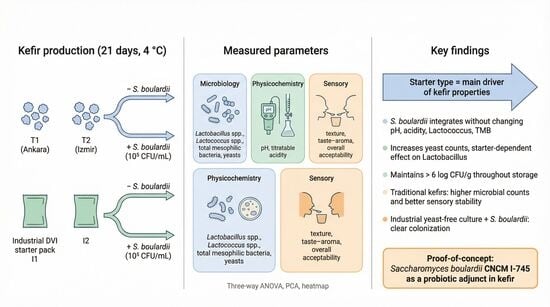
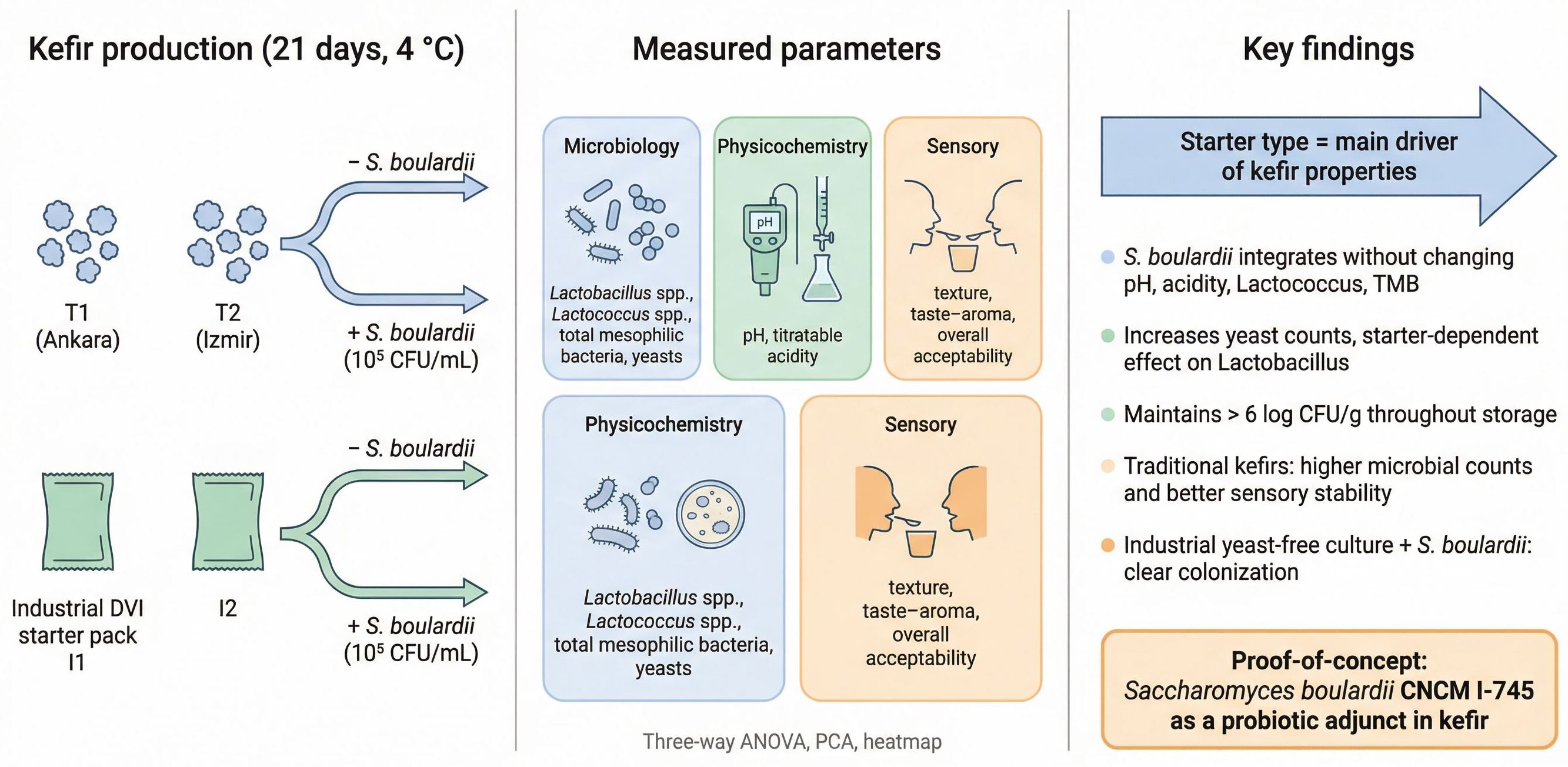
Therefore, the present study aimed to investigate the effect of
S. boulardii CNCM I-745 supplementation on the microbiological (
Lactobacillus spp.,
Lactococcus spp., total mesophilic aerobic bacteria, and yeast counts), physicochemical (pH and titratable acidity), and sensory (texture, taste–aroma, and overall acceptability) properties of kefir produced with two traditional kefir grain cultures and two industrial DVI cultures over 21 days of refrigerated storage at 4 °C. A factorial design with three factors (starter culture type,
S. boulardii addition, and storage time) was used, and the data were also examined in a multivariate way to obtain an integrated picture of the kefir quality profile; the statistical methods are described in detail in
Section 2.6. The specific hypotheses tested were: (i)
S. boulardii supplementation modulates LAB populations and enhances sensory quality in a starter-dependent manner; (ii) the probiotic yeast maintains viable counts above the recommended threshold (≥6 log CFU/g, the regulatory minimum for labelled adjunct microorganisms in fermented milks) throughout refrigerated storage; and (iii) traditional kefir grain cultures provide a more favorable ecological niche for
S. boulardii integration compared to industrial DVI starters.
2. Materials and Methods
2.1. Materials
2.1.1. Milk
Commercially available UHT cow’s milk with 3% fat content (SEK, Bursa, Türkiye) was used as the fermentation substrate for all kefir productions.
2.1.2. Starter Cultures and Probiotic Yeast
Two traditional kefir grain cultures and two industrial kefir starter cultures were used in this study. Traditional kefir grains were obtained from local producers in Ankara (designated T1) and Izmir (designated T2), Türkiye. Industrial kefir starter cultures were commercial direct-vat-inoculation (DVI) products: Büyüdanem (Danem Milk and Dairy Products Ltd. Co., Isparta, Türkiye; designated I1) and Doğadan Bizim (Doğadan Bizim Food and Dairy Products Industry and Trade Ltd. Co., Istanbul, Türkiye; designated I2). The industrial starter cultures were purchased from local markets and stored according to the manufacturer’s instructions until use. According to the manufacturers’ label information, the I1 culture contained Lactococcus lactis subsp. lactis, Lactococcus lactis subsp. cremoris, Leuconostoc mesenteroides subsp. cremoris, Lactobacillus spp., and Kluyveromyces marxianus, whereas the I2 culture was a yeast-free formulation containing only lactic acid bacteria (Lactococcus lactis subsp. lactis, Lactococcus lactis subsp. cremoris, and Lactobacillus spp.). The traditional grains (T1, T2) were used as intact symbiotic consortia, in line with the way kefir is produced at household and small-scale levels in Türkiye; no isolation or molecular identification of individual species was performed in the present work, and the grains were treated as an undefined microbial community whose net effect on kefir quality was the object of study. The grains had been used continuously for kefir production by their suppliers and were considered safe for human consumption on the same basis as the traditionally fermented kefir consumed in the region.
Lyophilized
Saccharomyces boulardii CNCM I-745 (Reflor
®, Biocodex, Beauvais, France) was obtained from a licensed pharmacy. The experimental design, including sample codes and starter culture types, is summarized in
Table 1.
2.1.3. Activation of Saccharomyces boulardii
The lyophilized
S. boulardii was activated according to the method described by Karaolis et al. [
24] with minor modifications. Briefly, the yeast was streaked onto Yeast Extract Peptone Dextrose Agar (YEPD agar; yeast extract 5 g/L, meat peptone 10 g/L, glucose 20 g/L, agar 15 g/L) and incubated aerobically at 25 °C for 48 h. Well-isolated single colonies were transferred into Yeast Extract Peptone Dextrose Broth (YEPD broth; yeast extract 5 g/L, meat peptone 10 g/L, glucose 20 g/L) and incubated at 25 °C for 48 h under aerobic conditions. The culture was then transferred into 50-mL sterile centrifuge tubes and centrifuged at 4100 rpm for 10 min at 4 °C. After discarding the supernatant, the resulting cell pellet was washed twice with sterile buffered peptone water (0.1%,
w/
v; Merck, Darmstadt, Germany) and twice with sterile distilled water, centrifuging under the same conditions between each wash step. The final biomass was resuspended in sterile physiological saline (0.85% NaCl) and adjusted to the target inoculation level of approximately
CFU/mL using a McFarland densitometer prior to addition to milk.
2.2. Kefir Production
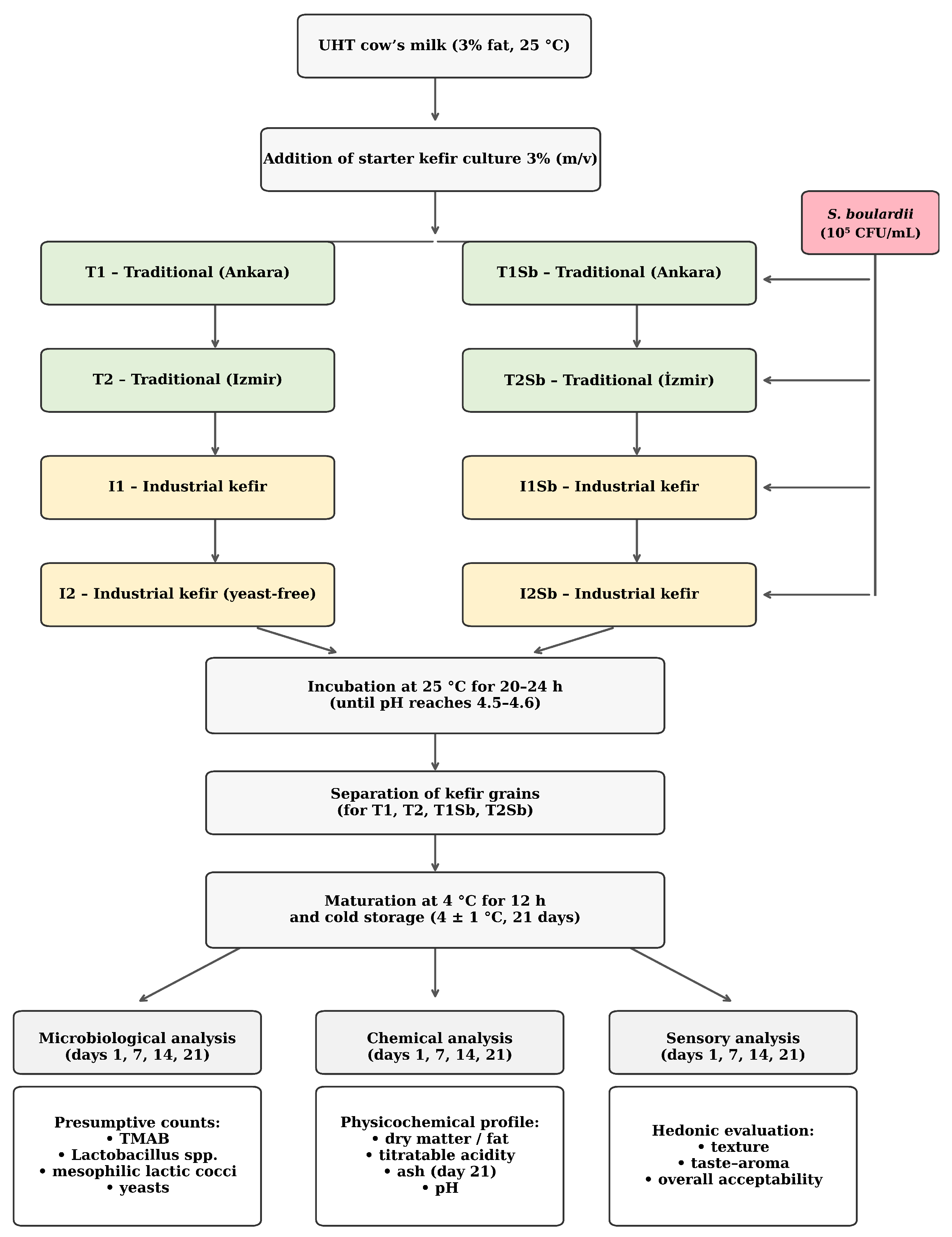
Kefir production was conducted according to the flow chart presented in
Figure 1. For samples produced with traditional kefir grain cultures (T1, T2), kefir grains were added to UHT cow’s milk at a rate of 3% (
w/
v). For samples produced with industrial DVI cultures (I1, I2), the starter cultures were inoculated into milk following the respective manufacturer’s recommended dosage.
All inoculated milk samples were fermented at 25 °C until the pH reached 4.5–4.6 (approximately 20–24 h). For S. boulardii-supplemented samples (T1Sb, T2Sb, I1Sb, I2Sb), the activated yeast cell suspension was co-inoculated with the respective starter culture at a final concentration of CFU/mL at the onset of fermentation. Upon reaching the target pH, kefir grains were separated from the fermented milk by straining through a sterile sieve, and all kefir samples were transferred into sterile glass jars, cooled to 4 ± 1 °C, and ripened for 12 h. The kefir samples were subsequently stored at 4 ± 1 °C for 21 days. The entire experiment was performed independently in duplicate (two production batches on separate days).
2.3. Physicochemical Analyses
Physicochemical analyses of kefir samples were performed on days 1, 7, 14, and 21 of refrigerated storage at 4 ± 1 °C. The pH values were measured at ambient temperature using a calibrated digital pH meter (WTW Inolab, Xylem Analytics, Weilheim, Germany) by direct immersion of the electrode into the kefir samples [
29]. Titratable acidity was determined by titration with 0.1 N NaOH using phenolphthalein as an indicator and expressed as grams of lactic acid per 100 g of sample [
30]. Total dry matter content was determined by the gravimetric method and expressed as a percentage (%) [
31]. Fat content was measured according to the Gerber method [
32]. Ash content was determined by incineration at 550 °C in a muffle furnace and expressed as a percentage (%) [
33].
2.4. Microbiological Analyses
2.4.1. Sample Preparation
For each microbiological analysis, 10 g of kefir sample was aseptically weighed and homogenized with 90 mL of sterile Maximum Recovery Diluent (MRD; Merck, Darmstadt, Germany) in a stomacher (Seward 400 Circulator, Seward Ltd., Worthing, UK) for 1 min, in accordance with ISO 6887-1:2017 [
34]. Serial decimal dilutions were prepared in MRD up to
.
2.4.2. Enumeration of Microorganisms
The following selective and non-selective media were employed for microbial enumeration:
Total mesophilic aerobic bacteria (TMAB): Appropriate dilutions were surface-plated onto Plate Count Agar (PCA; Merck, Darmstadt, Germany). Inoculated plates were incubated aerobically at 30 °C for 48 h [
35].
Lactobacillus spp.: Appropriate dilutions were pour-plated onto de Man, Rogosa, and Sharpe Agar (MRS agar; Merck). Plates were incubated aerobically at 30 °C for 72 h [
36].
Mesophilic lactic cocci (mainly
Lactococcus spp.): Appropriate dilutions were pour-plated onto M17 Agar (Merck). Plates were incubated aerobically at 30 °C for 72 h [
37].
Yeast: Appropriate dilutions were surface-plated onto Yeast Extract Glucose Chloramphenicol Agar (YGC agar; Merck). Plates were incubated aerobically at 25 °C for 72 h [
38].
The MRS and M17 media were used as recommended by the manufacturer. Lactobacillus spp. counts on MRS agar and Lactococcus spp. counts on M17 agar were therefore reported as presumptive counts based on the differential ecological selectivity of the two media (MRS favoring lactobacilli and M17 favoring lactococci); colony morphology was used to discard atypical colonies. To address potential cross-growth, particularly the proliferation of yeasts on MRS and M17 media, colony counts were performed by experienced researchers. Differentiation was based on distinct colony morphology and was supported by periodic microscopic examination of cell morphology to ensure that only bacterial colonies were included in the respective counts. No molecular identification was performed at the colony level.
2.5. Sensory Evaluation
The sensory evaluation involved adult volunteers who participated voluntarily. Informed consent was obtained from all participants prior to the evaluation, and their privacy was strictly respected throughout the study. The sensory analyses were conducted using safe, food-grade products without the collection or processing of sensitive personal data. Because the institution did not have an ethical guidelines document for human studies in place during the data collection period, the study’s ethical framework was planned in accordance with the national legislation, specifically the Regulation on Clinical Trials of Human Medicinal Products in Türkiye (published in the Official Gazette No. 32203 on 27 May 2023). Under this statutory framework, official ethics committee approval is not required for the routine sensory evaluation of safe, food-grade products. Sensory analyses were carried out on days 1, 7, 14, and 21 of storage by a panel of 10 trained assessors, consisting of academic staff and graduate students from the Faculty of Engineering and the Faculty of Architecture and Design at Aksaray University, who were familiar with kefir consumption. Panelists were healthy adults aged 22–45 years, with both sexes represented. They were selected on the basis of regular consumption of fermented dairy products and previous experience with hedonic sensory testing of dairy samples in our laboratory. Exclusion criteria were: known allergy or intolerance to milk or milk products (including lactose intolerance), pregnancy or lactation, current acute respiratory or gastrointestinal illness affecting taste or smell, smoking within 1 h before the session, and consumption of strongly flavored food or beverages within 1 h before the session. Kefir samples (∼50 mL) were served at 4–6 °C in coded, white plastic cups under daylight conditions. Sensory sessions were conducted in a quiet, well-ventilated room at room temperature (20–22 °C) and without external odors; panelists were seated separately to avoid interaction during scoring, and water and unsalted crackers were provided between samples for palate cleansing. Panelists evaluated each sample for texture, taste–aroma, and overall acceptability using a structured 5-point hedonic scale, where 5 = very good, 4 = good, 3 = average, 2 = poor, and 1 = very poor [
39,
40,
41]. The presentation order was randomized across sessions to minimize order bias. A copy of the participant information and consent form, as well as the Turkish national regulation referenced above, is provided as
Supplementary Files S2 and S3.
2.6. Statistical Analysis
This study employed a full factorial design to evaluate three independent variables: starter culture type (four levels: T1, T2, I1, I2), S. boulardii supplementation (two levels: present or absent), and storage duration (four levels: days 1, 7, 14, and 21). All kefir formulations were produced in two independent batches. All microbial counts and physicochemical analyses were performed in duplicate per production replicate.
Data are presented as mean ± standard deviation (SD). To assess the individual and interactive effects of the experimental factors on the microbiological, physicochemical, and sensory profiles, the dataset was subjected to a three-way analysis of variance (ANOVA; Type II sum of squares). Significant differences () were subsequently resolved using Tukey’s honest significant difference (HSD) test, with pairwise mean comparisons annotated via a compact letter display.
To elucidate broader structural relationships within the dataset, multivariate techniques were applied to the z-score-standardized treatment means of all nine analytical variables (comprising four microbiological, two physicochemical, and three sensory metrics). Principal component analysis (PCA) was utilized to map clustering patterns among the kefir treatments and isolate the primary variables driving their differentiation, visualized through a biplot of the first two principal components. Complementing the PCA, a hierarchically clustered heatmap—computed via Euclidean distance and average linkage—was generated to simultaneously illustrate the similarities across the specific kefir formulations and their measured quality traits. For the multivariate analyses, missing yeast values for the non-supplemented I2 culture were treated as 0 log CFU/g, reflecting the absence of indigenous yeast confirmed by selective plating.
All statistical computations and multivariate visualizations were programmed in Python (version 3.13.9), utilizing the statsmodels (version 0.14.5) library for inferential statistics and mean comparisons, scikit-learn (version 1.7.2) for PCA, alongside seaborn (version 0.13.2) and matplotlib (version 3.10.6) for graphical rendering.
3. Results
3.1. Three-Way ANOVA: Overview of Factor Effects
A three-way ANOVA (Type II sum of squares) was conducted to evaluate the individual and interactive effects of the starter culture type (Starter),
S. boulardii supplementation (Sb), and storage day (Day) on all measured parameters. The
p-values are summarized in
Table 2.
The starter culture type exerted highly significant effects (
p < 0.001) on every microbiological, chemical, and sensory variable measured (
Table 2).
S. boulardii supplementation significantly affected yeast count (
p < 0.001),
Lactobacillus spp. (
p < 0.001), and Taste–Aroma (
p = 0.041), but did not significantly alter
Lactococcus spp., TMAB, pH, titratable acidity, Texture, or General Sensory scores.
Storage day significantly influenced yeast count (p = 0.009), Lactobacillus spp. (p = 0.016), titratable acidity (p < 0.001), and all three sensory parameters (Taste–Aroma, p = 0.019; Texture, p = 0.011; General Sensory, p = 0.009). Among the interaction terms, the Starter × Sb interaction was significant only for yeast count (p < 0.001). The significant Starter × Day interaction for General Sensory (p = 0.033) indicated that sensory score changes during storage varied among culture types. The three-way interaction (Starter × Sb × Day) was significant only for yeast count (p = 0.027).
The Starter × Sb interaction did not reach significance for the sensory parameters (Taste–Aroma, p = 0.113; Texture, p = 0.099; General Sensory, p = 0.173). Numerically, S. boulardii supplementation produced larger sensory improvements in the traditional grain formulations (T2: +0.62 in General Sensory) than in the industrial cultures (I2: −0.25), but these differences were not statistically significant at the present sample size (n = 2 replicates).
3.2. Microbiological Properties of Kefir Samples
3.2.1. Total Mesophilic Aerobic Bacteria (TMAB) Counts During Storage
Mean TMAB counts ranged from 7.09 to 9.23 log CFU/g during the 21-day storage period (
Table 3). The T1 traditional grain formulation exhibited the highest counts (9.23 ± 0.07 log CFU/g at day 14), whereas I1Sb displayed the lowest (7.09 ± 0.30 log CFU/g at day 14). The difference in TMAB counts between traditional and industrial formulations is interpreted in
Section 4.1.
S. boulardii supplementation did not significantly affect TMAB (p = 0.051), and Tukey HSD groupings confirmed that no significant pairwise differences were attributable to S. boulardii addition for any Treatment × Day combination. TMAB counts fluctuated during storage without a consistent directional trend.
3.2.2. Lactobacillus spp. Counts During Storage
Lactobacillus spp. counts were significantly affected by all three main factors: starter culture type (p < 0.001), S. boulardii supplementation (p < 0.001), and storage day (p = 0.016). The highest count was recorded in I2 at day 1 (9.09 ± 0.07 log CFU/g); the lowest in I1Sb at day 21 (6.04 ± 0.80 log CFU/g). The overall average across all treatments and time points was 7.98 log CFU/g.
The mean difference in
Lactobacillus spp. counts between Sb-supplemented and non-supplemented kefirs was 0.18 log for T1, 0.33 log for T2, 0.85 log for I1, and 0.79 log for I2; the Starter × Sb interaction was not statistically significant (
p = 0.148). The culture-dependent pattern of these reductions is discussed in
Section 4.4.
Lactobacillus spp. counts declined from 8.20 to 7.64 log CFU/g on average across all samples over 21 days of storage. The Turkish Food Codex Fermented Milk Products Communiqué [
25] specifies a minimum of
CFU/g for the total LAB in kefir at the end of shelf life. Most formulations remained at approximately
CFU/g throughout the storage period when evaluated based on
Lactobacillus spp. counts on MRS agar. Only the formulation supplemented with Sb (I1Sb) reached 6.04 ± 0.80 log CFU/g on day 21.
3.2.3. Mesophilic Lactic Cocci (Lactococcus spp.) Counts During Storage
Lactococcus spp. counts were significantly affected only by the starter culture type (p < 0.001); neither S. boulardii supplementation (p = 0.122) nor storage day (p = 0.154) exerted a significant effect. The mean count was 7.58 log CFU/g in Sb-supplemented kefirs and 7.87 log CFU/g in non-supplemented kefirs. The highest Lactococcus spp. count was observed in I2 at day 1 (9.15 ± 0.11 log CFU/g), while the lowest was recorded in I1Sb at day 21 (6.24 ± 0.66 log CFU/g). The approximately 3 log range among Treatment × Day combinations was attributable to the dominant influence of the starter culture.
3.2.4. Yeast Counts During Storage
Yeast count was the most multifactorially influenced parameter, with significant effects from all three main factors and the Starter × Sb interaction (p < 0.001). The significant three-way interaction (Starter × Sb × Day, p = 0.027) indicated that the temporal dynamics of yeast populations during storage were jointly influenced by the host microbiota and S. boulardii supplementation.
The I2 industrial culture, which does not harbor indigenous yeast, yielded no detectable yeast throughout storage when used alone (
Table 3). In I2Sb kefir, the yeast count—attributable solely to
S. boulardii—was 6.61 ± 0.17 log CFU/g on day 1 and 6.11 ± 0.24 log CFU/g on day 21, demonstrating a decline of approximately 0.5 log while maintaining counts above the
CFU/g minimum required by the According to the Codex Alimentarius Standard for Fermented Milks (CXS 243-2003) [
26] and above 6 log CFU/g throughout.
In formulations that already harbor indigenous yeast, supplementation with
S. boulardii reduced the mean total yeast count from 7.06 log CFU/g (non-supplemented) to 6.74 log CFU/g (Sb-supplemented, excluding I2Sb). This reduction was less pronounced in traditional grain formulations (T1 and T2: 0.24 log each) than in the I1 industrial culture (0.48 log). Overall, all kefir samples met the minimum yeast count criterion of
CFU/g [
25].
3.3. Physicochemical Properties of Kefir Samples
3.3.1. pH Values During Storage
The mean pH values of kefir samples ranged from 4.26 (I2Sb, day 14) to 4.67 (T2, day 1) throughout storage (
Table 3). The starter culture type had a highly significant effect (
p < 0.001), whereas neither
S. boulardii supplementation (
p = 0.336) nor storage day (
p = 0.238) exerted a significant effect on pH. The overall average pH was 4.46 in Sb-supplemented and 4.49 in non-supplemented kefirs. Among the starter cultures, the I2 industrial culture exhibited the lowest mean pH (4.35), while the T2 traditional grain consortium exhibited the highest (4.58). No significant interaction effects were detected. All pH values remained within the 4.23–4.72 range (
Table 3).
3.3.2. Titratable Acidity During Storage
Titratable acidity ranged from 0.56 ± 0.05 (T2, day 1) to 0.95 ± 0.06% lactic acid (T1Sb, day 14) and was significantly affected by the starter culture type (
p < 0.001) and storage day (
p < 0.001), but not by
S. boulardii supplementation (
p = 0.421). Mean titratable acidity increased from 0.71% on day 1 to 0.89% on day 21 across all treatments. The T1 traditional grain and its Sb-supplemented counterpart exhibited the highest acidity values (0.94–0.95% at days 14–21), while T2 showed the lowest initial acidity (0.56 ± 0.05% on day 1). All samples complied with the minimum 0.6% lactic acid requirement of the Turkish Food Codex Fermented Milk Products Communiqué [
25] and the Codex Alimentarius Standard for Fermented Milks (CXS 243-2003) [
26] from day 7 onward.
3.3.3. Dry Matter Content During Storage
Dry matter content ranged from 9.79 ± 0.64% (T2, day 7) to 11.04 ± 1.34% (I2, day 14), with an overall mean of 10.54 ± 0.39%. The starter culture type was the only significant factor (p = 0.006), while neither S. boulardii supplementation (p = 0.091) nor storage day (p = 0.918) exerted a significant effect. The I2 industrial starter produced kefirs with the highest dry matter content (mean 10.82%), whereas the T2 traditional grain consortium yielded the lowest (mean 10.29%). Tukey HSD confirmed no significant pairwise differences among any Treatment × Day combinations.
3.3.4. Ash Content During Storage
Ash content exhibited a highly uniform profile across all formulations, with an overall mean of 0.59 ± 0.02%. Average values for the specific treatments ranged very narrowly from 0.55 ± 0.03% (I2Sb) to 0.61 ± 0.02% (I2). Consistent with this tight distribution, statistical analysis confirmed that neither starter culture type () nor S. boulardii supplementation () had a significant effect on ash content. Consequently, no significant pairwise differences were detected among the formulations by Tukey HSD, demonstrating that the total mineral content of the kefir matrix remained highly stable and was unaffected by the ecological complexity of the starter or the integration of the probiotic adjunct.
3.3.5. Lipid Content During Storage
The lipid content was constant at 3.0% across all treatments and time points, reflecting the standardized fat content of the UHT milk used as the base substrate. Neither the starter culture type, S. boulardii supplementation, nor storage day influenced lipid content. This parameter was therefore excluded from the ANOVA model and multivariate analyses.
3.4. Sensory Properties of Kefir Samples
The sensory evaluation encompassed Taste–Aroma, Texture, and General Sensory acceptance, each scored on a 5-point hedonic scale (
Table 4).
S. boulardii supplementation significantly improved Taste–Aroma scores (
p = 0.041): the overall average for Sb-supplemented kefirs was 3.34, compared with 3.07 for non-supplemented kefirs. The effects on Texture (
p = 0.198) and General Sensory (
p = 0.097) did not reach statistical significance, although Sb-supplemented kefirs consistently received equal or higher scores across all three sensory attributes.
Storage day significantly affected all sensory parameters (Taste–Aroma, p = 0.019; Texture, p = 0.011; General Sensory, p = 0.009), with mean scores declining from day 1 to day 21 (e.g., General Sensory: 3.66 → 3.00). The significant Starter × Day interaction for General Sensory (p = 0.033) indicates that the rate of sensory deterioration during storage varied among culture types.
Among all treatments, the T1 traditional grain microbiota supplemented with S. boulardii (T1Sb) achieved the highest scores across every sensory attribute (Taste–Aroma: 4.20 ± 0.37; Texture: 4.28 ± 0.19; General Sensory: 4.25 ± 0.27 averaged over storage). In contrast, the I2Sb formulation received the lowest General Sensory score (1.70 ± 0.28 on day 14). Kefirs produced with traditional grain consistently outperformed those produced with compositionally defined industrial cultures in all sensory attributes (mean Taste–Aroma: 3.65 vs. 2.76; mean General Sensory: 3.72 vs. 2.72).
The Starter × Sb interaction was not significant for any sensory parameter (Taste–Aroma, p = 0.113; Texture, p = 0.099; General Sensory, p = 0.173). However, a consistent numerical trend was observed: S. boulardii supplementation produced larger sensory improvements in the T2 traditional grain formulation (+0.62 in General Sensory) compared with the industrial cultures (I1: +0.33; I2: −0.25), while the improvement was modest in T1 (+0.22), where baseline scores were already high.
3.5. Multivariate Analysis
To integrate the relationships among all measured parameters, principal component analysis (PCA) was performed using z-score-standardized treatment-level means of nine variables. A complementary hierarchically clustered heatmap based on the same dataset is provided as
Supplementary Figure S1.
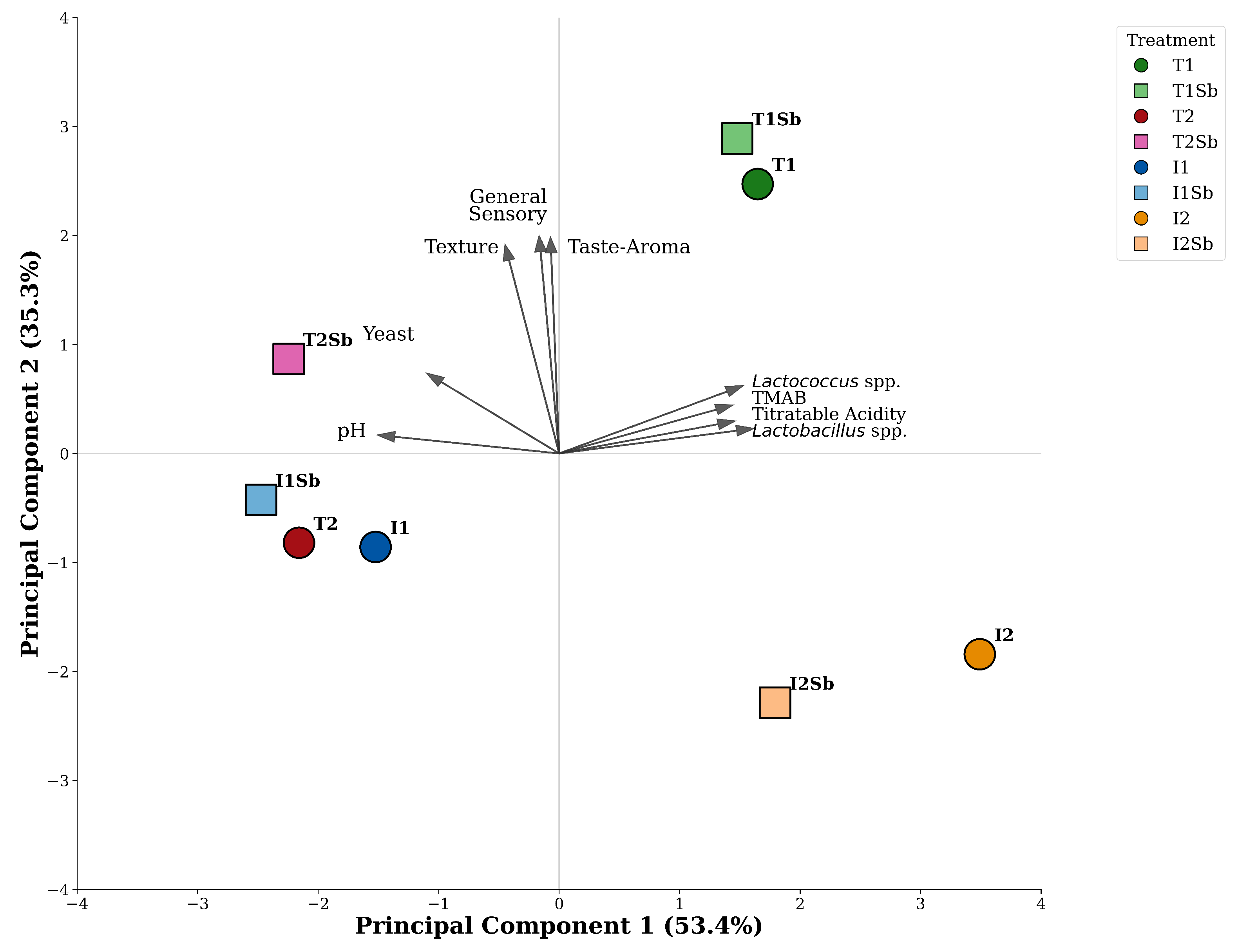
PCA Biplot: The PCA biplot (
Figure 2) captured 88.7% of the total variance (PC1: 53.4%; PC2: 35.3%). The loading vectors revealed two clearly distinct variable dimensions:
PC1 (53.4%): Along the positive direction, Lactococcus spp. (loading: 0.45), TMAB (0.43), titratable acidity (0.41), and Lactobacillus spp. (0.40) formed a tightly correlated microbiological–acidity cluster. Along the negative direction, pH (−0.42) and yeast (−0.31) loaded in opposition, indicating an inverse relationship between LAB-driven acid production and pH/yeast levels.
PC2 (35.3%): General Sensory (0.56), Taste–Aroma (0.55), and Texture (0.53) loaded as a tightly correlated group with negligible PC1 contributions, confirming that sensory quality constitutes a largely independent dimension from the microbiological–acidity axis.
Figure 2.
PCA biplot of microbiological, physicochemical, and sensory profiles of kefir treatments. Loading vectors (arrows) indicate variable contributions to PC1 and PC2; sample points represent treatment-level means, coded by treatment (color) and S. boulardii status (circle = without Sb; square = with Sb). Lactobacillus and Lactococcus are typeset in italics.
Figure 2.
PCA biplot of microbiological, physicochemical, and sensory profiles of kefir treatments. Loading vectors (arrows) indicate variable contributions to PC1 and PC2; sample points represent treatment-level means, coded by treatment (color) and S. boulardii status (circle = without Sb; square = with Sb). Lactobacillus and Lactococcus are typeset in italics.
The T1 and T1Sb formulations occupied the upper-right quadrant (positive PC1 and PC2), reflecting their simultaneously high LAB counts and superior sensory scores. The I2 and I2Sb formulations were positioned in the lower-right quadrant (positive PC1, negative PC2), indicating high microbiological activity but low sensory acceptance. The I1, I1Sb, T2, and T2Sb formulations clustered in the left half of the plot (negative PC1), characterized by lower LAB counts and higher pH. Within this group, T2Sb was displaced upward along PC2 relative to T2, consistent with the sensory improvement associated with S. boulardii supplementation in this formulation.
The heatmap (
Figure S1) confirms the two-axis quality structure identified by PCA, grouping T1/T1Sb and I2/I2Sb into clusters with high LAB–acidity values but contrasting sensory scores, and placing I1, I1Sb, T2, and T2Sb together with lower LAB counts and higher pH.
4. Discussion
4.1. Culture Type as the Dominant Source of Variation
Three-way ANOVA identified the starter culture type as the principal factor shaping kefir quality: it was the only factor that reached significance () for every microbiological, physicochemical, and sensory variable, accounting for 47–63% of total variance () in Lactococcus spp., TMAB, pH, and all three sensory attributes. By contrast, S. boulardii supplementation accounted for 1–23% of total variance depending on the parameter (largest for yeast count, ; smallest for titratable acidity, ). This asymmetry is not unexpected: the starter culture defines the principal microbial groups detected here (Lactobacillus spp., Lactococcus spp., total mesophilic aerobic bacteria, and yeast) and the resulting acidification and sensory profile—whereas S. boulardii is a single adjunct organism introduced into an already established ecosystem. We did not perform metagenomic profiling of the kefir samples; the term “microbial community” is used here in the operational sense of the four target groups enumerated by selective plating, not as a description of full community composition.
The practical consequence of this variance structure is that Tukey HSD post-hoc comparisons between paired Sb+ and Sb− formulations of the same culture rarely reached statistical significance (only 2 of 35 pairwise comparisons: I1 vs. I1Sb for yeast, , and for Lactobacillus spp., ). This outcome should be interpreted in the context of the study’s statistical power. With biological replicates per treatment×day cell and eight treatment groups, the experiment was designed to detect the large effects of the starter culture type but was inherently underpowered for detecting the smaller—yet potentially biologically meaningful—effects of a single adjunct organism. The ANOVA main effects, which pool data across all time points and cultures, provide a more sensitive indicator of S. boulardii’s influence than cell-level pairwise comparisons. This statistical limitation is explicitly acknowledged as the primary constraint on interpretation throughout this discussion.
Rather than ranking individual cultures as “better” or “worse,” the results highlight a fundamental distinction between complex traditional matrices and compositionally defined industrial cultures. Traditional kefir grains harbor self-sustaining symbiotic communities of bacteria, yeasts, and exopolysaccharide-producing species embedded in a kefiran matrix [
2,
3,
11]. High-throughput metagenomic studies have confirmed the extraordinary microbial complexity of artisanal kefir grains: even grains originating from the same geographical region (e.g., Ankara province) can harbor radically different dominant species—
Bifidobacterium longum vs.
Lactobacillus kefiranofaciens—alongside distinct yeast assemblages dominated by
Naumovozyma,
Kazachstania, or
Zygosaccharomyces [
42]. Similarly, Ding et al. [
43] demonstrated that kefir grains from Moscow, Ossetia, and Tibet share a core
Lactobacillus–
Lactococcus backbone but differ markedly in
Leuconostoc and
Acetobacter abundance, with yeast genera varying from
Kazachstania turicensis to
K. unispora depending on geographical origin. A recent systematic review synthesizing 14 metagenomic studies confirmed that artisanal kefir microbiomes are shaped by milk type, production methods, grain handling practices, and regional adaptations [
44].
This inherent microbial diversity translates into richer metabolic networks that produce a broader spectrum of organic acids, volatile aroma compounds (acetaldehyde, diacetyl, ethanol, CO
2), and bioactive peptides [
3,
5,
45]. Ströher et al. [
46] demonstrated through metabarcoding (16S rRNA + ITS) analysis that artisanal kefir harbors functionally significant minority genera such as
Enterococcus and
Acetobacter, alongside fungal communities including
Kazachstania and
Debaryomyces. Industrial cultures, by contrast, are assembled from a limited number of defined strains optimized for reproducibility rather than ecological complexity [
13,
14]. The consequences of this reduced diversity are illustrated by the volatilomics work of Capitain et al. [
47]: commercial kefir was virtually indistinguishable from yogurt by VOC profiling (PCA-LDA: 0% cross-validation error), and qPCR confirmed that it contained only
Leuconostoc mesenteroides and
Lactococcus lactis with no detectable yeasts or acetic acid bacteria [
47].
In our study, this ecological distinction manifested as an approximately 2 log difference in TMAB between traditional and industrial formulations—consistent with the findings of Aşcı-Arslan and Ender [
48]—and as markedly higher sensory scores for traditional grain kefirs (mean Taste–Aroma: 3.65 vs. 2.76; mean General Sensory: 3.72 vs. 2.72). These differences were confirmed by Tukey HSD (
for 11 of 28 treatment pairs in each sensory attribute). The sensory superiority of traditional grains corroborates Şen Dağ et al. [
49], who demonstrated that grain-fermented kefirs produce unique fruity/creamy volatiles (ethyl-3-methyl butyrate) absent in lyophilized-culture kefirs, as well as Dinkci et al. [
50] and Barukčić et al. [
13], who reported significantly higher hedonic scores for grain-fermented kefirs.
4.2. Non-Disruptive Integration of S. boulardii into the Kefir Ecosystem
The central finding regarding
S. boulardii supplementation is not that it transforms the kefir product, but that it integrates into the existing ecosystem without disrupting it—and this is the very property that makes it a viable probiotic adjunct.
S. boulardii did not significantly alter pH (
;
), titratable acidity (
;
), dry matter (
),
Lactococcus spp. (
;
), or TMAB (
;
). From a product-development point of view, this lack of effect on the matrix is in fact desirable: a probiotic adjunct intended for an existing fermented milk should not change the product to the extent that its typical pH, acidity, and main microbial groups are noticeably modified, because such changes would shift the product away from the established sensory and compositional profile of kefir [
23,
24].
The non-interference of
S. boulardii with acid-producing starter cultures is well-documented. Both Duong et al. [
51] and Niamah [
52] reported that
S. boulardii addition at concentrations up to
–
CFU/g had no significant effect on pH or titratable acidity in yogurt, with Duong et al. [
51] documenting pH values of 4.44–4.46 across three inoculation levels (
). Sarwar et al. [
53] confirmed that
S. boulardii CNCM I-745 did not alter LAB viability over 28 days at 4 °C (7.10–7.43 log CFU/g at endpoint). This physiological compatibility has a clear mechanistic basis:
S. boulardii cannot hydrolyze lactose and therefore relies on LAB-derived monosaccharides (glucose, galactose) and organic acids as carbon sources [
16,
21,
23,
24]. Chan et al. [
54] characterized this relationship as “nutrient siphoning”:
S. boulardii CNCM I-745 consumed glucose, L-alanine, and L-glutamic acid, thereby limiting lactic acid accumulation and preventing the post-acidification that commonly degrades LAB viability during cold storage [
54,
55]. In their co-culture system, all four tested
Lactobacillus species maintained
log CFU/mL for six months in the presence of
S. boulardii, whereas single cultures became undetectable within 1–3 months [
54].
Where S. boulardii did exert detectable effects, these were on parameters directly related to its biological identity as a yeast. The largest effect was on yeast count (, ), which is inherently expected when adding a viable yeast organism. The effect on Lactobacillus spp. (, ) indicates a genuine, if moderate, modulation of LAB populations—likely reflecting competitive interactions for shared metabolic substrates. The Taste–Aroma effect (, ) was statistically detectable but modest in magnitude. Importantly, no individual Sb+ vs. Sb− pair reached significance for any sensory attribute in Tukey HSD post-hoc testing. This means that the sensory effect, while real at the population level (ANOVA), was too small relative to inter-replicate variability to be detected within any single culture formulation at . We therefore interpret this as a weak but consistent directional effect rather than a transformative improvement.
4.3. The I2 Biological Control: Clearest Evidence of
S. boulardii Colonization and Regulatory Compliance
The I2 industrial culture, which does not harbor indigenous yeast, provided the clearest and most unambiguous evidence of S. boulardii’s functional contribution. In non-supplemented I2 kefir, no yeast was detected throughout 21 days of storage. In I2Sb kefir, the yeast count—attributable solely to S. boulardii due to the absence of any background yeast population in the I2 starter—was 6.61 ± 0.17 log CFU/g on day 1 and 6.11 ± 0.24 log CFU/g on day 21, decreasing modestly by approximately 0.5 log while remaining above 6 log CFU/g throughout cold storage.
This biological-control configuration is uniquely suited to evaluate S. boulardii viability against regulatory thresholds. Because the present study used non-selective YGC agar—which enumerates total culturable yeasts without distinguishing S. boulardii from other endogenous yeasts present in traditional grain consortia or in yeast-containing industrial cultures—strain-specific compliance with regulatory thresholds can be unambiguously assessed only in the I2Sb formulation. In this formulation, where the I2 industrial starter is yeast-free, the entire YGC count corresponds to S. boulardii alone.
For I2Sb, the maintenance of
S. boulardii counts above 6 log CFU/g throughout 21 days satisfies two distinct regulatory thresholds defined by the Turkish Food Codex Fermented Milk Products Communiqué [
25] and the Codex Alimentarius Standard for Fermented Milks (CXS 243-2003) [
26]: (i) the kefir-specific yeast minimum of
CFU/g, and—more relevantly—(ii) the
CFU/g minimum for labelled adjunct microorganisms added as a supplement to the specific starter culture. The latter category directly applies to
S. boulardii when declared on the product label, and the I2Sb biological control, therefore, demonstrates that
S. boulardii CNCM I-745, when used as the sole yeast source in a yeast-free industrial kefir matrix, can comply with regulatory expectations for a labeled probiotic adjunct in fermented dairy products throughout 21 days of refrigerated storage.
For the other Sb-supplemented formulations (I1Sb, T1Sb, T2Sb), the total yeast counts measured on YGC agar exceeded
CFU/g throughout storage; however, since these counts include both indigenous yeasts and
S. boulardii, the strain-specific contribution of
S. boulardii cannot be resolved without selective or molecular methods. Confirmation of regulatory compliance for labeled probiotic claims in grain-based or yeast-containing industrial kefirs would therefore require species- or strain-level enumeration approaches, such as selective media supplemented with chloramphenicol and cycloheximide combinations, qPCR with strain-specific primers, or flow cytometry with fluorescent labeling [
56]. This methodological limitation is acknowledged as an important constraint for translating the present findings into regulatory and commercial probiotic claims for multi-yeast kefir formulations.
The heatmap visualization captured this phenomenon starkly: the I2 culture exhibited a yeast
z-score of
(the most extreme negative value in the dataset), whereas I2Sb restored the yeast
z-score to 0.18—a normalization that demonstrates
S. boulardii’s capacity to fill an empty ecological niche. This has practical implications for functional product development: industrial cultures that lack yeast—which Capitain et al. [
47] showed produce kefir virtually indistinguishable from yogurt—could be meaningfully differentiated through
S. boulardii supplementation.
The viability performance is consistent with the broader literature: Tomičić et al. [
21] confirmed >
CFU/mL viability at the end of yogurt shelf life; Duong et al. [
51] showed optimal viability at 30 °C fermentation; and Niamah [
52] reported dose-dependent viability (5.78–6.31 log CFU/g at 21 days) [
52]. The functional significance extends beyond counts: Duong et al. [
51] demonstrated that yogurt-matrix
S. boulardii cells recovered to 72–85% of their original load after simulated gastrointestinal transit (vs. 34% for free cells), indicating that the dairy matrix provides substantial GI protection.
However, long-term viability beyond 21 days remains a concern. Sarwar et al. [
53] showed that
S. boulardii without a prebiotic dropped to 5.50 log CFU/g by day 28—below the recommended probiotic level of
CFU/g—whereas 1% inulin supplementation maintained counts at 6.22 log CFU/g. Ströher et al. [
46] similarly observed declining yeast diversity and yeast abundance during 30-day refrigerated storage of artisanal kefir. Whether the kefir matrix—with its naturally occurring kefiran and continuous LAB-mediated lactose hydrolysis—provides more sustained metabolic support than yogurt requires direct investigation.
Beyond absolute viability values, the way probiotic populations are enumerated and the criteria used to qualify them as “probiotic” deserve closer attention. Boyte et al. [
56] highlighted that selective plate counting, flow cytometry, and quantitative PCR can yield numerically different estimates of probiotic load, and that the operational definition of viability (culturable, viable but non-culturable, or metabolically active cells) directly influences the apparent dose delivered to the consumer. In the present study, the yeast counts reported for I2Sb on selective YGC agar should, therefore, be interpreted as a conservative, culturable-cell estimate of the
S. boulardii load. Binda et al. [
57] further specified that, to be qualified as “probiotic” in foods, the strain must be taxonomically identified, characterized at the strain level, safe for the intended use, and present in adequate viable amounts at the end of shelf life;
S. boulardii CNCM I-745 fulfills these requirements and was therefore selected as the adjunct in this work. The viability dynamics observed here are also in line with recent shelf-life surveys: Seyirçit et al. [
58] reported that key probiotic populations in dairy formulations gradually decline during refrigerated storage, and Dinkçi et al. [
59] reviewed how probiotic survival in functional foods is jointly governed by matrix composition, oxygen exposure, acidity, and storage temperature. Functional viability, however, is ultimately determined by survival through gastrointestinal transit: Naissinger da Silva et al. [
60] showed that commercial probiotics differ markedly in their tolerance to simulated gastric and intestinal fluids, which means that high storage counts do not automatically translate into a high delivered dose at the site of action. Direct in vitro gastrointestinal simulation of
S. boulardii-supplemented kefir, combined with strain-level enumeration methods is, therefore, an important next step to confirm the probiotic relevance of the formulations characterized here.
4.4. Culture-Dependent Response Patterns: A Hypothesis for Future Testing
Although the Starter × S. boulardii interaction did not reach statistical significance for any measured parameter except yeast count (), a consistent numerical pattern was observed. The magnitude of Lactobacillus spp. reduction upon S. boulardii supplementation was smaller in traditional grain kefirs (T1: 0.18 log; T2: 0.33 log) than in industrial culture kefirs (I1: 0.85 log; I2: 0.79 log; interaction ). Similarly, the yeast count reduction was 0.24 log for both traditional starters versus 0.48 log for I1. For sensory attributes, the pattern was variable: S. boulardii produced the largest General Sensory improvement in T2 (), a modest improvement in T1 (), and a decrease in I2 (; interaction ).
We emphasize that these patterns are hypothesis-generating observations, not confirmed interactions. The absence of significant Starter × S. boulardii terms (– for sensory; for Lactobacillus spp.) means that we cannot distinguish these numerical trends from random variation at the present sample size. Nevertheless, the directionality is biologically plausible and supported by recent mechanistic studies.
Ponomarova et al. [
61] demonstrated, using kefir-isolated
Lactococcus lactis strains, that yeast and LAB form an obligate bidirectional mutualism: yeast secrete amino acids via TORC1/NCR-regulated nitrogen overflow, while LAB hydrolyze lactose and excrete galactose that yeast require as a carbon source. Gabrielli et al. [
62] confirmed this exchange using
13C isotope tracing, with yeast peptide labeling reaching ∼30% from
13C-galactose. Zhu et al. [
63] modeled 972 cross-feeding events in a traditional fermented-beverage community, showing that LAB interaction complexity—not abundance—was the stronger predictor of flavor multifunctionality (organic acids:
; amino acids:
). These findings suggest that the diverse indigenous microbiota of traditional grains may provide a more accommodating ecological context for
S. boulardii through metabolic cross-feeding and niche complementarity.
However, Zampieri et al. [
64] showed that in pairwise co-culture with
Lactobacillus reuteri,
S. boulardii was the competitive beneficiary, with
L. reuteri growth drastically reduced. This suggests that the net outcome of
S. boulardii integration depends on community complexity: ecological redundancy in traditional grains may buffer competitive effects, whereas low-diversity industrial cultures may experience more direct competition. Hedin et al. [
65], screening 85 bacterial strains, classified 26% as cooperative and 5% as competitive with
S. boulardii—with
L. gasseri producing a 10.3-fold (log
2) viability reduction—underscoring the strain-specificity of these interactions and the need for empirical compatibility testing. A definitive test of the culture-dependent compatibility hypothesis would require
replicates per cell to achieve adequate power for detecting interaction effects of the magnitude observed here.
4.5. Sensory Effects: Modest but Mechanistically Plausible
The Taste–Aroma enhancement by S. boulardii (; ) deserves careful interpretation. The ANOVA main effect is significant, confirming that S. boulardii supplementation is associated with higher Taste–Aroma scores when data are pooled across all cultures and time points. However, three considerations temper this finding. First, the effect size is small: S. boulardii explains only 3.2% of the Taste–Aroma variance, compared with 49.0% for the starter culture. Second, no individual culture showed a significant Sb+ vs. Sb− difference in Tukey HSD (smallest for T2). Third, the effect was not consistent across cultures (improvement in T1, T2, and I1; decline in I2), though this differential could not be statistically confirmed (interaction ). We therefore characterize the Taste–Aroma effect as statistically detectable at the pooled level but too modest to be resolved within individual formulations at the present sample size.
Despite its small magnitude, the effect is mechanistically plausible.
S. boulardii is a known producer of flavor-active volatiles: Sarwar et al. [
66] demonstrated that synbiotic yogurts containing
S. boulardii CNCM I-745 with inulin contained 16 volatile compounds at week 0, compared with only 6 in plain control yogurts, and uniquely produced phenylethyl alcohol (13–24 mg/100 g) that was undetectable in the controls. The probiotic-supplemented yogurts also retained a richer volatile profile throughout 28 days of refrigerated storage. Chan et al. [
54] corroborated these findings in non-dairy matrices, showing 128–248-fold increases in 2,3-methylbutanol in coffee brews co-fermented with
S. boulardii.
Güzel-Seydim et al. [
67] established the baseline kefir flavor chemistry: yeasts convert acetaldehyde to ethanol via alcohol dehydrogenase, producing kefir’s distinctive mild, slightly effervescent character. Adding
S. boulardii would be expected to modulate the acetaldehyde/ethanol ratio and enrich the ester pool. Wang et al. [
68] showed that in kefir-type fermentation,
Lactobacillus abundance is negatively correlated with most volatile compounds, suggesting that LAB contribute acid substrates while yeasts drive volatile enrichment. This co-metabolic perspective explains why the Taste–Aroma dimension—rather than Texture or General Sensory—was the parameter most sensitive to
S. boulardii supplementation: the volatile compounds produced by an additional yeast would be expected to affect the aroma more directly than the tactile or overall quality perception.
The phenylethyl alcohol detected in
S. boulardii-supplemented yogurt is particularly relevant: Zhu et al. [
63] demonstrated that this compound is synthesized via the Ehrlich pathway from LAB-supplied phenylalanine, while Ströher et al. [
46] observed its appearance in artisanal kefir coinciding with yeast metabolic activity. However, without VOC profiling in the present study, this remains an inference from the literature rather than a confirmed mechanism. Volatile profiling—as demonstrated by Capitain et al. [
47] with 0% classification error between traditional and commercial kefir—would be an essential next step to verify whether
S. boulardii produces a detectable VOC signature in kefir.
4.6. Multivariate Structure: Two Independent Quality Axes
PCA captured 88.7% of total variance (PC1: 53.4%; PC2: 35.3%), revealing two orthogonal quality dimensions. PC1 represented a LAB–acidity axis (Lactococcus spp.: 0.45; TMAB: 0.43; titratable acidity: 0.41; Lactobacillus spp.: 0.40; pH: ). PC2 captured an independent sensory dimension (General Sensory: 0.56; Taste–Aroma: 0.55; Texture: 0.53). This orthogonal separation means that the microbiological profile of kefir does not directly predict its sensory quality—the two dimensions are governed by different aspects of the fermentation ecosystem.
The T1 and T1Sb formulations occupied the upper-right quadrant of the PCA biplot (positive PC1 and PC2), reflecting simultaneously high LAB counts and sensory scores. However, this reflects the specific ecological characteristics of the Ankara grain used in this study rather than a universal property of all traditional kefir grains. Given the documented diversity among traditional grains—even from the same province [
42]—generalization beyond the specific strains studied here is not warranted.
The heatmap clustering organized the treatments into three distinct groups, confirming the two-dimensional quality structure. The discriminating power of the Yeast variable was particularly notable: the I2 culture exhibited a
z-score of
, whereas I2Sb restored it to 0.18. Şen Dağ et al. [
49] similarly demonstrated that traditional grain and lyophilized starter cultures yield significantly different volatile and sensory profiles, with diacetyl and acetic acid intensities are higher in starter-culture kefirs and yeast-derived esters were detected only in grain-fermented samples. Ebner et al. [
69] showed that, although the casein-derived peptide profile of kefir is largely conserved across starter systems (97 peptides shared), starter culture-fermented kefir released a substantially larger number of peptides (230 vs. 124) and exhibited a 1.4-fold higher proteolytic activity than grain-fermented kefir.
4.7. Storage Stability: Culture-Dependent Sensory Resilience
The significant Starter × Day interaction for General Sensory () provides direct evidence that sensory changes during cold storage are culture-dependent. The Tukey HSD groupings across all Treatment × Day combinations reveal a striking pattern: the T1 and T1Sb formulations remained in the highest homogeneous group (“a”) across all four sampling points (days 1, 7, 14, and 21), with General Sensory scores ranging from 3.85 to 4.35 (T1) and 4.15 to 4.35 (T1Sb). No statistically significant decline was detected between any two time points within these formulations (all pairwise Tukey ). By contrast, the I2 and I2Sb formulations separated into the lower group (“b”) at late storage: I2 at day 21 (1.85 ± 0.21) and I2Sb at days 14 and 21 (1.70 ± 0.28 and 2.00 ± 0.57, respectively). These “b” designations indicate that the late-storage I2/I2Sb values became significantly lower than the T1/T1Sb values at all time points (), reflecting a widening quality gap between the two culture categories over the storage period.
The “b” grouping for I2 and I2Sb at late storage refers to the comparison with the T1/T1Sb formulations, not to a within-treatment day-1 vs. day-21 comparison. The within-treatment decrease in General Sensory score for I2 (from 3.80 on day 1 to 1.85 on day 21, ) was not statistically significant in the Tukey HSD post-hoc test (), most probably because of the high inter-replicate variance (SD up to 1.34 in I2 at day 14) and the low number of biological replicates (). The two observations are therefore not contradictory: T1/T1Sb kept their sensory scores at a high and stable level over 21 days, while I2/I2Sb gave lower scores at the end of storage that were significantly different from the T1/T1Sb cluster.
This differential storage stability is consistent with the ecological complexity hypothesis: the diverse indigenous microbiota of traditional grains—with their redundant metabolic pathways and self-regulating symbiotic interactions [
43,
46]—may provide greater resilience against the environmental stresses of cold storage (nutrient depletion, organic acid accumulation, cold-stress adaptation) than the limited microbial repertoire of industrial cultures. Fontán et al. [
70] attributed similar temporal oscillations in fermented milk quality to the competing effects of ongoing fermentation and metabolite accumulation, processes that are more effectively buffered in ecologically diverse communities. The practical implication is that traditional grain kefirs may offer a longer effective shelf life with respect to sensory quality—a consideration relevant to both artisanal production and commercial distribution logistics.
Future research should prioritize: (i) VOC profiling (GC–MS or HS-GC-IMS) of Sb
+ vs. Sb
− kefir to identify the specific volatile compounds underlying the observed Taste–Aroma effect; (ii) extended storage evaluation beyond 21 days, including the potential benefit of prebiotic supplementation [
53]; (iii) culture-independent metagenomic and metatranscriptomic approaches—as recently demonstrated for artisanal Turkish kefir grains [
42] and for grains of diverse geographical origin [
43,
44]—to characterize the microbial interaction networks between
S. boulardii and indigenous kefir microbiota; and (v) in vivo functional evaluation, particularly given the 280-fold AhR activation demonstrated for
S. boulardii–LAB communities [
65].
5. Conclusions
This proof-of-concept study showed that
S. boulardii CNCM I-745 can be incorporated into kefir produced with traditional grain or industrial DVI cultures without causing marked changes in the main physicochemical and microbiological properties of the product. The starter culture type was the predominant source of variation: traditional grain kefirs generally gave higher microbial counts and sensory scores than industrial kefirs, while
S. boulardii supplementation increased the total yeast count, slightly modulated
Lactobacillus spp. counts, and produced a small improvement in taste–aroma scores, with no significant effect on pH, titratable acidity,
Lactococcus spp., or TMAB. In the yeast-free I2 industrial culture,
S. boulardii maintained viable counts above 6 log CFU/g throughout 21 days of cold storage, satisfying the
CFU/g regulatory threshold for labeled adjunct microorganisms specified by both the Turkish Food Codex Fermented Milk Products Communiqué [
25] and the Codex Alimentarius Standard for Fermented Milks (CXS 243-2003) [
26], and indicating that it can act as the sole yeast source in such matrices under the conditions tested. For the other Sb-supplemented formulations (I1Sb, T1Sb, T2Sb), strain-specific quantification of
S. boulardii would require selective or molecular enumeration methods (e.g., qPCR with strain-specific primers, flow cytometry, or selective media), which were beyond the scope of this proof-of-concept study.
Considering the limited number of biological replicates () and the lack of volatile compound profiling and culture-independent microbiome analysis, the present findings should be regarded as preliminary. Further studies with higher replication, longer storage periods, and metagenomic and metabolomic characterization are needed to confirm the culture-dependent patterns observed here and to more fully describe the role of S. boulardii within the kefir microbiota.