Article

Heterologous Expression of gadA and speA from Alicyclobacillus acidoterrestris Enhances the Acid Resistance and Fermentative Activity of Lactiplantibacillus plantarum


1
School of Food Science and Engineering, Ningxia University, Yinchuan 750021, China
2
College of Food Science and Engineering, Northwest A & F University, Yangling 712100, China
*
Author to whom correspondence should be addressed.
Fermentation 2026, 12(3), 143; https://doi.org/10.3390/fermentation12030143
Submission received: 11 February 2026 / Revised: 4 March 2026 / Accepted: 6 March 2026 / Published: 8 March 2026
(This article belongs to the Special Issue Perspectives on Microbiota of Fermented Foods, 2nd Edition)

Abstract

Enhancing the acid tolerance of Lactiplantibacillus plantarum is essential for improving its fermentation performance and metabolic activity under acidic conditions, thereby strengthening its probiotic functionality. In this study, the glutamate decarboxylase gene (gadA) and the arginine decarboxylase gene (speA) from Alicyclobacillus acidoterrestris DSM 3922T were heterologously expressed in L. plantarum WCFS1 to enhance its acid resistance. Recombinant expression vectors pMG36e-gadA and pMG36e-speA were constructed and introduced into L. plantarum WCFS1 via electroporation. The acid tolerance, cell membrane integrity, intracellular pH, ATP content, gene expression profiles, and enzyme activities of the recombinant L. plantarum WCFS1-gadA and WCFS1-speA were systematically evaluated. The results demonstrate that both recombinant strains exhibited significantly higher acid tolerance than the control strains. Under acid stress, the expression of gadA and speA was up-regulated, accompanied by enhanced activities of glutamate and arginine decarboxylases. In addition, the recombinant strains maintained higher intracellular pH and ATP levels compared with the control strain. Furthermore, the fermentative activity results support their potential applicability in fruit juice fermentation. Collectively, the heterologous expression of gadA and speA effectively improved the acid tolerance of L. plantarum, providing both mechanistic insights into acid stress adaptation and a theoretical basis for developing industrially robust, acid-resistant probiotic strains.

1. Introduction

Lactic acid bacteria (LAB) are widely recognized as some of the most well-characterized commercial probiotics, renowned for their health-promoting properties [1]. Among these, Lactiplantibacillus plantarum is a generally recognized safe (GRAS) probiotic with multiple beneficial functions, including modulation of intestinal microbiota, cholesterol reduction, antimicrobial activity, antioxidation, heavy metal adsorption, and immune regulation [2,3,4]. It typically grows optimally at 30–37 °C and at a pH around 6.5 [5].
Acid tolerance is a critical trait of L. plantarum, as its survival and activity in the gastrointestinal tract depend on its ability to withstand highly acidic conditions. During fruit wine production, L. plantarum can initiate malolactic fermentation (MLF), which reduces wine acidity. Additionally, the bacterium serves as an ideal starter culture for juice fermentation. Both of these processes demand strong acid tolerance, given that the pH of fruit wines and juices is typically below 4.0 [6,7]. Various strategies have been explored to enhance the acid tolerance of lactic acid bacteria, including screening or adaptive evolution of acid-tolerant strains, pre-exposure to sublethal stress, supplementation with protective compounds, and genetic engineering [8,9,10]. Among these strategies, heterologous expression of acid-tolerant genes has emerged as a promising approach, as it enables stable and targeted improvement of acid resistance. For example, strains with overexpression of cell wall or membrane-related genes (DACB, DLTD, and ERFK) exhibited significantly higher survival rates under acid stress than the wild-type Lactococcus lactis F44 [11]. In Tetragenococcus halophilus, modulation of the arginine deiminase pathway via exogenous arginine and metabolic engineering improved acid resistance [12]. Similarly, overexpression of ABC transporters markedly strengthened acid stress tolerance in L. lactis NZ9000 [13]. Compared with many other microorganisms, L. plantarum is genetically tractable, safe, and widely studied, making it an attractive host for such applications [14].
A. acidoterrestris has strong acid tolerance, with an optimal growth pH of 4.0, and can withstand a minimum pH of around 2.2 [15]. These features not only make it a notorious spoilage organism in pasteurized fruit juices, but also a valuable source of acid-tolerant genes and enzymes [16]. Our previous transcriptomic and metabolomic analyses, supported by biochemical validation, revealed that amino acid metabolism plays a central role in its acid resistance. In particular, the decarboxylation pathways of glutamate and arginine were identified as key contributors to acid stress adaptation [17]. Therefore, harnessing the acid-tolerant genes from A. acidoterrestris provides a rational strategy to genetically reinforce the resilience of L. plantarum, thereby overcoming current limitations in food fermentation processes and improving its functional stability in the gastrointestinal tract.
Based on these findings, this study aimed to enhance the acid tolerance of L. plantarum WCFS1 by heterologously expressing the glutamate decarboxylase gene (gadA) and the arginine decarboxylase gene (speA) from A. acidoterrestris DSM 3922T. The acid stress response of the recombinant strains was comprehensively evaluated by assessing growth performance, intracellular pH, ATP content, gene expression, and enzyme activities, thereby elucidating the functional roles of these acid-tolerant genes in conferring enhanced stress resistance.

2. Materials and Methods

2.1. Strains and Plasmids

The details of bacterial strains and plasmids used in this study are shown in Table 1.

2.2. Strain Activation and Culture

A. acidoterrestris DSM 3922T stored at −80 °C was streaked onto an AAM agar (glucose 2.0 g/L, yeast extract 2.0 g/L, (NH4)2SO4 0.4 g/L, MgSO4·7H2O 0.5 g/L, CaCl2·2H2O 0.5 g/L, KH2PO4 1.2 g/L, MnSO4·H2O 0.5 g/L, and agar 15 g for solid medium) and incubated at 45 °C for 24 h [15]. Single colonies were inoculated into AAM liquid medium and cultured in a constant temperature incubator at 45 °C, 150 rpm for 12 h. Subsequently, a 2% (v/v) inoculum was transferred to fresh AAM broth and incubated under the same conditions for another 12 h to obtain the activated A. acidoterrestris.
For the activation of L. plantarum WCFS1, frozen stocks (−80 °C) were inoculated into MRS broth (2%, v/v) inoculation ratio and incubated statically at 37 °C for 12 h. Single colonies were then selected and transferred into fresh MRS broth, followed by incubation at 37 °C for 12 h to obtain fully activated L. plantarum cultures.

2.3. DNA Manipulations, Plasmid Construction, and Transformation

Genomic DNA was extracted from A. acidoterrestris using the Bacterial Genomic DNA Extraction Kit (D1600, Solarbio, Beijing, China) according to the manufacturer’s instructions. The gDNA integrity was assessed using agarose gel electrophoresis, and its concentration and purity were measured with a microvolume spectrophotometer. In this study, two acid-resistant genes, glutamic acid decarboxylase gene (N007_07430, gadA) and arginine decarboxylase gene (N007_00520, speA), were selected for heterologous expression. Primers were designed with protective bases and appropriate restriction sites (underlined) at both ends, and the details are shown in Table S1.
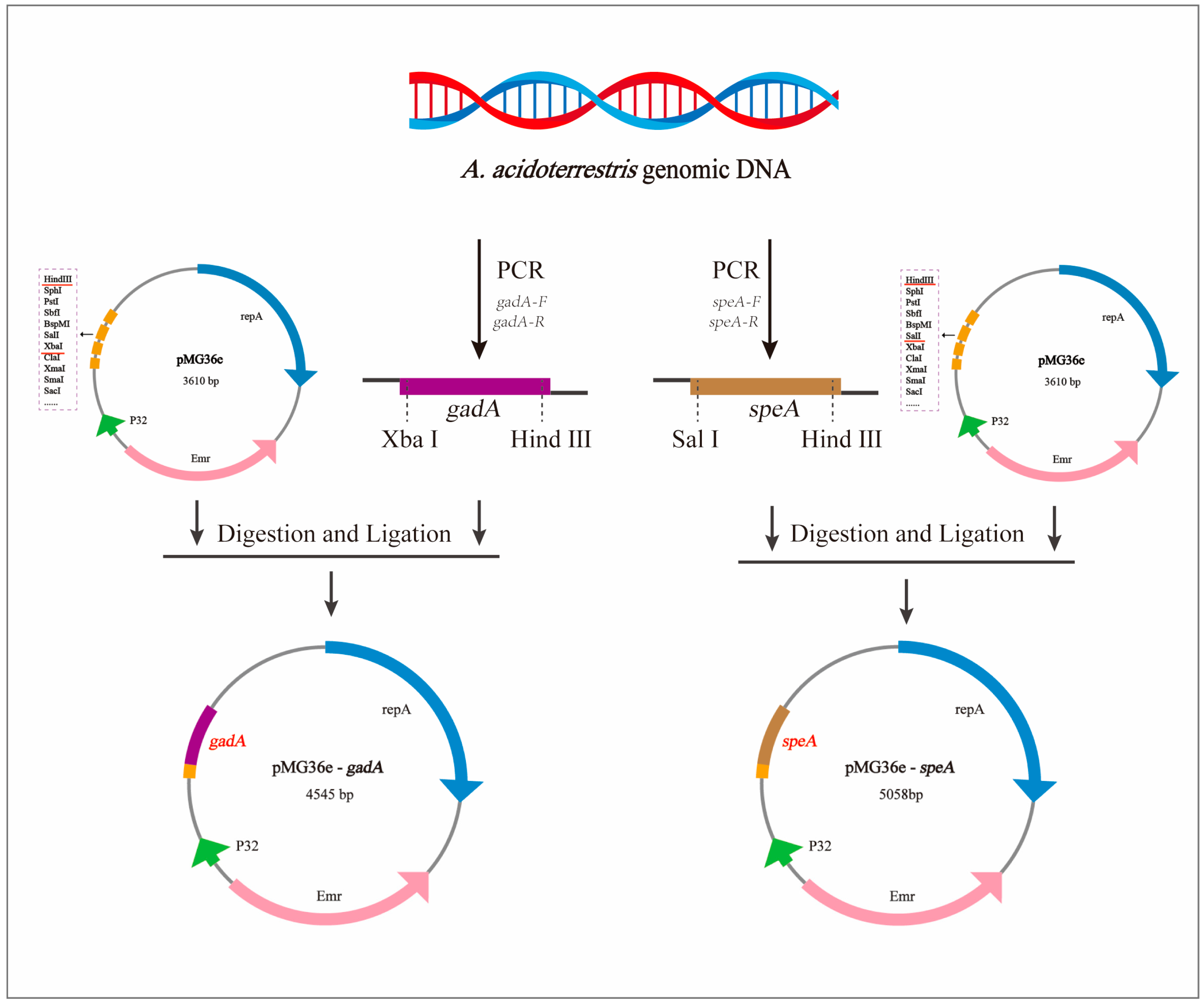
The gadA and speA genes were amplified by PCR (pre-denaturation at 95 °C for 2 min, denaturation at 98 °C for 10 s, annealing at 58 °C for 30 s, extension at 72 °C for 1 min, 30 cycles, with a final extension at 72 °C for 5 min), verified by 1.5% agarose gel electrophoresis, and purified using the Gel Extraction Kit. (Omega Bio-Tek, Inc., Norcross, GA, USA) The gadA gene and pMG36e plasmid were digested with Xba I and Hind III, while the speA gene was digested with Sal I and Hind III. The digested fragments were ligated with the corresponding vectors overnight, generating recombinant plasmids pMG36e-gadA and pMG36e-speA.
Electroporation was performed as described previously [18,19] with minor modifications. Briefly, activated L. plantarum cells were inoculated into MRS broth supplemented with 0.5 M glycine and 0.3 M sucrose and cultured until the OD600 reached 0.5. The cells were then harvested by centrifugation (5000× g, 10 min, 4 °C) and washed twice with ice-cold electroporation buffer (5 mmol/L potassium dihydrogen phosphate, 0.5 mmol/L magnesium chloride, and 0.5 mmol/L sucrose). The resulting cells were used as competent cells. Then, the competent cells (200 μL) were mixed with 2 μg plasmid DNA and electroporated in a 0.2 cm cuvette using a Bio-Rad system (2.0 kV, 5 ms). Transformants were recovered in MRS broth containing 0.3 M sucrose at 37 °C for 3 h and plated on MRS agar (Merck, Darmstadt, Germany) supplemented with erythromycin (100 μg/mL). Positive colonies were identified by colony PCR and sequencing.

2.4. Determination of Acid Tolerance of Recombinant L. plantarum

Recombinant L. plantarum-vector (control), L. plantarum-gadA and L. plantarum-speA were cultured in MRS broth supplemented with erythromycin (100 μg/mL) at 37 °C for 12 h. The cultures were then inoculated (2% v/v) into fresh selective MRS broth and incubated for 6 h to obtain seed liquid. Subsequently, seed culture was inoculated into MRS broth adjusted to pH 6.2 (control), 4.5, 4.0, 3.8, 3.6, 3.4, 3.2, and 3.0, respectively. Growth curves were monitored using a Bioscreen C automated growth curve analyzer (Oy Growth Curves Ab Ltd, Turku, Finland) under static conditions at 37 °C, with optical density recorded at 600 nm every 2 h for a total of 100 h.
The growth data were fitted using the modified Gompertz model (Formula (1)), as described by Li et al. [20], to evaluate the acid tolerance of the recombinant L. plantarum strains.
Y = A + ( B A ) × e x p [ e x p R × ( X M ) ]
where Y is the optical density (OD600) of the bacterium at X h; A is the initial OD600 value; B is the maximum OD600 value; M represents the time (h) corresponding to the maximum growth rate; R represents the corresponding relative growth rate at M. Growth kinetic parameters, such as the maximum specific growth rate (μmax), lag phase duration (λ) and generation time (Tg), were calculated as follows:
μ m a x = ( B A ) × R / e
λ = M ( 1 / R )
T g = l o g [ 2 × e / ( R × ( B A ) ) ]

2.5. Expression Analysis of Key Genes

Bacterial cultures were centrifuged at 5000 rpm for 10 min at 4 °C, and the pellets were washed with sterile saline. Cells were resuspended in MRS broth adjusted to pH 6.2 (control), 4.0, or 3.0, and incubated at 37 °C for 1 h. Recombinant L. plantarum cells were then collected, and total RNA was extracted using the RNA Extraction Kit (Accurate Biotechnology (Hunan) Co., Ltd., Changsha, China). After DNase treatment, RNA was reverse-transcribed into cDNA using Evo M-MLV RT Kit (Accurate Biotechnology (Hunan) Co., Ltd., Changsha, China) according to the manufacturer’s instructions. The reverse transcription reaction was performed at 37 °C for 15 min, followed by 85 °C for 5 s, and the resulting cDNA was stored at −20 °C until use.
Gene expression was quantified on a CFX96 Touch real-time PCR system. Cycling conditions were: 95 °C for 30 s, followed by 40 cycles of 95 °C for 5 s and 60 °C for 30 s. Primers were designed using NCBI Primer-BLAST (Table S2). The tuf gene was used as the internal reference [21], and relative expression levels were calculated using the 2−ΔΔCt method.

2.6. Evaluation of Cell Membrane Integrity

Cell membrane integrity of recombinant L. plantarum under acid stress was determined by LIVE/DEAD®BacLight™ assay kit (Invitrogen, Thermo Fisher Scientific, Waltham, MA, USA). Briefly, mid-log phase cells were harvested, washed with saline, and resuspended. For calibration, live cells were obtained by saline treatment, while dead cells were prepared with 70% (v/v) isopropanol at 25 °C, 120 rpm for 1 h. Both samples were washed, resuspended, and adjusted to OD600 = 0.5. Standard mixtures containing live/dead cells at ratios of 0:1, 1:9, 1:1, 9:1, and 1:0 were prepared to represent 0%, 10%, 50%, 90%, and 100% membrane integrity, respectively.
To impose acid stress, mid-log phase cells were harvested and resuspended in MRS broth adjusted to pH 4.0 or pH 3.0 (using 1 M HCl), and incubated at 37 °C for 1 h. Acid-stressed cells were collected, washed, resuspended in saline, and adjusted to OD600 = 0.5. Equal volumes (100 μL) of bacterial suspension and staining solution (SYTO 9/PI) were mixed and incubated in the dark at room temperature for 15 min. Fluorescence was measured with a microplate reader at 485 nm excitation, with emission recorded at 535 nm (SYTO 9, green) and 640 nm (PI, red). A standard curve of membrane integrity (%) versus green fluorescence intensity was used to calculate the membrane integrity of the samples.

2.7. Intracellular pH Determination

The intracellular pH of recombinant L. plantarum under acid stress was determined by BCECF-AM fluorescence probe method. MRS broth adjusted to pH 6.2 was selected as the control group, pH 4.0 and pH 3.0 (adjusted by 1 M HCl) lasted for 1 h as the acid stress treatment conditions, and the intracellular pH was determined after the acid stress was completed.
Mid-log phase cultures were harvested and resuspended in calibration buffers (pH 3.0–8.0) containing 0.05 M citric acid, 0.05 M glycine, 0.05 M Na2HPO4·12H2O, and 0.05 M KCl. Valinomycin and nigericin (final concentration 1 μM each) were added, and the cells were incubated at 37 °C for 25 min to equilibrate intra- and extracellular pH. After centrifugation and washing, cells were resuspended in the same buffer, stained with 1 μL BCECF-AM, and incubated at 37 °C for 30 min. Fluorescence was measured at excitation wavelengths of 490/440 nm and emission at 525 nm. The corrected fluorescence intensity (I) was calculated (Formula (5)), and a standard curve was generated from the linear relationship between log I and pH.
I = ( I 490 ) total ( I 490 ) filtrate ( I 440 ) total ( I 440 ) filtrate  
Acid-stressed bacterial samples were washed with equivalent HEPES-K buffer (50 mM, pH 8.0), resuspended, and stained with 1 μL BCECF-AM. After incubation at 37 °C for 30 min, cells were centrifuged, washed with phosphate buffer (50 mM, pH 7.0), and resuspended. Fluorescence intensity was determined as described above, and intracellular pH was calculated from the standard curve.

2.8. Determination of Intracellular ATP Concentration

The intracellular ATP content of recombinant L. plantarum was determined as described by Xu et al. [22]. with minor modifications. Acid-stressed cells (refers to 2.7) were washed, resuspended in saline, and adjusted to OD600 = 0.6. In an ice bath, 200 μL of ATP lysis buffer (50 mM Tris-HCl, 5 mM EDTA, 1% Triton X-100, 0.1% Tween-20, pH 7.6) was added to 2 mL of cell suspension and mixed thoroughly. After centrifugation, the supernatant was collected as the ATP extract.
For detection, 100 μL of ATP extract was mixed with equivalent ATP detection reagent in an opaque 96-well plate, and chemiluminescence was measured using a microplate reader (Infinite™ M200 PRO, Tecan, Männedorf, Switzerland). Standard curves were generated by serially diluting ATP standards in lysis buffer, and intracellular ATP content was calculated based on the linear relationship between ATP concentration and chemiluminescence intensity.

2.9. Determination of Glutamic Acid Decarboxylase (GAD) Activity

GAD activity was determined according to Kanwal et al. with modifications [23]. Recombinant L. plantarum at the logarithmic phase were harvested by centrifugation and resuspended in 100 mM KH2PO4 buffer (pH 4.0 and pH 3.0, adjusted with 1 M HCl), followed by incubation at 45 °C, 150 rpm for 1 h. Control cells were resuspended in KH2PO4 buffer (pH 6.2) and incubated under the same conditions. After treatment, cells were collected (5000× g, 8 min), washed three times with PBS (50 mM, pH 7.0), and disrupted on ice by ultrasonication. The lysates were centrifuged (12,000× g, 8 min, 4 °C), and the supernatant was used as crude enzyme extract. Protein concentration was determined using a BCA Protein Content Assay kit (Beijing Boxbio Science & Technology Co., Ltd., Beijing, China).
For the enzyme assay, 1 mL of extract was incubated with 2 mL of reaction mixture (50 mM NaH2PO4 buffer, pH 4.0; 20 mM glutamate; 20 μM pyridoxal-5-phosphate) at 37 °C for 30 min. The reaction was stopped by boiling. GABA production was quantified using a commercial GABA Content Assay Kit (BC6285, Solarbio, Beijing, China). One unit of GAD activity was defined as the amount of GABA (nmol) produced per minute per mg of protein.

2.10. Determination of Arginine Decarboxylase (ADC) Activity

Acid-stressed cells were obtained as described in Section 2.9. ADC activity was assayed as described for E. coli with modifications [24,25]. Briefly, 1 mL of enzyme extract was added to 2 mL of reaction mixture containing 50 mM PBS (pH 7.5), 30 mM arginine, 2.5 mM MgSO4, and 0.06 mM pyridoxal-5-phosphate, and incubated at 40 °C for 10 min. The reaction was terminated with saturated NaCl containing 10% KOH. Agmatine production was quantified by HPLC as described by a previous study [26]. One unit of ADC activity was defined as the amount of agmatine (nmol) produced per minute per mg of protein.

2.11. Determination of Fermentative Activity

Recombinant L. plantarum and control strain were cultured to the mid-log phase, achieving a viable count of approximately 108 CFU/mL. The bacterial cells were then inoculated at 2% (v/v) into not-from-concentrate (NFC) apple juice without erythromycin. A control group (CK) without bacterial inoculation was prepared in parallel. All samples were incubated at 37 °C for 48 h. The pH values and viable bacterial counts in the apple juice were monitored at 6 h intervals. The viable counts were determined by the standard plate count method using MRS agar supplemented with erythromycin (100 μg/mL).

2.12. Statistical Analysis

All experiments were performed in triplicate, and results are presented as means ± standard deviation. Statistical analysis was conducted using SPSS 22.0, with one-way ANOVA followed by multiple comparisons. Rigorous methodology ensured result reproducibility, thereby providing a reliable basis for subsequent phenotypic analysis.

3. Results

3.1. Cloning of the Target Genes

The target genes were amplified using genomic DNA of A. acidoterrestris DSM 3922T as the template. PCR products were analyzed by agarose gel electrophoresis (Figure S1). The glutamate decarboxylase gene (gadA, 972 bp) and arginine decarboxylase gene (speA, 1477 bp) were successfully amplified, yielding clear and intact bands consistent with the expected fragment sizes. The target fragments were excised, purified, and sequenced, and the results matched the reference sequences, confirming successful cloning of gadA and speA.

3.2. Identification of Recombinant L. plantarum

In this study, the gadA and speA genes of A. acidoterrestris were cloned and ligated into the expression vector pMG36e to construct the recombinant plasmids pMG36e-gadA and pMG36e-speA (Figure 1). These plasmids, along with the empty vector pMG36e, were introduced into L. plantarum WCFS1 by electroporation, generating the recombinant strains L. plantarum WCFS1-gadA and L. plantarum WCFS1-speA as well as the control strain L. plantarum WCFS1-vector. Transformants were selected on erythromycin-resistant plates (Figure S2).
Six colonies from each recombinant plate were screened by colony PCR using the primers listed in Table S1. Sterile water served as a negative control, and genomic DNA of A. acidoterrestris DSM 3922T was used as a positive control. As shown in Figure S3, no amplification was observed in the negative controls, while the positive control produced clear bands of the expected sizes. For L. plantarum WCFS1-gadA, colonies 1, 3, 5, and 6 yielded single bands corresponding to the predicted 972 bp fragment. For L. plantarum WCFS1-speA, colonies 12, 13, and 14 produced bands consistent with the expected 1477 bp fragment. Sequencing these PCR products confirmed 100% identity with the target gene sequences, verifying the successful construction of recombinant L. plantarum strains.

3.3. Acid Tolerance of Recombinant L. plantarum

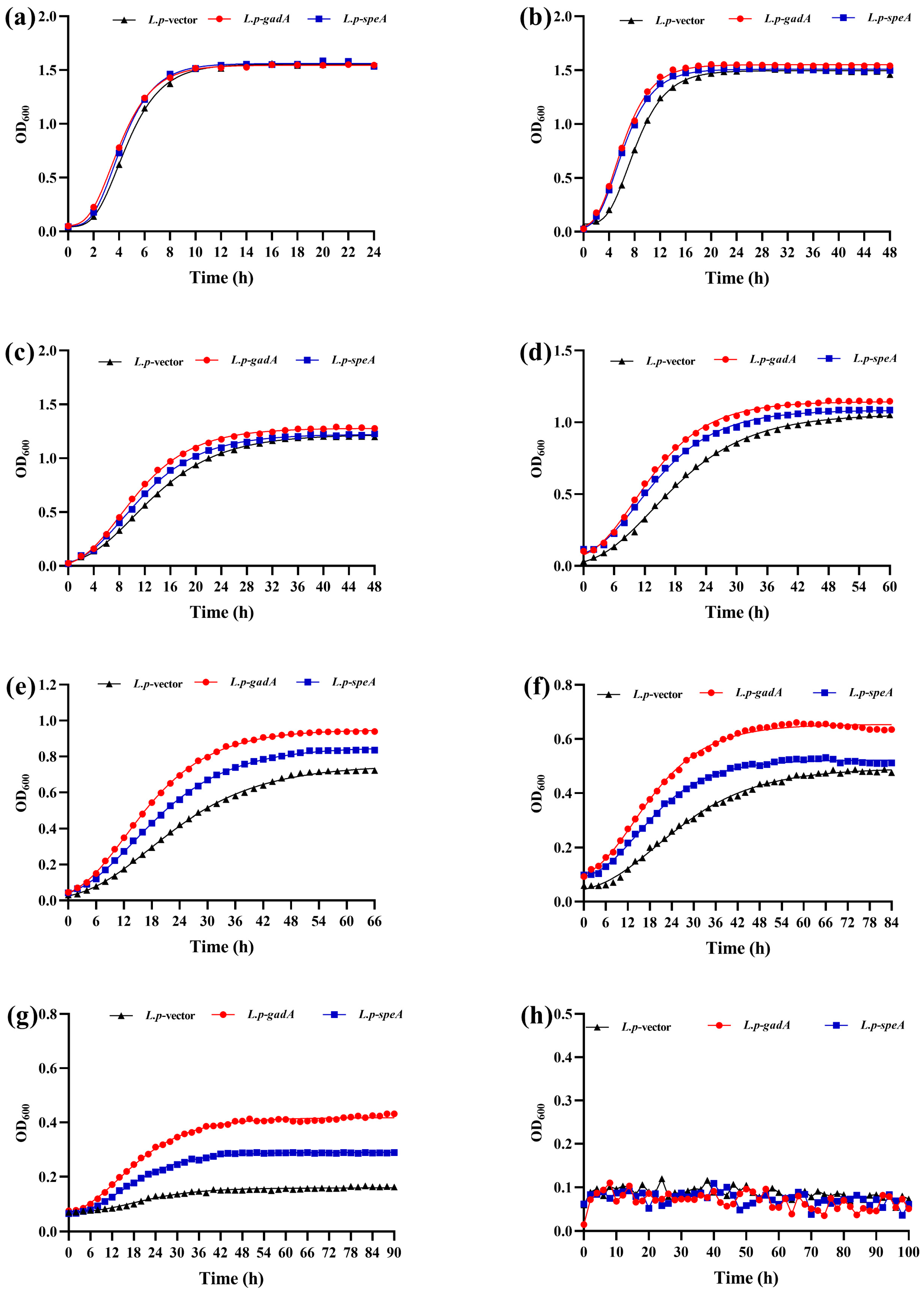
The Gompertz model is widely applied in biology to describe growth dynamics, extinction patterns, and lifespan relationships under intrinsic and extrinsic factors. In this study, the modified Gompertz equation was used to fit the growth curves of recombinant L. plantarum under different pH conditions (Figure 2), and the corresponding kinetic parameters are summarized in Table 2.
As the culture pH decreased from 6.2 to 3.2, both the maximum specific growth rate (μmax) and the maximum optical density (OD600max) declined progressively. Conversely, the lag phase (λ) and generation time (Tg) were gradually prolonged. These results indicate that increasing acidity in the growth environment intensifies acid stress, thereby inhibiting the growth performance of the strains.
Under near-neutral conditions (pH 6.2), L. plantarum WCFS1-gadA, L. plantarum WCFS1-speA, and the control strain (L. plantarum WCFS1-vector) exhibited nearly identical growth patterns, with comparable μmax, OD600max, and Tg values (Table 2). The only notable difference was that the recombinant strains carrying gadA or speA showed shorter lag phases than the control strain.
At pH 4.5, all strains exhibited delayed adaptation, as reflected by prolonged lag phases. Although the cell density did not differ significantly, L. plantarum WCFS1-gadA and L. plantarum WCFS1-speA displayed higher μmax values and shorter Tg than that of the control strain, suggesting enhanced tolerance to mild acid stress. Under more severe acid stress conditions (pH 3.4–4.0), both recombinant strains demonstrated markedly better growth performance than the control strain, with significantly higher μmax and OD600max as well as shorter lag phases and Tg. Notably, L. plantarum WCFS1-gadA exhibited the strongest acid tolerance.
At pH 3.2, the control strain almost ceased growing. Although its growth data could still be fitted by the Gompertz model, the R2 was only 0.9862, indicating poor fit. In contrast, the growth of WCFS1-gadA and WCFS1-speA was well described by the model, with R2 > 0.99, suggesting continued growth potential. At pH 3.0, the growth of all strains was completely inhibited, and the Gompertz equation failed to provide a valid fit. To further elucidate the physiological mechanisms underlying these growth differences, intracellular pH homeostasis and energy metabolism were examined under comparable acid stress conditions.

3.4. Intracellular pH of Recombinant L. plantarum Under Different Acid Stress Conditions

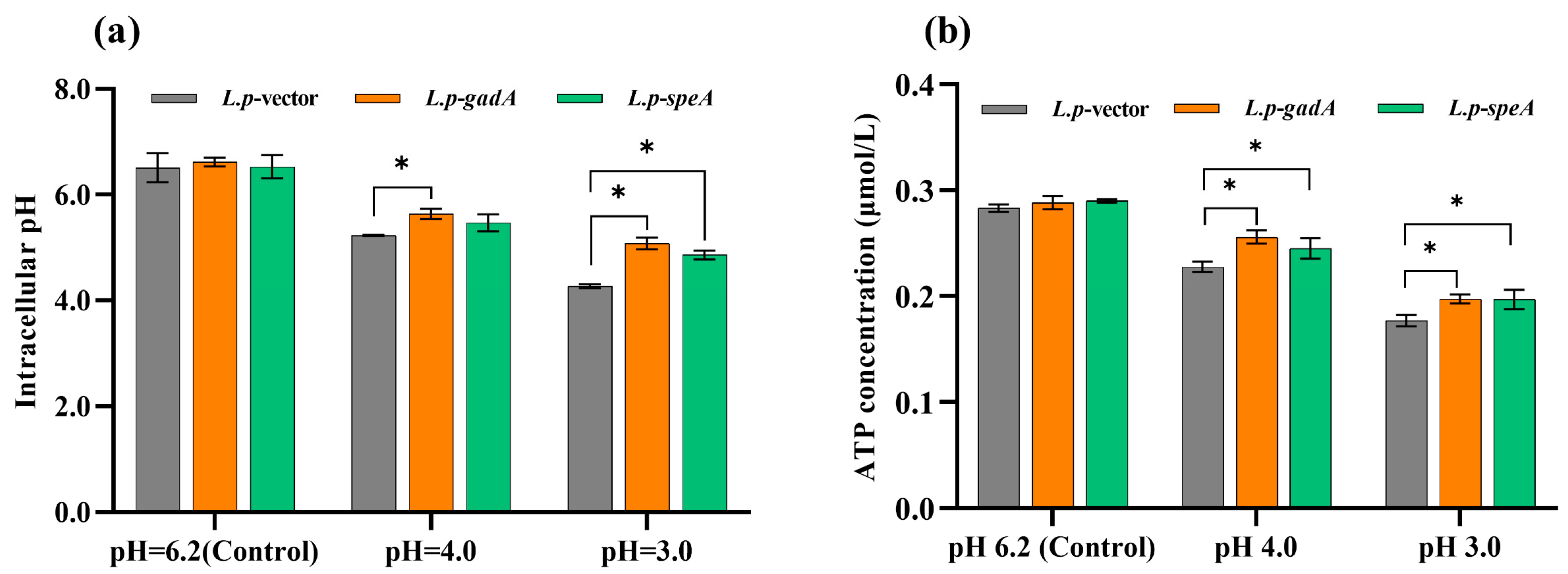
To elucidate the relationship between intracellular pH and bacterial acid resistance, we compared the intracellular pH levels of recombinant and wild-type strains under acid stress. Glutamate and arginine decarboxylation pathways play crucial roles in maintaining intracellular pH homeostasis under bacterial stress [27,28]. In this study, recombinant strains L. plantarum WCFS1-gadA and L. plantarum WCFS1-speA were successfully constructed. Although the introduction of gadA and speA enhanced acid resistance, their effect on intracellular pH regulation remained unclear. To address this, the intracellular pH of the recombinant strains was measured under different acid stress conditions (Figure 3a).
The results demonstrate that, after 1 h of acid stress, the intracellular pH of all strains decreased significantly compared with the control condition (pH 6.2). At pH 6.2, no significant differences were observed among the three strains. However, under acid stress, clear differences emerged. At pH 4.0 and pH 3.0, L. plantarum WCFS1-gadA maintained significantly higher intracellular pH levels than the control strain. L. plantarum WCFS1-speA also showed significantly higher intracellular pH, but only under the more extreme condition of pH 3.0. These findings indicate that heterologous expression of gadA and speA enhanced the ability of L. plantarum to maintain its intracellular pH under acid stress, thereby contributing to improved acid tolerance.

3.5. Intracellular ATP Levels of Recombinant L. plantarum Under Different Acid Stress Conditions

ATP is a direct source of energy, and its intracellular level is considered an important marker for monitoring the physiological state of bacteria in a stressful environment [29]. Previous studies have shown that increasing ATP supply is an effective way to enhance acid resistance of Candida glabrata [30]. Some acid stress response pathways, such as signal transduction, proton pump, DNA repair, and protein repair, require the support of energy. The intracellular ATP levels of recombinant L. plantarum under different degrees of acid stress were determined (Figure 3b). The results showed that heterologous expression of gadA and speA derived from A. acidoterrestris significantly increased the intracellular ATP levels of recombinant L. plantarum, providing more energy for the bacteria to resist acid stress.

3.6. Cell Membrane Integrity of Recombinant L. plantarum Under Different Acid Stress Conditions

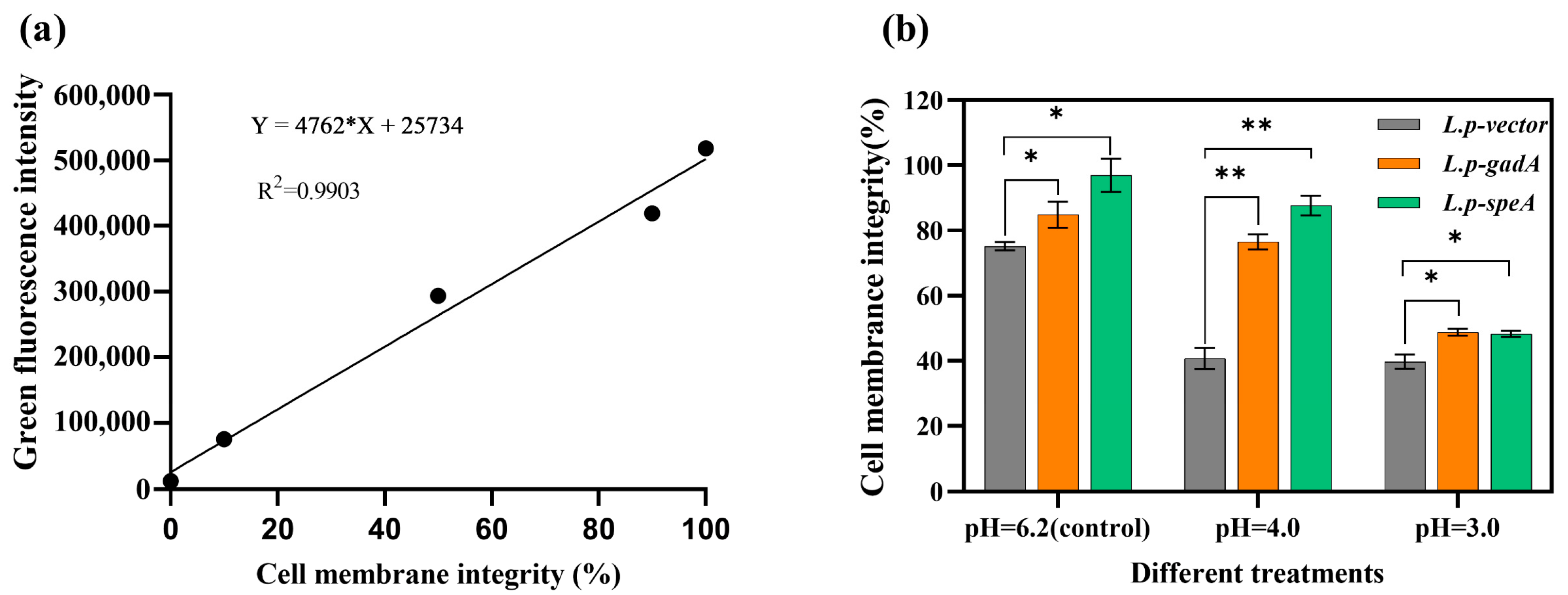
Cell membrane integrity was assessed using SYTO 9 (green fluorescence) and PI (red fluorescence) staining. A standard curve was generated by measuring the green fluorescence intensity of bacterial suspensions with defined live/dead cell ratios (Figure 4a). The fitting equation yielded an R2 of 0.9903, demonstrating an excellent linear relationship between fluorescence intensity and membrane integrity.
Exposure to extreme acidity damaged the bacterial cell membrane, reducing integrity and impairing function. As shown in Figure 4b, no significant differences were observed among the three strains after incubation at pH 6.2 for 1 h. However, at pH 4.0 and 3.0, membrane integrity decreased markedly in all strains. Importantly, L. plantarum WCFS1-gadA and L. plantarum WCFS1-speA maintained significantly higher integrity than the control strain, indicating that heterologous expression of gadA and speA effectively protects membrane stability under acid stress. This enhanced membrane integrity likely contributes to the higher intracellular pH and ATP levels observed in the recombinant strains compared with the control, underscoring the pivotal role of these decarboxylase pathways in maintaining cellular homeostasis during acid stress. This preservation of membrane integrity, together with elevated ATP levels and intracellular pH, demonstrates a coordinated protective effect conferred by gadA and speA expression.

3.7. Expression of Key Genes in Recombinant L. plantarum Under Acid Stress

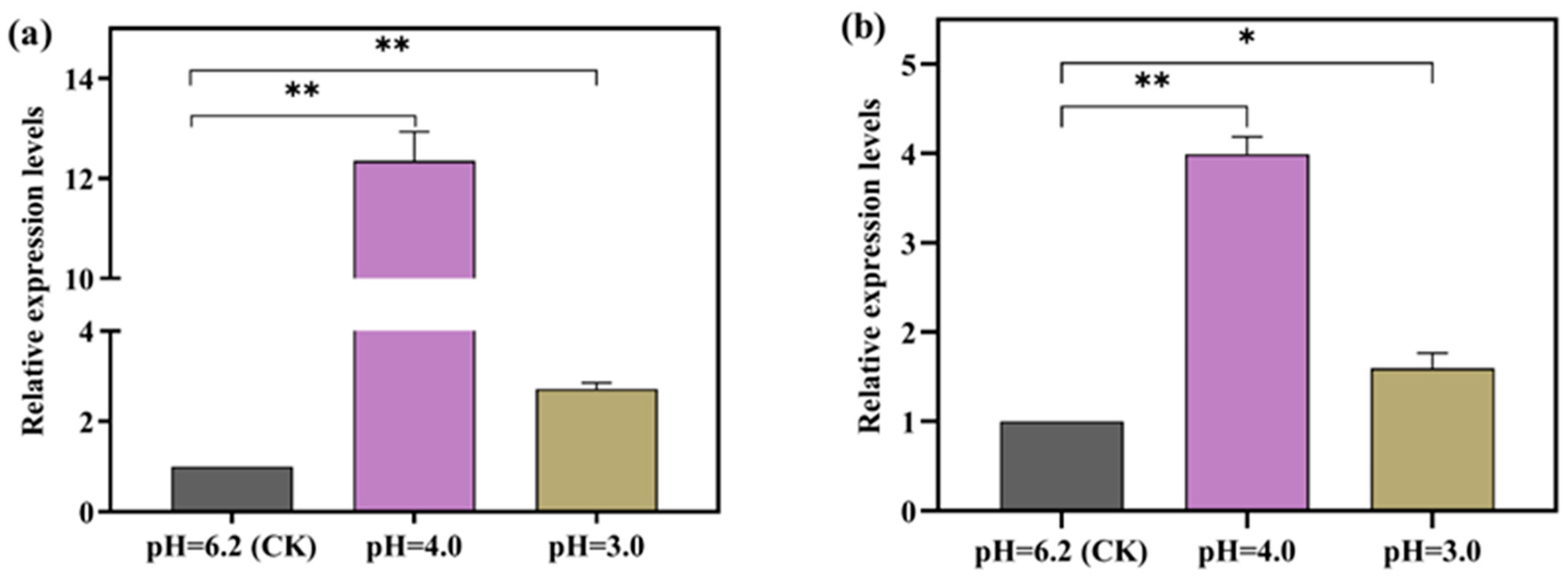
The growth performance and intracellular pH measurements suggested that the heterologous expression of gadA and speA enhanced the acid resistance of L. plantarum WCFS1. To further validate the role of the target genes, their relative expression levels were quantified by RT-qPCR after 1 h of acid stress at pH 4.0 and pH 3.0 (Figure 5). At pH 4.0, gadA expression was strongly induced, showing a 12-fold up-regulation compared with the control condition (pH 6.2 for 1 h, Figure 5a), while speA expression increased nearly 4-fold (Figure 5b). At pH 3.0, both gadA and speA were still significantly up-regulated, although the fold changes were lower than those observed at pH 4.0.
These results confirm that gadA and speA are responsive to acid stress and actively contribute to intracellular pH homeostasis. The stronger induction observed at pH 4.0 compared with pH 3.0 suggests that moderate acid stress may provide a more favorable condition for transcriptional activation, whereas extreme acidity imposes broader cellular damage that limits gene expression.

3.8. Analysis of Key Enzyme Activities in Recombinant L. plantarum

To further elucidate the enhanced growth capacity of recombinant L. plantarum under acid stress and the observed increase in intracellular pH, the activities of glutamate decarboxylase and arginine decarboxylase were measured under different acidic conditions. Enzyme activity was assessed by quantifying the reaction products of decarboxylation.
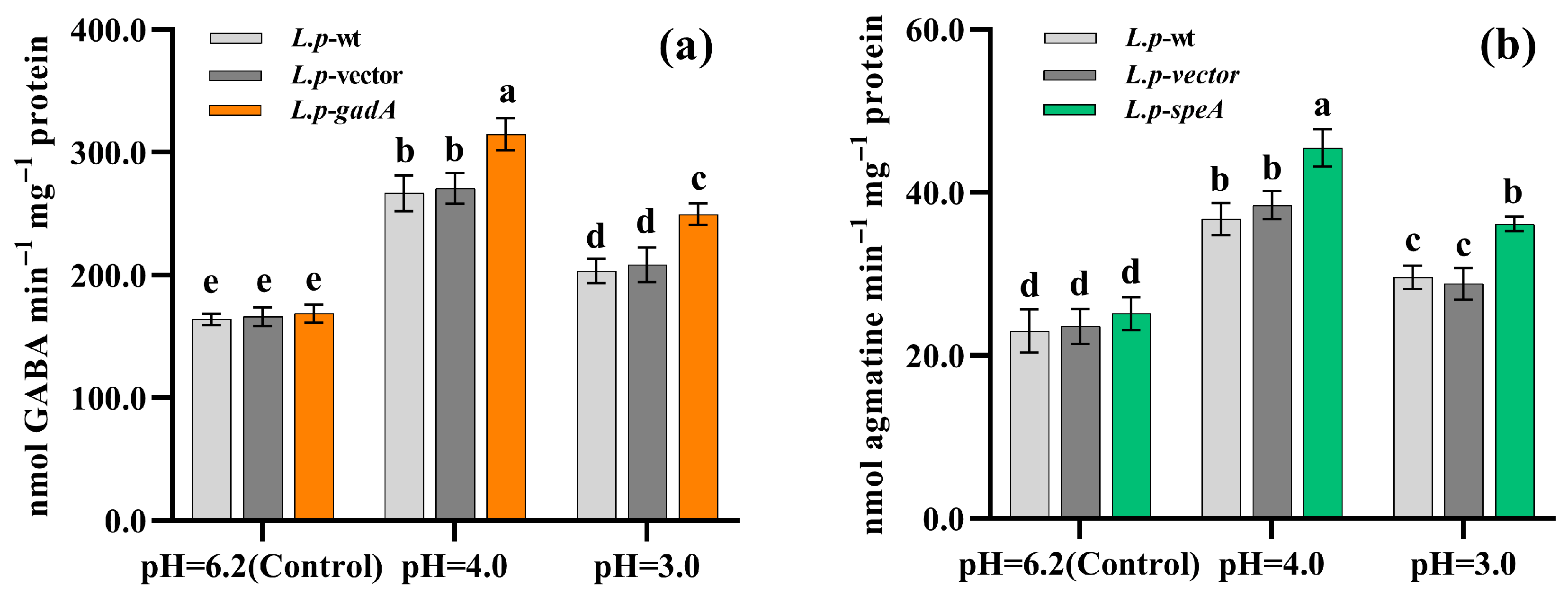
As shown in Figure 6, both enzymes displayed enhanced activity after 1 h of acid stress, consistent with the acid-adaptive responses previously reported in Bacillus cereus [31]. Notably, glutamate decarboxylase activity in L. plantarum WCFS1-gadA and arginine decarboxylase activity in L. plantarum WCFS1-speA were significantly higher than that in the control strains (L. plantarum WCFS1-wild type and L. plantarum WCFS1-vector) under both pH 4.0 and pH 3.0 conditions. However, the control strains also exhibited increased glutamate and arginine decarboxylase activities under acid stress. This is attributable to the presence of native gadB and speA homologs in the L. plantarum genome, which encode endogenous decarboxylases that are naturally induced as part of the strain’s intrinsic acid stress response [1,27].
The decarboxylation of amino acids consumes intracellular protons (H+), thereby contributing to the maintenance of intracellular pH homeostasis [32,33]. The significant enhancement of these enzyme activities under acid stress provides a mechanistic explanation for the higher intracellular pH and improved acid tolerance of the recombinant strains.

3.9. Fermentative Activity of Recombinant L. plantarum in Apple Juice

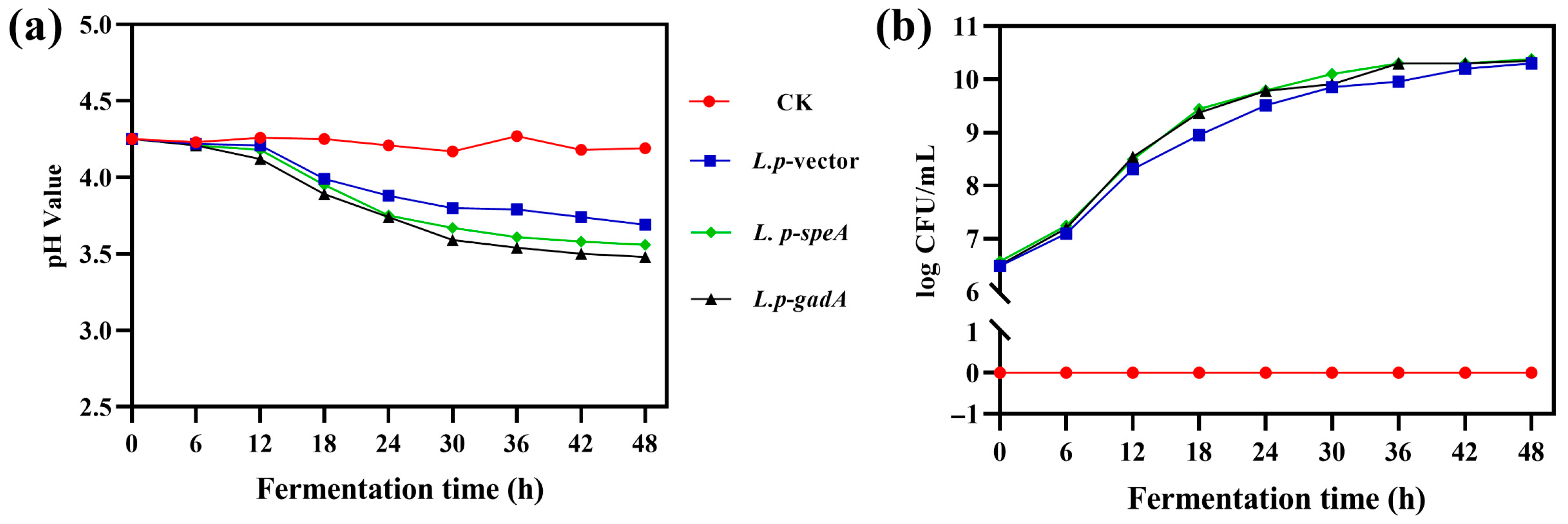
To further investigate the potential application of recombinant L. plantarum in fermented foods, its performance in apple juice fermentation was further evaluated. Changes in pH and viable cell counts during fermentation are shown in Figure 7. The pH of the control group (uninoculated apple juice) remained largely unchanged at around 4.2 throughout the 48 h fermentation period. In contrast, inoculation with control L. plantarum (L. plantarum-vector) reduced the pH to 3.69 after 48 h, while the recombinant strains L. plantarum-gadA and L. plantarum-speA further decreased the pH to 3.48 and 3.56, respectively, indicating their enhanced acid production capacity.
Although all strains eventually reached approximately 1010 CFU/mL by the end of fermentation, the recombinant strains exhibited significantly faster growth kinetics during the process. This accelerated growth likely contributed to their more rapid and pronounced pH reduction compared to the control strain. These findings demonstrate that the recombinant L. plantarum strains possess fermentation capabilities comparable to, or even exceeding, those of the control strain, highlighting their potential for application in fruit juice fermentations.

4. Discussion

Our previous work has demonstrated that A. acidoterrestris can activate the glutamate decarboxylase system and arginine decarboxylase system to maintain intracellular pH homeostasis under acid stress [17]. To test whether these mechanisms can be transferred to improve L. plantarum, we heterologously expressed gadA and speA in L. plantarum WCFS1 and systematically characterized acid tolerance and associated physiological responses. The results validate that transferring these pathways into L. plantarum significantly enhanced its acid stress tolerance.
Enhancing the acid resistance of L. plantarum has long been a research focus, and several strategies have been explored. For example, adaptive evolution of L. plantarum 1260G enabled a more refined and efficient response to citric acid stress by enhancing nucleotide repair and improving membrane fluidity [34]. Similarly, acid adaptation in L. plantarum C232 induced the overexpression of stress-response proteins, ATP synthases, and transporter genes, thereby strengthening its tolerance to acidic environments [1]. Methionine supplementation also enhanced the acid tolerance of L. plantarum XJ25 [35], while Michida et al. (2006) demonstrated that culturing in grain extract-containing media improved tolerance in simulated gastrointestinal conditions [36]. Genetic engineering has also been employed to reinforce acid stress tolerance. Liu et al. (2022) expressed the Oenococcus oeni-derived trxA gene to enhance acid stress resistance in L. plantarum WCFS1 [37]. Moreover, introduction of the argG gene from O. oeni resulted in 11.0-, 2.0-, and 1.9-fold increases in argininosuccinate synthase (ASS) activity, H+-ATPase activity, and intracellular ATP levels, respectively, compared with the control strain under acid stress [19]. These studies highlight that metabolic adaptation, environmental conditioning, and heterologous gene expression are effective strategies for improving acid resistance. However, compared with adaptive evolution or nutrient supplementation strategies, which may result in strain instability or condition-specific effects, heterologous gene (gadA, speA) expression provides a stable and targeted improvement in acid tolerance.
As a GRAS organism, L. plantarum offers distinct advantages as an expression host in the food industry due to its safety and efficiency [38,39]. It has been widely used for heterologous protein production, developing stress-resistant strains, and functional gene validation [40,41]. In this study, expression vectors pMG36e-gadA and pMG36e-speA were successfully constructed and introduced into L. plantarum WCFS1. The recombinant strains exhibited superior growth performance under acid stress, characterized by faster growth rates, shorter generation times, and higher biomass accumulation compared with the control. Remarkably, under pH 3.2 conditions, where the control strain nearly ceased growing, the recombinant strains maintained clear growth curves, underscoring the protective effect of the introduced genes.
Mechanistically, the decarboxylation of glutamate and arginine provides a proton-consuming pathway that elevates intracellular pH and mitigates acid-induced damage [42,43]. Given the intrinsic acidophilic nature of A. acidoterrestris, its glutamate and arginine decarboxylases likely retain robust activity at low pH, which explains why heterologous expression of these genes significantly improved the acid resistance of L. plantarum. Consistent with this, we observed significant up-regulation of gadA and speA expression in the recombinant strains under acid stress (p < 0.05), accompanied by higher intracellular pH and increased enzyme activity (p < 0.05). Although P32 in pMG36e is widely regarded as a strong, constitutively active promoter, RT-qPCR analysis revealed significantly higher relative transcript levels of gadA and speA under acid stress (pH 3.0 and 4.0). We hypothesize that this observed increase in transcript abundance reflects enhanced mRNA stability rather than de novo promoter activation. Consequently, recombinant L. plantarum may sustain transcription levels of key resistance genes by reducing the rate of mRNA degradation as a response to acid stress.
Furthermore, recombinant strains maintained significantly higher intracellular ATP levels than the control, providing additional energy to counteract acid stress, and exhibited greater membrane integrity, which is essential for sustaining cellular functions [44]. These findings confirm that the glutamate and arginine decarboxylase systems are key contributors to the acid resistance phenotype.
Collectively, this study not only validates the protective role of amino acid decarboxylation pathways in L. plantarum, but also provides a promising genetic engineering strategy to construct robust probiotic strains with enhanced acid tolerance. The apple juice fermentation trials confirmed that the recombinant L. plantarum strains possess superior fermentation capability compared to the control strain, highlighting their potential for fruit and vegetable juice fermentation. Moreover, their enhanced acid tolerance provides a crucial foundation for probiotic functions in the gastrointestinal tract, although this requires further validation. Therefore, this study not only elucidates the bacterial acid stress response mechanism, but also lays a solid theoretical foundation for developing highly acid-resistant strains for industrial fermentation and probiotic formulations. However, to translate this strategy into a mature industrial application, future research efforts should focus on the integration of the gadA and speA genes directly into the chromosome of L. plantarum using CRISPR/Cas9 or homologous recombination techniques, thereby ensuring permanent genetic stability of the target genes in the absence of selective pressure.

5. Conclusions

In this study, the gadA and speA genes from A. acidoterrestris were successfully introduced into L. plantarum WCFS1, generating the recombinant strains WCFS1-gadA and WCFS1-speA. Phenotypic characterization demonstrated that heterologous expression of these genes significantly enhanced the acid resistance and fermentation activity of L. plantarum. Under acid stress, both gene expression and the activities of glutamate and arginine decarboxylases were markedly higher in the recombinant strains than in the control, leading to improved intracellular pH, elevated ATP levels, and enhanced membrane integrity. These findings highlight the crucial role of amino acid decarboxylation pathways in conferring acid tolerance. Although gadA and speA were expressed individually in this work, future studies should explore co-expression or multi-gene engineering strategies to achieve synergistic effects. Such approaches may further strengthen the acid resistance of L. plantarum, providing a valuable foundation for developing robust probiotic strains and advancing their applications in food fermentation and gastrointestinal survival.

Supplementary Materials

The following supporting information can be downloaded at https://www.mdpi.com/article/10.3390/fermentation12030143/s1, Table S1. Sequence and description of primers for gene synthesis; Table S2. Sequence and description of primers for RT-qPCR; Figure S1. Agarose gel electrophoresis of gadA and speA genes after PCR amplification; Figure S2. Screening of recombinant L. plantarum using plate medium containing erythromycin; Figure S3. Electrophoresis result of recombinant L. plantarum colony PCR products.

Author Contributions

Conceptualization, J.X.; methodology, X.C., L.D., Y.R. and K.L.; software, Y.R., X.G. and H.L.; validation, J.W., J.M. and Y.R.; formal analysis, Y.R. and L.D.; investigation, X.C.; resources, J.X.; data curation, X.C.; writing—original draft preparation, X.C. and L.D.; writing—review and editing, J.X.; visualization, J.W., J.M. and Y.R.; supervision, J.X.; project administration, J.X.; funding acquisition, J.X. All authors have read and agreed to the published version of the manuscript.

Funding

This work was supported by the Key Research and Development Program of Ningxia (NO. 2024BEH04143), and Ningxia Natural Science Foundation (NO. 2025AAC030145).

Institutional Review Board Statement

Not applicable.

Informed Consent Statement

Not applicable.

Data Availability Statement

The data supporting the findings of this study are available within the article and its Supplementary Materials. The gene sequences present in this study are available from the NCBI database (https://www.ncbi.nlm.nih.gov/). Further inquiries can be directed to the corresponding author.

Conflicts of Interest

The authors declare no conflicts of interest.

References

  1. Zhu, J.; Sun, Y.; Zhang, S.; Li, H.; Liu, Z.; Liu, X.; Yi, J. Unraveling the Genetic Adaptations in Cell Surface Composition and Transporters of Lactiplantibacillus plantarum for Enhanced Acid Tolerance. J. Agric. Food Chem. 2024, 72, 5368–5378. [Google Scholar] [CrossRef]
  2. Da, J.-Y.; Wang, C.; Feng, X.; Li, H.-L.; Zhong, F.; Luo, X.-G. Postbiotic-Mediated Obesity Reduction via Bioactive Peptide ETLVK and Gut Microbiota in HFD Mice. J. Agric. Food Chem. 2025, 73, 22436–22447. [Google Scholar] [CrossRef]
  3. Echegaray, N.; Yilmaz, B.; Sharma, H.; Kumar, M.; Pateiro, M.; Ozogul, F.; Lorenzo, J.M. A novel approach to Lactiplantibacillus plantarum: From probiotic properties to the omics insights. Microbiol. Res. 2023, 268, 127289. [Google Scholar] [CrossRef]
  4. Singhal, N.; Singh, N.S.; Mohanty, S.; Kumar, M.; Virdi, J.S. Rhizospheric Lactobacillus plantarum (Lactiplantibacillus plantarum) strains exhibit bile salt hydrolysis, hypocholestrolemic and probiotic capabilities in vitro. Sci. Rep. 2021, 11, 15288. [Google Scholar] [CrossRef]
  5. Leal-Sanchez, M.V.; Ruiz-Barba, J.L.; Sanchez, A.H.; Rejano, L.; Jimenez-Diaz, R.; Garrido, A. Fermentation profile and optimization of green olive fermentation using Lactobacillus plantarum LPCO10 as a starter culture. Food Microbiol. 2003, 20, 421–430. [Google Scholar] [CrossRef]
  6. Sun, J.; Ge, Y.; Gu, X.; Li, R.; Ma, W.; Jin, G. Identification and Characterization of Malolactic Bacteria Isolated from the Eastern Foothills of Helan Mountain in China. Foods 2022, 11, 2455. [Google Scholar] [CrossRef] [PubMed]
  7. Xu, J.; Guo, L.; Wang, T.; Ma, M.; Wang, B.; Wei, X.; Fan, M. Effect of inorganic and organic nitrogen supplementation on volatile components and aroma profile of cider. Food Res. Int. 2022, 161, 111765. [Google Scholar] [CrossRef] [PubMed]
  8. Bisson, G.; Marino, M.; Poletti, D.; Innocente, N.; Maifreni, M. Turbidimetric definition of growth limits in probiotic Lactobacillus strains from the perspectine of an adaptation strategy. J. Dairy Sci. 2021, 104, 12236–12248. [Google Scholar] [CrossRef]
  9. Srisukchayakul, P.; Charalampopoulos, D.; Karatzas, K.A. Study on the effect of citric acid adaptation toward the subsequent survival of Lactobacillus plantarum NCIMB 8826 in low pH fruit juices during refrigerated storage. Food Res. Int. 2018, 111, 198–204. [Google Scholar] [CrossRef]
  10. Zhao, H.; Yuan, L.; Hu, K.; Liu, L.; Peng, S.; Li, H.; Wang, H. Heterologous expression of ctsR from Oenococcus oeni enhances the acid-ethanol resistance of Lactobacillus plantarum. Fems Microbiol. Lett. 2019, 366, fnz192. [Google Scholar] [CrossRef]
  11. Wu, H.; Zhang, Y.; Li, L.; Li, Y.; Yuan, L.; Yue, E.; Qiao, J. Positive regulation of the DLT operon by TCSR7 enhances acid tolerance of Lactococcus lactis F44. J. Dairy Sci. 2022, 105, 7940–7950. [Google Scholar] [CrossRef]
  12. Yang, H.; Wang, D.; Jin, Y.; Zhou, R.; Huang, J.; Wu, C. Arginine deiminase pathway of Tetragenococcus halophilus contributes to improve the acid tolerance of lactic acid bacteria. Food Microbiol. 2023, 113, 104281. [Google Scholar] [CrossRef]
  13. Zhu, Z.; Yang, J.; Yang, P.; Wu, Z.; Zhang, J.; Du, G. Enhanced acid-stress tolerance in Lactococcus lactis NZ9000 by overexpression of ABC transporters. Microb. Cell Factories 2019, 18, 136. [Google Scholar] [CrossRef] [PubMed]
  14. Schuemann, C.; Michlmayr, H.; Eder, R.; del Hierro, A.M.; Kulbe, K.D.; Mathiesen, G.; Thu-Ha, N. Heterologous expression of Oenococcus oeni malolactic enzyme in Lactobacillus plantarum for improved malolactic fermentation. AMB Express 2012, 2, 19. [Google Scholar] [CrossRef]
  15. Zhao, N.; Zhang, J.; Qi, Y.M.; Xu, J.N.; Wei, X.Y.; Fan, M.T. New insights into thermo-acidophilic properties of Alicyclobacillus acidoterrestris after acid adaptation. Food Microbiol. 2021, 94, 103657. [Google Scholar] [CrossRef]
  16. Meng, X.; Zhang, T.; Li, J.; Cao, X.; Duan, L.; Fang, H.; Xu, J. Preparation and antibacterial activity of p-coumaric acid-/1-cyclodextrin complex against Alicyclobacillus acidoterrestris in apple juice. Innov. Food Sci. Emerg. 2025, 100, 103918. [Google Scholar] [CrossRef]
  17. Xu, J.; Zhao, N.; Meng, X.; Li, J.; Zhang, T.; Xu, R.; Wei, X.; Fan, M. Transcriptomic and Metabolomic Profiling Uncovers Response Mechanisms of Alicyclobacillus acidoterrestris DSM 3922T to Acid Stress. Microbiol. Spectr. 2023, 11, e0002223. [Google Scholar] [CrossRef]
  18. Wang, T.; Xue, Z.; Liu, H.; Zhao, R.; Peng, J.; Huang, S.; Li, N.; Guo, X.; Xu, Z. Food-grade expression system of Lactobacillus plantarum using B-galactosidase small subunit as selection marker and lactose as screening condition. LWT-Food Sci. Technol. 2023, 182, 114922. [Google Scholar] [CrossRef]
  19. Zhao, H.; Liu, L.; Peng, S.; Yuan, L.; Li, H.; Wang, H. Heterologous Expression of Argininosuccinate Synthase from Oenococcus oeni Enhances the Acid Resistance of Lactobacillus plantarum. Front. Microbiol. 2019, 10, 1393. [Google Scholar] [CrossRef] [PubMed]
  20. Li, J.; Zhao, N.; Xu, R.Y.; Li, G.M.; Dong, H.Y.; Wang, B.Y.; Li, Z.C.; Fan, M.T.; Wei, X.Y. Deciphering the antibacterial activity and mechanism of p-coumaric acid against Alicyclobacillus acidoterrestris and its application in apple juice. Int. J. Food Microbiol. 2022, 378, 109822. [Google Scholar] [CrossRef] [PubMed]
  21. Arena, M.P.; Capozzi, V.; Longo, A.; Russo, P.; Weidmann, S.; Rieu, A.; Guzzo, J.; Spano, G.; Fiocco, D. The Phenotypic Analysis of Lactobacillus plantarum shsp Mutants Reveals a Potential Role for hsp1 in Cryotolerance. Front. Microbiol. 2019, 10, 838. [Google Scholar] [CrossRef]
  22. Xu, J.; Zhao, N.; Meng, X.; Zhang, T.; Li, J.; Dong, H.; Wei, X.; Fan, M. Contribution of amino acids to Alicyclobacillus acidoterrestris DSM 3922T resistance towards acid stress. Food Microbiol. 2023, 113, 104273. [Google Scholar] [CrossRef]
  23. Kanwal, S.; Rastogi, R.P.; Incharoensakdi, A. Glutamate decarboxylase activity and gamma-aminobutyric acid content in Synechocystis sp. PCC 6803 under osmotic stress and different carbon sources. J. Appl. Phycol. 2014, 26, 2327–2333. [Google Scholar] [CrossRef]
  24. Song, J.; Zhou, C.; Liu, R.; Wu, X.; Wu, D.; Hu, X.; Ding, Y. Expression and purification of recombinant arginine decarboxylase (speA) from Escherichia coli. Mol. Biol. Rep. 2010, 37, 1823–1829. [Google Scholar] [CrossRef]
  25. Sun, A.; Song, W.; Qiao, W.; Chen, X.; Liu, J.; Luo, Q.; Liu, L. Efficient agmatine production using an arginine decarboxylase with substrate-specific activity. J. Chem. Technol. Biotechnol. 2017, 92, 2383–2391. [Google Scholar] [CrossRef]
  26. Zhao, S.L.; Feng, Y.Z.; LeBlanc, M.H.; Piletz, J.E.; Liu, Y.M. Quantitation of agmatine by liquid chromatography with laser-induced fluorescence detection. Anal. Chim. Acta 2002, 470, 155–161. [Google Scholar] [CrossRef]
  27. Papadimitriou, K.; Alegria, A.; Bron, P.A.; de Angelis, M.; Gobbetti, M.; Kleerebezem, M.; Lemos, J.A.; Linares, D.M.; Ross, P.; Stanton, C.; et al. Stress Physiology of Lactic Acid Bacteria. Microbiol. Mol. Biol. Rev. 2016, 80, 837–890. [Google Scholar] [CrossRef] [PubMed]
  28. Brameyer, S.; Schumacher, K.; Kuppermann, S.; Jung, K. Division of labor and collective functionality in Escherichia coli under acid stress. Commun. Biol. 2022, 5, 327. [Google Scholar] [CrossRef] [PubMed]
  29. Zhang, T.; Yang, Y.; Zeng, X.; Wu, Z.; Pan, D.; Luo, H.; Tao, M.; Guo, Y. Protective mechanism of milk fat globule membrane proteins on Lactobacillus acidophilus CICC 6074 under acid stress based on proteomic analysis. Food Chem. 2024, 434, 137297. [Google Scholar] [CrossRef]
  30. Zhou, J.; Liu, L.; Chen, J. Improved ATP supply enhances acid tolerance of Candida glabrata during pyruvic acid production. J. Appl. Microbiol. 2011, 110, 44–53. [Google Scholar] [CrossRef]
  31. Senouci-Rezkallah, K.; Schmitt, P.; Jobin, M.P. Amino acids improve acid tolerance and internal pH maintenance in Bacillus cereus ATCC14579 strain. Food Microbiol. 2011, 28, 364–372. [Google Scholar] [CrossRef] [PubMed]
  32. Xu, J.; Guo, L.; Zhao, N.; Meng, X.; Zhang, J.; Wang, T.; Wei, X.; Fan, M. Response mechanisms to acid stress of acid-resistant bacteria and biotechnological applications in the food industry. Crit. Rev. Biotechnol. 2023, 43, 258–274. [Google Scholar] [CrossRef]
  33. Alvarez-Ordonez, A.; Fernandez, A.; Bernardo, A.; Lopez, M. Arginine and lysine decarboxylases and the Acid Tolerance Response of Salmonella Typhimurium. Int. J. Food Microbiol. 2010, 136, 278–282. [Google Scholar] [CrossRef]
  34. Xie, H.; Shi, C.-R.; Wei, Z.; Lu, Z.-M.; Chai, L.-J.; Xu, H.-Y.; Shi, J.-S.; Zhang, X.-J.; Xu, Z.-H. Adaptive evolution refines short-term citric acid stress responses in Lactiplantibacillus plantarum: Insights into enhanced acid tolerance. LWT-Food Sci. Technol. 2025, 229, 118148. [Google Scholar] [CrossRef]
  35. Meng, Q.; Li, Y.; Yuan, Y.; Wu, S.; Shi, K.; Liu, S. Methionine addition improves the acid tolerance of Lactiplantibacillus plantarum by altering cellular metabolic flux, energy distribution, lipids composition. Stress Biol. 2022, 2, 48. [Google Scholar] [CrossRef] [PubMed]
  36. Michida, H.; Tamalampudi, S.; Pandiella, S.S.; Webb, C.; Fukuda, H.; Kondo, A. Effect of cereal extracts and cereal fiber on viability of Lactobacillus plantarum under gastrointestinal tract conditions. Biochem. Eng. J. 2006, 28, 73–78. [Google Scholar] [CrossRef]
  37. Liu, L.; Yu, X.; Wu, M.; Zhang, K.; Shang, S.; Peng, S.; Song, W. Improved Tolerance of Lactiplantibacillus plantarum in the Presence of Acid by the Heterologous Expression of trxA from Oenococcus oeni. Fermentation 2022, 8, 452. [Google Scholar] [CrossRef]
  38. He, X.; Liu, P.; Tang, X.; Wang, T.; Xu, Z.; Hou, D.; Wu, D.; Han, N. Construction and analysis of a food-grade Lactiplantibacillus plantarum esterase/lipase overexpression system. LWT-Food Sci. Technol. 2022, 163, 113539. [Google Scholar] [CrossRef]
  39. Park, J.; Chang, S.; Kang, H.; Yi, S.; Jang, I.H.; Lee, K.A.; Kim, D.; Kim, J. A Safe and Versatile Minicell Platform Derived from Lactiplantibacillus plantarum for Biotechnological Applications. J. Microbiol. Biotechnol. 2025, 35, e2507031. [Google Scholar] [CrossRef]
  40. Heiss, S.; Hoermann, A.; Tauer, C.; Sonnleitner, M.; Egger, E.; Grabherr, R.; Heinl, S. Evaluation of novel inducible promoter/repressor systems for recombinant protein expression in Lactobacillus plantarum. Microb. Cell Fact. 2016, 15, 50. [Google Scholar] [CrossRef] [PubMed]
  41. Wang, M.; Du, S.; Xu, W.; Song, L.; Hao, P.; Jin, N.; Ren, L.; Li, C. Construction and optimization of Lactobacillus plantarum expression system expressing glycoprotein 5 of porcine reproductive and respiratory syndrome virus. Int. J. Biol. Macromol. 2020, 143, 112–117. [Google Scholar] [CrossRef] [PubMed]
  42. Liu, Y.; Tang, H.; Lin, Z.; Xu, P. Mechanisms of acid tolerance in bacteria and prospects in biotechnology and bioremediation. Biotechnol. Adv. 2015, 33, 1484–1492. [Google Scholar] [CrossRef] [PubMed]
  43. Guan, N.Z.; Liu, L. Microbial response to acid stress: Mechanisms and applications. Appl. Microbiol. Biotechnol. 2020, 104, 51–65. [Google Scholar] [CrossRef]
  44. Gao, R.; Bo, X.; Wang, H.; Yuan, B.; Zhao, X.; Li, J.; Kwok, L.-Y.; Bao, Q. Unraveling novel acid tolerance mechanisms in Lactococcus lactis through physiological and multi-omics analyses. LWT 2025, 232, 118387. [Google Scholar] [CrossRef]
Figure 1. Construction process of expression vectors pMG36e-gadA and pMG36e-speA.
Fermentation 12 00143 g001
Figure 2. Growth curves fitted by the modified Gompertz model for recombinant L. plantarum at different pH. (a): pH = 6.2; (b): pH = 4.5; (c): pH = 4.0; (d): pH = 3.8; (e): pH = 3.6; (f): pH = 3.4; (g): pH = 3.2; (h): pH = 3.0.
Fermentation 12 00143 g002
Figure 3. Intracellular pH and ATP concentrations of recombinant L. plantarum under different acid stress conditions. (a): Intracellular pH of recombinant L. plantarum under different acid stress conditions. (b): Intracellular ATP concentrations of recombinant L. plantarum under different acid stress conditions; *: p < 0.05.
Fermentation 12 00143 g003
Figure 4. Effect of acid stress treatments on membrane integrity of recombinant L. plantarum. (a): Linear relationship between green fluorescence intensity and cell membrane integrity. (b): Cell membrane integrity of recombinant L. plantarum under acid stress. *: p < 0.05; **: p < 0.01.
Fermentation 12 00143 g004
Figure 5. Relative expression levels of key genes in recombinant L. plantarum under acid stress. (a): The relative expression levels of gadA in L. plantarum WCFS1-gadA. (b): The relative expression levels of speA in L. plantarum WCFS1-speA. “*” Indicates that there is a significant difference versus the control (*: p < 0.05; **: p < 0.01).
Fermentation 12 00143 g005
Figure 6. Glutamate decarboxylase (a) and arginine decarboxylase (b) activity of recombinant L. plantarum. Note: Different letters indicate significant differences (Duncan’ multiple comparison test, p < 0.05).
Fermentation 12 00143 g006
Figure 7. Changes in pH (a) and viable cell counts (b) of apple juice fermented by L. plantarum.
Fermentation 12 00143 g007
Table 1. Strains and plasmids in this study.
Strains & PlasmidsDescriptionSource
Strains
A. acidoterrestris DSM 3922TStandard strainPurchased from the Deutsche Sammlung von Mikroorganismen
und Zellkulturen GmbH (DSMZ, Braunschweig, Germany).
L. plantarum WCFS1Strains whose whole genomes have been sequencedLaboratory of Food Microbiology and Biotechnology, Ningxia University
Escherichia coli DH5α competent stateEfficient cloning and plasmid amplification of host bacteriaAcquired from Shanghai Tolo Biotech Co., Ltd., Shanghai, China
Plasmids
pMG36eErythromycin resistance P32 promoter; lactic acid bacteria hostAcquired from Wuhan Miaoling Biotechnology Co., Ltd., Wuhan, China
pMG36e-gadAErythromycin resistance, recombinant expression vectorConstructed by this study
pMG36e-speAErythromycin resistance, recombinant expression vectorConstructed by this study
Table 2. Growth kinetic parameters of recombinant L. plantarum at different pH values.
pHStrainsGrowth Kinetics ParametersGompertz EquationR2
μmaxOD600maxλTg
6.2L. p-gadA0.31 ± 0.0061.545 ± 0.0711.59 ± 0.0900.82 ± 0.003Y = 0.051 + 1.49 × exp[−exp(−0.557 × (x − 3.386))]0.9998
6.2L. p-speA0.32 ± 0.0021.561 ± 0.0331.86 ± 0.0740.80 ± 0.010Y = 0.048 + 1.51 × exp[−exp(−0.576 × (x − 3.592))]0.9994
6.2L. p-vector0.30 ± 0.0021.555 ± 0.0902.03 ± 0.0980.83 ± 0.002Y = 0.042 + 1.51 × exp[−exp(−0.532 × (x − 3.909))]0.9995
4.5L. p-gadA0.18 ± 0.0021.551 ± 0.0211.93 ± 0.0471.04 ± 0.005Y = 0.041 + 1.51 × exp[−exp(−0.327 × (x − 4.985))]0.9985
4.5L. p-speA0.17 ± 0.0011.509 ± 0.0521.99 ± 0.0671.06 ± 0.003Y = 0.030 + 1.48 × exp[−exp(−0.321 × (x − 5.109))]0.9990
4.5L. p-vector0.060 ± 0.0031.496 ± 0.0712.82 ± 0.1701.52 ± 0.033Y = 0.012 + 1.21 × exp[−exp(−0.135 × (x − 10.22))]0.9992
4.0L. p-gadA0.076 ± 0.0021.278 ± 0.0311.97 ± 0.1411.42 ± 0.055Y = 0.0078 + 1.27 × exp[−exp(−0.163 × (x − 8.100))]0.9994
4.0L. p-speA0.068 ± 0.0031.223 ± 0.0462.04 ± 0.1261.47 ± 0.005Y = 0.0023 + 1.22 × exp[−exp(−0.151 × (x − 8.668))]0.9995
4.0L. p-vector0.061 ± 0.0011.220 ± 0.0233.06 ± 0.3201.52 ± 0.041Y = 0.016 + 1.20 × exp[−exp(−0.137 × (x − 10.35))]0.9997
3.8L. p-gadA0.051 ± 0.0031.114 ± 0.0782.07 ± 0.3101.59 ± 0.027Y = 0.045 + 1.10 × exp[−exp(−0.127 × (x − 9.920))]0.9988
3.8L. p-speA0.045 ± 0.0011.084 ± 0.0912.26 ± 0.2711.65 ± 0.019Y = 0.058 + 1.026 × exp[−exp(−0.119 × (x − 10.64))]0.9984
3.8L. p-vector0.037 ± 0.0021.057 ± 0.0393.03 ± 0.3401.73 ± 0.035Y = 0.0006 + 1.06 × exp[−exp(−0.096 × (x − 13.44))]0.9992
3.6L. p-gadA0.034 ± 0.0020.950 ± 0.0312.19 ± 0.1551.77 ± 0.091Y = 0.010 + 0.94 × exp[−exp(−0.099 × (x − 12.26))]0.9998
3.6L. p-speA0.027 ± 0.0010.852 ± 0.0412.35 ± 0.2071.87 ± 0.073Y = 0.011 + 0.84 × exp[−exp(−0.087 × (x − 13.87))]0.9998
3.6L. p-vector0.021 ± 0.0010.753 ± 0.0183.85 ± 0.4201.99 ± 0.005Y = 0.0054 + 0.75 × exp[−exp(−0.075 × (x − 17.22))]0.9991
3.4L. p-gadA0.019 ± 0.0010.654 ± 0.0192.72 ± 0.4342.01 ± 0.033Y = 0.083 + 0.57 × exp[−exp(−0.092 × (x − 13.57))]0.9973
3.4L. p-speA0.015 ± 0.0010.523 ± 0.0113.78 ± 0.3272.11 ± 0.028Y = 0.083 + 0.44 × exp[−exp(−0.095 × (x − 14.29))]0.9977
3.4L. p-vector0.011 ± 0.0010.492 ± 0.0094.32 ± 0.2252.25 ± 0.045Y = 0.033 + 0.46 × exp[−exp(−0.066 × (x − 19.44))]0.9975
3.2L. p-gadA0.012 ± 0.0010.417 ± 0.0212.91 ± 0.2942.21 ± 0.061Y = 0.059 + 0.36 × exp[−exp(−0.092 × (x − 13.68))]0.9972
3.2L. p-speA0.0086 ± 0.00010.290 ± 0.0014.23 ± 0.2512.36 ± 0.085Y = 0.060 + 0.23 × exp[−exp(−0.102 × (x − 14.01))]0.9981
3.2L. p-vector0.0031 ± 0.00010.160 ± 0.0017.18 ± 0.7582.81 ± 0.077Y = 0.071 + 0.09 × exp[−exp(−0.096 × (x − 17.57))]0.9862
3.0L. p-gadANot fitted
3.0L. p-speANot fitted
3.0L. p-vectorNot fitted
Note: μmax is the maximum specific growth rate; λ is the lag phase (h); Tg represents the generation time (h). “Not fitted” means that the growth data under this condition cannot be fitted with the Gompertz equation.
Disclaimer/Publisher’s Note: The statements, opinions and data contained in all publications are solely those of the individual author(s) and contributor(s) and not of MDPI and/or the editor(s). MDPI and/or the editor(s) disclaim responsibility for any injury to people or property resulting from any ideas, methods, instructions or products referred to in the content.