Review

Metal–Organic Frameworks as Synergistic Scaffolds in Biomass Fermentation: Evolution from Passive Adsorption to Active Catalysis


1
Guangdong Provincial Key Laboratory of Pharmaceutical Bioactive Substances, School of Basic Medical, Guangdong Pharmaceutical University, Guangzhou 510006, China
2
Key Laboratory of Renewable Energy, Guangzhou Institute of Energy Conversion, Chinese Academy of Sciences, Guangzhou 510640, China
*
Author to whom correspondence should be addressed.
Fermentation 2026, 12(1), 9; https://doi.org/10.3390/fermentation12010009
Submission received: 21 November 2025 / Revised: 14 December 2025 / Accepted: 20 December 2025 / Published: 22 December 2025
(This article belongs to the Special Issue Women’s Special Issue Series: Fermentation)

Abstract

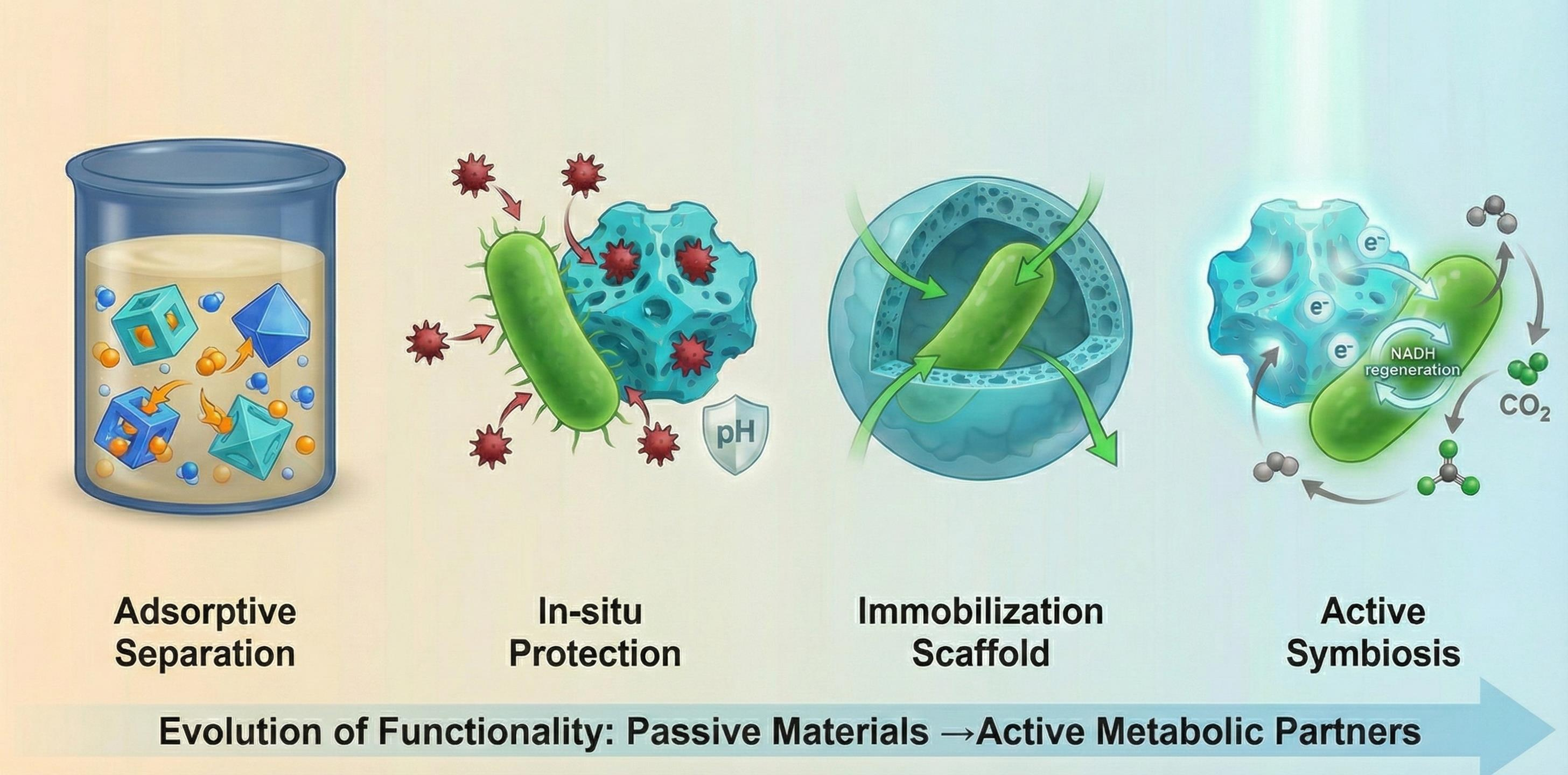
Microbial fermentation stands as the foundational technology in modern biorefineries, yet its industrial scalability is critically constrained by product inhibition, prohibitive downstream separation costs, and substrate inhibition. Metal–organic frameworks (MOFs) offer a tunable material platform to address these challenges through rational design of pore size, shape, and chemical functionality. This review systematically chronicles the evolution of MOF applications in biomass fermentation across four generations, demonstrating a synergistic mapping where the core fermentation challenges—product toxicity, substrate toxicity, and separation energy intensity—align with the inherent MOF advantages of high adsorption capacity, programmable selectivity, and tunable functionality. The applications progress from first-generation passive adsorbents for in situ product removal, to second-generation protective agents for mitigating inhibitors, and third-generation immobilization scaffolds enabling continuous processing. The fourth-generation systems transcend passive scaffolding to position MOFs as active metabolic partners in microbe-MOF hybrids, driving cofactor regeneration and tandem biocatalysis. By synthesizing diverse research streams, ranging from defect engineering to artificial symbiosis, including defect engineering strategies, this review establishes critical design principles for the rational integration of programmable materials in next-generation biorefineries.

Graphical Abstract

1. Introduction

1.1. The Biomass Energy Imperative and Fermentation Bottlenecks

The escalating climate crisis and the finite nature of fossil resources necessitate a transition to a sustainable, carbon-neutral economy [1]. Biomass, including lignocellulosic residues, algal biomass, and organic wastes, serves as the primary renewable source of fixed carbon for producing liquid fuels and platform chemicals [2]. However, industrial-scale biomass fermentation faces three critical bottlenecks that undermine its economic viability compared to petrochemical processes [3].
First, product inhibition remains a primary barrier. Metabolic end-products, particularly hydrophobic alcohols and lipophilic organic acids, compromise cellular integrity by partitioning into the phospholipid bilayer, thereby increasing membrane fluidity, disrupting transmembrane electrochemical gradients, and precipitating growth arrest even at dilute concentrations [4]. For example, the toxicity of butanol to Clostridium species limits titers in industrial ABE (Acetone-Butanol-Ethanol) fermentation to approximately 12–20 g/L, necessitating energy-intensive recovery strategies [5].
Second, prohibitive downstream processing costs plague the industry. Fermentation broths are highly dilute (e.g., ~2 wt% butanol) and contain complex mixtures of water, cells, unmetabolized sugars, and salts [6]. Notably, thermal separation processes, predominantly distillation, account for approximately 40% of the global energy burden in chemical processing industries, underscoring the critical imperative for developing energy-efficient, non-thermal fractionation alternatives [7].
Third, substrate inhibition presents a significant upstream challenge. Lignocellulosic feedstocks require pretreatment (e.g., acid hydrolysis) to release fermentable sugars, but these processes generate inhibitory compounds such as furans (furfural, 5-hydroxymethylfurfural [HMF]) and weak acids (e.g., acetic acid) [8,9]. These inhibitors via diverse mechanisms—ranging from enzyme denaturation to DNA damage—severely attenuate glycolytic flux and sugar conversion yields, thereby compromising the overall techno-economic viability of the biorefinery [10,11]. Therefore, it is crucial to develop cost-efficient pretreatment and detoxification methods that minimize inhibitor generation while maximizing sugar yields [12].

1.2. Metal–Organic Frameworks as Programmable Porous Materials

Metal–Organic Frameworks (MOFs), also known as porous coordination polymers (PCPs), are a class of crystalline materials constructed from inorganic secondary building units (SBUs)—typically metal ions or clusters, such as Zn4O or Zr6O4(OH)4—and multitopic organic linker molecules, such as terephthalates or imidazolates [13,14,15]. The self-assembly of these components results in ordered, three-dimensional networks with exceptionally well-defined and tunable porous architectures.
The properties that make MOFs a paradigm-shifting class of materials are numerous. First, they exhibit ultra-high porosity, routinely displaying Brunauer-Emmett-Teller (BET) surface areas that far exceed those of traditional porous materials like zeolites and activated carbon [16]. Many MOFs have surface areas surpassing 2000 m2/g, with some record-holders exceeding 7000 m2/g [17,18]. Second, they possess programmable pore environments [19]. In stark contrast to the rigid, fixed topologies of aluminosilicate zeolites or the disordered, tortuous pore networks of activated carbons, MOF architectures are amenable to rational, a priori reticular design. By judiciously selecting the metal node and organic linker, researchers can precisely tune the pore size, pore shape, and, critically, the chemical functionality of the pore walls to be hydrophobic [20], hydrophilic [21], acidic, basic [22], or chiral [23]. Third, they exhibit vast structural and chemical diversity. The reticular chemistry approach to MOF synthesis [15], which involves combining pre-selected building blocks, has yielded tens of thousands of reported structures [24]. This combinatorial versatility yields a vast “materials genome,” facilitating the targeted screening of candidates via high-throughput computational modeling and AI-driven paradigms to pinpoint optimal physiochemical attributes [25,26]. Consequently, this unprecedented tunability empowers the engineering of MOFs as bespoke, functional platforms specifically tailored to address the complex transport and kinetic challenges inherent to fermentation systems [27].

1.3. A Materials-Biology Interface: Scope and Structure of the Review

The limitations of fermentation—namely, toxicity and dilution—are fundamentally problems of chemical concentration and separation [28]. MOFs possess an exceptional combination of tunable selectivity, high adsorption capacity, and programmable functionality, arising from the modular design of their metal nodes and organic linkers. These strengths make MOFs particularly well suited to tackle the core challenges encountered in fermentation-based bioprocesses. In this context, the critical triad of fermentation challenges—product toxicity, substrate toxicity, and separation cost—maps directly onto the holy trinity of MOF advantages: high capacity, programmable selectivity, and tunable functionality. The rapid emergence of this interdisciplinary field is therefore not a random intersection, but rather a logical and synergistic convergence of biotechnology and materials science [29].
This review moves to establish a “Bioprocess-MOF Synergism Framework.” We evaluate MOFs based on three rigorous design criteria essential for industrial translation: (1) Hydrolytic Stability under Fermentation Conditions (aqueous, acidic, complex media); (2) Biocompatibility and Cytotoxicity (metal leaching thresholds); and (3) Process Efficiency (capacity, selectivity, and catalytic turnover).
The analysis is organized into four thematic sections reflecting increasing levels of process integration: (1) MOF-mediated separation and recovery of fermentation products; (2) In situ enhancement of fermentation via detoxification and buffering; (3) Microbial and enzymatic immobilization within MOF scaffolds; and (4) Coupled and tandem biocatalytic systems where MOFs act as active metabolic partners. Throughout, we synthesize conflicting data, particularly regarding stability, to provide a realistic roadmap for next-generation biorefineries.

2. MOF-Mediated Product Recovery

The most immediate application of MOFs lies in reducing the energy intensity of downstream separations. Fermentation broths are dilute aqueous solutions where the target product is the minor component. The separation challenge is twofold: achieving high capacity for the product to minimize adsorbent volume and high selectivity against water to reduce energy penalty.

2.1. Selective Adsorption of Bioalcohols from Dilute Broth

Biobutanol is a superior drop-in fuel compared to ethanol but is plagued by severe product inhibition. ZIF-8 has been established as the paradigmatic adsorbent for biobutanol recovery, distinguished by its intrinsic pore hydrophobicity and a dynamic structural flexibility known as the “gate-opening” effect. As delineated in Table 1, ZIF-8 demonstrates a superior saturation capacity for n-butanol (~360 mg/g), surpassing conventional hydrophobic benchmarks such as Silicalite-1 (~110 mg/g) and activated carbon matrices by nearly threefold. ZIF-8 data reflects the flexible aperture allowing butanol (4.3 Å) into 3.4 Å pores. mCB-MOF-1 represents a seminal advancement in the class of superhydrophobic frameworks, rationally engineered with bulky carborane ligands to shield metal nodes, thereby addressing the hydrolytic vulnerability limiting first-generation ZIFs. The mechanism of this superior performance is rooted in the molecular sieving effect combined with framework flexibility. While the nominal pore aperture of ZIF-8 is 3.4 Å, the imidazole linkers can rotate to accommodate the larger n-butanol molecule (kinetic diameter ~4.3 Å) [30,31]. Concurrently, the hydrophobic methyl moieties projecting into the pore cavities establish a non-polar microenvironment that thermodynamically excludes water molecules, yielding exceptional alcohol-over-water selectivity coefficients [20,32]. However, as we will discuss in Section 2.4, the thermodynamic favorability of adsorption is often counterbalanced by kinetic instability in real-world broths.

2.2. Recovery of Platform Chemicals via Adsorption and Derived Carbons

Beyond alcohols, the recovery of platform chemicals like furfural and 5-HMF is critical, both for their economic value and to detoxify fermentation broths. Table 2 summarizes the breakthrough performance of advanced MOFs in this domain. Notably, amino-functionalized UiO-67 (UiO-67-2AS) has demonstrated benchmark-setting adsorption capacities for 5-HMF (1530 mg/g) and furfural (1267 mg/g), outperforming standard resins by an order of magnitude [38]. The mechanism for this exceptional uptake is distinct from bioalcohol recovery. Rather than simple pore filling, these separation processes rely on specific chemical interactions. The amino groups in functionalized MOFs form hydrogen bonds with the carbonyl groups of furans, while the aromatic linkers facilitate π-π stacking interactions [38]. Additionally, novel materials like Covalent Organic Frameworks (e.g., COF-300) offer ultrafast kinetics, reaching equilibrium in seconds, which is advantageous for rapid-cycle pressure swing adsorption processes [39].

2.3. Process Integration via Membranes and Composites

A major practical limitation of powdered adsorbents like ZIF-8 is their difficult handling in large-scale industrial bioreactors. They must be added, agitated, and then meticulously recovered (e.g., via filtration or centrifugation) from complex fermentation broths containing cell debris and residual solids. This challenge has driven the field toward integrating MOFs into process-ready form factors, most notably membranes [42,43].
Mixed-matrix membranes (MMMs) are a prime example. In this approach, MOF nanoparticles act as the filler dispersed within a polymer matrix such as polydimethylsiloxane (PDMS) to create a composite membrane [44,45]. This design synergistically combines the robust processability and flexibility of the polymer with the superior selectivity of the MOF filler [46]. These MMMs are particularly promising for pervaporation, a membrane separation process where a liquid feed (the fermentation broth) contacts one side of the membrane, and the selectively permeating component (e.g., butanol) is removed as a vapor from the opposite side [42,45]. Studies on MMMs incorporating silane-modified ZIF-8 into a PDMS matrix for butanol recovery have demonstrated outstanding performance [47]. This synergy effectively breaks the notorious trade-off that plagues pure polymer membranes, known as the Robeson upper bound, where an increase in selectivity typically comes at the cost of decreased permeability (flux), and vice versa [46,48]. The MOF nanoparticles create selective, high-flux pathways through the polymer matrix, enhancing both selectivity and permeability simultaneously [49].
Beyond synthetic polymer matrices, a promising green alternative involves supporting MOFs on biopolymers, particularly nanocellulose (NC) [43]. Composites such as MOFs@NC can be fabricated via in situ or ex situ methods into robust aerogels, hydrogels, or membranes. This approach not only provides a scalable solution to the powder handling problem but also introduces a hierarchical pore structure and utilizes a renewable, biodegradable support matrix, further enhancing the system’s sustainability and mechanical stability [50].
A separate but related hybrid separation technique has also been proposed, which combines the merits of gas stripping and vapor-phase adsorption [6,51]. In this process, an inert gas is sparged through the fermenter, removing volatile products like those in the ABE mixture from the broth. This vapor-phase stream is then passed through an adsorbent bed for selective product capture [52]. This approach is advantageous as it prevents non-volatile components like microbial cells and sugars from contacting the adsorbent. However, this method places extreme demands on the adsorbent’s hydrolytic stability and its affinity for highly dilute products in the vapor phase [52,53]. Despite these demands, it represents a clear and scalable pathway for integrating MOF materials into continuous industrial separation processes [54].

2.4. Critical Challenge: The ZIF-8 Paradox and Hydrolytic Stability

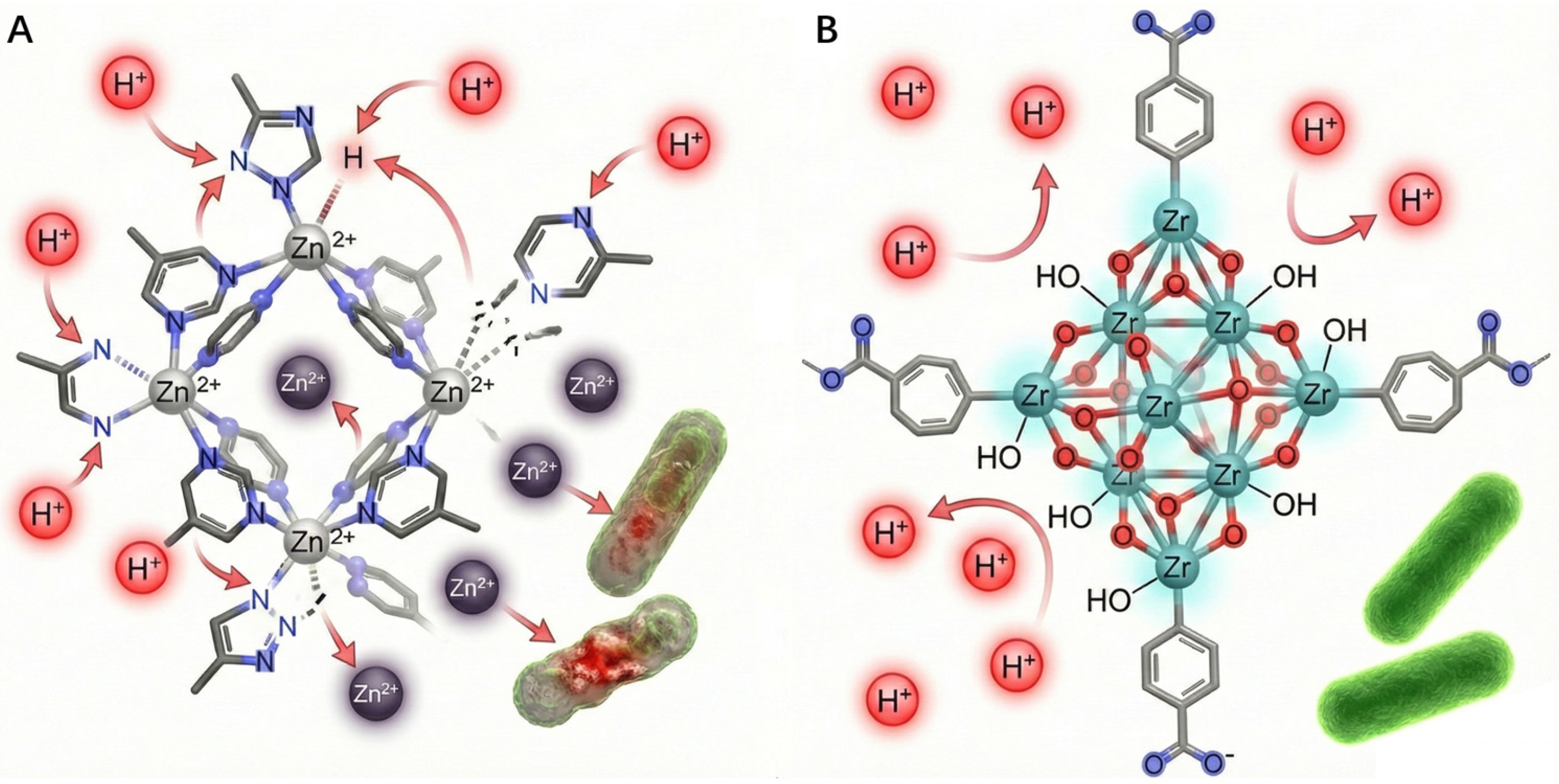
Despite exceptionally promising capacity and selectivity data, a critical, overriding challenge threatens the viability of many first-generation MOFs: hydrolytic stability. The fermentation environment is aqueous, complex, and often acidic. This dichotomy underscores the “ZIF-8 Paradox”: while serving as the archetype for capacity and selectivity, ZIF-8 simultaneously exemplifies the critical susceptibility of azolate-based frameworks to acidic media, a common condition in fermentation. The ABE fermentation process is biphasic, involving an acidogenesis phase where the broth pH drops to 4.5–5.5 [55]. Acid-triggered protonation of the imidazolate linker initiates framework disassembly via ligand exchange. While this mechanism parallels the beneficial “proton sponge” effect exploited in intracellular drug delivery, in the context of continuous fermentation, it precipitates catastrophic material loss and the release of biocidal Zn2+ ions [56,57]. Toxic ion leaching occurs. As shown in Figure 1, Framework degradation results in the leaching of Zn2+ ions into the solution [58,59]. Independent toxicological reviews confirm that free zinc ions, while essential in trace amounts, are highly toxic to most microorganisms at elevated concentrations [60], including Clostridium and E. coli [61]. This leaching would kill the very fermentation process the MOF is meant to enhance. There is also a complete loss of function, as the degrading framework loses its porosity and adsorption capacity [62].
This unavoidable conflict forces a critical re-evaluation of the extensive literature on ZIF-8 for ABE fermentation. The celebrated results of high titer increases were likely achieved in heavily buffered, non-representative laboratory media that artificially maintained a neutral pH [57,63]. Consequently, the ZIF-8 paradox serves as a decisive evolutionary filter, necessitating a fundamental reprioritization of design criteria: hydrolytic stability in complex, acidic broths must supersede adsorption capacity as the primary metric for industrial viability [56,64,65,66]. It dictates that hydrolytic stability is the primary, non-negotiable screening metric for any MOF intended for in situ biological application [67]. Capacity, selectivity, and surface area become irrelevant if the material dissolves in the process medium [68,69].
This insight has correctly pivoted the field toward exceptionally robust materials such as the Zr-based UiO-66 series and its derivatives, which maintain structural integrity even in boiling water and strong acids [53,70,71]. The stability challenge has spurred the targeted development of exceptionally robust, hydrophobic MOFs. A prime example is the mCB-MOF-1, a copper-based MOF built with hydrophobic meta-carborane linkers. This material demonstrated unprecedented stability, retaining its porosity after exposure to boiling water (90 °C) for over two months and in aqueous solutions ranging from pH 2 to 11 [34]. Critically, mCB-MOF-1 also addresses a performance limitation of ZIF-8. For separating dilute butanol from ABE broth (<2 wt%), the adsorbent must have high affinity at very low partial pressures. ZIF-8 exhibits S-shaped adsorption isotherms for alcohols, indicating weak interactions at low concentrations [72]. In contrast, mCB-MOF-1 displays a favorable Type I isotherm, characterized by steep butanol uptake at low pressures, which is ideal for dilute stream recovery. In dynamic breakthrough experiments comparing the two materials, mCB-MOF-1 proved to be a far superior adsorbent for butanol recovery from ABE mixtures at 333 K [34].
However, the limitation of ZIF-8 is context-dependent. Table 3 contrasts the operational windows of key MOFs, demonstrating that while ZIF-8 is limited to neutral/alkaline recovery (e.g., pH 7–9), Zr-based UiO-66 and Fe-based MIL-100 retain integrity down to pH 1–2, making them the viable candidates for direct contact with acidogenic fermentation broths.

3. In Situ Fermentation Enhancement

Building on the concept of ISPR, a more nuanced, second generation application of MOFs has emerged. This involves using them in situ not merely to remove the final product, but to proactively manage the fermentation environment, thereby enhancing microbial health and productivity. In this role, MOFs act as a protective sponge, sequestering toxic molecules like butanol from the immediate vicinity of the microbial cells [32]. This alleviates product inhibition, which would otherwise arrest metabolism, allowing the fermentation to proceed for a longer duration and achieve a higher final yield, thereby fundamentally improving process economics.

3.1. Mitigating Substrate Inhibition: Detoxification and Valorization

The protective sponge concept becomes even more critical when addressing substrate inhibition, the primary barrier to using second-generation lignocellulosic feedstocks [78,79]. The pretreatment or hydrolysis of biomass like corn stover or switchgrass releases the desired sugars (glucose and xylose), but also a cocktail of microbial toxins, chiefly furfural and 5-hydroxymethylfurfural (HMF) [10,80,81]. These compounds severely inhibit key enzymes in the glycolytic pathway of fermentative microbes like S. cerevisiae [11]. A brute-force detoxification using a non-selective adsorbent like activated carbon is often counter-productive, as it can also remove valuable sugars [82,83]. This is where the programmable selectivity of MOFs provides a profound advantage. The field is rapidly moving towards valorization, where MOFs act as catalysts to upgrade these inhibitors into value-added products. Table 4 highlights the state-of-the-art catalytic yields achieved by MOFs in biomass conversion.

3.2. Emergent Functions and Chemical Conflicts: pH Buffering

Beyond their role as selective adsorbents, MOFs have been shown to possess emergent functionalities, where the framework itself actively participates in regulating the broth chemistry. A salient instance of emergent functionality is observed in ZIF-8, where the Brønsted basicity of the 2-methylimidazole linker (pKa ~7.8) confers an intrinsic pH-buffering capacity upon the framework within the fermentation broth [89]. This property is critically important for ABE fermentation, which is a biphasic process. The microbes first enter an acidogenesis phase, producing acetic and butyric acids, which drops the broth pH. They must then metabolically switch to the solventogenesis phase, where they re-assimilate these acids and produce the target solvents. If the pH drops too rapidly or too low (an acid crash, typically below pH 4.5), the microbes die before this metabolic switch can occur [55]. The ZIF-8 linker (2-methylimidazole), being a weak Brønsted base (pKa ~7.8), can undergo protonation/deprotonation and thereby influence local pH and framework stability under acidogenic conditions. Materials bearing ionizable amine groups are widely reported to display strong buffering capacities in the endolysosomal pH range (~5–7), a mechanism often referred to as the proton-sponge effect [57,90]. This buffering action enables the metabolic switch to solventogenesis. The discovery reveals the potential for dual functionality, where a single material could simultaneously buffer the pH (via its linker chemistry) and remove the toxic product (via its porous adsorption).
However, a fundamental mechanistic incompatibility exists: the protonation event essential for pH buffering is thermodynamically identical to the initiation step of Zn-nitrogen bond hydrolysis, leading to irreversible framework degradation [91,92]. Therefore, the creates a functional conflict where the mechanism of buffering accelerates degradation and the leaching of toxic Zn2+ ions [57]. This paradox underscores a critical design axiom for second-generation systems: functional utility (e.g., buffering) must not compromise structural integrity within the specific chemical window of the bioprocess. This concept has been speculatively extended to other potential functions, such as pre-loading MOFs with nutrients or cofactors for slow, programmed release [93], but such applications equally hinge on the fundamental stability of the host framework.

3.3. Biocompatibility: Ion Leaching and Long-Term Bio-Fouling

The leaching of toxic metal ions (e.g., Zn2+ from ZIF-8 or Cr3+ from MIL-101) from unstable MOFs is prohibitive, as it is acutely biocidal [57,94,95]. This mandates a biocompatibility-first design approach, prioritizing frameworks constructed from non-toxic, earth-abundant metals such as Zr, Ti, Fe, Ca, and Mg [96]. A second, more insidious long-term challenge is bio-fouling. Fermentation broth is a complex mixture of proteins, lipids, polysaccharides, and cell debris [97]. Over time, these macromolecules can adsorb onto the external surfaces of MOF particles and irreversibly block their pore apertures. This serious membrane fouling is an issue when using porous materials in complex industrial liquids (e.g., extract, hydrolysate, fermentation broth) [98]. This clogging deactivates the MOF, destroying its adsorptive or catalytic function. Designing MOF surfaces that resist non-specific protein adsorption and bio-fouling, for instance, by grafting antifouling polymers like polyethylene glycol (PEG) [99] or zwitterionic coatings [100], represents a critical yet underexplored challenge essential for achieving long-term operational stability.
It is important to note the spectrum of biocompatibility. While some MOFs like ZIF-8 may exhibit low inherent toxicity if stable [63], others, particularly those unstable in aqueous media (e.g., MOF-199/HKUST-1 releasing Cu2+ ions), are highly toxic to microorganisms. Conversely, highly stable, insoluble MOF particulates, such as UiO-66, have been shown to have low particulate toxicity, with any adverse effects primarily arising from mild mechanical interaction with cell walls rather than ion leaching [101].

4. Biocatalyst Immobilization in MOF Scaffolds

The limitations of batch fermentation, such as downtime for cleaning and sterilization and low cell density, have driven the industry toward continuous processes. In a continuous fermenter, feedstock is constantly added and product is continuously removed. This third generation application leverages MOFs as protective scaffolds to enable this shift.

4.1. Rationale for Continuous Processing via Immobilization

In a continuous process, the biocatalyst (the microbe or enzyme) must be retained at high density within the reactor. Immobilizing a biocatalyst on a scaffold provides numerous process advantages: it enables high biocatalyst density, leading to a much higher concentration of cells or enzymes in the reactor volume and consequently higher volumetric productivity; it permits facile separation of the biocatalyst from the liquid product stream, eliminating the need for costly centrifugation or filtration, thereby ensuring catalyst reusability over multiple cycles [102,103]; and it offers enhanced stability, protecting the biocatalyst from shear stress caused by mixing and from hostile environmental conditions such as toxins or pH swings [104,105,106]. MOFs, with their high surface area and protective, cage-like structures, are being explored as next-generation immobilization supports [107,108,109]. Table 5 provides a quantitative comparison of free versus MOF-immobilized enzymes, demonstrating dramatic improvements in stability and reusability.

4.2. Synthesis Strategies: From Surface Adsorption to Biomimetic Mineralization

Several methods exist for immobilizing biocatalysts onto MOFs. Enzymes or cells can be physically adsorbed onto the MOF’s external surface, a simple method that typically results in weak binding. Alternatively, they can be covalently linked to functional groups on the MOF, which provides strong attachment but often involves harsh chemical conditions that can denature or damage the biocatalyst [115,116]. However, a far more revolutionary strategy has emerged: biomimetic mineralization. In this de novo encapsulation approach, the MOF precursors—metal ions and organic linkers—are added to an aqueous buffer solution containing the living cells. The MOF, most commonly ZIF-8 due to its benign synthesis conditions, then nucleates and grows in situ, forming a conformal, crystalline shell around each individual cell. This ship-in-a-bottle synthesis creates a novel biocomposite material: a living cell encased within a nanoscale bioreactor or artificial exoskeleton [117,118]. This technique is a specific application of a broader trend in developing MOF-biocomposites, including advanced MOF-nanocellulose (MOFs@NC) composites [50,119]. It has been successfully applied to encapsulate both eukaryotic yeast [120] and prokaryotic bacteria [121]. The bacterium Clostridium tyrobutyricum, a butyric acid producer, was encapsulated within a ZIF-8 shell using this method. Furthermore, it was demonstrated that this in situ grown MOF shell could subsequently serve as a support for the ex situ immobilization of enzymes, successfully decorating the bacterial shell with cellulase [122]. This results in a sophisticated biocomposite that combines a living cell and an external enzyme on a single MOF scaffold.

4.3. Enhanced Stability and Cytoprotection in Biocomposites

Immobilization within Metal–Organic Frameworks (MOFs) significantly enhances biocatalyst stability and operational robustness, overcoming the limitations of free enzymes in harsh industrial media [108,123]. This artificial cell wall shields microbes from severe environmental stressors, such as high osmotic pressure. This cytoprotective strategy includes both rigid frameworks like ZIF-8 and softer, responsive shells like copper metal–organic polyhedron (Cu-MOP) hydrogels [124]. Recent studies suggest this protection transcends simple physical shielding. The controlled release of Zn2+ ions from degrading ZIF-8 nanoparticles can act as a bio-active signal, rebalancing cellular metabolism (e.g., glycolysis/OXPHOS) and actively mitigating oxidative stress [125]. This presents a sophisticated mechanism distinct from the uncontrolled toxicity of bulk MOF degradation.
For enzyme immobilization, performance is dictated by both recovery and support architecture. Magnetic composites, such as laccase immobilized on Fe3O4@ZIF-8, solve the critical powder handling problem by enabling facile magnetic separation and show high reusability, retaining activity for over nine cycles [126]. Furthermore, to overcome the diffusion limitations inherent in microporous materials, hierarchically porous MOFs (e.g., HZIF-8) are superior supports. Comparative studies found that de novo encapsulation of laccase within HZIF-8 (LAC@HZIF-8-D) yielded significantly better stability and reusability than post-synthetic methods, retaining 80% efficiency after three cycles [112].

4.4. Critical Challenge: The Protection—Diffusion Trade-Off

Despite the profound protective benefits, the nanoscale bioreactor concept faces one major, unavoidable physical challenge: mass transfer limitations. The same MOF shell that protects the cell also impedes its access to nutrients and its ability to excrete waste products. Quantitative studies confirm that diffusion rates are significantly lower within MOF-cell composites compared to free solution [127]. This effect is well-documented for enzymes, where activity can decrease significantly due to diffusion limitations of cofactors like NAD+ or substrates into the MOF pores [128]. This is a general, fundamental problem for all immobilized biocatalysts, and such mass transfer limitations can increase production costs [109].
Consequently, the encapsulated biocatalyst may experience localized nutrient deprivation, where global metabolic flux is governed not by intrinsic enzymatic kinetics, but by mass transfer resistances across the MOF shell. This phenomenon establishes a pivotal design dichotomy: the “Protection-Permeability Trade-off.” Maximizing cytoprotection typically mandates dense, microporous shells, which inversely restricts the diffusive transport of substrates and metabolites [129,130]. This is not merely a simple optimization problem but a fundamental materials-architecture conflict. The protective function against osmotic stress and toxic compounds relies on a mechanically rigid, continuous, and semi-permeable shell. In contrast, the metabolic function relies on the rapid, unimpeded flux of large molecules (nutrients in, products out). A material comprising only micropores, such as ZIF-8, is inherently flawed for this application [131]. Its pores are too small for rapid molecular flux (leading to nutrient starvation), and a thin shell composed solely of microporous material tends to be mechanically weak.
The solution cannot be found by simply making the microporous shell marginally thinner or thicker; this represents an optimization dead-end. To reconcile these opposing constraints, strategies employing defect engineering (e.g., missing linker sites) and the fabrication of hierarchically porous architectures have emerged as decisive technological interventions. By intentionally introducing “missing linker” defects or mesopores into microporous frameworks (e.g., via modulated synthesis), researchers can create high-flux molecular highways that enhance substrate diffusion by orders of magnitude without compromising the cytoprotective shell [132]. Such materials would possess large highways (macropores or mesopores) for the rapid, unimpeded transport of nutrients and products, which then branch into the microporous framework that provides the protective, selective, and high-surface-area environment [112,113,114,115,116,117,118,119,120,121,122,123,124,125,126,127,128,129,130,131,132,133,134].

5. Active and Symbiotic MOF-Microbe Systems

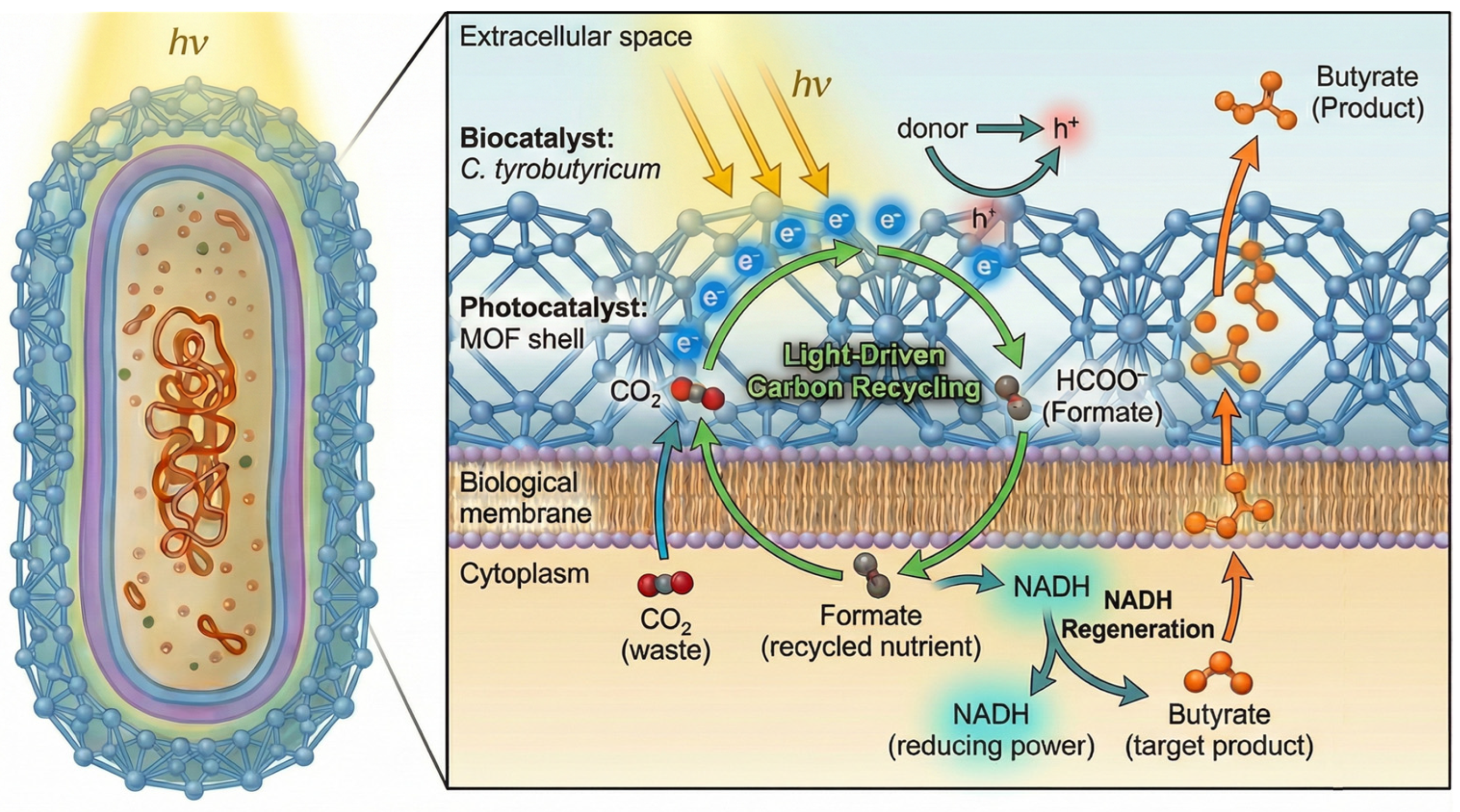
The most advanced and forward-looking application of MOFs in bioprocessing involves transitioning them from passive roles as adsorbents or scaffolds to active participants. In this fourth generation of applications, MOFs are employed as chemical catalysts that work in tandem with microbes, or even in a symbiotic partnership, to create novel, one-pot biotransformation pathways (Figure 2). For instance, ABE fermentation produces both butanol (a fuel) and butyric acid (an intermediate). These two products can be catalytically esterified to produce butyl butyrate. They systematically engineered the acidic catalytic sites in robust UiO-66 MOFs, discovering that a combination of linker-based acidic groups (e.g., in functionalized UiO-66) and structural defects within the Zr-cluster created a highly active catalyst, achieving 92% conversion [135]. This evolutionary stage marks a paradigm shift from passive scaffolding to active metabolic partnership. Here, the MOF transcends its role as a corrective agent to become a generative component, actively driving cofactor regeneration or precursor synthesis.

5.1. Photocatalytic Cofactor Regeneration in MOF-Microbe Hybrids

The one-pot concept aims to integrate multiple process steps, such as fermentation, chemical upgrading, and separation, into a single reactor vessel, thereby vastly improving process efficiency. This is a central goal of process intensification, often realized through configurations like a Membrane Reactor (MR), which combines catalytic reaction and membrane separation in a single unit [136]. MOFs are emerging as ideal mediators to bridge the gaps between these functions. This includes utilizing MOFs as nanozymes or enzyme mimics that can work in concert with biological enzymes [42,137].
Furthermore, MOFs or MOF-derived catalysts can directly upgrade bio-platform chemicals. For example, bioethanol was converted into other high-value products like ethylene and diethyl ether using various heterogeneous catalysts, including MOFs like UiO-66 and Cr-MIL-101 [138,139,140]. This concept also extends to hybrid materials. For instance, zeolite@MOF composites such as ZSM-5@IRMOF-1 have been developed as bifunctional catalysts to fine-tune Lewis/Brønsted acidity for the high-temperature (350 °C) gas-phase conversion of isopropyl alcohol (IPA) into aromatic compounds (BTX), demonstrating an alternative path for alcohol valorization [141]. However, the most innovative systems involve direct, symbiotic partnerships with microbes. The ZIF-8 shell encapsulating C. tyrobutyricum was discovered to function as an active photocatalyst. Under visible light irradiation, the photo-active MOF shell functions as an artificial photosynthetic antenna, facilitating the catalytic reduction of NAD+ to NADH. This exogenous supply of reducing equivalents directly alleviates intracellular redox imbalances [142]. This external supply of reducing power directly boosted the bacterium’s butyric acid synthesis pathway, resulting in a final titer of 26.25 g/L, which was 14–29% higher than in non-irradiated controls [122]. This integration constitutes a prototypical bio-hybrid system exhibiting quasi-symbiotic behavior, where the inorganic component complements the biological machinery.

5.2. Artificial Symbiosis via Photocatalytic CO2 Recycling

The most futuristic application is the creation of engineered symbiotic systems that drive a circular carbon economy. Fermentation is inherently wasteful from a carbon perspective; for example, for every two moles of ethanol produced from glucose, two moles of CO2 are typically vented as waste. Researchers have designed systems to capture and recycle this waste CO2 in situ.
A co-culture system involving a photocatalytic MOF and an anaerobic microbial consortium was designed [143,144]. This system creates a closed, light-driven loop. In the fermentation step, the microbes consume an organic substrate, producing waste CO2. In the photocatalysis step, the MOF absorbs light and uses that energy to photo-catalytically reduce the waste CO2 into formate or formic acid—a well-established application of MOFs [145]. In the assimilation step, microbes within the consortium utilize the formate produced by the MOF as a supplementary carbon source for growth or product synthesis. This represents an artificial, light-driven symbiosis: the microbe’s waste (CO2) becomes the MOF’s feedstock, and the MOF’s product (formate) becomes the microbe’s nutrient. Such a system dramatically increases the overall carbon efficiency of the fermentation process, potentially transforming a carbon-emitting process into a carbon-neutral or even carbon-negative one.
This concept has been successfully applied to other fermentation pathways, such as biohydrogen production. Jiao et al. integrated MOF-808 into a photo-fermentation system using corn stover hydrolysate and Proteobacteria. They observed that MOF-808 coagulated with the bacteria, forming a bio-composite that established an efficient proton transport interface and improved the reducing environment of the broth. This MOF-microbe coupling significantly enhanced the biohydrogen yield, demonstrating a clear symbiotic relationship [84,146,147].

5.3. Toward Full Process Integration: Simultaneous Saccharification and Fermentation

The integrated one-pot philosophy can be extended to the entire biorefinery chain. The initial step, lignocellulose pre-treatment, typically employs corrosive liquid sulfuric acid to hydrolyze cellulose into glucose. This liquid acid is difficult to recover and generates a waste salt stream upon neutralization. MOFs with strong acid sites, such as sulfonic acid-functionalized UiO-66 have been developed as solid acid catalysts [114]. These solid, recoverable MOF-catalysts can potentially replace liquid acids for cellulose hydrolysis. This opens the possibility of a fully MOF-integrated biorefinery. In a conceptual sequence: a solid-acid MOF like UiO-66-SO3H hydrolyzes biomass into sugars and inhibitors; the MOF-catalyst is then filtered out, and a second, detoxifying MOF (e.g., UiO-66-CH3) is added to selectively remove inhibitors; following its removal, microbes are introduced along with an in situ enhancing MOF and an ISPR MOF (e.g., a stable, hydrophobic Zr-MOF). This vision of a MOF-in-every-step process, while futuristic, illustrates the profound versatility of these materials. Beyond acting as primary catalysts, MOFs are also being explored as process enhancers for enzymatic hydrolysis. The hydrolysis of lignocellulose at high-solids loadings (industrially necessary for high sugar concentrations) is plagued by severe enzyme inhibition and poor mixing. A report demonstrated that simply adding UiO-66-NH2 nanoparticles to a high-solids hydrolysis of untreated corncob residues significantly boosted the sugar yield to 71.5%. This enhancement was attributed to the MOF’s ability to adsorb inhibitors and prevent the non-productive binding of enzymes to lignin, thereby reducing the required cellulase dosage by approximately 50% [114,148].
This culminates in the ultimate fourth-generation concept: MOFs coupling simultaneous saccharification and fermentation (MOFs-SSF) [122]. This single system, using rice straw as feedstock, accomplishes three tasks simultaneously. (1) For saccharification, a MOF-immobilized cellulase hydrolyzes the biomass (cellulose) into sugars [122]. (2) For fermentation, MOF-encapsulated bacteria (C. tyrobutyricum) consume the sugars to produce butyric acid. (3) For catalysis, the MOF shell acts as a photocatalyst to supply NADH, boosting the bacteria’s metabolic efficiency [122]. This MOFs-SSF process exemplifies the convergence of third-generation (immobilization) and fourth-generation (tandem catalysis) principles [108]. A separate but parallel fourth-generation approach involves using MOFs as purely chemocatalytic platforms for biomass conversion, such as the direct conversion of D-xylose to lactic acid using MOF-808 [84].

6. Conclusions and Future Perspectives

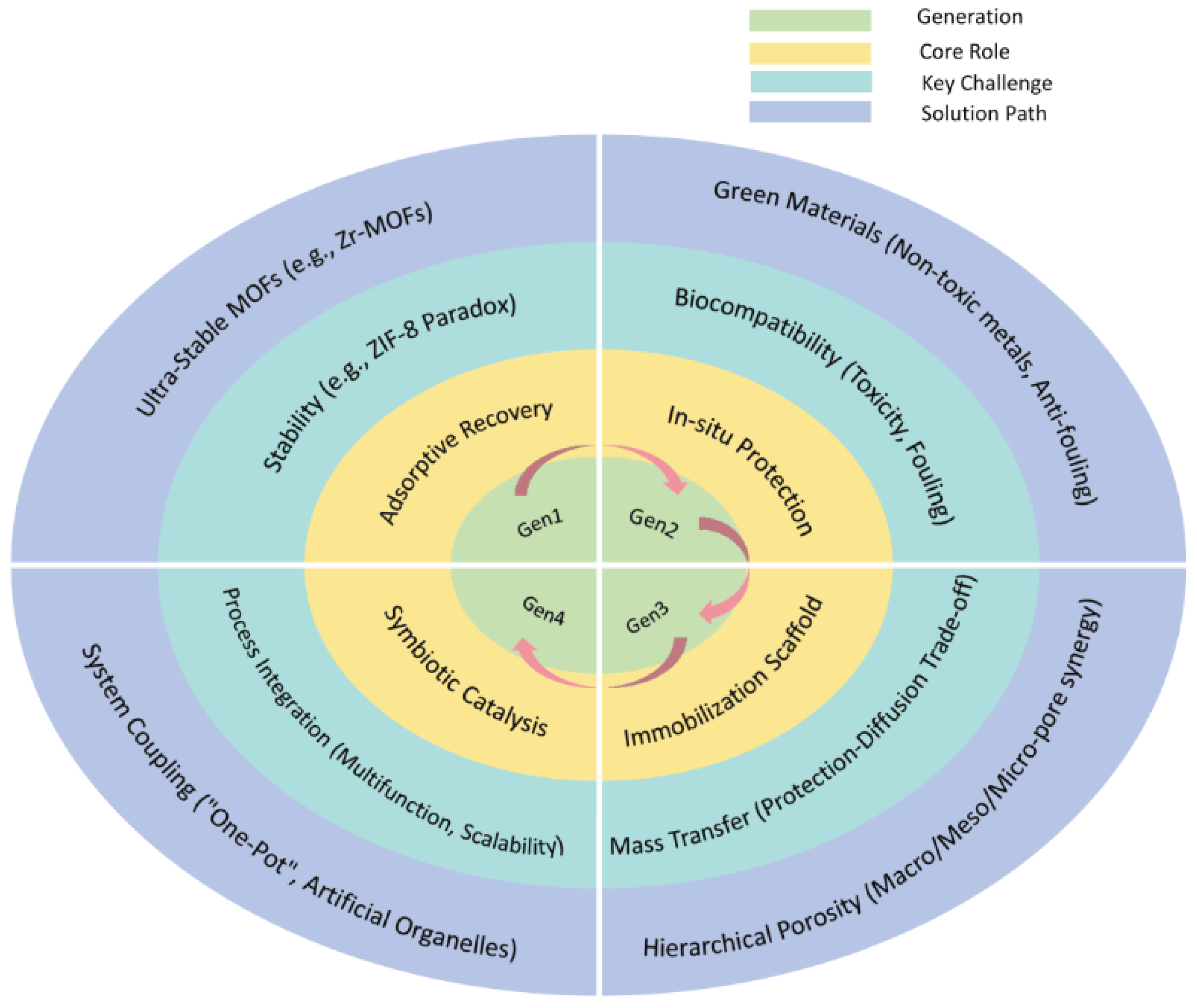
Metal–organic frameworks have emerged as a transformative material platform for advancing biomass fermentation processes. This review has chronicled their evolution across four generations of applications—from passive adsorbents for product recovery to active catalytic partners in integrated bioreactor systems. This progression demonstrates a fundamental shift in the role of MOFs, from merely mitigating process limitations to actively generating new metabolic pathways (Figure 3).
Critical analysis reveals several interconnected challenges that must be addressed to bridge the gap between laboratory promise and industrial implementation. The ZIF-8 paradox exemplifies the fundamental stability–functionality trade-off, where promising adsorption capacities are negated by hydrolytic instability under acidic fermentation conditions. This necessitates prioritizing robust frameworks with proven stability, such as Zr-based UiO-66 and Fe-based MILs. For immobilization applications, the conflict between protection and mass transfer remains unresolved—while MOF encapsulation provides excellent microbial shielding, it simultaneously restricts nutrient diffusion and metabolic activity. Furthermore, the scalability gap remains a formidable barrier; prevalent solvothermal synthesis routes often necessitate toxic solvents (e.g., DMF) and exotic linkers, incurring an environmental and economic footprint that may negate the sustainability benefits of the bio-process itself.
The integration of MOF and biotechnology is redefining how we utilize biomass, transforming an inefficient and high-energy consumption industry into a precise efficient and atom-economical modern biomanufacturing system. Future research trajectories must prioritize operational stability, specifically targeting high-valence metal nodes (e.g., Zr4+, Fe3+, Ti4+) that offer robust coordination bonds. Scalable manufacturing requires developing green preparation processes including aqueous phase synthesis and mechanochemical synthesis as a prerequisite for MOFs to enter thousand-ton fermentation tanks. Future implementation hinges not only on performance but on rigorous Techno-Economic Analysis and Life Cycle Assessment to validate the sustainability of MOF-based biorefining.

Author Contributions

Conceptualization, T.L. and W.L.; methodology, T.L.; validation, C.W.; formal analysis, C.W.; investigation, T.L.; resources, W.L.; data curation, T.L.; Writing—original draft preparation, T.L. and W.L.; writing—review and editing, T.L., C.W., H.Z. and W.L.; visualization, H.Z.; supervision, W.L.; project administration, W.L.; funding acquisition, T.L. All authors have read and agreed to the published version of the manuscript.

Funding

This research was funded by Key Area Project of General Universities in Guangdong Province (No. 2024ZDZX2080).

Institutional Review Board Statement

Not applicable.

Informed Consent Statement

Not applicable.

Data Availability Statement

No new data were created or analyzed in this study. Data sharing is not applicable.

Conflicts of Interest

The authors declare no conflicts of interest.

References

  1. Marvik, O.J.; Philp, J. The systemic challenge of the bioeconomy: A policy framework for transitioning towards a sustainable carbon cycle economy. EMBO Rep. 2020, 21, e51478. [Google Scholar] [CrossRef]
  2. Antar, M.; Lyu, D.; Nazari, M.; Shah, A.; Zhou, X.; Smith, D.L. Biomass for a sustainable bioeconomy: An overview of world biomass production and utilization. Renew. Sustain. Energy Rev. 2021, 139, 110691. [Google Scholar] [CrossRef]
  3. Vamsi Krishna, K.; Bharathi, N.; George Shiju, S.; Alagesan Paari, K.; Malaviya, A. An updated review on advancement in fermentative production strategies for biobutanol using Clostridium spp. Environ. Sci. Pollut. Res. 2022, 29, 47988–48019. [Google Scholar] [CrossRef]
  4. Tan, L.; Scott, H.L.; Smith, M.D.; Pingali, S.V.; Cheng, X.; O’Neill, H.M.; Katsaras, J.; Smith, J.C.; Elkins, J.G.; Davison, B.H.; et al. Toxic Effects of Butanol in the Plane of the Cell Membrane. Langmuir 2025, 41, 1281–1296. [Google Scholar] [CrossRef]
  5. Li, S.; Huang, L.; Ke, C.; Pang, Z.; Liu, L. Pathway dissection, regulation, engineering and application: Lessons learned from biobutanol production by solventogenic clostridia. Biotechnol. Biofuels 2020, 13, 39. [Google Scholar] [CrossRef]
  6. Chandrasekaran, T.; Uppuluri, K.B. Critical Analysis of Various Strategies for the Effective and Economical Separation and Purification of Butanol from ABE Fermentation. Sep. Purif. Rev. 2022, 52, 353–378. [Google Scholar] [CrossRef]
  7. Kiss, A.A.; Smith, R. Rethinking energy use in distillation processes for a more sustainable chemical industry. Energy 2020, 203, 117788. [Google Scholar] [CrossRef]
  8. Jönsson, L.J.; Alriksson, B.; Nilvebrant, N.-O. Bioconversion of lignocellulose: Inhibitors and detoxification. Biotechnol. Biofuels 2013, 6, 16. [Google Scholar] [CrossRef]
  9. Lyu, Q.; Dar, R.A.; Baganz, F.; Smoliński, A.; Rasmey, A.-H.M.; Liu, R.; Zhang, L. Effects of Lignocellulosic Biomass-Derived Hydrolysate Inhibitors on Cell Growth and Lipid Production During Microbial Fermentation of Oleaginous Microorganisms—A Review. Fermentation 2025, 11, 121. [Google Scholar] [CrossRef]
  10. Ujor, V.C.; Okonkwo, C.C. Microbial detoxification of lignocellulosic biomass hydrolysates: Biochemical and molecular aspects, challenges, exploits and future perspectives. Front. Bioeng. Biotechnol. 2022, 10, 1061667. [Google Scholar] [CrossRef]
  11. Jilani, S.B.; Olson, D.G. Mechanism of furfural toxicity and metabolic strategies to engineer tolerance in microbial strains. Microb. Cell Fact. 2023, 22, 221. [Google Scholar] [CrossRef]
  12. Guo, Y.; Liu, Y.; Guan, M.; Tang, H.; Wang, Z.; Lin, L.; Pang, H. Production of butanol from lignocellulosic biomass: Recent advances, challenges, and prospects. RSC Adv. 2022, 12, 18848–18863. [Google Scholar] [CrossRef]
  13. Mondal, S.; Ruidas, S.; Chongdar, S.; Saha, B.; Bhaumik, A. Sustainable Porous Heterogeneous Catalysts for the Conversion of Biomass into Renewable Energy Products. ACS Sustain. Resour. Manag. 2024, 1, 1672–1704. [Google Scholar] [CrossRef]
  14. Yusuf, V.F.; Malek, N.I.; Kailasa, S.K. Review on Metal-Organic Framework Classification, Synthetic Approaches, and Influencing Factors: Applications in Energy, Drug Delivery, and Wastewater Treatment. ACS Omega 2022, 7, 44507–44531. [Google Scholar] [CrossRef]
  15. Gropp, C.; Canossa, S.; Wuttke, S.; Gandara, F.; Li, Q.; Gagliardi, L.; Yaghi, O.M. Standard Practices of Reticular Chemistry. ACS Central Sci. 2020, 6, 1255–1273. [Google Scholar] [CrossRef]
  16. Mouctar, M.H.; Hassan, M.G.; Bimbo, N.; Abbas, S.Z.; Shigidi, I. Comparative Assessment and Deployment of Zeolites, MOFs, and Activated Carbons for CO2 Capture and Geological Sequestration Applications. Inventions 2025, 10, 78. [Google Scholar] [CrossRef]
  17. Furukawa, H.; Ko, N.; Go, Y.B.; Aratani, N.; Choi, S.B.; Choi, E.; Yazaydin, A.O.; Snurr, R.Q.; O’Keeffe, M.; Kim, J.; et al. Ultrahigh porosity in metal-organic frameworks. Science 2010, 329, 424–428. [Google Scholar] [CrossRef]
  18. Farha, O.K.; Eryazici, I.; Jeong, N.C.; Hauser, B.G.; Wilmer, C.E.; Sarjeant, A.A.; Snurr, R.Q.; Nguyen, S.T.; Yazaydin, A.O.; Hupp, J.T. Metal-organic framework materials with ultrahigh surface areas: Is the sky the limit? J. Am. Chem. Soc. 2012, 134, 15016–15021. [Google Scholar] [CrossRef]
  19. Ji, Z.; Wang, H.; Canossa, S.; Wuttke, S.; Yaghi, O.M. Pore Chemistry of Metal–Organic Frameworks. Adv. Funct. Mater. 2020, 30, 2000238. [Google Scholar] [CrossRef]
  20. Xie, L.H.; Xu, M.M.; Liu, X.M.; Zhao, M.J.; Li, J.R. Hydrophobic Metal-Organic Frameworks: Assessment, Construction, and Diverse Applications. Adv. Sci. 2020, 7, 1901758. [Google Scholar] [CrossRef]
  21. Rutherford, S.W. Evaluation of Hydrophobic, Hydrophilic, and Water Adsorption Properties of Microporous Metal–Organic Framework Materials by Unified Isotherm Analysis. Langmuir 2025, 41, 25086–25099. [Google Scholar] [CrossRef]
  22. Cohen, S.M. Postsynthetic methods for the functionalization of metal-organic frameworks. Chem. Rev. 2012, 112, 970–1000. [Google Scholar] [CrossRef]
  23. Peng, Y.; Gong, T.; Zhang, K.; Lin, X.; Liu, Y.; Jiang, J.; Cui, Y. Engineering chiral porous metal-organic frameworks for enantioselective adsorption and separation. Nat. Commun. 2014, 5, 4406. [Google Scholar] [CrossRef]
  24. Gibaldi, M.; Kapeliukha, A.; White, A.; Luo, J.; Mayo, R.A.; Burner, J.; Woo, T.K. MOSAEC-DB: A comprehensive database of experimental metal-organic frameworks with verified chemical accuracy suitable for molecular simulations. Chem. Sci. 2025, 16, 4085–4100. [Google Scholar] [CrossRef]
  25. Park, J.; Kim, H.; Kang, Y.; Lim, Y.; Kim, J. From Data to Discovery: Recent Trends of Machine Learning in Metal-Organic Frameworks. JACS Au 2024, 4, 3727–3743. [Google Scholar] [CrossRef]
  26. Ozcan, A.; Coudert, F.X.; Rogge, S.M.J.; Heydenrych, G.; Fan, D.; Sarikas, A.P.; Keskin, S.; Maurin, G.; Froudakis, G.E.; Wuttke, S.; et al. Artificial Intelligence Paradigms for Next-Generation Metal-Organic Framework Research. J. Am. Chem. Soc. 2025, 147, 23367–23380. [Google Scholar] [CrossRef]
  27. Multia, J.; Karppinen, M. Atomic/Molecular Layer Deposition for Designer’s Functional Metal–Organic Materials. Adv. Mater. Interfaces 2022, 9, 2200210. [Google Scholar] [CrossRef]
  28. Gupta, I.; Gupta, O. Recent Advancements in the Recovery and Reuse of Organic Solvents Using Novel Nanomaterial-Based Membranes for Renewable Energy Applications. Membranes 2023, 13, 108. [Google Scholar] [CrossRef]
  29. Furukawa, H.; Cordova, K.E.; O’Keeffe, M.; Yaghi, O.M. The Chemistry and Applications of Metal-Organic Frameworks. Science 2013, 341, 1230444. [Google Scholar] [CrossRef]
  30. Ganesan, A.; Metz, P.C.; Thyagarajan, R.; Chang, Y.; Purdy, S.C.; Jayachandrababu, K.C.; Page, K.; Sholl, D.S.; Nair, S. Structural and Adsorption Properties of ZIF-8-7 Hybrid Materials Synthesized by Acid Gas-Assisted and De Novo Routes. J. Phys. Chem. C Nanomater. Interfaces 2023, 127, 23956–23965. [Google Scholar] [CrossRef]
  31. Paul, A.; Banga, I.K.; Muthukumar, S.; Prasad, S. Engineering the ZIF-8 Pore for Electrochemical Sensor Applications—A Mini Review. ACS Omega 2022, 7, 26993–27003. [Google Scholar] [CrossRef]
  32. Wallbridge, S.P.; Archer, S.; Elsegood, M.R.J.; Wagner, J.L.; Christie, J.K.; Dann, S.E. An investigation into the adsorption mechanism of n-butanol by ZIF-8: A combined experimental and ab initio molecular dynamics approach. Phys. Chem. Chem. Phys. 2023, 25, 19911–19922. [Google Scholar] [CrossRef] [PubMed]
  33. Zhang, K.; Lively, R.P.; Zhang, C.; Chance, R.R.; Koros, W.J.; Sholl, D.S.; Nair, S. Exploring the Framework Hydrophobicity and Flexibility of ZIF-8: From Biofuel Recovery to Hydrocarbon Separations. J. Phys. Chem. Lett. 2013, 4, 3618–3622. [Google Scholar] [CrossRef]
  34. Gan, L.; Chidambaram, A.; Fonquernie, P.G.; Light, M.E.; Choquesillo-Lazarte, D.; Huang, H.; Solano, E.; Fraile, J.; Viñas, C.; Teixidor, F.; et al. A Highly Water-Stable meta-Carborane-Based Copper Metal–Organic Framework for Efficient High-Temperature Butanol Separation. J. Am. Chem. Soc. 2020, 142, 8299–8311. [Google Scholar] [CrossRef] [PubMed]
  35. Liu, Z.; Gao, J.; Qi, X.; Zhao, Z.; Sun, H. Experimental Study on Activated Carbon-MIL-101(Cr) Composites for Ethanol Vapor Adsorption. Materials 2021, 14, 3811. [Google Scholar] [CrossRef] [PubMed]
  36. Yeskendir, B.; Dacquin, J.-P.; Lorgouilloux, Y.; Courtois, C.; Royer, S.; Dhainaut, J. From metal–organic framework powders to shaped solids: Recent developments and challenges. Mater. Adv. 2021, 2, 7139–7186. [Google Scholar] [CrossRef]
  37. Chew, T.W.; H’Ng, P.S.; Luqman Chuah Abdullah, B.; Chin, K.L.; Lee, C.L.; Mohd Nor Hafizuddin, B.M.S.; TaungMai, L. A Review of Bio-Based Activated Carbon Properties Produced from Different Activating Chemicals during Chemicals Activation Process on Biomass and Its Potential for Malaysia. Materials 2023, 16, 7365. [Google Scholar] [CrossRef]
  38. Li, Z.; Wang, Z.; Wang, H.; Shi, Y.; Zhao, Y.; Wang, H. Designing Amino-Functionalized Metal–Organic Frameworks for Highly Efficient and Selective Separation of Furan Compounds from Water. ACS Sustain. Chem. Eng. 2025, 13, 3985–3993. [Google Scholar] [CrossRef]
  39. Li, S.; Yang, Y.; Shan, H.; Zhao, J.; Wang, Z.; Cai, D.; Qin, P.; Baeyens, J.; Tan, T. Ultrafast and ultrahigh adsorption of furfural from aqueous solution via covalent organic framework-300. Sep. Purif. Technol. 2019, 220, 283–292. [Google Scholar] [CrossRef]
  40. Zhao, Y.; Xu, J.; Wang, J.; Wu, J.; Gao, M.; Zheng, B.; Xu, H.; Shi, Q.; Dong, J. Adsorptive Separation of Furfural/5-Hydroxymethylfurfural in MAF-5 with Ellipsoidal Pores. Ind. Eng. Chem. Res. 2020, 59, 11734–11742. [Google Scholar] [CrossRef]
  41. Hu, L.; Zheng, J.; Li, Q.; Tao, S.; Zheng, X.; Zhang, X.; Liu, Y.; Lin, X. Adsorption of 5-Hydroxymethylfurfural, Levulinic Acid, Formic Acid, and Glucose Using Polymeric Resins Modified with Different Functional Groups. ACS Omega 2021, 6, 16955–16968. [Google Scholar] [CrossRef] [PubMed]
  42. Ban, Y.; Cao, N.; Yang, W. Metal-Organic Framework Membranes and Membrane Reactors: Versatile Separations and Intensified Processes. Research 2020, 2020, 1583451. [Google Scholar] [CrossRef] [PubMed]
  43. Tu, K.; Ding, Y.; Keplinger, T. Review on design strategies and applications of metal-organic framework-cellulose composites. Carbohydr. Polym. 2022, 291, 119539. [Google Scholar] [CrossRef] [PubMed]
  44. Zamani, A.; Thibault, J.; Tezel, F.H. Separation of n-Butanol from Aqueous Solutions via Pervaporation Using PDMS/ZIF-8 Mixed-Matrix Membranes of Different Particle Sizes. Membranes 2023, 13, 632. [Google Scholar] [CrossRef]
  45. Goyal, P.; Sundarrajan, S.; Ramakrishna, S. A Review on Mixed Matrix Membranes for Solvent Dehydration and Recovery Process. Membranes 2021, 11, 441. [Google Scholar] [CrossRef]
  46. Zhang, X.; Tong, Z.; Liu, C.; Ye, L.; Zhou, Y.; Meng, Q.; Zhang, G.; Gao, C. Functionalized MOF-Derived Nanoporous Carbon as Compatible Nanofiller to Fabricate Defect-Free PDMS-Based Mixed Matrix Pervaporation Membranes. ACS Omega 2022, 7, 15786–15794. [Google Scholar] [CrossRef]
  47. Li, S.; Chen, Z.; Yang, Y.; Si, Z.; Li, P.; Qin, P.; Tan, T. Improving the pervaporation performance of PDMS membranes for n-butanol by incorporating silane-modified ZIF-8 particles. Sep. Purif. Technol. 2019, 215, 163–172. [Google Scholar] [CrossRef]
  48. Mo, B.; Jin, Y.; Zhou, G.; Liu, G.; Chen, C.; Liu, Z.; Liu, G.; Jin, W. Ligand-engineered Zr-MOF membranes with fast water transport channels for alcohol–water separation. AIChE J. 2024, 70, e18368. [Google Scholar] [CrossRef]
  49. Zhang, H.; Xiao, F.; Wu, Y. Fluorinated Metal–Organic Framework–Polymer Mixed Matrix Membrane with Tunable Hydrophobic Channel for Efficient Pervaporation of Butanol/Water. Small Struct. 2023, 5, 2300333. [Google Scholar] [CrossRef]
  50. Song, Y.; Zhu, W.; Wang, C.; Li, Z.; Xin, R.; Wu, D.; Ma, X.; Wang, H.; Wang, X.; Li, S.; et al. Nanoarchitectonics of Metal–Organic Framework and Nanocellulose Composites for Multifunctional Environmental Remediation. Adv. Mater. 2025, 37, e2504364. [Google Scholar] [CrossRef]
  51. Outram, V.; Lalander, C.A.; Lee, J.G.M.; Davies, E.T.; Harvey, A.P. Applied in situ product recovery in ABE fermentation. Biotechnol. Prog. 2017, 33, 563–579. [Google Scholar] [CrossRef] [PubMed]
  52. Pereira, J.P.C.; Overbeek, W.; Gudiño-Reyes, N.; Andrés-García, E.; Kapteijn, F.; van der Wielen, L.A.M.; Straathof, A.J.J. Integrated Vacuum Stripping and Adsorption for the Efficient Recovery of (Biobased) 2-Butanol. Ind. Eng. Chem. Res. 2018, 58, 296–305. [Google Scholar] [CrossRef] [PubMed]
  53. Mosca, L.P.L.; Gapan, A.B.; Angeles, R.A.; Lopez, E.C.R. Stability of Metal–Organic Frameworks: Recent Advances and Future Trends. Eng. Proc. 2023, 56, 146. [Google Scholar]
  54. Rasmussen, E.G.; Kramlich, J.; Novosselov, I.V. Scalable Continuous Flow Metal–Organic Framework (MOF) Synthesis Using Supercritical CO2. ACS Sustain. Chem. Eng. 2020, 8, 9680–9689. [Google Scholar] [CrossRef]
  55. Kumar, M.; Saini, S.; Gayen, K. Exploring the Influence of pH on the Dynamics of Acetone–Butanol–Ethanol Fermentation. Microorganisms 2023, 11, 1610. [Google Scholar] [CrossRef]
  56. Li, Z.; Shao, Y.; Yang, Y.; Zan, J. Zeolitic imidazolate framework-8: A versatile nanoplatform for tissue regeneration. Front. Bioeng. Biotechnol. 2024, 12, 1386534. [Google Scholar] [CrossRef]
  57. Spitsyna, A.S.; Poryvaev, A.S.; Sannikova, N.E.; Yazikova, A.A.; Kirilyuk, I.A.; Dobrynin, S.A.; Chinak, O.A.; Fedin, M.V.; Krumkacheva, O.A. Stability of ZIF-8 Nanoparticles in Most Common Cell Culture Media. Molecules 2022, 27, 3240. [Google Scholar] [CrossRef]
  58. Xie, H.; Liu, X.; Huang, Z.; Xu, L.; Bai, R.; He, F.; Wang, M.; Han, L.; Bao, Z.; Wu, Y.; et al. Nanoscale Zeolitic Imidazolate Framework (ZIF)-8 in Cancer Theranostics: Current Challenges and Prospects. Cancers 2022, 14, 3935. [Google Scholar] [CrossRef]
  59. Tran, T.V.; Dang, H.H.; Nguyen, H.; Nguyen, N.T.T.; Nguyen, D.H.; Nguyen, T.T.T. Synthesis methods, structure, and recent trends of ZIF-8-based materials in the biomedical field. Nanoscale Adv. 2025, 7, 3941–3960. [Google Scholar] [CrossRef]
  60. Hussain, S.; Khan, M.; Sheikh, T.M.M.; Mumtaz, M.Z.; Chohan, T.A.; Shamim, S.; Liu, Y. Zinc Essentiality, Toxicity, and Its Bacterial Bioremediation: A Comprehensive Insight. Front. Microbiol. 2022, 13, 900740. [Google Scholar] [CrossRef]
  61. Rihacek, M.; Kosaristanova, L.; Fialova, T.; Kuthanova, M.; Eichmeier, A.; Hakalova, E.; Cerny, M.; Berka, M.; Palkovicova, J.; Dolejska, M.; et al. Zinc effects on bacteria: Insights from Escherichia coli by multi-omics approach. mSystems 2023, 8, e0073323. [Google Scholar] [CrossRef]
  62. Shortall, K.; Otero, F.; Bendl, S.; Soulimane, T.; Magner, E. Enzyme Immobilization on Metal Organic Frameworks: The Effect of Buffer on the Stability of the Support. Langmuir 2022, 38, 13382–13391. [Google Scholar] [CrossRef] [PubMed]
  63. Butonova, S.A.; Ikonnikova, E.V.; Sharsheeva, A.; Chernyshov, I.Y.; Kuchur, O.A.; Mukhin, I.S.; Hey-Hawkins, E.; Vinogradov, A.V.; Morozov, M.I. Degradation kinetic study of ZIF-8 microcrystals with and without the presence of lactic acid. RSC Adv. 2021, 11, 39169–39176. [Google Scholar] [CrossRef] [PubMed]
  64. Dhumal, P.; Bhadane, P.; Ibrahim, B.; Chakraborty, S. Evaluating the path to sustainability: SWOT analysis of safe and sustainable by design approaches for metal–organic frameworks. Green Chem. 2025, 27, 3815–3850. [Google Scholar] [CrossRef]
  65. Allegretto, J.A.; Onna, D.; Bilmes, S.A.; Azzaroni, O.; Rafti, M. Unified Roadmap for ZIF-8 Nucleation and Growth: Machine Learning Analysis of Synthetic Variables and Their Impact on Particle Size and Morphology. Chem. Mater. 2024, 36, 5814–5825. [Google Scholar] [CrossRef]
  66. Ryu, U.; Jee, S.; Rao, P.C.; Shin, J.; Ko, C.; Yoon, M.; Park, K.S.; Choi, K.M. Recent advances in process engineering and upcoming applications of metal–organic frameworks. Coord. Chem. Rev. 2021, 426, 213544. [Google Scholar] [CrossRef]
  67. Ding, M.; Cai, X.; Jiang, H.L. Improving MOF stability: Approaches and applications. Chem. Sci. 2019, 10, 10209–10230. [Google Scholar] [CrossRef]
  68. Xiao, C.; Tian, J.; Chen, Q.; Hong, M. Water-stable metal-organic frameworks (MOFs): Rational construction and carbon dioxide capture. Chem. Sci. 2024, 15, 1570–1610. [Google Scholar] [CrossRef]
  69. Dutta, S.; de Luis, R.F.; Goscianska, J.; Demessence, A.; Ettlinger, R.; Wuttke, S. Metal–Organic Frameworks for Water Desalination. Adv. Funct. Mater. 2023, 34, 2304790. [Google Scholar] [CrossRef]
  70. Muhammad, Y.A.; Sajid, M.; Umar, A.; Khan, N.A.; Abdulazeez, I.; Salhi, B.; Baig, N.; Falath, W. Recent advancements in UiO-66(Zr) MOFs and their derivatives: Designing water-stable membranes for water applications. Desalination 2025, 615, 119222. [Google Scholar] [CrossRef]
  71. Geng, R.; Li, P.; Tang, H.; Liu, L.; Huang, H.; Feng, W.; Zhang, Z. Bimetallic Cd/Zr-UiO-66 material as a turn-on/off probe for As(5+)/Fe(3+) in organic media. Chemosphere 2022, 291, 132827. [Google Scholar] [CrossRef] [PubMed]
  72. Zhang, K.; Zhang, L.; Jiang, J. Adsorption of C1–C4 Alcohols in Zeolitic Imidazolate Framework-8: Effects of Force Fields, Atomic Charges, and Framework Flexibility. J. Phys. Chem. C 2013, 117, 25628–25635. [Google Scholar] [CrossRef]
  73. Bůžek, D.; Adamec, S.; Lang, K.; Demel, J. INORGANIC CHEMISTRY FRONTIERS Metal-organic frameworks vs. buffers: Case study of UiO-66 stability †. Inorg. Chem. Front. 2020, 8, 720–734. [Google Scholar] [CrossRef]
  74. Winarta, J.; Shan, B.; McIntyre, S.M.; Ye, L.; Wang, C.; Liu, J.; Mu, B. A Decade of UiO-66 Research: A Historic Review of Dynamic Structure, Synthesis Mechanisms, and Characterization Techniques of an Archetypal Metal–Organic Framework. Cryst. Growth Des. 2020, 20, 1347–1362. [Google Scholar]
  75. Zou, M.; Dong, M.; Zhao, T. Advances in Metal-Organic Frameworks MIL-101(Cr). Int. J. Mol. Sci. 2022, 23, 9396. [Google Scholar] [CrossRef]
  76. Chamberlain, T.W.; Degirmenci, V.; Walton, R.I. Oxidation of 5-Hydroxymethyl Furfural to 2,5-Furan Dicarboxylic Acid Under Mild Aqueous Conditions Catalysed by MIL-100(Fe) Metal-Organic Framework. ChemCatChem 2022, 14, e202200135. [Google Scholar]
  77. Hashem, T.; Sanchez, E.P.V.; Bogdanova, E.; Ugodchikova, A.; Mohamed, A.; Schwotzer, M.; Alkordi, M.H.; Wöll, C. Stability of Monolithic MOF Thin Films in Acidic and Alkaline Aqueous Media. Membranes 2021, 11, 207. [Google Scholar] [CrossRef]
  78. Wang, Y.; Zhang, Y.; Cui, Q.; Feng, Y.; Xuan, J. Composition of Lignocellulose Hydrolysate in Different Biorefinery Strategies: Nutrients and Inhibitors. Molecules 2024, 29, 2275. [Google Scholar] [CrossRef]
  79. Zhang, L.; Zheng, Q.; Zhang, Z.; Li, H.; Liu, X.; Sun, J.; Wang, R. Application of Metal-Organic Frameworks (MOFs) in Environmental Biosystems. Int. J. Mol. Sci. 2023, 24, 2145. [Google Scholar]
  80. Pattnaik, F.; Tripathi, S.; Patra, B.R.; Nanda, S.; Kumar, V.; Dalai, A.K.; Naik, S. Catalytic conversion of lignocellulosic polysaccharides to commodity biochemicals: A review. Environ. Chem. Lett. 2021, 19, 4119–4136. [Google Scholar] [CrossRef]
  81. Baptista, S.L.; Costa, C.E.; Cunha, J.T.; Soares, P.O.; Domingues, L. Metabolic engineering of Saccharomyces cerevisiae for the production of top value chemicals from biorefinery carbohydrates. Biotechnol. Adv. 2021, 47, 107697. [Google Scholar] [CrossRef] [PubMed]
  82. Tavares, A.P.M.; Gonçalves, M.J.A.; Brás, T.; Pesce, G.R.; Xavier, A.M.R.B.; Fernandes, M.C. Cardoon Hydrolysate Detoxification by Activated Carbon or Membranes System for Bioethanol Production. Energies 2022, 15, 1993. [Google Scholar] [CrossRef]
  83. Jin, T.; Xing, X.; Xie, Y.; Sun, Y.; Bian, S.; Liu, L.; Chen, G.; Wang, X.; Yu, X.; Su, Y. Evaluation of Preparation and Detoxification of Hemicellulose Hydrolysate for Improved Xylitol Production from Quinoa Straw. Int. J. Mol. Sci. 2023, 24, 516. [Google Scholar] [CrossRef] [PubMed]
  84. Rungtaweevoranit, B.; Chaipojjana, K.; Junkaew, A.; Thongratkaew, S.; Impeng, S.; Faungnawakij, K. Identification of Cooperative Reaction Sites in Metal−Organic Framework Catalysts for High Yielding Lactic Acid Production from d-Xylose. ChemSusChem 2022, 15, e202102653. [Google Scholar] [CrossRef]
  85. Lara-Serrano, M.; Morales-delaRosa, S.; Campos-Martin, J.M.; Abdelkader-Fernández, V.K.; Cunha-Silva, L.; Balula, S.S. Isomerization of glucose to fructose catalyzed by metal–organic frameworks. Sustain. Energy Fuels 2021, 5, 3847–3857. [Google Scholar] [CrossRef]
  86. Tempelman, C.H.L.; Oozeerally, R.; Degirmenci, V. Heterogeneous Catalysts for the Conversion of Glucose into 5-Hydroxymethyl Furfural. Catalysts 2021, 11, 861. [Google Scholar] [CrossRef]
  87. Zhang, S.; Chu, G.; Wang, S.; Ma, J.; Wang, C. Base-Free Oxidation of HMF to FDCA over Ru/Cu-Co-O·MgO under Aqueous Conditions. Molecules 2024, 29, 3213. [Google Scholar] [CrossRef]
  88. Zhang, Q.; Zuo, J.; Wang, L.; Peng, F.; Chen, S.; Liu, Z. Non Noble-Metal Copper–Cobalt Bimetallic Catalyst for Efficient Catalysis of the Hydrogenolysis of 5-Hydroxymethylfurfural to 2,5-Dimethylfuran under Mild Conditions. ACS Omega 2021, 6, 10910–10920. [Google Scholar] [CrossRef]
  89. Német, N.; Lawson, H.S.; Holló, G.; Valletti, N.; Rossi, F.; Schuszter, G.; Lagzi, I. Non-autonomous zinc–methylimidazole oscillator and the formation of layered precipitation structures in a hydrogel. Sci. Rep. 2023, 13, 11029. [Google Scholar] [CrossRef]
  90. He, J.; Peng, J.; Ling, R.; Wang, J. Recent Progress on the Production of Liquid Fuel 2,5-Dimethylfuran via Chemoselective Hydrogenolysis Biomass-Derived 5-Hydroxymethylfurfural. Catalysts 2025, 15, 31. [Google Scholar] [CrossRef]
  91. Talukder, N.; Wang, Y.; Nunna, B.B.; Tong, X.; Lee, E.S. An investigation on the structural stability of ZIF-8 in water versus water-derived oxidative species in aqueous environment. Microporous Mesoporous Mater. 2024, 366, 112934. [Google Scholar] [CrossRef]
  92. Chatterjee, S.; Kon, E.; Sharma, P.; Peer, D. Endosomal escape: A bottleneck for LNP-mediated therapeutics. Proc. Natl. Acad. Sci. USA 2024, 121, e2307800120. [Google Scholar] [CrossRef] [PubMed]
  93. Rawat, A.; Negi, A.; Riyal, I.; Sharma, H.; Dwivedi, C. Comprehensive review of slow-release fertilizers utilizing metal-organic frameworks: Innovations, applications, and future directions. Environ. Geochem. Health 2025, 47, 432. [Google Scholar] [CrossRef] [PubMed]
  94. Wiśniewska, P.; Haponiuk, J.; Saeb, M.R.; Rabiee, N.; Bencherif, S.A. Mitigating metal-organic framework (MOF) toxicity for biomedical applications. Chem. Eng. J. 2023, 471, 144400. [Google Scholar] [CrossRef] [PubMed]
  95. Vallés-García, C.; Gkaniatsou, E.; Santiago-Portillo, A.; Giménez-Marqués, M.; Álvaro, M.; Greneche, J.-M.; Steunou, N.; Sicard, C.; Navalón, S.; Serre, C.; et al. Design of stable mixed-metal MIL-101(Cr/Fe) materials with enhanced catalytic activity for the Prins reaction. J. Mater. Chem. A 2020, 8, 17002–17011. [Google Scholar] [CrossRef]
  96. Gatou, M.-A.; Vagena, I.-A.; Lagopati, N.; Pippa, N.; Gazouli, M.; Pavlatou, E.A. Functional MOF-Based Materials for Environmental and Biomedical Applications: A Critical Review. Nanomaterials 2023, 13, 2224. [Google Scholar] [CrossRef]
  97. Kalafatakis, S.; Zarebska, A.; Lange, L.; Hélix-Nielsen, C.; Skiadas, I.V.; Gavala, H.N. Biofouling Mitigation Approaches during Water Recovery from Fermented Broth via Forward Osmosis. Membranes 2020, 10, 307. [Google Scholar] [CrossRef]
  98. Chen, H.; Yang, F.; Wang, Q.; Zheng, T.; Zhou, R.; Wu, C.; Jin, Y. Fouling Mechanisms in the Clarification of 1,3-Propanediol Fermentation Broths by Membrane Processes. Membranes 2025, 15, 276. [Google Scholar] [CrossRef]
  99. Moayedi, S.; Xia, W.; Lundergan, L.; Yuan, H.; Xu, J. Zwitterionic Polymers for Biomedical Applications: Antimicrobial and Antifouling Strategies toward Implantable Medical Devices and Drug Delivery. Langmuir 2024, 40, 23125–23145. [Google Scholar] [CrossRef]
  100. Weng, Y.; Chen, R.; Hui, Y.; Chen, D.; Zhao, C.X. Boosting Enzyme Activity in Enzyme Metal-Organic Framework Composites. Chem. Bio. Eng. 2024, 1, 99–112. [Google Scholar] [CrossRef]
  101. Yuan, H.; Li, J.; Pan, L.; Li, X.; Yuan, Y.; Zhong, Q.; Wu, X.; Luo, J.; Yang, S.T. Particulate toxicity of metal-organic framework UiO-66 to white rot fungus Phanerochaete chrysosporium. Ecotoxicol. Environ. Saf. 2022, 247, 114275. [Google Scholar] [CrossRef] [PubMed]
  102. Li, N.; Xia, H.; Jiang, Y.; Xiong, J.; Lou, W. Co-immobilization of beta-xylosidase and endoxylanase on zirconium based metal-organic frameworks for improving xylosidase activity at high temperature and in acetone. Bioresour. Technol. 2023, 383, 129240. [Google Scholar] [CrossRef] [PubMed]
  103. Mohidem, N.A.; Mohamad, M.; Rashid, M.U.; Norizan, M.N.; Hamzah, F.; Mat, H.b. Recent Advances in Enzyme Immobilisation Strategies: An Overview of Techniques and Composite Carriers. J. Compos. Sci. 2023, 7, 488. [Google Scholar] [CrossRef]
  104. Kaushal, J.; Khatri, M.; Singh, G.; Arya, S.K. Xylanase enzyme from novel strain and its immobilization onto metal organic framework MOF for fruit juice clarification. Biotechnol. Bioprocess Eng. 2024, 29, 197–210. [Google Scholar] [CrossRef]
  105. Sigurdardóttir, S.B.; Lehmann, J.; Ovtar, S.; Grivel, J.C.; Negra, M.D.; Kaiser, A.; Pinelo, M. Enzyme Immobilization on Inorganic Surfaces for Membrane Reactor Applications: Mass Transfer Challenges, Enzyme Leakage and Reuse of Materials. Adv. Synth. Catal. 2018, 360, 2578–2607. [Google Scholar] [CrossRef]
  106. Maghraby, Y.R.; El-Shabasy, R.M.; Ibrahim, A.H.; Azzazy, H.M.E.-S. Enzyme Immobilization Technologies and Industrial Applications. ACS Omega 2023, 8, 5184–5196. [Google Scholar] [CrossRef]
  107. Li, S.; Qi, B.; Luo, J.; Zhuang, Y.; Wan, Y. Ultrafast selective adsorption of pretreatment inhibitors from lignocellulosic hydrolysate with metal-organic frameworks: Performance and adsorption mechanisms. Sep. Purif. Technol. 2021, 275, 119183. [Google Scholar] [CrossRef]
  108. Gupta, R.K.; Patel, S.K.S.; Lee, J.K. Novel cofactor regeneration-based magnetic metal-organic framework for cascade enzymatic conversion of biomass-derived bioethanol to acetoin. Bioresour. Technol. 2024, 408, 131175. [Google Scholar] [CrossRef]
  109. Xia, H.; Li, N.; Zhong, X.; Jiang, Y. Metal-Organic Frameworks: A Potential Platform for Enzyme Immobilization and Related Applications. Front. Bioeng. Biotechnol. 2020, 8, 695. [Google Scholar] [CrossRef]
  110. Hu, Y.; Zhou, H.; Dai, L.; Liu, D.; Al-Zuhair, S.; Du, W. Lipase Immobilization on Macroporous ZIF-8 for Enhanced Enzymatic Biodiesel Production. ACS Omega 2021, 6, 2143–2148. [Google Scholar] [CrossRef]
  111. Wang, Y.; Zhang, N.; Tan, D.; Qi, Z.; Wu, C. Facile Synthesis of Enzyme-Embedded Metal-Organic Frameworks for Size-Selective Biocatalysis in Organic Solvent. Front. Bioeng. Biotechnol. 2020, 8, 714. [Google Scholar] [CrossRef] [PubMed]
  112. Xu, R.; Zhang, X.; Zelekew, O.A.; Schott, E.; Wu, Y.-n. Improved stability and activity of laccase through de novo and post-synthesis immobilization on a hierarchically porous metal–organic framework (ZIF-8). RSC Adv. 2023, 13, 17194–17201. [Google Scholar] [CrossRef] [PubMed]
  113. Yang, X.G.; Zhang, J.R.; Tian, X.K.; Qin, J.H.; Zhang, X.Y.; Ma, L.F. Enhanced Activity of Enzyme Immobilized on Hydrophobic ZIF-8 Modified by Ni2+ Ions. Angew. Chem. Int. Ed. Engl. 2023, 62, e202216699. [Google Scholar] [CrossRef] [PubMed]
  114. Zheng, T.; Yang, L.; Ding, M.; Huang, C.; Yao, J. Metal-organic framework promoting high-solids enzymatic hydrolysis of untreated corncob residues. Bioresour. Technol. 2022, 344, 126163. [Google Scholar] [CrossRef]
  115. Wahab, W.A.A. Review of research progress in immobilization and chemical modification of microbial enzymes and their application. Microb. Cell Factories 2025, 24, 167. [Google Scholar] [CrossRef]
  116. Pei, X.; Luo, Z.; Qiao, L.; Xiao, Q.; Zhang, P.; Wang, A.; Sheldon, R.A. Putting precision and elegance in enzyme immobilisation with bio-orthogonal chemistry. Chem. Soc. Rev. 2022, 51, 7281–7304. [Google Scholar] [CrossRef]
  117. Liang, K.; Richardson, J.J.; Cui, J.; Caruso, F.; Doonan, C.J.; Falcaro, P. Metal–Organic Framework Coatings as Cytoprotective Exoskeletons for Living Cells. Adv. Mater. 2016, 28, 7910–7914. [Google Scholar] [CrossRef]
  118. Gan, L.; Velasquez-Hernandez, M.J.; Emmerstorfer-Augustin, A.; Wied, P.; Wolinski, H.; Zilio, S.D.; Solomon, M.; Liang, W.; Doonan, C.; Falcaro, P. Multi-layered ZIF-coated cells for the release of bioactive molecules in hostile environments. Chem. Commun. 2022, 58, 10004–10007. [Google Scholar] [CrossRef]
  119. Cho, K.; Andrew, L.J.; MacLachlan, M.J. Uniform Growth of Nanocrystalline ZIF-8 on Cellulose Nanocrystals: Useful Template for Microporous Organic Polymers. Angew. Chem. Int. Ed. Engl. 2023, 62, e202300960. [Google Scholar] [CrossRef]
  120. Sun, C.; Chang, L.; Hou, K.; Liu, S.; Tang, Z. Encapsulation of live cells by metal-organic frameworks for viability protection. Sci. China Mater. 2019, 62, 885–891. [Google Scholar] [CrossRef]
  121. FitzGerald, L.I.; Sutton, A.L.; Doherty, C.M. Encapsulation of a Probiotic Bacterial Strain in a Biocompatible Iron(III) Fumarate Matrix. ACS Appl. Bio Mater. 2025, 8, 2765–2770. [Google Scholar] [CrossRef] [PubMed]
  122. Liu, T.; Malkmes, M.J.; Zhu, L.; Huang, H.; Jiang, L. Metal-organic frameworks coupling simultaneous saccharication and fermentation for enhanced butyric acid production from rice straw under visible light by Clostridium tyrobutyricum CtDeltaack::cat1. Bioresour. Technol. 2021, 332, 125117. [Google Scholar] [CrossRef]
  123. Tadesse, M.; Liu, Y. Recent Advances in Enzyme Immobilization: The Role of Artificial Intelligence, Novel Nanomaterials, and Dynamic Carrier Systems. Catalysts 2025, 15, 571. [Google Scholar] [CrossRef]
  124. Qin, Y.; Chen, L.; Cheng, Y.; Yang, S.; Liu, Y.; Fan, W.; Wang, L.; Wang, Q.; Zheng, L.; Cao, Q. Copper Metal Organic Polyhedron (Cu-MOP) Hydrogel as Responsive Cytoprotective Shell for Living Cell Encapsulation. ACS Appl. Bio Mater. 2020, 3, 3268–3275. [Google Scholar] [CrossRef] [PubMed]
  125. Li, Y.; Xu, C.; Mao, J.; Mao, L.; Li, W.; Liu, Z.; Shin, A.; Wu, J.; Hou, L.; Li, D.; et al. ZIF-8-based Nanoparticles for Inflammation Treatment and Oxidative Stress Reduction in Periodontitis. ACS Appl. Mater. Interfaces 2024, 16, 36077–36094. [Google Scholar] [CrossRef]
  126. Cao, M.; Yu, J.; Zhang, X.; Lin, Y.; Huang, H. Laccase-functionalized magnetic framework composite enabled chlorophenols degradation, a potential remediation for fungicides residues in leather. J. Leather Sci. Eng. 2022, 4, 21. [Google Scholar] [CrossRef]
  127. Bukowski, B.C.; Son, F.A.; Chen, Y.; Robison, L.; Islamoglu, T.; Snurr, R.Q.; Farha, O.K. Insights into Mass Transfer Barriers in Metal–Organic Frameworks. Chem. Mater. 2022, 34, 4134–4141. [Google Scholar] [CrossRef]
  128. Xu, X.; Wan, J.; Sun, J.; Wu, L.; Lei, J. Tailored Metal-Organic Framework-Based Enzyme Hybrids: Immobilization Strategies, Improved Performance, and Biological Applications. Small Sci. 2025, 5, 2500222. [Google Scholar] [CrossRef]
  129. Velásquez-Hernández, M.d.J.; Linares-Moreau, M.; Astria, E.; Carraro, F.; Alyami, M.Z.; Khashab, N.M.; Sumby, C.J.; Doonan, C.J.; Falcaro, P. Towards applications of bioentities@MOFs in biomedicine. Coord. Chem. Rev. 2021, 429, 213651. [Google Scholar] [CrossRef]
  130. Krishnan, S.R.; Langer, R.; Anderson, D.G. Materials approaches for next-generation encapsulated cell therapies. MRS Commun. 2025, 15, 21–33. [Google Scholar] [CrossRef]
  131. Qi, X.; Chen, Q.; Chang, Z.; Deng, Y. Breaking pore size limit of metal—Organic frameworks: Bio-etched ZIF-8 for lactase immobilization and delivery in vivo. Nano Res. 2022, 15, 5646–5652. [Google Scholar] [CrossRef]
  132. Feng, L.; Wang, K.-Y.; Willman, J.; Zhou, H.-C. Hierarchy in Metal–Organic Frameworks. ACS Cent. Sci. 2020, 6, 359–367. [Google Scholar] [CrossRef]
  133. Li, D.; Yadav, A.; Zhou, H.; Roy, K.; Thanasekaran, P.; Lee, C. Advances and Applications of Metal-Organic Frameworks (MOFs) in Emerging Technologies: A Comprehensive Review. Glob. Chall. 2023, 8, 2300244. [Google Scholar] [CrossRef]
  134. Li, S.-F.; Zhai, X.-J.; Zhang, C.; Mo, H.-L.; Zang, S.-Q. Enzyme immobilization in highly ordered macro–microporous metal–organic frameworks for rapid biodegradation of hazardous dyes. Inorg. Chem. Front. 2020, 7, 3146–3153. [Google Scholar] [CrossRef]
  135. Jrad, A.; Hmadeh, M.; Abu Tarboush, B.J.; Awada, G.; Ahmad, M. Structural engineering of Zr-based metal-organic framework catalysts for optimized biofuel additives production. Chem. Eng. J. 2020, 382, 122793. [Google Scholar] [CrossRef]
  136. Quintero-Arias, J.D.; Dobrosz-Gómez, I.; de Lasa, H.; Gómez-García, M.-Á. Pervaporation Membrane-Catalytic Reactors for Isoamyl Acetate Production. Catalysts 2023, 13, 284. [Google Scholar] [CrossRef]
  137. Cai, X.; Huang, Y.; Zhu, C. Immobilized Multi-Enzyme/Nanozyme Biomimetic Cascade Catalysis for Biosensing Applications. Adv. Healthc. Mater. 2024, 14, 2401834. [Google Scholar] [CrossRef] [PubMed]
  138. Thangaraj, B.; Monama, W.; Mohiuddin, E.; Millan Mdleleni, M. Recent developments in (bio)ethanol conversion to fuels and chemicals over heterogeneous catalysts. Bioresour. Technol. 2024, 409, 131230. [Google Scholar] [CrossRef]
  139. Yoshimaru, S.; Sadakiyo, M.; Maeda, N.; Yamauchi, M.; Kato, K.; Pirillo, J.; Hijikata, Y. Support Effect of Metal-Organic Frameworks on Ethanol Production through Acetic Acid Hydrogenation. ACS Appl. Mater. Interfaces 2021, 13, 19992–20001. [Google Scholar] [CrossRef]
  140. Parak, P.; Nikseresht, A.; Mohammadi, M.; Emaminia, M.S. Application of MIL-101(Cr) for biofuel dehydration and process optimization using the central composite design method. Nanoscale Adv. 2024, 6, 4625–4634. [Google Scholar] [CrossRef]
  141. Singh, O.; Agrawal, A.; Abraham, B.M.; Goyal, R.; Pendem, C.; Sarkar, B. Integration of zeolite@metal–organic framework: A composite catalyst for isopropyl alcohol conversion to aromatics. Mater. Today Chem. 2022, 24, 100796. [Google Scholar] [CrossRef]
  142. Zhao, Q.; Li, Y.; Shen, B.; Zhao, Q.; Zhu, L.; Jiang, L. UiO-66-Mediated Light-Driven Regeneration of Intracellular NADH in Clostridium tyrobutyricum to Strengthen Butyrate Production. ACS Sustain. Chem. Eng. 2023, 11, 3405–3415. [Google Scholar] [CrossRef]
  143. Ji, Z.; Zhang, H.; Liu, H.; Yaghi, O.M.; Yang, P. Cytoprotective metal-organic frameworks for anaerobic bacteria. Proc. Natl. Acad. Sci. USA 2018, 115, 10582–10587. [Google Scholar] [CrossRef]
  144. Noori, M.T.; Park, M.; Ezugwu, C.I.; Min, B. Enhanced carbon dioxide reduction in microbial electrosynthesis using amine-functionalized metal-organic framework catalyst. J. Environ. Chem. Eng. 2024, 12, 114005. [Google Scholar] [CrossRef]
  145. Albero, J.; Peng, Y.; García, H. Photocatalytic CO2 Reduction to C2+ Products. ACS Catal. 2020, 10, 5734–5749. [Google Scholar] [CrossRef]
  146. Jiao, Y.; Li, Y.; Zhang, Y.; Sami Khan, M.A.; Yin, F.; Zhu, S.; Zhang, Q.; Fatehi, P.; Zhang, Z. MOF incorporated photo-fermentation system with improved biohydrogen efficiency. Int. J. Hydrogen Energy 2024, 94, 376–384. [Google Scholar] [CrossRef]
  147. Fan, Y.; Yan, J.; Zhang, S.; Su, R.; Zha, B.; Zhang, W. Metal–organic framework micro-nano reactors as armour of Escherichia coli for hydrogen production in air. Inorg. Chem. Front. 2024, 11, 8070–8077. [Google Scholar] [CrossRef]
  148. Zuliani, A.; Balu, A.M.; Luque, R. Efficient and Environmentally Friendly Microwave-Assisted Synthesis of Catalytically Active Magnetic Metallic Ni Nanoparticles. ACS Sustain. Chem. Eng. 2017, 5, 11584–11587. [Google Scholar] [CrossRef]
Figure 1. Mechanistic comparison of hydrolytic stability between ZIF-8 and UiO-66 in acidogenic fermentation broths. (A) The “ZIF-8 Paradox”: Protonation of the imidazolate linker under acidic conditions (pH < 6.0) triggers the cleavage of Zn-N bonds, leading to framework collapse and the release of cytotoxic Zn2+ ions. (B) The robust stability of Zr-based MOFs (e.g., UiO-66) attributed to the high coordination number and strong Zr-O bonds, ensuring structural integrity and biocompatibility in acidic media.
Fermentation 12 00009 g001
Figure 2. Schematic of a fourth-generation MOF–microbe photo-symbiotic system.
Fermentation 12 00009 g002
Figure 3. Synopsis of MOF Application Evolution in Biomass Fermentation.
Fermentation 12 00009 g003
Table 1. Comparative Adsorption Performance of MOFs and Benchmark Adsorbents for Biobutanol Recovery.
Adsorbent MaterialMetal Node/LinkerAdsorption Capacity (mg/g)Surface Area (m2/g)Separation MechanismStability ConstraintsRef.
ZIF-8Zn2+/2-Methylimidazole~3601300–1600Hydrophobicity & Framework FlexibilityUnstable at pH < 6.0; Zn2+ leaching in acidic broth[32,33]
mCB-MOF-1Cu2+/Carborane>300~1000Super-hydrophobicityExcellent: Stable in boiling water (pH 2–11)[34]
MIL-101(Cr)Cr3+/Terephthalate~250–3503000–4000Pore filling; High VolumeHigh thermal/chemical stability; Cr toxicity[35]
Silicalite-1Zeolite (Si)~110–130~400Molecular SievingHydrothermally stable; Lower capacity[36]
Activated CarbonAmorphous Carbon~90–150800–1200Non-specific physisorptionLow selectivity; prone to fouling by cell debris[37]
Table 2. Adsorption Capacity of MOFs for Lignocellulosic Inhibitors (Furfural and 5-HMF).
Adsorbent MaterialMetal Node/LinkerAdsorption Capacity (mg/g)Surface Area (m2/g)Separation MechanismRef.
UiO-67-2AS5-HMF1530H-bonding & π-π stacking-[38]
UiO-67-2ASFurfural1267H-bonding & π-π stacking-[38]
COF-300Furfural567.8π-π interaction & hydrophobic effect<10 s[39]
ZIF-85-HMF465Hydrophobic interactionFast[38]
MAF-6Furfural260Hydrophobic/Pore shape match-[40]
XAD-761 Resin5-HMF106Hydrophobic/H-bonding~120 min[41]
Table 3. Stability Windows and Biocompatibility of Common MOFs in Fermentation Media.
MOF FamilyMetal NodeStable pH RangeHydrolytic Stability MechanismBiocompatibility RiskRecommended ApplicationRef.
ZIF-8Zn2+7.0–12.0Kinetic stability only; rapid hydrolysis of Zn-N bond in acidHigh: Zn2+ leakage is cytotoxic to microbesDownstream vapor recovery; Neutral pH enzymatic cascades[32,72,73]
UiO-66Zr4+1.0–9.0Strong Zr-O bond; high coordination number (12)Excellent: Zr is biologically inert; stable in acidDirect in situ fermentation; Acidogenic phase recovery[73,74]
MIL-101(Cr)Cr3+0.0–11.0Inertness of Cr (III); robust trimeric clustersModerate: Cr (III) is less toxic, but leaching is regulatedHigh-capacity adsorption; Vapor phase separation[68,75]
MIL-100(Fe)Fe3+1.0–9.0Fe-O bond stability; biocompatible metalExcellent: Fe is a nutrient trace metalCatalysis; In situ detoxification[76]
HKUST-1Cu2+UnstableWater ligands displace organic linkers rapidlySevere: Rapid release of biocidal Cu2+Not recommended for aqueous bioprocessing[77]
Table 4. Catalytic Performance of MOFs in Key Biomass Valorization Reactions.
Reaction PathwayMOF CatalystConditionsYield/ConversionMechanism/Active SiteRef.
Xylose → Lactic AcidMOF-808-2F (Zr)170 °C, 4 h, water79% yieldLewis acidic Zr sites & adjacent -OH (cooperative)[84]
HMF → FDCAMIL-100(Fe) + TEMPO70 °C, 24 h, aqueous57% yield (74% selectivity)Redox active Fe (III) sites/Radical mechanism[76]
Glucose → FructoseMIL-101(Cr)140 °C, GVL/H2O23–35% yieldLewis acid Cr sites (Isomerization)[85]
Glucose → HMFMIL-101(Cr)-SO3H130 °C, THF/H2O29% yieldBrønsted acid (-SO3H) + Lewis acid (Cr)[86]
HMF → FDCARu/Cu-Co-O@MgO100 °C, O2 pressure86.1% yieldBase-free oxidation (Ru sites)[87,88]
Table 5. Enhancement of Enzyme Stability via MOF Immobilization.
EnzymeMOF SupportImmobilization StrategyPerformance EnhancementStability MetricsRef.
Lipase (ANL)M-ZIF-8 (Macroporous)Diffusion into macropores6.5-fold higher activity68% activity after 5 cycles; 3.4× more stable at 100 °C[109,110]
Lipase (CalB)ZIF-8In situ Encapsulation4-fold higher activityResistant to organic solvents and proteolysis[109,111]
LaccaseHZIF-8 (Hierarchical)De novo Encapsulation80% removal efficiency retained (3 cycles)Superior thermostability & storage stability[112]
PepsinZIF-8/NiMetal-ion anchoringUltralow overpotential (127 mV)Prevention of conformational changes[22,113]
CellulaseUiO-66Physical Adsorption2-fold Vmax increaseRetained 69% activity after 30 days (vs. 32% free)[114]
Disclaimer/Publisher’s Note: The statements, opinions and data contained in all publications are solely those of the individual author(s) and contributor(s) and not of MDPI and/or the editor(s). MDPI and/or the editor(s) disclaim responsibility for any injury to people or property resulting from any ideas, methods, instructions or products referred to in the content.