


Abstract
Among the sustainable agricultural approaches, biological control agents are a promising new alternative to agrochemicals. However, expensive production methods, formulation, poor storage stability and short shelf life are limiting their adoption. One of the promising options for biopesticide production is solid-state fermentation (SSF). This study was conducted to evaluate spore production by two Trichoderma harzianum, Rey 3 and TF2, under forced air drying in SSF. A mixture of agroindustrial byproducts (sugarcane bagasse, vine shoots, wheat bran, potato flour and chitin) were used as substrates. CO2 generated during fungi growth was recorded by respirometry. We also investigated the effect of hydric stress conditions on the decreasing phase of Trichoderma metabolism as an inducer of sporulation. In parallel, we analyzed the viability of T. harzianum TF2 and spores under different storage conditions (lyophilized, frozen and dried). Under the present culture conditions, the highest production of spores was 10.1 ± 0.3 × 10⁹ spores/g DM (Dry Material) at 52 h for T. harzianum Rey 3 and 8.9 ± 0.6 × 10⁹ spores/g DM at 72 h for T. harzianum TF2. The forced dry air during the fermentation process had no notable effect on spore production, but it did increase the spore viability (29% viability for T. harzianum Rey 3 and 33% viability for T. harzianum TF2). In parallel, the chitinase, cellulase, xylanase and lipase activities were evaluated, obtaining interesting results regarding enzymatic activities.
1. Introduction
The perception of sustainability has undergone a profound transformation since the United Nations (UN) adopted the Sustainable Development Goals (SDGs) in 2015 [1]. Through the promotion of the circular economy, advancing renewable energy sources, and promoting more sustainable agricultural practices, these initiatives have been instrumental in driving fundamental social and economic changes worldwide, paving the way for a green revolution and a comprehensive ecological transition [2]. One significant challenge in developing a sustainable agrifood system is the growing need to identify and produce biopesticides and biostimulants from natural sources to reduce or replace the use of synthetic chemicals. Biopesticides are developed to eliminate or limit microbial proliferation on crops and plants [3]. Many filamentous fungi can be considered as biopesticides due to their physiological and biochemical properties [4]. In particular, the Trichoderma genus, a natural enemy of fungal phytopathogens, is among the most extensively researched biopesticides around the world [5]. This genus proved effective in the sustainable management of crop diseases caused by phytopathogens [6]. Trichoderma spp. are an opportunistic symbiont of plants, typically non-pathogenic, that act as parasites and antagonists against various phytopathogenic fungi, thereby providing plants with protection against diseases [7]. The success of Trichoderma is based on multiple mechanisms of action, including antibiosis, mycoparasitism, competition for space and nutrients, production of enzymes and secondary metabolites exhibiting antimicrobial activity [8]. Using Trichoderma offers a more ecological method for the biocontrol of pests, but they also face several challenges like low availability, formulation and distribution due to the limited technological approach of fungal production. Trichoderma spores are the toughest propagules, able to survive the harsh conditions of field crops [9,10]. Several reports have been published on spore production from different Trichoderma species [11,12] or other BCAs such as Metarhizium anisopliae [13] or Beauveria bassiana [14].
Solid-state fermentation (SSF) is a microbial process commonly used in the production of fungal biomass, metabolites (antibiotics, aromas, biosurfactants, enzymes, organic acids) and environmental purposes (biofuels, bioremediation) [15]. SSF allows for the utilization of agro-industrial byproducts, which contributes positively to global ecology by serving as a potential source of carbon and energy for fungal growth, resulting in excellent yields of fungal spore production [16]. A large number of studies have been published supporting the use of SSF in valorization of agricultural byproducts such as Jatropha seed cake, wheat, banana wastes, sorghum pulp, coffee wastes, etc.
In SSF, the medium is an important factor to be taken into account, holding different roles in supporting the culture and acting as a substrate. As a substrate, it must efficiently fulfill microbial nutritional requirements. Meanwhile, as a culture support, it must possess favorable physical properties influencing water availability, facilitating initial spore attachment, mycelial growth in space, and facilitating mass and heat transfer over time [1]. The difference in function and the essential aspect of support and acting as a substrate, which are of two distinct natures, must be used simultaneously. Obviously, the distinction between support and substrate can become blurred when using natural byproducts. A solid substrate, due to its physical characteristics, can also function as a support within the overall texture of the medium [17]. However, in the case mentioned, such as lignocellulosic byproducts like sugarcane bagasse and vine shoots that will be used in this study, which are rich in biopolymers, degradation occurs due to the production of certain enzymes. The fungus preferentially consumes the more easily metabolizable compounds.
Sugarcane bagasse and vine shoots will be used to support the culture medium because they possess favorable physical properties like high porosity, affecting water absorption and availability. They are rich in lignin, cellulose, and hemicelluloses, which represent an advantageous substrate for cellulase production. Indeed, the ideal mix of substrates for filamentous fungi growth should provide several nutriments like mineral salts, starch, carbon, nitrogen, protein sources, etc. In addition, wheat bran, potato flour and chitin supply the carbon source to induce the synthesis of lytic enzymes [18]. For this reason, the opportunity to use these substrates in SSF is an important economic valorization approach, offering advantages in the fermentation process.
Actually, SSF is an aerobic process, which highlights the critical need for effective oxygen diffusion throughout the fermenting material, crucial for supporting microbial development [19]. Typically, oxygen diffuses passively in reactors like flasks, trays, or bags, leading to high spore production. Arzumanov et al. [20] found that aeration does not significantly increase spore production. Yet, several authors suggest that forced aeration is crucial for enhancing or optimizing spore production in various fungi [21,22]. Hence, enhancing oxygen diffusion within the system and facilitating the removal of heat and CO2 through forced aeration could serve as a potential method to increase spore production when using Raimbault columns. Carrying out the SSF in Raimbault columns allows the application of controlled forced air to remove the heat generated from the fermentation and to provide better oxygen diffusion, improving the production of enzymes and therefore fungal growth. There are a great number of works that reported the effectiveness of the SSF process when using Trichoderma strains to produce enzymes and spores using different aeration systems. However, there are still challenges to be addressed, such as evaluating the application of dry air on the decreasing stage of fungal metabolism as an inducer of sporulation.
The present study reports an evaluation of the drying process using dry air to produce spores by two Trichoderma harzianum, Rey 3 and TF2, in SSF using sugarcane bagasse, vine shoots, wheat bran, potato flour and chitin in Raimbault column bioreactors. In the process, different storage conditions were tested to evaluate the viability of T. harzianum TF2 and Rey 3 spores.
2. Materials and Methods
2.1. Microorganisms and Inoculum Preparation
The strains of T. harzianum (strain) TF2 and T. harzianum (strain) Rey 3 were provided by the Institute Mediterranean of Biodiversity and Marine Ecology and Continental (IMBE), Aix-Marseille University, France. Fungal strains were cultured and preserved in a cryogenic solution of glycerol milk of 8.5%. The strains were activated in sterilized potato dextrose agar (PDA) (Grosseron SAS, Couëron, France) and incubated during 5 days at 29 °C. For inoculum preparation, 100 mL of sterile distilled water containing Tween 80 0.01% (v/v) (Sigma-Aldrich, St. Louis, MO, USA) was added to the Erlenmeyer flask containing the strains grown separately on PDA medium (Grosseron SAS, Couëron, France) over 7 days. The suspension was stirred with a sterile magnetic bar for 30 min. The number of spores was counted using a Malassez cell (BRAND GmbH + Co. KG, Wertheim, Germany), with a volume of the suspension introduced using a Pasteur pipette. After adjusting the microscope, the number of spores over 25 squares (5 rows × 5 columns) were counted. The number of microorganisms was calculated using the following formula:
where
- x: number of microorganisms per gram of dry matter;
- a: total number of spores counted;
- b: dilution factor (100, 50, or 25 depending on the sample);
- 104: factor to scale to 1 mL of suspension;
- c: volume of the stock suspension in mL;
- d: mass of the dry sample in grams.
2.2. Solid-State Fermentation (SSF)
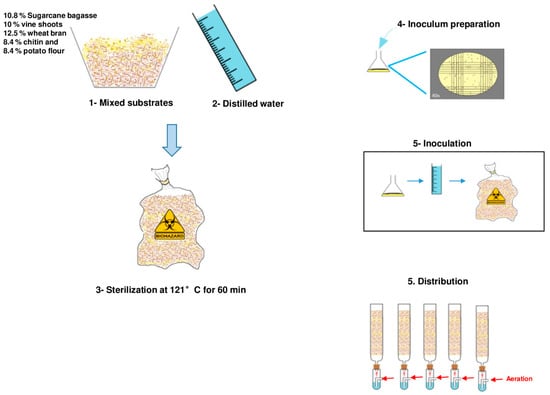
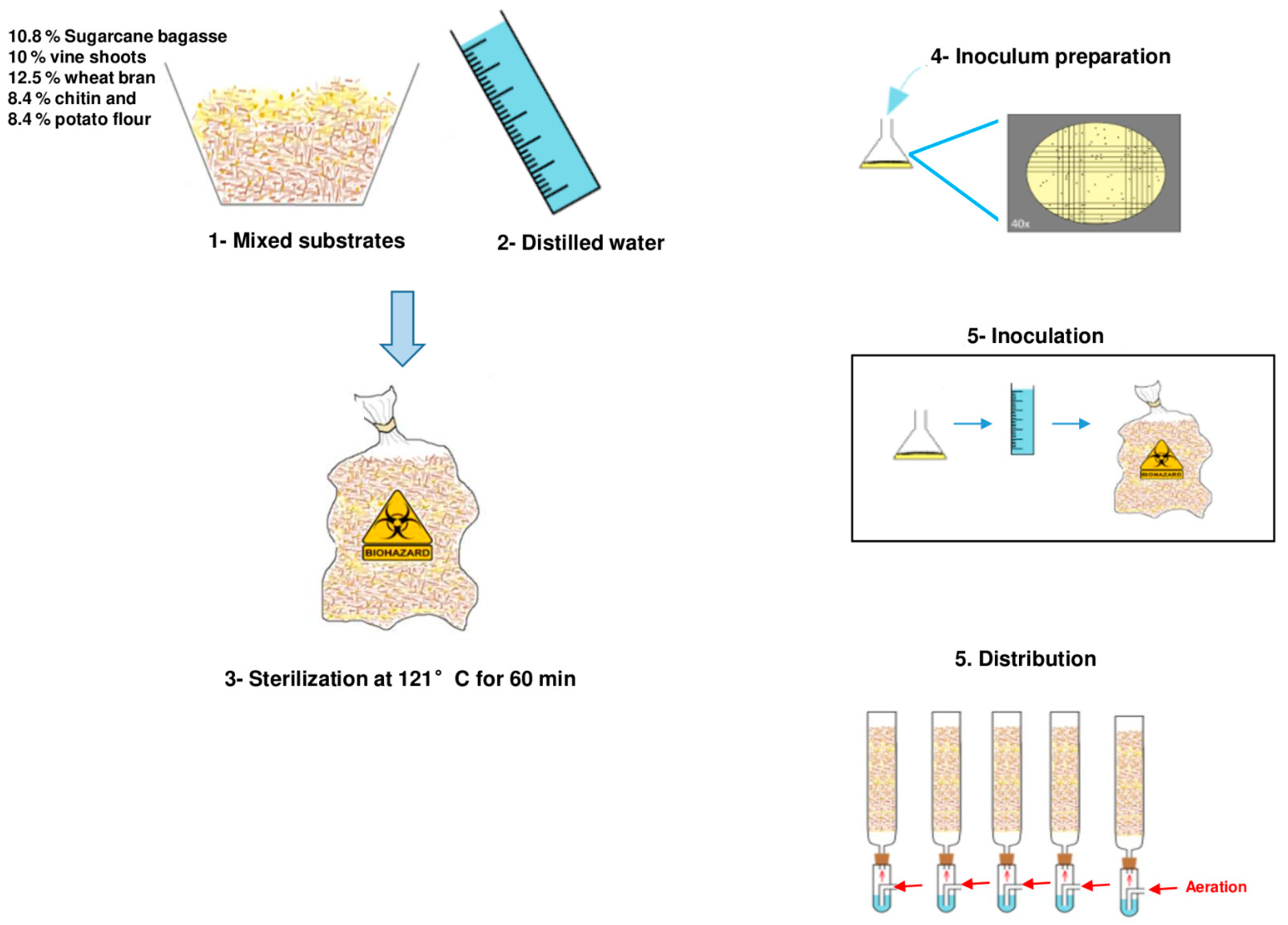
Solid-state fermentation was performed in Raimbault columns (diameter of 2.5 cm and height of 20 cm) containing a mixture of sugarcane bagasse, vine shoots, wheat bran, potato flour and chitin as substrates. The proportion of substrates was 10.8%, 10%, 12.5%, 8.4%, and 8.4%, respectively. Mixed substrates were homogenized with distilled water (initial moisture 55%), autoclaved at 121 °C for 60 min and subsequently inoculated with a spore suspension at a concentration of 2 × 10⁷ spores/g DM (dry material). Each column, packed with 40 g of inoculated substrate at 75% of moisture (w/v), was coupled to an air humidifier (Figure 1). The aeration was generated by an air compressor and humidified by passing the air through distilled water. A flowmeter was used to adjust the initial aeration rate at 35 mL min−1 for 48 h for T. harzianum (strain) Rey 3 and 72 h for T. harzianum (strain) TF2. After this stage, a dry-air flow of 60 mL/min was maintained until the end of the fermentation process. Based on preliminary tests of air flow rates of 5, 15, 35, 60, 72, and 150 mL/min, a rate of 60 mL/min was selected, as it provided complete drying within 5 days while preserving spore viability.
Figure 1.
Schematic representation of the SSF system.
For the control, the fermentation was carried out with the application of humid air (35 mL/min) during all the process. Air flow and CO2 levels were monitored using the PNEO. The PNEO system, used to monitor air flow and CO2 levels, is described in the Supplementary Materials (Figure S1). CO2 production was monitored only in the dry SSF to determine the optimal stage for the drying process. Each treatment was performed in triplicates and monitored kinetically.
2.3. Enzyme Assay
The fermented material (5 g) was placed in a Falcon® tube with 50 mL of distilled water. The enzymatic extract was homogenized with an Ultra-turax (Sigma-Aldrich, St. Louis, MO, USA) (1 min) to obtain a liquid–solid suspension for further determination of enzyme activity.
Cellulase activities were determined using sodium carboxymethylcellulose (1%) in sodium citrate buffer (50 mM, pH 4.8) at 50 °C for 30 min, in according with Bulgari et al. [23].
Xylanase activities was determined by incubating enzyme samples with 1% (w/v) birchwood xylan (Sigma-Aldrich, St. Louis, MO, USA; xylose residues ≥ 90%) in 0.05 M sodium acetate buffer pH 5.5 at 50 °C for 15 min [24].
Chitinase activity was determined according to the method described by Abu-Tahon et al. [25].
The three enzyme determinations mentioned above were placed in a bath with ice for 5 min. The concentration of reducing sugar released in the mixture was determined by the dinitrosalicylic acid method described by Miller [26] using glucose as a standard. One unit of carboxymethyl cellulase activities (unit per gram dry substrate U/g DM) is considered as the amount of enzyme releasing 1 µmol of glucose per mL per minute under the assay conditions.
Finally, lipase activity was assessed by incubating 0.5 mL of p-nitrophenyl octanoate in phosphate buffer (25 mM, pH 7.0) at 30 °C for 30 min [27]. The calibration curve was performed with p-nitrophenol standards at 412 nm. An enzyme activity (U) was defined as the amount of enzyme required to release 1 μmol of p-nitrophenol per minute.
2.4. Spore Quantification Produced on SSF
A total of 1 g of each sample was collected, put in distilled water with Tween 80 (Sigma-Aldrich, St. Louis, MO, USA) 0.01% (v/v) in an Erlenmeyer flask, and stirred for 10 min (200 rpm). After appropriate dilution, spores were counted using a Malassez cell. The number of spores was calculated using the formula presented in Section 2.1, with the same parameter definitions. The results were expressed as the spore number per gram of dry material (DM).
2.5. Spores Viability Under Different Stock Conditions
The viability of T. harzianum TF2 and Rey 3 spores was evaluated under different storage conditions (PDA, lyophilized, frozen and dried). Lyophilization was performed in the presence of 10% sucrose as a cryoprotectant to ensure spore viability, and the stability of spores in all conditions (PDA, frozen, and dried) was monitored over a period of six months. Samples (5 g) were added to 40 mL of Tween 80 at 0.1% in a Falcon® tube. After stirring, serial dilutions (10−1–10−10) of each suspension were performed and 0.2 mL of each dilution was inoculated onto Petri dishes containing PDA and spread under sterile conditions. Colonies of T. harzianum TF2 and Rey 3 were counted after 4 days of incubation at 28 °C
3. Results
3.1. Effect of Dry-Air Application on Spore Production
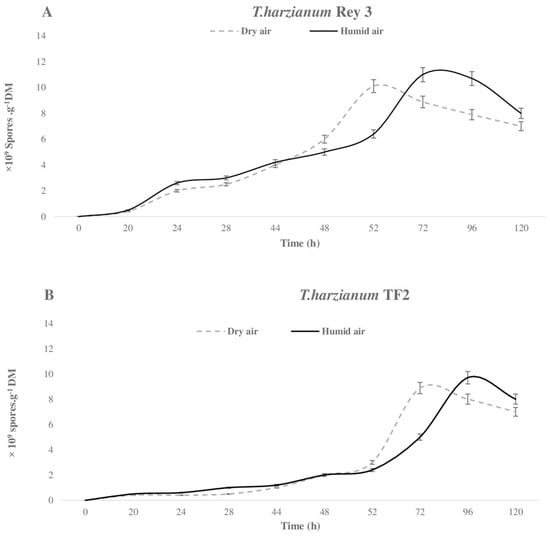
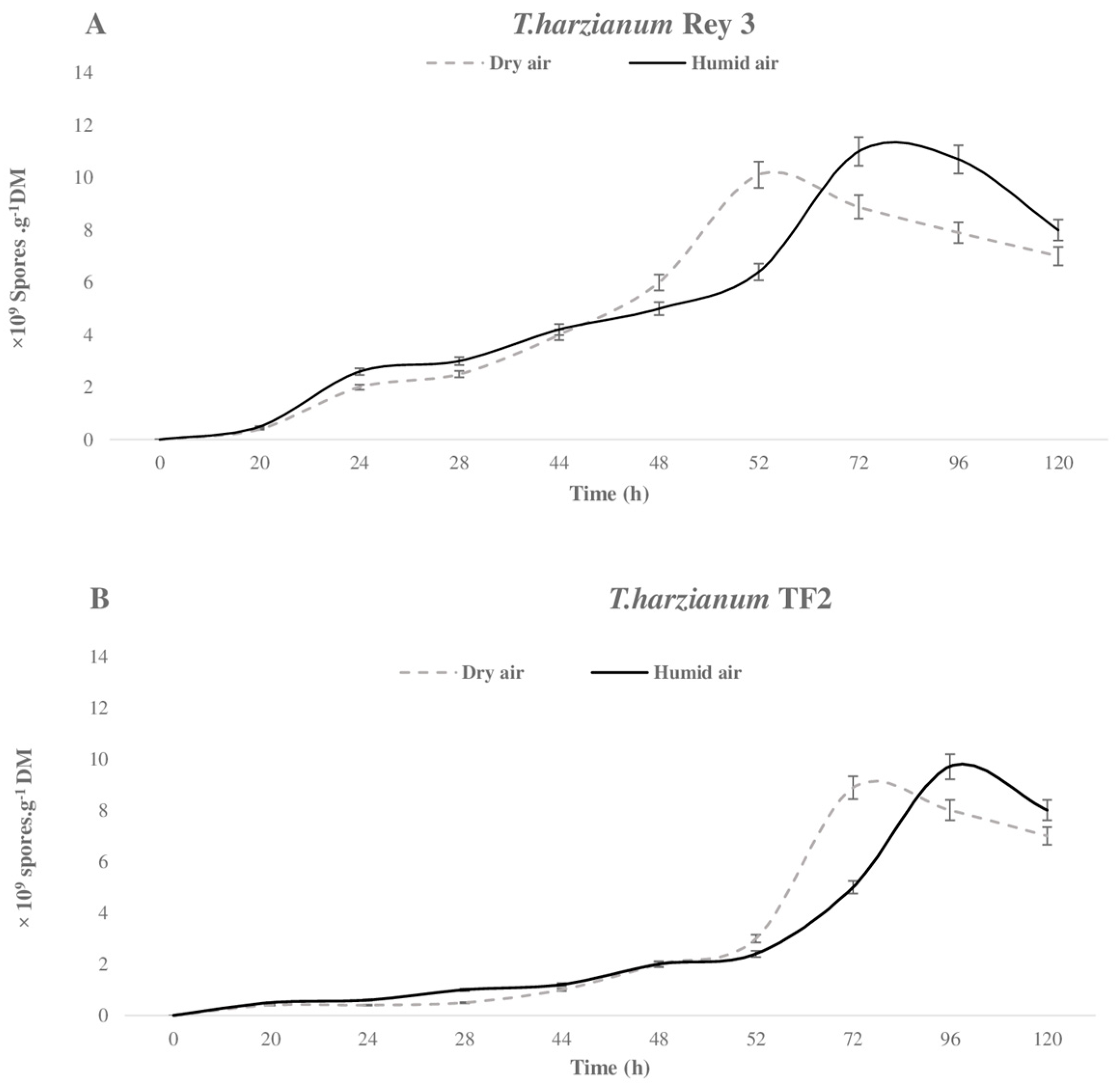
Spore production during SSF by T. harzianum Rey 3 and T. harzianum TF2 were determined. For T. harzianum Rey 3, under dry process conditions, spore production was initiated after 20 h of incubation. Spore production increased sharply to a level of 2.5 ± 0.5 × 10⁹ spores/g DM at the end of the second day of fermentation and, thereafter, the increase was gradual, reaching a maximum value of 10.1 ± 0.3 × 10⁹ spores/g DM at 52 h. As seen in Figure 2, spore production under control conditions with humid air follows a similar trend at the beginning of cultivation, showing a maximum value of 11.0 ± 1.2 × 10⁹ spores/g DM at 96 h. Regarding T. harzianum TF2, the drying process on SSF showed a maximum sporulation of 8.9 ± 0.6 × 10⁹ spores/g DM at 72 h, after which the values decreased to 7.1 ± 0.5 × 10⁹ spores/g DM by 120 h. In the wet SSF with humid air (control conditions), the maximum spore production was 9.7 ± 0.8 × 10⁹ spores/g DM at 96 h. Both fermentations maintained these spore concentrations until the end of the culture period (120 h).
Figure 2.
Spore production under dry air ( ) and humid air (
 ) during the SSF of T. harzianum Rey 3 (A) and T. harzianum TF2 (B).
) and humid air () during the SSF of T. harzianum Rey 3 (A) and T. harzianum TF2 (B).
Under the present culture and drying conditions, T. harzianum Rey 3 reached its highest spore yield at 52 h, with a maximum value of 10.1 ± 0.3 × 10⁹ spores/g DM. In contrast, T. harzianum TF2 exhibited a delayed peak at 72 h, reaching a maximum spore yield of 8.9 ± 0.6 × 10⁹ spores/g DM.
3.2. Determination of Enzyme Activities During Solid-State Fermentation
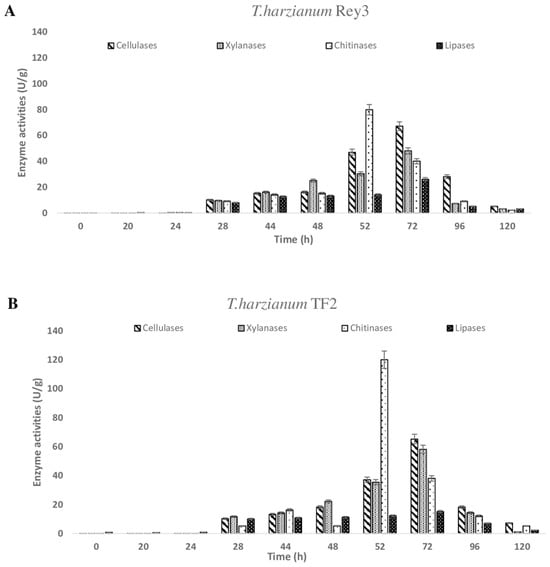
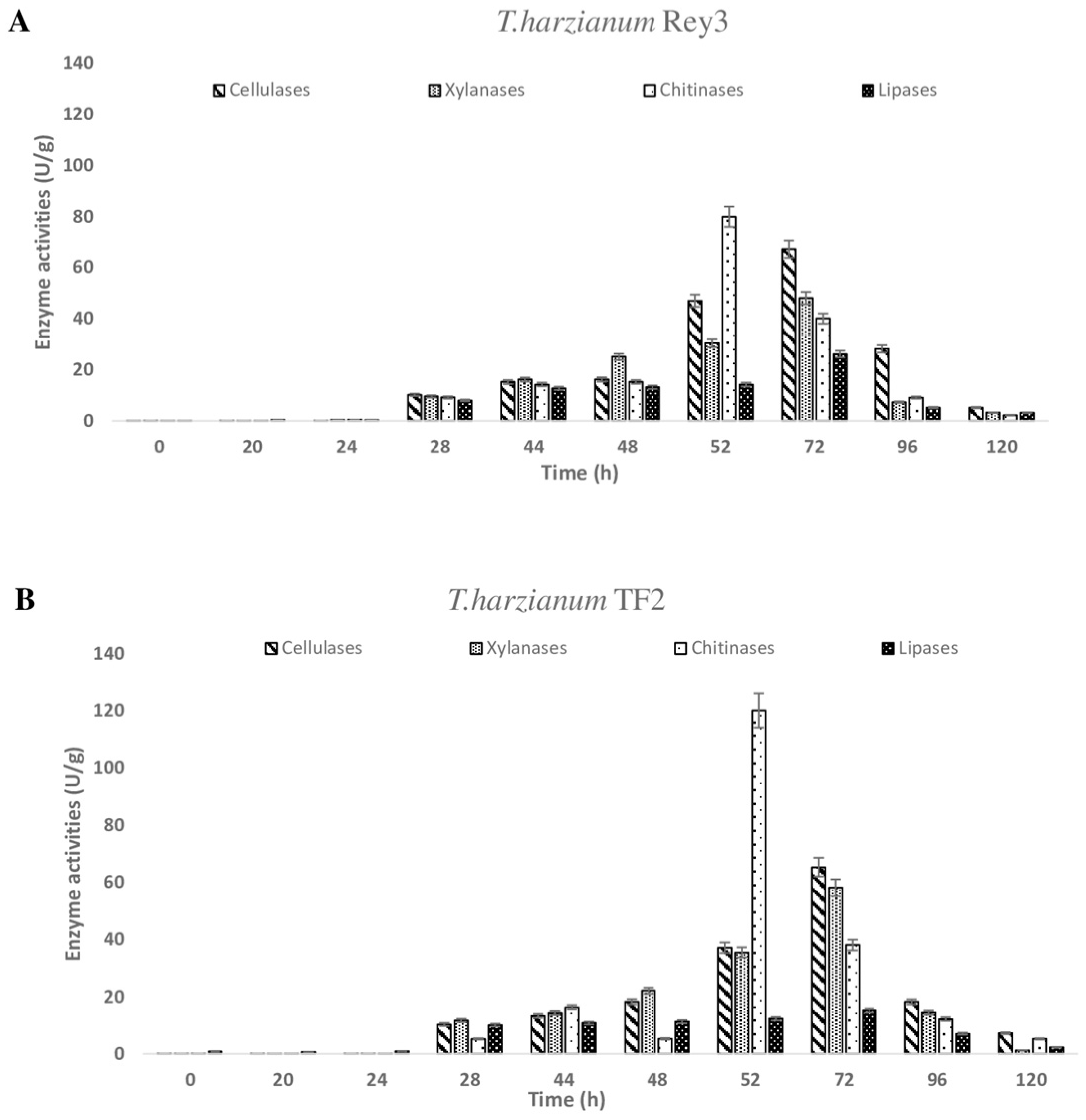
Cellulase, xylanase, chitinase and lipase activities were kinetically evaluated in the substrate during SSF of T. harzianum TF2 and Rey 3 during 120 h (Figure 3). All enzymes exhibited low activities during the first 24 h. After 28 h, enzyme activities started to be detected. The greater value for chitinase activities were showed by T. harzianum TF2 (120.1 ± 0.1 U g DM−1 at 52 h), followed by T. harzianum Rey 3 with 80.3 ± 0.1 U g DM−1, respectively (Figure 3). The higher value of cellulase activities was recorded at 72 h in the culture of T. harzianum Rey 3 (67.2 ± 0.1 U g DM−1), though not significantly different (p < 0.05) to 65.1 ± 0.1 U g DM−1 obtained with T. harzianum TF2. T harzianum Rey 3 also resulted in important lipases activities (27.2 ± 0.9 U g DM−1 at 72 h) compared to T. asperellum TF2 with 15.1 ± 0.4 U g DM−1 at 72 h.
Figure 3.
Kinetic of enzyme production under SSF for (A) T. harzianum TF2, (B) T. harzianum Rey 3. Data represent the mean ± SD of three independent replicates (n = 3).
For xylanase activities, T harzianum TF2 started with an activity of 11.65 ± 0.17 U g DM−1 at 28 h, reaching a maximum of 58.11 ± 0.23 U g DM−1 at 72 h (Figure 3). This activity was maintained until 96 h and disappeared thereafter. T. harzianum Rey 3 showed an initial xylanase activity of 9.4± 0.4 U g DM−1 at 28 h, reaching a maximum of 48.1 ± 0.6 U g DM−1 at 72 h.
3.3. CO2 Evolution During SSF
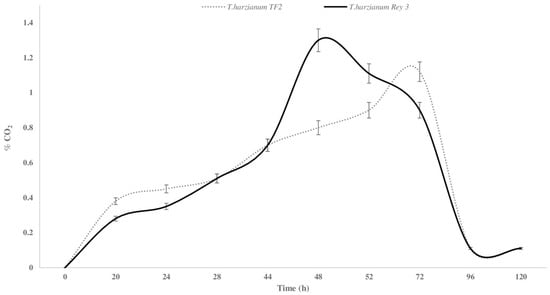
Figure 4 shows that the evolution of CO2 started after 5 h of culturing for the two strains. For T. harzianum Rey 3, the maximal concentration of CO2 (1.3% CO2) was observed at 48 H of incubation. However, for T. harzianum TF2, the maximal concentration of CO2 was noted at 72 h of growth (1.1% CO2). After that, the emission of CO2 decreased rapidly to attain values of 0.2% at 120 h of incubation. As the fungal metabolism decreased (shown by a diminution of CO2), a drying process was applied at 48 h and 72 h for T. harzianum Rey 3 and T. harzianum TF2, respectively.
Figure 4.
CO2 evolution under dry-air conditions during the SSF of T. harzianum Rey 3 and T. harzianum TF2. CO2 was monitored only under the dry-air conditions. Data represent the mean ± SD of three independent replicates (n = 3).
3.4. Effect of Conservation Methods on Spore Viability
Four treatments were evaluated to conserve the spores of T. harzianum strains Rey 3 and TF2 produced by SSF. The spores conserved on PDA media at 4 °C showed 32.6% viability for T. harzianum Rey 3 and 38.3% viability for T. harzianum TF2. The spores obtained from the dry samples of T. harzianum Rey 3 reached 28.98% viability (Table 1). A total of 2.9 and 15.17% viable spores were obtained for frozen and lyophilized samples, respectively. The spores obtained from the dry samples of T. harzianum TF2 demonstrated a viability of 33.4% (Table 1). In contrast, the frozen samples exhibited a significantly lower viability rate of 6.4%, suggesting that freezing may not be an optimal method for preserving T. harzianum TF2 spores. The lyophilized samples, however, showed an improved viability of 15.6% compared to the frozen samples, although still considerably less than the dry samples.
Table 1.
Spore viability percentages of T. harzianum Rey 3 and T. harzianum TF2 under different storage treatments.
4. Discussion
In this paper, an evaluation of the effect of dry air on the production of enzymes and spores by SSF was proposed. A mixture of substrates was used in the present study, which was used by the fungi as a source of nutrients and also as a matrix to anchor to it.
Chitinases of Trichoderma strains are likely involved in their antagonistic activity against phytopathogens and in the biocontrol. They are an effective tool for the complete degradation of mycelia or spore walls of phytopathogenic fungi. Chitinase activities were extensively produced in SSF by T. harzianum TF2 and T.harzianum Rey 3. A very marked pattern was observed in chitinase production, because a higher rate of chitinase activity was detected under the present culture conditions, with values of 120.13 ± 0.11 U g−1 at 52 h for T.harzianum TF2 and 80.34 ± 0.06 U g−1 for T. harzianum Rey 3. In a study by De la Cruz-Quiroz et al. [10] on chitinase production by T. longibrachiatum using SSF, a direct correlation between aeration and chitinase production was reported and the greater value for chitinase activity was (30.74 U g−1 at 48 h). Baldoni et al. [28] affirmed that Trichoderma koningiopsis UFSMQ40 could be grown using SSF to yield chitinase production of 10.76 Ug DM−1. Furthermore, Rachmawaty et al. [29] conducted a study optimizing chitinase production by Trichoderma virens using an experimental design under SSF, achieving a chitinase production of 0.49 U g DM−1. The low amounts of chitinase obtained by these authors, compared to the results presented in our study, could be partly attributed to the low moisture content of the substrate (54%), as well as the absence of aeration and medium composition. In addition, the presence of chitin in the culture medium appears to act as an inducer, promoting the expression and production of chitinase.
On the other hand, lignocellulolytic enzymes such as cellulases are extensively produced by the genus Trichoderma. The known function of cellulases is to degrade cellulose-rich fibrous substrates, providing a source of nutrients and energy for fungi [30]. In the present study, cellulase activities started at 48 h, increasing over time and achieving a maximum value at 72 h; however, after 120 h, the activity was significantly reduced. These results are consistent with those reported by De la Cruz-Quiroz et al. [11], who suggested that the presence of “cellobiose” may explain the low concentrations observed after 72 h of culturing. In comparison to our findings, high cellulase activity (623.35 U g DM−1) was reported by Xue et al. [31] when using Trichoderma reesei Rut-C30 cultivated under SSF with a constructed water-supply system, using a mix of dry straw and wheat bran impregnated to 70% humidity with mineral salt solution. Moreover, the production of cellulases by Trichoderma reesei CCT-2768 using SSF and green coconut fiber was evaluated by Campos et al. [12], producing a more porous biomass with higher cellulose and lower hemicellulose content. Recently, Legodi et al. [32] studied cellulase production through SSF using banana pseudostem as a carbon source. Authors reported that Trichoderma longibrachiatum LMLSAUL 14-1 produced the maximum total cellulase (75 Ug DM−1). Likewise, the production of cellulase using the SSF process was also reported for other filamentous fungi like the Aspergillus species. For example, Bansal et al. [33] recorded 31.0 U g DM−1 of cellulase by Aspergillus niger NS2 using wheat bran as a substrate on an Erlenmeyer bioreactor at 30 °C. In a similar study, Boondaeng et al. [34] reported 0.26 U g DM−1 using Aspergillus sp. IN5 under optimized SSF, the conditions of which were as follows: substrate, soybean residue; incubation temperature, 35 °C; pH, 7.0; and incubation duration, 5 days.
Xylanase is another crucial group of enzymes employed in modern biotechnology, particularly for its role in xylan hydrolysis. Xylanase can play a role in biological control of plant diseases by altering the characteristics of pathogen cell walls. The xylanolytic activity obtained in this study is higher than that reported by Gómez-García et al. [35], who showed a lower xylanolytic activity 7.85U g DM−1 using Trichoderma harzianum cultured under SSF using corn cobs as a support/substrate. Optimization of xylanase production by Trichoderma afroharzianum in SSF using wheat bran as substrate and response surface methodology was investigated by Azzouz et al. [36]. The authors showed that xylanase activity increased from 8475.87 to 14,766.28 U/mL in optimal conditions (6 days of fermentation, humidity of 85%, incubation temperature of 22 °C and inoculum size of 1.9 × 10⁷ spores/mL); however, it is not possible to carry out an effective comparison between the results obtained by those authors and ours because their results are not expressed in DM but in U/mL.
Finally, the two strains of Trichoderma spp. produced a considerable amount of lipase activity. T. harzianum Rey 3 achieved the highest yield (27.2 ± 0.9 U g DM−1), compared to T. harzianum TF2 (15.1 ± 0.4 U g DM−1). This production was in accordance with the results obtained by Toscano et al. [37], who investigated a lipase production by T. harzianum in SSF using wheat bran as a solid substrate, and compared this lipase production with submerged fermentation using a mineral culture medium. The maximum lipase activity (1.8 U mL−1) was obtained during submerged fermentation in a medium containing 2% sucrose and 2% olive oil. However, 71.3 U g DM−1 equivalent to 14.3 U.mL−1 of lipase activity was obtained using a SSF process with a medium containing 0.75% ammonium sulfate and 0.34% urea, 2% olive oil and wheat bran as a solid substrate. The authors emphasized the significance of including enzymatic precursors in the culture medium. In addition, olive oil is the most commonly used substrate in lipase production by filamentous fungi. It serves not only as an inducer for lipase generation, but also as a carbon source for microorganism growth [38].
Regarding spore production in SSF, it is reported that when culture conditions (such as environmental and nutritional needs) become unfavorable, filamentous fungi initiate sporogenesis [11]. Monitoring CO2 concentration is an important parameter that indicates metabolic activity by fungal respiration (Trichoderma strains). The exponential increase in CO2 concentration corresponds to the active metabolic phase associated with higher development of mycelial growth. Hence, the change in the physiological state of T. harzianum resulted in an important decrease in CO2 concentration and initiation of sporulation. In this study, the decrease of CO2 started at 48 h and 72 h for T. harzianum Rey 3 and T. harzianum TF2, respectively, in order to initiate critical fermentation conditions, the desiccation process was conducted by using a dry-air flow of 60 mL/min. The results obtained in this work showed that spore production was not improved by the application of dry air compared to the control (humid air); it was possible to produce the same quantity of spores in both experiments. Indeed, during the fermentation process, the application of dry air leads to an effect of hydric stress on T. harzianum. It is reported that hydric stress promotes the sporulation and reduces the spore production time, since the excess water is evaporated, causing the colonization of free space by the spores, which contribute to achieving the maximum sporulation in less time. In the literature, there are many studies available focusing on the production of spores by Trichoderma genus by SSF. For example, Flodman and Noureddini [39] reported a maximum spore production (7.50 × 10⁸ spores/g DM) by T. reseei using corn cob wastes as a substrate on an Erlenmeyer bioreactor. Similarly, Kancelista et al. [40] reported important spore production by T. asperellum (3.13 × 10⁹ spores/g DM) using the same substrates under SSF. Despite this, Narwade et al. [41], reported the production of Trichoderma viride spores in an earthen vessel using corn cobs, wherein spore-based biopesticide was produced after 21 days with a maximum spore count of 2.50 × 10⁹ spores/g DM. In a recent study by Meng et al. [42], the optimization of SSF parameters for Trichoderma guizhouense NJAU 4742 spore production resulted in a spore count of 1.8 × 10⁹ CFU/g. Moreover, the effect of aeration on spore production from Trichoderma asperellum strains was evaluated in a previous work [43] using a mixture of vine shoots, jatropha cake, olive pomace and olive oil as substrate and a single study used a bioreactor. The authors suggested that forced aeration on SSF systems leads to the production of high amounts of spores (8.55 × 10⁹ spores/g DM). In this study, no difference in spore production was observed after applying forced dry aeration for the two strains. This trend suggests that dry-air application does not enhance spore production; therefore, sporulation may not be oxygen-limited [20]. This outcome has a direct influence on the operational feasibility for the spore production of Trichoderma strains.
In addition, different types of bioreactors were designed to produce microbial biomass or specific metabolites under SSF with or without forced aeration. For example, Carboué et al. [44] developed a pilot-scale plug-flow bioreactor for semicontinuous SSF with Aspergillus niger, using Partial Least Square regression from lab-scale kinetics to estimate particle residence times and provide a new tool for scale-up evaluation. Maiga et al. [45] developed a disposable solid-state culture bioreactor (DSSCB) belonging to the packed-bed category for the production of fungal spores. The DSSCB was successfully tested under forced aeration for the production of conidia (2.1 × 10¹⁰/g dry substrate in 140 h) from Trichoderma asperellum, a biocontrol fungus. Moreover, Barrios-Nolasco et al. [46] evaluated Yarrowia lipolytica 2.2ab in a bench-scale packed-tray SSF bioreactor with forced aeration and wall cooling. The authors explained that despite limited heat removal, oxygen transfer remains adequate, and Yarrowia lipolytica 2.2ab maintains high growth and important protease production.
Regarding the relationship between enzyme production and sporulation, we noted that for T.harzianum Rey 3, most enzyme activity started during the vegetative phase, with maximum activity at 72 h, which corresponds to the maximum sporulation. However, for T.harzianum TF2, the dynamics were different: the change in the physiological state of T. harzianum TF2 noted with the initiation of sporulation resulted in an important decrease in enzyme production.
The viability of spores obtained after the application of hydric stress was evaluated under different storage conditions (PDA, lyophilized, frozen and dried). It is widely known that for short-term storage, fungal spores are typically preserved on PDA at 4 °C. Comparing storage systems, dried spores maintained high viability and were very similar to spores stored on PDA at 4 °C. However, freezing and lyophilization methods resulted in limited spore viability. This low viability can be explained by the physical damage and death of the spores caused by freezing process. Moreover, lyophilization is not suitable for all fungi, as some kinds of spores are prone to collapse, leading to irreversible structural damage [47]. In the marketplace, biopesticide products based on dried fungal spores are the most recommended. Environmental conditions such as moisture/humidity values, temperature, CO2, pH, UV radiation, etc., can influence the deterioration rate of fungal spores. This deterioration can be reduced by the application of dry air under SSF without high temperatures, maintaining increased levels of germinal spores. Our results achieved the conservation of 29% of T. harzianum Rey 3 spores and 33% of T. harzianum TF2 spores on the dried substrate, able to germinate. It should be noted that the higher viability observed in the dried substrates (29–33%) may be influenced by the difference in storage temperatures compared to the PDA (4 °C) and frozen (−20 °C) methods, which could partially explain the observed differences in viability. Several studies have investigated different storage conditions for the long-term conservation of filamentous fungi or their spores. Berikten et al. [48] tested thermophilic fungi spores using lyophilization (+4 °C), freezing (–20 °C), and liquid storage (ambient temperature). Viability was assessed on SDA (Sabouraud Dextrose Agar). The authors suggested that lyophilization and freezing blocks were most effective for long-term storage; morphology and growth were largely retained. Additionally, Al-Bedak al. [49] demonstrated a low-cost method for the long-term storage of fungi; colonized fungi were preserved on cotton balls moistened with PDA and incubated at 25 °C, then preserved at 17–20 °C for 36 months. The authors indicated 100% recovery at 2 years and 59% at 3 years, maintaining morphology. Other storage methods, such as storage in liquid nitrogen, have been tested by Homolka [50]. He evaluated the viability, growth, and morphology of 48 Ascomycota strains, 20 Zygomycota strains, and 3 Basidiomycota yeasts after 2 days and 1 year of cryopreservation in liquid nitrogen using perlite as a solid carrier. The results showed that the perlite method is effective for preserving diverse fungi with 94% viability for Ascomycota and 100% for Zygomycota and Basidiomycota. Although the viability results reported by these authors are higher than ours, our findings are still promising, as they reduce storage costs, and our proposed method preserves fungal spores directly from dried SSF, enabling continuous processing without additional preservation steps. In addition, the obtained dried spores’ substrate can serve in several application contexts; for example, as inoculum to initiate the subsequent fermentation, biopesticides, the production of primary and secondary metabolites, etc.
5. Conclusions
Under the present culture conditions, the processing of SSF using the Raimbault columns with Trichoderma harzianum strains demonstrated the great functionality of the mixture of sugarcane bagasse, vine shoots, wheat bran, potato flour and chitin for enzyme and spore production. Higher chitinase activities using T. harzianum TF2 (120.13 ± 0.11 U g−1) and Rey 3 (80.34 ± 0.06 U g−1) were obtained. These results suggest an opportunity to produce these biocontrol enzymes. The application of air into the SSF system allows a stabilized system to produce a high yield of spores; the results obtained in the process with forced dry aeration show marked spores production by T. harzianum TF2 and Rey 3 (more than 1 × 10⁹ spores/g DM). A direct correlation was observed between the release of CO2 and sporulation, as the CO2 levels decreased proportionally with the spores produced by T. harzianum.
The process of drying spores with dry air allowed us to maintain the viability of 29% and 33% of the spores, which is higher than the freezing and lyophilization methods. The drying process offers a promising approach for storing fungal spores, potentially reducing energy costs compared to the other methods mentioned. However, the operational conditions of the drying process need further optimization. Finally, this study offers important information on spore production under hydric stress conditions and on chitinase activity, yet further research is essential to improve spore production on larger scales.
Supplementary Materials
The following supporting information can be downloaded at: https://www.mdpi.com/article/10.3390/fermentation12010019/s1, Figure S1: Photograph of the PNEO Respirometer.
Author Contributions
All authors contributed to this publication and agreed on its content. R.H. and S.R. carried out the experiments. R.H., A.-M.F.-D.S., V.W. and N.D. led the writing of the manuscript with support from all authors. S.R., V.W. and R.H. initiated and supervised this research. Literature research and statistical analysis were performed by V.W., H.B. and N.D. Critical reviews were performed by A.-M.F.-D.S. and H.B. All authors have read and agreed to the published version of the manuscript.
Funding
This study received no external funding.
Institutional Review Board Statement
Not applicable.
Informed Consent Statement
Not applicable.
Data Availability Statement
Data are contained within the article.
Acknowledgments
The authors thank OvinAlp Haute Fertilisation for their support. The authors also acknowledge the Institut Méditerranéen de Biodiversité et d’Ecologie Marine et Continentale (IMBE) and Aix Marseille University for technical support and facilities.
Conflicts of Interest
The authors declare that there are no conflicts of interest. Dr. Rayhane Hamrouni, Dr. Vincent Walker, and Dr. Hervé Bresson were employed by the company OVINALP. The remaining authors declare that the research was conducted in the absence of any commercial or financial relationships that could be construed as a potential conflict of interest.
Abbreviations
The following abbreviations are used in this manuscript:
| SSF. | Solid-state fermentation |
| UN | United Nations |
| SDGs | Sustainable Development Goals |
| BCA | biological control agents |
| PDA | potato dextrose agar |
| IMBE | Institute Mediterranean of Biodiversity and Marine Ecology and Continental |
| DM | Dry material |
References
- Mattedi, A.; Sabbi, E.; Farda, B.; Djebaili, R.; Mitra, D.; Ercole, C.; Cacchio, P.; Del Gallo, M.; Pellegrini, M. Solid-State Fermentation: Applications and Future Perspectives for Biostimulant and Biopesticides Production. Microorganisms 2023, 11, 1408. [Google Scholar] [CrossRef] [Scilit]
- Swilling, M. Introduction: Change in the Age of Sustainability. In The Age of Sustainability: Just Transitions in a Complex World, 1st ed.; Routledge: London, UK, 2019; pp. 1–34. ISBN 9780429057823. [Google Scholar] [CrossRef] [Scilit]
- Rouphael, Y.; Colla, G. Toward a Sustainable Agriculture Through Plant Biostimulants: From Experimental Data to Practical Applications. Agronomy 2020, 10, 1461. [Google Scholar] [CrossRef] [Scilit]
- Awan, U.A.; Meng, L.; Xia, S.; Raza, M.F.; Zhang, Z.; Zhang, H. Isolation, fermentation, and formulation of entomopathogenic fungi virulent against adults of Diaphorina citri. Pest Manag. Sci. 2021, 77, 4040–4053. [Google Scholar] [CrossRef] [Scilit]
- Ganassi, S.; Di Domenico, C.; Altomare, C.; Samuels, G.J.; Grazioso, P.; Di Cillo, P.; Pietrantonio, L.; De Cristofaro, A. Potential of fungi of the genus Trichoderma for biocontrol of Philaenus spumarius, the insect vector for the quarantine bacterium Xylella fastidosa. Pest Manag. Sci. 2023, 79, 719–728. [Google Scholar] [CrossRef] [Scilit]
- Sala, A.; Barrena, R.; Artola, A.; Sánchez, A. Current developments in the production of fungal biological control agents by solid-state fermentation using organic solid waste. Crit. Rev. Environ. Sci. Technol. 2019, 49, 655–694. [Google Scholar] [CrossRef] [Scilit]
- Das, M.M.; Aguilar, C.N.; Haridas, M.; Sabu, A. Production of bio-fungicide, Trichoderma harzianum CH1 under solid-state fermentation using coffee husk. Bioresour. Technol. Rep. 2021, 15. [Google Scholar] [CrossRef] [Scilit]
- Stracquadanio, C.; Quiles, J.M.; Meca, G.; Cacciola, S.O. Antifungal Activity of Bioactive Metabolites Produced by Trichoderma asperellum and Trichoderma atroviride in Liquid Medium. J. Fungi 2020, 6, 263. [Google Scholar] [CrossRef] [Scilit] [PubMed]
- Ahmed, H.A.; Kasem, L.M.; Attaby, H.S.; Khalil, N.M.; El Amir, D.A.; Diab, M.R.; El-Baghdady, M.M.; Radwan, K.H.; Ibrahim, A.E. Molecular and genetic adaptations of heat-treated Trichoderma harzianum for enhanced stress resilience and biocontrol efficiency. Ann. Microbiol. 2025, 75, 1–18. [Google Scholar] [CrossRef] [Scilit]
- De la Cruz-Quiroz, R.; Robledo-Padilla, F.; Aguilar, C.N.; Roussos, S. Forced Aeration Influence on the Production of Spores by Trichoderma strains. Waste Biomass Valorization 2017, 8, 2263–2270. [Google Scholar] [CrossRef] [Scilit]
- De la Cruz-Quiroz, R.; Roussos, S.; Aguilar, C.N. Production of a biological control agent: Effect of a drying process of solid-state fermentation on viability of Trichoderma spores. Int. J. Green Tech. 2018, 4, 1–6. [Google Scholar]
- Campos, A.O.; Asevedo, E.A.; Souza Filho, P.F.; Santos, E.S.d. Extraction of Cellulases Produced through Solid-State Fermentation by Trichoderma reesei CCT-2768 Using Green Coconut Fibers Pretreated by Steam Explosion Combined with Alkali. Biomass 2024, 4, 92–106. [Google Scholar] [CrossRef] [Scilit]
- Loera-Corral, O.; Porcayo-Loza, J.; Montesinos-Matias, R.; Favela-Torres, E. Production of conidia by the fungus Metarhizium anisopliae using solid-state fermentation. In Microbial-Based Biopesticides. Methods in Molecular Biology; Glare, T., Moran-Diez, M., Eds.; Humana Press: New York, NY, USA, 2016; Volume 1477, pp. 61–69. [Google Scholar] [CrossRef] [Scilit]
- do Nascimento Silva, J.; Mascarin, G.M.; Lopes, R.B.; Freire, D.M.G. Production of dried Beauveria bassiana conidia in packed-column bioreactor using agro-industrial palm oil residues. Biochem. Eng J. 2023, 198, 109022. [Google Scholar] [CrossRef] [Scilit]
- Oiza, N.; Moral-Vico, J.; Sánchez, A.; Oviedo, E.R.; Gea, T. Solid-State Fermentation from Organic Wastes: A New Generation of Bioproducts. Processes 2022, 10, 2675. [Google Scholar] [CrossRef] [Scilit]
- Wang, L.; Liu, Y.; Chen, H.-Z. Advances in Porous Characteristics of the Solid Matrix in Solid-State Fermentation. In Current Developments in Biotechnology and Bioengineering; Pandey, A., Larroche, C., Soccol, C.R., Eds.; Elsevier: Amsterdam, The Netherlands, 2018; pp. 19–29. ISBN 9780444639905. [Google Scholar] [CrossRef] [Scilit]
- Velvizhi, G.; Jacqueline, P.J.; Shetti, N.P.; K, L.; Mohanakrishna, G.; Aminabhavi, T.M. Emerging trends and advances in valorization of lignocellulosic biomass to biofuels. J. Environ. Manag. 2023, 345, 118527. [Google Scholar] [CrossRef] [Scilit]
- Shi, Y.; Xu, X.; Zhu, Y. Optimization of Verticillium lecanii spore production in solid-state fermentation on sugarcane bagasse. Appl. Microbiol. Biotechnol. 2009, 82, 921–927. [Google Scholar] [CrossRef] [Scilit] [PubMed]
- Lima-Pérez, J.; López-Pérez, M.; Viniegra-González, G.; Loera, O. Solid-state fermentation of Bacillus thuringiensis var kurstaki HD-73 maintains higher biomass and spore yields as compared to submerged fermentation using the same media. Bioprocess Biosyst. Eng. 2019, 42, 1527–1535. [Google Scholar] [CrossRef] [Scilit] [PubMed]
- Arzumanov, T.; Jenkins, N.; Roussos, S. Effect of aeration and substrate moisture content on sporulation of Metarhizium anisopliae var. acridum. Process. Biochem. 2005, 40, 1037–1042. [Google Scholar] [CrossRef] [Scilit]
- Méndez-González, F.; Figueroa-Montero, A.; Saucedo-Castañeda, G.; Loera, O.; Favela-Torres, E. Addition of spherical-style packing improves the production of conidia by Metarhizium robertsii in packed column bioreactors. J. Chem. Technol. Biotechnol. 2022, 97, 1517–1525. [Google Scholar] [CrossRef] [Scilit]
- Yáñez-Hernández, O.; Ríos-Lira, A.; Pantoja-Pacheco, Y.V.; Jiménez-García, J.A.; Vázquez-López, J.A.; Hernández-González, S. Increase of Trichoderma harzianum Production Using Mixed-Level Fractional Factorial Design. Appl. Sci. 2023, 13, 9244. [Google Scholar] [CrossRef] [Scilit]
- Bulgari, D.; Alias, C.; Peron, G.; Ribaudo, G.; Gianoncelli, A.; Savino, S.; Boureghda, H.; Bouznad, Z.; Monti, E.; Gobbi, E. Solid-State Fermentation of Trichoderma spp.: A New Way to Valorize the Agricultural Digestate and Produce Value-Added Bioproducts. J. Agric. Food Chem. 2023, 71, 3994–4004. [Google Scholar] [CrossRef] [Scilit]
- Alananbeh, K.M.; Alkfoof, R.; Muhaidat, R.; Massadeh, M. Production of Xylanase by Trichoderma Species Growing on Olive Mill Pomace and Barley Bran in a Packed-Bed Bioreactor. J. Fungi 2024, 10, 49. [Google Scholar] [CrossRef] [Scilit]
- Abu-Tahon, M.A.; Isaac, G.S. Anticancer and antifungal efficiencies of purified chitinase produced from Trichoderma viride under submerged fermentation. J. Gen. Appl. Microbiol. 2020, 66, 32–40. [Google Scholar] [CrossRef] [Scilit]
- Miller, G.L. Use of Dinitrosalicylic Acid Reagent for Determination of Reducing Sugar. Anal. Chem. 1959, 31, 426–428. [Google Scholar] [CrossRef] [Scilit]
- Hamrouni, R.; Regus, F.; Claeys-Bruno, M.; Farnet Da Silva, A.-M.; Orsière, T.; Laffont-Schwob, I.; Boudenne, J.-L.; Dupuy, N. Statistical Experimental Design as a New Approach to Optimize a Solid-State Fermentation Substrate for the Production of Spores and Bioactive Compounds from Trichoderma asperellum. J. Fungi 2023, 9, 1123. [Google Scholar] [CrossRef] [Scilit] [PubMed]
- Baldoni, D.B.; Antoniolli, Z.I.; Mazutti, M.A.; Jacques, R.J.S.; Dotto, A.C.; de Oliveira Silveira, A.; Ferraz, R.C.; Soares, V.B.; de Souza, A.R.C. Chitinase production by Trichoderma koningiopsis UFSMQ40 using solid state fermentation. Braz. J. Microbiol. 2020, 51, 1897–1908. [Google Scholar] [CrossRef] [Scilit]
- Rachmawaty, R.; Halifah, P.; Hartati, H.; Maulana, Z.; Salleh, M.M. Optimization of Chitinase Production by Trichoderma virens in Solid State Fermentation Using Response Surface Methodology. Mater. Sci. Forum 2019, 967, 132–142. [Google Scholar] [CrossRef] [Scilit]
- Zhang, Z.; Xing, J.; Li, X.; Lu, X.; Liu, G.; Qu, Y.; Zhao, J. Review of research progress on the production of cellulase from filamentous fungi. Int. J. Biol. Macromol. 2024, 277, 134539. [Google Scholar] [CrossRef] [Scilit]
- Xue, W.; Sheng, Y.; Tai, Y.; Ding, J.; He, R.; Jiang, Y.; Zhong, B.; He, J.; Ren, A.; He, Q. Mechanism of improved cellulase production by Trichoderma reesei in water-supply solid-state fermentation. Bioresour. Technol. 2025, 419, 132017. [Google Scholar] [CrossRef] [Scilit]
- Legodi, L.M.; La Grange, D.C.; van Rensburg, E.L.J. Production of the Cellulase Enzyme System by Locally Isolated Trichoderma and Aspergillus Species Cultivated on Banana Pseudostem during Solid-State Fermentation. Fermentation 2023, 9, 412. [Google Scholar] [CrossRef] [Scilit]
- Bansal, N.; Tewari, R.; Soni, R.; Soni, S.K. Production of cellulases from Aspergillus niger NS-2 in solid state fermentation on agricultural and kitchen waste residues. Waste Manag. 2012, 32, 1341–1346. [Google Scholar] [CrossRef] [Scilit]
- Boondaeng, A.; Keabpimai, J.; Trakunjae, C.; Vaithanomsat, P.; Srichola, P.; Niyomvong, N. Cellulase production under solid-state fermentation by Aspergillus sp. IN5: Parameter optimization and application. Heliyon 2024, 10, e26601. [Google Scholar] [CrossRef] [Scilit]
- Gómez-García, R.; Medina-Morales, M.A.; Rodrìguez, R.; Farruggia, B.; Picó, G.; Aguilar, C.N. Production of a xylanase by Trichoderma harzianum (Hypocrea lixii) in solid-state fermentation and its recovery by an aqueous two-phase system. Can. J. Biotechnol. 2018, 2, 108–115. [Google Scholar] [CrossRef] [Scilit]
- Azzouz, Z.; Bettache, A.; Boucherba, N.; Amghar, Z.; Benallaoua, S. Optimization of xylanase production by newly isolated strain Trichoderma afroharzianum isolate AZ 12 in solid state fermentation using response surface methodology. Cellul. Chem. Technol. 2020, 54, 451–462. [Google Scholar] [CrossRef] [Scilit]
- Toscano, L.; Montero, G.; Stoytcheva, M.; Cervantes, L.; Gochev, V. Comparison of the performances of four hydrophilic polymers as supports for lipase immobilisation. Biotechnol. Biotechnol. Equip. 2014, 28, 52–60. [Google Scholar] [CrossRef] [Scilit] [PubMed]
- Shu, C.-H.; Xu, C.-J.; Lin, G.-C. Purification and partial characterization of a lipase from Antrodia cinnamomea. Process. Biochem. 2006, 41, 734–738. [Google Scholar] [CrossRef] [Scilit]
- Flodman, H.R.; Noureddini, H. Effects of intermittent mechanical mixing on solid-state fermentation of wet corn distillers grain with Trichoderma reesei. Biochem. Eng. J. 2013, 81, 24–28. [Google Scholar] [CrossRef] [Scilit]
- Kancelista, A.; Tril, U.; Stempniewicz, R.; Piegza, M.; Szczech, M.; Witkowska, D. Application of lignocellulosic waste materials for the production and stabilization of Trichoderma biomass. Pol. J. Environ. Studies 2013, 22, 1083–1090. [Google Scholar]
- Narwade, J.D.; Odaneth, A.A.; Lele, S.S. Solid-state fermentation in an earthen vessel: Trichoderma viride spore-based biopesticide production using corn cobs. Fungal Biol. 2023, 127, 1146–1156. [Google Scholar] [CrossRef] [Scilit] [PubMed]
- Meng, Z.; Xiang, S.; Wang, X.; Zhang, J.; Bai, G.; Liu, H.; Li, R.; Shen, Q. Turning Waste into Wealth: Utilizing Trichoderma’s Solid-State Fermentation to Recycle Tea Residue for Tea Cutting Production. Agronomy 2024, 14, 526. [Google Scholar] [CrossRef] [Scilit]
- Hamrouni, R.; Molinet, J.; Mitropoulou, G.; Kourkoutas, Y.; Dupuy, N.; Masmoudi, A.; Roussos, S. From flasks to single used bioreactor: Scale-up of solid state fermentation process for metabolites and conidia production by Trichoderma asperellum. J. Environ. Manag. 2019, 252, 109496. [Google Scholar] [CrossRef] [Scilit]
- Carboué, Q.; Rébufa, C.; Dupuy, N.; Roussos, S.; Bombarda, I. Solid state fermentation pilot-scaled plug flow bioreactor, using partial least square regression to predict the residence time in a semicontinuous process. Biochem. Eng. J. 2019, 149. [Google Scholar] [CrossRef] [Scilit]
- Maïga, Y.; Carboué, Q.; Hamrouni, R.; Tranier, M.-S.; Ben Menadi, Y.; Roussos, S. Development and Evaluation of a Disposable Solid-State Culture Packed-Bed Bioreactor for the Production of Conidia from Trichoderma asperellum Grown Under Water Stress. Waste Biomass Valorization 2021, 12, 3223–3231. [Google Scholar] [CrossRef] [Scilit]
- Barrios-Nolasco, A.; Castillo-Araiza, C.O.; Huerta-Ochoa, S.; Reyes-Arreozola, M.I.; Buenrostro-Figueroa, J.J.; Prado-Barragán, L.A. Evaluating the Performance of Yarrowia lipolytica 2.2ab in Solid-State Fermentation under Bench-Scale Conditions in a Packed-Tray Bioreactor. Fermentation 2024, 10, 344. [Google Scholar] [CrossRef] [Scilit]
- Nakasone, K.K.; Peterson, S.W.; Jong, S.-C. Preservation and distribution of fungal cultures. In Biodiversity of Fungi: Inventory and Monitoring Methods; Muller, G.M., Bills, G.F., Foster, M.S., Eds.; Academic Press: Amsterdam, The Netherlands, 2004; pp. 37–47. [Google Scholar] [CrossRef] [Scilit]
- Berikten, D. Survival of thermophilic fungi in various preservation methods: A comparative study. Cryobiology 2021, 101, 38–43. [Google Scholar] [CrossRef] [Scilit]
- Al-Bedak, O.A.; Sayed, R.M.; Hassan, S.H.A. A new low-cost method for long-term preservation of filamentous fungi. Biocatal. Agric. Biotechnol. 2019, 22, 101417, Erratum in Biocatal. Agric. Biotechnol. 2021, 36, 101857. https://doi.org/10.1016/j.bcab.2020.101857. [Google Scholar] [CrossRef] [Scilit]
- Homolka, L. Methods of Cryopreservation in Fungi. In Laboratory Protocols in Fungal Biology: Current Methods in Fungal Biology; Gupta, V.K., Tuohy, M.G., Ayyachamy, M., Turner, K.M., O’Donovan, A., Eds.; Springer: New York, NY, USA, 2013; pp. 9–16. [Google Scholar] [CrossRef] [Scilit]

Disclaimer/Publisher’s Note: The statements, opinions and data contained in all publications are solely those of the individual author(s) and contributor(s) and not of MDPI and/or the editor(s). MDPI and/or the editor(s) disclaim responsibility for any injury to people or property resulting from any ideas, methods, instructions or products referred to in the content. |
© 2025 by the authors. Licensee MDPI, Basel, Switzerland. This article is an open access article distributed under the terms and conditions of the Creative Commons Attribution (CC BY) license.