Article

A Simple, Rapid Assembly Method for Integrating Different Gene Order into Synthetic Operons

1
Key Laboratory of Industrial Biotechnology of the Ministry of Education, Laboratory of Applied Microorganisms and Metabolic Engineering, School of Biotechnology, Jiangnan University, Wuxi 214122, China
2
Institute of Future Food Technology, Jiangsu Industrial Technology Research Institute (JITRI), Yixing 214200, China
*
Author to whom correspondence should be addressed.
Fermentation 2026, 12(1), 11; https://doi.org/10.3390/fermentation12010011
Submission received: 31 October 2025 / Revised: 11 December 2025 / Accepted: 20 December 2025 / Published: 23 December 2025
(This article belongs to the Special Issue Metabolic Engineering, Strain Modification and Industrial Application)

Abstract

Although operons are a fundamental feature of prokaryotic genomes, their organization is non-random. The specific influence of operon architecture on gene expression, however, remains poorly characterized. In this study, we systematically analyzed the effects of operon length and gene position on expression levels in Escherichia coli and Bacillus subtilis. We found that promoter-proximal (5′ end) genes were expressed at higher levels and that expression of a given gene could be enhanced by increasing the overall length of the operon. To leverage these principles for metabolic engineering, we developed a Head-to-Tail PCR (HTPCR) method for the rapid assembly of synthetic operons with permuted gene orders. Application of this method enabled the construction of a synthetic rib operon that increased riboflavin yield by 35.38%. Collectively, these findings provide a theoretical framework and a practical methodology for designing efficient synthetic operons to enhance the production of target compounds.

1. Introduction

Operons are a fundamental feature of prokaryotic genomes, with approximately half of all protein-coding genes in a typical bacterium being organized into polycistronic units. As a core mechanism of bacterial gene regulation, an operon consists of a set of adjacent genes that are co-transcribed into a single mRNA molecule [1]. These genes are typically functionally related and are co-regulated to ensure coordinated expression [2,3]. Consequently, genes within the same operon exhibit highly correlated expression patterns.
Although operon genes are co-transcribed, the translation rates of individual open reading frames (ORFs) within the polycistronic mRNA can vary by up to 100-fold [4]. This disparity is often attributed to the distinct local mRNA structures surrounding each ORF on the shared transcript. Genomic analyses reveal that the gene order within many operons is conserved across species [5,6]. Essential genes are preferentially positioned at the 5′ end of operons, while genes with less critical functions tend to be located at the 3′ end [7]. This non-random organization suggests that operon architecture is evolutionarily driven by selection for optimal co-expression and controlled protein abundance [8]. Despite these insights, the precise mechanisms by which operon structure regulates differential gene expression remain incompletely understood.
Two conflicting theories explain operon evolution: (i) in situ formation to achieve co-regulation of adjacent genes, and (ii) the horizontal transfer of pre-formed, functionally linked gene clusters. A fundamental function of operon organization is to optimize and coordinate the expression of its constituent genes through mechanisms such as gene spacing and co-transcriptional regulation [9]. This principle is central to metabolic engineering, where the co-expression of multiple genes is required for applications such as the synthesis of natural and non-natural products, the expression of multi-subunit biologics, the engineering of genetic circuits, and the implementation of multi-enzyme pathways for biocatalysis [10,11,12]. To achieve precise coordination, multiple genes are often assembled into artificial operons. By rationally designing the expression levels of genes within these synthetic constructs, their functional output can be enhanced by over 100-fold compared to native operons or uncoordinated expression systems [13].
In metabolic engineering, functional genes are often integrated into synthetic operons to enhance the synthesis of target products. For instance, in the development of riboflavin-producing strains, combining the key genes ribA, ndk, guaB, and gmk into a single operon has been established as a highly effective strategy for increasing yield [14]. Similarly, to enable continuous polyhydroxybutyrate (PHB) synthesis, the phaCAB operon has been co-expressed with the essential gene ompW, ensuring production persists throughout all growth phases [15]. Additionally, to enhance gene expression efficiency within the operon, a method for rearranging gene order was engineered. The resulting phaCAB operon significantly increased the yield of ultrahigh-molecular-weight poly[(R)-3-hydroxybutyrate] (UHMW-P(3HB)) [16]. While various methods have been developed for constructing synthetic operons [17,18], efficient and generalizable strategies for assembling operons with diverse gene sequences remain a challenge.
This study established a rapid method, Head-to-Tail PCR (HTPCR), for constructing synthetic operons with diverse gene orders, thereby addressing the technical challenges associated with creating varied operon architectures. Our investigation first elucidated the effects of operon length and gene position on expression levels. We then validated the HTPCR method by constructing and characterizing a synthetic operon comprising four distinct reporter genes. Finally, we applied this technique to engineer a synthetic rib operon, which achieved a 35.38% increase in riboflavin yield. This efficient and versatile strategy offers a valuable framework for constructing synthetic operons for the production of various target compounds in synthetic biology.

2. Materials & Methods

2.1. Strains, Plasmids and Culture Conditions

The strains and plasmids used in this study are listed in Table S1. E. coli JM109 was employed for recombinant plasmid construction. Both E. coli JM109 and B. subtilis were activated in LB medium (composition: 10 g/L peptone, 5 g/L yeast extract, 10 g/L sodium chloride) and cultured at 37 °C, 220 rpm conditions [19]. Plasmid pNMK was used for target gene expression in B. subtilis 168 [20], while plasmid pMA5S was employed for target gene overexpression in the riboflavin-overproducing strain. Specific antibiotics were added to the medium as needed to maintain plasmid stability: ampicillin 100 μg/mL, kanamycin 50 μg/mL, and norseothricin 20 μg/mL.

2.2. Plasmid Construction

The primers used in this study are listed in Table S2. The primer design strategy for the Head-to-Tail PCR (HTPCR) method is as follows. For a synthetic operon, primers are first designed for each individual target gene. The genes are then assembled into a single synthetic operon template via fusion PCR. Finally, primers are designed to amplify the full, assembled operon. For natural operons, where the genome itself serves as the template, this fusion PCR step is unnecessary.
The construction procedure begins with the amplification of individual target genes via PCR. The primers for this step are designed with homologous overhangs to facilitate the subsequent fusion of genes end-to-end, thereby constructing the synthetic operon through fusion PCR. It is crucial that the primers for the first and last genes in the operon also include homologous arms compatible with the linearized plasmid. Next, using the assembled synthetic operon as a new template, upstream and downstream primers are designed to amplify the complete operon according to the desired gene order. This fragment is then ligated into a linearized plasmid using Gibson Assembly (2× MultiF Seamless Assembly Mix, ABclonal, Wuhan, China). The resulting recombinant plasmid is transformed into E. coli JM109 via chemical transformation for propagation. Finally, the plasmid was transformed into B. subtilis cells to generate the recombinant strain.
To illustrate this method, the construction of plasmid pUC19-EGFP-mCherry-YFP-LacZ is provided as an example. Primers GRYL-F1/GRYL-R1, GRYL-F2/GRYL-R2, GRYL-F3/GRYL-R3, and GRYL-F4/GRYL-R4 were used to amplify the egfp, mcherry, yfp, and lacI genes, respectively. Fusion PCR was then employed to assemble these four PCR fragments into a single synthetic operon. The fusion PCR protocol was as follows: For the initial assembly reaction, the four purified gene fragments were mixed in equimolar ratios. The reaction mixture was prepared to a final volume of 50 µL, containing the fragments, deionized water, and 25 µL of 2× Phanta Max Master Mix (Vazyme, Nanjing, China). The assembly was performed using the following thermocycling conditions: 98 °C for 50 s, 61 °C for 5 s, and 72 °C for 30 s, repeated for 13 cycles. This fusion product served as the template for a second round of PCR to generate operons with different gene orders: primers GRYL1-F/GRYL1-R amplified the EGFP-mCherry-YFP-LacZ fragment; GRYL2-F/GRYL2-R amplified the mCherry-YFP-LacZ-EGFP fragment; GRYL3-F/GRYL3-R amplified the YFP-LacZ-EGFP-mCherry fragment; and GRYL4-F/GRYL4-R amplified the LacZ-EGFP-mCherry-YFP fragment. The amplification conditions were: 98 °C for 10 s, 61 °C for 15 s, and 72 °C for 2 min, repeated for 30 cycles. These various operon constructs were then individually ligated into linearized plasmids to create the respective recombinant plasmids.

2.3. Fluorescence Analysis Methods

The fluorescence intensity of EGFP, mCherry and YFP were measured to assess the efficacy of the HTPCR method in constructing operons comprising four genes. E. coli strains harboring the reporter plasmid were inoculated from LB agar plates into 10 mL of LB medium and cultured overnight. A specific volume of the overnight bacterial culture was transferred to 10 mL of fresh LB medium at an inoculation ratio of 1% (v/v). Incubate the mixture at 37 °C with shaking for 8 h. Fluorescence intensity was subsequently measured using a microplate multimode reader (BioTek (Winooski, VT, USA), Cytation 3). The measurement parameters were as follows: EGFP (excitation 488 nm, emission 507 nm), mCherry (excitation 588 nm, emission 610 nm), and YFP (excitation 514 nm, emission 527 nm).

2.4. Analysis Method

Determination of Lycopene Content [21]: A single bacterial colony was inoculated into 10 mL of LB medium and incubated overnight at 37 °C with shaking. This cell suspension was then used to inoculate a 300 mL conical flask containing 50 mL of LB medium to a final OD600 of approximately 0.1. The culture was incubated at 37 °C with shaking at 220 rpm for 24 h. For lycopene extraction, 1 mL of fermentation broth was centrifuged at 10,000 rpm for 10 min at 4 °C. The cell pellet was collected, washed once with an equal volume of phosphate-buffered saline (PBS), and resuspended in 1 mL of acetone. The suspension was incubated at 55 °C for 15 min and then centrifuged again at 10,000 rpm for 10 min. Lycopene content in the supernatant was determined by measuring the absorbance at 475 nm using a spectrophotometer (MAPADA, Shanghai, China).
Riboflavin Content Determination: Monitor bacterial growth by measuring absorbance at 600 nm (OD600) using a spectrophotometer. Dilute the fermentation broth with 0.01 M NaOH solution until no crystalline residue remains to ensure complete riboflavin dissolution. Centrifuge at 10,000 rpm for 2 min to remove bacterial cells, then collect the supernatant. Transfer the supernatant to a fresh centrifuge tube and dilute to achieve an absorbance value between 0.3 and 0.8 at the target wavelength. Determine the concentration by measuring the absorbance at 444 nm and referencing the riboflavin standard curve. Glucose concentration in the fermentation broth was measured using a biosensor glucose analyzer (SBA-40 model, Biology Institute of Shandong Academy of Sciences, Jinan, China).

3. Results

3.1. The Effect of Gene Position in Operons on Gene Expression

Operons are a fundamental mechanism for coordinated gene regulation in bacteria and are widely distributed across prokaryotic genomes. In typical prokaryotes, approximately half of all protein-coding genes are organized into multi-gene operons [2]. This organization highlights the prevalence and functional importance of operons in prokaryotic biology. The genomic arrangement of operons with identical functions varies across microbial species as a result of evolutionary divergence [2]. In the industrial model strains E. coli JM109 and B. subtilis 168, factors influencing gene expression within synthetic operons warrant investigation. To investigate this, we constructed a synthetic operon containing three distinct reporter genes: those encoding green fluorescent protein (EGFP), red fluorescent protein (mCherry), and β-galactosidase (LacZ). By measuring the fluorescence of EGFP and mCherry, we assessed how gene position and operon context affect expression. We systematically swapped the positions of these genes within the operon and compared their expression levels. The results demonstrated that in E. coli, genes closer to the 5′ end of the operon exhibited higher expression (Figure 1A), whereas the terminal gene showed significantly lower expression (Figure 1B). A similar expression gradient was observed in B. subtilis for the same operon constructs (Figure 1C,D). Specifically, the first gene consistently displayed the highest expression intensity, while the last gene showed the lowest.

3.2. The Effect of Operon Length on Gene Expression

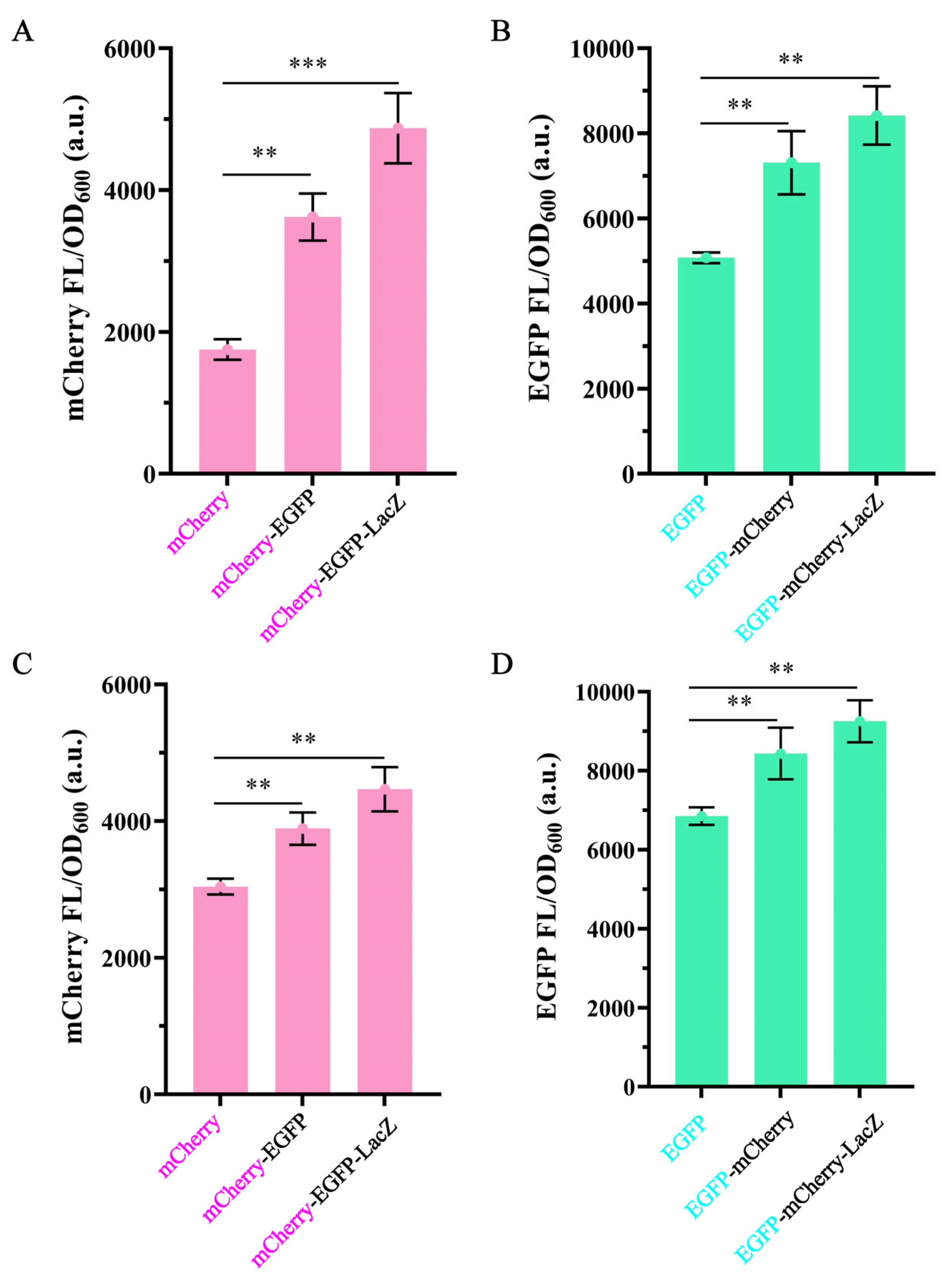
To determine whether operon length influences gene expression, we constructed synthetic operons of varying lengths encoding three reporter proteins: EGFP, mCherry, and LacZ. The effects of operon length on gene expression were assessed by measuring EGFP and mCherry fluorescence. In E. coli and B. subtilis, three operon sets were designed with EGFP and mCherry fixed at the promoter-proximal position, while operon length was systematically increased by adding genes downstream. The results demonstrated that fluorescence intensity for both EGFP and mCherry increased with operon length (Figure 2A,B). A similar positive correlation was observed in B. subtilis (Figure 2C,D). These results indicate that operon length is a key factor influencing gene expression levels, with some expression differences amplified as operon length increases [22].

3.3. The Order of Key Lycopene Synthesis Genes Influences Lycopene Production

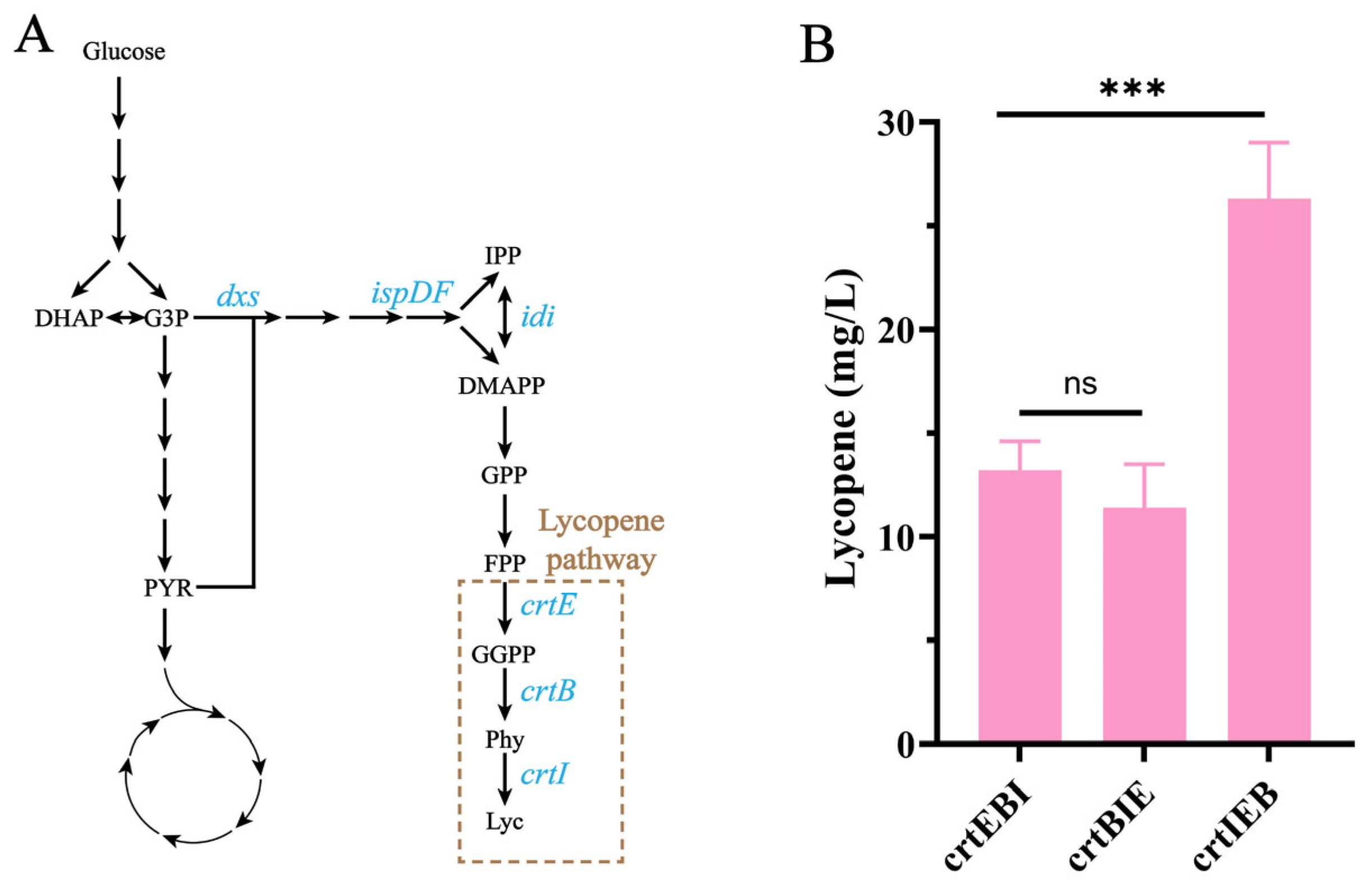
Synthesis operons are widely used in metabolic engineering to synthesize target compounds. Based on how gene length and positional changes affect gene expression, we constructed an artificially synthesized crtEBI operon to validate the impact of gene order within the operon and operon length on metabolite synthesis. Lycopene is a bright red carotenoid serving as a food coloring agent and antioxidant. Its vivid red color makes it an ideal molecular marker for verifying the effects of gene order and operon length on metabolite synthesis. The lycopene biosynthesis pathway begins with farnesyl pyrophosphate (FPP), which undergoes three reactions catalyzed by CrtE, CrtI, and CrtB to synthesize lycopene. We altered the order of the key lycopene synthesis genes crtE, crtI, and crtB to construct different synthetic operons. Lycopene content measurements revealed that the synthetic operon crtIEB yielded the highest lycopene production at 26.3 mg/mL (Figure 3B). This indicates that the crtE and crtI genes located at the end of the operon play a decisive role in the synthesis of lycopene.

3.4. A PCR Method for Altering the Order of Operon

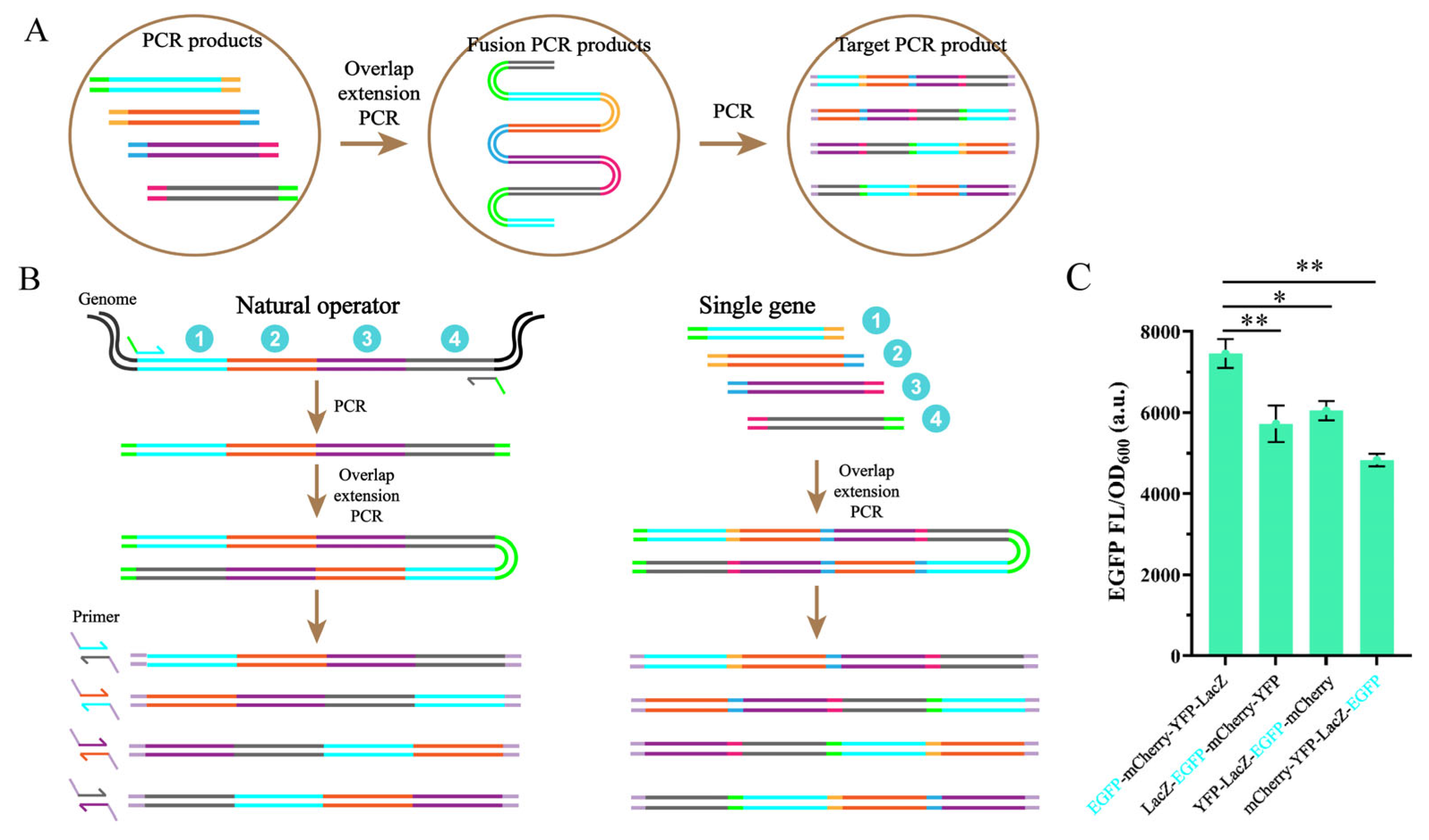
The rearrangement of gene sequences is a crucial strategy for enhancing gene expression and optimizing the synthesis of target products. However, systematically reordering genes within multi-gene operons remains a significant technical challenge. To address this, we developed a PCR-based method called Head-to-Tail PCR (HTPCR) (Figure 4A). This method utilizes primers to add homologous overhangs to both ends of individual DNA fragments, enabling their assembly into long, repetitive DNA structures via end-to-end ligation. These assembled constructs then serve as templates for amplifying the desired target operon with a specific gene order.
The HTPCR workflow is as follows (Figure 4B). First, to generate templates capable of producing operons with any gene sequence, individual gene fragments are amplified with complementary homologous arms. Using a four-gene operon as an example, fragments 1–2, 2–3, and 3–4 were designed with 20 bp homologous arms at their junctions. Critically, a specific homologous arm was also designed to connect fragment 4 back to fragment 1. These amplified fragments were then mixed in equimolar ratios and assembled via fusion PCR. The homologous arms facilitated the precise connection of these segments, generating a pool of fusion fragments with diverse sequences. The PCR fusion fragment produced in this process comprises at least four combined gene fragments (Figure 4B). To modify the gene sequence of a natural operon, the native operon can be used directly as a template for fusion PCR (Figure 4B). These various fusion fragments subsequently serve as versatile templates. The final target operon, with the desired gene order, is amplified from this template library using sequence-specific primers.
To validate the convenience and efficiency of the HTPCR method for constructing synthetic operons with diverse gene orders, we assembled an operon comprising EGFP, mCherry, YFP, and LacZ. The reporter genes within this synthetic operon were arranged in different sequences. We analyzed the effect of gene position on expression by measuring EGFP fluorescence intensity. The results confirmed that the HTPCR method successfully generated PCR fragments for operons with all desired gene sequences, performing as expected. Fluorescence analysis further revealed that EGFP intensity was strongest when the gene was in the promoter-proximal (first) position and weakest when in the terminal (last) position (Figure 4C), a finding consistent with the conclusions from our prior investigation. No significant differences in expression were observed between the intermediate (second and third) positions. This suggests that the pronounced positional effects are primarily associated with the specific structural and regulatory contexts of the 5′ and 3′ ends, rather than the internal positions within the operon.

3.5. Construction of Synthetic Rib Operons Using HTPCR Methods

Due to their functional role in coordinating gene expression, both natural and synthetic operons are widely used to regulate industrial traits and synthesize target compounds in microorganisms. For instance, overexpressing the manXYZ operon in E. coli significantly enhances the bacterium’s tolerance to organic solvents [23]. In another example, a 106-kb synthetic salinomycin gene cluster—comprising biosynthetic, regulatory, output, and fatty acid β-oxidation genes—was expressed in three heterologous Streptomyces hosts, yielding 14.3 mg/L of salinomycin in S. lividans K4-114 shake flask cultures [24]. To construct a more efficient artificial rib operon, we assembled synthetic operons with different gene orders using the HTPCR method, placing them under the control of the P43 promoter. As the rib operon is naturally occurring, only the ribosome-binding site (RBS) upstream of the first gene was modified, while the native RBS sequences of the downstream genes were retained.
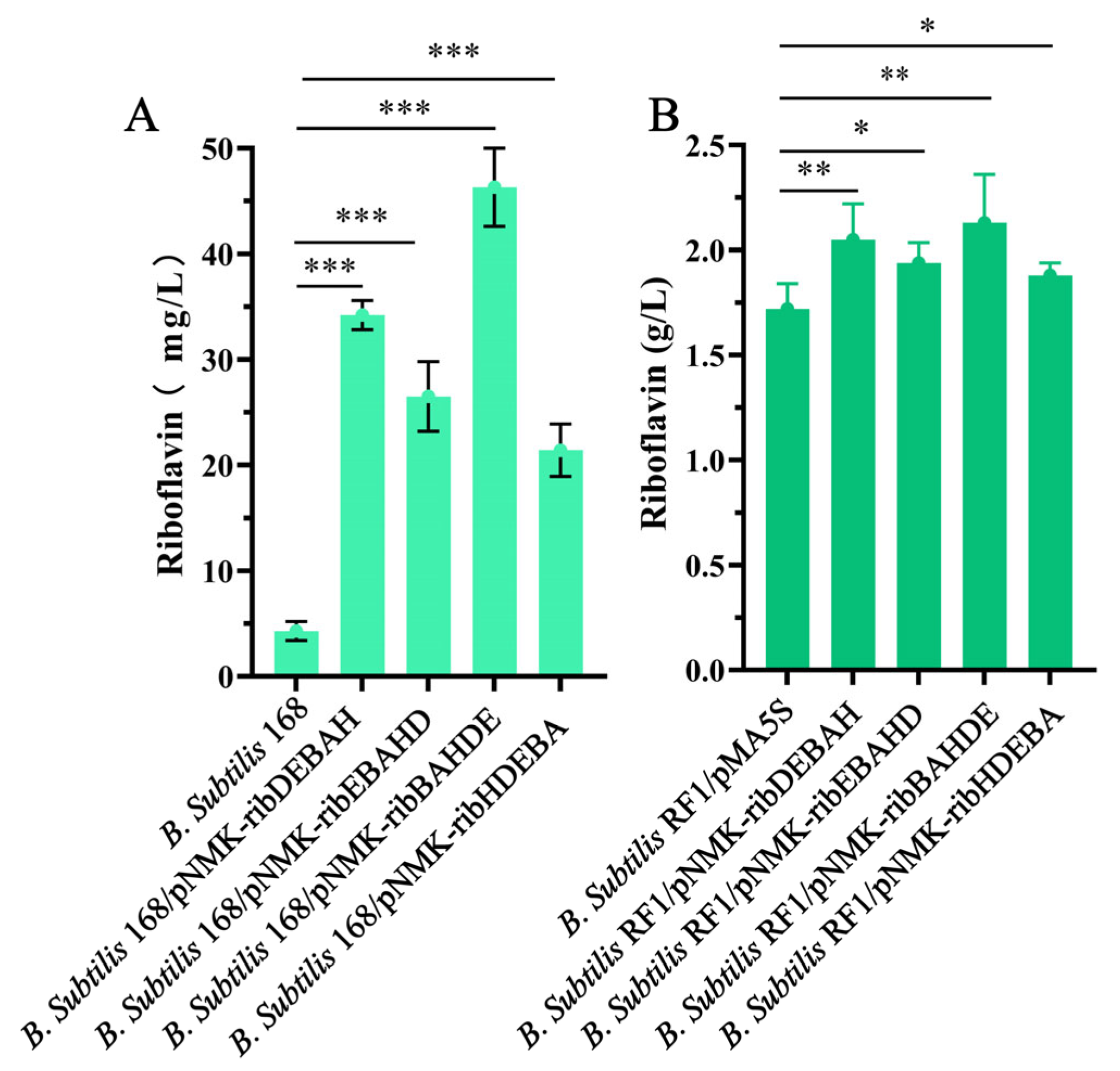
The results demonstrated that gene order profoundly impacts riboflavin yield. The synthetic operons ribDEBAH and ribBAHDE supported significantly higher production, whereas ribHDEBA yielded the lowest (Figure 5A). Riboflavin production from ribBAHDE was 2.16-fold higher than from ribHDEBA and 35.38% higher than from ribDEBAH in B. subtilis 168. This indicates that operon architecture is a critical determinant of riboflavin synthesis and that a key rate-limiting step exists in the pathway. Using the riboflavin-overproducing strain RF1 as the parental strain, we constructed engineered strains harboring different synthetic rib operons [25]. The results indicated that strain BFF3, containing the synthetic operon ribBAHDE, exhibited a 23.84% increase in riboflavin production compared to the control strain RF1/pMA5S (Figure 5B). This finding confirms that the ribBAHDE configuration significantly enhances riboflavin yield. However, the yield improvement conferred by ribBAHDE was lower in the RF1 background than in a B. subtilis 168, suggesting that precursor availability may become a limiting factor in the high-production strain. The superior performance of ribBAHDE is likely attributable to the position of ribBA, which encodes the pathway’s rate-limiting enzyme. The observation that placing ribBA at the operon’s terminus (ribHDEBA) further reduced production provides reverse genetic validation of its rate-limiting role. This finding is consistent with the conclusions from Chapter 3 and previous literature reports [26].

4. Discussion

Operons are a fundamental organizational feature of prokaryotic genomes; for instance, over half of all genes in E. coli and B. subtilis are organized into operons [9]. Within an operon, genes are co-transcribed from a single promoter into a polycistronic mRNA, and their protein products are typically functionally related [27]. The evolution of operons is thought to be driven by selection for co-regulated gene expression, which facilitates the coordinated optimization of cellular functions [28]. This organizational principle allows functionally related genes—such as those in flagellar synthesis and motility operons—to be integrated, thereby favoring rapid cellular growth and adaptation [29,30]. In metabolic pathways, key genes for riboflavin biosynthesis in B. subtilis are consolidated within the pur and rib operons [31,32]. This genomic architecture supports high-level riboflavin production and has served as the foundation for engineering industrial B. subtilis strains [33]. Consequently, operon structure is a critical determinant of functional gene expression in prokaryotes.
In our study, the order of genes within the operon and the operon length significantly influenced gene expression. This pattern is consistent with previous reports and indicates a strong inverse correlation between gene expression and transcriptional distance from the promoter [34]. This positional bias aligns with operon evolution, where essential genes are preferentially retained at the 5′ end, while pseudogenes are more common at the 3′ end [5,35]. This evolutionary conservation may be a direct consequence of the higher expression levels achieved by genes at the promoter-proximal position. Gene expression levels at the 5′ end of the operon are significantly higher than those at the 3′ end. This observation aligns with the established principle that essential genes are often organized within operons, with critically important genes preferentially positioned at the 5′ end [8]. This may be due to the gene being closer to the promoter at the 5′ end or the mRNA structure being more stable [28,36]. This study demonstrated that gene position within an operon significantly influences expression levels, with promoter-proximal (5′) genes exhibiting higher expression. Furthermore, we confirmed that operon length also modulates the expression of genes within it, a finding consistent with previous reports [34]. Additionally, the same expression pattern is observed in B. subtilis, providing guidance for constructing highly efficient engineered strains.
The gene rearrangement method developed in this study is characterized by its simplicity and efficiency. Its efficiency improves with the number of genes being assembled, and it requires fewer primers than traditional approaches for constructing diverse gene sequences. Another method, the OGAB technique, has been reported for rearranging gene order within operons [16]. In comparison, our PCR-based method is more rapid and eliminates the need for in vivo recombination steps. However, unlike the OGAB method, our approach does not support fully random gene order permutations. Additionally, compared to Gibson Assembly and Golden Gate methods, the HTPCR approach requires fewer primers for assembly. Furthermore, the cost advantage of this method becomes more pronounced as the number of gene fragments increases (≥4).
In synthetic biology, synthetic operons are engineered to optimize the synthesis of target compounds [37]. For instance, by systematically rearranging the key lycopene biosynthesis genes crtE, crtB, and crtI, we constructed a synthetic operon in the crtIEB configuration, which significantly enhanced lycopene production. LPctrE has been proven to be the key rate-limiting enzyme for the synthesis of lycopene, by altering the gene order arrangement [38]. Therefore, altering the order of the genes involved in the biosynthesis of lycopene will result in significant phenotypic effects. In bacterial operons, gene order and operon length significantly influence gene expression, so important genes are positioned at the 5′ end [2,39]. In metabolic engineering, integrating key genes into operons and rearranging their order to optimize the synthesis pathway for target products is an effective strategy. This approach enables the integration of heterologous genes to construct synthetic operons, thereby creating cellular factories for synthesizing products such as vitamins, amino acids, and carotenoids.

5. Conclusions

Achieving optimal performance in synthetic biological systems requires precise control over the expression levels of multiple recombinant proteins. However, this remains a significant challenge due to the multitude of factors influencing gene expression. In this study, we systematically analyzed gene expression patterns within synthetic operons by testing various operon architectures. Our results demonstrate a clear expression gradient, where gene expression decreases with increasing distance from the promoter, and genes at the 5′ end consistently show the highest activity. To leverage this principle for constructing more efficient systems, we developed a rapid PCR-based method that facilitates the rearrangement of gene order within operons. The synthetic operon constructed using this method demonstrated a 35.38% increase in yield compared to the native operon in 168, and a 23.84% increase in yield in RF1. By elucidating these expression patterns and providing a tool to construct optimized operon combinations, this work supplies more effective and predictable components for synthetic biology applications.

Supplementary Materials

The following supporting information can be downloaded at: https://www.mdpi.com/article/10.3390/fermentation12010011/s1, Table S1: The strains and plasmids used in this study; Table S2: The primers used in this study.

Author Contributions

Conceptualization, J.Y., H.Z. and Z.R.; methodology, J.Y. and K.W.; validation, K.W., Y.D. and X.Z.; formal analysis, J.Y. and H.Z., investigation, J.Y., M.S. and Z.R.; resources, J.Y., M.S. and H.Z.; data curation, J.Y. and Y.D.; writing—original draft preparation, J.Y.; writing—review and editing, J.Y., K.W. and Y.L.; visualization, J.Y., X.Z. and Y.L.; supervision, J.Y., Y.L. and Z.R.; project administration, Z.R.; funding acquisition, J.Y. and Z.R. All authors have read and agreed to the published version of the manuscript.

Funding

This research was funded by the National Key Research and Development Program of China (No. 2024YFA0917900), the Natural Science Foundation of Jiangsu Province (No. BK20221080), the National Natural Science Foundation of China (Nos. 32300063, 32471530, and 32501354), Jiangsu Program for Frontier Technology R&D (BF2024012), supported by the Fundamental Research Funds for the Central Universities (No. JUSRP202501034).

Institutional Review Board Statement

Not applicable.

Informed Consent Statement

Not applicable.

Data Availability Statement

The original contributions presented in this study are included in the article/Supplementary Materials. Further inquiries can be directed to the corresponding author.

Conflicts of Interest

The authors declare no conflicts of interest.

References

  1. Rocha, E.P. The organization of the bacterial genome. Annu. Rev. Genet. 2008, 42, 211–233. [Google Scholar] [CrossRef] [PubMed]
  2. Price, M.N.; Arkin, A.P.; Alm, E.J. The life-cycle of operons. PLoS Genet. 2006, 2, e96. [Google Scholar] [CrossRef] [PubMed]
  3. Jacob, F.; Monod, J.L. On the Regulation of Gene Activity. Cold Spring Harb. Symp. Quant. Biol. 1961, 26, 193–211. [Google Scholar] [CrossRef]
  4. Burkhardt, D.H.; Rouskin, S.; Zhang, Y.; Li, G.W.; Weissman, J.S.; Gross, C.A. Operon mRNAs are organized into ORF-centric structures that predict translation efficiency. eLife 2017, 6, e22037. [Google Scholar] [CrossRef]
  5. Liu, T.; Luo, H.; Gao, F. Position preference of essential genes in prokaryotic operons. PLoS ONE 2021, 16, e0250380. [Google Scholar] [CrossRef]
  6. Dandekar, T.; Snel, B.; Huynen, M.; Bork, P. Conservation of gene order: A fingerprint of proteins that physically interact. Trends Biochem. Sci. 1998, 23, 324–328. [Google Scholar] [CrossRef]
  7. Muro, E.M.; Mah, N.; Moreno-Hagelsieb, G.; Andrade-Navarro, M.A. The pseudogenes of Mycobacterium leprae reveal the functional relevance of gene order within operons. Nucleic Acids Res. 2011, 39, 1732–1738. [Google Scholar] [CrossRef]
  8. Kovács, K.; Hurst, L.D.; Papp, B. Stochasticity in protein levels drives colinearity of gene order in metabolic operons of Escherichia coli. PLoS Biol. 2009, 7, e1000115. [Google Scholar] [CrossRef]
  9. Memon, D.; Singh, A.K.; Pakrasi, H.B.; Wangikar, P.P. A global analysis of adaptive evolution of operons in cyanobacteria. Antonie Van Leeuwenhoek 2013, 103, 331–346. [Google Scholar] [CrossRef]
  10. Reddy, C.S.; Ghai, R.; Rashmi; Kalia, V.C. Polyhydroxyalkanoates: An overview. Bioresour. Technol. 2003, 87, 137–146. [Google Scholar] [CrossRef]
  11. Lamont, C.M.; Sargent, F. Design and characterisation of synthetic operons for biohydrogen technology. Arch. Microbiol. 2017, 199, 495–503. [Google Scholar] [CrossRef]
  12. Gong, Z.; Wang, H.; Tang, J.; Bi, C.; Li, Q.; Zhang, X. Coordinated Expression of Astaxanthin Biosynthesis Genes for Improved Astaxanthin Production in Escherichia coli. J. Agric. Food Chem. 2020, 68, 14917–14927. [Google Scholar] [CrossRef] [PubMed]
  13. Song, C.; Luan, J.; Cui, Q.; Duan, Q.; Li, Z.; Gao, Y.; Li, R.; Li, A.; Shen, Y.; Li, Y.; et al. Enhanced Heterologous Spinosad Production from a 79-kb Synthetic Multioperon Assembly. ACS Synth. Biol. 2019, 8, 137–147. [Google Scholar] [CrossRef] [PubMed]
  14. Liu, C.; Xia, M.; Fang, H.; Xu, F.; Wang, S.; Zhang, D. De novo engineering riboflavin production Bacillus subtilis by overexpressing the downstream genes in the purine biosynthesis pathway. Microb. Cell Factories 2024, 23, 159. [Google Scholar] [CrossRef] [PubMed]
  15. Ji, M.; Zheng, T.; Wang, Z.; Lai, W.; Zhang, L.; Zhang, Q.; Yang, H.; Meng, S.; Xu, W.; Zhao, C.; et al. PHB production from food waste hydrolysates by Halomonas bluephagenesis Harboring PHB operon linked with an essential gene. Metab. Eng. 2023, 77, 12–20. [Google Scholar] [CrossRef]
  16. Hiroe, A.; Tsuge, K.; Nomura, C.T.; Itaya, M.; Tsuge, T. Rearrangement of gene order in the phaCAB operon leads to effective production of ultrahigh-molecular-weight poly[(R)-3-hydroxybutyrate] in genetically engineered Escherichia coli. Appl. Environ. Microbiol. 2012, 78, 3177–3184. [Google Scholar] [CrossRef]
  17. Hochrein, L.; Machens, F.; Gremmels, J.; Schulz, K.; Messerschmidt, K.; Mueller-Roeber, B. AssemblX: A user-friendly toolkit for rapid and reliable multi-gene assemblies. Nucleic Acids Res. 2017, 45, e80. [Google Scholar] [CrossRef]
  18. Luo, Y.; Enghiad, B.; Zhao, H. New tools for reconstruction and heterologous expression of natural product biosynthetic gene clusters. Nat. Prod. Rep. 2016, 33, 174–182. [Google Scholar] [CrossRef]
  19. Wang, Q.; You, J.; Li, Y.; Zhang, J.; Wang, Y.; Xu, M.; Rao, Z. Continuous Evolution of Protein through T7 RNA Polymerase-Guided Base Editing in Corynebacterium glutamicum. ACS Synth. Biol. 2025, 14, 216–229. [Google Scholar] [CrossRef]
  20. Ren, K.; Wang, Q.; Chen, J.; Zhang, H.; Guo, Z.; Xu, M.; Rao, Z.; Zhang, X. Design-build-test of recombinant Bacillus subtilis chassis cell by lifespan engineering for robust bioprocesses. Synth. Syst. Biotechnol. 2024, 9, 470–480. [Google Scholar] [CrossRef]
  21. Lee, J.Y.; Cha, S.; Lee, J.H.; Lim, H.G.; Noh, M.H.; Kang, C.W.; Jung, G.Y. Plug-in repressor library for precise regulation of metabolic flux in Escherichia coli. Metab. Eng. 2021, 67, 365–372. [Google Scholar] [CrossRef] [PubMed]
  22. Price, M.N.; Alm, E.J.; Arkin, A.P. Interruptions in gene expression drive highly expressed operons to the leading strand of DNA replication. Nucleic Acids Res. 2005, 33, 3224–3234. [Google Scholar] [CrossRef] [PubMed]
  23. Okochi, M.; Kurimoto, M.; Shimizu, K.; Honda, H. Increase of organic solvent tolerance by overexpression of manXYZ in Escherichia coli. Appl. Microbiol. Biotechnol. 2007, 73, 1394–1399. [Google Scholar] [CrossRef] [PubMed]
  24. Jiang, C.; Zhou, H.; Sun, H.; He, R.; Song, C.; Cui, T.; Luan, J.; Fu, J.; Zhang, Y.; Jiao, N.; et al. Establishing an efficient salinomycin biosynthetic pathway in three heterologous Streptomyces hosts by constructing a 106-kb multioperon artificial gene cluster. Biotechnol. Bioeng. 2021, 118, 4668–4677. [Google Scholar] [CrossRef]
  25. Man, Z.W.; Rao, Z.M.; Cheng, Y.P.; Yang, T.W.; Zhang, X.; Xu, M.J.; Xu, Z.H. Enhanced riboflavin production by recombinant Bacillus subtilis RF1 through the optimization of agitation speed. World J. Microbiol. Biotechnol. 2014, 30, 661–667. [Google Scholar] [CrossRef]
  26. Yang, G.; Bhuvaneswari, T.V.; Joseph, C.M.; King, M.D.; Phillips, D.A. Roles for riboflavin in the Sinorhizobium-alfalfa association. Mol. Plant-Microbe Interact. 2002, 15, 456–462. [Google Scholar] [CrossRef]
  27. Nguyen, H.N.; Jain, A.; Eulenstein, O.; Friedberg, I. Tracing the ancestry of operons in bacteria. Bioinformatics 2019, 35, 2998–3004. [Google Scholar] [CrossRef]
  28. Kominek, J.; Doering, D.T.; Opulente, D.A.; Shen, X.X.; Zhou, X.; DeVirgilio, J.; Hulfachor, A.B.; Groenewald, M.; McGee, M.A.; Karlen, S.D.; et al. Eukaryotic Acquisition of a Bacterial Operon. Cell 2019, 176, 1356–1366.e10. [Google Scholar] [CrossRef]
  29. Maldonado, J.; Czarnecka, B.; Harmon, D.E.; Ruiz, C. The multidrug efflux pump regulator AcrR directly represses motility in Escherichia coli. mSphere 2023, 8, e0043023. [Google Scholar] [CrossRef]
  30. Hirakawa, H.; Shimokawa, M.; Noguchi, K.; Tago, M.; Matsuda, H.; Takita, A.; Suzue, K.; Tajima, H.; Kawagishi, I.; Tomita, H. The PapB/FocB family protein TosR acts as a positive regulator of flagellar expression and is required for optimal virulence of uropathogenic Escherichia coli. Front. Microbiol. 2023, 14, 1185804. [Google Scholar] [CrossRef]
  31. Sun, Y.; Liu, C.; Tang, W.; Zhang, D. Manipulation of Purine Metabolic Networks for Riboflavin Production in Bacillus subtilis. ACS Omega 2020, 5, 29140–29146. [Google Scholar] [CrossRef]
  32. Wang, G.; Shi, T.; Chen, T.; Wang, X.; Wang, Y.; Liu, D.; Guo, J.; Fu, J.; Feng, L.; Wang, Z.; et al. Integrated whole-genome and transcriptome sequence analysis reveals the genetic characteristics of a riboflavin-overproducing Bacillus subtilis. Metab. Eng. 2018, 48, 138–149. [Google Scholar] [CrossRef] [PubMed]
  33. Wang, Z.; Chen, T.; Ma, X.; Shen, Z.; Zhao, X. Enhancement of riboflavin production with Bacillus subtilis by expression and site-directed mutagenesis of zwf and gnd gene from Corynebacterium glutamicum. Bioresour. Technol. 2011, 102, 3934–3940. [Google Scholar] [CrossRef] [PubMed]
  34. Lim, H.N.; Lee, Y.; Hussein, R. Fundamental relationship between operon organization and gene expression. Proc. Natl. Acad. Sci. USA 2011, 108, 10626–10631. [Google Scholar] [CrossRef] [PubMed]
  35. Hu, X.P.; Brahmantio, B.; Bartoszek, K.; Lercher, M.J. Most bacterial gene families are biased toward specific chromosomal positions. Science 2025, 388, 186–191. [Google Scholar] [CrossRef]
  36. Kabaria, S.R.; Bae, Y.; Ehmann, M.E.; Beitz, A.M.; Lende-Dorn, B.A.; Peterman, E.L.; Love, K.S.; Ploessl, D.S.; Galloway, K.E. Programmable promoter editing for precise control of transgene expression. bioRxiv 2024. [Google Scholar] [CrossRef]
  37. Liao, C.; Xu, X.; Huang, H.; Yang, R.; Zhu, X.; Jin, K.; Liu, Y.; Li, J.; Du, G.; Lv, X.; et al. Construction of a plasmid-free Escherichia coli strain for lacto-N-neotetraose biosynthesis. Syst. Microbiol. Biomanufacturing 2024, 4, 965–982. [Google Scholar] [CrossRef]
  38. Colloms, S.D.; Merrick, C.A.; Olorunniji, F.J.; Stark, W.M.; Smith, M.C.; Osbourn, A.; Keasling, J.D.; Rosser, S.J. Rapid metabolic pathway assembly and modification using serine integrase site-specific recombination. Nucleic Acids Res. 2014, 42, e23. [Google Scholar] [CrossRef]
  39. Beerenwinkel, N.; Panke, S. Systematic investigation of synthetic operon designs enables prediction and control of expression levels of multiple proteins. bioRxiv 2022. [Google Scholar] [CrossRef]
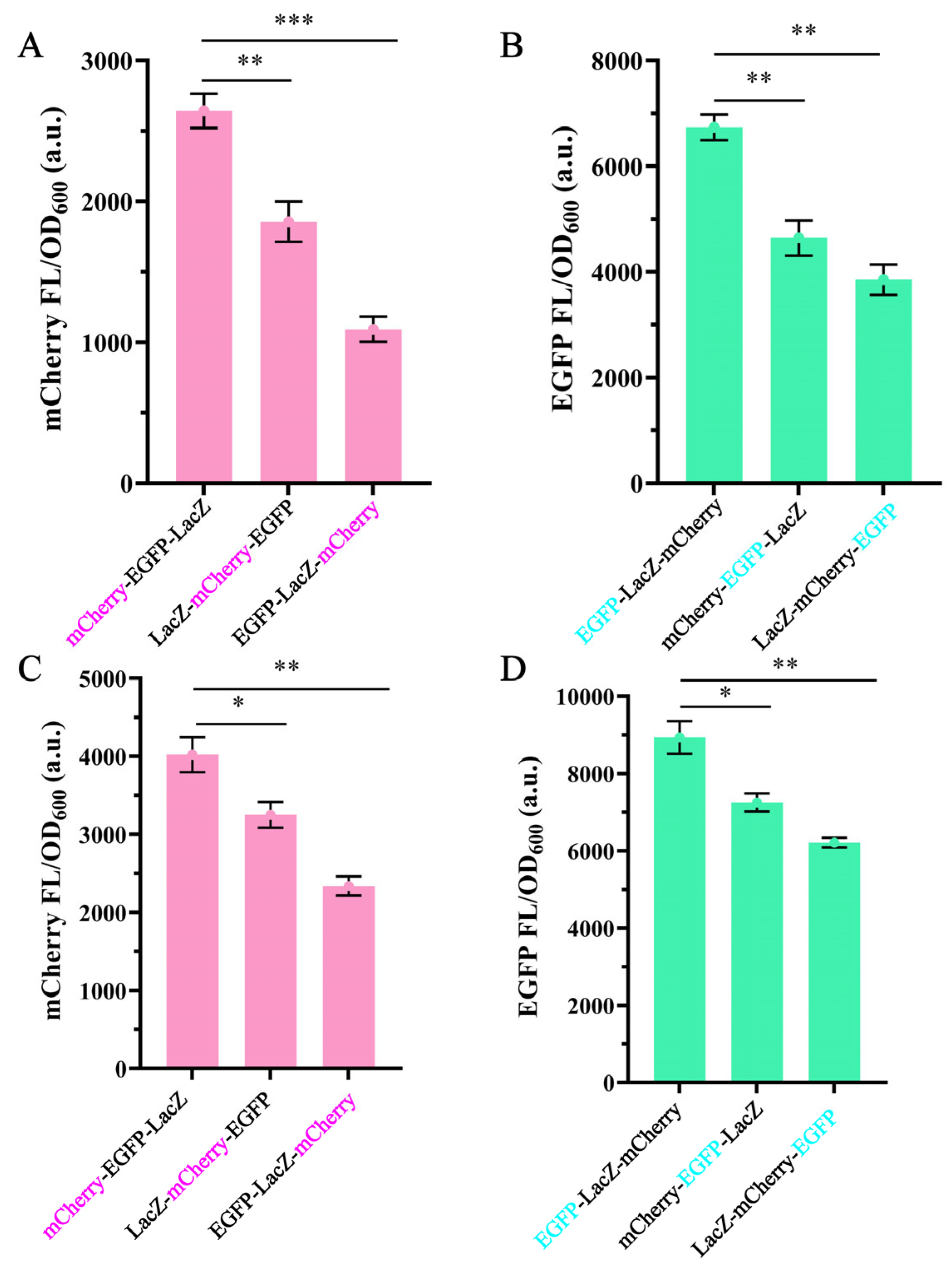
Figure 1. The effect of gene position within an operon on gene expression. (A) Expression levels of mCherry in E. coli; (B) expression levels of EGFP in E. coli; (C) expression levels of mCherry in B. subtilis; (D) expression levels of EGFP in B. subtilis. Bar graphs represent the means ± standard deviation from three independent experiments. *, p < 0.05; **, p < 0.01, ***, p < 0.001.
Fermentation 12 00011 g001
Figure 2. Effects of different operator lengths on gene expression. (A) Expression levels of mCherry in E. coli; (B) expression levels of EGFP in E. coli; (C) expression levels of mCherry in B. subtilis; (D) expression levels of EGFP in B. subtilis. Bar graphs represent the means ± standard deviation from three independent experiments. **, p < 0.01; ***, p < 0.001.
Fermentation 12 00011 g002
Figure 3. Effects of the Lycopene Synthetic Operon on Lycopene Synthesis. (A) Schematic diagram of the lycopene metabolic pathway. CrtE: encode Lamprocystis purpurea GGPP synthase; CrtB: phytoene synthase; CrtI: phytoene desaturase; the genes crtE, crtB, and crtI from Lamprocystis purpurea. (B) Effects of different gene order on lycopene synthesis. Bar graphs represent the means ± standard deviation from three independent experiments. ***, p < 0.001; ns, no significant.
Fermentation 12 00011 g003
Figure 4. Schematic diagram of rapid construction of synthetic operons using PCR methods. (A) Construction workflow diagram; (B) construction workflow diagrams for different templates: left side uses natural operons as templates, right side uses individual genes as templates. ①②③④, represent four different genes. (C) The expression levels of EGFP in different positions within the operon of B. subtilis. Bar graphs represent the means ± standard deviation from three independent experiments. *, p < 0.05; **, p < 0.01.
Fermentation 12 00011 g004
Figure 5. The Effect of the Riboflavin Synthetase Operon on Riboflavin Synthesis. (A) Effect of expressing the synthetic operon on riboflavin yield in B. subtilis 168; (B) effect of expressing the synthetic operon on riboflavin yield in riboflavin-overproducing B. subtilis RF1. Bar graphs represent the means ± standard deviation from three independent experiments. *, p < 0.05; **, p < 0.01; ***, p < 0.001.
Fermentation 12 00011 g005
Disclaimer/Publisher’s Note: The statements, opinions and data contained in all publications are solely those of the individual author(s) and contributor(s) and not of MDPI and/or the editor(s). MDPI and/or the editor(s) disclaim responsibility for any injury to people or property resulting from any ideas, methods, instructions or products referred to in the content.