Review

Volatile Fatty Acid Production vs. Methane and Hydrogen in Anaerobic Digestion

Institute of Chemical Engineering, Bulgarian Academy of Sciences, 1113 Sofia, Bulgaria
*
Author to whom correspondence should be addressed.
Fermentation 2025, 11(4), 172; https://doi.org/10.3390/fermentation11040172

Submission received: 13 February 2025 / Revised: 13 March 2025 / Accepted: 14 March 2025 / Published: 26 March 2025

Abstract

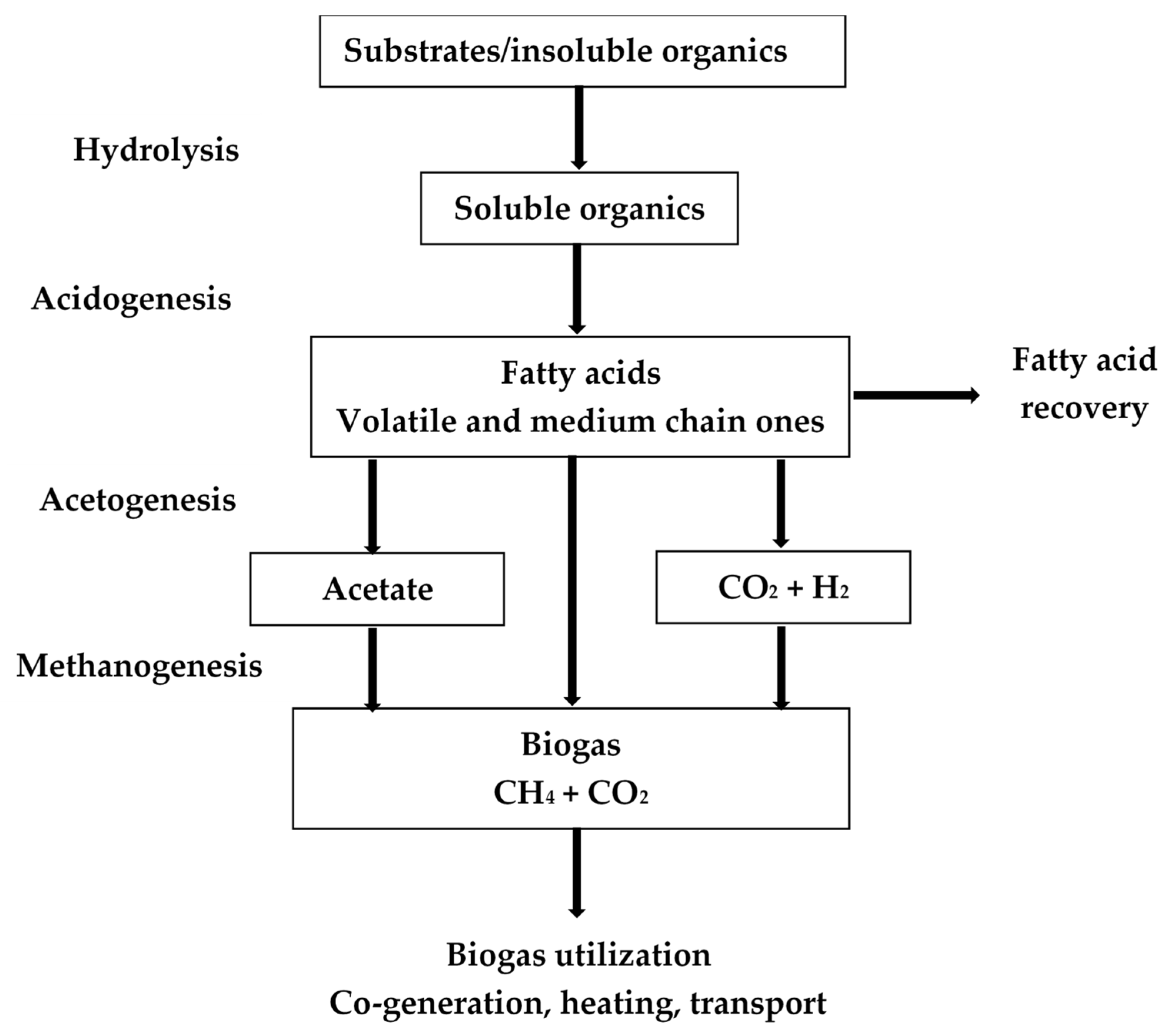
Volatile fatty acids (VFAs) are inevitable intermediates of biogas production during the anaerobic digestion of organic matter. The excessive accumulation of VFAs leads to a pH drop and the strong inhibition of methanogenesis. On the other hand, VFAs are useful commodities with different applications, and their fermentative production may compete with traditional production methods based on oil derivatives. The fermentation methods have commonalities with the biorefinery concept. The present review considers the methods of VFA fermentative production together with competitive simultaneous biogas and hydrogen production. Methods of the enhanced production of volatile fatty acids are presented, showing the option of integrated processes of product removal and energy production from the obtained biogas. On the basis of the present review, the following conclusion can be drawn. Volatile fatty acids (formic, acetic, propionic, and butyric ones) are useful commodities with various applications. That is why their targeted production with their desired production rate may shift the aims of the anaerobic digestion toward volatile fatty acids instead of biogas release. On the other hand, VFA production combined with biogas release can make the overall process self-consistent, with energy production sufficient to maintain the target processes using biogas for heating the digestor. The maintenance of optimum VFA concentrations can be accomplished by simultaneous VFA removal from the fermentation broth, thus integrating the product recovery with the maintenance of optimum operation conditions in the digester. The substrate preparation and the operating conditions (organic loading rate and hydraulic retention time) are of crucial importance for the successful fermentation process.
Keywords: anaerobic digester; biogas; volatile fatty acids; biohydrogen; product extraction anaerobic digester; biogas; volatile fatty acids; biohydrogen; product extraction