Article

The Use of Electric-Field Can Effectively Reduce Greenhouse Gas Emissions and Promote Carbon Conversion in Compost


1
College of Mechanical and Electrical Engineering, Tarim University, Alar 843300, China
2
Xinjiang Production and Construction Corps Key Laboratory of Utilization and Equipment of Special Agricultural and Forestry Products in Southern Xinjiang, Alar 843300, China
3
Modern Agricultural Engineering Key Laboratory, Universities of Education Department of Xinjiang Uygur Autonomous Region, Alar 843300, China
*
Authors to whom correspondence should be addressed.
Fermentation 2025, 11(11), 638; https://doi.org/10.3390/fermentation11110638
Submission received: 2 September 2025 / Revised: 9 October 2025 / Accepted: 6 November 2025 / Published: 9 November 2025
(This article belongs to the Section Industrial Fermentation)

Abstract

This study focused on the effect of electric field intensity on carbon transformation in aerobic composting of biochar–pig manure. Four treatment groups were set up with voltages of 0 V (CK group), 2 V (L group), 4 V (M group), and 5 V (H group). The physicochemical properties and carbon forms of the compost were characterized, and how they influence composting was investigated by observing the changes in the functional groups of the compost and the interactions between microorganisms and environmental factors. The results showed that the electric field treatment groups entered the thermophilic phase 2–3 d earlier than the CK group, and the duration of this phase was extended by 3–5 d. The seed germination indices were 95.2%, 106%, 110%, and 121% for the CK, L, M, and H treatment groups, respectively. The DOC content decreased by 11.7%, 11.4%, 16%, and 16.5%. The degradation rates of hemicellulose were 38.6%, 41.1%, 42.7%, and 42.8%, respectively. Those of cellulose were 46.8%, 47.7%, 51.8%, and 54.5%, respectively. Those of lignin were 37.2%, 40.8%, 47.9%, and 53.3%, respectively. Compared to the CK group, the cumulative emissions of CO2 and CH4 in the L, M, and H groups were reduced by 13.8–25% and 47.86–75.76%, respectively, resulting in lower carbon losses. Fourier transform infrared spectroscopy indicated that applying an external electric field induces changes in the functional groups of humic acid, the formation of aromatic functional groups, and the optimization of the maturation process. Compared to the CK group, applying an electric field (L/M/H groups) optimized the microbial communities (especially the Bacteroidota, Chloroflexi, and Acidobacteriota abundances), enriched Proteobacteria and Myxococcota, and regulated the moisture content and C/N ratio. These changes in the electric field treatment groups significantly improved the degradation efficiency of cellulose, lignin, and hemicellulose and reduced greenhouse gas emissions.

1. Introduction

With the extensive development of the livestock and poultry breeding industry, the production of livestock and poultry manure has significantly increased. As a result, global attention has increasingly focused on this industry’s resource utilization and on environmental pollution prevention and control. The sustainable development of human beings is also facing the pressure of global warming [1]. Soil carbon sequestration is one of the important ways to achieve this goal [2].
Livestock and poultry manure is rich in organic matter and nutrients. Conventional treatment methods, such as open-air piling, direct return to the field, and anaerobic fermentation, can partially utilize these wastes as a resource, but carbon loss in the treatment process is a significant problem. In particular, greenhouse gases (GHGs) are produced when anaerobically composting livestock and poultry manure. CO2 and CH4 are the main means of carbon loss. During the composting process, about 40% of the total organic carbon is emitted into the atmosphere in the form of CO2. Meanwhile, 0.5–1% of it escapes in the form of CH4, which not only reduces the fertilizer efficiency of the manure but also causes serious harm to humans and other organisms [3]. Notably, excessive CH4 emissions create an anaerobic environment in the compost, facilitating the conversion of nitrate (NO3) into N2 or N2O by denitrifying bacteria and directly reducing the effectiveness of nitrogen fertilizers.
Aerobic composting is an important way to utilize agricultural wastes. The carbon is transformed during composting in four main processes: hydrolysis of macromolecular organic matter, CO2 release, humification, and anaerobic CH4 production [4]. Most of the existing research on livestock and poultry manure composting has focused on accelerating the maturation process by regulating the compost microenvironment, such as aeration and biochar application. However, in order to achieve carbon storage, carbon emissions must be effectively inhibited while promoting compost maturation [5]. Aerobic composting is a biological redox process in which electrons are generated, with O2 serving as the terminal electron acceptor. Applying an electric field to the compost enhances electron transfer [6], effectively improving composting efficiency and environmental benefits. Directly increasing the electric potential to enhance electron transfer has been demonstrated to reduce gas emissions from composting. Lowering the electrical resistance of the composting biomass further strengthens electron transfer and promotes O2 utilization [7].
Tang et al. [8] applied a DC voltage to aerobic composting and found that, compared to traditional aerobic composting, electric field-assisted composting shortened the maturation phase by at least 30% and reduced total GHG emissions by 70%. Fu Tao et al. [9] found that in the presence of the electric field, large quantities of protein substances in the dissolved organic matter (DOM) were degraded during the thermophilic phase, carbohydrate and fat substances decreased, and aromatic compounds gradually increased during the entire composting cycle, effectively shortening the compost maturation time. An electric field can accelerate the conversion of lignocellulose to humus in the later stage of composting by activating extracellular enzymes, thereby improving composting quality and carbon fixation [10]. However, Zhang et al. [11] showed that the electric field affected carbon transformation at different composting phases by increasing the microbial metabolic activity, increasing CO2 emissions by 29.8%, and promoting the transformation of cellulose to humus. However, the electric field stimulates microbial activity, increasing CO2 emissions during composting. Simultaneously, insufficient oxygen supply, low electron transfer efficiency, and poor electrical conductivity in the electric field-assisted composting process can also lead to substantial greenhouse gas emissions during composting [12], which in turn causes carbon loss. Therefore, the use of biochar in composting has been considered an efficient method to improve organic matter degradation and GHG absorption by biochar [13,14,15]. Sun et al. [16] found that biochar has an aromatic structure similar to graphite, a conjugated π–electron system, and good conductivity, and that it is conducive to electron transfer. Therefore, adding biochar to electricity-assisted aerobic composting is expected to reduce resistance and accelerate electron transfer, thereby promoting oxygen utilization. Additionally, adding biochar to the electric field has been shown to enhance the conductivity of the matrix, promote electron transfer, increase the electron acceptance capacity of the matrix, and shorten the compost maturation time.
Electrical fields may cause fluctuations in carbon emissions due to factors such as stimulating microbial activity or oxygen deficiency. Meanwhile, biochar has been proven to enhance conductivity and adsorb greenhouse gases. However, previous studies have rarely elucidated the underlying mechanisms by which different electrical field intensities, through the synergistic effects of cotton stalk charcoal and aerobic composting, balance the composting efficiency and carbon sequestration effects within the pile while regulating greenhouse gas emissions. This paper aims to further reduce carbon loss during the aerobic composting of livestock and poultry manure. Cotton stalk biochar was used as an electron mediator to investigate how the electric field intensity influences the physicochemical properties and carbon transformation during the aerobic composting of cotton stalk biochar–pig manure. By examining the interaction network between environmental factors and microorganisms, the mechanism by which the electric field intensity reduces GHGs and sequesters carbon was analyzed.

2. Materials and Methods

2.1. Raw Material Collection and Preparation

Fresh pig manure was collected from a pig farm in Alar City, China. The straw and cotton stalks were collected from the paddy fields and cotton fields near Alar City in September 2023. They were naturally dried in the sun and then ground for later use. The ground cotton stalks were placed in a continuous pyrolysis device and burned at 300 °C for 2 h to obtain cotton stalk biochar. The basic properties of the raw materials are shown in Table 1.

2.2. Experimental Design and Sampling

In July 2024, 40 cm × 40 cm × 80 cm wooden boxes were used as containers for aerobic composting at the teaching station of the College of Animal Science and Technology, Tarim University, China. Fresh pig manure, cotton stalk biochar, and straw were mixed at a ratio of 10:1:1 (w/w). The C/N ratio and moisture content were adjusted to 25% and 60%, and the moisture content is not readjusted during the composting process. Four treatment groups were designed for the experiment. The DC voltages applied to each compartment were 0 V (Group CK), 2 V (Group L), 4 V (Group M), and 5 V (Group H). Voltage selection reference prior research [17]. In the electric field treatment groups, a stainless-steel plate was placed around the interior of each compost container as the positive electrode, and a graphite rod was inserted at the center of the compost as the negative electrode. Simultaneously, perforated PVC pipes were installed at the reactor bottom as aeration devices. Aeration was conducted at a flow rate of 0.2 L−1min−1kg−1 every other day, with manual turning performed every 5 days during the composting period.
The experiment was conducted from 25 July to 3 September 2024. Gas samples were collected once a day for the first four days of composting and then on the 7th, 9th, 12th, 17th, 22nd, 28th, 33rd, and 40th days. Each time a gas sample was collected, an air sample was first collected as a control. Then, a static sampling box was placed on the surface of the compost and inserted to a depth of 7 cm for gas concentration analysis. The static sampling box consists of three parts: the box body, the pressure balancing part, and the sampling port part. The box body is a truncated cone with the diameter of the lower base being 19 cm, the diameter of the upper base being 14 cm, and the height being 21 cm. Gas flux standards are expressed as “per kilogram of dry weight”. First, dry the samples in a 105 °C oven for 24 h until constant weight is achieved. Repeat the determination of fecal dry matter content three times, then convert the original fresh weight flux to a dry weight reference flux. After drying in a 105 °C oven for 24 h until constant weight, repeat the determination of fecal dry matter content three times. Then, convert the original fresh weight flux to a dry weight reference flux before conducting gas concentration analysis.
Solid samples were collected at depths of 15 cm, 45 cm, and 75 cm from the middle part of the compost on the 1st, 3rd, 7th, 9th, 12th, 17th, 22nd, 28th, 33rd, and 40th days, respectively. The samples were mixed evenly, dried, ground, and passed through a 100-mesh sieve within 24 h of collection. They were then stored in a 4 °C refrigerator before their physicochemical properties were analyzed. Meanwhile, a portion of the fresh samples collected on the 3rd, 7th, 28th, and 40th days was placed in 10 mL cryotubes. Three replicates were collected from each fresh sample and stored in a freezer at −80 °C for microbial diversity analysis.

2.3. Determination of Sample Performance

The ambient and compost temperatures were measured with a thermometer at noon every day. The moisture content was calculated by drying the sample in a 105 °C drying oven until the mass remained constant. To calculate the seed germination index (GI) of the compost samples, 10 g of fresh compost samples were weighed, added to 100 mL of distilled water, shaken at room temperature for 1 h, and then left to settle for 24 h. Then, the samples were filtered. Five milliliters of the filtrate was transferred into a 9 cm Petri dish lined with a layer of filter paper, and 50 plump rapeseed seeds were evenly arranged in the Petri dish. The seedlings were cultivated in a constant temperature incubator at 28 °C for 48 h. Finally, the seed GI was counted, and the root length was measured. Three replicates were prepared for each sample, with deionized water as the blank control. The calculation equations are as follows:
G I = A 1 A 2 B 1 B 2 × 100 %
where GI is the seed germination index of the compost sample, A1 is the germination rate of the seeds cultivated with compost sample extract, A2 is the total root length of the seeds cultivated with compost sample extract, B1 is the germination rate of the seeds cultivated in deionized water, and B2 is the total root length of the seeds cultivated in deionized water.
Organic carbon and organic matter were determined using the quantitative potassium dichromate–sulfuric acid solution titration method [18]. The concentrations of CH4 and CO2 were measured using a gas chromatograph (Agilent 7890A, Agilent Technologies, Santa Clara, CA, USA) equipped with a flame ionization detector (FID). The lignocellulose content (cellulose, hemicellulose, and lignin) was determined using the van Soest method and ANKOM DELTA Fiber Analyzer (Model DELTA1; ANKOM Technology, Macedon, NY, USA) automatic fiber analyzer. The morphology of the biochar was characterized with a scanning electron microscope (SEM). To analyze the surface functional groups, Fourier transform infrared spectrometer (iCAN9) was used to scan and measure at the wavelength range of 400–4000 cm−1 using the following method. After drying the compost samples under light conditions, they were crushed and ground to a particle size of less than 2 μm. Then, a small amount of the compost sample and KBr powder was mixed at a 1:100 ratio in an agate mortar and pressed into a pellet. The changes in functional groups were then observed.
To examine the microbial diversity of the samples, the compost samples on the 3rd, 7th, 28th, and 40th days were designated as the heating phase, thermophilic phase, cooling phase, and maturation phase, respectively. Three replicates were selected for each sample. DNA extraction, PCR amplification, sequencing library construction, 16S rRNA gene sequencing, and community result data analysis were conducted. The sequencing platform was Illumina Nextseq 2000 (Shanghai Meiji Biomedical Technology Co., Ltd., Shanghai, China).

2.4. Statistical Analysis

Data organization was carried out using Microsoft Excel 2024. Plotting analysis was conducted using Origin 2022. Environmental factor-microbial association analysis was conducted on the Majorbio cloud platform. Random sampling of sequences was employed to eliminate sequencing depth bias. To minimize the impact of sequencing depth, the number of sequences for all samples was standardized to 35,000. After standardization, the average sequence coverage (Good’s coverage) for each sample remained at 99.09%. All data analyses were conducted on the Majic Bio Cloud Platform (https://cloud.majorbio.com). The details are as follows: using the Correlation Heatmap analysis feature, the Pearson correlation coefficients between the environmental factors in the compost and the selected species were calculated. The obtained numerical matrix was visually presented in a heatmap. The Mantel test network heatmap combined the Mantel test and the correlation analysis between environmental factors. The Mantel test is a non-parametric statistical method used to test the correlation relationship between two matrices and is mostly used to test the correlation between community distance matrices (such as UniFrac distance matrix) and environmental variable distance matrices (such as pH and temperature).

3. Results and Discussion

3.1. Influence of Electric Field Intensity on the Physicochemical Properties of the Compost During Composting

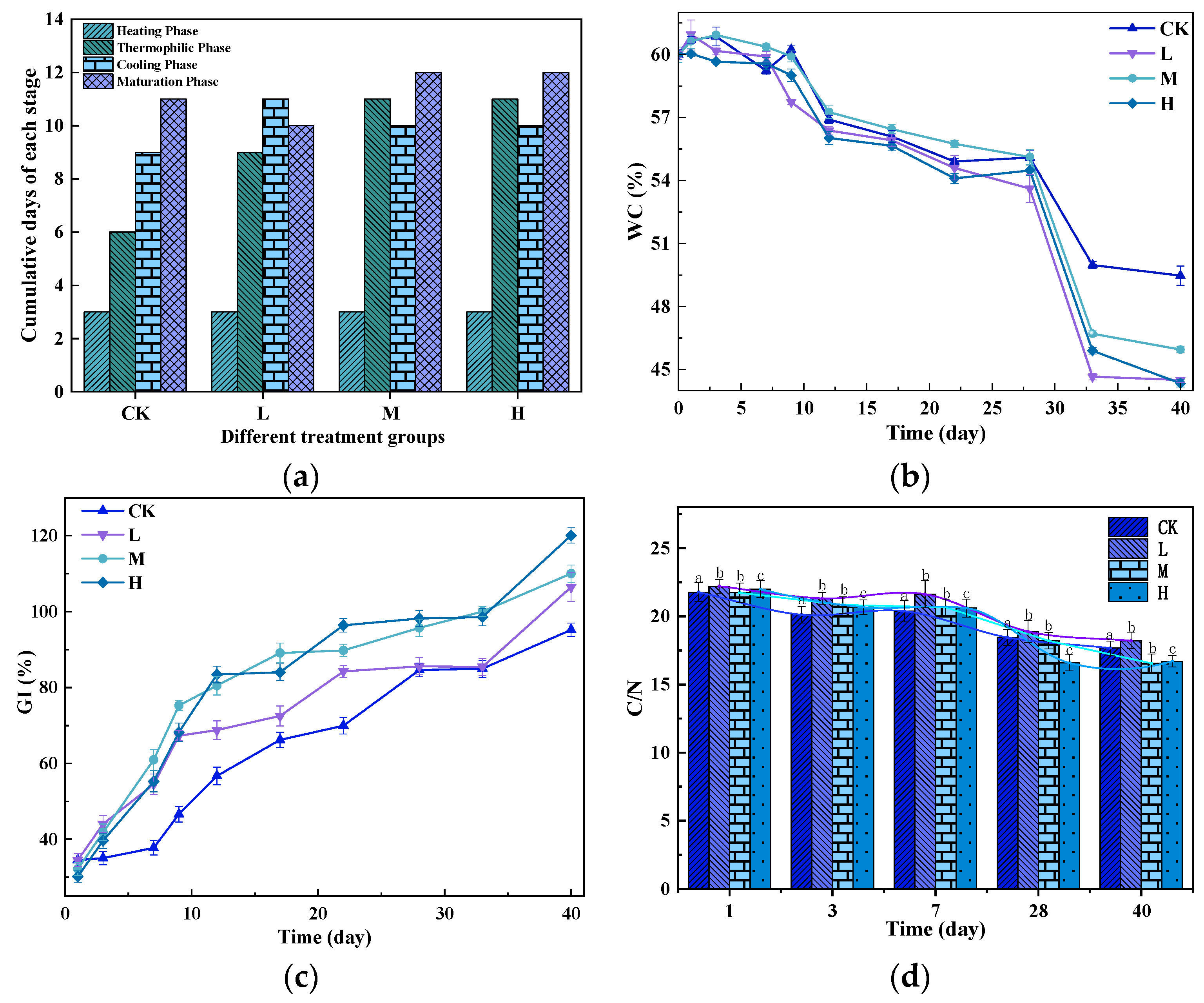
Compost temperature is one of the important indicators of compost quality. Different composting phases have different temperature ranges and trends. The early stage of composting, when the temperature rises from ambient temperature to 45 °C, is called the heating phase. It is also when mesophilic microorganisms are most active. The thermophilic phase is when the temperature exceeds 50 °C. The cooling phase is when the temperature starts dropping back to 45 °C and lower. When the temperature is below 35 °C and close to ambient temperature, the compost is at the maturation phase. The duration of each treatment group at the different composting phases is shown in Figure 1a. The heating, thermophilic, cooling, and maturation phases of the M and H treatment groups lasted for 3 d, 11 d, 10 d, and 12 d, respectively. The four phases of the L treatment were maintained successively for 3 d, 9 d, 11 d, and 10 d. Concurrently, those of the CK group were maintained for 3 d, 6 d, 9 d, and 11 d, respectively. As composting progressed, the electric field treatment groups remained at 50–54 °C from the 5th to the 13th day. Among them, the maximum temperatures of the L, M, and H treatment groups reached 55.1 °C, 54.3 °C, and 56.6 °C, respectively. In the CK group, the temperature rose above 50 °C on the 7th day, with the maximum temperature being 51.3 °C. Therefore, the electric field treatment groups entered the thermophilic phase 3–5 d earlier than the CK, which significantly helped accelerate the composting process. These treatment groups also achieved compost maturation, defined as compost temperature reaching 55 °C or above, or maintaining 50 °C for more than 4 d [19]. The rapid temperature increase observed in electrically stimulated micro-organisms is consistent with the findings of Shen et al. [20].
During the composting process, the moisture content of each treatment group decreased over time, as shown in Figure 1b. This decrease was mainly caused by the heat generated by the decomposition of organic matter [21]. The moisture content of each treatment group declined gradually during the early stage but decreased sharply on the 28th day. With the end of composting, the moisture content of CK, L, M, and H finally decreased by 17.55%, 25.82%, 23.42%, and 26.10%, respectively. Therefore, the electric field treatment groups achieved lower moisture during the composting process. Moisture content during composting directly affects the fermentation time and maturity of aerobic compost. The moisture content in the compost decreases faster, and the compost is more likely to be stabilized [22].
In composting, the seed GI is also an important indicator that evaluates the maturity of compost products [23]. As shown in Figure 1c, the GI values of the four treatment groups all increased relative to the first day of composting. The final GI values of the CK, L, M, and H treatment groups were 95.2%, 106%, 110%, and 121%, respectively. The GI values of the electric field treatment groups increased by 10.8–25.8% compared to those of CK. The auxiliary effect of the electric field significantly improved the GI of the compost products. The final compost products of all treatment groups met the required GI > 70% for organic fertilizer maturation [24].
The C/N ratio reflects the degradation degree of organic matter during the composting process, and thus it indicates how mature the compost is [25]. As the composting progressed, the degradation rate of organic carbon was higher than that of organic nitrogen, and the loss of carbon was higher than that of nitrogen. Therefore, the C/N in each treatment group decreased. When composting was over, the C/N ratios of the CK, L, M, and H treatment groups were 17.6, 18.2, 16.5, and 16.7, respectively, which were all less than 20, indicating that the compost had reached maturation [26]. The decrease in C/N may be explained by the higher rates of dry matter and carbon loss compared to the rate of nitrogen loss. This C/N decrease caused a nitrogen concentration effect [27], which led to lower C/N ratios in the M and H groups compared to the CK and L groups.

3.2. Effect of Electric Field Intensity on the Main Carbon Forms During Composting

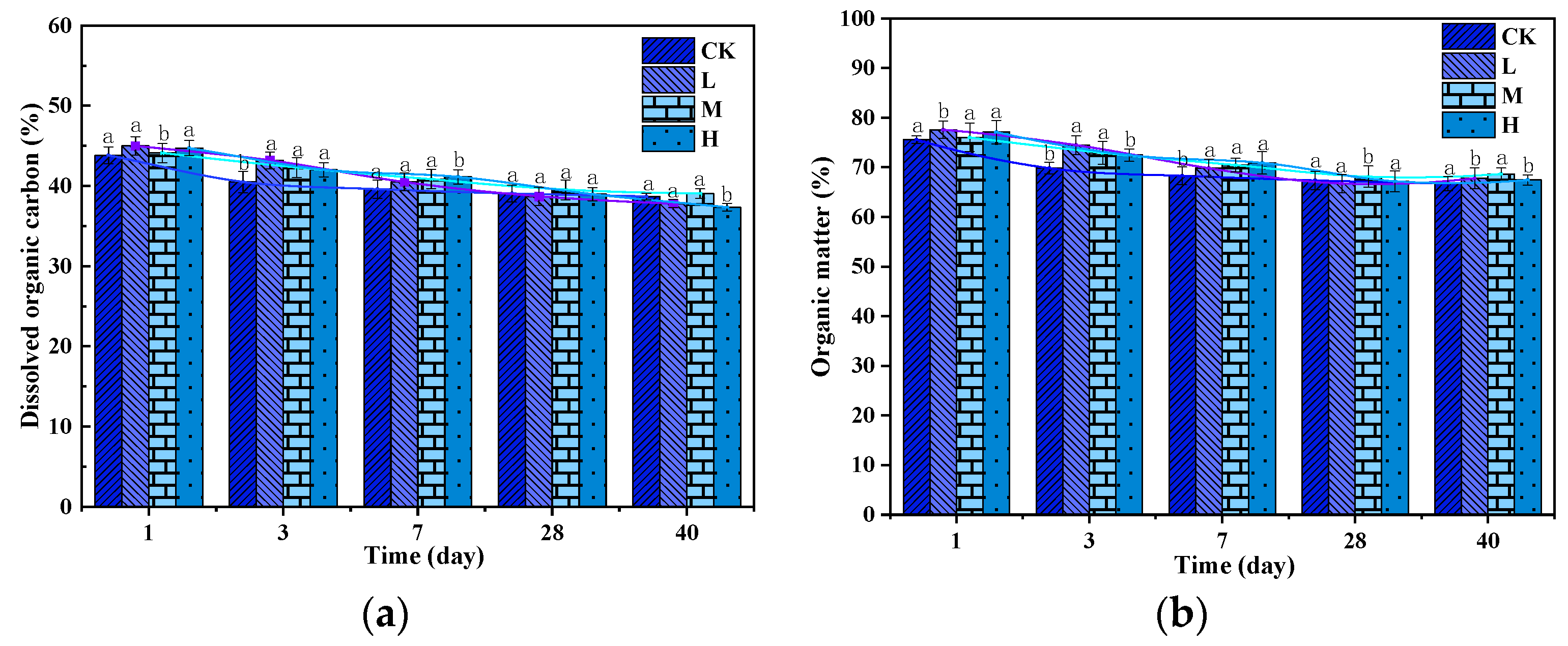
Dissolved organic carbon (DOC) is mainly composed of easily degradable substances, such as volatile fatty acids, sugars, and phenols, which are easily decomposed by microorganisms [28]. As shown in Figure 2a, the DOC content decreased during the composting process. The degradation rate of DOC was faster in 1–7 days. This was because in the early stage of composting, aerobic microorganisms in the compost preferentially utilized easily degradable organic matter, such as sugars, lipids, and starches, for growth and reproduction. As the easily degradable substances were consumed, the microorganisms began to use refractory organic matter (lignin, cellulose, and hemicellulose) as a carbon source [29]. After composting was completed, the DOC content in the CK group decreased by 11.7% compared to the first day, while that in the L, M, and H treatment groups decreased by 11.4%, 16.0%, and 16.5%, respectively. This indicates that the electric field promotes organic matter degradation in biochar composting, which is consistent with previous research results [30].
The organic matter (OM) content Is the core Indicator for evaluating the quality and maturity of compost products. As can be seen from Figure 2b, as the composting progressed, the overall OM content gradually decreased and then generally stabilized. However, during the early stage of composting, the degradation rate of OM in the electric field treatment groups was lower than that in the CK group. This occurred because the microorganisms in the compost biodegraded the OM and transformed it into CO2 through oxidative metabolism, which reduced the OM content in the compost [31]. At the end of composting, the OM content of the CK, L, M, and H groups was 66.7%, 67.8%, 68.6%, and 67.4%, respectively, thereby meeting the national standards in China for OM content in organic fertilizers, which state that it should not be less than 45% [32]. Consequently, during the early stages of composting, when readily degradable substrates were abundant, degradation rates were similar across all treatment groups. However, as the composting process progressed into the later stages and readily degradable materials were largely depleted, the advantage of electric field treatment in promoting the conversion of refractory substances became apparent, ultimately leading to differences among the groups.

3.3. Effect of Electric Field Intensity on the Degradation of Lignin, Cellulose, and Hemicellulose

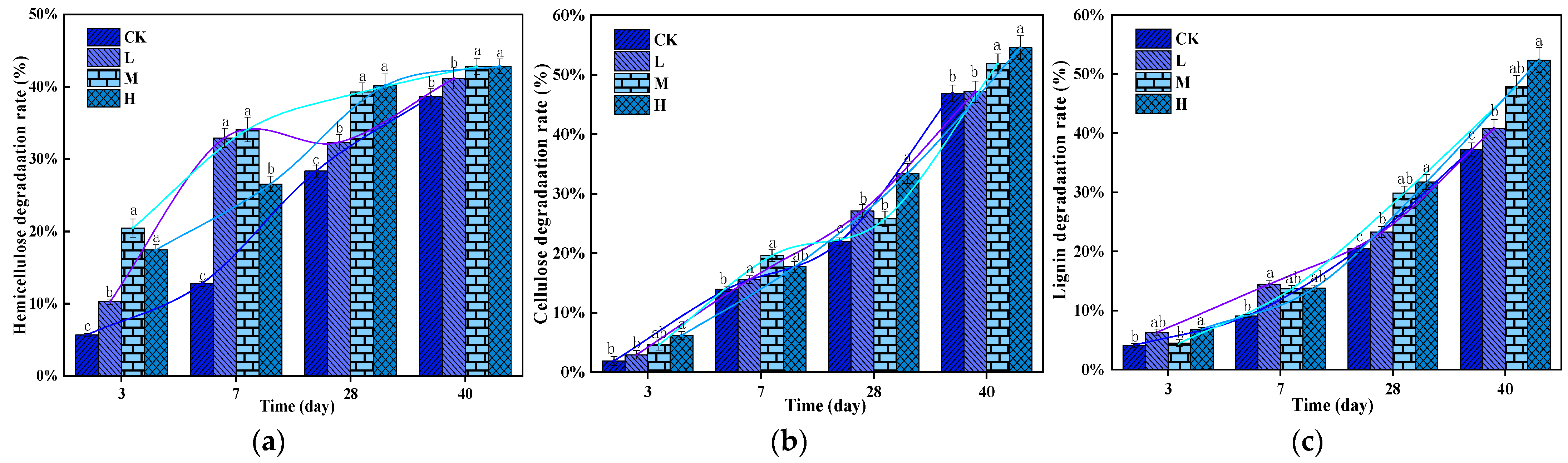
After the OM in the compost is oxidized and decomposed by microorganisms, complex carbon substances (i.e., gaseous, liquid, and solid carbon substances) are formed. The solid and liquid carbon substances mainly include organic matter, DOM, and lignocellulose. To investigate how these substances transform and migrate under the action of microorganisms, the effect of electric field intensity on the degradation of lignin, cellulose, and hemicellulose was studied. As composting progresses, the biomass and activity of the microorganisms gradually stabilize, and degradation becomes primarily focused on organic carbon, such as cellulose, hemicellulose, and lignin. By promoting the reduction in lignocellulose energy, the efficiency of converting lignocellulose degradation products into humus is enhanced, thereby increasing humus content in compost. This approach also reduces CO2 emissions caused by sugar decomposition, achieving carbon sequestration [33]. Lignocellulose, comprising cellulose, hemicellulose, and lignin, serves as the primary source of organic carbon. Its degradation rate is a key factor limiting compost maturation [34]. Figure 3 shows how the degradation rate of hemicellulose, cellulose, and lignin varies when affected by the electric field intensity in the CK, L, M, and H groups during the four phases of composting. As can be seen from Figure 3a, the degradation of hemicellulose occurred throughout the composting process. The electric field treatment group accelerated the degradation of hemicellulose during the early stage of composting (3–7 days). At the end of composting, the degradation rate of hemicellulose in each treatment ranged from 38.6% to 42.8%, and the degradation rate of hemicellulose in the electric field treatment groups was 6.45% to 10.78% higher than in the CK. This also confirms that the electric field strength exhibits a progressive increase in the efficiency of hemicellulose degradation. Simultaneously, as microorganisms continuously mineralize and decompose recalcitrant organic compounds such as lignin, cellulose, and hemicellulose [35], the electric field further accelerates their degradation rate by stimulating microbial activity. As shown in Figure 3b, the degradation rate of cellulose in each treatment group accelerated in the later stage of composting. This indicates that hemicellulose is a crucial carbon source for microbial metabolism during the heating and early thermophilic stages. In the middle and later stages of the thermophilic phase, microorganisms began to degrade and dissolve cellulose in large quantities. At the end of composting, the degradation rates of CK, L, M, and H cellulose were 46.8%, 47.7%, 51.8%, and 54.5%, respectively. Therefore, the electric field enhanced cellulose degradation, and its degradation rate increased with increasing electric field. Simultaneously, as the earlier consumption of hemicellulose releases small-molecule carbon sources, providing nutrients for cellulose-degrading bacteria, it will further accelerate cellulose decomposition. Lignin is a complex aromatic polymer and the most difficult organic matter component to degrade during composting [36]. As shown in Figure 3c, the degradation rate of lignin in each treatment group increased over time, mainly occurring during the later stage of composting. This is mainly because microorganisms preferentially utilize the easily degradable organic matter components during the early stage. At the end of composting, the degradation rates of lignin in CK, L, M, and H treatments were 37.2%, 40.8%, 47.9%, and 53.3%, respectively. Therefore, the electric field promotes the degradation of complex organic compounds such as lignin into water-soluble low-molecular-weight compounds [37]. Specifically, within the electro-composting system, electroactive bacteria generate hydroxyl radicals (OH) through electron transfer processes. This mechanism not only accelerates the degradation of lignin, cellulose, and hemicellulose in the compost but also drives subsequent humification, ultimately enabling faster and more effective stabilization of the compost [38].
In summary, during the initial stages of composting, the electric field enhances microbial utilization of readily degradable carbon sources. Simultaneously, the electric field utilizes electron transfer from electroactive bacteria to generate hydroxyl radicals (OH), accelerating the degradation of lignin, cellulose, and hemicellulose. This promotes the humification process and improves the stabilization efficiency of the compost. During the later stages, electrically activated microorganisms can more efficiently mineralize and decompose recalcitrant organic matter, significantly accelerating the degradation rate of these components overall.

3.4. Effect of Electric Field Intensity on Greenhouse Gas Emissions

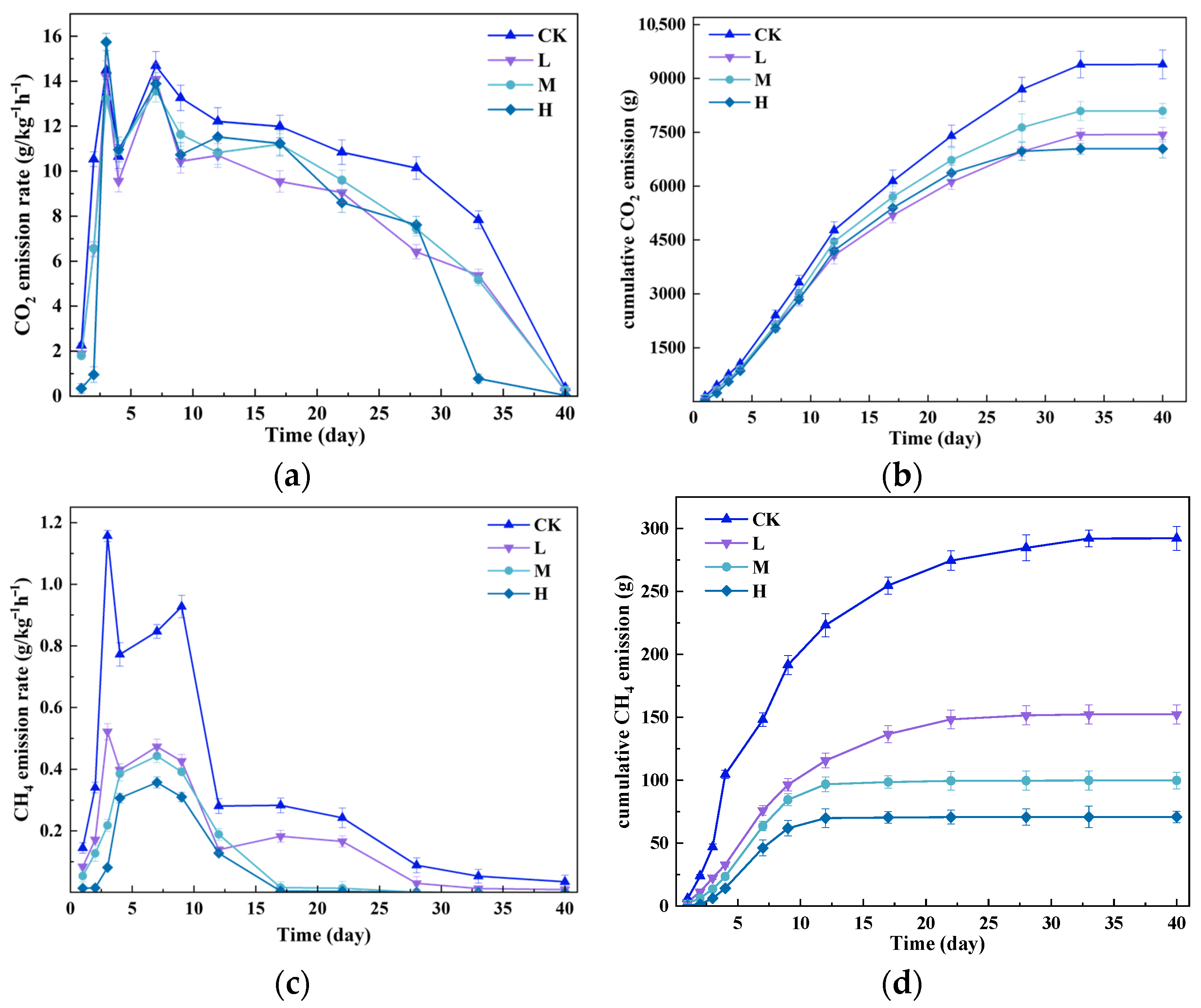
The carbon loss during composting was mainly in the form of CO2 and CH4 emissions, and their production, emission rates, and cumulative emissions are plotted in Figure 4. As shown in Figure 4a, the CO2 emission rate of each treatment group peaked during the thermophilic phase. The peak values of CK, L, M, and H were 14.5 ± 0.42 g·kg−1·h−1, 14.23 ± 0.71 g·kg−1·h−1, 13.21 ± 0.41 g·kg−1·h−1, and 15.7 ± 0.38 g·kg−1·h−1, respectively. This may be because the electric field is facilitating the early onset of the thermophilic phase and increasing the compost temperature. This temperature increase is also known to increase the metabolic activity of microorganisms and transform organic matter into CO2 [39]. Concurrently, the synergistic effect of biochar and the electric field likely drove electron transfer, which further increased the overall activity of microbial metabolism [40] and accelerated CO2 production and emission. With the exception of the third and fourth days, the CO2 emission rate of the CK group was higher than that of the electric field treatment groups during the composting process. As shown in Figure 4b, the cumulative CO2 emissions of the CK, L, M, and H groups were 9388.08 ± 400.40 g·kg, 7436.45 ± 204.75 g·kg, 8095.18 ± 200.14 g·kg, and 7039.90 ± 251.24 g·kg, respectively. Among them, the emission rates of the electric field treatment groups were 13.8–25% lower than those of CK. The electric field reduced CO2 emissions, possibly because CK released unstable aliphatic compounds in an oxygen-limited environment, causing direct oxidation of organic carbon to CO2 [41]. The cumulative CO2 emissions from the treatment group throughout the entire composting cycle exert a positive effect on “long-term carbon sequestration,” which outweighs the negative impact of “a slight increase in early CO2 emissions,” ultimately leading to greater net carbon retention. As shown in Figure 4c, during the composting period, the CH4 emission rate of the CK group was significantly higher than that of the electric field treatment groups. On the third day, the CH4 emission rate intensified, with the peak values of the L, M, and H groups being 45.09%, 18.83%, and 7.02% higher than the CK peak values, respectively. These trends were mainly attributed to the fact that the electric field promotes electron transfer within the compost, increasing the utilization rate of O2 and thus reducing CH4 emissions [42]. As can be seen from Figure 4d, at the end of composting, the cumulative CH4 emissions of the CK, L, M, and H groups were 292.11 ± 9.60 g·kg, 52.30 ± 7.61 g·kg, 99.8 ± 6.61 g·kg, and 70.79 ± 4.53 g·kg, respectively. The electric field treatment groups decreased by 47.86–75.76% compared to the CK group. Therefore, the electric field In the compost could significantly reduce CH4 emissions. From these analyses, it can be concluded that the electric field reduces carbon loss and carbon sequestration in the compost.

3.5. Effect of Electric Field Intensity on the Compost FTIR

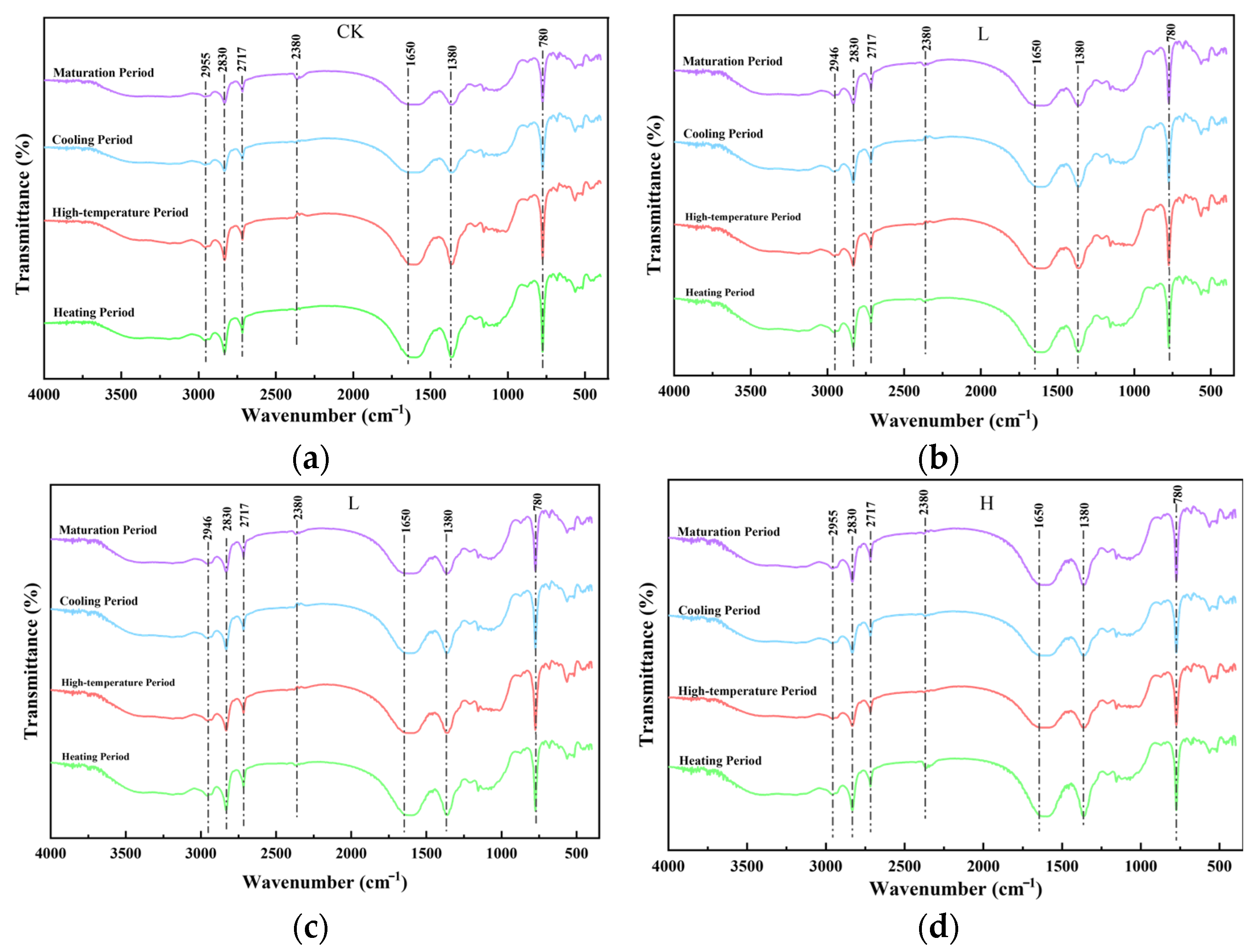
To examine the influence of electric field intensity on the functional groups on the compost surface, the compost materials were analyzed using Fourier transform infrared spectroscopy (FTIR; Figure 5). Prominent absorption peaks appeared in each treatment group at 2955, 2830, 2717, 1650, 1380, and 780 cm−1, and the relative intensities of the absorption peaks differed across the composting phases. The absorption peaks at 2955 cm−1 and 2830 cm−1 were caused by the C−H stretching vibration of aliphatic compounds [43]. During the composting process, the overall intensity of the absorption peaks at 2955 cm−1 and 2830 cm−1 decreased over time. The peak intensity of each treatment group decreased with decreasing electric field as follows: H > M > L > CK. These changes in the electric field treatment group were more significant than those in the CK group. They are due to the biodegradation of lipids and carbohydrates [44]. On the other hand, it may be because applying an electric field further increases the relative abundance of electroactive bacteria, resulting in the rapid degradation of organic matter [45]. At the absorption peak of 2717 cm−1, due to the C-H stretching vibration of aldehyde groups, the oxidation and decomposition of organic matter (such as lignin and cellulose) in the compost may generate aldehyde intermediates. The peak value changed in each treatment group as follows: H > L > M > CK. Therefore, the electric field treatment groups changed more significantly than CK. Moreover, the electric field promoted the degradation of lignin and cellulose in the compost. The absorption peak at the 660~1600 cm−1 band may be caused by the stretching vibration of C=C in olefins, C=O in carboxylic acid, or C=O in amides [46]. The stretching of aromatic C=C and C=O amide groups is near 1650 cm−1, where the peak changed as follows: H > M > L > CK. In comparison, the changes in the treatment groups were greater than in CK. These observations are consistent with the results of Wu et al. [47], indicating that electric field composting accelerates the formation of humic substances and promotes the maturation of the compost. The peak at 1380 cm−1 is associated with the symmetric stretching vibration of carboxylates, corresponding to the abundant carboxylic acid groups in humic acid (HA). The absorption peak at 780 cm−1 is related to the C-H deformation vibration of aromatic compounds, reflecting the characteristics of the aromatic structure in the humic acid molecule [48]. The peak value changed as follows: H > M > L > CK, indicating that the change in the electric field treatment groups was greater. These observations indicate that the electric field promotes changes in fulvic acid functional groups and enhances the formation of aromatic structures in humic acid molecules.
Overall, the intensity of the main absorption peaks in the electric field treatment groups was significantly different from that in CK, with the H group being the most intense. This indicates that the electric field induces changes in the functional groups of humic acid and the formation of aromatic functional groups. Among them, carbohydrates and fat substances were continuously degraded during aerobic composting, and aromatic substances gradually formed, with the peak intensity increasing accordingly. Therefore, applying an electric field facilitates the degradation of compost materials, accelerates the maturation of the compost, and optimizes the humification pathway.

3.6. Influence of Microorganisms and Environmental Factors on Carbon Transformation

3.6.1. Effects of Microorganisms and Environmental Factors in Each Treatment Group on the Degradation of Cellulose, Lignin, and Hemicellulose

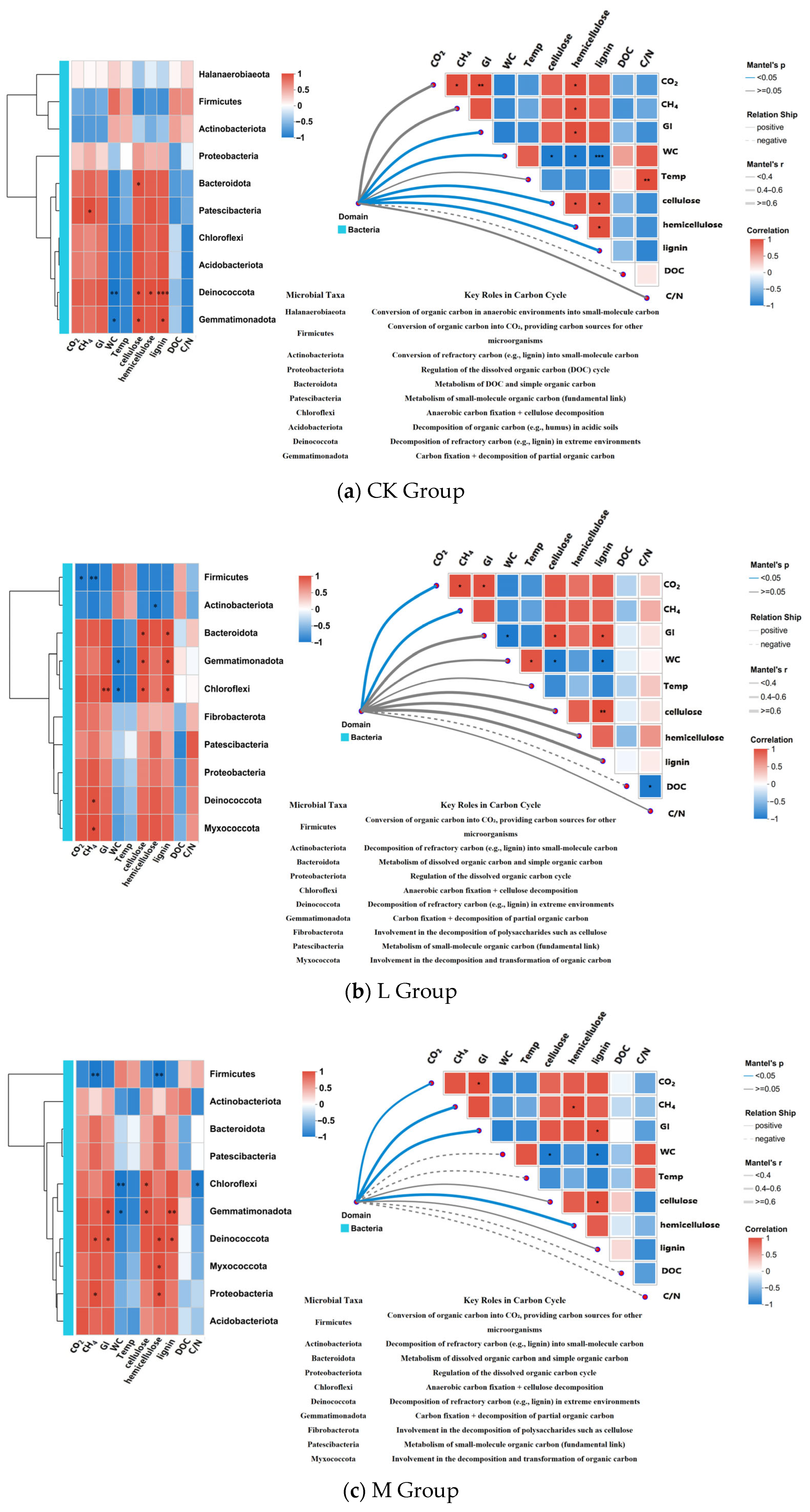
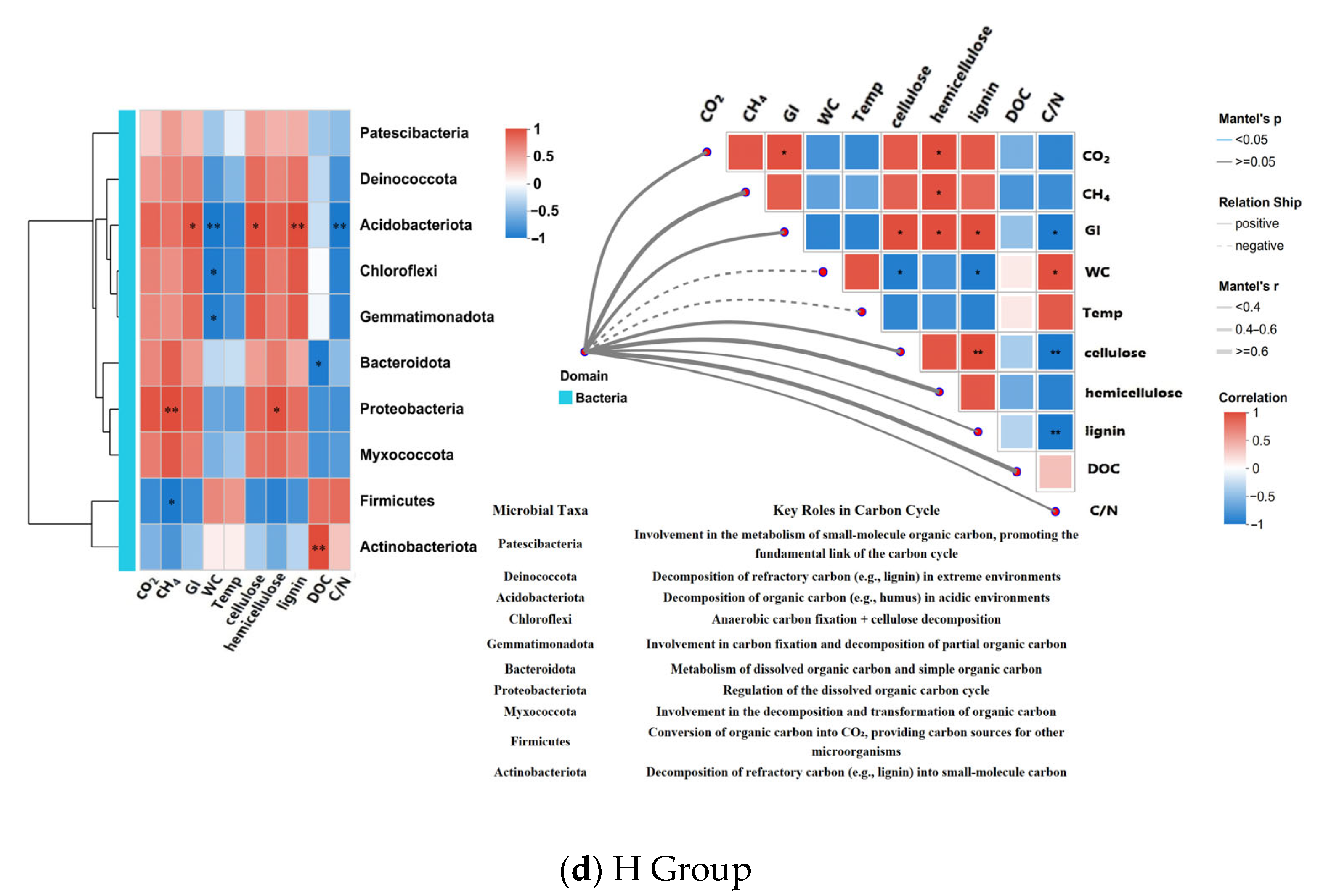
To explore the influence of colony succession and environmental factors on carbon transformation in different composting treatment groups, the correlations between microorganisms and physicochemical indicators of the compost were constructed. The results are shown in Figure 6.
As shown in Figure 6a, in the CK group, the degradation efficiency of cellulose, lignin, and hemicellulose was primarily correlated with moisture content, temperature, DOC, and C/N. These four environmental factors were negatively correlated with the cellulose, lignin, and hemicellulose content. Microbial communities are known to be the core drivers in this process. Among them, Deinococcota significantly promoted lignin degradation, while Bacteroidota and Gemmatimonadota jointly promoted the decomposition of cellulose and hemicellulose. Firmicutes and Actinobacteriota significantly inhibited the degradation process. As shown in Figure 6b, in the L group, the moisture content, temperature, and DOC were negatively correlated with the degradation of cellulose, lignin, and hemicellulose. Compared to the CK group, its degradation was jointly driven by Bacteroidota and Chloroflexi. Meanwhile, the electric field enhanced the synergistic degradation of hemicellulose by activating Acidobacteriota. As shown in Figure 6c, in the M group, cellulose, lignin, and hemicellulose degradation were negatively correlated with moisture content, C/N, and temperature. However, it was positively correlated with DOC. This may be due to the fact that lignocellulose degradation produces dissolved small molecules, resulting in an increase in their concentration. Compared to the CK group, the correlations between cellulose degradation and the relative abundance of members of the microbial communities in the electric field treatment groups were the strongest. Bacteroidota was significantly positively correlated with cellulose degradation, while Deinococcota drove lignin degradation and enhanced the efficiency of lignin degradation In synergy with Gemmatimonadota. As shown in Figure 6d, the degradation of lignin, cellulose, and hemicellulose was significantly negatively correlated with moisture content, DOC, C/N, and temperature. Among the environmental factors, DOC and C/N were positively correlated in the H group, while they were negatively correlated in the CK, L, and M groups, indicating that the electric field in the H group promoted the enrichment of the humus-degrading microbial populations. The synergistic degradation of DOC was positively correlated in the H group. However, the higher C/N ratios in the CK, L, and M groups would aggravate nitrogen shortage and inhibit the degradation of lignocellulose. The degradation of the key microorganisms, such as Bacteroidota, Deinococcota, Gemmatimonadota, Acidobacteriota, and Chloroflexi, all showed significant positive correlations with the degradation of cellulose and lignin in the H group compost. This trend suggests that these taxa are the essential members of the microbial communities driving degradation.
Among the various treatment groups of compost, the degradation efficiency of cellulose, lignin, and hemicellulose was mainly affected by moisture content, temperature, and C/N. Among them, Deinococcota, Bacteroidota, and Gemmatimonadota jointly constituted the main populations driving degradation, while Firmicutes and Actinobacteriota continuously inhibited the degradation process. During the composting process, the microbial communities in the electric field treatment groups underwent a crucial transformation. By activating Myxococcota and Acidobacteriota, the electrical field treatment group enhanced the degradation of hemicellulose and lignin, thereby improving the functional performance of the composting compared to the CK group.

3.6.2. Influence of Microorganisms and Environmental Factors in Each Treatment Group on Greenhouse Gas Emissions

As shown in Figure 6a, CO2 and CH4 were released synchronously from the CK compost, and this may be due to the degradation of cellulose, lignin, and hemicellulose. Both gases were negatively correlated with moisture content, temperature, and C/N. Patescibacteria had the strongest impact on CH4 emissions, given their ability to inhibit the production of methane, and Deinococcota simultaneously drove the production of both CO2 and CH4. As shown in Figure 6b, the GHG emissions in the L group compost were mainly regulated by the moisture content. Meanwhile, the electric field significantly suppressed gas emissions by reducing C/N. Concurrently, CH4 emissions were significantly positively correlated with Proteobacteria and Myxococcota. CO2 emissions were significantly positively correlated with Chloroflexi, Bacteroidota, and Deinococcota and were negatively correlated with Firmicutes. As shown in Figure 6c, the CO2 and CH4 emissions in the M group compost were mainly affected by the moisture content. Meanwhile, temperature was positively correlated with C/N, which suggests that the emission risk may indirectly increase, given the faster microbial metabolism. Among them, Deinococcota promoted CO2 emissions, while Patescibacteria and Proteobacteria significantly promoted CH4 production. As shown in Figure 6d, the H group showed a significant positive correlation between the degradation of lignin, cellulose, and hemicellulose and CO2 and CH4 emissions, indicating that their decomposition is likely the main source of gas emissions. However, moisture content and C/N were significantly negatively correlated. Among the microorganisms, Proteobacteria, Patescibacteria, Bacteroidota, Deinococcota, Acidobacteriota, and other bacterial phyla were significantly positively correlated with CH4, indicating that these microbial taxa play an important role in organic matter decomposition and gas production.
To sum up, GHG emissions in each treatment group were mainly driven by lignin, cellulose, and hemicellulose, and secondly, they were generally negatively correlated with moisture content. Among the microorganisms, the main drivers of CH4 emissions included Patescibacteria in the CK group, as well as Proteobacteria (L and H groups) and Myxococcota (L, M, and H) in the electric field groups. Deinococcota significantly drove CO2 and CH4 production in multiple treatment groups (CK, L, and M). Firmicutes suppressed gas emissions. Therefore, compared to the CK group, the electric field treatment groups (L/M/H) optimized the microbial communities (notably Bacteroidota, Chloroflexi, and Acidobacteriota). Specifically, the treatment groups activated microorganisms, such as Proteobacteria and Myxococcota, and regulated the moisture content and C/N to inhibit gas emissions, which significantly enhanced the degradation efficiency of cellulose, hemicellulose, and lignin, and achieved GHG reduction. This study’s small experimental scale may result in insufficient sample size, leading to weak statistical power that struggles to accurately reflect real-world conditions. While the controlled laboratory environment allows precise variable control and facilitates the study of single factors, it also diverges from the complex and variable conditions of actual composting. Actual composting processes are influenced by external factors such as temperature and humidity fluctuations, as well as the diverse sources of input materials. The idealized conditions of a laboratory setting may introduce discrepancies between research findings and real-world applications, thereby limiting the study’s applicability. However, when scaling up to full-scale composting systems, potential challenges become more pronounced: On one hand, the substantial increase in material volume significantly complicates operations such as mixing and aeration, making it difficult to achieve the uniform control observed in laboratory-scale trials. On the other hand, issues like heat distribution and odor dispersion become more complex, potentially posing environmental risks. Additionally, cost control and equipment durability during large-scale operation remain critical challenges that require focused solutions.

4. Conclusions

The electric field improves the biochar–pig manure aerobic composting system and allows it to enter the thermophilic phase earlier, prolonging the duration of the thermophilic phase, stably promoting the maturation of compost products. The study identified that the key microorganisms responsible for greenhouse gas (CO2, CH4) emissions are Proteobacteria, Myxococcota, Deinococcota, and Patescibacteria; by regulating these microorganisms, the emissions of greenhouse gases such as CO2 and CH4 are effectively inhibited. Meanwhile, electric field-assisted composting significantly enhances the decomposition efficiency of refractory organic matter (hemicellulose and lignin) by altering the microbial community structure—specifically through activating Myxococcota and Acidobacteriota. To further enhance the application potential of this strategy, future research could focus on the following: (i) testing more types of organic waste (such as poultry manure and food waste) to evaluate the universality of this technology and establish raw material adaptability guidelines; (ii) conducting field-scale verification trials to comprehensively assess its sustainability, economic feasibility, and long-term ecological effects in real-world environments.

Author Contributions

Conceptualization, X.L., L.C., H.Z., D.K. and L.Z.; Methodology, X.L., D.K. and W.X.; Software, X.L.; Validation, X.L., H.Z., L.Z. and W.X.; Formal analysis, X.L., D.K. and W.X.; Investigation, X.L.; Resources, H.Z.; Data curation, X.L. and H.Z.; Writing—original draft, X.L. and L.C.; Writing—review and editing, X.L., D.K., L.C., L.Z. and W.X.; Supervision, L.C., L.Z. and W.X. All authors have read and agreed to the published version of the manuscript.

Funding

This research was supported by Bingtuan Science and Technology Program “Effects of Biochar on nutrient evolution in pig manure aerobic composting” (2023CB009-03), Corps science and technology plan project-the key technology research and development and demonstration of salt-tolerant carbon-based slow-release functional fertilizer (2025AB005).

Institutional Review Board Statement

Not applicable.

Informed Consent Statement

Not applicable.

Data Availability Statement

The original contributions presented in this study are included in the article. Further inquiries can be directed to the corresponding authors.

Acknowledgments

The authors would like to thank their schools and colleges, as well as the funding providers of the project. All support and assistance are sincerely appreciated.

Conflicts of Interest

The authors declare no conflicts of interest.

References and Note

  1. Colglazier, W. Sustainable development agenda: 2030. Science 2015, 349, 1048–1050. [Google Scholar] [CrossRef]
  2. Paustian, K.; Lehmann, J.; Ogle, S.; Reay, D.; Robertson, G.P.; Smith, P. Climate-smart soils. Nature 2016, 532, 49–57. [Google Scholar] [CrossRef]
  3. Lei, L.; Gu, J.; Wang, X.; Song, Z.; Yu, J.; Wang, J.; Dai, X.; Zhao, W. Effects of Phosphogypsum and Medical Stone on Nitrogen Transformation, Nitrogen Functional Genes, and Bacterial Community during Aerobic Composting. Sci. Total Environ. 2021, 753, 141746. [Google Scholar] [CrossRef] [PubMed]
  4. Zhang, L.; Wang, H.G.; Wang, W.S.; Wang, X.; Li, J.; Li, L.; Guo, W.T.; Liu, S.; Wang, H.; Lu, Y.L.; et al. Effects of Food Waste-Enriched Degrading Microorganisms on Carbon Transformation During Garden Waste Composting. Chin. J. Eco-Agric. 2023, 31, 785–795. [Google Scholar]
  5. Awasthi, M.K.; Duan, Y.; Awasthi, S.K.; Liu, T.; Zhang, Z. Effect of Biochar and Bacterial Inoculum Additions on Cow Dung Composting. Bioresour. Technol. 2020, 297, 122407. [Google Scholar] [CrossRef] [PubMed]
  6. Cao, Y.; Wang, X.; Zhang, X.; Misselbrook, T.; Bai, Z.; Ma, L. Nitrifier denitrification dominates nitrous oxide production in composting and can be inhibited by a bioelectrochemical nitrification inhibitor. Bioresour Technol. 2021, 341, 125851. [Google Scholar] [CrossRef]
  7. Cao, Y.; Wang, X.; Zhang, X.; Misselbrook, T.H.; Bai, Z.; Wang, H.; Ma, L. The Effects of Electric Field Assisted Composting on Ammonia and Nitrous Oxide Emissions Varied with Different Electrolytes. Bioresour. Technol. 2022, 344, 126194. [Google Scholar] [CrossRef]
  8. Tang, J.; Li, X.; Zhao, W.; Wang, Y.; Cui, P.; Zeng, R.J.; Yu, L.; Zhou, S. Electric Field Induces Electron Flow to Simultaneously Enhance the Maturity of Aerobic Composting and Mitigate Greenhouse Gas Emissions. Bioresour. Technol. 2019, 279, 234–242. [Google Scholar] [CrossRef]
  9. Fu, T.; Li, X.; Shangguan, H.Y.; Wu, J.X.; Tang, J.H.; Zhou, S.G. Spectroscopic study on electric field-enhanced DOM evolution during aerobic composting of livestock manure. Acta Sci. Circumstantiae 2021, 41, 1465–1477. [Google Scholar]
  10. Wick, L.Y.; Buchholz, F.; Fetzer, I.; Kleinsteuber, S.; Hartig, C.; Shi, L.; Miltner, A.; Harms, H.; Pucci, G.N. Responses of Soil Microbial Communities to Weak Electric Fields. Sci. Total Environ. 2010, 408, 4886–4893. [Google Scholar] [CrossRef]
  11. Zhang, L.; Wang, X.; Wang, H.; Cao, Y.; Weng, L.; Ma, L. Electric Field as Extracellular Enzyme Activator Promotes Conversion of Lignocellulose to Humic Acid in Composting Process. Bioresour. Technol. 2024, 391, 129948. [Google Scholar] [CrossRef] [PubMed]
  12. Fu, T.; Shangguan, H.; Wu, J.; Tang, J.; Yuan, H.; Zhou, S. Insight into the Synergistic Effects of Conductive Biochar for Accelerating Maturation During Electric Field-Assisted Aerobic Composting. Bioresour. Technol. 2021, 337, 125359. [Google Scholar] [CrossRef]
  13. Wang, Q.; Awasthi, M.K.; Ren, X.; Zhao, J.; Li, R.; Wang, Z.; Wang, M.; Chen, H.; Zhang, Z. Combining Biochar, Zeolite and Wood Vinegar for Composting of Pig Manure: The Effect on Greenhouse Gas Emission and Nitrogen Conservation. Waste Manag. 2018, 74, 221–230. [Google Scholar] [CrossRef] [PubMed]
  14. Duan, M.; Zhang, Y.; Zhou, B.; Wang, Q.; Gu, J.; Liu, G.; Qin, Z.; Li, Z. Changes in Antibiotic Resistance Genes and Mobile Genetic Elements During Cattle Manure Composting After Inoculation with Bacillus subtilis. Bioresour. Technol. 2019, 292, 122011. [Google Scholar] [CrossRef]
  15. Chen, H.; Awasthi, S.K.; Liu, T.; Duan, Y.; Ren, X.; Zhang, Z.; Pandey, A.; Awasthi, M.K. Effects of Microbial Culture and Chicken Manure Biochar on Compost Maturity and Greenhouse Gas Emissions During Chicken Manure Composting. J. Hazard. Mater. 2020, 389, 121908. [Google Scholar] [CrossRef]
  16. Sun, T.; Levin, B.D.A.; Schmidt, M.P.; Guzman, J.J.L.; Enders, A.; Martínez, C.E.; Muller, D.A.; Angenent, L.T.; Lehmann, J. Simultaneous Quantification of Electron Transfer by Carbon Matrices and Functional Groups in Pyrogenic Carbon. Environ. Sci. Technol. 2018, 52, 8538–8547. [Google Scholar] [CrossRef]
  17. Cao, Y.; Wang, X.; Zhang, X.; Misselbrook, T.H.; Bai, Z.; Ma, L. An Electric Field Immobilizes Heavy Metals Through Promoting Combination with Humic Substances During Composting. Bioresour. Technol. 2021, 330, 124996. [Google Scholar] [CrossRef]
  18. NY 525-2021; Organic Fertilizers. China Agriculture Press: Beijing, China, 2021.
  19. Bernal, M.P.; Sommer, S.G.; Chadwick, D.; Qing, C.; Guoxue, L.; Michel, F.C. Current Approaches and Future Trends in Compost Quality Criteria for Agronomic, Environmental, and Human Health Benefits. Adv. Agron. 2017, 144, 143–233. [Google Scholar] [CrossRef]
  20. Shen, C.; Shangguan, H.Y.; Fu, T.; Mi, H.; Lin, H.; Huang, L.Y.; Tang, J.H. Electric Field-Assisted Aerobic Co-Composting of Chicken Manure and Kitchen Waste: Ammonia Mitigationand Maturation Enhancement. Bioresour. Technol. 2024, 391, 129931. [Google Scholar] [CrossRef]
  21. Li, X.; Wang, P.; Chu, S.; Xu, Y.; Su, Y.; Wu, D.; Xie, B. Short-Term Biodrying Achieves Compost Maturity and Significantly Reduces Antibiotic Resistance Genes During Semi-Continuous Food Waste Composting Inoculated with Mature Compost. J. Hazard. Mater. 2022, 427, 127915. [Google Scholar] [CrossRef] [PubMed]
  22. Li, X. Mechanism of Electric Field Accelerating Aerobic Composting Maturity and Reducing N2O emissions; Fujian Agriculture and Forestry University: Fuzhou, China, 2020; pp. 18–21. [Google Scholar]
  23. Cai, J.; Zhang, Y.H.; Zhang, C.Y.; Zhang, X.M.; Wang, Z.M. Material Transformation and Maturity Evaluation During Cattle Manure Composting. Guizhou Agric. Sci. 2018, 46, 72–75. [Google Scholar]
  24. NY/T 3442-2019; Technical Specification for Livestock Manure Composting. China Agriculture Press: Beijing, China, 2019.
  25. Moharana, P.C.; Biswas, D.R. Assessment of Maturity Indices of Rock Phosphate Enriched Composts Using Variable Crop Residues. Bioresour. Technol. 2016, 222, 1–13. [Google Scholar] [CrossRef]
  26. Zhao, X.; Che, Z.X.; Li, J.; Lu, B.L. Effects of Sulfuric Acid Addition on Sheep Manure Composting Process and Nitrogen Loss. Chin. Soil Fert. 2022, 8, 231–238. [Google Scholar]
  27. Cheng, F. Effects of Exogenous Additives on Reducing Nitrogen Loss During Aerobic Composting Process; Jiangnan University: Wuxi, China, 2021. [Google Scholar]
  28. Castaldi, P.; Garau, G.; Melis, P. Maturity Assessment of Compost from Municipal Solid Waste through the Study of Enzyme Activities and Water-Soluble Fractions. Waste Manag. 2008, 28, 534–540. [Google Scholar] [CrossRef] [PubMed]
  29. Du, J.; Zhang, Y.; Hu, B.; Qv, M.; Ma, C.; Wei, M.; Zhang, H. Insight into the Potentiality of Big Biochar Particle as an Amendment in Aerobic Composting of Sewage Sludge. Bioresour. Technol. 2019, 288, 121469. [Google Scholar] [CrossRef] [PubMed]
  30. Czekała, W.; Malińska, K.; Cáceres, R.; Janczak, D.; Dach, J.; Lewicki, A. Co-Composting of Poultry Manure Mixtures Amended with Biochar—The Effect of Biochar on Temperature and C-CO2 Emission. Bioresour. Technol. 2016, 200, 921–927. [Google Scholar] [CrossRef]
  31. Wang, Y.F.; Wang, J.B.; Guo, R.; Zhu, F.X.; Zhang, T.; Hong, C.L.; Yao, Y.L. Effects of Different Thermophilic Microorganisms on High-Temperature Composting of Pig Manure. J. Zhejiang Agric. Sci. 2025, 1–13. [Google Scholar]
  32. NY 525-2012; Organic Fertilizers. China Agriculture Press: Beijing, China, 2012.
  33. Zhao, Y.; Zhao, Y.; Zhang, Z.; Wei, Y.; Wang, H.; Lu, Q.; Li, Y.; Wei, Z. Effect of Thermo-Tolerant Actinomycetes Inoculation on Cellulose Degradation and the Formation of Humic Substances during Composting. Waste Manag. 2017, 68, 64–73. [Google Scholar] [CrossRef]
  34. Meng, X.Y.; Liang, X.N.; Wang, P.; Ren, L.H. Effect of Thermophilic Bacterial Complex Agents on Synergistic Humification of Carbon and Nitrogen During Lignocellulose-Rich Kitchen Waste Composting. J. Environ. Manag. 2024, 370, 122799. [Google Scholar] [CrossRef] [PubMed]
  35. Kulikowska, D. Kinetics of Organic Matter Removal and Humification Progress During Sewage Sludge Composting. Waste Manag. 2016, 49, 196–203. [Google Scholar] [CrossRef]
  36. Wu, D.; Wei, Z.; Mohamed, T.A.; Zheng, G.; Qu, F.; Wang, F.; Zhao, Y.; Song, C. Lignocellulose Biomass Bioconversion during Composting: Mechanism of Action of Lignocellulase, Pretreatment Methods and Future Perspectives. Chemosphere 2022, 286, 131635. [Google Scholar] [CrossRef] [PubMed]
  37. Wang, Q.; Li, R.; Cai, H.; Awasthi, M.K.; Zhang, Z.; Wang, J.J.; Ali, A.; Amanullah, M. Improving Pig Manure Composting Efficiency Employing Ca-Bentonite. Ecol. Eng. 2016, 87, 157–161. [Google Scholar] [CrossRef]
  38. Xing, R.Z.; Yin, K.K.; Du, X.; Lin, Y.; Yu, Z.; Chen, Z.; Zhou, S.G. Enhanced Organic Matter Humification by Hydroxyl Radical Generation During Electric j.cej.2024.Field-Assisted Aerobic Composting. Chem. Eng. J. 2024, 482, 148910. [Google Scholar] [CrossRef]
  39. Ren, X.; Wang, Q.; Awasthi, M.K.; Zhao, J.; Wang, J.; Liu, T.; Li, R.; Zhang, Z. Improvement of Cleaner Composting Production by Adding Diatomite: From the Nitrogen Conservation and Greenhouse Gas Emission. Bioresour. Technol. 2019, 286, 121377. [Google Scholar] [CrossRef]
  40. Tang, J.; Li, X.; Cui, P.; Lin, J.; Zeng, R.J.; Lin, H.; Zhou, S. Nitrification Plays a Key Role in N2O Emission in Electric-Field Assisted Aerobic Composting. Bioresour. Technol. 2020, 297, 122470. [Google Scholar] [CrossRef]
  41. Steiner, C.; Bayode, A.O.; Ralebitso-Senior, T.K. Feedstock and production parameters: Effects on biochar properties and microbial communities. In Biochar Application; Elsevier: Amsterdam, The Netherlands, 2016; pp. 41–54. [Google Scholar] [CrossRef]
  42. Wu, D.; Senbayram, M.; Well, R.; Brüggemann, N.; Pfeiffer, B.; Loick, N.; Stempfhuber, B.; Dittert, K.; Bol, R. Nitrification Inhibitors Mitigate N2O Emissions More Effectively Under Straw-Induced Conditions Favoring Denitrification. Soil Biol. Biochem. 2017, 104, 197–207. [Google Scholar] [CrossRef]
  43. Li, H.; Zhang, T.; Tsang, D.C.W.; Li, G. Effects of External Additives: Biochar, Bentonite, Phosphate, on Co-Composting for Swine Manure and Corn Straw. Chemosphere 2020, 248, 125927. [Google Scholar] [CrossRef] [PubMed]
  44. Cui, H.; Ou, Y.; Wang, L.X.; Yan, B.; Li, Y.; Bao, M. Critical Passivation Mechanisms on Heavy Metals during Aerobic Composting with Different Grain-Size Zeolite. J. Hazard. Mater. 2021, 406, 124313. [Google Scholar] [CrossRef] [PubMed]
  45. Chang, Y.; Li, R.Q.; Li, J.; Zhan, Y.B.; Wei, Y.Q.; Xu, T.; Li, J. Formation Mechanism of Humic Acid in Aerobic Composting and Regulation Techniques for Promoting Maturity: A Review. China Environ. Sci. 2023, 43, 5291–5302. [Google Scholar]
  46. Kong, X.; Luo, G.; Yan, B.; Su, N.; Zeng, P.; Kang, J.; Zhang, Y.; Xie, G. Dissolved Organic Matter Evolution Can Reflect the Maturity of Compost: Insight into Common Composting Technology and Material Composition. J. Environ. Manag. 2023, 326, 116747. [Google Scholar] [CrossRef]
  47. Wu, X.; Yu, R.; Zhou, J.; Yang, W.C.; Shao, W.Y.; Liang, M.Y.; Yuan, N.; Luo, N.N. Comparative Study on Effects of DC and AC Electric Fields on Maturity of Pig Manure Composting. China Environ. Sci. 2025, 7, 1–14. [Google Scholar]
  48. Chang, H.Y.; Xi, B.D.; Sun, X.J.; Chen, S.X.; Wang, W.; Tan, Z.H.; Zhang, J. Effects of Electric Field on Structural Characteristics of Humic Acid in Co-Sludg. Environm. Sci. Pollut. Res. 2023, 30, 83337–83349. [Google Scholar]
Figure 1. (a) Temperature, (b) moisture content, (c) seed germination index, and (d) C/N ratios during the composting process. The bar chart represents the average values of different treatment groups, while the line chart shows the trend changes. Note: Data marked with different letters indicate significant differences (p < 0.05).
Fermentation 11 00638 g001
Figure 2. Dynamic changes in carbon with composting time (a) dissolved organic carbon and (b) organic matter. The bar chart represents the average values of different treatment groups, while the line graph shows the trend changes. Note: Data marked with different letters indicate significant differences (p < 0.05).
Fermentation 11 00638 g002
Figure 3. Degradation of (a) hemicellulose, (b) cellulose, and (c) lignin during the composting process. The bar chart represents the average values of different treatment groups, while the line graph shows the overall trends. Note: Data marked with different letters indicate significant differences (p < 0.05).
Fermentation 11 00638 g003
Figure 4. (a) CO2 emission rate, (b) cumulative CO2 emission, (c) CH4 emission rate, and (d) cumulative CH4 emission in the compost.
Fermentation 11 00638 g004
Figure 5. Changes in the infrared spectrum of the compost during the composting process. (a) CK group, (b) L group, (c) M group, (d) H group.
Fermentation 11 00638 g005
Figure 6. Correlation analysis of environmental factors and microbial taxa. (a) CK, (b) L, (c) M, and (d) H. Mantel-test heatmaps: the lines in the figure represent the correlations between the microbial taxa and environmental factors, and the heat maps represent the correlations among environmental factors. Line thickness: the degree of correlation between the Bacteroidota phylum and environmental factors, plotted as Mantel’r (the absolute value of R). Relationship: Positive and Negative represent the positive and negative correlations between the microorganisms and environmental factors. In the heat maps, different colors represent positive and negative correlations, the shades of the colors represent the magnitude of the positive and negative correlations, the asterisks in the colored cells represent significance, * 0.01 < p ≤ 0.05, ** 0.001 < p ≤ 0.01, *** p ≤ 0.001. The Heatmap diagrams on the left show the correlations between the environmental factors and the top ten most abundant species in the Bacteroidota phylum, visually showing the correlation strengths and relationships between the environmental factors and species.
Fermentation 11 00638 g006aFermentation 11 00638 g006b
Table 1. Basic properties of raw materials.
MaterialTotal Nitrogen (g·kg−1)Organic Carbon
(g·kg−1)
C/NMoisture Content
%
Electrical Conductivity (mS·cm−1)pH
Pig manure16.5321012.743.43.477.2
Straw4.8431857.26.213.725.6
Cotton stalk-char10.862165.71.29.628.6
Disclaimer/Publisher’s Note: The statements, opinions and data contained in all publications are solely those of the individual author(s) and contributor(s) and not of MDPI and/or the editor(s). MDPI and/or the editor(s) disclaim responsibility for any injury to people or property resulting from any ideas, methods, instructions or products referred to in the content.