Article

Optimization of Fermentation Parameters and Medium Composition for Producing Prodiginines from Marine Bacterium Spartinivicinus ruber MCCC 1K03745T


1
Fujian Province Key Laboratory for the Development of Bioactive Material from Marine Algae, Quanzhou Normal University, Quanzhou 362000, China
2
College of Oceanology and Food Science, Quanzhou Normal University, Quanzhou 362000, China
*
Authors to whom correspondence should be addressed.
Fermentation 2025, 11(11), 629; https://doi.org/10.3390/fermentation11110629
Submission received: 11 September 2025 / Revised: 20 October 2025 / Accepted: 1 November 2025 / Published: 4 November 2025
(This article belongs to the Section Fermentation Process Design)

Abstract

Cycloheptylprodigiosin exhibits potent anticancer activity through a unique mechanism involving the induction of severe Golgi stress, a previously unrecognized cell death pathway. To increase the prodiginine production from the marine bacterium Spartinivicinus ruber MCCC 1K03745T, we investigated key fermentation parameters, including incubation time and initial medium pH. The culture medium composition was then sequentially optimized by single-factor experiments, a full factorial design, and an orthogonal design. Our results showed that the optimal incubation time was 30 h post inoculation, while initial pH had no effect on prodiginine production within the range of pH 6.0 to 8.0. By orthogonal design, the optimal medium was determined as follows: peptone 11 g/L, yeast extract 1 g/L, soybean oil 5 mL/L and MgCl2·6H2O 3 g/L in seawater. Verification experiments showed that prodiginine concentration under the optimized conditions reached 14.64 mg/L, representing 2.62 times the concentration obtained in basal Marine Broth 2216. These findings provide a basis for the cost-effective production of prodiginines from S. ruber MCCC 1K03745T for potential pharmaceutical applications.

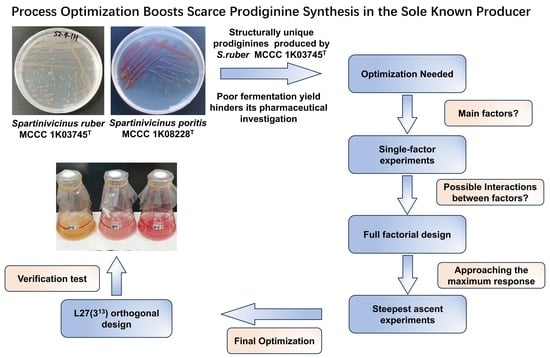
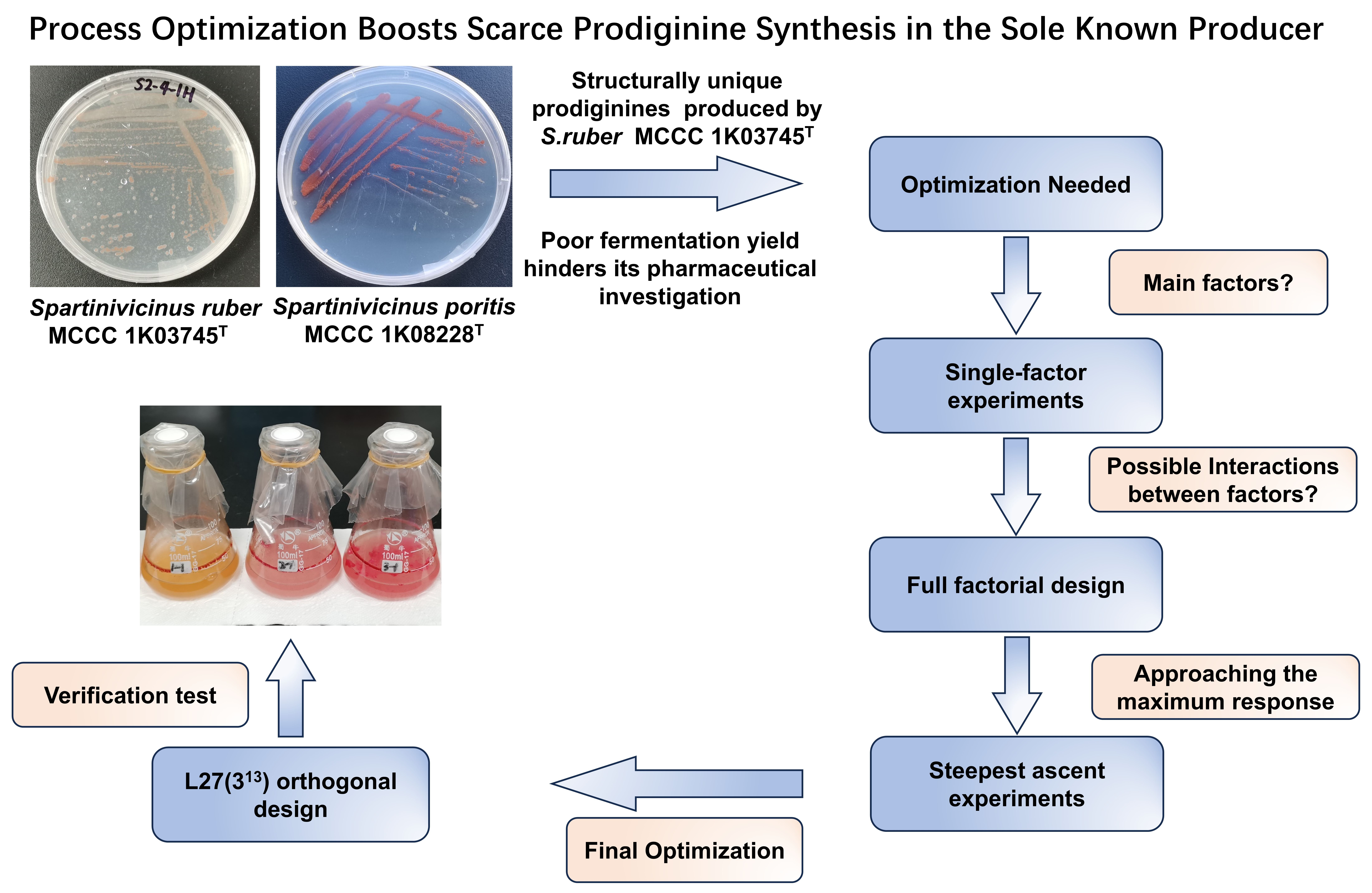
Graphical Abstract

1. Introduction

Prodiginines, a family of red pigments produced by various bacterial species, have been extensively studied for their diverse biological activities, including anticancer, antibacterial, antimalarial and immunoregulatory effects [1]. Although they share a common tripyrrole core, distinct functional groups modify the C-ring among prodiginine variants [2]. Because of their excellent inhibitory effect against numerous cancer cell lines and minimal toxicity toward normal tissues, prodiginines have attracted considerable interest in medical research [1]. Moreover, it was demonstrated that prodigiosin was not a substrate for multidrug resistance proteins, which efflux cytotoxic compounds from cancer cells and thereby confer treatment resistance [3,4,5]. These properties position prodiginines as promising scaffolds for anticancer drug development.
In our prior study, the prodiginine-producing marine bacterium Spartinivicinus ruber MCCC 1K03745T was isolated from cordgrass Spartina alterniflora sediments. Notably, this strain co-produces cycloheptylprodigiosin (S-1) and heptylprodigiosin (S-2), whose biological functions remain poorly understood [6]. We demonstrated that a panel of non-small cell lung cancer (NSCLC) cell lines with distinct genomic profiles was sensitive to S-1. In contrast to the apoptosis and autophagic death commonly induced by prodigiosin, our findings indicate that S-1 triggers a previously unrecognized cell-death pathway characterized by severe Golgi stress [7,8,9]. Although the molecular targets of S-1 and S-2 and the underlying cell-death mechanism remain elusive, these novel findings support the translational potential of further investigation of these compounds.
A major obstacle hindering in vivo investigation of the anticancer activity of S-1 and S-2 is the low fermentation titer of S. ruber MCCC 1K03745T in commercial Marine Broth 2216 (MB2216). As the only known S-1-producing strain, S. ruber MCCC 1K03745T produces a combined titer of S-1 and S-2 only approximately 5 mg/L in shake-flask fermentation. Furthermore, the cost of industrial-scale fermentation using commercial MB2216 is prohibitively high. It is therefore imperative to develop a cost-effective culture medium that yields high titers while remaining economically viable. Here, we systematically analyzed the effects of incubation time and medium composition on total prodiginine (S-1 + S-2) production. Medium composition was further optimized using an orthogonal array L27(313) design. These results provide a basis for the industrial-scale production of prodiginine by S. ruber MCCC 1K03745T.

2. Materials and Methods

2.1. Reagents

Spartinivicinus ruber MCCC 1K03745T was preserved in our lab, and it is also available from China Marine Culture Collection Center, Accession No. MCCC 1K03745. Peptone (Cat No. P8450), soya peptone (Cat No. S9500), proteose peptone (Cat No. P8960) were purchased from Solarbio (Beijing, China); yeast extract (Cat No. LP0021B) was from Oxoid (Basingstoke, UK); D(+)-glucose (Cat No. 63005518), glycerol (Cat No. 10010618), sucrose (Cat No. 10021463), MgCl2·6H2O (Cat No. 10012818) were from Sinopharm Chemical Reagent Co., Ltd. (Shanghai, China). FePO4 (Cat No. F854540) was from Macklin (Shanghai, China). Soybean oil (food-grade) was from Yihai Kerry (Shanghai, China); DIFCOTM Marine Broth 2216 medium (Cat No. 279110) was from BD (Franklin Lakes, NJ, USA).

2.2. Single-Factor Experiments

Single-factor experiments were conducted to investigate the effects of process parameters and medium composition on prodiginine production. The basal medium used throughout this study was a modified MB2216 prepared in natural seawater collected from Quanzhou Bay. The seawater was left to stand for 1 week to allow sedimentation, and the supernatant was then used for medium preparation. The basal medium contained peptone (5 g/L), yeast extract (1 g/L), and FePO4 (0.01 g/L).
The influence of two process parameters, namely fermentation time (18–48 h) and initial pH (6.0–8.0), was evaluated using this basal medium. In addition, the effects of key medium constituents were assessed individually. In these experiments, a single component was either supplemented to the basal medium or used to replace the corresponding constituent, while all other components were kept constant. The investigated factors included the following:
“Nitrogen sources: Peptone in the basal medium was replaced with an equivalent amount of other nitrogen sources (e.g., proteose peptone, soya peptone).”
“Carbon sources: Various carbon sources (e.g., glucose, glycerol, sucrose and soybean oil) were supplemented into the basal medium.”
“MgCl2·6H2O: This salt was supplemented at different concentrations.”
“Other components: The concentrations of yeast extract and FePO4 were varied individually to identify optimal levels.”
For fermentation, a single colony was used to inoculate 10 mL of MB2216 medium, and the seed culture was incubated in an orbital shaker at 35 °C and 140 rpm for 16 h. The seed culture 1% (v/v) was then transferred into 100 mL Erlenmeyer flasks containing 30 mL of the respective sterile test medium. Fermentations were carried out at 30 °C and 140 rpm for predetermined incubation time.

2.3. Factorial Design and Steepest Ascent Experiments

To identify the main factors and interactions affecting the prodiginine concentration, a full factorial design was first performed (Table 1 and Table 2). Thereafter, two sequential steepest ascent experiments (Table 3 and Table 4) were conducted to move the experimental conditions toward the region of maximum fermentation titer.

2.4. Orthogonal Design

The standard orthogonal array L27(313) was employed to evaluate potential factor interactions. Total prodiginine concentration (S-1 + S-2) was used as the response variable. The effects of medium components, including peptone, yeast extract and soybean oil were evaluated at the levels listed in Table 5. SPSS 19.0 (IBM, Armonk, NY, USA) software was used to generate the experimental design (Table 6) and to perform the data analysis.

2.5. Quantification of Prodiginines

After fermentation, the bacterial cultures were centrifugated at 5000× g for 5 min. The pellets were resuspended with acidified methanol (4% of 1 M HCl) and sonicated in a water bath for 20 min. After centrifugated at 6000× g for 5 min, the supernatants were collected and adjusted to indicated volumes. The optical density of the extracts was measured at 535 nm using an Infinite M200 Pro microplate reader (Tecan, Männedorf, Switzerland).
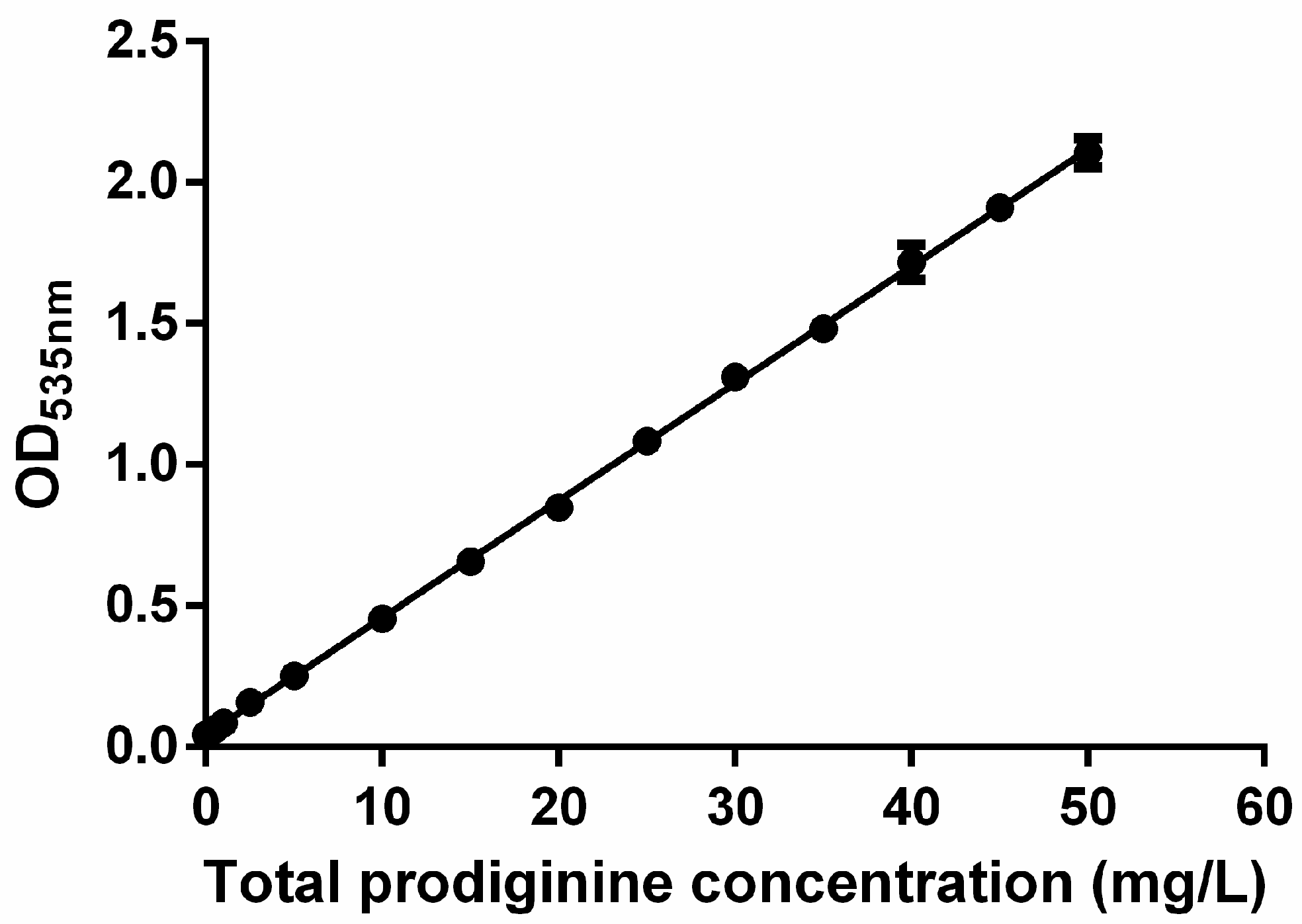
According to previous report [6], the ratio of S-1 to S-2 produced by S. ruber MCCC 1K03745T is approximately 1:1.5. Therefore, a series of mixed working standards containing purified S-1 and S-2 at this ratio were prepared to construct the calibration curve. Each concentration point was measured in triplicate, and data are expressed as mean ± standard deviation (SD, n = 3). The calibration curve showed excellent linearity over the concentration range of 0–50 mg/L, with a correlation coefficient (R2) of 0.9986 (Figure 1). OD535nm values of the fermentation samples were converted to concentrations using this calibration curve.

2.6. Statistical Analysis

Quantitative data are presented as means ± SD (n = 3). Statistical analysis was performed using one-way Analysis of Variance (ANOVA) followed by the Holm–Sidak post hoc test for multiple comparisons. A p-value < 0.05 was considered to be statistically significant.

3. Results

3.1. Effects of Single Factors on Fermentation Titer

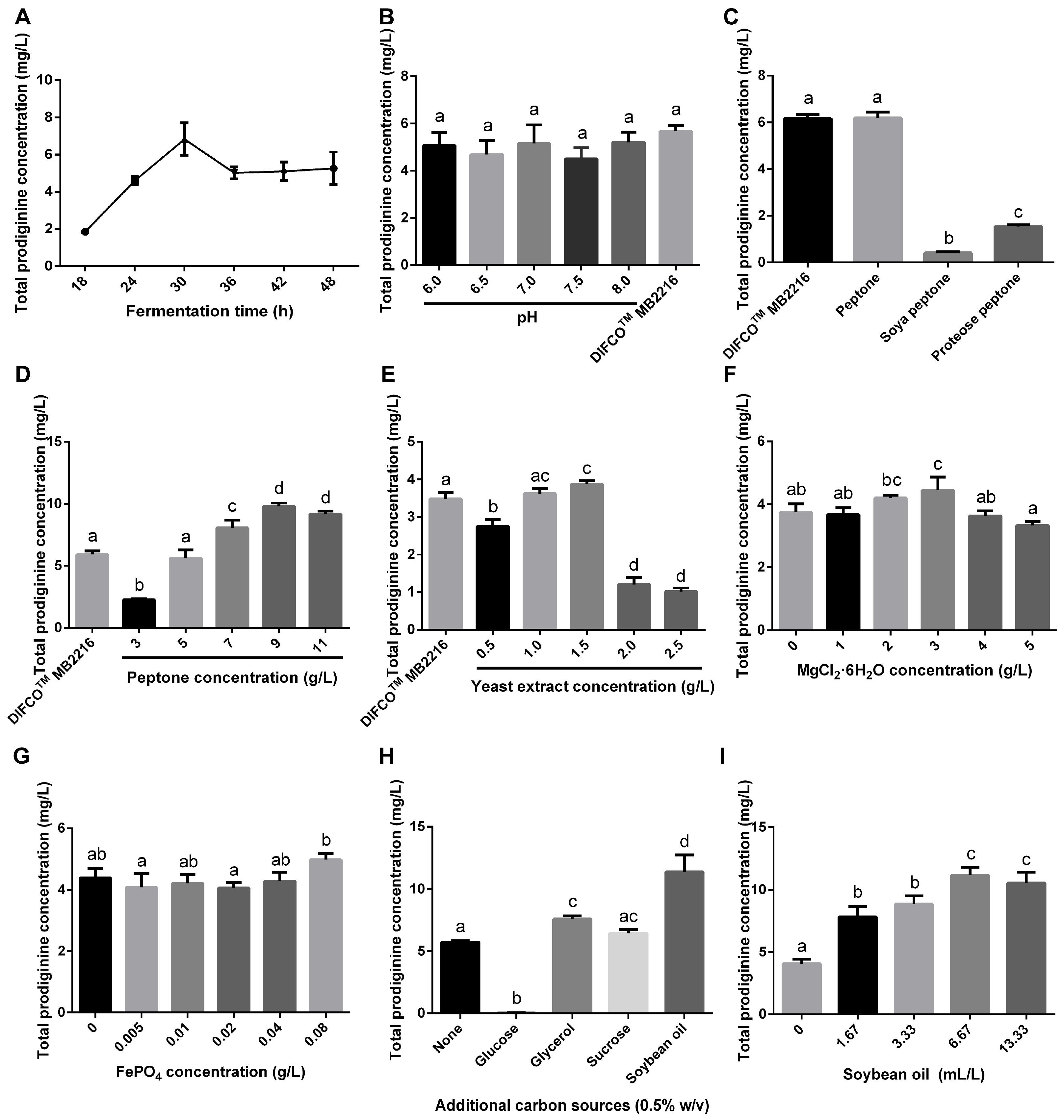
The effects of fermentation parameters and medium composition are presented in Figure 2. As shown in Figure 2A, the total prodiginine concentration in the modified MB2216 medium gradually increased after inoculation and reached its peak at 30 h. Therefore, 30 h post inoculation was selected as the standard fermentation time in subsequent experiments.
Because the initial pH of medium can influence fermentation performance, a series of pH values ranging from 6.0 to 8.0 were tested. As illustrated in Figure 2B, no significant difference in prodiginine concentration was observed within this pH range. Thus, an initial pH of 7.6-consistent with the manufacturer’s recommendation for DIFCOTM MB2216-was adopted.
To select an optimal nitrogen source for a cost-effective modified medium, three nitrogen sources were evaluated using the modified MB2216 composition (nitrogen source, 5 g/L; yeast extract, 1 g/L; FePO4, 0.01 g/L; initial pH 7.6). As shown in Figure 2C, peptone supported the highest prodiginine concentration, comparable to that obtained in commercial MB2216. To further determine the effect of peptone concentration, various levels were tested. As depicted in Figure 2D, peptone had a pronounced effect on prodiginine production, with the maximum concentration (9.80 mg/L) achieved at 9 g/L.
Yeast extract, a common component of bacterial fermentation media, provides not only nitrogen but also vitamins and trace elements. As shown in Figure 2E, the yeast extract concentration influenced prodiginine level, with higher concentrations inhibiting its synthesis. Magnesium and iron are typical enzyme cofactors, and their effects on prodiginine production were also investigated. As illustrated in Figure 2F, supplementation of MgCl2·6H2O at 3 g/L significantly increased the prodiginine concentration to 1.19-fold that of the modified MB2216 medium. In contrast, supplementation with additional FePO4 did not exert a noticeable effect (Figure 2G).
Previous studies have reported that the addition of carbon sources can enhance the production of other prodiginine family members. To test whether similar effects occur in S. ruber MCCC 1K03745T, various sugar alcohols, carbohydrates and oils were examined. As shown in Figure 2H, supplementation with glycerol and soybean oil increased the prodiginine concentration to 1.32- and 1.98-fold of that obtained with modified MB2216 medium, respectively. Therefore, soybean oil was selected as the additional carbon source. To further evaluated its effect, different concentrations of soybean oil were tested. As illustrated in Figure 2I, soybean oil supplementation markedly enhanced prodiginine production, with the highest concentration (11.16 mg/L) achieved at 6.67 mL/L (v/v).

3.2. Analysis of Main Effects and Interactions by Full Factorial Design

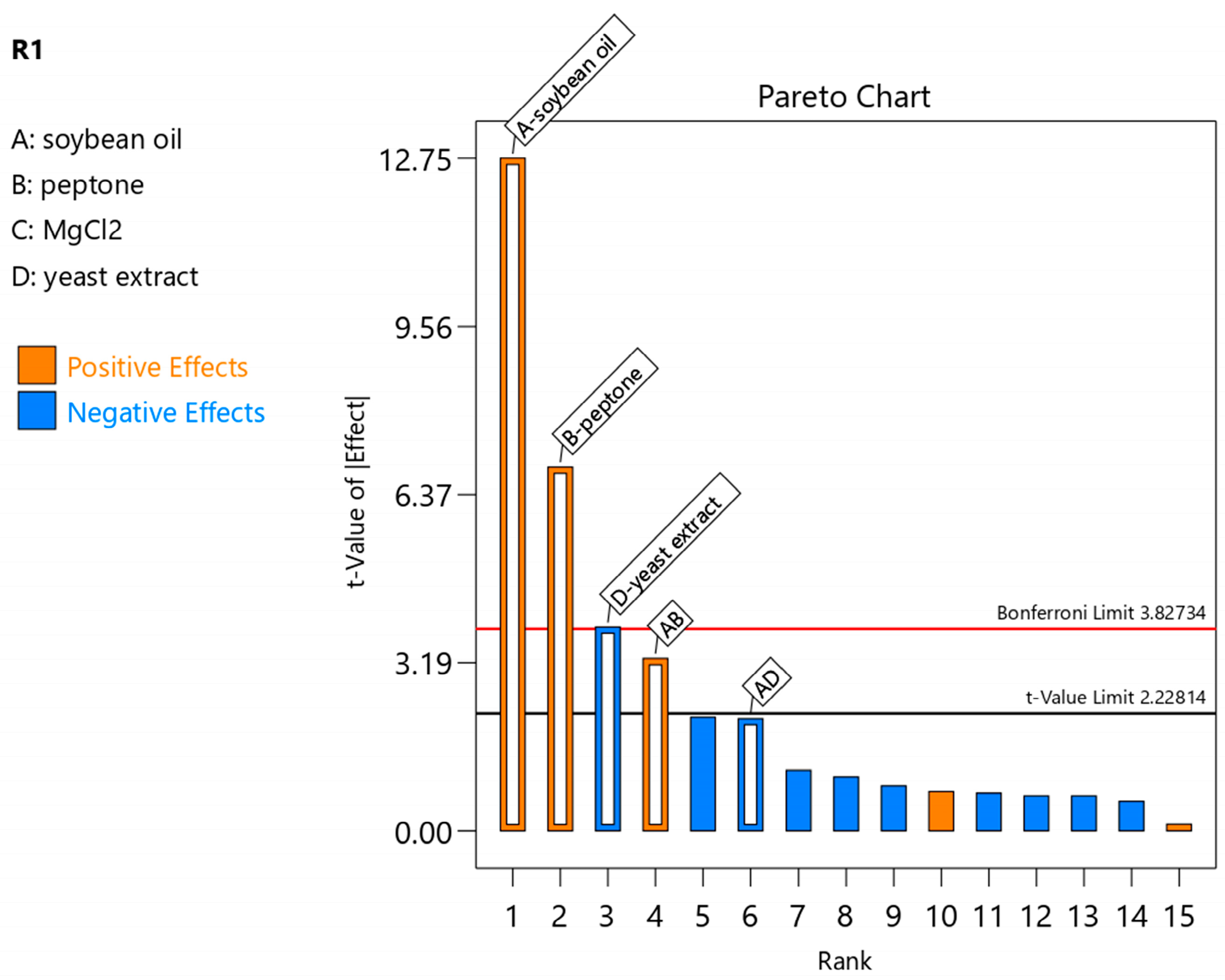
Although the single-factor experiments suggested that medium components, including peptone, yeast extract, MgCl2·6H2O and soybean oil, significantly influence prodiginine production, potential complex interactions among these factors should also be considered. Therefore, a full factorial design experiment was conducted (Table 1 and Table 2). The ANOVA for selected factorial model (Table 7) indicated that the model is significant. Soybean oil (factor A), peptone (factor B) and yeast extract (factor D) were identified as the main factors affecting prodiginine concentration. Notably, the interaction between soybean oil and peptone (AB) was significant, whereas the interaction between soybean oil and yeast extract (AD) showed marginal significance (p = 0.0593). Therefore, both AB and AD interaction terms were retained in the model. The R2, adjusted R2 and predicted R2 were 0.9600, 0.9400 and 0.8976, respectively. As shown in Figure 3, factors A, B and the interaction term AB exerted positive effects, while factor D and interaction term AD exhibited negative effects. These results suggest that soybean oil, peptone and yeast extract should be included in further optimization, whereas MgCl2·6H2O can be fixed at 3 g/L in the subsequent experiments.

3.3. Process Optimization via Sequential Steepest Ascent Experiments

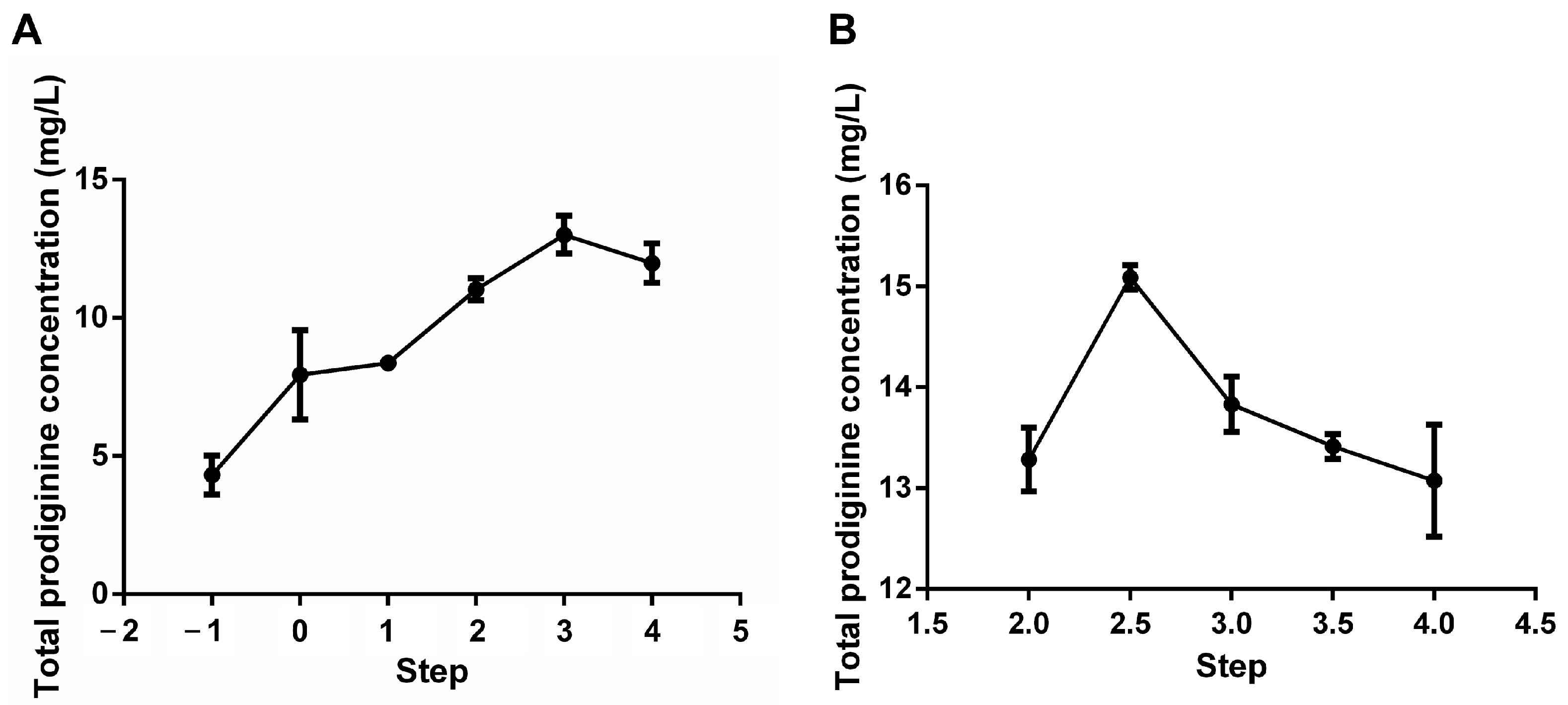
To optimize the culture medium formulation for maximizing prodiginine production, a steepest ascent experiment was first performed to approach the region of maximum response (Table 3). As shown in Figure 4A, the prodiginine concentration reached its peak at step 3. To further verify the fermentation trend and refine the step interval, a second steepest ascent experiment was conducted (Table 4). As illustrated in Figure 4B, after refinement, the peak concentration was observed at step 2.5.

3.4. Optimization of Prodiginine Production Medium by Orthogonal Design

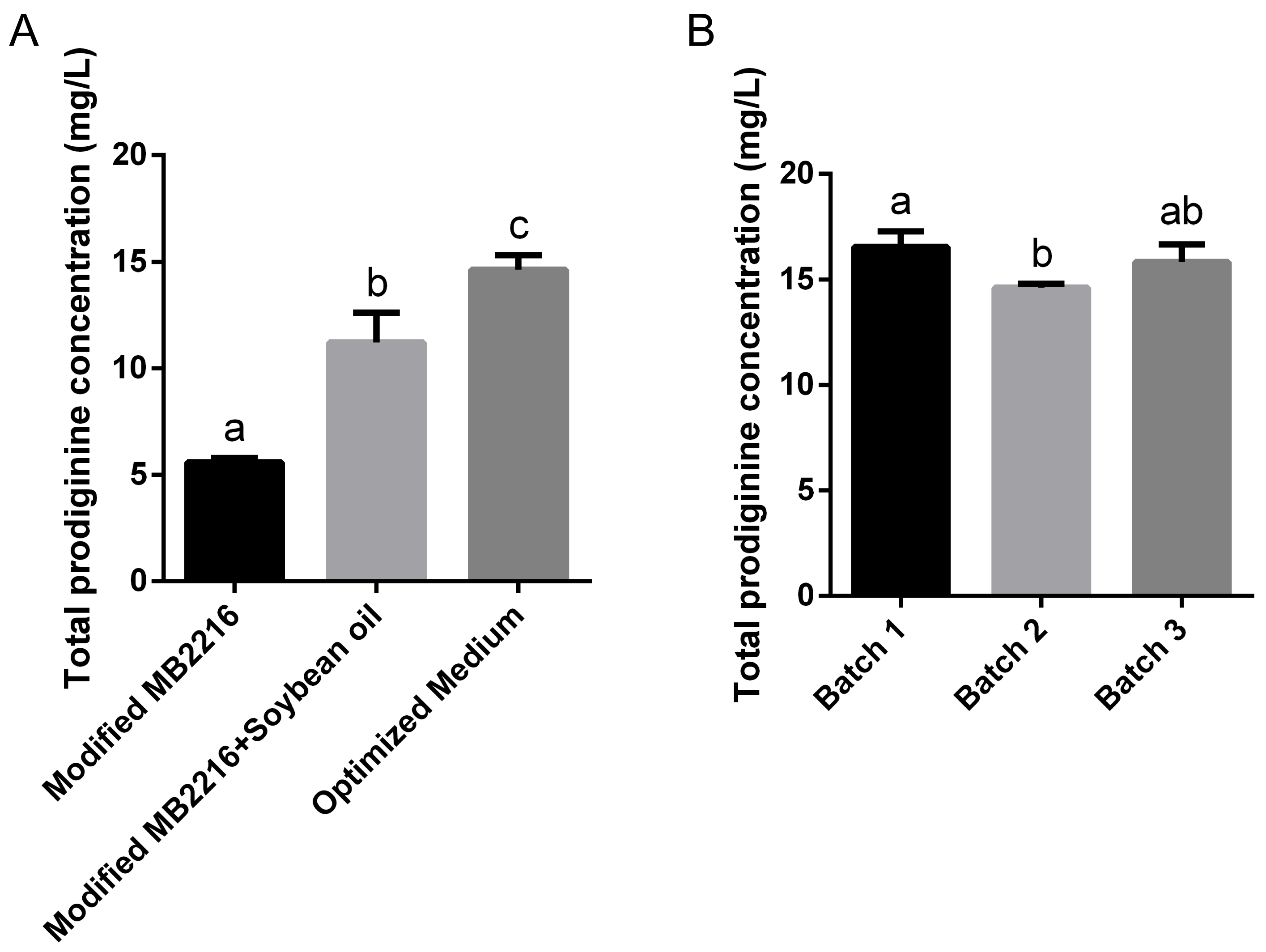
To further enhance prodiginine production, an orthogonal design (Table 5 and Table 6) was performed based on the results from the steepest ascent experiments. In the initial model, all interaction terms among the three factors were found to be non-significant and were therefore pooled into the error term. The ANOVA results of the refined model (Table 8) showed that both peptone and yeast extract significantly influenced prodiginines concentration, whereas soybean oil had no significant effect. Since the F-values followed the order FA > FB > FC, the relative importance of the three factors was peptone > yeast extract > soybean oil. Based on Duncan‘s multiple range test (Table 9, Table 10 and Table 11), the optimal medium composition was determined to be A1B3C1, corresponding to peptone 11 g/L, yeast extract 1 g/L, soybean oil 5 mL/L. A verification experiment confirmed that the fermentation concentration of prodiginines in the optimized medium reached 14.64 mg/L, representing 2.62-fold and 1.30-fold concentrations obtained from the modified MB2216 medium and MB2216 supplemented with 0.5% (w/v) soybean oil, respectively (Figure 5A).
To assess the robustness of the optimized fermentation process, the effects of batch-to-batch variation in seawater on prodiginine production were further examined. The physicochemical properties of the three seawater batches are summarized in Table A1. Although a significant overall difference was observed among the three seawater batches (p < 0.05), subsequent pairwise comparisons indicated that the prodiginine concentrations were statistically comparable between Batch 2 and Batch 3, and between Batch 1 and Batch 3. The significant difference was limited to Batch 1 and Batch 2, suggesting a generally robust fermentation process with occasional batch-to-batch variability (Figure 5B).

4. Discussion

Our previous results indicate that cycloheptylprodigiosin (S-1) represents a promising broad-spectrum drug candidate for NSCLC treatment. However, an in-depth investigation of its underlying anti-tumor mechanism in vivo requires larger quantities of S-1. Although chemical synthesis offers a potential route, the synthetic pathway is highly complex and yields are extremely low, as exemplified by the reported synthesis of prodigiosin [10]. In contrast, microbial fermentation appears to be more practical and scalable approach. Unfortunately, the only known producing strain, S. ruber MCCC 1K03745T, exhibits a very low fermentation titer. Therefore, optimization of fermentation parameters is essential to obtain sufficient amounts of S-1, which is critical for its further pharmaceutical development.
There have been numerous attempts to optimize the fermentation yield of prodiginines, particularly prodigiosin. The basic media used for prodigiosin fermentation include nutrient broth, lysogeny broth and peptone-glycerol medium [11,12,13]. To achieve higher production levels, medium compositions have been further tailored for specific prodigiosin-producing strains [14,15,16,17]. Previous studies have demonstrated that the supplementation with additional carbon sources and optimization of trace elements can promote prodigiosin biosynthesis. Moreover, some oils have been reported to significantly enhance prodigiosin production [18,19]. It has been assumed that 2-octenal, generated during fatty acid oxidation, may serve as a precursor in the prodigiosin biosynthesis pathway.
In our study, peptone was identified as the optimal nitrogen source, whereas other nitrogen sources, including soya peptone and proteose peptone, resulted in poor total prodiginine production by S. ruber MCCC 1K03745T. Although glycerol promoted prodiginine synthesis, the most effective carbon source tested was soybean oil. Regarding the effects of trace elements, two common cofactors, magnesium and iron, were examined [20,21]. While supplementation with FePO4 did not enhance total prodiginine production, the addition of magnesium markedly increased the fermentation titer. Interestingly, although yeast extract is an essential component of the fermentation medium, it appeared to inhibit prodiginine synthesis at higher concentrations.
Unlike the extensively studied prodigiosin, reports on the fermentation of S. ruber MCCC 1K03745T for total prodiginine production remain scarce. In the only two available studies, the effects of fermentation parameters and medium components on prodiginine concentration were analyzed using commercially available MB2216 as the basal medium, yielding reported concentrations of 4.86 ± 0.30 mg/L and 5.71 ± 0.12 mg/L, respectively [22,23]. However, the commercial MB2216 may not be suitable for industrial-scale production due to its high cost. In contrast, our optimized medium, priced at only CNY 4.95 per liter (Chinese yuan, RMB), represents a substantial reduction compared to CNY 68.82 per liter for the commercial DIFCOTM MB2216 (Table A2). This cost advantage demonstrates that natural seawater can serve as an effective and economical source of salinity and trace elements.
This study was initially designed to employ Response Surface Methodology (RSM) for modeling and optimizing the fermentation process. However, preliminary RSM analysis indicated that the quadratic model fitting was unsuccessful, suggesting that, within the broad ranges of the investigated factors, the process response could not be adequately approximated by a standard second-order polynomial model. Consequently, an L27(313) orthogonal experimental design was adopted. This design is recognized for its robustness and efficiency, and importantly, it allows for the analysis of interactions among factors.
Notably, although total prodiginine production by S. ruber MCCC 1K03745T was markedly enhanced after optimization via orthogonal design, the fermentation titer remained relatively low, particularly when compared with soil-derived S. marcescens, which can reach 1.14–49.5 g/L [24,25]. Interestingly, marine bacteria generally appear to produce much lower levels of prodiginines than their terrestrial counterparts. For instance, two marine strains, Hahella chejuensis KCTC 2396 and Zooshikella rubidus S1-1, synthesize prodigiosin at 0.028 g/L and 0.048 g/L, respectively [26,27]. One possible explanation is that prodiginine biosynthesis in marine bacteria is tightly regulated due to their unique growth environment, including high salinity and limited nutrient availability. A complete elucidation of the biosynthetic pathway of total prodiginine in S. ruber MCCC 1K03745T may provide insights into the fundamental differences between marine and terrestrial producers. Future work will focus on mutagenesis and screening strategies, such as transposon insertion or chemical mutagenesis (e.g., ethyl methanesulfonate [EMS] and N-methyl-N’-nitro-N-nitrosoguanidine [MNNG]), to further enhance prodiginine production and elucidate its biosynthesis and regulatory mechanisms.

5. Conclusions

The orthogonal design analysis identified peptone and yeast extract as highly significant factors (p < 0.01) affecting prodiginine production, whereas soybean oil has no significant effect. Based on ANOVA results, the optimal fermentation medium was determined to contain peptone (11 g/L), yeast extract (1 g/L), soybean oil (5 mL/L) and MgCl2·6H2O (3 g/L) in seawater. Verification experiments conducted under these conditions achieved a total prodiginine concentration of 14.64 mg/L, which is 2.62 times that obtained from modified MB2216 medium. These findings demonstrate a substantial improvement in the fermentation process and provide a foundation for cost-effective production of prodiginines.

Author Contributions

Investigation, formal analysis, conceptualization, writing—original draft, writing—review and editing, X.L.; investigation, methodology, P.W.; investigation, methodology, Y.H.; conceptualization, funding acquisition, writing—review and editing, C.D. All authors have read and agreed to the published version of the manuscript.

Funding

The project was funded by FuXiaQuan National Independent Innovation Demonstration Zone Collaborative Innovation Platform Project (2023FX0001).

Institutional Review Board Statement

Not applicable.

Data Availability Statement

The original data presented in the study are openly available in FigShare at https://doi.org/10.6084/m9.figshare.30109795.

Acknowledgments

The authors would like to thank Yanqu Information Technology Co., Ltd. (Hangzhou, China) for performing the analyses of total nitrogen (TN), total phosphorus (TP), and total organic carbon (TOC) in seawater samples.

Conflicts of Interest

The authors declare no conflicts of interest.

Appendix A

Appendix A.1

Seawater samples were analyzed for total nitrogen (TN) and total phosphorus (TP) concentrations using a BDFIA-8100 automated flow injection analyzer (BAODE, Beijing, China) in accordance with the Chinese national standards [28,29]. Total organic carbon (TOC) was measured by a TOC-L CPH analyzer (Shimadzu, Kyoto, Japan) following standard method [30]. Salinity was determined with a DLX-ARH100 portable salinity refractometer (DELIXI ELECTRIC, Shanghai, China), and pH was measured with a calibrated FE22 portable pH meter (Mettler Toledo, Columbus, OH, USA). Quantitative data are presented as means ± SD (n = 3).
Table A1. Baseline composition of the three seawater batches for Figure 5B.
Batch 1Batch 2Batch 3
TN (mg/L)1.37 ± 0.110.64 ± 0.041.10 ± 0.01
TP (mg/L)0.040 ± 0.0050.023 ± 0.0030.044 ± 0.003
TOC (mg/L)1.8 ± 0.11.3 ± 0.11.5 ± 0.1
Salinity (‰)20.4 ± 0.228.4 ± 0.323.5 ± 0.3
pH6.56 ± 0.046.37 ± 0.037.01 ± 0.04

Appendix A.2

To quantitatively evaluate the cost-effectiveness of the optimized medium, the cost per liter was calculated and compared with that of DIFCOTM MB2216. The cost per liter of optimized medium was determined based on the quantities and unit price of each ingredient. The reagent grades are listed in Table A2, and all prices were obtained from local suppliers in October 2025. All costs are expressed in Chinese Yuan (CNY) and reflect small-scale laboratory purchase prices. In October 2025, the price of DIFCO™ MB2216 dehydrated medium (500 g) was CNY 920. According to the manufacturer’s instructions, 37.4 g of the powder is required per liter of medium, resulting in a cost of CNY 68.82 per liter for DIFCO™ MB2216.
Table A2. Medium cost per liter of optimized medium.
ComponentAmount
(/L)
GradeSupplierUnit Price (CNY/g or mL)Quotation DateCost (CNY/L)
Peptone11 g-Solarbio0.400October 20254.40
Yeast extract1 g-Oxoid0.270October 20250.27
Soybean oil5 mLFoodYihai Kerry0.015October 20250.08
MgCl2·6H2O3 gAnalyticalSinopharm0.068October 20250.20
total 4.95

References

  1. Williamson, N.R.; Fineran, P.C.; Leeper, F.J.; Salmond, G.P. The biosynthesis and regulation of bacterial prodiginines. Nat. Rev. Microbiol. 2006, 4, 887–899. [Google Scholar] [CrossRef]
  2. You, Z.; Zhang, S.; Liu, X.; Zhang, J.; Wang, Y.; Peng, Y.; Wu, W. Insights into the anti-infective properties of prodiginines. Appl. Microbiol. Biotechnol. 2019, 103, 2873–2887. [Google Scholar] [CrossRef]
  3. Llagostera, E.; Soto-Cerrato, V.; Joshi, R.; Montaner, B.; Gimenez-Bonafe, P.; Perez-Tomas, R. High cytotoxic sensitivity of the human small cell lung doxorubicin-resistant carcinoma (GLC4/ADR) cell line to prodigiosin through apoptosis activation. Anticancer. Drugs 2005, 16, 393–399. [Google Scholar] [CrossRef]
  4. Soto-Cerrato, V.; Llagostera, E.; Montaner, B.; Scheffer, G.L.; Perez-Tomas, R. Mitochondria-mediated apoptosis operating irrespective of multidrug resistance in breast cancer cells by the anticancer agent prodigiosin. Biochem. Pharmacol. 2004, 68, 1345–1352. [Google Scholar] [CrossRef]
  5. Elahian, F.; Moghimi, B.; Dinmohammadi, F.; Ghamghami, M.; Hamidi, M.; Mirzaei, S.A. The anticancer agent prodigiosin is not a multidrug resistance protein substrate. DNA Cell Biol. 2013, 32, 90–97. [Google Scholar] [CrossRef] [PubMed]
  6. Huang, Z.; Dong, L.; Lai, Q.; Liu, J. Spartinivicinus ruber gen. nov., sp. nov., a Novel Marine Gammaproteobacterium Producing Heptylprodigiosin and Cycloheptylprodigiosin as Major Red Pigments. Front. Microbiol. 2020, 11, 2056. [Google Scholar] [CrossRef] [PubMed]
  7. Cheng, S.Y.; Chen, N.F.; Kuo, H.M.; Yang, S.N.; Sung, C.S.; Sung, P.J.; Wen, Z.H.; Chen, W.F. Prodigiosin stimulates endoplasmic reticulum stress and induces autophagic cell death in glioblastoma cells. Apoptosis 2018, 23, 314–328. [Google Scholar] [CrossRef]
  8. Wang, J.; Liu, H.; Zhu, L.; Wang, J.; Luo, X.; Liu, W.; Ma, Y. Prodigiosin from Serratia Marcescens in Cockroach Inhibits the Proliferation of Hepatocellular Carcinoma Cells through Endoplasmic Reticulum Stress-Induced Apoptosis. Molecules 2022, 27, 7281. [Google Scholar] [CrossRef]
  9. Lin, X.; Dong, L.; Miao, Q.; Huang, Z.; Wang, F. Cycloheptylprodigiosin from marine bacterium Spartinivicinus ruber MCCC 1K03745T induces a novel form of cell death characterized by Golgi disruption and enhanced secretion of cathepsin D in non-small cell lung cancer cell lines. Eur. J. Pharmacol. 2024, 974, 176608. [Google Scholar] [CrossRef] [PubMed]
  10. Furstner, A. Chemistry and biology of roseophilin and the prodigiosin alkaloids: A survey of the last 2500 years. Angew. Chem. Int. Ed. Engl. 2003, 42, 3582–3603. [Google Scholar] [CrossRef]
  11. Lapenda, J.C.; Silva, P.A.; Vicalvi, M.C.; Sena, K.X.; Nascimento, S.C. Antimicrobial activity of prodigiosin isolated from Serratia marcescens UFPEDA 398. World J. Microbiol. Biotechnol. 2015, 31, 399–406. [Google Scholar] [CrossRef]
  12. Kimyon, O.; Das, T.; Ibugo, A.I.; Kutty, S.K.; Ho, K.K.; Tebben, J.; Kumar, N.; Manefield, M. Serratia Secondary Metabolite Prodigiosin Inhibits Pseudomonas aeruginosa Biofilm Development by Producing Reactive Oxygen Species that Damage Biological Molecules. Front. Microbiol. 2016, 7, 972. [Google Scholar] [CrossRef]
  13. Montaner, B.; Navarro, S.; Pique, M.; Vilaseca, M.; Martinell, M.; Giralt, E.; Gil, J.; Perez-Tomas, R. Prodigiosin from the supernatant of Serratia marcescens induces apoptosis in haematopoietic cancer cell lines. Br. J. Pharmacol. 2000, 131, 585–593. [Google Scholar] [CrossRef] [PubMed]
  14. Chen, W.-C.; Yu, W.-J.; Chang, C.-C.; Chang, J.-S.; Huang, S.-H.; Chang, C.-H.; Chen, S.-Y.; Chien, C.-C.; Yao, C.-L.; Chen, W.-M.; et al. Enhancing production of prodigiosin from Serratia marcescens C3 by statistical experimental design and porous carrier addition strategy. Biochem. Eng. J. 2013, 78, 93–100. [Google Scholar] [CrossRef]
  15. Li, X.; Zhang, G.; Zhu, T.; Li, D.; Gu, Q. Strain and Culture Medium Optimization for Production Enhancement of Prodiginines from Marine-Derived Streptomyces sp. GQQ-10. J. Ocean Univ. China 2012, 11, 361–365. [Google Scholar] [CrossRef]
  16. Kim, S.J.; Lee, H.K.; Lee, Y.K.; Yim, J.H. Mutant selection of Hahella chejuensis KCTC 2396 and statistical optimization of medium components for prodigiosin yield-up. J. Microbiol. 2008, 46, 183–188. [Google Scholar] [CrossRef]
  17. Su, W.-T.; Tsou, T.-Y.; Liu, H.-L. Response surface optimization of microbial prodigiosin production from Serratia marcescens. J. Taiwan Inst. Chem. E 2011, 42, 217–222. [Google Scholar] [CrossRef]
  18. Giri, A.V.; Anandkumar, N.; Muthukumaran, G.; Pennathur, G. A novel medium for the enhanced cell growth and production of prodigiosin from Serratia marcescens isolated from soil. BMC Microbiol. 2004, 4, 11. [Google Scholar] [CrossRef]
  19. Lin, C.; Jia, X.; Fang, Y.; Chen, L.; Zhang, H.; Lin, R.; Chen, J. Enhanced production of prodigiosin by Serratia marcescens FZSF02 in the form of pigment pellets. Electron. J. Biotechnol. 2019, 40, 58–64. [Google Scholar] [CrossRef]
  20. Fiorentini, D.; Cappadone, C.; Farruggia, G.; Prata, C. Magnesium: Biochemistry, Nutrition, Detection, and Social Impact of Diseases Linked to Its Deficiency. Nutrients 2021, 13, 1136. [Google Scholar] [CrossRef]
  21. Waldron, K.J.; Rutherford, J.C.; Ford, D.; Robinson, N.J. Metalloproteins and metal sensing. Nature 2009, 460, 823–830. [Google Scholar] [CrossRef]
  22. Dong, L.; Fu, J.; Li, S.; Wang, F.; Lin, X.; Huang, Z. The Optimization of Fermentation Medium Formulation for Six Hydrogen Cycloheptane Prodigiosin (ShcPG) Production from Spartinivicinus ruber Strain S2-4-1HT in Shake-Flask Fermentation. J. Quanzhou Norm. Univ. 2023, 41, 9–18. [Google Scholar]
  23. Fu, J.; Li, S.; Dong, L.; Lin, X.; Huang, Z.; Wang, F. Optimization of Condition Parameter for Six Hydrogen Cycloheptane Prodigiosin (ShcPG) Production from Spartinivicinus ruber Strain S2-4-1HT in Shake-Flask Fermentation. Food Ind. 2024, 45, 39–44. [Google Scholar]
  24. Xia, Y.; Wang, G.; Lin, X.; Song, X.; Ai, L. Solid-state fermentation with Serratia marcescens Xd-1 enhanced production of prodigiosin by using bagasse as an inertia matrix. Ann. Microbiol. 2016, 66, 1239–1247. [Google Scholar] [CrossRef]
  25. de Araujo, H.W.; Fukushima, K.; Takaki, G.M. Prodigiosin production by Serratia marcescens UCP 1549 using renewable-resources as a low cost substrate. Molecules 2010, 15, 6931–6940. [Google Scholar] [CrossRef] [PubMed]
  26. Kim, D.; Lee, J.S.; Park, Y.K.; Kim, J.F.; Jeong, H.; Oh, T.K.; Kim, B.S.; Lee, C.H. Biosynthesis of antibiotic prodiginines in the marine bacterium Hahella chejuensis KCTC 2396. J. Appl. Microbiol. 2007, 102, 937–944. [Google Scholar] [CrossRef]
  27. Lee, J.S.; Kim, Y.S.; Park, S.; Kim, J.; Kang, S.J.; Lee, M.H.; Ryu, S.; Choi, J.M.; Oh, T.K.; Yoon, J.H. Exceptional production of both prodigiosin and cycloprodigiosin as major metabolic constituents by a novel marine bacterium, Zooshikella rubidus S1-1. Appl. Environ. Microbiol. 2011, 77, 4967–4973. [Google Scholar] [CrossRef]
  28. HJ 668-2013; Water Quality-Determination of Total Nitrogen by Flow Injection Analysis (FIA) and N-(1-naphthyl)ethylenediamine Dihydrochloride Spectrophotometry. China Environment Publishing Group Co., Ltd.: Beijing, China, 2013.
  29. HJ 671-2013; Water Quality-Determination of Total Phosphorus-Flow Injection Analysis (FIA) and Ammonium Molybdate Spectrophotometry. China Environment Publishing Group Co., Ltd.: Beijing, China, 2013.
  30. HJ 501-2009; Water Quality-Determination of Total Organic Carbon-Combustion Oxidation Nondispersive Infrared Absorption Method. China Environmental Science Press: Beijing, China, 2009.
Figure 1. Calibration curve of quantification analysis of total prodignines (y = 0.0414x + 0.0446, R2 = 0.9986). Here, x represents the concentration of the standard (mg/L), and y represents the corresponding OD535nm. The R2 value was derived from a linear regression analysis.
Fermentation 11 00629 g001
Figure 2. Effects of fermentation parameters and medium composition on the total prodiginine production by S. ruber MCCC 1K03745T. (A) Fermentation time; (B) initial pH; (C) nitrogen source; (D) peptone concentration; (E) yeast extract concentration; (F) MgCl2·6H2O concentration; (G) FePO4 concentration; (H) additional carbon source; (I) soybean oil concentration. Data are presented as means ± SD from three independent replicates. Different letters above the bars indicate significant differences (p < 0.05).
Fermentation 11 00629 g002
Figure 3. Pareto Chart of factors affecting prodiginine fermentation by S. ruber MCCC 1K03745T.
Fermentation 11 00629 g003
Figure 4. Steepest ascent experiments of prodiginine fermentation showing a peak concentration at step 2.5. (A) The first steepest ascent experiment; (B) The second steepest ascent experiment. Data are presented as means ± SD from three independent replicates.
Fermentation 11 00629 g004
Figure 5. Validation of prodiginine production by S. ruber MCCC 1K03745T under different media conditions. (A) Comparison of total prodiginine concentrations across three fermentation media. (B) Assessment of process robustness in the optimized medium using three independent seawater batches. Data are presented as means ± SD from three independent replicates. Different letters above the bars indicate significant differences (p < 0.05).
Fermentation 11 00629 g005
Table 1. Process factors and levels used in full factorial design.
FactorsLow Level (−1)High Level (+1)
A-soybean oil0 mL/L3.333 mL/L
B-peptone7 g/L11 g/L
C-MgCl2·6H2O2 g/L4 g/L
D-yeast extract1 g/L2 g/L
Table 2. Full factorial design of prodiginine fermentation by S. ruber MCCC 1K03745T.
RunA-
Soybean Oil
B-
Peptone
C-
MgCl2·6H2O
D-
Yeast Extract
Prodiginine
Concentration (mg/L)
1+1+1+1−115.22
2−1−1−1−14.15
3+1−1+1−18.55
4−1+1+1−16.52
5+1−1−1−110.14
6−1+1−1−16.09
7+1+1−1+112.37
8+1+1−1−114.06
9−1−1−1+13.57
10+1+1+1+110.05
11−1+1−1+16.14
12−1+1+1+14.40
13+1−1+1+17.58
14−1−1+1−14.69
15−1−1+1+14.25
16+1−1−1+17.29
Table 3. Process factors and levels used in the first steepest ascent experiment.
StepA-Soybean Oil
(mL/L)
B-Peptone
(g/L)
D-Yeast Extract
(g/L)
−108.001.667
01.6679.001.500
13.33310.001.333
25.00011.001.167
36.66712.001.000
48.33313.000.833
Table 4. Process factors and levels used in the second steepest ascent experiment.
StepA-Soybean Oil
(mL/L)
B-Peptone
(g/L)
D-Yeast Extract
(g/L)
25.00011.0001.167
2.55.83311.5001.083
36.66712.0001.000
3.57.50012.5000.917
48.33313.0000.833
Table 5. Factors and levels used in Orthogonal design.
LevelFactors
A-Peptone (g/L)B-Yeast Extract (g/L)C-Soybean Oil (mL/L)
111.01.1675.000
211.51.0835.833
312.01.0006.667
Table 6. The L27(313) orthogonal design for prodiginine production.
RunFactorsProdiginine Concentration (mg/L)
ABA × BA × BCA × CA × CB × CBlankBlankB × CBlankBlank
1111111111111114.82
2111122222222215.14
3111133333333313.10
4122211122233315.25
5122222233311115.20
6122233311122215.68
7133311133322215.46
8133322211133316.40
9133333322211115.27
10212312312312314.49
11212323123123112.16
12212331231231211.90
13223112323131215.26
14223123131212315.15
15223131212323114.22
16231212331223113.75
17231223112331215.38
18231231223112315.56
19313213213213210.54
2031322132132139.60
21313232132132111.55
22321313221332112.57
23321321332113211.90
24321332113221310.42
25332113232121314.39
26332121313232113.26
27332132121313212.79
Table 7. Analysis of Variance (ANOVA) for the full factorial model.
SourceSum of SquaresdfMean SquareF-Valuep-Value
Model190.86 a538.1748.02<0.0001significant
A-soybean oil129.161129.16162.48<0.0001significant
B-peptone37.79137.7947.54<0.0001significant
D-yeast extract11.85111.8514.900.0032significant
AB8.4718.4710.660.0085significant
AD3.6013.604.520.0593
Residual7.95100.7949
Cor Total198.8115
a. R2 = 0.9600; adjusted R2 = 0.9400; predicted R2 = 0.8976.
Table 8. Analysis of Variance (ANOVA) for the orthogonal design model.
SourceType III Sum of SquaredfMean SquareF StatisticSignificance
Corrected Model73.200 a612.20014.056<0.001
Intercept5103.52515103.5255880.081<0.001
A-peptone50.530225.26529.110<0.001
B-yeast extract20.606210.30311.871<0.001
C-soybean oil2.06421.0321.1890.325
Error17.359200.868
Total5194.08427
Corrected Total90.55926
a. R2 = 0.808; adjusted R2 = 0.751.
Table 9. Duncan’s multiple range test for factor A (peptone) a.
LevelNSubset
123
3911.8911
29 14.2080
19 15.1462
a. α = 0.05.
Table 10. Duncan’s multiple range test for factor B (yeast extract) a.
LevelNSubset
12
1912.5883
29 13.9606
39 14.6964
a. α = 0.05.
Table 11. Duncan’s multiple range test for factor C (soybean oil) a.
LevelNSubset
1
3913.3872
2913.7995
1914.0586
a. α = 0.05.
Disclaimer/Publisher’s Note: The statements, opinions and data contained in all publications are solely those of the individual author(s) and contributor(s) and not of MDPI and/or the editor(s). MDPI and/or the editor(s) disclaim responsibility for any injury to people or property resulting from any ideas, methods, instructions or products referred to in the content.