Article

Enhanced Enzyme Production and Probiotic Viability in Oilseed Cakes Fermented with Bacillus subtilis for Piglet Nutrition


by
Mihaela Dumitru
1,*,
Dan-Traian Râmbu
1,2,
Georgeta Ciurescu
1,
Gabriela Maria Cornescu
1 and
Tatiana Dumitra Panaite
1
1
Laboratory of Animal Nutrition and Biotechnology, National Research Development Institute for Animal Biology and Nutrition, Calea Bucuresti No. 1, 077015 Balotesti, Romania
2
Faculty of Biotechnology, University of Agricultural Sciences and Veterinary Medicine, 011464 Bucharest, Romania
*
Author to whom correspondence should be addressed.
Fermentation 2025, 11(11), 607; https://doi.org/10.3390/fermentation11110607
Submission received: 8 September 2025 / Revised: 20 October 2025 / Accepted: 21 October 2025 / Published: 24 October 2025

Abstract

The growing consumption of oilseed-pressed cakes (OSCs), a largely underutilized feedstock, plays a significant role in animal feed. The study evaluates the use of three OSCs—flax (FSC), pumpkin (PSC), and hemp (HSC)—as substrates for Bacillus subtilis ATCC 6051a (BS) in a solid-state fermentation (SSF) to enhance enzyme production and probiotic viability. The SSF process was assessed to evaluate the microbial growth, sporulation efficiency, enzymatic activity (protease, cellulase, xylanase, and phytase), and in vitro digestibility of fermented substrates. The results indicate that bacterial growth and sporulation varied significantly among substrates (p < 0.05). FSC presents the highest spore resistance (86.52%), followed by PSC (82.87%) and HSC (81.29%). Notably, protease was highest in HSC (184.67 U/g), while FSC supported maximum cellulase activity. HSC exhibited superior xylanase (1.86 ± 0.043 U/g DW, p < 0.05) and phytase production, while pH analysis indicated a shift toward alkalinity in PSC and HSC due to proteolytic activity. FSC maintained the most stable bacterial population during digestion, suggesting its potential as a probiotic carrier. These findings highlight that fermentation of OSCs with BS improved their nutritional value and can be used as a sustainable solution in feeding programs for piglets.

1. Introduction

Spore-forming Bacillus spp. probiotics have received considerable scientific and commercial interest due to their ability to serve as natural protective shields against pathogenic infections, ultimately enhancing animal health, boosting productivity, and ensuring improved product safety [1]. Bacillus species are widely distributed in nature and exhibit remarkable adaptability to diverse environmental conditions. The presence of spores possesses exceptional resistance to harsh environmental stresses, ensuring a prolonged shelf life and the ability to remain viable in a dehydrated state [2]. Notably, Bacillus spores can survive the acidic environment of the stomach, allowing the entire dose of ingested live bacteria spores to reach the small intestine. This resilience enables them to germinate and exert probiotic effects within the gastrointestinal tract (GIT) [3]. In addition, in their vegetative form, Bacillus spp. produce a variety of extracellular enzymes (proteases, cellulases, xylanases, phytase, pectinases, and lipases). These enzymes play a crucial role in enhancing nutrient digestibility and absorption, as well as supporting overall gut immune function. For instance, Bacillus subtilis is known to produce industrially significant enzymes such as α-amylase, xylanase, lipase, cellulase, and pectinase [4]. Additionally, studies have demonstrated that enzyme supplementation in animal feed can improve the digestibility and absorption of nutrients from vegetable and animal-derived ingredient sources, thereby increasing growth parameters and supporting health [5,6]. Moreover, the production of these enzymes by Bacillus spp. has been linked to beneficial effects on the host’s immune system, further highlighting their potential as probiotics [3].
It is well known that animal feeding is based on meeting the animal’s nutritional requirements for optimal production [7]. However, with the rapid advancements in animal farming, ensuring balanced nutrition has become even more critical. These changes demand a comprehensive evaluation of feeding strategies, focusing not only on meeting the specific nutritional needs of animals but also on integrating cost-effective technologies to enhance efficiency and sustainability.
The growing interest in agro-industrial by-product valorization has been highlighted by solid-state fermentation (SSF) as an efficient and sustainable biotechnological process. Regarding this, SSF is a microbial process carried out on moist solid substrates with limited water availability, where water activity (Aw) and moisture content are the key factors influencing microbial growth and enzyme production [8]. Among these by-products, oilseed cakes (OSCs) have emerged as promising substrates for SSF due to their nutrient composition and the capacity to retain adequate moisture for microbial growth. This process not only facilitates enzyme production but also offers several advantages, including stable pH conditions, controlled moisture levels, and enhanced nutrient bioavailability [9]. Moreover, SSF provided a wide range of value-added products like feed additives, enzymes, animal feed, biofertilizers, and biofuels [10].
SSF is inherently a heterogeneous system in which the moisture level and Aw strongly influence substrate accessibility, oxygen transfer, and enzyme secretion. A key study on wheat bran SSF showed that enzymes produced during fermentation significantly modify the substrate’s structural and bioactive properties [11]. Variations in moisture content and fermentation time directly affect enzyme activity, emphasizing the importance of precise process control [12].
Therefore, this study aimed to evaluate the performance of Bacillus subtilis ATCC 6051a (BS) during the SSF of three OSCs (hemp, pumpkin, and flax). Specifically, the research focused on assessing the effects of the substrate composition on BS growth, sporulation efficiency, and pH evolution throughout fermentation. In addition, the cumulative enzymatic activities (protease, cellulase, xylanase, and phytase) were quantified to determine the bioconversion potential of each substrate. Finally, the bacterial viability and spore resistance of BS in wet- and dried-fermented substrates, as well as its in vitro GIT survival, were analyzed to evaluate its potential as a probiotic feed additive for piglets.

2. Materials and Methods

2.1. Microorganism and Vegetable Material Source

The microorganism used in the present study was Bacillus subtilis ATCC 6051a (BS) acquired from the American Type Culture Collection (Manassas, VA, USA). The wild strain was maintained in the Intern culture Collection of the National Research Development Institute for Biology and Animal Nutrition (IBNA—Balotesti), Romania, under the code IBNA 70.
Hempseed (Cannabis sativa L.) cake was provided by Canah International S.R.L. (Bihor, Romania), while pumpkin (Cucurbita spp.) and flaxseed (Linum usitatissimum L.) cakes were supplied by Dachim S.R.L. (Cluj Napoca, Romania), both as by-products resulting from oil cold-pressing production processes. The substrates were ground into fine powder.

2.2. Chemical Composition

The chemical composition of OSCs was analyzed based on the Official Methods of Analysis of AOAC International [13]. Dry matter was determined gravimetrically by the drying oven method at 105 °C (AOAC 925.09), crude protein was determined by the Kjeldahl method (AOAC 979.09) using Kjeltec auto 1030 system (FOSS Analytical A/S, Hillerød, Denmark). Crude fat was determined gravimetrically by organic solvent extraction (AOAC 920.39) using a Soxtec 2055 Soxhlet extractor (FOSS Analytical A/S, Hillerød, Denmark). Ash content was assayed gravimetrically by calcination in an oven at 600 °C (AOAC 923.03). Crude fiber was quantified by successive hydrolysis in an alkali and acid environment (AOAC 962.09). Neutral detergent fiber (NDF) and acid detergent fiber (ADF) content was determined by Van Soest extraction using a Raw Fiber Extractor FIWE 6 (Velp Scientifica, Usmate, Italy) [14]. Hemicellulose was calculated by the difference between NDF and ADF on a DM basis and acid detergent lignin (ADL) was determined on the ADF residue (AOAC 973.18). Cellulose was obtained by difference as ADF-ADL, calculated on a DM basis.

2.3. Solid-State Fermentation (SSF) Conditions

Fermentation experiments with BS were conducted in 500 mL Erlenmeyer flasks (50 g of each OSC substrate) moistened with 80 mL of distilled water (% w/v) to achieve a final substrate moisture of 65 % (w/w). The substrates were sterilized by autoclaving at 121 °C, 15 min at 15 lb/in2 to eliminate indigenous microorganisms and prevent undesirable spontaneous fermentation. After cooling to room temperature, each flask was inoculated with 10 mL of fresh BS inoculum, grown in nutrient broth up to the log phase (20 h, DO600 of 1.65; 8.32 × 10⁹ cfu/mL). The inoculated flasks were thoroughly mixed with the substrate using a sterile spatula to ensure uniform distribution and incubated at 37 °C for 72 h under static conditions. During incubation, the flasks were mixed twice daily to maintain substrate homogeneity. After fermentation, samples were freeze-dried (Alpha 1-4 LSC basic, Martin Christ, Osterode am Harz, Germany; −50 °C, 0.110 mbar, 18 ± 2 h), ground to a fine powder, and then stored at +4 °C in a Ziplock bag until analysis. The fermentation batches were performed in triplicate.

2.4. Inoculum Preparation

Frozen BS stock culture stored at −80 °C was reactivated in nutrient broth medium (g/L: tryptone 10; meat extract 5.0; sodium chloride 5.0; pH 7.2 ± 0.2 before autoclaving). After three successive passages on nutrient agar (g/L: tryptone 5.0; meat extract 3.0; bacteriological agar 5.0; distilled water), a fresh culture was obtained and incubated overnight in a rotary shaker incubator (22 ± 2 h, 37 °C, 150 rpm, aerobically). The viable cell concentration was determined by serial 10-fold dilutions in 0.85% sterile saline solution (SFS, w/v), followed by surface plating of 1 mL from 10−8 to 10−12 on nutrient agar. After incubation, colonies were counted to determine the viable cell number (CFU/mL).

2.5. Moisture Content, Vegetative Cells, Spores’ Resistance, and pH Value

2.5.1. Moisture Content and Dry Weight Evaluation

The moisture content of OSCs was determined in triplicate using a standard hot air oven, following the method of the AOAC (2016). Approximately 5 g of each OSC was weighed using an electronic balance in pre-dried and pre-weighed Petri dishes. The dishes were transferred and dried in a hot air oven at 105 ± 1 °C for 17 ± 1 h. After cooling, the dishes with dried samples were reweighed. Drying was continued (105 ± 1 °C, 1h) until the difference between two consecutive weighing was less than 0.1 mg. The moisture content was estimated on a wet basis (%, w/w) using the formula:
M = (Wi − Wf)/Wi × 100, where: M = moisture content (%, wet basis)
Wi = mass of sample until drying (g)
Wf = mass of sample after drying (g)
For the fermentation process, the substrate moisture was adjusted to approximately 65% (w/w), which supports optimal BS growth and enzyme secretion during SSF. All analyses were performed at 72 h, based on preliminary tests showing that pH and enzymatic activity stabilized at this time point.

2.5.2. Bacterial Viability

Approximately 1 g of the dried and wet sample of SSF (72 h) was taken and diluted with sterile distilled water (DW) at a 1:10 (w/v) ratio. The suspension was homogenized in a stomacher blender (BagMixer, Interscience, Saint-Nom-la-Bretèche, France) for 1 min at room temperature [15]. For the determination of the viable cell number, 1 mL of supernatant was sampled and serially diluted in 0.85% SFS (w/v), and 0.1 mL was plated on selective media (nutrient agar). The results were expressed as log cfu/g after 24 h of incubation at 37 °C.

2.5.3. Spores’ Resistance

Spore number was assayed at 72 h, with 1 mL of the supernatant consisting of vegetative cells; the Bacillus spores were diluted 10-fold in 0.85% SFS, followed by incubation for 15 min at 80 °C and plated on nutrient agar [12]. Spore numbers were determined after incubation at 37 °C for 24 h. Results were expressed similarly to the bacterial viability assay.

2.5.4. pH Measurement

The pH of the SSF samples was determined at 0, 24, 48, and 72 h from the supernatant using a digital pH meter (pH 1100 L + VWR, XS Instruments, VWR International GmbH, Darmstadt, Germany) at room temperature. The final pH value represents the average of three readings.

2.6. Enzymatic Extract

After 72 h of fermentation, the enzymes produced via SSF were extracted. The crude enzymatic extract (EE) was prepared by adding 5 g of each fermented OSC substrate (the entire flask homogenization was performed using a sterile spatula for 5 min) and 35 mL of DW in the stomacher plastic bags (150 rpm, 2 min at room temperature). The liquid portion from this shaking, which contained EE, was collected and used to determine enzymatic activity [16].
In the SSF experiments, the values of enzymatic activity (protease, cellulase, xylanase, and phytase) were determined based on calibration curves and expressed in units per gram of dry substrate (U/g DW), representing the enzymatic activity to the dry weight of the fermented material. Linear regression equations (y = ax + b) with correlation coefficients (R2 > 0.99) were used to determine the enzymatic activity concentration (see Supplementary Material, Figures S1–S4).

2.6.1. Protease Activity

Protease activity was measured using casein as a substrate [17]. The reaction mixture contained 1 mL of EE and 5 mL of 0.65% (w/v) casein solution dissolved in 0.1 M Tris-HCl buffer (pH 8.5). The mixture was incubated at 37 °C for 20 min and vortexed for 1 min. The reaction was stopped with 5 mL of 10% (w/v) trichloroacetic acid (TCA). The solution was allowed to stand at 37 °C for 20 min to ensure complete precipitation of undigested protein, and then the mixture was filtered through Whatman No. 1 filter paper. For colorimetric analysis, 2 mL of the filtrate was mixed with 5 mL of sodium bicarbonate (0.4 M) and 1 mL of Folin–Ciocalteu reagent (0.5 M), followed by incubation at 37 °C for 30 min. The absorbance was measured at 660 nm by using a UV–VIS spectrophotometer (UV-basic, Eppendorf, Germany). A standard curve was prepared using L-tyrosine (0–100 µg/mL) under the same conditions. One unit (U) of protease activity was defined as the amount of enzyme that releases µmol of tyrosine per min under the assay conditions. Protease activity was calculated using the formula:
Protease   activity   ( U / mL )   =   ( µ m o l   T y r . s a m p l e µ m o l   T y r . B l a n k ) × t o t a l   v o l u m e   o f   a s s a y v o l u m e   o f   e n z y m e   u s e d × l e n g t h   o f   a s s a y × v o l u m e   u s e d   i n   c o l o r i m e t r i c   t e s t
The protease activity was normalized to the DW of fermented substrate and was expressed as units per gram of dry substrate (U/g DW). All assays were carried out in triplicate.

2.6.2. Cellulase Activity

The cellulase activity was measured based on estimating the amount of reducing sugars released from carboxymethyl cellulose (CMC, Sigma, St. Louis, MO, USA) using the 3,5-dinitrosalicylic acid (DNS) assay [18]. The reaction mixture consisted of 0.1 mL of EE and 0.9 mL of 1% CMC (w/v) prepared in 0.1 M Tris-HCl buffer (pH 7.0). The mixture was incubated at 37 °C for 1 h. The reaction was stopped by adding 1.5 mL of DNS reagent (1 g DNS, 16 g NaOH, 300 g potassium sodium tartrate, and distilled water up to 1 L), followed by boiling in a water bath for 5 min and immediately cooled under flowing water. The final volume of each reaction mixture was then adjusted to 5 mL with distilled water and left at room temperature for 20 min before measuring the absorbance at 540 nm UV–VIS spectrophotometer (Basic, Eppendorf, Hamburg, Germany). Glucose was used as a standard reference to determine the amount of reducing sugars released.
One unit (U) of cellulase activity was defined as the amount of enzyme able to release 1 µmol of reducing sugars (glucose equivalent) per mL of crude EE per minute under standard assay conditions. Calculation of cellulase activity was carried out with the formula:
Cellulase   activity   ( U / mL )   =   ( µ m o l   r e d u c i n g   s u g a r   i n   s a m p l e µ m o l   r e d u c i n g   s u g a r   i n   b l a n k ) × t o t a l   a s s a y   v o l u m e v o l u m e   o f   e n z y m e   u s e d × r e a c t i o n   t i m e × v o l u m e   u s e d   i n   c o l o r i m e t r i c   d e t e r m i n a t i o n
The calculated cellulase activity was estimated to the DW of fermented substrate and expressed as U/g DM. All measurements were performed in triplicate.

2.6.3. Xylanase Activity

Xylanase activity was determined after 72 h using 1% (w/v) bench wood xylan (Sigma-Aldrich) as the substrate [19]. The reaction mixture contained 0.2 mL of EE and 1.8 mL of substrate prepared in citrate buffer (0.05 M, pH 5.3). The mixture was incubated at 50 °C for 5 min and then cooled under flowing water. After incubation, the reaction was stopped by the addition of 3 mL of DNS reagent, followed by heating in a boiling water bath (100 °C) for 5 min. After cooling, the solution volume was adjusted to 10 mL with distilled water, mixed well, and left at room temperature for 20 min. The absorbance was measured at 540 nm using a UV–VIS spectrophotometer (Eppendorf, Germany).
One unit (U) of enzyme activity was defined as the amount of enzyme required to produce 1 µmol of reducing sugar (expressed as xylose equivalents) per minute under standard assay conditions. Results were presented as U/mL under the conditions described. Units were calculated by using the following formula:
Xylanase   activity   ( U / mL )   =   r e d u c i n g   s u g a r   r e l e a s e d   ( µ m o l s ) t i m e   o f   i n c u b a t i o n m i n × v o l u m e   o f   e n z y m e   u s e d   ( m L )
The final results of xylanase activity were estimated to the DW of fermented substrate and expressed as U/g DM. All measurements were performed in triplicate.

2.6.4. Phytase Activity

The presence of phytase was determined at 72 h using sodium phytate as the substrate. The reaction mixture consisted of 0.1 mL EE homogenized with 0.4 mL sodium phytate (6.2 mM, 2 mM CaCl2, in 0.1 mM Tris-HCl buffer, pH 7.0) for 30 min at 37 °C. The reaction was stopped by adding 0.5 mL TCA (5%, w/v), followed by the addition of 0.5 mL color reagent (5 parts—10% ascorbic acid in 1 M H2SO4 and 1 part—5% ammonium molybdate in ultrapure water) [20]. The mixture was incubated for 1 h at 37 °C; the color intensity was read at 655 nm against a sample blank.
One unit of phytase activity (U) is defined as the amount of phytase that generates 1.0 μg of inorganic phosphorus in 1 min under standard assay conditions and was calculated as follows:
Phytase   activity   ( U / mL )   = ( µ m o l   r e d u c i n g   s u g a r   i n   s a m p l e µ m o l   r e d u c i n g   s u g a r   i n   b l a n k ) × t o t a l   a s s a y   v o l u m e v o l u m e   o f   e n z y m e   u s e d × r e a c t i o n   t i m e × v o l u m e   u s e d   i n   c o l o r i m e t r i c   d e t e r m i n a t i o n
The phytase activity was normalized to the DW and was expressed as U/g DM.

2.7. In Vitro Digestion Under Simulated Conditions

The in vitro gastrointestinal (GI) digestion simulation model was performed following the methods presented by Râmbu et al. [12], accordingly to a standardized protocol (INFOGEST 2.0) [21]. The in vitro digestion portion consisted of three phases, which included oral, gastric, and intestinal stages. Briefly, in the oral stage, 2.5 g of sample was first mixed with 2.5 mL of distilled water and 5 mL simulated oral solution containing 750 U α-amylase at 37 °C, 2 min at pH 7.0. Gastric stage: The oral bolus was mixed with 10 mL of simulated gastric solution containing 40,000 U pepsin at 37 °C, 2 min at pH 3.0. pH was controlled at 3.0 using HCl 5M. Intestinal phase: The gastric chyme was mixed with 20 mL simulated intestinal solution containing 32 mg/mL pancreatin [22] and 24 mg/mL bile salts at 37 °C, 2 min at pH 7.0 [23]. pH was controlled at 7.0 using NaOH 5 M. Samples were taken at different points of the digestion: gastric 1 h (G1), gastric 2 h (G2), intestinal 1 h (I1), and intestinal 2 h (I2). Distinct digestion flasks were prepared at each time point. At the end of the prescribed time, samples were taken and immediately diluted and plated for the viability assay.

2.8. Statistical Analysis

Data represent the means of triplicate experiments ± standard deviations (SD). Statistical analysis was performed using one-way ANOVA followed by Tukey’s test with the GLM procedure of SPSS, version 20.0 (SPSS Inc., Chicago, IL, USA). Differences were considered significant at p < 0.05. The results were calculated on a dry basis (DW). Graphics were prepared using Prism-GraphPad v. 9.1.2 (Boston, MA, USA).

3. Results

3.1. Chemical Composition

The chemical composition of OSCs is presented in Table 1. Our cakes had high protein content (32.54–45.28% DM), as expected for cold press extraction, a mechanical process based on lipids expelling and proteins concentrating in the press cakes. FSC presented the highest residual fat (18.82 ± 0.02%), followed by PSC and HSC. Crude fiber (CF) ranged from 10.45% (FSC) to 31.19% (PSC). The NDF and ADF OSC content are in the range of 27.33–45.28%, respectively, 13.98–29.88% (DM). Regarding ash content, OSCs showed low values, which vary between 4.10 and 7.00%. On the other hand, hemicellulose (NDF-ADF) differed significantly (PSC 15.68 ± 0.23%, FSC 13.34 ± 0.55%, HSC 11.59 ± 0.55%). HSC had the highest ADL value, followed by FSC and PSC. Cellulose (ADF-ADL) contributes to a structural matrix rigidity and varies widely among OSCs, with PSC having the highest value (27.51 ± 1.04%), HSC intermediate (16.67 ± 0.07%), and FSC lowest (6.58 ± 1.17%).

3.2. Solid-State Fermentation, Microbial Growth, and Spore Resistance

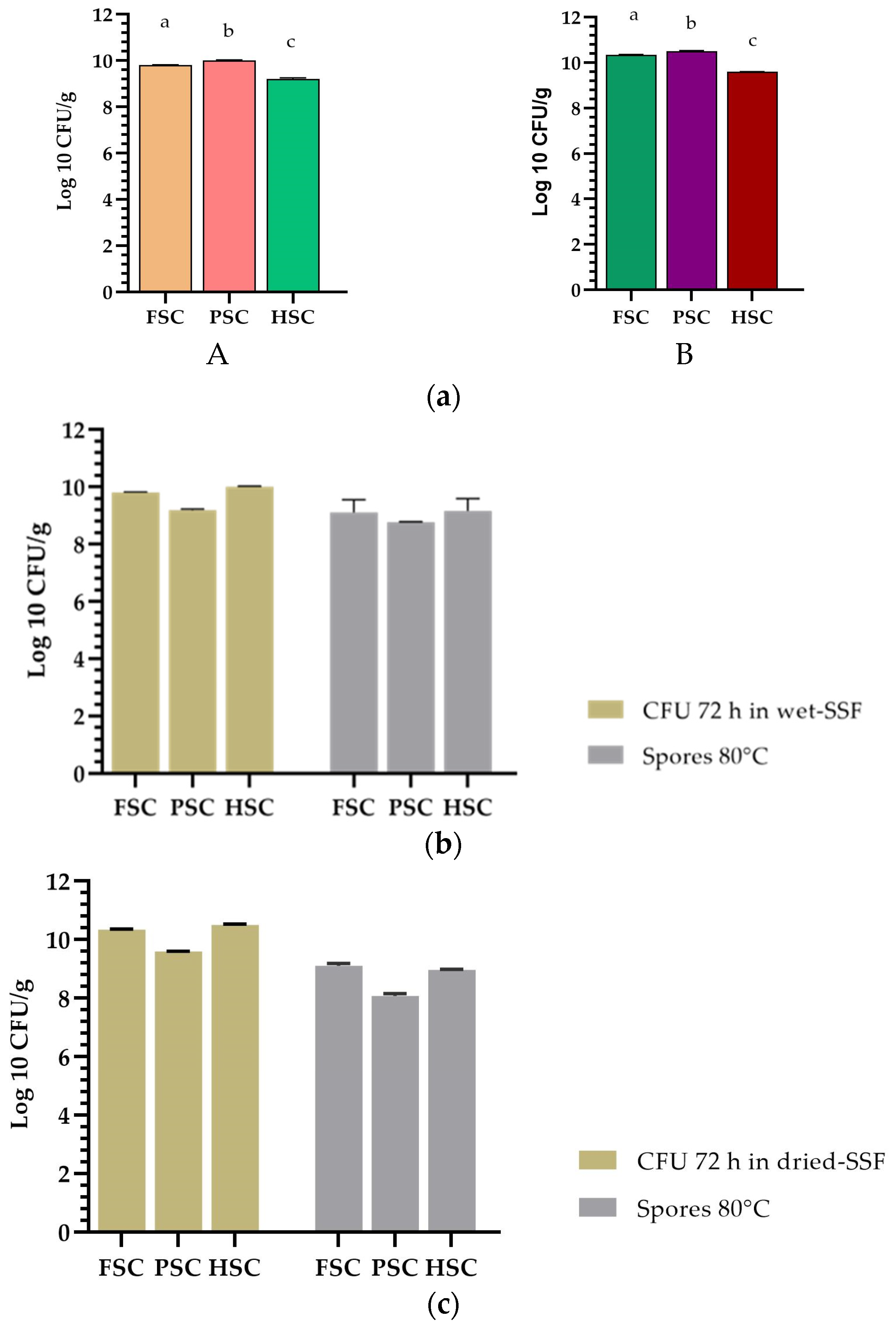
Each sterilized SSF medium was inoculated with 10% (v/w) of the BS overnight culture and thoroughly mixed with an equal volume of sterile water to achieve a 65% moisture content. After 72 h of fermentation at 37 °C, BS growth exhibited significant variations between all OSC substrates (p < 0.05). Among them, the wet-fermented PSC substrate showed the highest Log10 value (10.01 ± 0.024), followed by FSC (9.81 ± 0.013) and HSC (9.20 ± 0.055) (Figure 1a). The SSF cultures were dried using a freeze dryer at −50 °C for 18 ± 2 h. Following drying, the viable bacterial counts were 10.34 ± 0.020 for FSC, 10.50 ± 0.027 for PSC, and 9.59 ± 0.011 for HSC (p < 0.05). Freeze-drying led to an increase in bacterial viability across all substrates, with FSC, PSC, and HSC showing 5.39%, 4.90%, and 4.23%, respectively, compared to their wet-fermented state.
The sporulation capacity of the bacterial culture was assessed by the ability of the spores to withstand at 80 °C for 15 min in a water bath, as well as in wet- and dried-fermented, respectively. From our results, all three substrates exhibit high viable bacterial counts (~10 Log10 CFU/g) after 72 h of fermentation, indicating successful bacterial growth during SSF. As can be observed in Figure 1b, in wet-SSF, FSC maintains the highest spore count, followed by HSC, while PSC shows a substantial reduction in viable cells. The BS strain cultivated on FSC under wet-SSF conditions developed the highest spore count, followed by HSC and PSC. The relative proportion of heat-resistant spores to total CFU suggested superior sporulation efficiency on FSC (~86.52%), followed by PSC (~82.87%) and HSC (~81.29%). The enhanced sporulation observed in FSC may be attributed to its balanced nutrient profile [12], and higher availability of sporulation-promoting factors like manganase and carbohydrates, which develop and create a more favorable environment for sporulation.
Among the substrates, PSC exhibited the highest CFU count in dried-SSF (Figure 1c). However, a notable decline was observed after heat treatment for PSC, suggesting that a smaller proportion of the population successfully transitioned into heat-resistant spores (82.87% sporulation efficiency). In contrast, HSC displayed an intermediate pattern, with 81.29% of the population surviving heat treatment, indicating moderate sporulation efficiency. FSC presented the highest number of heat-resistant spores, indicating that BS may sporulate more efficiently in this substrate compared to the other OSCs (86.52%). These findings highlight the substrate-dependent variation in sporulation efficiency, which is relevant for optimizing SSF conditions when developing spore-based formulations for probiotics, bio preservation, or industrial bioprocesses.

3.3. Effect of Fermentation on pH Value

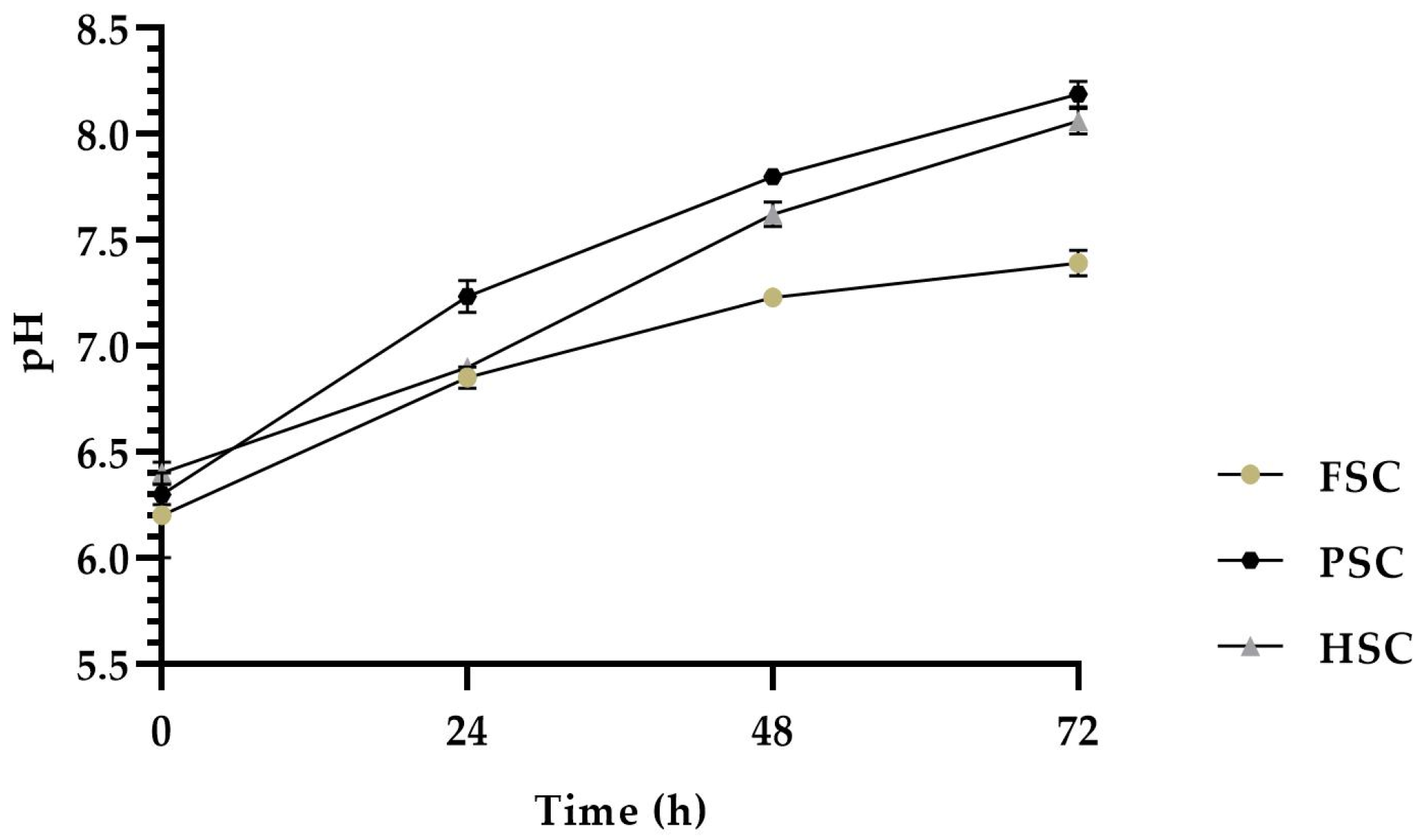
The initial pH of all substrates was measured and ranged from 6.0 to 6.4, indicating a slightly acidic to neutral environment. During fermentation, the pH gradually increased, reaching values between 6.85 and approximately 8.2, depending on the substrate used in the fermentation process (Figure 2).
This indicates that BS metabolism leads to alkaline conditions, possibly due to proteolytic enzyme activity. After 72 h, FSC shows the lowest pH (7.39 ± 0.06), indicating a moderate pH shift. HSC exhibits a sharp pH increase (8.06 ± 0.09), suggesting higher enzymatic activity or stronger proteolysis. The highest pH shift occurs in PSC, reaching above 8.19 ± 0.03, indicating the most pronounced alkalization, possibly due to higher nitrogenous compound breakdown.

3.4. Determination of Moisture and Dry Matter Content

Following fermentation, the treatment applied to the OSC sources resulted in different moisture contents (U%) and dry/wet (DW%) values. Considering that the initial moisture of the OSC variants was 65% with an inoculation rate of 10% of BS/treatment, HSC presented the highest level of U (73.79%), followed by PSC (71.15%) and FSC (67.53%). The differences in moisture retention may be linked to the composition of each substrate (e.g., fiber, protein, and fat content). Moreover, higher moisture levels may indicate better water retention capacity of certain substrates, which can influence microbial growth, enzymatic activity, and digestibility during the fermentation process. Also, it is known that when the moisture content increases, the dry weight decreases [10]. Therefore, the chemical composition present in Table 1 suggests that HSC presents a more lignocellulosic content and fibrous morphology, while FSC is richer in lipids and less in fiber. Similar findings have been reported for these substrates, where FSC exhibits a denser structure and lower moisture content [24,25].

3.5. Enzymes

3.5.1. Protease Activity

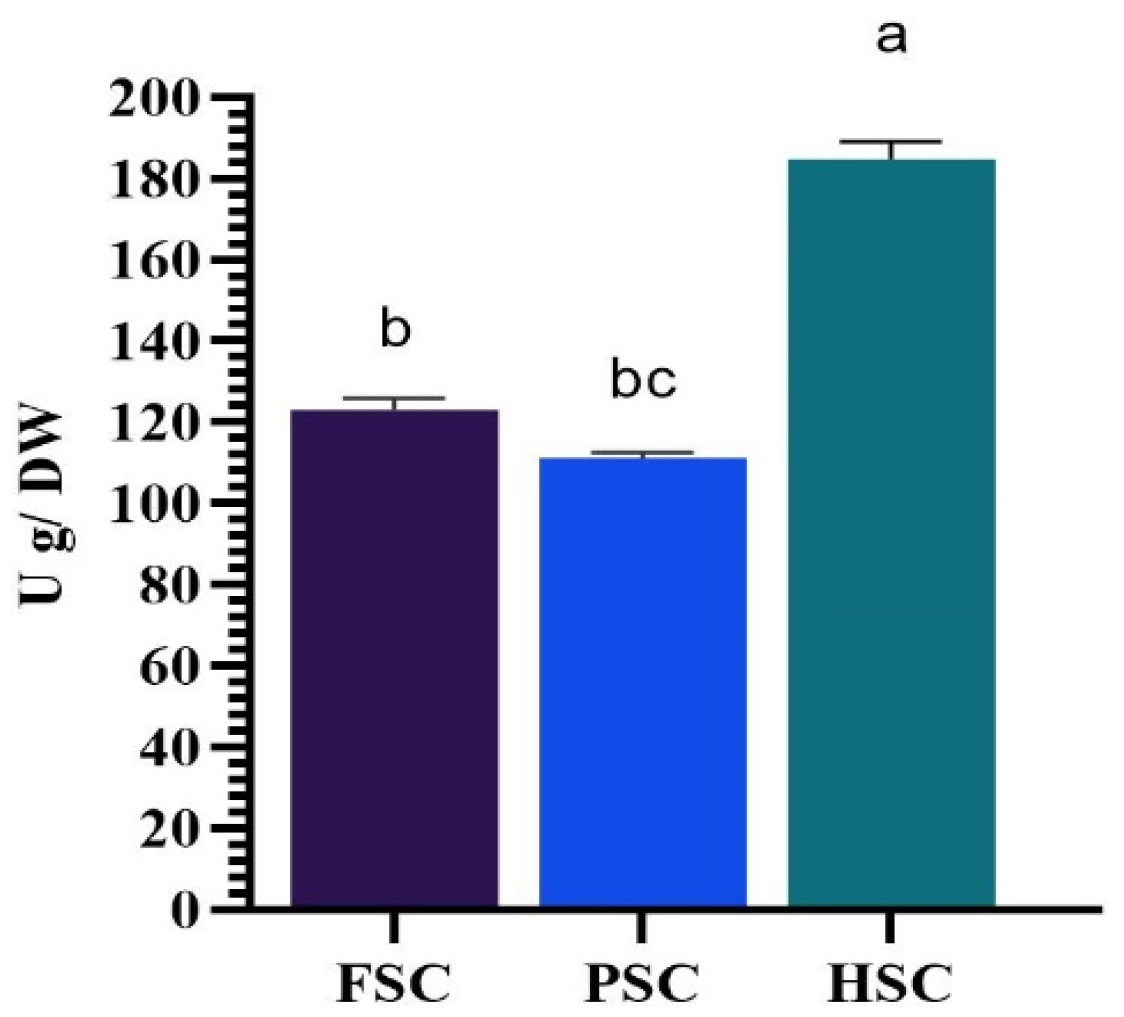
Production of protease was recorded after 72 h of SSF and varied significantly (p < 0.05) among OSC substrates (Figure 3). It was observed that BS showed higher proteolytic activity (U/g DW) in HSC (184.67 ± 4.35), significantly higher than FSC (123.06 ± 2.93) and PSC (111.27 ± 1.33).
The significantly greater protease activity observed with HSC suggests this substrate provides more favorable conditions, potentially due to higher protein content, optimal moisture retention, or nutrient composition, thus stimulating proteolytic enzyme production by our strain. Regarding PSC, the protease production was lower, which might indicate a lower protein availability. These differences emphasize the importance of substrate composition on microbial enzyme production during SSF.

3.5.2. Cellulase Activity

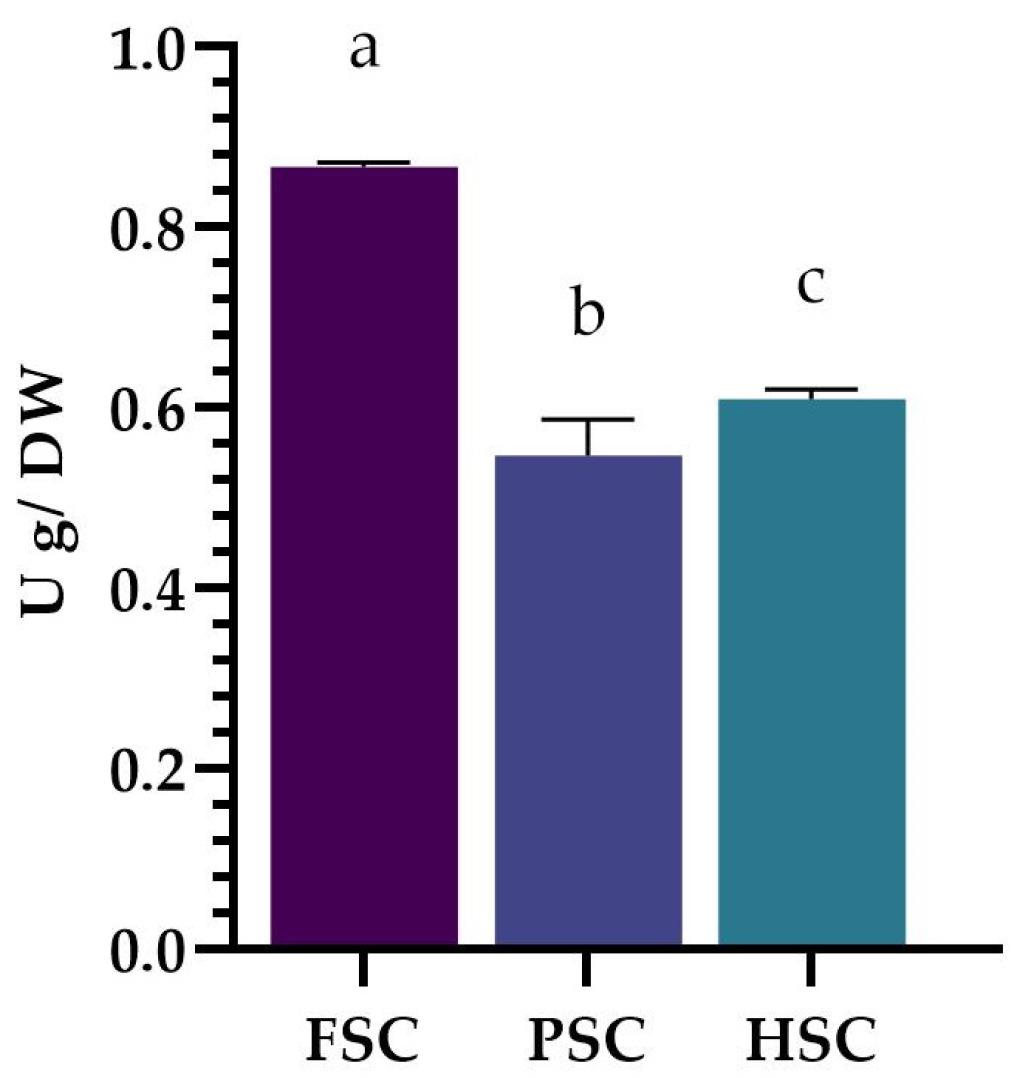
In the present study, three OSCs were tested for cellulase production during SSF for 72 h, at 37 °C. Figure 4 revealed that all substrates registered significant differences (p < 0.05). The use of FSC led to higher cellulase activity in contrast to other substrates; this could be because FSC is very rich in dietary fiber (cellulose, lignin).

3.5.3. Xylanase Activity

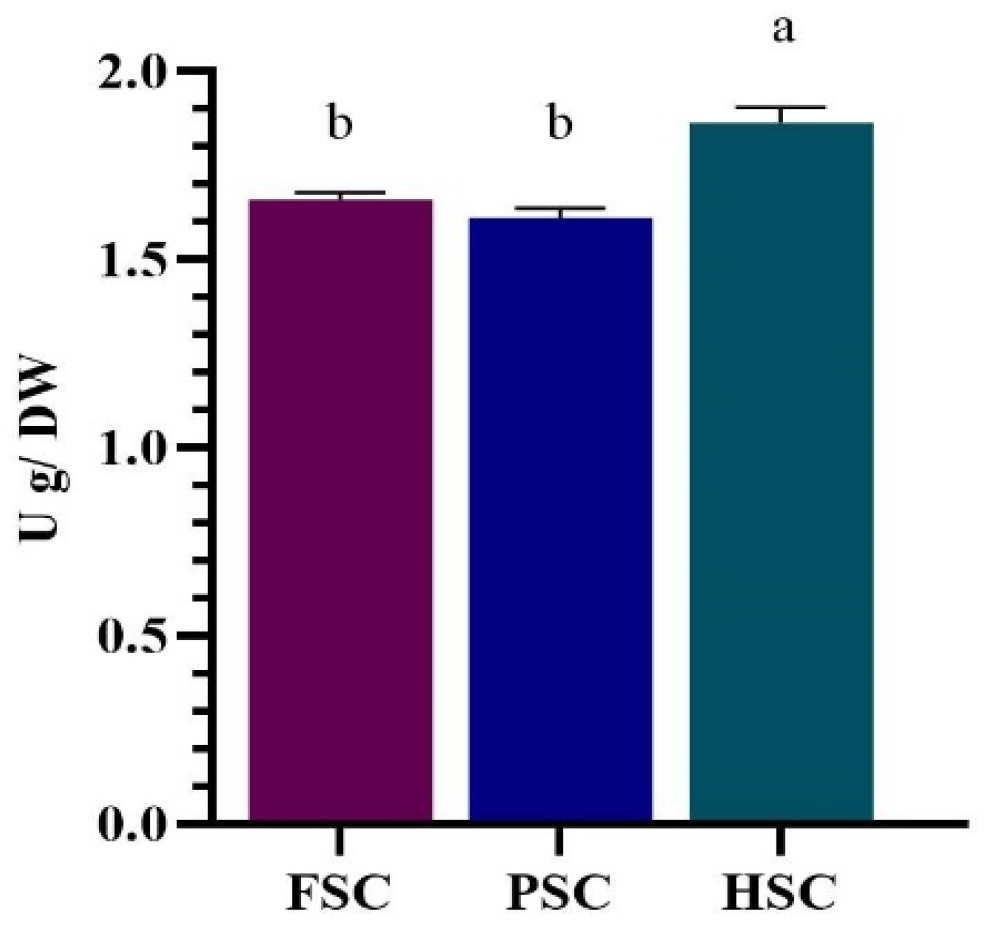
The results indicate that xylanase production varies significantly depending on the substrate used in the fermentation process. As illustrated in the bar graph (Figure 5), the highest xylanase activity was observed in HSC (1.86 ± 0.043 U/g DW), which was significantly higher than the activities recorded for FSC (1.66 ± 0.014 U/g DW) and PSC (1.61 ± 0.024 U/g DW). The statistical annotations on the graph further confirm that HSC-supported fermentation yielded the most effective enzyme production, as denoted by the distinct grouping (a vs. b) in the bar chart. The superior xylanase yield in HSC may be attributed to enhanced nutrient availability, improved microbial adaptability, or optimal environmental conditions favoring enzyme production. Consequently, selecting the appropriate substrate is crucial for maximizing xylanase productivity in industrial and biotechnological applications.

3.5.4. Phytase Activity

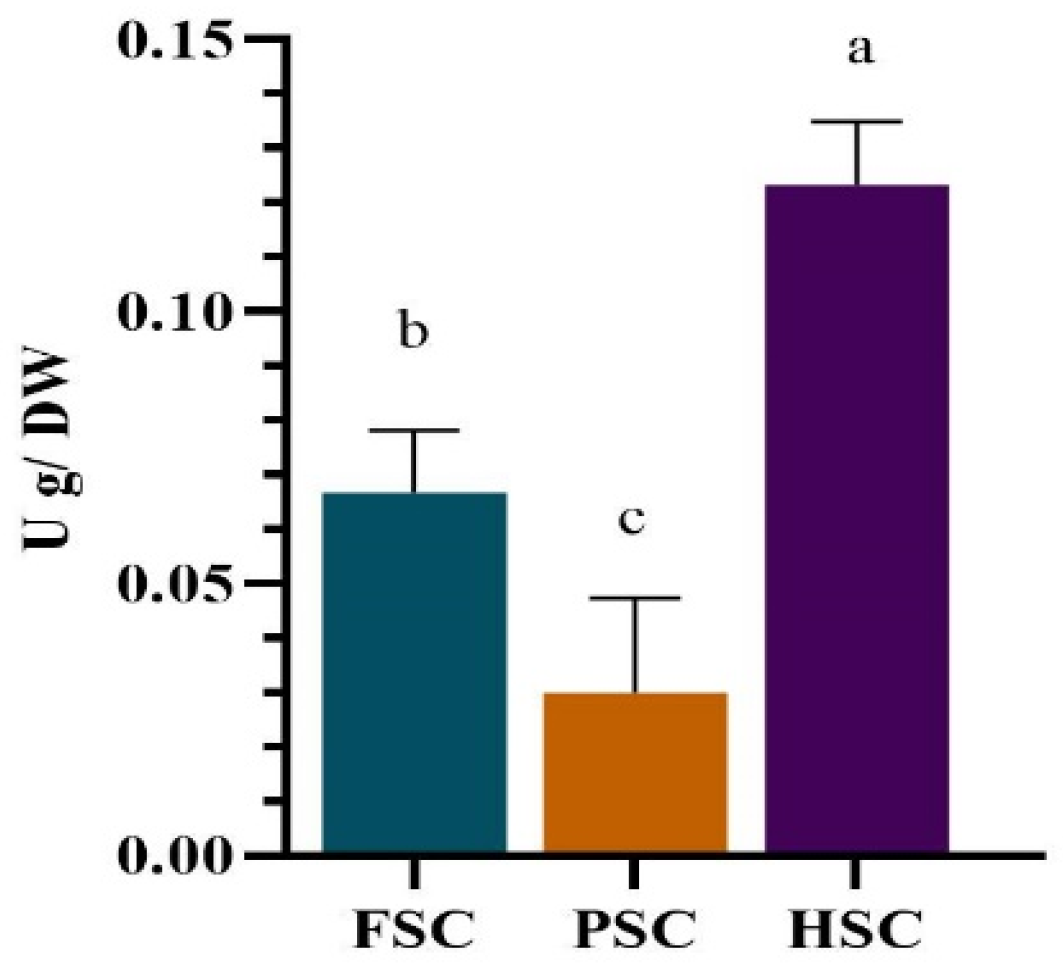
The determination of phytase activity in SSF was carried out using a quantitative assay, as represented in Figure 6.
The bar graph reveals that phytase production varied significantly depending on the fermentation substrate. The highest activity was observed in HSC, followed by FSC, while the lowest activity was recorded in PSC (p < 0.05). Statistically, HSC had significantly higher phytase activity compared to both FSC and PSC, suggesting that this substrate offers superior conditions for phytase production. These findings indicate that substrate selection plays a crucial role in optimizing phytase enzyme production in SSF. The higher phytase yield in HSC may be due to improved microbial growth, nutrient availability, or enhanced enzymatic induction under these fermentation conditions.

3.6. In Vitro Digestibility

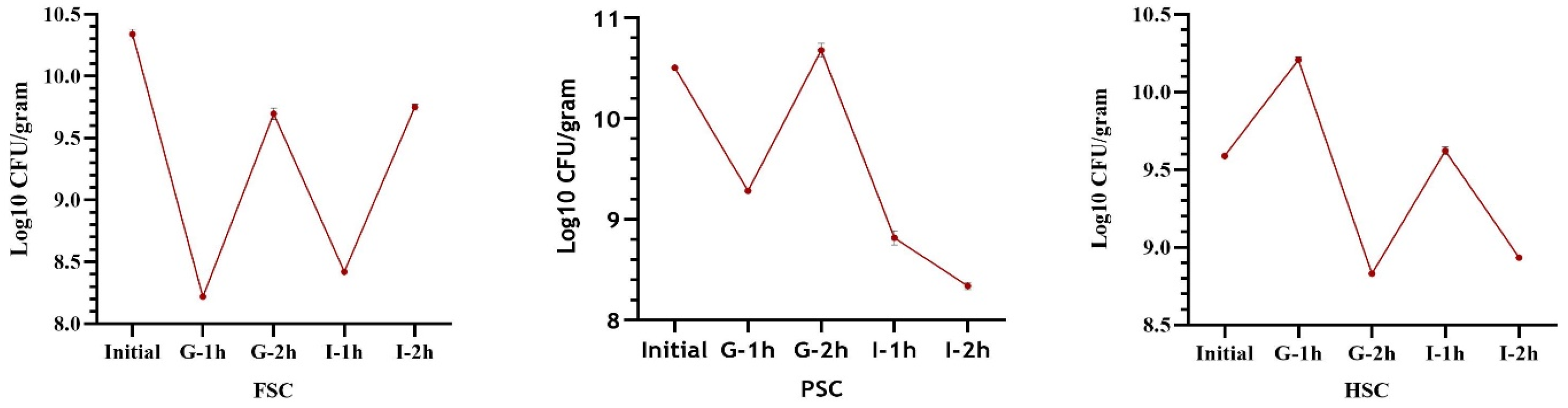
Figure 7 illustrates the changes in BS count (Log10 CFU/gram) during the digestion process of OSCs under different conditions (G-1 h, G-2 h, I-1 h, I-2 h). These variations reflect the microbial dynamics, which serve as indicators of digestibility and microbial survival in different stages.
At the initial stage, all OSCs exhibited a high bacterial load, indicating a rich microbial community present in the untreated substrates. This suggests that substrates used in the SSF process provide suitable conditions for microbial proliferation, likely due to their nutrient composition and moisture content. The bacterial count fluctuates significantly during digestion. A sharp decline in bacterial count at G-1 h suggests that BS faced challenging survival conditions during the initial gastric phase, possibly due to acidic pH or the presence of inhibitory compounds. However, bacterial recovery at G-2 h indicates microbial adaptation and favorable conditions for growth. This trend continues during the intestinal phases (I-1 h, I-2 h), where microbial survival fluctuates but remains relatively stable, suggesting that FSC supports a dynamic yet resilient microbial environment throughout digestion. In contrast, HSC exhibited a more gradual variation in bacterial count. A peak at G-1h suggests that BS adapted better to the gastric environment compared to FSC. However, a decline at G-2h, followed by fluctuations at I-1 h and I-2 h, suggests that microbial survival in HSC was influenced by digestive enzymatic activity and substrate composition, leading to variable nutrient availability for bacterial proliferation. While PSC initially supported high bacterial proliferation, it exhibited a significant decline in later stages (8.82 Log10 in I-1 h, respectively, 8.34 Log10 in I-2 h). This pattern suggests rapid nutrient consumption without sustained release, possibly due to lower enzymatic activity and inefficient fiber breakdown, limiting microbial survival as digestion progressed.

4. Discussion

OSCs are agro-industrial by-products, rich in fiber and nutrients, representing a valuable but underutilized resource for animal nutrition [26]. Their direct inclusion in piglets’ diets can, however, develop significant digestive disorders due to the immature GIT and the presence of anti-nutritional factors (ANFs) [27].
SSF is an effective biotechnological process that improves nutrient bioavailability by modifying the biochemical structure through microbial enzymatic activity [28,29]. Through the enzymatic action of microorganisms such as Bacillus spp., Lactobacillus spp., Saccharomyces spp., and various fungi, an important role in the SSF process occurs, improving the absorption and accessibility of nutrients [29,30,31,32]. Moreover, the enzymatic activity contributes to the degradation of ANF compounds, which can limit bioavailability and nutrient digestibility in animal feed. Ultimately, the SSF process presents a great interest in improving the bioavailability and digestibility of nutrients in agro-industrial waste [33].
Among the biological factors affecting SSF efficiency, inoculum size remains one of the most critical, influencing both the biomass yield and enzyme production [34,35]. An insufficient inoculum leads to poor cell proliferation and low metabolite yields, whereas an excessive inoculum rapidly depletes available nutrients, limiting sustained microbial growth [35]. According to the literature, an inoculum level between 4 and 6% has been reported as optimal for extracellular enzyme production [36]. Although higher inoculum levels (up to 10%) have been associated with significant enhancement in xylanase production in B. megaterium [37], excessive inoculum can reduce enzyme production due to rapid nutrient depletion, ultimately lowering metabolic activity. Therefore, maintaining a balance between microbial biomass proliferation and available substrate is essential to maximize the enzyme yield in fermented products [36].
Sporulation of Bacillus spp. depends on several environmental and physicochemical factors such as medium composition, aeration, pH, and other factors [38]. These species are widely recognized for their probiotic benefits, including improved gut health and enhanced nutrient digestibility in animals through spore colonization and enzyme production.
In this study, BS showed consistent growth and sporulation across all substrates tested, confirming the capacity of OSCs as fermentation matrices. After 72 h, spore viability remained high even after exposure to 80 °C for 15 min, confirming the strain’s capacity to resist at high temperatures. In dried OSCs, the viability of spores decreased modestly after 72 h of fermentation between 13 and 19%. This decline remained within an acceptable limit for probiotics and suggests a strong preservation of viability. Thus, BS inoculation of the evaluated substrates presented a sporulation rate (%) related to the initial viability of the fermented samples, as a result of the lyophilization process of 86.48% (FSC), 82.87% (PSC), and 81.23% (HSC). These indicate the remarkable resilience of the BS strain to dehydration stress and its capacity to survive within a complex matrix, as an essential trait for probiotic utilization. Moreover, the retention of spore viability within such carrier matrices is a key trait for bio-preserved formulations, indicating that OSCs serve as protective substrates for BS during the SSF process [39].
In parallel with the viability assay, the pH measurement during 72 h provides valuable aspects driven by BS activity in the SSF. The final pH variations can be associated with Bacillus spp. capacity, known to produce proteases and peptidases, which break down proteins, leading to ammonia release and pH elevation. Instead, using different substrates in the fermentation process may reflect variations in their protein content, buffering capacity, and microbial metabolic interactions [12]. In the present study, BS induced an alkaline shift after 72 h of SSF, with PSC exhibiting the highest increase, followed by HSC and FSC. This change results from protease and peptidase activity, leading to ammonia release from protein hydrolysis [12]. Interestingly, the final pH value on FSC (6.0–6.5) is typically found in the piglet’s small intestine [40], suggesting that fermented OSCs can better mimic physiological conditions and improve functionality as a source of feed additives. The results also confirm previous findings showing that Bacillus fermentation on OSCs and lignocellulosic substrates stabilizes after 60–72 h, corresponding with a maximum enzyme activity [41,42]. This physiological compatibility could facilitate microbial survival during the GIT, resulting by the end in high nutrient utilization and significant zootechnical performance.
Beyond pH, moisture is a critical and relevant parameter influencing the SSF quality. While water maintains enzymatic activity and nutrient solubility, excessive moisture (> 70%) can reduce aeration (oxygen limit) and make a favorable medium for contaminants [35]. Conversely, insufficient moisture levels can reduce nutrient solubility in the substrate, limit microbial growth, and enzyme secretion [34]. Similar to Potpcka et al., who observed that fermentation of rapeseed was not fully achieved due to the low water activity, our results indicate that maintaining an intermediate moisture level is essential for balanced enzyme activity and production [43].
SSF not only supports bacterial growth but also promotes the production of exogenous enzymes like proteases [44,45,46,47]. In this study, BS produced extracellular proteases during SSF on all evaluated substrates, confirming the nutritional value of these OSCs as carbon and nitrogen sources [48]. The production of enzymes from bacteria is strongly influenced by the medium composition, temperature, pH values, percentage of culture inoculated, time of incubation, respectively, and the substrate used in the fermentation process [49,50,51]. The highest proteolytic activity was recorded in HSC after 72 h, showing an activity level 66% higher than PSC and 50% than FSC, indicating that substrate composition strongly influences enzyme production. Many researchers have investigated the production of protease using different agro-industrial resources [52,53,54]. The maximum protease in HSC may be attributed to previous observations, where it was affirmed that the decrease in enzyme activity can be caused by nutrient depletion in the medium and pH modifications during the SSF, which inhibit enzyme synthesis [55,56].
In this study, BS exhibited efficient cellulase production under SSF conditions using OSCs as substrates. Among the tested materials, the highest cellulase activity was observed on FSC (0.87 U), followed by HSC (0.61 U) and PSC (0.54 U). These results indicate that the chemical composition of substrates strongly affects enzyme secretion. Comparable data have been reported with another Bacillus spp., where the substrate significantly influences enzyme production due to their fiber complexity [57].
Cellulases are relevant in hydrolyzing vegetable materials’ polysaccharides into oligosaccharides and monomeric sugars, improving by the end the fiber nutrient digestibility [58,59,60]. BS’ ability to produce such enzymes under SSF conditions is consistent with previous findings highlighting the cellulolytic and spore-forming properties of this genus [60,61,62,63,64,65,66].
Hemicellulose and cellulose represent more than 50% of the DW of agro-industrial by-products, with xylan being the major component of the plant whose hydrolysis depends on endo-β-1,4-D-xylanase activity [67]. In this study, BS produced xylanase during SSF on oilseed cakes, with activities ranging from 1.61 to 1.86 U after 72 h. The maximum activities were obtained on HSC, followed by PSC and FSC. These values are consistent with previous results for B. pumilus SY30A (1.43 U/g) on oil lam residue [68]. Xylanase production in Bacillus spp. is known to be influenced by factors such as the inoculum size, pH, temperature, incubation time, medium composition, aeration, agitation, or nitrogen/carbon source [69,70]. While most xylanase production has been conducted under submerged fermentation [70], a few studies are exploring SSF using agricultural residues such as OSCs. Additionally, bacterial isolates exhibit lower extracellular xylanase yields compared to fungal systems such as Aspergillus spp., which produce enzymes that can break lignocellulosic matrices more efficiently.
Globally, soybean, sunflower, and rapeseed cakes are the most common protein and energy sources in animal feed worldwide [71]. Due to the projected growth of the animal industry, it is very important to find alternative protein resources [72]. The results of this study confirm that SSF can be used successfully to valorize agro-industrial by-products into functional materials, giving a cost-effective and sustainable alternative to conventional liquid-submerged fermentation [73,74].
Beyond the enzymes presented above, another enzyme class of particular importance in the valorization of agro-industrial by-products is phytase. Phytases are a subclass of phosphatases that catalyze the hydrolysis of phytic acid, producing myo-inositol phosphates and inorganic phosphate [75]. These enzymes have attracted significant interest due to their applications in the nutrition area, environmental protection, and various biotechnology processes. Microorganisms represent the main source of high-performance phytases with biotechnological potential, primarily utilized in the animal feed industry to improve phosphorus bioavailability and reduce anti-nutritional factors [76]. Phytase production through SSF is significantly influenced by the choice of substrate, as it provides both the nutrients and the physical support necessary for microbial growth and enzyme synthesis. Studies have demonstrated that substrates such as wheat bran, rice bran, and OSCs are particularly effective in supporting high levels of phytase activity [77]. Based on our results (Figure 6), HSC showed maximum activity, followed by FSC and PSC (p < 0.05), but the level of phytase production remained low. Similar results were reported by Shreedevi and Reddy, who observed enhanced phytase activity in Bacillus C45 combining wheat bran and groundnut oil cake under submerged fermentation [77]. Overall, our data provide novel insights, as only a few studies from the literature have evaluated phytase activity during SSF using HSC, FSC, or PSC as a substrate with the BS strain. Taken together with the other enzymes evaluated (protease, cellulase, and xylanase), the results emphasize that the enzymatic profile of BS is strongly influenced by the substrate characteristics.
Building on these results, it is very important to evaluate how enzymatic modification translates into nutrient availability and feed performance improvements. In vitro digestibility assays provide valuable tools to assess the feed ingredients’ digestibility and the bioavailability of nutrients within a diet [78,79,80]. In this study, FSC had the highest digestibility, as evidenced by its relatively stable bacterial population throughout digestion. This stability suggests that FSC provides a sustained release of nutrients, likely due to efficient enzymatic hydrolysis and microbial resilience. HSC supports microbial adaptation in the gastric phase but fluctuates in the intestinal phase, indicating moderate digestibility with dynamic microbial interactions. In contrast, PSC showed the highest bacterial proliferation during the early digestive stage but showed a sharp decline in later stages, reflecting rapid nutrient depletion and lower long-term digestibility. These findings highlight the importance of substrate–bacterial interaction in defining the functional value of fermented feed ingredients. The stable performance of BS on FSC shows its potential as a probiotic carrier and enzymatic source for improvement in nutrient absorption and intestinal health in livestock, offering benefits for animal performance and feed efficiency [81].

5. Conclusions

The findings confirm that the digestibility and microbial viability of BS in OSCs depend on the substrate composition, enzymatic activity, and nutrient bioavailability. Among the substrates evaluated, FSC showed the highest digestibility and maintained stable microbial viability throughout the digestion process. HSC supports microbial adaptation but exhibits fluctuations, while PSC allows initial bacterial growth but lacks sustained nutrient release. From a practical perspective, these results suggest that fermented OSCs could be included in pig diets as feed ingredients to enhance nutrient utilization and gastrointestinal health. Moreover, the valorization of OSCs through SSF represents a cost-effective and sustainable method for reducing feed costs and also holds potential for contributing to the circular bioeconomy in agriculture by converting low-value agro-industrial by-products into fully utilizing feed resources for animal nutrition.

Supplementary Materials

The following supporting information can be downloaded at: https://www.mdpi.com/article/10.3390/fermentation11110607/s1, Figure S1: Standard calibration curve for determination of protease activity; Figure S2: Standard calibration curve for determination of cellulase activity; Figure S3: Standard calibration curve for determination of xylanase activity; Figure S4: Standard calibration curve for determination of phytase activity.

Author Contributions

Conceptualization, M.D. and D.-T.R.; methodology, M.D. and G.C.; software, M.D. and D.-T.R.; validation, M.D., D.-T.R., and G.C.; formal analysis, M.D., D.-T.R., G.C., G.M.C., and T.D.P.; investigation, M.D.; resources, M.D. and G.C.; data curation M.D.; writing—original draft preparation, M.D.; writing—review and editing, M.D. and G.C.; project administration, M.D. and G.C.; funding acquisition, M.D. and G.C. All authors have read and agreed to the published version of the manuscript.

Funding

This research was financed through the Ministry of Agriculture and Rural Development Program ADER 8.1.6/2025.

Institutional Review Board Statement

Not applicable.

Informed Consent Statement

Not applicable.

Data Availability Statement

The original contributions presented in this study are included in the article/Supplementary Material. Further inquiries can be directed to the corresponding author.

Acknowledgments

This paper was supported by the Ministry of Agriculture and Rural Development Program ADER 8.1.7/2025.

Conflicts of Interest

The authors declare no conflicts of interest.

Abbreviations

FSCflaxseed oil cake
HSChemp seed oil cake
PSCpumpkin seed oil cake

References

  1. Berikashvili, V.; Sokhadze, K.; Kachlishvili, E.; Elisashvili, V.; Chikindas, M.L. Bacillus amyloliquefaciens spore production under solid-state fermentation of lignocellulosic residues. Probiotics Antimicrob. Proteins 2018, 10, 755–761. [Google Scholar] [CrossRef] [PubMed]
  2. Cho, W.I.; Chung, M.S. Bacillus spores: A review of their properties and inactivation processing technologies. Food Sci. Biotechnol. 2020, 29, 1447–1461. [Google Scholar] [CrossRef]
  3. Bernardeau, M.; Lehtinen, M.J.; Forssten, S.D.; Nurminen, P. Importance of the gastrointestinal life cycle of Bacillus for probiotic functionality. J. Food Sci. Technol. 2017, 54, 2570–2584. [Google Scholar] [CrossRef]
  4. Su, Y.; Liu, C.; Fang, H.; Zhang, D. Bacillus subtilis: A universal cell factory for industry, agriculture, biomaterials and medicine. Microb. Cell Factories 2020, 19, 173. [Google Scholar] [CrossRef] [PubMed]
  5. Deng, B.; Wu, J.; Li, X.; Zhang, C.; Men, X.; Xu, Z. Effects of Bacillus subtilis on growth performance, serum parameters, digestive enzyme, intestinal morphology, and colonic microbiota in piglets. Amb. Express 2020, 10, 212. [Google Scholar] [CrossRef]
  6. Zhang, Y.; Ishikawa, M.; Koshio, S.; Yokoyama, S.; Dossou, S.; Wang, W.; Seo, S.; Chen, J.; Zheng, S.; Zhang, X. Effects of dietary supplementation with Bacillus subtilis natto on growth, digestive enzyme activity, immune response, and intestinal microorganisms of red sea bream, Pagrus major. Fishes 2024, 9, 446. [Google Scholar] [CrossRef]
  7. Chebaibi, S.; Grandchamp, M.L.; Burgé, G.; Clément, T.; Allais, F.; Laziri, F. Improvement of protein content and decrease of anti-nutritional factors in olive cake by solid-state fermentation: A way to valorize this industrial by-product in animal feed. J. Biosci. Bioeng. 2019, 128, 384–390. [Google Scholar] [CrossRef]
  8. Filipe, D.; Vieira, L.; Ferreira, M.; Oliva-Teles, A.; Salgado, J.; Belo, I.; Peres, H. Enrichment of a plant feedstuff mixture’s nutritional value through solid-state fermentation. Animals 2023, 13, 2883. [Google Scholar] [CrossRef] [PubMed]
  9. Kahil, T.; Hassan, H.M. Economic co-production of cellulase and αamylase by fungi grown on agro-industrial wastes using solid-state fermentation conditions. Science 2015, 5, 184–195. [Google Scholar]
  10. Abu Yazid, N.; Barrena, R.; Komilis, D.; Sánchez, A. Solid-state fermentation as a novel paradigm for organic waste valorization: A review. Sustainability 2017, 9, 224. [Google Scholar] [CrossRef]
  11. Benabda, O.; M’hir, S.; Kasmi, M.; Mnif, W.; Hamdi, M. Optimization of protease and amylase production by Rhizopus oryzae cultivated on bread waste using solid-state fermentation. J. Chem. 2019, 1, 3738181. [Google Scholar] [CrossRef]
  12. Rambu, D.; Dumitru, M.; Ciurescu, G.; Vamanu, E. Solid-state fermentation using Bacillus licheniformis-driven changes in composition, viability and in vitro protein digestibility of oilseed cakes. Agriculture 2024, 14, 639. [Google Scholar] [CrossRef]
  13. AOAC. Official Methods of Analysis of AOAC International, 17th ed.; Association of Official Agricultural Chemists: Gaithersburg, MD, USA, 2000. [Google Scholar]
  14. Vlaicu, P.A.; Untea, A.E.; Turcu, R.P.; Saracila, M.; Panaite, T.D.; Cornescu, G.M. Nutritional composition and bioactive compounds of basil, thyme and sage plant additives and their functionality on broiler thigh meat quality. Foods 2022, 11, 1105. [Google Scholar] [CrossRef]
  15. Rohde, A.; Hammerl, J.A.; Appel, B.; Dieckmann, R.; Al Dahouk, S. Sampling and homogenization strategies significantly influence the detection of foodborne pathogens in meat. BioMed. Res. Int. 2015, 2015, 145437. [Google Scholar] [CrossRef]
  16. Sousa, D.; Moset, V.; del Carmen López-Luján, M.; Salgado, J.M.; Dias, A.; Belo, I.; Pascual, J.J.; Cambra-López, M. Potential of solid-state fermentation to enhance the nutritional value of oilseed cakes for poultry. Anim. Feed. Sci. Technol. 2024, 316, 116056. [Google Scholar] [CrossRef]
  17. Cupp-Enyard, C. Sigma’s non-specific protease activity assay-casein as a substrate. JoVE 2008, 19, 899. [Google Scholar] [CrossRef]
  18. Miller, G.L. Use of dinitrosalicylic acid reagent for determination of reducing sugar. Anal. Chem. 1959, 31, 426–428. [Google Scholar] [CrossRef]
  19. Bombardi, L.; Coltro, A.; Fusco, S. Endo-1, 4-β-D-xylanase assay using azo-xylan and variants thereof. Bio Protoc. 2025, 15, 1–11. [Google Scholar] [CrossRef] [PubMed]
  20. Sharma, R.; Mittal, A.; Gupta, V.; Aggarwal, N.K. Production, purification and characterization of phytase from Pichia kudriavevii FSMP-Y17and its application in layers feed. Braz. J. Microbiol. 2024, 55, 3097–3115. [Google Scholar] [CrossRef]
  21. Brodkorb, A.; Egger, L.; Alminger, M.; Alvito, P.; Assuncão, R.; Ballance, S.; Bohn, T.; Bourlieu-Lacanal, C.; Boutrou, R.; Carrière, F. INFOGEST static in vitro simulation of gastrointestinal food digestion. Nat. Protoc. 2019, 14, 991–1014. [Google Scholar] [CrossRef]
  22. Marttinen, M.; Anjum, M.; Saarinen, M.T.; Ahonen, I.; Lehtinen, M.J.; Nurminen, P.; Laitila, A. Enhancing bioaccessibility of plant protein using probiotics: An in vitro study. Nutrients 2023, 15, 3905. [Google Scholar] [CrossRef] [PubMed]
  23. Coelho, M.C.; Ribeiro, T.B.; Oliveira, C.; Batista, P.; Castro, P.; Monforte, A.R.; Rodrigues, A.S.; Teixeira, J.; Pintado, M. In vitro gastrointestinal digestion impact on the bioaccessibility and antioxidant capacity of bioactive compounds from tomato flours obtained after conventional and ohmic heating extraction. Foods 2021, 10, 554. [Google Scholar] [CrossRef]
  24. Teh, S.S.; Birch, J. Physicochemical and quality characteristics of cold-pressed hemp, flax and canola seed oils. J. Food Compos. Anal. 2013, 30, 26–31. [Google Scholar] [CrossRef]
  25. Ambroziak, K.; Wenda-Piesik, A. Comparative characterization of hemp seed cakes from dehulled and hulled Cannabis sativa L. var. oleifera cv. ‘Henola’: Nutritional, functional, and storage stability insights. Foods 2025, 14, 1605. [Google Scholar] [CrossRef]
  26. Amos, A.T.; Kareem, D.U.; Adeleye, T.M.; Adeyeye, E.A.; Abatan, M.O.; Ayorinde, O.S.; Adeboye, E.O.; Sbardella, M.; Fafiolu, A.O.; Oso, A.O.; et al. The effects of solid-state fermentation by Aspergillus spp. on the nutritional profile of selected agro-industrial by-products as potential feedstuffs for weaner rabbits. Fermentation 2025, 11, 356. [Google Scholar] [CrossRef]
  27. Dumitru, M.; Hăbeanu, M.; Sorescu, I.; Tabuc, C. Effects of Bacillus spp. as a supplemental probiotic in diets for weaned piglets. S. Afr. J. Anim. Sci. 2021, 51, 578–586. [Google Scholar] [CrossRef]
  28. Soares, V.F.; Castilho, L.R.; Bon, E.P.S.; Freire, D.M.G. High-yield Bacillus subtilis protease production by solid-state fermentation. Appl. Biochem. Biotechnol. 2005, 121–124, 311–319. [Google Scholar] [CrossRef]
  29. Heo, J.; Ham, Y.K.; Choi, A.Y.; Yoon, H.; Sung, H.G. Lactic acid bacteria as probiotics improve bioactive compounds in radix angelica gigas (danggui) via solid-state fermentation. Fermentation 2025, 11, 342. [Google Scholar] [CrossRef]
  30. Abdullah, R.; Asim, M.; Nadeem, M.; Nisar, K.; Kaleem, A.; Iqtedar, M. Production, optimization, purification, kinetic analysis, and applications of alkaline proteases produced from Bacillus subtilis through solid-state fermentation of agricultural byproducts. Kuwait J. Sci. 2022, 49, 1–15. [Google Scholar] [CrossRef]
  31. Hang, N.T.B.; Doan, C.C. Improving nutrition facts of cassava and soybean residue through solid-state fermentation by Pleurotus ostreatus Mycelium: A pathway to safety animal feed production. Fermentation 2025, 11, 271. [Google Scholar] [CrossRef]
  32. Kasprowicz-Potocka, M.; Zaworska-Zakrzewska, A.; Łodyga, D.; Józefiak, D. The effect of enzymatic fermentation on the chemical composition and contents of antinutrients in rapeseed meal. Fermentation 2024, 10, 107. [Google Scholar] [CrossRef]
  33. Yafetto, L.; Odamtten, G.T.; Wiafe-Kwagyan, M. Valorization of agro-industrial wastes into animal feed through microbial fermentation: A review of the global and Ghanaian case. Heliyon 2023, 9, e14814. [Google Scholar] [CrossRef]
  34. Gupta, A.; Sharma, A.; Pathak, R.; Kumar, A.; Sharma, S. Solid state fermentation of non-edible oil seed cakes for production of proteases and cellulases and degradation of anti-nutritional factors. J. Food Biotechnol. Res. 2018, 1, 1–6. [Google Scholar]
  35. Boratyński, F.; Szczepańska, E.; Grudniewska, A.; Gniłka, R.; Olejniczak, T. Improving of hydrolases biosythesis by solid-state fermentation of Penicillium camemberti on rapeseed cake. Sci. Rep. 2018, 8, 10157. [Google Scholar] [CrossRef]
  36. Banerjee, S.; Ghosh, K. Bio-processing of linseed oil-cake through solid state fermentation by non-starch polysaccharide degrading fish gut bacteria. Ferment. Technol. 2016, 5, 1–10. [Google Scholar] [CrossRef]
  37. Sindhu, I.; Chhibber, S.; Capalash, N.; Sharma, P. Production of cellulase-free xylanase from Bacillus megaterium by solid state fermentation for biobleaching of pulp. Curr. Microbiol. 2006, 53, 167–172. [Google Scholar] [CrossRef]
  38. Khardziani, T.; Metreveli, E.; Elisashvili, V. Obtaining high yields of Bacillus species during solid-state fermentation of plant raw materials for use as a feed additive. J. World Poult. Res 2025, 15, 158–165. [Google Scholar] [CrossRef]
  39. Cerda, A.; Mejias, L.; Rodríguez, P.; Rodríguez, A.; Artola, A.; Font, X.; Gea, T.; Sánchez, A. Valorisation of digestate from biowaste through solid-state fermentation to obtain value added bioproducts: A first approach. Biores. Technol. 2019, 271, 409–416. [Google Scholar] [CrossRef] [PubMed]
  40. Shi, Z.; Wang, T.; Kang, J.; Li, Y.; Li, Y.; Xi, L. Effects of weaning modes on the intestinal pH, activity of digestive enzymes, and intestinal morphology of piglets. Animals 2022, 12, 2200. [Google Scholar] [CrossRef]
  41. Feng, X.; Ng, K.; Ajlouni, S.; Zhang, P.; Liang, Z.; Fang, Z. Enhancement of protein hydrolysis and bioactivity in hempseed cake via solid-state fermentation using Aspergillus niger, Bacillus subtilis, and Lactobacillus rhamnosus. Food Bioprocess. Technol. 2025, 18, 8633–8651. [Google Scholar] [CrossRef]
  42. Li, C.; Liu, Z.; Gong, Z.; Bao, Z.; Zhao, J.; Zhao, Z.M. Steam explosion enhancing Bacillus subtilis fermentation on lignocellulosic biomass to prepare high-titer microecological agents. Ind. Crops Prod. 2025, 226, 120707. [Google Scholar] [CrossRef]
  43. Zhu, X.; Wang, L.; Zhang, Z.; Ding, L.; Hang, S. Combination of fiber-degrading enzymatic hydrolysis and lactobacilli fermentation enhances utilization of fiber and protein in rapeseed meal as revealed in simulated pig digestion and fermentation in vitro. Anim. Feed Sci. Technol. 2021, 278, 115001. [Google Scholar] [CrossRef]
  44. Amadou, I.; Le, G.W.; Shi, Y.H.; Gbadamisi, O.S.; Kamara, M.T.; Jin, S. Optimized Lactobacillus plantarum LP6 solid-state fermentation and proteolytic hydrolysis improve some nutritional attributes of soybean protein meal. J. Food Biochem. 2011, 35, 1686–1694. [Google Scholar] [CrossRef]
  45. Castro, A.M.; Castilho, L.R.; Freire, D.M.G. Performance of a fixed-bed solid-state fermentation bioreactor with forced aeration for the production of hydrolases by Aspergillus awamori. Biochem. Eng. J. 2015, 93, 303–308. [Google Scholar] [CrossRef]
  46. Balachandran, C.; Vishali, A.; Nagendran, N.A.; Baskar, K.; Hashem, A.; Abd_Allah, E.F. Optimization of protease production from Bacillus halodurans under solid state fermentation using agrowastes. Saudi J. Biol. Sci. 2021, 28, 4263–4269. [Google Scholar] [CrossRef] [PubMed]
  47. El Salamony, D.H.; Hassouna, M.S.E.; Zaghloul, T.I.; Abdallah, H.M. Valorization of chicken feather waste using recombinant Bacillus subtilis cells by solid-state fermentation for soluble proteins and serine alkaline protease production. Bioresour. Technol. 2024, 393, 130110. [Google Scholar] [CrossRef] [PubMed]
  48. Pant, G.; Prakash, A.; Pavani, J.V.P.; Bera, S.; Deviram, G.V.N.S.; Kumar, A.; Panchpuri, M.; Prasuna, R.G. Production, optimization and partial purification of protease from Bacillus subtilis. J. Taibah Univ. Sci. 2015, 9, 50–55. [Google Scholar] [CrossRef]
  49. Martău, G.A.; Unger, P.; Schneider, R.; Venus, J.; Vodnar, D.C.; López-Gómez, J.P. Integration of solid state and submerged fermentations for the valorization of organic municipal solid waste. J. Fungi 2021, 7, 766. [Google Scholar] [CrossRef]
  50. Sadh, P.K.; Chawla, P.; Bhandari, L.; Duhan, J.S. Bio-enrichment of functional properties of peanut oil cakes by solid state fermentation using Aspergillus oryzae. Food Meas. Charact. 2018, 12, 622–633. [Google Scholar] [CrossRef]
  51. Manan, M.A.; Webb, C. Design aspects of solid-state fermentation as applied to microbial bioprocessing. J. Appl. Biotechnol. Bioeng. 2017, 4, 511–532. [Google Scholar] [CrossRef]
  52. Kahraman, H.; Karaderi, C.C. Production of proline and protease with different organic wastes in bacteria (Production proline and protease with organic wastes). Braz. J. Biol. 2021, 82, e243187. [Google Scholar] [CrossRef]
  53. Ullah, N.; Mujaddad-ur-Rehman, M.; Sarwar, A.; Nadeem, M.; Nelofer, R.; Irfan, M.; Muhammad, I.; Ali, U.; Naz, S.; Aziz, T. Effect of bioprocess parameters on alkaline protease production by locally isolated Bacillus cereus AUST-7 using tannery waste in submerged fermentation. Biomass Convers. Biorefin. 2023, 14, 22977–22987. [Google Scholar] [CrossRef]
  54. Dumitru, M.; Lefter, N.; Idriceanu, L.; Habeanu, M. Evaluation of enzymatic potentialities of Bacillus subtilis using as substrate different animal raw materials feed. Scien. Papers Anim. Sci. Biotechnol. 2022, 55, 118. [Google Scholar]
  55. Sarwan, J.; Uddin, N.; Sahani, S.; Mittal, K.; Maurya, D.D.K.P.; Jagadeesh Chandra Bose, K. Isolation and characterization of novel Bacillus with dual enzymes, biodegradation potential: A special reference to cellulolytic and proteolytic activities. Biomass Convers. Biorefin. 2025, 15, 4167–4183. [Google Scholar] [CrossRef]
  56. Colla, L.M.; Reinehr, C.O.; Manfredini, P.G.; Cavanhi, V.A.F.; Costa, J.A.V. Simultaneous production of proteases and antioxidant biopeptides by solid-state fermentation. Sustain. Food Technol. 2023, 1, 874–885. [Google Scholar] [CrossRef]
  57. De Villa, R.; Roasa, J.; Mine, Y.; Tsao, R. Impact of solid-state fermentation on factors and mechanisms influencing the bioactive compounds of grains and processing by-products. Crit. Rev. Food Sci. Nutr. 2023, 63, 5388–5413. [Google Scholar] [CrossRef]
  58. Bouzaiene, T.; Ziadi, M.; Enneifer, M.; Sellami, A.; Aydi, A.; Cherif, A.; Hamdi, M. Cellulolytic Bacillus strain: Production optimization using wheat bran under solid-state fermentation and investigation of its probiotic potential. Sustainability 2023, 15, 8394. [Google Scholar] [CrossRef]
  59. Sarkar, N.; Chakraborty, D.; Dutta, R.; Agrahari, P.; Bharathi, S.D.; Singh, A.A.; Jacob, S. A comprehensive review on oilseed cakes and their potential as a feedstock for integrated biorefinery. J. Adv. Biotechnol. Exp. Ther. 2021, 4, 376–387. [Google Scholar] [CrossRef]
  60. Leite, P.; Sousa, D.; Fernandes, H.; Ferreira, M.; Costa, A.R.; Filipe, D.; Gonçalves, M.; Peres, H.; Belo, I.; Salgado, J.M. Recent advances in production of lignocellulolytic enzymes by solid-state fermentation of agro-industrial wastes. Curr. Opin. Green. Sust. 2021, 27, 100407. [Google Scholar] [CrossRef]
  61. Basha, M.A.; Shetaia, Y.M.; Mehaya, F.M.; Abdelzaher, F.H. Solid-state fermentation and optimization of cellulase production using local fungal isolate. Egypt. Pharm. J. 2023, 22, 456–465. [Google Scholar] [CrossRef]
  62. Ray, A.K.; Bairagi, A.; Sarkar Ghosh, K.; Sen, S.K. Optimization of fermentation conditions for cellulase production by Bacillus subtilis CY5 and Bacillus circulans TP3 isolated from fish gut. Acta Ichthyol. Piscatoria 2007, 37, 47–53. [Google Scholar] [CrossRef]
  63. Li, F.; Xie, Y.; Gao, X.; Shan, M.; Sun, C.; Niu, Y.D.; Shan, A. Screening of cellulose degradation bacteria from Min pigs and optimization of its cellulase production. Electron. J. Biotechnol. 2020, 48, 29–35. [Google Scholar] [CrossRef]
  64. Croos, A.M.B.; Sarathadevi, R.; Kapilan, R. Isolation of cellulose producing Bacillus cereus from cow dung and determination of kinetic properties of the crude enzyme. J. Nat. Sci. Found. Sri Lanka 2019, 47, 261–267. [Google Scholar] [CrossRef]
  65. Mingmongkolchai, S.; Panbangred, W. Bacillus probiotics: An alternative to antibiotics for livestock production. J. Appl. Microbiol. 2018, 124, 1334–1346. [Google Scholar] [CrossRef]
  66. Hu, T.; Zhou, Y.; Dai, L.; Wang, Y.; Liu, D.; Zhang, J.; Liu, H. Enhanced cellulase production by solid state fermentation with polyurethane foam as inert supports. Proc. Eng. 2011, 18, 335–340. [Google Scholar] [CrossRef][Green Version]
  67. Rodrigues, I.D.S.V.; Barreto, J.T.; Moutinho, B.L.; Oliveira, M.M.G.; da Silva, R.S.; Fernandes, M.F.; Fernandes, R.P.M. Production of xylanases by Bacillus sp. TC-DT13 in solid state fermentation using bran wheat. Prep. Biochem. Biotechnol. 2020, 50, 91–97. [Google Scholar] [CrossRef]
  68. Naz, S.; Irfan, M.; Farooq, M.U. Xylanase production from Bacillus subtilis in submerged fermentation using Box-Behnken design. PJBT 2017, 14, 151–156. [Google Scholar]
  69. López-López, A.; Santiago-Hernández, A.; Cayetano-Cruz, M.; García-Huante, Y.; Campos, J.E.; Bustos-Jaimes, I.; Marsch-Moreno, R.; Cano-Ramirez, C.; Benitez-Cardoza, C.G.; Hidalgo-Lara, M.E. TtCel7A: A native thermophilic bifunctional cellulose/xylanase exogluclanase from the thermophilic biomass-degrading fungus Thielavia terrestris Co3Bag1, and its application in enzymatic hydrolysis of agroindustrial derivatives. J. Fungi 2023, 9, 152. [Google Scholar] [CrossRef] [PubMed]
  70. Devi, S.; Dwivedi, D.; Bhatt, A.K. Utilization of Agroresidues for the production of xylanase by Bacillus safensis XPS7 and optimization of production parameters. Fermentation 2022, 8, 221. [Google Scholar] [CrossRef]
  71. OECD/FAO. Agricultural Outlook 2021–2030, OECD-FAO Agricultural Outlook; OECD: Paris, France, 2021. [CrossRef]
  72. Sousa, D.; Salgado, J.M.; Cambra-López, M.; Dias, A.C.; Belo, I. Degradation of lignocellulosic matrix of oilseed cakes by solid-state fermentation: Fungi screening for enzymes production and antioxidants release. J. Sci. Food Agric. 2022, 102, 1550–1560. [Google Scholar] [CrossRef]
  73. Zhao, H.-M.; Guo, X.-N.; Zhu, K.-X. Impact of solid state fermentation on nutritional, physical and flavor properties of wheat bran. Food Chem. 2017, 217, 28–36. [Google Scholar] [CrossRef]
  74. Leite, P.; Belo, I.; Salgado, J.M. Co-management of agro-industrial wastes by solid-state fermentation for the production of bioactive compounds. Ind. Crops Prod. 2021, 172, 113990. [Google Scholar] [CrossRef]
  75. Alves, N.M.; Guimarães, L.H.S.; Piccoli, R.H.; Cardoso, P.G. Production and partial characterization of an extracellular phytase produced by Muscodor sp. under submerged fermentation. Adv. Microbiol. 2016, 6, 23–32. [Google Scholar] [CrossRef]
  76. Kim, T.; Mullaney, E.J.; Porres, J.M.; Roneker, K.R.; Crowe, S.; Rice, S.; Ko, T.; Ullah, A.H.J.; Daly, C.B.; Welch, R.; et al. Shifting the pH profile of Aspergillus niger PhyA phytase to match the stomach pH enhances its effectiveness as an animal feed additive. Appl. Environ. Microbiol. 2006, 72, 4397–4403. [Google Scholar] [CrossRef]
  77. Sreedevi, S.; Reddy, B.N. Isolation, screening and optimization of phytase production from newly isolated Bacillus sp. C43. Intl. J. Pharma. Biol. Sci. 2012, 2, 218–231. [Google Scholar]
  78. Chukwuma, O.B.; Rafatullah, M.; Tajarudin, H.A.; Ismail, N. Lignocellulolytic enzymes in biotechnological and industrial processes: A review. Sustainability 2020, 12, 7282. [Google Scholar] [CrossRef]
  79. Bakri, Y.; Ammouneh, H.; Harba, M.; Akeed, Y.; Audi, Y.; Peng, L.C. Xylanase production by a new Bacillus pumilus SY30A under solid state fermentation and its application in oil palm biomass pulp bleaching. JSSM 2016, 11, 49–56. [Google Scholar]
  80. Bharambe, S.; Peshwe, S.; Bhuktar, J.; Naik, A. Screening of agroresidues for economical and sustainable phytase production by bacteria. IJSRST 2024, 11, 539–548. [Google Scholar] [CrossRef]
  81. Almada-Érix, C.N.; Almada, C.N.; Pedrosa, G.T.S.; Lollo, P.C.; Magnani, M.; Sant’Ana, A.S. Development of a semi-dynamic in vitro model and its testing using probiotic Bacillus coagulans GBI-30, 6086 in orange juice and yogurt. J. Microbiol. Methods 2021, 183, 106187. [Google Scholar] [CrossRef] [PubMed]
Figure 1. Bacterial growth and sporulation efficiency of BS after 72 h of fermentation using different OSCs. (a) Distinct lowercase letters (a, b, c) indicate statistically significant differences (p < 0.05) according to Tukey’s test post hoc test, highlighting variation in strain growth among different OSC; A = wet-fermented substrates; B = dried-fermented substrates; (b) sporulation under wet fermentation conditions; (c) sporulation efficiency under dried fermentation conditions. Bars represent SD of the means (n = 3).
Fermentation 11 00607 g001
Figure 2. pH variations during fermentation of OSCs. Bars represent SD of means.
Fermentation 11 00607 g002
Figure 3. Protease activity. Distinct lowercase letters (a, b, c) in the graph indicate statistically significant differences (p < 0.05); bars represent SD of means (n = 3).
Fermentation 11 00607 g003
Figure 4. Cellulase activity. Distinct lowercase letters (a, b, c) in the graph indicate statistically significant differences (p < 0.05); bars represent SD of means (n = 3).
Fermentation 11 00607 g004
Figure 5. Xylanase activity. Distinct lowercase letters (a, b, c) in the graph indicate statistically significant differences (p < 0.05); bars represent SD of means (n = 3).
Fermentation 11 00607 g005
Figure 6. Phytase activity. Distinct lowercase letters (a, b, c) in the graph indicate statistically significant differences (p < 0.05). Bars represent SD of means (n = 3).
Fermentation 11 00607 g006
Figure 7. Survival evaluation of B. subtilis in OSCs during simulated digestion.
Fermentation 11 00607 g007
Table 1. Chemical composition (on DM basic %) of oilseed cakes.
Oilseed CakeNutrient (%)
DMCPCrude fatCFNDFADFAshHemicelluloseADLCellulose
FSC90.53 b32.54 a18.82 a10.45 c27.33 c13.98 b4.10 c13.34 b7.40 b6.58 c
PSC90.91 b45.28 b15.61 b31.19 a45.28 a29.60 a6.39 a15.68 a2.09 c27.51 a
HSC93.85 a37.90 c8.42 c24.31 b41.48 b29.88 a7.00 b11.59 c13.21 a16.67 b
SEM0.1530.2500.0510.2300.1410.1670.1250.1570.2500.302
p-value0.00010.00010.00010.00010.00010.00010.00010.00010.00010.0001
DM = dry matter; CP = crude protein; CF = crude fiber; NDF = neutral detergent fiber; ADF = acid detergent fiber; hemicellulose = NDF−ADF; OSC = oilseed cake; each value represents the mean for three replications; SEM, standard error of the means; distinct lowercase letters (a, b, c) indicate statistically significant differences (p < 0.05) according to Tukey’s post hoc test.
Disclaimer/Publisher’s Note: The statements, opinions and data contained in all publications are solely those of the individual author(s) and contributor(s) and not of MDPI and/or the editor(s). MDPI and/or the editor(s) disclaim responsibility for any injury to people or property resulting from any ideas, methods, instructions or products referred to in the content.