
This is an early access version, the complete PDF, HTML, and XML versions will be available soon.
Article

Valorization of Vigna trilobata Rind Waste into Activated Carbon for Efficient Iron Removal from Aqueous Solutions

by
Vamsee Krishna Kodali
1,
Randhi Uma Devi
1,*,
K. Sri Lakshmi
2,
Damaraju Lakshmi Lavanya
3 and
Bala chandu Koya
4
1
School of Science, GITAM Deemed to be University, Hyderabad 502329, Telangana State, India
2
Geethanjali College of Engineering and Technology, Hyderabad 501301, Telangana State, India
3
Vignana Bharati Institute of Technology, Hyderabad 501301, Telangana State, India
4
B V Raju Institute of Technology, Narsapur 502313, Telangana State, India
*
Author to whom correspondence should be addressed.
Submission received: 9 June 2026 / Revised: 1 July 2026 / Accepted: 5 July 2026 / Published: 9 July 2026
(This article belongs to the Section Carbon Materials and Carbon Allotropes)

Abstract

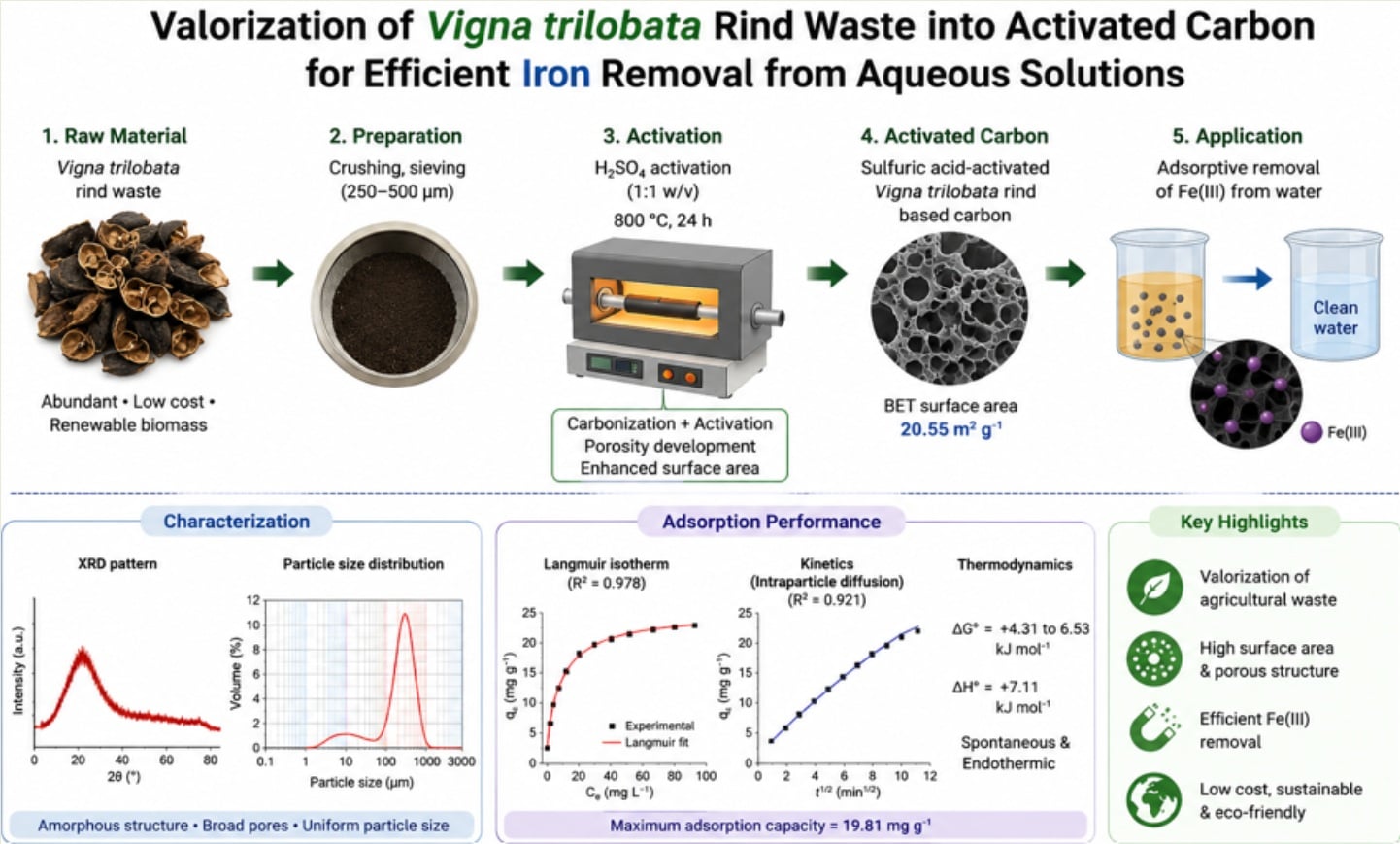
Iron (Fe) contamination of water sources has become an increasing environmental concern, creating the need for effective, environmentally friendly, and cost-effective technologies for Fe(III) removal from aqueous systems. In the present work, the possibility of using the sulfuric acid-activated carbon made of Vigna trilobata rind waste for treating water contaminated with Fe ions was explored. The characteristics of the synthesized material were identified by physical, chemical, and spectroscopic methods, and its Fe ion sorption efficiency was studied experimentally in batch mode under various conditions. Equilibrium, kinetics, and thermodynamics of Fe ion removal by the prepared adsorbent were determined. The obtained adsorbent had a BET surface area of 20.55 m2 g−1 and showed high experimental adsorption capacity with the highest observed uptake of 19.81 mg g−1. Based on the experimental results, the equilibrium data could be best described by the Langmuir equation (R2 = 0.978). Kinetic analysis showed that the rate-limiting step in Fe ion sorption was intraparticle diffusion (R2 = 0.921). Thermodynamic calculations indicated that the adsorption process occurred spontaneously (ΔG° = −4.31 to −6.53 kJ mol−1) and endothermically (ΔH° = +7.11 kJ mol−1). A comparative analysis showed that the sorption capacity of the studied adsorbent corresponded to that reported for the analogous materials produced from other biomasses.
Keywords: waste valorization; activated carbon; biosorption; Vigna trilobata rind waste valorization; activated carbon; biosorption; Vigna trilobata rind
Graphical Abstract