
Review

A Review of Graphene Oxide and Reduced Graphene Oxide Applications: Multifunctional Nanomaterials for Sustainable Environmental and Energy Devices

1
Department of Chemistry, Faculty of Mathematics and Natural Science, Universitas Sriwijaya, Jalan Palembang-Prabumulih Km 32, Indralaya 30653-30869, Ogan Ilir, Indonesia
2
Research Centre of Advanced Material and Nanocomposite, Faculty of Mathematics and Natural Science, Universitas Sriwijaya, Jalan Palembang-Prabumulih Km 32, Indralaya 30653-30869, Ogan Ilir, Indonesia
*
Author to whom correspondence should be addressed.
Submission received: 16 December 2025 / Revised: 11 January 2026 / Accepted: 14 January 2026 / Published: 23 January 2026
(This article belongs to the Special Issue Carbons for Health and Environmental Protection (2nd Edition))

Abstract

Graphene oxide (GO) and reduced graphene oxide (rGO) have solidified their role as cornerstone nanomaterials in the pursuit of sustainable technology. This review synthesizes recent advances in harnessing the unique properties of GO and rGO such as their tunable surface chemistry and exceptional electrical conductivity for applications spanning environmental remediation and energy storage. In the environmental domain, they function as superior adsorbents and catalysts for the removal of hazardous pollutants. Concurrently, in the energy sector, their integration into supercapacitors and battery electrodes significantly enhances energy and power density. The adaptability of these materials also facilitates the creation of highly sensitive sensors and biosensors. However, the transition from laboratory research to widespread industrial application is hindered by challenges in scalable production, environmental health and safety concerns, and long-term stability. This review enhances the understanding of GO and rGO’s diverse applications and paves the way for future sustainable technologies in energy and environmental sectors.

1. Introduction

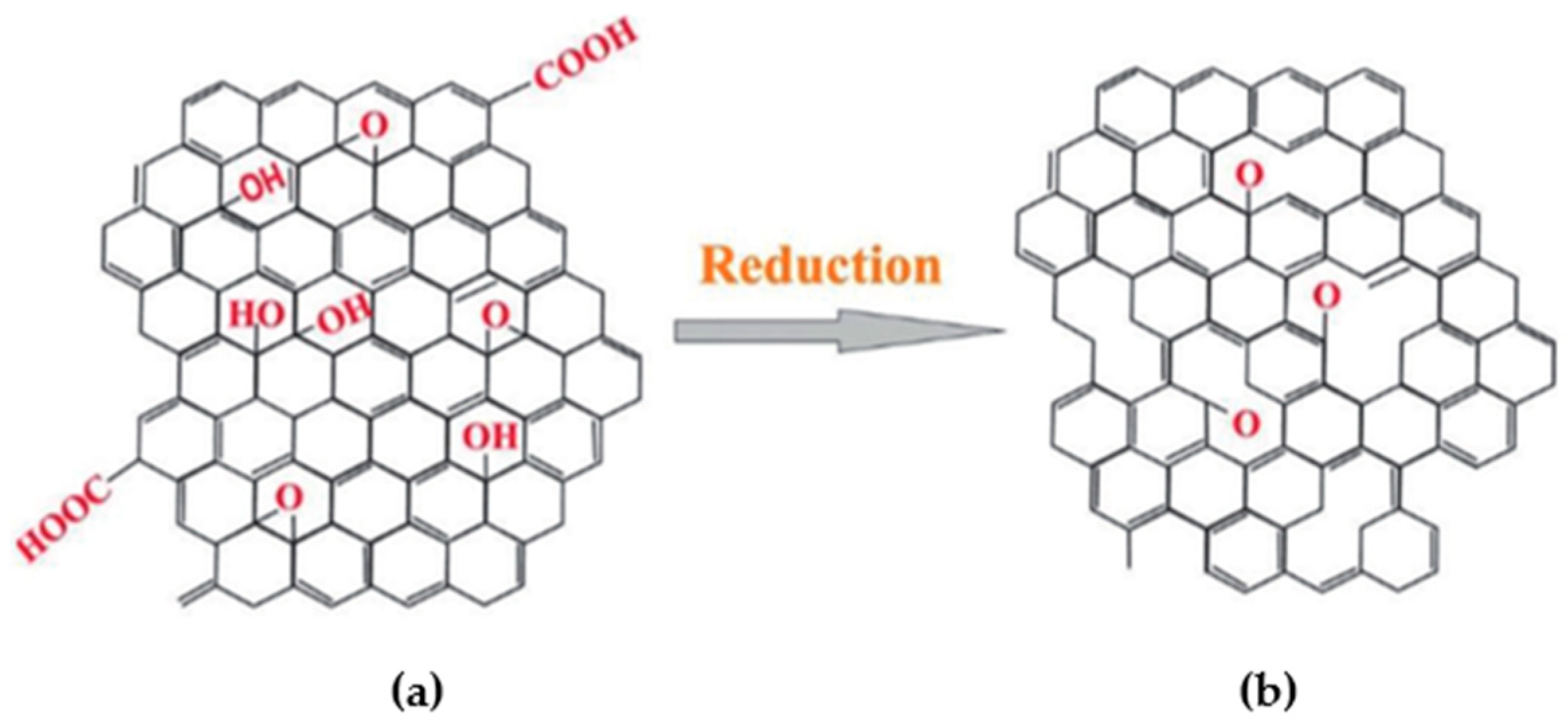
Graphene oxide (GO) and reduced graphene oxide (rGO) are the two most important types of graphene, with chemical and physical properties that can be changed, which makes them useful for many scientific and industrial purposes [1]. In the last ten years, research on GO and rGO has grown quickly because there is a strong need for new materials that can help solve global problems with energy and the environment. GO and rGO are very useful for things like adsorption, catalysis, sensors, and energy storage because they have high surface area and modifiable oxygen functional group [2]. GO and rGO are being looked at as eco-friendly replacements for traditional materials in water purification, pollutant removal, and air filtration in the field of environmental technology because they have very high surface reactivity and sorption capacity. In the energy sector, their high electrical conductivity and stability have made them good materials for electrodes in batteries, supercapacitors, and fuel cells [3]. GO/rGO is versatile because it can form hybrids or composites with metals, metal oxides, polymers, and other carbon-based materials, this makes it more useful [4]. The chemical structure of GO/rGO and the reduction process of GO to rGO can be seen in Figure 1.
The growing environmental concerns associated with industrialization, such as heavy metal pollution, organic dye contamination, and the increasing global energy demand, have further fueled interest in GO and rGO [3]. Traditional remediation and energy storage techniques often rely on expensive, inefficient, or environmentally harmful materials, prompting researchers to explore sustainable nanomaterial-based solutions [6]. GO and rGO, with their tunable chemical composition and electronic structure, have emerged as leading candidates to fill this gap. Their synthesis is relatively low-cost, scalable, and adaptable, making them suitable for both laboratory and industrial use [7]. Moreover, their ability to act as multifunctional materials simultaneously serving as adsorbents, catalysts, or conductive agents positions them as pivotal components in green technology innovation [3]. This combination of versatility, environmental compatibility, and scalability makes GO and rGO highly valuable in the pursuit of sustainable development goals related to clean water, renewable energy, and pollution control [8].
Although they have great potential, various significant issues persist in understanding and improving the application of GO and rGO. A significant research challenge involves discovering how to balance the structural and chemical characteristics to achieve the desired performance across various application fields [9]. For instance, while the elevated oxygen content in GO aids in drawing in contaminants via hydrogen bonding and electrostatic interactions, it also diminishes electrical conductivity, an essential property for energy storage and electrochemical apparatus [10]. In contrast, the partial restoration of the sp2 carbon framework during the reduction in rGO enhances its conductivity; nevertheless, this process simultaneously diminishes its capacity to draw in water and decreases the number of active functional sites that are accessible for adsorption [11]. Consequently, researchers face a trade-off between minimizing structure and enhancing surface reactivity, necessitating tailored strategies according to the intended application. Additionally, the persistent issues of durability, regenerative capacity, and recyclability of GO/rGO-based systems remain unresolved, limiting their broader use. To tackle these difficulties, many research efforts have focused on creating hybrid systems and functional composites that integrate the benefits of both GO and rGO. For instance, composites made from metal oxides and GO, like TiO2/GO and ZnO/GO, have shown enhanced photocatalytic effectiveness in breaking down organic pollutants when exposed to visible light. Additionally, composites formed from polymers and GO exhibit enhanced mechanical flexibility and increased adsorption efficiency [12]. Likewise, in the area of energy storage, rGO combined with transition metal oxides or conductive polymers has demonstrated improved electrochemical efficiency owing to the cooperative effects between conductivity and active surface areas [13]. These developments demonstrate that combining different materials is a useful method to address the fundamental drawbacks of pure GO or rGO [14]. However, the design principles that control these cooperative behaviors are still being actively investigated.
In environmental uses, GO and rGO have shown remarkable effectiveness as adsorbents for eliminating heavy metals (such as Pb2+, Cd2+, Cr6+), dyes (including methylene blue and rhodamine B), and organic contaminants [15]. The significant presence of oxygen-rich functional groups, such as hydroxyl, epoxy, and carboxyl, allows GO to have strong interactions with both ionic and molecular pollutants [16]. The addition of magnetic nanoparticles or biopolymers has been demonstrated to enhance the selectivity, recovery, and reusability of GO-based adsorbents [17]. Conversely, rGO having increased water-repelling properties and a restored connected structure, demonstrates better ability to adsorb aromatic and nonpolar pollutants due to π-π interactions [18]. These results show that both GO and rGO can be precisely modified to focus on particular types of contaminants, which makes them very flexible materials for treating wastewater and cleaning up the environment.
Alongside these advancements, materials based on rGO have become increasingly important in energy applications. Their excellent ability renders them suitable for application as electrodes in lithium-ion batteries, supercapacitors, and fuel cells [19]. Specifically, rGO composites combined with metal oxides (like MnO2, Fe3O4, and CO3O4) and conductive polymers (including polyaniline and polypyrrole) have demonstrated elevated energy and power densities along with enhanced cycling stability [20]. Additionally, the three-dimensional structure of GO/rGO aerogels and foams has been utilized to enhance ion movement and electrolyte availability, resulting in better electrochemical performance [21]. These findings highlight the capability of GO and rGO to serve as advanced materials for energy storage systems that are efficient, lightweight, and high-performing [22].
While considerable advancements have been made, a thorough review of the current literature reveals that numerous studies continue to focus on synthesis techniques rather than optimizing applications. The present research field shows a disjointed comprehension of the basic mechanisms that control the performance of GO/rGO in certain environmental or energy situations [23]. For example, the relationship between changes in surface chemistry and the preference for adsorbing pollutants has not been sufficiently studied. In a similar manner, the long-term stability and mechanisms of degradation of GO/rGO-based electrodes in energy devices under actual operating conditions need additional examination [3]. Furthermore, although many studies have emphasized that GO/rGO is outstanding as materials for laboratory use, their adaptation to industrial-scale applications is still limited due to production expenses, challenges in replicating results, and possible environmental effects [24]. These research gaps demonstrate the necessity for organized, practical studies that connect laboratory advancements with practical use in the real world.
Given these gaps, this review seeks to gather and thoroughly evaluate the recent progress made in the use of GO and rGO in environmental cleanup and energy technologies from 2015 to 2025. A key novelty of this review lies in its shift in focus from the synthesis techniques to the recent application of GO/rGO in these fields, instead it focuses on practical performance, relative efficiency, and new developments in adsorption, catalysis, energy storage, and sensing. The uniqueness of this research is found in its comprehensive viewpoint, linking various application areas through a cohesive framework that emphasizes the relationships among structure, properties, and performance. Additionally, it recognizes the current obstacles to widespread use, such as issues related to environmental safety, cost efficiency, and sustainability challenges. This review aims to present a clear summary of recent discoveries, highlight future research goals, and emphasize the essential role of GO and rGO in creating sustainable technologies for environmental and energy applications.

2. Overview of Research Trends

In the last ten years, the study of graphene oxide (GO) and reduced graphene oxide (rGO) has shifted from focusing primarily on improving their production to investigating their practical uses [25]. This change highlights the increasing awareness of these materials as flexible solutions for tackling worldwide environmental and energy issues [26]. At first, scientific research focused on comprehending the distinct structure and characteristics of graphene, which include its exceptional electrical conductivity, mechanical strength, and thermal stability [27]. Nevertheless, the practical difficulties associated with the large-scale production of flawless graphene have redirected focus to its derivatives, namely GO and rGO [28]. These derivatives provide comparable benefits while allowing for adjustable surface properties and variations in chemical reactivity. From 2015 to 2025, research on GO and rGO has risen dramatically, with bibliometric studies indicating that the yearly publication rates in this area have more than tripled [29]. This swift development highlights a change in focus from creating materials in a lab setting to practical research aimed at developing sustainable technologies.
The global growth in GO and rGO research is driven by increasing environmental concerns and the urgent need for sustainable materials that can help manage pollution and renewable energy needs [30]. Their carbon-based hybrid structures which include both sp2 and sp3 bonds allow for the merging of electrical conductivity with plentiful oxygen-containing functional groups, thus rendering them suitable for various uses [31]. Researchers have utilized these characteristics to create materials that function as adsorbents, catalysts, electrodes for energy storage, and platforms for sensing [32]. The natural adaptability of GO and rGO, combined with the relative simplicity of their production and alteration, has positioned them as excellent choices for large-scale environmentally friendly technologies [33]. Consequently, the emphasis of research in both academic and industrial settings has gradually moved from investigating methods of synthesis to enhancing performance in real-world applications, including wastewater treatment, pollutant adsorption, photocatalysis, supercapacitors, and battery technologies [3].
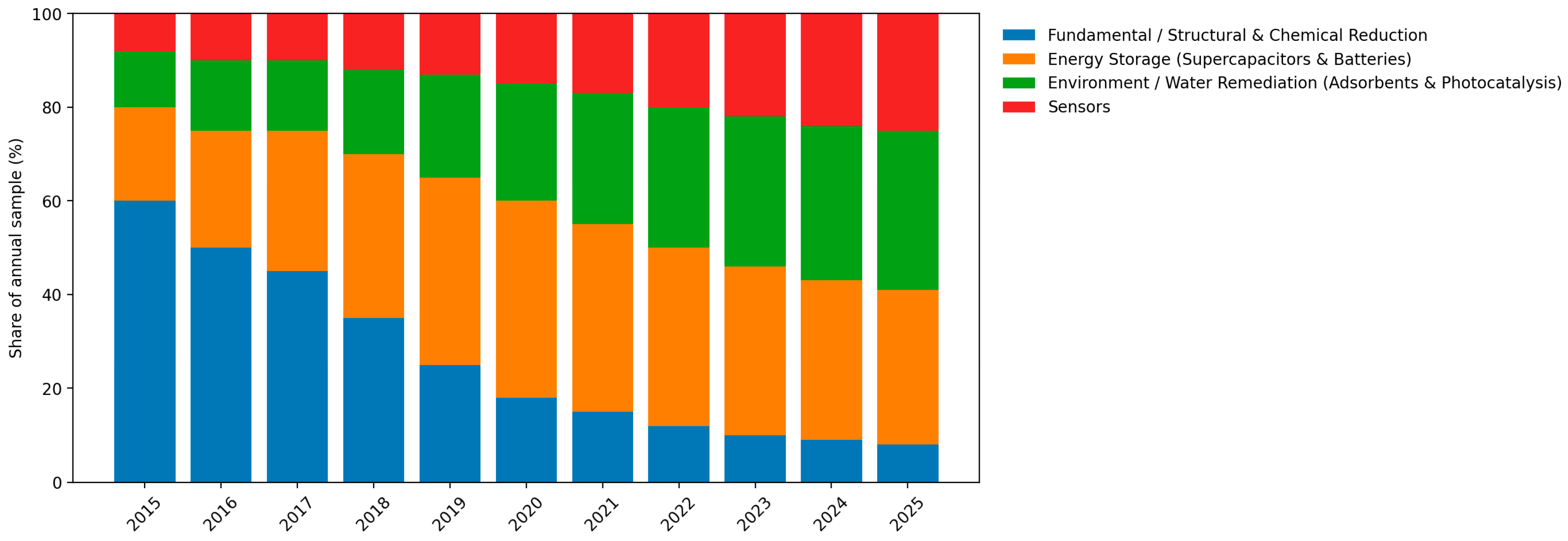
A bibliometric analysis of works published between 2015 and 2025 (Figure 2) shows a distinct development in subject matter. Earlier publications, especially those published before 2018, focused on the structural analysis and chemical reduction methods [29]. These efforts were mainly aimed at understanding how oxidation and reduction influence the morphology, defect density, and surface chemistry of GO. Following 2019, application-focused studies started to lead the field, indicating a development in the research of GO/rGO. The move towards applied science shows a wider understanding that a material’s performance relies not just on how it is made but also on how its physical and chemical properties work with the environments it is intended for. For example, the amount of oxygen in GO is important for adsorption and catalysis, as it creates active sites for attracting pollutants [34]. Meanwhile, the conductivity of rGO makes it useful for storing electrochemical energy [35]. This change from research focused on synthesis to research aimed at practical applications emphasizes the growing complexity of the field and how it corresponds with actual technological needs.
Another notable feature of contemporary research on GO/rGO is the increase in collaboration across different fields. Electrochemists, environmental engineers, and materials scientists are currently working together to develop these nanomaterials for specific applications [36]. Because of worldwide funding initiatives that encourage sustainable material innovation, there has been a rise in international collaborations and partnerships across various sectors, especially between universities in Asia and Europe [37]. By combining computational modeling, machine learning (ML), and on-site characterization techniques, this collaboration has enhanced research capabilities and broadened methodological strategies. Predictive algorithms are increasingly utilized to model electrochemical behavior and adsorption effectiveness, while machine learning-supported synthesis design enables the optimization of reduction conditions and the prediction of performance, all while reducing experimental costs [38]. These improvements indicate a shift in the industry from hands-on testing to materials design based on data, illustrating an increasing digital transformation.
Further analyses illustrate that research on GO and rGO encompasses several thematic categories, particularly focusing on adsorption and pollutant elimination, photocatalysis, and energy storage, with sensing emerging as the most favored area of study. About 70% of the published works concentrate on energy storage and the cleanup of environmental issues [39]. Because there is a high amount of oxygen-containing groups, most studies on adsorption have focused on employing GO and its derivatives to remove heavy metals and dyes [15]. achieve substantial interactions through electrostatic and hydrogen bonding. In the meantime, most studies on rGO have concentrated on its applications in energy storage, particularly in lithium-ion batteries and supercapacitors, where its electrical conductivity and mechanical stability enhance performance metrics [33]. such as charge–discharge stability and specific capacitance. These two areas environmental and energy applications are distinct, yet they have common foundational links between structure and properties, particularly regarding the adjustment of electronic conductivity and surface chemistry.
Even with major progress, many lasting problems still affect the direction of present research. A key issue that needs attention is reproducibility. Important alterations in the structure and function of GO/rGO may occur due to differences in manufacturing conditions, including oxidation duration, temperature, or the quality of the precursor used [40]. This lack of consistency complicates the comparison of research findings from different studies and impedes the standardization process within the industry. Furthermore, the long-term environmental and toxic effects of GO and rGO are still not well understood, even though they are often advertised as eco-friendly materials [41]. Concerns have been expressed about the safety of large-scale implementation, as various studies have suggested potential issues related to bioaccumulation and cytotoxicity in aquatic environments [42]. These uncertainties highlight the importance of conducting lifecycle assessments and environmental risk assessments alongside material development.
Another major challenge is scalability. Although numerous laboratory-scale demonstrations have proven GO/rGO’s functional potential, translating these findings into cost-effective industrial processes remains difficult [30]. Issues such as batch-to-batch variability, high production costs, and the environmental burden of chemical reduction processes hinder commercial adoption [43]. Researchers are increasingly investigating alternative synthesis routes based on bio-derived or waste carbon sources and green reduction methods utilizing plant extracts or benign chemical agents. These approaches not only reduce environmental impact but also align with circular economy principles, promoting sustainable material production.
At the same time, new research directions have begun to emerge that extend GO/rGO’s role beyond traditional applications. Hybrid composites, incorporating metal oxides, polymers, or other carbon nanostructures, represent one of the most promising strategies for enhancing multifunctionality [44]. Such hybrids often exhibit synergistic effects combining the high surface area and adsorption capacity of GO with the conductivity and durability of rGO [45]. Additionally, the integration of GO/rGO materials with renewable energy technologies, such as photocatalytic water splitting or CO2 reduction, has opened new possibilities for their utilization in energy conversion systems [46]. These advancements reflect a growing emphasis on multifunctional systems capable of performing simultaneous roles, such as pollutant degradation coupled with energy generation [3].
Overall, the trajectory of GO and rGO research from 2015 to 2025 illustrates a maturing scientific field characterized by increasing sophistication, interdisciplinarity, and application relevance. The initial phase of synthesis optimization has evolved into a complex research ecosystem that combines theoretical modeling, experimental validation, and technological integration. As the focus shifts toward sustainability and scalability, future research will likely prioritize eco-friendly synthesis routes, standardized characterization protocols, and comprehensive environmental assessments [37]. The convergence of computational methods, green chemistry, and hybrid material design marks a significant turning point for the field. GO and rGO are no longer viewed merely as laboratory materials but as pivotal components of global strategies aimed at clean energy production, environmental remediation, and sustainable technological advancement [29]. The continued evolution of this research area will depend on collaborative innovation that balances material performance with ecological responsibility and economic feasibility.

3. Applications of GO and rGO

3.1. Adsorption-Based Pollutant Removal

Graphene oxide (GO) and reduced graphene oxide (rGO) have been thoroughly studied as highly efficient materials for environmental remediation [47]. Due to the significant presence of oxygen-containing functional groups on GO, such as hydroxyl, epoxy, and carboxyl groups, there are active areas available for electrostatic interactions with various pollutants [16]. The properties of GO enable it to eliminate a wide range of pollutants, such as heavy metals, dyes, organic compounds, and even new contaminants like pharmaceuticals and tiny plastic particles [48]. In comparison, rGO has a decreased amount of oxygen and a partially regenerated sp2 carbon structure, which enhances π–π and hydrophobic interactions [49]. Consequently, both GO and rGO exhibit distinct yet complementary mechanisms for pollutant adsorption, making them versatile for diverse environmental remediation applications [50].
Over the last decade, many experimental studies have shown that GO and rGO have remarkable abilities to adsorb various pollutants [18]. For instance, rGO composites have shown greater effectiveness in adsorbing lead and cadmium ions, while GO-based adsorbents have achieved adsorption capacities exceeding 400 mg/g. the uptake of dyes such as methylene blue and rhodamine B [51,52]. The basic adsorption processes are significantly affected by the conditions of the solution, including pH, ionic strength, and temperature, along with surface modifications [53]. At lower pH levels, the attraction between opposite charges mainly governs the adsorption of positively charged species [54]. In contrast, at higher pH levels, the bonding of metal ions with carboxyl and hydroxyl groups becomes more significant. The effectiveness of adsorbing organic dyes and aromatic pollutants is significantly improved by the π-π interactions occurring between the graphene base plane and the attached dye molecules [55]. This adaptability emphasizes the effectiveness of GO and rGO in different environmental conditions.
The effectiveness of GO and rGO adsorbents has been improved further through functionalization and the creation of composites. The reusability of the materials has been enhanced through the use of magnetic nanoparticles (such as Fe3O4), allowing for their easy retrieval and regeneration with the help of external magnetic fields [56]. Polymer modification, for instance with chitosan, polyaniline, or polyethyleneimine, has enhanced selectivity, improved mechanical stability, and increased adsorption kinetics [57]. These changes enhance performance and address a significant challenge associated with nanocarbon adsorbents, namely the difficulties in recycling and separating them. Combinations of GO and rGO with TiO2 and ZnO are two instances of metal oxides that have shown dual capabilities, functioning as both photocatalysts for the decomposition of pollutants and as adsorbents [58]. By merging photocatalytic oxidation with adsorption-based concentration, this combined method enhances the overall efficiency of the purification process [59]. The application of GO/rGO and its composites as adsorbents, along with their adsorption capacities, can be seen in Table 1.
Although GO and rGO possess excellent adsorption abilities, several challenges remain. The stability of these materials in water is an important factor, as too much dispersion of GO can hinder their recovery and reuse [59]. Furthermore, the carbon structure might be partially damaged by the chemical or thermal techniques employed for regenerating the adsorbent, which would reduce its effectiveness over time [69]. Recent research has explored the attachment of GO/rGO onto solid materials such as membranes, foams, and aerogels to overcome these limitations. These established systems ensure a high ability to adsorb while also enhancing mechanical strength and user-friendliness [70]. Another important consideration is the potential that GO particles could pose a risk when released into the environment. Concerns have been raised regarding the safe disposal and reuse of GO, as studies show it may interact with aquatic organisms and microbial membranes [41]. Future research should consequently integrate the assessment of environmental risks, the sustainability throughout the lifecycle, and the enhancement of performance.
Despite these limitations, the advantages of GO and rGO as next-generation adsorbents are undeniable. Their superior adsorption capacities, chemical versatility, and structural tunability make them strong candidates for addressing complex environmental challenges [17]. The combination of experimental insights, computational modeling, and hybrid composite design continues to push the boundaries of their application in wastewater treatment and pollution control [3]. As research advances, integrating GO/rGO adsorbents into scalable, modular treatment systems remains a key direction for achieving sustainable water purification technologies [71].

3.2. Catalytic and Photocatalytic Applications

Beyond adsorption, GO and rGO have demonstrated significant potential as catalytic and photocatalytic materials in environmental remediation [72]. Their structural and electronic characteristics, including large surface area, high electron mobility, and abundant defect sites, make them ideal candidates for supporting or enhancing catalytic reactions [73]. GO’s oxygenated groups facilitate electron transfer and provide anchoring sites for metal and metal oxide nanoparticles, while rGO’s restored conjugated network improves charge transport, minimizing electron-hole recombination [74]. These synergistic features are particularly valuable in photocatalytic degradation and advanced oxidation processes (AOPs) targeting persistent organic pollutants [75].
In photocatalytic systems, GO and rGO are frequently integrated with semiconductor photocatalysts such as TiO2, ZnO, and g-C3N4 to improve visible-light response and overall degradation efficiency [76]. When coupled with these materials, GO/rGO acts as an electron mediator, promoting charge separation by capturing photogenerated electrons and reducing recombination losses [76,77]. This enhances the generation of reactive oxygen species (ROS) such as hydroxyl radicals (·OH) and superoxide anions (O2·−), which are responsible for the oxidative breakdown of pollutants [76,77]. Photocatalytic efficiencies exceeding 90% have been reported for dye and phenol degradation under visible-light irradiation, with rGO-TiO2 composites exhibiting improved activity compared to pure TiO2 due to enhanced electron transfer and extended light absorption range [78].
Furthermore, GO and rGO play crucial roles in heterogeneous catalytic systems for AOPs. Their surfaces can host transition metal nanoparticles (e.g., Fe, Cu, Co) that catalyze Fenton-like or peroxymonosulfate activation reactions, generating powerful oxidizing radicals capable of degrading refractory organic compounds [79]. rGO-based catalysts, in particular, demonstrate superior stability and electron conduction, maintaining activity over multiple cycles. The strong interactions between metal nanoparticles and rGO prevent aggregation, ensuring uniform dispersion and prolonged catalytic performance [80]. These systems have proven effective in treating industrial wastewater and reducing the concentration of toxic organics such as chlorophenols, pharmaceuticals, and pesticides.
Another emerging application involves metal-free catalysis using GO and rGO as active components themselves [81]. The intrinsic redox activity of oxygen-containing groups in GO enables it to activate oxidants like hydrogen peroxide or persulfates without requiring metal catalysts [82]. This metal-free approach eliminates secondary pollution associated with metal leaching and offers a more environmentally benign alternative. However, the catalytic efficiency of such systems depends heavily on the oxidation degree and defect density of GO, both of which govern its electron transfer capability [83]. Therefore, fine-tuning synthesis parameters and post-treatment processes remains critical for optimizing catalytic performance.
While catalytic and photocatalytic applications of GO and rGO have achieved substantial success in laboratory settings, several challenges hinder their industrial translation. Catalyst deactivation, poor recyclability, and scalability issues persist as major obstacles [84]. Metal nanoparticle leaching can contaminate treated water, while photocatalytic degradation under real environmental conditions may be limited by turbidity, natural organic matter, and light penetration [85]. Additionally, the high cost of producing high-quality GO and rGO composites restricts their widespread deployment. To address these challenges, researchers are developing immobilized catalyst systems, such as GO-coated membranes or rGO-supported aerogels, which combine high reactivity with mechanical durability and reusability [24,86].
Recent studies have also emphasized the integration of GO/rGO-based photocatalysts into hybrid technologies, such as photoelectrocatalytic and sonophotocatalytic systems [87,88]. These advanced configurations exploit external stimulielectric fields or ultrasonic vibrations to further enhance charge transfer and reactive species generation [89]. For example, rGO-g-C3N4 photoelectrocatalysts have achieved superior degradation rates for complex organic mixtures by simultaneously improving photon utilization and electron mobility [90]. Such hybrid systems exemplify the direction of contemporary research, which seeks to couple GO/rGO’s structural and electronic features with external energy inputs for maximized environmental performance [91].
In summary, GO and rGO serve as multifunctional platforms for catalytic and photocatalytic environmental applications, offering efficient pollutant degradation and energy-assisted remediation pathways [6]. Their high reactivity, electronic conductivity, and structural flexibility enable their integration into diverse catalytic systems [3]. However, realizing their full potential requires addressing challenges related to stability, scalability, and environmental compatibility. Future work must focus on developing durable, recyclable, and low-cost GO/rGO-based catalysts, guided by mechanistic understanding and life-cycle considerations. These efforts will be essential to transition from laboratory demonstrations to practical, sustainable environmental technologies.

3.3. Supercapacitors

Due to the unique structural, electrical, and mechanical characteristics of GO and rGO, they have garnered considerable attention as active components for supercapacitors [22]. Supercapacitors, referred to as electrochemical capacitors, are devices that store energi [92]. Supercapasitor serve as a bridge between batteries and standard capacitors by offering a high power density, an extended operational lifespan, and a broad range of working temperatures. rapid charging and discharging speeds, in addition to lifespan of cycles [93]. The excellent electrochemical properties of rGO and GO arise from their extensive surface area, adjustable functional groups, and varying electrical conductivity, which support both electrical techniques involving pseudocapacitance and electric double-layer capacitance (EDLC) [31]. The quest for energy storage systems that are lightweight, adaptable, and eco-friendly, suitable for the upcoming generation of wearable and portable devices, has resulted in the development of supercapacitors utilizing GO/rGO [94].
GO sheets in their unmodified form contain numerous oxygenated functional groups that enhance their affinity for water and assist in the distribution of aqueous electrolytes [95]. However, an excessive amount of oxygen disrupts the sp2 carbon structure, resulting in decreased electrical conductivity [95]. The incomplete transformation of GO into rGO reinstates electrical conductivity while maintaining an optimal level of oxygen functionalities that enhance interaction with electrolytes and facilitate ion transport [96]. It is crucial to keep a balance between surface chemistry and conductivity in order to achieve the highest possible capacitance [97]. For example, chemically reduced GO has demonstrated specific capacitances of about 150–250 F/g, whereas GO that has been reduced through thermal or hydrothermal methods may exhibit higher capacitance values, contingent on the reduction technique employed. the level of reduction and pore configuration [97]. The structured porosity of rGO, consisting of micropores for storing charge and mesopores for facilitating ion movement, enhances both electrochemical access and the efficiency of charge transport [98].
Recent studies have focused on improving the electrochemical efficiency of rGO by developing composites with metal oxides and conductive polymers [99,100]. Metal oxides such as MnO2, along with polymers like polyaniline (PANI) and polypyrrole (PPy), enhance the efficiency of charge transfer and offer greater mechanical flexibility [101]. Additionally, Fe2O3 and CO3O4 contribute additional pseudocapacitance through reversible redox reactions [102]. For instance, specific rGO-MnO2 and rGO-PANI composites have achieved capacitances reaching up to 185 F/g at 1 A/g and excellent capacitance retention of approximately 88.54% over 4000 charge–discharge cycles [103]. The cooperative interaction between the redox-active elements and the conductive structure of rGO enables greater energy and power densities, while also maintaining stability over a long period [103,104]. The capacitance of several supercapacitors based on GO/rGO are shown in Table 2.
Three-dimensional (3D) structures such as hydrogels, foams, and aerogels have been developed to solve the issue of sheet restacking, a common limitation that reduces the surface area of graphene-based materials [110]. These structures create linked networks that encourage electrolyte movement and efficient ion diffusion, leading to improved rate capability and cycle efficiency [110]. For example, aerogels composed of rGO with complex pore structures have shown a capacitance retention of more than 96% after 5000 cycles, indicating that they are stable and reversible [111]. Furthermore, the application of rGO films or fibers in the development of wearable and flexible supercapacitors has enabled the incorporation of energy storage into fabrics and flexible electronic devices [112]. The potential of the material for future use in flexible energy systems is highlighted by its ability to maintain high energy densities [112].
Despite these developments, the large-scale production and uniformity of rGO-based supercapacitors still present difficulties. The electrochemical performance can differ significantly based on the reduction methods employed, the quality of the precursor, and the conditions under which synthesis occurs [113]. Furthermore, the application of hazardous chemical reducing agents and the high cost of graphene derivatives present obstacles to sustainable production [114]. Recent studies have suggested eco-friendly synthesis methods that make use of plant extracts or ascorbic acid as reducing agents, alongside carbon sources obtained from biomass [115]. These approaches reduce the negative effects of creating electrodes on the environment and align with the goals of sustainable development. Future studies will probably focus on integrating these environmentally friendly production methods with scalable designs for electrodes to guarantee both efficiency and commercial viability.

3.4. Batteries

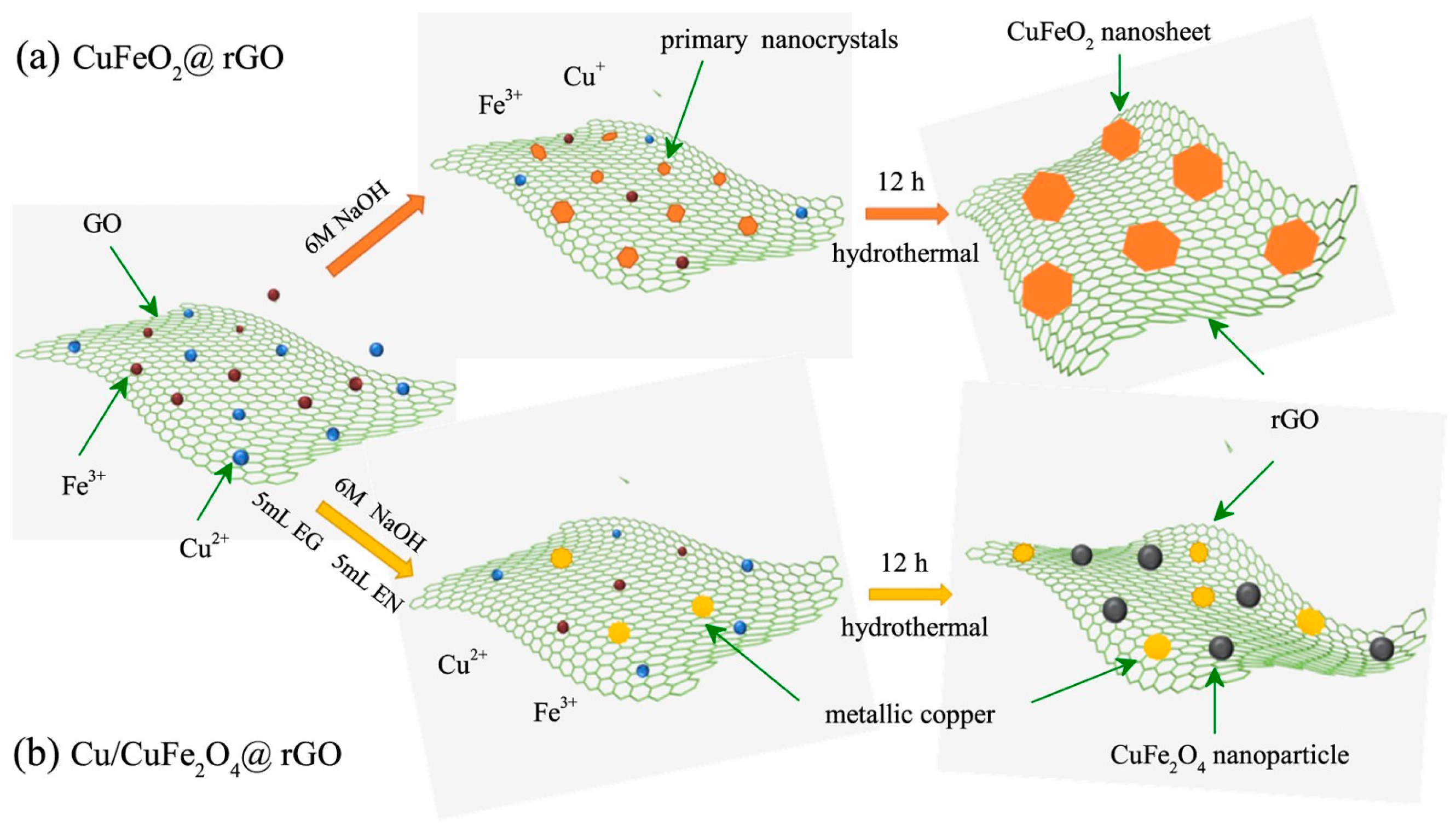
GO and rGO have been extensively explored as electrode materials in battery systems due to their excellent electrical conductivity, high mechanical stability, and tunable surface chemistry [116]. GO/rGO two-dimensional lamellar structure provides pathways for efficient electron and ion transport while accommodating volume changes during charge–discharge cycles [117]. The applications of GO and rGO in batteries span multiple systems, including lithium-ion (Li-ion), sodium-ion (Na-ion), lithium-sulfur (Li-S), and zinc-ion (Zn-ion) batteries, each leveraging distinct advantages of the materials [117,118,119]. Schematic illustration of the synthesis rGO based material for lithium-ion batteries illustrated in Figure 3.
In Li-ion batteries, rGO has primarily been utilized as a conductive additive or active anode material to enhance charge transfer and stabilize electrode structures [19]. rGO high electrical conductivity ensures rapid electron mobility, while the residual oxygen functionalities facilitate electrolyte interaction and ion diffusion [96]. Composite electrodes combining rGO with transition metal oxides (e.g., Fe3O4, CO3O4, SnO2) showcasing higher reversible capacities of 1021 and 773 mAhg−1 after 100 cycles at 100 mAg−1, along with excellent rate capability [116]. Similarly, rGO–Si anode composites mitigate the volume expansion issue associated with silicon electrodes, thereby improving cycle life and mechanical integrity [121]. The incorporation of GO as a binder or coating material on cathodes also enhances interfacial adhesion and structural cohesion, contributing to improved capacity retention over extended cycling [121].
In the case of sodium-ion and zinc-ion batteries, GO and rGO have shown promise as conductive frameworks that stabilize active materials and suppress dendrite formation [122,123]. rGO’s high electrical conductivity and structural flexibility make it particularly suitable for flexible and aqueous-based energy storage systems [119]. For example, Zn-ion batteries employing rGO-modified cathodes have achieved high energy densities and long-term stability due to the uniform ion distribution and efficient charge transfer facilitated by rGO layers [119]. Additionally, the hydrophilic nature of GO can enhance electrolyte wettability and interfacial contact, thereby reducing internal resistance and improving overall efficiency [124].
Lithium-sulfur (Li–S) batteries represent another domain where GO and rGO play crucial roles. These materials effectively trap polysulfide intermediates, mitigating the notorious “shuttle effect” that leads to capacity fading [125]. rGO’s conductive framework not only immobilizes sulfur species through physical adsorption and chemical bonding but also provides efficient electron pathways for redox reactions [126]. rGO–sulfur composites at 500 mA g−1 delivered an initial discharge capacity of 552 mA h g−1, and there was no capacity loss in its initial five cycles, maintaining a stable capacity of 390 mA h g−1 till 300 cycles with 73% capacity retention [126]. Moreover, the porous structure of rGO helps accommodate volume expansion during cycling, maintaining electrode integrity [127].
While the electrochemical performance of GO/rGO-based batteries is impressive, several challenges must be addressed before large-scale application becomes feasible. The synthesis of uniform, defect-controlled graphene derivatives remains complex, and the scalability of high-quality rGO production is limited by cost and environmental concerns [113]. Furthermore, optimizing the electrode–electrolyte interface and minimizing unwanted side reactions are ongoing areas of research. To overcome these limitations, recent studies have focused on hybridization strategies that combine GO/rGO with other carbon materials, such as carbon nanotubes (CNTs) and activated carbon, to create hierarchical architectures that enhance conductivity and mechanical stability [128].
Looking forward, the integration of GO and rGO into next-generation batteries aligns with global efforts to achieve high-performance, sustainable, and flexible energy storage technologies [129]. As the demand for renewable energy systems continues to grow, the versatility of GO and rGO offers a platform for tailoring electrode materials across diverse chemistries [117]. Through these approaches, GO and rGO will continue to play a pivotal role in advancing battery technology toward higher efficiency, durability, and environmental sustainability.

3.5. Sensing Applications

GO/rGO have emerged as highly promising materials for use in sensing applications because their exceptional electrical, mechanical, and chemical characteristics [130,131]. GO/rGO are ideal for identifying many different substances, including gases, because of their large surface area relative to their volume, customizable surface properties, and excellent ability to conduct charge, as well as metallic elements to biological molecules and carbon-based substances [131]. The partially restored sp2 network in rGO enhances the attraction of specific molecules and enables chemical modifications, as GO contains oxygen-rich functional groups. The movement of charge carriers and the ability to conduct electricity [11]. Because of the interaction between their electronic and structural features, both rGO and GO can serve as very sensitive transduction platforms for different types of sensing methods, including electrochemical sensing. Field-effect transistor (FET)-based sensors, optical sensors, and field-effect transistor (FET)-based sensors [132].
One of the most thoroughly studied electrochemical sensors is those that utilize rGO and GO due to their ability to transform molecular interactions into quantifiable electrical signals [133]. In these devices, GO and rGO typically act as modifications for electrodes, improving the adsorption of analytes, accelerating electron transfer rates, and enlarging the effective surface area [133]. The oxygen functional groups present in GO enable significant interactions with polar organic molecules and metal ions [134]. In contrast, the conductive structure of rGO supports efficient charge transfer between the analyte and the surface of the electrode [135]. For instance, electrodes modified with rGO have demonstrated outstanding sensitivity in detecting heavy metals such as lead, mercury, and cadmium, achieving detection limits as low as the nanomolar range [136]. The primary functioning method for these sensors is stripping voltammetry, where metal ions are initially concentrated on the surface of rGO and subsequently anodically dissolved, resulting in high signal-to-noise ratios [136]. In the same way, composites made with functionalized rGO and GO, using polymers or nanoparticles like gold, silver, and platinum, have been developed to detect pharmaceutical residues, pesticides, and organic pollutants. integrating selectivity with minimal detection limits in water environments [137].
The application of GO and rGO in biosensing is another area that is rapidly expanding. Their compatibility with living tissues, ability to adapt functions, and capability to hold biomolecules make them particularly appropriate for creating enzyme-based, DNA-based, and immunosensors [138]. The ability of GO to quench fluorescence is used in optical biosensing systems, and its high oxygen content aids in the physical absorption or covalent attachment of biomolecules [138]. Conversely, electrochemical transduction advantages arise from the increased electrical conductivity of rGO. For instance, glucose biosensors that utilize rGO and glucose oxidase was tested for glucose detection, the sensitivity of glucose detection was shown to be 57.3 µA/(mM·cm2) with a detection limit of 86.8 µM [139]. Furthermore, immunosensors that are functionalized with GO have been employed to selectively detect disease biomarkers, including cardiac proteins and cancer antigens; this high binding specificity is achieved due to the antibody being attached to the surface of the GO [140]. Besides that, the performance of the biosensor has been enhanced by incorporating GO and rGO with nanostructured materials such as quantum dots and metal nanoparticles, resulting in improved signal transduction efficiency and stability [141].
Gas sensing represents another field where both rGO and GO show significant potential. Because of their large surface area and customizable electronic features, they are highly selective and responsive to different gas molecules, such as nitrogen and ammonia (NH3), dioxide (NO2) and volatile organic compounds (VOCs) [142]. The primary function of the sensor relies on changes in electrical resistance caused by gas absorption, which subsequently influences the density of charge carriers within the material [143]. Due to its surface being rich in oxygen, GO interacts effectively with polar gas molecules; however, its low conductivity might restrict its sensitivity [144]. Conversely, the elevated conductivity and presence of defect sites in rGO facilitate the movement of electrons, resulting in faster response and recovery times [144]. Research indicates that rGO-based NO2 sensors have high sensitivity, rapid response, and a recovery time of 31 s and 81 s, respectively, when exposed to 250 ppm NO2 at room temperature (RT). The sensor demonstrated good repeatability, excellent 60-day stability, and linearity from 50 to 500 ppm of NO2 concentration [145]. Metallic nanoparticles such as Pd, Pt, or Cu can enhance functionalization and, in turn, increase selectivity by serving as catalysts. Furthermore, heterostructure designs that integrate rGO along with cooperative electronic interactions involving metal oxides such as ZnO and SnO2 enhance the sensitivity for specific gas adsorption reactions [142,146].
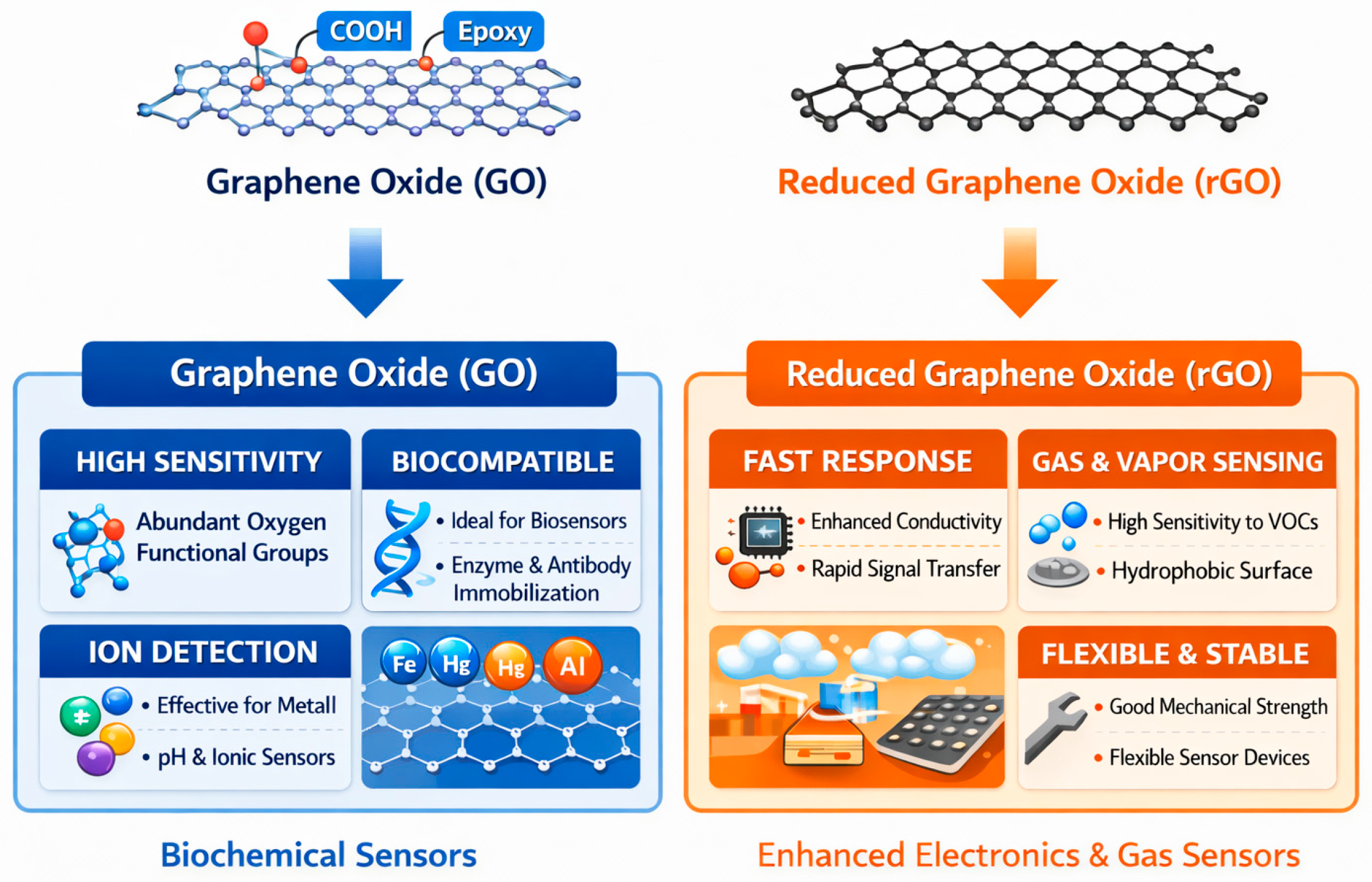
Optical sensing platforms utilizing GO and rGO benefit from their distinctive optical and photoluminescent properties [147]. GO demonstrates remarkable fluorescence quenching capability, which can be applied in fluorescence resonance energy transfer (FRET)-based biosensors for the detection of DNA, proteins, and small molecules [148]. The fluorescence of biomolecules that are labeled with fluorescent tags decreases when they come into contact with GO because energy moves from the fluorescent tag to GO’s conjugated π system [149]. However, the fluorescence returns to normal when the target is attached. This system enables detection that is highly sensitive and does not require labels. In a similar manner, surface plasmon resonance (SPR) sensors utilizing rGO as an active layer demonstrate enhanced refractive index and signal strength [150]. Improved surface plasmon coupling leads to increased sensitivity to the index. These optical sensing techniques have been employed in monitoring the environment and diagnosing medical conditions, offering fast, non-damaging, and efficient detection abilities [150]. The advantages of GO/rGO as a sensor are shown in the Figure 4.
Overall, rGO and GO have proven to be highly versatile materials for use in sensor applications, including optical, electrochemical, and gas detection systems. Their unique combination of adjustable properties, excellent conductivity, and strong mechanical durability positions them as future materials for advanced sensors. Future enhancements in the management of hybrid synthesis are expected. It is anticipated that their sensitivity, selectivity, and stability will improve through advancements in material design and the integration of systems. The upcoming wave of advanced sensing technologies will be characterized by the integration of data analysis, eco-friendly manufacturing, adaptable electronics, and the material science of GO/rGO materials [151]. This combination will enable applications in smart infrastructure, healthcare diagnostics, and environmental monitoring.

4. Comparative Analysis of GO and rGO Performance

To understand the respective benefits, drawbacks, and potential combinations of GO and rGO in various environmental and energy-related fields, a comparison between the two is required. Although both materials originate from the same carbon precursor, variations in oxygen levels, defect density, and electronic structure result in notable differences in their physical and chemical characteristics, these differences in structure affect their efficiency in adsorption, catalysis, sensing, and energy storage [2]. A methodical examination reveals that rGO outperforms GO in terms of electrical conductivity, stability, and mechanical strength, while GO excels in surface functionalization and chemical reactivity. The distinct characteristics of these materials underscore the importance of selecting them thoughtfully or combining them according to the specific needs of the application [152].
From a chemical and structural viewpoint GO is characterized by its significant presence of oxygen-containing groups such as hydroxyl, carboxyl, and epoxy which disrupt the extensive sp2 network of graphene. The addition of oxygen makes the substance more water-attracting, which enhances its ability to mix well in polar solvents and facilitates chemical modifications [153]. These surface groups serve as active sites for the adsorption and covalent bonding processes, which enhance the remarkable capability of GO to immobilize biomolecules, facilitate reactions, and eliminate pollutants [9]. However, the specific qualities that increase the reactivity of GO also reduce its conductivity. Electrochemical localization occurs as sp2 carbon changes to sp3 hybridization, resulting in reduced mobility of charge carriers. Consequently, the low conductivity of GO restricts its application in electrochemical fields such as supercapacitors and batteries, where efficient electron transfer is essential [154].
In contrast, rGO is made by chemically, thermally, or electrochemically reducing GO, which partially returns the sp2 conjugated structure and enhances its electrical conductivity [155]. The oxygen level in rGO is reduced; however, it still has imperfections that provide it with some degree of chemical reactivity. Due to its blend of conductivity and a morphology rich in defects, rGO is ideally suited for applications in energy storage and sensing [11]. rGO water-repellent properties and the prolonged π-conjugation enhance π–π interactions with aromatic compounds, making it more effective than GO in capturing nonpolar organic pollutants and acting as a sensing interface for gaseous and biochemical substances [144,156]. Nevertheless, the limited oxygen functionality of rGO hinders its ability to absorb water and interact with substances in water, thus complicating its dispersion and the formation of composites without additional modifications to its surface [157].
In environmental remediation, GO and rGO exhibit distinct yet complementary adsorption mechanisms. GO’s oxygenated functional groups favor electrostatic attraction, hydrogen bonding, and surface complexation, leading to high adsorption capacities for heavy metals and ionic contaminants [158]. Conversely, rGO demonstrates superior performance in removing organic and aromatic pollutants through hydrophobic interactions and van der Waals forces [159]. Hybrid materials combining GO and rGO have been found to exploit the strengths of both: GO contributes surface polarity and functional reactivity, while rGO enhances adsorption kinetics and structural stability. This dual-functionality approach represents a promising route for developing multifunctional adsorbents capable of treating complex pollutant mixtures [160].
The unique electronic properties of GO and rGO lead to different roles in photocatalytic and catalytic systems. Due to its abundant surface functional groups that facilitate the attachment of metal nanoparticles and enhance charge transfer activities, GO often functions as a catalyst support or co-catalyst [161]. When combined with semiconductors such as TiO2, ZnO, or g-C3N4, its semiconducting properties and oxygen-rich surface render it highly efficient in photocatalysis under visible light [162]. rGO primarily serves as a conductive platform and electron mediator, enhancing charge transport and reducing the recombination of electrons and holes [163]. For example, rGO–TiO2 composites enhance photocatalytic activity by allowing efficient electron movement, whereas GO–TiO2 composites boost the surface adsorption of reactants [164]. Consequently, when compared to each component alone, the combined use of GO and rGO can achieve greater degradation rates and enhanced catalytic stability.
Because of its greater electrical conductivity and strength, the advantages of rGO are more apparent in energy storage applications [6]. Due to rGO excellent specific capacitance, outstanding rate performance, and long cycling life, electrodes made from rGO are ideal for use in batteries and supercapacitors [107]. In comparison, GO is often used as a starting material, binder, or structural component to improve ion movement, while MnO2 or conductive polymers are utilized and the ability to bend easily [165]. The functional groups present in GO enhance the ability of electrolytes to spread and strengthen the bonding between interfaces in lithium-ion and sodium-ion batteries, whereas rGO acts as the conductive framework essential for swift electron transfer [166]. These additional functions emphasize how GO and rGO can be collaboratively engineered to achieve a balance between ionic and electronic conductivity in composite electrodes.
In sensing applications, GO and rGO demonstrate distinct yet interconnected roles. GO is ideal for chemical and biosensing applications due to its significant ability to undergo functionalization, enabling it to selectively engage with specific target analytes [49]. Due to GO ability to bind biomolecules through both covalent and non-covalent interactions, it finds applications in DNA detection systems and immunosensors [167]. Conversely, rGO possesses the efficiency in signal transduction and the electrical conductivity essential for immediate detection. When combined, GO and rGO may enhance sensing abilities, as GO facilitates the binding of analytes and rGO enables signal amplification through efficient electron transport [168]. In hybrid systems that combine electrochemical and optical sensing, where both selectivity and sensitivity are required, this additional method is particularly advantageous.
Despite these performance advantages, there remain several important trade-offs between rGO and GO. Because of the uneven removal of oxygen and remaining functional groups that happen during the reduction process for creating rGO, there is variation in the electronic and structural properties from one batch to another [169]. Conversely, excessive oxidation during the production of GO can lead to a breakdown of its structure, diminishing its mechanical strength and limiting its ability to be reused [170]. These factors complicate the process of standardization and hinder the ability to reproduce published performance metrics. Moreover, both substances present concerns regarding environmental safety and durability over time. Additional research on the life-cycle effects of GO and rGO is essential due to the potential toxicity associated with the oxidative surface of GO and the uncertain biodegradability of rGO [171]. For GO and rGO technologies to transition from small laboratory demonstrations to widespread industrial application, it is essential to tackle these challenges.
The growing application of GO/rGO in energy and environmental technologies should be supported by Life Cycle Assessment (LCA). An LCA framework can be introduced by defining a functional unit relevant to the application (e.g., per kWh delivered over battery lifetime), selecting system boundaries (cradle-to-gate for material synthesis or cradle-to-grave including use and end-of-life), and compiling a life cycle inventory covering oxidants/reductants, washing and purification steps, energy-intensive drying/thermal treatments, and wastewater management. Hotspot and sensitivity analyses are particularly important because the overall impacts are strongly influenced by synthesis yield, electricity mix, and the number of purification steps. Importantly, potential environmental burdens in material production may be offset by use-phase benefits such as extended cycle life, improved reusability, or reduced operational energy, which should be quantified whenever possible [172].
In summary, the comparison shows that there is no clear champion between GO and rGO, and the most appropriate choice relies on the specific application and context of use. rGO is ideal for use in electrochemical and electronic devices due to its excellent conductivity and stability [33]. In contrast, GO plays a vital role in adsorption and catalytic systems because of its ability to attract water, its chemical reactivity, and its functional surface properties [173]. The most effective method for future technological advancement is to integrate these various features through the design of hybrid materials [45]. Additional research should focus on enhancing synthesis control, improving reproducibility, and broadening mechanistic insights to fully leverage the complementary capabilities of GO and rGO in sustainable energy technologies.

5. Conclusions and Future Directions

This review has examined the recent advancements and emerging applications of GO and rGO, highlighting their unique physicochemical characteristics and the growing range of their environmental and energy-related applications. The comparative analysis demonstrates that GO, with its high degree of functionalization and hydrophilicity, excels in adsorption and catalytic systems, while rGO, characterized by superior electrical conductivity and structural stability, is better suited for electrochemical and sensing applications. The integration of both materials in hybrid systems provides synergistic improvements in performance, establishing them as pivotal components in next-generation sustainable technologies. Despite substantial progress, challenges such as synthesis reproducibility, environmental safety, and large-scale manufacturing remain critical barriers to practical implementation. The study underscores the importance of interdisciplinary innovation combining green chemistry, digital materials design, and advanced manufacturing to address these issues and to enable the development of scalable, eco-friendly GO/rGO-based systems. By consolidating the current state of knowledge and identifying key research gaps, this review contributes to a deeper understanding of GO and rGO’s multifunctional roles and sets a foundation for future research toward sustainable material technologies that support global energy and environmental goals.

Author Contributions

The contributions of each author are as follows: Conceptualization, I.A.M. and M.S.; methodology, M.S.; software, B.R.A.; validation, D., N.H. and B.R.A.; formal analysis, M.S.; investigation, I.A.M.; resources, D.; data curation, D.; writing—original draft preparation, I.A.M.; writing—review and editing, N.H.; visualization, N.H.; supervision, D.; project administration, B.R.A.; funding acquisition, M.S. All authors have read and agreed to the published version of the manuscript.

Funding

This research was funded by Kementerian Pendidikan Tinggi, Sains dan Teknologi Indonesia, grant number 109/C3 /DT.05.00 /PL/2025.

Data Availability Statement

We declare that all data has been presented in this manuscript, no additional data is stored elsewhere.

Acknowledgments

The author would like to thank the Department of Chemistry, Faculty of Mathematics and Natural Sciences, Sriwijaya University for the laboratory facilities used during this research.

Conflicts of Interest

The authors declare no conflicts of interest.

References

  1. Smith, A.T.; LaChance, A.M.; Zeng, S.; Liu, B.; Sun, L. Synthesis, properties, and applications of graphene oxide/reduced graphene oxide and their nanocomposites. Nano Mater. Sci. 2019, 1, 31–47. [Google Scholar] [CrossRef]
  2. Benzigar, M.R.; Talapaneni, S.N.; Joseph, S.; Ramadass, K.; Singh, G.; Scaranto, J.; Ravon, U.; Al-Bahily, K.; Vinu, A. Recent advances in functionalized micro and mesoporous carbon materials: Synthesis and applications. Chem. Soc. Rev. 2018, 47, 2680–2721. [Google Scholar] [CrossRef]
  3. Singh, R.; Samuel, M.S.; Ravikumar, M.; Ethiraj, S.; Kumar, M. Graphene materials in pollution trace detection and environmental improvement. Environ. Res. 2024, 243, 117830. [Google Scholar] [CrossRef]
  4. Kumar, R.; Thangappan, R. Electrode material based on reduced graphene oxide (rGO)/transition metal oxide composites for supercapacitor applications: A review. Emergent Mater. 2022, 5, 1881–1897. [Google Scholar] [CrossRef]
  5. Priyadarsini, S.; Mohanty, S.; Mukherjee, S.; Basu, S.; Mishra, M. Graphene and graphene oxide as nanomaterials for medicine and biology application. J. Nanostruct. Chem. 2018, 8, 123–137. [Google Scholar] [CrossRef]
  6. Pasindu, V.; Yapa, P.; Dabare, S.; Munaweera, I. Multifunctional transition metal oxide/graphene oxide nanocomposites for catalytic dye degradation, renewable energy, and energy storage applications. RSC Adv. 2025, 15, 33162–33186. [Google Scholar] [CrossRef]
  7. Ranjan, P.; Agrawal, S.; Sinha, A.; Rao, T.R.; Balakrishnan, J.; Thakur, A.D. A Low-Cost Non-explosive Synthesis of Graphene Oxide for Scalable Applications. Sci. Rep. 2018, 8, 12007. [Google Scholar] [CrossRef]
  8. Tene, T.; Jiménez-Gaona, Y.; Campoverde-Santos, D.K.; Cevallos, Y.; La Pietra, M.; Vacacela Gomez, C.; Scarcello, A.; Straface, S.; Caputi, L.S.; Bellucci, S. Tunable optical and semiconducting properties of eco-friendly-prepared reduced graphene oxide. Front. Chem. 2023, 11, 1267199. [Google Scholar] [CrossRef] [PubMed]
  9. Guo, S.; Garaj, S.; Bianco, A.; Ménard-Moyon, C. Controlling covalent chemistry on graphene oxide. Nat. Rev. Phys. 2022, 4, 247–262. [Google Scholar] [CrossRef]
  10. Tsai, M.-H.; Chao, H.-R.; Jiang, J.-J.; Su, Y.-H.; Cortez, M.P.; Tayo, L.L.; Lu, I.-C.; Hsieh, H.; Lin, C.-C.; Lin, S.-L.; et al. Toxicity of Low-dose Graphene Oxide Nanoparticles in an in-vivo Wild Type of Caenorhabditis elegans Model. Aerosol Air Qual. Res. 2021, 21, 200559. [Google Scholar] [CrossRef]
  11. Méndez-Romero, U.A.; Pérez-García, S.A.; Fan, Q.; Wang, E.; Licea-Jiménez, L. Lateral size reduction of graphene oxide preserving its electronic properties and chemical functionality. RSC Adv. 2020, 10, 29432–29440. [Google Scholar] [CrossRef]
  12. Bi, A.; Mahmood, S.; Garg, N.; Thakur, S.; Chaudhry, S.A.; Yadav, S.; Gupta, M.; Bechelany, M.; Prakash, J.; Haque, Z. Graphene oxide/polyindole nanocomposite: A highly efficient multi-cyclic, stable and sustainable photocatalyst platform for wastewater remediation under visible light. Mater. Adv. 2025, 6, 6320–6336. [Google Scholar] [CrossRef]
  13. Zięba, W.; Jurkiewicz, K.; Burian, A.; Pawlyta, M.; Boncel, S.; Szymański, G.S.; Kubacki, J.; Kowalczyk, P.; Krukiewicz, K.; Furuse, A.; et al. High-Surface-Area Graphene Oxide for Next-Generation Energy Storage Applications. ACS Appl. Nano Mater. 2022, 5, 18448–18461. [Google Scholar] [CrossRef]
  14. Tawade, A.K.; Tayade, S.N.; Dubal, D.P.; Mali, S.S.; Kook Hong, C.; Kumar, K.; Sharma, K. Enhanced supercapacitor performance through synergistic electrode design: Reduced graphene oxide-polythiophene (rGO-PTs) nanocomposite. Chem. Eng. J. 2024, 492, 151843. [Google Scholar] [CrossRef]
  15. Wang, J.; Zhang, J.; Han, L.; Wang, J.; Zhu, L.; Zeng, H. Graphene-based materials for adsorptive removal of pollutants from water and underlying interaction mechanism. Adv. Colloid. Interface Sci. 2021, 289, 102360. [Google Scholar] [CrossRef]
  16. Tawfik, A.; Eraky, M.; Khalil, M.N.; Osman, A.I.; Rooney, D.W. Sulfonated graphene nanomaterials for membrane antifouling, pollutant removal, and production of chemicals from biomass: A review. Environ. Chem. Lett. 2023, 21, 1093–1116. [Google Scholar] [CrossRef]
  17. Zubair, M.; Roopesh, M.S.; Ullah, A. Challenges and prospects: Graphene oxide-based materials for water remediation including metal ions and organic pollutants. Environ. Sci. Nano 2024, 11, 3693–3720. [Google Scholar] [CrossRef]
  18. Thakur, K.; Kandasubramanian, B. Graphene and Graphene Oxide-Based Composites for Removal of Organic Pollutants: A Review. J. Chem. Eng. Data 2019, 64, 833–867. [Google Scholar] [CrossRef]
  19. Müllner, S.; Held, T.; Tichter, T.; Rank, P.; Leykam, D.; Jiang, W.; Lunkenbein, T.; Gerdes, T.; Roth, C. Impact of Functional Groups in Reduced Graphene Oxide Matrices for High Energy Anodes in Lithium-Ion Batteries. J. Electrochem. Soc. 2023, 170, 070523. [Google Scholar] [CrossRef]
  20. Kandwal, K.; Jain, A.; Kumar, R.; Sharma, S.; Bains, P.S.; Sharma, A.; Joshi, S.K.; Kozak, D.; Abbas, M.; Lozanovic, J. Critical review on the derivative of graphene with binary metal oxide-based nanocomposites for high-performance supercapacitor electrodes. Main Group Met. Chem. 2025, 48, 20230027. [Google Scholar] [CrossRef]
  21. Han, S.-C.; Quan, J.-L.; Zhou, F.-G.; Xue, Y.-H.; Li, N.; Li, F.-Y.; Wang, D. 3D printing of architectured graphene-based aerogels by cross-linking GO inks with adjustable viscoelasticity for energy storage devices. Rare Metals 2023, 42, 971–981. [Google Scholar] [CrossRef]
  22. Mousavi, S.M.; Hashemi, S.A.; Kalashgrani, M.Y.; Gholami, A.; Binazadeh, M.; Chiang, W.-H.; Rahman, M.M. Recent advances in energy storage with graphene oxide for supercapacitor technology. Sustain. Energy Fuels 2023, 7, 5176–5197. [Google Scholar] [CrossRef]
  23. Qazi, U.Y.; Javaid, R. Graphene Utilization for Efficient Energy Storage and Potential Applications: Challenges and Future Implementations. Energies 2023, 16, 2927. [Google Scholar] [CrossRef]
  24. Pedico, A.; Baudino, L.; Aixalà-Perelló, A.; Lamberti, A. Green Methods for the Fabrication of Graphene Oxide Membranes: From Graphite to Membranes. Membranes 2023, 13, 429. [Google Scholar] [CrossRef] [PubMed]
  25. Yu, W.; Sisi, L.; Haiyan, Y.; Jie, L. Progress in the functional modification of graphene/graphene oxide: A review. RSC Adv. 2020, 10, 15328–15345. [Google Scholar] [CrossRef] [PubMed]
  26. Razaq, A.; Bibi, F.; Zheng, X.; Papadakis, R.; Jafri, S.H.M.; Li, H. Review on Graphene-, Graphene Oxide-, Reduced Graphene Oxide-Based Flexible Composites: From Fabrication to Applications. Materials 2022, 15, 1012. [Google Scholar] [CrossRef]
  27. Mbayachi, V.B.; Ndayiragije, E.; Sammani, T.; Taj, S.; Mbuta, E.R.; Khan, A.U. Graphene synthesis, characterization and its applications: A review. Results Chem. 2021, 3, 100163. [Google Scholar] [CrossRef]
  28. Kumar, G.; Mishra, S.; Yang, F.; Kundalwal, S.I. Cutting-edge techniques for graphene oxide reduction: Methods and applications. J. Mater. Sci. 2025, 60, 8632–8688. [Google Scholar] [CrossRef]
  29. Zhan, M.; Xu, M.; Lin, W.; He, H.; He, C. Graphene Oxide Research: Current Developments and Future Directions. Nanomaterials 2025, 15, 507. [Google Scholar] [CrossRef]
  30. Silva, W.C.H.; Zafar, M.A.; Allende, S.; Jacob, M.V.; Tuladhar, R. Sustainable Synthesis of Graphene Oxide from Waste Sources: A Comprehensive Review of Methods and Applications. Mater. Circ. Econ. 2024, 6, 23. [Google Scholar] [CrossRef]
  31. Lin, S.; Tang, J.; Zhang, K.; Chen, Y.; Gao, R.; Yin, H.; Qin, L.-C. Tuning oxygen-containing functional groups of graphene for supercapacitors with high stability. Nanoscale Adv. 2023, 5, 1163–1171. [Google Scholar] [CrossRef] [PubMed]
  32. Yokwana, K.; Ntsendwana, B.; Nxumalo, E.N.; Mhlanga, S.D. Recent advances in nitrogen-doped graphene oxide nanomaterials: Synthesis and applications in energy storage, sensor electrochemical applications and water treatment. J. Mater. Res. 2023, 38, 3239–3263. [Google Scholar] [CrossRef]
  33. Zhou, A.; Bai, J.; Hong, W.; Bai, H. Electrochemically reduced graphene oxide: PreparatioParln, composites, and applications. Carbon 2022, 191, 301–332. [Google Scholar] [CrossRef]
  34. Liou, T.H.; Liou, Y.H. Utilization of rice husk ash in the preparation of graphene-oxide-based mesoporous nanocomposites with excellent adsorption performance. Materials 2021, 14, 1214. [Google Scholar] [CrossRef]
  35. Chudziak, T.; Montes-García, V.; Czepa, W.; Pakulski, D.; Musiał, A.; Valentini, C.; Bielejewski, M.; Carlin, M.; Tubaro, A.; Pelin, M.; et al. A comparative investigation of the chemical reduction of graphene oxide for electrical engineering applications. Nanoscale 2023, 15, 17765–17775. [Google Scholar] [CrossRef]
  36. Huang, X.-M.; Liu, L.-Z.; Zhou, S.; Zhao, J.-J. Physical properties and device applications of graphene oxide. Front. Phys. 2020, 15, 33301. [Google Scholar] [CrossRef]
  37. Pecunia, V.; Petti, L.; Andrews, J.B.; Ollearo, R.; Gelinck, G.H.; Nasrollahi, B.; Jailani, J.M.; Li, N.; Kim, J.H.; Ng, T.N.; et al. Roadmap on printable electronic materials for next-generation sensors. Nano Futures 2024, 8, 032001. [Google Scholar] [CrossRef]
  38. Lim, C.Y.J.; IMade, R.; Khoo, Z.H.J.; Ng, C.K.; Bai, Y.; Wang, J.; Yang, G.; Handoko, A.D.; Lim, Y.-F. Machine learning-assisted optimization of multi-metal hydroxide electrocatalysts for overall water splitting. Mater. Horiz. 2023, 10, 5022–5031. [Google Scholar] [CrossRef]
  39. Yadav, S.; Malhotra, P. Advances in Semiconductor-Based Photocatalytic Materials: Synthesis, Properties, and Environmental Applications. Top. Catal. 2025. [Google Scholar] [CrossRef]
  40. Das, P.; Ibrahim, S.; Chakraborty, K.; Ghosh, S.; Pal, T. Stepwise reduction of graphene oxide and studies on defect-controlled physical properties. Sci. Rep. 2024, 14, 294. [Google Scholar] [CrossRef] [PubMed]
  41. Ghulam, A.N.; Dos Santos, O.A.L.; Hazeem, L.; Backx, B.P.; Bououdina, M.; Bellucci, S. Graphene Oxide (GO) Materials—Applications and Toxicity on Living Organisms and Environment. J. Funct. Biomater. 2022, 13, 77. [Google Scholar] [CrossRef] [PubMed]
  42. Malhotra, N.; Villaflores, O.B.; Audira, G.; Siregar, P.; Lee, J.S.; Ger, T.R.; Hsiao, C.D. Toxicity studies on graphene-based nanomaterials in aquatic organisms: Current understanding. Molecules 2020, 25, 3618. [Google Scholar] [CrossRef] [PubMed]
  43. Karim, N.; Afroj, S.; Tan, S.; He, P.; Fernando, A.; Carr, C.; Novoselov, K.S. Scalable Production of Graphene-Based Wearable E-Textiles. ACS Nano 2017, 11, 12266–12275. [Google Scholar] [CrossRef]
  44. Barra, A.; Nunes, C.; Ruiz-Hitzky, E.; Ferreira, P. Green Carbon Nanostructures for Functional Composite Materials. Int. J. Mol. Sci. 2022, 23, 1848. [Google Scholar] [CrossRef]
  45. Majumder, P.; Gangopadhyay, R. Evolution of graphene oxide (GO)-based nanohybrid materials with diverse compositions: An overview. RSC Adv. 2022, 12, 5686–5719. [Google Scholar] [CrossRef]
  46. Rubesh Ashok Kumar, S.; Vasvini Mary, D.; Suganya Josephine, G.A.; Riswan Ahamed, M.A. Graphene/GO/rGO based nanocomposites: Emerging energy and environmental application—review. Hybrid Adv. 2024, 5, 100168. [Google Scholar] [CrossRef]
  47. Joel, E.F.; Lujanienė, G. Progress in Graphene Oxide Hybrids for Environmental Applications. Environments 2022, 9, 153. [Google Scholar] [CrossRef]
  48. Asghar, F.; Shakoor, B.; Fatima, S.; Munir, S.; Razzaq, H.; Naheed, S.; Butler, I.S. Fabrication and prospective applications of graphene oxide-modified nanocomposites for wastewater remediation. RSC Adv. 2022, 12, 11750–11768. [Google Scholar] [CrossRef]
  49. Zamani, L.; Sadjadi, S.; Ashouri, F.; Jahangiri-rad, M. Carbamazepine removal from aqueous solution by synthesized reduced graphene oxide-nano zero valent iron (Fe0-rGO) composite: Theory, process optimization, and coexisting drugs effects. Water Sci. Technol. 2021, 84, 2557–2577. [Google Scholar] [CrossRef]
  50. Oluwole, A.O.; Omotola, E.O.; Olatunji, O.S. Pharmaceuticals and personal care products in water and wastewater: A review of treatment processes and use of photocatalyst immobilized on functionalized carbon in AOP degradation. BMC Chem. 2020, 14, 62. [Google Scholar] [CrossRef]
  51. Ozalp, O.; Kori, A.H.; Soylak, M. Natural Deep Eutectic Solvents Impregnated Graphene Oxide as an Effective Adsorbent for Dispersive Solid Phase Microextraction of Cd(II) From Environmental Samples. Available online: https://www.researchsquare.com/article/rs-5215478/v1 (accessed on 2 October 2025).
  52. Sarmiento, V.; Lockett, M.; Sumbarda-Ramos, E.G.; Vázquez-Mena, O. Effective Removal of Metal ion and Organic Compounds by Non-Functionalized rGO. Molecules 2023, 28, 649. [Google Scholar] [CrossRef] [PubMed]
  53. Zghal, S.; Jedidi, I.; Cretin, M.; Cerneaux, S.; Abdelmouleh, M. Adsorptive Removal of Rhodamine B Dye Using Carbon Graphite/CNT Composites as Adsorbents: Kinetics, Isotherms and Thermodynamic Study. Materials 2023, 16, 1015. [Google Scholar] [CrossRef]
  54. Dutta, S.; Gupta, B.; Srivastava, S.K.; Gupta, A.K. Recent advances on the removal of dyes from wastewater using various adsorbents: A critical review. Mater. Adv. 2021, 2, 4497–4531. [Google Scholar] [CrossRef]
  55. Khan, S.; Achazhiyath Edathil, A.; Banat, F. Sustainable synthesis of graphene-based adsorbent using date syrup. Sci. Rep. 2019, 9, 18106. [Google Scholar] [CrossRef]
  56. Stohamy, H.-A.; El-Sakhawy, M.; Kamel, S. Development of Magnetite/Graphene Oxide Hydrogels from Agricultural Wastes for Water Treatment. J. Renew. Mater. 2022, 10, 1889–1909. [Google Scholar] [CrossRef]
  57. Ali Khan, M.; Govindasamy, R.; Ahmad, A.; Siddiqui, M.R.; Alshareef, S.A.; Hakami, A.A.H.; Rafatullah, M. Carbon Based Polymeric Nanocomposites for Dye Adsorption: Synthesis, Characterization, and Application. Polymers 2021, 13, 419. [Google Scholar] [CrossRef]
  58. Kong, E.; Chau, J.; Lai, C.; Khe, C.; Sharma, G.; Kumar, A.; Siengchin, S.; Sanjay, M. GO/TiO2-Related Nanocomposites as Photocatalysts for Pollutant Removal in Wastewater Treatment. Nanomaterials 2022, 12, 3536. [Google Scholar] [CrossRef]
  59. Chomkitichai, W.; Ubolsook, P.; Jansanthea, P. Synergistic Photocatalytic Remediation Using Fe2O3/BiVO4 Nanocomposites: A Sustainable Solution. J. Clust. Sci. 2025, 36, 29. [Google Scholar] [CrossRef]
  60. Arabpour, A.; Dan, S.; Hashemipour, H. Preparation and optimization of novel graphene oxide and adsorption isotherm study of methylene blue. Arab. J. Chem. 2021, 14, 103003. [Google Scholar] [CrossRef]
  61. Luong, H.V.T.; Le, T.P.; Le, T.L.T.; Dang, H.G.; Tran, T.B.Q. A graphene oxide based composite granule for methylene blue separation from aqueous solution: Adsorption, kinetics and thermodynamic studies. Heliyon 2024, 10, e28648. [Google Scholar] [CrossRef] [PubMed]
  62. Wijaya, R.; Andersan, G.; Permatasari Santoso, S.; Irawaty, W. Green Reduction of Graphene Oxide using Kaffir Lime Peel Extract (Citrus hystrix) and Its Application as Adsorbent for Methylene Blue. Sci. Rep. 2020, 10, 667. [Google Scholar] [CrossRef]
  63. Tene, T.; Bellucci, S.; Guevara, M.; Viteri, E.; Arias Polanco, M.; Salguero, O.; Vera-Guzmán, E.; Valladares, S.; Scarcello, A.; Alessandro, F.; et al. Cationic Pollutant Removal from Aqueous Solution Using Reduced Graphene Oxide. Nanomaterials 2022, 12, 309. [Google Scholar] [CrossRef]
  64. Amri, A.; Wibiyan, S.; Wijaya, A.; Ahmad, N.; Mohadi, R.; Lesbani, A. Efficient Adsorption of Methylene Blue Dye Using Ni/Al Layered Double Hydroxide-Graphene Oxide Composite. Bull. Chem. React. Eng. Catal. 2024, 19, 181–189. [Google Scholar] [CrossRef]
  65. Sahar, J.; Naeem, A.; Farooq, M.; Zareen, S.; urRahman, A. Thermodynamic studies of adsorption of rhodamine B and Congo red on graphene oxide. Desalination Water Treat 2019, 164, 228–239. [Google Scholar] [CrossRef]
  66. Grigoraș, C.-G.; Simion, A.-I.; Drob, C. Hydrogels Based on Chitosan and Nanoparticles and Their Suitability for Dyes Adsorption from Aqueous Media: Assessment of the Last-Decade Progresses. Gels 2024, 10, 211. [Google Scholar] [CrossRef]
  67. Mohd Ali Jinnah, S.N.H.; Md Ali, U.F.; Gopinath, S.C.; Ibrahim, N.; Ahmad, R.; Mohamed Zuki, F. Oil palm waste-derived reduced graphene oxide (rGO) for dynamic adsorption of dye in a fixed-bed system. Desalination Water Treat 2024, 317, 100019. [Google Scholar] [CrossRef]
  68. Shi, X.; Ruan, W.; Hu, J.; Fan, M.; Cao, R.; Wei, X. Optimizing the Removal of Rhodamine B in Aqueous Solutions by Reduced Graphene Oxide-Supported Nanoscale Zerovalent Iron (nZVI/rGO) Using an Artificial Neural Network-Genetic Algorithm (ANN-GA). Nanomaterials 2017, 7, 134. [Google Scholar] [CrossRef]
  69. Chaabane, L.; Beyou, E.; Baouab, M.H. V: Preparation of a novel zwitterionic graphene oxide-based adsorbent to remove of heavy metal ions from water: Modeling and comparative studies. Adv. Powder Technol. 2021, 32, 2502–2516. [Google Scholar] [CrossRef]
  70. Pakulski, D.; Czepa, W.; Witomska, S.; Aliprandi, A.; Pawluć, P.; Patroniak, V.; Ciesielski, A.; Samorì, P. Graphene oxide-branched polyethylenimine foams for efficient removal of toxic cations from water. J. Mater. Chem. A Mater. 2018, 6, 9384–9390. [Google Scholar] [CrossRef]
  71. Nawaf, A.T.; Hassan, A.A. Design of (MnO2/GO) for removal organic compounds from wastewater using digital baffle batch reactor. Int. J. Environ. Sci. Technol. 2025, 22, 12487–12506. [Google Scholar] [CrossRef]
  72. El-Khawaga, A.M.; Tantawy, H.; Elsayed, M.A.; Abd El-Mageed, A.I.A. Synthesis and applicability of reduced graphene oxide/porphyrin nanocomposite as photocatalyst for waste water treatment and medical applications. Sci. Rep. 2022, 12, 17075. [Google Scholar] [CrossRef]
  73. Yan, Y.; Shin, W.I.; Chen, H.; Lee, S.-M.; Manickam, S.; Hanson, S.; Zhao, H.; Lester, E.; Wu, T.; Pang, C.H. A recent trend: Application of graphene in catalysis. Carbon Lett. 2021, 31, 177–199. [Google Scholar] [CrossRef]
  74. Aditya, T.; Jana, J.; Panda, S.; Pal, A.; Pal, T. Benzophenone assisted UV-activated synthesis of unique Pd-nanodendrite embedded reduced graphene oxide nanocomposite: A catalyst for C–C coupling reaction and fuel cell. RSC Adv. 2019, 9, 21329–21343. [Google Scholar] [CrossRef]
  75. Sodeinde, K.O.; Olusanya, S.O.; Lawal, O.S.; Sriariyanun, M.; Adediran, A.A. Enhanced adsorptional-photocatalytic degradation of chloramphenicol by reduced graphene oxide-zinc oxide nanocomposite. Sci. Rep. 2022, 12, 17054. [Google Scholar] [CrossRef]
  76. Zhang, H.; Xu, H.; Li, R.; Quan, L.; Zhan, C.; Han, P.; Liu, Y.; Tong, Y. g-C3N4 coupled with GO accelerates carrier separation via high conductivity for photocatalytic MB degradation. Colloids Surf. A Physicochem. Eng. Asp. 2024, 703, 135311. [Google Scholar] [CrossRef]
  77. Hayati, F.; Isari, A.A.; Fattahi, M.; Anvaripour, B.; Jorfi, S. Photocatalytic decontamination of phenol and petrochemical wastewater through ZnO/TiO2 decorated on reduced graphene oxide nanocomposite: Influential operating factors, mechanism, and electrical energy consumption. RSC Adv. 2018, 8, 40035–40053. [Google Scholar] [CrossRef]
  78. Wang, G.; Guo, W.; Xu, D.; Liu, D.; Qin, M. Graphene Oxide Hybridised TiO2 for Visible Light Photocatalytic Degradation of Phenol. Symmetry 2020, 12, 1420. [Google Scholar] [CrossRef]
  79. Sebah, I.; Belmouden, M. Copper ferrite–graphene oxide catalyst for enhanced peroxymonosulfate activation and pollutant degradation. Nanoscale Adv. 2025, 7, 5646–5657. [Google Scholar] [CrossRef] [PubMed]
  80. Bak, S.-J.; Kim, S.-I.; Lim, S.; Kim, T.; Kwon, S.-H.; Lee, D.H. Small Reduced Graphene Oxides for Highly Efficient Oxygen Reduction Catalysts. Int. J. Mol. Sci. 2021, 22, 12300. [Google Scholar] [CrossRef]
  81. Sachdeva, H. Recent advances in the catalytic applications of GO/rGO for green organic synthesis. Green Process. Synth. 2020, 9, 515–537. [Google Scholar] [CrossRef]
  82. Sims, C.M.; Hanna, S.K.; Heller, D.A.; Horoszko, C.P.; Johnson, M.E.; Montoro Bustos, A.R.; Reipa, V.; Riley, K.R.; Nelson, B.C. Redox-active nanomaterials for nanomedicine applications. Nanoscale 2017, 9, 15226–15251. [Google Scholar] [CrossRef]
  83. Aher, A.; Thompson, S.; Nickerson, T.; Ormsbee, L.; Bhattacharyya, D. Reduced graphene oxide–metal nanoparticle composite membranes for environmental separation and chloro-organic remediation. RSC Adv. 2019, 9, 38547–38557. [Google Scholar] [CrossRef]
  84. Yang, Z.; Zhou, S.; Feng, X.; Wang, N.; Ola, O.; Zhu, Y. Recent Progress in Multifunctional Graphene-Based Nanocomposites for Photocatalysis and Electrocatalysis Application. Nanomaterials 2023, 13, 2028. [Google Scholar] [CrossRef]
  85. Alalm, M.G.; Djellabi, R.; Meroni, D.; Pirola, C.; Bianchi, C.L.; Boffito, D.C. Toward Scaling-Up Photocatalytic Process for Multiphase Environmental Applications. Catalysts 2021, 11, 562. [Google Scholar] [CrossRef]
  86. Zhang, J.; Liu, Z.; Wang, J.; Zhang, Y.; Dong, J.; Gao, J.; Zhang, L.; Wang, J.; Tang, P.; Zhang, Q. 3D Coaxially Printing rGO Aerogel-Based Biocompatible Fiber for Peripheral Nerve Regeneration. Adv. Fiber Mater. 2024, 6, 713–726. [Google Scholar] [CrossRef]
  87. Marlinda, A.R.; Yusoff, N.; Sagadevan, S.; Johan, M.R. Recent developments in reduced graphene oxide nanocomposites for photoelectrochemical water-splitting applications. Int. J. Hydrogen Energy 2020, 45, 11976–11994. [Google Scholar] [CrossRef]
  88. Menaka, V.; Geetha, D. Synthesis and characterization of reduced graphene oxide nanoparticles via hydrothermal method for energy storage and photocatalysis. Ionics 2025, 31, 2771–2787. [Google Scholar] [CrossRef]
  89. Zou, Q.; Wang, B.; Gao, B.; Jiang, T.; Feng, Q.; Chen, M.; Zhang, J.; Zhang, X. Roles and mechanisms of carbonaceous materials in advanced oxidation coupling processes for degradation organic pollutants in wastewater: A review. Biochar 2023, 5, 86. [Google Scholar] [CrossRef]
  90. Vinesh, V.; Ashokkumar, M.; Neppolian, B. rGO supported self-assembly of 2D nano sheet of (g-C3N4) into rod-like nano structure and its application in sonophotocatalytic degradation of an antibiotic. Ultrason. Sonochem. 2020, 68, 105218. [Google Scholar] [CrossRef] [PubMed]
  91. Sabet, M. Graphene-based hybrid composites for dual electrochemical and environmental applications. J. Mater. Sci. Mater. Electron. 2025, 36, 1595. [Google Scholar] [CrossRef]
  92. Lin, S.; Tang, J.; Zhang, W.; Zhang, K.; Chen, Y.; Gao, R.; Yin, H.; Yu, X.; Qin, L.-C. Facile preparation of flexible binder-free graphene electrodes for high-performance supercapacitors. RSC Adv. 2022, 12, 12590–12599. [Google Scholar] [CrossRef] [PubMed]
  93. Sinha, P.; Kar, K.K. Introduction to Supercapacitors. In Handbook of Nanocomposite Supercapacitor Materials II: Performance; Kar, K.K., Ed.; Springer International Publishing: Cham, Switzerland, 2020; pp. 1–28. [Google Scholar]
  94. Sahoo, P.K.; Kumar, N.; Jena, A.; Mishra, S.; Lee, C.-P.; Lee, S.-Y.; Park, S.-J. Recent progress in graphene and its derived hybrid materials for high-performance supercapacitor electrode applications. RSC Adv. 2024, 14, 1284–1303. [Google Scholar] [CrossRef]
  95. Hao, H.; Wang, J.; Lv, Q.; Jiao, Y.; Li, J.; Li, W.; Akpinar, I.; Shen, W.; He, G. Interfacial engineering of reduced graphene oxide for high-performance supercapacitor materials. J. Electroanal. Chem. 2020, 878, 114679. [Google Scholar] [CrossRef]
  96. Suranshe, S.S.; Patil, A. Strategically improving electrical conductivity of reduced graphene oxide through a series of reduction processes. Mater. Lett. 2023, 333, 133648. [Google Scholar] [CrossRef]
  97. Johra, F.T.; Jung, W.-G. Hydrothermally reduced graphene oxide as a supercapacitor. Appl. Surf. Sci. 2015, 357, 1911–1914. [Google Scholar] [CrossRef]
  98. Wei, M.; Qiao, L.; Zhang, H.; Karakalos, S.; Ma, K.; Fu, Z.; Swihart, M.T.; Wu, G. Engineering reduced graphene oxides with enhanced electrochemical properties through multiple-step reductions. Electrochim. Acta. 2017, 258, 735–743. [Google Scholar] [CrossRef]
  99. Bokhari, S.W.; Siddique, A.H.; Yue, X.; Singh, H.; Hayat, M.D.; Gao, W. A hybrid composite of rGO/TiO2 as a double layer electrode with improved capacitance performance. Int. J. Energy Res. 2020, 44, 12197–12203. [Google Scholar] [CrossRef]
  100. Elsaidy, A.; Majcherkiewicz, J.N.; Puértolas, B.; Salgueiriño, V.; Nóvoa, X.R.; Correa-Duarte, M.A. Synergistic Interaction of Clusters of Iron Oxide Nanoparticles and Reduced Graphene Oxide for High Supercapacitor Performance. Nanomaterials 2022, 12, 2695. [Google Scholar] [CrossRef]
  101. Okhay, O.; Tkach, A. Synergetic Effect of Polyaniline and Graphene in Their Composite Supercapacitor Electrodes: Impact of Components and Parameters of Chemical Oxidative Polymerization. Nanomaterials 2022, 12, 2531. [Google Scholar] [CrossRef] [PubMed]
  102. Darshini, K.S.; Chakraborty, S.; Sam, D.M.; Mary, N.L. High-Performance Wearable Supercapacitors with the Enhanced Antimicrobial and Cytotoxic Activity of Poly(o-phenylenediamine)/Mn3O4 Composite. 2023. Available online: https://www.researchgate.net/publication/376346383_High-Performance_Wearable_Supercapacitors_with_the_Enhanced_Antimicrobial_and_Cytotoxic_Activity_of_Polyo-phenylenediamineMn_3O4_Composite (accessed on 2 October 2025). [CrossRef]
  103. Umar, A.; Akbar, S.; Kumar, R.; Ahmed, F.; Ansari, S.A.; Ibrahim, A.A.; Alhamami, M.A.; Almehbad, N.; Algadi, H.; Almas, T.; et al. Unveiling the potential of PANI@MnO2@rGO ternary nanocomposite in energy storage and gas sensing. Chemosphere 2024, 349, 140657. [Google Scholar] [CrossRef] [PubMed]
  104. Jayaramulu, K.; Mukherjee, S.; Morales, D.M.; Dubal, D.P.; Nanjundan, A.K.; Schneemann, A.; Masa, J.; Kment, S.; Schuhmann, W.; Otyepka, M.; et al. Graphene-Based Metal–Organic Framework Hybrids for Applications in Catalysis, Environmental, and Energy Technologies. Chem. Rev. 2022, 122, 17241–17338. [Google Scholar] [CrossRef]
  105. Zafar, S.; Krishna Mani, S.; Monisha, M.; Lochab, B. Concentration-dependent kinetic study of graphene oxide (GO) reduction using biophenol and electrochemical analysis. RSC Sustain. 2025, 3, 365–375. [Google Scholar] [CrossRef]
  106. Bazan-Aguilar, A.; Ponce-Vargas, M.; Caycho, C.L.; La Rosa-Toro, A.; Baena-Moncada, A.M. Highly Porous Reduced Graphene Oxide-Coated Carbonized Cotton Fibers as Supercapacitor Electrodes. ACS Omega 2020, 5, 32149–32159. [Google Scholar] [CrossRef]
  107. Rath, T.; Kundu, P.P. Reduced graphene oxide paper based nanocomposite materials for flexible supercapacitors. RSC Adv. 2015, 5, 26666–26674. [Google Scholar] [CrossRef]
  108. Beka, L.G.; Bu, X.; Li, X.; Wang, X.; Han, C.; Liu, W. A 2D metal–organic framework/reduced graphene oxide heterostructure for supercapacitor application. RSC Adv. 2019, 9, 36123–36135. [Google Scholar] [CrossRef]
  109. Panturotai, K.; Sriwong, C.; Ruttanapun, C. The Impact of Incorporating Reduced Graphene Oxide Quantum Dots into KOH Electrolyte on the Electrochemical Performance of Supercapacitors Using Sugarcane Bagasse Active Electrodes. ACS Omega 2025, 10, 44021–44037. [Google Scholar] [CrossRef] [PubMed]
  110. Hensleigh, R.M.; Cui, H.; Oakdale, J.S.; Ye, J.C.; Campbell, P.G.; Duoss, E.B.; Spadaccini, C.M.; Zheng, X.; Worsley, M.A. Additive manufacturing of complex micro-architected graphene aerogels. Mater. Horiz. 2018, 5, 1035–1041. [Google Scholar] [CrossRef]
  111. Li, C.; Yang, J.; Pachfule, P.; Li, S.; Ye, M.-Y.; Schmidt, J.; Thomas, A. Ultralight covalent organic framework/graphene aerogels with hierarchical porosity. Nat. Commun. 2020, 11, 4712. [Google Scholar] [CrossRef]
  112. Kim, T.; Samuel, E.P.; Park, C.; Kim, Y.-I.; Aldalbahi, A.; Alotaibi, F.; Yoon, S.S. Wearable fabric supercapacitors using supersonically sprayed reduced graphene and tin oxide. J. Alloys Compd. 2021, 856, 157902. [Google Scholar] [CrossRef]
  113. Wang, Y.-M.; Zhang, C.-H. Reduced Graphene Oxide Derived from Low-Grade Coal for High-Performance Flexible Supercapacitors with Ultrahigh Cyclability. Nanomaterials 2022, 12, 2989. [Google Scholar] [CrossRef] [PubMed]
  114. Torres, F.G.; Troncoso, O.P.; Rodriguez, L.; De-la-Torre, G.E. Sustainable synthesis, reduction and applications of graphene obtained from renewable resources. Sustain. Mater. Technol. 2021, 29, e00310. [Google Scholar] [CrossRef]
  115. Moon, S.; Senokos, E.; Trouillet, V.; Loeffler, F.F.; Strauss, V. Sustainable design of high-performance multifunctional carbon electrodes by one-step laser carbonization for supercapacitors and dopamine sensors. Nanoscale 2024, 16, 8627–8638. [Google Scholar] [CrossRef]
  116. Aslam, J.; Wang, Y. Metal Oxide Wrapped by Reduced Graphene Oxide Nanocomposites as Anode Materials for Lithium-Ion Batteries. Nanomaterials 2023, 13, 296. [Google Scholar] [CrossRef]
  117. Lai, S.; Huang, T.; Liu, P.; Wang, H.-B.; Yang, S.-C.; Liu, X.-H.; Yang, K.; Zhang, Q.-L.; Liu, J.-H.; Hu, J.-T. Progress and prospects of graphene-based materials in lithium batteries. Rare Metals 2024, 43, 1886–1905. [Google Scholar] [CrossRef]
  118. Huang, Z.; Sun, W.; Sun, Z.; Ding, R.; Wang, X. Graphene-Based Materials for the Separator Functionalization of Lithium-Ion/Metal/Sulfur Batteries. Materials 2023, 16, 4449. [Google Scholar] [CrossRef]
  119. Huang, Y.; Liu, J.; Huang, Q.; Zheng, Z.; Hiralal, P.; Zheng, F.; Ozgit, D.; Su, S.; Chen, S.; Tan, P.-H.; et al. Flexible high energy density zinc-ion batteries enabled by binder-free MnO2/reduced graphene oxide electrode. npj Flex. Electron. 2018, 2, 21. [Google Scholar] [CrossRef]
  120. Wang, J.; Deng, Q.; Li, M.; Jiang, K.; Zhang, J.; Hu, Z.; Chu, J. Copper ferrites@reduced graphene oxide anode materials for advanced lithium storage applications. Sci. Rep. 2017, 7, 8903. [Google Scholar] [CrossRef]
  121. Li, X.; Bai, Y.; Wang, M.; Wang, G.; Ma, Y.; Huang, Y.; Zheng, J. Dual Carbonaceous Materials Synergetic Protection Silicon as a High-Performance Free-Standing Anode for Lithium-Ion Battery. Nanomaterials 2019, 9, 650. [Google Scholar] [CrossRef] [PubMed]
  122. Park, J.; Sharma, J.; Jafta, C.J.; He, L.; Meyer, H.M.; Li, J.; Keum, J.K.; Nguyen, N.A.; Polizos, G. Reduced Graphene Oxide Aerogels with Functionalization-Mediated Disordered Stacking for Sodium-Ion Batteries. Batteries 2022, 8, 12. [Google Scholar] [CrossRef]
  123. Sun, M.; Yang, K.; Wang, N.; Hu, L.; Ren, X.; Li, Z.; Jia, C.; Yao, X. Nitrogen-doped graphene enables stable zinc anode for long-term cycling aqueous Zn-ion batteries. Appl. Surf. Sci. 2024, 648, 159008. [Google Scholar] [CrossRef]
  124. Huang, J.-Q.; Lin, X.; Tan, H.; Du, X.; Zhang, B. Realizing high-performance Zn-ion batteries by a reduced graphene oxide block layer at room and low temperatures. J. Energy Chem. 2020, 43, 1–7. [Google Scholar] [CrossRef]
  125. Lei, T.; Chen, W.; Lv, W.; Huang, J.; Zhu, J.; Chu, J.; Yan, C.; Wu, C.; Yan, Y.; He, W.; et al. Inhibiting Polysulfide Shuttling with a Graphene Composite Separator for Highly Robust Lithium-Sulfur Batteries. Joule 2018, 2, 2091–2104. [Google Scholar] [CrossRef]
  126. Grace, J.P.; Kaliprasad, Y.; Martha, S.K. Reduced graphene oxide derived from the spent graphite anodes as a sulfur host in lithium–sulfur batteries. Energy Adv. 2025, 4, 152–161. [Google Scholar] [CrossRef]
  127. Das, H.T.; Mahendraprabhu, K.; Maiyalagan, T.; Elumalai, P. Performance of Solid-state Hybrid Energy-storage Device using Reduced Graphene-oxide Anchored Sol-gel Derived Ni/NiO Nanocomposite. Sci. Rep. 2017, 7, 15342. [Google Scholar] [CrossRef]
  128. Bak, S.-J.; Son, M.; Shin, J.; Kim, S.-I.; Lee, J.W.; Lee, D.H. Hybrid Carbon Supports Composed of Small Reduced Graphene Oxide and Carbon Nanotubes for Durable Oxygen Reduction Catalysts in Proton Exchange Membrane Fuel Cells. Int. J. Mol. Sci. 2022, 23, 13312. [Google Scholar] [CrossRef]
  129. Mombeshora, E.T.; Muchuweni, E. The current impacts and future prospects of graphene derivatives in polymer-based supercapacitors. Discov. Mater. 2023, 3, 32. [Google Scholar] [CrossRef]
  130. Khune, A.S.; Padghan, V.; Bongane, R.; Narwade, V.N.; Dole, B.N.; Ingle, N.N.; Tsai, M.-L.; Hianik, T.; Shirsat, M.D. Highly Selective Chemiresistive SO2 Sensor Based on a Reduced Graphene Oxide/Porphyrin (rGO/TAPP) Composite. J. Electron. Mater. 2023, 52, 8108–8123. [Google Scholar] [CrossRef]
  131. Cha, H.G.; Das, S.K.; Hwang, Y.; Jun, S.C. Predominant hydroxyl group reduction for gas sensitivity control in graphene oxide. Micro Nano Manuf. 2025, 1, 3. [Google Scholar] [CrossRef]
  132. Furlan de Oliveira, R.; Montes-García, V.; Ciesielski, A.; Samorì, P. Harnessing selectivity in chemical sensing via supramolecular interactions: From functionalization of nanomaterials to device applications. Mater. Horiz. 2021, 8, 2685–2708. [Google Scholar] [CrossRef]
  133. Ren, H. Graphene and Its Derivatives for Electrochemical Sensing. Sensors 2025, 25, 1993. [Google Scholar] [CrossRef] [PubMed]
  134. Ko, S.H.; Kim, S.W.; Lee, Y.J. Flexible sensor with electrophoretic polymerized graphene oxide/PEDOT:PSS composite for voltammetric determination of dopamine concentration. Sci. Rep. 2021, 11, 21101. [Google Scholar] [CrossRef]
  135. Elbadawi, M.; Ong, J.J.; Pollard, T.D.; Gaisford, S.; Basit, A.W. Additive Manufacturable Materials for Electrochemical Biosensor Electrodes. Adv. Funct. Mater. 2021, 31, 2006407. [Google Scholar] [CrossRef]
  136. Anichini, C.; Czepa, W.; Pakulski, D.; Aliprandi, A.; Ciesielski, A.; Samorì, P. Chemical sensing with 2D materials. Chem. Soc. Rev. 2018, 47, 4860–4908. [Google Scholar] [CrossRef] [PubMed]
  137. Çimen, D.; Bereli, N.; Denizli, A. Advanced Plasmonic Nanosensors for Monitoring of Environmental Pollutants. Curr. Anal. Chem. 2023, 19, 2–17. [Google Scholar] [CrossRef]
  138. Baruah, A.; Newar, R.; Das, S.; Kalita, N.; Nath, M.; Ghosh, P.; Chinnam, S.; Sarma, H.; Narayan, M. Biomedical applications of graphene-based nanomaterials: Recent progress, challenges, and prospects in highly sensitive biosensors. Discov. Nano 2024, 19, 103. [Google Scholar] [CrossRef]
  139. Abd-Wahab, F.; Abdul Guthoos, H.F.; Wan Salim, W.W.A. Solid-State rGO-PEDOT:PSS Transducing Material for Cost-Effective Enzymatic Sensing. Biosensors 2019, 9, 36. [Google Scholar] [CrossRef]
  140. Mansuriya, B.D.; Altintas, Z. Enzyme-Free Electrochemical Nano-Immunosensor Based on Graphene Quantum Dots and Gold Nanoparticles for Cardiac Biomarker Determination. Nanomaterials 2021, 11, 578. [Google Scholar] [CrossRef]
  141. Jenrette, E.; Pradhan, S.K.; Rutherford, G.; Flowers, J.; Ha, D.; Pradhan, A.K. Quantum-dot-conjugated graphene oxide as an optical tool for biosensor. Opt. Express. 2015, 23, 25017. [Google Scholar] [CrossRef] [PubMed]
  142. Norizan, M.N.; Abdullah, N.; Halim, N.A.; Demon, S.Z.N.; Mohamad, I.S. Heterojunctions of rGO/Metal Oxide Nanocomposites as Promising Gas-Sensing Materials—A Review. Nanomaterials 2022, 12, 2278. [Google Scholar] [CrossRef] [PubMed]
  143. Recum, P.; Hirsch, T. Graphene-based chemiresistive gas sensors. Nanoscale Adv. 2024, 6, 11–31. [Google Scholar] [CrossRef]
  144. Strzelczyk, R.; Giusca, C.E.; Perrozzi, F.; Fioravanti, G.; Ottaviano, L.; Kazakova, O. Role of substrate on interaction of water molecules with graphene oxide and reduced graphene oxide. Carbon 2017, 122, 168–175. [Google Scholar] [CrossRef][Green Version]
  145. Khune, A.S.; Bongane, R.P.; Narwade, V.N.; Ingle, N.N.; Dole, B.N.; Tsai, M.-L.; Hianik, T.; Shirsat, M.D. Highly sensitive, selective, repeatable and flexible chemiresistive NO2 sensor based on reduced graphene oxide/free based porphyrin composite. J. Mater. Sci. Mater. Electron. 2024, 35, 672. [Google Scholar] [CrossRef]
  146. Huang, K.; Lu, J.; Li, D.; Chen, X.; Jin, D.; Jin, H. Au- or Ag-Decorated ZnO-Rod/rGO Nanocomposite with Enhanced Room-Temperature NO2-Sensing Performance. Nanomaterials 2023, 13, 2370. [Google Scholar] [CrossRef]
  147. Galstyan, V.; Comini, E.; Kholmanov, I.; Faglia, G.; Sberveglieri, G. Reduced graphene oxide/ZnO nanocomposite for application in chemical gas sensors. RSC Adv. 2016, 6, 34225–34232. [Google Scholar] [CrossRef]
  148. Shahriari, S.; Sastry, M.; Panjikar, S.; Singh Raman, R. Graphene and Graphene Oxide as a Support for Biomolecules in the Development of Biosensors. Nanotechnol. Sci. Appl. 2021, 14, 197–220. [Google Scholar] [CrossRef]
  149. Liu, Z.; Liu, B.; Ding, J.; Liu, J. Fluorescent sensors using DNA-functionalized graphene oxide. Anal. Bioanal. Chem. 2014, 406, 6885–6902. [Google Scholar] [CrossRef]
  150. Chiticaru, E.A.; Damian, C.M.; Pilan, L.; Ioniță, M. Label-Free DNA Biosensor Based on Reduced Graphene Oxide and Gold Nanoparticles. Biosensors 2023, 13, 797. [Google Scholar] [CrossRef] [PubMed]
  151. Machín, A.; Márquez, F. Next-Generation Chemical Sensors: The Convergence of Nanomaterials, Advanced Characterization, and Real-World Applications. Chemosensors 2025, 13, 345. [Google Scholar] [CrossRef]
  152. Syama, S.; Mohanan, P.V. Comprehensive Application of Graphene: Emphasis on Biomedical Concerns. Nano-Micro Lett. 2019, 11, 6. [Google Scholar] [CrossRef] [PubMed]
  153. Golda-Cepa, M.; Kumar, D.; Bialoruski, M.; Lasota, S.; Madeja, Z.; Piskorz, W.; Kotarba, A. Functionalization of graphenic surfaces by oxygen plasma toward enhanced wettability and cell adhesion: Experiments corroborated by molecular modelling. J. Mater. Chem. B 2023, 11, 4946–4957. [Google Scholar] [CrossRef] [PubMed]
  154. Valentini, C.; Montes-García, V.; Livio, P.A.; Chudziak, T.; Raya, J.; Ciesielski, A.; Samorì, P. Tuning the electrical properties of graphene oxide through low-temperature thermal annealing. Nanoscale 2023, 15, 5743–5755. [Google Scholar] [CrossRef]
  155. Imae, I. Reduction of Graphene Oxide Using an Environmentally Friendly Method and Its Application to Energy-Related Materials. Coatings 2021, 11, 297. [Google Scholar] [CrossRef]
  156. Davoudi, M.; Nezhad, F.K.; Rahdar, S.; Igwegbe, C.A. Current applications of functionalized reduced graphene oxide-based semiconductors for photocatalytic removal of pollutants from wastewater: A review. Chem. Pap. 2025, 79, 637–654. [Google Scholar] [CrossRef]
  157. Liu, W.; Speranza, G. Tuning the Oxygen Content of Reduced Graphene Oxide and Effects on Its Properties. ACS Omega 2021, 6, 6195–6205. [Google Scholar] [CrossRef]
  158. Al Kausor, M.; Gupta, S.S.; Chakrabortty, D. Graphene-based nanocomposites as scavenger of heavy metal ions from water: A review on synthesis, characterizations and application as adsorbent. Chem. Pap. 2024, 78, 6259–6285. [Google Scholar] [CrossRef]
  159. Tewari, C.; Kumar, S.; Saha, B.; Jung, Y.C.; Sahoo, N.G. Emerging carbon-based nanocomposites for the removal of hazardous materials. In Technological Solutions for Water Sustainability: Challenges and Prospects; IWA Publishing: London, UK, 2023; pp. 85–95. [Google Scholar]
  160. Kalderis, D.; Gholami, P.; Pashalidis, I.; Khataee, A. Synergistic integration of biochar and graphene oxide in multi-functional composites: From sustainable synthesis to environmental remediation and energy storage. J. Ind. Eng. Chem. 2025, 144, 210–227. [Google Scholar] [CrossRef]
  161. Lu, K.-Q.; Li, Y.-H.; Tang, Z.-R.; Xu, Y.-J. Roles of Graphene Oxide in Heterogeneous Photocatalysis. ACS Mater. Au 2021, 1, 37–54. [Google Scholar] [CrossRef]
  162. Justh, N.; Berke, B.; László, K.; Bakos, L.P.; Szabó, A.; Hernádi, K.; Szilágyi, I.M. Preparation of graphene oxide/semiconductor oxide composites by using atomic layer deposition. Appl. Surf. Sci. 2018, 453, 245–251. [Google Scholar] [CrossRef]
  163. Yang, X.; Cao, G.; Liu, H.; Wang, C.; Li, X.; Song, Z. Construction of mesoporous C3N4/rGO composite with enhanced visible light photocatalytic activity. Optik 2021, 241, 167159. [Google Scholar] [CrossRef]
  164. Deng, H.; Qin, C.; Pei, K.; Wu, G.; Wang, M.; Ni, H.; Ye, P. TiO2/reduced hydroxylated graphene nanocomposite photocatalysts: Improved electron–hole separation and migration. Mater. Chem. Phys. 2021, 270, 124796. [Google Scholar] [CrossRef]
  165. Fachrudin, A.C.; Sabarman, H. Reduced Graphene Oxide on Activated Carbon-Manganese Dioxide Composite Materials for High-Performance Supercapacitor Electrodes. J. Batter. Renew. Energy Electr. Veh. 2023, 1, 1–8. [Google Scholar] [CrossRef]
  166. Orzech, M.W.; Mazzali, F.; Adomkevicius, A.; Coduri, M.; Niu, Y.; McGettrick, J.D.; Chater, P.A.; Cabo-Fernandez, L.; Hardwick, L.J.; Malavasi, L.; et al. Understanding the electrochemical behaviour of reduced graphene oxide cathodes in all-carbon Na-ion batteries. Mater. Adv. 2024, 5, 8132–8144. [Google Scholar] [CrossRef]
  167. Gao, L.; Lian, C.; Zhou, Y.; Yan, L.; Li, Q.; Zhang, C.; Chen, L.; Chen, K. Graphene oxide–DNA based sensors. Biosens. Bioelectron. 2014, 60, 22–29. [Google Scholar] [CrossRef]
  168. Sainz-Urruela, C.; Vera-López, S.; San Andrés, M.P.; Díez-Pascual, A.M. Graphene-Based Sensors for the Detection of Bioactive Compounds: A Review. Int. J. Mol. Sci. 2021, 22, 3316. [Google Scholar] [CrossRef] [PubMed]
  169. Kumuda, S.; Gandhi, U.; Mangalanathan, U.; Rajanna, K. Synthesis and characterization of graphene oxide and reduced graphene oxide chemically reduced at different time duration. J. Mater. Sci. Mater. Electron. 2024, 35, 637. [Google Scholar] [CrossRef]
  170. Nishina, Y. Mass Production of Graphene Oxide Beyond the Laboratory: Bridging the Gap Between Academic Research and Industry. ACS Nano 2024, 18, 33264–33275. [Google Scholar] [CrossRef] [PubMed]
  171. Serrano-Luján, L.; Víctor-Román, S.; Toledo, C.; Sanahuja-Parejo, O.; Mansour, A.E.; Abad, J.; Amassian, A.; Benito, A.M.; Maser, W.K.; Urbina, A. Environmental impact of the production of graphene oxide and reduced graphene oxide. SN Appl. Sci. 2019, 1, 179. [Google Scholar] [CrossRef]
  172. Ge, X.; Lu, J.; Ma, L.; Ma, J. Life Cycle Assessment of Different Nitrogen-Doped Reduced Graphene Oxide Production Routes within Early Research. Pol. J. Environ. Stud. 2020, 30, 1601. [Google Scholar] [CrossRef]
  173. Jiříčková, A.; Jankovský, O.; Sofer, Z.; Sedmidubský, D. Synthesis and Applications of Graphene Oxide. Materials 2022, 15, 920. [Google Scholar] [CrossRef]
Figure 1. Chemical structure and conversion of (a) Graphene Oxide (GO); (b) reduced Graphene Oxide (rGO). Reproduced from [5].
Carbon 12 00011 g001
Figure 2. GO/rGO research trend from 2015–2025.
Carbon 12 00011 g002
Figure 3. Schematic illustration of the synthesis of (a) CuFeO2@rGO and (b) Cu/CuFe2O4@rGO for advanced lithium storage applications. Reproduced with permission from [120].
Carbon 12 00011 g003
Figure 4. Application of GO and rGO in sensors.
Carbon 12 00011 g004
Table 1. Comparison of maximum adsorption capacities of different GO/rGO-based adsorbents for MB or RhB adsorption.
AdsorbentType of DyeAdsorption
Capacity (mg/g)
Reference
Graphene oxide (GO)Methylene blue (MB)1635.5[60]
GO–chitosan composite granulesMethylene blue (MB)951.35[61]
Reduced graphene oxide (rGO)Methylene blue (MB)276.06[62]
Pristine reduced graphene oxide (rGO)Methylene blue (MB)121.95[63]
Ni/Al layered double hydroxide–graphene oxide composite (Ni/Al–GO)Methylene blue (MB)61.35[64]
Graphite oxide/graphene oxide (GO)Rhodamine B (RhB)1655[65]
EDTA/chitosan/magnetic graphene oxide nano-sheetsRhodamine B (RhB)1085.3[66]
reduced graphene oxide (rGO) (fixed-bed column)Rhodamine B (RhB)195.24[67]
nZVI/rGO compositeRhodamine B (RhB)87.72[68]
Table 2. Comparison of Capacitance for Supercapacitors Based on GO and rGO.
MaterialModel SupercapacitorSpecific Capacitance (F/g)Reference
Graphene Oxide (GO)EDLC electrode26.6 at 1 A/g[105]
Reduced Graphene Oxide (rGO)EDLC electrode301.7 at 1 A/g[105]
RGO/CCF15A compositeSupercapacitor electrode74.1 at 0.2 A/g[106]
rGO paper nanocompositeFlexible supercapacitor electrode255 (aqueous, KOH)[107]
NiCo-MOF/rGO hybridSupercapacitor electrode1553 at 1 A/g[108]
rGO composite (pseudocapacitive)Supercapacitor electrode176.83 F/g at 0.5 A/g[109]
Disclaimer/Publisher’s Note: The statements, opinions and data contained in all publications are solely those of the individual author(s) and contributor(s) and not of MDPI and/or the editor(s). MDPI and/or the editor(s) disclaim responsibility for any injury to people or property resulting from any ideas, methods, instructions or products referred to in the content.