


Abstract
We demonstrate that the energetic stability of carbon (5,6)-fullerene isomers can, to a large extent, be inferred from two topological invariants: the Kekulé count K and the Clar count C. Although neither invariant alone exhibits a strong correlation with the total electronic energy at equilibrium geometry, the application of a min–max principle (maximizing C while minimizing K) proves effective in identifying the lowest-energy subset of isomers for 50–100. This finding substantially reduces the complexity of determining the most stable isomer among larger fullerenes.
1. Introduction
The molecular structure of a carbon (5,6)-fullerene consists of 12 pentagons and hexagons, fused over the surface of a locally-deformed ellipsoid [1,2,3,4]. This characterization gives rise to a huge number of isomers of [5,6], which grow approximately as [7,8], yielding 271 isomers of , 1812 isomers of , 8149 isomers of , 31,924 isomers of , 99,918 isomers of , and 285,914 isomers of [5]. Quantum chemical identification and characterization of the lowest-energy isomer for each family require substantial computational resources, particularly for large values of n [9,10,11,12,13,14,15,16,17,18,19]. This task could be substantially simplified if an efficient strategy was available for the identification of low-energy isomers of , which allows a substantial reduction in the set of isomers for which quantum chemical calculations must be performed. Various strategies have been identified in this context [1,3,9,20,21,22,23,24,25], involving purely topological indices [26,27,28,29,30,31,32,33,34] as well as mixed topological–geometrical descriptors [35,36,37,38]. Despite considerable progress, none of these strategies can be deemed as entirely successful, allowing predictions of the energetic stability of fullerene cages within a few kcal/mol. The existing literature on the topic is overwhelming and consists of thousands of papers reporting various types of quantum chemical computations and applications of diversified physical and graph-theoretical fullerene invariants. For a thorough discussion of other approaches, the reader is referred to numerous reviews on the topic [6,39,40,41,42,43,44,45,46,47,48,49,50,51,52,53,54,55] and to extensive introductions in our two recent papers [56,57].
In our recent publications [56,57], we have reported various topological invariants of carbon (5,6)-fullerenes with , including a complete list of the Kekulé counts K, the Clar counts C, and the Clar numbers for all possible isomers of these fullerenes. The topological invariants were efficiently determined [58,59,60] as the corresponding Zhang–Zhang (ZZ) polynomials [61,62,63,64,65,66,67] directly from the adjacency matrix defining each fullerene isomer. None of these quantities displayed significant correlations with the quantum chemical energies and hence could not be used on their own for determination of the energetic stability of isomers for a given . However, it was observed that the plot of C vs. K has a special structure that permits the location of the low-energy isomers of each fullerene. For the fullerenes with , the lowest-energy isomers were always located at the left upper edge of the C vs. K distribution graph, with the minimum-energy isomer having the tendency to be located in the upper part of this subset of points [57]. There remained a question of whether this observation can be generalized to larger fullerenes. A positive answer to this question could substantially reduce the effort required to identify the set of isomers that need to be explicitly considered when finding the lowest-energy isomer for larger fullerenes, where the total number of isomers is too large to allow systematic analyses of all conceivable isomers using quantum chemical calculations. To test this hypothesis, in the current short paper, we extend the previous study to larger fullerenes, explicitly considering all the (5,6)-isomers of , , and . The resulting correlations between the total energy E, the Kekulé count K, and the Clar count C are presented in the next sections together with the previously obtained data for , , and , allowing us to analyze the trends with a growing value of n.
2. Computational Details
The thermodynamic stability of the isomers of , , , , , and is assessed by computing their total density functional tight-binding (DFTB) energies at the equilibrium geometry of each isomer. We use third-order DFTB [68,69] together with the 3OB Slater–Koster parameter file for carbon without any dispersion correction [70]. The calculations for , , and are performed using the DFTB+ program [71] with the convergence criterion for the self-consistent charges and the force convergence criterion of . The electronic temperature was set to K to avoid convergence problems for isomers with small HOMO-LUMO gaps. Note that DFTB has been successfully used for similar types of calculations several times before [10,11,56,57,72], giving good correlation with the corresponding DFT results for the isomers of [9].
The topological invariants (K and C) were computed in the form of the ZZ polynomial using the program ZZPolyCalc [58,60,73]. The ring-spiral pentagon lists for the fullerene isomers of , , and were taken from the database included in the FULLERENE program [2] (Version 4.5). The initial geometries of the isomers were generated using the adjacency matrix eigenvector (AME) method [1]. These structures were subsequently optimized using a force-field approach [74], extended to account for the third bond type and additional dihedral angles (activated using the ‘iopt = 3’ flag in the FULLERENE program). In instances when this procedure failed to generate a meaningful converged geometry, the process was repeated using Tutte embedding (3D-TE) [75] instead of AME and optimized using the ‘iopt = 2’ flag in the FULLERENE code. In a few rare cases, where this procedure also led to a fullerene structure with unreasonable bond lengths, the FULLERENE molecular mechanics procedure was repeated with ‘iopt = 3’, ‘iopt = 4’, and ‘iopt = 5’ based on variations in the force field of Wu et al. [74].
3. Results
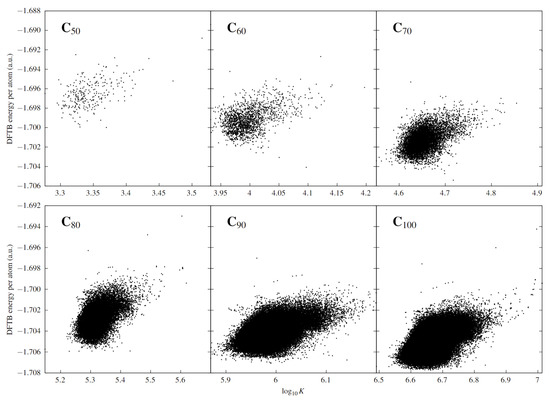
We begin our presentation of results by showing the correlations between the total DFTB energies of all isomers of the fullerenes , , , , , and and the corresponding topological invariants (Kekulé count K and Clar count C). As noted earlier for the fullerenes with , none of these quantities (neither K nor C) displayed significant correlations with the quantum chemical energies. We now extend this observation to larger fullerenes. Figure 1 shows a scatter plot, in which each point represents a single isomer of . Figure 1 is divided into six panels, each corresponding to a different size of fullerenes . Each of these panels shows a similar distribution of dots, suggesting a mild anticorrelation between and . Interestingly, the isomers with the largest value of K correspond to high-energy structures. This observation runs counter to typical resonance stability arguments well-accepted in organic chemists’ analyses of planar aromatic structures. The non-planarity of fullerenes does not seem to have a pronounced effect in this observation: The highest-energy isomer maximizes the Kekulé count K, both for the largest structure analyzed (, small curvature) and the smallest structure analyzed (, large curvature). Simultaneously, the most stable isomer corresponds to an intermediate value of K in each family of fullerenes. These observations show the Kekulé count K to be a mediocre predictor of fullerene stability, extending the results reported earlier for [9,76,77,78], – [56], and – [57].
Figure 1.
The total DFTB energy (per atom) of all the isomers of , , , , , and plotted as the function of the logarithm of Kekulé count, , suggests mild anticorrelation between these two quantities.
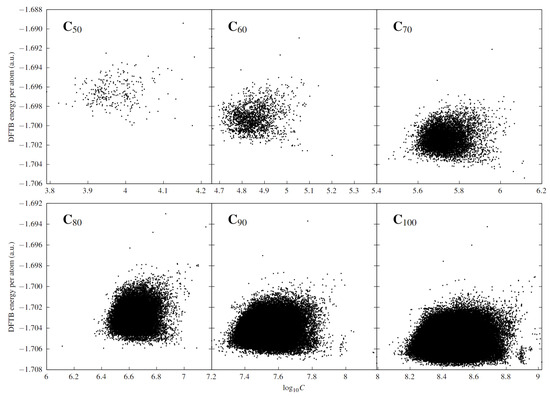
Figure 2 shows similar scatter plots with the Kekulé count K replaced with the Clar count C (We recall here briefly that the Kekulé count K of some benzenoid is the number of distinct resonance structures that can be constructed for using single and double bonds, while the Clar count C is the number of (generalized) resonance structures that can be constructed for using single and double bonds, as well as aromatic Clar sextets). The distributions in each of the panels of Figure 2 have similar irregular and somewhat ellipsoidal shapes, providing no correlation between and . For some families of fullerenes, the isomer with the largest value of C corresponds to the lowest DFTB energy; for others, it corresponds to the intermediate or even the highest energy values. The situation is probably best illustrated by , where the four isomers with the largest C comprise both the highest and the lowest-energy structures. It seems that the Clar count C alone cannot be a useful predictor of fullerene stability in close analogy to the Kekulé count K discussed above, extending the observations reported earlier for – [56] and – [57].
Figure 2.
The total DFTB energy of all the isomers of , , , , , and plotted as the function of the logarithm of Clar count, , suggests no correlation between these quantities.
The key discovery of our previous publication [57] was the observation of a unique correlation in the scatter plots relating the Clar count C with the Kekulé count K. Namely, we demonstrated that such distributions for () form a slanted wedge with the most stable isomers grouping near the left edge of the wedge. This observation could be rephrased more formally by saying that the most stable isomers maximize the Clar count C while minimizing the Kekulé count K. In the parlance of multi-objective optimization, they are located in the vicinity of the Pareto front of the optimization problem [79]. This regularity can prove useful by providing a tool for discriminating a subgroup of low-energy isomers in each family of fullerenes, provided that a similar observation can be extended to larger fullerenes, for which methodical quantum chemical investigations of all possible isomers are characterized by prohibitive numerical cost.
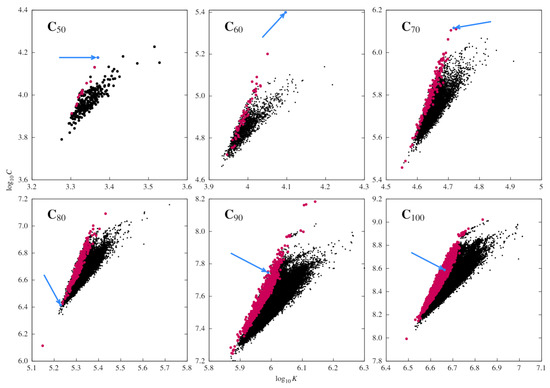
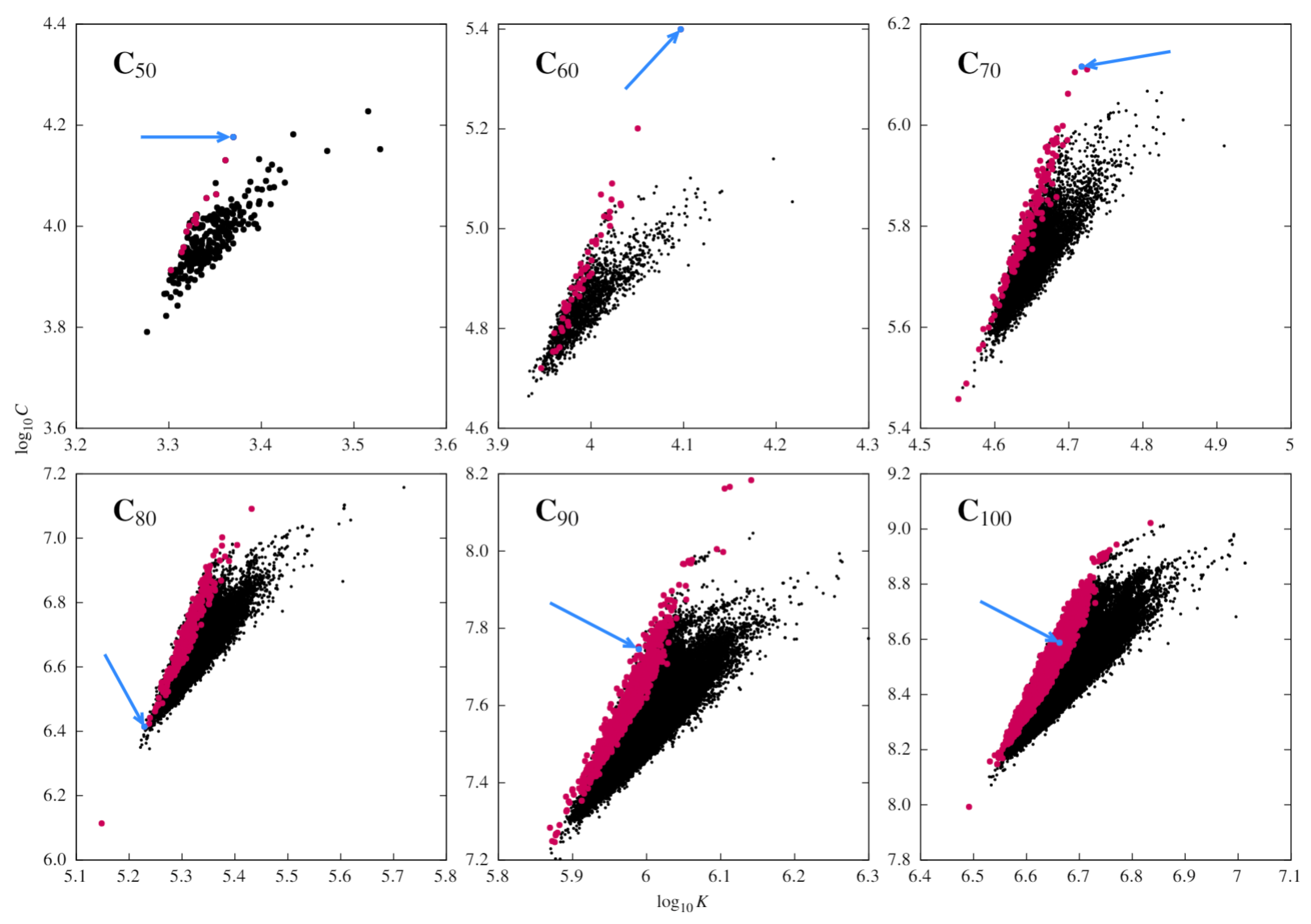
The main objective of the current study is to extend this analysis to larger fullerenes. Figure 3 shows scatter plots where each dot, with coordinates , represents a single isomer of six families of fullerenes: , , , , , and . The 1% of structures (or more; details in the caption of Figure 3) corresponding to the lowest-energy isomers in each family are depicted as red circles, while the remaining structures are depicted as (somewhat smaller) black circles. Additionally, the lowest-energy structure in each panel is depicted in blue. It is clear from Figure 3 that the lowest-energy portion of isomers is in each case located at the left edge of the wedge-like distribution, confirming the observation made earlier for with [57]. The generality of this observation has far-reaching consequences: It allows us to reduce the problem of identifying the most stable isomer in a given family of fullerenes to those located at the left edge of the distributions analogous to those shown in Figure 3. Note that obtaining such distributions using the ZZPolyCalc program version 19.0.117 [60] reported by us recently and freely distributed via GitHub 3.15.12 [73] does not require quantum chemical calculations and is extremely efficient with a computational time within 1 s per isomer.
Figure 3.
Scatter plots relating the Clar count C with the Kekulé count K for all isomers of , , , , , and show a surprising fact: The distributions have a shape of a wedge with the lowest-energy structures being located at the left edge of the distribution. Each dot represents a single isomer. The lowest-energy isomers are depicted in red (5% for , 3% for , 2% for , and 1% for , , and ); the remaining isomers are depicted in black. The blue dot (together with the blue arrow pointing at it) shows the location of the most stable isomer in each distribution.
A drawback of this screening technique needs to be mentioned: Not all isomers located on the left edge of the distributions shown in Figure 3 correspond to low-energy structures. Therefore, the screening technique will substantially reduce (to a few percentage points of the original size) the subfamily of isomers for which quantum chemical calculations must be performed in order to identify the most stable isomer, but it most probably will not single out a handful of isomers that contain the most stable structure. Another technical difficulty is designing an appropriate numerical parameter allowing us to locate isomers at the Pareto front and in its vicinity (i.e., close to the left edge of the distribution wedge) for each family. A simple descriptor, , is not always effective here. When all isomers of and are sorted by their falling ratio, the lowest-energy structure lies within the top 0.3% and 2.0%, respectively, of the two distributions. However, for , the lowest-energy structure is contained within the bottom 0.3% of the distribution because the lowest-energy structure is located at—nomen est omen—the thin edge of the wedge, belonging simultaneously to the left and to the right edge. An appropriate descriptor correctly resolving these nuances and identifying structures located close to the Pareto front remains to be discovered.
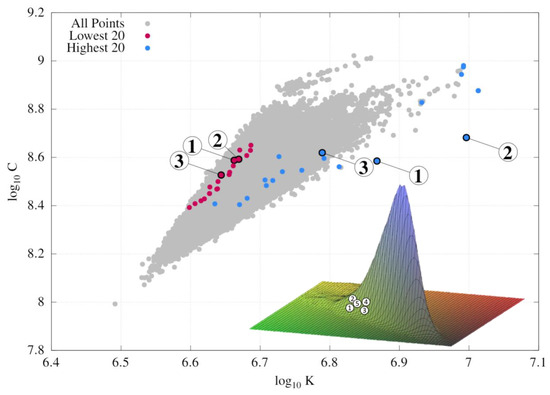
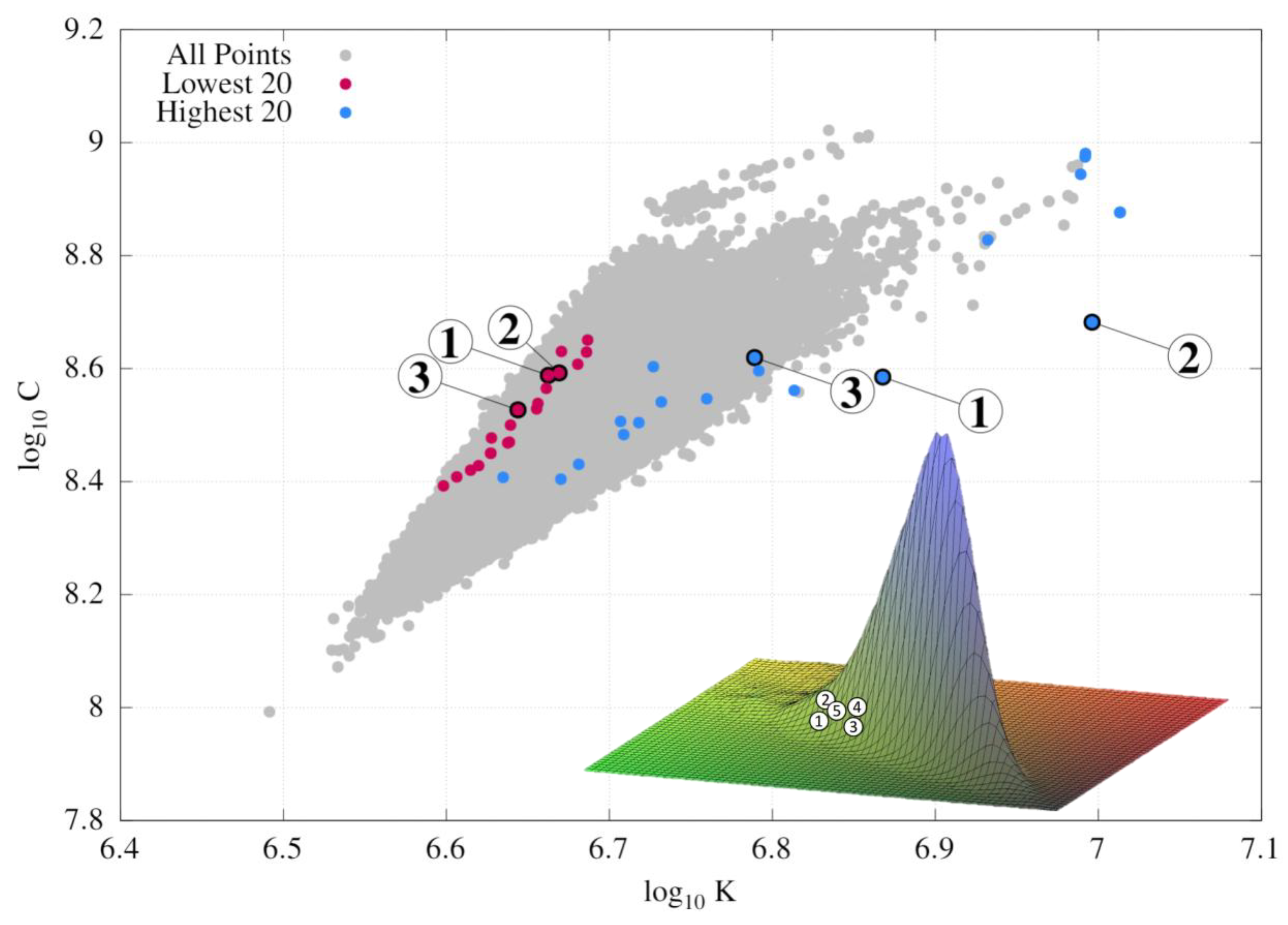
It is instructive to briefly discuss the location of the lowest- and highest-energy structures in the wedge-like distributions. Figure 4 provides such a detailed plot for : The 20 lowest-energy structures are depicted in red and the 20 highest-energy structures are depicted in blue. Additionally, we have labeled the three highest- and the three lowest-energy isomers. Three important observations arise.
Figure 4.
The scatter plot relating the Clar count C with the Kekulé count K for all isomers of with highlighted locations of the 20 lowest-energy isomers (in red) and 20 highest-energy isomers (in blue). The top and bottom three isomers are additionally marked with numbered labels. The inset presents a 3D visualization of this distribution with the exact location of the five lowest-energy isomers.
- 1.
- The lowest-energy structures are indeed distributed close to the left edge of the wedge, in contrast to the highest-energy structures, which are closer to the right edge.
- 2.
- These maximal and minimal points are not located directly on the edge, but only in its vicinity, showing that the C vs. K distribution can be treated only as an approximate descriptor of the thermodynamic stability of fullerene isomers.
- 3.
- The 2D visualization of the wedge in Figure 4 lacks information about the distribution density, leading to an incorrect impression that the low-energy structures are located in the midst of the distribution, rather than on its edge. In reality, both edges of the distribution are flat and account for a small number of points; the majority are located along the bisector of the wedge, with the right edge growing more steeply than the left edge. This behavior is clearest from the 3D visualization of the distribution shown as an inset in Figure 4, where the locations of the five lowest-energy isomers are depicted by numbers. This 3D visualization of the distribution was created by representing each isomer as a 2D Gaussian peak of unit volume located at ; the whole distribution is a union of such peaks.
4. Conclusions
We show that for , , , , , and , the two topological invariants, the Kekulé K and the Clar counts C, can be jointly used to identify the lowest-energy isomers of carbon fullerenes. The distribution of all isomers of a given fullerene forms a wedge-shaped pattern, with the most stable isomers situated along its left boundary. This insight allows us to significantly reduce the number of candidates that must be analyzed through explicit quantum–chemical calculations. The main observation of this paper is that low-energy isomers of carbon fullerenes tend to maximize their Clar count C while simultaneously minimizing their Kekulé count K.
Author Contributions
Conceptualization, H.A.W. and R.P.; methodology, H.A.W. and R.P.; validation, H.A.W. and R.P.; formal analysis, H.A.W. and R.P.; investigation, H.A.W. and R.P.; resources, H.A.W. and R.P.; writing—original draft preparation, H.A.W.; writing—review and editing, R.P.; visualization, H.A.W. and R.P.; supervision, H.A.W.; project administration, H.A.W.; funding acquisition, H.A.W. All authors have read and agreed to the published version of the manuscript.
Funding
H.A.W. acknowledges financial support by the National Science and Technology Council of Taiwan (grants 110-2923-M-009-004-MY3 and 112-2113-M-A49-033).
Institutional Review Board Statement
Not applicable.
Informed Consent Statement
Not applicable.
Data Availability Statement
We would be happy to share all the data corresponding to the analysis shown in this manuscript.
Conflicts of Interest
The authors declare no conflicts of interest.
References
- Fowler, P.W.; Manolopoulos, D.E. An Atlas of Fullerenes; Dover: Mineola, NY, USA, 2006. [Google Scholar]
- Schwerdtfeger, P.; Wirz, L.; Avery, J. Program Fullerene: A software package for constructing and analyzing structures of regular fullerenes. J. Comput. Chem. 2013, 34, 1508–1526. [Google Scholar] [CrossRef] [Scilit] [PubMed]
- Schwerdtfeger, P.; Wirz, L.N.; Avery, J. The topology of fullerenes. WIREs Comput. Mol. Sci. 2015, 5, 96–145. [Google Scholar] [CrossRef] [Scilit] [PubMed]
- Jin, P.; Gu, X. Structural Characteristics of Fullerenes. In Handbook of Fullerene Science and Technology; Lu, X., Akasaka, T., Slanina, Z., Eds.; Springer: Singapore, 2022; pp. 81–110. [Google Scholar] [CrossRef] [Scilit]
- Coolsaet, K.; D’hondt, S.; Goedgebeur, J. House of Graphs 2.0: A database of interesting graphs and more. Discr. Appl. Math. 2023, 325, 97–107. [Google Scholar] [CrossRef] [Scilit]
- Slanina, Z.; Nagase, S. Chapter 32-Computational chemistry of isomeric fullerenes and endofullerenes. In Theory and Applications of Computational Chemistry; Dykstra, C.E., Frenking, G., Kim, K.S., Scuseria, G.E., Eds.; Elsevier: Amsterdam, The Netherlands, 2005; pp. 891–917. [Google Scholar] [CrossRef] [Scilit]
- Cioslowski, J. Note on the asymptotic isomer count of large fullerenes. J. Math. Chem. 2014, 52, 1–5. [Google Scholar] [CrossRef] [Scilit]
- Rukhovich, A.D. On the growth rate of the number of fullerenes. Russ. Math. Surv. 2018, 73, 734–736. [Google Scholar] [CrossRef] [Scilit]
- Sure, R.; Hansen, A.; Schwerdtfeger, P.; Grimme, S. Comprehensive theoretical study of all 1812 C60 isomers. Phys. Chem. Chem. Phys. 2017, 19, 14296–14305. [Google Scholar] [CrossRef] [Scilit]
- Shao, N.; Gao, Y.; Yoo, S.; An, W.; Zeng, X.C. Search for Lowest-Energy Fullerenes: C98 to C110. J. Phys. Chem. A 2006, 110, 7672–7676. [Google Scholar] [CrossRef] [Scilit]
- Shao, N.; Gao, Y.; Zeng, X.C. Search for Lowest-Energy Fullerenes 2: C38 to C80 and C112 to C120. J. Phys. Chem. C 2007, 111, 17671–17677. [Google Scholar] [CrossRef] [Scilit]
- Zhao, X. On the Structure and Relative Stability of C50 Fullerenes. J. Phys. Chem. B 2005, 109, 5267–5272. [Google Scholar] [CrossRef] [Scilit]
- Calaminici, P.; Geudtner, G.; Köster, A.M. First-Principle Calculations of Large Fullerenes. J. Chem. Theory Comput. 2009, 5, 29–32. [Google Scholar] [CrossRef] [Scilit] [PubMed]
- Manolopoulos, D.E.; Fowler, P.W.; Taylor, R.; Kroto, H.W.; Walton, D.R.M. An end to the search for the ground state of C84? J. Chem. Soc. Faraday Trans. 1992, 88, 3117–3118. [Google Scholar] [CrossRef] [Scilit]
- Manolopoulos, D.E.; Fowler, P.W. Molecular graphs, point groups, and fullerenes. J. Chem. Phys. 1992, 96, 7603–7614. [Google Scholar] [CrossRef] [Scilit]
- Zhang, B.L.; Xu, C.H.; Wang, C.Z.; Chan, C.T.; Ho, K.M. Systematic study of structures and stabilities of fullerenes. Phys. Rev. B 1992, 46, 7333–7336. [Google Scholar] [CrossRef] [Scilit]
- Zhang, B.L.; Wang, C.Z.; Ho, K.M.; Xu, C.H.; Chan, C.T. The geometry of small fullerene cages: C20 to C70. J. Chem. Phys. 1992, 97, 5007–5011. [Google Scholar] [CrossRef] [Scilit]
- Murry, R.L.; Scuseria, G.E. Theoretical Study of C90 and C96 Fullerene Isomers. J. Phys. Chem. 1994, 98, 4212–4214. [Google Scholar] [CrossRef] [Scilit]
- Scuseria, G.E. Ab Initio Calculations of Fullerenes. Science 1996, 271, 942–945. [Google Scholar] [CrossRef] [Scilit]
- Kroto, H.W. The stability of the fullerenes Cn, with n = 24, 28, 32, 36, 50, 60 and 70. Nature 1987, 329, 529–531. [Google Scholar] [CrossRef] [Scilit]
- Cioslowski, J.; Rao, N.; Moncrieff, D. Standard Enthalpies of Formation of Fullerenes and Their Dependence on Structural Motifs. J. Am. Chem. Soc. 2000, 122, 8265–8270. [Google Scholar] [CrossRef] [Scilit]
- Fowler, P.W.; Caporossi, G.; Hansen, P. Distance Matrices, Wiener Indices, and Related Invariants of Fullerenes. J. Phys. Chem. A 2001, 105, 6232–6242. [Google Scholar] [CrossRef] [Scilit]
- Alcamí, M.; Sánchez, G.; Díaz-Tendero, S.; Wang, Y.; Martín, F. Structural patterns in fullerenes showing adjacent pentagons: C20 to C72. J Nanosci. Nanotechnol. 2007, 7, 1329–1338. [Google Scholar] [CrossRef] [Scilit]
- Gan, L.H.; Wu, R.; Tian, J.L.; Clarke, J.; Gibson, C.; Fowler, P.W. From C58 to C62 and back: Stability, structural similarity, and ring current. J. Comput. Chem. 2017, 38, 144–151. [Google Scholar] [CrossRef] [Scilit]
- Lu, X.; Chen, Z. Curved Pi-Conjugation, Aromaticity, and the Related Chemistry of Small Fullerenes (<C60) and Single-Walled Carbon Nanotubes. Chem. Rev. 2005, 105, 3643–3696. [Google Scholar] [PubMed]
- Wiener, H. Structural Determination of Paraffin Boiling Points. J. Am. Chem. Soc. 1947, 69, 17–20. [Google Scholar] [CrossRef] [Scilit] [PubMed]
- Balaban, A.T.; Millis, D.; Ivanciuc, O.; Basak, S. Reverse Wiener indices. Croat. Chem. Acta 2000, 73, 923–941. [Google Scholar]
- Balaban, A.T. Topological indices based on topological distances in molecular graphs. Pure Appl. Chem. 1983, 55, 199–206. [Google Scholar] [CrossRef] [Scilit]
- Balaban, A.T.; Liu, X.; Klein, D.J.; Babic, D.; Schmalz, T.G.; Seitz, W.A.; Randić, M. Graph Invariants for Fullerenes. J. Chem. Inf. Comput. Sci. 1995, 35, 396–404. [Google Scholar] [CrossRef] [Scilit]
- Heydari, A.; Taeri, B. Szeged index of TUC4C8(S) nanotubes. Eur. J. Combin. 2009, 30, 1134–1141. [Google Scholar] [CrossRef] [Scilit]
- Zhang, H.; Balasubramanian, K. Spectral moments of fullerene cages. Mol. Phys. 1993, 79, 727–745. [Google Scholar] [CrossRef] [Scilit]
- Estrada, E. Characterization of 3D molecular structure. Chem. Phys. Lett. 2000, 319, 713–718. [Google Scholar] [CrossRef] [Scilit]
- Schein, S.; Friedrich, T. A geometric constraint, the head-to-tail exclusion rule, may be the basis for the isolated-pentagon rule in fullerenes with more than 60 vertices. Proc. Natl. Acad. Sci. USA 2008, 105, 19142–19147. [Google Scholar] [CrossRef] [Scilit]
- Liu, X.; Klein, D.J.; Schmalz, T.G. Preferable Fullerenes and Clar-Sextet Cages. Fuller. Sci. Technol. 1994, 2, 405–422. [Google Scholar] [CrossRef] [Scilit]
- Fowler, P.W.; Heine, T.; Zerbetto, F. Competition between Even and Odd Fullerenes: C118, C119, and C120. J. Phys. Chem. A 2000, 104, 9625–9629. [Google Scholar] [CrossRef] [Scilit]
- Díaz-Tendero, S.; Martín, F.; Alcamí, M. Structure and Electronic Properties of Fullerenes : Is an Exception to the Pentagon Adjacency Penalty Rule? Chem. Phys. Chem. 2005, 6, 92–100. [Google Scholar] [CrossRef] [Scilit]
- Fowler, P.W.; Nikolić, S.; De Los Reyes, R.; Myrvold, W. Distributed curvature and stability of fullerenes. Phys. Chem. Chem. Phys. 2015, 17, 23257–23264. [Google Scholar] [CrossRef] [Scilit] [PubMed]
- Achiba, Y.; Fowler, P.W.; Mitchell, D.; Zerbetto, F. Structural Predictions for the C116 Molecule. J. Phys. Chem. A 1998, 102, 6835–6841. [Google Scholar] [CrossRef] [Scilit]
- Slanina, Z.; Lee, S.L.; Yu, C.H. Computations in Treating Fullerenes and Carbon Aggregates. In Reviews in Computational Chemistry; John Wiley & Sons, Ltd.: Hoboken, NJ, USA, 1996; pp. 1–62. [Google Scholar] [CrossRef] [Scilit]
- Slanina, Z.; Zhao, X.; Uhlík, F.; Lee, S.L.; Adamowicz, L. Computing enthalpy–entropy interplay for isomeric fullerenes. Int. J. Quant. Chem. 2004, 99, 640–653. [Google Scholar] [CrossRef] [Scilit]
- Slanina, Z.; Uhlík, F.; Adamowicz, L. Theoretical Predictions of Fullerene Stabilities. In Proceedings of the Handbook of Fullerene Science and Technology; Lu, X., Akasaka, T., Slanina, Z., Eds.; Springer: Singapore, 2022; pp. 111–179. [Google Scholar] [CrossRef] [Scilit]
- Popov, A.A. Structures and Stability of Fullerenes, Metallofullerenes, and Their Derivatives. In Proceedings of the Handbook of Computational Chemistry; Leszczynski, J., Kaczmarek-Kedziera, A., Puzyn, T., Papadopoulos, M.G., Reis, H., Shukla, M.K., Eds.; Springer: Cham, Switzerland, 2017; pp. 1031–1096. [Google Scholar] [CrossRef] [Scilit]
- Zhao, D.; Liu, S.; Rong, C.; Zhong, A.; Liu, S. Toward Understanding the Isomeric Stability of Fullerenes with Density Functional Theory and the Information-Theoretic Approach. ACS Omega 2018, 3, 17986–17990. [Google Scholar] [CrossRef] [Scilit] [PubMed]
- Liu, B.; Jin, J.; Liu, M. Mapping structure-property relationships in fullerene systems: A computational study from C20 to C60. npj Comput. Mater. 2024, 10, 227. [Google Scholar] [CrossRef] [Scilit]
- Sabirov, D.S.; Ori, O.; László, I. Isomers of the C84 fullerene: A theoretical consideration within energetic, structural, and topological approaches. Fuller. Nanotub. Carbon Nanostruct. 2018, 26, 100–110. [Google Scholar] [CrossRef] [Scilit]
- Liu, B.; Jin, J.; Liu, M. Extrapolating Beyond C60: Advancing Prediction of Fullerene Isomers with FullereneNet. Digit. Discov. 2025; Accepted manuscript. [CrossRef] [Scilit]
- Wang, Y.; Díaz-Tendero, S.; Alcamí, M.; Martín, F. Generalized structural motif model for studying the thermodynamic stability of fullerenes: From C60 to graphene passing through giant fullerenes. Phys. Chem. Chem. Phys. 2017, 19, 19646–19655. [Google Scholar] [CrossRef] [Scilit]
- Chan, B.; Kawashima, Y.; Dawson, W.; Katouda, M.; Nakajima, T.; Hirao, K. A Simple Model for Relative Energies of All Fullerenes Reveals the Interplay between Intrinsic Resonance and Structural Deformation Effects in Medium-Sized Fullerenes. J. Chem. Theory Comput. 2019, 15, 1255–1264. [Google Scholar] [CrossRef] [Scilit]
- Waite, S.L.; Karton, A.; Chan, B.; Page, A.J. Thermochemical stabilities of giant fullerenes using density functional tight binding theory and isodesmic-type reactions. J. Comput. Chem. 2021, 42, 222–230. [Google Scholar] [CrossRef] [Scilit] [PubMed]
- Guan, J.; Jin, Z.; Zhu, Z.; Chuang, C.; Jin, B.Y.; Tománek, D. Local curvature and stability of two-dimensional systems. Phys. Rev. B 2014, 90, 245403. [Google Scholar] [CrossRef] [Scilit]
- Li, M.Y.; Zhao, Y.X.; Han, Y.B.; Yuan, K.; Nagase, S.; Ehara, M.; Zhao, X. Theoretical Investigation of the Key Roles in Fullerene-Formation Mechanisms: Enantiomer and Enthalpy. ACS Appl. Nano Mater. 2020, 3, 547–554. [Google Scholar] [CrossRef] [Scilit]
- Irle, S.; Zheng, G.; Elstner, M.; Morokuma, K. From C2 Molecules to Self-Assembled Fullerenes in Quantum Chemical Molecular Dynamics. Nano Lett. 2003, 3, 1657–1664. [Google Scholar] [CrossRef] [Scilit]
- Irle, S.; Zheng, G.; Wang, Z.; Morokuma, K. The C60 Formation Puzzle “Solved“: QM/MD Simulations Reveal the Shrinking Hot Giant Road of the Dynamic Fullerene Self-Assembly Mechanism. J. Phys. Chem. B 2006, 110, 14531–14545. [Google Scholar] [CrossRef] [Scilit] [PubMed]
- Dinadayalane, T.C.; Leszczynski, J. Fundamental Structural, Electronic, and Chemical Properties of Carbon Nanostructures: Graphene, Fullerenes, Carbon Nanotubes, and Their Derivatives. In Proceedings of the Handbook of Computational Chemistry; Leszczynski, J., Kaczmarek-Kedziera, A., Puzyn, T., Papadopoulos, M.G., Reis, H., Shukla, M.K., Eds.; Springer: Cham, Switzerland, 2017; pp. 1175–1258. [Google Scholar] [CrossRef] [Scilit]
- Babić, D.; Klein, D.; Sah, C. Symmetry of fullerenes. Chem. Phys. Lett. 1993, 211, 235–241. [Google Scholar] [CrossRef] [Scilit]
- Witek, H.A.; Kang, J.S. ZZ polynomials for isomers of (5,6)-fullerenes Cn with n = 20–50. Symmetry 2020, 12, 1483. [Google Scholar] [CrossRef] [Scilit]
- Witek, H.A.; Podeszwa, R. Kekulé Counts, Clar Numbers, and ZZ Polynomials for All Isomers of (5,6)-Fullerenes C52–C70. Molecules 2024, 29, 4013. [Google Scholar] [CrossRef] [Scilit]
- Chou, C.P.; Witek, H.A. An algorithm and FORTRAN program for automatic computation of the Zhang-Zhang polynomial of benzenoids. MATCH Commun. Math. Comput. Chem. 2012, 68, 3–30. [Google Scholar]
- Chou, C.P.; Witek, H.A. Determination of Zhang-Zhang Polynomials for Various Classes of Benzenoid Systems: Non-Heuristic Approach. MATCH Commun. Math. Comput. Chem. 2014, 72, 75–104. [Google Scholar]
- Podeszwa, R.; Witek, H.A. ZZPolyCalc: An open-source code with fragment caching for determination of Zhang-Zhang polynomials of carbon nanostructures. Comp. Phys. Comm. 2024, 301, 109210. [Google Scholar] [CrossRef] [Scilit]
- Zhang, H.P.; Zhang, F.J. The Clar covering polynomial of hexagonal systems I. Discret. Appl. Math. 1996, 69, 147–167. [Google Scholar] [CrossRef] [Scilit]
- Zhang, H. The Clar covering polynomial of hexagonal systems with an application to chromatic polynomials. Discret. Math. 1997, 172, 163–173. [Google Scholar] [CrossRef] [Scilit]
- Zhang, H.; Zhang, F. The Clar covering polynomial of hexagonal systems III. Discret. Math. 2000, 212, 261–269. [Google Scholar] [CrossRef] [Scilit]
- Gutman, I.; Furtula, B.; Balaban, A.T. Algorithm for simultaneous calculations of Kekulé and Clar structure counts, and Clar number of benzenoid molecules. Polycyc. Arom. Comp. 2006, 26, 17–35. [Google Scholar] [CrossRef] [Scilit]
- Langner, J.; Witek, H.A. ZZ polynomials of regular m-tier benzenoid strips as extended strict order polynomials of associated posets. Part 1. Proof of equivalence. MATCH Commun. Math. Comput. Chem. 2022, 87, 585–620. [Google Scholar] [CrossRef] [Scilit]
- Langner, J.; Witek, H.A. ZZ polynomials of regular m-tier benzenoid strips as extended strict order polynomials of associated posets. Part 2. Guide to practical computations. MATCH Commun. Math. Comput. Chem. 2022, 88, 109–130. [Google Scholar] [CrossRef] [Scilit]
- Langner, J.; Witek, H.A. ZZ polynomials of regular m-tier benzenoid strips as extended strict order polynomials of associated posets. Part 3. Compilation of results for m = 1–6. MATCH Commun. Math. Comput. Chem. 2022, 88, 747–765. [Google Scholar] [CrossRef] [Scilit]
- Elstner, M.; Porezag, D.; Jungnickel, G.; Elsner, J.; Haugk, M.; Frauenheim, T.; Suhai, S.; Seifert, G. Self-consistent-charge density-functional tight-binding method for simulations of complex materials properties. Phys. Rev. B 1998, 58, 7260–7268. [Google Scholar] [CrossRef] [Scilit]
- Gaus, M.; Cui, Q.; Elstner, M. DFTB3: Extension of the Self-Consistent-Charge Density-Functional Tight-Binding Method (SCC-DFTB). J. Chem. Theory Comput. 2011, 7, 931–948. [Google Scholar] [CrossRef] [Scilit] [PubMed]
- Gaus, M.; Goez, A.; Elstner, M. Parametrization and Benchmark of DFTB3 for Organic Molecules. J. Chem. Theory Comput. 2013, 9, 338–354. [Google Scholar] [CrossRef] [Scilit] [PubMed]
- Hourahine, B.; Aradi, B.; Blum, V.; Bonafé, F.; Buccheri, A.; Camacho, C.; Cevallos, C.; Deshaye, M.Y.; Dumitricǎ, T.; Dominguez, A.; et al. DFTB+, a software package for efficient approximate density functional theory based atomistic simulations. J. Chem. Phys. 2020, 152, 124101. [Google Scholar] [CrossRef] [Scilit] [PubMed]
- Witek, H.A.; Irle, S.; Zheng, G.; de Jong, W.A.; Morokuma, K. Modeling carbon nanostructures with the self-consistent charge density-functional tight-binding method: Vibrational spectra and electronic structure of C28, C60, and C70. J. Chem. Phys. 2006, 125, 214706. [Google Scholar] [CrossRef] [Scilit]
- Podeszwa, R.; Witek, H.A. ZZPolyCalc: An Open-Source Code with Fragment Caching for Determination of Zhang-Zhang Polynomials of Carbon Nanostructures. 2023. Fortran 2008 Code in GitHub Repository. Available online: https://github.com/quantumint/zzpolycalc (accessed on 25 November 2025).
- Wu, Z.C.; Jelski, D.A.; George, T.F. Vibrational motions of buckminsterfullerene. Chem. Phys. Lett. 1987, 137, 291–294. [Google Scholar] [CrossRef] [Scilit]
- Tutte, W.T. How to Draw a Graph. Proc. London Math. Soc. 1963, s3-13, 743–767. [Google Scholar] [CrossRef] [Scilit]
- Austin, S.J.; Fowler, P.W.; Hansen, P.; Manolopoulos, D.E.; Zheng, M. Fullerene isomers of C60. Kekulé counts versus stability. Chem. Phys. Lett. 1994, 228, 478–484. [Google Scholar] [CrossRef] [Scilit]
- Klein, D.J.; Schmalz, T.G.; Hite, G.E.; Seitz, W.A. Resonance in C60 Buckminsterfullerene. J. Am. Chem. Soc. 1986, 108, 1301–1302. [Google Scholar] [CrossRef] [Scilit]
- Zhang, H.; Ye, D.; Liu, Y. A combination of Clar number and Kekulé count as an indicator of relative stability of fullerene isomers of C60. J. Math. Chem. 2010, 48, 733–740. [Google Scholar] [CrossRef] [Scilit]
- Ehrgott, M.; Köksalan, M.; Kadziński, M.; Deb, K. Fifty years of multi-objective optimization and decision-making: From mathematical programming to evolutionary computation. Eur. J. Oper. Res. 2025; in press. [CrossRef] [Scilit]
Disclaimer/Publisher’s Note: The statements, opinions and data contained in all publications are solely those of the individual author(s) and contributor(s) and not of MDPI and/or the editor(s). MDPI and/or the editor(s) disclaim responsibility for any injury to people or property resulting from any ideas, methods, instructions or products referred to in the content. |
© 2025 by the authors. Licensee MDPI, Basel, Switzerland. This article is an open access article distributed under the terms and conditions of the Creative Commons Attribution (CC BY) license (https://creativecommons.org/licenses/by/4.0/).