Communication

Combined Effect of Sonication and Electron Beam Irradiation on the Photocatalytic Organic Dye Decomposition Efficiency of Graphitic Carbon Nitride


1
Department of Applied Chemistry and Bioscience, Chitose Institute of Science and Technology, Bibi, Chitose 066-8655, Japan
2
Institute for Catalysis, Hokkaido University, Kita-ku, Sapporo 001-0021, Japan
3
Laboratory of XPS Analysis, Faculty of Engineering, Hokkaido University, Kita-ku, Sapporo 060-0814, Japan
*
Author to whom correspondence should be addressed.
C 2025, 11(4), 91; https://doi.org/10.3390/c11040091 (registering DOI)
Submission received: 30 September 2025 / Revised: 28 November 2025 / Accepted: 3 December 2025 / Published: 5 December 2025
(This article belongs to the Special Issue 10th Anniversary of C — Journal of Carbon Research)

Abstract

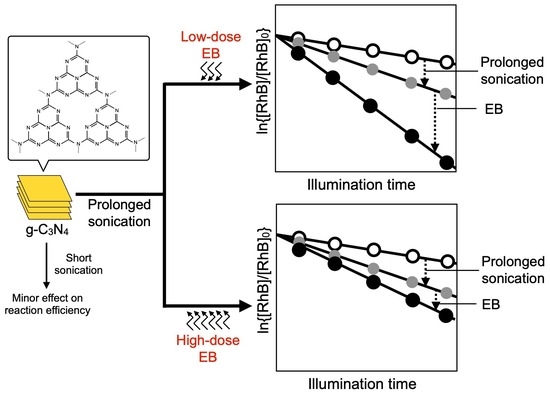
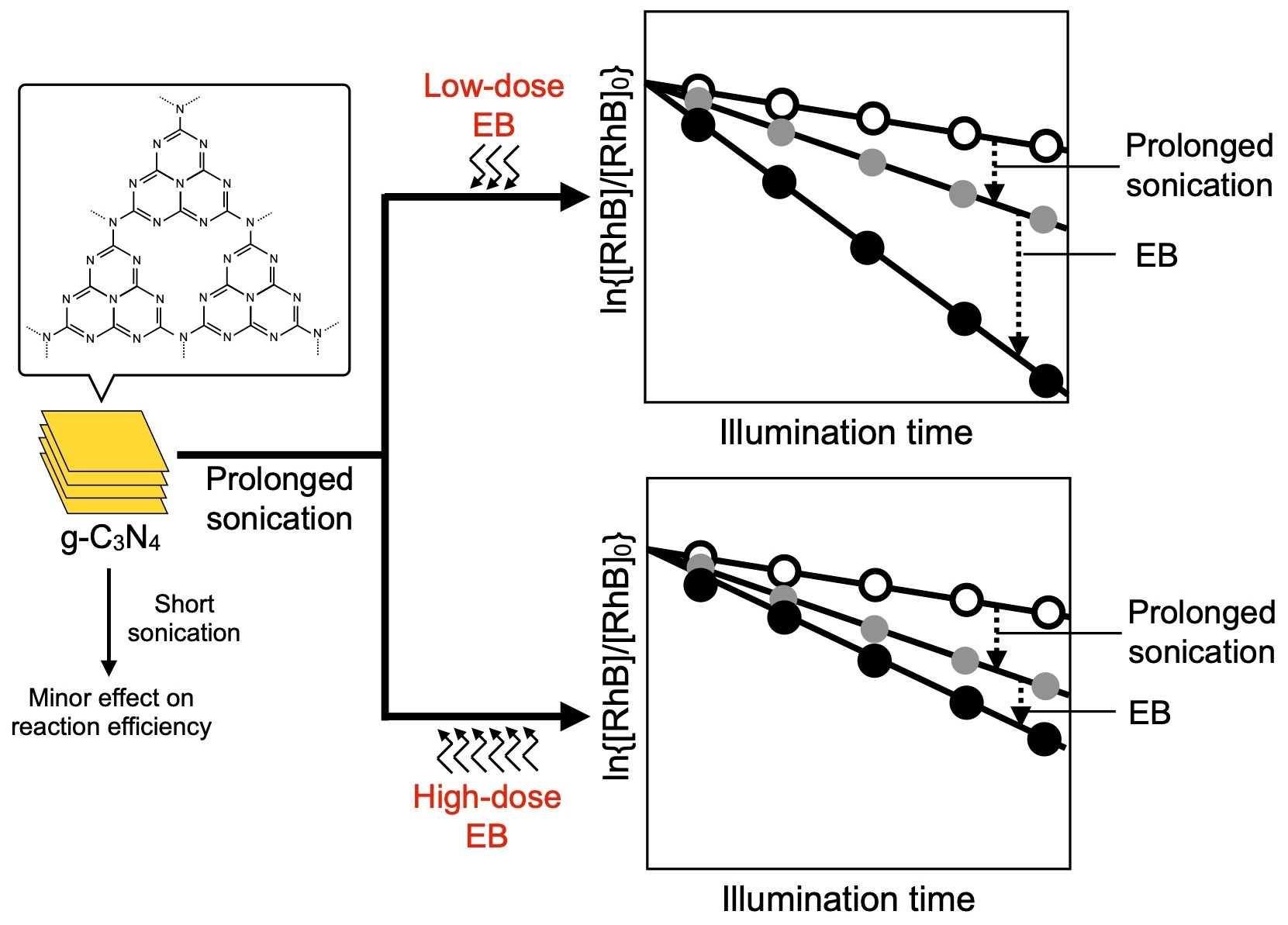
The photocatalytic efficiency of graphitic carbon nitride (g-C3N4) for the decomposition of aqueous rhodamine B (RhB) was investigated. To examine the combined effects of sonication and electron beam (EB) irradiation on the photocatalytic efficiency, g-C3N4 was sonicated in 1,3-butanediol and subsequently irradiated with EB. The photocatalytic efficiency was improved by the low-dose EB irradiation due to the generation of structural defects that acted as active reaction sites. Sonication before EB irradiation induced mild exfoliation and further improved photocatalytic efficiency. Prolonged sonication enhanced this improvement, primarily by increasing the specific surface area of g-C3N4. The positive effect of sonication was more remarkable for g-C3N4 irradiated with low-dose EB than for g-C3N4 irradiated with higher-dose EB. The photocatalytic RhB decomposition rate measured for g-C3N4 sonicated for 480 min and irradiated at 200 kGy was approximately 6.8 times higher than that measured for the untreated g-C3N4. The difference between the sonication effects can be ascribed to the electrostatic interactions and the resultant agglomeration of the g-C3N4 particles after EB irradiation. High-dose EB irradiation caused electrification followed by coarsening of the particles, whereas low-dose EB irradiation did not produce these results and led to positive effects due to the EB-induced g-C3N4 structural alteration.

1. Introduction

Graphitic carbon nitride (g-C3N4, Figure 1) is a carbon nitride polymorph with a graphite-like layered crystal structure that consists of heptazine ring (C6H7) units linked with N atoms. g-C3N4 behaves as a photocatalyst under visible light illumination. Its band gap of approximately 2.7 eV corresponds to visible light wavelengths, which allows g-C3N4 to utilize solar light efficiently. g-C3N4 can catalyze various photoinduced reactions, including hydrogen formation from water, pollutant degradation, and conversion of organic molecules [1,2,3,4,5,6,7,8,9,10,11,12,13,14,15,16,17,18]. Additionally, g-C3N4 is a metal-free photocatalyst comprising ubiquitous elements (C and N). It can be prepared from various commercially available nitrogen-containing organic materials, including melamine, urea, cyanamide, and dicyandiamide, through thermal condensation in air. Hence, the use of the g-C3N4 photocatalyst is potentially beneficial to various industrial and environmental processes.
A well-known shortcoming of g-C3N4 photocatalysts is their low photocatalytic reaction efficiency due to their high electron–hole recombination rates and small specific surface areas [2,3,4]. g-C3N4 photocatalytic reactions are induced by visible-light illumination, generating a charge-separated state via electronic excitation. The excited electrons and holes then trigger reduction and oxidation, respectively. However, if electrons and holes recombine rapidly through radiative and non-radiative relaxation, the reaction efficiency is reduced. In addition, the specific surface area of g-C3N4 is generally small. Therefore, the space on the g-C3N4 surface that contributes to the photocatalytic reactions is limited. Consequently, improving the photocatalytic reaction efficiency is important for expanding the range of g-C3N4.
Electron beam (EB) irradiation is a potential method for improving the reaction efficiency of g-C3N4. Although specially designed irradiation devices and radiation protection equipment are required to perform EB irradiation, EB irradiation can be performed without harmful substances under an ambient atmosphere and temperature. Therefore, this method has the potential to become an eco-friendly and energy-efficient processing technique. However, studies of the effects of EB irradiation on g-C3N4 are limited. Zhang et al. studied the effect of EB irradiation on the photocatalytic efficiency of g-C3N4 [19]. They found that the EB irradiation improved the photocatalytic efficiency of rhodamine B (RhB) degradation in aqueous solutions. Loss of pyridinic N and increased tertiary N content were also observed, suggesting that the structural alteration of the tri-s-triazine structure of g-C3N4 through EB irradiation resulted in altered photocatalytic efficiency. Picho-Chillán et al. studied the photocatalytic degradation of Direct Blue 1 using g-C3N4 irradiated with low-dose EB [20] and found that EB irradiation increased the adsorption capacity of the dye. Moreover, the photocatalytic dye decomposition efficiency of the EB-irradiated g-C3N4 in the presence of H2O2 was higher than that of intact g-C3N4. Mendes et al. investigated the structural changes in g-C3N4 during EB exposure using transmission electron microscopy [21] and found that N species were removed by the EB. Mohapatra et al. studied the effect of EB on the photocatalytic performance of g-C3N4 for H2 generation and Cr6+ reduction [22]. They reported that N vacancies were generated through EB irradiation, which led to an improvement in photocatalytic efficiency. We also studied the effects of EB irradiation on the structure and reactivity of g-C3N4. We found that relatively low-dose EB irradiation improved the photocatalytic efficiency, whereas the efficiency decreased when a higher dose of EB was used [23]. These results indicate that the EB-induced formation of defects through N elimination improves g-C3N4 photocatalytic efficiency. Enhancement of photocatalytic performance through N defect formation has also been reported using methods other than EB irradiation [5,6,7,17,18,24,25,26].
Another strategy for improving the photocatalytic efficiency involves exfoliation to create C3N4 nanosheets. This exfoliation technique has been applied in numerous studies of g-C3N4 photocatalysts. For example, nanosheet fabrication has been carried out in some of the above-mentioned studies [6,9,10,15,18] using various methods, such as thermal treatment in air. Liu et al. developed a novel exfoliation method that employs N2-assisted treatment [27] and cogrinding with sugar [28,29]. As a simpler method, the sonication of g-C3N4 in an organic liquid can be used for exfoliation. For example, Yang et al. examined the sonication of g-C3N4 in various solvents and found that isopropanol and N-methyl-pyrrolidone are promising solvents for preparing stable g-C3N4 nanosheet dispersions [30]. She et al. prepared a stable g-C3N4 nanosheet dispersion by sonication using 1,3-butanediol as the solvent [31]. These exfoliation treatments significantly increase the specific surface area of g-C3N4, thereby enhancing its photocatalytic performance. Consequently, a synergistic improvement in photocatalytic performance was expected from the combination of sonication and EB irradiation. However, studies of these combined effects are scarce.
Herein, the combination of sonication and EB irradiation was examined for the first time to develop a novel technique for improving the efficiency of photocatalytic reactions (decomposition of aqueous RhB). In this study, g-C3N4 prepared from melamine was sonicated for various durations and then irradiated with low- or high-dose EB. The textural and chemical characteristics of the samples were investigated to elucidate the effects of combined irradiation/sonication. We found that the photocatalytic efficiency of g-C3N4 was improved by sonication and subsequent EB irradiation. Prolonged sonication had a positive effect on photocatalytic efficiency. EB irradiation further increased the photocatalytic efficiency, particularly when a relatively low dose of EB was applied.

2. Materials and Methods

2.1. Preparation of g-C3N4

The g-C3N4 was prepared using melamine (FUJIFILM Wako Chemicals, Osaka, Japan). The melamine was placed in an alumina crucible and covered with an alumina lid. Subsequently, the crucible was heated in air in a muffle furnace at a heating rate of 5 °C/min and maintained at 550 °C for 2 h. A pale-yellow product was obtained. The product was ball-milled for 24 h and sifted through a stainless-steel sieve. g-C3N4 powder with a particle diameter between 1 mm and 180 µm was collected.

2.2. Sonication and Electron Beam Irradiation

The prepared g-C3N4 (1.0 g) was added to 25 mL of 1,3-butanediol (Tokyo Chemical Industry, Tokyo, Japan) and sonicated for 60–480 min using an ultrasonic homogenizer (LUH150; Yamato Scientific, Tokyo, Japan) [31]. In many cases, inorganic acids such as sulfuric acid are commonly used as a medium for ultrasonic exfoliation. However, if an acid is used, the reaction between RhB and the residual acid may affect the colorimetric quantification of RhB. To avoid unexpected color change, previously used 1,3-butanediol was employed in this study. The ultrasonic frequency was set at 20 kHz. The solvent was then vaporized at 140 °C using a thermostatic drying oven. This procedure was repeated until a sufficient amount of g-C3N4 was collected for the EB irradiation.
For EB irradiation, each sample (approximately 5 g) was placed in a polyamide-polyethylene bag (10 cm × 15 cm) before or after sonication and sealed with a household vacuum sealer (Deeplee, Dongguan, China). The sample was packed to form a sufficiently thin (1–2 mm thick) particle layer for EB transmission. EB irradiation was conducted at NHV Corporation Co., Ltd., Kyoto, Japan. The EB dose used for irradiation was 200 or 600 kGy. The EB dose was adjusted according to the number of passages through the irradiation device (50 kGy/pass). The irradiation was conducted at ambient temperature. Hereafter, the samples were named based on the sonication time (“S”) and EB dose (“E”). For example, the sample sonicated for 60 min and irradiated with 200 kGy EB is denoted as “S60E200”.

2.3. Characterization

The crystal structures of the samples were elucidated using X-ray diffractometry (XRD, D8 Discover, Bruker, Billerica, MA, USA) with Cu Kα X-ray. The elemental analysis and classification of chemical bonds were performed by X-ray photoelectron spectroscopy (XPS) (JPS-9200, JEOL, Tokyo, Japan) with Mg Kα X-ray. Indium foil was used to mount the samples for the XPS experiments. Peak deconvolution of the high-resolution C 1s and N 1s spectra was performed using the CasaXPS software ver. 2.3.26PR1.0 [32]. The specific surface areas of the samples were determined using N2 adsorption/desorption measurements (Autosorb, Quantachrome Instruments, Boynton Beach, FL, USA). The Brunauer–Emmett–Teller (BET) adsorption isotherm was used to calculate the specific surface areas [33]. The particle size distributions of the samples before and after sonication and the subsequent EB irradiation were observed using a particle size analyzer (MT-3300 EX II, MicrotracBEL, Osaka, Japan).

2.4. Photocatalytic Decomposition of Organic Dye

The photocatalytic degradation of RhB was monitored using colorimetric RhB concentration measurements. Portions of 10 mg/L aqueous RhB solution (50 mL) were taken, and 0.1 g g-C3N4 was added to each solution. The mixture was illuminated with visible light from a Xe light source (MAX-303, Asahi Spectra, Tokyo, Japan). Visible light illumination was performed using a quartz rod immersed in the sample mixture. The wavelength of the light was 400–600 nm. Air bubbling was continued throughout the photocatalytic reaction. The g-C3N4-containing solution was sampled every 10 min, g-C3N4 was removed from the sample by centrifugation, and the RhB concentration in the supernatant was determined by quantitative colorimetric analysis (V-630, JASCO, Tokyo, Japan). Photocatalytic tests were performed three times for each catalyst to verify the reproducibility of the experimental results.

3. Results and Discussion

3.1. Characterization of g-C3N4

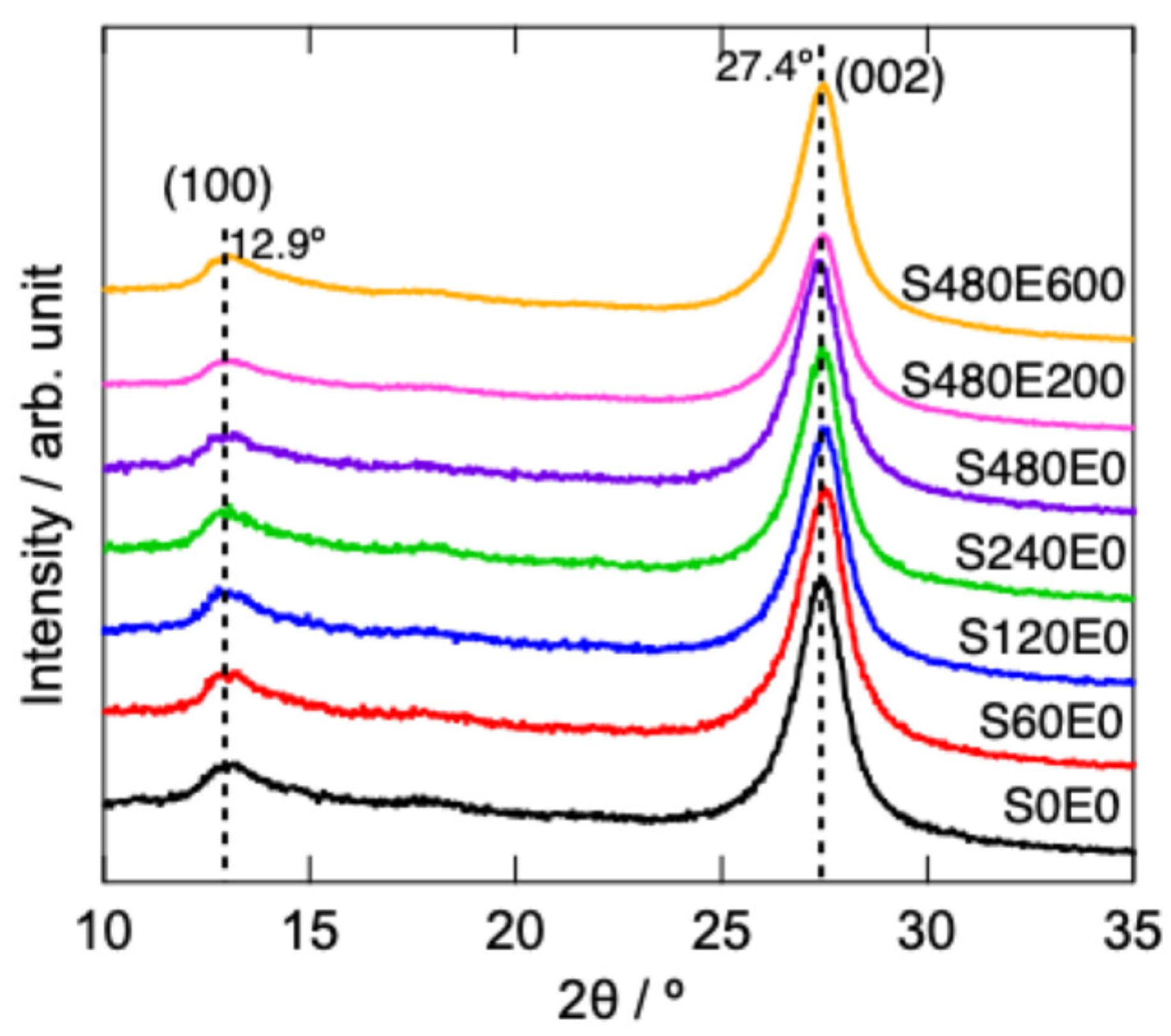
Figure 2 shows the powder XRD patterns of the untreated (S0E0), sonicated (S60E0–S480E0), and irradiated (S480E200 and S480E600) samples. Two major peaks assigned to the (100) and (002) reflections, corresponding to in-plane packing and interlayer stacking, were observed at 12.9° and 27.4°, respectively. A comparison of these diffraction patterns shows that sonication and subsequent EB irradiation barely affected the entire g-C3N4 crystal structure. The main features of the diffraction pattern did not change after sonication and EB irradiation. These results also indicate that sonication under the present treatment conditions did not cause intensive interlayer expansion to create nanosheets with a few layers and probably led to mild exfoliation. The crystallite size for each sample can be estimated using the Scherrer Equation (1) where D is the crystallite size, K is the Scherrer constant, λ is the Cu Kα X-ray wavelength, β is the line width at half-maximum height of the maximum intensity peak, and θ is the diffraction angle.
D = K   λ β c o s θ
In this case, K = 0.94 and λ = 0.154 nm were used for calculations. By calculating D based on the (002) peak data, the D were estimated to be approximately 6 nm for all cases, regardless of the treatment conditions. This result indicates that the crystallite size remained almost unchanged upon sonication and EB irradiation.
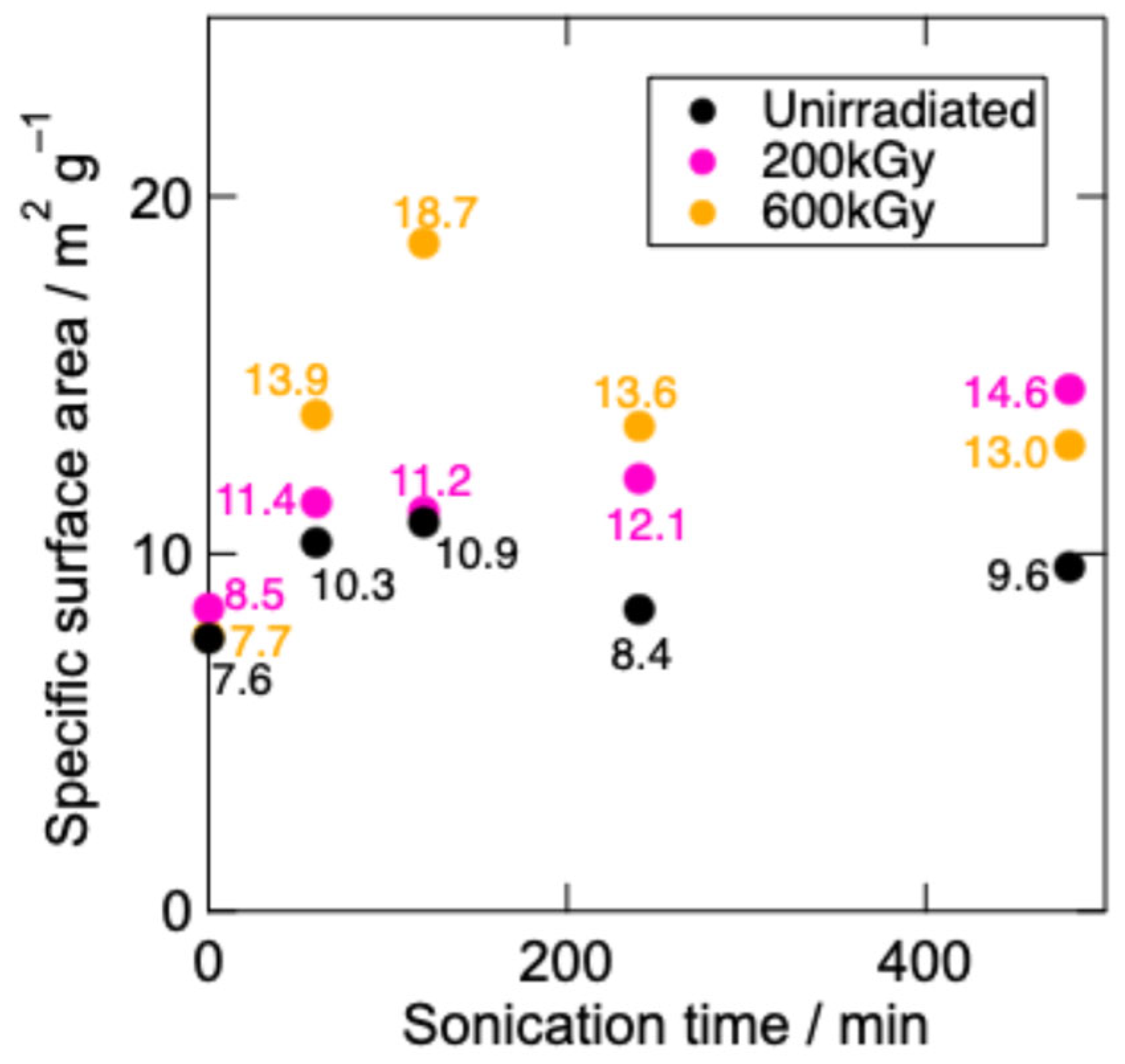
The specific surface areas of the samples as a function of sonication time are shown in Figure 3. The specific surface tended to be small, even after sonication (approximately 10–20 m2 g−1). The EB dose affected the specific surface area. Prolonged sonication increased the specific surface areas of the EB(200 kGy)-irradiated samples (S0E200–S480E200). In contrast, the specific surface areas of the EB(600 kGy)-irradiated samples (S0600–S480E600) exhibited marked fluctuations depending on sonication time. A similar tendency was observed in our previous work [23]: the moderate structural change that occurred through low-dose EB irradiation contributed to an increase in the surface area, whereas excess EB irradiation led to more destructive structural changes and a resultant decrease in the specific surface area.
The fluctuation in the specific surface area for EB irradiation at 600 kGy can be explained by the coarsening of relatively small particles caused by EB-induced electrification. The EB-induced electrification of materials has previously been reported [34,35]. Oxidation by EB, which causes electron detachment from metal cations, has also been reported for Co3O4 (the transformation of Co2+ to Co3+) [36]. Ionization is a typical initial process that occurs via radiation. Thus, electron detachment from g-C3N4 is possible via EB irradiation. If g-C3N4 is electrified by EB-induced charging, the g-C3N4 particles aggregate via electrostatic interactions, causing coarsening. Particle coarsening was confirmed based on the particle size distribution results (see Figure S1 in the Supplementary Materials). The proportion of relatively small particles (0.5–1 µm) decreased upon EB irradiation, while the cumulative distribution of medium-sized particles (20–50 µm) increased. Unlike the other samples, the cumulative distribution of the samples irradiated at 600 kGy did not correspond to the sonication time. The particle sizes of the samples sonicated for 480 min increased upon EB irradiation. This result is qualitatively consistent with the variation in the specific surface area and supports the EB-induced small-particle aggregation via electrification, as described above.
However, the impact of ionizing radiation on the physicochemical properties of g-C3N4 remains unclear, and further investigation into the effect of irradiation is necessary. Moreover, to further investigate the aggregation/exfoliation states of the samples, other techniques such as scanning electron microscopy, transmission electron microscopy, atomic force microscopy, and surface charge measurements based on the zeta potential provide further information.
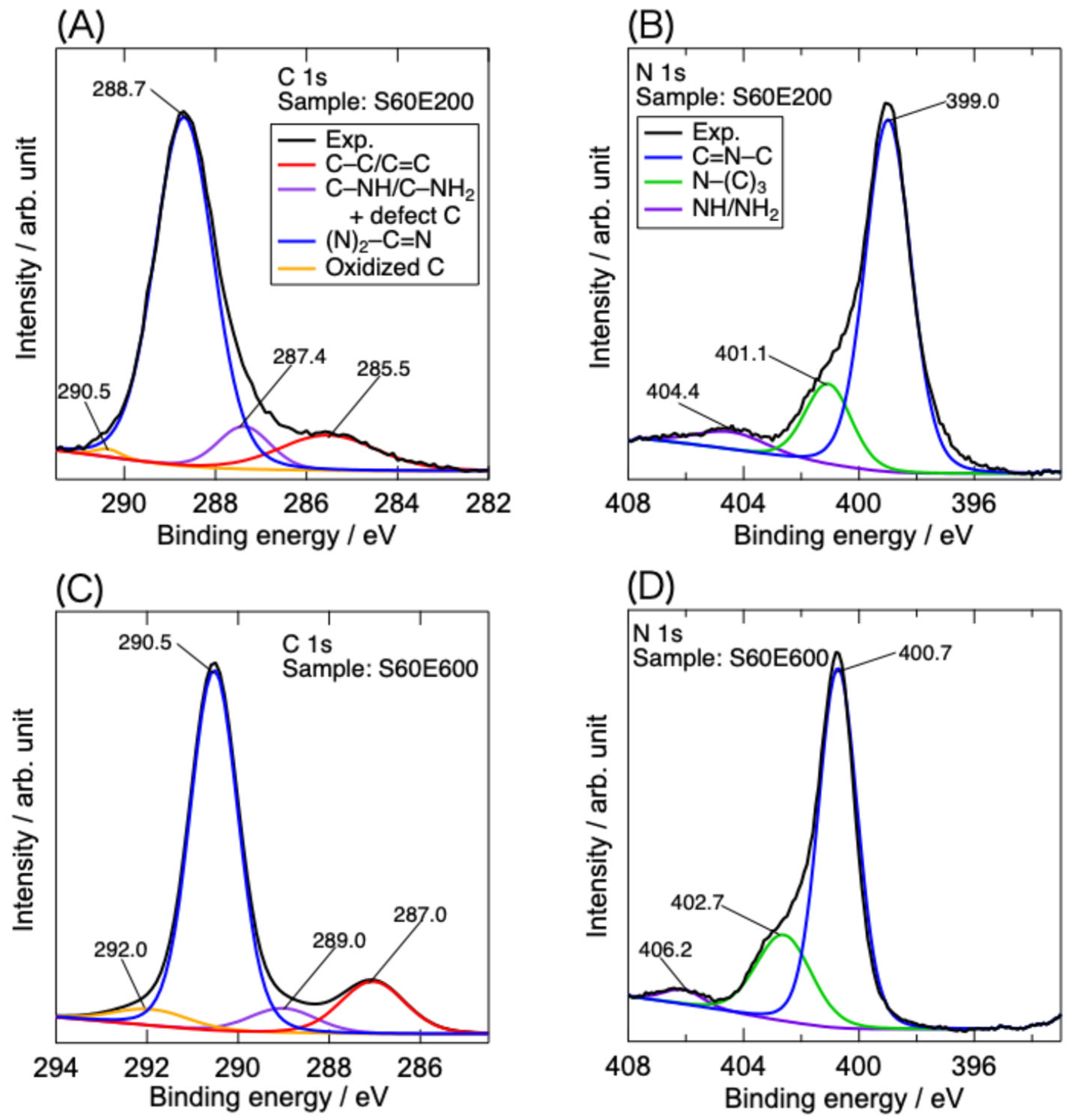
Figure 4 shows typical C 1s and N 1s high-resolution XPS spectra of the EB-irradiated samples after sonication for 60 min. The spectra recorded for untreated samples are also provided for comparison (see Figure S2 in the Supplementary Materials; the appearances of the spectra are consistent with those in Figure 4). The C 1s spectra revealed that four types of C existed in the samples [23,37]: the unexpectedly formed C–C + C=C, C–N possessing hydrogen-containing amino groups, (N)2–C=N contained in the triazine rings, and other species, including oxidized C (the XPS survey also detected a small amount of O). Although the peaks corresponding to defect moieties generated through EB-induced N elimination are not specifically identified, the species exhibiting C–NH/C–NH2 peaks (denoted as “C–NH/C–NH2 + defect C” in Figure 4A,C) may include also defect carbons. The N 1s spectra consisted of three types of N atoms: pyridinic C–N=C, N–(C)3 connecting three carbon atoms, and hydrogen-containing amino groups. Although charge-up-induced peak shifts were observed, the typical features of the C 1s and N 1s spectra were consistent with the previously reported results. The sample charging observed here possibly affect the peak shape and, ultimately, the results of quantitative analysis. For example, if the charging causes peak broadening, remarkable increase in noise may be observed, and hence the peak areas have never been accurately determined in such cases. However, little change in the signal/noise ratio was seen in the observed spectra despite the charging-induced peak shift. Therefore, it can be assumed that the quantification results described below are not seriously affected by the charging. However, evaluation of the charging effect on the spectra is still incomplete at present, and thus further validation should be carefully performed by utilizing the charge removal technique.
EB irradiation altered the C and N composition of the samples, as previously reported [23]. The C/N ratio (in mol%/mol%) of S0E200 and S0E600 were estimated to be 0.71 and 0.78, indicating that the degree of N elimination depends on the irradiation dose. High-dose EB irradiation resulted in more significant N elimination. The preceded sonication did not result in the systematic variation of the C/N ratio, but the C/N ratios estimated for S60E200–S480E200 (0.67–0.80) were larger than the ratios estimated for S60E600–S480E600 (0.83–0.89). These results indicate that the C/N ratio of sonicated g-C3N4 exhibits a similar trend.
The formation of structural defects through N elimination was confirmed based on the abundance ratio of N. Table S1 lists the abundance ratios of N determined by XPS peak deconvolution (see Supplementary Materials). The N in C=N–C tended to decrease with increasing EB dose. Correspondingly, the abundance ratios of N–(C)3 increases. These results indicate that pyridinic N contained in the triazine ring is predominantly eliminated upon EB irradiation compared to tertiary N. Previous results have also revealed that pyridinic N is the predominant species eliminated upon EB irradiation and that N vacancies and C defects form through N elimination [19,20,21,22,23]. Similar tendencies were observed for the samples irradiated after prolonged sonication (S480E200 and S480E600). This structural alteration could be related to the improvement in photocatalytic efficiency.

3.2. Photocatalytic RhB Decomposition Using Treated g-C3N4

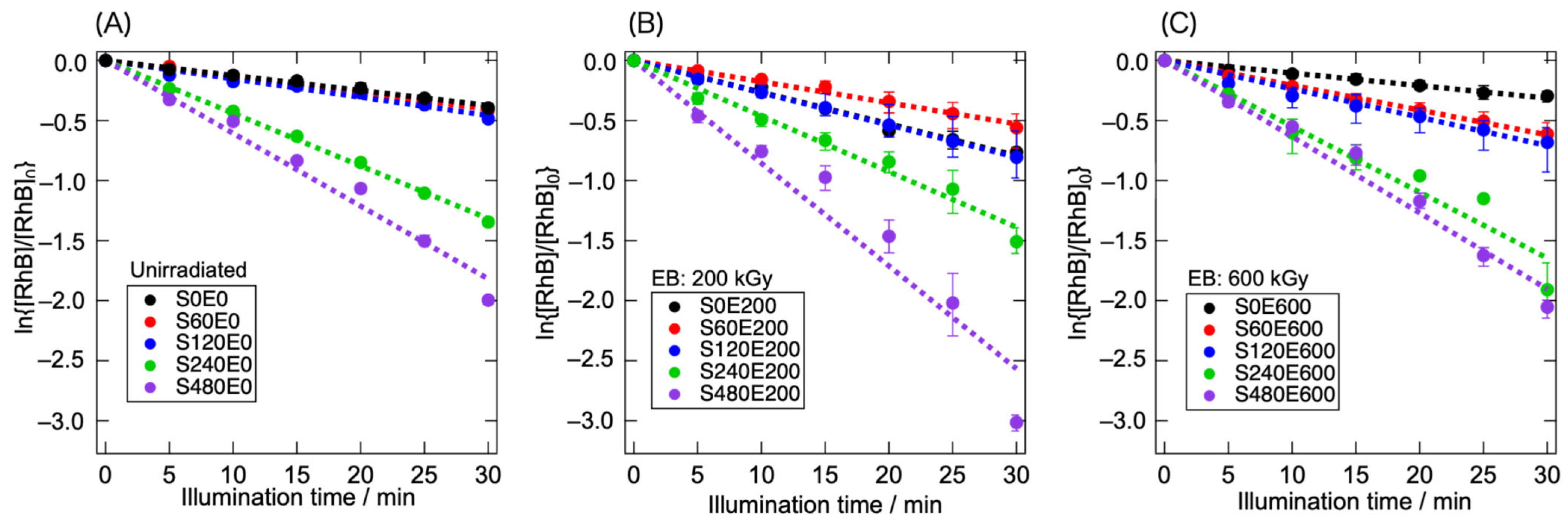
Figure 5 shows the RhB concentration as a function of illumination time under visible light along with the experimental error range. Generally, the uptake of the adsorbate through physical adsorption by g-C3N4 is minimal because of its small surface area. Moreover, the use of the sample with a relatively large surface area (S120E600) did not lead to a significant decrease in the RhB concentration. Therefore, the removal of RhB was exclusively caused by photocatalytic decomposition. The effects of sonication and EB irradiation on the photocatalytic RhB decomposition rate were observed. The photocatalytic reaction rate can be represented by the first-order rate Equation (2), where t is the illumination time, k is the apparent first-order rate constant, and [RhB] and [RhB]0 are the RhB concentrations in solution at t and 0, respectively.
l n R h B R h B 0 = k t
The values of k are listed in Table S2, along with the coefficient of determination (R2) (see Supplementary Materials). Comparison of the RhB decomposition rates of S0E0, S0E200, and S0E600 revealed that S0E200 exhibited the highest reaction rate. This difference in the reaction rate has already been reported in an earlier study [23], in which moderate structural modification with low-dose EB irradiation improved the photocatalytic reaction efficiency. The preceding sonication altered the reaction rate depending on sonication time. Sonication for up to 120 min had a relatively minor effect on the photocatalytic efficiency, but prolonged sonication markedly accelerated the photocatalytic RhB decomposition.
By comparing S480E0, S480E200, and S480E600, the influence of EB irradiation on the reaction efficiency was evident. S480E200 exhibited the highest reaction efficiency, indicating that low-dose EB irradiation effectively improves the photocatalytic reaction efficiency of sonicated g-C3N4. The rate constant measured for S480E200 was approximately 6.8 times that of untreated g-C3N4 (S0E0). In contrast, the reaction efficiency of S480E600 was similar to that of S480E0 despite its larger specific surface area (Figure 3). Notably, although S120E600 had the highest specific surface area among the samples examined, it exhibited a relatively low reaction efficiency. This suggests that the combined effect of EB-induced structural changes and surface area alteration through sonication dominated reaction efficiency. The structural and textural changes induced by low-dose EB irradiation had positive effects. However, the positive effect of EB irradiation at a higher dose (600 kGy) was limited. Under these conditions, electrostatic particle coarsening and EB-induced destructive structural alteration influenced the reaction efficiency.

4. Conclusions

In this study, the combined effect of EB irradiation and sonication on the photocatalytic efficiency of g-C3N4 was investigated. Prolonged sonication prior to EB irradiation improved the g-C3N4 reaction efficiency. The effect of subsequent EB irradiation on the photocatalytic efficiency depended on the EB dose and is summarized as follows:
  • Low-dose EB irradiation further improves the reaction efficiency of sonicated g-C3N4, as it does that of g-C3N4 that is not sonicated.
  • Higher-dose EB irradiation did not markedly increase the reaction efficiency compared to that of unirradiated g-C3N4 despite its larger specific surface area.
Therefore, the photocatalytic efficiency can be determined based on the complex counterbalance between EB- and ultrasonic-induced textural and structural alterations. Sonication and high-dose EB irradiation likely caused opposite changes in textural features, that is moderate particle refining and electrostatic coarsening and led to variations in the specific surface area. Additionally, as previously reported, high-dose EB irradiation results in destructive structural alterations through N elimination, thereby decreasing photocatalytic efficiency.
Currently, radiation-chemical processes of g-C3N4 have not been thoroughly elucidated. The primary reaction induced by ionizing radiation is electron detachment, forming positively charged species. This EB-induced electrostatic attraction between particles, followed by particle coarsening, explains the change in the specific surface area. However, the processes related to the radiation-chemical structural alteration of g-C3N4 remain unclear. To clarify the effects of irradiation on the textural properties of g-C3N4, further studies on this radiation-chemical process are needed. The subjects on the radiation-chemical process to be elucidated include the accurate quantification of C and N with different chemical bonding states based on XPS as referred above.
Additionally, the practical characteristics such as reusability and long-term stability were not examined in this study. While these characteristics have been investigated in previous works (e.g., ref. [38]), we focused specifically on the effects of sonication and EB irradiation on photocatalytic efficiency. These practical evaluations, though crucial for industrial and environmental applications, remain subjects for future work.

Supplementary Materials

The following supporting information can be downloaded at: https://www.mdpi.com/article/10.3390/c11040091/s1. Figure S1. Cumulative particle size distributions of g-C3N4: intact, unirradiated (A) and EB-irradiated (B,C). Figure S2. High-resolution C 1s (A) and N 1s (B) spectra of intact g-C3N4. Table S1. Abundance ratio of N of the samples (in atomic%). Table S2. Apparent first-order rate constants for the photocatalytic RhB decomposition (in min−1) and coefficients of determination.

Author Contributions

Conceptualization, T.T.; methodology, A.H. and T.T.; validation, A.H. and T.T.; investigation, A.H., S.S., K.S. and T.T.; resources, A.F. and T.T.; data curation, A.H. and T.T.; writing—original draft preparation, T.T.; writing—review and editing, A.H. and A.F.; visualization, A.H. and T.T.; supervision, A.F. and T.T.; project administration, T.T.; and funding acquisition, A.F. and T.T. All authors have read and agreed to the published version of the manuscript.

Funding

This research was partially funded by the Joint Usage/Research Center for Catalysis (Proposal No. 23DS0381).

Data Availability Statement

The original contributions presented in this study are included in the article/Supplementary Materials. Further inquiries can be directed to the corresponding author.

Acknowledgments

This study was supported by the Joint Usage/Research Center for Catalysis (No. 23DS0381) and the Advanced Research Infrastructure for Materials and Nanotechnology in Japan (ARIM), Ministry of Education, Culture, Sports, Science, and Technology, Japan (Nos. JPMXP1223HK0110 and JPMXP1223CT0053). The particle size measurements were carried out with a particle size analyzer at the “Joint-use Facilities: Laboratory of Nano-Micro Material Analysis”, Hokkaido University.

Conflicts of Interest

The authors declare no conflicts of interest.

References

  1. Wang, Z.; Wang, J.; Iqbal, W.; Shi, M.; Yang, L.; Chang, N.; Qin, C. Morphology-effects of four different dimensional graphitic carbon nitrides on photocatalytic performance of dye degradation, water oxidation and splitting. J. Phys. Chem. Solids 2023, 173, 111109. [Google Scholar] [CrossRef]
  2. Liu, C.; Wang, W.; Hu, W.; Xu, S.; Gao, C.; Li, X. Nitrogen vacancy/oxygen dopants designed nanoscale hollow tubular g-C3N4 with excellent photocatalytic hydrogen evolution and photodegradation. J. Phys. Chem. Solids 2023, 180, 111477. [Google Scholar] [CrossRef]
  3. Lin, Z.; Wang, Y.; Nga, T.T.T.; Zhang, J.; Wang, R.; Zhang, Z.; Xu, Y.; Zhao, D.; Dong, C.-L.; Shen, S. Electron-rich pyrimidine rings enabling crystalline carbon nitride for high-efficiency photocatalytic hydrogen evolution coupled with benzyl alcohol selective oxidation. EES Catal. 2023, 1, 552–561. [Google Scholar] [CrossRef]
  4. Yuan, H.; Shi, W.; Lu, J.; Shi, Y.; Guo, F.; Kang, Z. Dual-channels separated mechanism of photo-generated charges over semiconductor photocatalyst for hydrogen evolution: Interfacial charge transfer and transport dynamics insight. Chem. Eng. J. 2023, 454, 140442. [Google Scholar] [CrossRef]
  5. Hu, J.; Liu, H.; Sun, C.; Wu, L.; Jiao, F. Precise Defect Engineering with Ultrathin Porous Frameworks on g-C3N4 for Synergetic Boosted Photocatalytic Hydrogen Evolution. Ind. Eng. Chem. Res. 2024, 63, 2665–2675. [Google Scholar] [CrossRef]
  6. Ghosh, U.; Pal, A. Defect engineered mesoporous 2D graphitic carbon nitride nanosheet photocatalyst for rhodamine B degradation under LED light illumination. J. Photochem. Photobiol. A Chem. 2020, 397, 112582. [Google Scholar] [CrossRef]
  7. Ren, H.; Yang, D.; Ding, F.; An, K.; Zhao, Z.; Chen, Y.; Zhou, Z.; Wang, W.; Jiang, Z. One-pot fabrication of porous nitrogen-deficient g-C3N4 with superior photocatalytic performance. J. Photochem. Photobiol. A Chem. 2020, 400, 112729. [Google Scholar] [CrossRef]
  8. Shi, W.; Fang, W.-X.; Wang, J.-C.; Qiao, X.; Wang, B.; Guo, X. pH-controlled mechanism of photocatalytic RhB degradation over g-C3N4 under sunlight irradiation. Photochem. Photobiol. Sci. 2021, 20, 303–313. [Google Scholar] [CrossRef]
  9. Kong, L.; Li, X.; Song, P.; Ma, F. Porous graphitic carbon nitride nanosheets for photocatalytic degradation of formaldehyde gas. Chem. Phys. Lett. 2021, 762, 138132. [Google Scholar] [CrossRef]
  10. Ma, Z.; Zhou, P.; Zhang, L.; Zhong, Y.; Sui, X.; Wang, B.; Ma, Y.; Feng, X.; Xu, H.; Mao, Z. g-C3N4 nanosheets exfoliated by green wet ball milling process for photodegradation of organic pollutants. Chem. Phys. Lett. 2021, 766, 138335. [Google Scholar] [CrossRef]
  11. Tran, D.A.; Pham, C.T.N.; Ngoc, T.N.; Phi, H.N.; Ta, Q.T.H.; Truong, D.H.; Nguyen, V.T.; Luc, H.H.; Nguyen, L.T.; Dao, N.N.; et al. One-step synthesis of oxygen doped g-C3N4 for enhanced visible-light photodegradation of Rhodamine B. J. Phys. Chem. Solids 2021, 151, 109900. [Google Scholar] [CrossRef]
  12. Hu, C.; Tsai, W.-F.; Wei, W.-H.; Lin, K.-Y.A.; Liu, M.-T.; Nakagawa, K. Hydroxylation and sodium intercalation on g-C3N4 for photocatalytic removal of gaseous formaldehyde. Carbon 2021, 175, 467–477. [Google Scholar] [CrossRef]
  13. Rana, A.G.; Hussain, M.Z.; Hammond, N.; Luca, S.V.; Fischer, R.A.; Minceva, M. Synthesis of Highly Active Doped Graphitic Carbon Nitride using Acid-Functionalized Precursors for Efficient Adsorption and Photodegradation of Endocrine-Disrupting Compounds. ChemistrySelect 2022, 7, e202201909. [Google Scholar] [CrossRef]
  14. Kamble, G.; Ganai, A.M.; Lakshmi, D.V.; Rao, N.N.; Rajarikam, N.; Rao, P.V. Impact of pyrolysis temperature on physicochemical properties of carbon nitride photocatalyst. Semicond. Sci. Technol. 2023, 38, 055020. [Google Scholar] [CrossRef]
  15. Stefa, S.; Zografaki, M.; Dimitropouros, M.; Paterakis, G.; Galiotis, C.; Sangeetha, P.; Kiriakidis, G.; Konsolakis, M.; Binas, V. High surface area g-C3N4 nanosheets as superior solar-light photocatalyst for the degradation of parabens. Appl. Phys. A 2023, 129, 754. [Google Scholar] [CrossRef]
  16. Pérez-Molina, Á.; Pastrana-Martínez, L.M.; Morales-Torres, S.; Maldonado-Hódar, F.J. Photodegradation of cytostatic drugs by g-C3N4; Synthesis, properties and performance fitted by selecting the appropriate precursor. Catal. Today 2023, 418, 114068. [Google Scholar] [CrossRef]
  17. Tran, V.A.; Huu, H.T.; Ngo, H.N.T.; Ngo, N.N.; Thi, L.N.; Phan, T.T.T.; Nguyen, L.T.; Nguyen, T.L.; Luc, H.H.; Le, V.T.; et al. Magnesiothermic reduction synthesis of N-deficient g-C3N4 with enhanced photocatalytic performance under visible light. Chem. Phys. 2023, 575, 112061. [Google Scholar] [CrossRef]
  18. Ruan, D.; Kim, S.; Fujitsuka, M.; Majima, T. Defects rich g-C3N4 with mesoporous structure for efficient photocatalytic H2 production under visible light irradiation. Appl. Catal. B Environ. 2018, 238, 638–646. [Google Scholar] [CrossRef]
  19. Zhang, Y.; Zhang, H.; Cheng, L.; Wang, Y.; Miao, Y.; Ding, G.; Jiao, Z. Two physical strategies to reinforce a nonmetallic photocatalyst, g-C3N4: Vacuum heating and electron beam irradiation. RSC Adv. 2016, 6, 14002–14008. [Google Scholar] [CrossRef]
  20. Picho-Chillán, G.; Dante, R.C.; Muños-Bisesti, F.; Martín-Ramos, P.; Chamorro-Posada, P.; Vargas-Jentzsch, P.; Sánchez-Arévalo, F.M.; Sandoval-Pauker, C.; Rutto, D. Photodegradation of Direct Blue 1 azo dye by polymeric carbon nitride irradiated with accelerated electrons. Mater. Chem. Phys. 2019, 237, 121878. [Google Scholar] [CrossRef]
  21. Mendes, R.G.; Ta, H.Q.; Yan, X.; Bachmatiuk, A.; Praus, P.; Mamakhel, A.; Iversen, B.B.; Su, R.; Gemming, T.; Rümmeli, M.H. Tailoring the stoichiometry of C3N4 nanosheets under electron beam irradiation. Phys. Chem. Chem. Phys. 2021, 23, 4747–4756. [Google Scholar] [CrossRef]
  22. Mohapatra, L.; Paramanik, L.; Choi, D.; Yoo, S.H. Advancing photocatalytic performance for enhanced visible-light-driven H2 evolution and Cr(VI) reduction of g-C3N4 through defect engineering via electron beam irradiation. Appl. Surf. Sci. 2025, 685, 161996. [Google Scholar] [CrossRef]
  23. Harako, A.; Shimoda, S.; Suzuki, K.; Fukuoka, A.; Takada, T. Effects of the electron-beam-induced modification of g-C3N4 on its performance in photocatalytic organic dye decomposition. Chem. Phys. Lett. 2023, 813, 140320. [Google Scholar] [CrossRef]
  24. Huang, J.; Cao, Y.; Wang, H.; Yu, H.; Peng, F.; Zou, H.; Liu, Z. Revealing active-site structure of porous nitrogen-defected carbon nitride for highly effective photocatalytic hydrogen evolution. Chem. Eng. J. 2019, 373, 687–699. [Google Scholar] [CrossRef]
  25. Wang, J.; Gao, B.; Dou, M.; Huang, X.; Ma, Z. A porous g-C3N4 nanosheets containing nitrogen defects for enhanced photocatalytic removal meropenem: Mechanism, degradation pathway, and DFT calculation. Environ. Res. 2020, 184, 109339. [Google Scholar] [CrossRef]
  26. Zhong, D.; Jia, X.; Zhang, X.; Zhao, J.; Meng, F.; Wang, D.; Fang, Y.; Zhang, Z. Facile synthesis of distinctive nitrogen defect-regulated g-C3N4 for efficient photocatalytic hydrogen evolution. Diam. Relat. Mater. 2024, 142, 110816. [Google Scholar] [CrossRef]
  27. Liu, W.; Iwasa, N.; Fujita, S.; Koizumi, H.; Yamaguchi, M.; Shimada, T. Porous graphitic carbon nitride nanoplates obtained by a combined exfoliation strategy for enhanced visible light photocatalytic activity. Appl. Surf. Sci. 2020, 499, 143901. [Google Scholar] [CrossRef]
  28. Liu, W.; Yanase, T.; Iwasa, N.; Koizumi, H.; Mukai, S.; Iwamura, S.; Nagahama, T.; Shimada, T. Sugar-assisted mechanochemical exfoliation of graphitic carbon nitride for enhanced visible-light photocatalytic performance. Int. J. Hydrogen Energy 2020, 45, 8444–8455. [Google Scholar] [CrossRef]
  29. Liu, W.; Song, C.; Kou, M.; Wang, Y.; Deng, Y.; Shimada, T.; Ye, L. Fabrication of ultra-thin g-C3N4 nanoplates for efficient visible-light photocatalytic H2O2 production via two-electron oxygen reduction. Chem. Eng. J. 2021, 425, 130615. [Google Scholar] [CrossRef]
  30. Yang, S.; Gong, Y.; Zhang, J.; Zhan, L.; Ma, L.; Fang, Z.; Vajtai, R.; Wang, X.; Ajayan, P.M. Exfoliated Graphitic Carbon Nitride Nanosheets as Efficient Catalysts for Hydrogen Evolution Under Visible Light. Adv. Mater. 2013, 25, 2452–2456. [Google Scholar] [CrossRef]
  31. She, X.; Xu, H.; Xu, Y.; Yan, J.; Xia, J.; Xu, L.; Song, Y.; Jiang, Y.; Zhang, Q.; Li, H. Exfoliated graphene-like carbon nitride in organic solvents: Enhanced photocatalytic activity and highly selective and sensitive sensor for the detection of trace amounts of Cu2+. J. Mater. Chem. A 2014, 2, 2563–2570. [Google Scholar] [CrossRef]
  32. Fairley, N.; Fernandez, V.; Richard-Plouet, M.; Guillot-Deudon, C.; Walton, J.; Smith, E.; Flahaut, D.; Greiner, M.; Biesinger, M.; Tougaard, S.; et al. Systematic and collaborative approach to problem solving using X-ray photoelectron spectroscopy. Appl. Surf. Sci. Adv. 2021, 5, 100112. [Google Scholar] [CrossRef]
  33. Brunauer, S.; Emmett, P.H.; Teller, E. Adsorption of Gases in Multimolecular Layers. J. Am. Chem. Soc. 1938, 60, 309–319. [Google Scholar] [CrossRef]
  34. Fudouzi, H.; Egashira, M.; Shinya, N. Formation of electrified images using electron and ion beams. J. Electrostat. 1997, 42, 43–49. [Google Scholar] [CrossRef]
  35. Tatarintsev, A.A.; Zykova, E.Y.; Ieshkin, A.E.; Orikovsaya, N.G.; Rau, E.I. Electrization of the Quartz Glass Surface by Electron Beams. Phys. Solid State 2023, 65, 1236–1243. [Google Scholar] [CrossRef]
  36. Ghobashy, M.M.; Sharshir, A.I.; Zaghlool, R.A.; Mohamed, F. Investigating the impact of electron beam irradiation on electrical, magnetic, and optical properties of XLPE/Co3O4 nanocomposites. Sci. Rep. 2024, 14, 4829. [Google Scholar] [CrossRef]
  37. You, R.; Dou, H.; Chen, L.; Zheng, S.; Zhang, Y. Graphitic carbon nitride with S and O codoping for enhanced visible light photocatalytic performance. RSC Adv. 2017, 7, 15842–15850. [Google Scholar] [CrossRef]
  38. Muhmood, T.; Xia, M.; Lei, W.; Wang, F.; Mahmood, A. Fe-ZrO2 imbedded graphene like carbon nitride for acarbose (ACB) photo-degradation intermediate study. Adv. Powder Technol. 2018, 29, 3233–3240. [Google Scholar] [CrossRef]
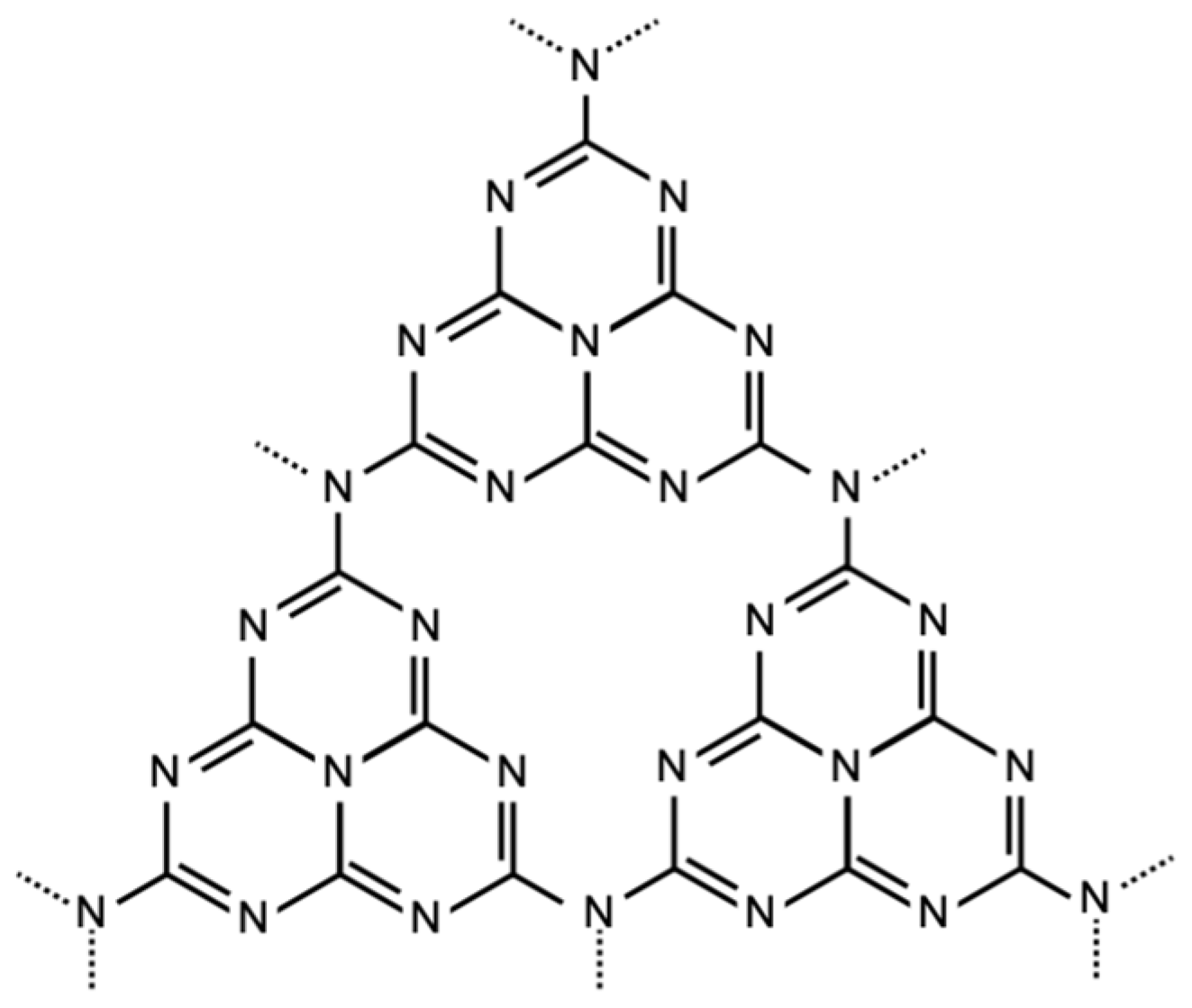
Figure 1. Typical structure of g-C3N4.
Carbon 11 00091 g001
Figure 2. Powder XRD patterns of intact and sonicated g-C3N4 samples. Diffraction patterns of S480E200 and S480E600 are also shown.
Carbon 11 00091 g002
Figure 3. Specific surface area of unirradiated and EB-irradiated g-C3N4 as a function of sonication time.
Carbon 11 00091 g003
Figure 4. Typical high-resolution XPS of g-C3N4 after sonication for 60 min and subsequent EB irradiation: C 1s spectra (A,C) and N 1s spectra (B,D).
Carbon 11 00091 g004
Figure 5. Variation of RhB concentration measured using unirradiated g-C3N4 (A) and EB-irradiated g-C3N4 (B,C) as a function of illumination time. The error bars indicate minimum and maximum experimental values.
Carbon 11 00091 g005
Disclaimer/Publisher’s Note: The statements, opinions and data contained in all publications are solely those of the individual author(s) and contributor(s) and not of MDPI and/or the editor(s). MDPI and/or the editor(s) disclaim responsibility for any injury to people or property resulting from any ideas, methods, instructions or products referred to in the content.