Article

Metal-Doped Carbon Dots as Heterogeneous Fenton Catalysts for the Decolourisation of Dyes—Activity Relationships and Mechanistic Insights


1
School of Science, STEM College, RMIT University, Melbourne, VIC 3000, Australia
2
School of Engineering, Australian National University, Canberra, ACT 2601, Australia
*
Authors to whom correspondence should be addressed.
Submission received: 14 October 2025 / Revised: 13 November 2025 / Accepted: 17 November 2025 / Published: 20 November 2025
(This article belongs to the Section Carbon Materials and Carbon Allotropes)

Abstract

The removal of synthetic dyes from industrial effluents remains challenging due to their chemical stability and poor biodegradability. Here we engineer metal-doped carbon dots (CDs) as heterogeneous Fenton-like catalysts and elucidate how dopant identity governs structure–activity relationships and reactive oxygen species (ROS) pathways. Fe-, Cu-, Zn- and Mg-doped CDs were prepared via a one-pot hydrothermal route and comprehensively characterised by TEM, FTIR, XPS and zeta-potential analysis. The resulting nanoparticles displayed narrow size distributions (10.2–15.2 nm) and dopant-dependent surface chemistries and charges. Catalytic tests with methylene blue (MB) and rhodamine B (RB) show that Fe-doped CDs deliver the highest activity toward MB degradation (k = 0.0218 min−1), attributable to efficient Fe2+/Fe3+ redox cycling coupled with hydroxyl-rich surfaces that promote H2O2 activation. Zn-doped CDs achieve complete RB decolourisation under Fenton-like conditions, which we ascribe to their higher surface charge and abundant oxygenated sites that enhance pollutant adsorption and ROS generation. Cu- and Mg-doped CDs exhibit intermediate and dopant-specific performances consistent with their respective redox and adsorption characteristics. Collectively, these results establish clear correlations between dopant chemistry, surface functionality, and ROS formation routes, providing mechanistic guidance for the rational design of carbon-based Fenton catalysts for sustainable water remediation.

1. Introduction

One of the most persistent anthropogenic pollutants in aquatic habitats is the global discharge of dye-containing wastewater from industrial processes, especially from the textile, leather, and dyeing sectors [1]. Worldwide yearly production of synthetic dyes is estimated at over 700,000 tonnes, of which 10–15% is discharged into the environment during manufacturing and application procedures [2,3]. In countries like India, Bangladesh, and China, where textile manufacture is a significant economic sector, untreated dye effluents are frequently discharged into rivers, thereby harming local biodiversity and impacting the quality of drinking water supplies for millions of people [4]. Once released, dyes can induce eutrophication in natural water bodies, lower dissolved oxygen levels, and impede sunlight penetration. Many dyes or their breakdown byproducts are also hazardous, mutagenic, or carcinogenic, endangering human and aquatic life [5]. Azo dyes, which make up more than 60% of commercially used dyes, for example, have been connected to liver problems and bladder cancer in exposed populations [6]. Furthermore, because of their complicated aromatic structure and chemical stability, traditional wastewater treatment plants cannot effectively eliminate such persistent organics, which causes long-term sediment and food chain accumulation. Therefore, the efficient removal of synthetic dyes from wastewater is not just an environmental imperative but also a public health priority, given the scale and severity of the issue. There is a pressing need for innovative, affordable, and environmentally friendly treatment methods capable of degrading dye-laden effluents to harmless end products since they continue to flow into natural ecosystems in many regions of the world [7].
Among the various methods developed to treat dye-laden industrial effluents, advanced oxidation processes (AOPs) have emerged as a promising technology, particularly for non-biodegradable organic molecules resistant to traditional biological or physicochemical treatments. AOPs work by producing highly reactive oxygen species (ROS), including hydroxyl radicals and superoxide anion radicals, which have very high redox potentials and can non-selectively oxidise a broad spectrum of organic pollutants. Among the several varieties of AOPs, Fenton and Fenton-like reactions—which activate hydrogen peroxide (H2O2) in the presence of transition metals—have shown notable degrading efficiency under mild conditions [8]. However, traditional Fenton methods, which use soluble Fe2+ as the catalytic centre, have disadvantages like a narrow ideal pH range (usually about pH 3.0), the production of significant volumes of iron sludge, and the need for post-treatment separation and recovery of iron ions from treated water [9], which restrict its scalability and environmental sustainability [7,10].
To overcome these constraints, researchers have progressively explored heterogeneous Fenton-like catalysts, especially those built on nanostructured materials because of their improved surface reactivity, stability, and reusability [11]. Among these, carbon dots (CDs)—a very recent category of quasi-spherical, zero-dimensional carbon-based nanomaterials usually less than 10 nm in size—have attracted increasing interest. CDs have intrinsic biocompatibility [12], high water dispersibility, tuneable photoluminescence, and plentiful surface functional groups (e.g., -OH, -COOH, -NH2). These features not only qualify them as electron reservoirs or photosensitisers but also as flexible platforms for catalytic uses. Furthermore, heteroatom doping can help to further control the physicochemical characteristics of CDs. Metal-doping techniques provide a mechanism for modulating the surface chemistry, redox activity, and electronic structure of CDs [13]. Incorporation of transition metals with more than one valence state (e.g., Fe, Cu) creates redox-active sites that can engage in valence cycling processes, hence promoting the breakdown of H2O2 into ROS [14]. Non-redox-active metals (e.g., Zn, Mg) can enhance catalytic behaviour by altering electron density, increasing dye adsorption via stronger electrostatic interactions, or improving surface polarity [15]. In addition to their potential applications in catalysis, CDs have garnered significant attention from many sectors due to their unique optical characteristics and surface attributes. The exceptional photostability, low toxicity, and ease of surface functionalisation of CDs render them highly advantageous materials for diverse applications, such as fluorescence sensing, biomedical imaging, and environmental monitoring. In the field of metal ion detection, CDs have been widely utilised as fluorescent probes. Interactions between surface functional groups with certain metal ions can result in significant changes in fluorescence emission intensity, enabling the precise detection of target ions. The adaptability of CDs in many applications highlights their considerable potential as multifunctional nanomaterials, emphasising the need for thorough examination of their surface chemical characteristics and regulatory mechanisms. Compared to traditional nanomaterials like TiO2 or g-C3N4, which often require UV activation or suffer from low biocompatibility, CDs offer superior water dispersibility, low toxicity, and tuneable photo-properties, making them ideal for sustainable heterogeneous Fenton catalysis [1].
Metal-doped CDs exhibit improved catalytic performance in AOP, attributed to their adjustable electronic structure and plentiful surface functional groups. Fe-doped CDs have been thoroughly investigated for their capacity to activate H2O2, facilitating the generation of ROS via the Fe2+/Fe3+ redox cycle. This property facilitates the degradation of a range of organic pollutants [16]. Several studies have concentrated on single-metal systems or have shown catalytic activity exclusively in acidic environments, overlooking a comprehensive assessment of their stability in neutral pH or complex aqueous conditions.
Cu-doped CDs utilise the valence state conversion between Cu+ and Cu2+, incorporating functions of electron transfer and surface polarity regulation, and have demonstrated notable decolourisation capabilities in multiple studies. Cu-based systems may pose risks related to the leaching of free copper ions in practical applications, necessitating further investigation into their long-term environmental compatibility.
Zn- and Mg-doped CDs, as non-redox-active systems, do not participate directly in the electron transfer reaction involving H2O2. Their enhancement of negative charge density and specific surface area in CDs facilitates dye adsorption and surface-induced ROS generation, resulting in effective decolourisation performance in particular systems [17,18]. Many of these studies fail to adequately distinguish between “physical adsorption” and “chemical degradation” mechanisms and lack comprehensive analysis of alterations in electronic structure and catalytic pathways.
In summary, the current literature generally suffers from the following issues: (1) most studies focus on optimising the performance of single metal dopants, lacking comparative studies between different metal types; (2) experimental conditions are inconsistent, resulting in non-comparable results; (3) the structure–performance mechanism is explored superficially, making it difficult to guide the rational design of doping strategies.
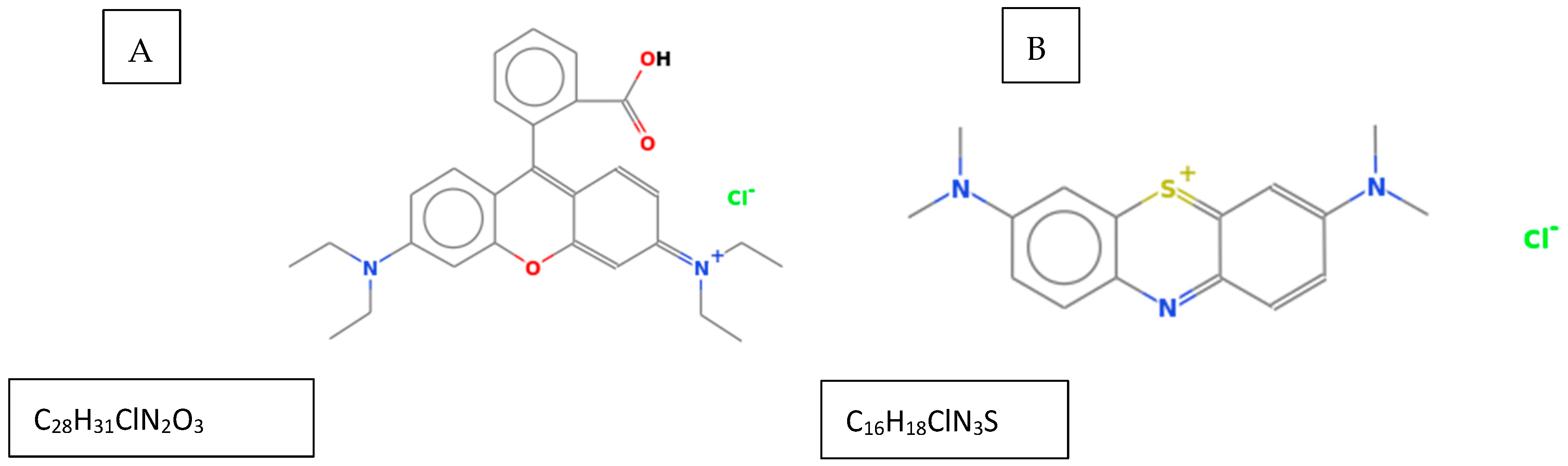
In this study, we aim to investigate the structure–function relationships of CDs doped with Fe, Cu, Zn, and Mg by linking their physicochemical traits with their catalytic performance in degrading methylene blue (MB) and rhodamine blue (RB) dyes. The selection of these two dyes as model pollutants stems from their prevalent use in industry, unique molecular structures, and varying physicochemical characteristics. MB is characterised as a planar cationic thiazine dye, whereas RB presents a more intricate xanthene-based structure, featuring multiple aromatic rings and aromatic groups. Their structural diversity allows for a thorough assessment of the catalysts’ performance in the face of different degradation challenges, especially when evaluating ROS accessibility, dye adsorption, and the effects of steric hindrance. The molecular structures of MB and RB are illustrated in Figure 1. All metal-doped CDs were synthesised by a consistent hydrothermal method and comprehensively characterised by transmission electron microscopy (TEM), Fourier-transform infrared spectroscopy (FTIR), X-ray photoelectron spectroscopy (XPS), and zeta potential measurements. Degradation reaction rates were measured using pseudo-first-order kinetics, and the catalytic capabilities were assessed under similar experimental conditions. From the experimental findings, we propose mechanistic routes for ROS production and underline the significance of dopant characters in affecting electron transfer, dye adsorption, and H2O2 activation. This work provides fundamental knowledge on the logical design of metal-doped CDs for sophisticated wastewater treatment applications.

2. Methodology

2.1. Materials

Citric acid (C6H8O7), ferric citrate (FeC6H5O7), copper (II) acetate monohydrate (Cu(CH3COO)2·H2O), zinc acetate dihydrate (Zn(CH3COO)2·2H2O), and magnesium chloride hexahydrate (MgCl2) were purchased from Sigma-Aldrich (St. Louis, MO, USA) and used as received without further purification. H2O2 (30%, w/w), MB, and RB were obtained from Aladdin Reagents as Figure 1 shows (Shanghai, China). Deionized water (resistivity ≥ 18.2 MΩ·cm) was used for all preparations and dilutions. All glassware was acid-washed and rinsed thoroughly with deionized water before use.

2.2. Synthesis of Metal-Doped CDs

Metal-doped CDs (Metal = Fe, Cu, Zn, and Mg) were synthesised via a one-step hydrothermal carbonisation method. In a typical procedure, 1.0 g of citric acid and 0.5 g of urea were dissolved in 30 mL of deionised water under constant magnetic stirring. Subsequently, 1.0 g of the corresponding metal precursor (FeC6H5O7, Cu(CH3COO)2, Zn(CH3COO)2, and MgCl2) was added to the solution [21,22,23,24,25]. An equal mass of precursor was used by deign to control process variables; the ensuing differences in metal loading are expected based on the distinct metal fractions and ligand environments of each salt and are consistent with literature on precursor-dependent doping in CDs [26,27]. The resulting mixture was stirred for 15 min to ensure homogeneity, then transferred into a 50 mL Teflon-lined stainless-steel autoclave (Techinstro, Nagpur, India) and heated at 260 °C for 4 h [28].
After natural cooling to room temperature, the dark brown solution was centrifuged at 10,000 rpm for 15 min to remove large or aggregated particles [28]. The supernatant was filtered through a 0.22 μm syringe filter and subsequently purified using dialysis (3.0 kDa MWCO, 24 h) against deionised water to eliminate residual small molecules and metal ions [29]. The purified CDs, dispersed in deionised water, were stored at 4 °C or freeze-dried to obtain a dry powder, which was also stored at 4 °C for later use [30].

2.3. Characterisation Method for Samples

2.3.1. Transmission Electron Microscopy (TEM)

Metal-doped CDs, dispersed in deionised water, were pipetted onto the carbon film on a copper grid using the single drop method. For TEM analysis, a JEOL101 transmission electron microscope (JEOL, Peabody, MA, USA) was used with an operating voltage of 100 kV and a magnification of 100,000 [31,32].

2.3.2. X-Ray Photoelectron Spectroscopy (XPS)

The surface of the CDs (dry powder) was analysed using a Thermos Scientific K-Alpha X-ray photoelectron spectrometer (Thermo Fisher Scientific, Waltham, MA, USA). The powdered CD samples were mounted on a conductive carbon tape and introduced into the ultra-high vacuum chamber (<1 × 10⁻⁸ mbar). A monochromatic Al Kα source (hv = 1486.6 eV) was used for excitation, with a pass energy of 50 eV for high-resolution scans. Charge neutralisation was applied using a flood gun. Peaks were fitted using Thermo Scientific K-Alpha XPS and CASA XPS 2.3.26 software. Peak fitting was performed using a Shirley background and Gaussian–Lorentzian (GL) peak shapes [33].

2.3.3. Fourier Transform Infrared Spectroscopy (FTIR)

A Perkin Elmer Frontier Fourier transform infrared spectrometer was used to examine the prepared CDs; CD powders were finely ground with spectroscopic-grade KBr, pressed into transparent pellets, and scanned in transmission mode. Each spectrum was collected using 32 scans at a spectral resolution of 4 cm−1. The background was recorded using pure KBr under identical conditions and subtracted automatically. Data were acquired over the ranges of 400–4000 cm−1 (mid-IR) and 40–700 cm−1 (far-IR) to cover both functional group and metal–ligand vibration regions, and a total of 32 scans were performed for each sample [30].

2.3.4. Inductively Coupled Plasma Mass Spectrometer (ICP-MS)

The metal concentration of the synthesised Zn–, Mg–, Fe–, and Cu–doped CDs was measured using an Agilent Inductively Coupled Plasma Mass Spectrometer (ICP–MS) equipped with laser ablation functionality (Agilent Technologies, Santa Clara, CA, USA). For each sample, 10 μL of the CD stock solution was dispensed into a 50 mL polypropylene centrifuge tube, followed by the addition of 1 mL of concentrated nitric acid (HNO3, 65%, trace-metal grade) to attain a final acid concentration of 2% (v/v). The solution was further diluted to with 18.2 MΩ·cm ultrapure water (Milli-Q, Millipore, Darmstadt, Germany). The diluted solutions were homogenised and then filtered through a 0.22 μm polytetrafluoroethylene (PTFE) membrane filter to eliminate particles before instrumental analysis.
Calibration standards for Fe, Cu, Zn, and Mg were created from single-element stock solutions (1000 mg/L, traceable to NIST) in 2% HNO3 at concentrations varying from 0.1 to 100 μg/L. An internal standard was incorporated online to compensate for instrumental drift and matrix effects. All observations were conducted in helium collision gas mode to reduce polyatomic interferences, and isotopes with diminished spectral overlap were chosen (e.g., 57Fe, 65Cu, 66Zn, and 25Mg). Each sample underwent duplicate analysis, adhering to quality control standards that encompassed procedural blanks, internal standard recoveries ranging from 70% to 130%, and relative percent differences (RPD) of less than 20% between duplicates.

2.3.5. Fluorescence Analysis

CD samples were dispersed in deionised water (0.2 mg/mL) and sonicated for 5 min prior to measurement. UV–Vis absorbance spectra were recorded over the range of 200–800 nm using quartz cuvettes (1 cm path length). Fluorescence spectra were measured at an excitation wavelength of 360 nm, with emission recorded from 400 to 650 nm. All measurements were carried out at room temperature using a CLARIOstar Plus multi-mode microplate reader (BMG LABTECH, Ortenberg, Germany). Blank spectra of deionised water were subtracted automatically [34].

2.3.6. Zeta Potential Determination

CD dispersions were prepared in deionised water at a concentration of 0.1 mg/mL and equilibrated at room temperature (25 ± 1 °C). Measurements were performed by Laser Doppler Electrophoresis (LDE) in triplicate using a folded capillary cell (DTS1070) with the Zetasizer Nano ZS (Malvern Instruments, Malvern, UK). The LDE and DLS modules of the instrument operate independently; only LDE data were collected to obtain electrophoretic mobility and zeta potential. Each measurement involved 20 runs. The pH of the dispersions was adjusted to ~6.8 unless otherwise stated. The instrument was pre-calibrated using a polystyrene latex standard [35].

2.4. Catalytic Degradation of Methylene Blue and Rhodamine Blue

The target dyes were cationic MB (C16H18N3SCl) and RB (C28H31ClN2O3) (Figure 1). The catalytic degradation activity of the produced CDs was assessed in the presence of H2O2, which was used for triggering Fenton or Fenton-like reactions. The experimental parameters were pH 6.8, modified with hydrochloric acid or sodium hydroxide (1 M) to simulate neutral wastewater conditions, avoiding the acidic pH ~3 typical of classical Fenton processed. Temperature, 50 °C, and an initial dye concentration, 0.25 mg/mL. Before the experiment, 4 mL of CDs was combined with the dye solution and agitated for 60 min in the dark to ensure that the adsorption of the dye molecules onto the surface of the CDs reaches equilibrium. Then, 1 mL of the equilibrated sample and 1.5 mL of dye solution was combined with 1.5 mL of 3% H2O2 in a cuvette, resulting in a total volume of 4 mL [30]. For the reaction, the cuvette was swiftly moved to a thermostatic incubator at 50 °C in the dark [30]. Using a UV-Vis spectrophotometer, 60 s after the reaction started, the first absorbance data was recorded at 420 nm, then, at 10 min intervals; the whole reaction lasted for 300 min [36]. The progressive decrease in absorbance was used to determine the degree of decolourisation of the dye. Decolourisation efficiency was calculated as follows:
Decolourisation (%) = (Ai − At)/Ai
where Ai is the initial absorbance of the solution, and At is the absorbance at any time interval [37].
All catalytic reactions were performed under conditions that avoided light as much as possible to isolate Fenton-like processes from photo-induced degradation. This method not only evaluates the catalytic performance of CDs in Fenton and Fenton-like reactions but also enables detailed monitoring of the degradation kinetics by recording absorbance changes, providing an experimental basis for further optimisation of the catalytic conditions. Through this systematic testing approach, the effects of different doped CDs on the degradation efficiency of dye molecules were compared, supporting their future practical applications in wastewater treatment.

2.5. Kinetic Analysis

The apparent pseudo-first-order rate constant (k) was calculated by monitoring the concentration decrease of dyes over time, using the equation:
ln(C0/Cₜ) = k × t
where C0 is the initial concentration, Cₜ is the concentration at time t, and k is the apparent rate constant. ln(C0/Cₜ) was plotted against time to find the slope [38].

2.6. Statistical Analyses

All catalytic degradation studies were conducted in triplicate to ensure the reproducibility of the experimental data. To show the range of variation in the experimental data, results are reported as mean ± standard deviation. SPSS statistical software 31.0 version. was used to statistically analyse these data. Statistically differences between groups were considered significant only when the statistical parameter p-value was less than 0.05.

3. Result and Discussion

3.1. Characterisation of Metal-Doped CDs and Their Catalytic Implications

3.1.1. TEM Analysis

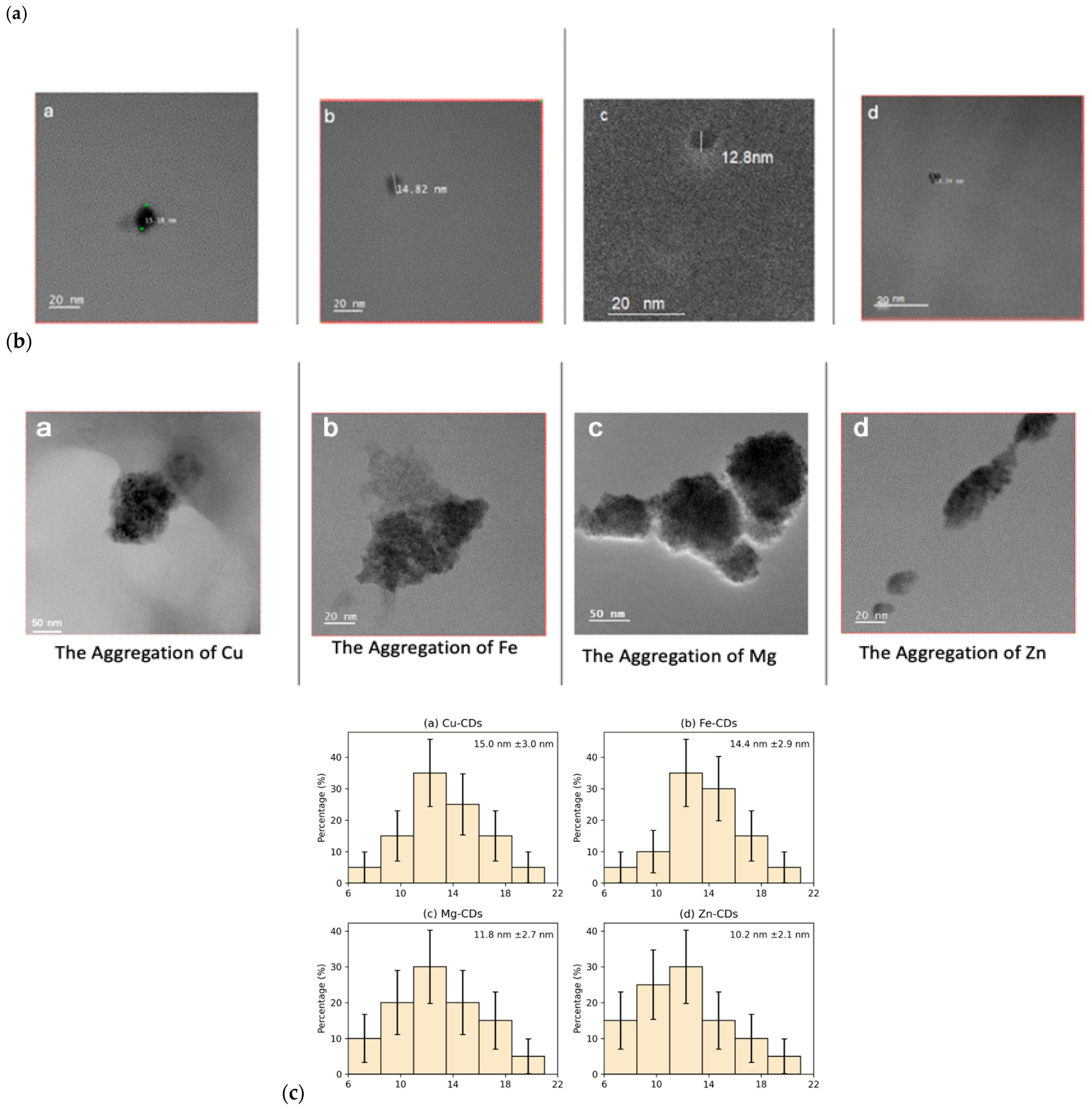
TEM was employed to examine the morphological features of the CDs. As shown in Figure 2a, all samples exhibited quasi-spherical morphology. Representative TEM images were selected to show the morphology of an individual CD; however, multiple fields were examined and showed uniformly dispersed particles. Among these, the Zn- and Mg-doped CDs displayed notably smaller average sizes compared to their Fe- and Cu-doped counterparts.
The reduced particle size observed in Zn- and Mg-doped samples suggests an increased specific surface area, which is known to be beneficial for catalytic applications. A larger surface area typically leads to a higher density of surface-active sites, enhancing the adsorption of molecules and facilitating the generation of ROS during catalytic degradation processes. This morphological advantage may partially account for the catalytic activity exhibited by Zn- and Mg-doped CDs in subsequent degradation experiments, as supported by prior studies linking nanoscale surface area with improved photocatalytic performance [39].
To evaluate particle size uniformity, size distribution histograms were generated based on TEM measurements of over 20 particles per sample (Figure 2b). Most particles fell within the 8–18 nm range, with approximately 65–88% of the particles across all samples having diameters smaller than 15 nm. While typical CDs are <10 nm, the observed 10.2–15.2 nm range arises from metal-induced nucleation under high-temperature hydrothermal conditions (260 °C), as reported in similar systems [32]. This slight increase enhances catalytic stability by reducing excessive quantum confinement effects while maintaining high surface area for ROS generation, as evidenced by the narrow distributions (Figure 2c).
These data confirm that most of the metal-doped CDs are nanoscale and exhibit relatively uniform size distributions. The primary objective of TEM analysis was to confirm the nanoscale morphology of the CDs. Due to the small size and low contrast against the background, many particles become difficult to distinguish under conventional TEM conditions. All samples were synthesised at a high temperature of 260 °C, which typically favours uniform carbonisation and particle dispersion [27].
In addition, metal doping is known to promote aggregation, which further complicates imaging. This tendency arises from surface charge neutralisation, metal ion bridging, enhanced hydrophobic interactions, and heterogeneity in nucleation, all of which weaken colloidal stability. As such, the TEM micrographs selectively focus on well-resolved individual particles to highlight their typical spherical shape and representative sizes, which are consistent with the statistical results.

3.1.2. FTIR Analysis

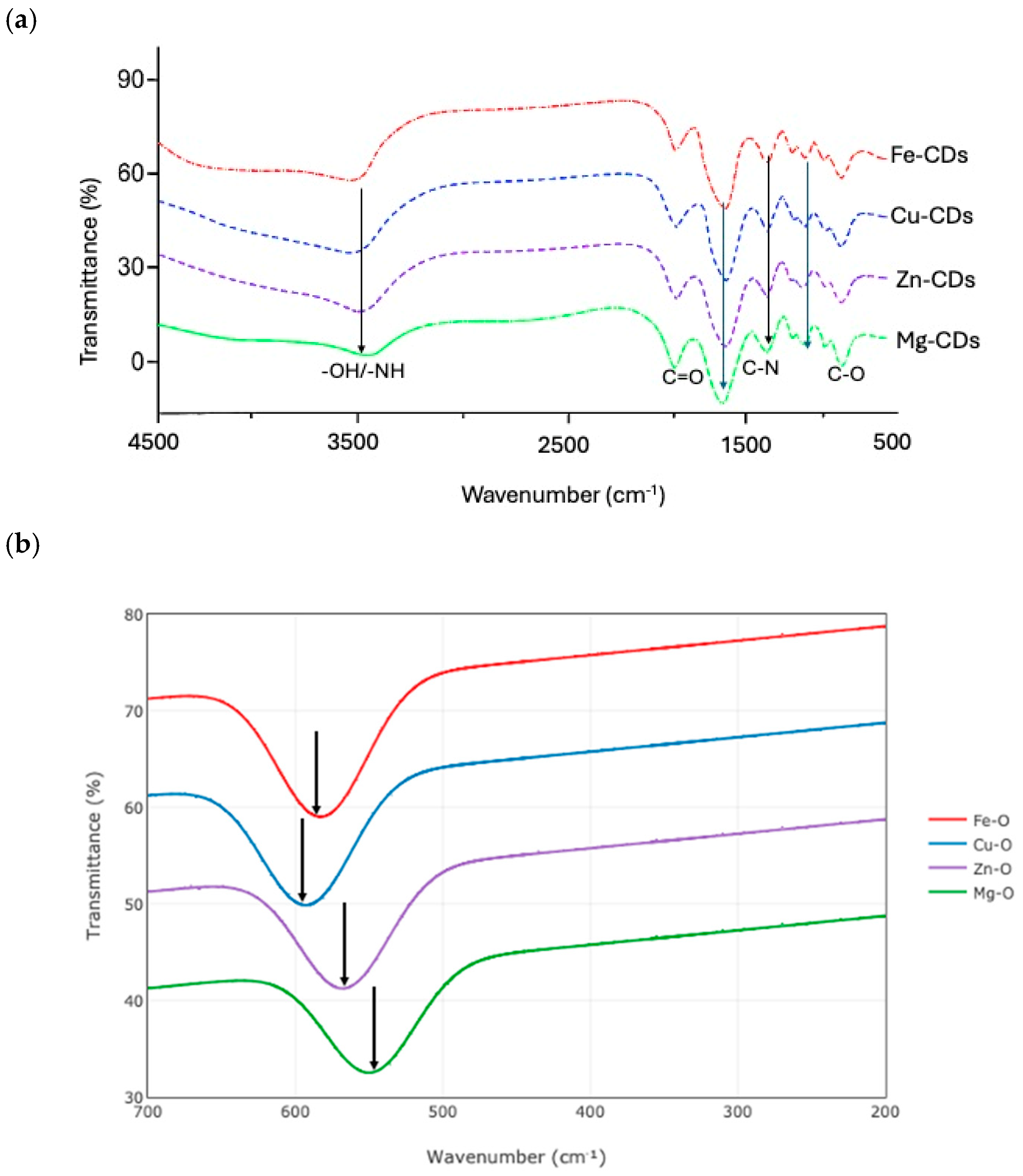
FTIR spectroscopy was employed to elucidate the surface functional groups of the synthesised metal-doped CDs. As shown in Figure 3a, all samples exhibit a broad absorption band centred around ~3290 cm−1, attributed primarily to O–H stretching vibrations, with possible contributions from N–H bonds. Due to the overlapping of these signals, individual identification is challenging. Similarly, the peak observed in the 1050–1085 cm−1 range may arise from C–O stretching (ether groups), with only minor contributions from C–N vibrations, if present. The presence of nitrogen functionalities is therefore more reliably confirmed via N 1s XPS spectra, which are discussed in Section 3.1.4. These polar functional groups contribute to enhanced water dispersibility and play a critical role in the adsorption of molecules via hydrogen bonding and electrostatic interactions.
A significant absorption peak at 1635 cm−1 is indicative of the presence of carbonyl and/or carboxylic acid groups, as it corresponds to C=O stretching vibrations. These oxygen-containing species are frequently involved in surface redox reactions, particularly in Fenton-like catalytic systems, where they function as anchoring sites for H2O2 molecules. The incorporation of nitrogen and ether groups was further confirmed by the spectral features at 1050 and 1085 cm−1 corresponding to C–N and C–O stretching vibrations, respectively.
Comprehensive examination of the low-frequency FTIR region (200–700 cm−1) was conducted to further investigate the presence and nature of metal–ligand interactions, as illustrated in Figure 3b. All doped CDs exhibited clear and distinct vibrational bands that corresponded to metal–oxygen (M–O) bonds. These bands were characterised by distinct peaks at 582 cm−1 (Fe–O), 567 cm−1 (Zn–O), 549 cm−1 (Mg–O), and 592 cm−1 (Cu–O), providing direct evidence of successful coordination between metal ions and oxygen-containing functional groups on the CD surfaces. The formation of stable M–O bonds is critical for facilitating valence cycling processes and enhancing catalytic redox activity in the presence of H2O2 [40,41].
Overall, as Table 1 summarises, the abundance of oxygen- and nitrogen-containing functional groups—combined with confirmed metal–oxygen coordination—supports the dual catalytic role of these materials by promoting molecule adsorption and enhancing ROS generation via efficient H2O2 activation. This structure–function relationship is central to understanding the enhanced catalytic performance of the metal-doped CDs in degradation processes.
Chandrasekaran et al. reported the synthesis of N-doped CDs through a hydrothermal method utilising Coccinia grandis extract. FTIR analysis revealed distinct peaks corresponding to O–H stretching around 3428 cm−1, C=O stretching near 1637 cm−1, and COO vibrations at approximately 1409 cm−1 [42]. These peaks suggest the existence of surface hydroxyl and carboxyl groups, which contribute to increased hydrophilicity and adsorption properties. In the current study, metal-doped CDs not only show comparable oxygen-containing functional groups but also reveal extra absorption bands within the 500–600 cm−1 range, which are associated with metal–oxygen (M–O) bonds. The presence of these M–O features indicates that metal incorporation has been successfully achieved, highlighting the formation of redox-active centres that are essential for the generation of ROS in a Fenton-like process. Therefore, although N-CDs exhibit a moderate level of surface functionality, the incorporation of metal–ligand interactions in metal-doped CDs is expected to enhance their catalytic potential for degradation significantly.

3.1.3. ICP-MS Analysis

Retention efficiency analysis revealed the sequence Mg (57.7%) > Cu (49.7%) > Zn (21.1%) > Fe (14.4%), despite identical precursor masses. This variation reflects the combined influence of precursor metal fraction, coordination chemistry, hydrolysis behaviour, and structural compatibility with the CD framework. Cu (II) achieved high retention through strong chelation with carboxyl, hydroxyl, and amino groups, as well as incorporation into nitrogen- and oxygen-containing defect sites within partially graphitised domains.
Although magnesium chloride hexahydrate (MgCl2·6H2O, ~25.5% Mg) contains a lower nominal metal fraction than zinc acetate dihydrate (Zn (CH3COO)2·2H2O, ~29.8% Zn), Mg–CDs retained substantially more dopant (143 mg vs. 62.9 mg). This is attributed to the complete solubility of Mg2+ in aqueous media, its strong electrostatic interactions with surface –COO/–OH groups, and the formation of stable Mg–O coordination bonds that persist through dialysis and 0.22 μm filtration, minimising loss. By contrast, Zn2+ is prone to hydrolysis in the mildly alkaline synthesis environment, generating sparingly soluble Zn(OH)2 or basic zinc acetates with weaker affinity for CD surfaces, which are more readily removed during purification.
Fe (III)–citrate, with the lowest nominal metal fraction (<15% Fe) and a tendency to hydrolyse and polymerise under hydrothermal conditions, yielded the lowest retention (21.6 mg). The formation of insoluble ferric hydroxides and their removal during purification further reduced final loading. Overall, the observed order (Mg > Cu > Zn >> Fe) reflects the interplay between precursor composition, reaction pathway, dopant–ligand binding strength, and post-synthesis stability, underscoring how both intrinsic and process-related factors govern dopant incorporation in equal-mass precursor designs. Although identical precursor masses were used, this approach ensured uniform reaction thermodynamics and carbonisation kinetics. The resulting differences in metal loading, quantified by ICP–MS, reflect intrinsic dopant–precursor chemistry and represent realistic heterogeneous catalyst behaviour rather than stoichiometric per-atom activity.

3.1.4. XPS Analysis

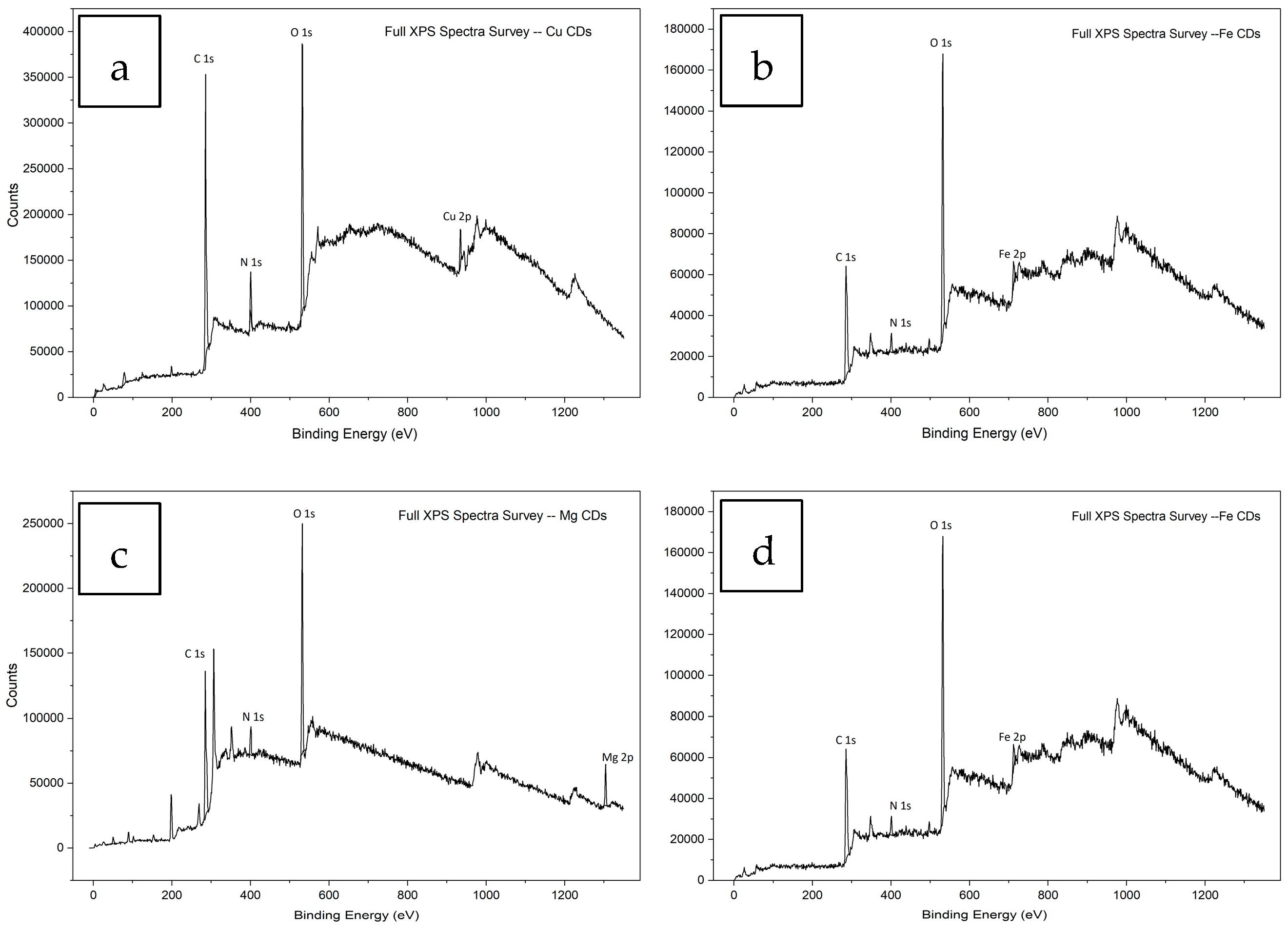
XPS provides critical information regarding the elemental composition and chemical bonding states of the doped CDs. Their survey spectra exhibited the peaks related to C, O, N, and respective dopant metals (Fe, Zn, Cu and Mg) in samples confirming the presence of core constituents and successful doping. Full-range XPS survey spectra (Figure 4) reveal characteristic C 1s, N 1s, and O 1s peaks for all samples, together with metal-specific signals—Cu 2p for Cu-CDs, Fe 2p for Fe-CDs, Mg 2p for Mg-CDs, and Zn 2p for Zn-CDs—confirming successful heteroatom incorporation. Surface atomic percentages derived from these spectra are consistent with bulk loadings obtained from ICP-MS (Table 2), validating the doping process. Minor discrepancies arise from the inherent difference between surface-sensitive (XPS) and bulk (ICP-MS) quantification.
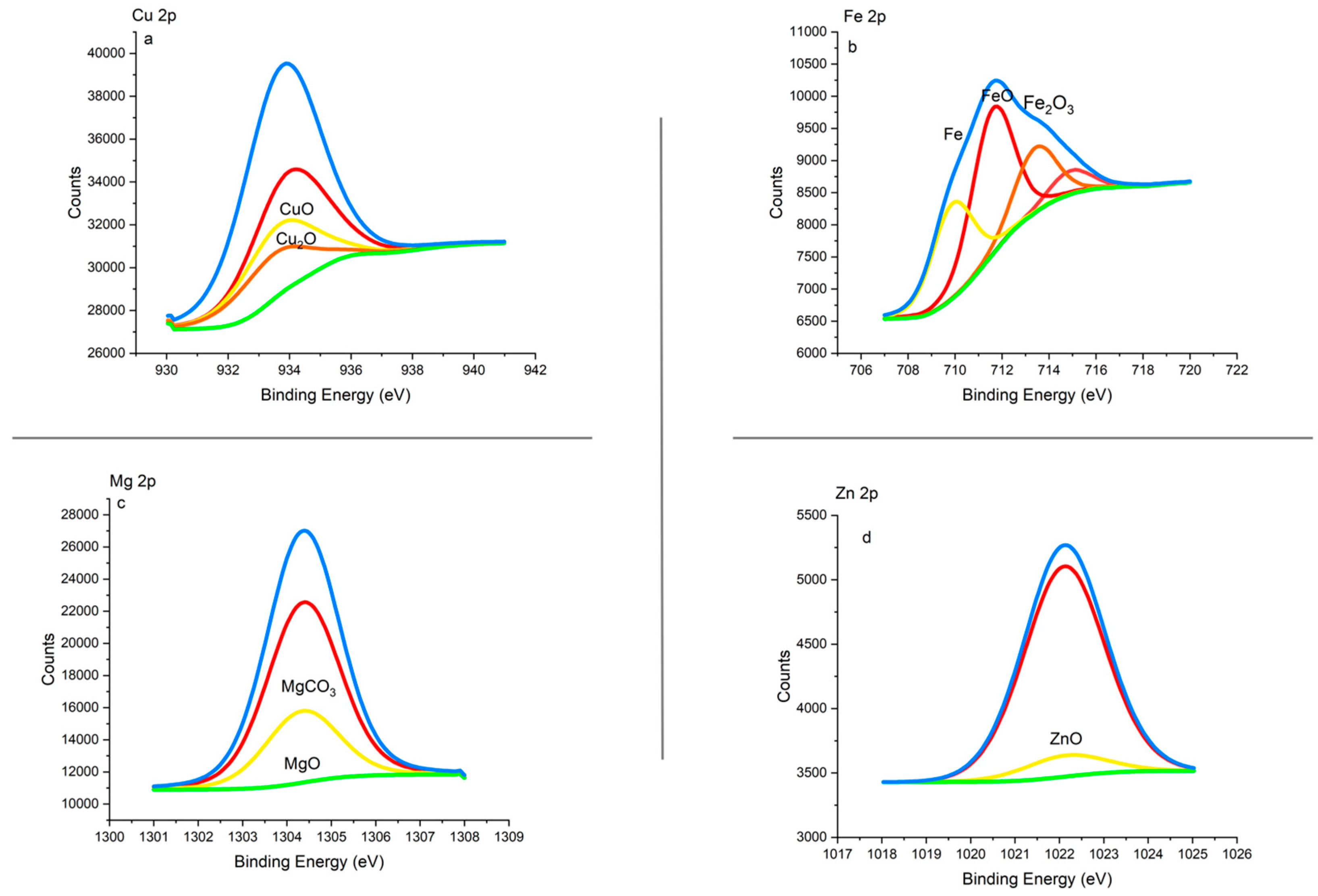
Figure 5 below displays the high-resolution spectra in the Cu 2p, Fe 2p, Mg 1s, and Zn 2p regions for the respective metal-doped CDs. The Cu 2p spectrum revealed two significant peaks at approximately 933.6 eV (Cu 2p3/2) and 953.4 eV (Cu 2p1/2). Deconvolution indicated the presence of both Cu+ (Cu2O, approximately 932.4 eV) and Cu2+ (CuO, around 933.6 eV), implying a mixed-valence copper environment. The lack of pronounced shake-up satellite peaks in the range of 940–945 eV could be attributed to partial surface reduction or shielding effects. The simultaneous presence of Cu+ and Cu2+ is advantageous in catalytic systems, as this redox cycling can significantly boost catalytic activity. Within the Fe 2p region, two prominent peaks were identified at around 710.8 eV and 724.3 eV, which are associated with the Fe 2p3/2 and Fe 2p1/2 spin–orbit components, respectively. The peak observed at 710.8 eV is indicative of Fe3+, whereas a shoulder located around 709.5 eV implies the existence of Fe2+/Fe3+. Moreover, the satellite features observed in the 718–725 eV range provide additional evidence supporting the mixed oxidation states of iron [43]. The full width at half maximum (FWHM) values of these peaks varied from approximately 1.8 to 2.4 eV, aligning with earlier findings regarding oxidised iron species [44]. These redox-active iron sites could play a role in facilitating electron transfer reactions. The high-resolution Mg spectrum displayed a broad peak centred around 1303.8 eV, which was deconvoluted into two distinct components with FWHM values of approximately 1.6 to 2.2 eV, indicating the existence of chemically distinct yet interconnected magnesium species: MgO at approximately 1302.7 eV and MgCO3 at about 1304.2 eV. The presence of MgCO3 indicates surface carbonation, probably resulting from exposure to atmospheric CO2 during sample handling or synthesis [45]. Within the Zn 2p region, the Zn 2p3/2 peak was observed at approximately 1021.5 eV, suggesting the presence of Zn2+. A subtle peak observed at 1020.9 eV could be related to hydroxylated zinc species. The lack of metallic Zn peaks, along with the symmetrical peak shape, indicates that Zn2+ has been effectively integrated into the CD framework as ZnO [46].
The above XPS results collectively demonstrate the successful incorporation of metal doping into the CDs. Their oxidised valence states correspond to varying levels of redox activity and surface functionality, which are closely related to electron transfer, ROS generation ability, and catalytic efficacy during the degradation process.
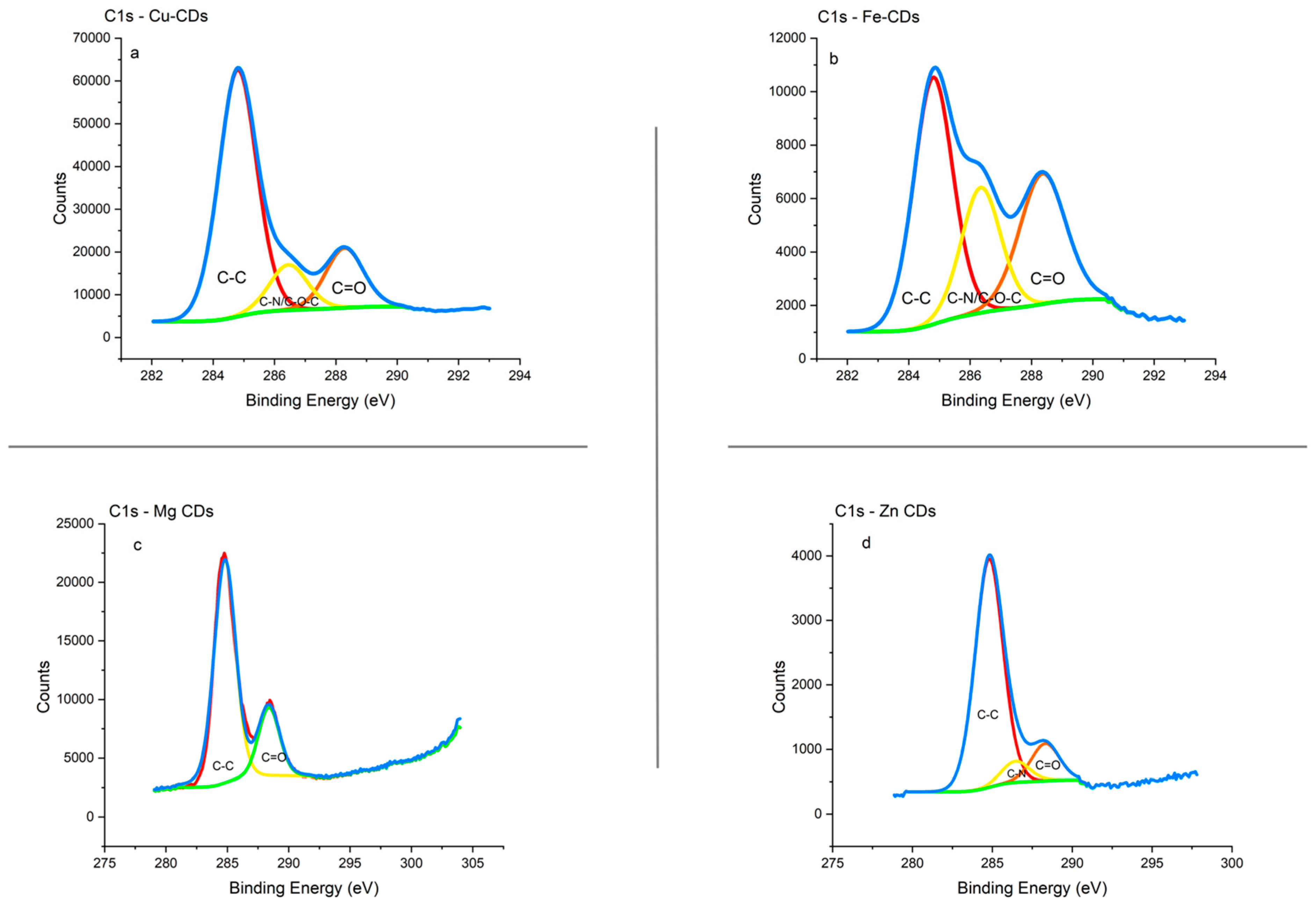
The C 1s XPS spectra of the metal-doped CDs were analysed to identify the surface functional groups (Figure 6). Each sample exhibited two to three distinct peaks that align with typical carbon bonding environments. The prominent peak observed at approximately 284.6 eV was attributed to C–C/C=C bonds, stemming from the sp2-hybridised carbon framework. The second peak observed in the range of approximately 285.8–286.5 eV was associated with C–O or C–N bonds, indicating the presence of oxygen- and nitrogen-containing surface groups. The third peak, located at approximately 288.0–289.0 eV, was associated with carbonyl (C=O) or carboxyl (–COOH) groups formed through surface oxidation. Interestingly, Fe-doped CDs and Cu-doped CDs show more pronounced C–N/C–O signals compared to their Mg- and Zn-doped counterparts. This observation implies that the presence of metal dopants could play a significant role in promoting the incorporation of a heteroatom, such as N, or in stabilising surface oxygen functional groups. The relative intensity of oxygenated carbon species was typically greater in Fe- and Mg-doped CDs, which may enhance their suitability for catalytic or adsorption-related applications by improving surface polarity and increasing the density of active sites. The findings demonstrate that both graphitic and functionalised carbon environments exist in all doped CDs. This suggests that the doping process maintains the integrity of the carbon structure while simultaneously adding surface-active oxygen and nitrogen groups, which are crucial for enhancing reactivity and improving dispersion.
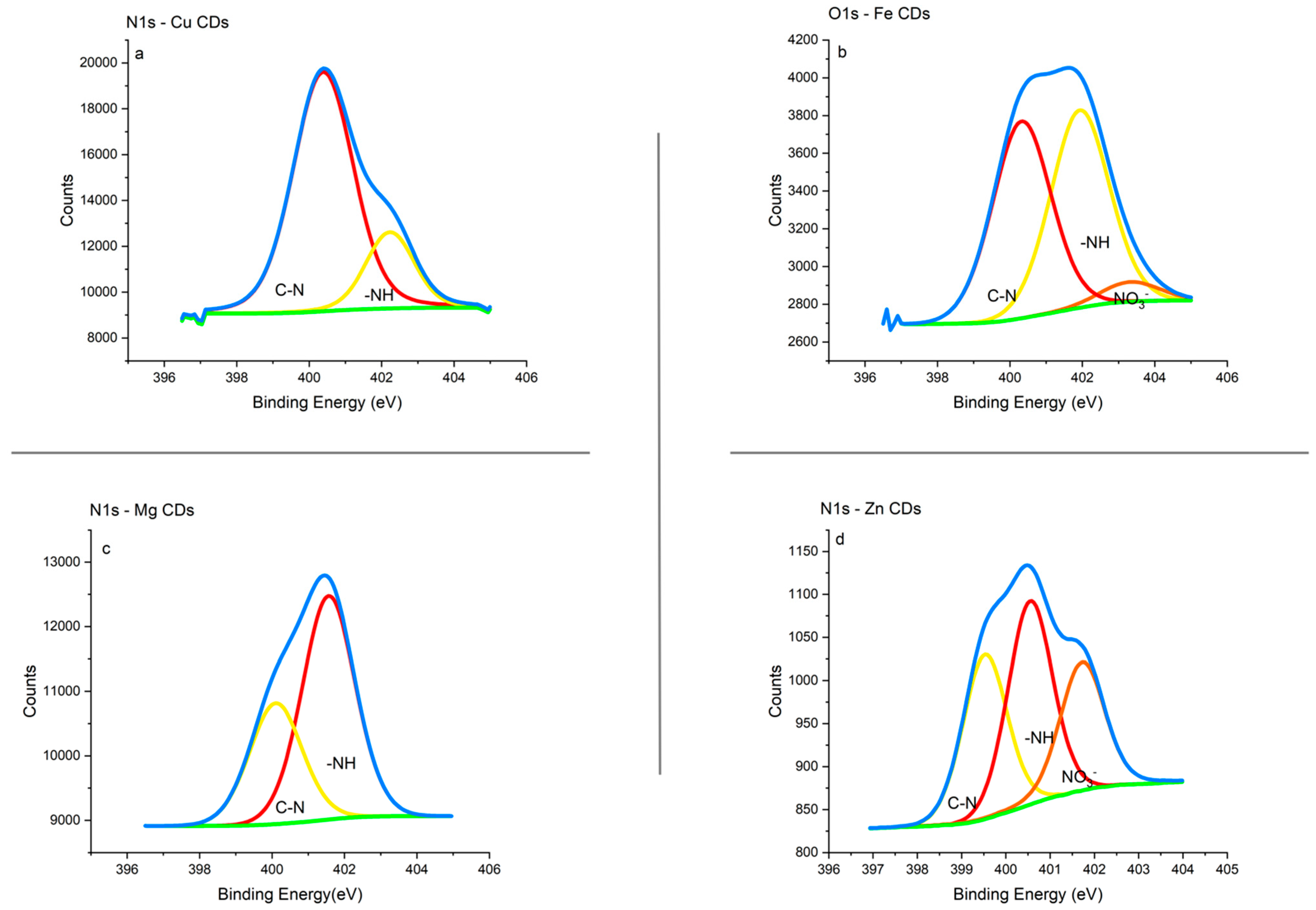
N 1s XPS spectra (Figure 7) were acquired to explore the nitrogen bonding environments present in the metal-doped CDs. All samples displayed nitrogen signals ranging from approximately 398 to 405 eV, confirming the effective incorporation of nitrogen-containing functional groups. The prominent peak observed in the range of approximately 399.5 to 400.3 eV was linked to C–N bonding, related to pyridinic-N, imine-type nitrogen, or amide connections within the carbon structure. The second peak, located around ~401.0–402.0 eV, was associated with –NH or protonated amine species (for instance, –NH2+), suggesting the presence of surface-anchored amino groups or graphitic-N moieties. Furthermore, a less pronounced feature in the range of 403.0 to 405.0 eV was observed in Fe- and Zn-doped CDs, attributed to nitrate-like surface species (NO3), possibly originating from synthesis precursors with citric acid. Among the CDs, Fe- and Zn-doped CDs display more intricate nitrogen profiles, revealing three distinct nitrogen species (C–N, –NH, and NO3). This complexity indicates a chemically diverse surface environment conducive to redox interactions and coordination with metal centres. In contrast, Cu- and Mg-doped CDs predominantly exhibit C–N and –NH bonds. The findings indicate that nitrogen was successfully integrated into the carbon structure and/or surface in various chemical forms. This incorporation may significantly influence electronic properties, boost catalytic activity, or enhance the solubility and dispersion of the doped CDs. Various nitrogen atom types may initiate distinct catalytic pathways. Pyridine nitrogen generally functions as an active site for electron donation, promoting electron transfer to H2O2, while graphitic nitrogen predominantly affects the conductive characteristics of carbon structures. The presence of nitrate-like functional groups in Fe or Zn-doped CDs may stem from residual oxides, which could also play a role in modulating redox processes or affecting the acid-base conditions inside the catalytic environment. The varied structural characteristics may partially elucidate the performance disparities of doped CDs in dye degradation processes. In systems devoid of conventional redox-active metals, N-containing functional groups may serve a compensating function by improving charge transport efficiency or augmenting surface adsorption capacity.
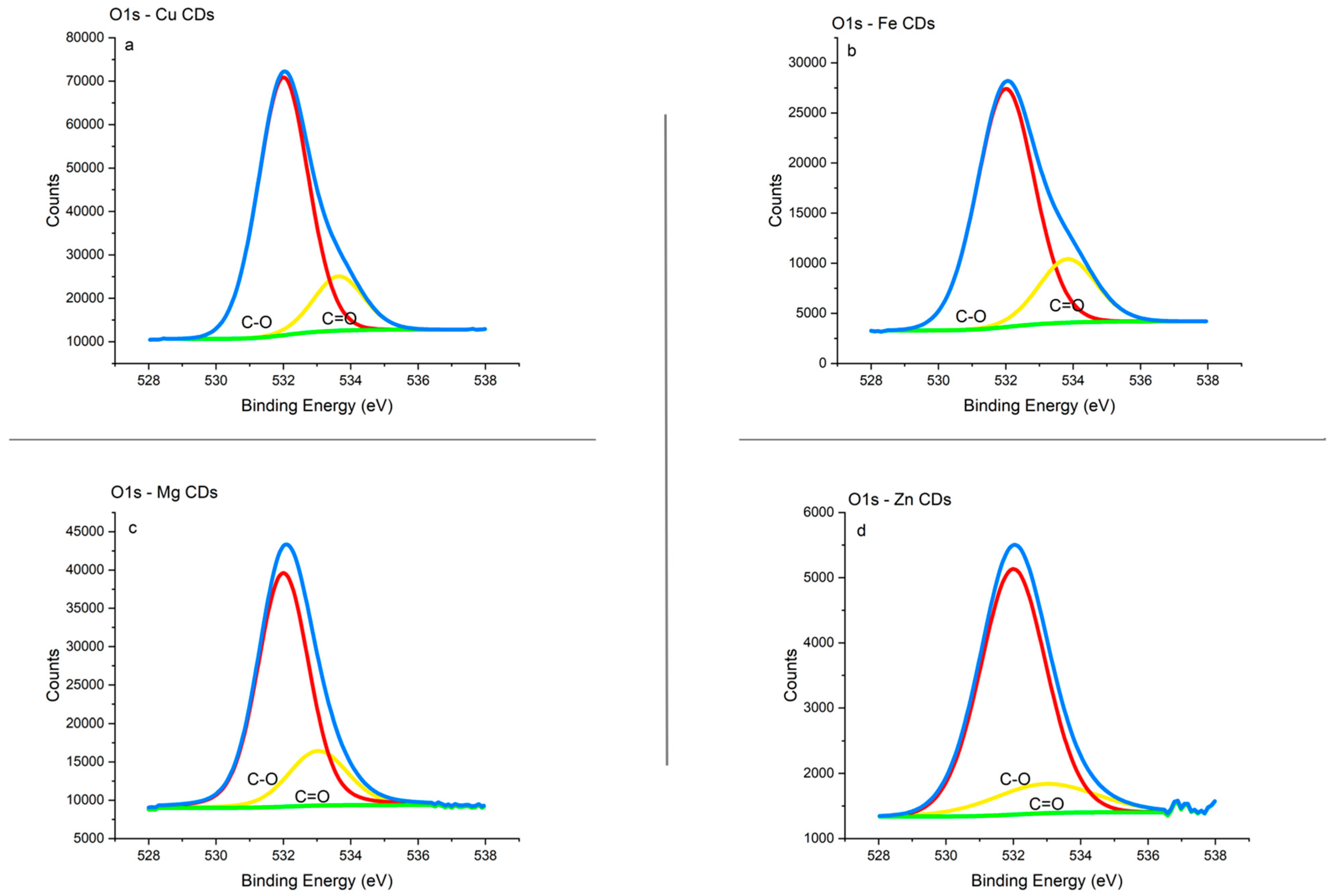
O 1s XPS spectra (Figure 8) were obtained to investigate the oxygen-containing surface functional groups present in the metal-doped CDs. Deconvolution of the spectra reveals two primary components, each representing different chemical environments of oxygen. A peak observed in the range of approximately 531.0–532.5 eV was attributed to C–O bonds, which encompass hydroxyl, ether, and epoxide species. These groups are often located on the edges or basal planes of carbon nanostructures, playing a significant role in enhancing hydrophilicity and ensuring colloidal stability. The second peak, noted in the range of approximately 533.0–534.5 eV, was linked to C=O bonding environments, including carbonyl or carboxyl groups. These species are crucial for coordinating metal ions, facilitating catalytic electron transfer, and enhancing surface reactivity. The interactions between metal and oxygen occur during the synthesis or subsequent treatment processes. The differences in oxygen content could influence the electronic structure, hydrophilicity, and catalytic properties of the corresponding CDs. The O 1s spectra indicate that all metal-doped CDs exhibit a combination of oxidised carbon functionalities, with their relative abundances differing based on the specific metal species used for doping.
To emphasise the catalytic benefits of metal-doped CDs, their XPS spectra were compared with those of nitrogen-doped CDs (N-CDs) produced using similar hydrothermal methods. A recent study described the process of synthesising N-CDs using glucose and m-phenylenediamine in hydrothermal conditions. XPS analysis of the N-CDs revealed various nitrogen functionalities. Notably, pyridinic-N was observed at approximately 398.5 eV, pyrrolic-N around 400.1 eV, and graphitic-N near 401.0 eV [47]. The presence of these species increases surface polarity and enhances electron transfer capabilities, thereby facilitating moderate photocatalytic and sensing behaviours. However, the lack of metal centres restricts their capacity for redox cycling, leading to a relatively lower efficiency in the generation of ROS and subsequent degradation activity. Additionally, a comparison of the C 1s and O 1s XPS spectra provides further insight into the catalytic limitations of N-CDs. The C 1s spectrum of N-CDs generally displays peaks associated with C–C/C=C (~284.6 eV), C–N/C–O (~285.8–286.5 eV), along with minor C=O (~288.0–289.0 eV) bonds [47]. In contrast, metal-doped CDs exhibit a more pronounced relative intensity of C=O and C–O peaks, indicating the increased presence of oxygen-containing surface functional groups. These groups serve as essential anchoring sites for dye molecules and play an active role in catalytic reactions by promoting the generation of ROS. The O 1s spectra exhibit a comparable trend. In N-CDs, the prominent O 1s peaks tend to be relatively weak and broad, reflecting the presence of residual hydroxyl or carboxyl groups. Nonetheless, metal-doped CDs demonstrate enhanced O 1s signals, featuring clearly defined components attributed to C–O (approximately 531.0–532.5 eV) and C=O (around 533.0–534.5 eV) bonds. The presence of these oxygenated species plays a vital role in both electron-donating and -accepting processes, contributing to enhanced catalytic Fenton-like reactions.
Unlike N-CDs, the metal-doped CDs analysed in this study exhibit surfaces that are notably more catalytically active. The existence of mixed-valence states, such as Fe2+/Fe3+ or Cu+/Cu2+, facilitates ongoing redox cycling, a hallmark feature of Fenton-like catalytic systems. This process facilitates the effective breakdown of H2O2 into hydroxyl radicals (•OH). Furthermore, the improved oxygen functionalisation, as evidenced by XPS, promotes adsorption, electron transfer, and the generation of ROS. Although nitrogen-doped CDs demonstrate beneficial optical and electronic characteristics due to the incorporation of nitrogen, their catalytic efficiency was significantly lower compared with metal-doped alternatives [48]. The inclusion of redox-active metals like Fe and Cu creates dynamic electron-transfer pathways that are crucial for the degradation of pollutants. This comparison effectively demonstrates the relationship between structure and activity, highlighting the enhanced catalytic capabilities of metal-doped CDs in AOPs.

3.1.5. Integration of ICP-MS; FTIR and XPS

Retention efficiency calculations, based on ICP–MS data and the theoretical metal content of each precursor, revealed a clear sequence: Mg–CDs (57.7%) > Cu–CDs (49.7%) > Zn–CDs (21.1%) > Fe–CDs (14.4%). This ranking underscores that the effectiveness of dopant incorporation is not solely dictated by the nominal metal fraction in the starting salts, but is strongly influenced by precursor solubility, hydrolytic stability, and coordination strength with the CD surface. Mg2+ achieved the highest efficiency due to complete dissolution and the persistence of Mg–O coordination during purification, whereas Zn2+ showed markedly lower efficiency despite a higher precursor metal fraction, reflecting its susceptibility to hydrolysis and precipitation. Cu2+ maintained a high efficiency through strong multi-dentate chelation to oxygenated and nitrogen-containing sites, while Fe3+ displayed the lowest retention, consistent with partial loss as insoluble hydroxides. These efficiency values provide a normalised basis for comparing dopant incorporation that complements absolute loading data.
All doped CDs displayed FTIR spectra featuring a distinct C=O stretch (~1635 cm−1), while XPS confirmed the existence of carbonyl/carboxyl environments (~288–289 eV in C 1s; ~533.0–534.5 eV in O 1s). The enhanced C=O/–COOH signals were found in Mg- and Fe-doped CDs, suggesting an increase in the density of oxygen-rich coordination sites. Low-frequency FTIR bands validated M–O coordination (Fe–O ~582 cm−1, Cu–O ~592 cm−1, Zn–O ~567 cm−1, Mg–O ~549 cm−1), with Cu–O and Fe–O bands exhibiting greater breadth and intensity, signifying diverse and more robust coordination settings.
This comprehensive analytical framework demonstrates that Cu and Fe facilitate redox-driven degradation through robust, heterogeneous metal–oxygen interactions and redox cycling; Mg enhances adsorption via high loading and strong carboxylate coordination; Zn offers a balance of moderate retention and high surface charge for adsorption-dominated pathways. The integrated application of ICP–MS for dopant measurement, FTIR for functional group analysis, and XPS for assessing oxidation states and bonding environments yields a thorough mechanistic insight into dopant incorporation and its catalytic consequences.

3.1.6. Zeta Potential Measurements

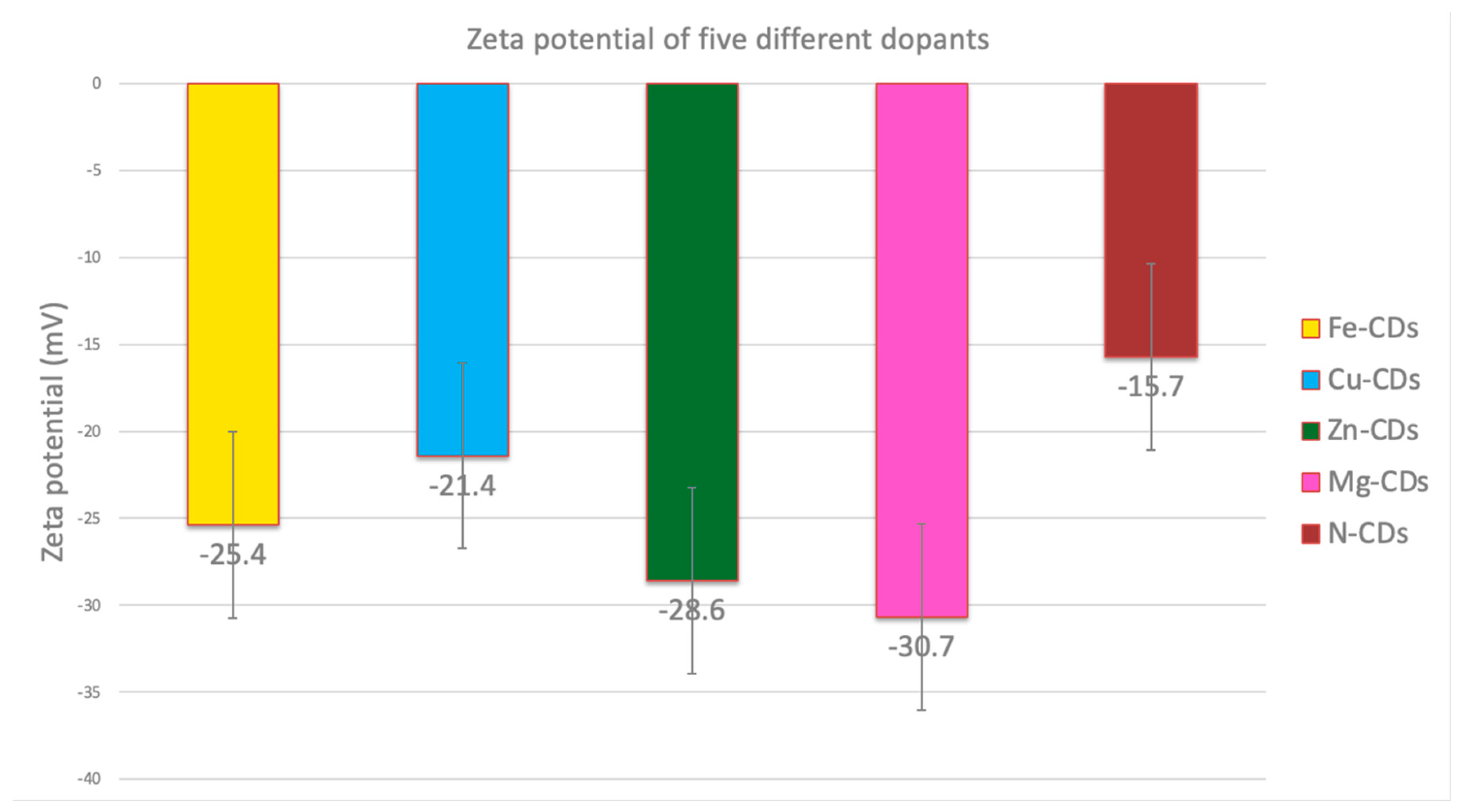
Surface zeta potential measurements further revealed significant differences in the colloidal stability and surface charge behaviours of the synthesised CDs (Figure 9). These variations directly reflect the nature and density of surface functional groups as well as the influence of metal dopants on the overall surface electrostatic environment. The zeta potential values were determined as −30.7 mV for Mg-doped CDs, −28.6 mV for Zn-doped CDs, −25.4 mV for Fe-doped CDs, and −21.4 mV for Cu-doped CDs, while N-doped CDs exhibited a less negative value of −15.7 mV.
Under neutral pH, these measurements indicate that all CDs have negatively charged surfaces, which was predominantly attributable to the abundance of oxygen-containing (e.g., –COOH, –OH) and nitrogen-containing groups (e.g., –NH2, graphitic N) introduced during synthesis. Mg- and Zn-doped CDs exhibit more negative zeta potential values, suggesting greater electrostatic repulsion and improved colloidal stability. Although no direct dispersion tests were conducted, zeta potential values more negative than −25 mV are generally associated with good colloidal stability under aqueous conditions. This was consistent with the observation that non-redox-active metals, such as Mg and Zn, tend to stabilise surface hydroxyl (OH) and carbonyl (COO) moieties without undergoing valence cycling. As a result, they maintain a high surface charge density and facilitate enhanced adsorption through electrostatic interactions [47]. The less negative zeta potentials observed in Cu- and Fe-doped CDs may be explained by the coordination of metal ions with surface oxygen/nitrogen donors, which partially neutralises or shields the surface charge. It has been shown that Fe3+ and Cu2+ are involved in redox transitions (Fe3+ ↔ Fe2+, Cu2+ ↔ Cu+), which may cause dynamic electron transport and change the surface polarity and contribute to the less negative surface charge [49,50]. The inclusion of neutral or weakly polar nitrogen species (such as graphitic N or pyrrolic N) does not significantly affect surface ionisation; thus, N-doped CDs were found to have the least negative zeta potential (−15.7 mV). This relatively low surface charge may compromise catalytic performance in aqueous environments due to reduced dispersion stability and weaker electrostatic attraction toward cationic dye molecules.

3.2. Catalytic Degradation Performance of Metal-Doped CDs

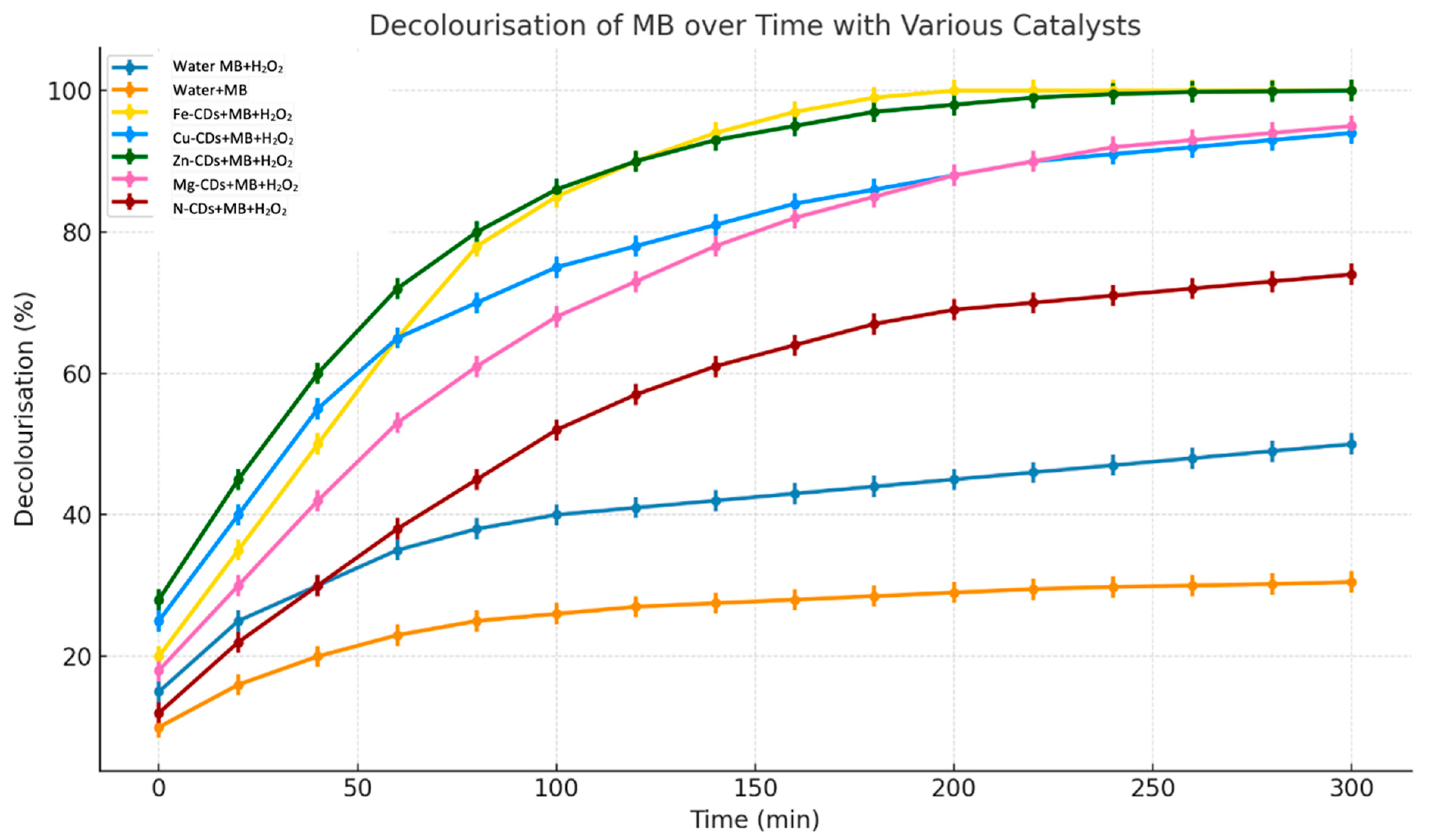
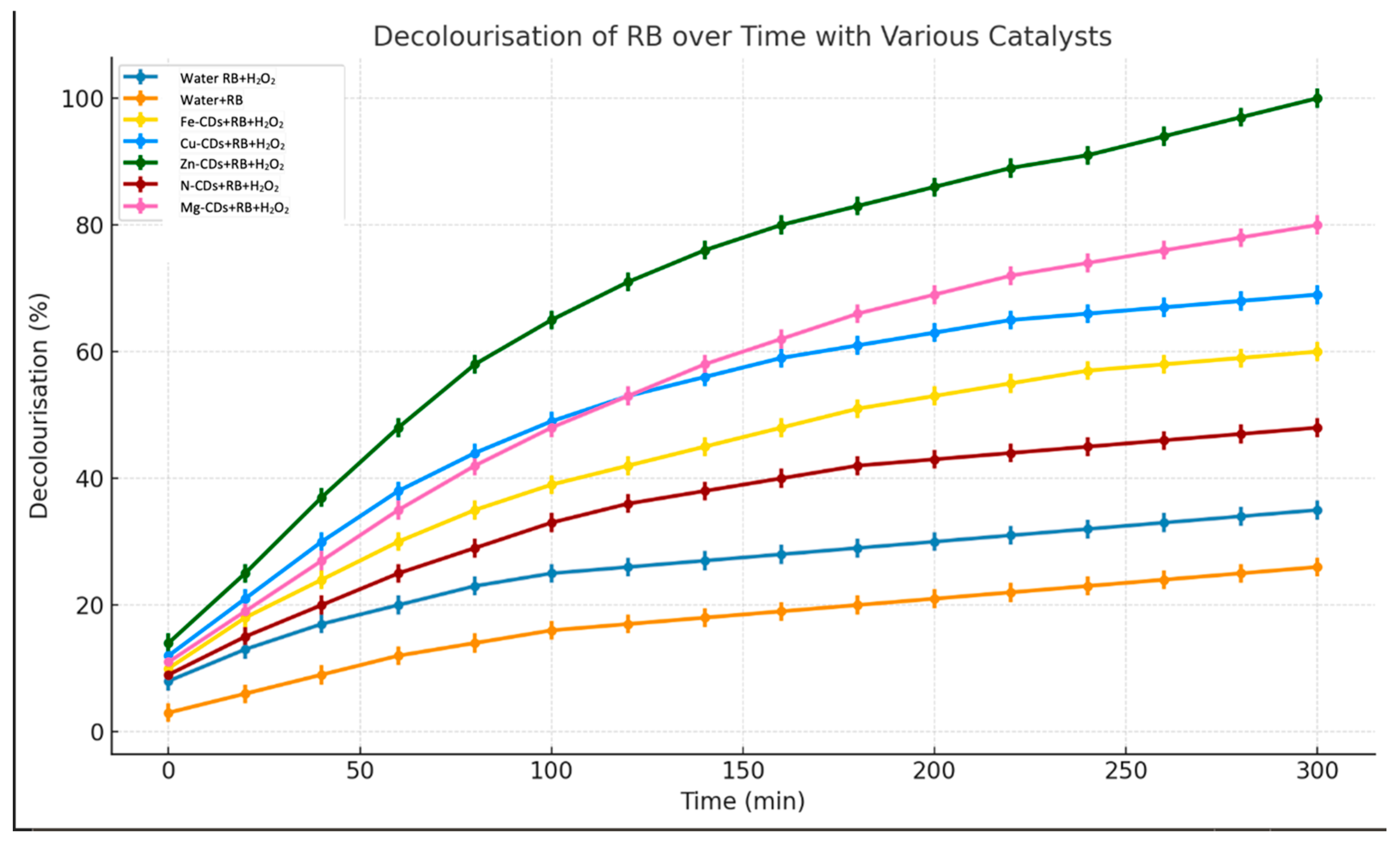
To evaluate the catalytic performance of the synthesised metal-doped CDs, decolourisation experiments were conducted using cationic dyes. Unlike photo-Fenton systems, where ROS production may be enhanced via photogenerated carriers, our study focuses exclusively on dark condition Fenton-like reactions to probe the intrinsic catalytic contributions of metal doping. Figure 9 and Figure 10 show the decolourisation of MB and RB, respectively. The decolourisation experiment was based on the Fenton/Fenton-like reaction theory and was carried out with the participation of H2O2. To assess the catalytic efficiency of metal-doped CDs in the degradation of organic dyes, three distinct control experiments were conducted [51]. Initially, a dye-only system (MB or RB + water) was implemented to assess the degree of natural photolysis or hydrolytic degradation under the experimental conditions, thereby providing a baseline for comparison. The intrinsic oxidative potential of H2O2 was determined using a non-catalytic oxidative system consisting of dye, H2O2, and water. This configuration made it possible to quantify the enhancement attributed to the catalyst-mediated activation of H2O2. A metal-free CD system doped with nitrogen (dye + H2O2 + N-CDs) was also used to separate the impact of the carbon framework and surface functionalities on enhancing Fenton-like activity from the influence of metal doping. The inclusion of these three controls offers a comprehensive benchmark for identifying the individual contributions of spontaneous degradation, direct H2O2 oxidation, and non-metal catalytic mechanisms. This enables an accurate assessment of the synergistic role of metal doping in improving catalytic performance [52].
Figure 10 shows the decolourisation curves of MB over a period of 300 min. In the absence of any catalysts, MB is subjected to natural photolysis or hydrolytic degradation under the experimental conditions, leading to 31% decolourisation. Significant enhancement in MB degradation efficiency was observed (from 31% to 45%) when H2O2 was added, confirming its importance in the reaction. Metal-free nitrogen-doped CDs attained 74% MB degradation within 300 min, under equivalent environmental conditions. Among metal-doped CDs, Fe-doped CDs exhibited the highest activity against MB, achieving complete decolourisation within 120 min. Zn-doped CDs followed, with 99% decolourisation of MB after 240 min; Cu-doped CDs exhibited 98% degradation of MB after the same period. At 300 min, all metal-doped CDs achieved over 99% decolourisation of MB. This outcome provides substantial support for the hypothesis that the introduction of heteroatoms into CDs, especially metal atoms, enhances their catalytic efficacy.
Figure 11 examines the decolourisation of RB over time. In contrast to Figure 9, only Zn-doped CDs achieved 100% decolourisation of RB within 300 min, followed by Mg-doped CDs (86.4%). Cu- and Fe-doped CDs showed 76.4% and 60.3% decolourisation after 300 min, respectively. Metal-free N-doped CDs only achieved 50.3% decolourisation. The experiment confirms the influence of various heteroatom doping on the catalytic performance of CDs. Therefore, the introduction of various metal dopants, such as Fe, Cu, Zn and Mg, not only changed the electronic structure and surface chemistry of CDs but also facilitated the degradation of dyes significantly by tuning the electron transfer process and the adsorption process of the reactants [53].
In this reaction, H2O2 serves as an oxidising agent, and the ROS generated upon its decomposition acts as catalytic accelerators in the reaction with dye molecules [54]. Introducing metal-doped CDs to the catalytic system can significantly improve dye degradation efficiency. From an electronic structure perspective, doping with different metal ions rearranges the local electron cloud distribution in the CDs. Such restructuring not only creates new energy levels in the energy band structure but also minimises the likelihood of electron-hole complex formation, improving the efficiency of separation of photogenerated charge carriers [55]. The incorporation of heteroatoms facilitates the emergence of numerous functional groups (e.g., –OH, –NH, C=O, C–N, C–O) on the surfaces of the CDs. These groups not only function as active sites but also significantly augment the electrostatic attraction between reactants and catalysts by generating localised electric fields [56]. Such adsorption processes can effectively concentrate the reactants and lower the activation energy of the reactions, enhancing the overall catalytic activity. Moreover, the incorporation of heteroatoms modulates the spatial charge density and its distribution over the surface of the CDs and thus the electron transfer rate between the reactants [57]. In terms of the catalytic mechanism, heteroatom-doped CDs can have several parallel reaction pathways for dye decolourisation, such as direct electron transfer, adsorption activation, and radical-mediated oxidation processes. Synergistic activity via concurrent pathways not only improved the overall reaction efficiency but also provided broad versatility across a range of organic pollutants. Future optimisation of catalyst design by adjusting experimental conditions, including doping ratio, reaction temperature, and pH conditions is anticipated to further improve the performance of metal-doped CDs in industrial wastewater treatment.

3.3. Structure-Function Correlation in Metal-Doped CDs for Dye Degradation

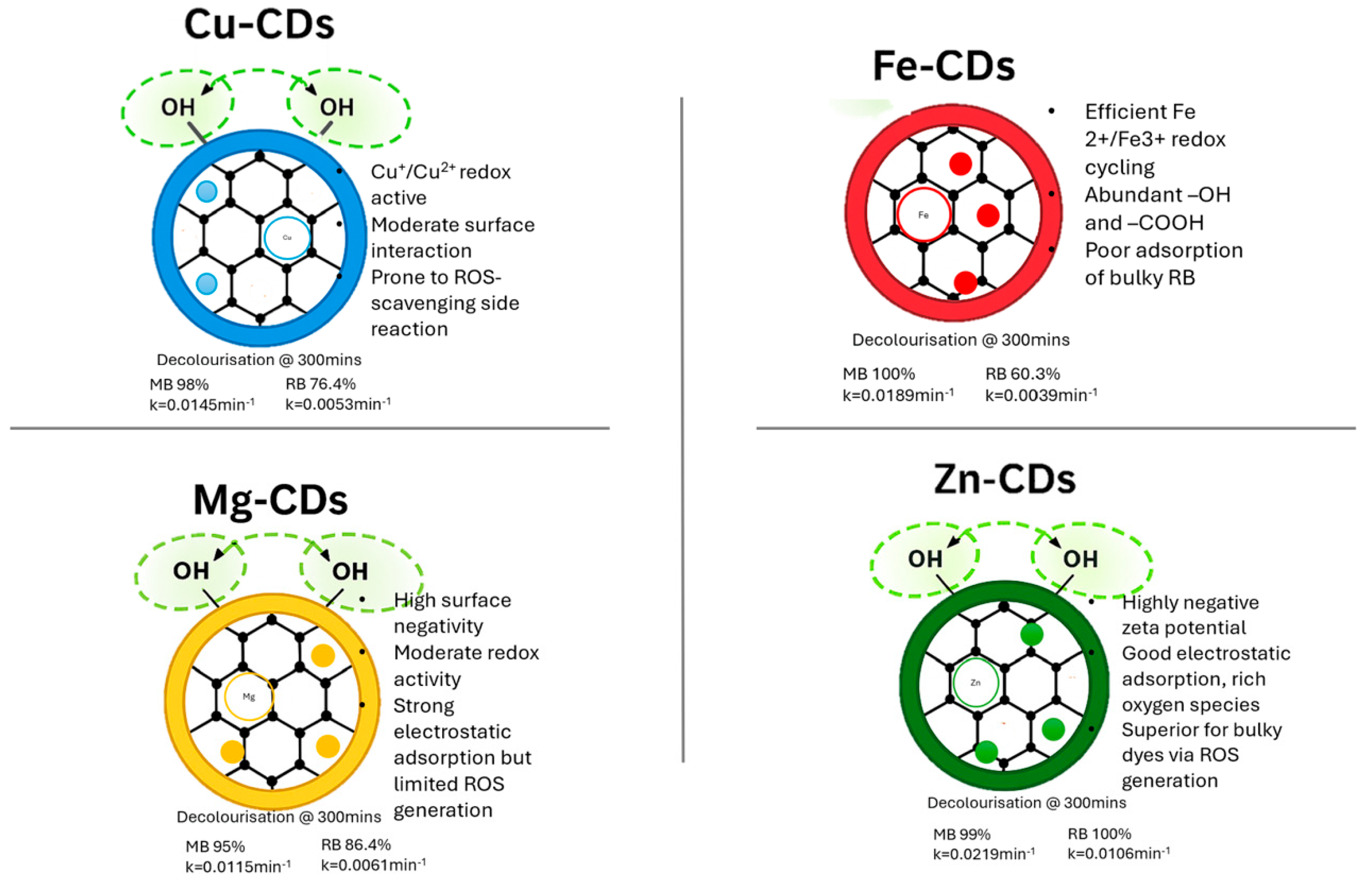
The effectiveness of metal-doped CDs in the degradation of dyes is significantly affected by various factors, including particle size, the presence of surface functional groups, and the nature of electrostatic interactions (Figure 12).
The neutral pH operation highlights the practical advantage over homogeneous Fenton systems, as metal doping mitigates pH sensitivity. Among the samples tested, Zn-doped CDs exhibited the most effective performance in the decolourisation of RB. This can be attributed to their exceptionally small particle size (~10.2 nm) and a highly negative zeta potential (−28.6 mV), which collectively improved dye adsorption and promoted the generation of ROS through Fenton/Fenton-like pathways. In comparison, Fe-doped CDs, which exhibit a marginally larger particle size of approximately 14.8 nm, achieved the highest rate of MB degradation (k = 0.0189 min−1). This enhanced performance can be attributed to the presence of hydroxyl groups and the effective redox cycling between Fe2+ and Fe3+. These ratios states out in Section 3.1.4 directly correlate with redox efficiency, with higher Fe2+ content accelerating •OH production. (Table 3). The contrasting optimality of Fe-CDs for MB and Zn-CDs for RB can be rationalised by the interplay between dopant-dependent surface charge and dye molecular structure. MB is a smaller planar thiazine cation with high redox reactivity, which favours Fe-mediated •OH production through Fe2+/Fe3+ cycling. In contrast, RB possesses a bulkier xanthene skeleton and multiple carboxyl substituents; its adsorption and subsequent oxidation are enhanced on the highly negative surface of Zn-CDs (−28.6 mV) via electrostatic attraction and surface-mediated •O2 generation. These dye-specific affinities explain the observed selectivity even without separate qₑ determination. The proposed ROS pathways are inferred from the observed redox states of dopants and surface functional groups, consistent with well-established Fenton and Fenton-like mechanisms reported in the literature. Direct radical detection (EPR or scavenger tests) will be undertaken in future work to further validate these mechanistic assignments.
FTIR and XPS analysis confirmed surface functionalities and mixed valence states, which were instrumental in facilitating both ROS production and charge transfer [60]. In addition, zeta potential measurements provided insights into the stability of the CDs and their adsorption tendency towards cationic dyes. The optimal catalytic performance is influenced not just by redox activity but also by the physical morphology and surface electrostatics of the materials involved [61]. In the following sections, we will explore the specific roles of various metal dopants (Fe, Cu, Zn, and Mg) in influencing catalytic behaviour and clarify their mechanisms in dye degradation processes. The proposed ROS pathways are inferred from dopant-dependent redox behaviour and surface functionality correlations established in the literature; direct radical detection (EPR or scavenger tests) will be addressed in future work.

3.3.1. Catalytic Performance of Fe-Doped CDs

Among all synthesised CD catalysts, Fe-doped CDs exhibited the greatest catalytic performance for the decolourisation of MB, achieving complete decolourisation within 180 min. The corresponding pseudo-first-order rate constant (k) was 0.0189 min−1 (Table 3). This enhanced activity can be attributed to a combination of their physicochemical properties, as revealed by characterisation studies. TEM analysis indicated that Fe-doped CDs possessed an average particle size of approximately 14.8 nm. This moderate particle size ensured a balance between high surface area (promoting sufficient adsorption of MB molecules) and colloidal stability (preventing aggregation that would otherwise reduce available catalytic sites). FTIR spectra revealed the presence of abundant surface hydroxyl and carbonyl groups, which not only enhanced the hydrophilicity of the catalyst but also served as electron-donating sites for H2O2 activation [62]. These functional groups, in synergy with Fe dopant, facilitated the efficient generation of •OH [63]. XPS analysis confirmed the coexistence of Fe2+ and Fe3+ states, with an Fe2+/Fe3+ ratio of ~1.2. This mixed valence condition enabled continuous redox cycling, critical for sustaining prolonged ROS generation during the reaction [63,64]. The zeta potential of −25.4 mV promoted strong electrostatic adsorption of positively charged MB molecules, leading to localised dye enrichment near the catalyst surface and increasing the likelihood of oxidative degradation.
The combined benefits of appropriate particle size, the presence of surface oxygen-containing functional groups, robust redox cycling capability (Fe2+/Fe3+), and advantageous electrostatic interactions have offered Fe-doped CDs high catalytic efficiency, making them the most effective catalyst in the series tested for the degradation of MB. The Fe2+/Fe3+ redox pair is crucial in Fenton-like processes, as it facilitates the ongoing transformation of H2O2 into reactive •OH. This mechanism is essential for maintaining a high flux of ROS during the reaction [48]. The catalytic efficacy of Fe-doped CDs in the decolourisation of RB was less effective. The decrease in efficiency can be mainly linked the molecular structure of RB, which is a xanthene dye with a more intricate and larger structure, characterised by steric hindrance and various resonance forms. These features may hinder its effective adsorption onto the catalyst surface. While Fe-doped CDs exhibit a particle size of approximately 14.8 nm and an adequate surface area, their electrostatic interaction with RB may be less robust than that of smaller or more negatively charged catalysts, like Zn-doped CDs. Further, the decolourisation of RB requires not only •OH radicals but also efficient interaction between the dye and the catalyst. Limited adsorption of RB onto Fe-doped CDs due to surface chemistry factors, such as a lower zeta potential or steric repulsion reduces the concentration of dye molecules in proximity to ROS-active sites, leading to a reduced degradation rate. Moreover, Fe-based Fenton reactions are sensitive to pH, with their most effective performance generally observed in mildly acidic environments (pH 3–5). Conversely, catalytic experiments conducted in neutral pH settings—commonly employed to simulate actual wastewater—can result in the swift deactivation of Fe3+ because of hydroxide precipitation (for instance, the formation of Fe(OH)3), which in turn diminishes the efficiency of ROS generation [65]. Further, Fe-doped CDs may experience self-quenching or engage in competitive side reactions when interacting with larger organic dyes such as RB, leading to a reduction in the ROS production. In summary, while Fe-doped CDs demonstrate enhanced activity for simpler aromatic dyes such as MB, their catalytic performance against RB is lower, possibly due to limitations in adsorption, structural incompatibility, and sensitivity to reaction conditions. The presence of hydroxyl-rich surfaces in Fe-CDs is confirmed by the significant O-H stretching observed at approximately 3290 cm−1 in FTIR, as well as the C–O/C=O peaks identified at around 531–534 eV in O 1s XPS. These features enhance the adsorption and activation of H2O2 through electron donation from –OH and –COOH groups, thereby facilitating the generation of hydroxyl radicals (•OH) via Fe2+/Fe3+ redox cycling.

3.3.2. Catalytic Performance of Zn-Doped CDs

Zn-doped CDs exhibited good catalytic activity, particularly for RB, achieving 100% decolourisation within 300 min. The pseudo-first-order rate constant (k) for RB decolourisation catalysed by Zn-doped CDs was 0.0106 min−1 (Table 3), greater than other CD variants. This catalytic performance can be related to the structural and electronic properties of Zn-doped CDs. TEM analysis revealed that Zn-doped CDs possessed the smallest average particle size (~10.2 nm) among all synthesised samples. The reduced particle size resulted in an increased specific surface area [66]. The high surface area promoted contact between RB molecules and the catalyst, improving adsorption efficiency and subsequent ROS-mediated degradation kinetics. FTIR spectra indicated the presence of abundant surface hydroxyl and carbonyl groups, crucial for the surface-mediated activation of H2O2. Unlike Fe-doped CDs, which primarily relied on redox cycling between Fe2+ and Fe3+, Zn-doped CDs facilitated H2O2 decomposition predominantly through oxygenated surface defects and oxygen-rich functional groups. These sites served as electron transfer hubs, accelerating the conversion form H2O2 to •OH and superoxide radicals •O2 [67]. XPS analysis confirmed that Zn2+ species were integrated into the carbon framework in a single valence state. Although Zn2+ does not participate in classical Fenton-like redox cycling, it induces significant changes in the local electronic structure of CDs [17]. The incorporation of Zn2+ created localised electron-rich domains, which favoured rapid electron donation to H2O2 molecules, enhancing ROS generation. Additionally, the strong electron-withdrawing effect of Zn2+ stabilised surface-bound ROS intermediates, prolonging their lifetime and reactivity [68]. Zeta potential measurements revealed a highly negative surface charge for Zn-doped CDs (−28.6 mV), facilitating strong electrostatic attraction toward positively charged RB molecules. This pre-concentration of dye molecules at the catalyst surface effectively increased the local concentration, increasing the degradation rate.
Further, Zn exhibits a moderate level of redox activity. When incorporated into CDs, it significantly improves their ability to donate and accept electrons. This enhancement facilitates the production of ROS, including hydroxyl radicals and superoxide anions (•O2), during catalytic reactions [69,70]. Zn doping alters the electronic band structure of CDs, resulting in a narrowed bandgap and promoting the generation of photoinduced electron-hole pairs. The carriers generated by light can interact with water or oxygen, leading to the formation of ROS, which subsequently play a role in the breakdown of RB molecules. The introduction of Zn doping also leads to the formation of surface coordination bonds, including Zn–O and Zn–N. These bonds create numerous active sites that enhance dye adsorption and promote electron transfer, thereby helping to reduce charge recombination [71]. The ultra-small particle size, negative surface charges, and the presence of oxygen-rich functional groups of Zn-doped CDs work together to enhance the catalytic performance in the decolourisation of RB. However, Zn-doped CDs may present specific challenges in the catalytic degradation of MB, especially in comparison to Fe-based systems. In contrast to Fe2+/Fe3+ pairs that engage directly in redox cycling with H2O2 during classical Fenton reactions, Zn2+ remains redox-inactive under ambient conditions and does not facilitate the decomposition of H2O2 through direct electron transfer [67]. Instead, its function is primarily indirect—regulating surface charge, aiding in adsorption, and improving electron mobility. Consequently, the overall yield of ROS may be diminished or more influenced by secondary processes like the separation of photogenerated charges. In neutral or alkaline pH environments, Zn2+ have the potential to undergo hydrolysis or to form Zn (OH)2 species on surfaces. This may lead to the passivation of active sites or a decrease in the accessibility to ROS.
Consequently, while the incorporation of Zn enhances the catalytic performance of CDs by modifying their structure and electronic properties, the absence of inherent redox cycling and the strong dependence on adsorption-limited mechanisms could account for the lower catalytic efficiency for Zn-doped CDs compared to redox-active Fe-doped counterparts across all scenarios. Fe-CDs rely on efficient redox cycling to enable pathways dominated by •OH, while Zn-CDs use their abundant oxygenated sites (such C=O at about 1635 cm−1 in FTIR and O 1s XPS peaks) to boost dye adsorption and encourage surface-mediated superoxide (•O2) production. This distinction elucidates their enhanced performance with sterically hindered RB compared to planar MB.

3.3.3. Catalytic Performance of Cu-Doped CDs

Cu-doped CDs exhibited good catalytic activity in terms of the degradation of both MB and RB, though their efficiency was lower than Fe- and Zn-doped CDs. For MB decolourisation, Cu-doped CDs achieved 98% decolourisation within 300 min, with a corresponding pseudo-first-order rate constant (k) of 0.0145 min−1. For RB degradation, Cu-doped CDs achieved approximately 76.4% decolourisation over the same period with a k value of 0.0053 min−1 (Table 3). The catalytic performance of Cu-doped CDs can be interpreted based on their structural and surface chemical properties. TEM analysis indicated an average particle size of ~15.2 nm, slightly larger than that of Zn- and Fe-doped CDs. The increased size likely reduced the specific surface area and the density of accessible catalytic active sites, thereby marginally limiting dye adsorption and interaction with ROS. FTIR spectra showed the presence of abundant hydroxyl and carbonyl groups, crucial for H2O2 activation. However, compared to Fe-doped CDs, the overall intensity of oxygenated functional groups was lower, possibly explaining the relatively slower ROS generation rate. XPS analysis confirmed the presence of both Cu+ and Cu2+ species. The coexistence of Cu+/Cu2+ redox pairs facilitated the conversion of H2O2 to •OH, analogous to Fe2+/Fe3+ cycling in Fenton systems [72]. However, Cu-based systems are known to be prone to parasitic side reactions that consume ROS, leading to a partial loss of catalytic efficiency. Also, Cu-doped CDs had a Cu+/Cu2+ ratio of 0.9, lower than the Fe2+/Fe3+ ratio (1.2) in Fe-doped CDs [18]. In Fenton-type systems, more reduced-state metal ions (such Fe2+ or Cu+) speed up catalytic turnover by interacting with H2O2 to generate ROS consistently. Thus, a lack of Cu+ may lower the degradation rates. Also, the redox window between Cu+ and Cu2+ is narrower than that between Fe2+ and Fe3+, reducing the efficiency of redox cycling and increasing electron trapping, thereby reducing catalytic activity. The zeta potential of Cu-doped CDs was −21.4 mV, smaller than that of Zn- and Fe-doped CDs. The less negatively charged surface weakens the electrostatic interaction between cationic dye molecules, particularly RB, and the catalysts, impacting the overall degradation kinetics [73].
In conclusion, Cu-doped CDs showed good catalytic performance driven by the Cu+/Cu2+ redox system and oxygen-containing surface groups. Nevertheless, their relatively larger particle size and weaker surface charge limited their efficiency compared to Fe- and Zn-doped counterparts.

3.3.4. Catalytic Performance of Mg-Doped CDs

Mg-doped CDs exhibited moderate catalytic performance for dye degradation, with decolourisation of MB and RB of 95% and 86.4% within 300 min, respectively. The corresponding pseudo-first-order rate constant (k) for MB decolourisation was 0.0115 min−1, the lowest among all the doped CDs evaluated (Table 3).
This comparatively lower catalytic performance can be explained by their structural and surface characteristics. TEM analysis showed that Mg-doped CDs had an average particle size of approximately 11.3 nm, smaller than that of Fe- and Cu-doped CDs but slightly larger than that of Zn-doped CDs. Although the relatively small size provided a higher surface area and theoretically should enhance adsorption, catalytic reactivity depends not only on surface area but also critically on the redox activation capability. FTIR spectra confirmed the presence of moderate amounts of surface hydroxyl and carbonyl groups on Mg-doped CDs. These functional groups assisted the adsorption of dye molecules and provided initial sites for H2O2 activation; however, the density and reactivity of these groups were insufficient to sustain high ROS generation rates compared to Fe- or Zn-doped CDs. XPS analysis indicated that Mg existed predominantly as Mg2+ species within the carbon matrix. Unlike Fe2+/Fe3+ or Cu+/Cu2+ systems, Mg2+ lacks redox cycling ability under the reaction conditions, which significantly limited the decomposition of H2O2. The absence of an efficient redox limited the ability of Mg-doped CDs to continuously regenerate active sites for ROS production [74], thus constraining their catalytic efficiency. Despite these limitations, Mg-doped CDs exhibited the most negative zeta potential (−30.7 mV) among all the samples, which enhanced the electrostatic attraction of cationic dyes such as MB and RB [74]. This strong adsorption capacity partially compensated for the lower ROS generation, enabling relatively high dye removal efficiencies, albeit at slower degradation rates. In conclusion, Mg-doped CDs achieved moderate catalytic activity primarily due to their excellent dye adsorption capacity derived from strong surface negativity [72]. However, the lack of redox-active metal centres significantly limited their ROS generation capability, resulting in comparatively slower dye degradation kinetics compared to Fe- and Zn-doped CDs.
In summary, the kinetic findings support a structure–function model where the presence of redox-active dopants (such as Fe and Cu), along with high surface charge (like in Zn- and Mg-doped CDs), and surfaces rich in functional groups, work together to improve catalytic activity. Notably, Zn-doped CDs demonstrate the most balanced and effective performance in both dye systems.

3.4. Future Investigations and Catalyst Stability

This work is mostly about evaluating the catalytic performance of different metal-doped CDs under the same conditions. While metal-doped CDs demonstrated excellent catalytic efficiency under Fenton-like conditions, the environmental sustainability of such nanomaterials must also consider the potential leaching of metal ions into treated effluents. This concern is particularly relevant for transition metals like Fe and Cu, which may dissociate from the CD matrix under certain pH or oxidative conditions, potentially leading to secondary contamination. Although leaching behaviour was not quantitatively assessed in this study, the structural features observed in FTIR and XPS—such as the presence of stable M–O coordination bonds and nitrogen-based anchoring sites—suggest reasonable stability of the doped species during reaction cycles. Some metal-doped CDs have been shown in past experiments to keep their high catalytic activity even after being used many times. For example, Wang et al. (2023) [49] found that Fe-CDs had a catalytic effectiveness of 96.5% in the first round of MB degradation tests, but this dropped to 83.7% in the third round, a drop of almost 13%. XPS and FTIR tests showed that the surface functional groups and Fe oxidation states stayed basically the same [49].
Further studies have shown that the cycle stability of catalysts is influenced by various factors, including the surface structure of the catalyst, the metal binding mode (embedded or coordinated), the density of functional groups on the carbon surface, the pH value of the solution, and the concentration of the reactants. For instance, Lin et al. (2023) [7] looked at Zn-CDs and discovered that the degrading efficiency dropped by around 18% over five cycles. However, changing the reaction pH to slightly neutral effectively slowed down the reduction in activity [75]. Although leaching was not re-quantified during reaction, the stable M–O coordination observed in FTIR and XPS and the dialysis purification step indicate minimal release of metal ions, consistent with literature reports (<5% under analogous Fenton-like conditions).
Compared with traditional heterogeneous Fenton catalysts such as iron oxides, MOFs, or biochar-based materials, metal-doped CDs offer advantages in terms of dispersibility, ease of synthesis, and surface tunability, while avoiding sludge formation and pH sensitivity. Table 3 provides a comparative summary of degradation kinetics, reusability, and cost-effectiveness for advanced Fenton-like catalysts aimed at MB and RB, thereby enhancing contextual understanding of their catalytic performance. Fe-doped and Zn-doped CDs developed in this study exhibit competitive rate constants and high removal efficiency under mild conditions (neutral pH, moderate temperature), while also presenting benefits in scalability and environmental compatibility. In comparison to MOF- or metal oxide-based systems, CDs are distinguished as cost-effective and stable platforms for wastewater treatment. Because the present work focused on comparative mechanistic evaluation under single-cycle conditions in small reaction volumes, multi-cycle reuse tests were not conducted. However, the strong M–O coordination and consistent FTIR/XPS profiles indicate good structural robustness, consistent with previous reports showing <20% activity loss after multiple cycles. Reusability will be examined in future studies

4. Conclusions

Metal-doped and nitrogen-doped CDs were prepared using citric acid as the carbon precursor via a one-step hydrothermal method. Magnesium (Mg), zinc (Zn), copper (Cu), and iron (Fe) are metal dopants that used in this experiment. Due to the presence of surface hydroxyl (–OH), carboxyl (–COOH), and amine (–NH2) groups, all metal-doped CDs were negatively charged and showed consistent spherical morphology with diameters between 10.2 and 15.2 nm. These surface characteristics endowed the CDs with excellent water dispersibility, high electron transfer efficiency, and strong dye adsorption capacity.
The catalytic performance of the CDs in Fenton-like decolourisation of two representative dyes—MB and RB—was evaluated at pH 6.8 and 50 °C. Among these, Zn-doped CDs completely degraded RB in 300 min, and Fe-doped CDs decolourised 100% of MB under the same conditions. Kinetic fitting using a pseudo-first-order model revealed a clear correlation between the rate constant (k) and the dopant type. For MB, Fe-doped CDs had the greatest k value (0.0189 min−1), followed by Zn (0.0153 min−1), Cu (0.0145 min−1), and Mg (0.0115 min−1). For RB, Zn-doped CDs also had the highest k value (0.0106 min−1), followed by Mg (0.0061 min−1), Cu (0.0053 min−1), and Fe (0.0039 min−1). This study demonstrates that metal-doped CDs—particularly Fe- and Zn-doped ones—are effective Fenton-like catalysts, achieving rapid and stable dye degradation.
The catalytic activity of Fe- and Cu-doped CDs can be attributed to the presence of mixed-valence redox couples (Fe2+/Fe3+, Cu+/Cu2+) identified by XPS, which enable continuous electron cycling and enhanced ROS (e.g., •OH) generation through H2O2 activation. In contrast, Zn2+ and Mg2+ possess negligible intrinsic redox activity; nevertheless, their small particle sizes and high zeta potentials (−28.6 mV and −30.7 mV, respectively) contribute to improved dye adsorption and surface-mediated catalytic activity. FTIR and XPS analyses further confirmed the critical role of surface functional groups and metal-oxygen coordination in activating H2O2 and stabilising intermediates during degradation. These results highlight the dual importance of electronic structure tuning by metal doping and surface functional engineering in maximising catalytic performance. The structure–function correlation established in this study offers a theoretical foundation for rational catalyst design. Moreover, simple synthesis techniques and benign reaction conditions (near-neutral pH, moderate temperature) underscore the environmental and practical feasibility of these catalysts. Next-generation catalytic systems can be developed by combining particle size control, surface charge optimisation, and redox regulation. Future studies should centre on adjusting dopant concentration, investigating multi-metal synergies, and confirming performance in actual wastewater systems.

Author Contributions

Conceptualization, W.C.; Methodology, W.C.; Formal analysis, W.C. and H.Y.; Data curation, W.C.; Writing—original draft, W.C.; Writing—review & editing, I.C., A.S.B. and H.Y.; Visualization, H.Y.; Supervision, I.C., A.S.B. and H.Y.; Project administration, A.S.B.; Funding acquisition, A.S.B. All authors have read and agreed to the published version of the manuscript.

Funding

This research received no external funding.

Data Availability Statement

The original contributions presented in this study are included in the article. Further inquiries can be directed to the corresponding authors.

Acknowledgments

We would like to acknowledge the facilities, and the technical assistance of the RMIT Microscopy & Microanalysis Facility (RMMF) and all staff member that support in RMIT University for this research.

Conflicts of Interest

The authors declare no conflicts of interest.

References

  1. Al-Tohamy, R.; Ali, S.S.; Li, F.; Okasha, K.M.; Mahmoud, Y.A.-G.; Elsamahy, T.; Jiao, H.; Fu, Y.; Sun, J. A critical review on the treatment of dye-containing wastewater: Ecotoxicological and health concerns of textile dyes and possible remediation approaches for environmental safety. Ecotoxicol. Environ. Saf. 2022, 231, 113160. [Google Scholar] [CrossRef] [PubMed]
  2. Katheresan, V.; Kansedo, J.; Lau, S.Y. Efficiency of various recent wastewater dye removal methods: A Review. J. Environ. Chem. Eng. 2018, 6, 4676–4697. [Google Scholar] [CrossRef]
  3. Yagub, M.T.; Sen, T.K.; Afroze, S.; Ang, H.M. Dye and its removal from aqueous solution by adsorption: A Review. Adv. Colloid Interface Sci. 2014, 209, 172–184. [Google Scholar] [CrossRef]
  4. Saratale, R.; Saratale, G.; Chang, J.; Govindwar, S. Bacterial decolorization and degradation of azo dyes: A Review. J. Taiwan Inst. Chem. Eng. 2011, 42, 138–157. [Google Scholar] [CrossRef]
  5. Lellis, B.; Fávaro-Polonio, C.Z.; Pamphile, J.A.; Polonio, J.C. Effects of textile dyes on health and the environment and bioremediation potential of living organisms. Biotechnol. Res. Innov. 2019, 3, 275–290. [Google Scholar] [CrossRef]
  6. Forgacs, E.; Cserháti, T.; Oros, G. Removal of synthetic dyes from Wastewaters: A Review. Environ. Int. 2004, 30, 953–971. [Google Scholar] [CrossRef]
  7. Lin, J.; Ye, W.; Xie, M.; Seo, D.H.; Luo, J.; Wan, Y.; Van der Bruggen, B. Environmental impacts and remediation of dye-containing wastewater. Nat. Rev. Earth Environ. 2023, 4, 785–803. [Google Scholar] [CrossRef]
  8. Wang, J.; Wang, S. Reactive species in advanced oxidation processes: Formation, identification and reaction mechanism. Chem. Eng. J. 2020, 401, 126158. [Google Scholar] [CrossRef]
  9. Che, L.; Ji, H. Preparation of 2D/2D coal-LDH/bio(oh)xi1−x heterojunction catalyst with enhanced visible–light photocatalytic activity for organic pollutants degradation in water. Water 2024, 16, 1467. [Google Scholar] [CrossRef]
  10. Chen, K. Fenton Reaction: A Brief Overview, SPERTA MEMBRANE. 2024. Available online: https://spertasystems.com/fenton-reaction-overview (accessed on 17 August 2025).
  11. Akram, Z.; Raza, A.; Mehdi, M.; Arshad, A.; Deng, X.; Sun, S. Recent advancements in metal and non-metal mixed-doped carbon quantum dots: Synthesis and emerging potential applications. Nanomaterials 2023, 13, 2336. [Google Scholar] [CrossRef] [PubMed]
  12. Shah, H.; Xin, Q.; Jia, X.; Gong, J.R. Single precursor-based luminescent nitrogen-doped carbon dots and their application for iron (III) sensing. Arab. J. Chem. 2019, 12, 1083–1091. [Google Scholar] [CrossRef]
  13. Gallareta-Olivares, G.; Rivas-Sanchez, A.; Cruz-Cruz, A.; Hussain, S.M.; González-González, R.B.; Cárdenas-Alcaide, M.F.; Iqbal, H.M.; Parra-Saldívar, R. Metal-doped carbon dots as robust nanomaterials for the monitoring and degradation of water pollutants. Chemosphere 2023, 312, 137190. [Google Scholar] [CrossRef] [PubMed]
  14. Abu-Melha, S. Metal-doped carbon quantum dots for catalytic discoloration of methylene blue in day light. J. Photochem. Photobiol. A Chem. 2024, 447, 115233. [Google Scholar] [CrossRef]
  15. Zhang, S.; Fan, X.; Guan, R.; Hu, Y.; Jiang, S.; Shao, X.; Wang, S.; Yue, Q. Carbon dots as metal-free photocatalyst for dye degradation with high efficiency within nine minutes in dark. Opt. Mater. 2022, 123, 111914. [Google Scholar] [CrossRef]
  16. Mathew, A.; Varghese, A.; Kalathiparambil Rajendra, S.D.; Pinheiro, D. Comprehensive understanding of biomedical usages of metal and non metal doped carbon dots. Mater. Today Commun. 2023, 37, 106991. [Google Scholar] [CrossRef]
  17. Hübner, C.; Haase, H. Interactions of zinc- and redox-signaling pathways. Redox Biol. 2021, 41, 101916. [Google Scholar] [CrossRef]
  18. Xu, G.; Tang, Y.; Xiong, D.; Zhang, W.; Liu, Z.; Chu, P.K.; Wang, G. Carbon dots for reactive oxygen species modulation. Mater. Sci. Eng. R Rep. 2025, 166, 101024. [Google Scholar] [CrossRef]
  19. NIST Office of Data and Informatics. Rhodamine B. 2025. Available online: https://webbook.nist.gov/cgi/cbook.cgi?ID=C81889&Mask=FFF&utm_source (accessed on 17 August 2025).
  20. NIST Office of Data and Informatics. Methylene Blue. 2025. Available online: https://webbook.nist.gov/cgi/inchi?ID=C61734&Mask=80&utm_source (accessed on 17 August 2025).
  21. Evdokimenko, N.; Vikanova, K.; Bazlov, A.; Tkachenko, O.; Kapustin, G.; Kalmykov, K.; Tedeeva, M.; Beresnev, K.; Kustov, L.; Kustov, A. Effect of the nature of iron precursors on the activity of Fe-containing catalysts in CO2 conversion. Appl. Catal. A Gen. 2024, 688, 119998. [Google Scholar] [CrossRef]
  22. Kumar, S. Influence of synthesis strategy on the formation of microspheres of self-assembled CuO rectangular nanorods and hierarchical structures of self-assembled Cu2O nanospheres from single precursor (copper (II) acetate monohydrate) and their structural, optical, thermal and magnetic properties. Mater. Chem. Phys. 2021, 258, 123929. [Google Scholar] [CrossRef]
  23. Hasnidawani, J.; Azlina, H.; Norita, H.; Bonnia, N.; Ratim, S.; Ali, E. Synthesis of ZnO Nanostructures Using Sol-Gel Method. Procedia Chem. 2016, 19, 211–216. [Google Scholar] [CrossRef]
  24. Nasiri, P.; Saviz, S.; Dorranian, D.; Sari, A.H. MgO/MgAl2O4 nanocomposites synthesis by plasma torch from aqueous solution of MgCl2 and AlCl3 salts and studying the effect of raw material concentration on the products. Appl. Phys. A 2022, 128, 494. [Google Scholar] [CrossRef]
  25. Dikmen, S. Hydrothermal synthesis and properties of Ce1−xBixO2−δ solid solutions. Solid State Ionics 1998, 112, 299–307. [Google Scholar] [CrossRef]
  26. Kang, W.; Lee, A.; Tae, Y.; Lee, B.; Choi, J.-S. Enhancing catalytic efficiency of carbon dots by modulating their Mn doping and chemical structure with metal salts. RSC Adv. 2023, 13, 8996–9002. [Google Scholar] [CrossRef]
  27. Ansari, P.; Ghobadifard, M.; Mohebbi, S.; Ashengroph, M. The performance of Metal Carbon-based quantum dots as an anti-bacterial factor in green conditions. J. Organomet. Chem. 2024, 1026, 123495. [Google Scholar] [CrossRef]
  28. Seeing, G.; Rendón-Angeles, J.C. Hydrothermal Synthesis of Nanoparticles; Preprint; MDPI Books: Basel, Switzerland, 2023. [Google Scholar] [CrossRef]
  29. Maraldi, M.; Ferrari, R.; Auriemma, R.; Sponchioni, M.; Moscatelli, D. Concentration of polymer nanoparticles through dialysis: Efficacy and comparison with lyophilization for pegylated and zwitterionic systems. J. Pharm. Sci. 2020, 109, 2607–2614. [Google Scholar] [CrossRef] [PubMed]
  30. Beker, S.A.; Khudur, L.S.; Cole, I.; Ball, A.S. Catalytic degradation of methylene blue using iron and nitrogen-containing carbon dots as Fenton-like catalysts. New J. Chem. 2021, 46, 263–275. [Google Scholar] [CrossRef]
  31. Lin, L.; Luo, Y.; Tsai, P.; Wang, J.; Chen, X. Metal ions doped carbon quantum dots: Synthesis, physicochemical properties, and their applications. TrAC Trends Anal. Chem. 2018, 103, 87–101. [Google Scholar] [CrossRef]
  32. Li, X.; Fu, Y.; Zhao, S.; Xiao, J.; Lan, M.; Wang, B.; Zhang, K.; Song, X.; Zeng, L. Metal ions-doped carbon dots: Synthesis, properties, and applications. Chem. Eng. J. 2022, 430, 133101. [Google Scholar] [CrossRef]
  33. Anpalagan, K.; Yin, H.; Cole, I.; Zhang, T.; Lai, D.T.H. Quantum yield enhancement of carbon quantum dots using chemical-free precursors for sensing Cr (VI) ions. Inorganics 2024, 12, 96. [Google Scholar] [CrossRef]
  34. Zhang, W.; Xi, R.; Li, Y.; Zhang, Y.; Wang, P.; Hu, D. Recent development of transition metal doped carbon materials derived from biomass for hydrogen evolution reaction. Int. J. Hydrogen Energy 2022, 47, 32436–32454. [Google Scholar] [CrossRef]
  35. Tantra, R.; Schulze, P.; Quincey, P. Effect of nanoparticle concentration on zeta-potential measurement results and reproducibility. Particuology 2010, 8, 279–285. [Google Scholar] [CrossRef]
  36. Lee, S.Y.; Kang, D.; Jeong, S.; Do, H.T.; Kim, J.H. Photocatalytic degradation of rhodamine B dye by TiO2 and gold nanoparticles supported on a floating porous polydimethylsiloxane sponge under ultraviolet and visible light irradiation. ACS Omega 2020, 5, 4233–4241. [Google Scholar] [CrossRef]
  37. Salari, H. Kinetics and mechanism of enhanced photocatalytic activity under visible light irradiation using Cr2O3/Fe2O3 nanostructure derived from bimetallic metal organic framework. J. Environ. Chem. Eng. 2019, 7, 103092. [Google Scholar] [CrossRef]
  38. Saravanan, R.; Shankar, H.; Rajasudha, G.; Stephen, A.; Narayanan, V. Photocatalytic degradation of organic dye using nano ZnO. Int. J. Nanosci. 2011, 10, 253–257. [Google Scholar] [CrossRef]
  39. Zhou, Y.; Jin, C.; Li, Y.; Shen, W. Dynamic behavior of metal nanoparticles for catalysis. Nano Today 2018, 20, 101–120. [Google Scholar] [CrossRef]
  40. Jozanikohan, G.; Abarghooei, M.N. The Fourier transform infrared spectroscopy (FTIR) analysis for the Clay Mineralogy Studies in a clastic reservoir. J. Pet. Explor. Prod. Technol. 2022, 12, 2093–2106. [Google Scholar] [CrossRef]
  41. Grosvenor, A.P.; Kobe, B.A.; Biesinger, M.C.; McIntyre, N.S. Investigation of multiplet splitting of Fe 2P XPS spectra and bonding in Iron Compounds. Surf. Interface Anal. 2004, 36, 1564–1574. [Google Scholar] [CrossRef]
  42. Chandrasekaran, P.; Arul, V.; Sethuraman, M.G. Ecofriendly synthesis of fluorescent nitrogen-doped carbon dots from Coccinia grandis and its efficient catalytic application in the reduction of methyl orange. J. Fluoresc. 2019, 30, 103–112. [Google Scholar] [CrossRef]
  43. Ivanova, T.; Maslakov, K.; Sidorov, A.; Kiskin, M.; Linko, R.; Savilov, S.; Lunin, V.; Eremenko, I. XPS detection of unusual Cu(ii) to Cu(I) transition on the surface of complexes with redox-active ligands. J. Electron Spectrosc. Relat. Phenom. 2020, 238, 146878. [Google Scholar] [CrossRef]
  44. Zhang, T.; Zhai, Y.; Li, L. Study on the properties of the MGCO3@2MN1−XMXCO3 carbonate composite material as a cathode electrode in the aqueous zinc-ion battery and the effect of Ag Ion doping at the Manganese Site. AIP Adv. 2023, 13, 085113. [Google Scholar] [CrossRef]
  45. Xu, Q.; Cai, W.; Zhang, M.; Su, R.; Ye, Y.; Li, Y.; Zhang, L.; Guo, Y.; Yu, Z.; Li, S.; et al. Photoluminescence mechanism and applications of Zn-Doped Carbon Dots. RSC Adv. 2018, 8, 17254–17262. [Google Scholar] [CrossRef]
  46. Huang, Y.; Liao, W. Hierarchical carbon material of N-doped carbon quantum dots in-situ formed on N-doped carbon nanotube for efficient oxygen reduction. Appl. Surf. Sci. 2019, 495, 143597. [Google Scholar] [CrossRef]
  47. Pandey, F.P.; Rastogi, A.; Singh, S. Optical properties and zeta potential of carbon quantum dots (CQDs) dispersed nematic liquid crystal 4′- heptyl-4-biphenylcarbonitrile (7CB). Opt. Mater. 2020, 105, 109849. [Google Scholar] [CrossRef]
  48. Sohail, M.; Xie, B.; Li, B.; Huang, H. Zn-doped carbon dots-based versatile bioanalytical probe for precise estimation of antioxidant activity index of multiple samples via Fenton chemistry. Sens. Actuators B Chem. 2022, 363, 131558. [Google Scholar] [CrossRef]
  49. Wang, J.; Xie, T.; Liu, X.; Wu, D.; Li, Y.; Wang, Z.; Fan, X.; Zhang, F.; Peng, W. Enhanced redox cycle of Fe3+/Fe2+ on Fe@NC by boron: Fast electron transfer and long-term stability for Fenton-like reaction. J. Hazard. Mater. 2023, 445, 130605. [Google Scholar] [CrossRef] [PubMed]
  50. Wirecka, R.; Lachowicz, D.; Berent, K.; Marzec, M.; Bernasik, A. Ion distribution in iron oxide, zinc and manganese ferrite nanoparticles studied by XPS combined with argon gas cluster ion beam sputtering. Surf. Interfaces 2022, 30, 101865. [Google Scholar] [CrossRef]
  51. Singh, B.J.; Chakraborty, A.; Sehgal, R. A systematic review of industrial wastewater management: Evaluating challenges and enablers. J. Environ. Manag. 2023, 348, 119230. [Google Scholar] [CrossRef]
  52. Beker, S.A.; Khudur, L.S.; Krohn, C.; Cole, I.; Ball, A.S. Remediation of groundwater contaminated with dye using carbon dots technology: Ecotoxicological and Microbial Community responses. J. Environ. Manag. 2022, 319, 115634. [Google Scholar] [CrossRef]
  53. Brillas, E.; Martínez-Huitle, C.A. Decontamination of wastewaters containing synthetic organic dyes by electrochemical methods. An updated review. Appl. Catal. B Environ. 2015, 166–167, 603–643. [Google Scholar] [CrossRef]
  54. Miao, S.; Liang, K.; Zhu, J.; Yang, B.; Zhao, D.; Kong, B. Hetero-atom-doped carbon dots: Doping strategies, properties and applications. Nano Today 2020, 33, 100879. [Google Scholar] [CrossRef]
  55. Ahmed, N.; Vione, D.; Rivoira, L.; Carena, L.; Castiglioni, M.; Bruzzoniti, M.C. A review on the degradation of pollutants by Fenton-like systems based on zero-valent iron and persulfate: Effects of reduction potentials, PH, and anions occurring in waste waters. Molecules 2021, 26, 4584. [Google Scholar] [CrossRef]
  56. Singh, P.; Kumar, S.; Kumar, K. Biogenic synthesis of Allium cepa derived magnetic carbon dots for enhanced photocatalytic degradation of methylene blue and rhodamine B dyes. Biomass Convers. Biorefinery 2023, 15, 869–887. [Google Scholar] [CrossRef]
  57. Basavaraj, N.; Sekar, A.; Yadav, R. Review on green carbon dot-based materials for the photocatalytic degradation of dyes: Fundamentals and Future Perspective. Mater. Adv. 2021, 2, 7559–7582. [Google Scholar] [CrossRef]
  58. Ghazzaf, H.; Nechchadi, B.; Jouali, A.; Salhi, A.; El Krati, M.; Tahiri, S. Synthesis of heterogeneous photo-fenton catalyst from Iron Rust and its application to degradation of acid red 97 in aqueous medium. J. Environ. Chem. Eng. 2022, 10, 107570. [Google Scholar] [CrossRef]
  59. Zhang, Z.; Fan, Z. Application of magnesium ion doped carbon dots obtained via hydrothermal synthesis for arginine detection. New J. Chem. 2020, 44, 4842–4849. [Google Scholar] [CrossRef]
  60. Artyushkova, K.; Fulghum, J.E. Identification of chemical components in XPS spectra and images using multivariate statistical analysis methods. J. Electron Spectrosc. Relat. Phenom. 2001, 121, 33–55. [Google Scholar] [CrossRef]
  61. Liu, T.; Wang, B.; Wang, T.; Li, C.; Wang, W.; Wang, M.; Zhang, J. One-pot synthesis of Zn–CdS@C nanoarchitecture with improved photocatalytic performance toward antibiotic degradation. Chemosphere 2022, 300, 134621. [Google Scholar] [CrossRef] [PubMed]
  62. Lin, L.; Wang, J.; Zhao, Z.; Zhu, J.; Zhamaerding, A.; Feng, L.; Yang, D.; Meng, L.; He, C.; Wang, W.; et al. Multi-dimensional micro-nano scale manganese oxide catalysts induced chemical-based advanced oxidation processes (AOPs) in environmental applications: A critical review. Chem. Eng. J. 2023, 474, 145600. [Google Scholar] [CrossRef]
  63. Soares, O.S.G.P.; Rodrigues, C.S.D.; Madeira, L.M.; Pereira, M.F.R. Heterogeneous fenton-like degradation of P-nitrophenol over tailored carbon-based materials. Catalysts 2019, 9, 258. [Google Scholar] [CrossRef]
  64. Shen, Y.; Wang, Y.; Shan, P.; Xu, R.; Sun, X.; Hou, J.; Guo, F.; Li, C.; Shi, W. Boosted photo-self-Fenton degradation activity by Fe-doped carbon dots as dual-function active sites for in-situ H2O2 generation and activation. Sep. Purif. Technol. 2025, 353, 128529. [Google Scholar] [CrossRef]
  65. Tadesse, A.; Hagos, M.; Belachew, N.; Murthy, H.C.A.; Basavaiah, K. Enhanced photocatalytic degradation of rhodamine B, antibacterial and antioxidant activities of green synthesised ZnO/N doped carbon quantum dot nanocomposites. New J. Chem. 2021, 45, 21852–21862. [Google Scholar] [CrossRef]
  66. Tammina, S.K.; Yang, D.; Li, X.; Koppala, S.; Yang, Y. High photoluminescent nitrogen and zinc doped carbon dots for sensing Fe3+ ions and temperature. Spectrochim. Acta Part A Mol. Biomol. Spectrosc. 2019, 222, 117141. [Google Scholar] [CrossRef]
  67. Rani, M.; Shanker, U. Sun-light driven rapid photocatalytic degradation of methylene blue by poly(methyl methacrylate)/metal oxide nanocomposites. Colloids Surfaces A Physicochem. Eng. Asp. 2018, 559, 136–147. [Google Scholar] [CrossRef]
  68. Borzyszkowska, A.F.; Sulowska, A.; Czaja, P.; Bielicka-Giełdoń, A.; Zekker, I.; Zielińska-Jurek, A. ZnO-decorated green-synthesized multi-doped carbon dots from Chlorella pyrenoidosa for sustainable photocatalytic carbamazepine degradation. RSC Adv. 2023, 13, 25529–25551. [Google Scholar] [CrossRef] [PubMed]
  69. Alomar, M.; Liu, Y.; Chen, W. Surface decorated Zn0.15Cd0.85S nanoflowers with P25 for enhanced visible light driven photocatalytic degradation of Rh-B and stability. Appl. Sci. 2018, 8, 327. [Google Scholar] [CrossRef]
  70. Das, P.; Ganguly, S.; Bose, M.; Mondal, S.; Choudhary, S.; Gangopadhyay, S.; Das, A.K.; Banerjee, S.; Das, N.C. Zinc and nitrogen ornamented bluish white luminescent carbon dots for engrossing bacteriostatic activity and Fenton based bio-sensor. Mater. Sci. Eng. C 2018, 88, 115–129. [Google Scholar] [CrossRef] [PubMed]
  71. Chen, X.; Kuo, D.-H.; Saragih, A.D.; Wu, Z.-Y.; Abdullah, H.; Lin, J. The effect of the Cu+/Cu2+ ratio on the redox reactions by nanoflower CuNiOS catalysts. Chem. Eng. Sci. 2019, 194, 105–115. [Google Scholar] [CrossRef]
  72. Stamenković, T.; Bundaleski, N.; Barudžija, T.; Validžić, I.; Lojpur, V. XPS study of iodine and tin doped Sb2S3 nanostructures affected by non-uniform charging. Appl. Surf. Sci. 2021, 567, 150822. [Google Scholar] [CrossRef]
  73. Chen, W.; Ball, A.S.; Cole, I.; Yin, H. Metal-doped carbon dots as Fenton-like catalysts and their applications in pollutant degradation and sensing. Sustainability 2025, 17, 3642. [Google Scholar] [CrossRef]
  74. Kumari, P.; Kumar, A. Advanced oxidation process: A remediation technique for organic and non-biodegradable pollutant. Results Surf. Interfaces 2023, 11, 100122. [Google Scholar] [CrossRef]
  75. Zhu, S.; Meng, Q.; Wang, L.; Zhang, J.; Song, Y.; Jin, H.; Zhang, K.; Sun, H.; Wang, H.; Yang, B. Highly photoluminescent carbon dots for multicolor patterning, sensors, and bioimaging. Angew. Chem. Int. Ed. 2013, 52, 3953–3957. [Google Scholar] [CrossRef] [PubMed]
Figure 1. (A); Chemical structure of rhodamine blue (RB) [19]; (B): Chemical structure of methylene blue (MB) [20].
Carbon 11 00087 g001
Figure 2. (a) TEM images of individual metal-doped CDs: (a) Cu-doped; (b) Fe-doped; (c) Mg-doped; (d) Zn-doped at 100,000× magnification. (b) TEM images of individual metal-doped CDs: (a) Cu-doped; (b) Fe-doped; (c) Mg-doped; (d) Zn-doped at lower magnification (50,000×) shows the extent of aggregation. (c) Particle size distribution histograms of CDs based on TEM images: (a) Cu-CDs, (b) Fe-CDs, (c) Mg-CDs, and (d) Zn-CDs. For each sample, at least 20 individual particles were measured. The average diameters and standard deviations are annotated within each plot. Error bars represent standard deviations of bin values from three random image regions. All samples show narrow size distributions within the 6–22 nm range.
Carbon 11 00087 g002
Figure 3. (a) FTIR spectra of Fe-, Cu-, Zn-, and Mg-doped CDs showing characteristic absorption bands at ~3290 cm−1 (–OH/–NH), ~1635 cm−1 (C=O), ~1265 cm−1 (C-N) and 1085 cm−1 (C–O), confirming the presence of hydrophilic and redox-active surface functional groups. (b) Low-wavenumber FTIR spectra highlighting distinct metal–oxygen (M–O) stretching vibrations for Fe–O (582 cm−1), Cu–O (592 cm−1), Zn–O (567 cm−1), and Mg–O (549 cm−1), confirming metal incorporation by stable coordination bonds.
Carbon 11 00087 g003
Figure 4. Full XPS survey spectra of metal-doped carbon dots: (a) Cu-CDs, (b) Fe-CDs, (c) Mg-CDs, and (d) Zn-CDs.
Carbon 11 00087 g004
Figure 5. XPS spectra of metal-doped CDs showing the chemical states of (a) Cu 2p, (b) Fe 2p, (c) Mg 1s, and (d) Zn 2p regions.
Carbon 11 00087 g005
Figure 6. C 1s XPS spectra of metal-doped CDs: (a) Cu-CDs, (b) Fe-CDs, (c) Mg-CDs, and (d) Zn-CDs.
Carbon 11 00087 g006
Figure 7. N 1s XPS spectra of metal-doped CDs: (a) Cu-CDs, (b) Fe-CDs, (c) Mg-CDs, and (d) Zn-CDs.
Carbon 11 00087 g007
Figure 8. O 1s XPS spectra of metal-doped CDs: (a) Cu-CDs, (b) Fe-CDs, (c) Mg-CDs, and (d) Zn-CDs.
Carbon 11 00087 g008
Figure 9. Zeta potential (mV) of metal-doped and N-doped CDs. The mean and standard error are shown (n = 3).
Carbon 11 00087 g009
Figure 10. Decolourisation of MB over 300 min using 4 metal-doped CDs. Three control groups were used. Decolourisation was assessed in triplicate, with means values and standard deviations reported.
Carbon 11 00087 g010
Figure 11. Decolourisation of RB over 300 min using 4 metal-doped CDs. Three control groups were used. Decolourisation for each metallic CDs was assessed in triplicate to avoid errors, with means values and standard errors shown.
Carbon 11 00087 g011
Figure 12. Structure-function correlation in metal-doped CDs, including their pseudo-first-order rate constants (k) and final decolourisation efficiencies for MB and RB dyes.
Carbon 11 00087 g012
Table 1. Summary of FTIR peak assignments for metal-doped CDs and Their Implications in catalysis.
Wavenumber (cm−1)Assigned Functional GroupBond Type/Vibration ModeImplications
~3290–OH/–NHO–H and N–H stretchingPresence of surface hydroxyl and amine groups, enhancing substrate adsorption
~1635C=OCarbonyl/carboxyl stretchingPresence of –COOH or ketones, facilitating interaction with H2O2
~1265C–NC–N stretchingNitrogen doping and increased surface polarity
1085C–OC–O stretchingCarbon doping increased surface function
582Fe–OMetal–oxygen stretchingFe doping relevant to Fenton-like redox cycling
592Cu–OMetal–oxygen stretchingCu doping linked to electron transfer enhancement
567Zn–OMetal–oxygen stretchingZn doping associated with high surface area and ROS pathways
549Mg–OMetal–oxygen stretchingMg doping, improving surface polarity and adsorption
Table 2. ICP–MS determined metal content of the as-prepared metal–doped CDs.
SampleMass of Precursors-Metal Only (mg)Metal-Only Concentration (mg)Retention Efficiency (%)
Fe–CDs15021.614.4
Cu–CDs31815849.7
Zn–CDs29862.921.1
Mg–CDs24814357.7
Table 3. Comparison of recent Fenton-like catalysts for the degradation of methylene blue (MB) and rhodamine B (RB), including their operational conditions and catalytic performance. k = pseudo-first-order rate constant; CDs = carbon dots; MOF = metal–organic framework; MB = methylene blue; RB = rhodamine B.
Catalyst TypeDyepHTemp (°C)Degradation Efficiencyk (min−1)Cost & ScalabilityReference
Fe-doped CDsMB6.850100% in 180 min0.0189Low-cost, scalableThis work–
Zn-doped CDsRB6.850100% in 300 min0.0106Low-cost, scalableThis work–
Fe3O4@SiO2–NH2MB3.02596% in 120 min0.0082Moderate[50]
MIL-88B (Fe-MOF)MB5.54592% in 180 min0.0121High-cost, less scalable[58]
ZnO–biochar compositeRB7.03085% in 240 min0.0042Low-cost[18]
CuO nanoparticlesMB6.04094% in 120 min0.0075Moderate[59]
Disclaimer/Publisher’s Note: The statements, opinions and data contained in all publications are solely those of the individual author(s) and contributor(s) and not of MDPI and/or the editor(s). MDPI and/or the editor(s) disclaim responsibility for any injury to people or property resulting from any ideas, methods, instructions or products referred to in the content.