Article

On the Numerical Investigation of Natural-Convection Heat Sinks Across a Wide Range of Flow and Operating Conditions


Department of Mechanical, Manufacturing & Biomedical Engineering, Trinity College, University of Dublin, D02 PN40 Dublin, Ireland
*
Author to whom correspondence should be addressed.
Fluids 2024, 9(11), 252; https://doi.org/10.3390/fluids9110252
Submission received: 5 October 2024 / Revised: 24 October 2024 / Accepted: 25 October 2024 / Published: 28 October 2024
(This article belongs to the Special Issue Convective Flows and Heat Transfer)

Abstract

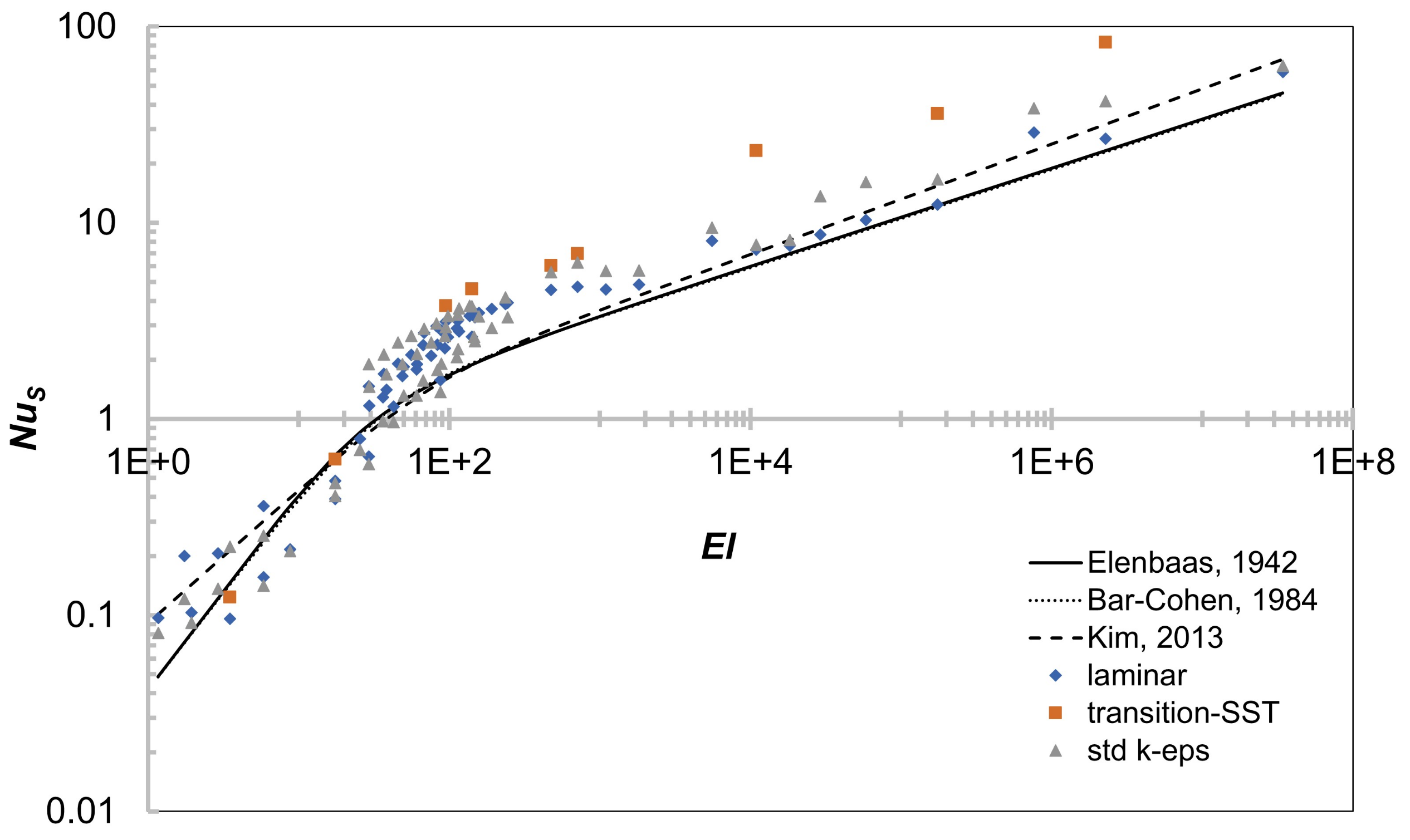
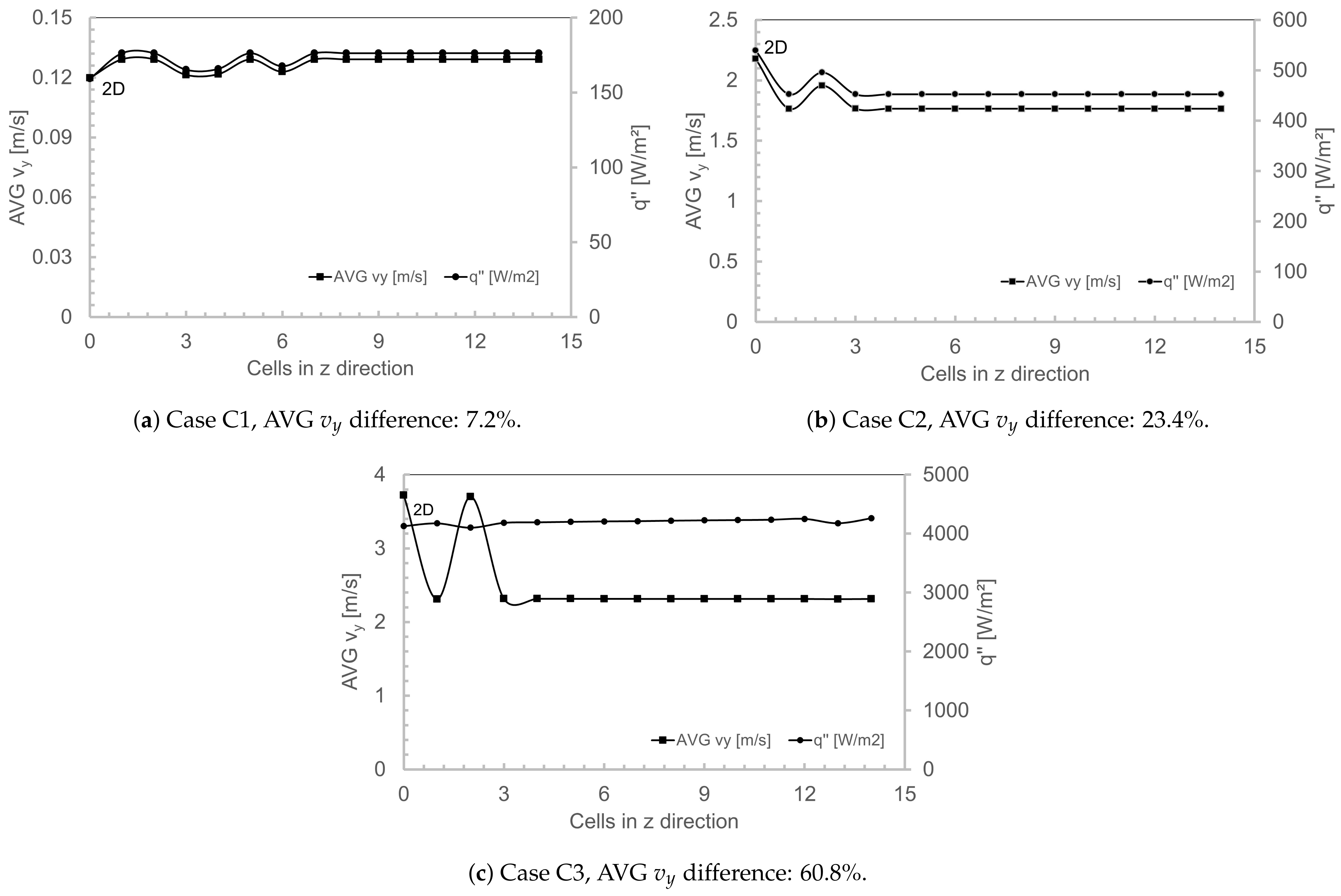
Many designs for natural-convection heat sinks and semi-empirical correlations have been proposed in the recent years, but they are only valid in a limited range of Elenbaas numbers El and were mostly tested for laminar flows. To alleviate those limits, parametric studies with 2D and quasi-3D models were carried out, in ranges of Grashof numbers up to 1.55×10¹¹ and Elenbaas numbers up to 3.42×10⁷. Ansys Fluent’s laminar, transition-SST, SST k-ω and k-ϵ models were applied. In addition, when used in this valid range, i.e., mean Elenbaas numbers, with the simplified quasi-3D model, the transition-SST model could predict better results, overestimating the heat flux by 10 to 15% compared to semi-empirical correlations. The 2D model was not deemed satisfying, regarding turbulence models. Consequently, a quasi-3D model was developed: it appeared to be an efficient trade-off between computational time and prediction accuracy, in particular for turbulence models. New grouping factors were also found, to ensure proper dimensioning of natural-convection heat sinks. They corresponded to non-dimensional parameters that dictated the physical behaviour of the heat sink with respect to the semi-empirical correlations. Typically, the ratio of the spacing to the optimal spacing predicted by Bar-Cohen’s correlation turned out to be an appropriate grouping factor with a threshold of 1, above which the fins could safely be considered as isolated, thus greatly simplifying all further calculations.
Keywords: natural convection; heat sink; turbulence modelling; computational fluid dynamics; electronics cooling natural convection; heat sink; turbulence modelling; computational fluid dynamics; electronics cooling