
This is an early access version, the complete PDF, HTML, and XML versions will be available soon.
Article

Chaos and Stability in Continuous Stirred Tank Reactors: The Influence of Non-Ideal Feeding Dynamics on Processes with Haldane Kinetics


by
Felipe Piancatelli
,
Henrique Antônio Mendonça Faria
and
Fábio Roberto Chavarette
*
Department of Physics and Mathematics, Institute of Chemistry, São Paulo State University (UNESP), Rua Prof. Francisco Degni, 55, Quitandinha, Araraquara 14800-060, SP, Brazil
*
Author to whom correspondence should be addressed.
Fluids 2026, 11(9), 220; https://doi.org/10.3390/fluids11090220

Submission received: 8 July 2026 / Revised: 31 July 2026 / Accepted: 28 August 2026 / Published: 31 August 2026
(This article belongs to the Special Issue Mixing and Mass Transfer in Various Chemical Reactors)

Abstract

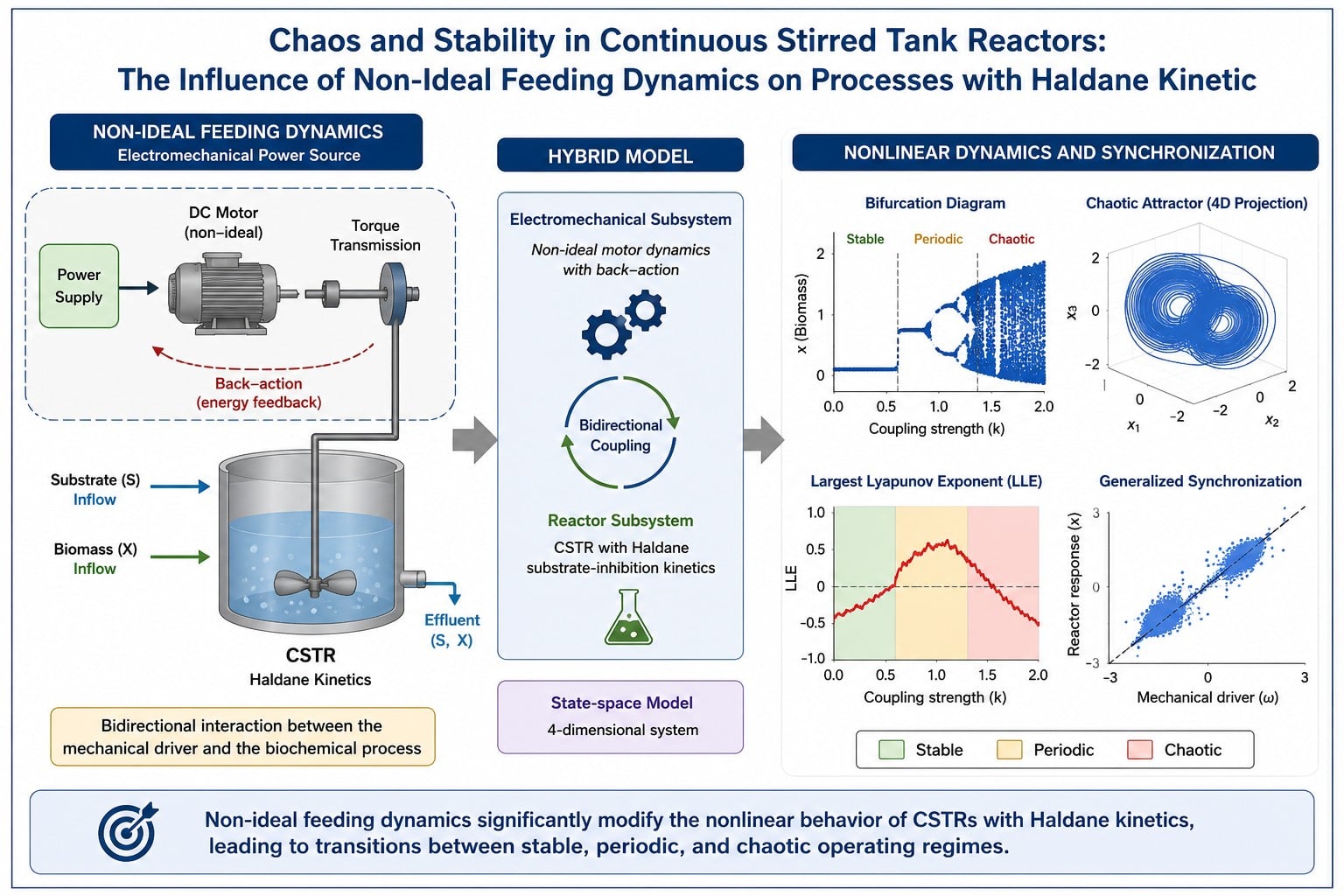
This study investigates how non-ideal electromechanical actuation influences the emergence and modulation of complex dynamics in dissipative nonlinear systems. A hybrid four-dimensional model is formulated by coupling a continuous stirred tank reactor (CSTR) with Haldane substrate-inhibition kinetics to a non-ideal electromechanical power source, explicitly accounting for the bidirectional interaction between the mechanical driver and the biochemical process. Numerical simulations and Lyapunov spectrum analysis are employed to characterize the resulting nonlinear dynamics and synchronization properties. The results show that the mechanical subsystem can evolve toward a high-energy chaotic regime with non-ideal rotational velocity pulsations, while the reactor subsystem retains a negative conditional Lyapunov exponent over a broad parameter range despite the presence of global chaos. This dynamical configuration characterizes generalized synchronization, in which the dissipative reactor response becomes functionally constrained by the chaotic mechanical attractor. In addition, the parametric analysis demonstrates that variations in coupling strength can either transmit complex oscillatory behavior or suppress chaos, depending on the operating regime. These findings indicate that aperiodic oscillations in process variables may originate from deterministic electromechanical coupling rather than intrinsic chemical instabilities and highlight the dual role of non-ideal actuation as both a source of nonlinear complexity and a potential mechanism for stabilization and control in hybrid engineering systems.
Keywords: nonlinear dynamics; Non-Ideal Systems; Haldane kinetics; generalized synchronization; induced chaos nonlinear dynamics; Non-Ideal Systems; Haldane kinetics; generalized synchronization; induced chaos
Graphical Abstract