Article

Numerical Simulation of the Flow Around Cylinders for a Wide Range of Reynolds Numbers

1
China Ship Scientific Research Center, Wuxi 214082, China
2
School of Aerospace Engineering, Tsinghua University, Beijing 100084, China
*
Authors to whom correspondence should be addressed.
Fluids 2026, 11(3), 68; https://doi.org/10.3390/fluids11030068
Submission received: 1 December 2025 / Revised: 10 February 2026 / Accepted: 14 February 2026 / Published: 3 March 2026
(This article belongs to the Special Issue Industrial CFD and Fluid Modelling in Engineering, 3rd Edition)

Abstract

To support the increasing complexity of innovation, design, and performance evaluation in the maritime industry, a ship-specific computational fluid dynamics (CFD) software suite tailored to incompressible viscous flow is required. This study utilizes the MarineFlow marine fluid dynamics code to explore numerical simulation schemes for cylindrical flow problems across a broad range of Reynolds numbers (1–107) that are applicable to self-developed codes. Additionally, an analysis of the flow around a cylinder is conducted from the perspective of code developers. Various grid types and turbulence model schemes are employed to analyze and compare the drag coefficient, separation points, and pressure distribution characteristics of the cylinder. The results obtained from these simulations are then contrasted with those derived from commercial CFD software to assess their accuracy. Despite the presence of certain numerical artifacts, within the Reynolds number range of 1–105, the unstructured grids combined with the laminar flow models effectively capture experimental data. Further exploration of the transitional Reynolds number range ( R e = 2 × 10 5 6 × 10 5 ) shows a consistent decreasing trend in the mean drag coefficient, although significant deviations from theoretical predictions are evident. From the perspective of code developers, this study aims to reveal the limitations of current computational schemes and code architecture in accurately capturing flow dynamics within the transitional Reynolds number range. This provides a crucial basis for future optimization of turbulence models and algorithmic improvements, which are essential for the continued development of self-developed CFD codes and their engineering applications.

1. Introduction

As the maritime industry advances towards larger and more complex operations, industrial computer-aided engineering (CAE) software plays an increasingly pivotal role in the lifecycle of innovation, design, and performance evaluation for ships. Computational fluid dynamics (CFD) software is a cornerstone technology supporting the development of marine and ocean engineering equipment, particularly in the realm of incompressible viscous flow calculations. Currently, CFD software development in China is distributed across various sectors, including open-source CFD software PHengLEI in aerospace, thermal fluid software AICFD, and general-purpose CFD software VirtualFlow. Despite the advanced application capabilities of China in CAE software for maritime applications reaching international standards, ship-specific software has been relatively underdeveloped. Therefore, the development of a CFD software suite tailored to incompressible viscous flow dynamics is required. This would not only boost innovation capabilities in ship and ocean engineering equipment but also strengthen the capacity of China for software development within the maritime industry.
To address this gap, this study develops a CFD code, MarineFlow (NaViiX solver), specifically for marine hydrodynamics. MarineFlow integrates typical turbulence models, including Reynolds-averaged Navier–Stokes (RANS) models (e.g., k ω SST, k ϵ ), and supports mainstream CFD mesh types, including structured, unstructured, and Cartesian grids. To date, MarineFlow has yielded promising results in blind calculations for hull models conducted under the auspices of the International Towing Tank Conference (ITTC) [1,2]. Specifically, when using different mesh point numbers (ranging from approximately 1 million to 2 million) and Froude numbers (Fn) were employed, the form factor predicted by MarineFlow exhibiteds a relative error of less than 1.5%, which is comparable to the experimental results of ship model tests and the computational results obtained by STAR-CCM+. However, conventional ship model tests are inherently limited in providing detailed flow field data. As a result, the CFD code requires validation against more typical and well-established test cases to verify their accuracy, robustness, and applicability in resolving complex flow phenomena inherent in marine engineering.
Circular cylinder flow is a highly representative and classic fluid mechanics problem in the field of marine engineering. Its flow characteristics directly impact the safety design and stable operation of marine structures. In practical engineering, core structures—such as tensioned risers on offshore drilling platforms, guide frame support columns, and steel cable sheaths in floating platform mooring systems—are widely used with cylindrical shapes to carry loads, guide flows, or connect functions. Given that these structures are continuously subjected to ocean currents and wave loads in marine environments, phenomena such as vortex-induced vibrations and sudden changes in local pressure due to flow around cylinders can lead to structural fatigue damage or failure. Therefore, investigating the laws of circular cylinder flow is crucial for the safety of marine engineering structures.
Researchers have conducted extensive numerical simulations to investigate the phenomenon of fluid flow around a cylinder. As early as the 1930s, Thom [3] reported the first numerical solution for a viscous incompressible fluid passing through a cylinder, using staggered grids to calculate a steady-state solution for Reynolds number ( R e ) = 10. With the advancement of CFD technology and research, numerical studies of vortex flow around cylinders have become more advanced.
Hirota and Miyakoda [4] further simulated the development and formation of the Karman vortex street at R e = 100; Thoman and Szewczyk [5] used finite difference methods to calculate steady-state results for R e = 1–3 × 10 5 , validating the accuracy of the method by analyzing parameters such as the drag coefficient, Strouhal number ( S t ), separation point location, and vortex structure. Tsuboi et al. [6], building on [5], studied oscillating cylinders under subcritical Reynolds numbers ( R e = 1 × 10 5 ) and critical Reynolds numbers ( R e = 6 × 10 5 ), finding significant drops in resistance.
In recent years, with advancements in algorithms and hardware, research on vortex flow around cylinders has increasingly focused on simulating transitional Reynolds numbers in the laminar–turbulent and supercritical ranges. For example, Xia et al. [7] investigated how different turbulence models affect flow characteristics under subcritical Reynolds numbers.
For the critical Reynolds number range ( R e = 1.0 × 10 4 5.0 × 10 5 ), the shear stress transport (SST) model has been employed to calculate and qualitatively predict the transition phenomena in the boundary layer; however, research findings indicate that the predicted drag coefficients at various Reynolds numbers are consistently lower than experimental measurements [8]. Ong et al. [9] utilized custom CFD solvers to validate solutions for two-dimensional cylindrical wake problems at extremely high Reynolds numbers ( R e = 1 × 10 6 , 2 × 10 6 , and 3.6 × 10 6 ), revealing that while local detail discrepancies exist in the predictions, the model accurately captures the main trends and magnitudes in the hydrodynamic parameters, fulfilling engineering requirements. For the analysis of flow fields with cylinders of the same characteristic length, Yuce et al. [10] systematically examined the impact of flow behavior from laminar ( R e = 2) to turbulent ( R e = 4 × 10 6 ) regimes across a range of Reynolds numbers using the SST model within a single numerical framework. They found that existing models exhibit limited predictive capabilities in the transitional region.
To address the aforementioned issues, the large eddy simulation (LES) approach, which is capable of resolving all unsteady flow features larger than the filter size, has been developed [11]. By resolving most of the turbulent kinetic energy, particularly that contained within the subfilter-scale range, LES can achieve higher computational accuracy with the adoption of finer grids. Compared with direct numerical simulation (DNS), LES is more computationally economical and applicable to the study of flow scenarios at high Reynolds numbers [12]. For example, based on the LES model integrated in the OpenFOAM code library, Lloyd and James [13] investigated the effects of the grid type and computational domain width on the numerical simulation of flow around a cylinder at a Reynolds number of 1.26 × 10 5 , concluding that improving the grid resolution perpendicular to the flow direction yields more pronounced benefits. Jiang and Cheng [14] employed the open-source software packages OpenFOAM and Nektar++ to conduct a comparative analysis of flow simulation results within the Reynolds number range of 400–3900. However, considering the current computational cost of LES, the RANS models remain the mainstream approach in practical engineering applications, despite the higher accuracy of LES and its applicability to high Reynolds number flow scenarios.
Current research on engineering transition models based on the RANS approach primarily centers on the structural ensemble dynamics (SED) theory proposed by She et al. [15,16,17]. By introducing the Lie group analysis method, this theory proposes a new von Kármán constant and improves the accuracy of velocity prediction in the logarithmic and central regions of pipe flow.
Domestic and international research on cylindrical wake flow has revealed that the physical characteristics of the cylindrical wake problem are complex, with phenomena such as boundary layer separation and periodic vortex shedding. When conducting studies using numerical methods, the results are highly sensitive to the mesh partitioning strategy and turbulence model selection. This sensitivity is notably enhanced when the flow transitions from laminar to turbulent, which in turn demands higher accuracy from computational models. In practical engineering computations, mainstream commercial CFD software packages, such as Fluent and STAR CCM+, exhibit significant limitations in this regard. They often fail to accurately capture flow discontinuities during the transition processes, whereas the use of LES greatly increases the computational time and cost, making it difficult to meet the demands of practical engineering applications.
The subject of this study is the flow around a circular cylinder in ocean engineering. Numerical computations are performed using the self-developed CFD code with multiple computational schemes, focusing on key parameters, such as the drag coefficient, pressure distribution on the cylinder surface, and the location of separation points, while analyzing the differential characteristics of flow phenomena. The objectives of this study are to (1) systematically validate the MarineFlow code using the cylindrical wake problem and propose an engineering-acceptable numerical simulation scheme; (2) identify the challenges of simulating flow around a circular cylinder via the analysis of computational results at common Reynolds numbers ( 10 5 and 4 × 10 5 ) combined with those from commercial software; and (3) present discussions from the perspective of code developers with an engineering approach. The research outcomes can provide typical case study support for subsequent practical engineering applications.

2. Numerical Framework

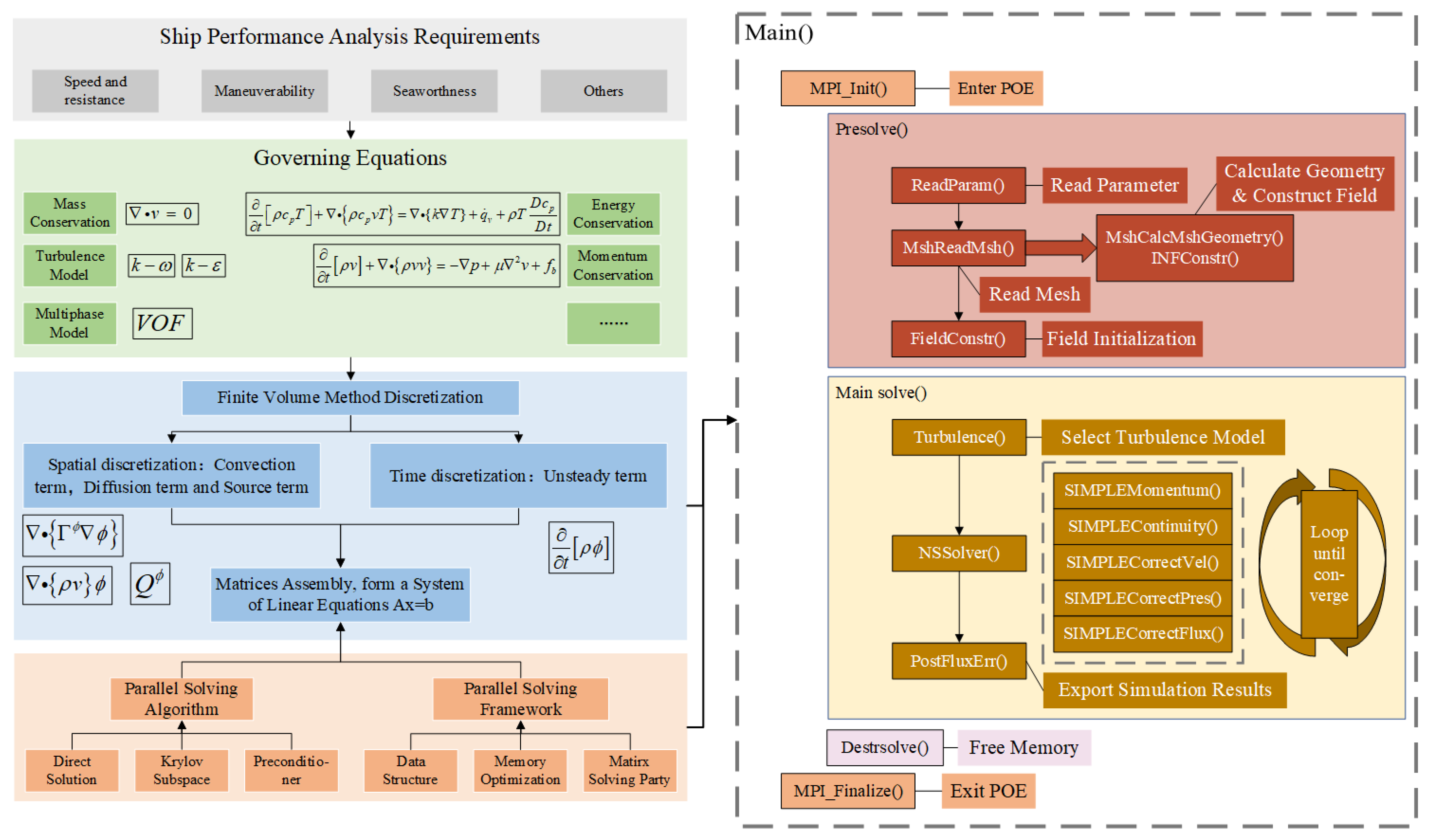
The MarineFlow (NaViiX solver) hydrodynamic CFD code, developed jointly by the China Ship Science Research Center and Zhongchuan Orient Wuxi Software Technology Co., Ltd., Wuxi, China, boasts complete proprietary intellectual property and has been successfully industrialized. This code supports a variety of grid-solving methods, tailored to meet the design and research needs for ships and marine equipment. It facilitates analysis through modular disassembly and customized development of functional modules, ensuring ship performance in critical scenarios such as speed, maneuverability, and seakeeping. It provides standardized computational workflows that are adaptable to different engineering problems, catering to a wide range of engineering design and research simulation requirements. The flow chart and code framework as Figure 1.
At the core of the solution, MarineFlow employs the finite volume method, discretizing directly within the physical space without the need for transformations between physical and computational coordinate systems. This approach ensures the conservation of physical quantities, such as mass and momentum, within the computational domain. Beyond incompressible flow models, MarineFlow comprises modules for multiphase flow models and free surface models to support numerical calculations for ships. These capabilities provide robust technical support for the development of marine and ocean engineering equipment.
MarineFlow conducts in-depth analysis for design and research needs in the field of marine vessels and equipment. It dissects functions based on application scenarios such as ship speed, maneuverability, and seakeeping; designs corresponding solution processes and modules; and ultimately generates code files for each module. The general process typically comprises three critical steps: preprocessing, iterative solving, and result output.
The preprocessing phase is primarily responsible for reading grid data and calculating related parameters, as well as acquiring the geometric information of the grid, to construct the solution matrix and initialize the flow field. Subsequently, it enters the iterative solution phase until the flow field converges or reaches the predefined computational conditions. Finally, the system outputs relevant data files, such as Tecplot files, force integration data, or momentum data. It also releases memory resources, exits the parallel environment, and completes the entire computational process.
MarineFlow has developed a variety of physical models for calculating ship flow performance, including free surface models and six degrees of freedom (6DOF) motion models for numerical computations in ship hydrodynamics.

3. Method and Scheme Design

3.1. Control Equation

CFD software numerically simulates flow under the basic control equations of fluid dynamics. The flow satisfies the three conservation laws, namely mass, momentum, and energy conservation. These are mathematically described by the Navier–Stokes (N-S) equations. For studies in ship hydrodynamics, heat transfer is typically not considered; hence, only the mass conservation and momentum conservation laws are provided here in their corresponding mass and momentum equations:
· v = 0
t ρ v + · ρ v v = p + μ 2 v + f b
where ρ represents the fluid density, p is the pressure, μ is the fluid viscosity coefficient, and f b is the body force.

3.2. Turbulent Models

Reynolds introduced an averaging approach to handle the N-S equations, which results in an unclosed system of equations [18]. This typically necessitates the incorporation of turbulence models to close the solution for the system, such as the RANS model. The codes employ various physical models to solve the discretized N-S equations. It decomposes and organizes the governing equations into sub-items such as convective terms, diffusive terms, non-stationary terms, and source terms. Different methods are applied to discretize these sub-items: the convective terms are handled with a second-order upwind scheme, while the diffusive terms are discretized using a central difference scheme.
MarineFlow supports common turbulence models, such as the standard k ϵ , renormalization group (RNG) k ϵ , and SST k ω . This study conducts numerical simulations using the laminar model and the SST k ω turbulence model.
A brief introduction to the SST k ω turbulence model is provided; this is a two-equation turbulent model developed based on the Boussinesq approximation theory, in which k represents turbulent kinetic energy, ω is the efficiency of converting turbulent kinetic energy into heat energy within a unit volume per unit time, and SST refers to the SST formula. The SST k ω turbulence model combines the advantages of both k ϵ and k ω turbulence models. It uses the k ϵ model in far-field flow and the k ω model near-wall surfaces, which improves the simulation performance of reverse pressure gradients [19]. The specific implementation involves transforming the k ϵ model into an equation with k and ω as variables, then combining equations from both standard k ϵ and k ω models through two mixing functions. The expression is as follows:
t ρ k + · ρ v k = ( μ e f f , k k ) + G k ˜ + β * ρ k ω
t ρ ω + · ρ v ω = ( μ e f f , ω ω ) + C α ˜ ω k G k C β ˜ β ω 2 + 2 ( 1 F 1 ) σ ω 2 ρ ω k · ω
where μ e f f , k = μ + μ t σ k , μ e f f , ω = μ + μ t σ ω , k represents turbulent kinetic energy, ω is the specific turbulent dissipation rate, and F 1 is the mixing function. k ω is activated in near-wall regions, while k ϵ is activated in the far field. The definition of F 1 is as follows:
F 1 = t a n h ( γ 1 4 )
The definition of γ 1 4 is as follows:
γ 1 = m i n ( m a x ( k β * ω ( d ) , 500 ν ( d ) 2 ω ) , 4 ρ ω 2 k C D k ω ( d ) 2 )
C D k ω = m a x ( 2 ρ σ ω 2 1 ω k · ω , 10 10 )
G k ˜ is defined in the k formula G k ˜ = m i n ( G k , c 1 β * k ω ) and G k is a production term, as follows:
G k = μ t u i x j ( u i x j + u j x i )
The turbulent viscosity coefficient μ t can be obtained as follows:
μ t = ρ α 1 k m a x ( α 1 ω , 2 S t F 2 )
where S t represents the strain rate invariant and F 2 is the second mixing function. Its definition is similar to Equation (5) as follows:
F 2 = t a n h ( γ 2 2 )
γ 2 = m a x ( 2 k β * ω ( d ) , 500 ν ( d ) 2 ω )
The indexed coefficients in Equation (4) can be obtained through the mixed function F 1 as follows:
ϕ ˜ = ϕ 1 F 1 + ϕ 2 ( 1 F 1 )
The coefficients used in the model are as follows: C α 1 = 0.5532 ,   C β 1 = 0.075 ,   C α 2 = 0.4403 ,   C β 2 = 0.0828 ,   σ k 1 = 2 ,   σ ω 1 = 2 ,   σ k 2 = 1.0 ,   σ ω 2 = 1.186 ,   β * = 0.09 ,   c 1 = 10 ,   α 1 = 0.31 .

3.3. Scheme Design

This study focuses on the flow around cylindrical bodies, aiming to encompass critical flow regions and systematically validate the performance of MarineFlow code solutions. The computational scenarios are defined by the non-dimensional Reynolds number ( R e ) as follows:
R e = ρ v d μ
where ρ represents the fluid density, v is the incoming velocity, d is the characteristic length (usually the cylinder diameter), and μ is the fluid dynamic viscosity.
The R e selected has a range of 1– 10 7 for investigation, encompassing a complete spectrum of typical flow phases for a cylindrical wake: R e = 1– 10 5 corresponds to laminar and subcritical turbulent states, serving as the foundational interval for validating the capabilities of the codes in simulating unsteady-state flow fields; R e = 2 × 10 5 6 × 10 5 marks the critical transition zone between laminar and turbulent flows, pinpointing where current commercial CFD software has limited precision; and R e > 10 6 pertains to supercritical turbulent regimes, further testing the computational stability in handling complex flow fields at high Reynolds numbers.
Therefore, appropriate computational models are matched with different flow states: for R e 10 2 , a laminar model is used to ensure accuracy in laminar field calculations; for 10 3 R e 10 5 , SST k ω turbulent models are adopted to cater to the simulation needs of turbulent flows transitioning through transitional flow fields.
The dimensionless time T * is set to 300 according to Equation (14) as follows:
T * = v t D
The computational approach for both tables employs an unsteady calculation method. Each time step is set to 10 4 s. The convergence criterion is a flux residual decrease of six orders of magnitude, with a maximum of 20 inner iterations allowed.
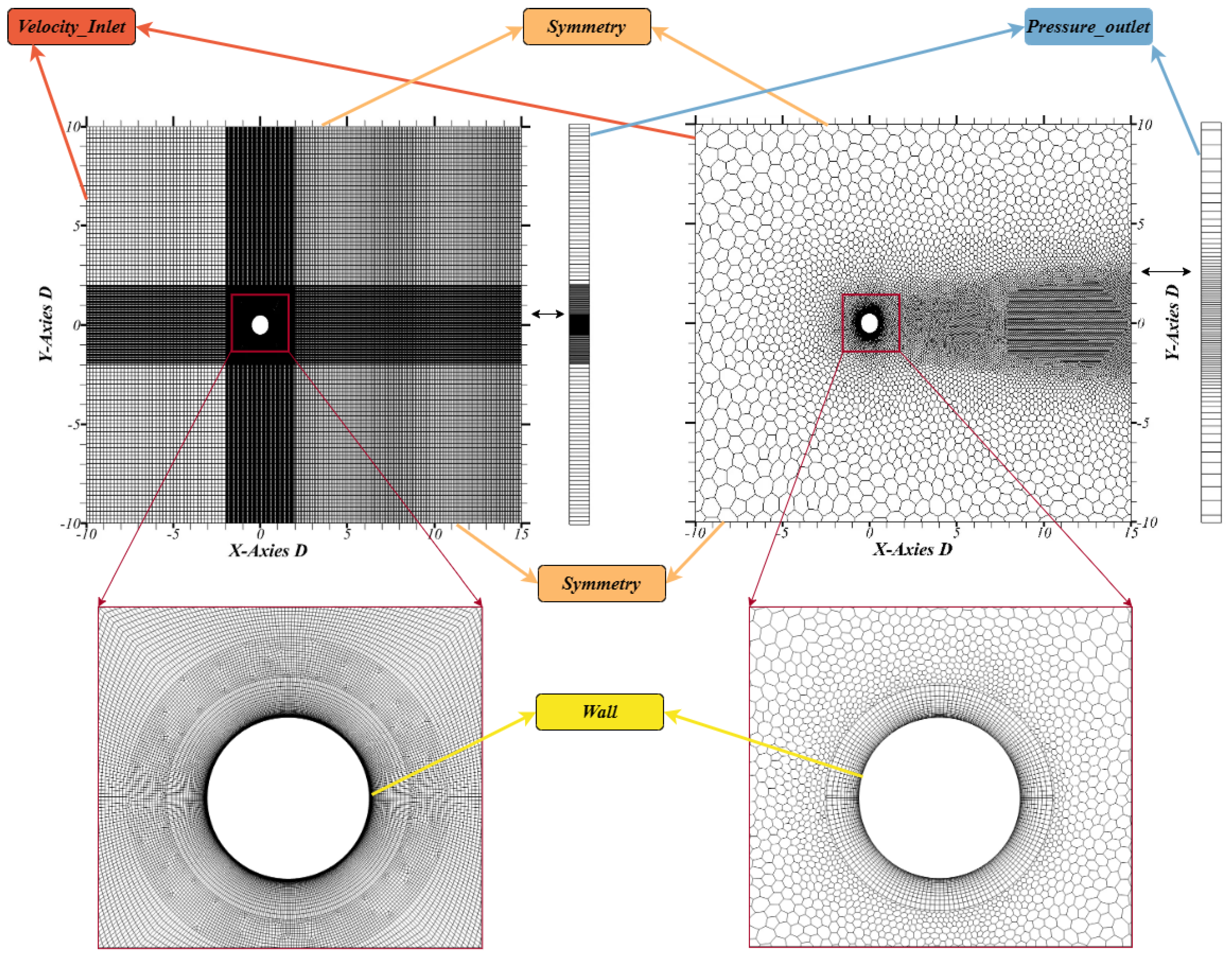
Modeling the flow field continues to generate both structured and unstructured grids for different schemes. The cylindrical diameter D is 0.1 m, with the flow field dimensions being 20 D × 25 D . The example is stretched on a two-dimensional plane. Structured grids employ a partition refinement strategy, with finer grid spacing in the “H” shaped region around the cylinder wall (where y + 5 ), and unstructured grids focus on refining around the cylinder wall (where y + 5 ) and the wake vortex dominant area. The overall grid distribution and wall refinement details are shown in Figure 2. All grids control the y + boundary layer grid such that y + 5 , and the grid growth rate is 1.2, which is derived from the Schlichting [20] skin friction coefficient C f formula (Equation (15)). This C f formula is applicable for R e 10 9 , and the derived formula for calculating the height of the first-layer grid is given as Equation (16) below.
C f = ( 2 l o g 10 R e 0.65 ) 2.3
y = y + D R e C f 2
Upon completion of the calculations, the results are processed, including the average drag coefficient ( C d ¯ ). The average drag coefficient is provided by Batchelor’s measurements [21], and the calculation formula is as follows:
C d ¯ = F d ¯ 1 2 ρ v 2 A
F d ¯ represents the average drag, and A denotes the projected area perpendicular to the flow direction. In addition, the average surface pressure coefficient is used to analyze the cylinder surface pressure distribution as follows:
C p ¯ = ( P P f a r ) ¯ 1 2 ρ v 2
where P is the pressure of points on the cylinder surface, and P f a r represents the far-field pressure. All the other solving settings that are not mentioned are listed in table.

4. Results and Discussion

Based on the scheme design presented in Table 1 and Table 2, and the solver settings in Table 3, this section presents the results and analysis for a wide range of Reynolds numbers and the transition Reynolds number. Additionally, in Section 4.3, the calculation performance of the transition Reynolds number is comparatively analyzed using results from commercial software. Finally, the discussion from the perspective of a code developer is provided in Section 4.4.

4.1. Analysis of a Wide Range of Reynolds Numbers

4.1.1. Mean Drag Coefficient

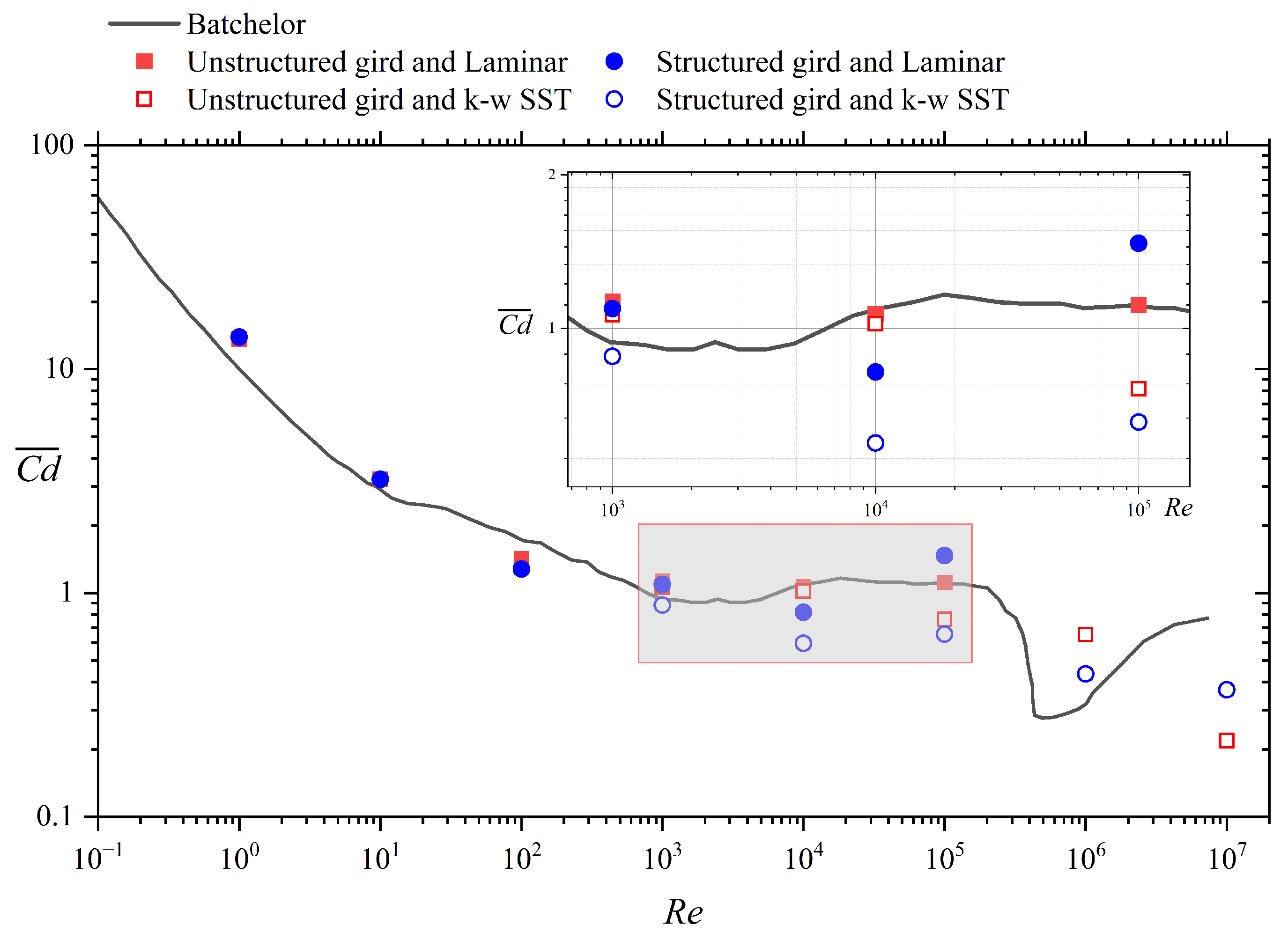
Firstly, the computational results for a broad range of Reynolds numbers were analyzed, performing time-averaging on the drag coefficient data obtained through simulation. Figure 3 compares the Batchelor average drag curve to the simulated average drag coefficients for a wide range of Reynolds numbers. At low Reynolds numbers ( R e 100 ), the computational outcomes for structured or unstructured grids were largely consistent and closely aligned with the average drag curve, with discrepancies below 5%. This indicates that laminar models effectively simulate low Reynolds number flows. However, within the subcritical Reynolds number range, significant differences emerged between computations using different grids and turbulence models. The use of unstructured grids and laminar models yielded results that closely matched the Batchelor drag curve; in contrast, schemes employing structured grids and SST k ω turbulence models generally underestimated the results. For example, at R e = 10 4 , the computed drag coefficient using an unstructured grid and laminar model was 1.06, with a relative error of only 2.7% compared to the Batchelor curve value of 1.09. In contrast, for a structured grid and SST k ω turbulence model scheme, the predicted drag coefficient was 0.59, resulting in an error of up to 45.8%. Beyond supercritical Reynolds numbers ( R e > 10 6 ), all grid types struggled to accurately simulate the sudden drop in resistance.
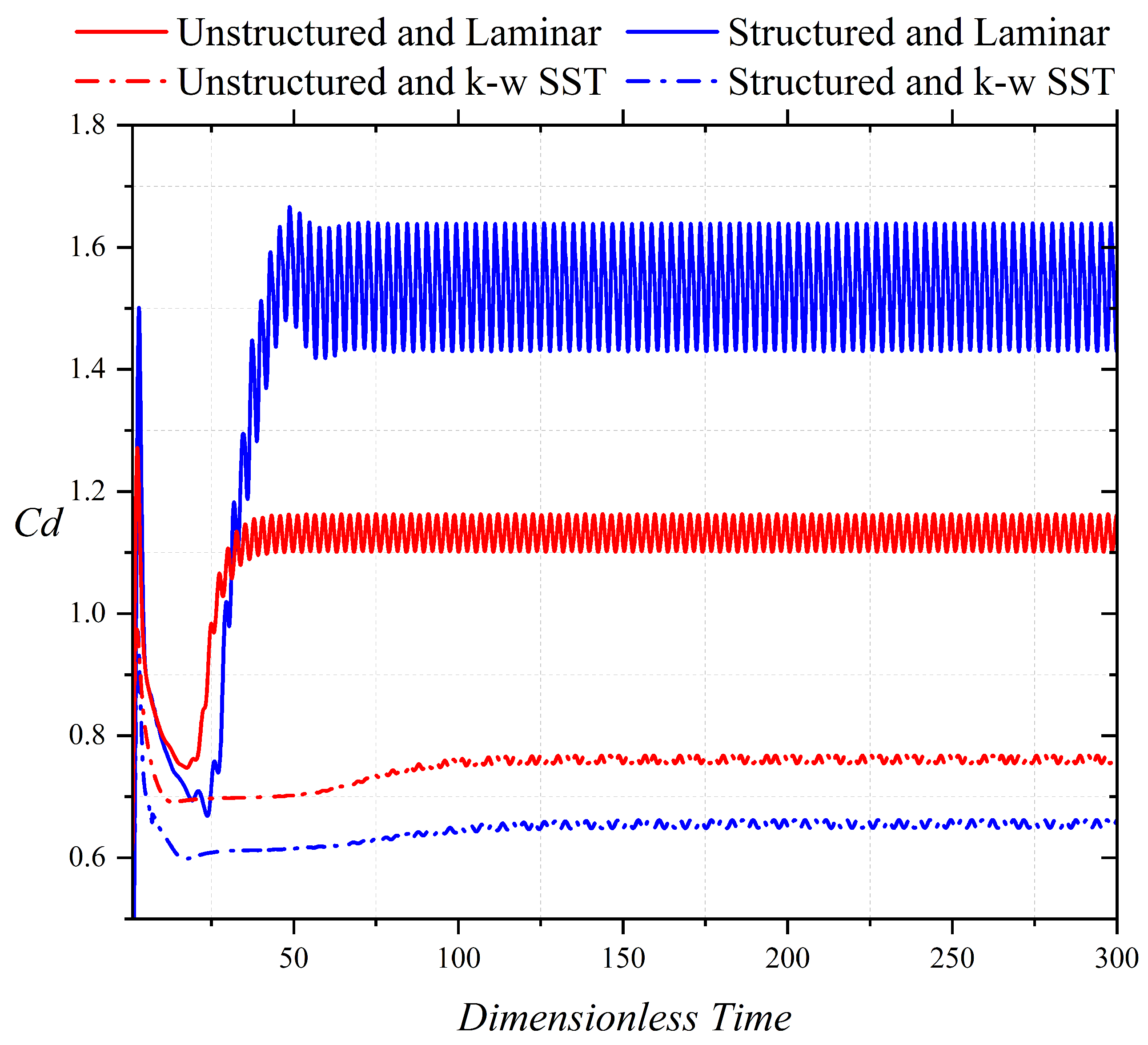
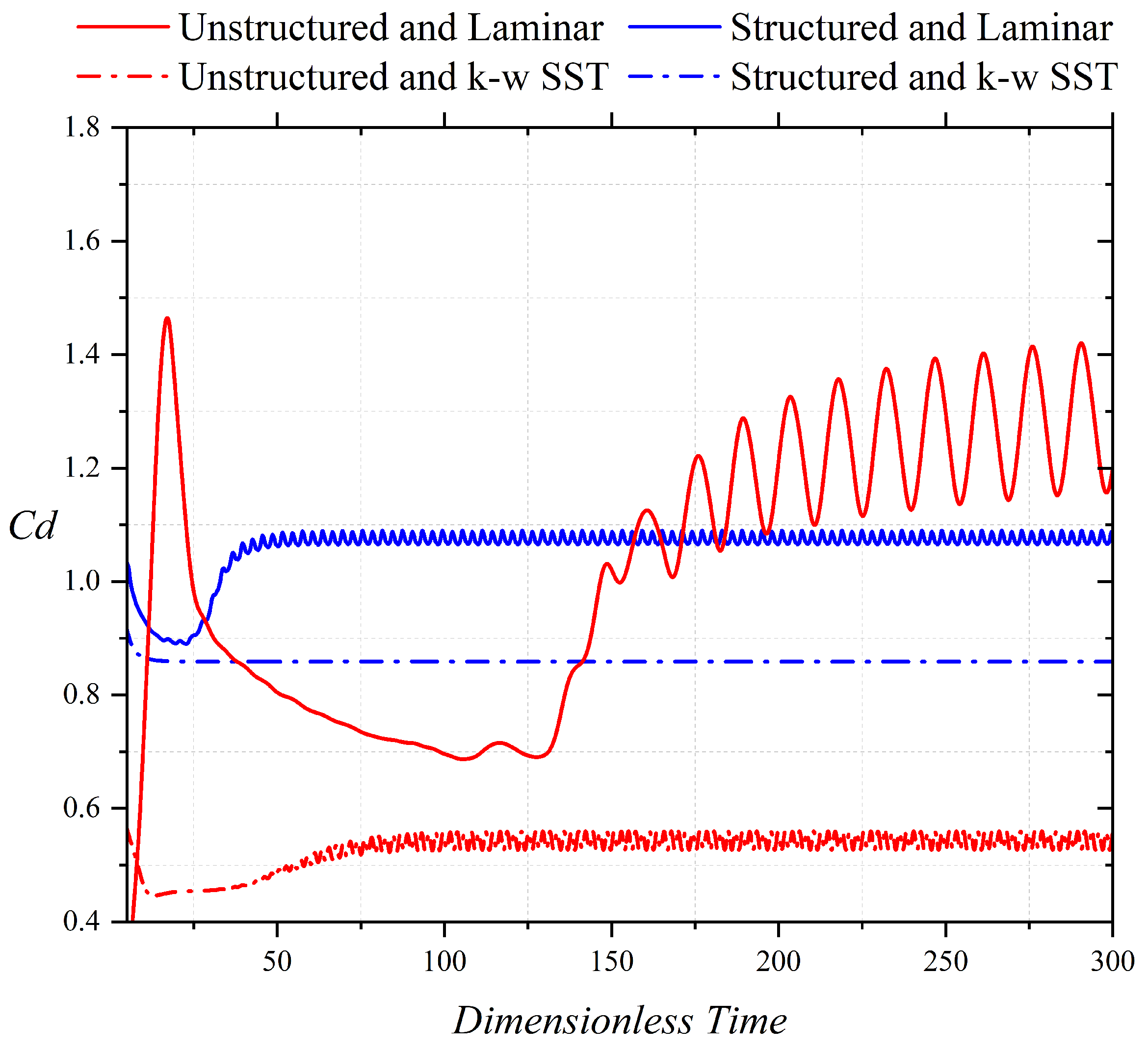
Considering that a Reynolds number of R e = 10 5 represents a common operating condition in practical ocean engineering, such as an inlet velocity of approximately 1 m/s for a cylinder diameter of 0.1 m, the significant discrepancies in computational results among various schemes under this condition required an in-depth analysis. Section 4.1 focuses on the solver-calculated results corresponding to this operating condition. The time-history plots are presented as Figure 4. In the unsteady computations, all four schemes exhibited a certain degree of drag force fluctuation and generally reached a relatively stable state once the dimensionless number exceeded 100. Only the data corresponding to this stable fluctuation stage in the time history were retained for time-averaged processing, and the results corresponding to the mean drag coefficients are illustrated in Figure 3.

4.1.2. Flow Field and Drag Composition

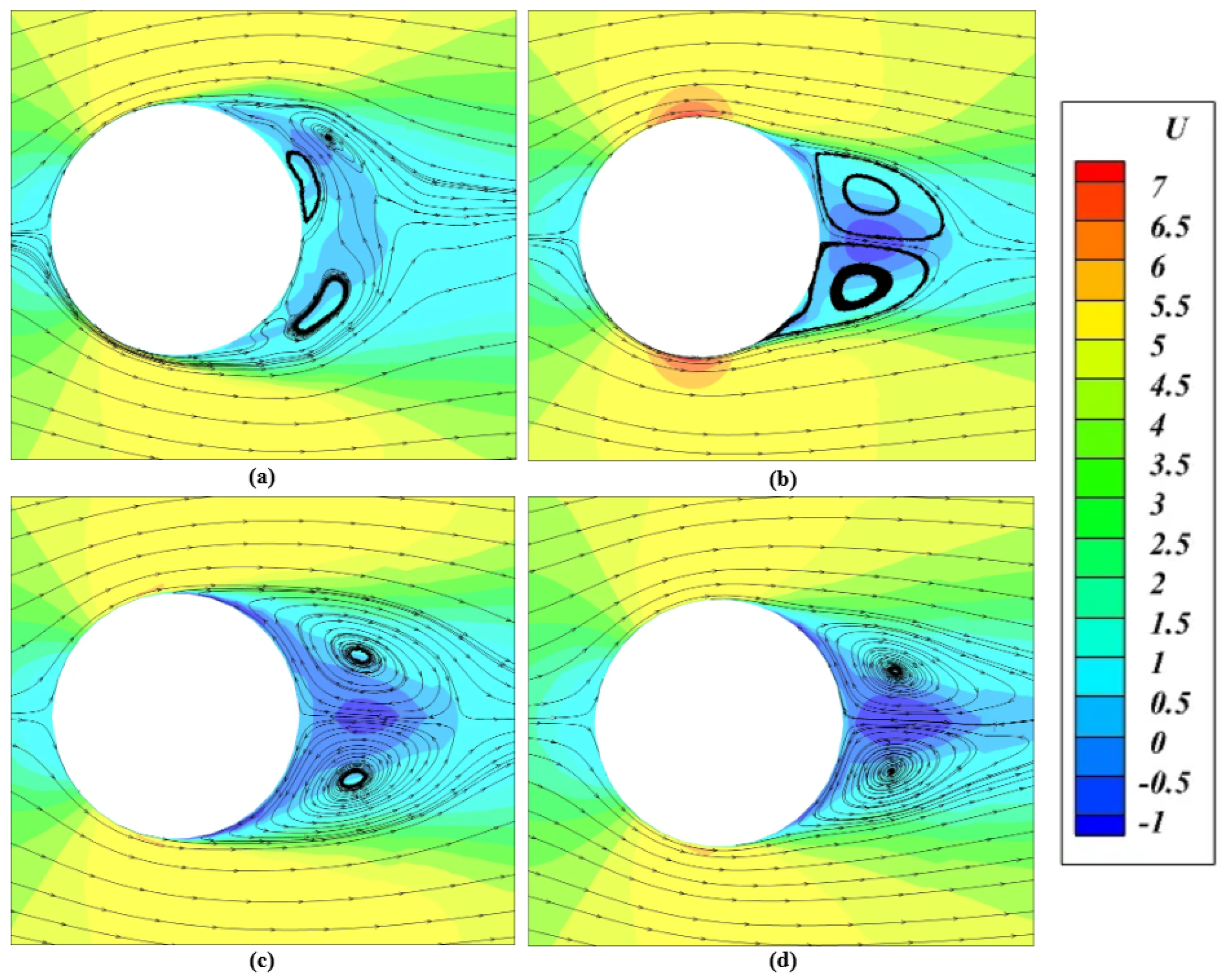
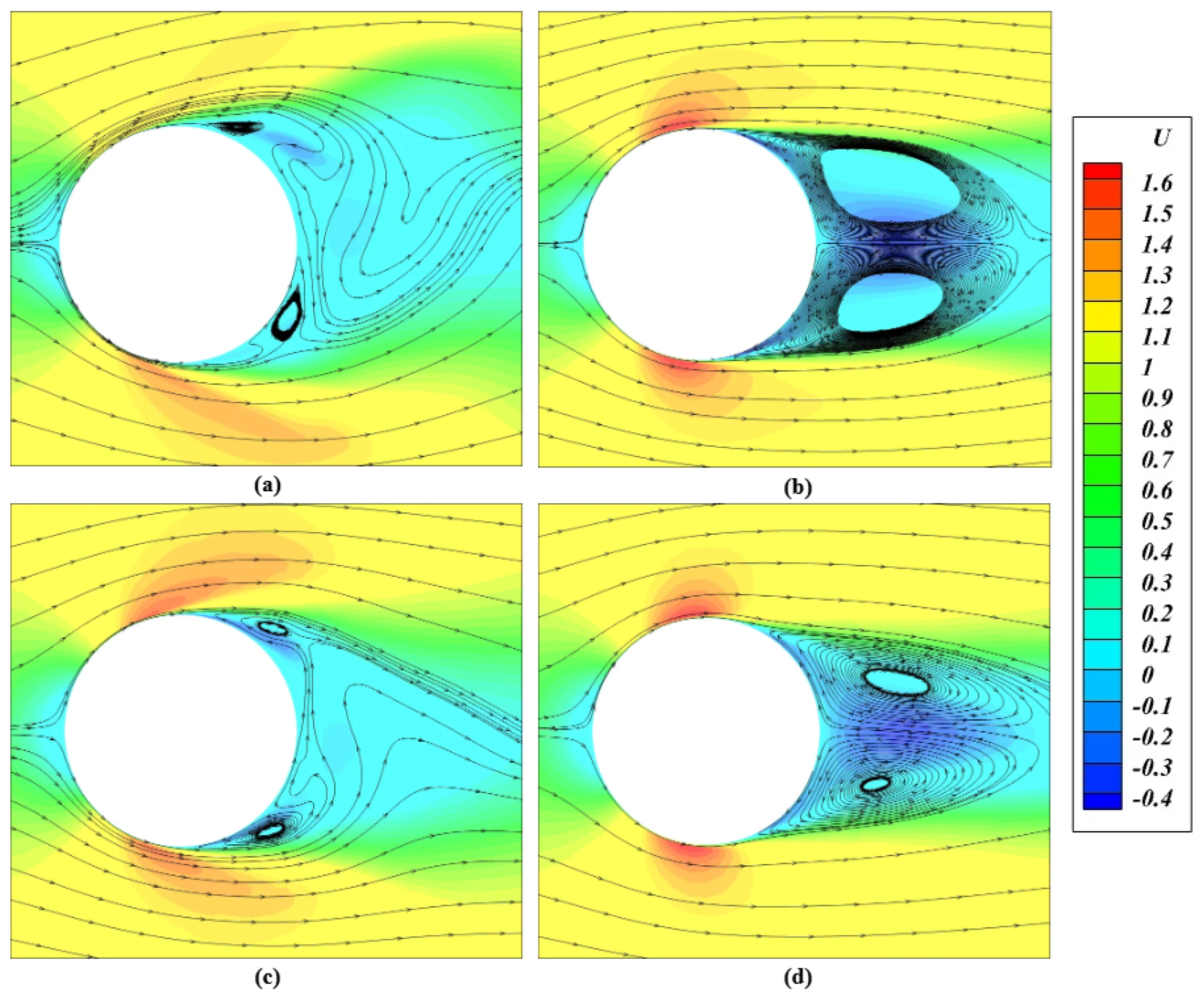
To present the computational results more intuitively, this study provides the time-averaged velocity contours of different schemes at R e = 10 5 , with all velocity scales uniformly processed. The flow field velocity contours and streamline distributions in Figure 5 indicate that there are significant differences in the positions of flow separation points and the maximum surface velocity of the cylinder among different schemes. In Figure 5a,c, employing the laminar model, the flow separation points are located at approximately 88 ° , which is consistent with the 85 ° reported in the literature [22] and smaller than the range of 95 ° to 100 ° obtained from the schemes adopting the SST k ω turbulence model. However, the laminar model failed to effectively generate vortex systems, which may be attributed to the inherent differences between the laminar and SST k ω turbulence models.
The frictional force and pressure acting on the wall boundary in marine and offshore engineering can be calculated and output separately using MarineFlow, with the total drag derived by summing these two components. By processing the individual force components output by MarineFlow, the time-averaged results of the cylinder force and its composition were obtained. Table 4 lists the composition of the cylinder drag coefficient. As can be seen, the proportion of the frictional drag coefficient in the mean drag coefficient is extremely small, with the maximum value not exceeding 3%. This demonstrates that the pressure drag coefficient is the dominant contributor to the total drag force coefficient.
Combining the findings in Section 4.1.1 and the data in Table 4, it can be inferred that the drag force acting on the cylinder is correlated with the pressure distribution on the cylinder surface. Therefore, the average pressure coefficient on the cylinder surface is presented in Section 4.1.3.

4.1.3. Surface Pressure Coefficient

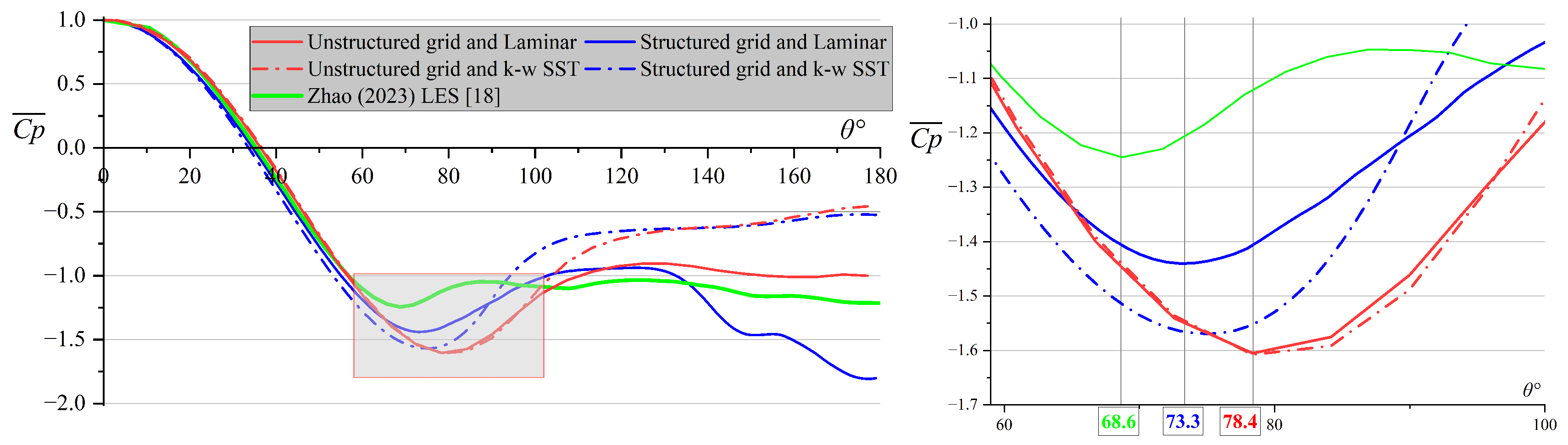
The pressure at the centroid of the grid cells on the cylinder wall boundary was extracted at different times and subjected to time-averaging processing. The windward and downstream sides of the cylinder were at 0 ° and 180 ° . Assuming that the flow field is quasi-symmetric, the calculation formula is given in Equation (18). As listed in Table 4 at the end of Section 4.1.2, the dominant force acting on the cylinder is pressure resistance, which is obtained by integrating the pressure over the cylinder surface. Therefore, an analysis of the pressure distribution curve on the cylinder surface facilitates a better understanding of the results in Table 4.
Comparisons with the results in [22] showed that the angle corresponding to the minimum surface pressure coefficient in the LES was approximately 68.6 ° , while the computational results of various MarineFlow schemes ranged from 73.3 ° to 78.4 ° , which were 5 10 ° larger than the LES results. Notably, the minimum pressure coefficient in LES was approximately −1.27, and the minimum pressure coefficient of the scheme using unstructured grids was significantly lower than that of the structured grid scheme, dropping to approximately −1.6. This indicates that the grid type influences the minimum pressure coefficient. Overall, there were significant differences in the magnitude and corresponding angle of the surface pressure coefficient extremum between the results obtained via the RANS equations and LES.
The pressure on the cylinder’s windward side ( 0 ° ) remained essentially consistent across all schemes, with the processed pressure coefficients all starting from approximately 1. However, notable differences existed in the downstream region of the cylinder (near 180 ° ). The surface pressure coefficient distributions of the schemes adopting the SST k ω turbulence model were essentially consistent, all approaching −0.5, whereas significant discrepancies were observed among the schemes using the laminar model. In these cases, the plateau in the downstream region of the cylinder generated separation bubbles, which matched well with Figure 6. This may be attributed to the differences between the laminar model and the SST k ω turbulence model. The considerable pressure difference between the windward side and the downstream region is assumed to be the reason for the higher drag coefficient in the structured grid and laminar model scheme.
Given that MarineFlow calculates the force acting on the wall through numerical integration over the wall boundary, it can be concluded that the magnitude and corresponding angle of the pressure extremum on the cylinder surface, as well as the pressure distribution in the wake region, all affect the overall drag calculation. This also explains why the computational results of the unstructured grid + laminar model scheme agree well with the LES results despite the difference in the angle corresponding to the minimum pressure coefficient. Although the unstructured grid + laminar model scheme exhibited deviations in the magnitude and angle of the pressure extremum, the pressure in the downstream region produced a compensating effect, ultimately leading to a good agreement between this scheme and the LES results.
Combining the analysis in Section 4.1.2 and the aforementioned findings, pressure was confirmed as the main component of the total drag. Different schemes yielded distinct flow field velocity distributions and flow separation points, and the evolutionary characteristics of the velocity and separation points further affected the pressure distribution on the cylinder surface, thereby influencing the total drag obtained via integral calculation.

4.2. Analysis of Transitional Reynolds Numbers

4.2.1. Mean Drag Coefficient

The transitional Reynolds number range corresponded to the flow field transitioning from laminar to turbulent flow. Within this range, the phenomenon of “abrupt drag reduction” occurred, which is specifically characterized by the backward shift of the flow separation point and a significant decrease in the mean drag coefficient. By averaging the computational results within this interval, solving for the drag coefficient, and conducting flow field analysis, the computational performance of the solver and various schemes in the transition region was validated. This study performed calculations using the parameter settings listed in Table 2 and Table 3, with the Reynolds number range of (2–6) × 10 5 selected for computation. Subsequently, the computational results were subjected to processing and comparative analysis consistent with those described in the preceding sections.
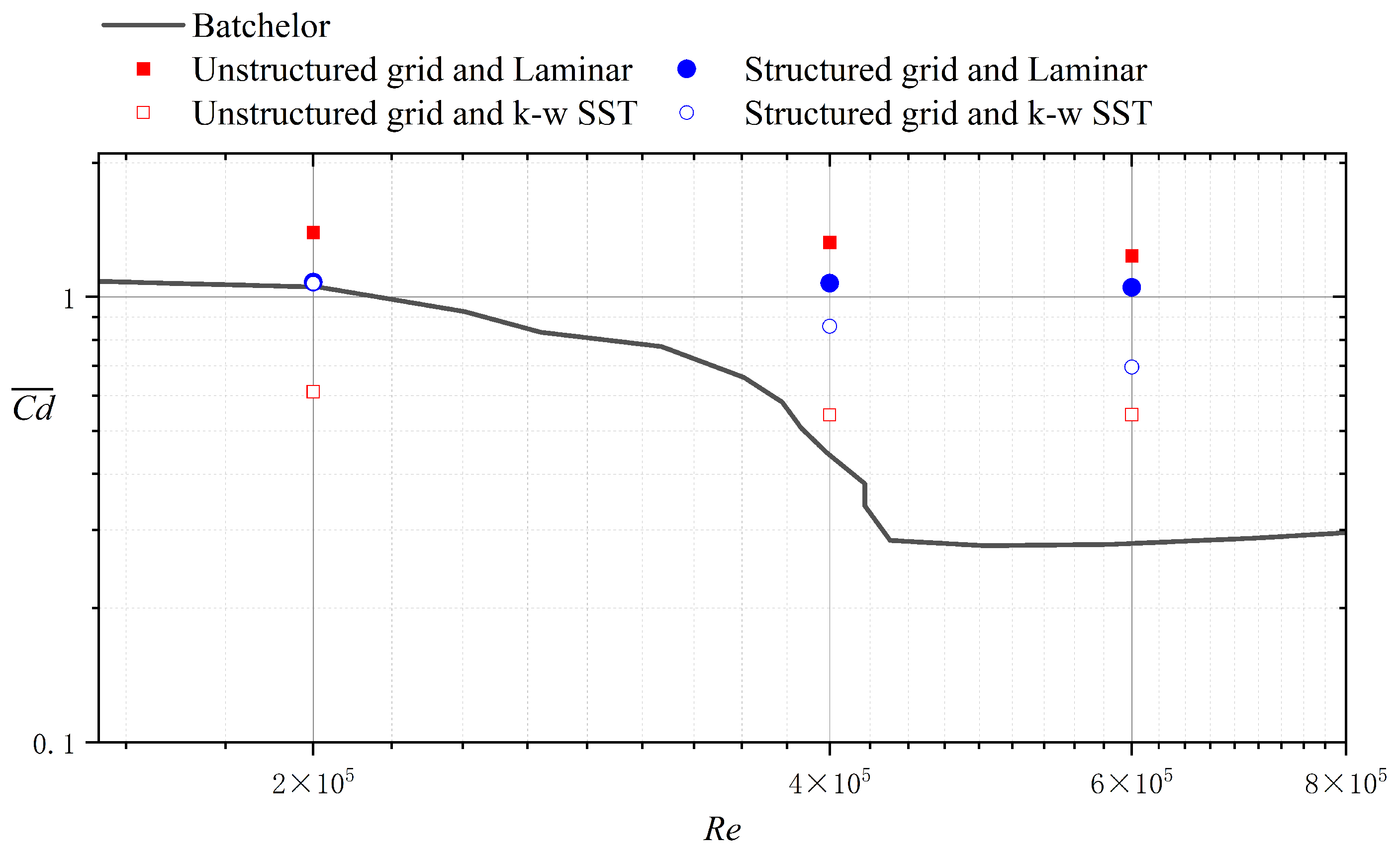
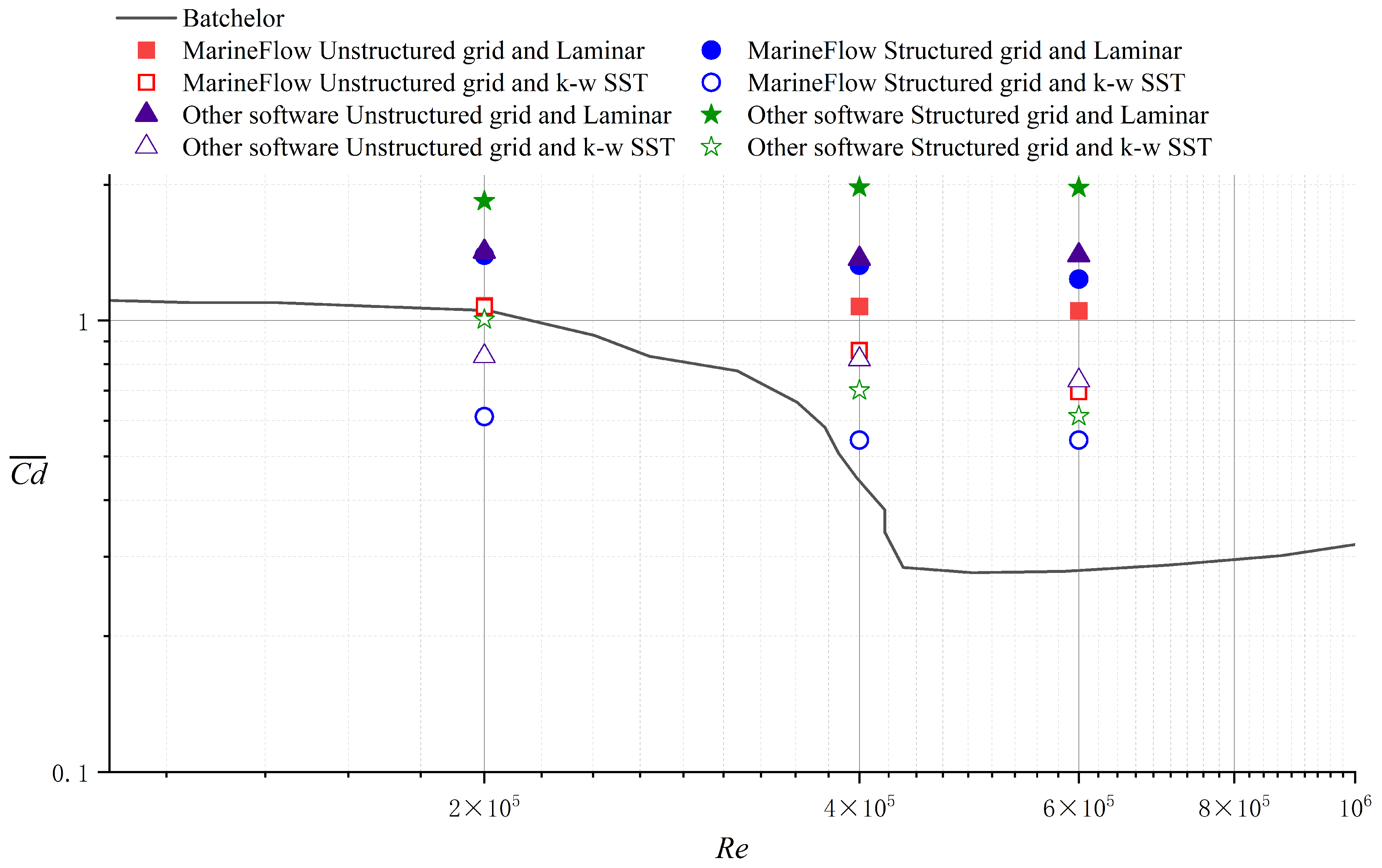
From the mean drag coefficient curves in Figure 7, it is evident that all computational schemes exhibited a decreasing trend in the drag coefficient within the laminar–turbulent transition Reynolds number range. Among these schemes, the scheme utilizing structured grids combined with the SST k ω turbulence model showed the most pronounced reduction in drag; however, it still failed to fit the Batchelor curve well. Based on the analysis in Section 4.1, it is tentatively inferred that this discrepancy arises from the computational distortion caused by the surface pressure distribution. At the operating condition of R e = 2 × 10 5 , the computational results of the two structured grid schemes demonstrated a good degree of agreement; however, as the Reynolds number increased further, all methods failed to accurately reproduce the decreasing drag coefficient, which may be attributed to the limitations of the turbulence models and dimensional effects. Based on this observation, the operating condition at R e = 4 × 10 5 was selected in this study to conduct flow field characteristic analysis.
Figure 8 shows the time-history curves of the drag coefficient for the cylinder at a Reynolds number of R e = 4 × 10 5 . In comparison with Figure 4, it is evident that the schemes employing structured grids combined with the laminar model exhibited relatively large fluctuations, which did not gradually stabilize until the dimensionless time reached 200. Although the mean drag coefficient obtained from calculations was slightly higher than that of the Batchelor curve, the mean drag coefficient after stabilization was consistent with the results presented in Figure 8.

4.2.2. Flow Field and Drag Composition

Flow field contour plots under this Reynolds number condition are also presented in this study. Compared with the contour plots in Section 4.1.2, the flow separation points and velocity contours in Figure 9 exhibited significant differences. The separation points shifted backward, and the discrepancies among different schemes were further enlarged. Specifically, the separation points in Figure 9b,d (employing the SST k ω model) shifted backward significantly to approximately 100 ° , whereas those in the two schemes with the laminar model (Figure 9a,c) remained near 90 ° . These observations indicate distinct deviations among various computational schemes in the transition region, implying that the computational results in this region are extremely sensitive to grid types and turbulence models. Combined with Figure 9d and the time-history plots in Section 4.2.1, it is evident that the scheme using structured grids with the SST k ω model appears to achieve an approximately “steady” flow result. We conjectured that this may be attributed to the calculation of the turbulent viscosity μ t .
A comparison of the drag coefficient data in Table 5 further illustrates the differences in the capability of various computational schemes to capture separation points, as well as the resulting deviations in drag calculation results.

4.2.3. Surface Pressure Coefficient

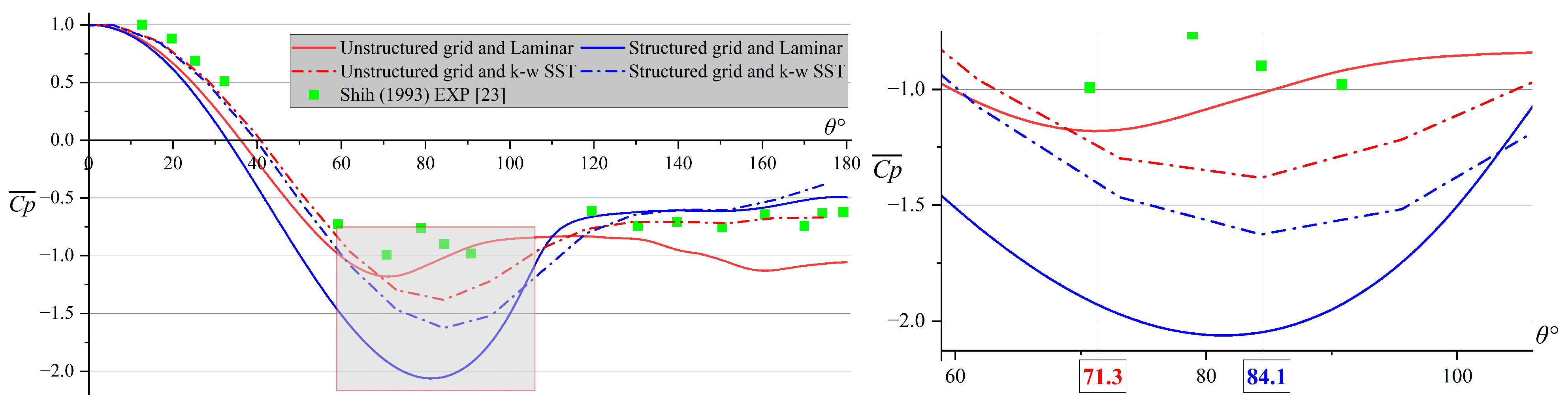
Due to the lack of relevant studies under the target Reynolds number, the physical experiment results from a study with a close Reynolds number [23] were selected for comparison. In the physical experiment of the study, holes were drilled on the cylinder surface, and pressure sensors were installed for sampling. However, limited by the number of sampling points and sensor interference, the flow separation point and the minimum surface pressure coefficient could not be accurately recorded; only the sampling point data and the overall surface pressure distribution trend (green scattered points in Figure 10) could be presented.
Nevertheless, it was still observed that under the operating condition of R e = 4 × 10 5 , the extreme value distribution range of the surface pressure coefficient for different schemes was 71.3 84 ° , and there were significant differences among the schemes in terms of the position and magnitude of the extreme points, as well as the pressure coefficient in the wake region. This verified the conjecture presented in Section 4.2.1 that the computational distortion is highly associated with the surface pressure distribution. In addition, the two schemes adopting the SST k ω model exhibited a similar distribution trend of the surface pressure coefficient in the downstream region of the cylinder. However, as indicated in Figure 6, the difference in their pressure drag coefficients was approximately 60%. This further verifies the discussion in Section 4.1.3, that is, the drag coefficient of the cylinder is affected by the variation in the surface pressure distribution.
The combined results from Section 4.1 and Section 4.2 demonstrate that the drag coefficient of the cylinder is influenced by changes in the surface pressure distribution. Furthermore, the angle and magnitude of the extreme points of the surface pressure distribution, as well as the pressure in the wake region, are correlated with the ability of computational schemes to capture separation points. This implies that the accurate calculation of separation points and surface pressure coefficients in the transition region is crucial for obtaining reliable results. Finally, the discrepancies among different computational schemes were further confirmed. The core issue in drag calculation within the transition region lies in the inability of existing schemes to accurately capture the variation law of flow separation points and reliably solve the pressure distribution on the cylindrical surface.

4.3. Comparison with Commercial Software

Section 4.3 utilized a specific commercial CFD software package (Fluent 2023 R1) to calculate the range of the Reynolds number for the transition from laminar to turbulent flow. This was conducted with identical computational approaches (meshes and turbulent models) and conditions, followed by processing the outcomes for comparison with MarineFlow, as shown in Figure 11.
Despite the consistent trend in the overall computational results, a decline was observed in the transition region for all commercial software computations. These results were generally larger than expected and failed to effectively fit the declining curve, which aligns with findings from the literature review. Lastly, comparison with the MarineFlow results further highlights that the computation of the Reynolds number range for transition from laminar to turbulent flow remains a universal challenge. Current design schemes are unable to accurately simulate the sudden drop in resistance. This is corroborated by references [8,9,10], suggesting that this may be attributed to inherent limitations in RANS turbulence models. Pope [24] analyzed the RANS model and concluded that the assumption that the anisotropic Reynolds stress is determined by the velocity gradient in a local range is not universally valid. This assumption is relatively reasonable in simple shear flow, but it no longer holds in complex flows, which is a limitation of the current RANS models.

4.4. Discussion from the Perspective of a Developer

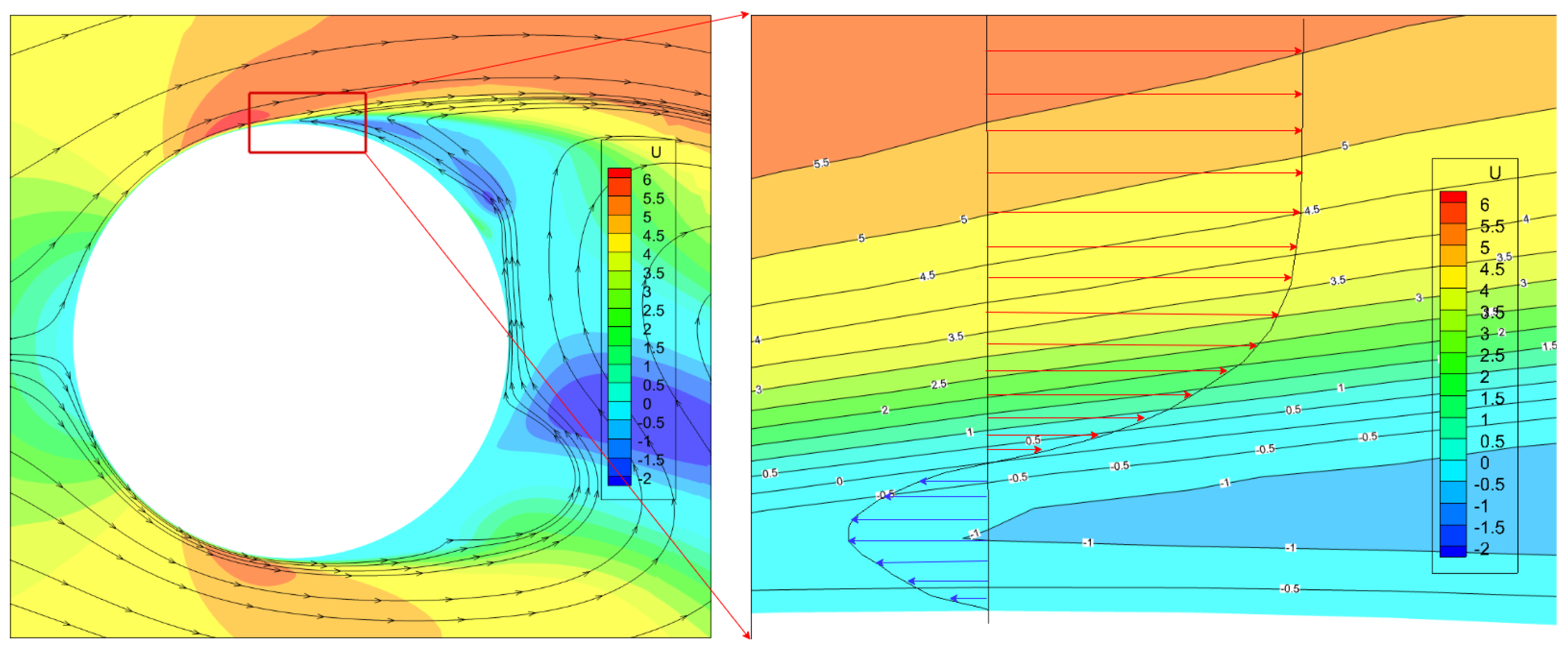
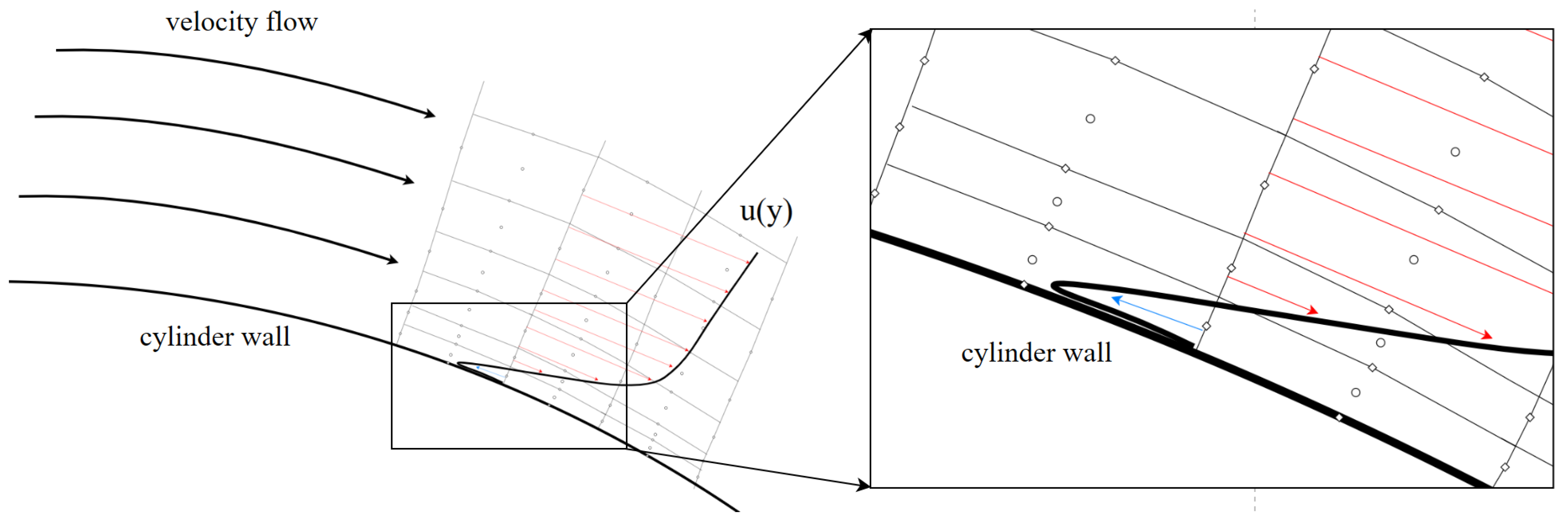
The study aims to provide a solver developer-oriented perspective for problem analysis. In addition to the inherent limitations of the turbulence model, computational accuracy is also related to the solver architecture and flow phenomena. As shown in Figure 12, the flow can be regarded as secondary flows, which emerge near the separation points of the cylinder wall, arising from flow recirculation induced by flow separation. This phenomenon results in an S-shaped distribution of the velocity variation trend along the tangential direction of the cylinder. A Taylor expansion can be applied to the velocity distribution u ( y ) at the wall surface ( y = k , which k > 0 ), yielding the following equation:
u ( y ) = u ( k ) + i = 1 n f n ( k ) n ! ( x n ) n
When velocity characteristics vary, the approximation accuracy of u ( y ) differs accordingly. In the problem investigated in this study, the presence of secondary flow near the velocity separation points around the cylinder endows u ( y ) with the relevant characteristics listed in Table 6, that is, requiring a precision of the second order or higher. Its expansion can therefore be approximated using the following formula:
u ( y ) = f ( k ) ( y k ) + f ( k ) 2 ( y k ) 2 + f ( k ) 6 ( y k ) 3
To accurately resolve the transition phenomenon of flow around a cylinder, a higher precision of the third order or above is required. The design of the MarineFlow solver, which solves the flow equations using a cell- and face-centered grid scheme (as illustrated in Figure 13), means that it generally achieves second-order accuracy. Consequently, it is unable to effectively capture the velocity profiles that incorporate secondary flows downstream of the cylinder separation points.
From the perspective of a solver developer, adopting a higher-order finite volume method, such as incorporating additional face nodes or using vertex nodes to improve precision, may offer a more robust engineering solution. Based on computational mathematics, more sampling points correspond to a higher solver accuracy, which allows the velocity profiles of secondary flows to be approximated as second-order curves at finer sampling points, thereby capturing the separated flow phenomena accurately. However, this improvement entails an increase in the computational cost due to the expansion of the matrix scale. Therefore, balancing the trade-off between accuracy and computational cost will be crucial for subsequent studies.
This study had seceral limitations. Firstly, more sampling points could potentially be achieved by employing a finer mesh (such as y + 1 ). However, as Concerned that this study were more focused on validation for a wide range of Reynolds numbers validation, mesh independence for all cases was not feasible due to the computational resource constraints. The present scheme, which adopted fixed y+ and two-dimensional stretched meshes, may have influenced the computational results. In future work will, we plan to select specific Reynolds numbers ( 10 5 and 4 × 10 5 ) for a more detailed validation, including mesh independence studies using sufficiently refined meshes. Second, considering the limitations of the turbulent viscosity hypothesis adopted in this study, the above analysis are ideal speculations based on time-averaged results. In practice, transitional flow is unsteady and exhibits three-dimensional effects; even a third-order scheme cannot capture the velocity profiles. This necessitates further verification of higher-order schemes by developers.

5. Conclusions

This study was based on the marine CFD code MarineFlow and conducted a systematic investigation of numerical simulation schemes applicable to the turbulent flow around a cylinder over a wide range of Reynolds numbers. The findings identified the simulation schemes suitable for MarineFlow and were then compared with results from commercial software. Finally, this problem was analyzed from the perspective of code engineers, leading to the following conclusions:
  • Within the low Reynolds number and subcritical Reynolds number range (1–105), scheme simulations using unstructured grids and laminar models showed good agreement with the average drag coefficient and thus can be applied to engineering scheme designs. Simulations in the transition Reynolds number range for laminar–turbulent flow and supercritical regions, although showing a trend of reduced resistance, exhibited significant discrepancies with the actual results.
  • The pressure drag is a major component of the average drag. Different schemes simulate distinct flow field velocity distributions and flow separation points. Furthermore, the velocity field and separation points also affect the cylinder surface pressure distribution, including the magnitude and angle of the pressure extremum and the pressure in the downstream region, thereby influencing the total drag obtained via integral calculation.
  • Finally, by comparing the results obtained from commercial software, it was found that existing commercial software also fails to effectively simulate the phenomenon of sudden reduction in drag. This may be attributed to the limitations of the current scheme and code architecture in the turbulent-viscosity hypothesis. The secondary flow requires a precision of the third order or above, yet existing codes only reach second-order accuracy. Without additional sampling points, accurately resolving this problem is a major challenge.
The research outcomes of this study provide a perspective for the development of transition models. Furthermore, in response to the limitations of this study, future work will adopt high-order methods or LES to conduct analysis for specific Reynolds numbers and perform mesh independence verification using sufficiently refined meshes.

Author Contributions

Conceptualization, methodology, H.Y. and C.W.; software, T.H., J.W. and C.W.; validation, H.Y. and T.H.; formal analysis, H.Y. and J.Y.; investigation, H.Y.; resources, J.W.; data curation, H.Y.; writing—original draft preparation, review and editing, H.Y. and J.Y.; visualization, H.Y. and J.Y.; supervision, T.H. and C.W.; project administration, C.W. All authors have read and agreed to the published version of the manuscript.

Funding

This research received no external funding.

Institutional Review Board Statement

Not applicable; this study consists of computational software and does not involve humans or animals.

Informed Consent Statement

Not applicable.

Data Availability Statement

The data presented in this study are available on request from the corresponding author.

Conflicts of Interest

The authors declare no conflicts of interest.

References

  1. Andersson, J.; Shiri, A.A.; Bensow, R.E.; Jin, Y.; Wu, C.; Qiu, G.; Deng, G.; Queutey, P.; Xing-Kaeding, Y.; Horn, P.; et al. Ship-scale CFD benchmark study of a pre-swirl duct on KVLCC2. Appl. Ocean Res. 2022, 123, 103134. [Google Scholar] [CrossRef]
  2. ITTC. Figure on p. 509, Volume II, 29th ITTC Conference. 2021. Available online: https://ittc.info/media/10940/volume-ii.pdf (accessed on 27 January 2026).
  3. Thom, A. The flow past circular cylinders at low speeds. Proc. R. Soc. Lond. Ser. A 1933, 141, 651–669. [Google Scholar] [CrossRef]
  4. Hirota, I.; Miyakoda, K. Numerical solution of Kármán vortex street behind a circular cylinder. J. Meteorol. Soc. Jpn. Ser. II 1965, 43, 30–41. [Google Scholar] [CrossRef]
  5. Thoman, D.C.; Szewczyk, A.A. Time-dependent viscous flow over a circular cylinder. Phys. Fluids 1969, 12, II-76–II-86. [Google Scholar] [CrossRef]
  6. Tsuboi, K.; Tamura, T.; Kuwahara, K. Numerical study for vortex induced vibration of a circular cylinder in high-Reynolds-number flow. In 27th Aerospace Sciences Meeting; American Institute of Aeronautics and Astronautics: Reston, VA, USA, 1989; p. 294. [Google Scholar]
  7. Xi, X.; You, Z.; Wang, Z. The three types of turbulence models and stability numerical simulation studies for cylindrical flow. Hydro-Sci. Eng. 2024, 5, 84–94. [Google Scholar]
  8. Benim, A.C.; Cagan, M.; Nahavandi, A.; Pasqualotto, E. RANS predictions of turbulent flow past a circular cylinder over the critical regime. In Proceedings of the 5th IASME/WSEAS International Conference on Fluid Mechanics and Aerodynamics, Athens, Greece, 25–27 August 2007; pp. 232–237. [Google Scholar]
  9. Ong, M.C.; Utnes, T.; Holmedal, L.E.; Myrhaug, D.; Pettersen, B. Numerical simulation of flow around a smooth circular cylinder at very high Reynolds numbers. Mar. Struct. 2009, 22, 142–153. [Google Scholar] [CrossRef]
  10. Yuce, M.I.; Kareem, D.A. A numerical analysis of fluid flow around circular and square cylinders. J. Am. Water Works Assoc. 2016, 108, E546–E554. [Google Scholar] [CrossRef]
  11. Ferziger, J.; Perić, M.; Street, R. Computational Methods for Fluid Dynamics; Springer: Cham, Switzerland, 2019. [Google Scholar]
  12. Sagaut, P. Large Eddy Simulation for Incompressible Flows: An Introduction; Springer: Berlin/Heidelberg, Germany, 2006. [Google Scholar]
  13. Lloyd, T.; James, M. Large eddy simulations of a circular cylinder at Reynolds numbers surrounding the drag crisis. Appl. Ocean Res. 2016, 59, 676–686. [Google Scholar] [CrossRef]
  14. Jiang, H.; Cheng, L. Large-eddy simulation of flow past a circular cylinder for Reynolds numbers 400 to 3900. Phys. Fluids 2021, 33, 034119. [Google Scholar] [CrossRef]
  15. She, Z.; Chen, X.; Wu, Y.; Hussain, F. New perspective in statistical modeling of wall-bounded turbulence. Acta Mech. Sin. 2010, 26, 847–861. [Google Scholar] [CrossRef]
  16. She, Z.; Wu, Y.; Chen, X.; Hussain, F. A multi-state description of roughness effects in turbulent pipe flow. New J. Phys. 2012, 14, 093054. [Google Scholar] [CrossRef]
  17. Wu, Y.; Chen, X.; She, Z.; Hussain, F. Incorporating boundary constraints to predict mean velocities in turbulent channel flow. Sci. China Phys. Mech. Astron. 2012, 55, 1691–1695. [Google Scholar] [CrossRef]
  18. Zhao, S.N. Turbulence Problems: Ten Lectures—Foundations for Understanding and Researching Turbulence; Science Press: Beijing, China, 2016. [Google Scholar]
  19. Moukalled, F.; Mangani, L.; Darwish, M. The Finite Volume Method in Computational Fluid Dynamics; Springer: Cham, Switzerland, 2016. [Google Scholar]
  20. Schlichting, H.; Gersten, K. Boundary-Layer Theory; Springer: Berlin/Heidelberg, Germany, 2016. [Google Scholar]
  21. Batchelor, G.K. An Introduction to Fluid Dynamics; Cambridge University Press: Cambridge, UK, 2000. [Google Scholar]
  22. Zhao, Z.; Wang, J.; Gong, Y.; Xu, H. Large eddy simulation of flow and separation bubbles around a circular cylinder from sub-critical to super-critical Reynolds numbers. J. Mar. Sci. Appl. 2023, 22, 219–231. [Google Scholar] [CrossRef]
  23. Shih, W.C.L.; Wang, C.; Coles, D.; Roshko, A. Experiments on flow past rough circular cylinders at large Reynolds numbers. J. Wind Eng. Ind. Aerodyn. 1993, 49, 351–368. [Google Scholar] [CrossRef]
  24. Pope, S.B. Turbulent flows. Meas. Sci. Technol. 2001, 12, 2020–2021. [Google Scholar] [CrossRef]
Figure 1. Flow chart of the MarineFlow code.
Fluids 11 00068 g001
Figure 2. Comparison chart of computational grids and boundary conditions, the left column corresponds to the structured grid and near-wall region, the right column corresponds to the unstructured grid and near-wall region.
Fluids 11 00068 g002
Figure 3. Comparison graph of average drag coefficient from a wide range of Reynolds number simulations and the Batchelor curve.
Fluids 11 00068 g003
Figure 4. Drag coefficient time-history plots of all schemes at a Reynolds number of R e = 10 5 .
Fluids 11 00068 g004
Figure 5. Time-averaged flow field of all schemes at a Reynolds number of R e = 10 5 : (a) structured grid and laminar flow; (b) structured grid and SST k ω ; (c) unstructured grid and laminar flow; (d) structured grid and SST k ω .
Fluids 11 00068 g005
Figure 6. Pressure distribution on the cylinder surface for each scheme at a dimensionless time of 200 and R e = 10 5 .
Fluids 11 00068 g006
Figure 7. Comparison graph of the average drag coefficient for the transition Reynolds number simulation and the Batchelor curve.
Fluids 11 00068 g007
Figure 8. Drag coefficient time-history plots of all schemes at a Reynolds number of R e = 4 × 10 5 .
Fluids 11 00068 g008
Figure 9. Time-averaged flow field of all schemes at a Reynolds number of R e = 4 × 10 5 : (a) structured grid and laminar flow; (b) structured grid and SST k ω ; (c) unstructured grid and laminar flow; (d) structured grid and SST k ω .
Fluids 11 00068 g009
Figure 10. Pressure distribution on the cylinder surface for each scheme at a dimensionless time of 100 and R e = 4 × 10 5 .
Fluids 11 00068 g010
Figure 11. Comparison graph of average drag coefficient for the Batchelor curve and the transition simulation by different commercial software.
Fluids 11 00068 g011
Figure 12. Velocity vector distribution along the flow direction near the cylinder wall.
Fluids 11 00068 g012
Figure 13. Cell-centered and face-centered grid distributions near the cylinder wall, as well as the velocity distribution u ( y ) .
Fluids 11 00068 g013
Table 1. Design of the wide range of Reynolds number simulation scheme.
Re Turbulence ModelsGrid TypeGrid Count
1LaminarUnstructured/Structured5221/33,958
10LaminarUnstructured/Structured5221/33,958
10 2 LaminarUnstructured/Structured5221/33,958
10 3 Laminar/SST k ω Unstructured/Structured5391/47,753
10 4 Laminar/SST k ω Unstructured/Structured5391/64,446
10 5 Laminar/SST k ω Unstructured/Structured11,749/68,046
10 6 SST k ω Unstructured/Structured15,911/71,654
10 7 SST k ω Unstructured/Structured34,383/80,005
Table 2. Design of simulation scheme for the range of Reynolds number in transition.
Re Turbulence ModelsGrid TypeGrid Count
2 × 10 5 Laminar/SST k ω Unstructured/Structured15,494/69,853
4 × 10 5 Laminar/SST k ω Unstructured/Structured15,560/73,453
6 × 10 5 Laminar/SST k ω Unstructured/Structured15,687/75,253
Table 3. Additional solver settings.
AlgorithmVelocity RelaxationPressure RelaxationConvectionConvergence Criteria
SIMPLE0.30.3SOU 10 6
Table 4. Table of each scheme’s average drag coefficient when the Reynolds number is 10 5 .
SchemesFriction Resistance CoefficientPressure Resistance CoefficientTotal
Structured grid and laminar flow0.012641.455821.46846
Structured grid and SST k ω 0.015640.638840.65448
Unstructured grid and laminar flow0.010631.100561.11119
Unstructured grid and SST k ω 0.012970.747720.76069
Table 5. Table of each scheme’s average drag coefficient when the Reynolds number is 4 × 10 5 .
SchemesFriction Resistance CoefficientPressure Resistance CoefficientTotal
Structured grid and laminar flow0.004671.070231.07490
Structured grid and SST k ω 0.011930.846950.85888
Unstructured grid and laminar flow0.017121.308561.32568
Unstructured grid and SST k ω 0.013180.530160.54335
Table 6. Approximation accuracy requirements for velocity functions under different boundary conditions.
Boundary Conditions u ( y ) Accuracy Request
y = k , u = 0 u ( k ) = 0
( y > k , u > 0 ) or ( y < k , u < 0 )1st order
u · 0 , u · · 0 2nd order
( y < k , u · · > 0 ) or ( y > k , u · · < 0 ) or ( y = k , u · · = 0 )2nd order or higher
Disclaimer/Publisher’s Note: The statements, opinions and data contained in all publications are solely those of the individual author(s) and contributor(s) and not of MDPI and/or the editor(s). MDPI and/or the editor(s) disclaim responsibility for any injury to people or property resulting from any ideas, methods, instructions or products referred to in the content.