Chitosan Hydrogels for Antibiotic Remediation and Dye Removal: A Review

Abstract
1. Introduction
2. Fabrication and Construction Strategies of Chitosan-Based Hydrogels
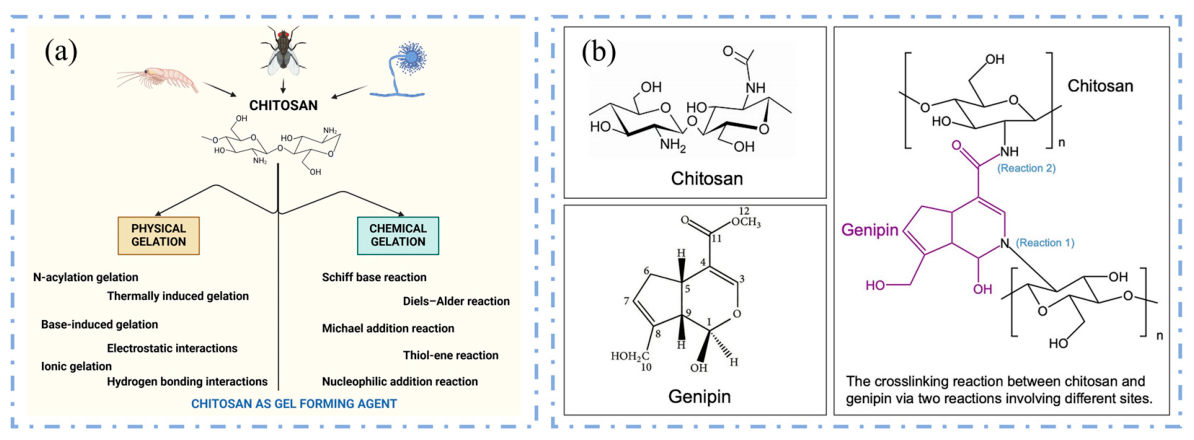
2.1. Cross-Linking Mechanisms of Chitosan Hydrogels
2.2. Functional Modification at the Molecular Level
2.3. Multi-Dimensional Structural Design
3. Application of Chitosan-Based Hydrogels in Antibiotic Remediation
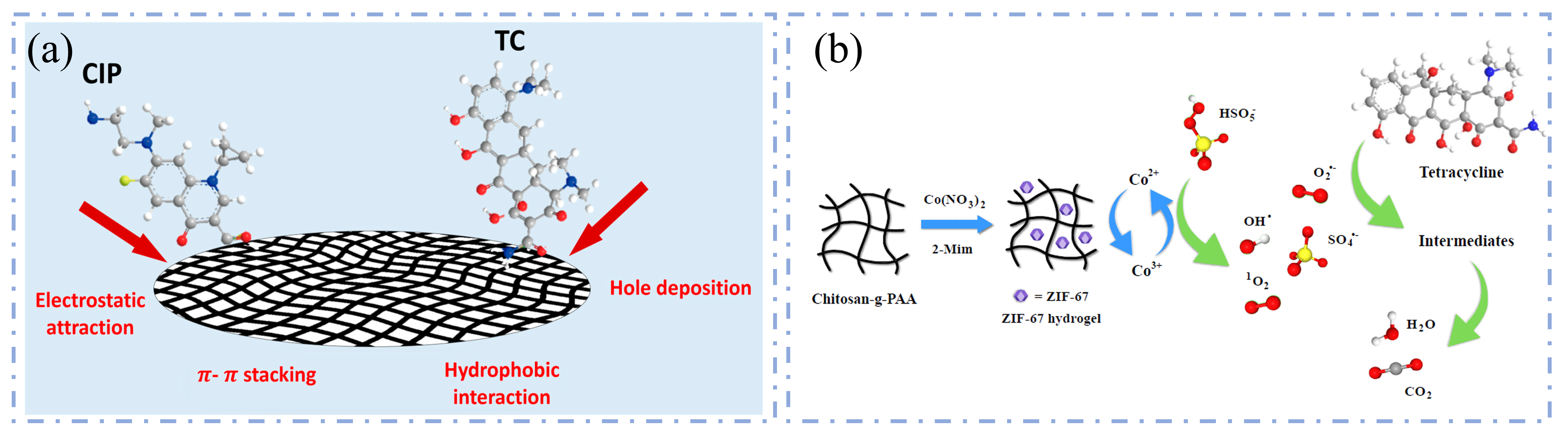
3.1. Adsorption Performance Toward Tetracyclines

3.2. Adsorption Performance for Quinolone Antibiotics
3.3. Removal of Sulfonamides and Other Antibiotics

| Adsorbent Material/System | Target Pollutant | Max. Adsorption Capacity (mg/g) | Operating Conditions (pH, Time, Temp) | Regeneration Performance | Dominant Mechanism(s) | Ref. |
|---|---|---|---|---|---|---|
| CCP double-network hydrogel (DES-based) | TC | / | Acidic conditions | 5 cycles (84.3–93.4% retention) | Electrostatic attraction (NH3+ and O−) | [48] |
| Oxidized cellulose/CS/Fe3O4 magnetic hydrogel | TC | / | pH < 4, H2O2 presence | Magnetic separation | Synergistic adsorption-oxidation (Fenton-like, ·OH) | [49] |
| TCMA-modified chitosan (Ionic liquid) | TC | 22.42 | pH 5–11, 45 min, 45 °C | High stability over a wide pH window | Ion-exchange, pseudo-first-order, Langmuir monolayer | [50] |
| CS/halloysite MIP hydrogels | TC | 178.05 | Diluted synthesis conditions | / | Specific recognition, pore matching, multi-site synergy | [52] |
| Co/Zn MOF (UiO-66)/biochar/CS aerogel | TC | 1693.45 | / | 10 cycles (~80% retention) | Monolayer chemisorption, Lewis acid coordination, π-π stacking | [54] |
| rGO@ZIF-67@CS double-network hydrogel | NOR/TC | 1890.32 (NOR)/1685.26 (TC) | pH 5 (NOR), pH 4 (TC) | / | Pore filling, π-π stacking, H-bonding | [57] |
| CS/alginate beads + MSe-MOF | CIP | 440 | / | / | Entropy-driven endothermic chemisorption | [58] |
| BC-MgO-CS composite | CIP | 1678.9 | / | / | Lewis base/acid complexation, electrostatic attraction | [59] |
| Humic acid-coated biochar/CS (HBCB) | CIP | 154.89 | / | 4 cycles (>47 mg/g net adsorption capacity) | π-π EDA interactions, H-bonding, hydrophobic, electrostatic | [60] |
| Acrylic acid-grafted hydrogel | CIP/ENR | 267.7 (CIP)/387.7 (ENR) | pH 3 | 5 cycles (>85% retention) | Electrostatic attraction (anion-responsive COO−) | [62] |
| CH@COF + TA-Fe3+ interlayer membrane | NOR, CIP, OFL | >94% rejection | Continuous flow | 98% flux recovery | Size sieving, H-bonding, Fe3+ coordination | [63] |
| TiO2/biochar-loaded CS microspheres | CIP | 85.23% degradation | Ultrasonic power | 4 cycles (62% efficiency) | Sono-photocatalytic degradation (•O2−, h+, •OH) | [64] |
| CS/carbon nitride aerogel + AgNPs | SMX | 83.06% (ads)/99.22% (deg) | 20 min contact/UV | 6 cycles | SERS detection, hot electron injection, π-π stacking | [66] |
| PAC-modified CS/PVA hydrogel | SMX/BPA | 9.1 (SMX)/64.6 (BPA) | pH 4 (SMX), pH 2–9 (BPA) | Stable in real water matrices | H-bonding (SMX), hydrophobic partition (BPA) | [67] |
| PNIPAM/CS IPN hydrogel | SMZ/BPA | / | 5 min, 25 °C to 35 °C | / | Electrostatic (SMZ), hydrophobic inclusion (BPA) | [68] |
| Cationic hydrogel particles (CHPs) | AMX/TMP | >90% removal | pH 6.0 (AMX), pH 4.0 (TMP) | / | Electrostatic attraction (pH-dependent speciation) | [69] |
| Ni-Al LDH-modified biochar/CS hydrogel | ERY/AMX | 763 (ERY)/835 (AMX) | 20 mg/L initial conc. | 7 cycles (≥88% retention) | Lewis acid coordination (Ni2+), π-π stacking | [71] |
| Fe@N-doped carbon/CMCS nanocomposite | SMX | Complete degradation | Broad pH, high salinity | / | PMS activation, singlet oxygen (1O2) non-radical pathway | [73] |
4. Application of Chitosan-Based Hydrogels for Dye Removal
- (1)
- For cationic dyes: The inherent electrostatic repulsion between the polycationic chitosan backbone and positively charged dyes is mitigated by grafting anionic moieties (e.g., carboxyl or sulfonic groups) or compositing with anionic materials, effectively reversing the surface charge to favor adsorption.
- (2)
- For anionic dyes: The mechanism leverages the intrinsic electrostatic attraction provided by the protonated amino groups (-NH3+) of chitosan, while cross-linking strategies are simultaneously employed to reinforce the hydrogel’s structural integrity and prevent dissolution.
- (3)
- For reactive dyes and complex mixed systems: Multimodal interaction mechanisms—integrating hydrogen bonding, π-π stacking, and hydrophobic interactions—are engineered to achieve selective adsorption and separation in competitive environments.
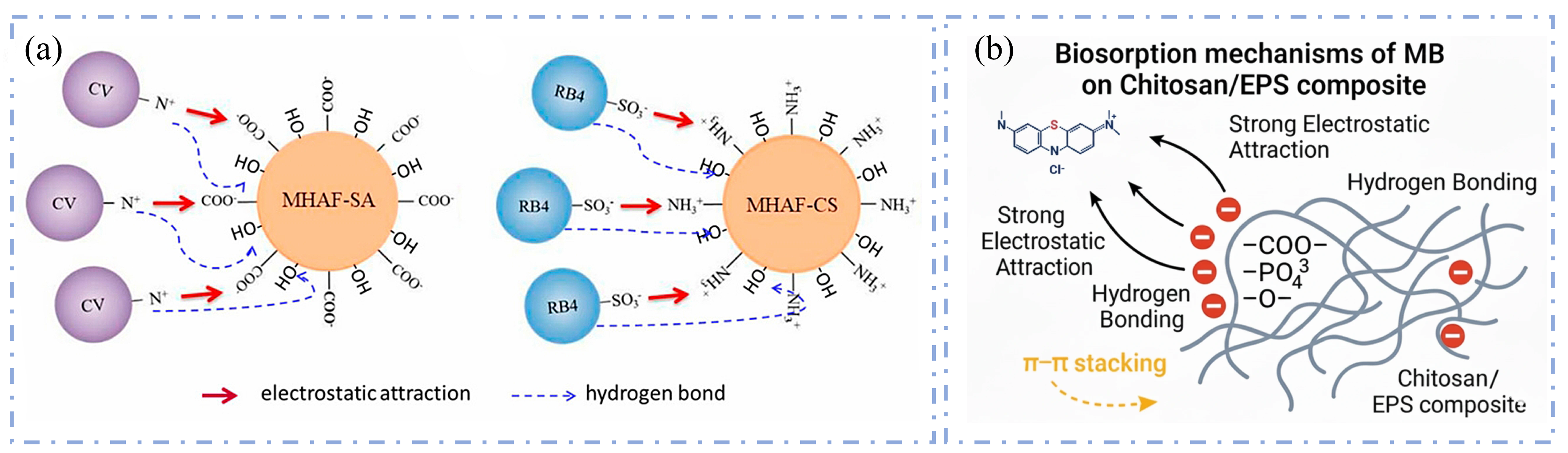
4.1. Removal of Cationic Dyes

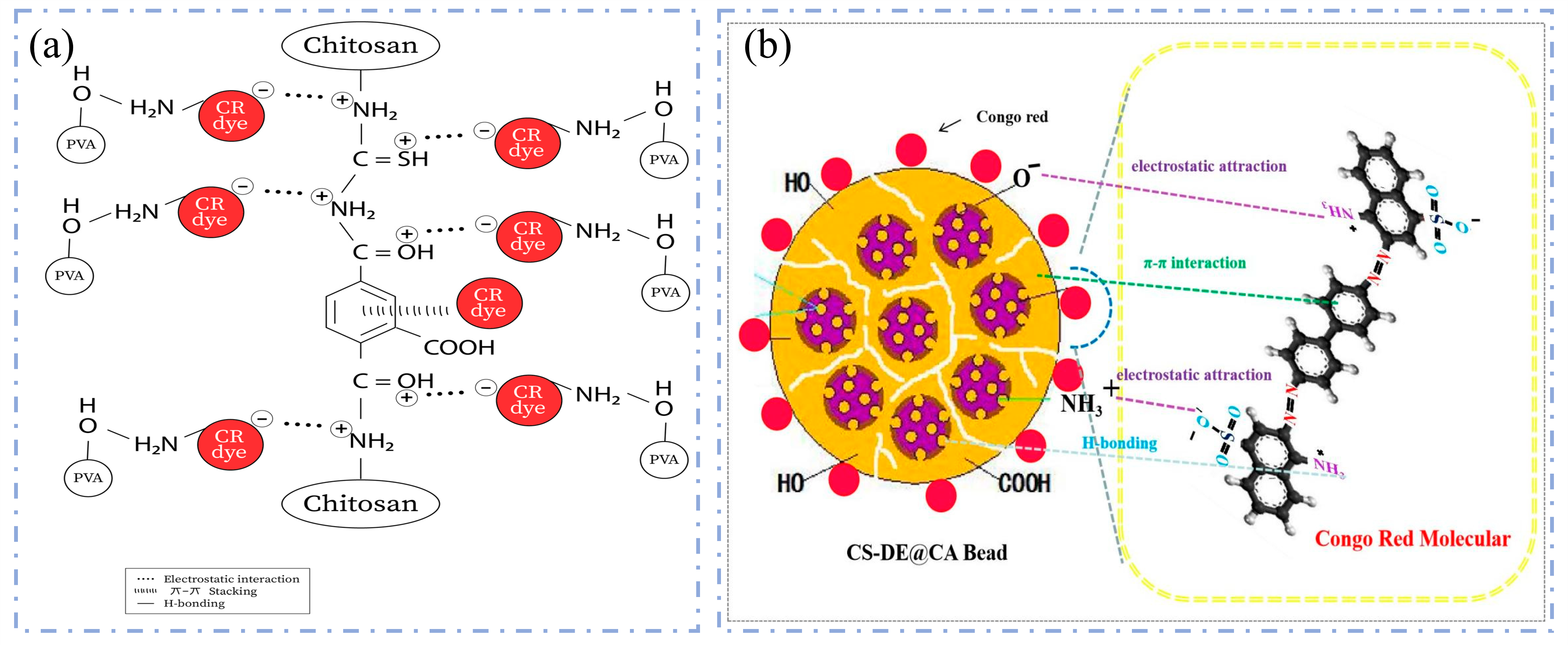
4.2. Removal of Anionic Dyes

4.3. Removal of Metal Complex Dyes, Vat Dyes, and Direct Dyes
5. Summary and Outlook
Author Contributions
Funding
Data Availability Statement
Conflicts of Interest
References
- Burnham, J.P. The Antimicrobial Resistance-Water-Corporate Interface: Exploring the Connections Between Antimicrobials, Water, and Pollution. Trop. Med. Infect. Dis. 2025, 10, 105. [Google Scholar] [CrossRef] [Scilit] [PubMed]
- Hu, J.; Li, S.; Zhang, W.; Helbling, D.E.; Xu, N.; Sun, W.; Ni, J. Animal production predominantly contributes to antibiotic profiles in the Yangtze River. Water Res. 2023, 242, 120214. [Google Scholar] [CrossRef] [Scilit] [PubMed]
- Teo, S.H.; Ng, C.H.; Islam, A.; Abdulkareem-Alsultan, G.; Joseph, C.G.; Janaun, J.; Taufiq-Yap, Y.H.; Khandaker, S.; Islam, G.J.; Znad, H.; et al. Sustainable toxic dyes removal with advanced materials for clean water production: A comprehensive review. J. Clean. Prod. 2022, 332, 130039. [Google Scholar] [CrossRef] [Scilit]
- Xue, X.; Hu, J.; Guo, P.; Wang, L.; Wang, L.; Dong, Y.; Xiao, F.; Li, C.; Ding, S. Cellulose-Based Composite Hydrogels for Heavy Metal Ion Removal: Recent Advances and Engineering Perspectives. Gels 2026, 12, 380. [Google Scholar] [CrossRef] [Scilit] [PubMed]
- Xing, G.; Lu, J.; Xuan, L.; Chen, J.; Xiong, J. Sediment prokaryotic assembly, methane cycling, and ammonia oxidation potentials in response to increasing antibiotic pollution at shrimp aquafarm. J. Hazard. Mater. 2022, 434, 128885. [Google Scholar] [CrossRef] [Scilit] [PubMed]
- Zhao, K.; Wang, Q.; Qian, S.; Li, F. Spatial and temporal distribution characteristics of antibiotics and heavy metals in the Yitong River basin and ecological risk assessment. Sci. Rep. 2023, 13, 4202. [Google Scholar] [CrossRef] [Scilit] [PubMed]
- Gunathilaka, M.D.K.L.; Bao, S.; Liu, X.; Li, Y.; Pan, Y. Antibiotic Pollution of Planktonic Ecosystems: A Review Focused on Community Analysis and the Causal Chain Linking Individual- and Community-Level Responses. Environ. Sci. Technol. 2023, 57, 1199–1213. [Google Scholar] [CrossRef] [Scilit] [PubMed]
- Aouay, F.; Attia, A.; Dammak, L.; Ben Amar, R.; Deratani, A. Activated Carbon Prepared from Waste Coffee Grounds: Characterization and Adsorption Properties of Dyes. Materials 2024, 17, 3078. [Google Scholar] [CrossRef] [Scilit] [PubMed]
- Ismail, M.; Akhtar, K.; Khan, M.; Kamal, T.; Khan, M.; Asiri, A.M.; Seo, J.; Khan, S. Pollution, Toxicity and Carcinogenicity of Organic Dyes and their Catalytic Bio-Remediation. Curr. Pharm. Des. 2019, 25, 3653–3671. [Google Scholar] [CrossRef] [Scilit] [PubMed]
- Sen, T.K. Agricultural Solid Wastes Based Adsorbent Materials in the Remediation of Heavy Metal Ions from Water and Wastewater by Adsorption: A Review. Molecules 2023, 28, 5575. [Google Scholar] [CrossRef] [Scilit] [PubMed]
- Wang, L.; Hu, J.; Wang, L.; Xue, X.; Guo, P.; Dong, Y.; Xiao, F.; Li, C.; Guo, L. Hydrogels for Agricultural Applications: From Soil Amendment to Crop Enhancement. Gels 2026, 12, 413. [Google Scholar] [CrossRef] [Scilit] [PubMed]
- Liang, J.; Zhao, Z.; Xing, M.; Wang, X.; Dong, Y.; Yang, Y.; Du, N.; Gu, H.; Meng, L.; Peng, W.; et al. Improving properties of soy protein–based hydrogel composites by incorporating bamboo biochar towards slow release and water retention of fertilizers and enhanced plant growth. Adv. Compos. Hybrid. Mater. 2024, 8, 53. [Google Scholar] [CrossRef] [Scilit]
- Tian, Z.; Li, G.; Chen, X.; Li, C.; Liu, R.; Yue, X.; Peng, W.; Gu, H. Innovative lignin-based MOFs and COFs for biomedicine, energy storage, and environmental remediation. Adv. Compos. Hybrid Mater. 2025, 8, 114. [Google Scholar] [CrossRef] [Scilit]
- Lei, Z.; Shao, J.; Li, C.; Jiang, S.; Yao, M.; Li, J. Skin-Inspired Durable and Cost-Effective Biomass-Based Supramolecular Adhesives. Adv. Funct. Mater. 2025, 35, 2501624. [Google Scholar] [CrossRef] [Scilit]
- Li, C.; Li, Z.; Wang, L.; Xue, X.; Xiao, F.; Guo, J.; Li, J.; Dong, Y.; Li, J.; Bao, C. High-Performance Phenolic Resin Reinforced by Tannic Acid-Polyethyleneimine Functionalized Multi-Walled Carbon Nanotubes for Wood-Based Panels. Macromol. Rapid Commun. 2026, 47, e00814. [Google Scholar] [CrossRef] [Scilit] [PubMed]
- Saheed, I.O.; Oh, W.D.; Suah, F.B.M. Chitosan modifications for adsorption of pollutants—A review. J. Hazard. Mater. 2021, 408, 124889. [Google Scholar] [CrossRef] [Scilit] [PubMed]
- Zhang, J.; Zhu, W.; Liang, J.; Li, L.; Zheng, L.; Shi, X.; Wang, C.; Dong, Y.; Li, C.; Zhu, X. In Situ Synthesis of Gold Nanoparticles from Chitin Nanogels and Their Drug Release Response to Stimulation. Polymers 2024, 16, 390. [Google Scholar] [CrossRef] [Scilit] [PubMed]
- Li, C.; Li, M.; Li, Z.; Guo, P.; Zhao, Z.; Lu, W.; Li, J.; Liang, J.; Tang, Y.; Ge, S.; et al. Cleaner production of liquefied biomass-based phenol–formaldehyde resin with improved properties via catalyzed copolymerization. Adv. Compos. Hybrid. Mater. 2024, 8, 101. [Google Scholar] [CrossRef] [Scilit]
- Mohammadzadeh Pakdel, P.; Peighambardoust, S.J. Review on recent progress in chitosan-based hydrogels for wastewater treatment application. Carbohydr. Polym. 2018, 201, 264–279. [Google Scholar] [CrossRef] [Scilit] [PubMed]
- Fan, X.; Wang, X.; Cai, Y.; Xie, H.; Han, S.; Hao, C. Functionalized cotton charcoal/chitosan biomass-based hydrogel for capturing Pb2+, Cu2+ and MB. J. Hazard. Mater. 2022, 423, 127191. [Google Scholar] [CrossRef] [Scilit] [PubMed]
- Li, H.; Zhang, L.; Xue, X.; Meng, Y.; Dong, Y.; Xiao, F.; Wang, H.; Li, C. Separation of Lignin from Paulownia and Its Application in DES Gels. Gels 2026, 12, 365. [Google Scholar] [CrossRef] [Scilit] [PubMed]
- Zhang, L.; Shen, B.; Zheng, C.; Huang, Y.; Liang, Y.; Fei, P.; Chen, J.; Lai, W. Chitosan/oxidized sodium alginate/Ca2+ hydrogels: Synthesis, characterization and adsorption properties. Food Hydrocoll. 2024, 156, 110368. [Google Scholar] [CrossRef] [Scilit]
- Balakrishnan, A.; Appunni, S.; Chinthala, M.; Jacob, M.M.; Vo, D.-V.N.; Reddy, S.S.; Kunnel, E.S. Chitosan-based beads as sustainable adsorbents for wastewater remediation: A review. Environ. Chem. Lett. 2023, 21, 1881–1905. [Google Scholar] [CrossRef] [Scilit]
- Li, C.; Zhao, Z.; Li, M.; Ye, Q.; Li, Z.; Wang, Y.; Peng, W.; Guo, J.; Chen, X.; Li, H. Constructing ultra-strong and water resistance magnesium oxychloride cement-based adhesive for wood industry. Adv. Compos. Hybrid. Mater. 2024, 8, 90. [Google Scholar] [CrossRef] [Scilit]
- Rostami, M.S.; Khodaei, M.M.; Benassi, E. Surface modified of chitosan by TiO2@MWCNT nanohybrid for the efficient removal of organic dyes and antibiotics. Int. J. Biol. Macromol. 2024, 274, 133382. [Google Scholar] [CrossRef] [Scilit] [PubMed]
- Li, Y.; Zhang, H.; Qu, G.; Xie, L.; Tang, S.; Lei, H.; Zhong, Y.; Zhang, Y.-F. Efficient removal of antibiotics from wastewater by chitosan/polyethyleneimine/Ti3C2 MXene composite hydrogels: Synthesis, adsorption, kinetics and mechanisms. Colloids Surf. Physicochem. Eng. Asp. 2024, 702, 135111. [Google Scholar] [CrossRef] [Scilit]
- Li, C.; Zhou, N.; Guo, P.R.; Li, M.; Wang, F.; Li, J.J.; Han, Y.F.; Wu, Z.G.; Lu, W.J. Innovative barnacle-inspired organic-inorganic hybrid magnesium oxychloride cement composites with exceptional mechanical strength and water resistance. Adv. Compos. Hybrid Mater. 2025, 8, 12. [Google Scholar] [CrossRef] [Scilit]
- Duan, X.; Chen, X.; Li, C.; Witherspoon, E.; Burcar, E.; Wang, Z.; Peng, W.; Pereira, A.; Li, H. Progress of MOFs and their derivatives for mitigating air pollution. Adv. Compos. Hybrid Mater. 2024, 7, 114. [Google Scholar] [CrossRef] [Scilit]
- Luo, Q.; Ren, T.; Lei, Z.; Huang, Y.; Huang, Y.; Xu, D.; Wan, C.; Guo, X.; Wu, Y. Non-toxic chitosan-based hydrogel with strong adsorption and sensitive detection abilities for tetracycline. Chem. Eng. J. 2022, 427, 131738. [Google Scholar] [CrossRef] [Scilit]
- Demirdağ, E.; Demirel, M.F.; Benek, V.; Doğru, E.; Önal, Y.; Alkan, M.H.; Erol, K.; Alacabey, İ. Efficient Removal of Ciprofloxacin from Water Using High-Surface-Area Activated Carbon Derived from Rice Husks: Adsorption Isotherms, Kinetics, and Thermodynamic Evaluation. Molecules 2025, 30, 2501. [Google Scholar] [CrossRef] [Scilit] [PubMed]
- Liu, Y.; Zhang, X.; Du, Y.; Du, X.; Zhang, Y.; Deng, L.; Li, C.; Guo, J. Functionalization of Wood for the Removal of Heavy Metal Ions from Waster Water: A Review. Forests 2025, 16, 1684. [Google Scholar] [CrossRef] [Scilit]
- Yang, L.; Xing, M.; Xue, X.; Jin, X.; Wang, Y.; Xiao, F.; Li, C.; Wang, F. Preparation and Characterization of a Novel Eco-Friendly Acorn-Based Wood Adhesive with High Performance. Forests 2025, 16, 853. [Google Scholar] [CrossRef] [Scilit]
- Li, H.; Meng, Y.; Wang, L.; Gao, Y.; Dong, Y.; Zhang, L.; Xiao, F.; Wang, H.; Li, C. A Novel Polyacrylamide Composite Hydrogel Reinforced with Deep Eutectic Solvent-Pretreated Paulownia Cellulose/Nanocellulose: Preparation, Characterization and Properties. Gels 2026, 12, 411. [Google Scholar] [CrossRef] [Scilit] [PubMed]
- Blebea, N.-M.; Pușcașu, C.; Vlad, R.-A.; Hancu, G. Chitosan-Based Gel Development: Extraction, Gelation Mechanisms, and Biomedical Applications. Gels 2025, 11, 275. [Google Scholar] [CrossRef] [Scilit] [PubMed]
- Hosseini, S.F.; Rezaei, M.; Zandi, M.; Farahmandghavi, F. Development of bioactive fish gelatin/chitosan nanoparticles composite films with antimicrobial properties. Food Chem. 2016, 194, 1266–1274. [Google Scholar] [CrossRef] [Scilit] [PubMed]
- Chang, L.; Kong, B.; Liu, Q.; Du, X.; Xia, X. Effect of freeze-thaw processes on the water-absorption ability and mechanical properties of hydrogel pads with chitosan/poly(vinyl alcohol) based on citrate crosslinks. Food Chem. 2025, 471, 142785. [Google Scholar] [CrossRef] [Scilit] [PubMed]
- Pan, M.; Bretcanu, O.; Xie, F.; Deehan, D.; Novakovic, K. Uncovering the dominant role of ionic strength in chitosan-genipin and chitosan-genipin-apatite wollastonite gelation kinetics and resulting hydrogel properties. Carbohydr. Polym. 2025, 369, 124328. [Google Scholar] [CrossRef] [Scilit] [PubMed]
- Yang, H.; Zhang, G.; Chen, X.; Hou, F.; Tang, S.; Yang, D.; Wang, Y.; Zhang, W. Carboxymethyl fenugreek gum grafted poly(acrylic-co-2-acrylamide-2-methylpropanesulfonic acid) composite hydrogel with broad pH adaptability for stabilization and efficient adsorption of crystal violet dye. Chem. Eng. Sci. 2025, 308, 121394. [Google Scholar] [CrossRef] [Scilit]
- Tang, B.; Xu, T.; Li, Q.; Tu, J.; Liu, K.; Xu, H.; Wang, X.; Zhou, Y.; Yu, G.; Yin, S.-F. Waste biomass based sodium lignosulfonate/chitosan/polyvinyl alcohol/polyacrylic acid hydrogel for the synergistic adsorption of Levofloxacin and Cu2+ with copper recovery. Carbohydr. Polym. 2025, 369, 124304. [Google Scholar] [CrossRef] [Scilit] [PubMed]
- Zhao, H.; Li, J.; Cong, S.; Hou, H.; Zhang, G.; Bi, J. Fabrication and Anti-Swelling Properties of Gelatin/Sodium Alginate–Carboxymethyl Chitosan-Based Cationic Coordination Hydrogels. Foods 2025, 14, 3149. [Google Scholar] [CrossRef] [Scilit] [PubMed]
- Chen, Z.; Zhang, Z.-B.; Zeng, J.; Zhang, Z.-J.; Ma, S.; Tang, C.-M.; Xu, J.-Q. Preparation of polyethyleneimine-modified chitosan/Ce-UIO-66 composite hydrogel for the adsorption of methyl orange. Carbohydr. Polym. 2023, 299, 120079. [Google Scholar] [CrossRef] [Scilit] [PubMed]
- Zou, X.; Zhao, X.; Ye, L. Synthesis of cationic chitosan hydrogel with long chain alkyl and its controlled glucose-responsive drug delivery behavior. RSC Adv. 2015, 5, 96230–96241. [Google Scholar] [CrossRef] [Scilit]
- Hosseini, H.; Zirakjou, A.; McClements, D.J.; Goodarzi, V.; Chen, W.-H. Removal of methylene blue from wastewater using ternary nanocomposite aerogel systems: Carboxymethyl cellulose grafted by polyacrylic acid and decorated with graphene oxide. J. Hazard. Mater. 2022, 421, 126752. [Google Scholar] [CrossRef] [Scilit] [PubMed]
- Sharma, S.; Bhende, M.; Mulwani, P.; Patil, V.; Verma, H.R.; Kumar, S. Mechanically improved chitosan/graphene oxide nanocomposite hydrogel for sustained release of levofloxacin. Int. J. Biol. Macromol. 2025, 289, 139481. [Google Scholar] [CrossRef] [Scilit] [PubMed]
- Sacourbaravi, R.; Ansari-Asl, Z.; Hoveizi, E.; Darabpour, E. Poly(vinyl alcohol)/Chitosan Hydrogel Containing Gallic Acid-Modified Fe, Cu, and Zn Metal–Organic Frameworks (MOFs): Preparation, Characterization, and Biological Applications. ACS Appl. Mater. Interfaces 2024, 16, 61609–61620. [Google Scholar] [CrossRef] [Scilit] [PubMed]
- Viteri, A.; Espanol, M.; Ginebra, M.-P.; García-Torres, J. Tailoring drug release from skin-like chitosan-agarose biopolymer hydrogels containing Fe3O4 nanoparticles using magnetic fields. Chem. Eng. J. 2025, 517, 164214. [Google Scholar] [CrossRef] [Scilit]
- Li, H.; Zhou, C.; Wang, L.; Yang, F.; Liang, J.; Wang, F.; Li, P.; Li, C.; Wu, Z.; Ren, T. A novel eco-friendly bamboo-based composite biochar for effective removing oxytetracycline hydrochloride. Adv. Compos. Hybrid Mater. 2024, 8, 91. [Google Scholar] [CrossRef] [Scilit]
- Li, S.; Gao, D.; Lin, J.; Wen, Z.; Zhang, K.; Xia, Z.; Wang, D. Preparation of double-network hydrogel consisting of chitosan, cellulose and polyacrylamide for enrichment of tetracyclines. Microchem. J. 2022, 182, 107931. [Google Scholar] [CrossRef] [Scilit]
- Dehghani Firoozabadi, A.; Eslami, H.; Sabzevari, A.; Ansari, M. Removal of Tetracycline Antibiotic as a Hospital Waste by pH-Sensitive Degradable Composite Hydrogel Using Fenton-Like System. J. Polym. Sci. 2025, 63, 1236–1248. [Google Scholar] [CrossRef] [Scilit]
- Ranjbari, S.; Tanhaei, B.; Ayati, A.; Khadempir, S.; Sillanpää, M. Efficient tetracycline adsorptive removal using tricaprylmethylammonium chloride conjugated chitosan hydrogel beads: Mechanism, kinetic, isotherms and thermodynamic study. Int. J. Biol. Macromol. 2020, 155, 421–429. [Google Scholar] [CrossRef] [Scilit] [PubMed]
- Qian, Z.; Li, X.; Yan, G.; Chen, X.; Sajab, M.S.; Ding, G.; Wan Jusoh, W.N.L. Sodium Alginate/Carboxymethyl Chitosan Hydrogel Microbeads for Antibiotic Adsorption in Single and Binary Systems. Gels 2025, 11, 646. [Google Scholar] [CrossRef] [Scilit] [PubMed]
- Kurczewska, J.; Stachowiak, M.; Cegłowski, M. Chitosan-based hydrogel beads with molecularly imprinted receptors on halloysite nanotubes for tetracycline separation in water and soil. Environ. Res. 2024, 262, 119924. [Google Scholar] [CrossRef] [Scilit] [PubMed]
- Kurczewska, J.; Cegłowski, M. Alginate vs. chitosan composites loaded with halloysite/molecularly imprinted polymer hybrids for tetracycline removal: Comparative studies of adsorption behaviour. Int. J. Biol. Macromol. 2025, 307, 142000. [Google Scholar] [CrossRef] [Scilit] [PubMed]
- Guo, Y.; Huang, J.; Yang, W.; Xu, H. PAA-functionalized UiO-66 incorporated into lotus biochar-chitosan hydrogel: A bimetallic adsorbent with enhanced adsorption capacity for antibiotics. Colloids Surf. Physicochem. Eng. Asp. 2025, 727, 138127. [Google Scholar] [CrossRef] [Scilit]
- Nachaichot, A.; Phonlakan, K.; Nijpanich, S.; Pornsuwan, S.; Budsombat, S. Zeolitic imidazolate framework-67 in chitosan-grafted hydrogel as an effective catalyst for peroxymonosulfate activation to degrade antibiotics and dyes. RSC Adv. 2024, 14, 35628–35637. [Google Scholar] [CrossRef] [Scilit] [PubMed]
- Li, C.; Zhang, X.; Zhou, C.; Yang, F.; Liang, J.; Gu, H.; Wang, J.; Wang, F.; Peng, W.; Guo, J.; et al. Performance and mechanism of a novel bamboo-based magnetic biochar composite for efficient removal of norfloxacin. Adv. Compos. Hybrid Mater. 2024, 8, 71. [Google Scholar] [CrossRef] [Scilit]
- Yang, H.; Wang, S.; Liu, Y.; Hu, Y.; Shen, W. ZIF-67 grows in chitosan-rGO hydrogel beads for efficient adsorption of tetracycline and norfloxacin. Sep. Purif. Technol. 2024, 330, 125208. [Google Scholar] [CrossRef] [Scilit]
- Guesmi, A.; Hamadi, N.B.; El-Fattah, W.A.; Subaihi, A.; Alluhaybi, A.A.; El-Desouky, M.G.; El-Bindary, A.A. Efficient removal of ciprofloxacin in aqueous solutions by magnetic Se-MOF embedded within a biopolymer (chitosan/alginate): Adsorptive behavior, mechanism study, and optimization using Box-Behnken design. Int. J. Biol. Macromol. 2025, 314, 144274. [Google Scholar] [CrossRef] [Scilit] [PubMed]
- Li, D.; Zhang, H.; Ren, K.; Zhu, D.; Xiao, G.; Vakili, M.; Wang, W.; Ye, J. Development and mechanistic insights of hierarchically porous biochar-MgO-chitosan hydrogel beads for efficient removal of ciprofloxacin. Sep. Purif. Technol. 2025, 361, 131305. [Google Scholar] [CrossRef] [Scilit]
- Afzal, M.Z.; Yue, R.; Sun, X.-F.; Song, C.; Wang, S.-G. Enhanced removal of ciprofloxacin using humic acid modified hydrogel beads. J. Colloid. Interface Sci. 2019, 543, 76–83. [Google Scholar] [CrossRef] [Scilit] [PubMed]
- Afzal, M.Z.; Hameed, S.; Mohiuddin, M.; Abbasi, A. Simultaneous adsorptive removal of three fluoroquinolones using humic acid modified hydrogel beads. Environ. Sci. Pollut. Res. 2023, 30, 24398–24407. [Google Scholar] [CrossRef] [Scilit] [PubMed]
- Wang, N.; Xiao, W.; Niu, B.; Duan, W.; Zhou, L.; Zheng, Y. Highly efficient adsorption of fluoroquinolone antibiotics using chitosan derived granular hydrogel with 3D structure. J. Mol. Liq. 2019, 281, 307–314. [Google Scholar] [CrossRef] [Scilit]
- Tang, L.; Gong, J.; Li, J.; Fang, S.; Wang, Y.; Zhou, H. Synergistic effect between tannic acid-Fe3+ and chitosan hydrogel-coated covalent organic framework: Endowing better nanofiltration performance and stability. Sep. Purif. Technol. 2023, 323, 124469. [Google Scholar] [CrossRef] [Scilit]
- Afzal, M.Z.; Zu, P.; Zhang, C.-M.; Guan, J.; Song, C.; Sun, X.-F.; Wang, S.-G. Sonocatalytic degradation of ciprofloxacin using hydrogel beads of TiO2 incorporated biochar and chitosan. J. Hazard. Mater. 2022, 434, 128879. [Google Scholar] [CrossRef] [Scilit] [PubMed]
- Zhou, A.; Yang, K.; Wu, X.; Liu, G.; Zhang, T.C.; Wang, Q.; Luo, F. Functionally-Designed Chitosan-based hydrogel beads for adsorption of sulfamethoxazole with light regeneration. Sep. Purif. Technol. 2022, 293, 120973. [Google Scholar] [CrossRef] [Scilit]
- Luo, M.; Qin, L.; Tao, J.; Gao, X.; Zhang, T.; Kang, S.-Z.; Li, X. Selective surface enhanced Raman detection and effective photocatalytic degradation of sulfonamides antibiotic based on a flexible three-dimensional chitosan/carbon nitride/silver substrate. J. Hazard. Mater. 2023, 459, 132131. [Google Scholar] [CrossRef] [Scilit] [PubMed]
- Zhou, A.; Wu, X.; Chen, W.; Liao, L.; Xie, P. Fabrication of hydrophobic/hydrophilic bifunctional adsorbent for the removal of sulfamethoxazole and bisphenol A in Water. J. Environ. Chem. Eng. 2020, 8, 104161. [Google Scholar] [CrossRef] [Scilit]
- Zhou, A.; Chen, W.; Liao, L.; Xie, P.; Zhang, T.C.; Wu, X.; Feng, X. Comparative adsorption of emerging contaminants in water by functional designed magnetic poly(N-isopropylacrylamide)/chitosan hydrogels. Sci. Total Environ. 2019, 671, 377–387. [Google Scholar] [CrossRef] [Scilit] [PubMed]
- Aranda, F.L.; Meléndrez, M.F.; Pérez, M.A.; Rivas, B.L.; Pereira, E.D.; Palacio, D.A. Development of Variable Charge Cationic Hydrogel Particles with Potential Application in the Removal of Amoxicillin and Sulfamethoxazole from Water. Gels 2024, 10, 760. [Google Scholar] [CrossRef] [Scilit] [PubMed]
- Samani, F.N.; Darvishi, R.; Moshkriz, A.; Darvish, M. Oxidized Pectin-Cross-Linked O- Carboxymethyl Chitosan/EDTriAA Intercalated LDH: An Antibiotic Adsorbent Hydrogel. J. Polym. Environ. 2023, 31, 3131–3148. [Google Scholar] [CrossRef] [Scilit]
- Mosaffa, E.; Jamshidi, E.; Malekshah, R.E.; Chakraborty, D.; Oroujzadeh, M.; Chavez, F.A.; Ghafuri, H.; Banerjee, A. Physiochemically cross-linked cherry gum–LDH@Biochar chitosan/PVA biosorbent for antibiotic removal: Monte Carlo and mechanistic insights. Desalination 2026, 619, 119545. [Google Scholar] [CrossRef] [Scilit]
- Mahmoud, M.E.; Moneim El-Ghanam, A.; Saad, S.R. Fast and efficient adsorptive capture of Congo red and Erythromycin pollutants by a novel nanobiosorbent from crosslinked nanosilica with nanobiochar and chitosan. Inorg. Chem. Commun. 2023, 158, 111557. [Google Scholar] [CrossRef] [Scilit]
- He, J.; Huang, J.; Wang, Z.; Liu, Z.; Chen, Y.; Su, R.; Ni, X.; Li, Y.; Xu, X.; Zhou, W.; et al. The enhanced catalytic degradation of sulfamethoxazole over Fe@nitrogen-doped carbon-supported nanocomposite: Insight into the mechanism. Chem. Eng. J. 2022, 439, 135784. [Google Scholar] [CrossRef] [Scilit]
- Nakhjiri, M.T.; Marandi, G.B.; Kurdtabar, M. Poly(AA-co-VPA) hydrogel cross-linked with N-maleyl chitosan as dye adsorbent: Isotherms, kinetics and thermodynamic investigation. Int. J. Biol. Macromol. 2018, 117, 152–166. [Google Scholar] [CrossRef] [Scilit] [PubMed]
- Pal, A.; Pan, S.; Saha, S. Synergistically improved adsorption of anionic surfactant and crystal violet on chitosan hydrogel beads. Chem. Eng. J. 2013, 217, 426–434. [Google Scholar] [CrossRef] [Scilit]
- Ma, C.M.; Yang, B.-Y.; Hong, G.-B. Husk of Agarwood Fruit-Based Hydrogel Beads for Adsorption of Cationic and Anionic Dyes in Aqueous Solutions. Molecules 2021, 26, 1437. [Google Scholar] [CrossRef] [Scilit] [PubMed]
- Çavuşoğlu, F.C.; Akan, S.; Arı, E.A.; Çetinkaya, E.; Çolak, E.; Daştan, G.N.; Deniz, S.; Erdem, D.; Köksal, M.; Korkmaz, S.; et al. Preparation of magnetic activated carbon-chitosan nanocomposite for crystal violet adsorption. Korean J. Chem. Eng. 2019, 36, 1915–1921. [Google Scholar] [CrossRef] [Scilit]
- Sadat, Z.; Eivazzadeh-Keihan, R.; Kashtiaray, A.; Maleki, A. Magnetic gelatin-chitosan hydrogel containing zinc chromite nanoparticles as a novel and antibacterial nanostructure for efficient removal of methylene blue and crystal violet from aqueous solutions. J. Environ. Chem. Eng. 2024, 12, 114875. [Google Scholar] [CrossRef] [Scilit]
- Abd-Alla, M.H.; Hassan, E.A.; Mohammed, E.A.; Bashandy, S.R. A novel composite of chitosan and Bacillus subtilis exopolysaccharide for the removal of methylene blue from aqueous solutions. Sci. Rep. 2026, 16, 6349. [Google Scholar] [CrossRef] [Scilit] [PubMed]
- Hossein, H.; Neda, K. Synthesis of Antibacterial Hydrogel Nanocomposite Adsorbents Based on Carboxylated RAFT Agent/Ag Nanoparticles for Effective Dye Adsorption. Polym. Sci. Ser. B 2023, 65, 356–371. [Google Scholar] [CrossRef] [Scilit]
- Alfuraydi, R.T.; Al-Harby, N.F.; Alminderej, F.M.; Elmehbad, N.Y.; Mohamed, N.A. Poly (Vinyl Alcohol) Hydrogels Boosted with Cross-Linked Chitosan and Silver Nanoparticles for Efficient Adsorption of Congo Red and Crystal Violet Dyes. Gels 2023, 9, 882. [Google Scholar] [CrossRef] [Scilit] [PubMed]
- Liu, H.; Zhang, H.; Ye, Z.; Xiong, G. Efficient removal of anionic dye congo red by Chitosan/Poly (dimethyl diallyl ammonium chloride-co-acrylamide) composite hydrogel. Int. J. Biol. Macromol. 2025, 294, 139462. [Google Scholar] [CrossRef] [Scilit] [PubMed]
- Patel, S.R.; Patel, M.P. Selective capture of anionic and cationic dyes via chitosan-g-poly-(IA-co-DADMAC)/Fe3O4 polymer composite hydrogel. Polym. Bull. 2022, 79, 11079–11101. [Google Scholar] [CrossRef] [Scilit]
- Jing, Z.; Li, Y.; Zhang, Y.; Wang, M.; Chen, B.; Sun, Y.; Chen, K.; Du, Q.; Pi, X.; Wang, Y.; et al. Effective Removal of Congo Red from Water using Chitosan@UiO-67 Hydrogel Spheres: Synthesis, Characterization and Adsorption Mechanisms. ChemistrySelect 2023, 8, e202204367. [Google Scholar] [CrossRef] [Scilit]
- Zhang, L.; Li, Q.; Bai, X.; Li, X.; Zhang, G.; Zou, J.; Fei, P.; Lai, W. Double network self-healing hydrogels based on carboxyethyl chitosan/oxidized sodium alginate/Ca2+: Preparation, characterization and application in dye absorption. Int. J. Biol. Macromol. 2024, 264, 130564. [Google Scholar] [CrossRef] [Scilit] [PubMed]
- Zhao, D.; Shen, X. Preparation of Chitosan-Diatomite/Calcium Alginate Composite Hydrogel Beads for the Adsorption of Congo Red Dye. Water 2023, 15, 2254. [Google Scholar] [CrossRef] [Scilit]
- Bingöl, M.S. Effects of Prepared Gadolinium Oxide-Doped Chitosan/PVA Hydrogels on Congo Red Removal in Water. Water Air Soil Pollut. 2022, 233, 410. [Google Scholar] [CrossRef] [Scilit]
- Omidi, S.; Kakanejadifard, A. Eco-friendly synthesis of graphene–chitosan composite hydrogel as efficient adsorbent for Congo red. RSC Adv. 2018, 8, 12179–12189. [Google Scholar] [CrossRef] [Scilit] [PubMed]
- Das, L.; Das, P.; Bhowal, A.; Bhattachariee, C. Synthesis of hybrid hydrogel nano-polymer composite using Graphene oxide, Chitosan and PVA and its application in waste water treatment. Environ. Technol. Innov. 2020, 18, 100664. [Google Scholar] [CrossRef] [Scilit]
- Jiang, R.; Zhu, H.-Y.; Fu, Y.-Q.; Jiang, S.-T.; Zong, E.-M.; Zhu, J.-Q.; Zhu, Y.-Y.; Chen, L.-F. Colloidal CdS sensitized nano-ZnO/chitosan hydrogel with fast and efficient photocatalytic removal of congo red under solar light irradiation. Int. J. Biol. Macromol. 2021, 174, 52–60. [Google Scholar] [CrossRef] [Scilit] [PubMed]
- Karimi, A.R.; Rostaminezhad, B.; Khodadadi, A. Effective removal of a cobalt-tetrasulfonated phthalocyanine dye from an aqueous solution with a novel modified chitosan-based superabsorbent hydrogel. J. Appl. Polym. Sci. 2018, 135, 46167. [Google Scholar] [CrossRef] [Scilit]
- Azadikhah, F.; Ghaderi, M.; Khorsandi, H.; Karimi, A.R. Advanced superparamagnetic cross-linked chitosan-based biosorbent hydrogel for efficient removal of indigo carmine dye from water: Adsorption isotherms, kinetics, and thermodynamic studies. Polym. Adv. Technol. 2024, 35, e6513. [Google Scholar] [CrossRef] [Scilit]
- Ngwabebhoh, F.A.; Gazi, M.; Oladipo, A.A. Adsorptive removal of multi-azo dye from aqueous phase using a semi-IPN superabsorbent chitosan-starch hydrogel. Chem. Eng. Res. Des. 2016, 112, 274–288. [Google Scholar] [CrossRef] [Scilit]
- Grigoraș, C.-G.; Simion, A.-I.; Favier, L.; Drob, C.; Gavrilă, L. Performance of Dye Removal from Single and Binary Component Systems by Adsorption on Composite Hydrogel Beads Derived from Fruits Wastes Entrapped in Natural Polymeric Matrix. Gels 2022, 8, 795. [Google Scholar] [CrossRef] [Scilit] [PubMed]
- Xie, W.; Zhao, K.; Xu, L.; Gao, N.; Zhao, H.; Gong, Z.; Yu, L.; Jiang, J. Oxalic acid cross-linked sodium alginate and carboxymethyl chitosan hydrogel membrane for separation of dye/NaCl at high NaCl concentration. Chin. Chem. Lett. 2022, 33, 1951–1955. [Google Scholar] [CrossRef] [Scilit]
- Zhijiang, C.; Ping, X.; Cong, Z.; Tingting, Z.; Jie, G.; Kongyin, Z. Preparation and characterization of a bi-layered nano-filtration membrane from a chitosan hydrogel and bacterial cellulose nanofiber for dye removal. Cellulose 2018, 25, 5123–5137. [Google Scholar] [CrossRef] [Scilit]
- Phonlakan, K.; Khamsuk, B.; Soontonhong, N.; Panawong, C.; Kongseng, P.; Chantarak, S.; Budsombat, S. Composite beads from chitosan and zeolitic imidazolate framework-8 for the adsorption and photocatalytic degradation of reactive red 141. RSC Adv. 2023, 13, 12295–12308. [Google Scholar] [CrossRef] [Scilit] [PubMed]

| Material (Chitosan-Based Hydrogel/Composite) | Target (Dye Type) | Adsorption Capacity | Operating Conditions (pH, Contact Time, T) | Regeneration & Performance | Dominant Adsorption Mechanism (as Stated) | Ref. |
|---|---|---|---|---|---|---|
| Maleated CS grafted with acrylic & phosphonic acid | CV & MB (Cationic) | 64.56 mg/g (CV); 66.89 mg/g (MB) | / | 4 cycles with ethanol; stable performance | Mixed multi-mechanism (Redlich-Peterson); spontaneous & endothermic | [74] |
| CS gel beads embedded with SDS | CV (Cationic) | Max 76.9 mg/g | / | Extended desorption released ~47% CV, preserving SDS | Chemisorption via synergistic electrostatic (-OSO3−) & hydrophobic (alkyl) forces | [75] |
| Chitosan-coated magnetic activated carbon (Chitosan-AC-Fe3O4) | Cationic dyes | Max 505.87 mg/g | 298 K | 3 cycles (1 M acetic acid); desorption dropping from 64.63% to 27.84% | Multilayer physical/chemical adsorption on a heterogeneous surface (Freundlich) | [77] |
| Gelatin-CS magnetic hydrogel + ZnCr2O4/Fe3O4 | MB & CV (Cationic) | 235.5 mg/g (MB); 195.5 mg/g (CV); removal >97% | / | / | Dual “adsorption–antibacterial” synergy; metal ion slow release | [78] |
| CS nanocomposite hydrogels + AgNPs (RAFT synthesis) | Dyes | / | / | / | Spontaneous, endothermic; enhanced via surface polarization + antibacterial | [80] |
| CS/CPDA semi-IPN hydrogel (quaternized) | CR (Anionic) | Max 1803.507 mg/g | pH 4–10 stable | Stable after 6 cycles | Multilayer self-assembly on quaternary ammonium sites (Hill model) | [82] |
| pH-responsive magnetic CS-grafted copolymer + Fe3O4 | MB (Cat.)/CR (Ani.) | 1111.11 mg/g (MB); 862.06 mg/g (CR) | / | Magnetic recovery functional | Active-group enrichment with synergistic magnetic separation | [83] |
| CS@UiO-67 hydrogel (MOF coordinated crosslinking) | CR (Anionic) | Max 1001.2 mg/g | / | 4 cycles; efficiency dropped 98% → 65% | Monolayer chemisorption: electrostatic + π-π + H-bonding | [84] |
| DN self-healing hydrogel (CS + oxidized SA + Ca2+) | MB (Cat.)/CR (Ani.) | 254.41 mg/g (MB); 185.43 mg/g (CR) | / | Self-heals within 12 h | Monolayer physical/chemical interaction; robust physical recovery | [85] |
| Gd2O3-doped Ch-PVA-Gd hydrogel | CR (Anionic) | >99% removal; max 312.5 mg/g | pH 6; 10 min ultra-fast | / | Lewis acid sites of Gd3+ accelerate dye coordination | [87] |
| Graphene/CS aerogel | Cationic & Anionic (esp. CR) | 384.62 mg/g (CR) | / | Removal near 100% over 3 cycles | π-π interactions and porous network mapping | [88] |
| GO/CS-PVA gel | CR (Anionic) | 88.17% at pH 2; 81% at pH neutral | pH 2 optimal vs. neutral | / | Electrostatic repulsion inhibits adsorption at neutral pH (deprotonated -COOH) | [89] |
| CdS@n-ZnO/CS hydrogel | CR (Anionic) | 95% (5mg/L); 94.34% (100mg/L) | 1 min (low conc); 30 min (high conc) over sunlight | / | Adsorption + in situ photocatalytic mineralization (role of h+ and ·O2−) | [90] |
| BTCBDA-crosslinked CS + ammonium sulfate | CoTsPc (Metal complex) | 98% removal | pH 8 (stable pH 4–8) | / | π-π stacking (benzophenone ↔ phthalocyanine) + ion-exchange with Co2+ | [91] |
| BTDA-crosslinked CS + magnetic NPs | IC (Vat dye/Indigo) | 98.9% removal | pH 4 strict optimum | Facile regeneration/responsive | Hydrophobic microdomains + H-bonding; neutral molecular state affinity | [92] |
| CS-starch semi-IPN hydrogel | DR80 (Direct dye) | Max 312.77 mg/g | High swelling state | High performance over 4 cycles | Multilayer chemisorption (Freundlich); intra-particle diffusion is rate-limiting | [93] |
| CS + cherry stone powder | Acid Red 66/Reactive Black 5 | >90% (single); >70% (binary mixture) | pH 2; 30 °C | / | Enhanced matrix structure via agricultural residue embedding | [94] |
| CMCS-OA-NaAlg hydrogel membrane | Brilliant Blue/Direct Black | Rejection >95.0%; water permeate high | Hypersaline (up to 10.0 wt% NaCl) | / | Anti-swelling dimensional stability for dye/salt fractionation (NaCl rejection < 7%) | [95] |
| BC-g-cMWCNTs + CS nanofiltration membrane | Dyes (MW > 600 g/mol) | Rejection >90%; flux 140.7 L/m2·h | 0.6 MPa pressure | Robust anti-fouling | Size sieving/nanofiltration via a hybrid support layer | [96] |
| CS/ZIF-8/ZnO composite microbeads | RR141/MB | 6.51 mg/g (RR141 at 1000 mg/L) | 5 h UV light | 10 consecutive cycles robust | Synergistic adsorption + photocatalysis (RR141/MB degradation rate constant provided) | [97] |
Disclaimer/Publisher’s Note: The statements, opinions and data contained in all publications are solely those of the individual author(s) and contributor(s) and not of MDPI and/or the editor(s). MDPI and/or the editor(s) disclaim responsibility for any injury to people or property resulting from any ideas, methods, instructions or products referred to in the content. |
© 2026 by the authors. Licensee MDPI, Basel, Switzerland. This article is an open access article distributed under the terms and conditions of the Creative Commons Attribution (CC BY) license.
Share and Cite
Yin, S.; Yuan, W.; Zhao, L.; Niu, Y.; Guo, J. Chitosan Hydrogels for Antibiotic Remediation and Dye Removal: A Review. Gels 2026, 12, 658. https://doi.org/10.3390/gels12080658
Yin S, Yuan W, Zhao L, Niu Y, Guo J. Chitosan Hydrogels for Antibiotic Remediation and Dye Removal: A Review. Gels. 2026; 12(8):658. https://doi.org/10.3390/gels12080658
Chicago/Turabian StyleYin, Sai, Wen Yuan, Longmei Zhao, Yida Niu, and Jianhui Guo. 2026. "Chitosan Hydrogels for Antibiotic Remediation and Dye Removal: A Review" Gels 12, no. 8: 658. https://doi.org/10.3390/gels12080658
APA StyleYin, S., Yuan, W., Zhao, L., Niu, Y., & Guo, J. (2026). Chitosan Hydrogels for Antibiotic Remediation and Dye Removal: A Review. Gels, 12(8), 658. https://doi.org/10.3390/gels12080658