2.1. Structural Characterization
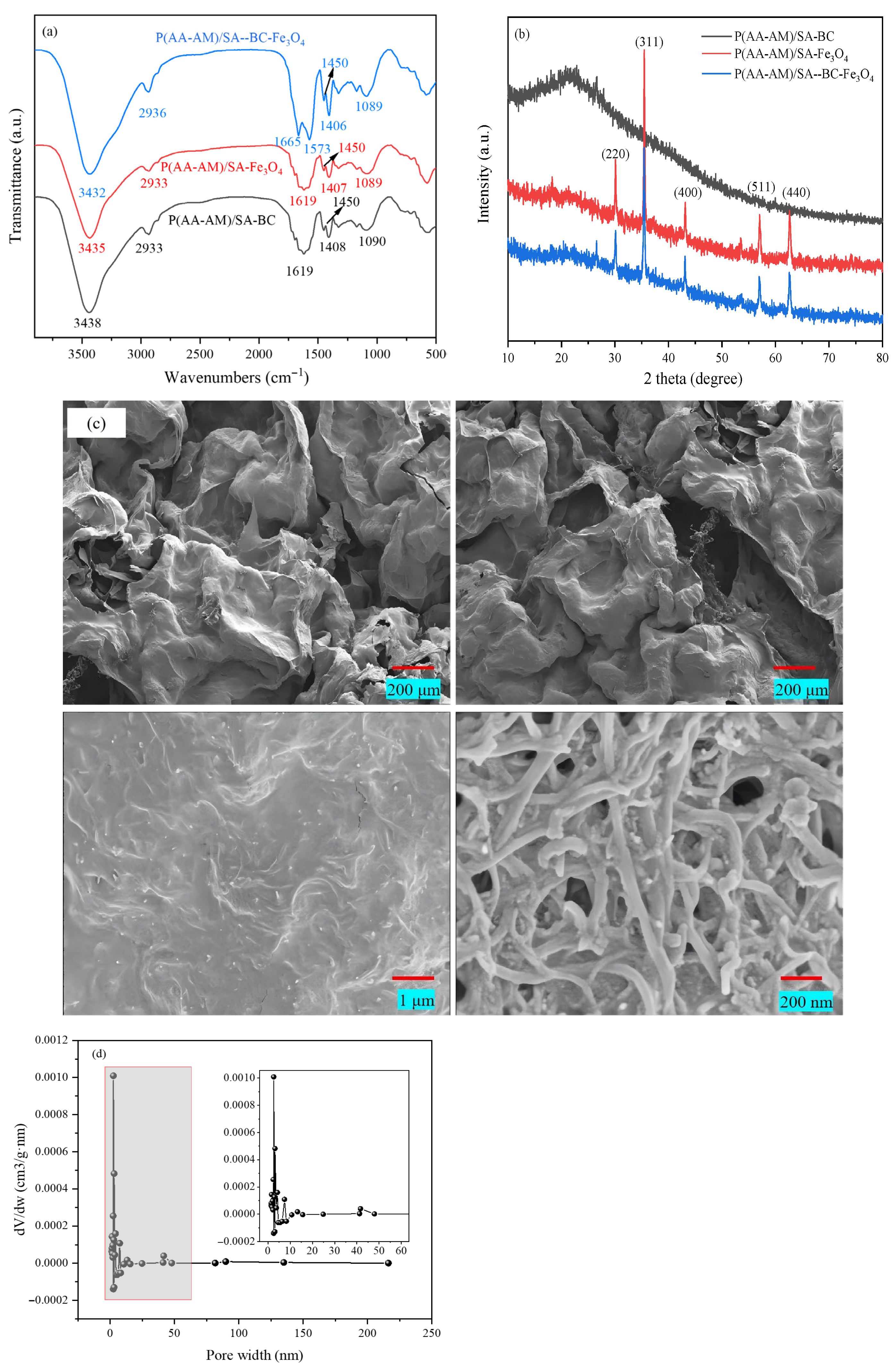
The FTIR spectra of the three hydrogels are shown in
Figure 1a. The absorption bands at 3438–3432 cm
−1 and 2933–2936 cm
−1 correspond to O–H stretching and C–H stretching of methyl/methylene groups, respectively [
10]. In the region of 1619–1665 cm
−1 and 1573 cm
−1, both P(AA-AM)/SA-BC and P(AA-AM)/SA-Fe
3O
4 exhibit characteristic absorptions of amide C=O or carboxylate groups. Notably, the ternary composite displays two distinct peaks at 1665 cm
−1 and 1573 cm
−1, whereas the binary systems show only a single peak at 1619 cm
−1. The bands at 1450 cm
−1 and 1408–1406 cm
−1 are attributed to symmetric stretching vibrations of carboxyl groups. All samples show a characteristic peak at 1090–1089 cm
−1 corresponding to C–O–C or C–OH stretching, indicating the intact polymer backbone [
11]. Collectively, the systematic shifts and splitting of characteristic IR peaks confirm the successful incorporation of biochar and Fe
3O
4, with the ternary system exhibiting a more complex interaction network involving hydrogen bonding and electrostatic interactions.
Figure 1b shows the XRD patterns of the three composite hydrogels. P(AA-AM)/SA-BC exhibits a broad and diffuse peak in the 2θ range of 10–30°, originating from the combined contribution of the amorphous polymer matrix and the amorphous structure of biochar, indicating a predominantly non-crystalline nature with extremely low crystallinity. P(AA-AM)/SA-Fe
3O
4 displays characteristic diffraction peaks at approximately 30.1°, 35.5°, 43.1°, 57.0°, and 62.6°, corresponding to the (220), (311), (400), (511), and (440) crystal planes of Fe
3O
4, respectively [
12]. These peaks are in full agreement with the standard XRD pattern of Fe
3O
4, confirming the successful incorporation of Fe
3O
4 nanoparticles into the hydrogel network while preserving their crystalline structure. The pattern of P(AA-AM)/SA-BC-Fe
3O
4 shows diffraction peaks consistent with those of P(AA-AM)/SA-Fe
3O
4, clearly displaying the characteristic Fe
3O
4 crystal planes alongside the broad amorphous hump from the polymer and biochar. This indicates that the crystal structure of Fe
3O
4 remains intact after biochar introduction, with all components achieving good structural coexistence in the composite hydrogel.
Figure 1c shows the SEM images of P(AA-AM)/SA-BC-Fe
3O
4 at different magnifications. At low magnification (200 μm scale bar), the hydrogel exhibits a typical three-dimensional, wrinkled, porous macrostructure, with lamellae stacked and interconnected to form continuous open pores. This loose network provides ample space for water diffusion and solute transport. At medium magnification (1 μm scale bar), finer textures are observed on the wrinkled lamellar surfaces, where biochar and the polymer matrix show tight interfacial adhesion with no obvious phase separation, indicating relatively uniform dispersion of the components within the hydrogel network. At high magnification (200 nm scale bar), Fe
3O
4 nanoparticles are relatively uniformly distributed on the lamellar surfaces and within the skeleton, either attached or embedded, further confirming good dispersibility of Fe
3O
4 in the composite system. Meanwhile, nanoscale pores and fibrous structures between the lamellae are clearly visible, suggesting that this hierarchical porous structure synergistically enhances the specific surface area and adsorption/mass transfer efficiency of the material. The pore size distribution in
Figure 1d reveals that P(AA-AM)/SA-BC-Fe
3O
4 features a primarily mesoporous architecture, with the majority of pores in the mesopore range and a mean diameter of 22.49 nm. Consequently, these mesopores can serve as conduits for the transport of MB molecules.
2.2. Magnetic Properties
As shown in
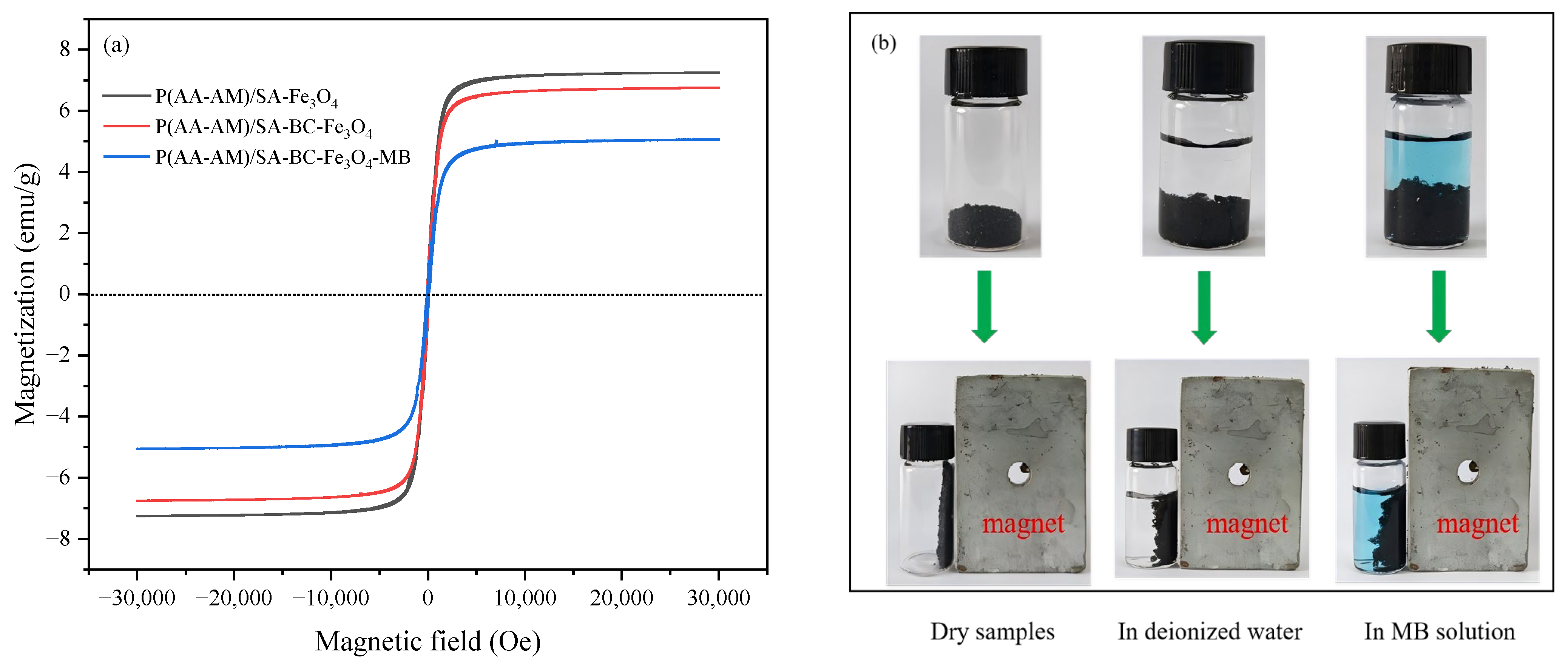
Figure 2a, all samples exhibit typical S-shaped curves with no hysteresis loop, showing no remanence or coercivity within the ±30,000 Oe magnetic field range, confirming the superparamagnetic nature of Fe
3O
4 nanoparticles embedded in the hydrogel matrix. This characteristic ensures no magnetic residue in the absence of an external field, preventing particle aggregation and structural agglomeration. Among the samples, P(AA-AM)/SA-Fe
3O
4 shows the highest saturation magnetization of approximately 7.2 emu/g. After biochar incorporation, the magnetization of P(AA-AM)/SA-BC-Fe
3O
4 slightly decreases to about 6.8 emu/g, attributable to the dilution effect of the non-magnetic biochar component. Following MB adsorption, the magnetization of P(AA-AM)/SA-BC-Fe
3O
4-MB further declines to approximately 5.1 emu/g, indicating that adsorption of organic dye molecules partially shields the magnetic response of Fe
3O
4 while still maintaining sufficient magnetic separability.
The magnetic response photographs in
Figure 2b visually confirm the magnetic separation performance. The composite hydrogels—whether in the dry state, dispersed in deionized water, or in MB solution—can be rapidly and directionally moved and aggregated under an external magnetic field, enabling efficient solid–liquid separation even in aqueous environments. This provides key technical support for their recovery and reuse in practical applications such as wastewater treatment. Collectively, the incorporation of Fe
3O
4 endows the composite hydrogels with excellent superparamagnetism and magnetic responsiveness. The introduction of biochar and dye adsorption only moderately reduces the saturation magnetization without compromising magnetic separation capability, demonstrating the feasibility and stability of this ternary composite hydrogel for coupled adsorption-magnetic separation applications. It should be noted, however, that after repeated adsorption cycles, the magnetic separation rate does decrease to some extent due to the gradual reduction in magnetization. Nevertheless, under the same external magnetic field strength, the majority of the hydrogel can still be effectively separated from the solution. In subsequent cycles, the separation efficiency can be restored or improved by appropriately increasing the magnetic field strength to compensate for the loss in magnetization.
2.3. Optimization of Preparation Conditions for P(AA-AM)/SA Hydrogel
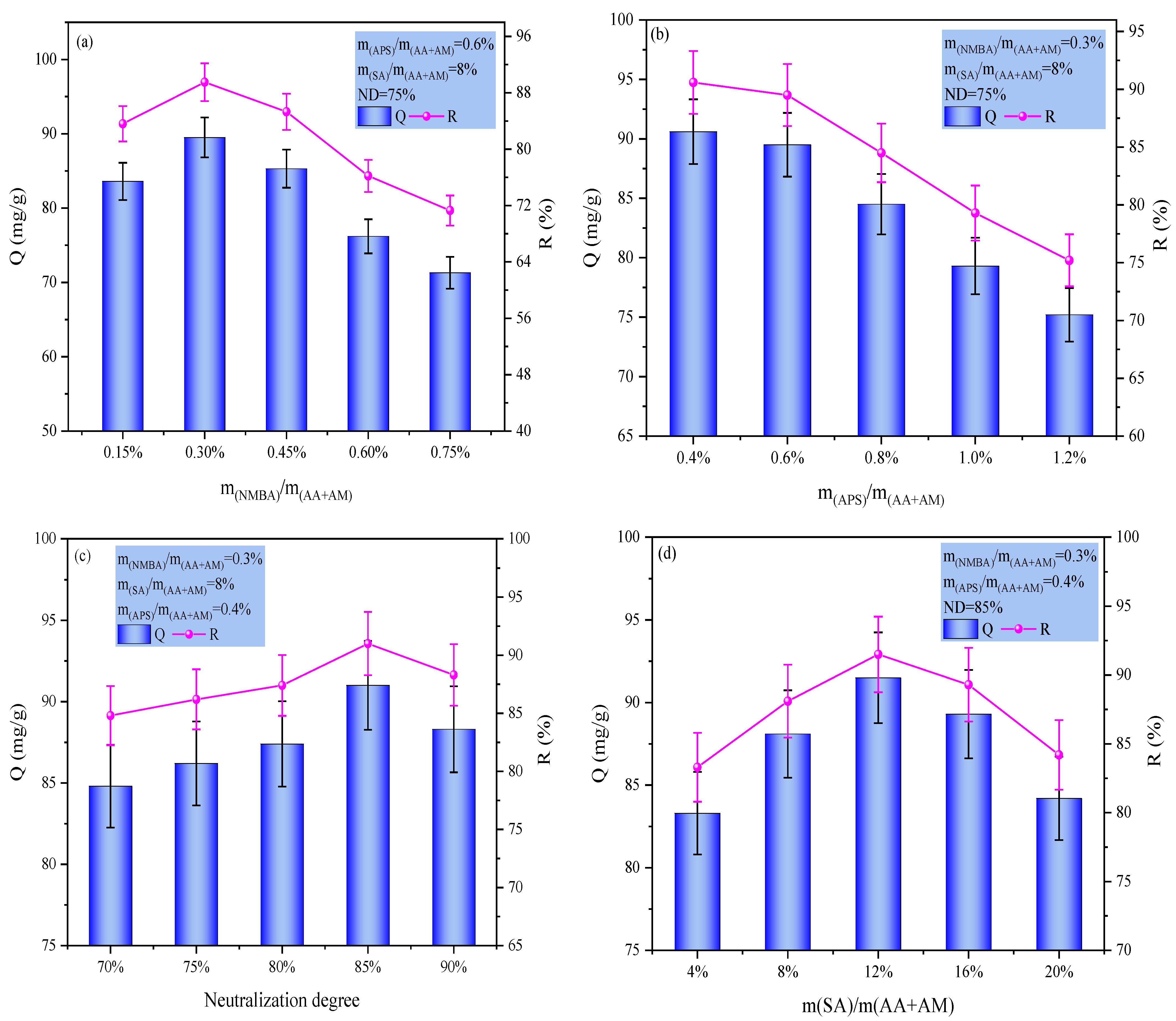
This study systematically investigated the effects of NMBA, APS, neutralization degree (ND) of acrylic acid, and SA dosage on the MB adsorption performance of P(AA-AM)/SA hydrogels. As shown in
Figure 3, with increasing NMBA dosage, the adsorption performance gradually increased and reached a peak, beyond which further increase led to a significant decline in adsorption capacity. This is attributed to the loose network structure and susceptibility to swelling-induced mass loss at excessively low crosslinking densities (a mass loss of ~3.6% was measured after swelling and re-drying at an NMBA loading of 0.15%), whereas excessive crosslinking renders the pore structure overly dense, hindering the diffusion and accessibility of methylene blue molecules [
13]. From a mechanistic perspective, the crosslinker concentration directly determines the number of effective crosslinking points, which governs both the equilibrium swelling ratio and the diffusional permeability of the gel network.
Excessive APS initiator dosage tends to cause overly rapid polymerization and a high concentration of free radicals, which promotes chain transfer and termination reactions, resulting in heterogeneous crosslinking structures and non-uniform network architecture—both of which compromise adsorption performance.
The ND of acrylic acid directly determines the charge state and swelling capacity of the hydrogel. At low neutralization degrees, insufficient dissociation of carboxyl groups results in contracted polymer chains and fewer negatively charged sites. As the ND increases, the progressive deprotonation of –COOH groups introduces negative charges along the polymer backbone. The resulting electrostatic repulsion between polymer chains promotes chain expansion and network enlargement, thereby increasing the free volume and exposing more active sites for dye binding, substantially improving adsorption performance. However, excessive neutralization leads to a salting-out effect due to elevated ionic strength within the system, simultaneously reducing swelling and adsorption capacities [
14].
SA forms a semi-interpenetrating network with the polymer matrix; its abundant hydroxyl and carboxyl groups provide additional adsorption sites and act as physical entanglement points that optimize the pore structure and enhance mechanical stability. At an appropriate dosage, the SA chains interpenetrate the synthetic network without significant phase separation, creating a more open and interconnected porous architecture. Excess SA significantly increases system viscosity, disrupts copolymerization uniformity, and induces phase separation, resulting in disordered pore structures and hindered mass transfer, ultimately diminishing adsorption performance [
15].
In summary, under the optimal conditions where NMBA, APS, and SA dosages were 0.3%, 0.4%, and 12% of the total monomer mass, respectively, with an ND of 85%, the hydrogel exhibited the optimal adsorption capacity (91.5 mg/g) and removal efficiency (91.5%) for MB. Subsequent investigations into the effects of biochar and Fe3O4 dosages on the adsorption performance of the composite hydrogels were conducted under these conditions.
2.4. Effect of BC and Fe3O4 Dosages on Adsorption Performance
Based on the optimized preparation of P(AA-AM)/SA hydrogels, the effects of BC and Fe
3O
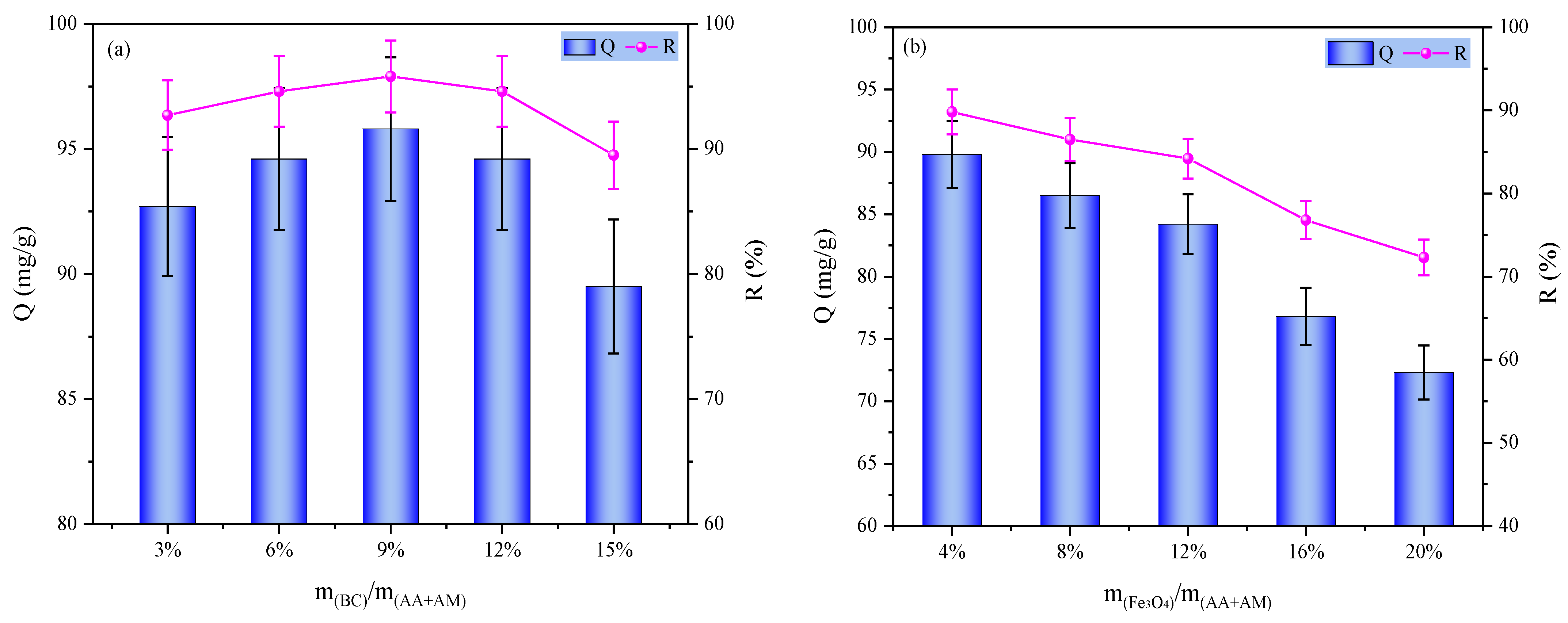
4 dosages on the adsorption performance for MB were further investigated. As shown in
Figure 4a, with increasing BC dosage, the adsorption capacity of the hydrogels continuously increased, reaching a peak value of 95.8 mg/g at a BC dosage of 9%. Further increasing the BC dosage to 15% led to a significant decline in adsorption performance. This is because an appropriate amount of BC introduces a hierarchical pore structure; its abundant pores and surface oxygen-containing functional groups provide additional adsorption sites for MB, while synergistically interacting with the polymer network to enhance the specific surface area and adsorption affinity. However, excessive BC disrupts the uniformity of the hydrogel network and causes pore blockage, hindering the diffusion and mass transfer of MB molecules, ultimately weakening the adsorption performance [
16].
As the Fe
3O
4 content increased from 4% to 20%, the adsorption performance exhibited a monotonic decreasing trend (
Figure 4b). This is attributed to the fact that Fe
3O
4 is a non-adsorptive magnetic component; although its incorporation endows the hydrogel with magnetic separation functionality, it occupies a portion of the adsorption sites and blocks the pore channels. As the Fe
3O
4 dosage increases, this dilution and blockage effect becomes more pronounced, leading to a reduction in effective adsorption sites and mass transfer efficiency, thereby continuously diminishing the MB adsorption capacity.
Overall, the addition of BC and Fe3O4 involves a significant performance trade-off: an appropriate amount of BC enhances adsorption performance, whereas the incorporation of Fe3O4 improves magnetic responsiveness at the expense of a partial reduction in adsorption capacity.
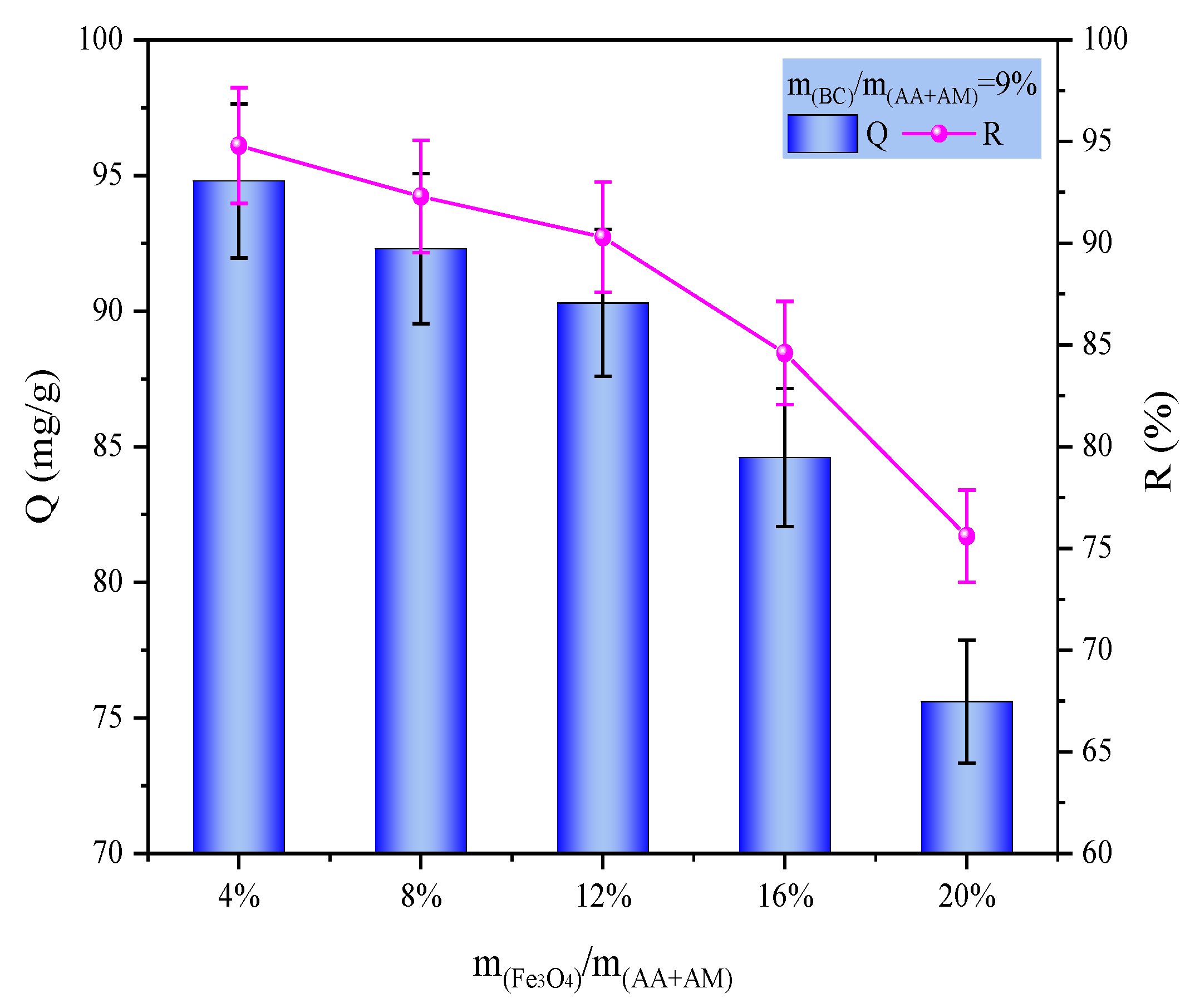
Therefore, under the condition of a BC addition of 9%, we further investigated the effect of Fe
3O
4 dosage on the MB adsorption performance of the composite hydrogel. The results are shown in
Figure 5. As the Fe
3O
4 dosage increased, the adsorption capacity of the hydrogel gradually decreased. To balance the dye-removal performance and magnetic properties of the hydrogel, we ultimately chose to prepare the hydrogel at an Fe
3O
4 mass fraction of 12% relative to the monomers and used this formulation to evaluate its comprehensive performance. All subsequent investigations on the hydrogel properties were conducted under this condition.
2.5. Swelling Properties of P(AA-AM)/SA-BC-Fe3O4
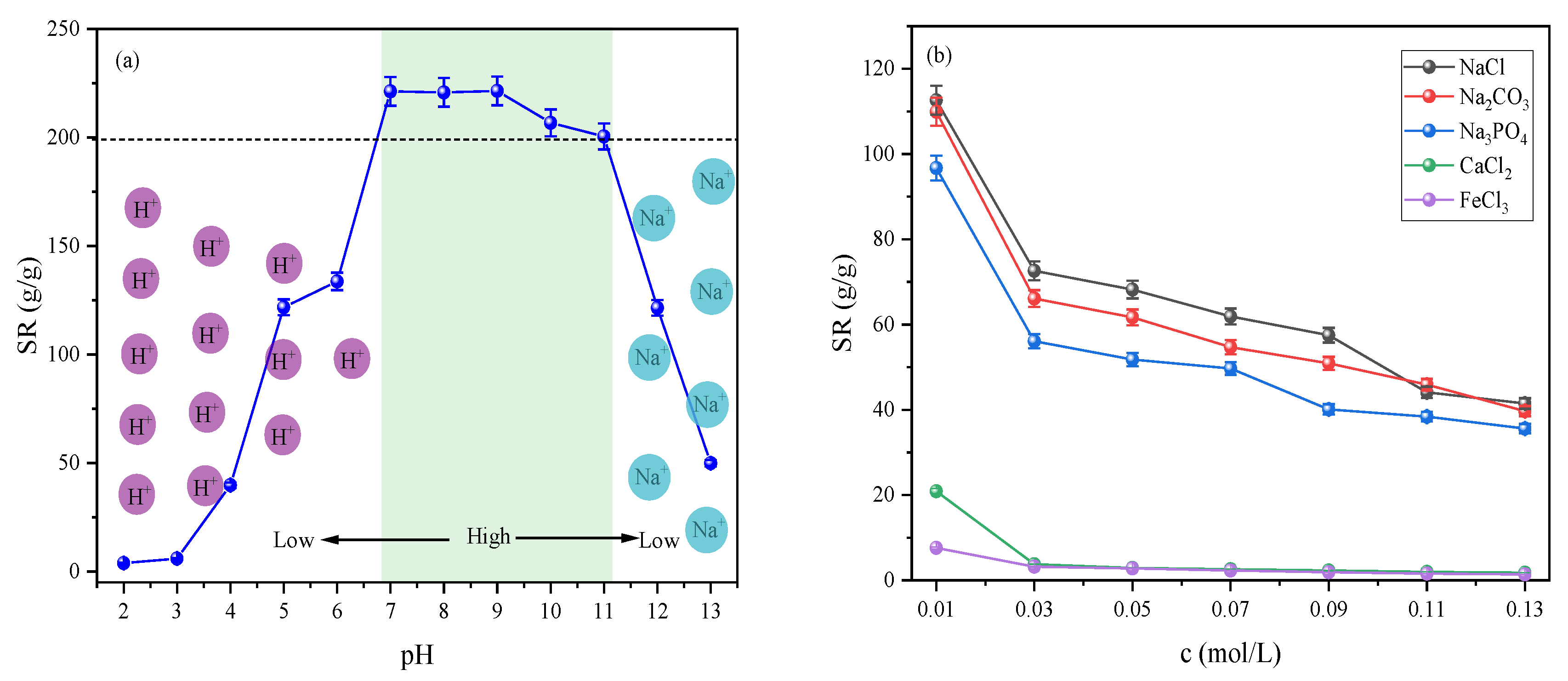
Figure 6a,b systematically illustrate the swelling behavior of the P(AA-AM)/SA-BC-Fe
3O
4 composite hydrogel under varying pH and salt solution environments. As shown in
Figure 6a, the swelling ratio (SR) of the hydrogel exhibited a U-shaped trend with changing pH, reaching a peak value in the pH range of 7–11. Under strongly acidic conditions (pH < 5), carboxyl groups were protonated, significantly weakening interchain electrostatic repulsion, while H
+ formed hydrogen bonds with the network, leading to polymer chain contraction and collapse, resulting in a low swelling ratio. As the pH increased to the neutral to weakly alkaline range, carboxyl groups became fully dissociated into –COO
−, and the enhanced electrostatic repulsion between chains promoted full expansion of the three-dimensional network, substantially improving swelling performance. In strongly alkaline environments (pH > 11), the salt effect induced by excess Na
+ compressed the electrical double layer, weakening interchain electrostatic repulsion and causing a sharp decline in the swelling ratio [
17].
Figure 6b shows that the SR of the hydrogel decreased with increasing salt concentration across various salt solutions, with significant differences observed depending on ion valence and type. Within the Flory–Rehner–Donnan (FRD) framework for ionic hydrogels, the equilibrium swelling is governed by the balance of mixing free energy, elastic free energy, and ionic free energy (electrostatic repulsion among fixed charges and Donnan osmotic pressure). Among monovalent sodium salts (NaCl, Na
2CO
3, Na
3PO
4), higher valence anions exerted a more pronounced inhibitory effect on swelling due to stronger charge screening, which reduces the ionic free energy contribution by collapsing the Donnan potential. Divalent Ca
2+ and trivalent Fe
3+ formed ionic crosslinking “bridges” with carboxyl groups, causing rapid network contraction even at very low concentrations and reducing the swelling ratio to near zero, highlighting a clear ion valence effect [
18]. These observations are consistent with the FRD prediction that external cations screen anionic carboxylate groups (–COO
−), thereby diminishing electrostatic repulsion and shifting the swelling equilibrium toward a lower swelling ratio.
In summary, this composite hydrogel achieved efficient swelling under neutral to weakly alkaline conditions and low salt concentrations, whereas swelling performance was significantly constrained in high-concentration or high-valence ion systems. This behavior provides important structural and performance insights for selecting operating conditions in practical wastewater treatment scenarios and adsorption applications.
2.6. MB Adsorption Performance of P(AA-AM)/SA-BC-Fe3O4 Composite Hydrogel
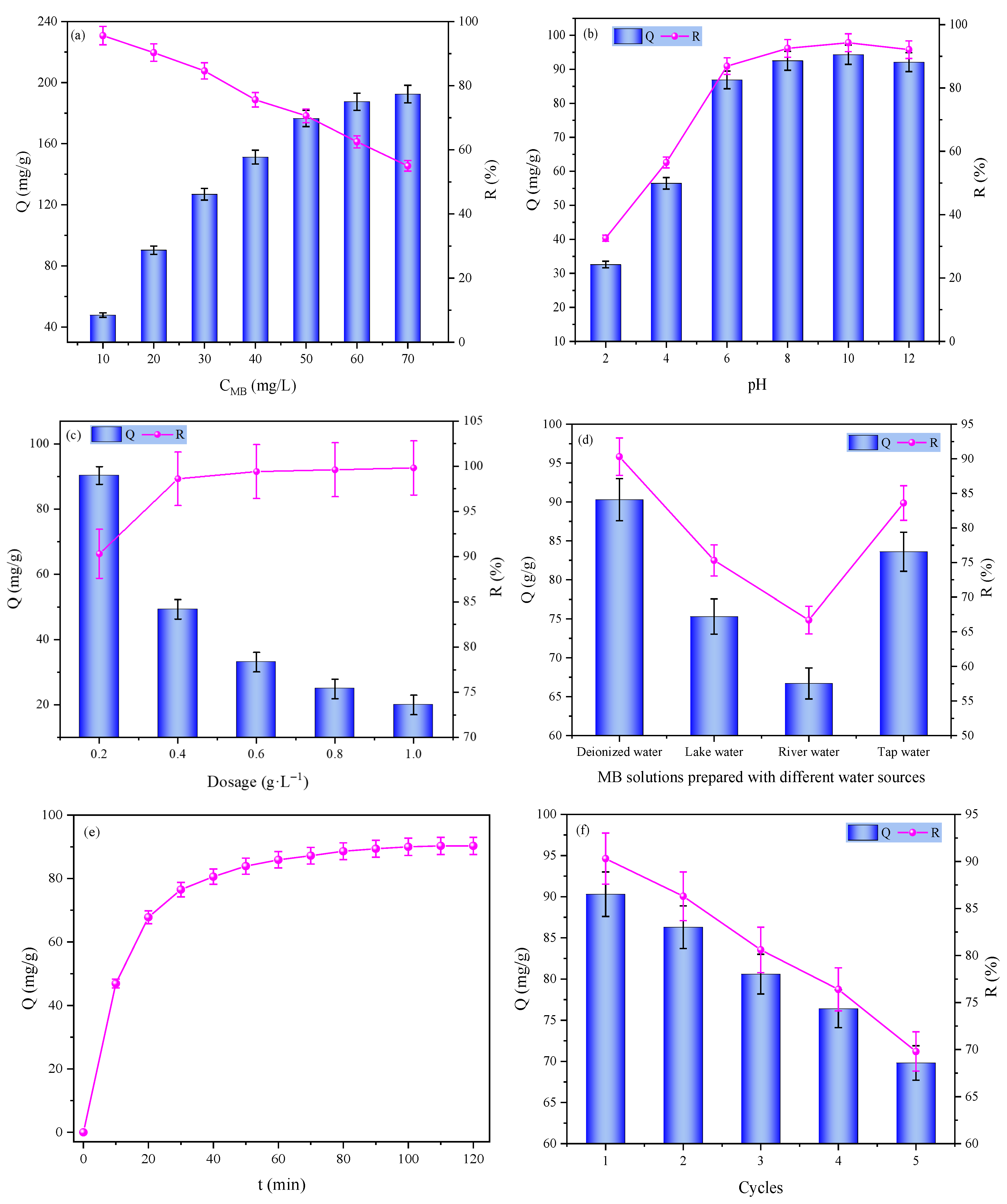
Figure 7a illustrates the influence of initial MB concentration on the adsorption performance of the hydrogel. As the initial MB concentration increased from 10 to 70 mg/L, the removal efficiency declined gradually from 95.6% to 55%. At low concentrations, abundant adsorption sites ensure nearly complete MB removal, yet the unit adsorption capacity is limited by the weak driving force from the concentration gradient. With increasing initial MB concentration, the enhanced concentration gradient drives greater diffusion of MB molecules toward the hydrogel surface, significantly boosting the unit adsorption capacity. However, the progressive saturation of adsorption sites at high concentrations leads to a higher proportion of unadsorbed MB, resulting in a continuous decrease in removal efficiency [
19]. These results confirm the hydrogel’s potential for treating high-load dye wastewater.
Figure 7b demonstrates the pH-dependent adsorption behavior of the hydrogel toward MB. Within the pH range of 2–12, both Q and R increased initially and then stabilized, reaching a maximum at pH of 10 (Q = 94.3 mg/g, R = 94.3%). This behavior is governed by the polyelectrolyte nature of the hydrogel: under strongly acidic conditions, carboxyl groups (–COO
−) are protonated to –COOH, reducing the density of negative charge sites and inhibiting electrostatic attraction with cationic MB. As pH rises into the weakly alkaline range, carboxyl groups fully dissociate, maximizing negative charge density and strengthening electrostatic interactions, while avoiding the salt-induced compression of the electrical double layer that occurs at high pH [
20]. Further increasing pH to strongly alkaline conditions leads to a slight decline in adsorption performance due to charge screening by excess Na
+ ions. These results verify that a weakly alkaline environment is optimal for the hydrogel’s adsorption activity.
Figure 7c illustrates the effect of adsorbent dosage on the Q and R of MB. As the adsorbent dosage increased from 0.2 g·L
−1 to 1.0 g·L
−1, the R monotonically increased from 90.3% to 99.8%, which can be attributed to the availability of more adsorption sites, leading to a lower residual dye concentration in the solution. In contrast, the unit adsorption capacity Q significantly decreased from 90.3 mg/g to 19.9 mg/g. This trend is consistent with the classical adsorption equilibrium law: under fixed initial dye concentration and solution volume, increasing the adsorbent dosage reduces the amount of dye allocated per unit mass of adsorbent, thereby lowering the equilibrium adsorption capacity. This behavior aligns with the prediction of the Langmuir model, which assumes homogeneous adsorption sites and a fixed saturation capacity; thus, excessive adsorbent dosage leads to a decrease in unit adsorption capacity.
Figure 7d evaluates the hydrogel’s adsorption performance in different water matrices, revealing that Q and R follow the order: deionized water > tap water > lake water > river water. This discrepancy arises from the interference of coexisting components in natural waters: deionized water contains no competing ions, allowing unimpeded adsorption. In contrast, lake and river waters contain high concentrations of divalent/polyvalent cations and natural organic matter. These species not only compete with MB for adsorption sites but also induce ionic cross-linking, compressing the electrical double layer and weakening electrostatic interactions. Additionally, natural organic matter may block hydrogel pores, further reducing mass transfer efficiency. The electrical conductivity of lake water and river water was measured at 1096 µS/cm and 4740 µS/cm, respectively, providing a quantitative indicator of their ionic strength. The higher electrical conductivity of river water corresponds to its lower adsorption performance. These findings demonstrate the hydrogel’s practical applicability in complex water matrices and provide guidance for pretreatment strategies.
Figure 7e displays the adsorption kinetic curve of MB onto the hydrogel, exhibiting a typical “fast adsorption-slow equilibrium” pattern: rapid adsorption occurs within 0–60 min, followed by a gradual slowdown until equilibrium is achieved at 120 min. This process can be divided into two stages: the initial stage is dominated by fast external diffusion and site occupation, driven by a high MB concentration gradient and abundant surface sites. In the later stage, adsorption is rate-limited by intraparticle diffusion and site saturation, as the concentration gradient diminishes and available sites decrease. This kinetic behavior indicates the hydrogel’s rapid response to MB contamination, making it suitable for continuous-flow or rapid-treatment scenarios.
Figure 7f presents the hydrogel’s reusability over five adsorption–desorption cycles. The initial Q and R were 90.3 mg/g and 90.3%, respectively, and after five cycles, Q decreased to 69.8 mg/g and R to 69.8%, retaining ~77% of the initial adsorption capacity. The performance decay is attributed to two main factors: (1) partial irreversible binding of MB molecules to adsorption sites, preventing full regeneration; (2) minor structural damage to the hydrogel network (e.g., pore collapse, chain scission) during repeated cycles, reducing specific surface area and mass transfer efficiency. The proposed degradation mechanisms—irreversible site blocking and network structural damage—are consistent with those widely reported for analogous hydrogel adsorbents and observed in our previous studies [
21,
22]. Notably, the neutralization degree adopted in this study exacerbates such structural damage, as the highly ionized carboxyl groups lead to excessive swelling and reduced mechanical stability under cyclic swelling–shrinking stresses. Consequently, the network becomes more susceptible to fatigue-induced pore collapse and chain scission, which is consistent with the observed decline in removal efficiency from 90.3% to 69.8% after five cycles. Despite this attenuation, the hydrogel demonstrates promising reusability, which is critical for reducing operational costs and enabling sustainable material reuse in practical applications.
2.7. Adsorption Kinetics, Isotherms, and Mechanisms
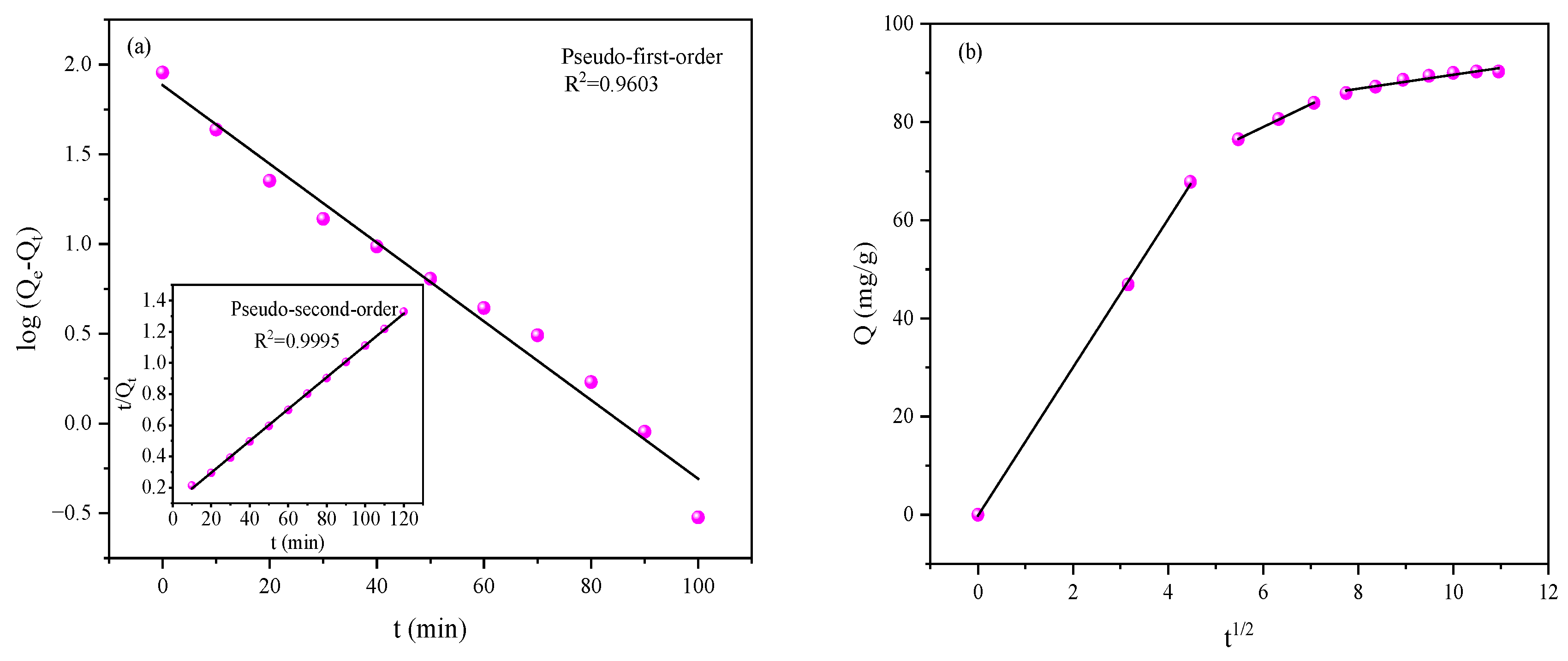
The adsorption kinetics of MB onto hydrogel were systematically investigated using pseudo-first-order (Equation (1)), pseudo-second-order (Equation (2)), and intra-particle diffusion (Equation (3)) models, with the fitting results presented in
Figure 8a,b, and the corresponding parameters summarized in
Table 1.
where Q
t refers to the adsorption amount of MB on the hydrogel at time t; Q
e corresponds to the equilibrium adsorption capacity at adsorption saturation; k
1 and k
2 represent the rate constants of the pseudo-first-order and pseudo-second-order kinetic models, respectively; K stands for the rate constant of the intra-particle diffusion process; and C is a constant related to the thickness and resistance of the boundary layer during mass transfer.
As shown in
Figure 8a, the pseudo-second-order model yields a significantly higher correlation coefficient (R
2 = 0.9995) compared to the pseudo-first-order model (R
2 = 0.9603), and the calculated equilibrium adsorption capacity is highly consistent with the experimental value, which is often considered as an indication of chemisorption-dominated behavior. Nevertheless, this interpretation is primarily derived from kinetic fitting and should therefore be regarded as preliminary. This result suggests that the rate-limiting step involves chemical interactions (e.g., electrostatic attraction, hydrogen bonding) between the MB molecules and the functional groups on the hydrogel surface, rather than simple physical diffusion [
23].
Figure 8b displays the intra-particle diffusion plot, which exhibits a multi-linear profile with three distinct stages, revealing that the adsorption process is controlled by multiple mass transfer steps. The first stage corresponds to the rapid external diffusion of MB molecules from the bulk solution to the hydrogel surface, driven by a high concentration gradient. The second stage reflects the gradual intra-particle diffusion of MB into the hydrogel’s porous network, where the rate is limited by pore diffusion and site availability. The third stage represents the final equilibrium phase, where adsorption is restricted by the saturation of active sites and the reduced concentration gradient [
24]. The non-zero intercept of the linear segments further confirms that intra-particle diffusion is not the sole rate-limiting step, and that boundary-layer resistance also contributes to the overall adsorption kinetics.
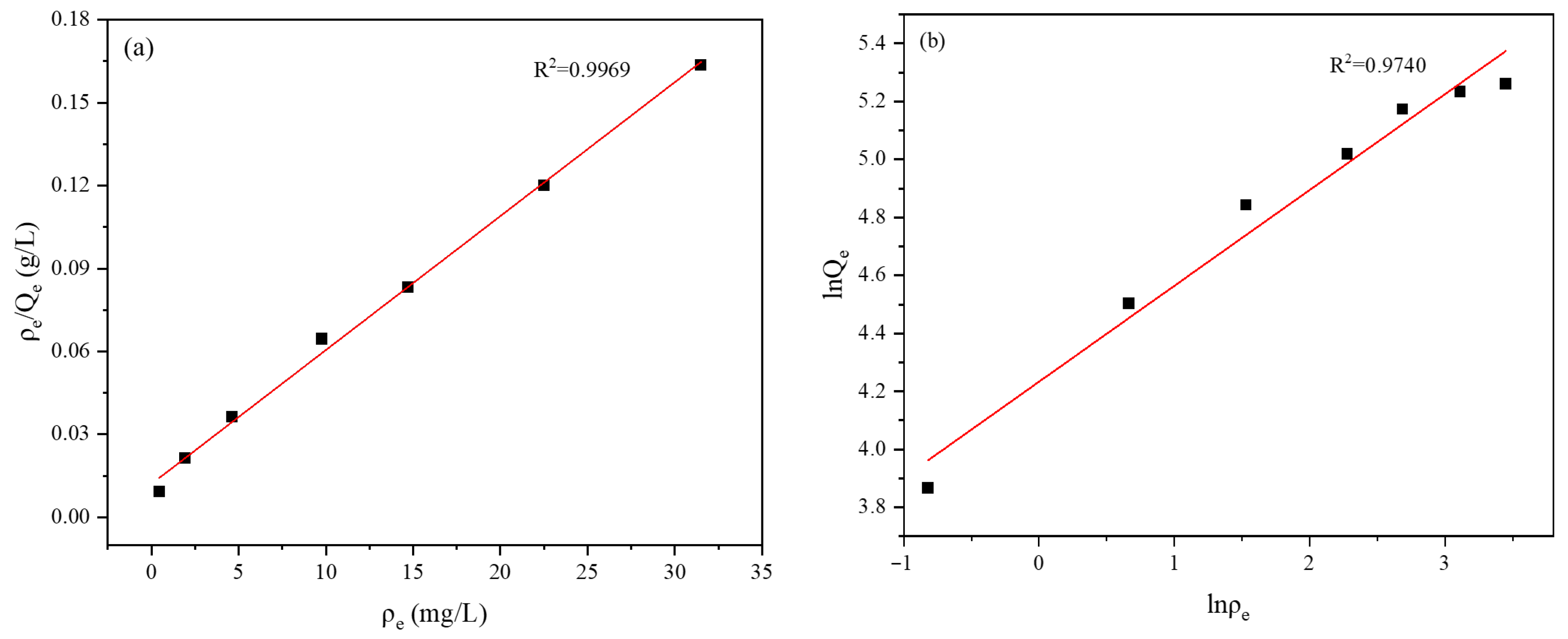
The Langmuir (Equation (4)) and the Freundlich (Equation (5)) isotherm models were employed to fit the equilibrium adsorption behavior of MB onto the hydrogel, and the results are presented in
Figure 9. The Langmuir model exhibited a strong linear relationship (
Figure 9a), with a correlation coefficient of 0.9969, significantly higher than that of the Freundlich model (
Figure 9b). This indicates that the Langmuir model provides a more accurate description of the adsorption process, suggesting that the adsorption of MB onto the hydrogel surface occurs primarily via homogeneous monolayer coverage.
The superior goodness-of-fit of the Langmuir model further confirms the homogeneity of the adsorption sites, which is closely associated with the presence of functional groups such as carboxyl and hydroxyl moieties on the hydrogel surface [
25]. In contrast, the relatively lower fitting degree of the Freundlich model suggests that the adsorption process does not follow a typical multilayer heterogeneous adsorption mechanism, thereby reinforcing the conclusion that monolayer adsorption is the dominant mode.
where ρ
e stands for the residual MB concentration in solution following adsorption, mg/L. Q
e denotes the amount of MB adsorbed at equilibrium, mg/g. Q
0 refers to the maximum adsorption capacity under theoretical conditions, mg/g. The constant K
b represents the adsorption equilibrium constant, L/mg. K
f, another constant associated with the adsorption process, mg
1−n·L
n·g
−1, while n is the dimensionless adsorption intensity factor.
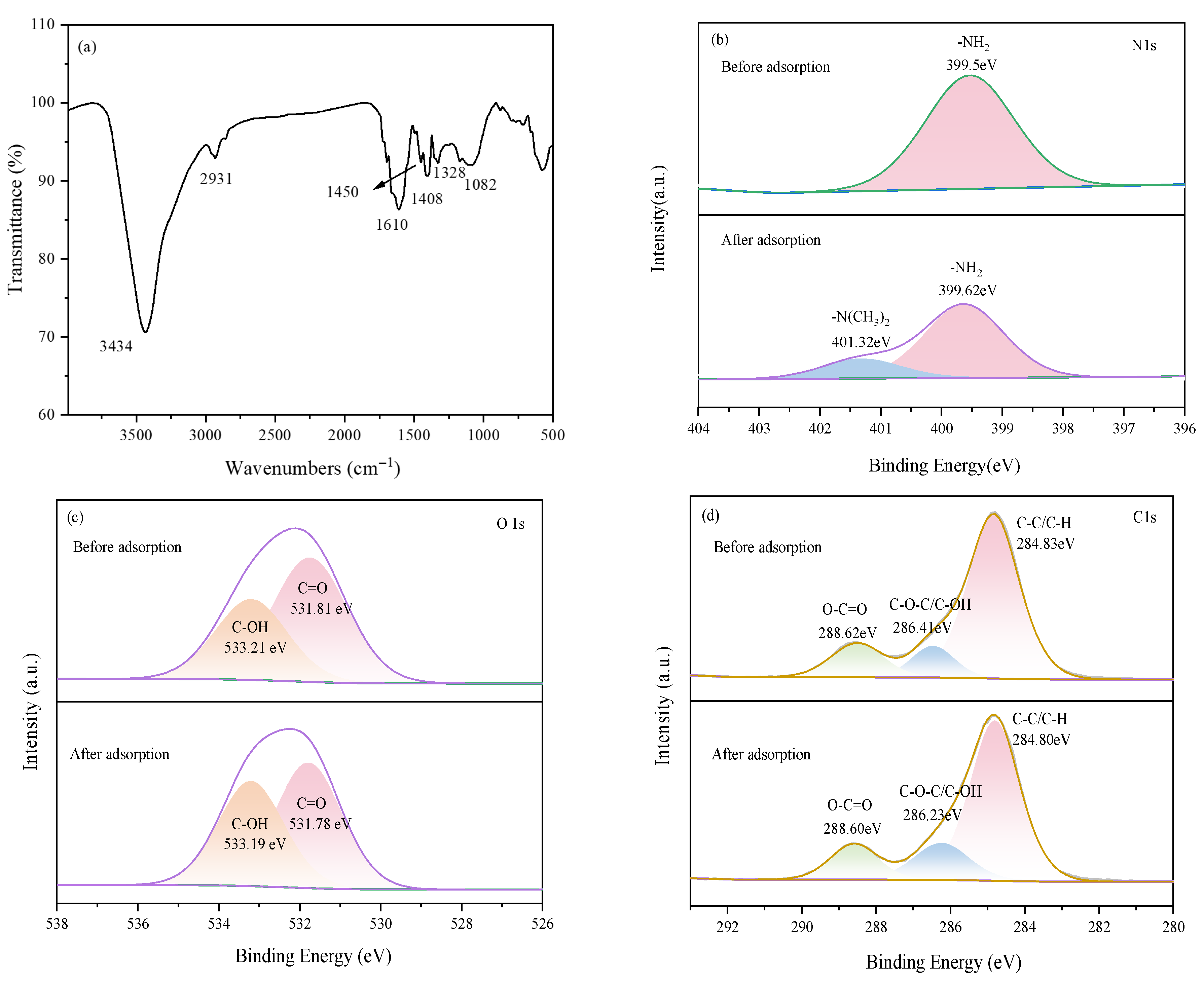
The infrared spectra of the hydrogel after methylene blue adsorption are shown in
Figure 10a. Following adsorption, the stretching vibration peak of hydroxyl (–OH) and amino (–NH) groups, originally located at 3432 cm
−1, blue-shifted to 3434 cm
−1, indicating changes in electron cloud density due to hydrogen bonding interactions. In the carboxyl/amide region, the peaks at 1665 cm
−1 (amide I band) and 1573 cm
−1 (asymmetric stretching of carboxylate) merged into a strong, broad peak at 1610 cm
−1 after adsorption, accompanied by a slight shift in the symmetric carboxylate stretching peak from 1406 cm
−1 to 1408 cm
−1. These significant changes confirm the occurrence of strong electrostatic interactions between carboxylate groups and MB cations, representing an important interaction mechanism for the adsorption process. Additionally, the C–O–C/C–OH stretching peak at 1089 cm
−1 shifted to 1082 cm
−1, further supporting hydrogen-bonding interactions between the polysaccharide backbone and the dye molecules [
26]. The emergence of a new peak at 1328 cm
−1 after adsorption corresponds to characteristic vibrations of the aromatic heterocyclic rings in MB, providing direct evidence for successful dye loading. The C–H bending vibration at 1450 cm
−1 remained largely unchanged, indicating the structural integrity of the material framework.
By comparing the XPS spectra of the hydrogel before and after adsorption, the interaction mechanism with MB can be further elucidated. In the N1s spectrum (
Figure 10b), in addition to the original –NH
2 peak (shifted from 399.5 eV to 399.62 eV), a new characteristic peak corresponding to –N(CH
3)
2 appeared at 401.32 eV after adsorption, which directly corresponds to the dimethylamino group in MB molecules, confirming the successful loading of MB onto the hydrogel surface. In the O1s spectrum (
Figure 10c), the C–OH (533.21 eV to 533.19 eV) and C=O (531.81 eV to 531.78 eV) peaks both exhibited slight shifts, indicating that hydroxyl and carbonyl functional groups participated in hydrogen bonding or electrostatic interactions with MB. In the C1s spectrum (
Figure 10d), the peaks corresponding to C–C/C–H (284.83 eV to 284.80 eV), O–C=O (288.62 eV to 288.60 eV), and C–O–C/C–OH (286.41 eV to 286.23 eV) also showed subtle shifts, suggesting changes in electron cloud density around the carbon skeleton and oxygen-containing functional groups during adsorption, which further supports the occurrence of electrostatic attraction and hydrogen bonding as key contributing mechanisms [
27]. Collectively, the XPS results, together with the FTIR analysis, clearly demonstrate that efficient adsorption is driven by the synergistic effects of electrostatic interactions and hydrogen bonding between the active sites (such as carboxyl and hydroxyl groups) on the hydrogel surface and MB molecules.
2.8. Comparison with Other Adsorbents
Based on the comparison of MB adsorption performance in
Table 2, it is evident that the adsorption capacity (Q) is strongly influenced by experimental conditions such as initial concentration and pH. Under alkaline conditions (pH 10.0) and a relatively low initial concentration (20 mg/L), the hydrogel developed in this study achieves a Q value of 94.3 mg/g. This performance is superior to several previously reported biochar and hydrogel composites (e.g., N-doped biochar: 84.2 mg/g at 30 mg/L, pH 11.0 [
28]; hydrogel-biochar composite: 23.53 mg/g at 20 mg/L, pH 11 [
29]; HG/MTWBC nanocomposite: 20.79 mg/g at 10 mg/L, pH 8 [
30]), and also outperforms a similar hydrogel-based adsorbent P(AA-AM)/SA-BC-Fe
3O
4 (this study) in terms of overall capacity under comparable conditions.
However, a more critical comparison reveals that some state-of-the-art adsorbents, such as β-cyclodextrin xanthate hydrogel/nickel oxide nanocomposites, exhibit a substantially higher Q (310.55 mg/g) under a much higher initial concentration (100 mg/L) and neutral pH [
32]. This indicates that while our hydrogel shows good removal efficiency at low MB concentrations and alkaline conditions, its capacity at higher concentrations may be less competitive. Furthermore, differences in initial concentration and pH make direct capacity comparisons challenging. Therefore, rather than claiming general superiority, we conclude that the present hydrogel is a promising candidate for MB removal under specific conditions (low initial concentration, alkaline pH), but further optimization and evaluation under more realistic or variable conditions are needed to benchmark against the best-performing materials.