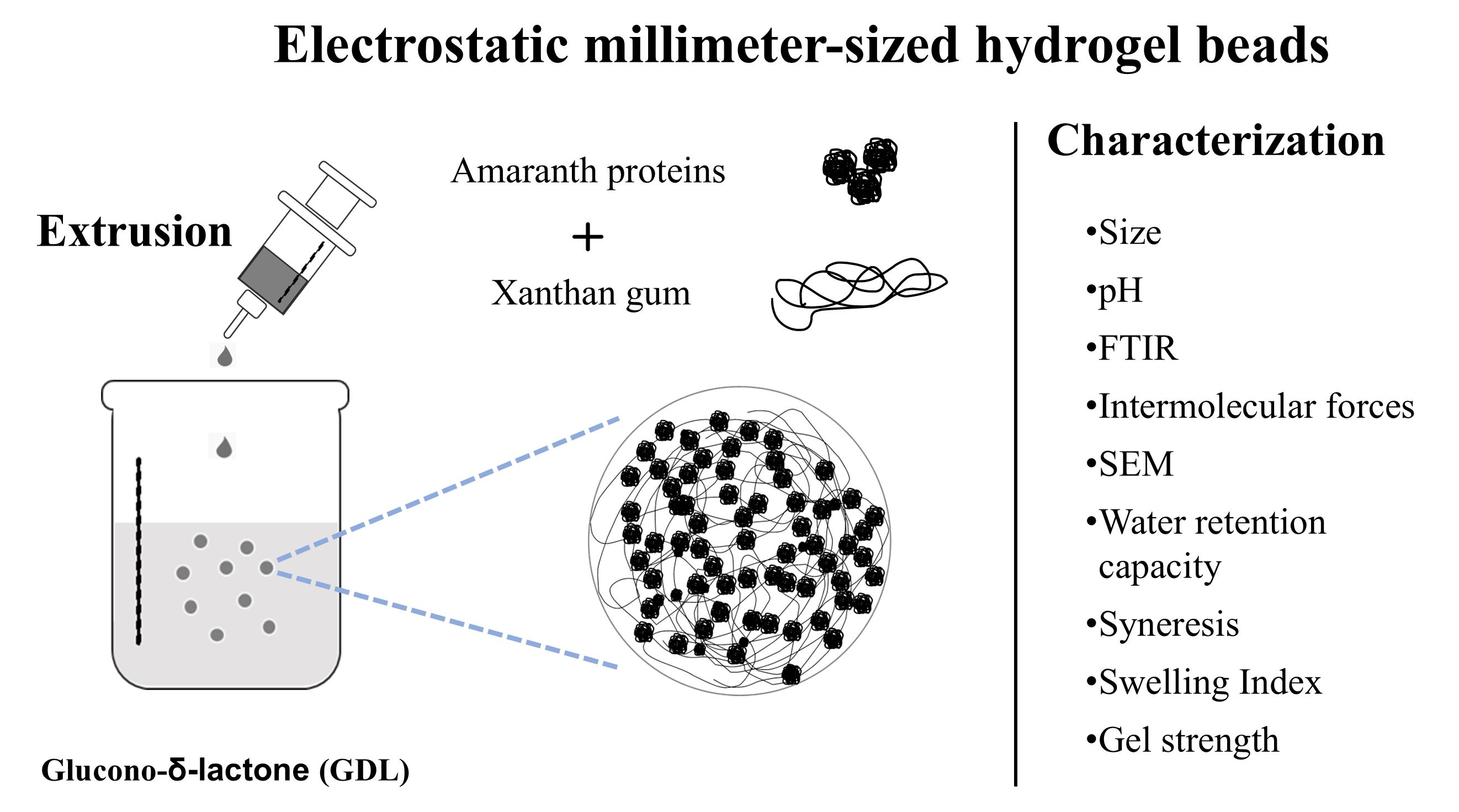
Electrostatic Protein–Polysaccharide Assembly as a Potential Alternative to Ionic Gelation for Millimeter-Scale Hydrogel Beads: Insights into Accelerated Gelation from an Amaranth Protein–Xanthan Gum System

 , , ,
, , ,
Abstract
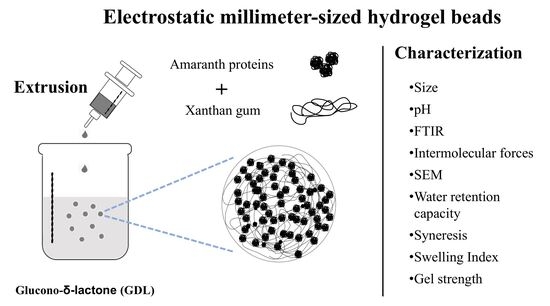
1. Introduction
2. Results and Discussion
2.1. Macroscopic Observation, Size, and pH
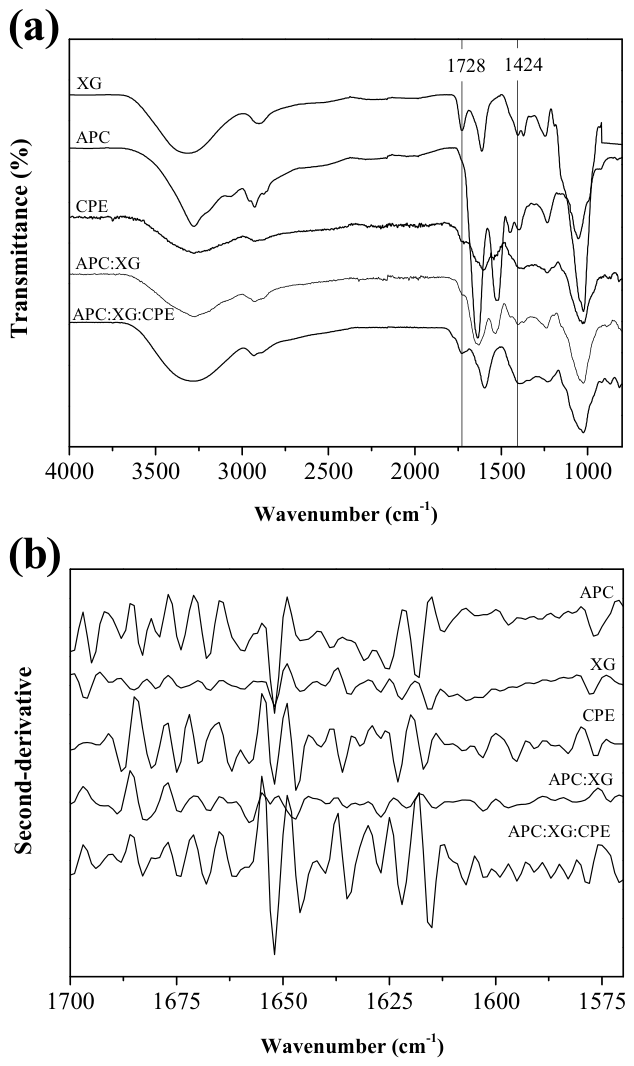
2.2. Intermolecular Forces and Secondary Structure Analysis
2.3. WRC, Syneresis, and Swelling Index
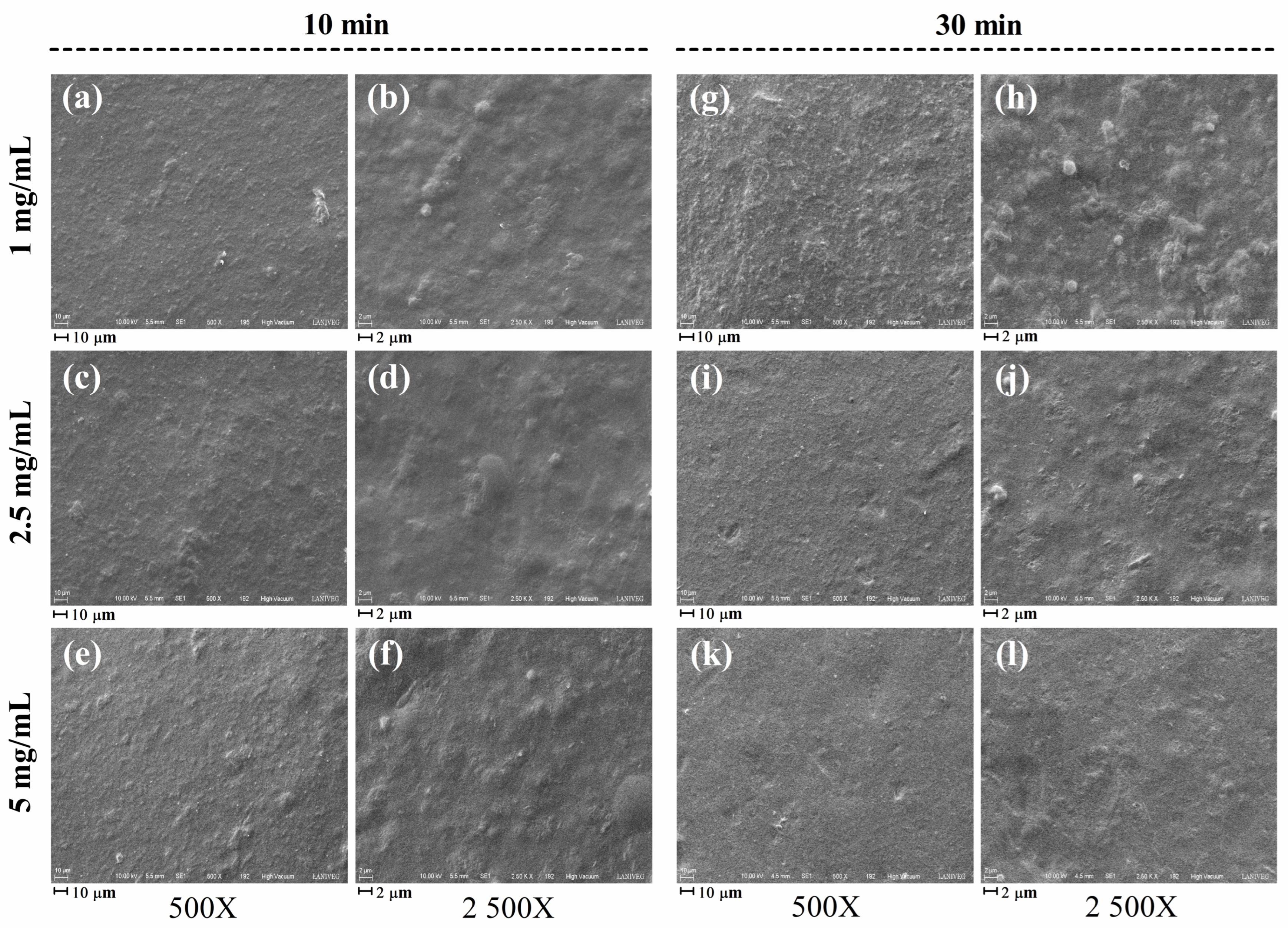
2.4. Microstructure
2.5. Gel Strength
2.6. External Acidification and Network Evolution: An Initial Interpretation
2.7. Phenolic Incorporation: Proof of Concept
3. Conclusions
4. Materials and Methods
4.1. Materials
4.2. Bead Fabrication
4.3. Hydrogel Beads Characterization
4.3.1. Macroscopic Observation, pH, and Size
4.3.2. Intermolecular Forces and FTIR Analyses
4.3.3. Water Retention Capacity (WRC)
4.3.4. Syneresis
4.3.5. Swelling Index (S.I.)
4.3.6. SEM
4.3.7. Compression Test
4.4. Bioactive Loading Experiment
4.5. Statistical Analysis
Supplementary Materials
Author Contributions
Funding
Institutional Review Board Statement
Informed Consent Statement
Data Availability Statement
Conflicts of Interest
Abbreviations
| APC | Amaranth protein concentrate |
| ATR | Attenuated total reflectance |
| CPE | Coffee pulp extract |
| FTIR | Fourier-transform infrared spectroscopy |
| EGCG | Epicatechin gallate |
| GAE | Gallic acid equivalent |
| GDL | Glucono-δ-lactone |
| pI | Isoelectric point |
| SEM | Scanning electron microscopy |
| SDS | Sodium dodecyl sulfate |
| S.I. | Swelling index |
| TPC | Total phenolic content |
| WRC | Water retention capacity |
| XG | Xanthan gum |
References
- Bashir, S.; Hina, M.; Iqbal, J.; Rajpar, A.H.; Mujtaba, M.A.; Alghamdi, N.A.; Ramesh, S. Fundamental concepts of hydrogels: Synthesis, properties, and their applications. Polymers 2020, 12, 2702. [Google Scholar] [CrossRef] [PubMed]
- Pinelli, F.; Magagnin, L.; Rossi, F. Progress in hydrogels for sensing applications: A review. Mater. Today Chem. 2020, 17, 100317. [Google Scholar] [CrossRef]
- Nezamdoost-Sani, N.; Khaledabad, M.A.; Amiri, S.; Phimolsiripol, Y.; Khaneghah, A.M. A comprehensive review on the utilization of biopolymer hydrogels to encapsulate and protect probiotics in foods. Int. J. Biol. Macromol. 2024, 254, 127907. [Google Scholar] [CrossRef]
- Hilal, A.; Florowska, A.; Wroniak, M. Binary hydrogels: Induction methods and recent application progress as food matrices for bioactive compounds delivery—A bibliometric review. Gels 2023, 9, 68. [Google Scholar] [CrossRef] [PubMed]
- Xue, H.; Wang, P.; Ji, L.; Zhang, K.; Ge, S.; Tan, J. Polysaccharide-based hydrogels: Materials, preparation, and applications in medicine, food, adsorption, and agriculture. J. Agric. Food Res. 2025, 24, 102395. [Google Scholar] [CrossRef]
- Le, X.T.; Rioux, L.E.; Turgeon, S.L. Formation and functional properties of protein-polysaccharide electrostatic hydrogels in comparison to protein or polysaccharide hydrogels. Adv. Colloid Interface Sci. 2017, 239, 127–135. [Google Scholar] [CrossRef]
- Al-Hatim, R.R.; Al-Younis, Z.K.; Issa, N.K.; Al-Shawi, S.G. Application of glucono delta-lactone acid (GDL) in foods systems: A review. Nat. Volatiles Essent. Oils 2021, 8, 11459–11474. [Google Scholar]
- Le, X.T.; Turgeon, S.L. Rheological and structural study of electrostatic crosslinked xanthan gum hydrogels induced by β-lactoglobulin. Soft Matter 2013, 9, 3063–3073. [Google Scholar] [CrossRef]
- Le, X.T.; Turgeon, S.L. Textural and water-binding behaviors of β-lactoglobulin-xanthan gum electrostatic hydrogels in relation to their microstructure. Food Hydrocoll. 2015, 49, 216–223. [Google Scholar] [CrossRef]
- Toimbayeva, D.; Saduakhasova, S.; Kamanova, S.; Kiykbay, A.; Tazhina, S.; Temirova, I.; Ospankulova, G. Prospects for the use of amaranth grain in the production of functional and specialized food products. Foods 2025, 14, 1603. [Google Scholar] [CrossRef]
- Akin-Idowu, P.E.; Odunola, O.A.; Gbadegesin, M.A.; Oke, A.; Orkpeh, U. Assessment of the protein quality of twenty nine grain amaranth (Amaranthus spp. L.) accessions using amino acid analysis and one-dimensional electrophoresis. Afr. J. Biotechnol. 2013, 12, 1802–1810. [Google Scholar] [CrossRef]
- Zhang, X.; Shi, J.; Fu, Y.; Zhang, T.; Jiang, L.; Sui, X. Structural, nutritional, and functional properties of amaranth protein and its application in the food industry: A review. Sustain. Food Proteins 2023, 1, 45–55. [Google Scholar] [CrossRef]
- Cortez-Trejo, M.C.; Mendoza, S.; Loarca-Piña, G.; Figueroa-Cárdenas, J.D. Physicochemical characterization of protein isolates of amaranth and common bean and a study of their compatibility with xanthan gum. Int. J. Biol. Macromol. 2021, 166, 861–868. [Google Scholar] [CrossRef] [PubMed]
- Cortez-Trejo, M.C.; Figueroa-Cárdenas, J.D.; Quintanar-Guerrero, D.; Baigts-Allende, D.K.; Manríquez, J.; Mendoza, S. Effect of pH and protein-polysaccharide ratio on the intermolecular interactions between amaranth proteins and xanthan gum to produce electrostatic hydrogels. Food Hydrocoll. 2022, 129, 107648. [Google Scholar] [CrossRef]
- Cortez-Trejo, M.C.; Figueroa-Cárdenas, J.D.; Mendoza, S. Electrostatic hydrogels based on amaranth proteins and xanthan gum: Water-binding, microstructural, rheological, and textural properties. J. Polym. Environ. 2023, 31, 3937–3950. [Google Scholar] [CrossRef]
- Nsengiyumva, E.M.; Heitz, M.P.; Alexandridis, P. Salt and temperature effects on xanthan gum polysaccharide in aqueous solutions. Int. J. Mol. Sci. 2023, 25, 490. [Google Scholar] [CrossRef]
- Aschemann-Witzel, J.; Gantriis, R.F.; Fraga, P.; Perez-Cueto, F.J. Plant-based food and protein trend from a business perspective: Markets, consumers, and the challenges and opportunities in the future. Crit. Rev. Food Sci. Nutr. 2021, 61, 3119–3128. [Google Scholar] [CrossRef]
- Saqib, M.N.; Khaled, B.M.; Liu, F.; Zhong, F. Hydrogel beads for designing future foods: Structures, mechanisms, applications, and challenges. Food Hydrocoll. Health 2022, 2, 100073. [Google Scholar] [CrossRef]
- Manzoor, A.; Dar, A.H.; Pandey, V.K.; Shams, R.; Khan, S.; Panesar, P.S.; Khan, S.A. Recent insights into polysaccharide-based hydrogels and their potential applications in the food sector: A review. Int. J. Biol. Macromol. 2022, 213, 987–1006. [Google Scholar] [CrossRef] [PubMed]
- McClements, D.J. Recent progress in hydrogel delivery systems for improving nutraceutical bioavailability. Food Hydrocoll. 2017, 68, 238–245. [Google Scholar] [CrossRef]
- Amiri, M.; Khazaeli, P.; Salehabadi, A.; Salavati-Niasari, M. Hydrogel bead-based nanocomposites in novel drug delivery platforms: Recent trends and developments. Adv. Colloid Interface Sci. 2021, 288, 102316. [Google Scholar] [CrossRef] [PubMed]
- Singha, K.; Pandit, P.; Maity, S. Applications of alginate-based bionanocomposites in drug delivery. In Bionanocomposites in Tissue Engineering and Regenerative Medicine; Woodhead Publishing: Cambridge, UK, 2021; pp. 399–416. [Google Scholar] [CrossRef]
- Uyen, N.T.T.; Hamid, Z.A.A.; Tram, N.X.T.; Ahmad, N. Fabrication of alginate microspheres for drug delivery: A review. Int. J. Biol. Macromol. 2020, 153, 1035–1046. [Google Scholar] [CrossRef]
- Chen, L.; Lin, S.; Sun, N. Food gel-based systems for efficient delivery of bioactive ingredients: Design to application. Crit. Rev. Food Sci. Nutr. 2023, 64, 13193–13211. [Google Scholar] [CrossRef]
- Tangsombun, C.; Smith, D.K. Fabricating shaped and patterned supramolecular multigelator objects via diffusion-adhesion gel assembly. J. Am. Chem. Soc. 2023, 145, 24061–24070. [Google Scholar] [CrossRef] [PubMed]
- Mizrahi, S. Syneresis in food gels and its implications for food quality. In Chemical Deterioration and Physical Instability of Food and Beverages; Woodhead Publishing: Cambridge, UK, 2010; pp. 324–348. [Google Scholar] [CrossRef]
- Najafi-Soulari, S.; Shekarchizadeh, H.; Kadivar, M. Encapsulation optimization of lemon balm antioxidants in calcium alginate hydrogels. J. Biomater. Sci. Polym. Ed. 2016, 27, 1631–1644. [Google Scholar] [CrossRef]
- Davarci, F.; Turan, D.; Ozcelik, B.; Poncelet, D. The influence of solution viscosities and surface tension on calcium-alginate microbead formation using dripping technique. Food Hydrocoll. 2017, 62, 119–127. [Google Scholar] [CrossRef]
- Gómez-Mascaraque, L.G.; Llavata-Cabrero, B.; Martínez-Sanz, M.; Fabra, M.J.; López-Rubio, A. Self-assembled gelatin-ι-carrageenan encapsulation structures for intestinal-targeted release applications. J. Colloid Interface Sci. 2018, 517, 113–123. [Google Scholar] [CrossRef]
- Wong, S.K.; Lawrencia, D.; Supramaniam, J.; Goh, B.H.; Manickam, S.; Wong, T.W.; Tang, S.Y. In vitro digestion and swelling kinetics of thymoquinone-loaded Pickering emulsions incorporated in alginate-chitosan hydrogel beads. Front. Nutr. 2021, 8, 752207. [Google Scholar] [CrossRef]
- Kour, P.; Afzal, S.; Gani, A.; Zargar, M.I.; Tak, U.N.; Rashid, S.; Dar, A.A. Effect of nanoemulsion-loaded hybrid biopolymeric hydrogel beads on the release kinetics, antioxidant potential and antibacterial activity of encapsulated curcumin. Food Chem. 2022, 376, 131925. [Google Scholar] [CrossRef] [PubMed]
- Ziemecka, I.; Koper, G.J.; Olive, A.G.; van Esch, J.H. Chemical-gradient directed self-assembly of hydrogel fibers. Soft Matter 2013, 9, 1556–1561. [Google Scholar] [CrossRef]
- Wijaya, W.; Patel, A.R.; Setiowati, A.D.; Van der Meeren, P. Functional colloids from proteins and polysaccharides for food applications. Trends Food Sci. Technol. 2017, 68, 56–69. [Google Scholar] [CrossRef]
- Yang, X.; Li, A.; Li, D.; Guo, Y.; Sun, L. Applications of mixed polysaccharide-protein systems in fabricating multi-structures of binary food gels—A view. Trends Food Sci. Technol. 2021, 109, 197–210. [Google Scholar] [CrossRef]
- André, I.; Linse, S.; Mulder, F.A. Residue-specific pKa determination of lysine and arginine side chains by indirect 15N and 13C NMR spectroscopy: Application to apo calmodulin. J. Am. Chem. Soc. 2007, 129, 15805–15813. [Google Scholar] [CrossRef]
- Bueno, V.B.; Petri, D.F.S. Xanthan hydrogel films: Molecular conformation, charge density, and protein carriers. Carbohydr. Polym. 2014, 101, 897–904. [Google Scholar] [CrossRef] [PubMed]
- Oakenfull, D.; Scott, A. Hydrophobic interaction in the gelation of high methoxyl pectins. J. Food Sci. 1984, 49, 1093–1098. [Google Scholar] [CrossRef]
- Bourara, H.; Hadjout, S.; Benabdelghani, Z.; Etxeberria, A. Miscibility and hydrogen bonding in blends of poly(4-vinyl phenol)/poly(vinyl methyl ketone). Polymers 2014, 6, 2752–2763. [Google Scholar] [CrossRef]
- Kamer, D.D.A.; Kaynarca, G.B.; Yılmaz, O.Ş.; Gümüş, T. Waste to value: Enhancing xanthan gum hydrogel with wine lees extract for optimal performance. Int. J. Biol. Macromol. 2024, 259, 129342. [Google Scholar] [CrossRef]
- Sara, H.; Yahoum, M.M.; Lefnaoui, S.; Abdelkader, H.; Moulai-Mostefa, N. New alkylated xanthan gum as amphiphilic derivatives: Synthesis, physicochemical, and rheological studies. J. Mol. Struct. 2020, 1207, 127768. [Google Scholar] [CrossRef]
- Pawlicka, A.; Tavares, F.C.; Dörr, D.S.; Cholant, C.M.; Ely, F.; Santos, M.J.L.; Avellaneda, C.O. Dielectric behavior and FTIR studies of xanthan gum-based solid polymer electrolytes. Electrochim. Acta 2019, 305, 232–239. [Google Scholar] [CrossRef]
- Mykolenko, S.; Soon, W.L.; Mezzenga, R. Production and characterization of amaranth amyloid fibrils from food protein waste. Food Hydrocoll. 2024, 149, 109604. [Google Scholar] [CrossRef]
- Acar, H.; Kurt, A. Purified salep glucomannan synergistically interacted with xanthan gum: Rheological and textural studies on a novel pH-/thermo-sensitive hydrogel. Food Hydrocoll. 2020, 101, 105463. [Google Scholar] [CrossRef]
- Brunchi, C.E.; Bercea, M.; Morariu, S.; Avadanei, M. Investigations on the interactions between xanthan gum and poly(vinyl alcohol) in solid state and aqueous solutions. Eur. Polym. J. 2016, 84, 161–172. [Google Scholar] [CrossRef]
- Bubin, S.F.A.; Mat Ali, S.; Shukri, R.; Wan Ibadullah, W.Z.; Ramli, N.S.; Mustapha, N.A.; Mohammad Rashedi, I.F. Characterization and stability of pitaya pearls from hydrocolloids by reverse spherification. Int. J. Food Prop. 2019, 22, 1353–1364. [Google Scholar] [CrossRef]
- Belščak-Cvitanović, A.; Komes, D.; Karlović, S.; Djaković, S.; Špoljarić, I.; Mršić, G.; Ježek, D. Improving the controlled delivery formulations of caffeine in alginate hydrogel beads combined with pectin, carrageenan, chitosan, and psyllium. Food Chem. 2015, 167, 378–386. [Google Scholar] [CrossRef] [PubMed]
- Velings, N.M.; Mestdagh, M.M. Physico-chemical properties of alginate gel beads. Polym. Gels Netw. 1995, 3, 311–330. [Google Scholar] [CrossRef]
- Astuti, W.I.S.T.; Wardhani, D.H.; Sagala, E.R.; Siregar, B.E.I. Effects of iron-alginate ratios and pHs of gelation on characteristics of iron bead encapsulation. Food Res. 2024, 8, 48–53. [Google Scholar] [CrossRef]
- Chen, X.; Zhang, Y.; Sun, C.; Zhao, G.; Zhou, Y. Preparation-structure-function relationships governing syneresis behavior in alkali-induced konjac glucomannan gel. Food Chem. 2025, 496, 146920. [Google Scholar] [CrossRef]
- Li, H.; Wang, T.; Hu, Y.; Wu, J.; Van der Meeren, P. Designing delivery systems for functional ingredients by protein/polysaccharide interactions. Trends Food Sci. Technol. 2022, 119, 272–287. [Google Scholar] [CrossRef]
- Wang, R.; Cheng, C.; Wang, H.; Wang, D. Swollen hydrogel nanotechnology: Advanced applications of the rudimentary swelling properties of hydrogels. Chem. Phys. Mater. 2024, 3, 357–375. [Google Scholar] [CrossRef]
- Karoyo, A.H.; Wilson, L.D. A review on the design and hydration properties of natural polymer-based hydrogels. Materials 2021, 14, 1095. [Google Scholar] [CrossRef]
- Tan, Y.; Chan, S.; Wu, B.; Wang, H.; Lou, Z. Fabrication of pH-responsive whey protein/sodium alginate composite hydrogel beads for theaflavins. J. Food Eng. 2025, 387, 112324. [Google Scholar] [CrossRef]
- Yang, X.; Tan, Z.; Zhao, W.; Zheng, Y.; Ling, S.; Guo, X.; Dong, X. Molecular interactions and gel network modulation in ionic polysaccharide-gelatin hydrogels for improved texture of skipjack tuna products. Food Chem. 2025, 482, 144002. [Google Scholar] [CrossRef]
- Zhang, L.; Wang, S.; Shi, S.; Wang, R.; Liu, H. Dual-crosslinked soy protein-soy hull polysaccharide liposomal gels for targeted lutein delivery and controlled release in vitro and in vivo: Impact of soy hull polysaccharide concentration. Food Chem. 2025, 493, 145986. [Google Scholar] [CrossRef] [PubMed]
- Tsai, F.H.; Chiang, P.Y.; Kitamura, Y.; Kokawa, M.; Islam, M.Z. Producing liquid-core hydrogel beads by reverse spherification: Effect of secondary gelation on physical properties and release characteristics. Food Hydrocoll. 2017, 62, 140–148. [Google Scholar] [CrossRef]
- Aljewicz, M.; Keklik, M.; Recio, I.; Martinez-Sanz, M. Effect of polysaccharide-protein interactions on the multi-scale structure of hybrid micellar casein-xanthan gum systems. Food Hydrocoll. 2024, 151, 109833. [Google Scholar] [CrossRef]
- Funami, T. Next target for food hydrocolloid studies: Texture design of foods using hydrocolloid technology. Food Hydrocoll. 2011, 25, 1904–1914. [Google Scholar] [CrossRef]
- Manev, Z.; Denev, P.; Zsivanovits, G.; Ludneva, D. Structural mechanical and gelling properties of alginate beads. Bulg. J. Agric. Sci. 2013, 19, 775–779. [Google Scholar]
- Ćorković, I.; Pichler, A.; Šimunović, J.; Kopjar, M. Hydrogels: Characteristics and application as delivery systems of phenolic and aroma compounds. Foods 2021, 10, 1252. [Google Scholar] [CrossRef] [PubMed]
- Ozdal, T.; Capanoglu, E.; Altay, F. A review on protein–phenolic interactions and associated changes. Food Res. Int. 2013, 51, 954–970. [Google Scholar] [CrossRef]
- Maleki, M.; Mortazavi, S.A.; Yeganehzad, S.; Pedram Nia, A. Study on liquid core barberry (Berberis vulgaris) hydrogel beads based on calcium alginate: Effect of storage on physical and chemical characterizations. J. Food Process. Preserv. 2020, 44, e14426. [Google Scholar] [CrossRef]
- Martinović, J.; Lukinac, J.; Jukić, M.; Ambrus, R.; Planinić, M.; Šelo, G.; Bucić-Kojić, A. Physicochemical characterization and evaluation of gastrointestinal in vitro behavior of alginate-based microbeads with encapsulated grape pomace extracts. Pharmaceutics 2023, 15, 980. [Google Scholar] [CrossRef]
- Yang, J.; Song, J.; Miao, S.; Gao, Y.; Mao, L. Alginate-based gel beads with bigel structures: Preparation, characterization, and bioactive encapsulation. Food Hydrocoll. 2024, 146, 109294. [Google Scholar] [CrossRef]
- Topuz, O.K.; Aygün, T.; Ural, G.N. Caviar-like hydrogel beads containing different concentrations of NaCl and melanin-free squid ink. Food Biosci. 2020, 36, 100652. [Google Scholar] [CrossRef]
- Bradford, M.M. A rapid and sensitive method for the quantitation of microgram quantities of protein utilizing the principle of protein-dye binding. Anal. Biochem. 1976, 72, 248–254. [Google Scholar] [CrossRef]
- Gu, X.; Campbell, L.J.; Euston, S.R. Influence of sugars on the characteristics of glucono-δ-lactone-induced soy protein isolate gels. Food Hydrocoll. 2009, 23, 314–326. [Google Scholar] [CrossRef]
- Sadat, A.; Joye, I.J. Peak fitting applied to Fourier transform infrared and Raman spectroscopic analysis of proteins. Appl. Sci. 2020, 10, 5918. [Google Scholar] [CrossRef]
- AOAC. Official Methods of Analysis of the Association of Official Analytical Chemists, 17th ed.; AOAC International: Washington, DC, USA, 2000. [Google Scholar]
- Wei, Z.; Chen, Y.; Wijaya, W.; Cheng, Y.; Xiao, J.; Huang, Q. Hydrogels assembled from ovotransferrin fibrils and xanthan gum as dihydromyricetin delivery vehicles. Food Funct. 2020, 11, 1478–1488. [Google Scholar] [CrossRef]
- Li, Q.; Duan, M.; Hou, D.; Chen, X.; Shi, J.; Zhou, W. Fabrication and characterization of Ca(II)-alginate-based beads combined with different polysaccharides as vehicles for delivery, release, and storage of tea polyphenols. Food Hydrocoll. 2021, 112, 106274. [Google Scholar] [CrossRef]
- Pourkhatoun, M.; Kalantari, M.; Kamyabi, A.; Moradi, A. Preparation and characterization of pH-sensitive carboxymethyl cellulose-based hydrogels for controlled drug delivery. Polym. Int. 2022, 71, 991–998. [Google Scholar] [CrossRef]
- Duangjai, A.; Suphrom, N.; Wungrath, J.; Ontawong, A.; Nuengchamnong, N.; Yosboonruang, A. Comparison of antioxidant, antimicrobial activities and chemical profiles of three coffee (Coffea arabica L.) pulp aqueous extracts. Integr. Med. Res. 2016, 5, 324–331. [Google Scholar] [CrossRef]
- Prior, R.L.; Wu, X.; Schaich, K. Standardized methods for the determination of antioxidant capacity and phenolics in foods and dietary supplements. J. Agric. Food Chem. 2005, 53, 4290–4302. [Google Scholar] [CrossRef] [PubMed]




| Hardening Time (min) | mg/mL GDL | Diameter (mm) | pH |
|---|---|---|---|
| 10 | 1 | 3.95 ± 0.34 Aa | 4.52 ± 0.11 |
| 2.5 | 3.57 ± 0.15 Ab | 4.21 ± 0.09 | |
| 5 | 3.63 ± 0.16 Ab | 3.82 ± 0.16 | |
| 30 | 1 | 3.64 ± 0.19 Ba | 3.56 ± 0.12 |
| 2.5 | 3.07 ± 0.14 Bb | 3.34 ± 0.05 | |
| 5 | 3.07 ± 0.19 Bb | 3.02 ± 0.14 |
Disclaimer/Publisher’s Note: The statements, opinions and data contained in all publications are solely those of the individual author(s) and contributor(s) and not of MDPI and/or the editor(s). MDPI and/or the editor(s) disclaim responsibility for any injury to people or property resulting from any ideas, methods, instructions or products referred to in the content. |
© 2026 by the authors. Licensee MDPI, Basel, Switzerland. This article is an open access article distributed under the terms and conditions of the Creative Commons Attribution (CC BY) license.
Share and Cite
Cortez-Trejo, M.d.C.; Román-Doval, R.; Abadía-García, L.; Mendoza, S.O.; Amaya-Llano, S.L. Electrostatic Protein–Polysaccharide Assembly as a Potential Alternative to Ionic Gelation for Millimeter-Scale Hydrogel Beads: Insights into Accelerated Gelation from an Amaranth Protein–Xanthan Gum System. Gels 2026, 12, 406. https://doi.org/10.3390/gels12050406
Cortez-Trejo MdC, Román-Doval R, Abadía-García L, Mendoza SO, Amaya-Llano SL. Electrostatic Protein–Polysaccharide Assembly as a Potential Alternative to Ionic Gelation for Millimeter-Scale Hydrogel Beads: Insights into Accelerated Gelation from an Amaranth Protein–Xanthan Gum System. Gels. 2026; 12(5):406. https://doi.org/10.3390/gels12050406
Chicago/Turabian StyleCortez-Trejo, María del Carmen, Ramón Román-Doval, Lucía Abadía-García, Sandra O. Mendoza, and Silvia L. Amaya-Llano. 2026. "Electrostatic Protein–Polysaccharide Assembly as a Potential Alternative to Ionic Gelation for Millimeter-Scale Hydrogel Beads: Insights into Accelerated Gelation from an Amaranth Protein–Xanthan Gum System" Gels 12, no. 5: 406. https://doi.org/10.3390/gels12050406
APA StyleCortez-Trejo, M. d. C., Román-Doval, R., Abadía-García, L., Mendoza, S. O., & Amaya-Llano, S. L. (2026). Electrostatic Protein–Polysaccharide Assembly as a Potential Alternative to Ionic Gelation for Millimeter-Scale Hydrogel Beads: Insights into Accelerated Gelation from an Amaranth Protein–Xanthan Gum System. Gels, 12(5), 406. https://doi.org/10.3390/gels12050406