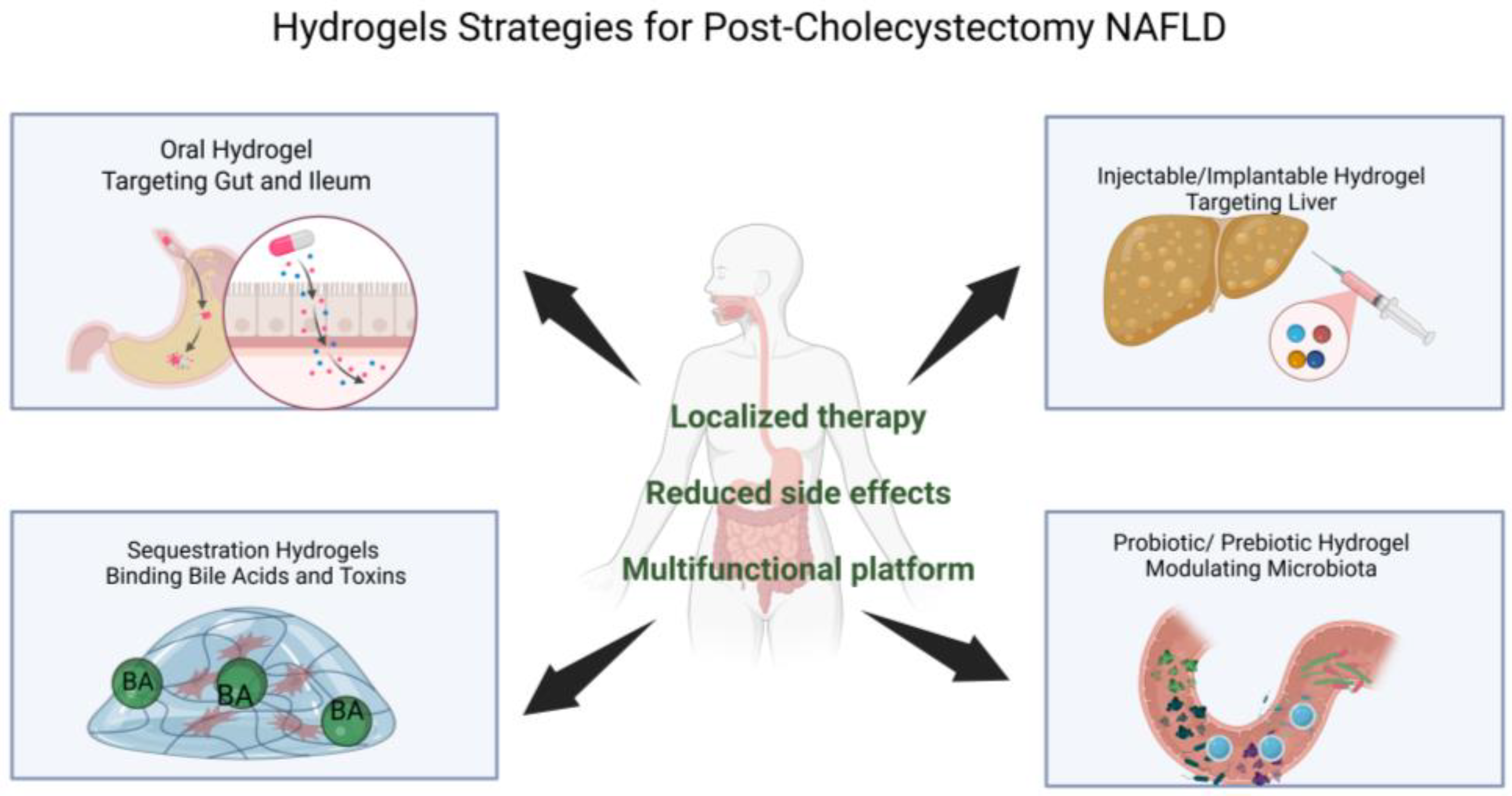

Hydrogel-Based Therapeutic Strategies for Post-Cholecystectomy NAFLD: Targeting Bile Acid Signaling, Gut Microbiota, Inflammation, and Hepatic Fibrosis


 ,
,  ,
,
Abstract
1. Post-Cholecystectomy NAFLD: Clinical and Biological Context
1.1. Clinical Relevance of NAFLD After Cholecystectomy
1.2. Pathophysiological Alterations Induced by Cholecystectomy Relevant to NAFLD
2. Materials and Methods
3. Hydrogels as a Therapeutic Platform in Post-Cholecystectomy NAFLD
4. Hydrogel-Based Bile Acid Sequestration Strategies
4.1. Bile Acids as a Key Therapeutic Target After Cholecystectomy
4.2. Hydrogels as Bile Acid Sequestration Platforms
5. Hydrogels for Modulation of the Gut Microbiota
5.1. Post-Cholecystectomy Dysbiosis and Its Contribution to NAFLD
5.2. Hydrogels as Platforms for Microbiota-Targeted Therapy
6. Hydrogel-Based Anti-Inflammatory Strategies
6.1. Intestinal and Hepatic Inflammation in Post-Cholecystectomy NAFLD
6.2. Hydrogels as Anti-Inflammatory Therapeutic Platforms
7. Hydrogels and Hepatic Fibrosis
7.1. Hepatic Fibrosis as the Critical Determinant of Disease Progression
7.2. Hydrogel-Based Antifibrotic Interventions
8. Limitations and Future Directions
9. Conclusions
Author Contributions
Funding
Institutional Review Board Statement
Informed Consent Statement
Data Availability Statement
Acknowledgments
Conflicts of Interest
Abbreviations
| AFG | Snail mucus-derived glycosaminoglycan |
| ALP | Alkaline phosphatase |
| ALT | Alanine aminotransferase |
| AST | Aspartate aminotransferase |
| BA | Bile acid(s) |
| CC | Carboxymethyl chitosan |
| CUR | Curcumin |
| Cy7 | Cyanine7 (near-infrared fluorescent dye) |
| DEX | Dexamethasone |
| DSS | Dextran sulfate sodium |
| ECM | Extracellular matrix |
| EVs | Extracellular vesicles |
| FXR | Farnesoid X receptor |
| FGF19 | Fibroblast growth factor 19 |
| F127 | Pluronic F127 (poloxamer 407) |
| FLR | Future liver remnant |
| GelMA | Gelatin methacryloyl |
| HA | Hyaluronic acid |
| HA–GE | Hyaluronic acid–gelatin |
| HASH | Thiolated hyaluronic acid |
| HEMA | 2-Hydroxyethyl methacrylate |
| HFD | High-fat diet |
| H2O2 | Hydrogen peroxide |
| IBD | Inflammatory bowel disease |
| LPS | Lipopolysaccharide(s) |
| MASLD | Metabolic dysfunction-associated steatotic liver disease |
| MAFLD | Metabolic (dysfunction)-associated fatty liver disease |
| MASH | Metabolic dysfunction-associated steatohepatitis |
| MNP | Microneedle patch |
| MSCs | Mesenchymal stem cells |
| MRI-PDFF | Magnetic resonance imaging–proton density fat fraction |
| NAFLD | Non-alcoholic fatty liver disease |
| NASH | Non-alcoholic steatohepatitis |
| NF-κB | Nuclear factor kappa B |
| PAA | Poly(acrylic acid) |
| PAM | Polyacrylamide |
| PB | Prussian blue |
| PBNPs | Prussian blue nanoparticles |
| PFD | Pirfenidone |
| PVA | Poly(vinyl alcohol) |
| QT | Quercetin |
| ROS | Reactive oxygen species |
| SCFA | Short-chain fatty acid(s) |
| TGR5 | Takeda G protein-coupled receptor 5 |
| TLR4 | Toll-like receptor 4 |
| TMNR | Thermosensitive mucoadhesive nanoregulator hydrogel (as defined in the cited study) |
References
- Devi, J.; Raees, A.; Butt, A.S. Redefining non-alcoholic fatty liver disease to metabolic associated fatty liver disease: Is this plausible? World J. Hepatol. 2022, 14, 158–167. [Google Scholar] [CrossRef]
- Xie, Z.Q.; Li, H.X.; Tan, W.L.; Yang, L.; Ma, X.W.; Li, W.X.; Wang, Q.B.; Shang, C.Z.; Chen, Y.J. Association of Cholecystectomy With Liver Fibrosis and Cirrhosis Among Adults in the USA: A Population-Based Propensity Score-Matched Study. Front. Med. 2021, 8, 787777. [Google Scholar] [CrossRef]
- Liu, X.Y.; Ma, J.; Jiao, Y. Cholecystectomy and non-alcoholic fatty liver disease: Exploring the hidden connection and implications. World J. Gastrointest. Surg. 2025, 17, 109359. [Google Scholar] [CrossRef]
- Latenstein, C.S.S.; Alferink, L.J.M.; Darwish Murad, S.; Drenth, J.P.H.; van Laarhoven, C.J.H.M.; de Reuver, P.R. The Association Between Cholecystectomy, Metabolic Syndrome, and Nonalcoholic Fatty Liver Disease: A Population-Based Study. Clin. Transl. Gastroenterol. 2020, 11, e00170. [Google Scholar] [CrossRef] [PubMed]
- Bahri, M.H.; Navabian, S.; Akbari, H.; Bagherpour, J.Z.; Bozorgmehr, R.; Mohammaditabar, M. Impact of cholecystectomy on Metabolic dysfunction-Associated Steatotic Liver Disease and metabolic syndrome: A 6-month prospective cohort study. BMC Gastroenterol. 2025, 25, 671. [Google Scholar] [CrossRef] [PubMed]
- Di Ciaula, A.; Garruti, G.; Wang, D.Q.; Portincasa, P. Cholecystectomy and risk of metabolic syndrome. Eur. J. Intern. Med. 2018, 53, 3–11. [Google Scholar] [CrossRef] [PubMed]
- Lange, A.H.; Pedersen, M.G.; Ellegaard, A.M.; Nerild, H.H.; Brønden, A.; Sonne, D.P.; Knop, F.K. The bile-gut axis and metabolic consequences of cholecystectomy. Eur. J. Endocrinol. 2024, 190, R1–R9. [Google Scholar] [CrossRef]
- Pomare, E.W.; Heaton, K.W. The effect of cholecystectomy on bile salt metabolism. Gut 1973, 14, 753–762. [Google Scholar] [CrossRef]
- Chiang, J.Y.L.; Ferrell, J.M. Bile Acids as Metabolic Regulators and Nutrient Sensors. Annu. Rev. Nutr. 2019, 39, 175–200. [Google Scholar] [CrossRef]
- Hofmann, A.F.; Hagey, L.R. Bile acids: Chemistry, pathochemistry, biology, pathobiology, and therapeutics. Cell Mol. Life Sci. 2008, 65, 2461–2483. [Google Scholar] [CrossRef]
- Chiang, J.Y.L.; Ferrell, J.M. Bile acid receptors FXR and TGR5 signaling in fatty liver diseases and therapy. Am. J. Physiol. Gastrointest. Liver Physiol. 2020, 318, G554–G573. [Google Scholar] [CrossRef]
- Gou, X.; Qin, L.; Wu, D.; Xie, J.; Lu, Y.; Zhang, Q.; He, Y. Research Progress of Takeda G Protein-Coupled Receptor 5 in Metabolic Syndrome. Molecules 2023, 28, 5870. [Google Scholar] [CrossRef] [PubMed]
- Xu, Y.; Zhang, F.; Ke, Z.; Lin, Y.; Zhang, Y.; Liu, Y.; Xu, J. HFD Exacerbates Hepatic Lipid Metabolism Disorders After Cholecystectomy by Regulating the Bile Acid and Neutrophil Recruitment. Liver Int. 2025, 45, e70130. [Google Scholar] [CrossRef] [PubMed]
- Wang, Q.; Lu, Q.; Shao, W.; Jiang, Z.; Hu, H. Dysbiosis of gut microbiota after cholecystectomy is associated with non-alcoholic fatty liver disease in mice. FEBS Open Bio 2021, 11, 2329–2339. [Google Scholar] [CrossRef] [PubMed]
- Dmytriv, T.R.; Storey, K.B.; Lushchak, V.I. Intestinal barrier permeability: The influence of gut microbiota, nutrition, and exercise. Front. Physiol. 2024, 15, 1380713. [Google Scholar] [CrossRef]
- Wang, M.; Feng, J.; Zhou, D.; Wang, J. Bacterial lipopolysaccharide-induced endothelial activation and dysfunction: A new predictive and therapeutic paradigm for sepsis. Eur. J. Med. Res. 2023, 28, 339. [Google Scholar] [CrossRef]
- Rotaru-Zavaleanu, A.D.; Neacșu, A.I.; Neacșu, A.D.; Pirici, D.; Osiac, E.; Cătălin, B.; Gheonea, D.I. Effects of Acute Sepsis on Cellular Dynamics and Amyloid Formation in a Mouse Model of Alzheimer’s Disease. Curr. Issues Mol. Biol. 2022, 44, 3822–3834. [Google Scholar] [CrossRef]
- Koyama, Y.; Brenner, D.A. Liver inflammation and fibrosis. J. Clin. Investig. 2017, 127, 55–64. [Google Scholar] [CrossRef]
- Jin, P.; Lu, X.; Chen, D.; Chen, Y. Interventions targeting the gut-liver axis: A potential treatment strategy for metabolic dysfunction-associated steatotic liver disease. Clin. Mol. Hepatol. 2025, 31, 1100–1102. [Google Scholar] [CrossRef]
- Amaral Raposo, M.; Sousa Oliveira, E.; Dos Santos, A.; Guadagnini, D.; El Mourabit, H.; Housset, C.; Lemoinne, S.; Abdalla Saad, M.J. Impact of cholecystectomy on the gut-liver axis and metabolic disorders. Clin. Res. Hepatol. Gastroenterol. 2024, 48, 102370. [Google Scholar] [CrossRef]
- Musa, I.; Rotaru-Zavaleanu, A.D.; Sfredel, V.; Aldea, M.; Gresita, A.; Glavan, D.G. Post-Stroke Recovery: A Review of Hydrogel-Based Phytochemical Delivery Systems. Gels 2025, 11, 260. [Google Scholar] [CrossRef] [PubMed]
- Rotaru-Zăvăleanu, A.D.; Dinescu, V.C.; Aldea, M.; Gresita, A. Hydrogel-Based Therapies for Ischemic and Hemorrhagic Stroke: A Comprehensive Review. Gels 2024, 10, 476. [Google Scholar] [CrossRef] [PubMed]
- Taisescu, O.; Dinescu, V.C.; Rotaru-Zavaleanu, A.D.; Gresita, A.; Hadjiargyrou, M. Hydrogels for Peripheral Nerve Repair: Emerging Materials and Therapeutic Applications. Gels 2025, 11, 126. [Google Scholar] [CrossRef] [PubMed]
- Rotaru-Zavaleanu, A.D.; Bica, M.; Dinescu, S.N.; Ruscu, M.A.; Vasile, R.C.; Zavate, A.C.; Dinescu, V.C. Bioactive Hydrogels for Spinal Cord Injury Repair: Emphasis on Gelatin and Its Derivatives. Gels 2025, 11, 497. [Google Scholar] [CrossRef]
- Viezuina, D.M.; Musa, I.; Aldea, M.; Matache, I.M.; Rotaru Zavaleanu, A.D.; Gresita, A.; Veronica, S.; Mitran, S.I. Gelatin-Based Hydrogels for Peripheral Nerve Regeneration: A Multifunctional Vehicle for Cellular, Molecular, and Pharmacological Therapy. Gels 2025, 11, 490. [Google Scholar] [CrossRef]
- Dinescu, V.C.; Martin, L.; Bica, M.; Vasile, R.C.; Gresita, A.; Bunescu, M.; Ruscu, M.A.; Aldea, M.; Rotaru-Zavaleanu, A.D. Hydrogel-Based Innovations in Carpal Tunnel Syndrome: Bridging Pathophysiological Complexities and Translational Therapeutic Gaps. Gels 2025, 11, 52. [Google Scholar] [CrossRef]
- Gresita, A.; Raja, I.; Petcu, E.; Hadjiargyrou, M. Collagen-Coated Hyperelastic Bone Promotes Osteoblast Adhesion and Proliferation. Materials 2023, 16, 6996. [Google Scholar] [CrossRef]
- Tharakan, S.; Khondkar, S.; Lee, S.; Ahn, S.; Mathew, C.; Gresita, A.; Hadjiargyrou, M.; Ilyas, A. 3D Printed Osteoblast-Alginate/Collagen Hydrogels Promote Survival, Proliferation and Mineralization at Low Doses of Strontium Calcium Polyphosphate. Pharmaceutics 2022, 15, 11. [Google Scholar] [CrossRef]
- Zhang, B.G.; Liu, Q.; Ma, T.; Liu, J.J.; Zhang, Y.; Liu, F.; Wen, X.M.; Wang, D.X.; Jiang, W.; An, W.B. Mechanism and application of injectable hydrogel as carrier system in the treatment of osteoarthritis. Front. Bioeng. Biotechnol. 2025, 13, 1636518. [Google Scholar] [CrossRef]
- Jiménez-Gastelum, G.R.; Villegas-Mercado, C.E.; Cota-Quintero, J.L.; Arzola-Rodríguez, S.I.; Ramos-Payán, R.; Bermúdez, M. Hydrogels Modulating the Microbiome: Therapies for Tissue Regeneration with Infection Control. Gels 2025, 11, 584. [Google Scholar] [CrossRef]
- Patroklou, G.; Triantafyllopoulou, E.; Goula, P.E.; Karali, V.; Chountoulesi, M.; Valsami, G.; Pispas, S.; Pippa, N. pH-Responsive Hydrogels: Recent Advances in Pharmaceutical Applications. Polymers 2025, 17, 1451. [Google Scholar] [CrossRef] [PubMed]
- Adepu, S.; Ramakrishna, S. Controlled Drug Delivery Systems: Current Status and Future Directions. Molecules 2021, 26, 5905. [Google Scholar] [CrossRef] [PubMed]
- Zhang, Y.; Li, L.; Dong, L.; Cheng, Y.; Huang, X.; Xue, B.; Jiang, C.; Cao, Y.; Yang, J. Hydrogel-Based Strategies for Liver Tissue Engineering. Chem Bio Eng. 2024, 1, 887–915. [Google Scholar] [CrossRef] [PubMed]
- Butcher, E.L.; Arthur, S. Emerging Roles of Bile Acids in Neuroinflammation. Int. J. Mol. Sci. 2025, 26, 11301. [Google Scholar] [CrossRef]
- Musuc, A.M.; Mititelu, M.; Chelu, M. Hydrogel for Sustained Delivery of Therapeutic Agents. Gels 2024, 10, 717. [Google Scholar] [CrossRef]
- Park, S.; Zhang, T.; Yue, Y.; Wu, X. Effects of Bile Acid Modulation by Dietary Fat, Cholecystectomy, and Bile Acid Sequestrant on Energy, Glucose, and Lipid Metabolism and Gut Microbiota in Mice. Int. J. Mol. Sci. 2022, 23, 5935. [Google Scholar] [CrossRef]
- Puleston, J.; Morgan, H.; Andreyev, J. New treatment for bile salt malabsorption. Gut 2005, 54, 441–442. [Google Scholar] [CrossRef]
- Han, S.; Lu, Y.; Xie, J.; Fei, Y.; Zheng, G.; Wang, Z.; Liu, J.; Lv, L.; Ling, Z.; Berglund, B.; et al. Probiotic Gastrointestinal Transit and Colonization After Oral Administration: A Long Journey. Front. Cell. Infect. Microbiol. 2021, 11, 609722. [Google Scholar] [CrossRef]
- Bhattacharya, S.; Baidya, S. Viability Preservation of Probiotic Bacteria Encapsulated in Pectin-Reinforced pH-Responsive Composite Alginate Hydrogel Matrix as the Synbiotic Delivery System. Probiotics Antimicrob. Proteins 2025. [Google Scholar] [CrossRef]
- Zhang, S.; Ermann, J.; Succi, M.D.; Zhou, A.; Hamilton, M.J.; Cao, B.; Korzenik, J.R.; Glickman, J.N.; Vemula, P.K.; Glimcher, L.H.; et al. An inflammation-targeting hydrogel for local drug delivery in inflammatory bowel disease. Sci. Transl. Med. 2015, 7, 300ra128. [Google Scholar] [CrossRef]
- Liao, K.M.; Chen, C.Y. Risk of potential hepatotoxicity from pirfenidone or nintedanib in patients with idiopathic pulmonary fibrosis: Results of a retrospective analysis of a large insurance database in Taiwan. Front. Pharmacol. 2024, 15, 1309712. [Google Scholar] [CrossRef] [PubMed]
- Huang, R.L.; Huang, W.K.; Xiao, X.Y.; Ma, L.F.; Gu, H.Z.; Yang, G.P. Diagnosis and treatment of post-cholecystectomy diarrhoea. World J. Gastrointest. Surg. 2023, 15, 2398–2405. [Google Scholar] [CrossRef] [PubMed]
- Simbrunner, B.; Hofer, B.S.; Schwabl, P.; Zinober, K.; Petrenko, O.; Fuchs, C.; Semmler, G.; Marculescu, R.; Mandorfer, M.; Datz, C.; et al. FXR-FGF19 signaling in the gut-liver axis is dysregulated in patients with cirrhosis and correlates with impaired intestinal defence. Hepatol. Int. 2024, 18, 929–942. [Google Scholar] [CrossRef]
- Moon, D.O. Structure-Based Insights into TGR5 Activation by Natural Compounds: Therapeutic Implications and Emerging Strategies for Obesity Management. Biomedicines 2025, 13, 2405. [Google Scholar] [CrossRef] [PubMed]
- Simonson, M.; Simonson, T.; Nobécourt, E. An overview of basic pathophysiological interactions between gut bacteria and their host. Front. Nutr. 2025, 12, 1565609. [Google Scholar] [CrossRef] [PubMed]
- Ridlon, J.M.; Gaskins, H.R. Another renaissance for bile acid gastrointestinal microbiology. Nat. Rev. Gastroenterol. Hepatol. 2024, 21, 348–364. [Google Scholar] [CrossRef]
- Chen, F.; Gong, L. Bile acid-microbiota interactions in cardiometabolic diseases: Mechanisms and emerging therapeutic approaches. Front. Microbiol. 2025, 16, 1689026. [Google Scholar] [CrossRef]
- Chiang, J.Y. Bile acid metabolism and signaling. Compr. Physiol. 2013, 3, 1191–1212. [Google Scholar] [CrossRef]
- Zhang, Q.; Huang, X.; Zhang, L.; Jin, Z. Isothermal Titration Calorimetry Directly Measures the Selective Swelling of Block Copolymer Vesicles in the Presence of Organic Acid. ACS Omega 2022, 7, 10580–10587. [Google Scholar] [CrossRef]
- Afzal, K.B.; Kali, G.; Haris, M.; Schmidt, M.R.; Ebert, M.; Stefan, E.; Bernkop-Schnürch, A. Quaternary ammonium-modified dextran: A unique biodegradable mucoadhesive polymer. Eur. J. Pharm. Biopharm. 2025, 214, 114788. [Google Scholar] [CrossRef]
- Alipour, E.; Norouzi, S.; Yousefzadeh, H.; Mohammadi, R.; Amini-Fazl, M.S. Synthesis of chitosan-grafted poly-acrylic acid (CTS-g-PAA) hydrogel and its potential application in biosensors for signal enhancing and bioanalysis. J. Mater. Sci. Mater. Electron. 2021, 32, 24812–24824. [Google Scholar] [CrossRef] [PubMed]
- Liu, Y.; Huang, J.; Li, S.; Li, Z.; Chen, C.; Qu, G.; Chen, K.; Teng, Y.; Ma, R.; Wu, X.; et al. Advancements in hydrogel-based drug delivery systems for the treatment of inflammatory bowel disease: A review. Biomater. Sci. 2024, 12, 837–862. [Google Scholar] [CrossRef] [PubMed]
- Dargaville, B.L.; Hutmacher, D.W. Water as the often neglected medium at the interface between materials and biology. Nat. Commun. 2022, 13, 4222. [Google Scholar] [CrossRef] [PubMed]
- Elnaggar, Y.S. Multifaceted applications of bile salts in pharmacy: An emphasis on nanomedicine. Int. J. Nanomed. 2015, 10, 3955–3971. [Google Scholar] [CrossRef]
- Stanciu, M.C.; Nichifor, M.; Teacă, C.A. Bile Acid Sequestrants Based on Natural and Synthetic Gels. Gels 2023, 9, 500. [Google Scholar] [CrossRef]
- Sieders, M.; Candry, P.; El Aidy, S. Hydrogel-based experimental models of the gastrointestinal tract. Microbiome 2025, 13, 233. [Google Scholar] [CrossRef]
- Thang, N.H.; Chien, T.B.; Cuong, D.X. Polymer-Based Hydrogels Applied in Drug Delivery: An Overview. Gels 2023, 9, 523. [Google Scholar] [CrossRef]
- Song, G.; Xie, Y.; Yi, L.; Cheng, W.; Jia, H.; Shi, W.; Liu, Q.; Fang, L.; Xue, S.; Liu, D.; et al. Bile acids affect intestinal barrier function through FXR and TGR5. Front. Med. 2025, 12, 1607899. [Google Scholar] [CrossRef]
- Stanciu, M.C.; Nichifor, M.; Ailiesei, G.L. Bile salts adsorption on dextran-based hydrogels. Int. J. Biol. Macromol. 2021, 190, 270–283. [Google Scholar] [CrossRef]
- De Piano, R.; Caccavo, D.; Barba, A.A.; Lamberti, G. Swelling Behavior of Anionic Hydrogels: Experiments and Modeling. Gels 2024, 10, 813. [Google Scholar] [CrossRef]
- Ho, T.C.; Chang, C.C.; Chan, H.P.; Chung, T.W.; Shu, C.W.; Chuang, K.P.; Duh, T.H.; Yang, M.H.; Tyan, Y.C. Hydrogels: Properties and Applications in Biomedicine. Molecules 2022, 27, 2902. [Google Scholar] [CrossRef] [PubMed]
- Stanciu, M.C.; Nichifor, M.; Anca-Irina, P. Adsorption of Sodium Cholate on Cationic Dextran Gels: Comparison of Isotherm Binding Models. Mater. Plast. 2020, 57, 181–192. [Google Scholar] [CrossRef]
- Hoti, G.; Caldera, F.; Cecone, C.; Rubin Pedrazzo, A.; Anceschi, A.; Appleton, S.L.; Khazaei Monfared, Y.; Trotta, F. Effect of the Cross-Linking Density on the Swelling and Rheological Behavior of Ester-Bridged β-Cyclodextrin Nanosponges. Materials 2021, 14, 478. [Google Scholar] [CrossRef] [PubMed]
- Tang, B.; Li, S.; Li, X.; He, J.; Zhou, A.; Wu, L.; Xiao, X.; Wang, S.; Jiang, H.; Jian, J.; et al. Cholecystectomy-related gut microbiota dysbiosis exacerbates colorectal tumorigenesis. Nat. Commun. 2025, 16, 7638. [Google Scholar] [CrossRef]
- Larabi, A.B.; Masson, H.L.P.; Bäumler, A.J. Bile acids as modulators of gut microbiota composition and function. Gut Microbes 2023, 15, 2172671. [Google Scholar] [CrossRef]
- Du, Y.; He, C.; An, Y.; Huang, Y.; Zhang, H.; Fu, W.; Wang, M.; Shan, Z.; Xie, J.; Yang, Y.; et al. The Role of Short Chain Fatty Acids in Inflammation and Body Health. Int. J. Mol. Sci. 2024, 25, 7379. [Google Scholar] [CrossRef]
- Lau, E.; Carvalho, D.; Freitas, P. Gut Microbiota: Association with NAFLD and Metabolic Disturbances. Biomed. Res. Int. 2015, 2015, 979515. [Google Scholar] [CrossRef]
- Chang, H.; Jiang, Y.; Zhao, Q.; Su, Z.; Chen, M.; He, Q.; Lai, J.; Zheng, J.; Pan, R.; Shao, J.; et al. Disruption of Bile Acid Metabolism in the Gut-Liver Axis Predisposes Mice to Inflammatory Bowel Disease. MedComm 2025, 6, e70429. [Google Scholar] [CrossRef]
- Arab, J.P.; Arrese, M.; Shah, V.H. Gut microbiota in non-alcoholic fatty liver disease and alcohol-related liver disease: Current concepts and perspectives. Hepatol. Res. 2020, 50, 407–418. [Google Scholar] [CrossRef]
- Li, M.; He, X.; Zhao, R.; Shi, Q.; Nian, Y.; Hu, B. Hydrogels as promising carriers for the delivery of food bioactive ingredients. Front. Nutr. 2022, 9, 1006520. [Google Scholar] [CrossRef]
- Abbaszadeh, S.; Gandomi, H.; Misaghi, A.; Bokaei, S.; Noori, N. The effect of alginate and chitosan concentrations on some properties of chitosan-coated alginate beads and survivability of encapsulated Lactobacillus rhamnosus in simulated gastrointestinal conditions and during heat processing. J. Sci. Food Agric. 2014, 94, 2210–2216. [Google Scholar] [CrossRef] [PubMed]
- Agriopoulou, S.; Tarapoulouzi, M.; Varzakas, T.; Jafari, S.M. Application of Encapsulation Strategies for Probiotics: From Individual Loading to Co-Encapsulation. Microorganisms 2023, 11, 2896. [Google Scholar] [CrossRef] [PubMed]
- Orlando, A.; Linsalata, M.; Bianco, G.; Notarnicola, M.; D’Attoma, B.; Scavo, M.P.; Tafaro, A.; Russo, F. Lactobacillus rhamnosus GG Protects the Epithelial Barrier of Wistar Rats from the Pepsin-Trypsin-Digested Gliadin (PTG)-Induced Enteropathy. Nutrients 2018, 10, 1698. [Google Scholar] [CrossRef] [PubMed]
- Arukha, A.P.; Nayak, S.; Swain, D.M. Effect of Akkermansia muciniphila on GLP-1 and Insulin Secretion. Nutrients 2025, 17, 2516. [Google Scholar] [CrossRef]
- Wang, X.; Gao, S.; Yun, S.; Zhang, M.; Peng, L.; Li, Y.; Zhou, Y. Microencapsulating Alginate-Based Polymers for Probiotics Delivery Systems and Their Application. Pharmaceuticals 2022, 15, 644. [Google Scholar] [CrossRef]
- Zhong, H.; Jiang, J.; Hussain, M.; Zhang, H.; Chen, L.; Guan, R. The Encapsulation Strategies for Targeted Delivery of Probiotics in Preventing and Treating Colorectal Cancer: A Review. Adv. Sci. 2025, 12, e2500304. [Google Scholar] [CrossRef]
- Kumar, R.; Sood, U.; Gupta, V.; Singh, M.; Scaria, J.; Lal, R. Recent Advancements in the Development of Modern Probiotics for Restoring Human Gut Microbiome Dysbiosis. Indian J. Microbiol. 2020, 60, 12–25. [Google Scholar] [CrossRef]
- Kibbie, J.J.; Dillon, S.M.; Thompson, T.A.; Purba, C.M.; McCarter, M.D.; Wilson, C.C. Butyrate directly decreases human gut lamina propria CD4 T cell function through histone deacetylase (HDAC) inhibition and GPR43 signaling. Immunobiology 2021, 226, 152126. [Google Scholar] [CrossRef]
- Dafe, A.; Etemadi, H.; Dilmaghani, A.; Mahdavinia, G.R. Investigation of pectin/starch hydrogel as a carrier for oral delivery of probiotic bacteria. Int. J. Biol. Macromol. 2017, 97, 536–543. [Google Scholar] [CrossRef]
- Zhang, S.; Kang, L.; Hu, S.; Hu, J.; Fu, Y.; Hu, Y.; Yang, X. Carboxymethyl chitosan microspheres loaded hyaluronic acid/gelatin hydrogels for controlled drug delivery and the treatment of inflammatory bowel disease. Int. J. Biol. Macromol. 2021, 167, 1598–1612. [Google Scholar] [CrossRef]
- Xu, T.; Ning, X.; Wu, J.; Wang, Q.; Wang, Z.; Chen, Z.; Tang, X.; Bai, P.; Pu, K.; Li, L.; et al. Metabolic Nanoregulator Remodels Gut Microenvironment for Treatment of Inflammatory Bowel Disease. ACS Nano 2024, 18, 7123–7135. [Google Scholar] [CrossRef] [PubMed]
- Jing, S.; Chen, H.; Liu, E.; Zhang, M.; Zeng, F.; Shen, H.; Fang, Y.; Muhitdinov, B.; Huang, Y. Oral pectin/oligochitosan microspheres for colon-specific controlled release of quercetin to treat inflammatory bowel disease. Carbohydr. Polym. 2023, 316, 121025. [Google Scholar] [CrossRef] [PubMed]
- Zhang, G.; Song, D.; Ma, R.; Li, M.; Liu, B.; He, Z.; Fu, Q. Artificial mucus layer formed in response to ROS for the oral treatment of inflammatory bowel disease. Sci. Adv. 2024, 10, eado8222. [Google Scholar] [CrossRef] [PubMed]
- Gieryńska, M.; Szulc-Dąbrowska, L.; Struzik, J.; Mielcarska, M.B.; Gregorczyk-Zboroch, K.P. Integrity of the Intestinal Barrier: The Involvement of Epithelial Cells and Microbiota-A Mutual Relationship. Animals 2022, 12, 145. [Google Scholar] [CrossRef]
- Xu, F.; Chen, R.; Zhang, C.; Wang, H.; Ding, Z.; Yu, L.; Tian, F.; Chen, W.; Zhou, Y.; Zhai, Q. Cholecystectomy Significantly Alters Gut Microbiota Homeostasis and Metabolic Profiles: A Cross-Sectional Study. Nutrients 2023, 15, 4399. [Google Scholar] [CrossRef]
- An, L.; Wirth, U.; Koch, D.; Schirren, M.; Drefs, M.; Koliogiannis, D.; Nieß, H.; Andrassy, J.; Guba, M.; Bazhin, A.V.; et al. The Role of Gut-Derived Lipopolysaccharides and the Intestinal Barrier in Fatty Liver Diseases. J. Gastrointest. Surg. 2022, 26, 671–683. [Google Scholar] [CrossRef]
- Pezzino, S.; Sofia, M.; Faletra, G.; Mazzone, C.; Litrico, G.; La Greca, G.; Latteri, S. Gut-Liver Axis and Non-Alcoholic Fatty Liver Disease: A Vicious Circle of Dysfunctions Orchestrated by the Gut Microbiome. Biology 2022, 11, 1622. [Google Scholar] [CrossRef]
- Ma, L.; Gu, F.; Hu, J.; Wang, X.; Yang, Y.W. Hydrogel adhesives for upper gastrointestinal wound healing. Theranostics 2026, 16, 2221–2248. [Google Scholar] [CrossRef]
- Wang, J.; Ouyang, S.; Lin, G.; Li, D.; Ding, B.; Chen, Y.; Tong, B.; Ouyang, T.; Xu, H.; Wu, W. Dual-mechanism mucoadhesive hydrogel integrating pH-independent barriers and autophagy-driven immunotherapy for the treatment of ulcerative colitis. Acta Biomater. 2025, 205, 302–318. [Google Scholar] [CrossRef]
- Huang, C.; Dong, L.; Zhao, B.; Huang, S.; Lu, Y.; Zhang, X.; Hu, X.; Huang, Y.; He, W.; Xu, Y.; et al. Tunable Sulfated Alginate-based Hydrogel Platform with enhanced anti-inflammatory and antioxidant capacity for promoting burn wound repair. J. Nanobiotechnol. 2023, 21, 387. [Google Scholar] [CrossRef]
- Yang, C.; Zhang, Y.; Zhang, X.; Tang, P.; Zheng, T.; Ran, R.; Li, G. An injectable, self-healing, and antioxidant collagen- and hyaluronic acid-based hydrogel mediated with gallic acid and dopamine for wound repair. Carbohydr. Polym. 2023, 320, 121231. [Google Scholar] [CrossRef] [PubMed]
- Zhou, Z.; Deng, T.; Tao, M.; Lin, L.; Sun, L.; Song, X.; Gao, D.; Li, J.; Wang, Z.; Wang, X.; et al. Snail-inspired AFG/GelMA hydrogel accelerates diabetic wound healing via inflammatory cytokines suppression and macrophage polarization. Biomaterials 2023, 299, 122141. [Google Scholar] [CrossRef] [PubMed]
- Meli, V.S.; Atcha, H.; Veerasubramanian, P.K.; Nagalla, R.R.; Luu, T.U.; Chen, E.Y.; Guerrero-Juarez, C.F.; Yamaga, K.; Pandori, W.; Hsieh, J.Y.; et al. YAP-mediated mechanotransduction tunes the macrophage inflammatory response. Sci. Adv. 2020, 6, eabb8471. [Google Scholar] [CrossRef] [PubMed]
- Xu, J.; Tam, M.; Samaei, S.; Lerouge, S.; Barralet, J.; Stevenson, M.M.; Cerruti, M. Mucoadhesive chitosan hydrogels as rectal drug delivery vessels to treat ulcerative colitis. Acta Biomater. 2017, 48, 247–257. [Google Scholar] [CrossRef]
- Ge, X.; Wen, H.; Fei, Y.; Xue, R.; Cheng, Z.; Li, Y.; Cai, K.; Li, L.; Li, M.; Luo, Z. Structurally dynamic self-healable hydrogel cooperatively inhibits intestinal inflammation and promotes mucosal repair for enhanced ulcerative colitis treatment. Biomaterials 2023, 299, 122184. [Google Scholar] [CrossRef]
- Xiao, R.; Huang, K.; Chen, Y.; Jiang, W.; Xu, L. Emerging novel hydrogels application in oral and gastrointestinal diseases: Design wet adhesive strategy towards possible mechanisms. Sci. Technol. Adv. Mater. 2025, 26, 2556646. [Google Scholar] [CrossRef]
- Wang, L.; Zhou, F.; Xie, W. Advances in hyaluronic acid-based biomaterials: Applications in cancer therapy, wound healing, and disease management. J. Mater. Sci. Mater. Med. 2025, 36, 91. [Google Scholar] [CrossRef]
- Stevanović, M.; Jović, M.; Filipović, N.; Lukač, S.; Tomić, N.; Popović Maneski, L.; Stojanović, Z. Multifunctional Nanomaterial-Integrated Hydrogels for Sustained Drug Delivery: From Synthesis and Characterization to Biomedical Application. Gels 2025, 11, 892. [Google Scholar] [CrossRef]
- Sun, Y.; Wu, J.; Zan, J.; Li, Z.; Liu, L.; Ding, G. Multi-Functional Applications of Hydrogel Delivery Systems in Inflammatory Bowel Disease: Drug Delivery, Anti-Inflammation, and Intestinal Repair. Polymers 2025, 17, 1430. [Google Scholar] [CrossRef]
- Huang, A.P.; Lai, D.M.; Hsu, Y.H.; Tsai, H.H.; Su, C.Y.; Hsu, S.H. An anti-inflammatory gelatin hemostatic agent with biodegradable polyurethane nanoparticles for vulnerable brain tissue. Mater. Sci. Eng. C Mater. Biol. Appl. 2021, 121, 111799. [Google Scholar] [CrossRef]
- Pais, R.; Pascale, A.; Fedchuck, L.; Charlotte, F.; Poynard, T.; Ratziu, V. Progression from isolated steatosis to steatohepatitis and fibrosis in nonalcoholic fatty liver disease. Clin. Res. Hepatol. Gastroenterol. 2011, 35, 23–28. [Google Scholar] [CrossRef] [PubMed]
- Subramanian, P.; Hampe, J.; Tacke, F.; Chavakis, T. Fibrogenic Pathways in Metabolic Dysfunction Associated Fatty Liver Disease (MAFLD). Int. J. Mol. Sci. 2022, 23, 6996. [Google Scholar] [CrossRef] [PubMed]
- Sofias, A.M.; De Lorenzi, F.; Peña, Q.; Azadkhah Shalmani, A.; Vucur, M.; Wang, J.W.; Kiessling, F.; Shi, Y.; Consolino, L.; Storm, G.; et al. Therapeutic and diagnostic targeting of fibrosis in metabolic, proliferative and viral disorders. Adv. Drug Deliv. Rev. 2021, 175, 113831. [Google Scholar] [CrossRef] [PubMed]
- Torresan, V.; Gandin, A.; Contessotto, P.; Zanconato, F.; Brusatin, G. Injectable hyaluronic acid-based hydrogel niches to create localized and time-controlled therapy delivery. Mater. Today Bio 2025, 31, 101510. [Google Scholar] [CrossRef]
- Diwan, R.; Bhatt, H.N.; Beaven, E.; Nurunnabi, M. Emerging delivery approaches for targeted pulmonary fibrosis treatment. Adv. Drug Deliv. Rev. 2024, 204, 115147. [Google Scholar] [CrossRef]
- Chu, Y.H.; Pang, B.Y.; Yang, M.; Meng, Q.; Leng, Y. The intervention of curcumin on rodent models of hepatic fibrosis: A systematic review and meta-analysis. PLoS ONE 2024, 19, e0304176. [Google Scholar] [CrossRef]
- Bolinas, D.K.M.; Barcena, A.J.R.; Mishra, A.; Bernardino, M.R.; Lin, V.; Heralde, F.M.; Chintalapani, G.; Fowlkes, N.W.; Huang, S.Y.; Melancon, M.P. Mesenchymal Stem Cells Loaded in Injectable Alginate Hydrogels Promote Liver Growth and Attenuate Liver Fibrosis in Cirrhotic Rats. Gels 2025, 11, 250. [Google Scholar] [CrossRef]
- Gu, X.; Wu, Z.; Wu, D.; Hou, B.; Bian, L.; Zhou, T.; Hou, Y.; Wang, H.; Zheng, Z. Hydrogel microneedle patch for treatment of liver fibrosis. Mater. Today Adv. 2023, 20, 100417. [Google Scholar] [CrossRef]
- Abolhasani, S.; Ahmadi, Y.; Rostami, Y.; Baravar, E.; Fattahi, D. Biomaterials in tissue repair and regeneration: Key insights from extracellular matrix biology. Front. Med. Technol. 2025, 7, 1565810. [Google Scholar] [CrossRef]
- Cerrito, L.; Galasso, L.; Iaccarino, J.; Pizzi, A.; Termite, F.; Esposto, G.; Borriello, R.; Ainora, M.E.; Gasbarrini, A.; Zocco, M.A. Present and Future Perspectives in the Treatment of Liver Fibrosis. Pharmaceuticals 2025, 18, 1321. [Google Scholar] [CrossRef]
- Maj, M.A.; Burrin, D.G.; Manjarín, R. Decreased FXR Agonism in the Bile Acid Pool Is Associated with Impaired FXR Signaling in a Pig Model of Pediatric NAFLD. Biomedicines 2023, 11, 3303. [Google Scholar] [CrossRef]
- Segneanu, A.E.; Bejenaru, L.E.; Bejenaru, C.; Blendea, A.; Mogoşanu, G.D.; Biţă, A.; Boia, E.R. Advancements in Hydrogels: A Comprehensive Review of Natural and Synthetic Innovations for Biomedical Applications. Polymers 2025, 17, 2026. [Google Scholar] [CrossRef] [PubMed]
- Di Ciaula, A.; Bonfrate, L.; Baj, J.; Khalil, M.; Garruti, G.; Stellaard, F.; Wang, H.H.; Wang, D.Q.; Portincasa, P. Recent Advances in the Digestive, Metabolic and Therapeutic Effects of Farnesoid X Receptor and Fibroblast Growth Factor 19: From Cholesterol to Bile Acid Signaling. Nutrients 2022, 14, 4950. [Google Scholar] [CrossRef] [PubMed]
- Li, Y.; Wang, L.; Yi, Q.; Luo, L.; Xiong, Y. Regulation of bile acids and their receptor FXR in metabolic diseases. Front. Nutr. 2024, 11, 1447878. [Google Scholar] [CrossRef] [PubMed]
- Nikam, A.; Sahoo, P.R.; Musale, S.; Pagar, R.R.; Paiva-Santos, A.C.; Giram, P.S. A Systematic Overview of Eudragit® Based Copolymer for Smart Healthcare. Pharmaceutics 2023, 15, 587. [Google Scholar] [CrossRef]
- Zahran, S.A.; Ali-Tammam, M.; Hashem, A.M.; Aziz, R.K.; Ali, A.E. Azoreductase activity of dye-decolorizing bacteria isolated from the human gut microbiota. Sci. Rep. 2019, 9, 5508. [Google Scholar] [CrossRef]
- Ozorio, L.; Mellinger-Silva, C.; Cabral, L.M.C.; Jardin, J.; Boudry, G.; Dupont, D. The Influence of Peptidases in Intestinal Brush Border Membranes on the Absorption of Oligopeptides from Whey Protein Hydrolysate: An Ex Vivo Study Using an Ussing Chamber. Foods 2020, 9, 1415. [Google Scholar] [CrossRef]
- Ways, T.M.M.; Lau, W.M.; Khutoryanskiy, V.V. Chitosan and Its Derivatives for Application in Mucoadhesive Drug Delivery Systems. Polymers 2018, 10, 267. [Google Scholar] [CrossRef]
- da Silva, R.Y.P.; de Menezes, D.L.B.; Oliveira, V.D.S.; Converti, A.; de Lima, Á. Microparticles in the Development and Improvement of Pharmaceutical Formulations: An Analysis of In Vitro and In Vivo Studies. Int. J. Mol. Sci. 2023, 24, 5441. [Google Scholar] [CrossRef]
- Xu, Y.; Jing, H.; Wang, J.; Zhang, S.; Chang, Q.; Li, Z.; Wu, X.; Zhang, Z. Disordered Gut Microbiota Correlates With Altered Fecal Bile Acid Metabolism and Post-cholecystectomy Diarrhea. Front. Microbiol. 2022, 13, 800604. [Google Scholar] [CrossRef]
- Sabbagh, F.; Zargarian, S.S.; Kosik-Kozioł, A.; Nakielski, P.; Pierini, F. Hydrogel-based ocular drug delivery systems. J. Mater. Chem. B 2025, 13, 14982–15006. [Google Scholar] [CrossRef]


| Property | Natural Hydrogels | Synthetic Hydrogels |
|---|---|---|
| Source | Derived from biological sources (e.g., chitosan, alginate, cellulose) | Engineered from synthetic monomers (e.g., PVA, PAA, HEMA) |
| Biodegradability | High—readily broken down by natural enzymes or microbiota | Variable—often resistant to biodegradation |
| Customizability | Limited—dependent on natural polymer backbone | High—customizable via monomer choice and crosslinking |
| Interaction Mechanism | Primarily ionic and hydrogen bonding with bile acids | Ionic, hydrophobic, and steric interactions |
| Examples | Chitosan, Alginate, Pectin, Cellulose | Poly(acrylic acid), Poly(vinyl alcohol), Poly(HEMA) |
| Toxicity | Low toxicity; good biocompatibility | Can vary—depends on monomer used |
| Swelling Behavior | Moderate and pH-dependent | Highly tunable across conditions |
| Porosity Control | Difficult to tune precisely | Precisely adjustable by formulation |
| Response Type | Hydrogel Composition | Quantitative Performance | In Vivo Efficacy | Mechanism Details | References |
|---|---|---|---|---|---|
| pH-sensitive | HA–gelatin (1:2 ratio) with curcumin-loaded chitosan microspheres | pH transition: 6.8–7.4; Release: 80% in 8 h at pH 7.4 vs. <10% at pH 1.2; Stability: >95% intact through gastric transit | IBD rat model: 65% reduction in colonic inflammation (MPO activity); 2.8-fold increase in mucosal integrity scores vs. free drug | Carboxyl ionization above pH 6.8 triggers swelling; sustained colonic curcumin release via enzymatic matrix degradation | [80] |
| Temperature-sensitive | Pluronic F127–HA–α-cyclodextrin with melanin–gallium nanocomplex (TMNR) | LCST: 32 °C; Gelation time: <2 min at 37 °C; G′ = 450 Pa; Retention: >48 h vs. 6 h (non-thermogelling); Mucoadhesion: 8.2× vs. control | UC mouse model: 3.2-fold TNF-α reduction; 70% decrease in DAI scores; histological recovery (inflammation score 1.2 vs. 4.8 control) | Liquid at 4 °C for injection; sol–gel transition at body temp; ROS-scavenging melanin complex; strong mucosal adhesion resists peristalsis | [81] |
| Enzyme-sensitive | Pectin/Ca2+ matrix with chitosan oligosaccharide–quercetin (COS–QT) microspheres | Target: colonic pectinase; Degradation: 90% in 6 h with enzyme vs. <5% without; Colonic delivery efficiency: 87% vs. 34% (pH-only); QT bioavailability: 4.3× improvement | Colitis model: Quercetin plasma Cmax 2.8 μg/mL (vs. 0.6 μg/mL free); 58% reduction in colonic IL-6; improved barrier function (TEER recovery 78%) | Pectin resistant to upper GI; degraded by bacterial pectinases in colon; COS enhances penetration and controlled QT release at inflammation sites | [82] |
| Redox-responsive | Thiolated hyaluronic acid (HASH60%, 60% thiol modification) | ROS threshold: >100 μM H2O2; Gelation: <5 min at oxidative sites; Selective adhesion: 8:1 ratio (inflamed vs. healthy mucosa); Retention: 36 h at inflamed sites | DSS-colitis mice: IL-10 increase 2.8-fold; selective accumulation in inflamed regions (fluorescence imaging); 62% reduction in oxidative stress markers (4-HNE) | Disulfide bond formation with mucin thiols under oxidative stress; ROS-triggered crosslinking; artificial mucus layer formation; protects epithelium from luminal irritants | [83] |
| Study/System | Hydrogel Type & Delivery Mode | Therapeutic Payload | Experimental Model | Key Outcomes | Relevance to Antifibrotic Therapy |
|---|---|---|---|---|---|
| General hepatic hydrogel platforms | Injectable, liver-conforming hydrogels | Small molecules, biologics, siRNA | Preclinical liver fibrosis models | Sustained local drug release; enhanced target engagement; reduced systemic toxicity | Improves spatial control of antifibrotic therapy and minimizes off-target effects |
| Bolinas et al. | Injectable hydrogel, intraportal administration | Mesenchymal stem cells (MSCs) | Cirrhotic rat model | High MSC viability (89.0 ± 3.0%); sustained release (2 weeks); increased liver volume (FLR 0.57 ± 0.32) and weight (FLR 0.84 ± 0.05); reduced AST, ALT, ALP; fibrosis reduced to 4.52 ± 0.22%; higher cell retention (37.30 ± 16.10 MSCs/mm2) | Enhances MSC localization, viability, retention, and antifibrotic efficacy |
| Gu et al. | GelMA-based hydrogel microneedle patch (MNP) | Pirfenidone (PFD) | C57 mouse model of chronic liver fibrosis | Complete degradation within 1 week; suppressed fibroblast proliferation and migration; reduced fibrosis, inflammation, and apoptosis markers; near-normal liver enzymes; superior efficacy vs. oral PFD | Minimally invasive, long-acting antifibrotic delivery with improved consistency and tolerability |
| Biomimetic ECM hydrogels | ECM-mimicking scaffolds with tunable mechanics | None (structural/biophysical cues) | Liver regeneration and fibrosis models | Modulation of hepatic stellate cell behavior; reduced fibrogenic activation; promotion of regenerative phenotype | Supports tissue repair and fibrosis attenuation via microenvironmental regulation |
| Conceptual relevance to post-cholecystectomy NAFLD | Not yet directly evaluated | — | NAFLD progression models | Fibrosis identified as a shared final pathway independent of disease trigger | Provides a rational strategy for addressing advanced fibrosis in post-cholecystectomy NAFLD |
| Model Limitation | Impact on Hydrogel Validation | Translational Consequence |
|---|---|---|
| Bile acid dynamics | Standard models with pulsatile, meal-dependent bile secretion fail to reproduce continuous post-cholecystectomy bile flow. Hydrogel swelling behavior, binding capacity, selectivity for primary vs. secondary bile acids, and saturation kinetics cannot be accurately assessed. | Hydrogels optimized for intermittent exposure may perform suboptimally under sustained bile acid conditions in patients. Material chemistry and release kinetics based on non-physiological concentrations will not translate. |
| Ileal FXR–FGF19 signaling | Absence of cholecystectomy-specific disruption of ileal FXR–FGF19 feedback limits validation of ileum-targeted FXR modulators, mucoadhesive systems regulating bile acid availability, and sequestrants designed to preserve physiological signaling. | Interventions designed to restore specific signaling defects cannot be meaningfully validated in models lacking those defects. FXR agonist-loaded hydrogels may show efficacy through off-target hepatic effects rather than intended ileal mechanisms. |
| Microbiota composition | Post-cholecystectomy dysbiosis (bile acid-driven selection of bile-tolerant taxa, reduced secondary bile acid conversion) differs qualitatively from diet-induced dysbiosis. Probiotic strain selection for bile acid biotransformation capacity and hydrogel protective functions against bile toxicity cannot be assessed. | Probiotic formulations validated for general anti-inflammatory effects may fail to restore bile acid metabolism or colonize under high bile acid conditions. Stimuli-responsive systems targeting disease-specific metabolites will not demonstrate appropriate responsiveness. |
| Intestinal barrier function | Standard models do not reproduce bile acid-induced epithelial injury and barrier dysfunction. Mucoadhesive barrier-forming hydrogels, delivery systems for barrier-reinforcing agents (butyrate, growth factors), and LPS-sequestering formulations cannot be evaluated for their intended mechanisms. | Hydrogels demonstrating anti-inflammatory effects through general mechanisms may not prevent bile acid-driven epithelial damage and bacterial translocation. Portal endotoxemia patterns differ, limiting relevance of inflammatory endpoint assessment. |
| Material design parameters | Bile acid binding specificity, pH/enzymatic/metabolic responsiveness, site-specific targeting accuracy, and gastrointestinal transit under altered bile flow cannot be refined. Standard efficacy endpoints (triglycerides, ALT, NAS) do not capture mechanism-specific effects on FXR–FGF19 signaling, intestinal permeability, or microbial bile acid metabolism. | Fundamental material chemistry decisions (charge density, hydrophobicity, crosslinking) based on inappropriate models may compromise clinical performance. Responsive release profiles optimized for wrong environmental cues will fail in target population. |
| Clinical translation pathway | Absence of cholecystectomy-specific models prevents assessment of whether hydrogel interventions produce intended mechanistic effects: normalization of FXR–FGF19 signaling, restoration of secondary bile acid production, reduction in portal LPS translocation, or reinforcement of bile acid-damaged epithelium. | Promising preclinical data from standard models may not predict clinical efficacy, risking expensive trial failures. Conversely, marginally effective interventions in inappropriate models might prove highly effective in disease-relevant contexts but remain undiscovered. |
Disclaimer/Publisher’s Note: The statements, opinions and data contained in all publications are solely those of the individual author(s) and contributor(s) and not of MDPI and/or the editor(s). MDPI and/or the editor(s) disclaim responsibility for any injury to people or property resulting from any ideas, methods, instructions or products referred to in the content. |
© 2026 by the authors. Licensee MDPI, Basel, Switzerland. This article is an open access article distributed under the terms and conditions of the Creative Commons Attribution (CC BY) license.
Share and Cite
Marinescu, G.-A.; Rotaru-Zavaleanu, A.-D.; Trasca, E.-T.; Caluianu, E.-I.; Taisescu, O.; Gresita, A.; Musat, M.I.; Radulescu, D.; Mercut, R.; Taisescu, C.-I. Hydrogel-Based Therapeutic Strategies for Post-Cholecystectomy NAFLD: Targeting Bile Acid Signaling, Gut Microbiota, Inflammation, and Hepatic Fibrosis. Gels 2026, 12, 179. https://doi.org/10.3390/gels12020179
Marinescu G-A, Rotaru-Zavaleanu A-D, Trasca E-T, Caluianu E-I, Taisescu O, Gresita A, Musat MI, Radulescu D, Mercut R, Taisescu C-I. Hydrogel-Based Therapeutic Strategies for Post-Cholecystectomy NAFLD: Targeting Bile Acid Signaling, Gut Microbiota, Inflammation, and Hepatic Fibrosis. Gels. 2026; 12(2):179. https://doi.org/10.3390/gels12020179
Chicago/Turabian StyleMarinescu, Georgiana-Andreea, Alexandra-Daniela Rotaru-Zavaleanu, Emil-Tiberius Trasca, Elena-Irina Caluianu, Oana Taisescu, Andrei Gresita, Madalina Iuliana Musat, Dumitru Radulescu, Razvan Mercut, and Citto-Iulian Taisescu. 2026. "Hydrogel-Based Therapeutic Strategies for Post-Cholecystectomy NAFLD: Targeting Bile Acid Signaling, Gut Microbiota, Inflammation, and Hepatic Fibrosis" Gels 12, no. 2: 179. https://doi.org/10.3390/gels12020179
APA StyleMarinescu, G.-A., Rotaru-Zavaleanu, A.-D., Trasca, E.-T., Caluianu, E.-I., Taisescu, O., Gresita, A., Musat, M. I., Radulescu, D., Mercut, R., & Taisescu, C.-I. (2026). Hydrogel-Based Therapeutic Strategies for Post-Cholecystectomy NAFLD: Targeting Bile Acid Signaling, Gut Microbiota, Inflammation, and Hepatic Fibrosis. Gels, 12(2), 179. https://doi.org/10.3390/gels12020179