
Functional and Bioactive Performance of Premixed Bioceramic Sealers with Warm Obturation: A Scoping Review



Abstract
1. Introduction
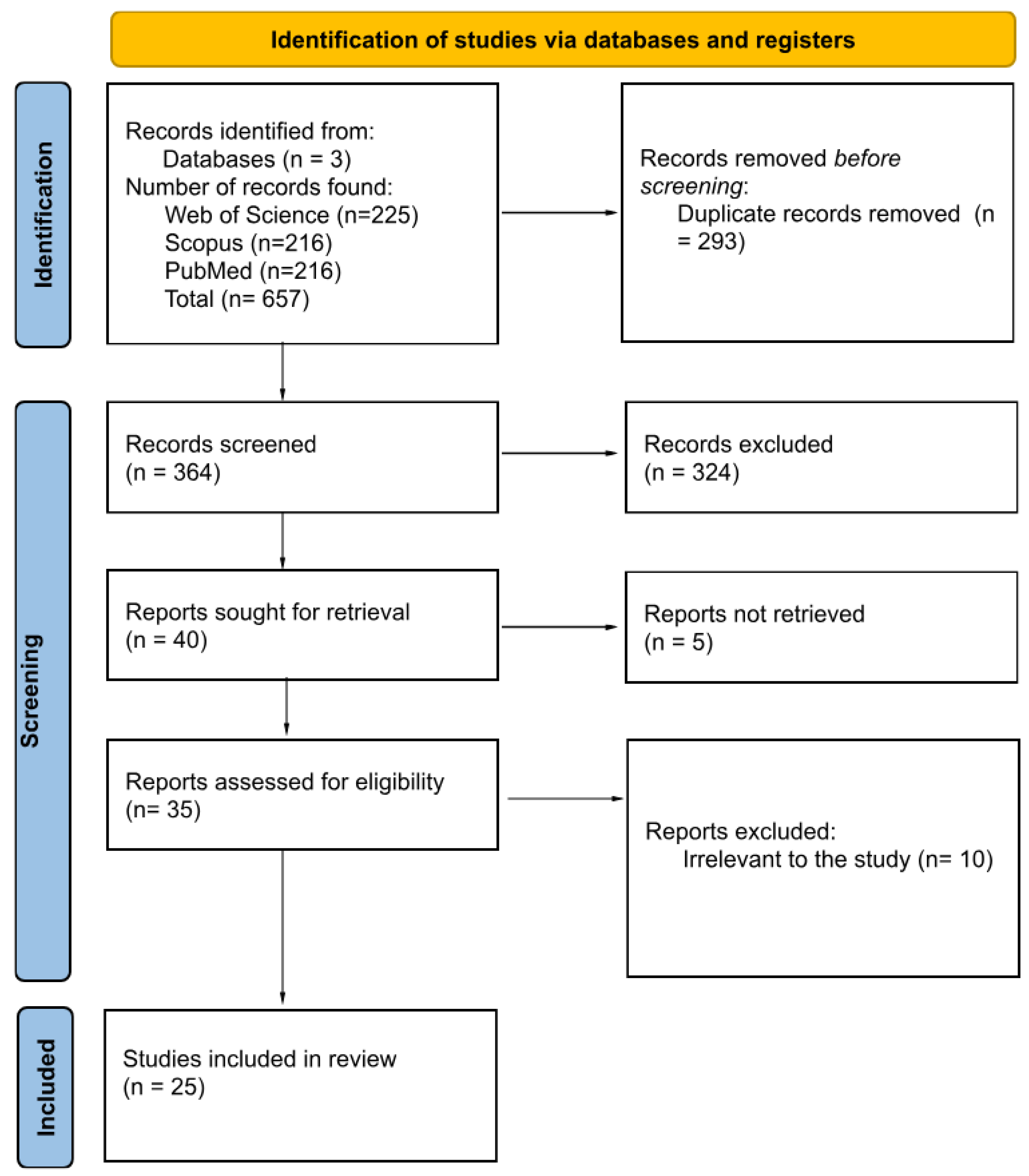
2. Materials and Methods
- For Web of Science: TS = (“bioceramic sealer” OR “calcium silicate sealer” OR “calcium silicate-based sealer” OR “BC Sealer” OR “bioceramic material”) AND TS = (“gutta-percha” OR “warm gutta-percha” OR “thermoplastic technique” OR “carrier-based obturation” OR “vertical compaction” OR “Thermafil”) AND TS = (“endodontic treatment” OR “root canal” OR “root canal obturation” OR “endodontics”)
- For Scopus: (ALL(premixed biosealers) OR ALL(premixed bioceramic sealer) OR ALL(premixed bioceramics) OR ALL(premixed calcium silicate sealer) AND ALL(root canal treatment) OR ALL(RCT) OR ALL(endodontic treatment) AND ALL(warm gutta-percha obturation) OR ALL(warm vertical compaction gutta-percha) OR ALL(thermoplasticized gutta-percha) OR ALL(obtura II) OR ALL(warm condensation)
- For PubMed: (“bioceramic sealer” OR “calcium silicate sealer” OR “calcium silicate-based sealer” OR “BC Sealer” OR “bioceramic material”) AND (“gutta-percha” OR “warm gutta-percha” OR “thermoplastic technique” OR “carrier-based obturation” OR “vertical compaction” OR “Thermafil”) AND (“endodontic treatment” OR “root canal” OR “root canal obturation” OR “endodontics”)
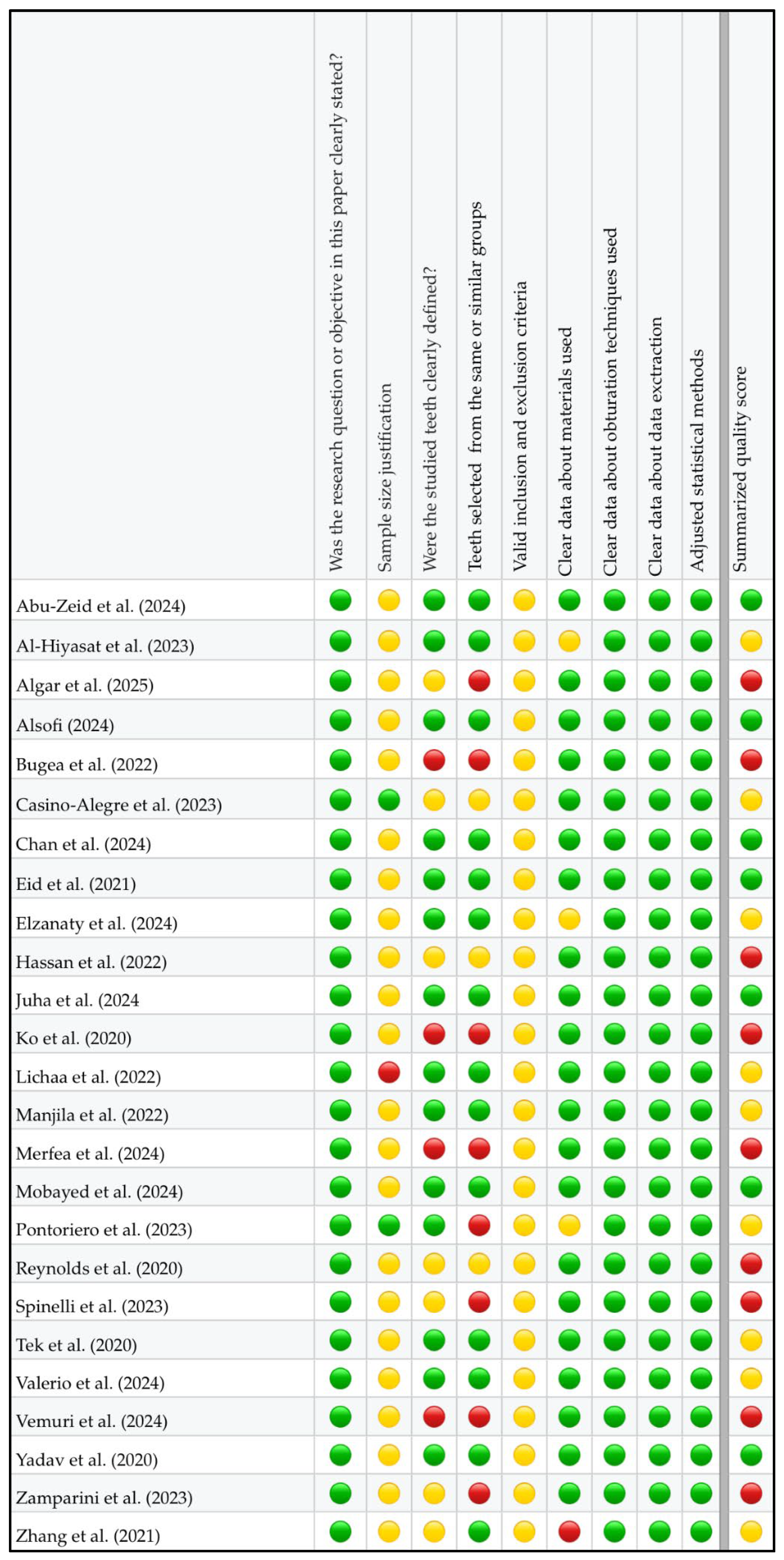
Quality Assessment and Critical Appraisal for the Systematic Review of Included Studies

3. Results

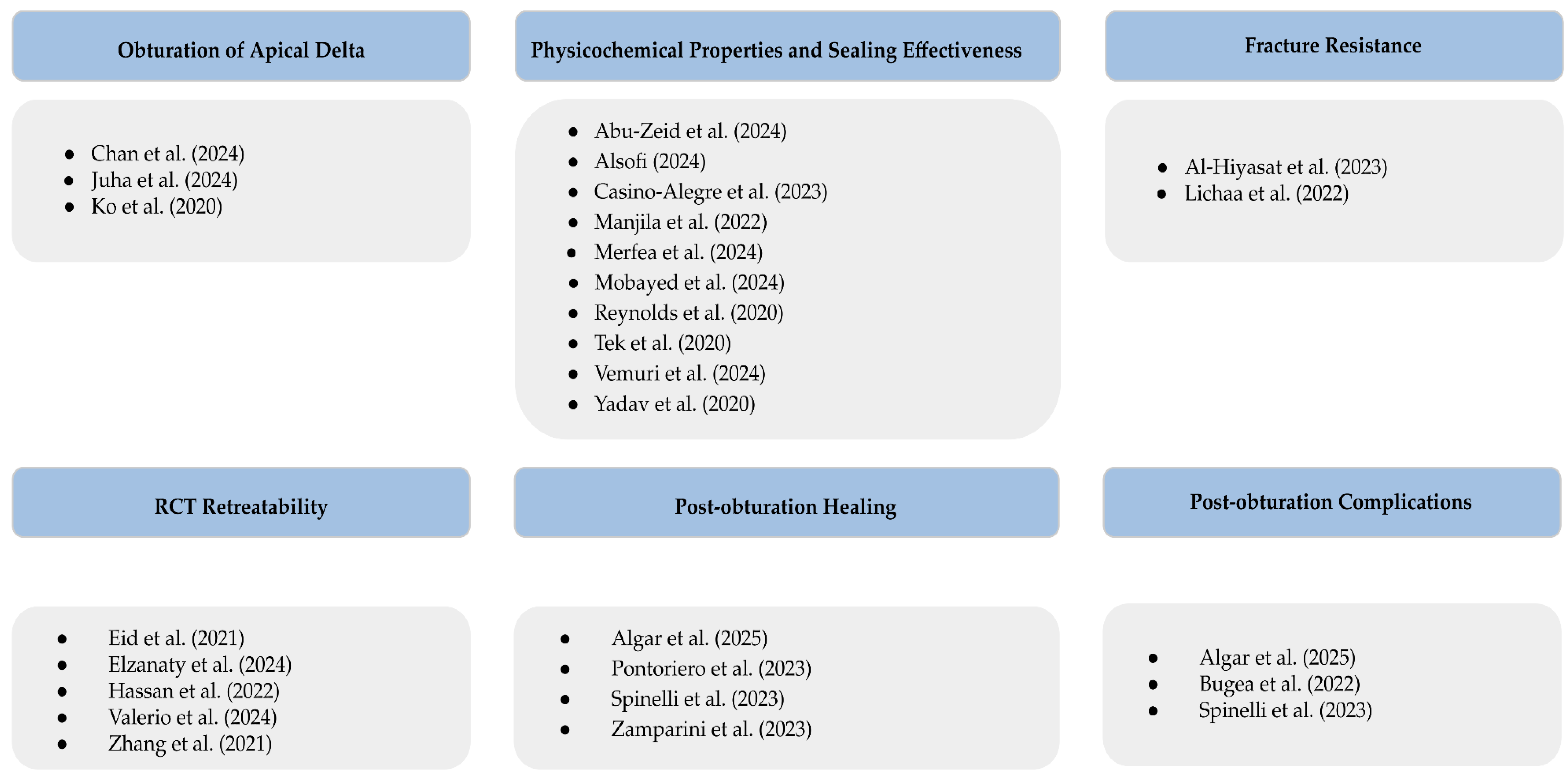
3.1. Physicochemical Properties and Sealing Effectiveness
3.2. Obturation of Apical Delta
3.3. Fracture Resistance
3.4. RCT Retreatability
3.5. Post-Obturation Healing
3.6. Post-Obturation Complications
4. Discussion
5. Conclusions
6. Limitations
Supplementary Materials
Author Contributions
Funding
Institutional Review Board Statement
Informed Consent Statement
Data Availability Statement
Acknowledgments
Conflicts of Interest
Abbreviations
| ND | No Data |
| PRISMA | Preferred Reporting Items for Systematic Reviews and Meta-Analyses |
| RCT | Root Canal Treatment |
| BC | Bioceramic Sealer |
| BCH | Bioceramic HiFlow Sealer |
| SC | Single Cone Technique |
| SCU | Single Cone with Ultrasound Activation |
| CLC | Cold Lateral Condensation |
| VC | Vertical Compaction |
| WVC | Warm Vertical Compaction |
| CWT | Continuous Wave Technique |
| CBT | Carrier-Based Technique |
| GP | Gutta-Percha |
| PBS | Phosphate-buffered Saline |
| DTPB | Dentinal Tubule Penetration of Bioceramic Sealer |
| PUI | Passive Ultrasonic Irrigation |
| PCD | Pericervical Dentin |
| SAF | Self-Adjusting File |
References
- Raghavendra, S.S.; Jadhav, G.R.; Gathani, K.M.; Kotadia, P. Bioceramics in Endodontics—A Review. J. Istanb. Univ. Fac. Dent. 2017, 51, S128–S137. [Google Scholar] [CrossRef] [PubMed]
- Yilmaz, B.; Alshemary, A.Z.; Evis, Z. Co-Doped Hydroxyapatites as Potential Materials for Biomedical Applications. Microchem. J. 2019, 144, 443–453. [Google Scholar] [CrossRef]
- Asgary, S.; Motazedian, H.R.; Parirokh, M.; Eghbal, M.J.; Kheirieh, S. Twenty Years of Research on Mineral Trioxide Aggregate: A Scientometric Report. Iran. Endod. J. 2013, 8, 1–5. [Google Scholar] [PubMed]
- Ashkar, I.; Kharouf, N.; Haïkel, Y.; Zogheib, C. A Literature Review of the Effect of Heat on the Physical-Chemical Properties of Calcium Silicate–Based Sealers. J. Endod. 2024, 50, 1044–1058.e5. [Google Scholar] [CrossRef]
- Hess, D.; Solomon, E.; Spears, R.; He, J. Retreatability of a Bioceramic Root Canal Sealing Material. J. Endod. 2011, 37, 1547–1549. [Google Scholar] [CrossRef]
- Hadis, M.; Camilleri, J. Characterization of Heat Resistant Hydraulic Sealer for Warm Vertical Obturation. Dent. Mater. 2020, 36, 1183–1189. [Google Scholar] [CrossRef]
- Santos-Junior, A.O.; Tanomaru-Filho, M.; Pinto, J.C.; Tavares, K.I.M.C.; Torres, F.F.E.; Guerreiro-Tanomaru, J.M. Effect of Obturation Technique Using a New Bioceramic Sealer on the Presence of Voids in Flattened Root Canals. Braz. Oral Res. 2021, 35, e028. [Google Scholar] [CrossRef]
- Page, M.J.; McKenzie, J.E.; Bossuyt, P.M.; Boutron, I.; Hoffmann, T.C.; Mulrow, C.D.; Shamseer, L.; Tetzlaff, J.M.; Akl, E.A.; Brennan, S.E.; et al. The PRISMA 2020 Statement: An Updated Guideline for Reporting Systematic Reviews. BMJ 2021, 372, n71. [Google Scholar] [CrossRef]
- Oxford Centre for Evidence-Based Medicine. OCEBM Levels of Evidence. Available online: https://www.cebm.net/2016/05/ocebm-levels-of-evidence (accessed on 7 August 2025).
- Abu-Zeid, S.T.; Alamoudi, R.A. Comparative Analysis of Interfacial Adaptation and Depth Penetration of Recent HiFlow versus Regular Bioceramic Sealers in Conjunction with BC Gutta-Percha Points Using Two Different Obturation Techniques—A Preliminary Report of an Ex Vivo Study. J. Funct. Biomater. 2024, 15, 134. [Google Scholar] [CrossRef]
- Alsofi, L. Bioactivity and Element Composition of Three Endodontic Root Canal Sealers. J. Contemp. Dent. Pract. 2025, 26, 62–70. [Google Scholar] [CrossRef]
- Casino-Alegre, A.; Aranda-Verdú, S.; Zarzosa-López, J.I.; Rubio-Climent, J.; Plasencia-Alcina, E.; Pallarés-Sabater, A. Intratubular Penetration Ability in the Canal Perimeter Using HiFlow Bioceramic Sealer with Warm Obturation Techniques and Single Cone. J. Clin. Exp. Dent. 2022, 14, e639–e645. [Google Scholar] [CrossRef]
- Mobayed, M.; Ayoubi, H.R.; Achour, H.; Alsayed Tolibah, Y. Comparison of Different Obturation Techniques in the Dentinal Tubule Penetration of EndoSequence® Bioceramic Sealer HiFlow™: An In-Vitro Study. Cureus 2024, 16, e71155. [Google Scholar] [CrossRef]
- Reynolds, J.Z.; Augsburger, R.A.; Svoboda, K.K.H.; Jalali, P. Comparing Dentinal Tubule Penetration of Conventional and ‘HiFlow’ Bioceramic Sealers with Resin-Based Sealer: An In Vitro Study. Aust. Endod. J. 2020, 46, 387–393. [Google Scholar] [CrossRef] [PubMed]
- Merfea, M.; Cimpean, S.I.; Chiorean, R.S.; Antoniac, A.; Delean, A.G.; Badea, I.C.; Badea, M.E. Comparative Assessment of Push-Out Bond Strength and Dentinal Tubule Penetration of Different Calcium-Silicate-Based Endodontic Sealers. Dent. J. 2024, 12, 397. [Google Scholar] [CrossRef] [PubMed]
- Vemuri, S.; Rachamadugu, E.S.; Naveena, T.; Garlapati, R.; Bolla, N.; Basam, R.C. Comparative Evaluation of the Effect of Three Different Obturation Techniques on Push-Out Bond Strength of AH Plus Bioceramic and EndoCeramic Sealers: An In Vitro Study. J. Conserv. Dent. Endod. 2024, 27, 1026–1031. [Google Scholar] [CrossRef] [PubMed]
- Yadav, S.; Nawal, R.R.; Chaudhry, S.; Talwar, S. Assessment of Quality of Root Canal Filling with C Point, Guttacore and Lateral Compaction Technique: A Confocal Laser Scanning Microscopy Study. Eur. Endod. J. 2020, 5, 236–241. [Google Scholar]
- Tek, V.; Türker, S.A. A Micro-Computed Tomography Evaluation of Voids Using Calcium Silicate-Based Materials in Teeth with Simulated Internal Root Resorption. Restor. Dent. Endod. 2020, 45, e5. [Google Scholar] [CrossRef]
- Manjila, J.C.; Vijay, R.; Srirekha, A.; Santhosh, L.; Reddy, J.; Srinivasan, A. Apical Microleakage in Root Canals with Separated Rotary Instruments Obturated with Different Endodontic Sealers. J. Conserv. Dent. 2022, 25, 274–277. [Google Scholar]
- Chan, A.Y.Y.; Chang, J.W.W.; Cheung, G.S.P.; Neelakantan, P.; Zhang, C.; Lee, A.H.C. Penetration of Calcium Silicate and Epoxy Resin Sealers into the Lateral Canals. Int. Dent. J. 2024, 74, 762–768. [Google Scholar] [CrossRef]
- Juha, W.; Sarkis, E.; Alsayed Tolibah, Y. Three-Dimensional Assessment of Obturation Volume in Lateral Canals after Three Obturation Techniques with Bioceramic Sealer: An In Vitro Comparative Study. BDJ Open 2024, 10, 50. [Google Scholar] [CrossRef]
- Ko, S.Y.; Choi, H.W.; Jeong, E.D.; Rosa, V.; Hwang, Y.C.; Yu, M.K.; Min, K.S. Main and Accessory Canal Filling Quality of a Premixed Calcium Silicate Endodontic Sealer According to Different Obturation Techniques. Materials 2020, 13, 4389. [Google Scholar] [CrossRef]
- Lichaa, R.; Deeb, G.; Mhanna, R.; Zogheib, C. Comparison of Fracture Resistance between Single-Cone and Warm Vertical Compaction Technique Using Bio-C Sealer® in MandibularIncisors: An In Vitro Study. J. Contemp. Dent. Pract. 2022, 23, 143–148. [Google Scholar] [CrossRef] [PubMed]
- Al-Hiyasat, A.S.; Sawallha, A.M.; Taha, N.A. The Effect of Sealer Type and Obturation Technique on the Fracture Resistance of Endodontically Treated Roots. Clin. Oral Investig. 2023, 27, 7359–7367. [Google Scholar] [CrossRef] [PubMed]
- Hassan, R.; Elzahar, S. Cleaning Efficiency of XP Finisher, XP Finisher R and Passive Ultrasonic Irrigation Following Retreatment of Teeth Obturated with TotalFill HiFlow Bioceramic Sealer. Eur. Endod. J. 2022, 7, 143–149. [Google Scholar] [CrossRef] [PubMed]
- Elzanaty, T.K.; Elashiry, M.M.; Mahran, A.H. Retreatability of NeoSEALER Flo Obturated with Warm Vertical Compaction Versus Single-Cone Technique Using Two Different Retreatment Systems. J. Conserv. Dent. Endod. 2024, 27, 286–292. [Google Scholar] [CrossRef]
- Valerio, L.; Oda, L.Y.; Copelli, F.A.; Rodrigues, C.T.; Carneiro, E.; Duarte, M.A.H.; Cavenago, B.C. Effect of the Filling Technique on the Filling Removal from Oval-Shaped Canals. Clin. Oral Investig. 2024, 28, 453. [Google Scholar] [CrossRef]
- Eid, B.M.; Abdel Maksoud, H.B.; Elsewify, T.M. Efficacy of XP-endo Finisher-R in Enhancing Removal of Bioceramic Sealer from Oval Root Canal: A Micro-CT Study. G. Ital. Endod. 2021, 35, 201–208. [Google Scholar]
- Zhang, W.; Liu, H.; Wang, Z.; Haapasalo, M.; Jiang, Q.; Shen, Y. Long-Term Porosity and Retreatability of Oval-Shaped Canals Obturated Using Two Different Methods with a Novel Tricalcium Silicate Sealer. Clin. Oral Investig. 2022, 26, 1045–1052. [Google Scholar] [CrossRef]
- Spinelli, A.; Zamparini, F.; Lenzi, J.; Gandolfi, M.G.; Prati, C. Clinical Evaluation of a Novel Premixed Tricalcium Silicate Containing Bioceramic Sealer Used with Warm Carrier-Based Technique: A 12-Month Prospective Pilot Study. Appl. Sci. 2023, 13, 11835. [Google Scholar] [CrossRef]
- Algar, J.; Docampo-Vázquez, C.; Rico-Romano, C.; Boquete-Castro, A.; Obispo-Díaz, C.; Aragoneses, J.M. Randomised Clinical Trial: Effect of AH Plus and Neosealer Flo on Postoperative Pain and Healing of Periapical Lesions. Bioengineering 2025, 12, 376. [Google Scholar] [CrossRef]
- Pontoriero, D.I.K.; Ferrari Cagidiaco, E.; Maccagnola, V.; Manfredini, D.; Ferrari, M. Outcomes of Endodontic-Treated Teeth Obturated with Bioceramic Sealers in Combination with Warm Gutta-Percha Obturation Techniques: A Prospective Clinical Study. J. Clin. Med. 2023, 12, 2867. [Google Scholar] [CrossRef] [PubMed]
- Zamparini, F.; Spinelli, A.; Cardinali, F.; Ausiello, P.; Gandolfi, M.G.; Prati, C. The Use of Premixed Calcium Silicate Bioceramic Sealer with Warm Carrier-Based Technique: A 2-Year Study for Patients Treated in a Master Program. J. Funct. Biomater. 2023, 14, 164. [Google Scholar] [CrossRef] [PubMed]
- Bugea, C.; Cerutti, F.; Ongaro, F.; Sforza, F.; Scarano, A.; Rampino, M.; Luongo, R.; Pedullà, E. Postoperative Pain and One Year Follow-Up Success Rate of Warm Vertical Compaction, Single Cone, Coneless and Bioconeless Obturation Methods. J. Osseointegration 2022, 14, 209–216. [Google Scholar]
- Debelian, G.; Trope, M. The Use of Premixed Bioceramic Materials in Endodontics. G. Ital. Endod. 2016, 30, 70–80. [Google Scholar] [CrossRef]
- Nouroloyouni, A.; Samadi, V.; Salem Milani, A.; Noorolouny, S.; Valizadeh-Haghi, H. Single Cone Obturation versus Cold Lateral Compaction Techniques with Bioceramic and Resin Sealers: Quality of Obturation and Push-Out Bond Strength. Int. J. Dent. 2023, 2023, 3427151. [Google Scholar] [CrossRef]
- Alkahtany, S.M.; AlHussain, A.A.; AlMthen, H.A.; AlDokhi, H.D.; Bukhary, S.M.; Almohaimede, A.A.; AlNeshmi, B. Obturation Quality of Bioceramic Sealers with Different Obturation Techniques: A Micro-CT Evaluation. Sci. Rep. 2024, 14, 31146. [Google Scholar] [CrossRef]
- Washio, A.; Morotomi, T.; Yoshii, S.; Kitamura, C. Bioactive Glass-Based Endodontic Sealer as a Promising Root Canal Filling Material without Semisolid Core Materials. Materials 2019, 12, 3967. [Google Scholar] [CrossRef]
- Katakidis, A.; Sidiropoulos, K.; Koulaouzidou, E.; Gogos, C.; Economides, N. Flow Characteristics and Alkalinity of Novel Bioceramic Root Canal Sealers. Restor. Dent. Endod. 2020, 45, e42. [Google Scholar] [CrossRef]
- Al-Haddad, A.; Che Ab Aziz, Z.A. Bioceramic-Based Root Canal Sealers: A Review. Int. J. Biomater. 2016, 2016, 9753210. [Google Scholar] [CrossRef]
- López-García, S.; Sanz, J.L.; Murcia, L.; García-Bernal, D.; Lozano, A.; Forner, L.; Rodríguez-Lozano, F.J.; Oñate-Sánchez, R.E. Assessment of the Anti-Inflammatory and Biological Properties of Bioroot Flow: A Novel Bioceramic Sealer. Tissue Cell 2024, 88, 102391. [Google Scholar] [CrossRef]
- Ortega, M.A.; Rios, L.; Fraile-Martinez, O.; Boaru, D.L.; De Leon-Oliva, D.; Barrena-Blázquez, S.; Pereda-Cerquella, C.; Garrido-Gil, M.J.; Manteca, L.; Buján, J.; et al. Bioceramic versus Traditional Biomaterials for Endodontic Sealers According to the Ideal Properties. Histol. Histopathol. 2024, 39, 279–292. [Google Scholar]
- Sharma, D.; Worlikar, N.; Shah, K.; Sharma, Y. Recent Advancements in Root Canal Sealers—An Overview. J. Adv. Med. Dent. Sci. Res. 2023, 11, 82–91. [Google Scholar]
- Tabassum, S.; Khan, F.R. Failure of Endodontic Treatment: The Usual Suspects. Eur. J. Dent. 2016, 10, 144–147. [Google Scholar] [CrossRef] [PubMed]
- Yamaguchi, M.; Noiri, Y.; Itoh, Y.; Komichi, S.; Yagi, K.; Uemura, R.; Naruse, H.; Matsui, S.; Kuriki, N.; Hayashi, M.; et al. Factors That Cause Endodontic Failures in General Practices in Japan. BMC Oral Health 2018, 18, 70. [Google Scholar] [CrossRef] [PubMed]
- Timis, L.; Gorea, M.; Har, N.; Cimpean, S.; Delean, A.; Bud, M.G.; Campian, R.S. Biomineralization Ability of an Experimental Bioceramic Endodontic Sealer Based on Nanoparticles of Calcium Silicates. Med. Pharm. Rep. 2023, 96, 434–440. [Google Scholar] [CrossRef] [PubMed]
- Somolová, L.; Morozova, Y.; Voborná, I.; Rosa, M.; Novotná, B.; Holík, P.; Langová, K. Comparison of Apical Microleakage in Bioceramic and Resin-Based Endodontic Sealers with Conventional and Bioceramic Surface-Impregnated Gutta-Percha Points. Ceramics 2025, 8, 65. [Google Scholar] [CrossRef]
- Marques Ferreira, M.; Martinho, J.P.; Duarte, I.; Mendonça, D.; Craveiro, A.C.; Botelho, M.F.; Carrilho, E.; Marto, C.M.; Coelho, A.; Paula, A.; et al. Evaluation of the Sealing Ability and Bond Strength of Two Endodontic Root Canal Sealers: An In Vitro Study. Dent. J. 2022, 10, 201. [Google Scholar] [CrossRef]
- Salem, A.; Saleh, A.; Elmasmari, H. In Vitro Assessment of Apical Leakage of Bioceramic Endodontic Sealer with Two Obturation Techniques. Open Dent. J. 2018, 12, 1162–1168. [Google Scholar] [CrossRef]
- Asawaworarit, W.; Pinyosopon, T.; Kijsamanmith, K. Comparison of Apical Sealing Ability of Bioceramic Sealer and Epoxy Resin-Based Sealer Using the Fluid Filtration Technique and Scanning Electron Microscopy. J. Dent. Sci. 2020, 15, 186–192. [Google Scholar] [CrossRef]
- Singhal, R.; Singla, M.G.; Wahi, P.; Bhasin, P.; Garg, A.; Nangia, D. Sealing Ability of Three Bioceramic Sealers Using Sealer-Based Obturation Method after Immersion in Simulated Body Fluid: An In Vitro Study. J. Conserv. Dent. Endod. 2025, 28, 199–203. [Google Scholar]
- Alalaf, N.; Alkhalidi, E. Comparative Assessment of Root Canal Sealer’s Apical Sealing Ability. Al-Rafidain Dent. J. 2022, 22, 124–135. [Google Scholar] [CrossRef]
- Lakshmi, R.S.; Das, B.; Jadhav, A.; Haridas, H.; Murugesan, S.; Subramani, S.K. The Effect of Different Obturation Techniques on the Sealing Ability of Root Canal Filling Materials. J. Pharm. Bioallied Sci. 2024, 16 (Suppl. S4), S3568–S3570. [Google Scholar] [CrossRef]
- Versiani, M.A.; Martins, J.; Ordinola-Zapata, R. Anatomical Complexities Affecting Root Canal Preparation: A Narrative Review. Aust. Dent. J. 2023, 68 (Suppl. S1), S5–S23. [Google Scholar] [CrossRef] [PubMed]
- Zou, X.; Zheng, X.; Liang, Y.; Zhang, C.; Fan, B.; Liang, J.; Ling, J.; Bian, Z.; Yu, Q.; Hou, B.; et al. Expert Consensus on Irrigation and Intracanal Medication in Root Canal Therapy. Int. J. Oral Sci. 2024, 16, 23. [Google Scholar] [CrossRef] [PubMed]
- Gomes, B.P.F.A.; Aveiro, E.; Kishen, A. Irrigants and Irrigation Activation Systems in Endodontics. Braz. Dent. J. 2023, 34, 1–33. [Google Scholar] [CrossRef]
- Retsas, A.; Dijkstra, R.J.B.; van der Sluis, L.; Boutsioukis, C. The Effect of the Ultrasonic Irrigant Activation Protocol on the Removal of a Dual-Species Biofilm from Artificial Lateral Canals. J. Endod. 2022, 48, 775–780. [Google Scholar] [CrossRef]
- Bao, P.; Liu, H.; Yang, L.; Zhang, L.; Yang, L.; Xiao, N.; Shen, J.; Deng, J.; Shen, Y. In Vitro Efficacy of Er:YAG Laser-Activated Irrigation versus Passive Ultrasonic Irrigation and Sonic-Powered Irrigation for Treating Multispecies Biofilms in Artificial Grooves and Dentinal Tubules: An SEM and CLSM Study. BMC Oral Health 2024, 24, 261. [Google Scholar] [CrossRef]
- Gündoğar, M.; Özdemir, O.; Gündoğar, Ö.; Bektaş, S.; Demir, F.N.; Bolat, N. Multisonic Ultracleaning and Laser-Activated Irrigation Effect Compared to Passive Ultrasonic Activation for Debridement in Minimally Invasive Instrumentation of Necrotic Oval Root Canals: An Ex Vivo Histological Analysis. J. Clin. Med. 2025, 14, 2597. [Google Scholar] [CrossRef]
- Addokhi, A.; Rahoma, A.; Hanna, N.M.A.; Alonaizan, F.; Farooqi, F.; Rifaat, S. Influence of Irrigant Activation Techniques on External Root Temperature Rise and Irrigation Penetration Depth in 3D-Printed Tooth Model: An In Vitro Study. Dent. J. 2025, 13, 295. [Google Scholar] [CrossRef]
- Frasquetti, K.S.; Piasecki, L.; Kowalczuck, A.; Carneiro, E.; Westphalen, V.P.D.; Neto, U.X.D. Effect of Different Root Canal Drying Protocols on the Bond Strength of Two Bioceramic Sealers. Eur. J. Dent. 2023, 17, 1229–1234. [Google Scholar] [CrossRef]
- Koo, J.; Kwak, S.W.; Kim, H.C. Differences in Setting Time of Calcium Silicate-Based Sealers under Different Test Conditions. J. Dent. Sci. 2023, 18, 1042–1046. [Google Scholar] [CrossRef]
- European Society of Endodontology. Quality Guidelines for Endodontic Treatment: Consensus Report of the European Society of Endodontology. Int. Endod. J. 2006, 39, 921–930. [Google Scholar] [CrossRef]
- Chiramel, D.E.; H, A.; Mani, E.S.; George, S.; Semwal, I.; Raj, R.A. Fracture Strength of Tooth Roots Following Canal Preparation by Three Rotary File Systems: An In Vitro Study. Cureus 2024, 16, e57302. [Google Scholar] [CrossRef]
- Patel, S.; Bhuva, B.; Bose, R. Present Status and Future Directions: Vertical Root Fractures in Root Filled Teeth. Int. Endod. J. 2022, 55 (Suppl. S3), 804–826. [Google Scholar] [CrossRef]
- Boveda, C.; Kishen, A.; Millan, B.; Camejo, M.V.; Gomez-Sosa, J.F. Pericervical Dentin Metrics in Mandibular First Molars Determined with Digital Periapical Radiography and Cone-Beam Computed Tomography. J. Endod. 2024, 50, 637–643. [Google Scholar] [CrossRef]
- Marvaniya, J.; Agarwal, K.; Mehta, D.N.; Parmar, N.; Shyamal, R.; Patel, J. Minimal Invasive Endodontics: A Comprehensive Narrative Review. Cureus 2022, 14, e25984. [Google Scholar] [CrossRef] [PubMed]
- Jain, A.K.; Jain, R.; Rao, R.; Rao, P.; Yadav, P.; Thorat, V. Comparative Evaluation of Increase in Temperature on the External Root Surface of Teeth during Retrieval of Broken NiTi Instrument Using Two Ultrasonic Tips and Two Power Settings: An In Vitro Study. J. Conserv. Dent. Endod. 2024, 27, 634–638. [Google Scholar] [CrossRef] [PubMed]
- Külzer, L.; Saban, T.; Braun, A.; Wenzler, J.-S. In Vitro Evaluation of Root Surface Temperature Using Different Endodontic Filling Techniques. Appl. Sci. 2024, 14, 9830. [Google Scholar] [CrossRef]
- Chellapilla, P.K.; Boddeda, M.R.; Jyothi, M.; Uppalapati, L.V.; Konagala, R.K.; Dasari, L. Influence of Obturating Techniques on Root Dentin Crack Propagation: A Micro-Computed Tomography Assessment. J. Conserv. Dent. 2021, 24, 72–76. [Google Scholar] [CrossRef]
- Ersoy, I.; Evcil, M.S. Evaluation of the Effect of Different Root Canal Obturation Techniques Using Two Root Canal Sealers on the Fracture Resistance of Endodontically Treated Roots. Microsc. Res. Tech. 2015, 78, 404–407. [Google Scholar] [CrossRef]
- Donnermeyer, D.; Schäfer, E.; Bürklein, S. Real-Time Intracanal Temperature Measurement during Different Obturation Techniques. J. Endod. 2018, 44, 1832–1836. [Google Scholar] [CrossRef]
- Batra, D.; Dixit, A.; Marwaha, J.; Maiti, N.; Gowda, T.; Saha, A. Effect of Obturation Techniques on Fracture Resistance of Endodontically Treated Teeth. Bioinformation 2025, 21, 361–364. [Google Scholar] [CrossRef]
- Pandey, K.; Mehar, S.; Chaubey, N.; Kumar, A.; Jha, R.K.; Hiwale, S. Comparison of Five Different Obturation Approaches for Resistance against Fracture in Root Canal Treated Teeth. Bioinformation 2024, 20, 625–629. [Google Scholar] [CrossRef] [PubMed]
- Haralur, S.B.; Al-Qahtani, A.S.; Al-Qarni, M.M.; Al-Homrany, R.M.; Aboalkhair, A.E. Influence of Remaining Dentin Wall Thickness on the Fracture Strength of Endodontically Treated Tooth. J. Conserv. Dent. 2016, 19, 63–67. [Google Scholar] [CrossRef] [PubMed]
- Siqueira, J.F.; Rôças, I.N.; Ricucci, D.; Hülsmann, M. Causes and Management of Post-Treatment Apical Periodontitis. Br. Dent. J. 2014, 216, 305–312. [Google Scholar] [CrossRef] [PubMed]
- Athkuri, S.; Mandava, J.; Chalasani, U.; Ravi, R.C.; Munagapati, V.K.; Chennareddy, A.R. Effect of Different Obturating Techniques and Sealers on the Removal of Filling Materials During Endodontic Retreatment. J. Conserv. Dent. 2019, 22, 578–582. [Google Scholar] [CrossRef]
- Gouveia, P.; Limoeiro, A.G.; Silva, C.B.F.; Marceliano-Alves, M.F.V.; Fontana, C.E.; Rocha, D.G.P.; Bueno, C.E.D.S.; De Martin, A.S. Evaluation of the Retreatability of BC Sealer, BC Sealer HiFlow, and AH Plus: A Micro-Computed Tomography Study. J. Endod. 2025, 51, 748–754. [Google Scholar] [CrossRef]
- Rajda, M.; Miletić, I.; Baršić, G.; Krmek, S.J.; Šnjarić, D.; Baraba, A. Efficacy of Reciprocating Instruments in the Removal of Bioceramic and Epoxy Resin-Based Sealers: Micro-CT Analysis. Materials 2021, 14, 6670. [Google Scholar] [CrossRef]
- Machado, A.G.; Guilherme, B.P.S.; Provenzano, J.C.; Marceliano-Alves, M.F.; Gonçalves, L.S.; Siqueira, J.F., Jr.; Neves, M.A.S. Effects of Preparation with the Self-Adjusting File, TRUShape and XP-endo Shaper Systems, and a Supplementary Step with XP-endo Finisher R on Filling Material Removal During Retreatment of Mandibular Molar Canals. Int. Endod. J. 2019, 52, 709–715. [Google Scholar] [CrossRef]
- Abramovitz, I.; Relles-Bonar, S.; Baransi, B.; Kfir, A. The Effectiveness of a Self-Adjusting File to Remove Residual Gutta-Percha After Retreatment with Rotary Files. Int. Endod. J. 2012, 45, 386–392. [Google Scholar] [CrossRef]
- Zhekov, K.; Stefanova, V. Optimizing Non-Surgical Endodontic Retreatment: A 3D CBCT Quantification of Root Canal Bioceramic Filling Material Removal. Open Dent. J. 2024, 18, e18742106300149. [Google Scholar] [CrossRef]
- Estivalet, M.S.; de Araújo, L.P.; Immich, F.; da Silva, A.F.; Ferreira, N.d.S.; da Rosa, W.L.d.O.; Piva, E. Bioactivity Potential of Bioceramic-Based Root Canal Sealers: A Scoping Review. Life 2022, 12, 1853. [Google Scholar] [CrossRef]
- Song, W.; Sun, W.; Chen, L.; Yuan, Z. In vivo Biocompatibility and Bioactivity of Calcium Silicate-Based Bioceramics in Endodontics. Front. Bioeng. Biotechnol. 2020, 8, 580954. [Google Scholar] [CrossRef]
- Zamparini, F.; Prati, C.; Taddei, P.; Spinelli, A.; Di Foggia, M.; Gandolfi, M.G. Chemical-Physical Properties and Bioactivity of New Premixed Calcium Silicate-Bioceramic Root Canal Sealers. Int. J. Mol. Sci. 2022, 23, 13914. [Google Scholar] [CrossRef] [PubMed]
- Sebastian, S.; El-Sayed, W.; Adtani, P.; Zaarour, R.F.; Nandakumar, A.; Elemam, R.F.; Eid, B.; Elsewify, T. Evaluation of the Antibacterial and Cytotoxic Properties of TotalFill and NeoSEALER Flo Bioceramic Sealers. J. Conserv. Dent. Endod. 2024, 27, 491–497. [Google Scholar] [CrossRef] [PubMed]
- Zhou, H.; Shen, Y.; Wang, Z.; Li, L.; Zheng, Y.; Häkkinen, L.; Haapasalo, M. In Vitro Cytotoxicity Evaluation of a Novel Root Repair Material. J. Endod. 2013, 39, 478–483. [Google Scholar] [CrossRef] [PubMed]
- Dolińska, E.; Wiśniewski, P.; Pietruska, M. Periodontal Molecular Diagnostics: State of Knowledge and Future Prospects for Clinical Application. Int. J. Mol. Sci. 2024, 25, 12624. [Google Scholar] [CrossRef]
- Dong, X.; Xu, X. Bioceramics in Endodontics: Updates and Future Perspectives. Bioengineering 2023, 10, 354. [Google Scholar] [CrossRef]
- Salim, F.; Saleem, B.M. Evaluation of Fracture Resistance of Roots Obturated with Three Different Sealers and Three Various Obturation Techniques. Eur. Endod. J. 2025, 10, 326–332. [Google Scholar] [CrossRef]
- Merfea, M.; Pop-Ciutrila, I.S.; Badea, M.E.; Delean, A.G.; Cimponeriu, O.; Pop, R.C.; Peter, M.; Badea, I.C.; Cimpean, S.I. An Observational Study on Pain Occurrence After Root Canal Treatment: Role of Operator Experience When Using a Bioceramic Sealer. J. Clin. Med. 2025, 14, 4558. [Google Scholar] [CrossRef]
- Fonseca, B.; Coelho, M.S.; Bueno, C.E.D.S.; Fontana, C.E.; Martin, A.S.; Rocha, D.G.P. Assessment of Extrusion and Postoperative Pain of a Bioceramic and Resin-Based Root Canal Sealer. Eur. J. Dent. 2019, 13, 343–348. [Google Scholar] [CrossRef]
- Huang, Y.; Orhan, K.; Celikten, B.; Orhan, A.I.; Tufenkci, P.; Sevimay, S. Evaluation of the Sealing Ability of Different Root Canal Sealers: A Combined SEM and Micro-CT Study. J. Appl. Oral Sci. 2018, 26, e20160584. [Google Scholar] [CrossRef]
- Tanomaru-Filho, M.; Pinto, J.C.; Esteves, T.F.; de Souza, P.H.; Pereira, M.C.; Guerreiro-Tanomaru, J.M. Flow, Filling Ability and Apical Extrusion of New Calcium Silicate-Based Sealers: A Micro-Computed Tomographic Study. J. Oral Biol. Craniofac. Res. 2020, 3, 1–6. [Google Scholar]
- Patel, A.R.; Ujariya, U.M.; Kothari, A.K.; Bharatiya, R.P. Comparative Evaluation of Apical Debris Extrusion during Root Canal Preparation Using Three Different File Systems: An In Vitro Study. Endodontology 2020, 32, 20–25. [Google Scholar] [CrossRef]
- Yammine, S.D.; Jabbour, E.A. Apically Extruded Debris Following Programmed Over Instrumentation of Curved Canals with Three Nickel Titanium Rotary Instruments. Eur. J. Dent. 2021, 15, 20–26. [Google Scholar] [CrossRef] [PubMed]
- Zamparini, F.; Lenzi, J.; Duncan, H.F.; Spinelli, A.; Gandolfi, M.G.; Prati, C. The Efficacy of Premixed Bioceramic Sealers versus Standard Sealers on Root Canal Treatment Outcome, Extrusion Rate and Post-Obturation Pain: A Systematic Review and Meta-Analysis. Int. Endod. J. 2024, 57, 1021–1042. [Google Scholar] [CrossRef]
- Li, J.; Chen, L.; Zeng, C.; Liu, Y.; Gong, Q.; Jiang, H. Clinical Outcome of Bioceramic Sealer iRoot SP Extrusion in Root Canal Treatment: A Retrospective Analysis. Head Face Med. 2022, 18, 28. [Google Scholar] [CrossRef]
- Ferreira, N.S.; Gollo, E.K.F.; Boscato, N.; Arias, A.; Silva, E.J.N.L.D. Postoperative Pain After Root Canal Filling with Different Endodontic Sealers: A Randomized Clinical Trial. Braz. Oral Res. 2020, 34, e069. [Google Scholar] [CrossRef]
- Spinelli, A.; Zamparini, F.; Lenzi, J.; Gandolfi, M.G.; Prati, C. Three-Year Clinical Outcome of Root Canal Treatment Using a Single-Cone Technique and Ceraseal Premixed Bioceramic Sealer: A Prospective Cohort Study. Eur. Endod. J. 2024, 9, 383–393. [Google Scholar] [CrossRef]
- Sadaf, D.; Ahmad, M.Z. Factors Associated with Postoperative Pain in Endodontic Therapy. Int. J. Biomed. Sci. 2014, 10, 243–247. [Google Scholar] [CrossRef]
- de Oliveira Damasceno, C.; da Silveira Bueno, C.E.; De Martin, A.S.; Pelegrine, R.A.; Villela, A.M.; Ruivo, L.M.; Shoji Kato, A. Factors Associated with Post-Endodontic Treatment Pain Performed by Students in an Endodontic Graduate Program. Iran. Endod. J. 2020, 15, 221–226. [Google Scholar] [PubMed]
- Alhilou, A.M. Factors Reducing Postoperative Pain Related to Root Canal Treatment: A Narrative Review of Systematic Reviews. Dent. J. 2025, 13, 102. [Google Scholar] [CrossRef] [PubMed]
- Elsayed, M.A.; Hassanien, E.E.; Elgendy, A.A.E. Ageing of TotalFill BC Sealer and MTA Fillapex in Simulated Body Fluid. Eur. Endod. J. 2021, 6, 183–188. [Google Scholar] [PubMed]
- Abu Zeid, S.T.; Alamoudi, R.A.; Mokeem Saleh, A.A. Impact of Water Solubility on Chemical Composition and Surface Structure of Two Generations of Bioceramic Root Canal Sealers. Appl. Sci. 2022, 12, 873. [Google Scholar] [CrossRef]
- Lim, M.; Jung, C.; Shin, D.-H.; Cho, Y.-B.; Song, M. Calcium Silicate-Based Root Canal Sealers: A Literature Review. Restor. Dent. Endod. 2020, 45, e35. [Google Scholar] [CrossRef]
- Sfeir, G.; Zogheib, C.; Patel, S.; Giraud, T.; Nagendrababu, V.; Bukiet, F. Calcium Silicate-Based Root Canal Sealers: A Narrative Review and Clinical Perspectives. Materials 2021, 14, 3965. [Google Scholar] [CrossRef]
- AlRahabi, M.K. Predictors, Prevention, and Management of Postoperative Pain Associated with Nonsurgical Root Canal Treatment: A Systematic Review. J. Taibah Univ. Med. Sci. 2017, 12, 376–384. [Google Scholar] [CrossRef]

| Parameter | Inclusion Criteria | Exclusion Criteria |
|---|---|---|
| Population (P) | in vitro studies using removed human teeth | 3D-printed teeth models |
| Intervention(I) | warm obturation techniques | cold obturation techniques only |
| Comparison (C) | comparison of BC and other endodontic sealants comparison of warm obturation techniques to SC and CLC | – |
| Outcomes (O) | evaluation of root canal treatment obturation quality, mechanical properties, accuracy of retreatment | – |
| Study Design | clinical studies, cohort and cross-sectional studies published after 2020 | systematic reviews, case reports, conference reports, editorials, works not published in English, non-human studies |
| Parameter | Inclusion Criteria | Exclusion Criteria |
|---|---|---|
| Population (P) | in vivo studies on human populations | in vitro studies |
| Intervention(I) | warm obturation techniques | cold obturation techniques only |
| Comparison (C) | comparison of BC and other endodontic sealants comparison of warm obturation techniques to SC and CLC | – |
| Outcomes (O) | healing of lesions and postoperative complications | – |
| Study Design | clinical studies, cohort and cross-sectional studies published after 2020 | systematic reviews, case reports, conference reports, editorials, works not published in English, non-human studies |
| Author and Year | Journal | Study Type | Obturation Techniques | Materials | Teeth Examined | Objective | Results |
|---|---|---|---|---|---|---|---|
| Abu-Zeid et al. (2024) [10] | Journal of Functional Materials | in vitro | (1) vertical condensation (VC) (2) warm vertical compaction (WVC) | EndoSequence BC sealer (Brasseler, Savannah, GA, USA), EndoSequence BC Sealer HiFlow (Brasseler, Savannah, GA, USA), BC points (Brasseler, Savannah, GA, USA), AH Plus (Dentsply Sirona, Charlotte, NC, USA), gutta-percha (ND) | 54 (extracted mandibular premolars) | To evaluate the adaptability and intratubular penetration depth of bioceramic systems using different obturation techniques. | EndoSequence BC Sealer HiFlow (Brasseler) sealer use resulted in the greatest dentinal tubule penetration. |
| Alsofi (2024) [11] | Bioactivity of Endodontic Sealers | in vitro | (1) single-cone (SC) technique (2) warm vertical compaction (WVC) | EndoSequence BC sealer (Brasseler, Savannah, GA, USA), EndoSequence BC Sealer HiFlow (Brasseler, Savannah, GA, USA), AH Plus (Dentsply Sirona, Charlotte, NC, USA), gutta-percha (ND) | 0 (extracted mandibular premolars) | To assess the bioactivity and intratubular penetration depth of three different endodontic sealers applied with a warm compaction technique and single cone technique | EndoSequence BC Sealer HiFlow (Brasseler) sealer use resulted in the greatest dentinal tubule penetration. Furthermore, incubating the BC Sealer HiFlow in phosphate-buffered saline (PBS) led to the formation of hydroxyapatite crystal |
| Casino-Alegre et al. (2023) [12] | Journal of Clinical and Experimental Dentistry | in vitro | (1) single-cone (SC) technique (2) continuous wave technique (CWT) (3) vertical condensation (VC) (4) carrier-based technique | EndoSequence BC Sealer HiFlow (Brasseler, Savannah, GA, USA), GuttaCore (Dentsply Sirona, Charlotte, NC, USA), gutta-percha (Dentsply Sirona, Charlotte, NC, USA), gutta-percha (TotalFill BC, FKG Dentaire, Le Crêt-du-Locle, Switzerland) | 180 (extracted incisors, canines and premolars) | To assess the intratubular penetration percentage of the calcium silicate-based sealer along the canal perimeter using three different warm obturation techniques | Warm obturation techniques exhibited higher intratubular penetration percentage compared to the SC. |
| Manjila et al. (2022) [19] | Journal of Conservative Dentistry | in vitro | (1) cold lateral compaction (2) undisclosed thermoplasticized technique | Tubli-Seal (Sybron Endo), Sealapex (Kerr Sybron Endo, Orange, CA, USA), AH Plus (Dentsply Sirona, Charlotte, NC, USA), Meta Cera (Meta Biomed, Cheongju, Republic of Korea) | 96 (extracted mandibular premolars) | To assess apical microleakage in root canals containing fractured rotary instruments, obturated using cold lateral condensation and thermoplasticized injectable gutta-percha techniques with various sealers | The thermoplasticized condensation method consistently outperformed CLC in minimizing apical microleakage, irrespective of the sealer type. |
| Merfea et al. (2024) [15] | Dentistry Journal | in vitro | (1) single-cone (SC) technique (2) continuous wave technique (CWT) | AH Plus Bioceramic Sealer (Dentsply Sirona, Charlotte, NC, USA), AH Plus (Dentsply Sirona, Charlotte, NC, USA), TotalFill HiFlow BC (FKG Dentaire, Le Crêt-du-Locle, Switzerland), gutta-percha (Dentsply Sirona, Charlotte, NC, USA) | 36 (extracted mono-radicular teeth) | To assess the push-out bond strength (POBS) of calcium silicate-based sealers in comparison with an epoxy resin-based sealer using various obturation techniques | AH Plus exhibited consistently greater POBS values in the apical, middle, and coronal regions of the root canal, surpassing both AH Plus Bioceramic (Dentsply Sirona) and TotalFill HiFlow (FKG Dentaire). |
| Mobayed et al. (2024) [13] | Cureus | in vitro | (1) single-cone (SC) technique (2) cold lateral compaction (CLC) (3) warm vertical compaction (WVC) | EndoSequence BC Sealer HiFlow (Brasseler, Savannah, GA, USA) | 45 (extracted mandibular premolars) | To evaluate the extent of dentinal tubule penetration achieved by a bioceramic sealer | Warm obturation techniques exhibited higher intratubular penetration percentage compared to the SC. |
| Reynolds et al. (2020) [14] | Australian Endodontic Journal | in vitro | (1) single-cone (SC) technique (2) warm vertical compaction (WVC) | 2Seal easymiX (Roydent, Johnson City, TN, USA), EndoSequence BC Sealer HiFlow (Brasseler, Savannah, GA, USA), gutta-percha (ND) | 50 (extracted incisors, canines and premolars) | To assess the depth and percentage of dentinal tubule infiltration achieved by two bioceramic sealers when applied using different obturation techniques | WVC exhibited higher intratubular penetration percentage compared to the SC. |
| Tek et al. (2020) [18] | Restorative Dentistry and Endodontics | in vitro | (1) warm vertical compaction (WVC) | White MTA (Angelus, Londrina, Paraná, Brazil), Biodentine (Septodont, Saint-Maur-des-Fossés, France), TotalFill BC (FKG Dentaire, Le Crêt-du-Locle, Switzerland) | 40 (extracted maxillary central incisors) | To evaluate the obturation quality of various materials combined with warm gutta-percha (WGP) in teeth with simulated internal root resorption (IRR) | The fewest internal voids were observed in specimens obturated with gutta-percha in combination with TotalFill BC (FKG Dentaire, Le Crêt-du-Locle, Switzerland). |
| Vemuri et al. (2024) [16] | Journal of Conservative Dentistry and Endodontics | in vitro | (1) cold lateral compaction (CLC) (2) carrier-based technique (CBT) (3) thermoplasticized technique | AH Plus Bioceramic Sealer (Dentsply Sirona, Charlotte, NC, USA), EndoCeramic Bioceramic Sealer (Endo Direct) | 42 (extracted single rooted, no specific data) | To investigate the impact of different obturation techniques on the push-out bond strength (POBS) of various endodontic sealers | Warm obturation techniques also demonstrated higher POBS. No differences between AH Plus Bioceramic Sealer (Dentsply Sirona) and EndoCeramic Bioceramic Sealer (Endo Direct) |
| Yadav et al. (2020) [17] | European Endodontic Journal | in vitro | (1) single-cone (SC) technique (2) cold lateral compaction (CLC) (3) carried-based technique (CBT) | EndoSequence BC sealer (Brasseler, Savannah, GA, USA), GuttaCore (Dentsply Sirona, Charlotte, NC, USA), gutta-percha (Dentsply Sirona, Charlotte, NC, USA), CPoint (EndoTechnologies) | 90 (extracted mandibular incisors) | To compare the quality of root canal obturation achieved using various techniques | CBT achieved the highest quality of root canal filling. In contrast, SC was associated with internal defects, including tears and delamination, which may compromise its long-term performance. |
| Author and Year | Journal | Study Type | Obturation Techniques | Materials | Teeth Examined | Objective | Results |
|---|---|---|---|---|---|---|---|
| Chan et al. (2024) [20] | International Dental Journal | in vitro | (1) single-cone (SC) technique (2) wave compaction (CW) | AH Plus (Dentsply Sirona, Charlotte, NC, USA), iRoot SP (Innovative BioCeramix.), TotalFill HiFlow BC (FKG Dentaire, Le Crêt-du-Locle, Switzerland), gutta-percha (Dentsply Sirona, Charlotte, NC, USA) | 90 (30 maxillary incisors, 60 mandibular premolars) | To compare the penetration efficacy of calcium silicate-based sealers and an epoxy resin-based sealer into lateral canals using either the single-cone or continuous wave compaction obturation techniques | No statistical differences between the materials and techniques used. |
| Juha et al. (2024) [21] | BDJ Open | in vitro | (1) single-cone (SC) technique (2) continuous wave technique (CWT) (3) cold lateral condensation (CLC) | BCHiF Sealer (Brasseler, Savannah, GA, USA), gutta-percha (DiaDent) | 30 (mandibular premolars) | To assess the efficacy of simulated lateral canal obturation using various techniques, including continuous wave compaction, cold lateral condensation, and the single cone method | CWT was more effective than the alternative approaches at both apical and coronal levels. Although CLC resulted in reduced filling quality, it still outperformed SC. |
| Ko et al. (2020) [22] | Materials | in vitro | (1) single-cone (SC) technique (2) single cone with ultrasonic activation (SCU) (3) warm vertical compaction (WVC) | Endoseal TCS (MARUCH), gutta-percha (DiaDent) | 105 (ND) | To assess the efficacy of various obturation techniques influence the filling quality of main and accessory canals when using a premixed calcium silicate sealer | There were no statistically significant differences between the SCU and WVT groups in terms of void number or distribution. |
| Author and Year | Journal | Study Type | Obturation Techniques | Materials | Teeth Examined | Objective | Results |
|---|---|---|---|---|---|---|---|
| Al-Hiyasat et al. (2023) [24] | Clinical Oral Investigations | in vitro | (1) single-cone (SC) technique (2) cold lateral compaction (CLC) (3) warm vertical compaction (WVC) | TotalFill BC (FKG Dentaire, Le Crêt-du-Locle, Switzerland), AH Plus (Dentsply Sirona, Charlotte, NC, USA), gutta-percha (ND) | 80 (extracted mandibular premolars) | To evaluate the effect of sealer type and obturation technique on root fracture resistance | SC showed the highest fracture resistance, followed by CLC, with WVC yielding the lowest values. WVC performed with gutta-percha alone significantly reduced fracture resistance |
| Lichaa et al. (2022) [23] | The Journal of Contemporary Dental Practice | in vitro | (1) single-cone (SC) technique (2) continuous wave technique (CWT) | Bio-C sealer (Angelus, Londrina, Paraná, Brazil), gutta-percha FM (Meta Biomed, Cheongju, Republic of Korea) | 22 (extracted mandibular incisors) | To compare fracture resistance of single-cone vs. warm vertical compaction technique | No statistically significant difference in fracture resistance between SC and CWT. |
| Author and Year | Journal | Study Type | Obturation Techniques | Materials | Teeth Examined | Objective | Results |
|---|---|---|---|---|---|---|---|
| Eid et al. (2021) [28] | Giornale Italiano di Endodonzia | ex vivo | (1) warm vertical compaction (WVC) | TotalFill BC (FKG Dentaire, Le Crêt-du-Locle, Switzerland), gutta-percha (Dentsply Sirona, Charlotte, NC, USA) | 40 (mandibular incisors) | Evaluate efficacy of XP-endo Finisher-R and manual H-filing in removing bioceramic sealer from oval canals using micro-CT | Rotary instruments alone achieved a median total filling reduction; XP-endo Finisher R removed significantly more residual material than H-files. |
| Elzanaty et al. (2024) [26] | Journal of Conservative Dentistry and Endodontics | ex vivo | (1) single-cone (SC) technique (2) warm vertical compaction (WVC) | NeoSEALER Flo (Avalon Biomed Inc., Houston, TX, USA), gutta-percha (ND) | 32 (maxillary premolars) | Compare retreatability of NeoSEALER Flo obturated with WVC vs. single-cone using ProTaper or EdgeFile XR | No complete removal: SC promote more residue than WVC; EdgeFile XR is better than ProTaper (in the middle third WVC); most debris in apical third. |
| Hassan et al. (2022) [25] | European Endodontic Journal | ex vivo | (1) warm vertical compaction (WVC) | TotalFill BC (FKG Dentaire, Le Crêt-du-Locle, Switzerland), gutta-percha EQ-V (Cerkamed) | 75 (single-rooted premolars) | Compare cleaning efficiency of XP Finisher, XP Finisher R, and PUI after retreatment | No complete removal: XPF, XPR is better than PUI in all segments; apical third least clean. |
| Valerio et al. (2024) [27] | Clinical Oral Investigations | ex vivo | (1) single-cone (SC) technique (2) warm vertical compaction (WVC) | Bio-C (Angelus, Londrina, Paraná, Brazil), gutta-percha (Maillefer Instruments SA) | 36 (mandibular incisors) | Evaluate effect of obturation technique on filling removal efficiency in oval canals | No differences between techniques; thermoplastic takes longer time; no complete removal. |
| Zhang et al. (2021) [29] | Clinical Oral Investigations | ex vivo | (1) single-cone (SC) technique (2) warm vertical compaction (WVC) | BC HiFlow (ND), gutta-percha Reciproc (VDW) | 40 (premolars with oval canals) | Assess voids/gaps and retreatability after 2 weeks or 6 months using SCO or WVC with XP-endo Finisher R as supplementary step | Longer storage—lower efficiency; XPR is effective in oval canals. |
| Author and Year | Journal | Study Type | Obturation Techniques | Materials | Teeth Examined | Objective | Results |
|---|---|---|---|---|---|---|---|
| Algar et al. (2025) [31] | Bioengineering | Randomized clinical trial | (1) warm vertical compaction (WVC) (2) thermoplastic backfill | Neosealer Flo (Avalon Biomed Inc., Houston, TX, USA), AH Plus (Dentsply Sirona, Charlotte, NC, USA), gutta-percha Superendo Alpha (B&L) | 60 necrotic teeth (premolars, molars, incisors, canines) | To compare the effects of AH Plus and Neosealer Flo on postoperative pain and healing of periapical lesions over a 6-month period. | Both sealers achieved similar periapical lesions healing rates after 6 months. |
| Pontoriero et al. (2023) [32] | Journal of Clinical Medicine | Prospective clinical study | (1) continuous wave (CWT) (2) carrier-based technique (CBT) | CeraSeal (Meta Biomed, Cheongju, Republic of Korea), BioRoot (Septodont, Saint-Maur-des-Fossés, France), AH Plus Bioceramic (Dentsply Sirona, Charlotte, NC, USA), gutta-percha (ND) | 210 (98 primary RCT, 112 retreatment; maxillary and mandibular anterior and posterior teeth) | To evaluate the clinical outcomes of endodontically treated teeth obturated with various bioceramic sealers and warm gutta-percha techniques over a minimum of 18 months. | Overall success rate (healed + healing) 99%; complete healing in all primary RCTs, 55.2% in retreatments; smaller lesions (<5 mm) healed more frequently. |
| Spinelli et al. (2023) [30] | Applied Sciences | Prospective clinical (pilot) | (1) carrier-based technique (CBT) | AH Plus Bioceramic (Dentsply Sirona, Charlotte, NC, USA), gutta-percha Thermafill (Dentsply Sirona, Charlotte, NC, USA) | 38 (maxillary and mandibular anterior and posterior teeth with endodontic pathology) | To evaluate the 12-month clinical outcomes of teeth obturated with AH Plus Bioceramic sealer and warm carrier-based technique, including healing, survival rate, and post-operative pain. | Healing rate after 12 months was 81.6%, with most lesions showing resolution or improvement. |
| Zamparini et al. (2023) [33] | Journal of Functional Biomaterials | Prospective cohort study | (1) carrier-based technique (CBT) | Ceraseal (premixed CaSi-based bioceramic sealer) AH Plus (Dentsply Sirona, Charlotte, NC, USA), gutta-percha Thermafill (Dentsply Sirona, Charlotte, NC, USA) | 94 (primary RCT, retreatment; maxillary and mandibular anterior and posterior teeth) | To evaluate and compare the 2-year clinical outcomes of Ceraseal vs. AH Plus used with warm carrier-based technique, focusing on periapical lesions healing, sealer extrusion, and survival. | Healing rate after 2 years was ~90% for both sealers; no new lesions observed. |
| Author and Year | Journal | Study Type | Obturation Techniques | Materials | Teeth Examined | Objective | Results |
|---|---|---|---|---|---|---|---|
| Algar et al. (2025) [31] | Bioengineering | Randomized clinical trial | (1) warm vertical compaction (WVC) (2) thermoplastic backfill | Neosealer Flo (Avalon Biomed Inc., Houston, TX, USA), AH Plus (Dentsply Sirona, Charlotte, NC, USA), gutta-percha Superendo Alpha (B&L) | 60 necrotic teeth (premolars, molars, incisors, canines) | To compare postoperative pain, extrusion, and periapical lesions healing after root canal obturation using AH Plus or Neosealer Flo sealers. | NeoSEALER Flo caused significantly lower pain at 24 h and 7 d vs. AH Plus. Greater pain intensity was associated with extrusion, but extrusion rates were similar between groups. |
| Bugea et al. (2022) [34] | Journal of Osseointegration | Prospective clinical study | (1) single cone (SC) (2) thermoplastic gutta-percha injection | EndoSequence BC (Brasseler, Savannah, GA, USA), gutta-percha (Brasseler, Savannah, GA, USA), gutta-percha (Dentsply Sirona, Charlotte, NC, USA), gutta-percha Thermafill (Dentsply Sirona, Charlotte, NC, USA) | 40 (single-rooted teeth with irreversible pulpitis, ND) | To evaluate postoperative pain and 1-year success rate of four obturation techniques using different sealers in single-rooted teeth. | Bioceramic sealer group had lower postoperative pain (less analgesic use, no percussion pain after 1 week) vs. ZOE sealers. Controlled thermoplastic injection minimized extrusion and periapical irritation. |
| Spinelli et al. (2023) [30] | Applied Sciences | Prospective clinical pilot study | (1) carrier-based technique (CBT) | AH Plus Bioceramic (Dentsply Sirona, Charlotte, NC, USA), gutta-percha Thermafill (Dentsply Sirona, Charlotte, NC, USA) | 38 (maxillary and mandibular anterior and posterior teeth with endodontic pathology) | To evaluate the 12-month periapical lesions healing, survival rate, and post-operative pain associated with a novel premixed CaSi-containing sealer used with warm carrier-based obturation. | Extrusion observed in 47% of cases, without significant effect on healing. Mild pain persisted in some patients during the first month, linked to slower healing but not directly to extrusion. |
Disclaimer/Publisher’s Note: The statements, opinions and data contained in all publications are solely those of the individual author(s) and contributor(s) and not of MDPI and/or the editor(s). MDPI and/or the editor(s) disclaim responsibility for any injury to people or property resulting from any ideas, methods, instructions or products referred to in the content. |
© 2025 by the authors. Licensee MDPI, Basel, Switzerland. This article is an open access article distributed under the terms and conditions of the Creative Commons Attribution (CC BY) license (https://creativecommons.org/licenses/by/4.0/).
Share and Cite
Wiśniewski, P.; Krokosz, S.; Pietruska, M.; Zalewska, A. Functional and Bioactive Performance of Premixed Bioceramic Sealers with Warm Obturation: A Scoping Review. Gels 2025, 11, 932. https://doi.org/10.3390/gels11110932
Wiśniewski P, Krokosz S, Pietruska M, Zalewska A. Functional and Bioactive Performance of Premixed Bioceramic Sealers with Warm Obturation: A Scoping Review. Gels. 2025; 11(11):932. https://doi.org/10.3390/gels11110932
Chicago/Turabian StyleWiśniewski, Patryk, Stanisław Krokosz, Małgorzata Pietruska, and Anna Zalewska. 2025. "Functional and Bioactive Performance of Premixed Bioceramic Sealers with Warm Obturation: A Scoping Review" Gels 11, no. 11: 932. https://doi.org/10.3390/gels11110932
APA StyleWiśniewski, P., Krokosz, S., Pietruska, M., & Zalewska, A. (2025). Functional and Bioactive Performance of Premixed Bioceramic Sealers with Warm Obturation: A Scoping Review. Gels, 11(11), 932. https://doi.org/10.3390/gels11110932