Article

Dipole Theory of Polyzwitterion Microgels and Gels

by
Murugappan Muthukumar
Department of Polymer Science and Engineering, University of Massachusetts, Amherst, MA 01003, USA
Gels 2024, 10(6), 393; https://doi.org/10.3390/gels10060393
Submission received: 26 April 2024 / Revised: 1 June 2024 / Accepted: 4 June 2024 / Published: 11 June 2024
(This article belongs to the Special Issue Recent Advances in Thermoreversible Gelation)

Abstract

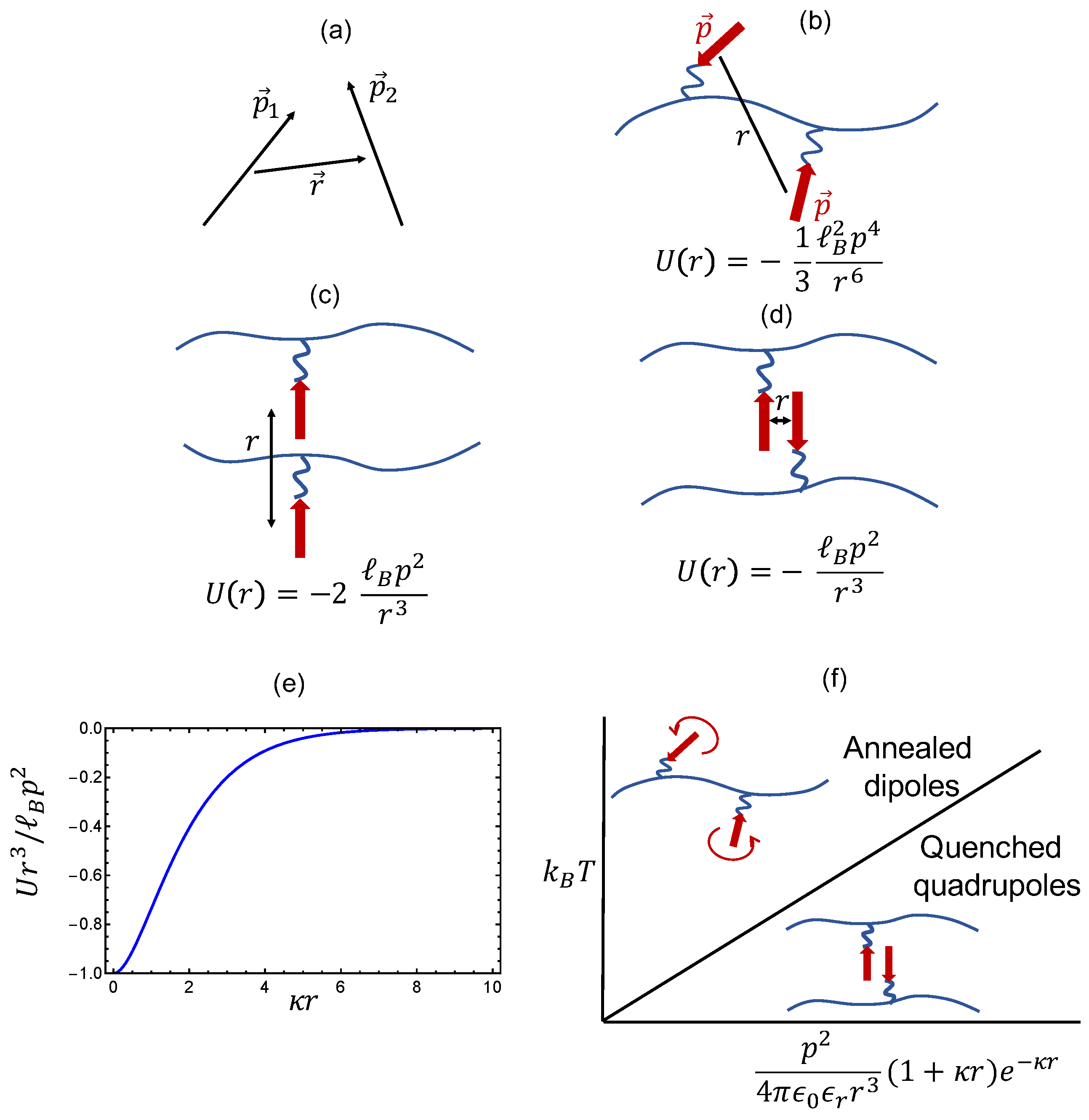
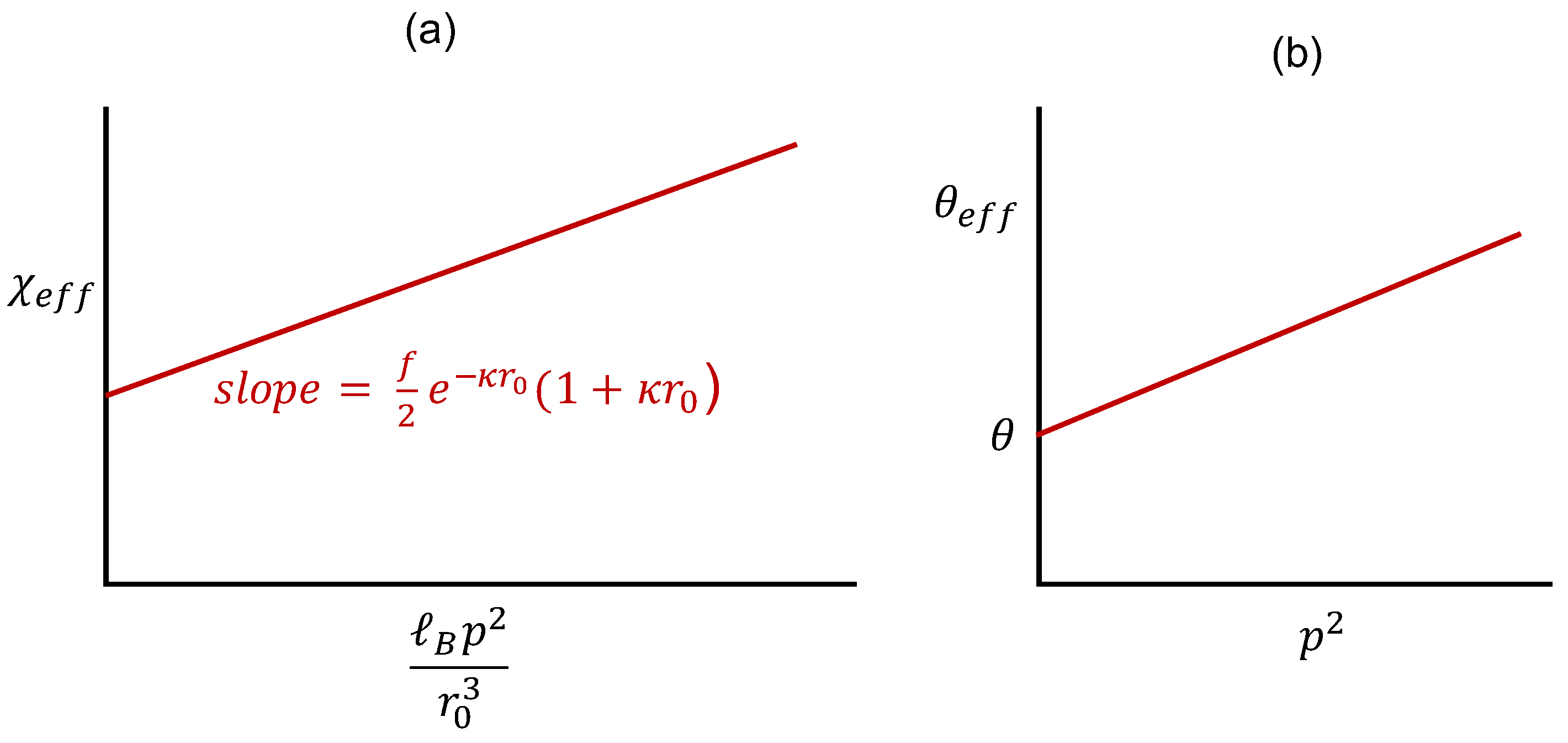
The behavior of polyzwitterions, constituted by dipole-like zwitterionic monomers, is significantly different from that of uniformly charged polyelectrolytes. The origin of this difference lies in the intrinsic capacity of polyzwitterions to self-associate intramolecularly and associate with interpenetrating chains driven by dominant dipolar interactions. Earlier attempts to treat polyzwitterions implicitly assume that the dipoles of zwitterion monomers are randomly oriented. At ambient temperatures, the dipolar zwitterion monomers can readily align with each other generating quadrupoles and other multipoles and thus generating heterogeneous structures even in homogeneous solutions. Towards an attempt to understand the role of such dipolar associations, we present a mean field theory of solutions of polyzwitterions. Generally, we delineate a high-temperature regime where the zwitterion dipoles are randomly oriented from a low-temperature regime where quadrupole formation is significantly prevalent. We present closed-form formulas for: (1) Coil-globule transition in the low-temperature regime, the anti-polyelectrolyte effect of chain expansion upon addition of low molar mass salt, and chain relaxation times in dilute solutions. (2) Spontaneous formation of a mesomorphic state at the borderline between the high-temperature and low-temperature regimes and its characteristics. A universal law is presented for the radius of gyration of the microgel, as a proportionality to one-sixth power of the polymer concentration. (3) Swelling equilibrium of chemically cross-linked polyzwitterion gels in both the high temperature and low-temperature regimes. Addressing the hierarchical internal dynamics of polyzwitterion gels, we present a general stretched exponential law for the time-correlation function of gel displacement vector, that can be measured in dynamic light scattering experiments. The present theory is of direct experimental relevance and additional theoretical developments to all polyzwitterion systems, and generally to biological macromolecular systems such as intrinsically disordered proteins.
Keywords: polyzwitterions; hydrogels; gel swelling equilibria; hierarchical gel dynamics; dipole-dipole interactions; mesomorphic state; polyzwitterion gels polyzwitterions; hydrogels; gel swelling equilibria; hierarchical gel dynamics; dipole-dipole interactions; mesomorphic state; polyzwitterion gels