
Fungal Diversity and Community Composition across Ecosystems



Abstract
1. Introduction
2. Materials and Methods
3. Results and Discussion
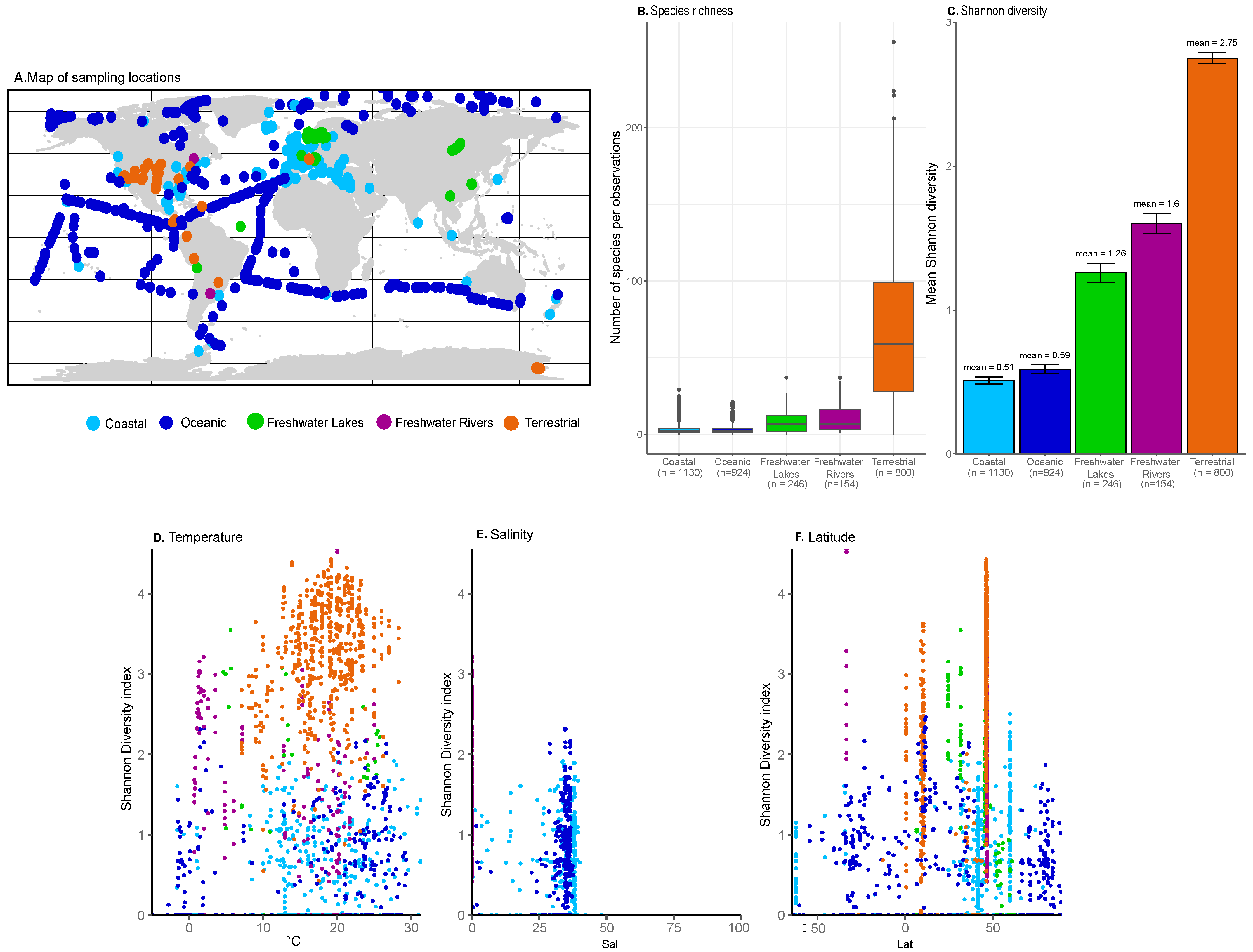
3.1. Global Comparison of Fungal Diversity by Ecosystem
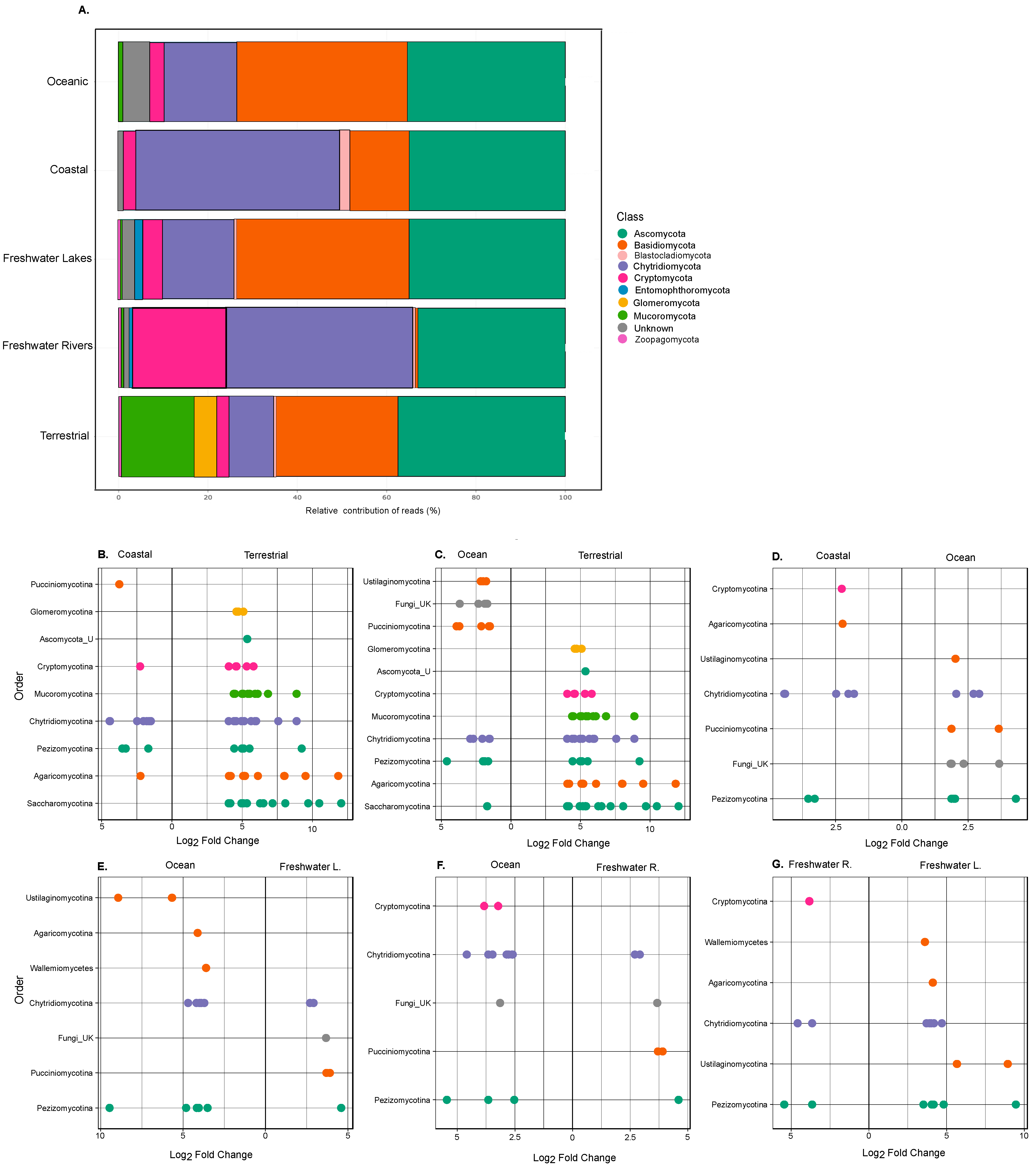
3.2. Fungal Communities by Ecosystem
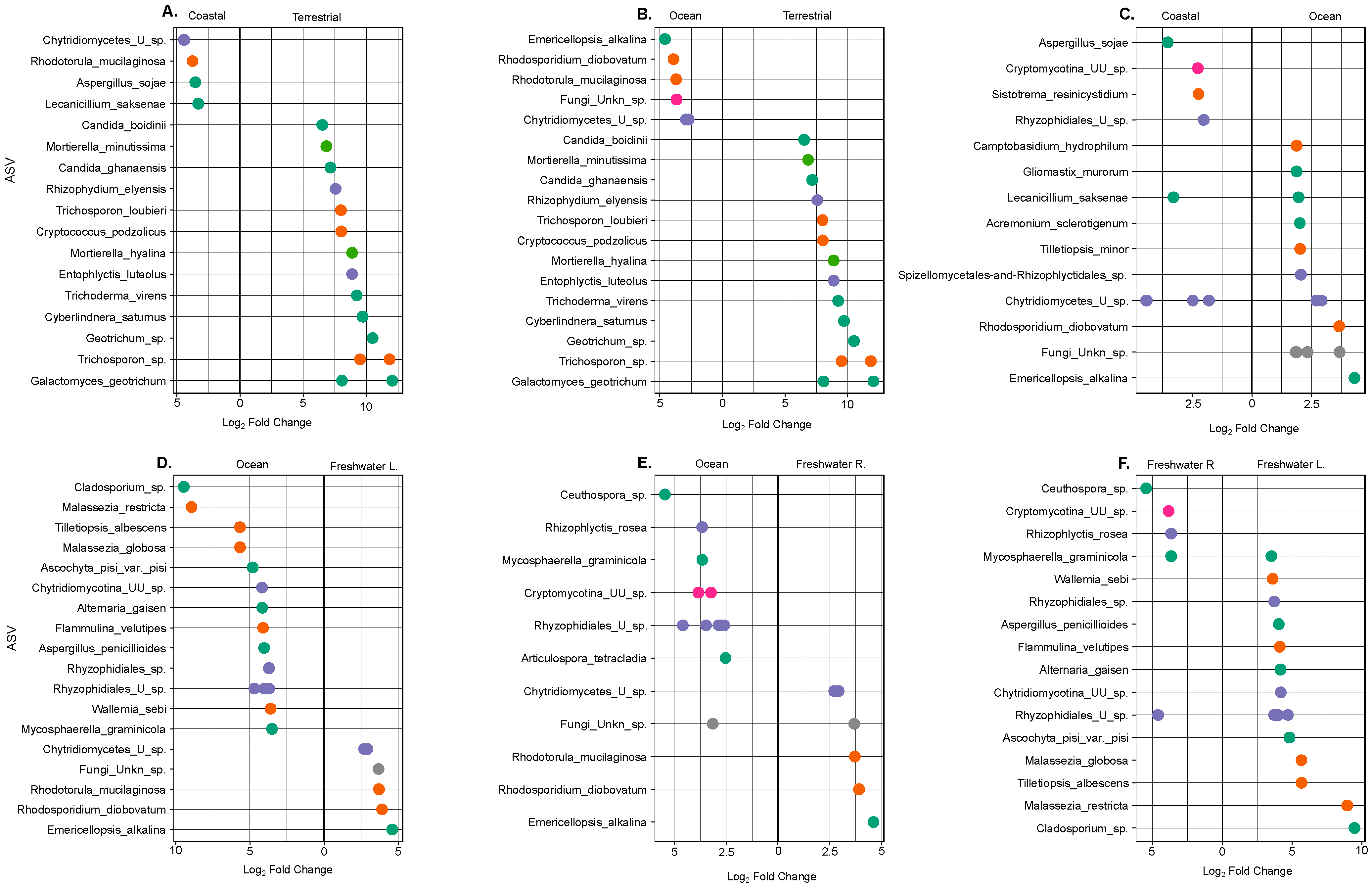
3.3. ASV-Specific Differences by Ecosystem
Supplementary Materials
Author Contributions
Funding
Institutional Review Board Statement
Informed Consent Statement
Data Availability Statement
Acknowledgments
Conflicts of Interest
References
- Hawksworth, D.L. The Fungal Dimension of Biodiversity: Magnitude, Significance, and Conservation. Mycol. Res. 1991, 95, 641–655. [Google Scholar] [CrossRef] [Scilit]
- Hibbett, D.S.; Binder, M.; Bischoff, J.F.; Blackwell, M.; Cannon, P.F.; Eriksson, O.E.; Huhndorf, S.; James, T.; Kirk, P.M.; Lücking, R.; et al. A Higher-Level Phylogenetic Classification of the Fungi. Mycol. Res. 2007, 111, 509–547. [Google Scholar] [CrossRef] [Scilit] [PubMed]
- Mueller, G.M.; Schmit, J.P.; Leacock, P.R.; Buyck, B.; Cifuentes, J.; Desjardin, D.E.; Halling, R.E.; Hjortstam, K.; Iturriaga, T.; Larsson, K.-H.; et al. Global Diversity and Distribution of Macrofungi. Biodivers. Conserv. 2007, 16, 37–48. [Google Scholar] [CrossRef] [Scilit]
- O’Brien, H.E.; Parrent, J.L.; Jackson, J.A.; Moncalvo, J.-M.; Vilgalys, R. Fungal Community Analysis by Large-Scale Sequencing of Environmental Samples. Appl. Environ. Microbiol. 2005, 71, 5544–5550. [Google Scholar] [CrossRef] [Scilit]
- Hawksworth, D.L. The Magnitude of Fungal Diversity: The 1.5 Million Species Estimate Revisited. Mycol. Res. 2001, 105, 1422–1432. [Google Scholar] [CrossRef] [Scilit]
- Hawksworth, D.L.; Lücking, R. Fungal Diversity Revisited: 2.2 to 3.8 Million Species. Microbiol. Spectr. 2017, 5, 10. [Google Scholar] [CrossRef] [Scilit]
- Hassett, B.T.; Vonnahme, T.R.; Peng, X.; Jones, E.B.G.; Heuzé, C. Global Diversity and Geography of Planktonic Marine Fungi. Bot. Mar. 2020, 63, 121–139. [Google Scholar] [CrossRef] [Scilit]
- Tedersoo, L.; Bahram, M.; Põlme, S.; Kõljalg, U.; Yorou, N.S.; Wijesundera, R.; Ruiz, L.V.; Vasco-Palacios, A.M.; Thu, P.Q.; Suija, A.; et al. Global Diversity and Geography of Soil Fungi. Science 2014, 346, 1256688. [Google Scholar] [CrossRef] [Scilit]
- Grossart, H.-P.; Van den Wyngaert, S.; Kagami, M.; Wurzbacher, C.; Cunliffe, M.; Rojas-Jimenez, K. Fungi in Aquatic Ecosystems. Nat. Rev. Microbiol. 2019, 17, 339–354. [Google Scholar] [CrossRef] [Scilit]
- Orsi, W.D.; Vuillemin, A.; Coskun, Ö.K.; Rodriguez, P.; Oertel, Y.; Niggemann, J.; Mohrholz, V.; Gomez-Saez, G.V. Carbon Assimilating Fungi from Surface Ocean to Subseafloor Revealed by Coupled Phylogenetic and Stable Isotope Analysis. ISME J. 2022, 16, 1245–1261. [Google Scholar] [CrossRef] [Scilit]
- Edgcomb, V.P.; Beaudoin, D.; Gast, R.; Biddle, J.F.; Teske, A. Marine Subsurface Eukaryotes: The Fungal Majority. Environ. Microbiol. 2011, 13, 172–183. [Google Scholar] [CrossRef] [Scilit]
- Bochdansky, A.B.; Clouse, M.A.; Herndl, G.J. Eukaryotic Microbes, Principally Fungi and Labyrinthulomycetes, Dominate Biomass on Bathypelagic Marine Snow. ISME J. 2017, 11, 362–373. [Google Scholar] [CrossRef] [Scilit] [PubMed]
- Morales, S.E.; Biswas, A.; Herndl, G.J.; Baltar, F. Global Structuring of Phylogenetic and Functional Diversity of Pelagic Fungi by Depth and Temperature. Front. Mar. Sci. 2019, 6, 131. [Google Scholar] [CrossRef] [Scilit]
- Richards, T.A.; Jones, M.D.M.; Leonard, G.; Bass, D. Marine Fungi: Their Ecology and Molecular Diversity. Annu. Rev. Mar. Sci. 2012, 4, 495–522. [Google Scholar] [CrossRef] [Scilit] [PubMed]
- Baltar, F.; Zhao, Z.; Herndl, G.J. Potential and Expression of Carbohydrate Utilization by Marine Fungi in the Global Ocean. Microbiome 2021, 9, 106. [Google Scholar] [CrossRef] [Scilit] [PubMed]
- Breyer, E.; Zhao, Z.; Herndl, G.J.; Baltar, F. Global Contribution of Pelagic Fungi to Protein Degradation in the Ocean. Microbiome 2022, 10, 143. [Google Scholar] [CrossRef] [Scilit]
- Chrismas, N.; Cunliffe, M. Depth-Dependent Mycoplankton Glycoside Hydrolase Gene Activity in the Open Ocean—Evidence from the Tara Oceans Eukaryote Metatranscriptomes. ISME J. 2020, 14, 2361–2365. [Google Scholar] [CrossRef] [Scilit]
- Vaulot, D.; Sim, C.W.H.; Ong, D.; Teo, B.; Biwer, C.; Jamy, M.; Lopes Dos Santos, A. MetaPR2: A Database of Eukaryotic 18S RRNA Metabarcodes with an Emphasis on Protists. Mol. Ecol. Resour. 2022, 22, 3188–3201. [Google Scholar] [CrossRef] [Scilit]
- McMurdie, P.J.; Holmes, S. Phyloseq: An R Package for Reproducible Interactive Analysis and Graphics of Microbiome Census Data. PLoS ONE 2013, 8, e61217. [Google Scholar] [CrossRef] [Scilit]
- Wickham, H. Ggplot2: Elegant Graphics for Data Analysis; Use R! Springer: New York, NY, USA, 2009; ISBN 978-0-387-98141-3. [Google Scholar]
- Dixon, P. VEGAN, A Package of R Functions for Community Ecology. J. Veg. Sci. 2003, 14, 927–930. [Google Scholar] [CrossRef]
- Love, M.I.; Huber, W.; Anders, S. Moderated Estimation of Fold Change and Dispersion for RNA-Seq Data with DESeq2. Genome Biol. 2014, 15, 550. [Google Scholar] [CrossRef] [Scilit] [PubMed]
- Pelikan, C.; Wasmund, K.; Glombitza, C.; Hausmann, B.; Herbold, C.W.; Flieder, M.; Loy, A. Anaerobic Bacterial Degradation of Protein and Lipid Macromolecules in Subarctic Marine Sediment. ISME J. 2021, 15, 833–847. [Google Scholar] [CrossRef] [Scilit]
- Peay, K.G.; Kennedy, P.G.; Talbot, J.M. Dimensions of Biodiversity in the Earth Mycobiome. Nat. Rev. Microbiol. 2016, 14, 434–447. [Google Scholar] [CrossRef] [Scilit]
- Li, W.; Wang, M.; Burgaud, G.; Yu, H.; Cai, L. Fungal Community Composition and Potential Depth-Related Driving Factors Impacting Distribution Pattern and Trophic Modes from Epi- to Abyssopelagic Zones of the Western Pacific Ocean. Microb. Ecol. 2019, 78, 820–831. [Google Scholar] [CrossRef] [Scilit]
- Wang, X.; Singh, P.; Gao, Z.; Zhang, X.; Johnson, Z.I.; Wang, G. Distribution and Diversity of Planktonic Fungi in the West Pacific Warm Pool. PLoS ONE 2014, 9, e101523. [Google Scholar] [CrossRef] [Scilit] [PubMed]
- Wang, Y.; Sen, B.; He, Y.; Xie, N.; Wang, G. Spatiotemporal Distribution and Assemblages of Planktonic Fungi in the Coastal Waters of the Bohai Sea. Front. Microbiol. 2018, 9, 584. [Google Scholar] [CrossRef] [Scilit]
- Sen, K.; Bai, M.; Sen, B.; Wang, G. Disentangling the Structure and Function of Mycoplankton Communities in the Context of Marine Environmental Heterogeneity. Sci. Total Environ. 2021, 766, 142635. [Google Scholar] [CrossRef] [Scilit] [PubMed]
- Duan, Y.; Xie, N.; Wang, Z.; Johnson, Z.I.; Hunt, D.E.; Wang, G. Patchy Distributions and Distinct Niche Partitioning of Mycoplankton Populations across a Nearshore to Open Ocean Gradient. Microbiol. Spectr. 2021, 9, e01470-21. [Google Scholar] [CrossRef] [Scilit]
- Fuhrman, J.A.; Steele, J.A.; Hewson, I.; Schwalbach, M.S.; Brown, M.V.; Green, J.L.; Brown, J.H. A Latitudinal Diversity Gradient in Planktonic Marine Bacteria. Proc. Natl. Acad. Sci. 2008, 105, 7774–7778. [Google Scholar] [CrossRef] [Scilit]
- Sul, W.J.; Oliver, T.A.; Ducklow, H.W.; Amaral-Zettler, L.A.; Sogin, M.L. Marine Bacteria Exhibit a Bipolar Distribution. Proc. Natl. Acad. Sci. USA 2013, 110, 2342–2347. [Google Scholar] [CrossRef] [Scilit]
- Barton, A.D.; Dutkiewicz, S.; Flierl, G.; Bragg, J.; Follows, M.J. Patterns of Diversity in Marine Phytoplankton. Science 2010, 327, 1509–1511. [Google Scholar] [CrossRef] [Scilit] [PubMed]
- El-Elimat, T.; Raja, H.A.; Figueroa, M.; Al Sharie, A.H.; Bunch, R.L.; Oberlies, N.H. Freshwater Fungi as a Source of Chemical Diversity: A Review. J. Nat. Prod. 2021, 84, 898–916. [Google Scholar] [CrossRef] [Scilit] [PubMed]
- Schoch, C.L.; Seifert, K.A.; Huhndorf, S.; Robert, V.; Spouge, J.L.; Levesque, C.A.; Chen, W.; Fungal Barcoding Consortium; Fungal Barcoding Consortium Author List; Bolchacova, E.; et al. Nuclear Ribosomal Internal Transcribed Spacer (ITS) Region as a Universal DNA Barcode Marker for Fungi. Proc. Natl. Acad. Sci. USA 2012, 109, 6241–6246. [Google Scholar] [CrossRef] [Scilit]
- Raghukumar, S. Fungi in Coastal and Oceanic Marine Ecosystems; Springer International Publishing: Cham, Switzerland, 2017; ISBN 978-3-319-54303-1. [Google Scholar]
- Bauer, R.; Lutz, M.; Piątek, M.; Vánky, K.; Oberwinkler, F. Flamingomyces and Parvulago, New Genera of Marine Smut Fungi (Ustilaginomycotina). Mycol. Res. 2007, 111, 1199–1206. [Google Scholar] [CrossRef] [Scilit] [PubMed]
- Manohar, C.S.; Boekhout, T.; Müller, W.H.; Stoeck, T. Tritirachium Candoliense Sp. Nov., a Novel Basidiomycetous Fungus Isolated from the Anoxic Zone of the Arabian Sea. Fungal Biol. 2014, 118, 139–149. [Google Scholar] [CrossRef] [Scilit] [PubMed]
- Jin, L.; Liu, F.; Sun, W.; Zhang, F.; Karuppiah, V.; Li, Z. Pezizomycotina Dominates the Fungal Communities of South China Sea Sponges Theonella swinhoei and Xestospongia testudinaria. FEMS Microbiol. Ecol. 2014, 90, 935–945. [Google Scholar] [CrossRef] [Scilit]
- Baker, P.W.; Kennedy, J.; Dobson, A.D.W.; Marchesi, J.R. Phylogenetic Diversity and Antimicrobial Activities of Fungi Associated with Haliclona Simulans Isolated from Irish Coastal Waters. Mar. Biotechnol. 2009, 11, 540–547. [Google Scholar] [CrossRef] [Scilit] [PubMed]
- Francis, M.; Webb, V.; Zuccarello, G. Marine Yeast Biodiversity on Seaweeds in New Zealand Waters. N. Z. J. Bot. 2016, 54, 30–47. [Google Scholar] [CrossRef] [Scilit]
- Buedenbender, L.; Kumar, A.; Blümel, M.; Kempken, F.; Tasdemir, D. Genomics- and Metabolomics-Based Investigation of the Deep-Sea Sediment-Derived Yeast, Rhodotorula Mucilaginosa 50-3-19/20B. Mar. Drugs 2020, 19, 14. [Google Scholar] [CrossRef] [Scilit]
- Canter, H.M. Studies on British Chytrids: XXVI. A Critical Examination of Zygorhizidium Melosirae Canter and Z. Planktonicum Canter. J. Linn. Soc. Lond. Bot. 1967, 60, 85–97. [Google Scholar] [CrossRef] [Scilit]
- Kagami, M.; Miki, T.; Takimoto, G. Mycoloop: Chytrids in Aquatic Food Webs. Front. Microbiol. 2014, 5, 166. [Google Scholar] [CrossRef] [Scilit] [PubMed]
- Grum-Grzhimaylo, A.A.; Georgieva, M.L.; Debets, A.J.M.; Bilanenko, E.N. Are Alkalitolerant Fungi of the Emericellopsis Lineage (Bionectriaceae) of Marine Origin? IMA Fungus 2013, 4, 213–228. [Google Scholar] [CrossRef] [Scilit] [PubMed]
- Newell, S.Y.; Hunter, I.L. Rhodosporidium diobovatum sp. n., the Perfect Form of an Asporogenous Yeast (Rhodotorula sp.). J. Bacteriol. 1970, 104, 503–508. [Google Scholar] [CrossRef] [Scilit] [PubMed]
- Zeng, L.-P.; Huang, J.-F.; Qiu, G.-Z.; Chu, F.-Y.; Chen, D.; Tong, J.-B.; Luo, X.-G. Isolation and Identification of Rhodosporidium Diobovatum DS-0205 from Deep-Sea Sediment of Eastern Pacific Ocean. J. Cent. South Univ. Technol. 2009, 16, 942–947. [Google Scholar] [CrossRef] [Scilit]
- Johnson, J.M.; Ludwig, A.; Furch, A.C.U.; Mithöfer, A.; Scholz, S.; Reichelt, M.; Oelmüller, R. The Beneficial Root-Colonizing Fungus Mortierella hyalina Promotes the Aerial Growth of Arabidopsis and Activates Calcium-Dependent Responses That Restrict Alternaria brassicae-Induced Disease Development in Roots. Mol. Plant-Microbe Interact. 2019, 32, 351–363. [Google Scholar] [CrossRef] [Scilit]
- Lee, J.-S.; Nam, B.; Lee, H.B.; Choi, Y.-J. Molecular Phylogeny and Morphology Reveal the Underestimated Diversity of Mortierella (Mortierellales) in Korea. Korean J. Mycol. 2018, 46, 375–382. [Google Scholar] [CrossRef]
- Shearer, C.A.; Raja, H.A.; Miller, A.N.; Nelson, P.; Tanaka, K.; Hirayama, K.; Marvanová, L.; Hyde, K.D.; Zhang, Y. The Molecular Phylogeny of Freshwater Dothideomycetes. Stud. Mycol. 2009, 64, 145–153. [Google Scholar] [CrossRef] [Scilit] [PubMed]


Disclaimer/Publisher’s Note: The statements, opinions and data contained in all publications are solely those of the individual author(s) and contributor(s) and not of MDPI and/or the editor(s). MDPI and/or the editor(s) disclaim responsibility for any injury to people or property resulting from any ideas, methods, instructions or products referred to in the content. |
© 2023 by the authors. Licensee MDPI, Basel, Switzerland. This article is an open access article distributed under the terms and conditions of the Creative Commons Attribution (CC BY) license (https://creativecommons.org/licenses/by/4.0/).
Share and Cite
Debeljak, P.; Baltar, F. Fungal Diversity and Community Composition across Ecosystems. J. Fungi 2023, 9, 510. https://doi.org/10.3390/jof9050510
Debeljak P, Baltar F. Fungal Diversity and Community Composition across Ecosystems. Journal of Fungi. 2023; 9(5):510. https://doi.org/10.3390/jof9050510
Chicago/Turabian StyleDebeljak, Pavla, and Federico Baltar. 2023. "Fungal Diversity and Community Composition across Ecosystems" Journal of Fungi 9, no. 5: 510. https://doi.org/10.3390/jof9050510
APA StyleDebeljak, P., & Baltar, F. (2023). Fungal Diversity and Community Composition across Ecosystems. Journal of Fungi, 9(5), 510. https://doi.org/10.3390/jof9050510