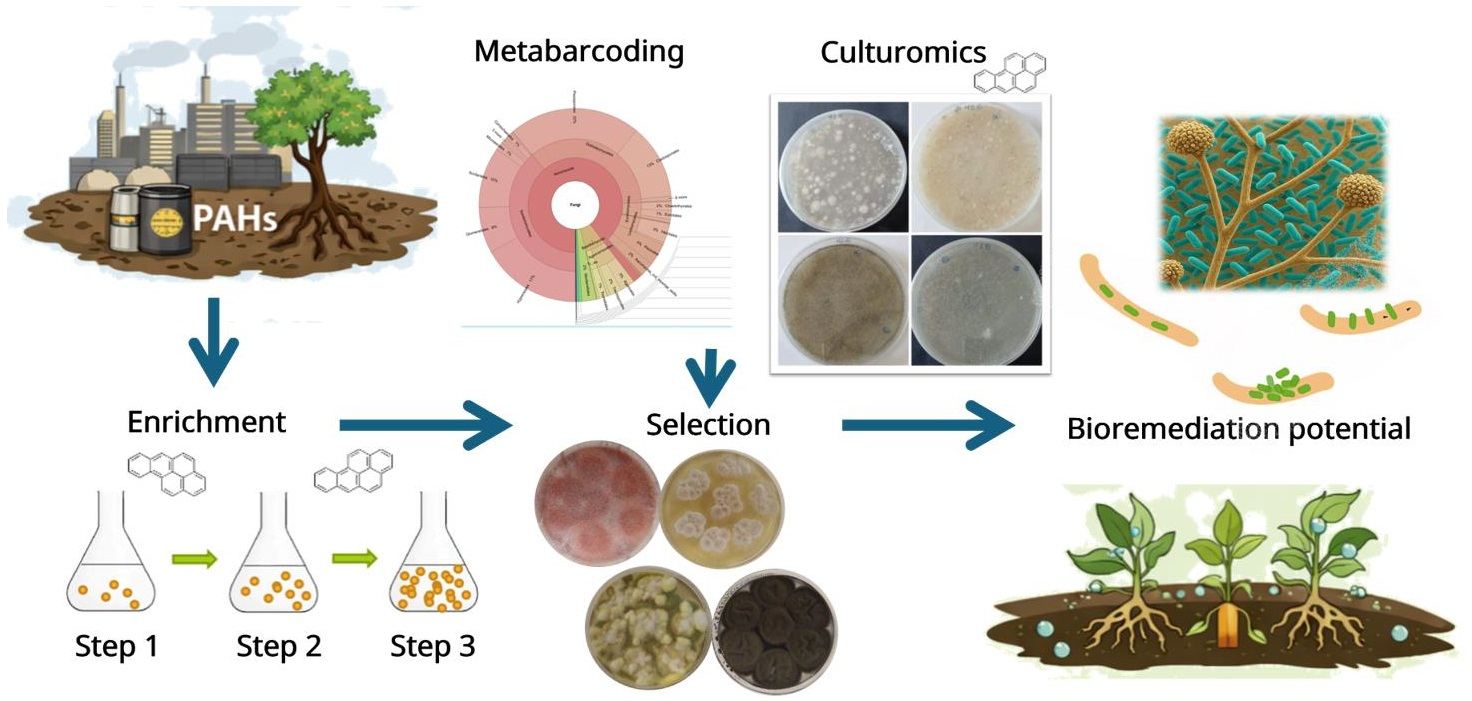

When Fungi Meet Bacteria: Cross-Kingdom Assembly and Bioremediation Potential Under PAH Stress

 ,
, 
 ,
, 
 and
and 
Abstract
1. Introduction
2. Materials and Methods
2.1. Sampling Site and Collection
2.2. Target PAHs
2.3. Enrichment in Liquid Culture and Fungal Isolation
2.4. Chemical Analyses
2.5. eDNA Extraction and Metabarcoding
2.6. Bioinformatic Analysis
2.7. Identification of Isolates—DNA Extraction, PCR Amplification and Sequence Assembly
2.8. PCR Fingerprinting
2.9. Biosurfactant Production
- (i)
- Drop collapsing assay (DCA)
- (ii)
- Oil displacing test (ODT)
- (iii)
- Emulsification activity (EI)
2.10. Microplates Screening
2.11. Statistical Analyses
3. Results and Discussion
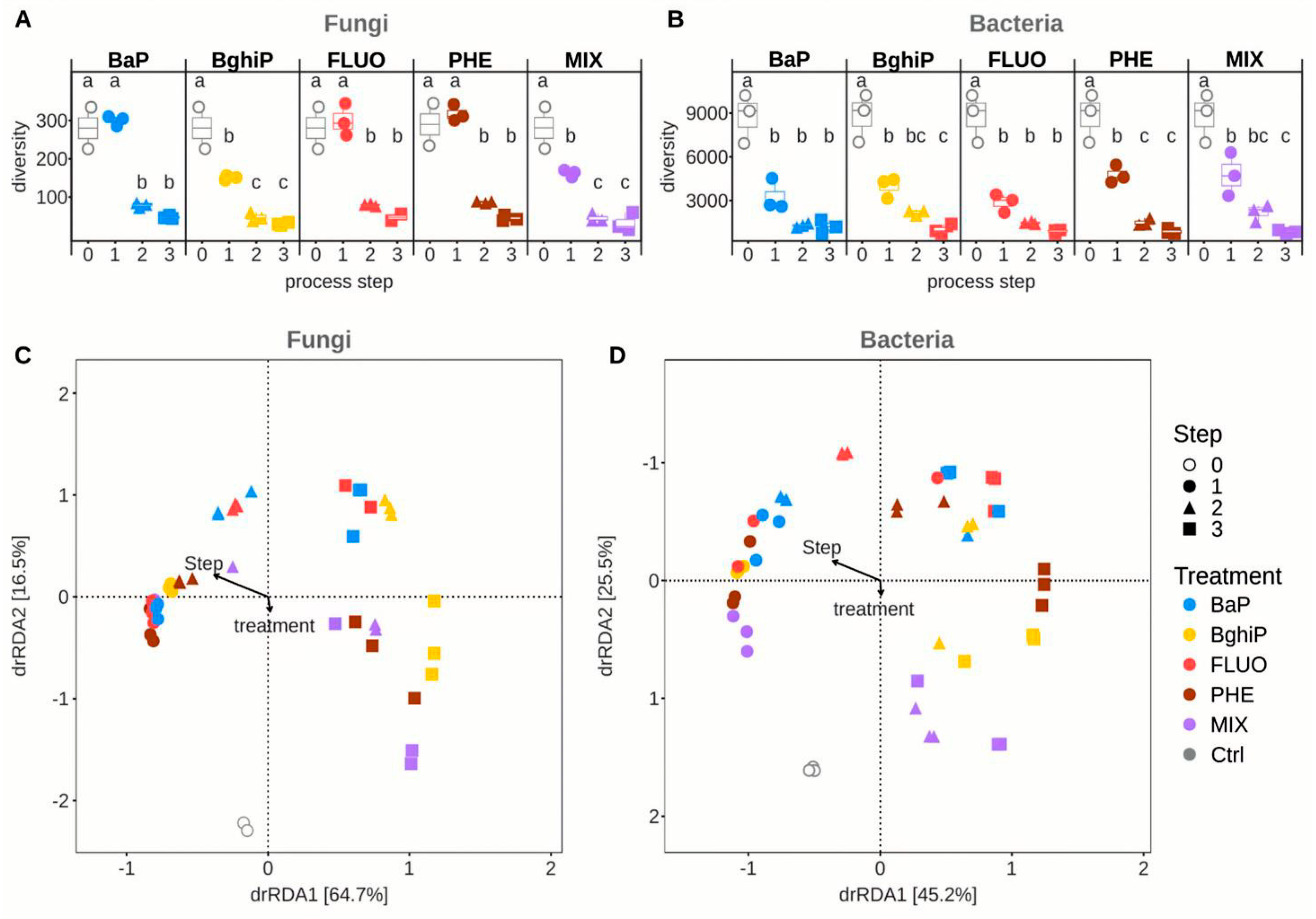
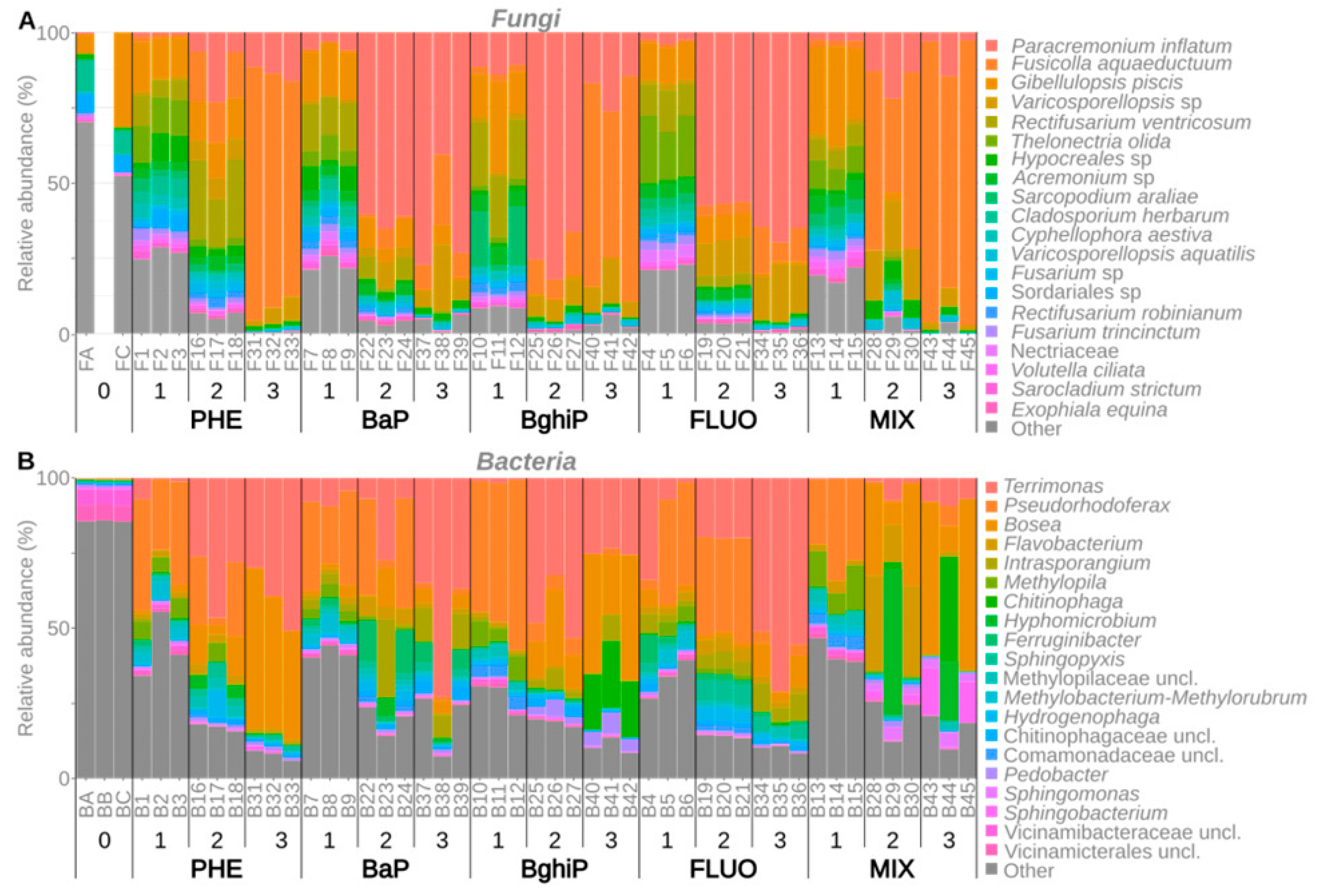
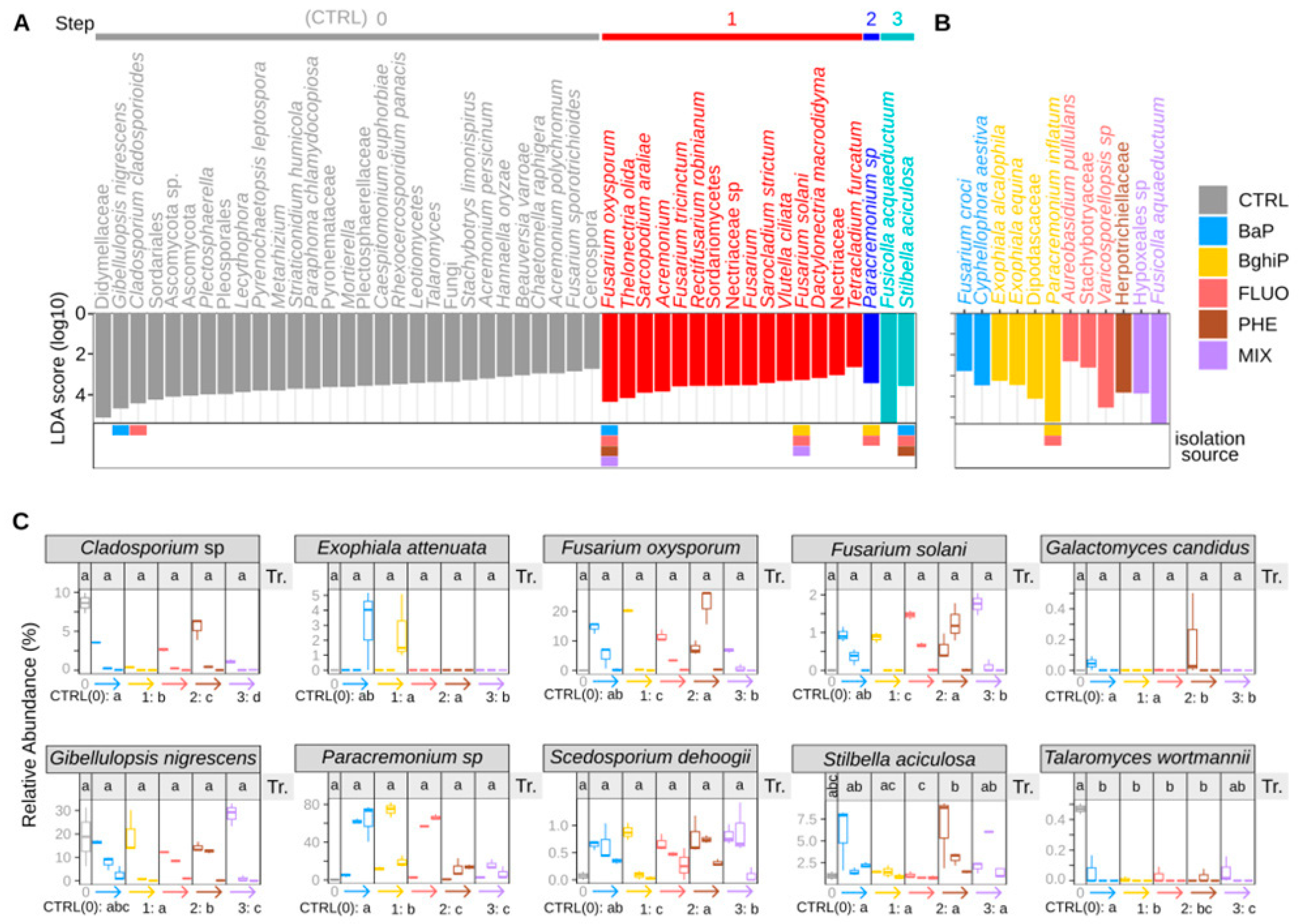
3.1. Changes in Fungal and Bacterial Community Compositions Across Enrichment with Different PAHs
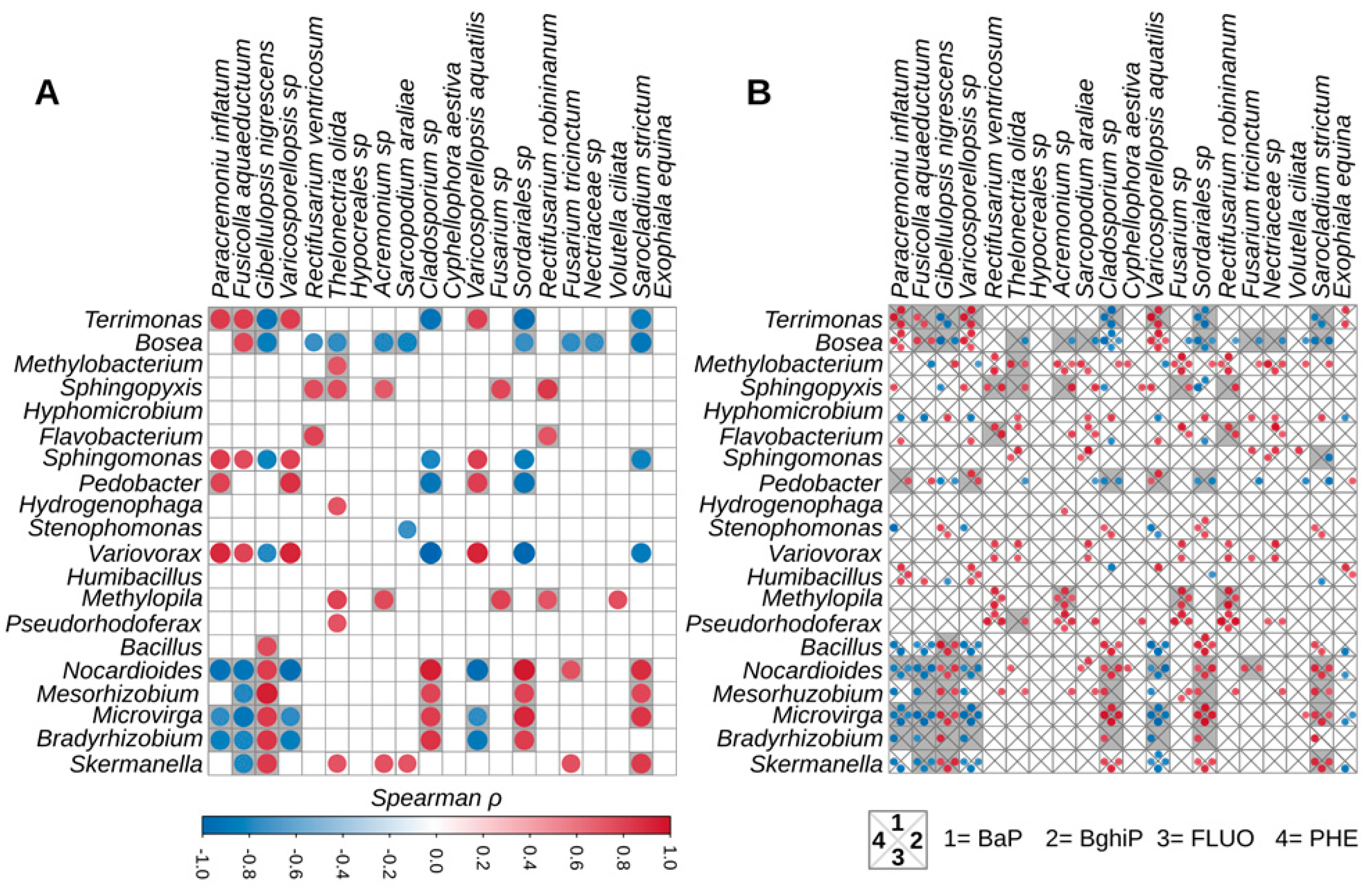
3.2. Co-Occurrences Between Fungi and Prokaryotes Across PAH Enrichments
3.3. Solid Screening: Fungal Isolation and Identification
3.4. Fungi–Bacteria Associations
3.5. Strain Characterization
3.5.1. Production of Biosurfactants
3.5.2. Evaluation of Fungal Growth Under PAH-Selective Conditions
4. Conclusions
Supplementary Materials
Author Contributions
Funding
Institutional Review Board Statement
Informed Consent Statement
Data Availability Statement
Acknowledgments
Conflicts of Interest
Abbreviations
| BaP | Benzo(a)pyrene |
| BGHI | Benzo(g,h,i)perylene |
| CTRL | Control |
| FLUO | Fluoranthene |
| MEA | Malt extract agar |
| MIX | Mixture of the four PAHs |
| MM | Mineral medium |
| PAH | Polycyclic aromatic hydrocarbon |
| PHE | Phenanthrene |
References
- Saccá, M.; Caracciolo, A.; Di Lenola, M.; Grenni, P. Ecosystem services provided by soil microorganisms. In Proceedings of the Soil Biological Communities and Ecosystem Resilience; Springer: Cham, Switzerland, 2017; pp. 9–24. [Google Scholar]
- Sokol, N.; Slessarev, E.; Marschmann, G.; Nicolas, A.; Blazewicz, S.; Brodie, E.; Firestone, M.; Foley, M.; Hestrin, R.; Hungate, B.; et al. Life and death in the soil microbiome: How ecological processes influence biogeochemistry. Nat. Rev. Microbiol. 2022, 20, 415–430. [Google Scholar] [CrossRef] [Scilit] [PubMed]
- Anikwe, M.; Ife, K. The role of soil ecosystem services in the circular bioeconomy. Front. Soil Sci. 2023, 3, 1209100. [Google Scholar] [CrossRef] [Scilit]
- Cachada, A.; da Silva, E.; Duarte, A.; Pereira, R. Risk assessment of urban soils contamination: The particular case of polycyclic aromatic hydrocarbons. Sci. Total Environ. 2016, 551, 271–284. [Google Scholar] [CrossRef] [Scilit] [PubMed]
- Wang, C.; Wu, S.; Zhou, S.; Sill, Y.; Song, J. Characteristics and source identification of polycyclic aromatic hydrocarbons (PAHs) in urban soils: A Review. Pedosphere 2017, 27, 17–26. [Google Scholar] [CrossRef] [Scilit]
- Heywood, E.; Wright, J.; Wienburg, C.; Black, H.; Long, S.; Osborn, D.; Spurgeon, D. Factors influencing the national distribution of polycyclic aromatic hydrocarbons and polychlorinated biphenyls in British soils. Environ. Sci. Technol. 2006, 40, 7629–7635. [Google Scholar] [CrossRef] [Scilit] [PubMed]
- Conte, P.; Zena, A.; Pilidis, G.; Piccolo, A. Increased retention of polycyclic aromatic hydrocarbons in soils induced by soil treatment with humic substances. Environ. Pollut. 2001, 112, 27–31. [Google Scholar] [CrossRef] [Scilit] [PubMed]
- Sakshi; Singh, S.; Haritash, A. Polycyclic aromatic hydrocarbons: Soil pollution and remediation. Int. J. Environ. Sci. Technol. 2019, 16, 6489–6512. [Google Scholar] [CrossRef] [Scilit]
- Weissenfels, W.; Klewer, H.; Langhoff, J. Adsorption of polycyclic aromatic-hydrocarbons (PAHS) by soil particles: Influence on biodegradability and biotoxicity. Appl. Microbiol. Biotechnol. 1992, 36, 689–696. [Google Scholar] [CrossRef] [Scilit] [PubMed]
- Haritash, A.; Kaushik, C. Biodegradation aspects of polycyclic aromatic hydrocarbons (PAHs): A review. J. Hazard. Mater. 2009, 169, 1–15. [Google Scholar] [CrossRef] [Scilit] [PubMed]
- Imam, A.; Suman, S.; Kanaujia, P.; Ray, A. Biological machinery for polycyclic aromatic hydrocarbons degradation: A review. Bioresour. Technol. 2022, 343, 126121. [Google Scholar] [CrossRef] [Scilit] [PubMed]
- Godoy, P.; Reina, R.; Calderón, A.; Wittich, R.; García-Romera, I.; Aranda, E. Exploring the potential of fungi isolated from PAH-polluted soil as a source of xenobiotics-degrading fungi. Environ. Sci. Pollut. Res. 2016, 23, 20985–20996. [Google Scholar] [CrossRef] [Scilit] [PubMed]
- Ijoma, G.; Tekere, M. Potential microbial applications of co-cultures involving ligninolytic fungi in the bioremediation of recalcitrant xenobiotic compounds. Int. J. Environ. Sci. Technol. 2017, 14, 1787–1806. [Google Scholar] [CrossRef] [Scilit]
- Miglani, R.; Parveen, N.; Kumar, A.; Ansari, M.; Khanna, S.; Rawat, G.; Panda, A.; Bisht, S.; Upadhyay, J.; Ansari, M. Degradation of Xenobiotic Pollutants: An Environmentally Sustainable Approach. Metabolites 2022, 12, 818. [Google Scholar] [CrossRef] [Scilit] [PubMed]
- Kuppan, N.; Padman, M.; Mahadeva, M.; Srinivasan, S.; Devarajan, R. A comprehensive review of sustainable bioremediation techniques: Eco friendly solutions for waste and pollution management. Waste Manag. Bull. 2024, 2, 154–171. [Google Scholar] [CrossRef] [Scilit]
- Singh, B.; Christina, E. Indigenous microorganisms as an effective tool for in situ bioremediation. In Relationship Between Microbes and the Environment for Sustainable Ecosystem Services; Elsevier: Amsterdam, The Netherlands, 2022; Volume 2, pp. 273–295. [Google Scholar]
- Fallahi, M.; Sarempour, M.; Gohari, A. Potential biodegradation of polycyclic aromatic hydrocarbons (PAHs) and petroleum hydrocarbons by indigenous fungi recovered from crude oil-contaminated soil in Iran. Sci. Rep. 2023, 13, 22153. [Google Scholar] [CrossRef] [Scilit] [PubMed]
- González-Abradelo, D.; Pérez-Llano, Y.; Peidro-Guzmán, H.; Sánchez-Carbente, M.; Folch-Mallol, J.; Aranda, E.; Vaidyanathan, V.; Cabana, H.; Gunde-Cimerman, N.; Batista-García, R. First demonstration that ascomycetous halophilic fungi (Aspergillus sydowii and Aspergillus destruens) are useful in xenobiotic mycoremediation under high salinity conditions. Bioresour. Technol. 2019, 279, 287–296. [Google Scholar] [CrossRef] [Scilit] [PubMed]
- Pozdnyakova, N.; Nikiforova, S.; Turkovskaya, O. Influence of PAHs on ligninolytic enzymes of the fungus Pleurotus ostreatus D1. Cent. Eur. J. Biol. 2010, 5, 83–94. [Google Scholar] [CrossRef] [Scilit]
- Liu, P.; Wen, S.; Zhu, S.; Hu, X.; Wang, Y. Microbial degradation of soil organic pollutants: Mechanisms, challenges, and advances in forest ecosystem management. Processes 2025, 13, 916. [Google Scholar] [CrossRef] [Scilit]
- Agnello, A.; Bagard, M.; van Hullebusch, E.; Esposito, G.; Huguenot, D. Comparative bioremediation of heavy metals and petroleum hydrocarbons co-contaminated soil by natural attenuation, phytoremediation, bioaugmentation and bioaugmentation-assisted phytoremediation. Sci. Total Environ. 2016, 563, 693–703. [Google Scholar] [CrossRef] [Scilit] [PubMed]
- Muter, O. Current Trends in Bioaugmentation Tools for Bioremediation: A critical review of advances and knowledge gaps. Microorganisms 2023, 11, 710. [Google Scholar] [CrossRef] [Scilit] [PubMed]
- Spini, G.; Spina, F.; Poli, A.; Blieux, A.; Regnier, T.; Gramellini, C.; Varese, G.; Puglisi, E. Molecular and microbiological insights on the enrichment procedures for the isolation of petroleum degrading bacteria and fungi. Front. Microbiol. 2018, 9, 2543. [Google Scholar] [CrossRef] [Scilit] [PubMed]
- Zhu, S.; Li, M.; Qian, T.; Chen, J.; Pan, T. Influence of surfactants on interfacial microbial degradation of hydrophobic organic compounds. Catalysts 2025, 15, 187. [Google Scholar] [CrossRef] [Scilit]
- Aparna, A.; Srinikethan, G.; Hegde, S. Effect of addition of biosurfactant produced by Pseudomonas sps. on biodegradation of crude oil. In Proceedings of the Environmental Science and Technology; IACSIT: Singapore, 2011; pp. VI71–VI75. [Google Scholar]
- Santos, B.; Jesus, M.; Mata, F.; Prado, A.; Vieira, I.; Ramos, L.; López, J.; Vaz-Velho, M.; Ruzene, D.; Silva, D. Use of Agro-Industrial Waste for Biosurfactant Production: A comparative study of hemicellulosic liquors from corncobs and sunflower stalks. Sustainability 2023, 15, 6341. [Google Scholar] [CrossRef] [Scilit]
- Ibrahim, A.; Oginga, B.; Zhang, Y.; Ling, W.; Tang, L.; Elatafi, E.; Abady, M.; Gao, Y. Bioremediation of soils with emerging organic contaminants using immobilized microorganisms. Environ. Technol. Innov. 2025, 40, 104345. [Google Scholar] [CrossRef] [Scilit]
- Khan, M. Microbial remediation of agrochemical-contaminated soils: Enzymatic mechanisms, quorum sensing, and emerging opportunities. Integr. Environ. Assess. Manag. 2025, vjaf167. [Google Scholar] [CrossRef] [Scilit] [PubMed]
- Giunchino, F.; Mucciarelli, M.; Malandrino, M.; Sordello, F.; Lanfranco, L.; Primo, L.; Calza, P. Assessing PTEs in a polluted urban green environment and proposing sustainable approaches for its recovery. Ecol. Eng. 2026, 222, 107784. [Google Scholar] [CrossRef] [Scilit]
- Poli, A.; Bongiovanni, D.; Stefanini, I.; Crespi, M.; Giunchino, F.; Morel, E.; Calza, P.; Varese, G.; Prigione, V. Autochthonous microorganisms of a soil contaminated by polycyclic aromatic hydrocarbons: Allies or silent threats? Biodivers. Conserv. 2026, 35, 42. [Google Scholar] [CrossRef] [Scilit]
- White, T.J.; Bruns, T.; Lee, S.; Taylor, J. Amplification and direct sequencing of fungal ribosomal RNA genes for phylogenetics. PCR Protoc. A Guide Methods Appl. 1990, 18, 315–322. [Google Scholar] [CrossRef] [Scilit]
- Ihrmark, K.; Bödeker, I.; Cruz-Martinez, K.; Friberg, H.; Kubartova, A.; Schenck, J.; Strid, Y.; Stenlid, J.; Brandström-Durling, M.; Clemmensen, K.; et al. New primers to amplify the fungal ITS2 region—Evaluation by 454-sequencing of artificial and natural communities. FEMS Microbiol. Ecol. 2012, 82, 666–677. [Google Scholar] [CrossRef] [Scilit] [PubMed]
- Klindworth, A.; Pruesse, E.; Schweer, T.; Peplies, J.; Quast, C.; Horn, M.; Glöckner, F. Evaluation of general 16S ribosomal RNA gene PCR primers for classical and next-generation sequencing-based diversity studies. Nucleic Acids Res. 2013, 41, e1. [Google Scholar] [CrossRef] [Scilit] [PubMed]
- Bolyen, E.; Rideout, J.; Dillon, M.; Bokulich, N.; Abnet, C.; Al-Ghalith, G.; Alexander, H.; Alm, E.; Arumugam, M.; Asnicar, F.; et al. Reproducible, interactive, scalable and extensible microbiome data science using QIIME 2. Nat. Biotechnol. 2019, 37, 852–857. [Google Scholar] [CrossRef] [Scilit] [PubMed]
- Callahan, B.; McMurdie, P.; Rosen, M.; Han, A.; Johnson, A.; Holmes, S. DADA2: High-resolution sample inference from Illumina amplicon data. Nat. Methods 2016, 13, 581–583. [Google Scholar] [CrossRef] [Scilit] [PubMed]
- Quast, C.; Pruesse, E.; Yilmaz, P.; Gerken, J.; Schweer, T.; Yarza, P.; Peplies, J.; Glöckner, F. The SILVA ribosomal RNA gene database project: Improved data processing and web-based tools. Nucleic Acids Res. 2013, 41, D590–D596. [Google Scholar] [CrossRef] [Scilit] [PubMed]
- Vilgalys, R.; Hester, M. Rapid genetic identification and mapping of enzymatically amplified ribosomal DNA from several Cryptococcus species. J. Bacteriol. 1990, 172, 4238–4246. [Google Scholar] [CrossRef] [Scilit] [PubMed]
- Glass, N.L.; Donaldson, G.C. Development of primer sets designed for use with the PCR to amplify conserved genes from filamentous ascomycetes. Appl. Environ. Microbiol. 1995, 61, 1323–1330. [Google Scholar] [CrossRef] [Scilit] [PubMed]
- Carbone, I.; Kohn, L.M. A method for designing primer sets for speciation studies in filamentous ascomycetes. Mycologia 1999, 91, 553–556. [Google Scholar] [CrossRef] [Scilit]
- O’Donnell, K. Molecular phylogeny of the Nectria haematococca-Fusarium solani species complex. Mycologia 2000, 92, 919–938. [Google Scholar] [CrossRef] [Scilit]
- Lane, D.J. 16S/23S rRNA Sequencing. In Nucleic Acid Techniques in Bacterial Systematic; Stackebrandt, E., Goodfellow, M., Eds.; John Wiley and Sons: New York, NY, USA, 1991; pp. 115–175. [Google Scholar]
- Poli, A.; Zanellati, A.; Piano, E.; Biagioli, F.; Coleine, C.; Nicolosi, G.; Selbmann, L.; Isaia, M.; Prigione, V.; Varese, G. Cultivable fungal diversity in two karstic caves in Italy: Under-investigated habitats as source of putative novel taxa. Sci. Rep. 2024, 14, 4164. [Google Scholar] [CrossRef] [Scilit] [PubMed]
- Poli, A.; Lazzari, A.; Prigione, V.; Voyron, S.; Spadaro, D.; Varese, G.C. Influence of plant genotype on the cultivable fungi associated to tomato rhizosphere and roots in different soils. Fungal Biol. 2016, 120, 862–872. [Google Scholar] [CrossRef] [Scilit] [PubMed]
- Fidalgo-Jiménez, A.; Danie, H.; Evrard, P.; Decock, C.; Lachance, M. Metschnikowia cubensis sp. nov., a yeast species isolated from flowers in Cuba. Int. J. Syst. Evol. Microbiol. 2008, 58, 2955–2961. [Google Scholar] [CrossRef] [Scilit] [PubMed]
- Bertout, S.; Drakulovski, P.; Kouanfack, C.; Krasteva, D.; Ngouana, T.; Dunyach-Rémy, C.; Dongtsa, J.; Aghokeng, A.; Delaporte, E.; Koulla-Shiro, S.; et al. Genotyping and antifungal susceptibility testing of Cryptococcus neoformans isolates from Cameroonian HIV-positive adult patients. Clin. Microbiol. Infect. 2013, 19, 763–769. [Google Scholar] [CrossRef] [Scilit] [PubMed]
- Bodour, A.; Miller-Maier, R. Application of a modified drop-collapse technique for surfactant quantitation and screening of biosurfactant-producing microorganisms. J. Microbiol. Methods 1998, 32, 273–280. [Google Scholar] [CrossRef] [Scilit]
- Youssef, N.; Duncan, K.; Nagle, D.; Savage, K.; Knapp, R.; McInerney, M. Comparison of methods to detect biosurfactant production by diverse microorganisms. J. Microbiol. Methods 2004, 56, 339–347. [Google Scholar] [CrossRef] [Scilit] [PubMed]
- Morikawa, M.; Hirata, Y.; Imanaka, T. A study on the structure-function relationship of lipopeptide biosurfactants. Biochim. Biophys. Acta-Mol. Cell Biol. Lipids 2000, 1488, 211–218. [Google Scholar] [CrossRef] [Scilit] [PubMed]
- Walter, V.; Syldatk, C.; Hausmann, R. Screening concepts for the isolation of biosurfactant producing microorganisms. Biosurfactants 2010, 672, 1–13. [Google Scholar] [CrossRef] [Scilit]
- Al-hazmi, M.; Moussa, T.; Alhazmi, N. Statistical optimization of biosurfactant production from Aspergillus niger SA1 fermentation process and mathematical modeling. J. Microbiol. Biotechnol. 2023, 33, 1238–1249. [Google Scholar] [CrossRef] [Scilit] [PubMed]
- McNab, E.; Rether, A.; Hsiang, T. Development of a microplate absorbance assay for assessing fungicide sensitivity of filamentous fungi and comparison to an amended agar assay. J. Microbiol. Methods 2023, 204, 106653. [Google Scholar] [CrossRef] [Scilit] [PubMed]
- Wang, C.; Wu, H.; Zhao, W.; Zhu, B.; Yang, J. Effects of Polycyclic aromatic hydrocarbons on soil bacterial and fungal communities in soils. Diversity 2024, 16, 675. [Google Scholar] [CrossRef] [Scilit]
- Gréau, L.; Blaudez, D.; Le Cordier, H.; Fornasier, F.; Cébron, A. Taxonomic and functional responses of soil and root bacterial communities associated with poplar exposed to a contamination gradient of phenanthrene. FEMS Microbiol. Ecol. 2023, 99, fiad052. [Google Scholar] [CrossRef] [Scilit] [PubMed]
- Egidi, E.; Delgado-Baquerizo, M.; Plett, J.; Wang, J.; Eldridge, D.; Bardgett, R.; Maestre, F.; Singh, B. A few Ascomycota taxa dominate soil fungal communities worldwide. Nat. Commun. 2019, 10, 2369. [Google Scholar] [CrossRef] [Scilit] [PubMed]
- Zhang, S.; Wang, Q.; Wan, R.; Xie, S. Changes in bacterial community of anthracene bioremediation in municipal solid waste composting soil. J. Zhejiang Univ. -Sci. B 2011, 12, 760–768. [Google Scholar] [CrossRef] [Scilit] [PubMed]
- Zhou, G.; Qiao, H.; Liu, Y.; Yu, X.; Niu, X. High phenanthrene degrading efficiency by different microbial compositions construction. Front. Microbiol. 2024, 15, 1439216. [Google Scholar] [CrossRef] [Scilit] [PubMed]
- Shen, Q.; Fu, W.; Chen, B.; Zhang, X.; Xing, S.; Ji, C.; Zhang, X. Community response of soil microorganisms to combined contamination of polycyclic aromatic hydrocarbons and potentially toxic elements in a typical coking plant. Front. Microbiol. 2023, 14, 1143742. [Google Scholar] [CrossRef] [Scilit] [PubMed]
- Luo, C.; Guan, G.; Dai, Y.; Cai, X.; Huang, Q.; Li, J.; Zhang, G. Determination of soil phenanthrene degradation through a fungal-bacterial consortium. Appl. Environ. Microbiol. 2024, 90, e0066224. [Google Scholar] [CrossRef] [Scilit] [PubMed]
- Saito, A.; Iwabuchi, T.; Harayama, S. A novel phenanthrene dioxygenase from Nocardioides sp. strain KP7: Expression in Escherichia coli. J. Bacteriol. 2000, 182, 2134–2141. [Google Scholar] [CrossRef] [Scilit] [PubMed]
- Nzila, A.; Musa, M.M.; Afuecheta, E.; Al-Thukair, A.; Sankaran, S.; Xiang, L.; Li, Q.X. Benzo [a] pyrene biodegradation by multiple and individual mesophilic bacteria under axenic conditions and in soil samples. Int. J. Environ. Res. Public Health 2023, 20, 1855. [Google Scholar] [PubMed]
- Pozdnyakova, N.; Muratova, A.; Bondarenkova, A.; Turkovskaya, O. Degradation of a Model mixture of PAHs by bacterial–fungal co-cultures. Front. Biosci. -Elite 2023, 15, 26. [Google Scholar] [CrossRef] [Scilit]
- Aranda, E.; Godoy, P.; Reina, R.; Badia-Fabregat, M.; Rosell, M.; Marco-Urrea, E.; García-Romera, I. Isolation of of Ascomycota fungi with capability to transform PAHs: Insights into the biodegradation mechanisms of Penicillium oxalicum. Int. Biodeterior. Biodegrad. 2017, 122, 141–150. [Google Scholar] [CrossRef] [Scilit]
- Gao, J.; Qi, M.; Wang, X.; Feng, X.; Li, J.; Zhang, G.; Feng, S.; Yang, Z.; Ning, G. Combined induction by Cu(II) and veratrole enhances the degradation of high molecular weight polyaromatic hydrocarbons by Fusarium dlaminii ZH-H2. Ecotoxicol. Environ. Saf. 2025, 291, 117794. [Google Scholar] [CrossRef] [Scilit] [PubMed]
- Wang, X.; Gong, Z.; Li, P.; Zhang, L.; Hu, X. Degradation of pyrene and benzo(a) pyrene in contaminated soil by immobilized fungi. Environ. Eng. Sci. 2008, 25, 677–684. [Google Scholar] [CrossRef] [Scilit]
- Thion, C.; Cébron, A.; Beguiristain, T.; Leyval, C. PAH biotransformation and sorption by Fusarium solani and Arthrobacter oxydans isolated from a polluted soil in axenic cultures and mixed co-cultures. Int. Biodeterior. Biodegrad. 2012, 68, 28–35. [Google Scholar] [CrossRef] [Scilit]
- Potin, O.; Veignie, E.; Rafin, C. Biodegradation of polycyclic aromatic hydrocarbons (PAHs) by Cladosporium sphaerospermum isolated from an aged PAH contaminated soil. FEMS Microbiol. Ecol. 2004, 51, 71–78. [Google Scholar] [CrossRef] [Scilit] [PubMed]
- Birolli, W.; Santos, D.; Alvarenga, N.; Garcia, A.; Romao, L.; Porto, A. Biodegradation of anthracene and several PAHs by the marine-derived fungus Cladosporium sp. CBMAI 1237. Mar. Pollut. Bull. 2018, 129, 525–533. [Google Scholar] [CrossRef] [Scilit] [PubMed]
- Egbewale, S.; Kumar, A.; Olasehinde, T.; Mokoena, M.; Olaniran, A. Anthracene detoxification by Laccases from indigenous fungal strains Trichoderma lixii FLU1 and Talaromyces pinophilus FLU12. Biodegradation 2024, 35, 769–787. [Google Scholar] [CrossRef] [Scilit] [PubMed]
- Potin, O.; Rafin, C.; Veignie, E. Bioremediation of an aged polycyclic aromatic hydrocarbons (PAHs)-contaminated soil by filamentous fungi isolated from the soil. Int. Biodeterior. Biodegrad. 2004, 54, 45–52. [Google Scholar] [CrossRef] [Scilit]
- Ghosal, D.; Ghosh, S.; Dutta, T.; Ahn, Y. Current state of knowledge in microbial degradation of polycyclic aromatic hydrocarbons (PAHs): A Review. Front. Microbiol. 2016, 7, 1837. [Google Scholar] [CrossRef] [Scilit] [PubMed]
- Eldin, A.; Kamel, Z.; Hossam, N. Isolation and genetic identification of yeast producing biosurfactants, evaluated by different screening methods. Microchem. J. 2019, 146, 309–314. [Google Scholar] [CrossRef] [Scilit]
- Kamilari, E.; Stanton, C.; Reen, F.; Ross, R. Uncovering the biotechnological importance of Geotrichum candidum. Foods 2023, 12, 1124. [Google Scholar] [CrossRef] [Scilit] [PubMed]
- Obi, L.; Atagana, H.; Adeleke, R.; Maila, M.; Bamuza-Pemu, E. Potential microbial drivers of biodegradation of polycyclic aromatic hydrocarbons in crude oil sludge using a composting technique. J. Chem. Technol. Biotechnol. 2020, 95, 1569–1579. [Google Scholar] [CrossRef] [Scilit]
- Kohlmeier, S.; Smits, T.; Ford, R.; Keel, C.; Harms, H.; Wick, L. Taking the fungal highway: Mobilization of pollutant-degrading bacteria by fungi. Environ. Sci. Technol. 2005, 39, 4640–4646. [Google Scholar] [CrossRef] [Scilit] [PubMed]
- Simon, A.; Bindschedler, S.; Job, D.; Wick, L.; Filippidou, S.; Kooli, W.; Verrecchia, E.; Junier, P. Exploiting the fungal highway: Development of a novel tool for the in situ isolation of bacteria migrating along fungal mycelium. FEMS Microbiol. Ecol. 2015, 91, fiv116. [Google Scholar] [CrossRef] [Scilit] [PubMed]
- Richter, I.; Buettner, H.; Hertweck, C. Endofungal bacteria as hidden facilitators of biotic interactions. ISME J. 2025, 19, wraf128. [Google Scholar] [CrossRef] [Scilit] [PubMed]
- Worrich, A.; König, S.; Miltner, A.; Banitz, T.; Centler, F.; Frank, K.; Thullner, M.; Harms, H.; Kästner, M.; Wick, L. Mycelium-like networks increase bacterial dispersal, growth, and biodegradation in a model ecosystem at various water potentials. Appl. Environ. Microbiol. 2016, 82, 2902–2908. [Google Scholar] [CrossRef] [Scilit] [PubMed]
- Ksiazek-Trela, P.; Figura, D.; Wezka, D.; Szpyrka, E. Degradation of a mixture of 13 polycyclic aromatic hydrocarbons by commercial effective microorganisms. Open Life Sci. 2024, 19, 20220831. [Google Scholar] [CrossRef] [Scilit] [PubMed]
- Junier, P.; Cailleau, G.; Palmieri, I.; Vallotton, C.; Trautschold, O.; Junier, T.; Paul, C.; Bregnard, D.; Palmieri, F.; Estoppey, A.; et al. Democratization of fungal highway columns as a tool to investigate bacteria associated with soil fungi. FEMS Microbiol. Ecol. 2021, 97, fiab003. [Google Scholar] [CrossRef] [Scilit] [PubMed]
- Juhasz, A.; Stanley, G.; Britz, M. Microbial degradation and detoxification of high molecular weight polycyclic aromatic hydrocarbons by Stenotrophomonas maltophilia strain VUN 10,003. Lett. Appl. Microbiol. 2000, 30, 396–401. [Google Scholar] [CrossRef] [Scilit] [PubMed]
- Singh, A.; Kumar, K.; Pandey, A.; Sharma, A.; Singh, S.; Kumar, K.; Arora, A.; Nain, L. pyrene degradation by biosurfactant producing bacterium Stenotrophomonas maltophilia. Agric. Res. 2015, 4, 42–47. [Google Scholar] [CrossRef] [Scilit]
- Xiao, Y.; Jiang, R.; Wu, X.; Zhong, Q.; Li, Y.; Wang, H. Comparative genomic analysis of Stenotrophomonas maltophilia strain W18 reveals its adaptative genomic features for degrading polycyclic aromatic hydrocarbons. Microbiol. Spectr. 2021, 9, e01420-21. [Google Scholar] [CrossRef] [Scilit] [PubMed]
- Wick, L.; Remer, R.; Würz, B.; Reichenbach, J.; Braun, S.; Schärfer, F.; Harms, H. Effect of fungal hyphae on the access of bacteria to phenanthrene in soil. Environ. Sci. Technol. 2007, 41, 500–505. [Google Scholar] [CrossRef] [Scilit] [PubMed]
- Cao, H.; Zhang, X.; Wang, S.; Liu, J.; Han, D.; Zhao, B.; Wang, H. Insights into mechanism of the naphthalene-enhanced biodegradation of phenanthrene by Pseudomonas sp. SL-6 based on omics analysis. Front. Microbiol. 2021, 12, 761216. [Google Scholar] [CrossRef] [Scilit] [PubMed]
- Li, B.; Liu, H.; Liu, X.; Han, L.; Yang, J.; Kang, L.; Tang, L.; Qian, T. Naphthalene enhances polycyclic aromatic hydrocarbon biodegradation by Pseudomonas aeruginosa in soil and water: Effect and mechanism. Water 2024, 16, 2537. [Google Scholar] [CrossRef] [Scilit]
- Escudero-Leyva, E.; Belle, M.; DadkhahTehrani, A.; Culver, J.; Araya-Salas, M.; Kutza, J.; Goldson, N.; Chavarría, M.; Chaverri, P. Genomic insights reveal community structure and phylogenetic associations of endohyphal bacteria and viruses in fungal endophytes. Environ. Microbiome 2025, 20, 95. [Google Scholar] [CrossRef] [Scilit] [PubMed]
- Liu, J.; Cui, Z.; Hao, T.; Li, Y.; Luan, X.; Feng, K.; Zheng, L. Characterization and hydrocarbon degradation potential of Variovorax sp. strain N23 isolated from the antarctic soil. Microbiol. Res. 2023, 14, 91–103. [Google Scholar] [CrossRef] [Scilit]
- Ghimire, N.; Kim, B.; Lee, C.; Oh, T. Comparative genome analysis among Variovorax species and genome guided aromatic compound degradation analysis emphasizing 4-hydroxybenzoate degradation in Variovorax sp. PAMC26660. BMC Genom. 2022, 23, 375. [Google Scholar] [CrossRef] [Scilit] [PubMed]
- Shaffer, J.; U’Ren, J.; Gallery, R.; Baltrus, D.; Arnold, A. An endohyphal bacterium (Chitinophaga, Bacteroidetes) alters carbon source use by Fusarium keratoplasticum (F. solani Species Complex, Nectriaceae). Front. Microbiol. 2017, 8, 350. [Google Scholar] [CrossRef] [Scilit] [PubMed]
- Cicatiello, P.; Stanzione, I.; Dardano, P.; De Stefano, L.; Birolo, L.; De Chiaro, A.; Monti, D.; Petruk, G.; D’Errico, G.; Giardina, P. Characterization of a surface-active protein extracted from a marine strain of Penicillium chrysogenum. Int. J. Mol. Sci. 2019, 20, 3242. [Google Scholar] [CrossRef] [Scilit] [PubMed]
- Gautam, G.; Mishra, V.; Verma, P.; Pandey, A.K.; Negi, S. A cost effective strategy for production of bio-surfactant from locally isolated Penicillium chrysogenum SNP5 and its applications. J. Bioprocess. Biotech. 2014, 4.1, 10.4172. [Google Scholar]
- Khan, A.; Tanveer, S.; Kiyani, A.; Barros, R.; Iqbal, M.; Yousaf, S. Biosurfactant-producing Aspergillus, Penicillium, and Candida Performed higher biodegradation of diesel oil than a non-producing fungal strain. Appl. Biochem. Microbiol. 2023, 59, 282–289. [Google Scholar] [CrossRef] [Scilit]
- Ruggeri, C.; Franzetti, A.; Bestetti, G.; Caredda, P.; La Colla, P.; Pintus, M.; Sergi, S.; Tamburini, E. Isolation and characterisation of surface active compound-producing bacteria from hydrocarbon-contaminated environments. Int. Biodeterior. Biodegrad. 2009, 63, 936–942. [Google Scholar] [CrossRef] [Scilit]
- Gargouri, B.; Contreras, M.; Ammar, S.; Segura-Carretero, A.; Bouaziz, M. Biosurfactant production by the crude oil degrading Stenotrophomonas sp. B-2: Chemical characterization, biological activities and environmental applications. Environ. Sci. Pollut. Res. 2017, 24, 3769–3779. [Google Scholar] [CrossRef] [Scilit] [PubMed]
- Patel, K.; Patel, M. Improving bioremediation process of petroleum wastewater using biosurfactants producing Stenotrophomonas sp. S1VKR-26 and assessment of phytotoxicity. Bioresour. Technol. 2020, 315, 123861. [Google Scholar] [CrossRef] [Scilit] [PubMed]
- Larik, I.; Qazi, M.; Phulpoto, A.; Haleem, A.; Ahmed, S.; Kanhar, N. Stenotrophomonas maltophilia strain 5DMD: An efficient biosurfactant-producing bacterium for biodegradation of diesel oil and used engine oil. Int. J. Environ. Sci. Technol. 2019, 16, 259–268. [Google Scholar] [CrossRef] [Scilit]
- Yuan, C.; Wang, J.; Wu, J.; Li, Q. Degradation of puffed feather to produce functional biosurfactants by Chitinophaga eiseniae 4 H. Process Biochem. 2025, 148, 168–175. [Google Scholar] [CrossRef] [Scilit]
- Udume, O.A.; Stanley, H.O.; Abu, G.O. Hydrocarbon solubilization by oil and cellulose-degrading Chitinophaga terrae isolated from the rumen. GSC Biol. Pharm. Sci. 2021, 14, 215–225. [Google Scholar] [CrossRef] [Scilit]
- Hammel, K. Mechanisms for polycyclic aromatic hydrocarbon degradation by ligninolytic fungi. Environ. Health Perspect. 1995, 103, 41–43. [Google Scholar] [CrossRef] [Scilit]
- Aydin, S.; Karaçay, H.; Shahi, A.; Gökçe, S.; Ince, B.; Ince, O. Aerobic and anaerobic fungal metabolism and omics insights for increasing polycyclic aromatic hydrocarbons biodegradation. Fungal Biol. Rev. 2017, 31, 61–72. [Google Scholar] [CrossRef] [Scilit]
- Dai, Y.; Liu, R.; Chen, J.; Li, N. Bioremediation of HMW-PAHs-contaminated soils by rhizosphere microbial community of Fire Phoenix plants. Chem. Eng. J. 2022, 432, 134246. [Google Scholar] [CrossRef] [Scilit]
- Padilla-Garfias, F.; Araiza-Villanueva, M.; Calahorra, M.; Sánchez, N.; Peña, A. Advances in the degradation of polycyclic aromatic hydrocarbons by yeasts: A Review. Microorganisms 2024, 12, 2484. [Google Scholar] [CrossRef] [Scilit] [PubMed]
- Sun, Y.; Li, Y.; Liang, H.; Li, M.; Liu, Y.; Wang, L.; Lai, W.; Tang, T.; Diao, Y.; Bai, Y.; et al. Distinct laccase expression and activity profiles of Trametes versicolor facilitate degradation of benzo[a]pyrene. Front. Bioeng. Biotechnol. 2023, 11, 1264135. [Google Scholar] [CrossRef] [Scilit] [PubMed]
- Winding, A.; Modrzynski, J.; Christensen, J.; Brandt, K.; Mayer, P. Soil bacteria and protists show different sensitivity to polycyclic aromatic hydrocarbons at controlled chemical activity. FEMS Microbiol. Lett. 2019, 366, fnz214. [Google Scholar] [CrossRef] [Scilit] [PubMed]
- Das, N.; Chandran, P. Microbial degradation of petroleum hydrocarbon contaminants: An overview. Biotechnol. Res. Int. 2011, 2011, 941810. [Google Scholar] [CrossRef] [Scilit] [PubMed]



| Fungal Species | MUT Number | Associated Bacteria | DCA | ODT | EI |
|---|---|---|---|---|---|
| Cladosporium allicinum | 7452 | + | + | + | |
| Cladosporium cladosporioides | 7444 | - | + | - | |
| Cladosporium langeronii | 7441 | - | - | - | |
| Cladosporium westerdijkia | 7439 | - | + | + | |
| Fusarium falciforme | 7448 | + | - | + | |
| Fusarium oxysporum | 7456 | - | - | + | |
| Fusarium oxysporum | 7458 | - | ++ | - | |
| Fusarium oxysporum | 7442 | - | - | - | |
| Fusarium oxysporum | 7440 | - | - | - | |
| Fusarium oxysporum | 7457 | - | - | + | |
| Fusarium solani | 7447 | - | - | + | |
| Fusarium solani | 7459 | - | - | + | |
| Galactomyces pseudocandidus | 7461 | - | - | + | |
| Galactomyces pseudocandidus | 7463 | Bosea robiniae | + | + | + |
| Galactomyces pseudocandidus | 7462 | - | ++ | + | |
| Galactomyces pseudocandidus | 7464 | Stenotrophomonas maltophilia | + | + | ++ |
| Galactomyces pseudocandidus | 7466 | - | + | + | |
| Galactomyces pseudocandidus | 7467 | - | - | - | |
| Galactomyces pseudocandidus | 7469 | Pseudomonas sp. | - | + | - |
| Galactomyces pseudocandidus | 7470 | Bosea robiniae | - | +++ | + |
| Galactomyces pseudocandidus | 7471 | Chitinophaga ginsengisegetis | + | ++ | + |
| Galactomyces pseudocandidus | 7472 | Bosea robiniae | + | ++ | ++ |
| Galactomyces pseudocandidus | 7474 | Stenotrophomonas sp. | + | +++ | - |
| Galactomyces pseudocandidus | 7475 | + | + | ++ | |
| Galactomyces pseudocandidus | 7476 | Putative consortium | + | + | + |
| Galactomyces pseudocandidus | 7477 | Putative consortium | ++ | ++ | ++ |
| Galactomyces pseudocandidus | 7478 | Stenotrophomonas sp. | - | - | + |
| Galactomyces pseudocandidus | 7479 | Putative consortium | + | + | ++ |
| Galactomyces pseudocandidus | 7480 | Stenotrophomonas sp. | + | + | + |
| Galactomyces pseudocandidus | 7481 | Stenotrophomonas sp. | - | - | + |
| Galactomyces pseudocandidus | 7482 | Putative consortium | + | ++ | + |
| Galactomyces pseudocandidus | 7483 | Putative consortium | - | - | + |
| Galactomyces pseudocandidus | 7484 | - | + | + | |
| Galactomyces pseudocandidus | 7505 | Stenotrophomonas sp. | + | +++ | + |
| Galactomyces pseudocandidus | 7485 | Stenotrophomonas indicatrix | - | + | ++ |
| Galactomyces pseudocandidus | 7465 | - | + | + | |
| Paracremonium sp. | 7451 | ++ | + | + | |
| Paracremonium sp. | 7450 | ++ | + | - | |
| Penicillium chrysogenum | 7430 | +++ | ++ | ++ | |
| Penicillium crustosum | 7445 | - | - | - | |
| Stilbella aciculosa | 7449 | +++ | + | - | |
| Stilbella aciculosa | 7436 | Chitinophaga arvensicola | + | ++ | + |
| Stilbella aciculosa | 7438 | - | - | + | |
| Stilbella aciculosa | 7453 | Chitinophaga ginsengisegetis | - | + | + |
| Trametes versicolor | 7454 | Bosea robiniae | - | + | - |
| Strain | Hours | 24 | 48 | 72 | 168 | 240 | 336 | 504 | |
|---|---|---|---|---|---|---|---|---|---|
| PAH | |||||||||
| Cladosporium allicinum MUT 7452 | PHE | ns | ns | ns | ns | ns | * | * | |
| FLUO | ns | ns | ns | ns | ns | ns | ns | ||
| BaP | ns | ns | ns | ns | ns | ns | ns | ||
| BghiP | ns | ns | ns | ns | ns | ns | ns | ||
| MIX | ns | ns | ns | ns | ns | ns | ns | ||
| Fusarium solani MUT 7447 | PHE | ** | *** | *** | **** | ** | **** | ** | |
| FLUO | ns | ns | ns | ns | ns | *** | ns | ||
| BaP | *** | ns | ** | ns | ns | **** | * | ||
| BghiP | ns | ** | ns | ns | ns | *** | ns | ||
| MIX | ns | ns | ns | ns | ns | *** | ns | ||
| Fusarium solani MUT 7459 | PHE | ns | ns | ns | ns | ** | ** | * | |
| FLUO | ns | ns | ns | ns | ns | ns | ns | ||
| BaP | ** | ns | ** | ns | * | * | ns | ||
| BghiP | * | ns | ns | * | * | * | * | ||
| MIX | * | ns | ns | ns | ns | ns | ns | ||
| Galactomyces pseudocandidus MUT 7467 | PHE | ** | ** | ** | NA | ns | ns | **** | |
| FLUO | ** | **** | ** | NA | ns | ns | ns | ||
| BaP | ns | ns | ns | NA | * | ns | **** | ||
| BghiP | * | ** | * | NA | ns | ns | ns | ||
| MIX | *** | **** | ns | NA | ns | ns | ns | ||
| Galactomyces pseudocandidus MUT 7469 Pseudomonas sp. | PHE | ** | ** | * | * | * | * | ns | |
| FLUO | ns | ns | ns | ns | ns | ns | ns | ||
| BaP | ns | ns | ns | ns | ns | * | ns | ||
| BghiP | ns | ns | ns | ns | ns | ns | ns | ||
| MIX | ns | ns | ns | ns | * | * | ns | ||
| Galactomyces pseudocandidus MUT 7471 Chitinophaga ginsengisegetis | PHE | ns | ns | * | ns | ns | ns | * | |
| FLUO | ns | * | ns | ns | ns | ns | ns | ||
| BaP | ns | ns | ns | ** | **** | ** | ns | ||
| BghiP | ns | ns | ns | *** | **** | **** | **** | ||
| MIX | ns | ns | ns | ns | ** | * | ns | ||
| Galactomyces pseudocandidus MUT 7473 | PHE | * | ns | * | ns | ns | ns | ns | |
| FLUO | ns | ns | * | ns | ns | ns | ns | ||
| BaP | *** | ns | *** | ns | ns | ns | ns | ||
| BghiP | ** | ns | **** | ns | ns | ns | ns | ||
| MIX | ns | ns | * | ns | ns | ns | ns | ||
| Galactomyces pseudocandidus MUT 7475 | PHE | **** | *** | **** | ns | ns | ns | ** | |
| FLUO | ns | ns | ns | * | ** | ns | ns | ||
| BaP | ns | ns | * | * | ** | * | * | ||
| BghiP | ns | ns | ns | ** | *** | **** | **** | ||
| MIX | ns | * | ns | * | ** | *** | ** | ||
| Galactomyces pseudocandidus MUT 7477 Putative consortium | PHE | ns | ns | ns | NA | ns | * | *** | |
| FLUO | * | ns | ns | NA | ns | ns | ns | ||
| BaP | *** | *** | * | NA | ns | ** | *** | ||
| BghiP | ns | ns | ns | NA | ** | **** | * | ||
| MIX | ns | * | ns | NA | ns | ns | ns | ||
| Galactomyces pseudocandidus MUT 7484 | PHE | ns | ** | *** | ns | ns | ns | ** | |
| FLUO | ns | *** | * | ns | ns | ns | ns | ||
| BaP | ns | ** | ** | ns | ns | ns | ns | ||
| BghiP | ns | ns | ns | ns | *** | *** | ** | ||
| MIX | ns | ns | ns | ns | ns | ns | ns | ||
| Penicillium crustosum MUT 7445 | PHE | ** | ns | ns | ns | ns | ns | ns | |
| FLUO | ns | ** | *** | * | ns | ns | ns | ||
| BaP | * | ns | ** | * | ns | ns | ns | ||
| BghiP | ns | ** | ns | ns | * | ns | * | ||
| MIX | ns | ns | ns | ns | ns | ns | ns | ||
| Trametes versicolor MUT 7454 | PHE | ns | ns | ns | ns | * | **** | **** | |
| FLUO | ns | ns | ns | ns | ns | ns | ns | ||
| BaP | ns | ns | ns | ns | ns | ns | ns | ||
| BghiP | ns | ns | ns | ns | **** | **** | **** | ||
| MIX | ns | ns | ns | ns | ** | **** | **** | ||
Disclaimer/Publisher’s Note: The statements, opinions and data contained in all publications are solely those of the individual author(s) and contributor(s) and not of MDPI and/or the editor(s). MDPI and/or the editor(s) disclaim responsibility for any injury to people or property resulting from any ideas, methods, instructions or products referred to in the content. |
© 2026 by the authors. Licensee MDPI, Basel, Switzerland. This article is an open access article distributed under the terms and conditions of the Creative Commons Attribution (CC BY) license.
Share and Cite
Poli, A.; Marchitelli, A.L.; Stefanini, I.; Bambi, M.; Giunchino, F.; Calza, P.; Varese, G.C.; Prigione, V. When Fungi Meet Bacteria: Cross-Kingdom Assembly and Bioremediation Potential Under PAH Stress. J. Fungi 2026, 12, 469. https://doi.org/10.3390/jof12070469
Poli A, Marchitelli AL, Stefanini I, Bambi M, Giunchino F, Calza P, Varese GC, Prigione V. When Fungi Meet Bacteria: Cross-Kingdom Assembly and Bioremediation Potential Under PAH Stress. Journal of Fungi. 2026; 12(7):469. https://doi.org/10.3390/jof12070469
Chicago/Turabian StylePoli, Anna, Andrea L. Marchitelli, Irene Stefanini, Marina Bambi, Francesco Giunchino, Paola Calza, Giovanna Cristina Varese, and Valeria Prigione. 2026. "When Fungi Meet Bacteria: Cross-Kingdom Assembly and Bioremediation Potential Under PAH Stress" Journal of Fungi 12, no. 7: 469. https://doi.org/10.3390/jof12070469
APA StylePoli, A., Marchitelli, A. L., Stefanini, I., Bambi, M., Giunchino, F., Calza, P., Varese, G. C., & Prigione, V. (2026). When Fungi Meet Bacteria: Cross-Kingdom Assembly and Bioremediation Potential Under PAH Stress. Journal of Fungi, 12(7), 469. https://doi.org/10.3390/jof12070469