Article

Morphology, Chemistry, and Phylogeny Reveal Two New Species of the Genus Lecidella (Ascomycota, Lecanoraceae) from Anhui Province, China
1
Key Laboratory of Biodiversity Conservation and Ecological Security in the Yangtze River Basin of Anhui Province, College of Life Sciences, Anhui Normal University, Wuhu 241000, China
2
State Key Laboratory of Phytochemistry and Natural Medicines, Kunming Institute of Botany, Chinese Academy of Sciences, Kunming 650201, China
3
Yunnan Key Laboratory for Fungal Diversity and Green Development, Kunming Institute of Botany, Chinese Academy of Sciences, Kunming 650201, China
*
Author to whom correspondence should be addressed.
J. Fungi 2026, 12(6), 453; https://doi.org/10.3390/jof12060453 (registering DOI)
Submission received: 29 April 2026 / Revised: 19 June 2026 / Accepted: 20 June 2026 / Published: 22 June 2026
(This article belongs to the Special Issue Taxonomy, Phylogeny, Ecology, and Metabolites of Lichen)

Abstract

In this study, two new species, Lecidella biformis Y. S. Feng & Y. Y. Zhang and L. versicolor Y. S. Feng & Y. Y. Zhang, are described from Anhui Province, China, based on morphological, chemical, and molecular evidence. Phylogenetic analyses show that these two new species, together with L. albida Hafellner, form a well-supported clade characterized by small apothecia (less than 0.5 mm in diameter), a hyaline, yellowish-brown or nut-brown hypothecium, and the presence of atranorin. Lecidella biformis is distinguished by dimorphic apothecia, ranging from brown with a paler margin to entirely brown, a blackish-brown or nut-brown epithecium, a yellowish-brown or nut-brown hypothecium, and the presence of atranorin and methyl 2′-O-methylmicrophyllinate. Lecidella versicolor is characterized by apothecia that are yellow to reddish-brown when young and nut-brown at maturity, an orange-brown epithecium, a hyaline to yellowish-brown hypothecium, anastomosed paraphyses, and the presence of atranorin only. Detailed descriptions, discussions, and illustrations are provided for the new species, along with a key to all known Lecidella species from China.

1. Introduction

Lecidella was established by Körber [1], who separated it from Lecidea Ach. based on its lighter-colored, never carbonaceous hypothecium. Nevertheless, only a few lichenologists initially accepted this concept [2,3] and, for a long time, these species were largely considered part of the genus Lecidea Ach. [4]. Later, Leuckert and Hertel [5] re-elevated Lecidella to generic rank, based on the presence of chlorinated norlichexanthones in many species. Currently, Lecidella is classified within the family Lecanoraceae, not only because of similarities in ascus type [6,7] but also based on strong support from molecular data [8,9]. The genus is characterized by dark-colored lecideine apothecia; a persistent proper excipulum; clavate, large amyloid, eight-spored asci of the Lecidella-type; simple, hyaline, non-halonate ascospores; curved filiform conidia; and the presence of xanthones in the majority of species [8,10,11]. To date, the genus Lecidella includes approximately 80 accepted species worldwide [12], of which 14 have been recorded in China [13,14]. The genus is widely distributed and occurs on various substrates [8,11,15,16].
Anhui Province is located in eastern China, situated in the transitional zone between the Huai River basin and the lower Yangtze River basin [17]. Previously, only two Lecidella species, L. elaeochroma (Ach.) M. Choisy and L. euphorea (Flörke) Kremp., had been recorded in the province [18]. Over the past five years, we have conducted more than ten field surveys targeting Lecidella and collected several specimens with small apothecia that could not be assigned to any known species, along with two newly recorded taxa from Anhui Province, Lecidella mandshurica S.Y. Kondr., Lőkös & Hur and L. aff. euphorea, found during this study. Based on integrated morphological, chemical, and molecular phylogenetic evidence, we here describe these specimens as two new species of Lecidella from Anhui Province, China.

2. Materials and Methods

2.1. Morphology and Chemistry

We collected six specimens of Lecidella biformis and one specimen of Lecidella versicolor from the southeastern part of the Dabie Mountains in Anhui Province, China. These specimens are preserved in the Botany Herbarium of Anhui Normal University (ANUB). A key to the Lecidella species from China is provided here.
External morphological features were observed, measured, and described using an OLYMPUS SZ61TR (Hachioji, Japan) stereomicroscope. Key characteristics were photographed with a Mingmei MS60-2 (Guangzhou Mingmei Optoelectric Technology Co., Ltd., Guangzhou, China) camera. Thin sections of apothecia were manually prepared using a razor blade, mounted in water, and examined under an OLYMPUS BX43 (Hachioji, Japan) compound microscope to observe anatomical structures. Photomicrographs were taken using a Mingmei MDX10 (Guangzhou, China) camera. The colors of the thallus surface, apothecia, and vertical sections of apothecia were compared and identified using the RAL color chart (Bonn, Germany). Spore measurement data are presented as follows: [minimum] − ( x ¯ − SD) − x ¯ − ( x ¯ + SD) − [maximum], where x ¯ is the arithmetic mean and SD is the standard deviation (values rounded to the nearest 0.5 µm), followed by the number of measurements (n) [19]. A 10% Lugol’s iodine solution (I) was used to examine the apical structure of asci. Crystals in apothecia were observed under polarized light (POL); their solubility was tested in 20% nitric acid (HNO3 = “N”) and 10% potassium hydroxide (KOH = “K”), where N-sol/K-sol indicates that crystals dissolved and N-insol/K-insol indicates that they did not dissolve.
Spot tests were conducted using K, C (10% calcium hypochlorite), and KC (K followed by C). To assess compositional differences between the thallus and apothecia, approximately 20 mg of thallus and 4–5 apothecia were separately sampled from each specimen and analyzed using thin-layer chromatography (TLC) with solvent systems A and C, according to the methods of [5,20].

2.2. DNA Extraction, PCR and Sequencing

Apothecia from dry specimens were taken to extract genomic DNA using the Chelex® 100 Resin (Bio-Rad, Hercules, CA, USA) method [21] following the manufacturer’s instructions. For PCR amplification of the nrITS region, primers ITS1F and ITS4a were employed [22,23], while for the nrLSU region, primers LR0R and LR5 were used [24,25]. The PCR reaction mix (total volume 25 µL) contained the following: 9.5 μL dd H2O, 12.5 μL 2 × Trio Taq Master Mix (Monad, Anhui, China), 1 μL of each primer, and 1 μL of DNA. The PCR amplification conditions for both nrITS and nrLSU were as follows: initial denaturation at 94 °C for 5 min; 35 cycles of denaturation at 94 °C for 15 s, annealing at 53 °C for 15 s, and extension at 72 °C for 1 min; final extension at 72 °C for 10 min; hold at 4 °C. The PCR products were sent to General Biosystems (Chuzhou, China) for sequencing.

2.3. Phylogenetic Analyses

Using the NCBI online BLAST tool (https://blast.ncbi.nlm.nih.gov/Blast.cgi (accessed on 7 December 2024)), we analyzed the raw sequences to confirm that the DNA belonged to lichenized fungi, made a preliminary assessment of their taxonomic status, and downloaded additional Lecidella sequences from GenBank for phylogenetic tree construction (Table 1). Following the phylogenetic framework of Lecidella [8], Protoparmelia badia (Hoffm.) Hafellner and P. picea (Dicks.) Hafellner were selected as the outgroup for our analysis.
Geneious 2025.0.2 was used to assemble and edit the raw sequences and to generate a single matrix for nrITS and nrLSU. Each sequence was aligned using the online MAFFT service (https://mafft.cbrc.jp/alignment/server/index.html (accessed on 30 March 2026)). Prior to concatenating the single-gene datasets, we tested for potential incongruence in PhyloSuite v1.2.3 [26] using 1000 ultrafast bootstrap replicates. The nrITS and nrLSU genes were then combined using the concatenate sequence function after confirming that all statistically supported clades (bootstrap ≥ 95%) were consistent across the individual gene trees.
Maximum likelihood (ML) and Bayesian inference (BI) analyses based on the two loci were performed using PhyloSuite v1.2.3 [26]. ModelFinder [27] was used to estimate the best partitioning schemes and nucleotide substitution models. The IQ-TREE best-fit models were TIM2 + F + G4 for ITS1 and ITS2, TNe + R2 for 5.8S, and nrLSU. Statistical support values were obtained through 1000 standard non-parametric bootstrap replicates, with default settings used for other parameters. The MrBayes best-fit models were GTR + F + G4 for ITS1 and ITS2, SYM + I + G4 for 5.8S, and nrLSU. Four chains (three heated and one cold) were used and were run for 2 million generations. Samples were taken every 1000th generation, and the burn-in was set to 0.25 (i.e., the first 25% of samples were discarded). Bayesian convergence was considered achieved when the average standard deviation of split frequencies (ASDSF) was below 0.01. All other parameters were set to default values. Support values were annotated on branches when the Shimodaira–Hasegawa-like approximate likelihood ratio test (SH-aLRT) was ≥80%, maximum likelihood bootstrap values (MLBPs) were ≥70% and Bayesian posterior probabilities (BPPs) were ≥0.90. The phylogenetic tree was visualized using FigTree v.1.4.4 and subsequently refined and edited in Adobe Illustrator 2020 SP.
Table 1. Sequences used in this study. Newly obtained sequences are in bold. “na” indicates that no sequence is available and “—” means that the sequences were submitted directly to NCBI.
Species NameCountryVoucher SpecimensGenBank Accession NumberReference
nrITSnrLSU
Lecidella achristoteraAustriaVondrák 26094 (PRA)OQ717476na[28]
L. achristoteraCzech RepublicVondrák 25559 (PRA)OQ717918na[28]
L. aff. euphoreaChina: AnhuiZYY 24-1733 (ANUB)PZ322664PZ319260This paper
L. aff. euphoreaChina: YunnanZX YN 0186-2 KT453755KT453782[9]
L. aff. euphoreaChina: ShaanxiZX 20114605 KT453756KT453781[9]
L. aff. flavosorediataRussiaJ. Malicek 10904 (hb. JM)MK778614na[29]
L. albidaSwitzerlandLIFU 055-16KX132964na[30]
L. albidaCzech Republic: KrivoklatskoZP 30064 (PRA)OL457926na[31]
L. albidaCanada: Alberta, EdmontonD. Haughland 2020-28 (hb. Haughland)ON116032na[32]
L. albidaCzech RepublicPalice33684 (PRA)OQ717477na[28]
L. asema var. elaeochromoidesChina: ShaanxiZX 20114966-2KT453746KT453948[9]
L. asema var. elaeochromoidesChina: XinjiangZX 20141142KT453750KT453790[9]
L. ayaziiAntarctica: James Ross IslandJR 0.062 (ERCH)OQ534850na[11]
L. ayaziiAntarctica: James Ross IslandJR 0.323 (ERCH)OQ534851na[11]
L. biformisChina: AnhuiZYY 24-1546 (ANUB)PZ322658PZ319255This paper
L. biformisChina: AnhuiZYY 24-1551 (ANUB)PZ322659PZ319256This paper
L. biformisChina: AnhuiZYY 24-1692 (ANUB)PZ322660PZ319257This paper
L. biformisChina: AnhuiZYY 24-1699 (ANUB)PZ322661PZ319258This paper
L. biformisChina: AnhuiZYY 24-1746 (ANUB)PZ322662PZ319259This paper
L. biformisChina: AnhuiZYY 24-1752 (ANUB)PZ322663naThis paper
L. carpathicaChina: Inner MongoliaZX 20141477KT453739KT453783[9]
L. carpathicaChina: XinjiangZX 20140367-2KT453741KT453784[9]
L. cf. wulfeniiUSA: AlaskaTønsberg 43815 (BG)MN906295na[33]
L. drakensisChile: Region de Magallanes y de la Antartica ChilenaUR 00120 (SZU)MK620158na[11]
L. drakensisAntarctica: James Ross IslandJR 0.082 (ERCH)OQ534854na[11]
L. effugiensChina: JilinZX 20141148-2KT453747KT453786[9]
L. effugiensChina: JilinZX 20141269-2KT453748KT453785[9]
L. elaeochromaGermany: HessenFR-0261123PQ099899PQ100515[34]
L. elaeochromaChina: XinjiangZX XL0395-2KT453749KT453789[9]
L. enteroleucellaChina: YunnanZX YN0201KT453757KT453792[9]
L. euphoreaSpainABG 25OR105762na[35]
L. euphoreaChina: XinjiangZX 20140638KT453742KT453798[9]
L. euphoreaChina: XinjiangZX XL 0351-2KT453745KT453797[9]
L. flavosorediataSwitzerlandLIFU 056-16KX132965na[30]
L. flavosorediataSpainABG 47OR105778na[35]
L. fuligineaBrazilA. Aptroot 52200 (L.A. dos Santos)ON178677na[36]
L. greeniiAntarctica: Victoria LandR.Türk 33612 (SZU)JN873884na[37]
L. greeniiAntarctica: Ross DependencyT 44636MK208776na[38]
L. iqbaliiPakistanAfshan & Niazi 37007 (LAH)OL843365na[39]
L. laureriFinland59388OR075190na[40]
L. leprothallaSwitzerlandLIFU 057-16KX132966na[30]
L. mandshuricaChinaZYY 24-1079 (ANUB)PZ322665naThis paper
L. mandshuricaChinaZYY 24-1318 (ANUB)PZ322666naThis paper
L. mandshuricaChinaZYY 24-1583 (ANUB)PZ322667naThis paper
L. mandshuricaChinaZYY 24-1596 (ANUB)PZ322668naThis paper
L. mandshuricaChinaZYY 21-115 (ANUB)PZ322669naThis paper
L. mandshuricaChina: JilinZX 20141284KT453751KT453780 [9]
L. mandshuricaSouth Korea: Gangwon-doKondratyuk & L. Lőkös 034385 (KoLRI)MK672836na[41]
L. meiococcaSwedenEkman 3101 (BG)AF517929na[42]
L. patavinaChina: XinjiangZX XL 0345KT453761KT453801[9]
L. patavinaChina: XinjiangZX 20140501-2KT453767KT453799[9]
L. scabraChinaNALH-XT 0609 (XJU)PV688700na
L. scabraChinaNALH-XT 0612 (XJU)PV688702na
L. sipleiAntarctica: Victoria LandR. Türk 32987 (SZU)JN873895na[37]
L. spPortugalSipman 62831MN586977na[43]
L. spPortugalSipman 62998MN586978na[43]
L. spPortugalSipman 62989MN586979na[43]
L. spCzech RepublicMalicek 14713 (hb. JM)OP730574na[44]
L. spCzech RepublicPalice 32481 (PRA)OQ717478na[28]
L. sp. 1Argentina: Provincia de ChubhutUR 00211 MK620219na[45]
L. sp. 1Argentina: Provincia de ChubhutUR 00213MK620221na[45]
L. sp. 1Antarctica: Maritime AntarcticaUR 00970PV788476na[16]
L. sp. 1Antarctica: Maritime AntarcticaUR0 0985PV788477na[16]
L. sp. 2Antarctica: Ross DependencyGS1_64 (MAF)MK208746na[45]
L. sp. 2Antarctica: Ross DependencyHS7_59 (MAF)MK208747na[38]
L. sp. 3Antarctica: Maritime AntarcticaUR 00860PV788446na[16]
L. sp. 3Antarctica: Maritime AntarcticaUR 00879PV788447na[16]
L. sp. 4Antarctica: Maritime AntarcticaUR 00896PV788479na[16]
L. sp. 4Antarctica: Maritime AntarcticaUR 00908PV788480na[16]
L. stigmateaChina: XinjiangZX 20141254 KT453758KT453808[9]
L. stigmateaChina: XinjiangZX 20140086-2KT453764KT453804[9]
L. tumidulaChina: XinjiangZX XL 0009KT453736KT453810[9]
L. tumidulaChinaNALH-XT0024b (XJU)PV688674na
L. versicolorChina: AnhuiZYY 24-1504 (ANUB)PZ322657PZ319254This paper
L. wulfeniiAustria: SalzburgR. Türk 39666 (SZU)JN873903na[37]
L. yunnanensisChina: YunnanA. H. Ekanayaka 17-1910-a (MFLU)MK075945MK075949[13]
L. yunnanensisChina: YunnanA. H. Ekanayaka 17-1910-b (MFLU)MK075946MK075950[13]
Protoparmeli badiaUSAFryday 8575KY066254KY066280[46]
P. piceaNorway: Sor-TrondelagHaugan 9612 (O)KF562194KF562186[47]

3. Results and Discussion

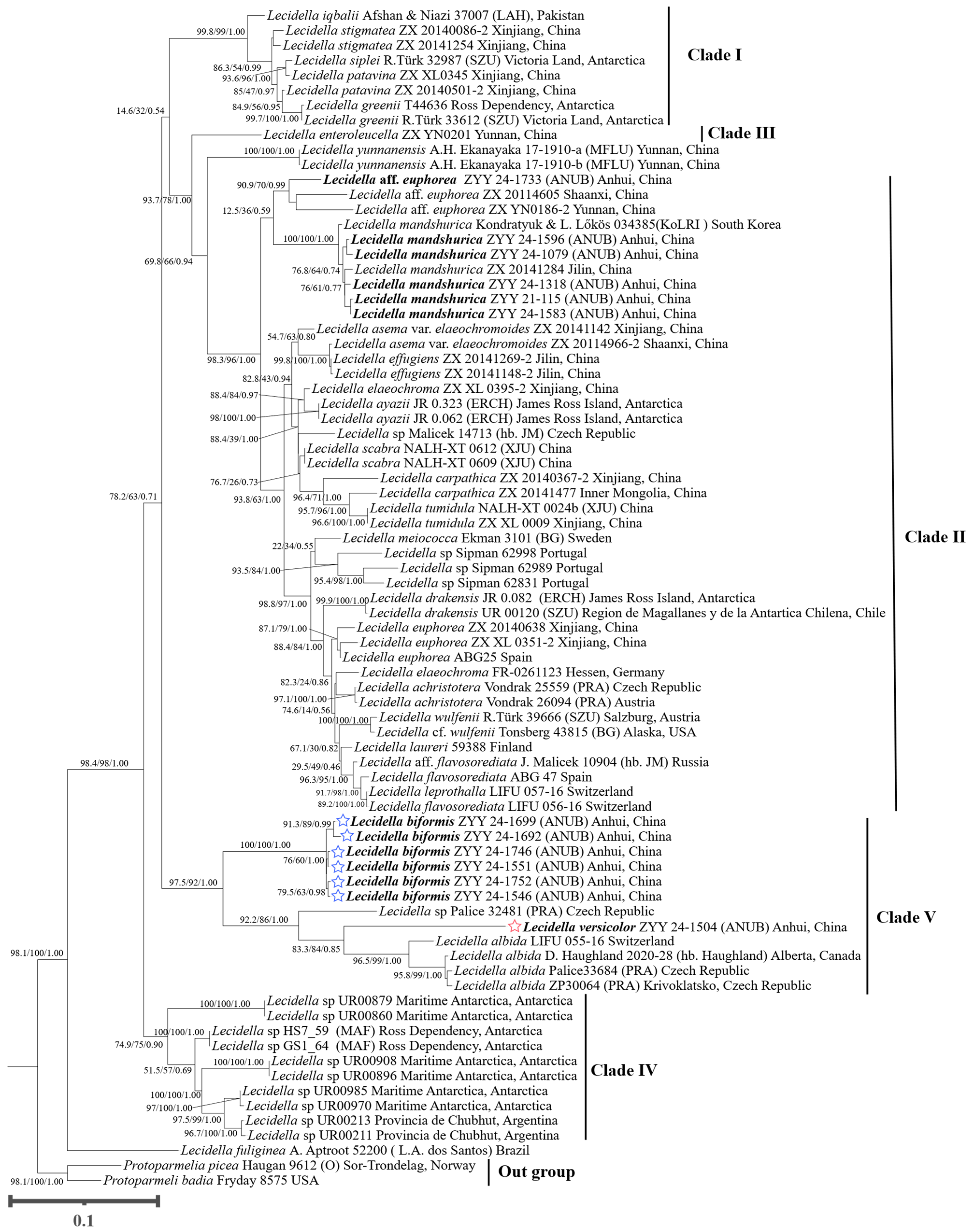
The concatenated nrITS-nrLSU alignment comprised 108 sequences, including 89 obtained from GenBank and 19 newly generated in this study (Table 1). This dataset encompasses the majority of available sequences of Lecidella species. Both methods produced congruent tree topologies; the ML tree is presented in the main text (Figure 1).
The two-locus phylogenetic tree shows that species of the genus Lecidella fall into five main clades and two distinct species lineages, although the relationships between these clades are weakly supported (Figure 1). Clades I–IV are consistent with those from previous studies [8,45], and we identify an additional new lineage, Clade V (97.5/92/1.00), here. Species of Clade I are characterized by a hyaline hypothecium and the absence of xanthones. Clade II consists of several subclades and species lineages, with most species having a yellowish-brown, reddish-brown, or brown hypothecium and containing xanthones. Clade III comprises a single species, L. enteroleucella (Nyl.) Hertel, which is distinguished by a colorless hypothecium and produces the chlorinated xanthones, thuringione and arthothelin [8]. Clade IV mainly includes specimens from southern South America (sSA) and continental Antarctica; however, no detailed morphological or chemical characteristics have been provided for these undescribed species [16,45].
Species in Clade V, which is newly proposed here, are characterized by small apothecia (less than 0.5 mm in diameter), a hyaline, yellowish-brown, or nut-brown hypothecium, and the presence of atranorin. Both new species belong to this clade. Lecidella biformis (100/100/1.00) represents the basal lineage of Clade V, and is distinguished by its dimorphic apothecia, yellowish-brown or nut-brown hypothecium, as well as the presence of atranorin and methyl 2′-O-methylmicrophyllinate. Lecidella versicolor forms a single-sample lineage that is sister to L. albida and clusters with an unidentified sample from the Czech Republic. However, L. albida differs in having a sorediate thallus, a bluish-grey to blackish-brown epithecium, and the presence of atranorin, capistratone, and thiophanic acid [48]. In our phylogenetic analysis, another species with small apothecia, L. yunnanensis Ekanayaka & K.D. Hyde, is sister to Clade II and is clearly distinct from other known Lecidella species. It is characterized by its black, shiny apothecia; blackish-brown hypothecium; and 1-septate ascospores, which are hyaline when immature and greenish-brown at maturity [13].
Six additional Lecidella species also possess small apothecia (less than 0.5 mm in diameter), but their sequences are not yet available: L. aptrootii Knoph & Garnitz, L. commutata Knoph & Leuckert, L. nashiana Knoph & Leuckert, L. oceanica Lu L. Zhang & Xin Y. Wang, L. subviridis Tønsberg, and L. varangrica Haugan & Tønsberg [49,50,51,52,53]. Among these, L. aptrootii, L. oceanica, L. subviridis, and L. varangrica share the same combination of characters—a hyaline or yellowish-brown hypothecium and the presence of atranorin [49,51,52,53]—as the species of Clade V; therefore, we hypothesize that they will also belong to this clade. The hypothecium of L. commutata and L. nashiana is also hyaline or weakly yellowish-brown, but these species lack atranorin [49,50], suggesting that they may represent a lineage distinct from Clade V. The phylogenetic placement of these species requires clarification in future studies. Nevertheless, our new species can be readily distinguished from aforementioned species by thallus and apothecial characters, as well as by differences in secondary chemistry (Table 2).
Table 2. Comparison of diagnostic characters among Lecidella species possessing small apothecia (less than 0.5 mm in diameter).
SpeciesExternal MorphologyEpitheciumHypotheciumChemistrySubstrateReference
Lecidella albida HafellnerThallus thin, sometimes sorediate; apothecia 0.2–0.5 mm; disc nut-brown to black.Bluish-grey to blackish-brownHyaline to yellowish-brownAtranorin, capistratone, thiophanic, arthothelin (±trace)On bark[48]
L. aptrootii Knoph & GarnitzThallus coherent to rimose; apothecia up to 0.2–0.25 (–0.33) mm, disc black.Pale green to blackish-brownHyalineAtranorin, aotearone, capistratoneOn branches and twigs[49]
L. biformis Y. S. Feng & Y. Y. ZhangThallus thin, continuous to rimose to nearly granulose; apothecia 0.05–0.25 mm; disc dimorphic.Blackish-brown or nut-brownYellowish-brown or nut-brownAtranorin, methyl 2′-O-methylmicrophyllinateOn barkThis paper
L. commutata Knoph & LeuckertThallus coherent to areolate; apothecia 0.2–0.4 (–0.5) mm; disc black.Hyaline to pale yellowish olive-greyHyalineTwo chemotypes: (a) containing vicanicin, vicanicinmonomethylether(trace); (b) vivanicin, 2,5,7-trichloro-3-O-methylnor lichexanthone (trace)On bark[49]
L. nashiana Knoph & LeuckertThallus continuous to rimose to nearly granulose; apothecia 0.2–0.4 mm; disc black.Green, blackish-green, bluish-green, blackish-brownWeakly yellowish-brown2,7-dichloro-6-O-methylnorlichexanthone, 2′-O-methylperlatolic acidOn bark[50]
L. oceanica Lu L. Zhang & Xin Y. WangThallus rimose to areolate; apothecia up to 0.3 (–0.4) mm; disc brownish-black to black.Olive, olive-brown to brownHyalineAtranorin(±), capistratone, isoarthothelin and thiophanic acid.On large siliceous boulders[51]
L. subviridis TønsbergThallus areolate to continuous, sorediate, sometimes leprose; apothecia 0.1–0.4 (–0.5) mm; disc black.BrownHyalineAtranorin, thiophanic acid, arthothelin, expallens unknownOn trunk, branches and twigs[52]
L. varangrica Haugan & TønsbergThallus episubstratal, areolate; apothecia 0.2–0.5 mm; disc black.Bluish-grey to blackish-brownBrown to yellowish-brownAotearone, capistratone, thiophanic acid, isoarthothelin, and atranorin (trace)On rock[53]
L. versicolor Y. S. Feng & Y. Y. ZhangThallus thin, continuous to rimose; apothecia 0.1–0.25 mm; disc yellow to reddish-brown when young, nut-brown at maturity.Orange-brownHyaline to yellowish-brownAtranorinOn barkThis paper
L. yunnanensis Ekanayaka & K.D. HydeThallus continuous to nearly granulose; apothecia 0.3–0.5 mm; disc black.Blackish-brownBlackish-brownNot providedOn bark[13]

3.1. Taxonomy

Lecidella biformis Y. S. Feng & Y. Y. Zhang, sp. nov.
Fungal name: FN573735
Etymology. The epithet refers to its dimorphic apothecia.
Type. CHINA • Anhui Prov, Lu’an City, Jinzhai County, Madiedang Village, 31°32′00″ N, 115°26′31″ E, 381 m alt., on Liquidambar formosana bark, 4 November 2024, Yanyun Zhang, Yujiao Yin and Yishan Feng 24-1752 (ANUB2412)—holotype.
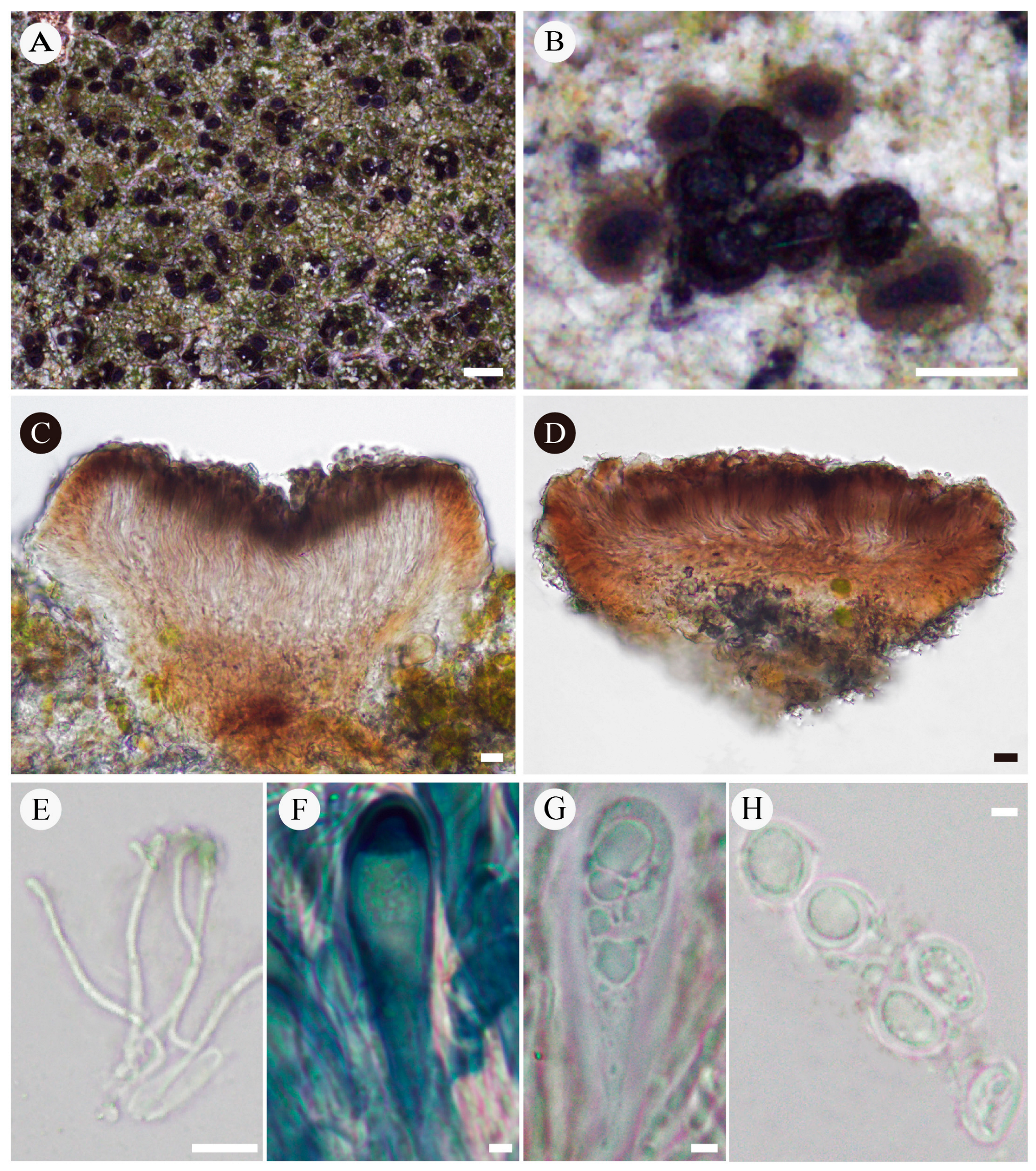
Diagnosis. The species is characterized by its small, dimorphic apothecia—even within a single specimen—with either a brown disc and paler margin or a purely brown disc and margin, a blackish-brown or nut-brown epithecium, a yellowish-brown or nut-brown hypothecium, and the presence of atranorin and methyl 2′-O-methylmicrophyllinate.
Description. Thallus crustose, thin, continuous to rimose to nearly granulose; upper surface pale green or patina-green; prothallus absent; apothecia lecideine, dispersed to aggregated, orbicular, adnate, 0.05–0.25 mm in diameter, disc plane, margin persistent, entire, dimorphic even in a single specimen: disc brown with paler margin or disc and margin purely brown. Exciple orange-brown or nut-brown, 15–32.5 (−37.5) µm thick, crystals present (pol+, K-sol, N-insol) or absent; parathecium indistinct; epithecium blackish-brown or nut-brown, (2.5–) 5.0–10.0 µm thick, crystals present (pol+, K-sol, N-insol) or not; epihymenium pale brown to nut-brown, sometimes suffused with pigment of epithecium in the upper part, 12.5–25 µm high; hymenium pale brown to nut-brown, 22.5–45.0 (−50.0) µm high; hypothecium yellowish-brown or nut-brown, 7.5–15.0 (−17.5) µm high; paraphyses simple to branched, not anastomosing, 1.5–2 µm thick; asci Lecidella-type, clavate, usually immature, 25.0–50.0 × 5.0–15.0 µm, 8-spored; ascospores simple, hyaline, ellipsoid to widely ellipsoid, [3.5]–(5.8)–7.5–(9.2)–[11.0] × [2.5]–(3.5)–5.0–(6.5)–[7.0] µm (n = 50). Pycnidia unknown.
Chemistry. Thallus K+ yellow, C-, KC+ yellow. Both thallus and apothecia contain atranorin and methyl 2′-O-methylmicrophyllinate.
Distribution. The new species has been found on the Liquidambar formosana bark or dead wood at altitudes between 362 and 807 m in Anhui Province, China.
Notes. The new species shares small apothecia and pigmented hypothecium with Lecidella nashiana, L. varangrica, and L. yunnanensis. However, L. nashiana is distinguished by its black disc; its green, blackish-green, or bluish-green epithecium; and the production of 2,7-dichloro-6-O-methylnorlichexanthone and 2′-O-methylperlatolic acids [50]. Lecidella varangrica differs by its sorediate thallus, black disc, and saxicolous habitat [53], while L. yunnanensis is distinguished by its black, shiny apothecia and its 1-septate ascospores, which are hyaline when immature and greenish-brown at maturity [13].
Additional specimens examined: CHINA • Anhui Prov, Lu’an City, Jinzhai County, Baojiawo Forest farm, Longjing River, 31°13′27″ N, 115°51′26″ E, 629 m alt., on Liquidambar formosana bark, 3 November 2024, Yanyun Zhang, Yujiao Yin and Yishan Feng 24-1699 (ANUB2359); Dahuanglishuling, 31°10′10″ N, 115°50′42″ E, 798–807 m alt., on Liquidambar formosana bark, 7 August 2024, Yanyun Zhang and Xiaoying Wu 24-1546 (ANUB1932), 24-1551 (ANUB1937); Dahuanglishuling, 31°10′09″ N, 115°50′37″ E, 795 m alt., on dead wood, 2 November 2024, Yanyun Zhang, Yujiao Yin and Yishan Feng 24-1692 (ANUB2352); Madiedang Village, 31°32′00″ N, 115°26′31″ E, 362 m alt., on Liquidambar formosana bark, 4 November 2024, Yanyun Zhang, Yujiao Yin and Yishan Feng 24-1746 (ANUB2406).
Lecidella versicolor Y. S. Feng & Y. Y. Zhang, sp. nov.
Fungal name: FN573734
Etymology. The specific epithet refers to the variable color of the apothecial disc, even within the same specimen.
Type. CHINA • Anhui Prov, Lu’an City, Jinzhai County, Xiaonanpeng, 31°16′02″ N, 115°38′52″ E, 496 m alt., on Liquidambar formosana bark, 6 August 2024, Yanyun Zhang and Xiaoying Wu 24-1504 (ANUB1890)—holotype.
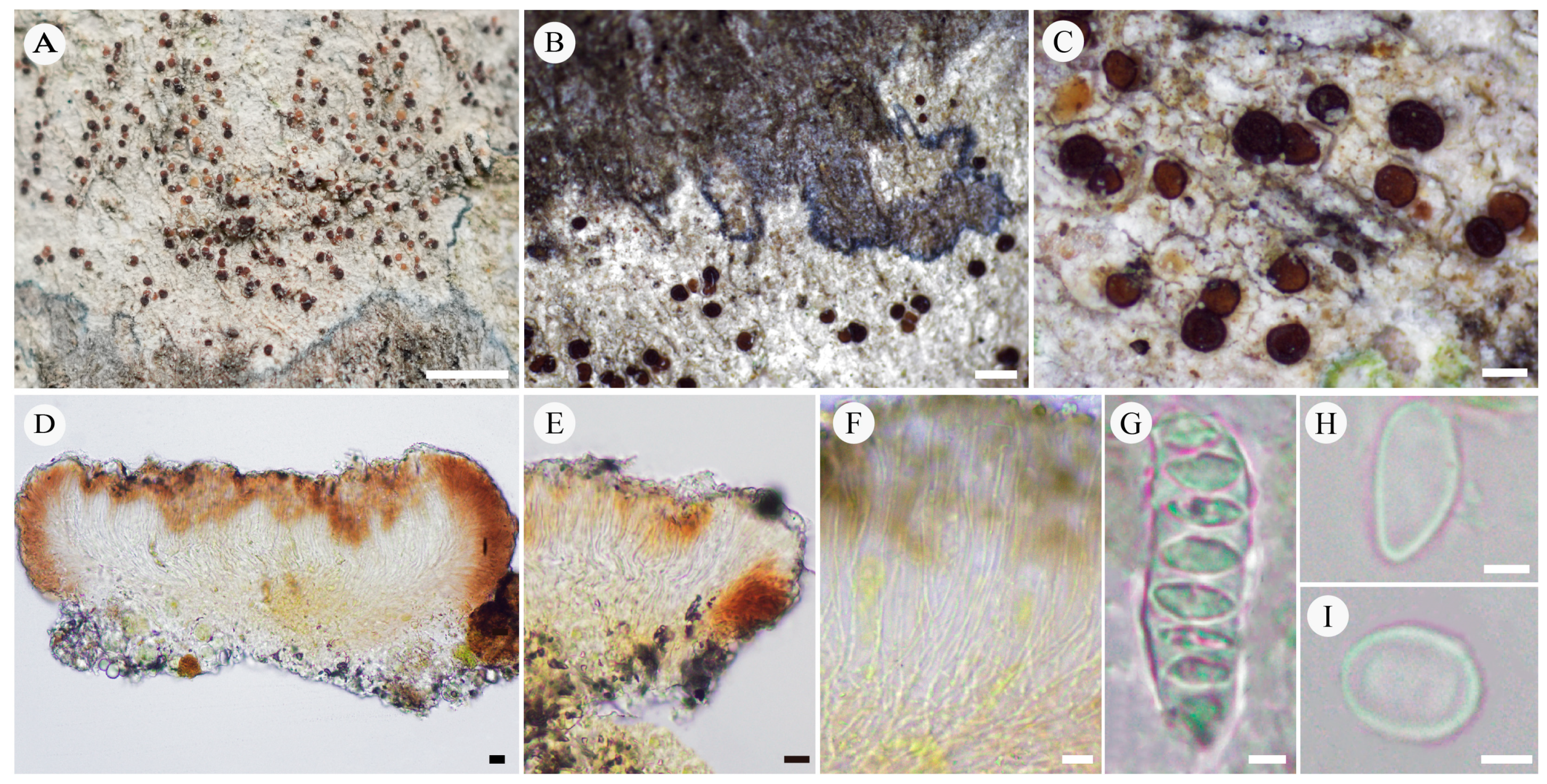
Diagnosis. The new species is distinguished from other Lecidella species by its small apothecia, an orange-brown epithecium, a hyaline to yellowish-brown hypothecium, anastomosing paraphyses, and the presence of atranorin as the sole compound.
Description. Thallus crustose, thin, continuous to rimose; upper surface pale green, becoming white-gray in the herbarium; prothallus present, black-blue; apothecia lecideine, dispersed to in groups of 2–3, orbicular, adnate, 0.1–0.25 mm in diameter; disc plane, yellow to reddish-brown with indistinct to thin and same level margin when young, nut-brown with thick, entire and protruding margin at maturity. Exciple orange-brown, 12.5–25 µm thick, crystals present (pol+, K-sol, N-insol) or absent; parathecium indistinct; epithecium orange-brown, 5.0–12.5 µm thick, crystals present (pol+, K-sol, N-insol); epihymenium hyaline to weakly yellowish-brown, sometimes suffused with pigment of epithecium in the upper part, 12.5–25 µm high; hymenium hyaline to weakly yellowish-brown, 30.0–50.0 µm high; hypothecium hyaline to yellowish-brown, 10.0–25.0 (−30.0) µm high; paraphyses simple to rarely branched, anastomosing, ca. 1 µm thick; asci Lecidella-type, clavate, usually immature, 17.5–55.0 × 3.8–15.0 µm, 8-spored; ascospores simple, hyaline, broadly ellipsoid or ovoid, [7.0]–(8.1)–9.3–(10.5)–[12.0] × [3.0]–(4.6)–5.3–(6.0)–[6.5] µm (n = 34). Pycnidia unknown.
Chemistry. Thallus K+ yellow, C-, KC-. Both thallus and apothecia contain atranorin.
Distribution. This species occurs on the Liquidambar formosana bark and is known from Anhui Province, in the south-eastern part of the Dabie Mountains at 496 m altitude.
Notes. Lecidella albida is closely related to the new species and shares the characters of small apothecia (0.2–0.5 mm in diameter) and a hyaline to yellowish-brown hypothecium. However, L. albida differs in having a sorediate thallus, nut-brown to black apothecia, a bluish-grey to blackish-brown epithecium and containing capistratone and thiophanic acid as accessory compound alongside atranorin [48].
Lecidella aptrootii, L. commutata, L. oceanica and L. subviridis also have small apothecia and a hyaline hypothecium, but their apothecia are black, while L. aptrootii has a green or blackish-brown epithecium and contains the secondary metabolites atranorin, aotearone and capistratone [49]. Lecidella commutata is characterized by an areolate thallus, a colorless to pale yellowish olive-grey epithecium, and the presence of vicanicin [49]. Lecidella oceanica has a rimose or areolate thallus, an olive, olive-brown to brown epithecium, and is sometimes saxicolous [51]. Lecidella subviridis has a sorediate thallus, a brown epithecium, and contains thiophanic acid and expallens unknowns, as accessory compounds alongside atranorin [52].
Lecidella destituta Kantvilas & Elix and Lecidella iqbalii Fayyaz, Afshan, Niazi & Khalid often contain only atranorin; however, L. destituta differs by possessing a typically areolate, deeply cracked thallus, apothecia 0.2–0.9 mm in diameter and a pale yellow-brown to yellow-orange hypothecium [10]. L. iqbalii can be distinguished by its areolate thallus, its black apothecia 0.1–1.2 mm in diameter and its blackish-brown epithecium [39].

3.2. Key to the Species of Lecidella in China

1 On bryophytes                                                           Lecidella wulfenii
- On bark, wood, or rocks                                                               2
2 Apothecial discs black with shiny appearance; ascospores hyaline when immature, greenish-brown, 1-septate at maturity             L. yunnanensis
- Apothecia discs matt; ascospores hyaline, simple                                                    3
3 Apothecia discs plane, margin persistent, entire, dimorphic even in a single specimen: disc brown with paler margin or disc and margin purely brown L. biformis
- Apothecia not dimorphic                                                             4
4 Apothecial discs yellow to reddish-brown when young and nut-brown at maturity; both thallus and apothecia contain atranorin only        L. versicolor
- Apothecial discs brown, brownish-black to black, or black; containing other compounds                                   5
5 Hypothecium and parathecium hyaline or weakly yellowish-brown; on rocks                                       6
- Hypothecium and parathecium yellowish-brown, reddish-brown or brown; on bark or wood, or on rocks                             10
6 Zeorin absent                                                                    7
- Zeorin present                                                                   9
7 Apothecial discs pale gray to bluish-gray pruinose; thallus with usnic acid, ± psoromic acid, and terpenoids as accessory compounds together with atranorin
                                                                       L. bullata
- Apothecial discs epruinose; usnic acid and terpenoids absent                                               8
8 Apothecia discs flat, margin distinct; prothallus absent or black; containing capistratone, isoarthothelin and thiophanic acid as accessory compound alongside atranorin                                                                    L. oceanica
- Apothecial discs often become convex with an obliterated margin; prothallus gray or blackish-gray to black; thallus with arthothelin and thuringione as accessory compounds together with atranorin                                                      L. enteroleucella
9 Hymenium inspersed with oil droplets; epithecium bright green to bluish-green                                 L. patavina
- Hymenium lacks oil droplets; epithecium bluish-green, blackish-green to olivaceous or reddish-brown                        L. stigmatea
10 On bark or rotting wood                                                               11
- On rocks, occasionally on soil or wood                                                       14
11 Parathecium purple; apothecial margin black or shiny golden; thallus sometimes sorediate                            L. mandshurica
- Parathecium yellowish to reddish-brown; apothecial margin black; thallus esorediate                                   12
12 Hymenium inspersed with oil droplets; containing arthothelin, thiophanic acid, thuringione and granulosin                   L. elaeochroma
- Hymenium lacks oil droplets; arthothelin, thiophanic acid, thuringione and granulosin absent                               13
13 Lichexanthone present as a major compound, capistratone absent                                        L. tumidula
- Capistratone present as a major compound, lichexanthone absent                                        L. euphorea
14 Diploicin and thuringione present                                                    L. carpathica
- Diploicin absent                                                                 15
15 Capistratone present as a major compound, sometimes containing aotearone and isoarthothelin                         L. effugiens
- Capistratone absent                                                                16
16 Thiophanic acid present as a major compound; on rocks, soil, wood or bark                                    L. asema
- Arthothelin as a major compound; on rocks                                                 L. elaeochromoides

Author Contributions

Conceptualization: Y.-S.F. and Y.-Y.Z.; data curation: Y.-S.F. and Y.-Y.Z.; formal analysis: Y.-S.F.; funding acquisition: X.-Y.W. and Y.-Y.Z.; investigation: Y.-S.F. and Y.-Y.Z.; methodology: Y.-S.F. and Y.-Y.Z.; project administration: X.-Y.W. and Y.-Y.Z.; resources: Y.-S.F. and Y.-Y.Z.; software: Y.-S.F.; supervision: X.-Y.W. and Y.-Y.Z.; validation: Y.-S.F. and Y.-Y.Z.; visualization: Y.-S.F.; writing—original draft: Y.-S.F.; writing—review and editing: X.-Y.W. and Y.-Y.Z. All authors have read and agreed to the published version of the manuscript.

Funding

This study was funded by the National Natural Science Foundation of China (32400005, 32570250).

Institutional Review Board Statement

Not applicable.

Data Availability Statement

All of the data that support the findings of this study are available in the main text.

Acknowledgments

The authors thank the rangers of the Anhui Tianma National Nature Reserve for their invaluable assistance in collecting lichen samples.

Conflicts of Interest

The authors have declared that no competing interests exist.

References

  1. Körber, G.W. Systema Lichenum Germaniae (I-XXXIV). Die Flechten Deutschlands Mikroscopisch Geprüft, Kritisch Gesichtet, Charakteristisch Beschrieben und Systematisch Geordnet; Trewendt & Granier: Breslau, ON, Canada, 1855. [Google Scholar]
  2. Stein, B. Flechten; J.U. Kern’s Verlag (Max Müller): Breslau, Poland, 1879. [Google Scholar]
  3. Sydow, P. Die Flechten Deutschlands: Anleitung zur Kenntnis und Bestimmung der deutschen Flechten; Springer: Berlin/Heidelberg, Germany, 1887. [Google Scholar]
  4. Hertel, H. Revision einiger calciphiler Formenkreise der Flechtengattung Lecidea. Beih. Nova Hedwig. 1967, 24, 1–155. [Google Scholar]
  5. Leuckert, C.; Hertel, H. Über Flechtenstoffe und Systematik einiger Arten der Gattung Lecidea. Nova Hedwig. 1969, 14, 291–300. Available online: https://www.jstor.org/stable/3995457 (accessed on 19 June 2026).
  6. Hafellner, J. Durch Ascusstrukturanalysen zun einem besseren Verständnis der Systematik der Lecideaceae coll. (lichenisierte Ascomycetes). In Mitteilungsband Botaniker-Tagung Wien; University of Vienna Institute for Botany: Vienna, Austria, 1984; p. 116. [Google Scholar]
  7. Hafellner, J. Studien in Richtung einer natürlicheren Gliederung der Sammelfamilien Lecanoraceae und Lecideaceae. Beih. Nova Hedwig. 1984, 79, 241–371. [Google Scholar]
  8. Zhao, X.; Zhang, L.L.; Zhao, Z.T.; Wang, W.C.; Leavitt, S.D.; Lumbsch, H.T. A molecular phylogeny of the lichen genus Lecidella focusing on species from mainland China. Plosone 2015, 10, e0139405. [Google Scholar] [CrossRef] [PubMed]
  9. Zhao, X.; Leavitt, S.D.; Zhao, Z.T.; Zhang, L.L.; Arup, U.; Grube, M.; Pérez-Ortega, S.; Printzen, C.; Śliwa, L.; Kraichak, E.; et al. Towards a revised generic classification of lecanoroid lichens (Lecanoraceae, Ascomycota) based on molecular, morphological and chemical evidence. Fungal Divers. 2016, 78, 293–304. [Google Scholar] [CrossRef]
  10. Kantvilas, G.; Elix, J.A. The lichen genus Lecidella (Lecanoraceae) with special reference to the Tasmanian species. Muelleria Aust. J. Bot. 2013, 31, 31–47. [Google Scholar] [CrossRef]
  11. Ruprecht, U.; Avci, F.N.; Candan, M.; Halıcı, M.G. Two new species of the genus Lecidella (Lecanoraceae, Ascomycota) from maritime Antarctica, southern South America and North America. Lichenologist 2024, 56, 83–92. [Google Scholar] [CrossRef]
  12. Kirk, P.M.; Cannon, P.F.; Minter, D.W.; Stalpers, J.A. Ainsworth & Bisby’s Dictionary of the Fungi, 10th ed.; CAB International: Wallingford, UK, 2008. [Google Scholar]
  13. Hyde, K.D.; Tennakoon, D.S.; Jeewon, R.; Bhat, D.J.; Maharachchikumbura, S.S.N.; Rossi, W.; Leonardi, M.; Lee, H.B.; Mun, H.Y.; Houbraken, J.; et al. Fungal diversity notes 1036–1150: Taxonomic and phylogenetic contributions on genera and species of fungal taxa. Fungal Divers. 2019, 96, 123. [Google Scholar] [CrossRef]
  14. Wei, J.C. The Enumeration of Lichenized Fungi in China; China Forestry Publishing House: Beijing, China, 2020; pp. 210–212. [Google Scholar]
  15. Zulfiqar, R.; Habib, K.; Khan, M.; Khalid, A.N. A taxonomic and phylogenetic study of some Lecidella species from Pakistan. J. Plant Taxon. Geogr. 2020, 75, 219–230. [Google Scholar] [CrossRef]
  16. Götz, A.; Andreev, M.; Junker, R.R.; Maislinger, L.; Sancho, L.G.; Trutschnig, W.; Ruprecht, U. Future range shifts and diversity patterns of Antarctic Lecideoid Lichens under climate change scenarios. Glob. Change Biol. Commun. 2025, 1, e70000. [Google Scholar] [CrossRef]
  17. Wang, Y.L.; Wang, H.; Xu, R.S.; Abdulla, A. Analysis on lichen stufies history of anhui province. Resour. Environ. Yangtze Basin 2014, 23, 1072–1080. [Google Scholar] [CrossRef]
  18. Zhao, X. Study on Taxonomy and Systematics of the Lichen Genus Lecidella and Its Allies from China. Ph.D. Thesis, Shandong Normal University, Shandong, China, 2016. [Google Scholar]
  19. Li, L.J.; Zhang, Y.Y.; Printzen, C. Phylogeny, morphology and chemistry reveal two new multispored species in the Lecanora subfusca group (Lecanoraceae, Ascomycota). MycoKeys 2023, 99, 25–43. [Google Scholar] [CrossRef] [PubMed]
  20. Orange, A.; James, P.W.; White, F.J. Microchemical Methods for the Identification of Lichens; British Lichen Society: London, UK, 2001. [Google Scholar]
  21. Ferencová, Z.; Rico, V.J.; Hawksworth, D.L. Extraction of DNA from lichen-forming and lichenicolous fungi: A low-cost fast protocol using Chelex. Lichenologist 2017, 49, 521–525. [Google Scholar] [CrossRef]
  22. Gardes, M.; Bruns, T.D. ITS primers with enhanced specificity for basidiomy cetesapplication to the identification of mycorrhizae and rusts. Mol. Ecol. 1993, 2, 113–118. [Google Scholar] [CrossRef] [PubMed]
  23. Larena, I.; Salazar, O.; González, V.; Julián, M.C.; Rubio, V. Design of a primer for ribosomal DNA internal transcribed spacer with enhanced specificity for Ascomycetes. J. Biotechnol. 1999, 75, 187–194. [Google Scholar] [CrossRef] [PubMed]
  24. Vilgalys, R.; Hester, M. Rapid genetic identification and mapping of enzymatically amplified ribosomal DNA from several Cryptococcus species. J. Bacteriol. 1990, 172, 4238–4246. [Google Scholar] [CrossRef] [PubMed]
  25. Rehner, S.A.; Samuels, G.J. Taxonomy and phylogeny of Gliocladium analysed from nuclear large subunit ribosomal DNA sequences. Mycol. Res. 1994, 98, 625–634. [Google Scholar] [CrossRef]
  26. Xiang, C.Y.; Gao, F.; Jakovlić, I.; Lei, H.P.; Hu, Y.; Zhang, H.; Zou, H.; Wang, G.T.; Zhang, D. Using PhyloSuite for molecular phylogeny and tree-based analyses. iMeta 2023, 2, e87. [Google Scholar] [CrossRef] [PubMed]
  27. Kalyaanamoorthy, S.; Minh, B.Q.; Wong, T.K.; Haeseler, A.V.; Jermiin, L.S. ModelFinder: Fast model selection for accurate phylogenetic estimates. Nat. Methods 2017, 14, 587–589. [Google Scholar] [CrossRef] [PubMed]
  28. Vondrák, J.; Svoboda, S.; Kosnar, J.; Malicek, J.; Soun, J.; Frolov, I.; Svensson, M.; Novotny, P.; Palice, Z. Martin7: A reference database of DNA barcodes for European epiphytic lichens and its taxonomic implications. Preslia 2023, 95, 311–345. [Google Scholar] [CrossRef]
  29. Urbanavichus, G.; Vondrák, J.; Urbanavichene, I.; Palice, Z.; Malíček, J. Lichens and allied non-lichenized fungi of virgin forests in the Caucasus State Nature Biosphere Reserve Western Caucasus, Russia. Herzogia 2020, 33, 90–138. [Google Scholar] [CrossRef]
  30. Mark, K.; Cornejo, C.; Keller, C.; Flück, D.; Scheidegger, C. Barcoding lichen-forming fungi using 454 pyrosequencing is challenged by artifactual and biological sequence variation. Genome 2016, 59, 685–704. [Google Scholar] [CrossRef] [PubMed]
  31. Vondrák, J.; Svoboda, S.; Malíček, J.; Palice, Z.; Kocourková, J.; Knudsen, K.; Mayrhofer, H.; Thus, H.; Schultz, M.; Konsnar, J.; et al. From Cinderella to Princess: An exceptional hotspot of lichen diversity in a long-inhabited central-European landscape. Preslia 2022, 94, 143–181. [Google Scholar] [CrossRef]
  32. Haughland, D.L.; Hood, A.; Thauvette, D.; Toni, S.A.; Cao, M.; Birch, J.D.; Wasyliw, J.; Hjartarson, L.; Villeneuve, M.; Stordock, A.; et al. Getting to know our biomonitor neighbours: Urban lichens and allied fungi of Edmonton, Alberta, Canada. Opusc. Philolichenum 2022, 21, 33–181. [Google Scholar] [CrossRef]
  33. McCune, B.; Arup, U.; Breuss, O.; Di Meglio, E.; Di Meglio, J.; Esslinger, T.L.; Midilikowska, J.; Miller, A.E.; Rosentreter, R.; Schultz, M.; et al. Biodiversity and ecology of lichens of Kenai Fjords National Park, Alaska. Plant Fungal Syst. 2020, 65, 586–619. [Google Scholar] [CrossRef]
  34. Ivanovich, C.; Weber, L.; Palice, Z.; Hollinger, J.; Otte, V.; Sohrabi, M.; Sheehy, S.; Printzen, C. A taxonomic revision of the lichen genus Lecanoropsis (Lecanoraceae). Phytotaxa 2025, 695, 1–56. [Google Scholar] [CrossRef]
  35. de Gea, A.B.; Verdú, M.; Villar-dePablo, M.; Pérez-Ortega, S. The combined effects of habitat fragmentation and life history traits on specialisation in lichen symbioses. J. Ecol. 2024, 112, 200–216. [Google Scholar] [CrossRef]
  36. Aptroot, A.; de Souza, M.F.; dos Santos, L.A.; Junior, I.O.; Barbosa, B.M.C.; da Silva, M.E.C. New species of lichenized fungi from Brazil, with a record report of 492 species in a small area of the Amazon Forest. Bryologist 2022, 1253, 435–467. [Google Scholar] [CrossRef]
  37. Ruprecht, U.; Lumbsch, H.T.; Brunauer, G.; Green, T.A.; Türk, R. Insights into the diversity of Lecanoraceae (Lecanorales, Ascomycota) in continental Antarctica (Ross Sea region). Nova Hedwig. 2012, 94, 287. [Google Scholar] [CrossRef]
  38. Wagner, M.; Brunauer, G.; Bathke, A.C.; Cary, S.C.; Fuchs, R.; Sancho, L.G.; Turk, R.; Ruprecht, U. Macroclimatic conditions as main drivers for symbiotic association patterns in lecideoid lichens along the Transantarctic Mountains, Ross Sea region, Antarctica. Sci. Rep. 2021, 11, 23460. [Google Scholar] [CrossRef] [PubMed]
  39. Fayyaz, I.; Afshan, N.U.S.; Niazi, A.R.; Khalid, A.N.; Ruprecht, U. A new species of Lecidella (Lecanorales, Ascomycota) from Azad Jammu and Kashmir, Pakistan. Acta Bot. Bras. 2022, 36, e2021abb0324. [Google Scholar] [CrossRef]
  40. Myllys, L.K.; Launis, M.A. Additions to the diversity of lichens and lichenicolous fungi living on decaying wood in Finland. Graph. Scr. 2018, 30, 149–154. [Google Scholar]
  41. Kondratyuk, S.Y.; Lőkös, L.; Jang, S.H.; Hur, J.S.; Farkas, E. Phylogeny and taxonomy of Polyozosia, Sedelnikovaea and Verseghya of the Lecanoraceae (Lecanorales, lichen-forming Ascomycota). Acta Bot. Hung. 2019, 61, 137–184. [Google Scholar] [CrossRef]
  42. Ekman, S.; Tønsberg, T. Most species of Lepraria and Leproloma form a monophyletic group closely related to Stereocaulon. Mycol. Res. 2002, 106, 1262–1276. [Google Scholar] [CrossRef]
  43. Sipman, H.; Aptroot, A. Ikaeria serusiauxii, a new Caloplaca-like lichen from Macaronesia and mainland Portugal, with a lichen checklist for Porto Santo. Plant Fungal Syst. 2020, 65, 120–130. [Google Scholar] [CrossRef]
  44. Malíček, J. Lišejníky přírodní rezervace Ptačí stěna v Blanském lese. Bryonora 2022, 70, 1–14. [Google Scholar]
  45. Ruprecht, U.; Fernández-Mendoza, F.; Türk, R.; Fryday, A.M. High levels of endemism and local differentiation in the fungal and algal symbionts of saxicolous lecideoid lichens along a latitudinal gradient in southern South America. Lichenologist 2020, 52, 287–303. [Google Scholar] [CrossRef] [PubMed]
  46. Singh, G.; Dal Grande, F.; Divakar, P.K.; Otte, J.; Crespo, A.; Schmitt, I. Fungal–algal association patterns in lichen symbiosis linked to macroclimate. New Phytol. 2016, 214, 317–329. [Google Scholar] [CrossRef] [PubMed]
  47. Singh, G.; Divakar, P.K.; Dal Grande, F.; Otte, J.; Parnmen, S.; Wedin, M.; Crespo, A.; Lumbsch, H.T.; Schmitt, I. The sister-group relationships of the largest family of lichenized fungi, Parmeliaceae (Lecanorales, Ascomycota). Fungal Biol. 2013, 117, 715–721. [Google Scholar] [CrossRef] [PubMed]
  48. Dietrich, M. Die xanthonhaltigen, epiphytischen sorediösen Krustenflechten Lecidella albida und L. subviridis in der Schweiz. Meylania 2007, 39, 14–17. [Google Scholar]
  49. Knoph, J.G.; Garnitz, R.; Leuckert, C. Two new coriticolous species of the genus Lecidella (Lecanoraceae, lecanorales, lichenized, ascomycotina). Mycotaxon 1999, 71, 163–168. [Google Scholar] [CrossRef]
  50. Ryan, B.D. Lecidella. In Lichen Flora of the Greater Sonoran Desert Region 2; Nash, T.H., III, Ryan, B.D., Diederich, P., Gries, C., Bungartz, F., Eds.; Lichens Unlimited, Arizona State University: Tempe, AZ, USA, 2004; pp. 316–317. [Google Scholar]
  51. Zhang, L.L.; Wang, X.Y.; Wang, H.Y.; Wang, L.S.; Hur, J.S. A new species and new records of saxicolous species of the genus Lecidella (Lecanoraceae) from South Korea. Bryologist 2012, 115, 329–332. [Google Scholar] [CrossRef]
  52. Tønsberg, T. The sorediate and isidiate, corticolous, crustose lichens in Norway. Sommerfeltia 1992, 14, 1–331. [Google Scholar] [CrossRef]
  53. Haugan, R.; Tønsberg, T. Lecidella varangrica sp. nov. from the Varanger Peninsula, northernmost Norway. Graph. Scr. 2018, 30, 149–154. Available online: https://hdl.handle.net/1956/20240 (accessed on 15 June 2026).
Figure 1. Maximum likelihood (ML) phylogenetic tree based on the concatenated nrITS and nrLSU dataset. Support values (SH-aLRT ≥ 80%/ML bootstrap values ≥ 70%/Bayesian posterior probabilities ≥ 0.90) are displayed along the branches. Newly generated sequences are indicated in bold, and the two new taxa are marked with pentagrams.
Jof 12 00453 g001
Figure 2. Lecidella biformis ((A,C,E,F) are from ANUB 2352; (B,D) are from ANUB 2406; (G,H) are from ANUB 2412). (A) Lichen thallus, habit. (B) Apothecia in two morphological types. (C) Vertical sections of apothecia (disc brown with paler margin). (D) Vertical sections of apothecia (disc and margin purely brown). (E) Paraphyses. (F) Ascus (in I reagent). (G) Ascus and ascospores. (H) Ascospores. Scale bars: 0.5 mm (A); 0.2 mm (B); 20 µm (C,D); 5 µm (EH).
Jof 12 00453 g002
Figure 3. Lecidella versicolor (ANUB1890). (A) Lichen thallus, habit. (B). Prothallus. (C) Apothecia. (D) Vertical sections of apothecia (apothecia when mature). (E) Vertical sections of apothecia (apothecia when young). (F) Anastomosing paraphyses (in K reagent). (G) Eight-spored ascus. (H,I) Ascospores. Scale bars: 0. 5 mm (A,B); 0.2 mm (C); 20 µm (DF); 5 µm (GI).
Jof 12 00453 g003
Disclaimer/Publisher’s Note: The statements, opinions and data contained in all publications are solely those of the individual author(s) and contributor(s) and not of MDPI and/or the editor(s). MDPI and/or the editor(s) disclaim responsibility for any injury to people or property resulting from any ideas, methods, instructions or products referred to in the content.