
Article

Unlocking the Biocontrol Potential of Indigenous Soil Fungi: High-Performing Strains of Beauveria bassiana and Metarhizium robertsii Against the Tomato Leafminer Tuta absoluta

by
Noureddine Idali
1,*,
Abdelhi Dihazi
1,
Mohammed Lahcini
2,3,
Tariq Butt
4 and
Abdellatif El Meziane
1,3,*
1
Laboratory of Excellence in Agrobiotechnology and Bioengineering, AgroBioTech Center, CNRST-Labeled Research Unit (URL05-CNRST), Cadi Ayyad University, Marrakech 40000, Morocco
2
IMED-Lab, Cadi Ayyad University (UCA), Avenue Abdelkrim Elkhattabi, B.P. 549, Marrakech 40000, Morocco
3
High Throughput Multidisciplinary Research Laboratory (HTMR), Mohammed VI Polytechnic University (UM6P), Ben Guerir 43150, Morocco
4
Department of Biosciences, Swansea University, Singleton Park, Swansea SA2 PP, UK
*
Authors to whom correspondence should be addressed.
J. Fungi 2026, 12(6), 452; https://doi.org/10.3390/jof12060452 (registering DOI)
Submission received: 2 February 2026 / Revised: 4 March 2026 / Accepted: 16 March 2026 / Published: 21 June 2026
(This article belongs to the Section Fungi in Agriculture and Biotechnology)

Abstract

The invasive tomato leafminer, Tuta absoluta, poses a severe global threat to solanaceous crops, necessitating sustainable biocontrol solutions. Through systematic bioprospecting across several Moroccan soils, we constructed a novel library of indigenous fungal isolates using complementary Tenebrio molitor baiting and selective media methods. High-throughput phenotyping identified 49 highly pathogenic isolates, which were characterized for conidial production, thermotolerance, and virulence against T. absoluta. We discovered two lead isolates, Beauveria bassiana UCA-350 and Metarhizium robertsii UCA-329, that demonstrated superior virulence, reducing median survival time and achieving lower LC50 values than most commercial reference strains. Notably, virulence was positively correlated with in vitro conidial yield, revealing a key trait linkage for strain selection. Furthermore, genus-level divergence in thermotolerance was observed, with Beauveria isolates exhibiting significantly higher heat resilience. Our integrated multi-trait screening pipeline not only delivers two potent, regionally sourced biocontrol candidates but also establishes a phenotypic selection framework that prioritizes both efficacy and production scalability, advancing the rational development of next-generation mycoinsecticides.

1. Introduction

The global agriculture landscape faces a dual crisis: the urgent need to ensure food security for a growing population and the imperative to mitigate the profound environmental and societal costs of intensive pesticide use. The development of insecticide resistance in over 600 arthropod species, coupled with the destabilization of ecosystem services and risks to human health, has rendered the status quo of chemical-dependent pest management untenable [1,2]. This confluence of challenges has been the impetus for a paradigm shift toward Integrated Pest Management (IPM), wherein biological control agents form a critical pillar. Among these agents, entomopathogenic fungi (EPF), particularly hypocrealean ascomycetes EPF, have gained significant and sustained scientific interest due to their broad host range and self-dissemination mechanisms, offering a promising route to sustainable pest suppression [3,4,5].
Hypocrealean EPF, particularly the Beauveria, Metarhizium, Isaria, and Lecanicillium genera, are facultative pathogens that contribute to the natural regulation of arthropod populations across soil and phyllosphere habitats [6,7]. The infection process begins with the adhesion of hydrophobic conidia to the insect integument, followed by germination and the formation of appressoria [8]. Through a combination of immense turgor pressure and the secretion of a cocktail of cuticle-degrading enzymes, the fungus breaches the host’s physical barrier [8,9,10,11]. Once within the hemocoel, the fungus undergoes a dimorphic shift to yeast-like hyphal bodies (blastospores), proliferating while actively modulating and suppressing the host immune system. Host death results from a combination of nutrient depletion, tissue destruction, colonization, and the action of fungal toxins. Critically, under conditions of high humidity, the cadaver becomes a site of prolific external conidiation, releasing millions of new infectious propagules into the environment to initiate secondary infection cycles—a feature that underpins their potential for causing epizootics and ensuring environmental persistence [8,12,13,14].
Biocontrol strategies often relied on a handful of commercialized, generalist EPF strains deployed across diverse geographies [15]. However, a growing body of evidence reveals that this “one-size-fits-all” approach may be suboptimal. Fungal performance is intimately tied to environmental adaptation. Traits with thermotolerance and compatibility with local microbial communities are finely tuned by evolution. Consequently, the global trend has decisively shifted towards the prospection, characterization, and utilization of indigenous EPF strains, which are naturally selected for and pre-adapted to local climatic conditions and agroecosystems [16,17,18,19].
This local adaptation paradigm is consistently validated by comparative studies. For instance, indigenous B. bassiana strains from Puerto Rico matched the efficacy of the commercial B. bassiana GHA against the coffee berry borer in the laboratory, but more importantly, their pathogenicity and persistence exceeded in the field [20]. Similarly, locally isolated B. bassiana strains from spotted lanternfly populations in the eastern USA outperformed the commercial B. bassiana strain GHA against Lycorma delicatula adults and nymphs [21]. Furthermore, studies on whiteflies (Bemisia tabaci and Trialeurodes vaporariorum) and African cotton leafworm (Spodoptera littoralis) have repeatedly found native isolates with superior pathogenicity to common commercialized strains like B. bassiana ATCC 74040 [22,23]. This empirical justification makes the construction and rigorous evaluation of localized EPF libraries a critical first step in developing resilient, context-specific biocontrol solutions.
A compelling example of the urgent need for innovative pest management strategies is the tomato leafminer, Tuta absoluta (Meyrick) (Lepidoptera: Gelechiidae). Native to South America, this pest has become a global threat to tomato (Solanum lycopersicum) production, capable of causing yield losses of 80–100% in the absence of effective control [24,25]. Its invasion of the Mediterranean basin, reaching Morocco around 2008, has been particularly destructive, facilitated by favorable climatic conditions and the widespread practice of year-round tomato cultivation [26].
The biology of T. absoluta poses exceptional challenges to control. Its larval leaf-mining behavior provides substantial protection from contact insecticides. Its high fecundity and short generation time are further accelerated by elevated temperatures that often suppress the performance of many biocontrol agents (BCAs), and it has rapidly evolved resistance to multiple insecticide classes [27,28,29]. This convergence of concealment, rapid population growth, and resistance underscores the need for alternative control agents capable of reaching cryptic larvae, acting rapidly, and maintaining efficacy under harsh field conditions.
Accordingly, the evaluation of EPF for T. absoluta management cannot rely solely on laboratory virulence assays, which can be poor predictors of field performance. Instead, a holistic, multi-trait selection framework is required. First, high in vitro conidial yield and vigor are essential prerequisites for cost-effective mass production and for achieving sufficient propagule pressure to offset environmental losses and ensure infection [30,31]. Robust sporulation can accelerate host mortality, while prolific conidiation on insect cadavers—especially the production of abundant secondary inoculum—enhances epizootic potential and population-level suppression [32,33,34]. Second, thermotolerance is a critical determinant of persistence and efficacy in open-field tomato systems, where canopy temperatures might exceed 40 °C. Conidial viability, germination kinetics, and pathogenic activity are all highly susceptible to heat stress, making systematic screening for thermal resilience indispensable when targeting warm agroecosystems [31,35,36].
To address these challenges, we conducted a comprehensive study aimed at discovering and characterizing indigenous EPF from Moroccan soils, with particular emphasis on the endemic, arid-adapted Argania spinosa forest ecosystem. The study was structured around three sequential and interlinked objectives: (i) establish a diverse EPF collection using a dual-isolation strategy—combining Tenebrio molitor baiting with selective media cultivation—to mitigate the taxonomic and functional biases inherent in single-method approaches; (ii) morphologically characterize recovered isolates to enable accurate genus-level identification; and (iii) implement a multi-trait screening pipeline that evaluated not only pathogenicity against T. absoluta but also two critical enabling traits: conidial production capacity and thermotolerance. Through this integrated approach, we sought to move beyond the identification of merely virulent isolates and instead prioritize robust, high-performing, and locally adapted EPF candidates possessing the trait combinations necessary for successful development into effective mycoinsecticides against T. absoluta and other recalcitrant pests.

2. Materials and Methods

2.1. Soil Sampling

Soil samples were collected between October 2022 and March 2023 from different regions in Morocco, including cultivated lands and forest areas (Table S1). The samples were taken from the top 5–15 cm of the soil, where fungal spores are most abundant [37]. A total of 70 samples were collected, and each sample was stored in sterile plastic bags, labeled with precise location data, and stored at 4 °C until required.

2.2. Fungal Isolation

To isolate EPF from the collected soil samples, two complementary methods were used: The first one involved the Tenebrio molitor-baiting technique, in which the larvae of T. molitor (4th–5th instar) were used as bait to attract fungal pathogens. following the same protocol of Kim et al. (2018) [17].
In the second method, a selective medium was used to directly isolate fungal propagules from the soil, as shown in ref. [37] with changes. Briefly, thirty grams of soil from each sample was suspended in 250 mL of sterile 0.05% Triton-X solution, and the suspension was shaken for one hour. One ml of the resulting suspension was spread onto quartered Sabouraud Dextrose Agar medium (¼SDA) supplemented with cycloheximide (0.02%) and chloramphenicol (0.05%). Once the fungal colonies were observed, individual colonies were subcultured and purified and then transferred onto potato dextrose agar supplemented with yeast extract (PDAY) to facilitate the development of pure fungal cultures. The cultures of purified isolates were stored in either sterilized distilled water or mineral oil, following the protocol described by Ayala-Zermeño et al. [38].

Preliminary Pathogenicity Screening Using T. molitor

The pathogenic potential of the isolates was preliminarily assessed using Tenebrio molitor larvae. Each isolate was cultured on ¼SDA at 26 °C for 10 days. Ten healthy fourth-instar larvae were placed on each fungal culture, with three replicate plates per isolate [16,17]. Control larvae were placed on fungus-free ¼SDA plates. All plates were incubated in darkness at 26 °C for 10 days without supplementary diet, and the experiment was repeated three times. Mortality was recorded daily over 10 days. Dead insects were surface sterilized by sequential immersion in 70% ethanol for 30 s, followed by 1% (v/v) sodium hypochlorite for 30 s, then rinsed three times in sterile distilled water (1 min each). The cadavers were then transferred to petri dishes lined with moistened tissue paper to encourage external sporulation. Isolates causing larval mortality within 10 days were retained for further testing.

2.3. EPF Conidial Viability

The conidial viability was evaluated by determining the ability of conidia to germinate, following [39]. The conidial suspension was prepared and adjusted to 107 conidia/mL for each isolate. A 10 µL aliquot of each suspension was evenly spread onto ¼SDA plates and incubated for 16 h at 26 °C in the dark. The ability to germinate was examined using a light microscope, and the conidium was considered germinated when its germ tube reached the conidium’s diameter. At least 300 conidia were counted for each isolate, and the viability was expressed as the percentage of germinated conidia. Only isolates exhibiting more than 80% as conidial viability were kept for further experiments.

2.4. Conidia Production by EPF

Conidial production was quantified following Kim et al. [17] with minor modifications. Reference benchmark strains included Beauveria bassiana ATCC 74040, B. bassiana GHA (=ARSEF 6444), Metarhizium brunneum V275 (=Met52/BIPESCO 5), and M. brunneum ARSEF 4556. Isolates ATCC 74040, GHA and V275 are the active ingredients in Naturalis® (CBC Europe Srl, Grassobbio, Italy), BotaniGard® (Certis Biologicals, Columbia, MD, USA) and Lalguard M52 OD® (Lallemand Inc., Montreal, QC, Canada), respectively.
Conidia were harvested from actively growing cultures on ¼SDA, adjusted to 1 × 10⁷ conidia mL−1, and 10 µL aliquots were spread onto agar plates. Plates were incubated in darkness at 26 °C for 10 days. Conidia were recovered from the entire agar surface with sterile 0.05% Triton X-100, then vortexed at 3000 rpm for 5 min, and sonicated to disperse aggregates. Conidial concentration was determined by using a hemocytometer, and total conidia per plate were calculated. Experiments were performed in three biological replicates and repeated three times.

2.5. Thermotolerance

Thermotolerance was evaluated using conidial suspensions (1 × 10⁷ conidia mL−1) prepared in triplicate for each isolate, following Rangel et al. [40]. One-milliliter aliquots were placed in sterile microcentrifuge tubes and incubated at 45 °C for 2 h, while control suspensions were maintained under identical conditions without heat treatment. After incubation, 10 µL of each suspension was plated onto ¼SDA and incubated at 26 °C for 16 h. Germination was scored as a conidium with a germ tube length equal to or greater than the conidial diameter. Germination rate was determined by scoring at least 300 randomly selected conidia per sample, and isolates were classified as thermotolerant when relative germination was ≥60%.

2.6. Tuta absoluta Rearing

Tomato leaves and fruits infested with T. absoluta larvae and pupae were collected from fields in the Souss Massa Daraa region and reared in BugDorm cages in the greenhouse. Fresh tomato leaves were supplied weekly for oviposition and larval feeding. The infested plant material was subsequently transferred to 3–5-week-old potted tomato plants (cv. ‘Campbell 33’).

2.7. EPF Virulence Against Tuta absoluta

The pathogenicity of fungal isolates was assessed at 1 × 10⁸ conidia/mL against third–fourth instar T. absoluta larvae using a modified IRAC leaf-dip bioassay [41]. Tomato leaves were dipped in conidial suspension for 10 s, then the petioles were wrapped with sterile, moistened cotton and placed in Petri dishes. Ten larvae were added per dish, with three replicates per isolate (30 larvae total). Control leaves were treated with sterile 0.05% Triton X-100. All treatments were maintained under controlled conditions for 10 days (26 ± 2 °C, 60% RH, in total darkness), and larval mortality was recorded daily. Virulence was estimated using median survival time (MST), with lower values indicating higher pathogenicity. Isolates with log(HR) ≥ 2 relative to B. bassiana ATCC 74040 were selected for dose–response assays.

2.8. LC50 and LC90 Determination for the Most-Performing Isolates

To further characterize the most virulent isolates, the lethal concentration (LC50) values were determined using three conidial suspension concentrations: 1 × 10⁵, 1 × 10⁶, and 1 × 10⁷ conidia/mL. The same leaf-dip method was employed for each concentration, and the experiment was conducted in triplicate, with 10 larvae per replicate. The leaves treated with sterile Triton-X solution served as a control. Larval mortality was recorded daily over 10 days. Bioassays for each concentration were performed under the same controlled conditions described above.

2.9. Morphological and Molecular Identification of the EPF

The morphological identification of the most performing isolates was carried out over a period of 7 to 14 days by determining macroscopic characteristics of the fungal colonies and by optical microscope after staining with lactophenol cotton blue [42].
The molecular identification was conducted using a multi-locus approach targeting three genomic regions: the internal transcribed spacer (ITS), the elongation factor 1-alpha (EF1-α), and the nuclear block region (Idali et al. paper in preparation on the diversity of the Moroccan EPF).

2.10. Statistical Analysis

All analyses and graphics were performed in R version 4.5.1 [43], with a significance level of α = 0.05. Conidial counts per plate were log10-transformed and analyzed by one-way ANOVA, with Tukey’s HSD for pairwise comparisons and a Welch two-sample t-test to compare genera. Thermotolerance (germination after heat exposure vs. control) was assessed using Fisher’s exact tests with Benjamini–Hochberg FDR correction, and genus differences under heat treatment were evaluated with a quasibinomial generalized linear model. Pathogenicity and dose-response survival data were analyzed using Kaplan–Meier curves and log-rank tests, and Cox proportional hazards models were fitted to estimate hazard ratios and median survival times. LC50 and LC90 values for the selected isolates were obtained from two-parameter log-logistic models after Abbott correction for control mortality. Relationships between conidia production, thermotolerance, and virulence (log hazard ratio) were explored using Pearson correlations visualized with a principal component analysis (PCA) biplot based on standardized variables.

3. Results

3.1. Construction and Primary Screening of a Novel Entomopathogenic Fungal Library

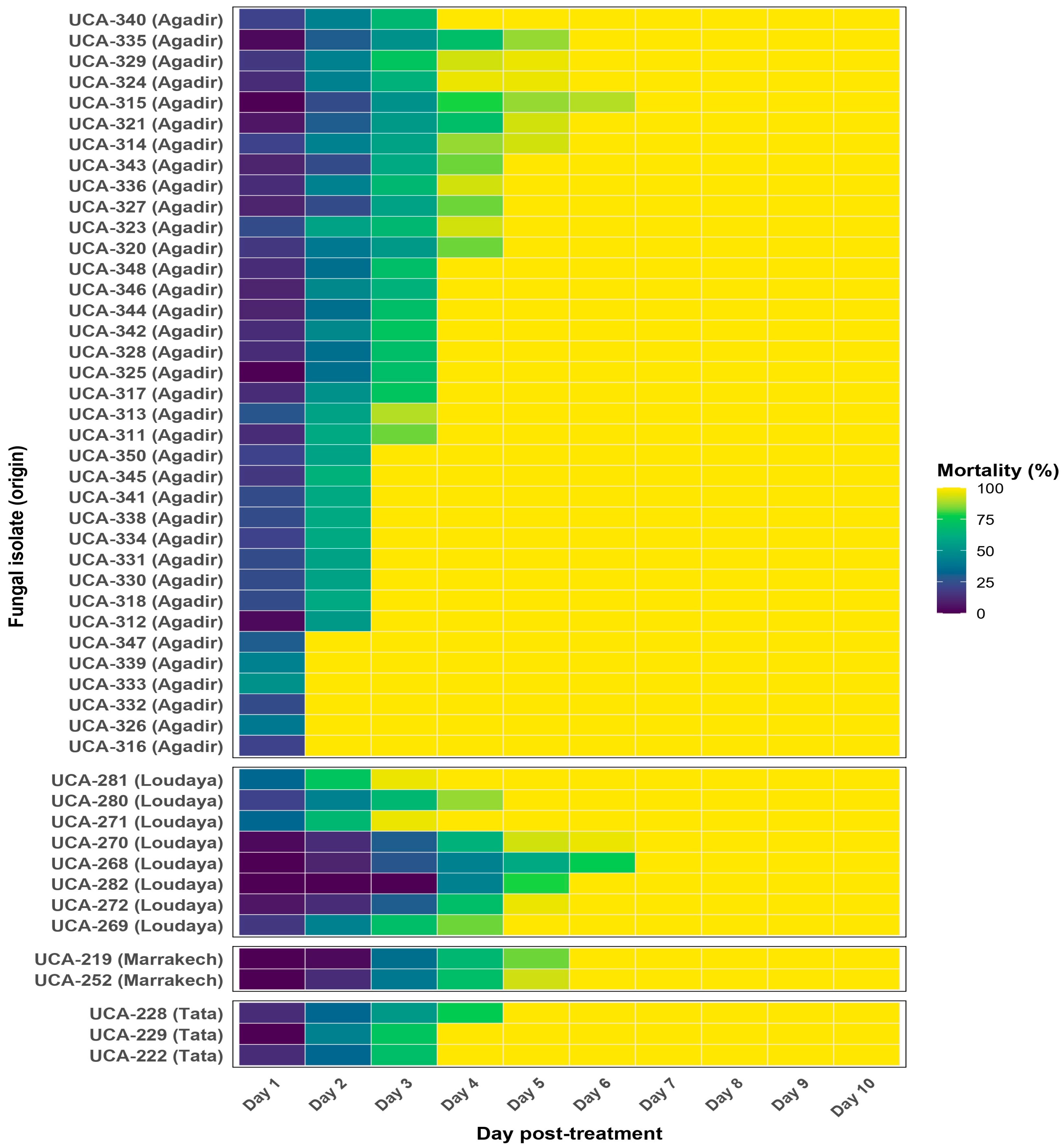
To establish a regionally sourced library of EPF, soil samples from four distinct Moroccan biotopes were subjected to two complementary isolation techniques: Tenebrio molitor baiting (TBM) and selective medium cultivation (SMC). This dual approach yielded a collection of 144 distinct fungal isolates, 88 with the selective medium (41 from Marrakech, 24 from Loudaya, 7 from Agadir and 16 from Tata) and 56 with the baiting method (8 from Marrakech, 14 from Loudaya and 34 from Agadir) (Figure S1, Table S1). The first pathogenicity screening of these 144 fungal isolates on T. molitor showed that a total of 49 isolates of the collection caused 100% larval mortality within 10 days (Figure 1, Table S2). Among these EPF isolates, 38 were isolated by TBM, and only 11 were isolated by SMC. This step reduced the initial collection to 49 most promising strains forming the core of our EPF library.

3.2. Morphological Identification of EPF Library

The morphological examination of the EPF isolates was carried out using macroscopic and microscopic observations and revealed two main genera: Beauveria and Metarhizium (Figure S2). Beauveria isolates typically formed white to cream, powdery colonies, whereas Metarhizium isolates formed greenish colonies that darkened with age. Microscopic features were also consistent with these genera.

3.3. Conidia Production Assay

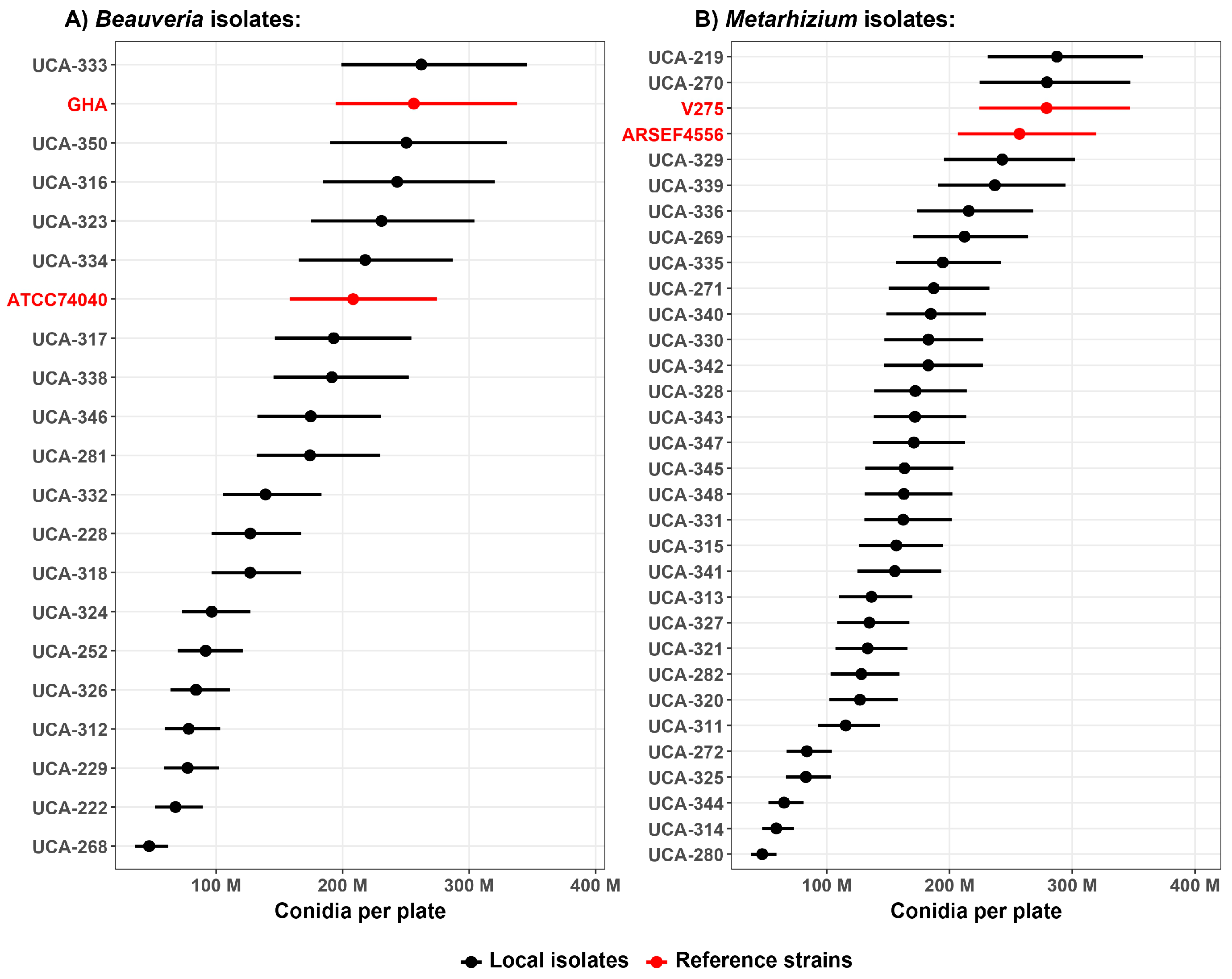
The conidial yield of the 49 isolates varied markedly after 10 days of incubation on SDA medium, and the Beauveria isolates produced between 26.22 × 10⁷ (UCA-333) and 4.72 × 10⁷ conidia (UCA-268), whereas the Metarhizium ones yielded 28.74 × 10⁷ (UCA-219) and 4.74 × 10⁷ (UCA-280) (Figure 2, Table S3). The highest conidial yields were obtained by nine Beauveria and six Metarhizium isolates. These yields are not significantly different from those obtained from the marketed strains B. bassiana GHA and ATCC 74040 and M. brunneum V275, and ARSEF 4556 (Table S4). These results showed that several isolates from our library performed equally to the reference strains.

3.4. Heat Tolerance Assay

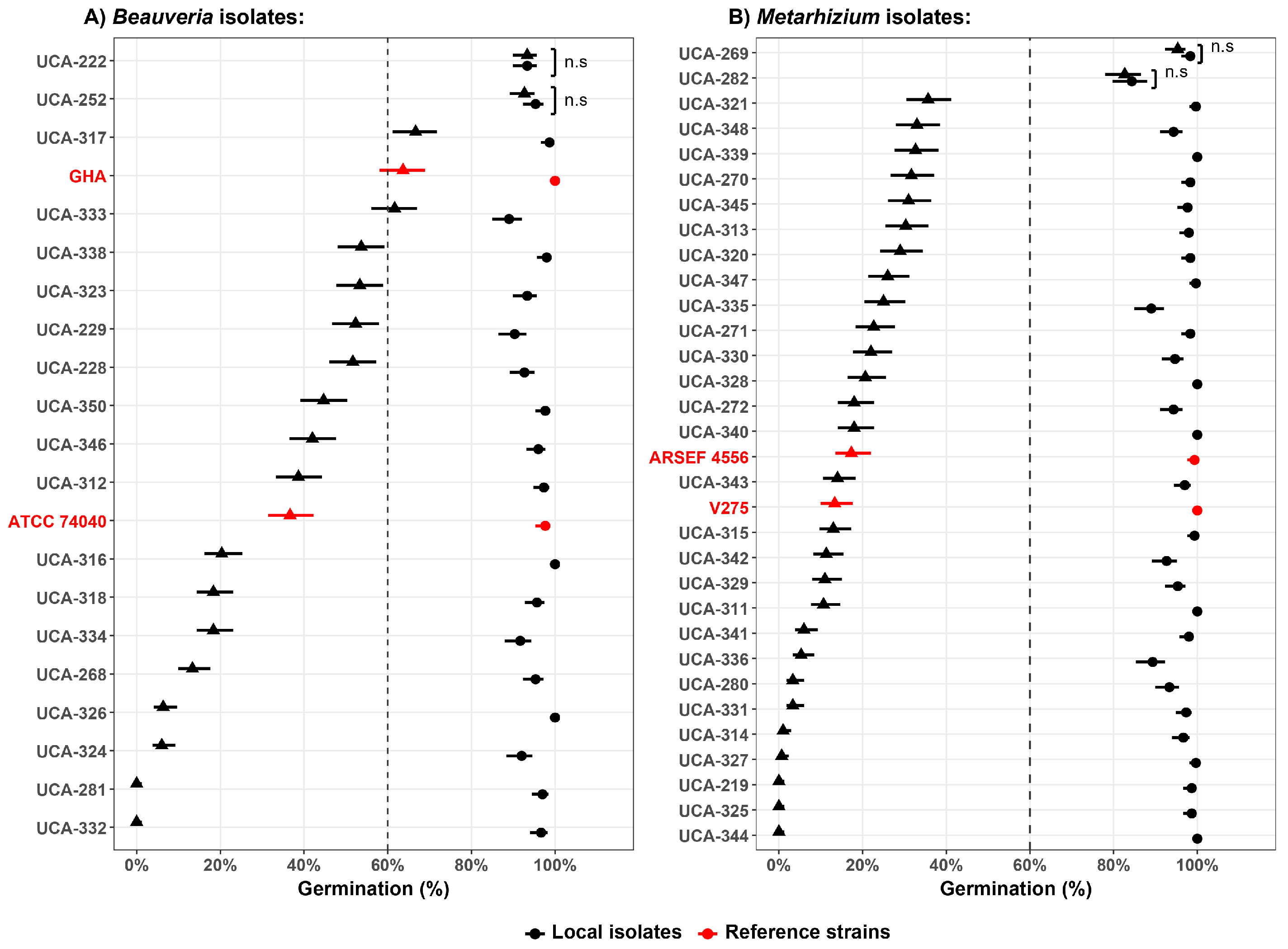
The thermal stress experiments showed that the germination rates of the Beauveria isolates UCA-222 and UCA-252, and the Metarhizium isolates UCA-269 and UCA-282, were not significantly different after exposure to 45 °C for 2 h (Table S5). These 4 isolates were highly tolerant to thermal stress. Furthermore, an additional eight Beauveria isolates maintained more than 50% of their initial germination rate and are considered moderate in their tolerance to thermal stress.
The heat exposure revealed a significant difference in germination between the Beauveria and Metarhizium genera from our entomopathogenic fungal library (Figure 3). Beauveria maintained an overall higher mean germination than Metarhizium under heat stress (38.6%, 95% CI 27.3–51.3% vs. 21.1%, 95% CI 14.1–30.4%; p = 0.019). In this study, the reference strain B. bassiana GHA maintained more than 50% of the germination rate (64%), whereas all the other reference strains were strongly affected by the heat treatment: V275 (13%) and ARSEF 4556 (17%).

3.5. Pathogenicity Trials Against T. absoluta

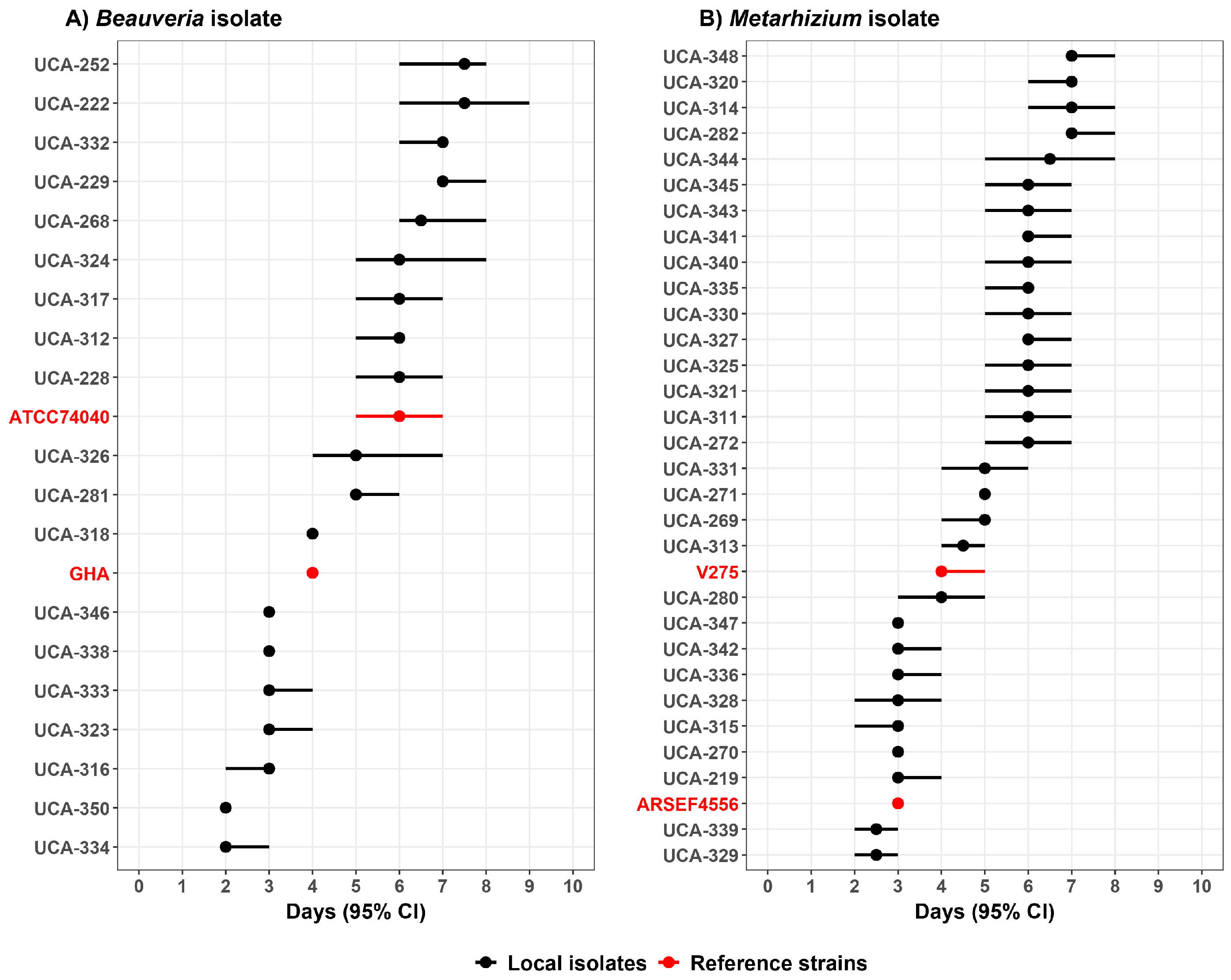
The results showed that the larval survival of T. absoluta varied strongly depending on the isolates (log-rank; p < 0.001), but not between the two genera (log-rank; p = 0.3). The median survival times (MSTs) ranged from 2 to 9 days across the collection (Figure 4), indicating that variation is primarily driven by isolates rather than genus. To identify the isolates exerting the strongest impact on T. absoluta larvae, we fitted a Cox proportional hazards model using B. bassiana ATCC 74040 (MST = 6 days) as the baseline and selected isolates with a log hazard ratio (log(HR)) ≥ 2 relative to this strain (Table S6). Within Beauveria, seven isolates met this criterion: UCA-350 (MST = 2 days), UCA-334 (MST = 2 days), UCA-316, UCA-346, UCA-338, UCA-323, and UCA-333 (all MST = 3 days). Within Metarhizium, nine isolates met the same criterion: UCA-329 (MST = 2.5 days), and UCA-339, UCA-315, UCA-328, UCA-336, UCA-342, UCA-347, UCA-219, and UCA-270 (all MST = 3 days). The four additional reference strains had MSTs between 3 and 4 days. For further screening of the best pathogenic isolates to T. absoluta, seven Beauveria isolates and nine Metarhizium isolates were further analyzed in dose-response assays.

3.6. Dose-Response and Survival Patterns for the Most Virulent Isolates

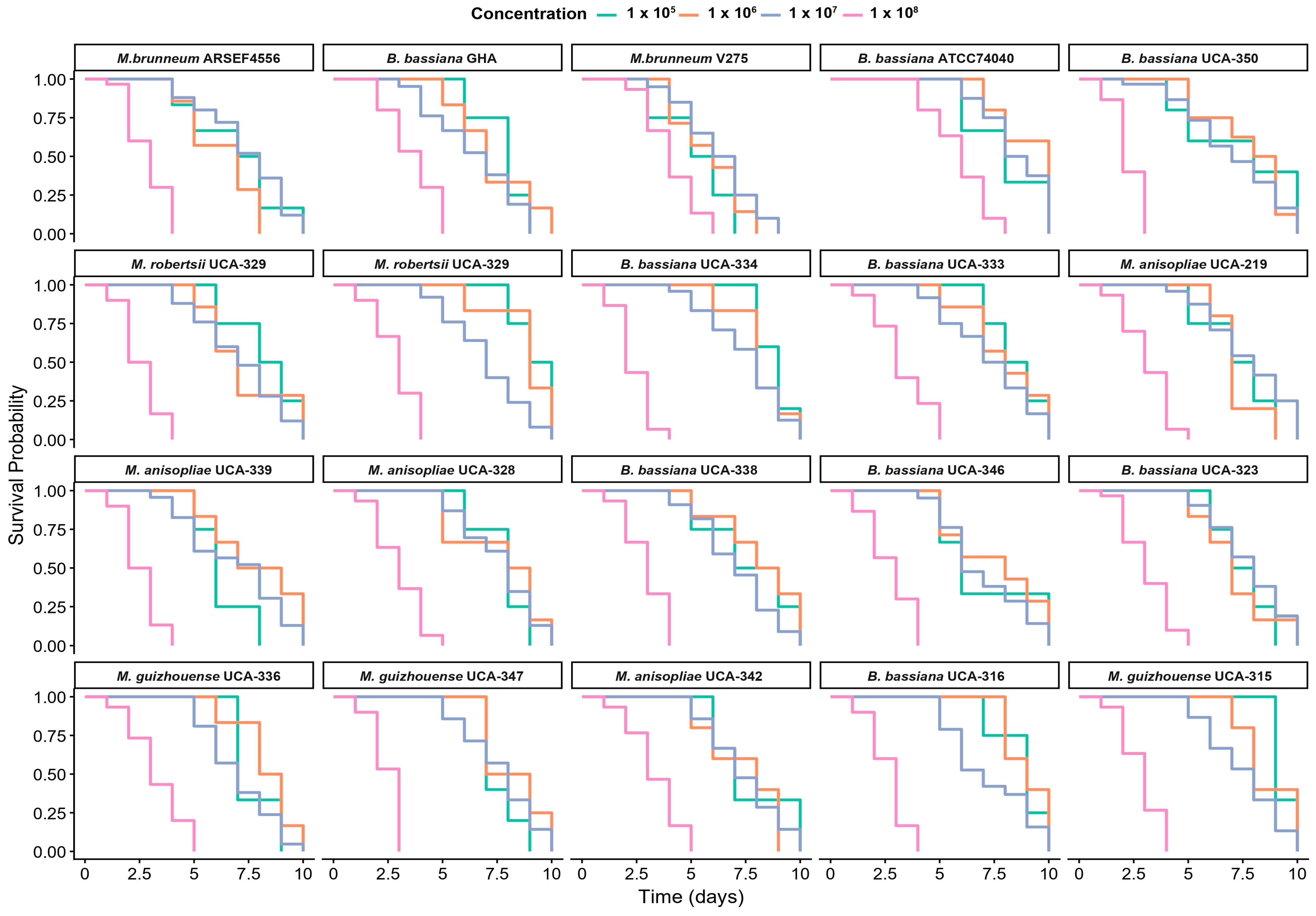
Across the best selected isolates, the concentrations for 50% (LC50) values ranged from 1.49 × 10⁶ to 7.54 × 10⁶ conidia/mL, whereas the LC50 for the reference strains spanned from 2.25 × 10⁶ conidia/mL for M. brunneum ARSEF 4556 to 1.42 × 10⁷ conidia/mL for B. bassiana ATCC 74040 (Table 1). The lowest LC50 were observed for B. bassiana UCA-350 (1.49 × 10⁶), M. robertsii UCA-329 (2.67 × 10⁶), and a cluster having an LC50 close to 2.91 × 10⁶ and presented by B. bassiana UCA-334, B. bassiana UCA-333, and M. anisopliae UCA-270. In contrast, isolates such as M. guizhouense UCA-315 and B. bassiana UCA-316 had the highest LC50 values with 7.54 × 10⁶ and 5.24 × 10⁶, respectively. Within the reference strains, M. brunneum ARSEF 4556 sat among the more potent isolates (2.25 × 10⁶), and B. bassiana GHA, M. brunneum V275 was intermediate (4.07 × 10⁶–4.43 × 10⁶), and B. bassiana ATCC 74040 had the highest LC50 value (14.2 × 10⁶). These patterns were largely mirrored by the LC90 values, B. bassiana UCA-350 and M. robertsii UCA-329 having the lowest LC90 values (7.73 × 10⁶ and 1.95 × 10⁷, respectively), and the highest LC90 registered by UCA-315 (7.18 × 10⁷), and B. bassiana UCA-316 (4.76 × 10⁷). Similarly, the reference strains ranked the same trend, with M. brunneum ASREF 4556 having the lowest LC90 (2.25 × 10⁷), followed by B. bassiana GHA (3.67 × 10⁷), M. brunneum V275 (4.29 × 10⁷), and with B. bassiana ATCC 74040 having the highest LC90 (1.13 × 10⁸). Taken together, the dose-response analysis identified B. bassiana UCA-350 and M. robertsii UCA-329 as the most potent isolates exceeding reference strains. Kaplan–Meier survival profiles across concentrations (Figure 5) mirrored this ordering, showing the fastest declines for these isolates in comparison to the reference strains.
These highly pathogenic isolates of T. absoluta were identified using the molecular multi-locus approach: ITS, nuclear block region, elongation factor EF1-a (Idali et al., paper in preparation). The isolates UCA-350 and UCA-329 were identified as B. bassiana and M. robertsii, respectively.

3.7. Inter-Trait Correlations Linking Conidia Production, Thermotolerance, and Virulence

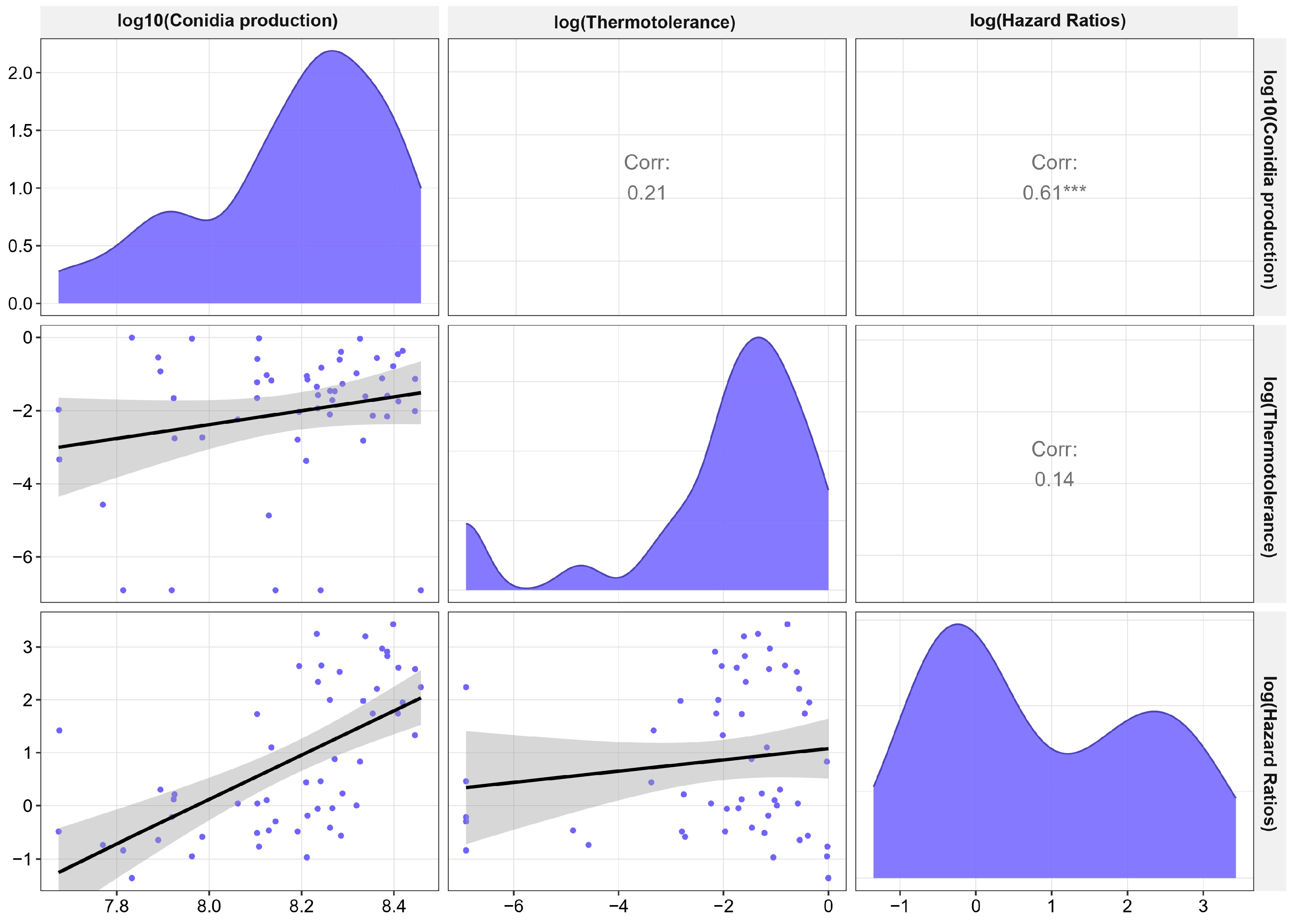
Pairwise Pearson correlations showed that virulence (log(HR)) was positively associated with conidia production (r = 0.61), while associations were weak between production and thermotolerance (r = 0.21) and between thermotolerance and virulence (r = 0.14) (Figure 6, Table S7). A PCA of standardized traits yielded PC1 (56.7%) aligned with production and virulence and PC2 (30.5%) driven mainly by thermotolerance, mirroring the correlations (Figure S4). Descriptively, the best performing strains cluster on negative PC1 (conidia production-virulence direction), the other isolates are more dispersed toward positive PC1, and reference strains lie near the biplot origin.

4. Discussion

In this study, we established an entomopathogenic fungal library with a dual use of T. molitor baiting and selective medium cultivation. Following a preliminary pathogenicity screen against T. molitor larvae, 49 isolates induced significant mortality within 10 days of incubation and were then classified as putative EPF (Figure 1, Table S2). The baiting method resulted in the screening of more isolates than the selective medium, confirming the efficiency of insect-bait methods in EPF library construction [17,44]. Our collection includes Beauveria and Metarhizium spp. predominantly (Figure S2), confirming earlier findings reporting that these genera frequently occur in both agricultural and forest soils [37,45].
The combination of these complementary isolation techniques is important for the development of a diverse EPF library, as each method can bias the recovery of particular fungal taxa [46]. A selective isolation medium can promote the culture of certain fungal strains that might be highly specific to an insect species, and not pathogenic to the Tenebrio- or Galleria-baiting method alone. Masoudi et al. [47] observed that, when focusing on Metarhizium isolates, some variations in entomopathogenic potential have been missed using T. molitor solely. Therefore, a dual strategy, combining both a selective medium and an insect-bait approach, is recommended to ensure the collection of a broader range of EPF, maximizing the likelihood of obtaining isolates with strong biocontrol potential.
Geographic origin can influence the pool of recoverable EPF, and we noted that several highly virulent isolates were recovered from Argania spinosa forest soils, which have been reported as reservoirs of microbial biocontrol agents [37,48,49]. More generally, differences in recovered EPF profiles across sites can reflect both environmental context and methodological factors, including bait-insect choice [5,45]. In particular, insect-bait methods may preferentially recover EPF strains adapted to the selected host, which could contribute to differences in the relative abundance of Beauveria vs. Metarhizium observed among collections [50]. Moreover, this is the first time that M. robertsii and M. guizhouense were reported in Moroccan habitats (Figure S3), underscoring a hidden diversity that needs more investigation by screening and targeting more Moroccan forests and national parks coupled to next generation techniques (e.g., HTS and metagenomics) [51].
Given the urgent need for effective biocontrol agents against T. absoluta [24], we evaluated the pathogenicity and virulence of indigenous EPF isolates using a standardized leaf-based bioassay. Virulence varied widely across the collection, and several indigenous isolates performed comparably to, or better than, the reference strains (Figure 4; Table 1). Thus, to enable robust comparison across isolates, we ranked treatments using hazard ratios from Cox proportional hazards models relative to the reference strain B. bassiana ATCC 74040 and prioritized the top-performing candidates for dose–response testing (Table S6). Dose–response bioassays confirmed that the two lead isolates (B. bassiana UCA-350 and M. robertsii UCA-329) consistently ranked among the most potent candidates, with LC estimates comparable to, or exceeding, those of the benchmark reference strains (Table 1; Figure 5). Notably, performance differences among commercial reference strains also emphasize that virulence is strain-specific and should be validated under standardized conditions rather than inferred from species identity or commercial status.
Multiple research laboratories have been interested in the biocontrol of T. absoluta using entomopathogenic fungi [52,53,54]. Although extensive data are available on these newly identified strains, the parameters of these strains cannot be compared due to the lack of standardized methods. Most of these bioassays have used different methods (Spraying or dipping) and larval stages (L1 to L4) and have not included any reference or known EPF strain. Ndereyimana et al. [54] observed cumulative mortalities of 82%, 61%, and 47% by day 6 for M. anisopliae FCM Ar 23B3, B. bassiana J25, and B. bassiana GHA, respectively. In our study, the same cumulative mortality (50%) of T. absoluta was obtained at day 4 for GHA, whereas our best-performing strains, B. bassiana UCA-350 and M. robertsii UCA-329, showed higher values, with 100% and 90% cumulative mortality at day 4, respectively.
Notably, studies examining local EPF isolates have reported even lower LC50 values. Avery et al. [55] and Aynalem [56] found LC50 values ranging from 1.2 × 10³ to 7 × 10⁴ conidia/mL for M. anisopliae and B. bassiana isolates against Ethiopian populations of T. absoluta. While these values appeared to be lower than those reported in our study, they cannot be compared to the values in this study, due to different experimental conditions. Indeed, their bioassays used L2-L3 larvae and spraying with 3 mL of conidial suspension, whereas in this study, the L3-L4 larvae were exposed to leaflets that were dipped in conidial suspensions for 10 s.
Zheng et al. [57] evaluated the pathogenicity of three Metarhizium species, one Beauveria species, and one Cordyceps species against second instar T. absoluta larvae, reporting cumulative mortalities of 100% for M. anisopliae, 92.16% for both M. flavoviride and Cordyceps fumosorosea, and 92.62% for B. bassiana by day 7 using a 108 conidia/mL concentration. These results are consistent with our findings, where 100% mortality was observed by day 6 for 16 tested isolates of our collection.
Other studies have explored the pathogenicity of local B. bassiana isolates from Brazil and Argentina against T. absoluta. Allegrucci et al. [58] and Silva et al. [59] reported median survival times ranging from 6 to 8 days when B. bassiana isolates were applied at a concentration of 1 × 10⁸ conidia/mL on leaflets infested with T. absoluta larvae. These MSTs are similar to those observed for most of our isolates. Notably, our most virulent isolates, UCA-350 and UCA-329, achieved better MSTs (2 to 3 days), underscoring genuine differences among isolates while also reflecting known variation arising from assay conditions, host populations, and strain identity.
Although virulence is a critical criterion for selecting effective entomopathogenic fungal strains, conidial production is equally important for successful field application and large-scale manufacturing [3,60]. In our study, the conidia production varied substantially among isolates (Figure 2; Tables S3 and S4), and the two lead candidates ranked among the higher-producing profiles. Notably, we observed a positive association between in vitro conidial yield and virulence (Table S7; Figure 6 and Figure S4), suggesting that production potential can align with pathogenic performance under standardized conditions. Together, these results place our two lead candidates among the higher-producing profiles, which supports the concept that strains capable of producing substantial quantities of viable conidia may possess a competitive advantage in both in vitro assays and pest infection dynamics [61]. Biologically, this association may reflect a broader propagule vigor axis, where isolates that sporulate abundantly also generate conidia with higher physiological quality (e.g., viability, energy reserves, and faster germination kinetics), which can translate into earlier host penetration and accelerated disease progression [8]. Importantly, production and virulence are often co-shaped by the same upstream factors. For instance, nutrient environment can influence growth, sporulation, germination speed, and virulence in EPF, indicating that the direction and strength of production–virulence relationships can be strain- and condition-dependent [62,63]. Nonetheless, plate-based yields should be further validated under mass production conditions using solid-state fermentation systems, as conidia production at the laboratory scale does not always translate directly to bioreactor performance [3].
Thermotolerance is also an important determinant of EPF field performance, as fungal conidia are frequently exposed to elevated daytime temperatures in agricultural environments [36,61,64]. In our study, four isolates (UCA-269, UCA-282, UCA-222 and UCA-252) showed no statistically significant reduction in germination after a 2 h exposure to 45 °C compared with their non-heated controls (Figure 3, Table S5), indicating a high level of heat tolerance. Fernandes et al. [65] evaluated the thermotolerance of 60 Beauveria isolates under the same temperature-time regime, found that many retained >60% germination, including the commercial strain B. bassiana GHA. Consistent with their results, we also identified B. bassiana UCA-317, B. bassiana UCA-333 and the reference strain B. bassiana GHA as thermotolerant, with post-stress germination exceeding this 60% threshold. It is noteworthy that heat stress may delay rather than completely prevent germination, as shown for Metarhizium spp. by Rangel et al. [40], suggesting that some isolates classified as thermosensitive under short incubation periods could partially recover over longer time frames. Importantly, the relationship between thermotolerance and virulence is expected to be context dependent. Thermotolerant conidia may survive longer on leaf surfaces and retain infectivity under hot microclimates, potentially improving infection opportunity under field conditions [66]. However, in the present study, virulence was quantified under a single bioassay temperature (26 ± 2 °C). Therefore, future work should test virulence across a range of temperatures and humidity regimes (including heat-stress scenarios) to determine whether thermotolerance predicts pathogenic performance under realistic field fluctuations [67,68].
Taken together, these findings underscore the need for a multidimensional approach in selecting entomopathogenic fungi. While virulence remains the primary filter for effective pest control, conidial productivity is equally crucial for ensuring sufficient inoculum and scalability, and thermotolerance further underpins performance under hot field conditions. Future work should explore the genetic and physiological determinants that enable certain isolates to perform well across these key traits, and assess whether formulation strategies such as biopolymer-based encapsulation of EPF [69] or alternative delivery approaches, including endophytic establishment [70], can improve the field-relevant performance of otherwise stress-sensitive strains. Moreover, greenhouse and field trials are underway to validate these laboratory results under real-world conditions.

5. Concluding Remarks and Trajectory for Future

Our integrated assessment reveals that the indigenous Moroccan isolates Beauveria bassiana UCA-350 and Metarhizium robertsii UCA-329 exhibit a compelling critical attribute: high virulence towards Tuta absoluta, vigorous conidial production, and moderate thermotolerance. This outcome underscores the profound value of targeted bioprospecting in under-explored ecologically distinct niches, such as the Argania forest, and validates a dual-isolation approach as a powerful strategy for capturing functional EPF diversity.
Translating these promising in vitro results into a reliable agricultural technology necessitates a coordinated research pathway. The immediate and paramount step is the empirical validation of efficacy through progressive greenhouse and open-field trials, confirming performance under real environmental and cropping conditions. Concurrently, this effort must be partnered with advanced formulation science to develop protective systems that enhance shelf-life and field resistance.
This holistic selection paradigm directly facilitates the development of effective, locally adapted mycoinsecticides, offering a sustainable and sophisticated tool for the integrated management of Tuta absoluta and other pervasive agricultural pests.

Supplementary Materials

The following supporting information can be downloaded at https://www.mdpi.com/article/10.3390/jof12060452/s1, Figure S1: The entomopathogenic fungal isolates recovered from Moroccan soils before and after the preliminary pathogenicity screening on T. molitor. The colors indicate the method used to select the EPF (blue for the selective medium cultivation method; yellow for T. molitor baiting method); Figure S2: Macroscopic (A–D) and microscopic (a–d) morphological features of representative Beauveria and Metarhizium isolates. Metarhizium isolates form greenish colonies (A,B) with cylindrical-ellipsoidal conidia in chains produced on flask-shaped phialides (a,b). Beauveria colonies exhibit white to cream, powdery growth (C,D) with globose conidia produced sympodially on a zig-zag denticulate rachis, which extend from a globose-flask-shaped phialide (c,d); Figure S3: EF1-α (TEF1) phylogenetic tree of Moroccan Metarhizium isolates (primers EF1-983F/EF1-2218R), multiple sequence alignment performed with Clustal Omega v1.2.4; Figure S4: PCA visualization of conidia production, thermotolerance, and virulence (logHR) for local and reference EPF isolates; 95% ellipses denote performing strains vs. other isolates; Table S1: Overview of sampling locations (GPS coordinates, sampling date, and dominant crops) and recovery of entomopathogenic fungal isolates via selective medium and T. molitor baiting before and after preliminary screening across four regions in Morocco; Table S2: Preliminary pathogenicity screening results showing daily mortality (%) of T. molitor larvae over 10 days for each fungal isolate (only isolates achieving 100% mortality by Day 10 are presented) with metadata; Table S3: Estimated marginal means of conidia production by isolate (conidia per plate) with 95% confidence intervals and Tukey HSD compact-letter display (CLD), from one-way ANOVAs stratified by genus. Reference isolates are marked with an asterisk (*). Values and CIs are back-transformed from log10 models; Table S4: Tukey-adjusted pairwise comparisons for conidia production (log10(conidia per plate)) by isolate within each genus. Entries report the difference in estimated marginal means, standard error, degrees of freedom, t ratio, and Tukey-adjusted p-value; Table S5: Per-isolate germination in control vs. heat treatment with Wilson 95% CIs, and Benjamini–Hochberg (BH) adjusted Fisher’s exact p-values; Table S6: Cox proportional hazards analysis of T. absoluta larval survival (10-day assay) at 1 × 10⁸ conidia/mL for local isolates and reference strains. Hazard ratios (HR) with 95% CIs and p-values are reported for each isolate relative to B. bassiana ATCC 74040 (baseline, HR = 1); larval death was the event, and survivors at day 10 were right-censored. Reference strains are marked with an asterisk (*). Isolates with log(HR) ≥ 2 were preselected for dose–response testing, alongside the five reference strains (cells shaded with darker gray); Table S7: Pearson correlation matrix for log10 conidia production, log thermotolerance, and virulence (log Hazard Ratios): Pearson’s r, 95% CI (Fisher z), two-sided p-value.

Author Contributions

Conceptualization, N.I. and A.E.M.; methodology, N.I., A.D. and A.E.M.; software, N.I.; validation, A.D., T.B. and A.E.M.; formal analysis, N.I. and A.E.M.; investigation, N.I. and A.E.M.; resources, A.E.M.; data curation, N.I. and A.E.M.; writing—original draft preparation, N.I. and A.D.; writing—review and editing, N.I., A.D., T.B. and A.E.M.; visualization, N.I.; supervision, A.D. and A.E.M.; project administration, M.L. and A.E.M.; funding acquisition, M.L. and A.E.M. All authors have read and agreed to the published version of the manuscript.

Funding

The authors would like to thank the Moroccan Ministry of Higher Education, Scientific Research and Innovation, the OCP Foundation, the UM6P, and the CNRST, who supported this work through the APRD research program.

Institutional Review Board Statement

Not applicable.

Informed Consent Statement

Not applicable.

Data Availability Statement

The original contributions presented in this study are included in the article/Supplementary Materials. Further inquiries can be directed to the corresponding authors.

Conflicts of Interest

The authors declare no conflicts of interest.

References

  1. Payumo, J.; Bello-Bravo, J.; Chennuru, V.; Mercene, S.A.; Yim, C.; Duynslager, L.; Kanamarlapudi, B.; Posos-Parra, O.; Payumo, S.; Mota-Sanchez, D. An Assessment Model for Agricultural Databases: The Arthropod Pesticide Resistance Database as a Case Study. Insects 2024, 15, 747. [Google Scholar] [CrossRef]
  2. Sparks, T.C.; Crossthwaite, A.J.; Nauen, R.; Banba, S.; Cordova, D.; Earley, F.; Ebbinghaus-Kintscher, U.; Fujioka, S.; Hirao, A.; Karmon, D.; et al. Insecticides, Biologics and Nematicides: Updates to IRAC’s Mode of Action Classification—A Tool for Resistance Management. Pestic. Biochem. Physiol. 2020, 167, 104587. [Google Scholar] [CrossRef]
  3. Lacey, L.A.; Grzywacz, D.; Shapiro-Ilan, D.I.; Frutos, R.; Brownbridge, M.; Goettel, M.S. Insect Pathogens as Biological Control Agents: Back to the Future. J. Invertebr. Pathol. 2015, 132, 1–41. [Google Scholar] [CrossRef]
  4. Mascarin, G.M.; Lopes, R.B.; Delalibera, Í.; Fernandes, É.K.K.; Luz, C.; Faria, M. Current Status and Perspectives of Fungal Entomopathogens Used for Microbial Control of Arthropod Pests in Brazil. J. Invertebr. Pathol. 2019, 165, 46–53. [Google Scholar] [CrossRef]
  5. Meyling, N.V.; Eilenberg, J. Occurrence and Distribution of Soil Borne Entomopathogenic Fungi within a Single Organic Agroecosystem. Agric. Ecosyst. Environ. 2006, 113, 336–341. [Google Scholar] [CrossRef]
  6. Scheepmaker, J.W.A.; Butt, T.M. Natural and Released Inoculum Levels of Entomopathogenic Fungal Biocontrol Agents in Soil in Relation to Risk Assessment and in Accordance with EU Regulations. Biocontrol Sci. Technol. 2010, 20, 503–552. [Google Scholar] [CrossRef]
  7. Zimmermann, G. The Entomopathogenic Fungi Isaria farinosa (Formerly Paecilomyces farinosus) and the Isaria fumosorosea Species Complex (Formerly Paecilomyces fumosoroseus): Biology, Ecology and Use in Biological Control. Biocontrol Sci. Technol. 2008, 18, 865–901. [Google Scholar] [CrossRef]
  8. Butt, T.M.; Coates, C.J.; Dubovskiy, I.M.; Ratcliffe, N.A. Entomopathogenic Fungi: New Insights into Host-Pathogen Interactions. In Advances in Genetics, 1st ed.; Lovett, B., St. Leger, R., Eds.; Elsevier: Cambridge, MA, USA, 2016; Volume 94, pp. 307–364. [Google Scholar] [CrossRef]
  9. Ma, M.; Luo, J.; Li, C.; Eleftherianos, I.; Zhang, W.; Xu, L. A Life-and-Death Struggle: Interaction of Insects with Entomopathogenic Fungi across Various Infection Stages. Front. Immunol. 2024, 14, 1329843. [Google Scholar] [CrossRef]
  10. Ortiz-Urquiza, A.; Keyhani, N. Action on the Surface: Entomopathogenic Fungi versus the Insect Cuticle. Insects 2013, 4, 357–374. [Google Scholar] [CrossRef]
  11. Pedrini, N. Molecular Interactions between Entomopathogenic Fungi (Hypocreales) and Their Insect Host: Perspectives from Stressful Cuticle and Hemolymph Battlefields and the Potential of Dual RNA Sequencing for Future Studies. Fungal Biol. 2018, 122, 538–545. [Google Scholar] [CrossRef]
  12. Dubovskiy, I.M.; Butt, T. Entomopathogenic Fungi in Biological Plant Protection: The Machinery of Multicomponent System Interactions. J. Fungi 2023, 9, 825. [Google Scholar] [CrossRef]
  13. Hong, S.; Shang, J.; Sun, Y.; Tang, G.; Wang, C. Fungal Infection of Insects: Molecular Insights and Prospects. Trends Microbiol. 2024, 32, 302–316. [Google Scholar] [CrossRef]
  14. Wu, S.; Toews, M.D.; Oliveira-Hofman, C.; Behle, R.W.; Simmons, A.M.; Shapiro-Ilan, D.I. Environmental Tolerance of Entomopathogenic Fungi: A New Strain of Cordyceps Javanica Isolated from a Whitefly Epizootic Versus Commercial Fungal Strains. Insects 2020, 11, 711. [Google Scholar] [CrossRef]
  15. Faria, M.R.D.; Wraight, S.P. Mycoinsecticides and Mycoacaricides: A Comprehensive List with Worldwide Coverage and International Classification of Formulation Types. Biol. Control 2007, 43, 237–256. [Google Scholar] [CrossRef]
  16. Chang, J.-C.; Wu, S.-S.; Liu, Y.-C.; Yang, Y.-H.; Tsai, Y.-F.; Li, Y.-H.; Tseng, C.-T.; Tang, L.-C.; Nai, Y.-S. Construction and Selection of an Entomopathogenic Fungal Library from Soil Samples for Controlling Spodoptera Litura. Front. Sustain. Food Syst. 2021, 5, 596316. [Google Scholar] [CrossRef]
  17. Kim, J.C.; Lee, M.R.; Kim, S.; Lee, S.J.; Park, S.E.; Nai, Y.-S.; Lee, G.S.; Shin, T.Y.; Kim, J.S. Tenebrio Molitor-Mediated Entomopathogenic Fungal Library Construction for Pest Management. J. Asia-Pac. Entomol. 2018, 21, 196–204. [Google Scholar] [CrossRef]
  18. Li, Z.; Alves, S.B.; Roberts, D.W.; Fan, M.; Delalibera, I.; Tang, J.; Lopes, R.B.; Faria, M.; Rangel, D.E.N. Biological Control of Insects in Brazil and China: History, Current Programs and Reasons for Their Successes Using Entomopathogenic Fungi. Biocontrol Sci. Technol. 2010, 20, 117–136. [Google Scholar] [CrossRef]
  19. Quesada-Moraga, E.; González-Mas, N.; Yousef-Yousef, M.; Garrido-Jurado, I.; Fernández-Bravo, M. Key Role of Environmental Competence in Successful Use of Entomopathogenic Fungi in Microbial Pest Control. J. Pest Sci. 2024, 97, 1–15. [Google Scholar] [CrossRef]
  20. Bayman, P.; Mariño, Y.A.; García-Rodríguez, N.M.; Oduardo-Sierra, O.F.; Rehner, S.A. Local Isolates of Beauveria Bassiana for Control of the Coffee Berry Borer Hypothenemus Hampei in Puerto Rico: Virulence, Efficacy and Persistence. Biol. Control 2021, 155, 104533. [Google Scholar] [CrossRef]
  21. Clifton, E.H.; Castrillo, L.A.; Jaronski, S.T.; Hajek, A.E. Cryptic Diversity and Virulence of Beauveria Bassiana Recovered from Lycorma Delicatula (Spotted Lanternfly) in Eastern Pennsylvania. Front. Insect Sci. 2023, 3, 1127682. [Google Scholar] [CrossRef]
  22. Quesada-Moraga, E.; Maranhao, E.A.A.; Valverde-García, P.; Santiago-Álvarez, C. Selection of Beauveria Bassiana Isolates for Control of the Whiteflies Bemisia Tabaci and Trialeurodes Vaporariorum on the Basis of Their Virulence, Thermal Requirements, and Toxicogenic Activity. Biol. Control 2006, 36, 274–287. [Google Scholar] [CrossRef]
  23. Ranesi, M.; Vitale, S.; Staropoli, A.; Di Lelio, I.; Izzo, L.G.; De Luca, M.G.; Becchimanzi, A.; Pennacchio, F.; Lorito, M.; Woo, S.L.; et al. Field Isolates of Beauveria Bassiana Exhibit Biological Heterogeneity in Multitrophic Interactions of Agricultural Importance. Microbiol. Res. 2024, 286, 127819. [Google Scholar] [CrossRef]
  24. Biondi, A.; Guedes, R.N.C.; Wan, F.-H.; Desneux, N. Ecology, Worldwide Spread, and Management of the Invasive South American Tomato Pinworm, Tuta absoluta: Past, Present, and Future. Annu. Rev. Entomol. 2018, 63, 239–258. [Google Scholar] [CrossRef]
  25. Desneux, N.; Wajnberg, E.; Wyckhuys, K.A.G.; Burgio, G.; Arpaia, S.; Narváez-Vasquez, C.A.; González-Cabrera, J.; Catalán Ruescas, D.; Tabone, E.; Frandon, J.; et al. Biological Invasion of European Tomato Crops by Tuta Absoluta: Ecology, Geographic Expansion and Prospects for Biological Control. J. Pest Sci. 2010, 83, 197–215. [Google Scholar] [CrossRef]
  26. Mansour, R.; Brévault, T.; Chailleux, A.; Cherif, A.; Grissa-Lebdi, K.; Haddi, K.; Mohamed, S.A.; Nofemela, R.S.; Oke, A.; Sylla, S.; et al. Occurrence, Biology, Natural Enemies and Management of Tuta Absoluta in Africa. Entomol. Gen. 2018, 38, 83–112. [Google Scholar] [CrossRef]
  27. Martins, J.C.; Picanço, M.C.; Bacci, L.; Guedes, R.N.C.; Santana, P.A.; Ferreira, D.O.; Chediak, M. Life Table Determination of Thermal Requirements of the Tomato Borer Tuta Absoluta. J. Pest Sci. 2016, 89, 897–908. [Google Scholar] [CrossRef]
  28. Mohamed, S.A.; Azrag, A.G.A.; Obala, F.; Ndlela, S. Estimating the Demographic Parameters of Tuta Absoluta (Lepidoptera: Gelechiidae) Using Temperature-Dependent Development Models and Their Validation under Fluctuating Temperature. Biology 2022, 11, 181. [Google Scholar] [CrossRef]
  29. Tarusikirwa, V.L.; Machekano, H.; Mutamiswa, R.; Chidawanyika, F.; Nyamukondiwa, C. Tuta Absoluta (Meyrick) (Lepidoptera: Gelechiidae) on the “Offensive” in Africa: Prospects for Integrated Management Initiatives. Insects 2020, 11, 764. [Google Scholar] [CrossRef]
  30. Faria, M.; Lopes, R.B.; Souza, D.A.; Wraight, S.P. Conidial Vigor vs. Viability as Predictors of Virulence of Entomopathogenic Fungi. J. Invertebr. Pathol. 2015, 125, 68–72. [Google Scholar] [CrossRef]
  31. Mascarin, G.M.; Golo, P.S.; De Souza Ribeiro-Silva, C.; Muniz, E.R.; De Oliveira Franco, A.; Kobori, N.N.; Fernandes, É.K.K. Advances in Submerged Liquid Fermentation and Formulation of Entomopathogenic Fungi. Appl. Microbiol. Biotechnol. 2024, 108, 451. [Google Scholar] [CrossRef]
  32. Jordan, C.; Dos Santos, P.L.; Oliveira, L.R.D.S.; Domingues, M.M.; Gêa, B.C.C.; Ribeiro, M.F.; Mascarin, G.M.; Wilcken, C.F. Entomopathogenic Fungi as the Microbial Frontline against the Alien Eucalyptus Pest Gonipterus Platensis in Brazil. Sci. Rep. 2021, 11, 7233. [Google Scholar] [CrossRef]
  33. Ramos, Y.; Pineda-Guillermo, S.; Tamez-Guerra, P.; Orozco-Flores, A.A.; Figueroa De La Rosa, J.I.; Ramos-Ortiz, S.; Chavarrieta-Yáñez, J.M.; Martínez-Castillo, A.M. Natural Prevalence, Molecular Characteristics, and Biological Activity of Metarhizium rileyi (Farlow) Isolated from Spodoptera frugiperda (J. E. Smith) Larvae in Mexico. J. Fungi 2024, 10, 416. [Google Scholar] [CrossRef]
  34. Wu, S.; Toews, M.D.; Behle, R.W.; Barman, A.K.; Sparks, A.N.; Simmons, A.M.; Shapiro-Ilan, D.I. Post-Application Field Persistence and Efficacy of Cordyceps javanica against Bemisia tabaci. J. Fungi 2023, 9, 827. [Google Scholar] [CrossRef]
  35. Acheampong, M.A.; Coombes, C.A.; Moore, S.D.; Hill, M.P. Temperature Tolerance and Humidity Requirements of Select Entomopathogenic Fungal Isolates for Future Use in Citrus IPM Programmes. J. Invertebr. Pathol. 2020, 174, 107436. [Google Scholar] [CrossRef]
  36. Inglis, G.D.; Enkerli, J.; Goettel, M.S. Laboratory Techniques Used for Entomopathogenic Fungi: Hypocreales, 2nd ed.; Academic Press: San Diego, CA, USA, 2012; Volume 2. [Google Scholar]
  37. Imoulan, A.; Alaoui, A.; El Meziane, A. Natural Occurrence of Soil-Borne Entomopathogenic Fungi in the Moroccan Endemic Forest of Argania Spinosa and Their Pathogenicity to Ceratitis Capitata. World J. Microbiol. Biotechnol. 2011, 27, 2619–2628. [Google Scholar] [CrossRef]
  38. Ayala-Zermeño, M.A.; Gallou, A.; Berlanga-Padilla, A.M.; Andrade-Michel, G.Y.; Rodríguez-Rodríguez, J.C.; Arredondo-Bernal, H.C.; Montesinos-Matías, R. Viability, Purity, and Genetic Stability of Entomopathogenic Fungi Species Using Different Preservation Methods. Fungal Biol. 2017, 121, 920–928. [Google Scholar] [CrossRef]
  39. Oliveira, D.G.P.; Pauli, G.; Mascarin, G.M.; Delalibera, I. A Protocol for Determination of Conidial Viability of the Fungal Entomopathogens Beauveria Bassiana and Metarhizium Anisopliae from Commercial Products. J. Microbiol. Methods 2015, 119, 44–52. [Google Scholar] [CrossRef]
  40. Rangel, D.E.N.; Braga, G.U.L.; Anderson, A.J.; Roberts, D.W. Variability in Conidial Thermotolerance of Metarhizium Anisopliae Isolates from Different Geographic Origins. J. Invertebr. Pathol. 2005, 88, 116–125. [Google Scholar] [CrossRef]
  41. Insecticide Resistance Action Committee (IRAC). IRAC Susceptibility Test Methods Series: Method No. 022—Tuta Absoluta Larvae (Leaf-Dip Bioassay); Version 3 (October 2012); IRAC International: Research Triangle Park, NC, USA, 2012. [Google Scholar]
  42. Humber, R.A. Identification of entomopathogenic fungi. In Manual of Techniques in Invertebrate Pathology, 2nd ed.; Lacey, L.A., Ed.; Academic Press: San Diego, CA, USA, 2012. [Google Scholar]
  43. R Core Team. R: A Language and Environment for Statistical Computing; R Foundation for Statistical Computing: Vienna, Austria, 2025. [Google Scholar]
  44. Zimmermann, G. Review on safety of the entomopathogenic fungi Beauveria bassiana and Beauveria brongniartii. Biocontrol Sci. Technol. 2007, 17, 553–596. [Google Scholar] [CrossRef]
  45. Quesada-Moraga, E.; Navas-Cortés, J.A.; Maranhao, E.A.A.; Ortiz-Urquiza, A.; Santiago-Álvarez, C. Factors Affecting the Occurrence and Distribution of Entomopathogenic Fungi in Natural and Cultivated Soils. Mycol. Res. 2007, 111, 947–966. [Google Scholar] [CrossRef]
  46. Shin, T.-Y.; Choi, J.-B.; Bae, S.-M.; Koo, H.-N.; Woo, S.-D. Study on Selective Media for Isolation of Entomopathogenic Fungi. Int. J. Ind. Entomol. 2010, 20, 7–12. [Google Scholar]
  47. Masoudi, A.; Koprowski, J.L.; Bhattarai, U.R.; Wang, D. Elevational Distribution and Morphological Attributes of the Entomopathogenic Fungi from Forests of the Qinling Mountains in China. Appl. Microbiol. Biotechnol. 2018, 102, 1483–1499. [Google Scholar] [CrossRef]
  48. Aboussaid, H.; Vidal-Quist, J.C.; Oufdou, K.; El Messoussi, S.; Castañera, P.; González-Cabrera, J. Occurrence, Characterization and Insecticidal Activity of Bacillus thuringiensis Strains Isolated from Argan Fields in Morocco. Environ. Technol. 2011, 32, 1383–1391. [Google Scholar] [CrossRef]
  49. Imoulan, A.; Elmeziane, A. Pathogenicity of Beauveria Bassiana Isolated from Moroccan Argan Forests Soil against Larvae of Ceratitis Capitata (Diptera: Tephritidae) in Laboratory Conditions. World J. Microbiol. Biotechnol. 2014, 30, 959–965. [Google Scholar] [CrossRef]
  50. Sharma, L.; Oliveira, I.; Torres, L.; Marques, G. Entomopathogenic Fungi in Portuguese Vineyards Soils: Suggesting a ‘Galleria-Tenebrio-Bait Method’ as Bait-Insects Galleria and Tenebrio Significantly Underestimate the Respective Recoveries of Metarhizium (robertsii) and Beauveria (bassiana). MycoKeys 2018, 38, 1–23. [Google Scholar] [CrossRef]
  51. Masoudi, A.; Wang, M.; Zhang, X.; Wang, C.; Qiu, Z.; Wang, W.; Wang, H.; Liu, J. Meta-Analysis and Evaluation by Insect-Mediated Baiting Reveal Different Patterns of Hypocrealean Entomopathogenic Fungi in the Soils from Two Regions of China. Front. Microbiol. 2020, 11, 1133. [Google Scholar] [CrossRef]
  52. Akutse, K.S.; Subramanian, S.; Khamis, F.M.; Ekesi, S.; Mohamed, S.A. Entomopathogenic Fungus Isolates for Adult Tuta absoluta (Lepidoptera: Gelechiidae) Management and Their Compatibility with Tuta Pheromone. J. Appl. Entomol. 2020, 144, 777–787. [Google Scholar] [CrossRef]
  53. Kinyanjui, G.; Tadesse Mawcha, K.; Ndolo, D. Advancing Entomopathogenic Fungi for Improved Management of Phthorimaea (Tuta) absoluta (Lepidoptera: Gelechiidae). J. Integr. Pest Manag. 2025, 16, pmaf034. [Google Scholar] [CrossRef]
  54. Ndereyimana, A.; Nyalala, S.; Murerwa, P.; Gaidashova, S. Pathogenicity of Some Commercial Formulations of Entomopathogenic Fungi on the Tomato Leaf Miner, Tuta Absoluta (Meyrick) (Lepidoptera: Gelechiidae). Egypt. J. Biol. Pest Control 2019, 29, 70. [Google Scholar] [CrossRef]
  55. Avery, P.B.; Duren, E.B.; Qureshi, J.A.; Adair, R.C.; Adair, M.M.; Cave, R.D. Field Efficacy of Cordyceps Javanica, White Oil and Spinetoram for the Management of the Asian Citrus Psyllid, Diaphorina citri. Insects 2021, 12, 824. [Google Scholar] [CrossRef] [PubMed]
  56. Aynalem, B. Empirical Review of Tuta Absoluta Meyrick Effect on the Tomato Production and Their Protection Attempts. Adv. Agric. 2022, 2022, 2595470. [Google Scholar] [CrossRef]
  57. Zheng, Y.; Liu, Y.; Zhang, J.; Liu, X.; Ju, Z.; Shi, H.; Mendoza-Mendoza, A.; Zhou, W. Dual Role of Endophytic Entomopathogenic Fungi: Induce Plant Growth and Control Tomato Leafminer Phthorimaea absoluta. Pest Manag. Sci. 2023, 79, 4557–4568. [Google Scholar] [CrossRef]
  58. Allegrucci, N.; Velazquez, M.S.; Russo, M.L.; Perez, E.; Scorsetti, A.C. Endophytic colonisation of tomato by the entomopathogenic fungus Beauveria bassiana: The use of different inoculation techniques and their effects on the tomato leafminer Tuta absoluta (Lepidoptera: Gelechiidae). J. Plant Prot. Res. 2017, 57, 205–211. [Google Scholar] [CrossRef]
  59. Silva, G.A.; Queiroz, E.A.; Arcanjo, L.P.; Lopes, M.C.; Araújo, T.A.; Galdino, T.S.V.; Samuels, R.I.; Rodrigues-Silva, N.; Picanço, M.C. Biological Performance and Oviposition Preference of Tomato Pinworm Tuta Absoluta When Offered a Range of Solanaceous Host Plants. Sci. Rep. 2021, 11, 1153. [Google Scholar] [CrossRef]
  60. Mantzoukas, S.; Lagogiannis, I.; Mpousia, D.; Ntoukas, A.; Karmakolia, K.; Eliopoulos, P.A.; Poulas, K. Beauveria Bassiana Endophytic Strain as Plant Growth Promoter: The Case of the Grape Vine Vitis Vinifera. J. Fungi 2021, 7, 142. [Google Scholar] [CrossRef]
  61. Jaronski, S.T. Mass Production of Entomopathogenic Fungi—State of the Art. In Mass Production of Beneficial Organisms: Invertebrates and Entomopathogens, 2nd ed.; Morales-Ramos, J.A., Rojas, M.G., Shapiro-Ilan, D.I., Eds.; Academic Press: Cambridge, MA, USA, 2022; pp. 317–357. [Google Scholar] [CrossRef]
  62. Safavi, S.A.; Shah, F.A.; Pakdel, A.K.; Reza Rasoulian, G.; Bandani, A.R.; Butt, T.M. Effect of Nutrition on Growth and Virulence of the Entomopathogenic Fungus Beauveria bassiana. FEMS Microbiol. Lett. 2007, 270, 116–123. [Google Scholar] [CrossRef]
  63. Safavi, S.A. Attenuation of the Entomopathogenic Fungus Beauveria bassiana Following Serial in Vitro Transfers. Biologia 2012, 67, 1062–1068. [Google Scholar] [CrossRef]
  64. Da Paixão, F.R.S.; Muniz, E.R.; Catão, A.M.L.; Santos, T.R.; Luz, C.; Marreto, R.N.; Mascarin, G.M.; Fernandes, É.K.K. Microsclerotial Pellets of Metarhizium spp.: Thermotolerance and Bioefficacy against the Cattle Tick. Appl. Microbiol. Biotechnol. 2023, 107, 2263–2275. [Google Scholar] [CrossRef]
  65. Fernandes, É.K.K.; Rangel, D.E.N.; Moraes, Á.M.L.; Bittencourt, V.R.E.P.; Roberts, D.W. Cold Activity of Beauveria and Metarhizium, and Thermotolerance of Beauveria. J. Invertebr. Pathol. 2008, 98, 69–78. [Google Scholar] [CrossRef] [PubMed]
  66. Bidochka, M.J.; Menzies, F.V.; Kamp, A.M. Genetic groups of the insect pathogenic fungus Beauveria bassiana are associated with habitat and thermal growth preferences. Arch. Microbiol. 2002, 178, 531–537. [Google Scholar] [CrossRef] [PubMed]
  67. Kryukov, V.; Yaroslavtseva, O.; Tyurin, M.; Akhanaev, Y.; Elisaphenko, E.; Wen, T.-C.; Tomilova, O.; Tokarev, Y.; Glupov, V. Ecological preferences of Metarhizium spp. from Russia and neighboring territories and their activity against Colorado potato beetle larvae. J. Invertebr. Pathol. 2017, 149, 1–7. [Google Scholar] [CrossRef]
  68. Keyser, C.A.; Fernandes, É.K.K.; Rangel, D.E.N.; Roberts, D.W. Heat-Induced Post-Stress Growth Delay: A Biological Trait of Many Metarhizium Isolates Reducing Biocontrol Efficacy? J. Invertebr. Pathol. 2014, 120, 67–73. [Google Scholar] [CrossRef] [PubMed]
  69. Kamouni, A.; Idali, N.; Brik, A.; Qayouh, H.; Dihazi, A.; Vinceković, M.; Youcef, H.B.; Meziane, A.E.; Lahcini, M. Encapsulation of Beauveria Bassiana Conidia in Carboxymethylcellulose Beads: Advancing UV Protection and Thermal Resilience in Bioinsecticide Applications. Int. J. Biol. Macromol. 2025, 330, 148225. [Google Scholar] [CrossRef] [PubMed]
  70. Ghaffari, S.; Karimi, J.; Cheniany, M.; Seifi, A.; Loverodge, J.; Butt, T.M. Endophytic Entomopathogenic Fungi Enhance Plant Immune Responses against Tomato Leafminer. J. Invertebr. Pathol. 2025, 209, 108270. [Google Scholar] [CrossRef] [PubMed]
Figure 1. Heatmap of the pathogenicity screening of EPF against T. molitor. The daily mortality (%) of T. molitor larvae was followed over 10 days for each fungal isolate. Mortality was recorded for each isolate from dark blue (0%) to yellow (100%).
Jof 12 00452 g001
Figure 2. Mean conidial production of Beauveria (A) and Metarhizium (B) isolates after 10 days incubation on ¼SDA medium ± 95% CI. The reference strains (B. bassiana ATCC 74040 and GHA (ARSEF 6444); M. brunneum F52, V275, ARSEF 4556) were highlighted in red.
Jof 12 00452 g002
Figure 3. Thermotolerance of Beauveria (A) and Metarhizium (B) isolates after heat treatment (2 h at 45 °C). The thermotolerance was evaluated by the percentage of the conidial germination (%) after heat treatment (● control and ▲ heat-treated). Points are means with Wilson 95% Cis. Red indicates the reference strains. The vertical dashed line marks the 60% thermotolerance threshold. “n.s” indicates no significant difference between treatment and control (Fisher’s exact test with BH FDR correction, q ≥ 0.05).
Jof 12 00452 g003
Figure 4. Median survival times in days (MST) of T. absoluta larvae following infection by the entomopathogenic fungal isolates: (A) B. bassiana and (B) Metarhizium. The points show the MST from Kaplan–Meier estimates, and horizontal bars are 95% CIs. The reference strains were presented in red.
Jof 12 00452 g004
Figure 5. Kaplan–Meier survival curves illustrating time-to-death patterns in T. absoluta larvae for the 16 high-hazard log(HR) ≥ 2 and the reference strains (B. bassiana ATCC 74040, GHA (ARSEF 6444); M. brunneum F52, V275, ARSEF 4556) in the concentration 1 × 10⁵, 1 × 10⁶, 1 × 10⁷, and 1 × 10⁸ conidia/mL. Curves show survival probability over 10 days.
Jof 12 00452 g005
Figure 6. Pairs plot of log10 conidia production, log thermotolerance, and log Hazard Ratios. Upper panels: Pearson’s r, lower: Scatter with linear fit (±95% CI), and diagonal: kernel densities. Asterisks (***) indicate the significance levels of the correlations (p < 0.001).
Jof 12 00452 g006
Table 1. Effective concentrations for 50% and 90% mortality (LC50, LC90; conidia/mL) of T. absoluta larvae exposed to Beauveria and Metarhizium isolates, with standard errors (SE) and 95% confidence intervals (95% CI). Reference strains are marked with an asterisk (*).
IsolateSpeciesLC50LC50 SELC50 95% CILC90LC90 SELC90 95% CI
UCA-350B. bassiana1.49 × 1063.54 × 1057.91 × 105–2.18 × 1067.73 × 1063.08 × 1061.70 × 106–1.38 × 10⁷
UCA-334B. bassiana2.91 × 1068.20 × 1051.30 × 106–4.51 × 1062.69 × 1071.25 × 1072.33 × 106–5.14 × 10⁷
UCA-333B. bassiana2.91 × 1067.91 × 1051.36 × 106–4.46 × 1062.31 × 1071.02 × 1073.07 × 106–4.31 × 10⁷
UCA-338B. bassiana3.54 × 1061.02 × 1061.55 × 106–5.53 × 1063.52 × 1071.69 × 1072.12 × 106–6.83 × 10⁷
GHA *B. bassiana4.06 × 1061.14 × 1061.83 × 106–6.28 × 1063.67 × 1071.71 × 1073.30 × 106–7.01 × 10⁷
UCA-346B. bassiana4.07 × 1061.10 × 1061.91 × 106–6.22 × 1063.16 × 1071.39 × 1074.40 × 106–5.88 × 10⁷
UCA-323B. bassiana4.08 × 1061.15 × 1061.83 × 106–6.33 × 1063.70 × 1071.72 × 1073.21 × 106–7.07 × 10⁷
UCA-316B. bassiana5.24 × 1061.47 × 1062.36 × 106–8.11 × 1064.76 × 1072.24 × 1073.70 × 106–9.15 × 10⁷
ATCC74040 *B. bassiana1.42 × 1073.89 × 1066.60 × 106–2.18 × 1071.13 × 1085.46 × 1075.59 × 106–2.20 × 10⁸
ARSEF4556 *M. brunneum2.25 × 1066.64 × 1059.53 × 105–3.56 × 1062.52 × 1071.25 × 1077.56 × 105–4.96 × 10⁷
UCA-329M. robertsii2.67 × 1067.12 × 1051.28 × 106–4.07 × 1061.95 × 1078.37 × 1063.07 × 106–3.59 × 10⁷
UCA-270M. anisopliae2.91 × 1067.62 × 1051.41 × 106–4.40 × 1061.98 × 1078.28 × 1063.54 × 106–3.60 × 10⁷
UCA-219M. anisopliae3.25 × 1068.85 × 1051.52 × 106–4.99 × 1062.59 × 1071.15 × 1073.44 × 106–4.84 × 10⁷
UCA-339M. anisopliae3.25 × 1069.18 × 1051.45 × 106–5.05 × 1063.02 × 1071.41 × 1072.56 × 106–5.77 × 10⁷
UCA-328M. anisopliae3.44 × 1069.35 × 1051.61 × 106–5.27 × 1062.73 × 1071.21 × 1073.65 × 106–5.10 × 10⁷
V275 *M. brunneum4.07 × 1061.18 × 1061.75 × 106–6.39 × 1064.29 × 1072.11 × 1071.59 × 106–8.42 × 10⁷
UCA-336M. guizhouense4.18 × 1061.15 × 1061.93 × 106–6.44 × 1063.49 × 1071.57 × 1074.02 × 106–6.57 × 10⁷
UCA-347M. guizhouense4.19 × 1061.21 × 1061.82 × 106–6.55 × 1064.28 × 1072.08 × 1072.00 × 106–8.36 × 10⁷
UCA-342M. anisopliae4.55 × 1061.22 × 1062.16 × 106–6.94 × 1063.44 × 1071.50 × 1075.01 × 106–6.37 × 10⁷
UCA-315M. guizhouense7.54 × 1062.14 × 1063.35 × 106–1.17 × 1077.18 × 1073.52 × 1072.75 × 106–1.41 × 10⁸
Disclaimer/Publisher’s Note: The statements, opinions and data contained in all publications are solely those of the individual author(s) and contributor(s) and not of MDPI and/or the editor(s). MDPI and/or the editor(s) disclaim responsibility for any injury to people or property resulting from any ideas, methods, instructions or products referred to in the content.