Recent Outbreaks, Resistance Trends, and Control Measures in Candida auris and Candida glabrata Infections



Abstract
1. Introduction
2. Methods
3. Candida auris
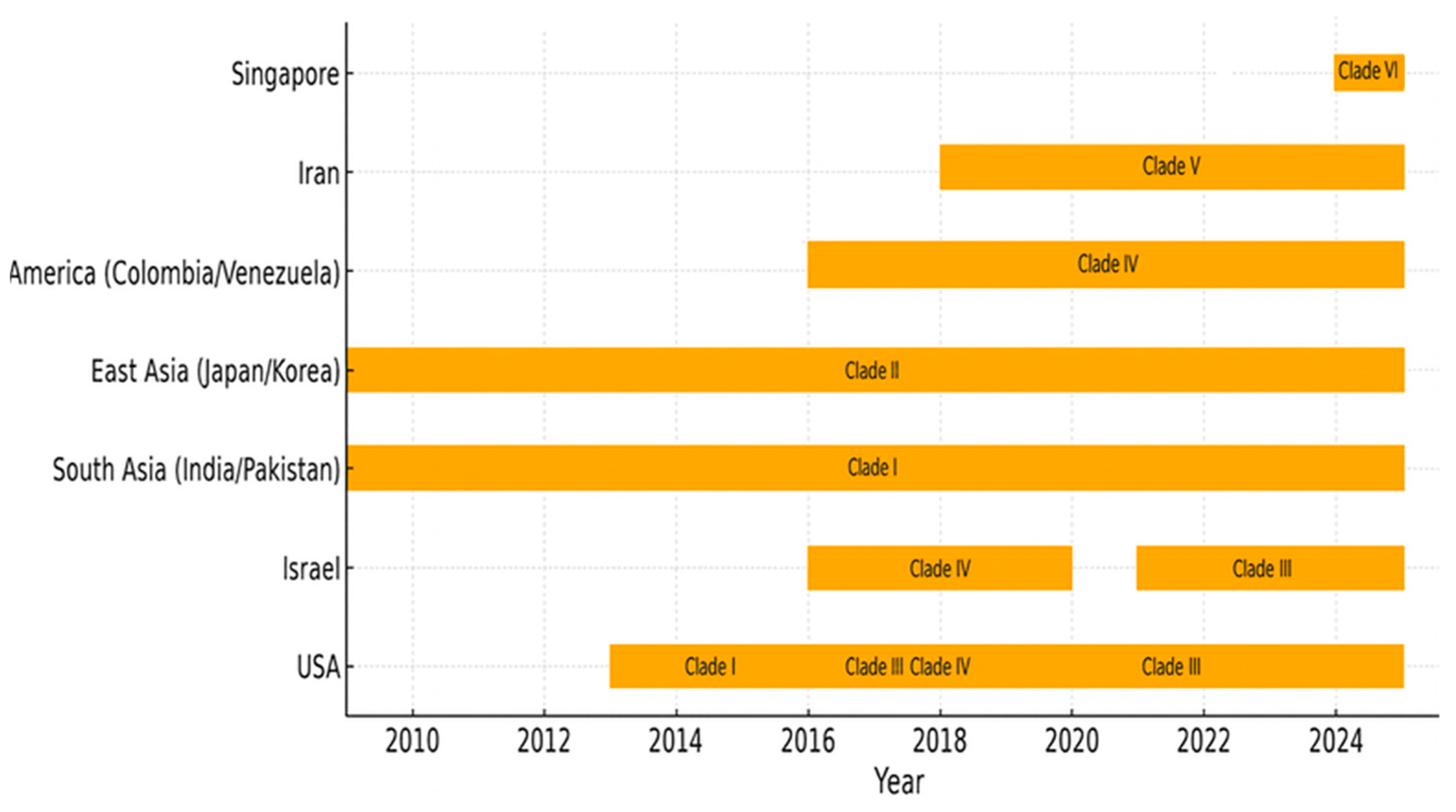
3.1. Candida auris Clade Epidemiology and Outbreaks
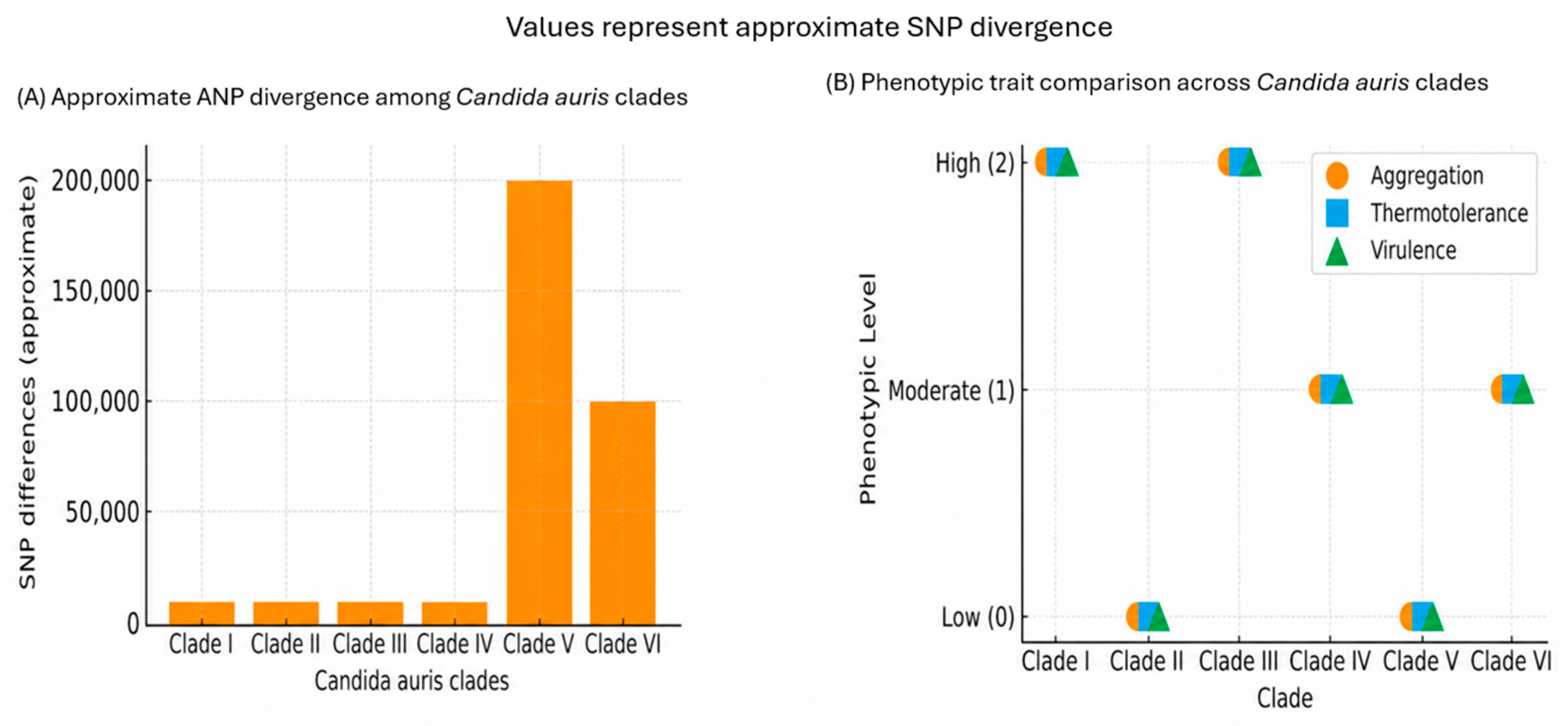
3.2. Genetic Diversity and Clade Characteristics
3.3. Drug Resistance Profiles in C. auris

| Drug Class/Resistance Type | Molecular Mechanism/Genes Involved | Effect | Clinical Impact | Refs |
|---|---|---|---|---|
| Azole resistance | ERG11 mutations (e.g., Y132F, K143R); overexpression of CDR1, TAC1b and UPC2 | Reduces azole binding affinity, enhances drug efflux, decreases intracellular drug accumulation. | Outbreak-prone, persistent environmental contamination, linked to pan-resistant cases. | [21,25,27,30,33] |
| Amphotericin B resistance | Putative alterations in ergosterol biosynthesis pathways, including ERG6-associated mechanisms | Altered membrane sterol composition resulting in reduced amphotericin B binding | Linked to pan-resistant cases. | [33] |
| Echinocandin resistance | Mutations in the FKS1 gene | Alters the structure of β-1,3-D-glucan synthase and reduces drug-binding affinity | Associated with treatment failure and reduced efficacy of first-line therapy | [7,25,29] |
| Flucytosine resistance | Mutations in genes FUR1 and FCY2 | Impairs drug activation in fungal cells | Associated with clinical treatment failure | [24] |
3.4. Infection Control Against C. auris
4. Candida glabrata
4.1. Candida glabrata Outbreaks
4.2. Candida glabrata Genetics
4.3. Drug Resistance Profiles in C. glabrata
4.4. Infection Control Against C. glabrata
5. Comparative Analysis
6. Future Directions
7. Conclusions and Outlook
Author Contributions
Funding
Institutional Review Board Statement
Informed Consent Statement
Data Availability Statement
Conflicts of Interest
References
- Soriano, A.; Honore, P.M.; Puerta-Alcalde, P.; Garcia-Vidal, C.; Pagotto, A.; Gonçalves-Bradley, D.C.; Verweij, P.E. Invasive candidiasis: Current clinical challenges and unmet needs in adult populations. J. Antimicrob. Chemother. 2023, 78, 1569–1585. [Google Scholar] [CrossRef]
- Lamoth, F.; Lockhart, S.R.; Berkow, E.L.; Calandra, T. Changes in the epidemiological landscape of invasive candidiasis. J. Antimicrob. Chemother. 2018, 73, i4–i13. [Google Scholar] [CrossRef] [PubMed]
- Cornely, O.A.; Sprute, R.; Bassetti, M.; Chen, S.C.A.; Groll, A.H.; Kurzai, O.; Lass-Flörl, C.; Ostrosky-Zeichner, L.; Rautemaa-Richardson, R.; Revathi, G.; et al. Global guideline for the diagnosis and management of candidiasis: An initiative of the ECMM in cooperation with ISHAM and ASM. Lancet Infect. Dis. 2025, 25, e280–e293. [Google Scholar] [CrossRef]
- Kim, J.S.; Cha, H.; Bahn, Y.S. Comprehensive overview of Candida auris: An emerging multidrug-resistant fungal pathogen. J. Microbiol. Biotechnol. 2024, 34, 1365–1375. [Google Scholar] [CrossRef] [PubMed]
- World Health Organization (WHO). Fungal Priority Pathogens List to Guide Research, Development and Public Health Action; WHO: Geneva, Switzerland, 2022; Available online: https://www.who.int/publications/i/item/9789240060241 (accessed on 10 July 2025).
- Bhargava, A.; Klamer, K.; Sharma, M.; Ortiz, D.; Saravolatz, L. Candida auris: A continuing threat. Microorganisms 2025, 13, 652. [Google Scholar] [CrossRef] [PubMed]
- De Gaetano, S.; Midiri, A.; Mancuso, G.; Avola, M.G.; Biondo, C. Candida auris outbreaks: Current status and future perspectives. Microorganisms 2024, 12, 927. [Google Scholar] [CrossRef]
- Centers for Disease Control and Prevention (CDC). Infection Control Guidance: Candida auris; CDC: Atlanta, GA, USA, 2024. Available online: https://www.cdc.gov/candida-auris/hcp/infection-control/index.html (accessed on 10 July 2025).
- Castanheira, M.; Deshpande, L.M.; Rhomberg, P.R.; Carvalhaes, C.G. Recent increase in Candida auris frequency in the SENTRY surveillance program: Antifungal activity and genotypic characterization. Antimicrob. Agents Chemother. 2024, 68, e00570-24. [Google Scholar] [CrossRef]
- Codda, G.; Willison, E.; Magnasco, L.; Morici, P.; Giacobbe, D.R.; Mencacci, A.; Marini, D.; Mikulska, M.; Bassetti, M.; Marchese, A.; et al. In vivo evolution to echinocandin resistance and increasing clonal heterogeneity in Candida auris during a difficult-to-control hospital outbreak, Italy, 2019 to 2022. Euro Surveill. 2023, 28, 2300161. [Google Scholar] [CrossRef]
- Al-Baqsami, Z.F.; Ahmad, S.; Khan, Z. Antifungal drug susceptibility, molecular basis of resistance to echinocandins and molecular epidemiology of fluconazole resistance among clinical Candida glabrata isolates in Kuwait. Sci. Rep. 2020, 10, 6238. [Google Scholar] [CrossRef]
- Duggan, S.; Usher, J. Candida glabrata: A powerhouse of resistance. PLoS Pathog. 2023, 19, e1011651. [Google Scholar] [CrossRef]
- Galocha, M.; Viana, R.; Pais, P.; Silva-Dias, A.; Cavalheiro, M.; Miranda, I.M.; Van Ende, M.; Souza, C.S.; Costa, C.; Branco, J.; et al. Genomic evolution towards azole resistance in Candida glabrata clinical isolates unveils the importance of CgHxt4/6/7 in azole accumulation. Commun. Biol. 2022, 5, 1118. [Google Scholar] [CrossRef]
- Naskar, S.; Prajapati, A.; Kaur, R. Antifungal drug resistance in Candida glabrata: Role of cellular signaling and gene regulatory networks. FEMS Yeast Res. 2025, 25, foaf025. [Google Scholar] [CrossRef]
- Arastehfar, A.; Daneshnia, F.; Floyd, D.J.; Jeffries, N.E.; Salehi, M.; Perlin, D.S.; Ilkit, M.; Lass-Flöerl, C.; Mansour, M.K. Echinocandin persistence directly impacts the evolution of resistance and survival of the pathogenic fungus Candida glabrata. mBio 2024, 15, e00072-24. [Google Scholar] [CrossRef] [PubMed]
- Lin, W.; Peng, Y.; Xiang, B.; Fang, J.; Ye, J.; Guo, P. Prevalence and molecular basis of resistance to echinocandins among clinical Candida glabrata isolates in Guangdong province, China. BMC Microbiol. 2025, 25, 521. [Google Scholar] [CrossRef]
- Keighley, C.; Garnham, K.; Harch, S.A.J.; Robertson, M.; Chaw, K.C.; Teng, J.C.; Chen, S.C.A. Candida auris: Diagnostic challenges and emerging opportunities for the clinical microbiology laboratory. Curr. Fungal Infect. Rep. 2021, 15, 116–126. [Google Scholar] [CrossRef]
- Abdolrasouli, A.; Fraser, M.A. Candida auris identification and profiling by MALDI-TOF mass spectrometry. Methods Mol. Biol. 2022, 2517, 21–32. [Google Scholar] [CrossRef] [PubMed]
- Jones, C.R.; Neill, C.; Borman, A.M.; Budd, E.L.; Cummins, M.; Fry, C.; Guy, R.L.; Jeffery, K.; Johnson, E.M.; Manuel, R.; et al. The laboratory investigation, management, and infection prevention and control of Candida auris: A narrative review to inform the 2024 national guidance update in England. J. Med. Microbiol. 2024, 73, 001820. [Google Scholar] [CrossRef] [PubMed]
- Kriegl, L.; Egger, M.; Boyer, J.; Hoenigl, M.; Krause, R. New treatment options for critically important WHO fungal priority pathogens. Clin. Microbiol. Infect. 2025, 31, 922–930. [Google Scholar] [CrossRef]
- Chowdhary, A.; Jain, K.; Chauhan, N. Candida auris genetics and emergence. Annu. Rev. Microbiol. 2023, 77, 583–602. [Google Scholar] [CrossRef]
- Spruijtenburg, B.; Badali, H.; Abastabar, M.; Mirhendi, H.; Khodavaisy, S.; Sharifisooraki, J.; Armaki, M.T.; de Groot, T.; Meis, J.F. Confirmation of fifth Candida auris clade by whole genome sequencing. Emerg. Microbes Infect. 2022, 11, 2405–2411. [Google Scholar] [CrossRef]
- Byun, S.A.; Kwon, Y.J.; Lee, G.Y.; Choi, M.J.; Jeong, S.H.; Kim, D.; Choi, M.H.; Kee, S.-J.; Kim, S.H.; Shin, M.G.; et al. Virulence traits and azole resistance in Korean Candida auris isolates. J. Fungi 2023, 9, 979. [Google Scholar] [CrossRef] [PubMed]
- Sanyaolu, A.; Okorie, C.; Marinkovic, A.; Abbasi, A.F.; Prakash, S.; Mangat, J.; Hosein, Z.; Haider, N.; Chan, J. Candida auris: An overview of the emerging drug-resistant fungal infection. Infect. Chemother. 2022, 54, 236. [Google Scholar] [CrossRef]
- Burrack, L.S.; Todd, R.T.; Soisangwan, N.; Wiederhold, N.P.; Selmecki, A. Genomic diversity across Candida auris clinical isolates shapes rapid development of antifungal resistance in vitro and in vivo. mBio 2022, 13, e00842-22. [Google Scholar] [CrossRef] [PubMed]
- Centers for Disease Control and Prevention (CDC). Infection Control Actions for Prevention and Response. 2024. Available online: https://www.cdc.gov/candida-auris/hcp/infection-control/prevention-response.html (accessed on 10 July 2025).
- Misas, E.; Seagle, E.; Jenkins, E.N.; Rajeev, M.; Hurst, S.; Nunnally, N.S.; Bentz, M.L.; Lyman, M.M.; Berkow, E.; Harrison, L.H.; et al. Genomic description of acquired fluconazole- and echinocandin-resistance in patients with serial Candida glabrata isolates. J. Clin. Microbiol. 2024, 62, e01140-23. [Google Scholar] [CrossRef]
- Hirayama, T.; Miyazaki, T.; Sumiyoshi, M.; Ito, Y.; Ashizawa, N.; Takeda, K.; Iwanaga, N.; Takazono, T.; Yamamoto, K.; Izumikawa, K.; et al. Echinocandin resistance in Candida auris occurs in the murine gastrointestinal tract due to FKS1 mutations. Antimicrob. Agents Chemother. 2023, 67, e01243-22. [Google Scholar] [CrossRef]
- Li, J.; Aubry, L.; Brandalise, D.; Coste, A.T.; Sanglard, D.; Lamoth, F. Upc2-mediated mechanisms of azole resistance in Candida auris. Microbiol. Spectr. 2024, 12, e03526-23. [Google Scholar] [CrossRef] [PubMed]
- Jacobs, S.E.; Jacobs, J.L.; Dennis, E.K.; Taimur, S.; Rana, M.; Patel, D.; Gitman, M.; Patel, G.; Schaefer, S.; Iyer, K.; et al. Candida auris pan-drug-resistant to four classes of antifungal agents. Antimicrob. Agents Chemother. 2022, 66, e00053-22. [Google Scholar] [CrossRef]
- Hoenigl, M.; Arastehfar, A.; Arendrup, M.C.; Brüggemann, R.; Carvalho, A.; Chiller, T.; Chen, S.; Egger, M.; Feys, S.; Gangneux, J.-P.; et al. Novel antifungals and treatment approaches to tackle resistance and improve outcomes of invasive fungal disease. Clin. Microbiol. Rev. 2024, 37, e00074-23. [Google Scholar] [CrossRef]
- Hope, W.W.; Tabernero, L.; Denning, D.W.; Anderson, M.J. Molecular Mechanisms of Primary Resistance to Flucytosine in Candida albicans. Antimicrob. Agents Chemother. 2004, 48, 4377–4386. [Google Scholar] [CrossRef]
- Rybak, J.M.; Cuomo, C.A.; Rogers, P.D. The molecular and genetic basis of antifungal resistance in the emerging fungal pathogen Candida auris. Curr. Opin. Microbiol. 2022, 70, 102208. [Google Scholar] [CrossRef]
- Pristov, K.E.; Ghannoum, M.A. Resistance of Candida to azoles and echinocandins worldwide. Clin. Microbiol. Infect. 2019, 25, 792–798. [Google Scholar] [CrossRef] [PubMed]
- Caudle, K.E.; Barker, K.S.; Wiederhold, N.P.; Xu, L.; Homayouni, R.; Rogers, P.D. Genomewide expression profile analysis of the Candida glabrata Pdr1 regulon. Eukaryot. Cell 2011, 10, 373–383. [Google Scholar] [CrossRef] [PubMed]
- Cong, P.; Wang, B.; He, H.; Li, X.; Peng, L.; Liu, J.; Guo, H.; Sun, G. Molecular characterization of Echinocandin resistance and the CHS3-mediated adaptive response in Candida glabrata bloodstream infections in Eastern China. BMC Microbiol. 2025, 25, 490. [Google Scholar] [CrossRef]
- Whaley, S.G.; Berkow, E.L.; Rybak, J.M.; Nishimoto, A.T.; Barker, K.S.; Rogers, P.D. Azole antifungal resistance in Candida albicans and emerging non-albicans Candida species. Front. Microbiol. 2017, 7, 2173. [Google Scholar] [CrossRef]
- Saha, D.; Gregor, J.B.; Hoda, S.; Eastman, K.E.; Gutierrez-Schultz, V.A.; Navarrete, M.; Wisecaver, J.H.; Briggs, S.D. Candida glabrata maintains two HAP1 ohnologs, HAP1A and HAP1B, for distinct roles in ergosterol gene regulation to mediate sterol homeostasis under azole and hypoxic conditions. mSphere 2024, 9, e00524-24. [Google Scholar] [CrossRef]
- Perlin, D.S. Echinocandin resistance in Candida. Clin. Infect. Dis. 2015, 61, S612–S617. [Google Scholar] [CrossRef] [PubMed]
- Arastehfar, A.; Daneshnia, F.; Cabrera, N.; Penalva-Lopez, S.; Sarathy, J.; Zimmerman, M.; Shor, E.; Perlin, D.S. Macrophage internalization creates a multidrug-tolerant fungal persister reservoir and facilitates the emergence of drug resistance. Nat. Commun. 2023, 14, 1183. [Google Scholar] [CrossRef]
- Zhao, J.T.; Chen, K.Z.; Liu, J.Y.; Li, W.H.; Wang, Y.Z.; Wang, L.L.; Xiang, M.J. FLO8 deletion leads to decreased adhesion and virulence with downregulated expression of EPA1, EPA6, and EPA7 in Candida glabrata. Braz. J. Microbiol. 2022, 53, 727–738. [Google Scholar] [CrossRef]
- Fattouh, N.; Khalaf, R.A.; Husni, R. Candida glabrata hospital isolate from Lebanon reveals micafungin resistance associated with increased chitin and resistance to a cell-surface-disrupting agent. J. Glob. Antimicrob. Resist. 2024, 37, 62–68. [Google Scholar] [CrossRef]
- Balázsi, D.; Tóth, Z.; Locke, J.B.; Borman, A.M.; Forgács, L.; Balla, N.; Kovács, F.; Kovács, R.; Amano, C.; Baran, T.I.; et al. In Vivo Efficacy of Rezafungin, Anidulafungin, Caspofungin, and Micafungin against Four Candida auris Clades in a Neutropenic Mouse Bloodstream Infection Model. J. Fungi 2024, 10, 617. [Google Scholar] [CrossRef]
- Locke, J.B.; Andes, D.; Flanagan, S.; Redell, M.; Ong, V.; Aram, J.A.; Pappas, P.G.; Castanheira, M.; Thompson, G.R. Activity of rezafungin against Candida auris. J. Antimicrob. Chemother. 2025, 80, 1482–1493. [Google Scholar] [CrossRef] [PubMed]


| Drug Class/Resistance Type | Molecular Mechanism/Genes Involved | Effect | Clinical Impact | References |
|---|---|---|---|---|
| Azole resistance | Gain-of-function mutations in PDR1; overexpression of efflux pumps (CgCDR1, CgCDR2, PDH1, SNQ2) | Reduced intracellular azole accumulation via efflux activity | Major driver of multidrug resistance; limits azole efficacy in candidemia | [12,35] |
| Indirect azole resistance | Mutations in CgHXT4/6/7 (hexose transporters regulating azole uptake) | Reduced azole import; resistance even in PDR1 wild-type strains | Harder to predict; bypasses standard molecular markers | [13] |
| Ergosterol regulation (azole-related) | Deletion of HAP1B contributes to reduced ERG gene expression under hypoxic stress | Increased azole susceptibility; links oxygen stress to ergosterol regulation | Highlights hypoxia as a modulator of antifungal response; potential therapeutic target | [38] |
| Echinocandin resistance | Point mutations in FKS1 and FKS2 (hotspot 1 and 2 regions) | Reduced β-1,3-glucan synthase activity; decreased susceptibility to echinocandins | Treatment failure in bloodstream infections; requires early detection | [34,39] |
| Emerging echinocandin resistance | Gene conversion between FKS1 and FKS2, forming hybrid alleles | Reduced echinocandin binding affinity; complicates molecular diagnostics | Hidden resistance under therapeutic pressure; challenges detection | [15] |
| Cell wall remodeling | Mutations in CHS3, CHS3B, KRE5; increased chitin deposition | Reinforced cell walls; resistance to micafungin and detergents (e.g., SDS) | Cross-resistance to environmental stressors; potential hospital outbreak marker | [36,42] |
| Biofilm-associated resistance | Upregulation of EPA1, EPA6, EPA7; biofilm regulators (BCR1, ACE2, YAK1) | Poor drug penetration, metabolic quiescence, and stress adaptation | Major factor in catheter/mucosal infections; tolerance persists during therapy | [35,41] |
| Drug-tolerant persisters | Non-proliferative macrophage-resident cells; oxidative stress–adapted and tolerant to echinocandins | Serve as reservoirs for resistance; only amphotericin B can eradicate persisters | Hidden reservoirs of recurrence; novel target for antifungal development | [40] |
| Feature | Candida auris | Candida glabrata |
|---|---|---|
| First identification | 2009 (Japan) | 1995 (reclassified from Saccharomyces) |
| Epidemiology | Emerging global pathogen; hospital outbreaks; clade-specific distribution | Endogenous opportunistic pathogen; widely distributed; increasing incidence |
| Transmission | High nosocomial transmission; environmental persistence | Limited person-to-person transmission; mainly endogenous |
| Drug resistance profile | Frequently multidrug-resistant (azole, amphotericin B, echinocandin) | Intrinsically reduced azole susceptibility; acquired echinocandin resistance |
| Genetic diversity | Distinct clades (I–VI) with geographic segregation | High genetic plasticity; sequence types and microevolution |
| Biofilm formation | Moderate; clade-dependent | Variable but clinically significant biofilm formation |
| Environmental survival | High (survives on surfaces, disinfectants) | Moderate |
| Virulence | Variable; often lower than C. albicans but outbreak-prone | Lower virulence but persistent infections |
| Diagnostic challenges | Misidentification common without MALDI-TOF/WGS | Easier identification; sufficient standard methods |
| Clinical impact | Severe outbreaks; high mortality in ICU settings | Persistent candidemia; recurrent infections |
Disclaimer/Publisher’s Note: The statements, opinions and data contained in all publications are solely those of the individual author(s) and contributor(s) and not of MDPI and/or the editor(s). MDPI and/or the editor(s) disclaim responsibility for any injury to people or property resulting from any ideas, methods, instructions or products referred to in the content. |
© 2026 by the authors. Licensee MDPI, Basel, Switzerland. This article is an open access article distributed under the terms and conditions of the Creative Commons Attribution (CC BY) license.
Share and Cite
Raeisi, S.; Madhavan, P.; Adisuri, D.S. Recent Outbreaks, Resistance Trends, and Control Measures in Candida auris and Candida glabrata Infections. J. Fungi 2026, 12, 436. https://doi.org/10.3390/jof12060436
Raeisi S, Madhavan P, Adisuri DS. Recent Outbreaks, Resistance Trends, and Control Measures in Candida auris and Candida glabrata Infections. Journal of Fungi. 2026; 12(6):436. https://doi.org/10.3390/jof12060436
Chicago/Turabian StyleRaeisi, Sepinoud, Priya Madhavan, and Diajeng Sekar Adisuri. 2026. "Recent Outbreaks, Resistance Trends, and Control Measures in Candida auris and Candida glabrata Infections" Journal of Fungi 12, no. 6: 436. https://doi.org/10.3390/jof12060436
APA StyleRaeisi, S., Madhavan, P., & Adisuri, D. S. (2026). Recent Outbreaks, Resistance Trends, and Control Measures in Candida auris and Candida glabrata Infections. Journal of Fungi, 12(6), 436. https://doi.org/10.3390/jof12060436