Article

Knockout of SsArl1 Leading to Enhanced Virulence in Sclerotinia sclerotiorum

1
Hunan Provincial Key Laboratory of Phytohormones and Growth Development, College of Bioscience and Biotechnology, Hunan Agricultural University, Changsha 410128, China
2
Yuelushan Laboratory, Changsha 410125, China
3
Crop Research Institute, Hunan Academy of Agricultural Sciences, Changsha 410125, China
*
Author to whom correspondence should be addressed.
These authors contributed equally to this work.
J. Fungi 2026, 12(6), 431; https://doi.org/10.3390/jof12060431
Submission received: 25 April 2026 / Revised: 4 June 2026 / Accepted: 8 June 2026 / Published: 12 June 2026
(This article belongs to the Special Issue Genomics of Fungal Plant Pathogens, 4th Edition)

Abstract

Sclerotinia sclerotiorum is a formidable soilborne fungus that wreaks havoc on numerous crops globally. While the role of ADP-ribosylation factor-like 1 (Arl1) small GTPases in vesicular trafficking and fungal development is well-documented, their specific impact on S. sclerotiorum remains unclear. Through reverse genetic techniques, we identified and characterized SsArl1, a typical Arl small GTPase conserved across fungi. Deleting SsArl1 hampers the hyphal growth of S. sclerotiorum, but leads to higher oxalic acid buildup and boosts cellulase activity. This speeds up the infection of host plants, yet increases their sensitivity to certain environmental stresses, particularly ionic and cell wall-related stress. Our results reveal that SsArl1 acts as a negative regulator of oxalic acid accumulation and virulence, while playing a positive role in enhancing resistance to environmental stresses in S. sclerotiorum.

1. Introduction

Sclerotinia sclerotiorum utilizes a diverse array of pathogenicity factors, including cell wall-degrading enzymes, oxalic acid, and secreted effectors, to trigger host tissue acidification and breakdown [1,2,3]. Initially, infected tissues display water-soaked lesions that progressively enlarge and darken, ultimately forming robust sclerotia. These sclerotia can survive in soil for over ten years, highlighting their resilience [4,5,6]. Remarkably, S. sclerotiorum has an extensive host range, infecting over 75 plant families and numerous species [7,8], encompassing major crops like Brassica napus, Glycine max, Triticum aestivum, and Zea mays [9,10]. Post-infection, it hampers plant growth, drastically reduces yields, and causes substantial agricultural losses. Therefore, unraveling the pathogenic mechanisms of this fungus is crucial for devising effective and precise control measures.
In eukaryotic cells, the secretory pathway begins with proteins and lipids being packaged into vesicles that bud off from the endoplasmic reticulum (ER) and then travel to the Golgi apparatus for further processing and maturation [11,12,13]. For S. sclerotiorum, maintaining efficient secretory trafficking is crucial for hyphal growth and its ability to cause disease. The Arf and Arl small GTPases, part of the ADP-ribosylation factor family, are key regulators of vesicle transport within this secretory system [14,15]. Within the Arf family, Arl1 is predominantly found at the trans-Golgi network (TGN), a key sorting hub for vesicle transport [16]. Arl1, a Golgi-associated small GTPase, plays a pivotal role by recruiting effector proteins and controlling membrane trafficking [17,18,19,20]. Like other Ras superfamily GTPases, Arf/Arl proteins are active when bound to GTP and associated with membranes, but they become inactive when GTP hydrolysis is stimulated by GAPs, converting them to a GDP-bound state [21,22,23].
In Saccharomyces cerevisiae, ArfGEF Sec7 activates Arf1, Arl1, Ypt1 (Rab1), and Ypt31/32 (Rab11) [24], guiding them to the Golgi apparatus. Furthermore, Ypt1 aids in targeting ArfGEF Gea2 to the Golgi, facilitating the formation of a regulatory complex involving Arl1 and the phosphatidylserine flippase Drs2 [25,26]. Deletion of Arl1 disrupted vesicle movement and protein secretion, causing secretory vesicles to mislocalize and membrane traffic to become irregular [27]. Arl1 also affects how cells respond to stress. Yeasts without Arl1 show different tolerance to high salt and other ionic conditions [28]; in addition, mutants lacking Arl1 are more sensitive to ions and to antibiotics like hygromycin B [29], suggesting that vesicle trafficking changes can influence cell adaptation, and Arl1 influences both internal balance and how cells handle external stress.
Arl1 is vital for the virulence, growth, and development of plant pathogenic fungi. In Magnaporthe oryzae and Fusarium graminearum, deleting Arl1 homologs MoArl1 and FgArl1 leads to reduced virulence and hindered growth [30,31]. Yet Arl1’s precise role in S. sclerotiorum remains unclear. In this study, we identified the Arl1 homolog SsArl1 in S. sclerotiorum through homologous sequence alignment and initially explored its biological function using reverse genetics. Our findings reveal that SsArl1 negatively influences virulence, oxalic acid secretion, and cellulase activity in S. sclerotiorum. Additionally, SsArl1 is essential for the fungus’s response to external stresses.

2. Materials and Methods

2.1. Experimental Materials

The genetic manipulation used in this study was S. sclerotiorum reference strain 1980. SsArl1 deletion mutants and their complemented counterparts were created via genetic transformation. Fungal cultures were kept on solid potato dextrose agar and grown in liquid medium at 25 °C in darkness. For selecting transformants, hygromycin B (150 μg/mL, Roche, Basel, Switzerland) was added to the agar as needed. For pathogenicity tests, Arabidopsis thaliana Col-0 and Nicotiana benthamiana plants were grown in a controlled chamber at 22 °C with a 16 h light/8 h dark cycle before inoculation.

2.2. Arf1 Identification and Bioinformatics Analysis

We obtained the coding protein sequence file for the S. sclerotiorum genome (sclerotinia_sclerotiorum_1980_uf_70_gca_001857865) from the EnsemblFungi database. Using TBtools-II software (v2.0, South China Agricultural University, Guangzhou, China) [32], we identified the Arl1 gene in S. sclerotiorum through BLASTP (NCBI web server, Bethesda, MD, USA) searches, with protein sequences from FgArl1 (XP_011326587.1), ScArl1 (CAA85125.1), and human ARL1 (ARL1_HUMAN) as references. To clarify the evolutionary relationship of SsArl1 among fungi, sequence alignment was performed using the BLAST program within the RefSeq Select proteins (refseq_select) database of the National Center for Biotechnology Information (NCBI; https://www.ncbi.nlm.nih.gov/). The top 100 matched sequences were retained, and sequences with unclear annotations or non-fungal origins (animal and plant sequences) were removed. The remaining sequences were regarded as putative homologous genes and used for phylogenetic tree construction.
Meanwhile, to ensure the reliability of the phylogenetic tree, fungal Arl5 protein sequences were retrieved from the NCBI database according to the study of Vargová et al. [33], and Arl5 sequences were designated as the outgroup for phylogenetic analysis. All Arl1 and Arl5 protein sequences were firstly aligned and trimmed using ClustalW (MEGA12, v12.0.x) with default parameters in MEGA 12 [34]. Subsequently, the Maximum Likelihood (ML) phylogenetic tree was constructed in MEGA 12. The topological reliability of tree branches was evaluated by standard bootstrap analysis with 1000 replicates. The Jones–Taylor–Thornton (JTT) model was initially adopted as the amino acid substitution model with uniform substitution rates among sites. All sites, including gaps and missing data, were included in the analysis. The Nearest-Neighbor-Interchange (NNI) heuristic method was applied for ML tree inference, and the initial tree was automatically generated based on the default Neighbor-Joining or Maximum Parsimony algorithm, with the branch swap filter set to “Strong”. All protein sequences and their corresponding NCBI accession numbers used in this study are listed in Supplementary Materials S1 and S2.
We also searched for homologous templates for FgArl1(A0A428PG50.1.A), MoArl1(XP_003712475.1, A0A428PG50.1.A), and SsArl1(A0A4Z1K6Y0.1.A), and constructed their 3D protein structural models using SWISS-MODEL online software [35] (https://swissmodel.expasy.org). To further explore the differences in the three-dimensional protein structures among SsArl1, FgArl1, and MoArl1, pairwise structural alignment was performed using the Pairwise Structure Alignment program embedded in the PDBeFold server [36].

2.3. RNA and cDNA Extraction

Sclerotia were cultivated on PDA (potato dipping powder 5 g/L, glucose 20 g/L, agar 15 g/L, and chloramphenicol 0.1 g/L, Bio-Way Technology, Shanghai, China), and young hyphae were then moved to PDA covered with sterile cellophane for 36 to 48 h. The mycelia were collected, quickly frozen in liquid nitrogen, and ground up. Total RNA was extracted from the samples using the SteadyPure Plant RNA Extraction Kit from Accurate Biology in Changsha, Hunan, China. First-strand cDNA was synthesized with the Evo M-MLV RT-PCR Kit from the same company. Genomic DNA was isolated from fungal mycelia using a commercial kit. All nucleic acid samples were stored at −20 °C for future experiments.

2.4. Targeted Deletion and Complementation of SsArl1

To facilitate gene replacement, the 5′ and 3′ flanking regions of the SsArl1 gene were isolated from the genomic DNA of wild-type S. sclerotiorum. These regions were fused to overlapping segments of the hygromycin B resistance (HYG) cassette through overlap PCR, creating two split-marker fragments (SsArl1-UP-HY and SsArl1-DOWN-YG) essential for homologous gene replacement. These fragments were co-transformed into wild-type protoplasts using PEG-mediated transformation [37]. Transformants were selected on potato dextrose agar (PDA) containing 150 μg/mL hygromycin B and purified through at least three rounds of single-hyphal tip subculture to ensure homozygosity. The knockout mutants were verified by PCR with specific primers. For genetic complementation, a genomic fragment encompassing the full-length SsArl1 coding sequence, along with its native promoter and terminator, was amplified from wild-type DNA. This fragment was inserted into a modified pCH-NEO1 vector with a geneticin (G418, 100 μg/mL, Yeasen, Shanghai, China) resistance cassette to create the complementation construct. The plasmid was transformed into ΔSsarl1 mutant protoplasts using the same PEG-mediated method. Complemented transformants were selected on PDA with 150 μg/mL G418, and correct cassette integration was confirmed by PCR.

2.5. Assessment of Gene Expression

Total RNA was extracted from mycelial samples of the wild-type (WT), ΔSsarl1 mutant, and ΔSsarl1-C complemented strain. First-strand cDNA was synthesized as described earlier. Gene expression levels were assessed by semi-quantitative RT-PCR using specific primers, with SsTub1 as the reference gene for normalization. PCR products were separated by agarose gel electrophoresis, and equal cDNA amounts were confirmed by comparing band intensities before further gene expression analysis.
Quantitative real-time PCR (qPCR) was conducted using SYBR Green chemistry, with reactions prepared using iTaq™ Universal SYBR® Green Supermix (Thermo Fisher Scientific, Shanghai, China) as per the manufacturer’s instructions. All primers were designed using Beacon Designer 8.0 software. The relative expression levels of SsArl1 and SsOAH1 were determined using the 2−ΔΔCt method, with SsTub1 as the internal reference gene for normalization.

2.6. Colony Morphology and Growth Rate Assay

To analyze fungal phenotypes, agar plugs (~5 mm diameter) with actively growing mycelia from wild-type (WT), ΔSsarl1, and ΔSsarl1-C strains were placed at the center of 9 cm PDA plates. After incubation at 20 °C, radial growth was measured at 24 and 48 h to determine mean growth rates. Colony morphology was recorded photographically at 24 h, 48 h, and 7 days. Each experiment included three independent biological replicates, with measurements taken in triplicate for each replicate.

2.7. Virulence and Hyphal Structure Analysis

For virulence testing, agar plugs with actively growing mycelia from the wild-type (WT), ΔSsarl1 mutant, and complemented strain (ΔSsarl1-C) were prepared. A. thaliana leaves were inoculated with 1-mm plugs, while N. benthamiana leaves received 5-mm plugs. Inoculated leaves were placed in 9-cm square Petri dishes lined with moist paper towels (~25 cm) and 11 mL of sterile water to maintain high humidity.
Inoculated samples were incubated at 22 °C in a controlled growth chamber with a 16-h light/8-h dark cycle. Disease progression was assessed at 24 and 48 h post-inoculation, and lesion sizes were measured using ImageJ (v2.9.0/1.54t, National Institutes of Health, Bethesda, MD, USA). Data were collected from three independent biological replicates, each with triplicate measurements.
To study infection-related structures, hyphal agar plugs were placed on sterile glass slides inside 9-cm square Petri dishes. These dishes were lined with pre-moistened filter paper (~25 cm2) and filled with 11 mL of sterile water to maintain high humidity. The setup was incubated at 20 °C.
For onion epidermal cell assays, hyphal plugs were placed on fresh onion epidermis and incubated in humid chambers under the same conditions as previously described.
Hyphal branching was evaluated after 12 h of incubation. Appressorium formation on glass slides and onion epidermis was assessed at 16 h, with glass slide appressoria documented at 24 h. Compound appressorium structures were analyzed microscopically using an Axio Imager 2 (ZEISS, Oberkochen, Germany). Each experiment was independently repeated three times.

2.8. Qualitative and Quantitative Analysis of Acid Production and Oxalic Acid Determination

To assess acid secretion, 5 mm diameter plugs from actively growing hyphal fronts of the wild-type (WT), SsArl1 deletion mutant (ΔSsarl1), and complemented strain (ΔSsarl1-C) were placed on potato dextrose agar containing 0.005% (w/v) bromophenol blue (PDA-BPB, Beijing CoolLabs, Beijing, China). After 48 h of incubation at 20 °C, medium acidification was evaluated by observing bromophenol blue color changes. Each treatment was replicated three times independently.
Since bromophenol blue indicates overall acidification, not specific acidic compounds, we first examined SsOAH1—a key oxalic acid biosynthesis gene—to assess transcriptional regulation of acid production. Gene expression was analyzed via semi-quantitative and real-time PCR using RNA from WT, ΔSsarl1, and ΔSsarl1-C cultures grown under previously described conditions [38,39].
Ultra High-Performance Liquid Chromatography (UHPLC, Thermo Scientific, Vanquish Pump, Germany) was used to quantify oxalic acid, the primary virulence-related organic acid produced by S. sclerotiorum, with analytical conditions adapted from previously published HPLC/UHPLC methods for organic acid analysis [40,41,42]. WT, ΔSsarl1, and ΔSsarl1-C strains were cultured in potato dextrose broth (PDB; potato dipping powder 5 g/L, glucose 20 g/L, chloramphenicol 0.1 g/L, Bio-Way Technology, Shanghai, China) at 25 °C with shaking. Culture supernatants were collected for extracellular oxalic acid analysis, while mycelia were harvested, washed, and homogenized in 0.1% formic acid, followed by centrifugation to obtain intracellular extracts. All samples were filtered through 0.22 μm membranes before UHPLC analysis. Oxalic acid was quantified using a Hyperall Gold aQ column (Thermo Scientific, Bremen, Germany) (100 × 2.1 mm, 1.9 μm) with Diode array detector (DAD) at 200 nm, injecting 2 μL of each sample. A total of 0.01 M KH2PO4 (pH 2.5–2.8) aqueous solution was served as the mobile phase with a flow rate of 0.4 mL/min. Concentrations were determined using an external calibration curve prepared from authentic standards, correlating peak area with known concentrations. Oxalic acid levels in each sample were calculated based on the corresponding peak area obtained from UHPLC analysis.

2.9. Stress Sensitivity Assays

For stress sensitivity testing, 5 mm diameter agar discs with actively growing mycelia from the wild-type (WT), ΔSsarl1 mutant, and complemented strain (ΔSsarl1-C) were placed on PDA supplemented with cell wall-disrupting agents (0.5 mg/mL Congo red or 0.02% SDS) or osmotic stressors (0.5 M NaCl, 0.5 M KCl, 1 M sorbitol, or 1 M glucose). Cultures were incubated at 20 °C, and colony growth was measured after 48 h. Radial growth was recorded, and relative inhibition rates were calculated compared to untreated PDA. Colony phenotypes were documented photographically. Growth inhibition was calculated as Inhibition (%) = [(R_control − R_treatment)/R_control] × 100. All assays were performed in three independent biological replicates, each with three technical replicates.

3. Results

3.1. Identification of Arf1 from S. sclerotiorum

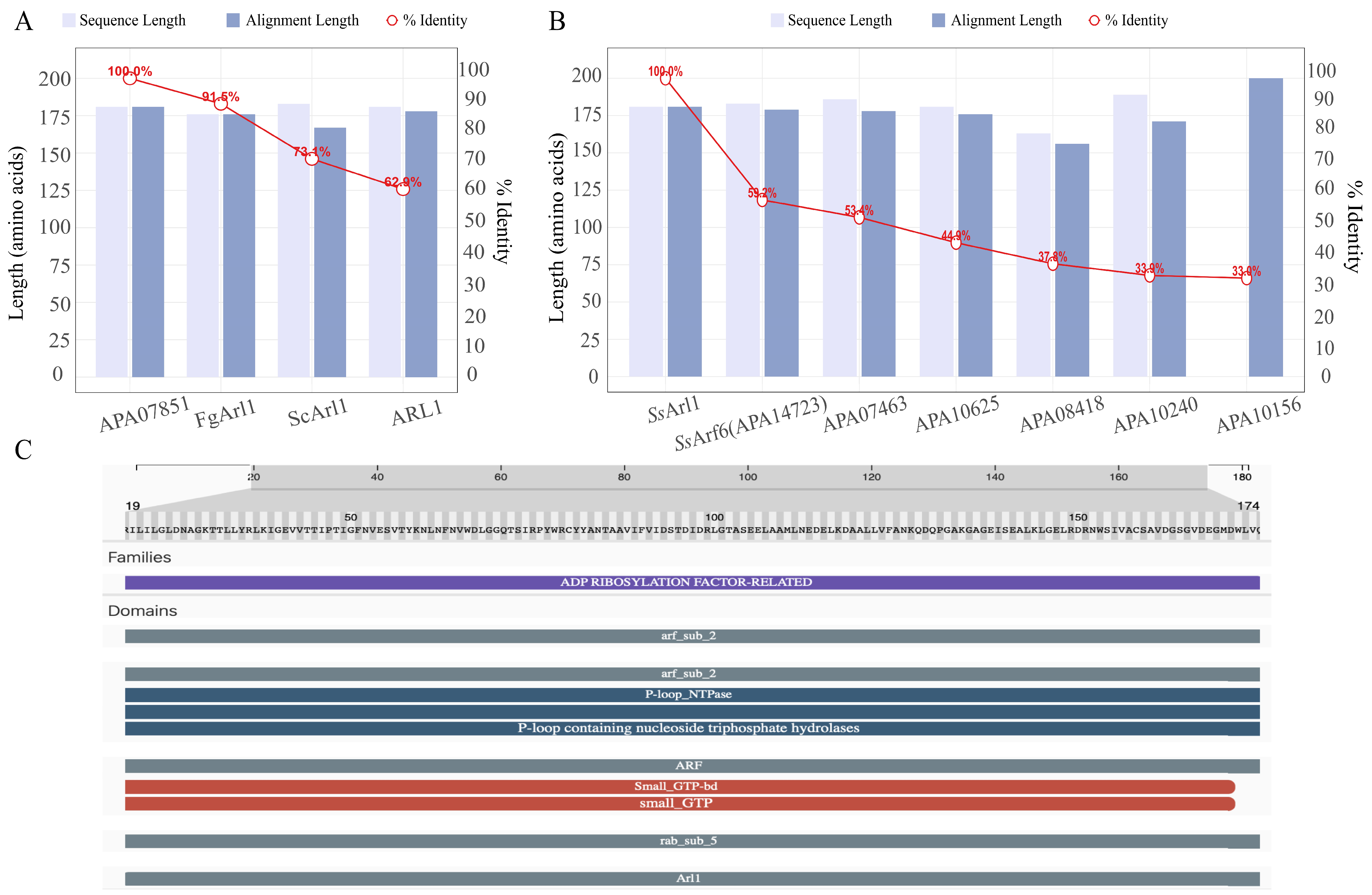
Using TBtools-II version 2.420’s Blast Zone module, we identified a putative Arl1 protein in S. sclerotiorum by comparing its genome with sequences from FgArl1, ScArl1, and ARL1. As shown in Figure 1A, the protein APA07851 (sscle_03g026210) in S. sclerotiorum shares significant homology with these sequences and was thus designated as SsArl1. Functional predictions from the InterPro database (https://www.ebi.ac.uk/interpro/, accessed on 21 December 2025) confirmed that SsArl1 belongs to the ADP-ribosylation factor-like protein 1 family (Figure 1B). Additionally, SsArl1 shows high sequence similarity to SsArf6 [43], an Arf family protein known to be crucial for vegetative growth and full virulence in S. sclerotiorum (Figure 1C). These results suggest that SsArl1 may also play a role in the development and virulence of this pathogen.

3.2. SsArl1 Is Essential for the Normal Hyphal Growth of S. sclerotiorum

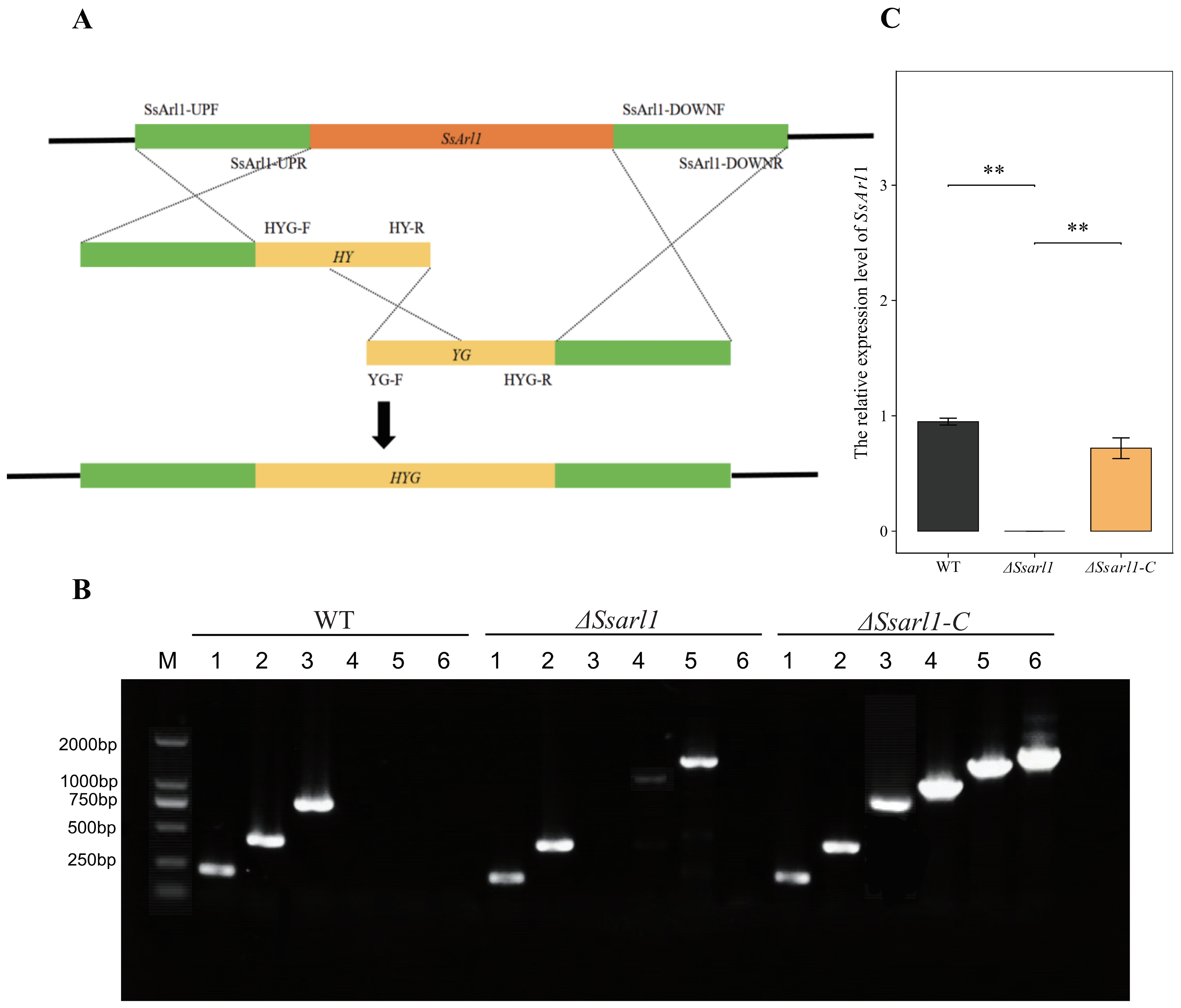
To investigate SsArl1’s role in infection-related development, we created SsArl1 deletion mutants using homologous recombination with a split-marker approach (Figure 2A). PEG-mediated protoplast transformation yielded 26 potential transformants. After at least three rounds of single-hyphal tip subculture and protoplast purification, we obtained one homozygous SsArl1 knockout mutant (ΔSsarl1). The complemented strain (ΔSsarl1-C) was then generated by reintroducing the SsArl1 coding sequence into ΔSsarl1 via PEG-mediated transformation. qPCR confirmed the restored SsArl1 expression in ΔSsarl1-C (Figure 2B,C).
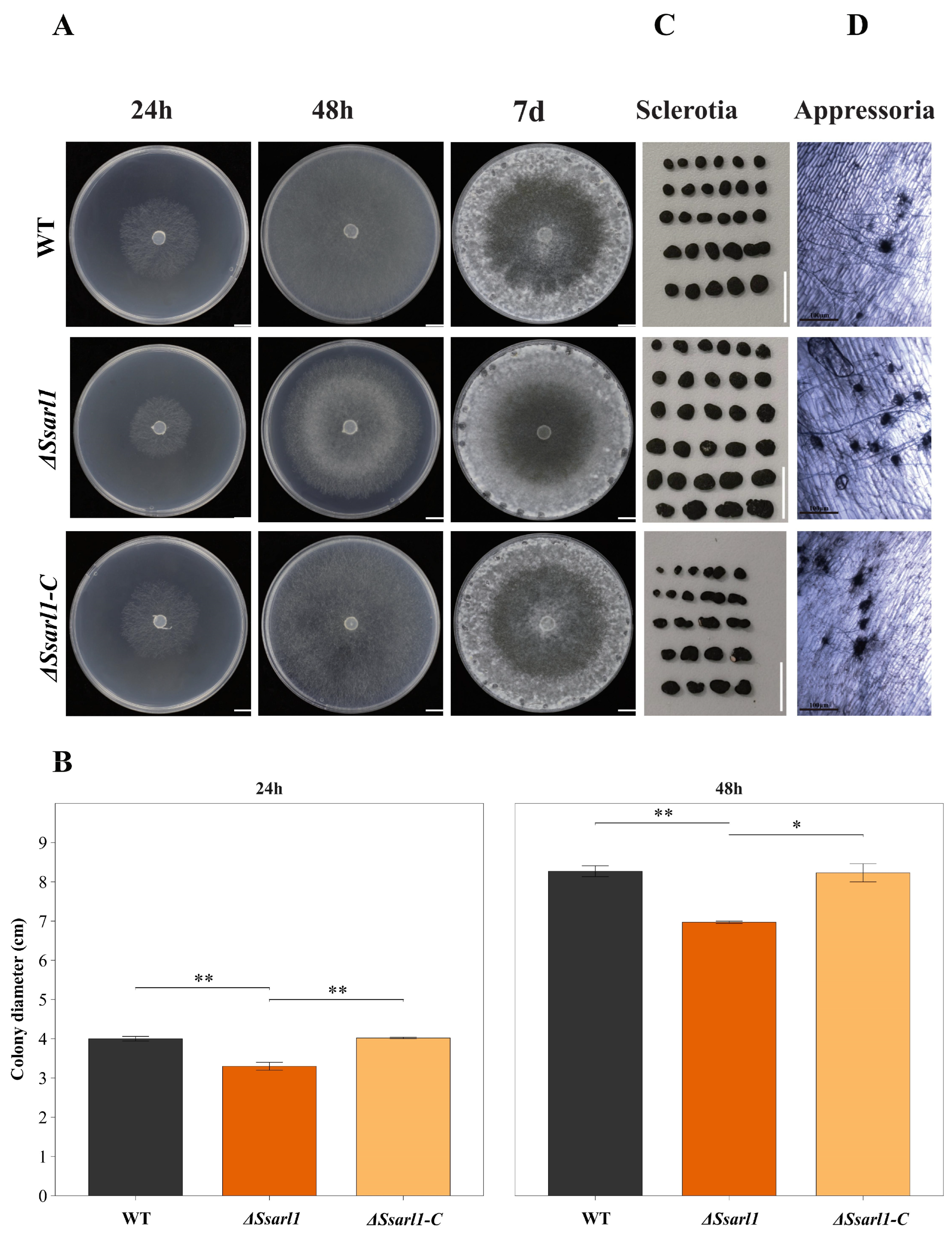
To assess the impact of SsArl1 knockout on S. sclerotiorum, we compared the phenotypes of the ΔSsarl1 mutant, the complemented strain (ΔSsarl1-C), and the wild-type (WT). As shown in Figure 3, the ΔSsarl1 mutant exhibited significantly reduced growth compared to ΔSsarl1-C and WT strains (Figure 3A,B). However, sclerotium and appressorium formation remained unaffected by the SsArl1 knockout. These results indicate that SsArl1 is essential for normal hyphal growth in S. sclerotiorum but not for the development of sclerotia or appressoria.

3.3. Knockout of SsArl1 Enhances Virulence in S. sclerotiorum

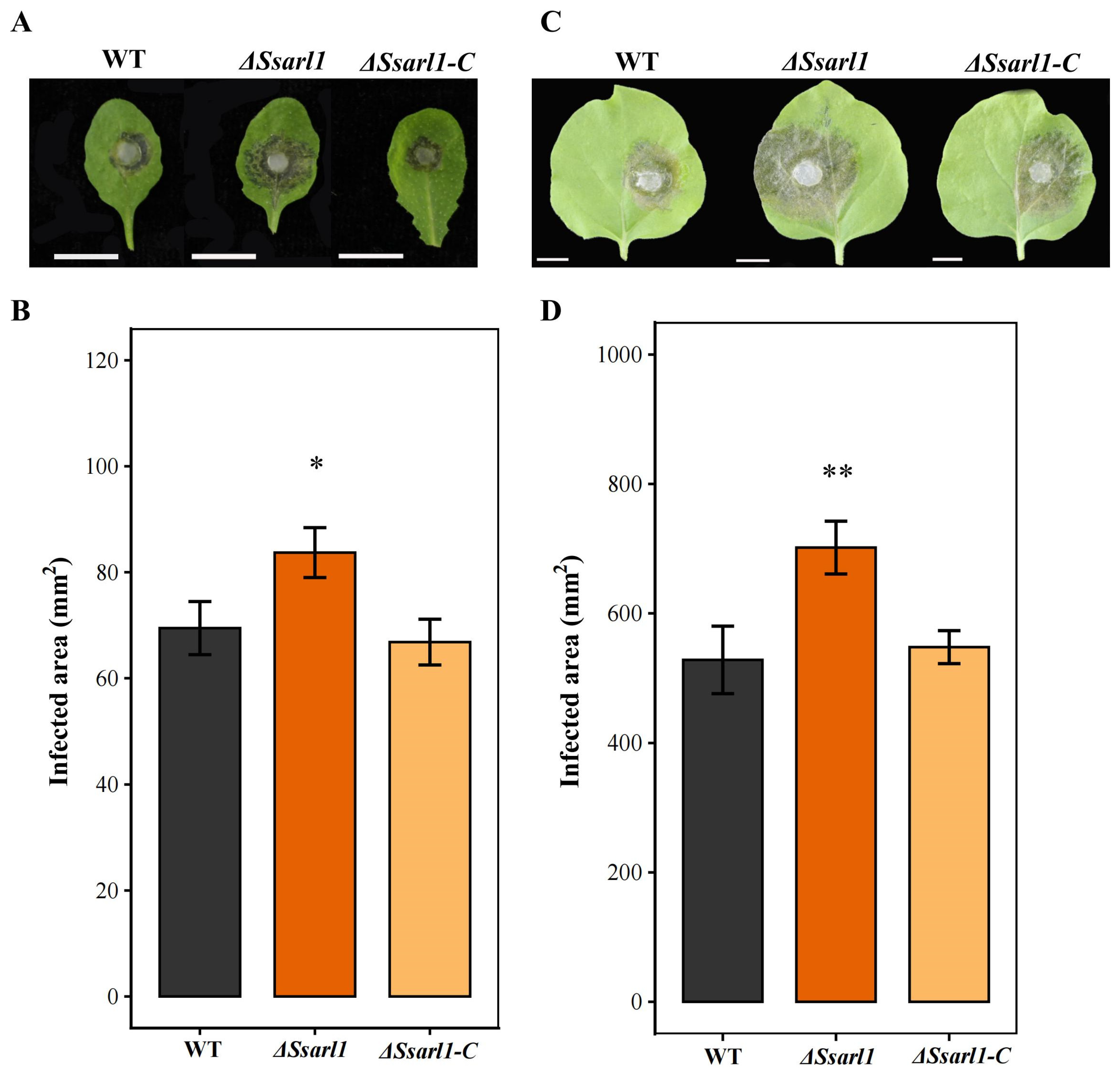
To assess the involvement of SsArl1 in the virulence of S. sclerotiorum, we investigated the pathogenic capacity of the ΔSsarl1 mutant strain using in vitro leaves of A. thaliana (Figure 4A) and N. benthamiana (Figure 4C). The findings revealed that the ΔSsarl1 mutant demonstrated enhanced infection capability compared to the wild-type (WT) strain. Furthermore, the infection ability of the ΔSsarl1-C complemented strain was significantly diminished relative to the ΔSsarl1 mutant (Figure 4B,D). These findings indicate that SsArl1 is involved in the virulence development of S. sclerotiorum, and functions as a negative regulator of fungal virulence.

3.4. SsArl1 Negatively Regulates Oxalic Acid Biosynthesis

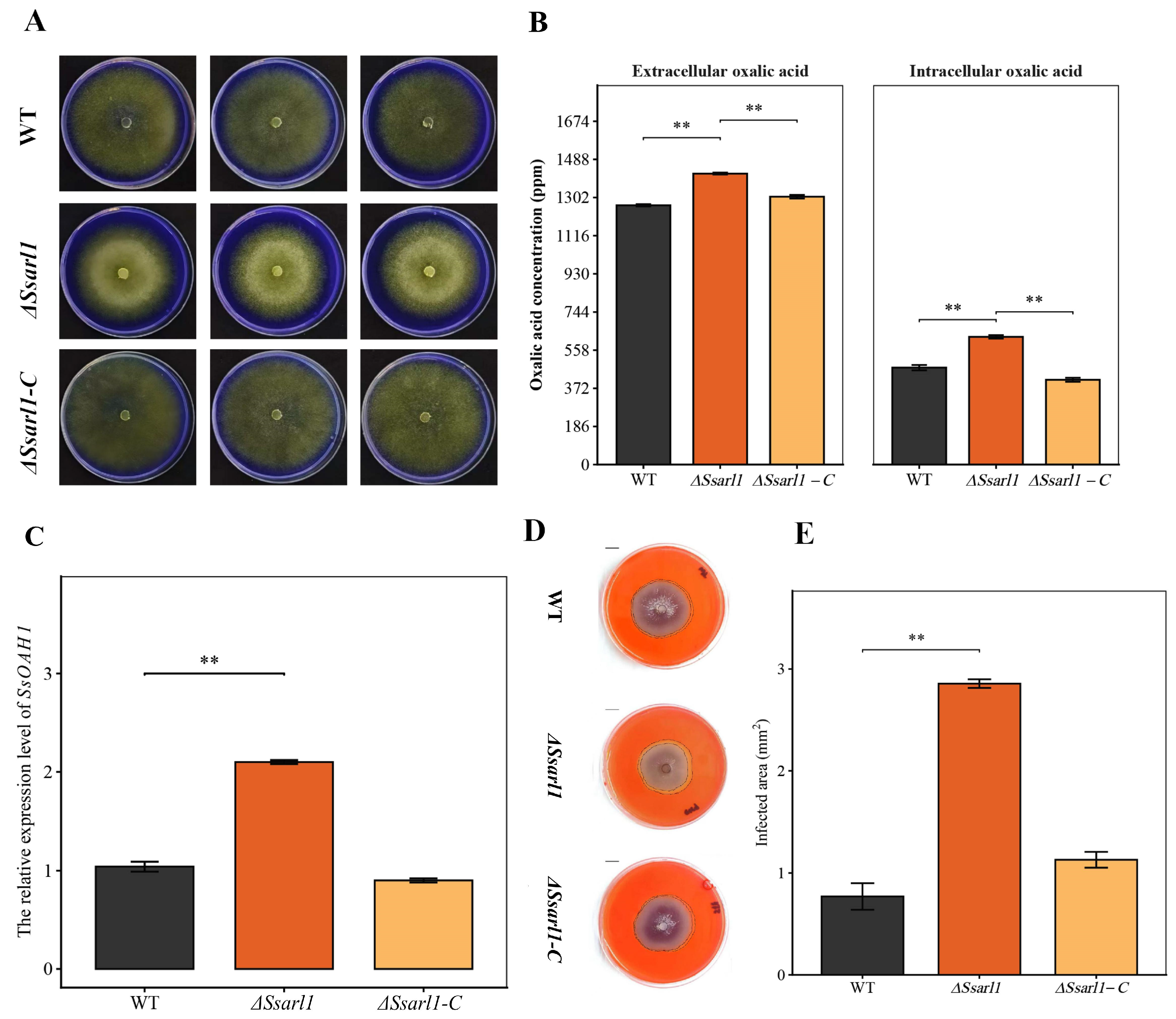
When assessing acidic metabolite production in the wild-type (WT), ΔSsarl1 mutant, and ΔSsarl1-C complemented strains, all induced a noticeable color change in the medium from blue to yellow after 24 and 48 h on PDB medium with bromophenol blue (BPB), indicating acid secretion. Interestingly, the ΔSsarl1 mutant formed smaller colonies but displayed more intense yellowing compared to the WT and ΔSsarl1-C strains, suggesting higher oxalic acid production around the ΔSsarl1 colony (Figure 5A). UHPLC analysis confirmed that both intracellular and extracellular oxalic acid levels were significantly higher in the ΔSsarl1 mutant than in the WT and ΔSsarl1-C strains (Figure 5B, Supplementary Figure S1 and Table S2). In addition, the increased OA in the SsArl1 deletion mutant correlates with altered transcription levels of the SsOAH1 gene, with SsOAH1 expression significantly upregulated compared to wild-type (WT) and ΔSsarl1-C complemented strains (Figure 5C–E). These findings indicate that SsArl1 negatively regulates oxalic acid biosynthesis and secretion in S. sclerotiorum.

3.5. SsArl1 Is Involved in Stress Responses in S. sclerotiorum

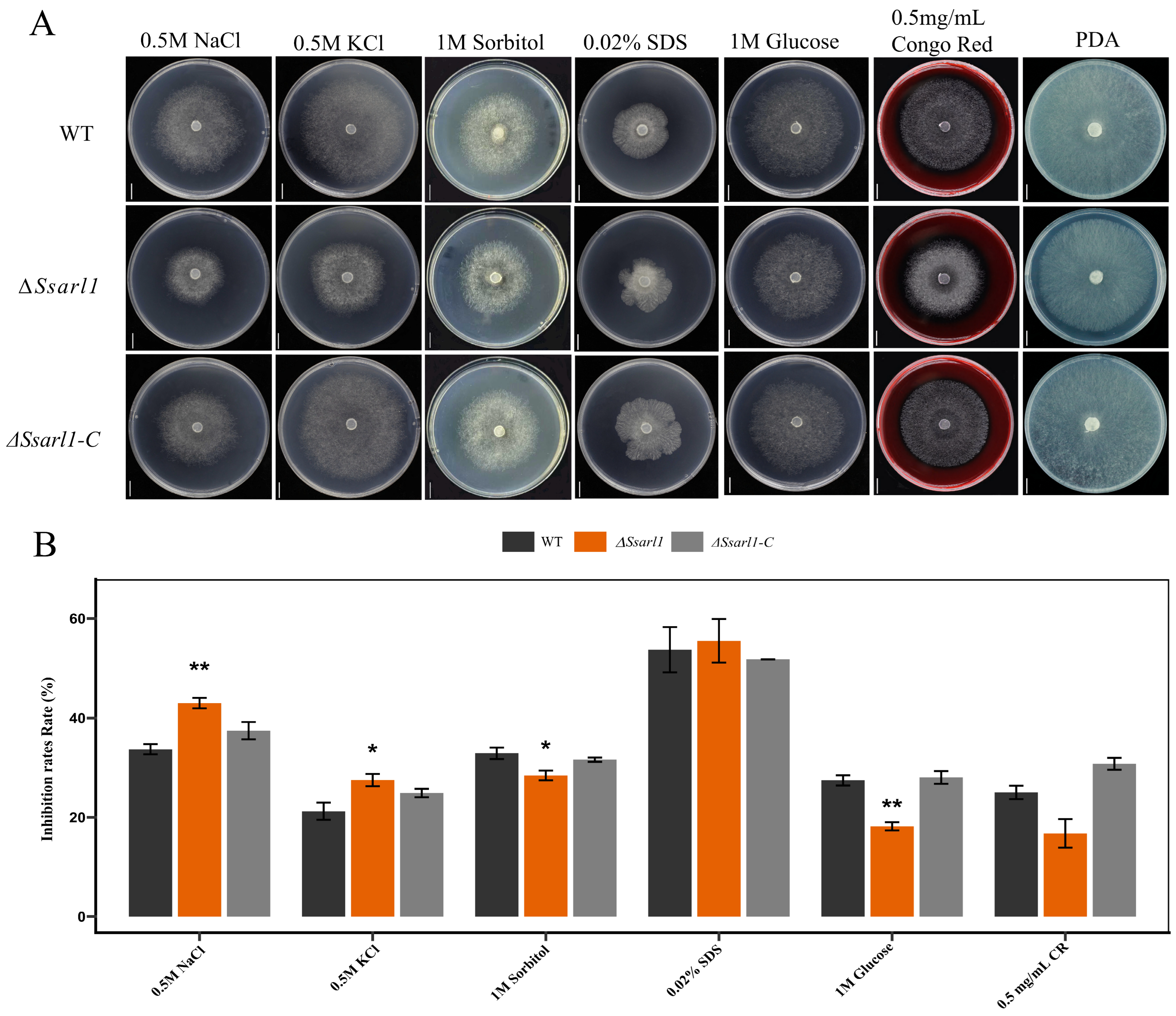
To explore SsArl1’s role in maintaining cell wall integrity and stress adaptation, mycelial plugs from wild-type (WT), ΔSsarl1 deletion mutant, and ΔSsarl1-C complemented strains were inoculated on potato dextrose agar (PDA) plates containing various stressors, cell wall-perturbing agents (0.5 mg/mL Congo Red [CR] or 0.02% sodium dodecyl sulfate [SDS]), ionic osmotic agents (0.5 M NaCl or 0.5 M KCl), and non-ionic osmotic agents (1 M sorbitol or 1 M glucose). Plain PDA plates served as controls. After 48 h at 20 °C, radial colony growth was measured. Under CR stress, the ΔSsarl1 mutant formed slightly smaller colonies compared to WT and ΔSsarl1-C strains, reflecting slower growth. However, relative growth inhibition, calculated against growth on plain PDA, showed no significant differences among these strains (Figure 6, Supplementary Figure S2). This suggests that the basal growth defect of ΔSsarl1 accounts for the smaller colony size, and its sensitivity to CR-induced cell wall stress is not noticeably enhanced.
With SDS, the ΔSsarl1 mutant had a smaller colony diameter, consistent with its basal growth defect on plain PDA, but no significant difference in relative growth inhibition was observed among the strains (Figure 6, Supplementary Figure S2), suggesting that SsArl1 does not affect SDS-induced membrane stress sensitivity. Under ionic stress (NaCl and KCl), the ΔSsarl1 mutant exhibited a higher relative growth inhibition rate than WT and ΔSsarl1-C strains (Figure 6, Supplementary Figure S2), indicating increased sensitivity to ionic stress. Under non-ionic osmotic stress, the ΔSsarl1 mutant showed a significantly lower relative growth inhibition than the WT and ΔSsarl1-C strains for sorbitol (1 M) at the 0.01 level, and glucose (1 M) at the 0.05 level, respectively (Figure 6, Supplementary Figure S2). These results suggest that SsArl1 is not required for tolerance to non-ionic osmotic stress.

4. Discussion

Several studies have shown that the Arl1 gene plays a crucial role in regulating physiological processes such as development and host infection in plant pathogenic fungi. For instance, in M. oryzae and F. graminearum, disrupting the Arl1 homologs MoArl1 [31] and FgArl1 [30] significantly reduces their ability to infect hosts and impairs their growth and development. Furthermore, phylogenetic analysis of Arl1 proteins from diverse fungi revealed that SsArl1 shares high sequence identity with MoArl1 and FgArl1, with identity values of 91.16% and 91.48%, respectively (Supplementary Figure S3).
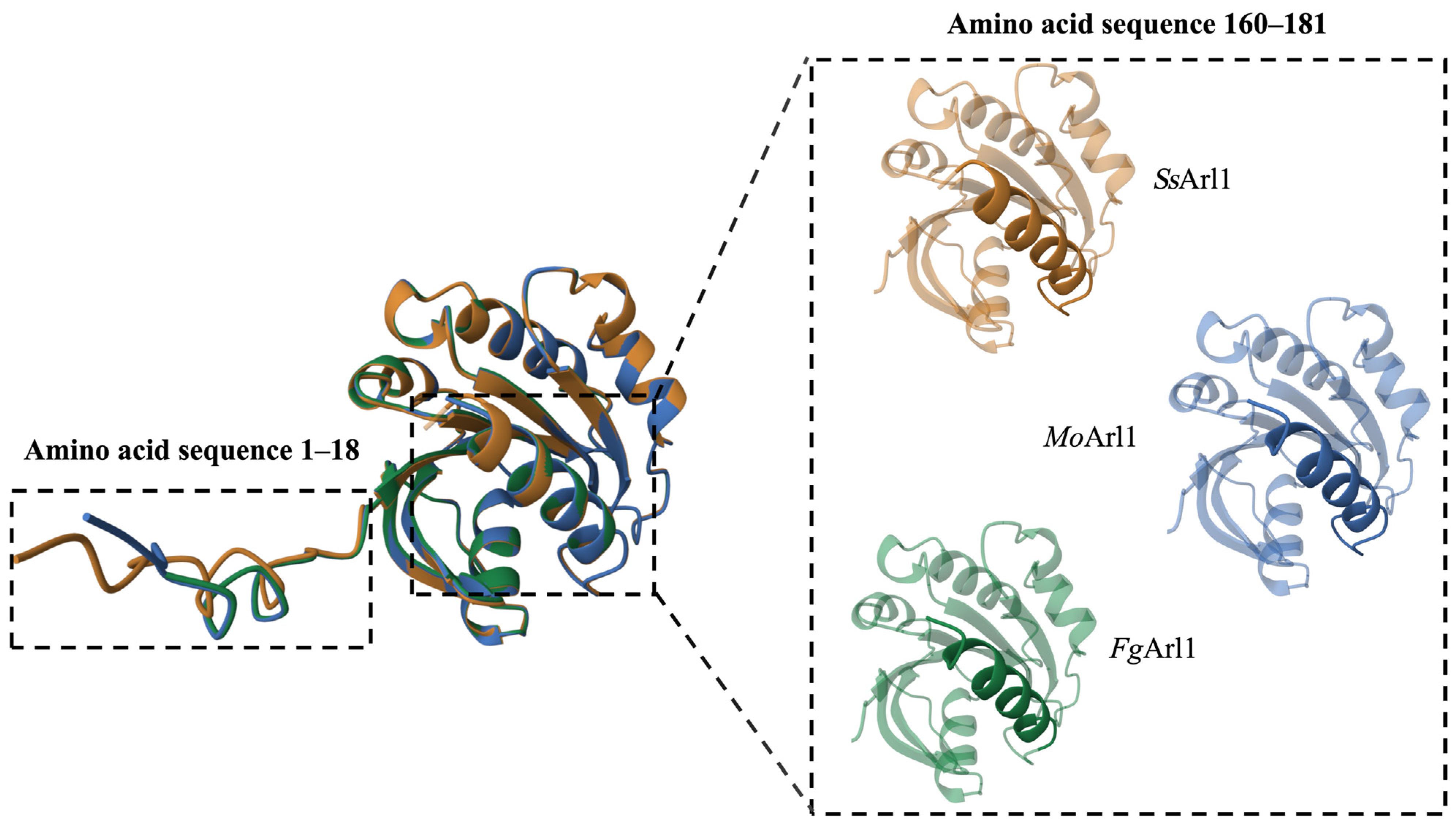
Interestingly, the function of Arl1 in S. sclerotiorum differs notably. While knockout of the Arl1 homolog SsArl1 in S. sclerotiorum suppresses hyphal growth, similar to the effects seen with MoArl1 and FgArl1 deletions, it unexpectedly enhances host infection by S. sclerotiorum, setting it apart from the other fungi. It is speculated that such functional differences may result from variations in protein structure. Compared with MoArl1 and FgArl1, SsArl1 exhibits two smaller random coils in the 1–18 amino acid region and possesses an additional α-helix within the α-helical domain spanning residues 160–181. However, these structural discrepancies are predicted based on homologous modeling and structural alignment, and further experimental validation is required to obtain more accurate and definitive conclusions (Figure 7).
In addition to structural factors, the increased secretion of oxalic acid (OA) significantly contributes to the enhanced virulence of the SsArl1 deletion mutant [8]. OA is a key virulence factor in S. sclerotiorum, performing multiple roles during plant infection. Early in infection, OA secretion creates a reducing environment that suppresses host defenses, such as oxidative bursts and callose deposition [5,44]. Once established, OA regulates ambient acidity, fostering pathogenicity and reproduction [45]. It also triggers a reactive oxygen species (ROS) burst in host tissues, leading to programmed cell death and necrosis, which provides nutrients for S. sclerotiorum [46,47]. Additionally, OA detoxifies by facilitating calcium ion translocation from host cells into older hyphae, forming non-toxic calcium oxalate crystals that protect hyphae in the infection zone from calcium toxicity [48]. Furthermore, secreted cellulolytic enzyme activity was markedly higher in the SsArl1 deletion mutant than in WT and ΔSsarl1-C strains.
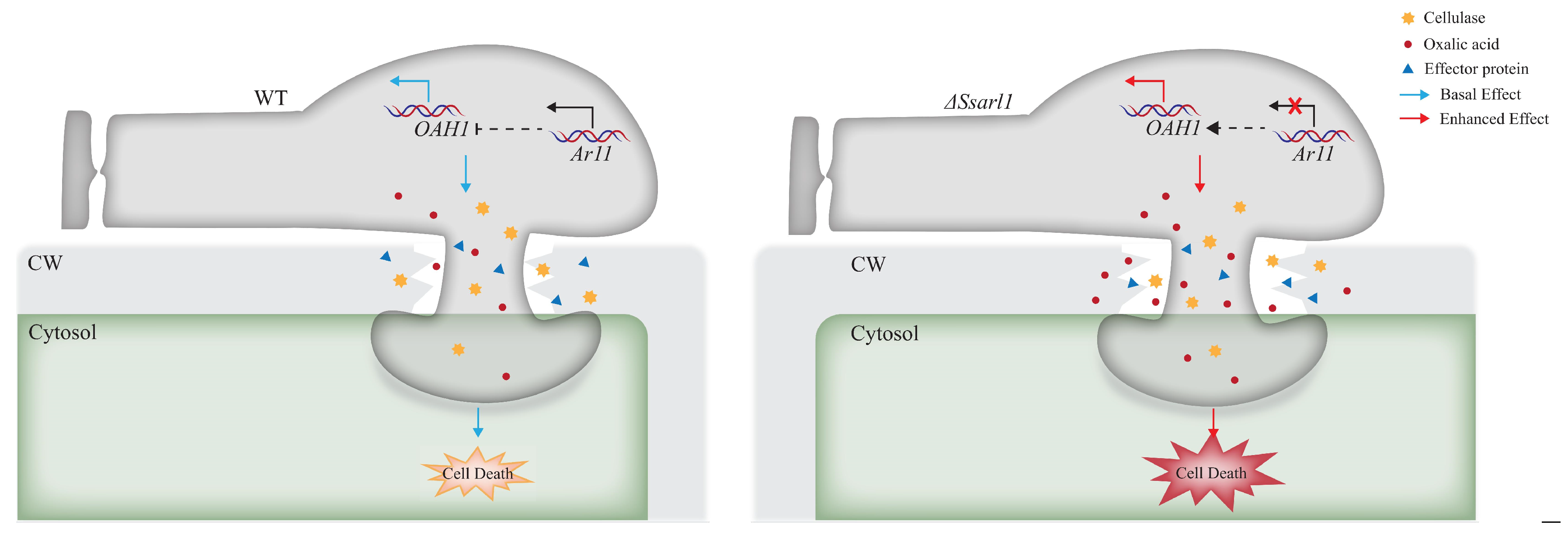
Based on our findings above, we propose that SsArl1 negatively regulates S. sclerotiorum virulence by limiting OA secretion. Disrupting SsArl1 removes this restriction, causing a significant increase in OA accumulation. During host interaction, elevated OA suppresses host defenses and enhances cellulolytic enzyme activity, thereby boosting the infectivity of the SsArl1 deletion mutant (Figure 8).
These findings advance the understanding of molecular mechanisms underlying fungal pathogenicity and secretory regulation. By demonstrating that SsArl1 modulates oxalic acid secretion, cellulase activity, and effector deployment, this study elucidates how a single Golgi-associated GTPase coordinates multiple virulence-related processes. Such mechanistic insights contribute to the broader comprehension of vesicle trafficking, protein secretion, and metabolite regulation in filamentous fungi.
Overall, this study comprehensively explored SsArl1’s role in S. sclerotiorum’s growth, stress response, and pathogenicity, revealing a new functional divergence of Arl1 proteins in plant pathogens. Moreover, identifying SsArl1 as a negative regulator of virulence highlights a potential target for disease management strategies. Manipulation of SsArl1’s regulation of OA secretion and/or similar regulatory pathways could benefit the development of crop protection approaches aimed at mitigating S. sclerotiorum infections and remarkably reducing the agricultural losses.

Supplementary Materials

The following supporting information can be downloaded at: https://www.mdpi.com/article/10.3390/jof12060431/s1, Table S1: Primer sequences used in this study. Table S2: UHPLC analysis of oxalic acid in different samples, including peak characteristics and quantitative parameters. Figure S1: Ultra-high performance liquid chromatography (UHPLC) analysis of oxalic acid in S. sclerotiorum. (A–F) Representative UHPLC chromatograms of oxalic acid standard solutions at concentrations of 25, 50, 100, 250, 500, and 1000 ppm, respectively. (G–I) UHPLC chromatograms of intracellular oxalic acid extracted from mycelia of the WT, ΔSsarl1, and ΔSsarl1-C. (J–L) UHPLC chromatograms of extracellular oxalic acid detected in culture supernatants of WT, ΔSsarl1, and ΔSsarl1-C strains. (M) UV absorption spectrum of the oxalic acid standard solution scanned from 190 to 680 nm. (N) External standard calibration curve for oxalic acid, generated by plotting peak area (mAU·min) against known concentrations (ppm). Figure S2. Re-evaluation of stress sensitivity assays using larger culture plates. (A) Colony morphology of WT, ΔSsarl1, and ΔSsarl1-C strains grown on PDA medium supplemented with different stress agents, including 0.5 M NaCl, 0.5 M KCl, 1 M sorbitol, 0.02% SDS, 1 M glucose, and 0.5 mg/mL Congo Red (CR). To minimize growth restriction under control conditions, the assays were repeated using 130 mm × 130 mm square Petri dishes, and colony growth was recorded after 48 h incubation at 20 °C. (B) Relative growth inhibition rates of the indicated strains under different stress conditions. Statistical analysis was performed using two-way ANOVA to evaluate the interaction between genotype and stress treatment. The repeated experiments produced results consistent with the original conclusions presented in Figure 6. Data represent the mean ± SD from three independent biological replicates. Asterisks indicate statistically significant differences (* p < 0.05, ** p < 0.01). Figure S3. Maximum-likelihood phylogenetic analysis of fungal Arl1 proteins. A maximum-likelihood (ML) phylogenetic tree was constructed using Arl1 protein sequences from representative fungal species in MEGA12 with 1000 bootstrap replicates. Bootstrap values are shown at the corresponding nodes. Labels consist of abbreviated species names, protein names, and NCBI accession numbers. For example, SsArl1 (APA07851) represents the Arl1 protein from S. sclerotiorum with accession number APA07851. Detailed sequence information is provided in Supplementary Materials S1 and S2.

Author Contributions

Z.C. and K.W. designed and carried out most of the experiments. Z.C. and K.W. wrote the original draft of the manuscript. K.W., L.Q. and J.C. contributed to the mutagenized population of S. sclerotiorum. Z.C. and J.T. analyzed and validated the data. S.X. conceptualized the project, supervised the research, and provided critical guidance throughout the study. Z.C., K.W. and S.X. revised the manuscript. All authors have read and agreed to the published version of the manuscript.

Funding

This work was financially supported by the following funding sources: the National Natural Science Foundation of China (Grant No. 31971836); the Yuelushan Major Project in Modern Seed Industry (Grant No. YLS-2025-ZY01008); and the Scientific Research Grant of Hunan Agricultural University (Grant No. 25SF019).

Institutional Review Board Statement

Not applicable.

Informed Consent Statement

Not applicable.

Data Availability Statement

The GenBank accession numbers, together with the corresponding species names for all organisms used in this study, are listed as follows, Sclerotinia sclerotiorum SsArl1 (APA07851), Fusarium graminearum FgArl1 (XP_011326587.1), Saccharomyces cerevisiae ScArl1 (CAA85125.1), human ARL1 (ARL1_HUMAN), and Magnaporthe oryzae MoArl1 (XP_003712475.1, A0A428PG50.1.A), and were retrieved from the National Center for Biotechnology Information (NCBI) database (https://www.ncbi.nlm.nih.gov/, last accessed on 28 December 2025). The general feature format (gff3) files for the Arl1 gene were downloaded from the Ensembl Fungi database (https://fungi.ensembl.org/, last accessed on 28 December 2025).

Acknowledgments

We would like to express our sincere gratitude to Xin Li (University of British Columbia) for providing critical suggestions on the experimental design of this study, to Daohong Jiang (Huazhong Agricultural University) for kindly sharing the pCH-EF-1 plasmid, and to Jeffrey Rollins (University of Florida) for providing the wild-type (WT) S. sclerotiorum strain 1980 used in our experiments. During the preparation of this manuscript, the first author used ChatGPT (GPT-3.5, OpenAI) to assist with English grammar correction, and language simplification of certain descriptions in Section 2 to better align with the journal’s writing style. The authors carefully reviewed and edited all AI-assisted content and take full responsibility for the content of this publication.

Conflicts of Interest

The authors declare no conflict of interest.

References

  1. Guyon, K.; Balague, C.; Roby, D.; Raffaele, S. Secretome analysis reveals effector candidates associated with broad host range necrotrophy in the fungal plant pathogen Sclerotinia sclerotiorum. BMC Genom. 2014, 15, 336. [Google Scholar] [CrossRef] [PubMed]
  2. Derbyshire, M.; Denton-Giles, M.; Hegedus, D.; Seifbarghy, S.; Rollins, J.; van Kan, J.; Seidl, M.F.; Faino, L.; Mbengue, M.; Navaud, O.; et al. The complete genome sequence of the phytopathogenic fungus Sclerotinia sclerotiorum reveals insights into the genome architecture of broad host range pathogens. Genome Biol. Evol. 2017, 9, 593–618. [Google Scholar] [CrossRef]
  3. Newman, T.E.; Kim, H.; Khentry, Y.; Sohn, K.H.; Derbyshire, M.C.; Kamphuis, L.G. The broad host range pathogen Sclerotinia sclerotiorum produces multiple effector proteins that induce host cell death intracellularly. Mol. Plant Pathol. 2023, 24, 866–881. [Google Scholar] [CrossRef]
  4. Erental, A.; Dickman, M.B.; Yarden, O. Sclerotial development in Sclerotinia sclerotiorum: Awakening molecular analysis of a “Dormant” structure. Fungal Biol. Rev. 2008, 22, 6–16. [Google Scholar] [CrossRef]
  5. Williams, B.; Kabbage, M.; Kim, H.J.; Britt, R.; Dickman, M.B. Tipping the balance: Sclerotinia sclerotiorum secreted oxalic acid suppresses host defenses by manipulating the host redox environment. PLoS Pathog. 2011, 7, e1002107. [Google Scholar] [CrossRef] [PubMed]
  6. Cessna, S.G.; Sears, V.E.; Dickman, M.B.; Low, P.S. Oxalic acid, a pathogenicity factor for Sclerotinia sclerotiorum, suppresses the oxidative burst of the host plant. Plant Cell 2000, 12, 2191–2200. [Google Scholar] [CrossRef]
  7. Xia, S.; Xu, Y.; Hoy, R.; Zhang, J.; Qin, L.; Li, X. The Notorious Soilborne Pathogenic Fungus Sclerotinia sclerotiorum: An Update on Genes Studied with Mutant Analysis. Pathogens 2019, 9, 27. [Google Scholar] [CrossRef]
  8. Xu, L.; Li, G.; Jiang, D.; Chen, W. Sclerotinia sclerotiorum: An Evaluation of Virulence Theories. Annu. Rev. Phytopathol. 2018, 56, 311–338. [Google Scholar] [CrossRef]
  9. Bolton, M.D.; Thomma, B.P.; Nelson, B.D. Sclerotinia sclerotiorum (Lib.) de Bary: Biology and molecular traits of a cosmopolitan pathogen. Mol. Plant Pathol. 2006, 7, 1–16. [Google Scholar] [CrossRef] [PubMed]
  10. Dean, R.; Van Kan, J.A.; Pretorius, Z.A.; Hammond-Kosack, K.E.; Di Pietro, A.; Spanu, P.D.; Rudd, J.J.; Dickman, M.; Kahmann, R.; Ellis, J.; et al. The Top 10 fungal pathogens in molecular plant pathology. Mol. Plant Pathol. 2012, 13, 414–430. [Google Scholar] [CrossRef]
  11. Burgess, T.L.; Kelly, R.B. Constitutive and regulated secretion of proteins. Annu. Rev. Cell Biol. 1987, 3, 243–293. [Google Scholar] [CrossRef]
  12. Bonifacino, J.S.; Glick, B.S. The mechanisms of vesicle budding and fusion. Cell 2004, 116, 153–166. [Google Scholar] [CrossRef]
  13. Suda, Y.; Kurokawa, K.; Nakano, A. Regulation of ER-Golgi Transport Dynamics by GTPases in Budding Yeast. Front. Cell Dev. Biol. 2017, 5, 122. [Google Scholar] [CrossRef] [PubMed]
  14. Mizuno-Yamasaki, E.; Rivera-Molina, F.; Novick, P. GTPase networks in membrane traffic. Annu. Rev. Biochem. 2012, 81, 637–659. [Google Scholar] [CrossRef]
  15. Donaldson, J.G.; Jackson, C.L. ARF family G proteins and their regulators: Roles in membrane transport, development and disease. Nat. Rev. Mol. Cell Biol. 2011, 12, 362–375. [Google Scholar] [CrossRef]
  16. Lu, L.; Horstmann, H.; Ng, C.; Hong, W. Regulation of Golgi structure and function by ARF-like protein 1 (Arl1). J. Cell Sci. 2001, 114, 4543–4555. [Google Scholar] [CrossRef]
  17. D’Souza-Schorey, C.; Chavrier, P. ARF proteins: Roles in membrane traffic and beyond. Nat. Rev. Mol. Cell Biol. 2006, 7, 347–358. [Google Scholar] [CrossRef]
  18. Gillingham, A.K.; Munro, S. The small G proteins of the Arf family and their regulators. Annu. Rev. Cell Dev. Biol. 2007, 23, 579–611. [Google Scholar] [CrossRef]
  19. Boman, A.L.; Kahn, R.A. Arf proteins: The membrane traffic police? Trends Biochem. Sci. 1995, 20, 147–150. [Google Scholar] [CrossRef] [PubMed]
  20. Jackson, C.L.; Bouvet, S. Arfs at a Glance. J. Cell Sci. 2014, 127, 4103–4109. [Google Scholar] [CrossRef] [PubMed]
  21. Gamara, J.; Chouinard, F.; Davis, L.; Aoudjit, F.; Bourgoin, S.G. Regulators and Effectors of Arf GTPases in Neutrophils. J. Immunol. Res. 2015, 2015, 235170. [Google Scholar] [CrossRef] [PubMed]
  22. Pasqualato, S.; Renault, L.; Cherfils, J. Arf, Arl, Arp and Sar proteins: A family of GTP-binding proteins with a structural device for ‘front-back’ communication. EMBO Rep. 2002, 3, 1035–1041. [Google Scholar] [CrossRef]
  23. Ungermann, C.; Kümmel, D. Structure of membrane tethers and their role in fusion. Traffic 2019, 20, 479–490. [Google Scholar] [CrossRef]
  24. McDonold, C.M.; Fromme, J.C. Four GTPases differentially regulate the Sec7 Arf-GEF to direct traffic at the trans-golgi network. Dev. Cell 2014, 30, 759–767. [Google Scholar] [CrossRef]
  25. Gustafson, M.A.; Fromme, J.C. Regulation of Arf activation occurs via distinct mechanisms at early and late Golgi compartments. Mol. Biol. Cell 2017, 28, 3660–3671. [Google Scholar] [CrossRef] [PubMed]
  26. Tsai, P.C.; Hsu, J.W.; Liu, Y.W.; Chen, K.Y.; Lee, F.J.S. Arl1p regulates spatial membrane organization at the trans-Golgi network through interaction with Arf-GEF Gea2p and flippase Drs2p. Proc. Natl. Acad. Sci. USA 2013, 110, E668–E677. [Google Scholar] [CrossRef]
  27. Rosenwald, A.G.; Rhodes, M.A.; Van Valkenburgh, H.; Palanivel, V.; Chapman, G.; Boman, A.; Zhang, C.J.; Kahn, R.A. ARL1 and membrane traffic in Saccharomyces cerevisiae. Yeast 2002, 19, 1039–1056. [Google Scholar] [CrossRef] [PubMed]
  28. Maresova, L.; Vydareny, T.; Sychrova, H. Comparison of the influence of small GTPases Arl1 and Ypt6 on yeast cells’ tolerance to various stress factors. FEMS Yeast Res. 2012, 12, 332–340. [Google Scholar] [CrossRef]
  29. Munson, A.M.; Haydon, D.H.; Love, S.L.; Fell, G.L.; Palanivel, V.R.; Rosenwald, A.G. Yeast ARL1 encodes a regulator of K+ influx. J. Cell Sci. 2004, 117, 2309–2320. [Google Scholar] [CrossRef] [PubMed]
  30. Wang, C.; Wang, Y.; Wang, Y.; Wang, Z.; Zhang, L.; Liang, Y.; Chen, L.; Zou, S.; Dong, H. The ADP-ribosylation factor-like small GTPase FgArl1 participates in growth, pathogenicity and DON production in Fusarium graminearum. Fungal Biol. 2020, 124, 969–980. [Google Scholar] [CrossRef]
  31. Zhang, S.; Yang, L.; Li, L.; Zhong, K.; Wang, W.; Liu, M.; Li, Y.; Liu, X.; Yu, R.; He, J.; et al. System-Wide Characterization of MoArf GTPase Family Proteins and Adaptor Protein MoGga1 Involved in the Development and Pathogenicity of Magnaporthe oryzae. mBio 2019, 10, e02398-19. [Google Scholar] [CrossRef]
  32. Chen, C.; Wu, Y.; Li, J.; Wang, X.; Zeng, Z.H.; Xu, J.; Liu, Y.L.; Feng, J.T.; Chen, H.; He, Y.H.; et al. TBtools-II: A “one for all, all for one”bioinformatics platform for biological big-data mining. Mol. Plant 2023, 16, 1733–1742. [Google Scholar]
  33. Vargová, R.; Wideman, J.G.; Derelle, R.; Klimeš, V.; Kahn, R.A.; Dacks, J.B.; Eliáš, M. A Eukaryote-Wide Perspective on the Diversity and Evolution of the ARF GTPase Protein Family. Genome Biol. Evol. 2021, 13, evab157. [Google Scholar] [CrossRef] [PubMed]
  34. Stecher, G.; Suleski, M.; Tao, Q.; Tamura, K.; Kumar, S. MEGA 12.1: Cross-Platform Release for macOS and Linux Operating Systems. J. Mol. Evol. 2026, 94, 14–18. [Google Scholar] [CrossRef] [PubMed]
  35. Torsten, S.; Jürgen, K.; Nicolas, G.; Peitsch, M.C. SWISS-MODEL: An automated protein homology-modeling server. Nucleic Acids Res. 2003, 31, 3381–3385. [Google Scholar]
  36. Bittrich, S.; Segura, J.; Duarte, J.M.; Burley, S.K.; Rose, Y. RCSB protein Data Bank: Exploring protein 3D similarities via comprehensive structural alignments. Bioinformatics 2024, 40, btae370. [Google Scholar] [CrossRef] [PubMed]
  37. Goswami, R.S. Targeted gene replacement in fungi using a split-marker approach. Methods Mol. Biol. 2012, 835, 255–269. [Google Scholar] [CrossRef]
  38. Liang, X.; Liberti, D.; Li, M.; Kim, Y.T.; Hutchens, A.; Wilson, R.; Rollins, J.A. Oxaloacetate acetylhydrolase gene mutants of Sclerotinia sclerotiorum do not accumulate oxalic acid, but do produce limited lesions on host plants. Mol. Plant Pathol. 2015, 16, 559–571. [Google Scholar] [CrossRef]
  39. McCaghey, M.; Shao, D.; Kurcezewski, J.; Lindstrom, A.; Ranjan, A.; Whitham, S.A.; Conley, S.P.; Williams, B.; Smith, D.L.; Kabbage, M. Host-Induced Gene Silencing of a Sclerotinia sclerotiorum oxaloacetate acetylhydrolase Using Bean Pod Mottle Virus as a Vehicle Reduces Disease on Soybean. Front. Plant Sci. 2021, 12, 677631. [Google Scholar] [CrossRef]
  40. Yu, C.; Wang, Y.; Cao, H.; Zhao, Y.; Li, Z.; Wang, H.; Chen, M.; Tang, Q. Simultaneous Determination of 13 Organic Acids in Liquid Culture Media of Edible Fungi Using High-Performance Liquid Chromatography. Biomed. Res. Int. 2020, 2020, 2817979. [Google Scholar] [CrossRef]
  41. Honow, R.; Bongartz, D.; Hesse, A. An improved HPLC-enzyme-reactor method for the determination of oxalic acid in complex matrices. Clin. Chim. Acta 1997, 261, 131–139. [Google Scholar] [CrossRef]
  42. Chen, Z.; Luo, Q.; Wang, M.; Chen, B. A Rapid Method with UPLC for the Determination of Fusaric Acid in Fusarium Strains and Commercial Food and Feed Products. Indian J. Microbiol. 2017, 57, 68–74. [Google Scholar] [CrossRef] [PubMed]
  43. Wang, K.; Wang, S.; Wang, T.; Xia, Q.; Xia, S. The Sclerotinia sclerotiorum ADP-Ribosylation Factor 6 Plays an Essential Role in Abiotic Stress Response and Fungal Virulence to Host Plants. J. Fungi 2023, 10, 12. [Google Scholar] [CrossRef] [PubMed]
  44. Gong, B.Q.; Liu, J.J.; Xu, J.; Cheng, J.; Li, J.F. Fungal oxalic acid inhibits the deamidation of CERK1 ectodomain to dampen chitin-triggered plant immunity. Sci. China Life Sci. 2025, 68, 3744–3755. [Google Scholar] [CrossRef]
  45. Atallah, O.; Yassin, S. Aspergillus spp. eliminate Sclerotinia sclerotiorum by imbalancing the ambient oxalic acid concentration and parasitizing its sclerotia. Environ. Microbiol. 2020, 22, 5265–5279. [Google Scholar] [CrossRef] [PubMed]
  46. Kim, K.S.; Min, J.Y.; Dickman, M.B. Oxalic acid is an elicitor of plant programmed cell death during Sclerotinia sclerotiorum disease development. Mol. Plant Microbe Interact. 2008, 21, 605–612. [Google Scholar] [CrossRef]
  47. Rana, K.; Yuan, J.; Liao, H.; Banga, S.S.; Kumar, R.; Qian, W.; Ding, Y. Host-induced gene silencing reveals the role of Sclerotinia sclerotiorum oxaloacetate acetylhydrolase gene in fungal oxalic acid accumulation and virulence. Microbiol. Res. 2022, 258, 126981. [Google Scholar] [CrossRef]
  48. Heller, A.; Witt-Geiges, T. Oxalic acid has an additional, detoxifying function in Sclerotinia sclerotiorum pathogenesis. PLoS ONE 2013, 8, e72292. [Google Scholar] [CrossRef]
Figure 1. Identification of Arf1 protein from S. sclerotiorum. (A) Identification of the Arl1 Protein in S. sclerotiorum. (B) Functional Prediction of the SsArl1 Protein. (C) Identification of SsArl1 Homologous Proteins in S. sclerotiorum.
Jof 12 00431 g001
Figure 2. Knockout of SsArl1 in S. sclerotiorum. (A) Strategy for generating the ΔSsarl1 strain via homologous recombination. The SsArl1 coding region was replaced with a hygromycin resistance cassette (HYG) using flanking sequence-mediated recombination. (B) PCR validation of the wild-type (WT), ΔSsarl1 mutant, and complemented strain (ΔSsarl1-C). Lanes 1–3 show amplification of the upstream region, downstream region, and SsArl1 coding sequence, respectively; lanes 4–6 display amplification of the HY, YG, and NEO marker genes. M represents the DNA size marker. (C) qPCR analysis of SsArl1 expression in WT, ΔSsarl1, and ΔSsarl1-C strains, normalized to the internal reference gene SsTub1. Data are presented as mean ± SD from three independent experiments. Statistical significance was assessed using Student’s t-test, with asterisks indicating significant differences (** p < 0.01).
Jof 12 00431 g002
Figure 3. Phenotypic analysis of ΔSsarl1 in S. sclerotiorum. (A) Growth phenotypes of WT, ΔSsarl1, and ΔSsarl1-C strains on PDA at 24 h, 48 h, and 7 days. Representative colonies are presented; scale bar = 1 cm. (B) Quantification of radial colony growth of the three strains at 24 h and 48 h post-inoculation. (C) Sclerotial production of WT, ΔSsarl1, and ΔSsarl1-C strains, scale bar = 1 cm. (D) Analysis of infection structures; scale bar = 100 μm. Data represent the mean ± SD of three independent experiments. Student’s t-test was applied to assess statistical significance. Statistically significant differences between groups are marked with asterisks (* p < 0.05, ** p < 0.01).
Jof 12 00431 g003
Figure 4. Analysis of mycelial branching and pathogenicity in three S. sclerotiorum strains. (A) Growth of wild-type (WT), ΔSsarl1 mutant, and ΔSsarl1-C complemented strains on A. thaliana leaves 24 h post-inoculation. (B) Lesion coverage as a percentage of total leaf area in A. thaliana infected with S. sclerotiorum. (C) Growth of the same strains on N. benthamiana leaves 24 h after inoculation. (D) Lesion coverage in N. benthamiana infected with S. sclerotiorum. Asterisks denote significant differences (* p < 0.05, ** p < 0.01); Scale bars = 1 cm.
Jof 12 00431 g004
Figure 5. Analysis of oxalic acid production in ΔSsarl1 mutants. (A) Comparison of colony growth and bromophenol blue (BPB)-induced color changes in WT, ΔSsarl1, and ΔSsarl1-C strains on PDA at 24 h and 48 h. (B) UHPLC quantification of oxalic acid levels in WT, ΔSsarl1, and ΔSsarl1-C strains. The ΔSsarl1 mutant showed significantly higher intracellular and extracellular oxalic acid compared to WT, while complementation restored oxalic acid levels to WT-like concentrations. (C) SsOAH1 expression of wild-type (WT), ΔSsarl1, and ΔSsarl1-C strains. (D) The cellulase secretion area to colony area in the wild type (WT), ΔSsarl1, and ΔSsarl1-C strains. Scale bar, 1 cm. (E) The cellulase secretion area in the wild type (WT), ΔSsarl1, and ΔSsarl1-C strains. Data represent mean ± SD from three independent biological replicates. Statistical significance was assessed using Student’s t-test (** p < 0.01); Scale bars = 1 cm.
Jof 12 00431 g005
Figure 6. Growth of different strains under stress conditions. (A) Hyphal growth phenotypes of wild-type (WT), ΔSsarl1, and ΔSsarl1-C strains under various stress treatments. (B) Growth inhibition rates of WT, ΔSsarl1, and ΔSsarl1-C strains under the same stresses. The relative inhibition rate for each strain was calculated using its radial growth on untreated PDA as the baseline, to account for differences in basal growth rates. Data are presented as mean ± SD from three independent experiments (* p < 0.05, ** p < 0.01); Scale bars = 1 cm.
Jof 12 00431 g006
Figure 7. Structural comparative analysis of Arl1 proteins. Different colors represent distinct structural features of various Arl1 proteins.
Jof 12 00431 g007
Figure 8. SsArl1 negatively regulates the virulence of S. sclerotiorum. In the left panel (WT strain), functional SsArl1 somehow exerts transcriptional repression on OAH1, the key gene controlling oxalic acid biosynthesis, thus limiting the secretion of oxalic acid (red dots) from the appressorium; Meanwhile, the secretion of cellulases (orange asterisks) and effector proteins (blue triangles) is maintained in the WT strain, which causes the degradation of cell wall (CW) and cell death of the host. In the right panel (ΔSsarl1 mutant), deletion of SsArl1 completely relieves the transcriptional inhibition on OAH1, resulting in a significant increase in OAH1 expression and oxalic acid secretion; The apoplastic acidification reinforces the activity of cellulase, which acts synergistically with effectors to cause severer degradation of the host cell wall, and robust host cell death ultimately, leading to significantly enhanced virulence of the ΔSsarl1 mutants.
Jof 12 00431 g008
Disclaimer/Publisher’s Note: The statements, opinions and data contained in all publications are solely those of the individual author(s) and contributor(s) and not of MDPI and/or the editor(s). MDPI and/or the editor(s) disclaim responsibility for any injury to people or property resulting from any ideas, methods, instructions or products referred to in the content.