Brief Report

Bioluminescence in the Edible Mushroom Hypsizygus marmoreus by Transformation with a Fungal Luciferase Gene


1
Key Laboratory of Edible Fungi Resources and Utilization (South), Ministry of Agriculture, National Engineering Research Center of Edible Fungi, National R&D Center for Edible Fungi Processing, Institute of Edible Fungi, Shanghai Academy of Agricultural Sciences, Shanghai 201403, China
2
Institute of Plant Protection, Jilin Agricultural University, Changchun 130118, China
3
Institute of Mycology, Jilin Agricultural University, Changchun 130118, China
4
College of Food Science, Shanghai Ocean University, Shanghai 201306, China
*
Authors to whom correspondence should be addressed.
These authors contributed equally to this work.
J. Fungi 2026, 12(6), 417; https://doi.org/10.3390/jof12060417 (registering DOI)
Submission received: 16 May 2026 / Revised: 4 June 2026 / Accepted: 5 June 2026 / Published: 9 June 2026
(This article belongs to the Section Fungal Cell Biology, Metabolism and Physiology)

Abstract

Following the elucidation of the fungal bioluminescence pathway (FBP), it was quickly adopted as a reporter system in plants; however, no such application has been documented in fungi to date. In this study, we established for the first time a luminescent reporter in the commercially important mushroom Hypsizygus marmoreus by expressing the luciferase gene from the luminous fungus Neonothopanus nambi. Using an established Agrobacterium-mediated transformation method, we separately introduced the wild-type luciferase gene nnLuz and the previously reported optimized variant nnLuz-v4 that can enhance bioluminescence expression into H. marmoreus arthroconidia. Both genes were stably integrated into the genome and expressed under the control of the H. marmoreus Glycerol 3-phosphate dehydrogenase (GPD) gene promoter. Upon addition of exogenous luciferin, transformants carrying the wild-type nnLuz produced clear, readily detectable bioluminescence signals, whereas no luminescence was observed in untransformed controls. Unexpectedly, the wild-type luciferase consistently exhibited substantially higher luminescence intensity than the optimized nnLuz-v4 variant. This finding suggests that codon optimization may be unnecessary or even detrimental when the donor and host are phylogenetically close basidiomycetes. The successful deployment of the fungal luciferase gene in H. marmoreus provides a sensitive and non-invasive genetic tool that does not require external excitation. This system opens new avenues for promoter characterization, real-time gene expression monitoring during mushroom development, and molecular breeding efforts aimed at improving agronomically important traits.

1. Introduction

The natural phenomenon of mushroom mycelium or cap emitting visible light at night has been recognized for centuries, yet the underlying biochemical mechanism remained elusive for a long time. A landmark discovery was made in 1959 when luciferase and its luciferin substrate were extracted from luminescent fungi [1]. However, it took nearly six decades to elucidate the complete bioluminescence pathway. In 2018, Kotlobay et al. revealed the molecular circuit of fungal bioluminescence, identifying the key enzymes and the cyclic mechanism of fungal luciferin regeneration [2].
Shortly after the disclosure of the fungal bioluminescence pathway (FBP), the first successful engineering of autonomous luminescent plants using the fungal luciferase system was reported in 2020 [3]. This breakthrough was subsequently adopted by several laboratories for plant synthetic biology applications [4,5]. Nevertheless, inconsistent results emerged, with some studies reporting no or extremely weak luminescence in certain plant species [6]. To address these limitations, a major optimization was achieved in 2024: the luciferase-encoding gene was subjected to codon optimization for plants, yeast, and human expression systems, combined with site-directed mutagenesis in bacteria. The resulting enhanced fungal luciferase system increased luminescence intensity by one to two orders of magnitude [7].
In parallel, edible mushrooms are cultivated on an industrial scale, and genetic improvement is of paramount importance for yield and quality. Mushroom genetics research serves as the foundation for such breeding efforts. Fluorescent markers, particularly GFP, have been widely used as genetic tools in edible mushroom research [8,9]. However, GFP requires blue light excitation and an expensive fluorescence microscope, limiting its convenience and throughput. Interestingly, although the FBP has been successfully repurposed for studying gene expression and promoter activity in plants [10], and despite the close phylogenetic relationship between most edible mushrooms (order Agaricales) and luminescent fungi (also within Agaricales), there has been no report of using the FBP as a reporter system in edible mushroom genetics.
Hypsizygus marmoreus is a commercially important edible mushroom cultivated on a large scale in China. Our laboratory has been dedicated to improving H. marmoreus strains through molecular genetic approaches [11,12]. A convenient, highly sensitive, and non-invasive tracer marker is essential for studying gene function and genetic regulation in this species. In the present study, we leveraged our previously established Agrobacterium-mediated transformation method using arthroconidia as recipient material [13]. We separately transformed the wild-type luciferase gene nnLuz from the luminescent mushroom Neonothopanus nambi and the final optimized version nnLuz-v4 [7] into H. marmoreus. Upon addition of the luciferin substrate, luminescence signals were detected with high sensitivity. This new tool enables robust investigation of gene expression patterns and promoter dynamics, thereby empowering molecular breeding of H. marmoreus.

2. Materials and Methods

2.1. Strains and Culture Conditions

The wild-type H. marmoreus dikaryotic strain HZ40 used in this study was maintained in our laboratory and cultivated on potato dextrose agar (PDA) at 25 °C. Arthroconidia were harvested from 14-day-old cultures grown on PDA plates according to the method described by Bao et al., which utilises arthroconidia as recipient cells for genetic transformation [13]. Escherichia coli strain DH5α was used for plasmid construction, and Agrobacterium tumefaciens strain EHA105 was used for fungal transformation.

2.2. Vector Construction

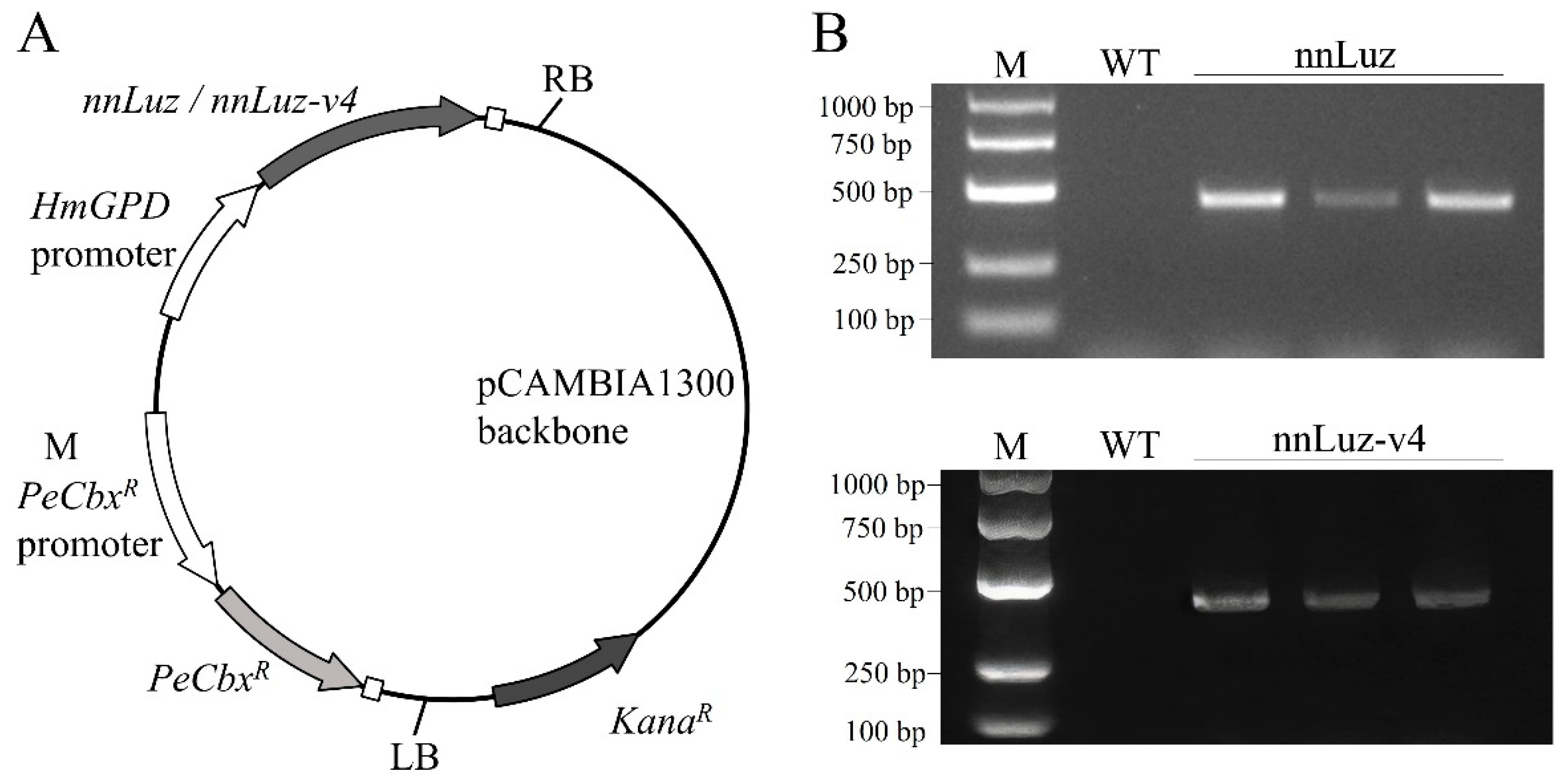
The fungal luciferase gene sequence was sourced from the published FBP of Neonothopanus nambi [2]. Two versions of the gene were commercially synthesised: the wild-type sequence (referred to as nnLuz) and the optimized version (referred to as nnLuz-v4) [7]. Both sequences were cloned into the binary vector pCAMBIA1300, in which expression was driven by the H. marmoreus Glycerol 3-phosphate dehydrogenase (GPD) gene promoter [14]. The carboxin resistance gene (CbxR) from Pleurotus eryngii served as the selectable marker under the control of its native promoter [15].

2.3. Agrobacterium-Mediated Transformation of Arthroconidia

Agrobacterium-mediated transformation (ATMT) of H. marmoreus arthroconidia was performed following the optimized protocol reported for this species [13]. Briefly, A. tumefaciens EHA105 cells harbouring the respective binary vectors were cultured in induction medium containing 200 μM acetosyringone to an OD600 of 0.4–0.6. Freshly harvested H. marmoreus arthroconidia were co-cultivated with induced Agrobacterium cells on nitrocellulose membranes overlaid on co-cultivation agar plates at 28 °C for two days. Following co-cultivation, the membranes were transferred to selection medium containing 2 μg/mL carboxin and 300 μg/mL cefotaxime to suppress residual Agrobacterium growth. Carboxin-resistant colonies that emerged after 10–14 days were subcultured onto fresh selective medium for three successive rounds to ensure mitotic stability.

2.4. Molecular Confirmation of Transformants

Genomic DNA was extracted from carboxin-resistant colonies using the cetyltrimethyl ammonium bromide (CTAB) method. Integration of the transgene was confirmed by PCR amplification with primers specific to the luciferase gene sequences. The PCR primers for nnLuz were nnluz-F3 (5′-ACCAGACTTTCCTAGAAGTG-3′) and nnluz-R3 (5′-AGATGAAGTGTGCAATCATG-3′), with an expected amplicon size of 457 bp. The PCR primers for nnLuz-v4 were nnluz-F5 (5′-GGAGAGACTACCAGACCTTC-3′) and nnluz-R5 (5′-GTCCTCCTGACAGTATCATG-3′), with an expected amplicon size of 415 bp. PCR products were resolved by agarose gel electrophoresis and visualized under UV illumination after ethidium bromide staining.

2.5. Luminescence Imaging

For luminescence detection, mycelial plugs were taken from PDA plates on which mycelium of wild-type and transformants had grown, placed in an empty Petri dish, and 1 mmol/L luciferin was added onto the mycelial surface. Luminescence was captured using the Tanon 5200 automatic chemiluminescence image analysis system equipped with a Sony ICX694 CCD camera (Tanon, Shanghai, China). All imaging experiments were performed at least three times independently, with representative images presented.

2.6. Image Processing and Statistical Analysis

The online image processing software ImageJ 1.53m (https://ij.imjoy.io/) was used to quantify the luminescence intensity of different strains in images taken after luciferin addition. The GraphPad Prism 9 software was used for statistical analysis and graphical representation of the quantified luminescence intensity data.

3. Results

3.1. The Wild-Type and Optimized Fungal Luciferase Genes Were Separately Transformed into H. marmoreus

Transformation of H. marmoreus arthroconidia with both the nnLuz and nnLuz-v4 binary vectors yielded carboxin-resistant colonies. PCR analysis of genomic DNA from representative transformants confirmed successful integration of the nnLuz or nnLuz-v4 transgene in all carboxin-resistant colonies tested, indicating that both fungal luciferase genes were stably integrated into the H. marmoreus genome. The PCR detection results of three independent nnLuz transformants and three independent nnLuz-v4 transformants are shown in Figure 1.

3.2. NnLuz Far Outperforms NnLuz-v4 in Luminescence Intensity

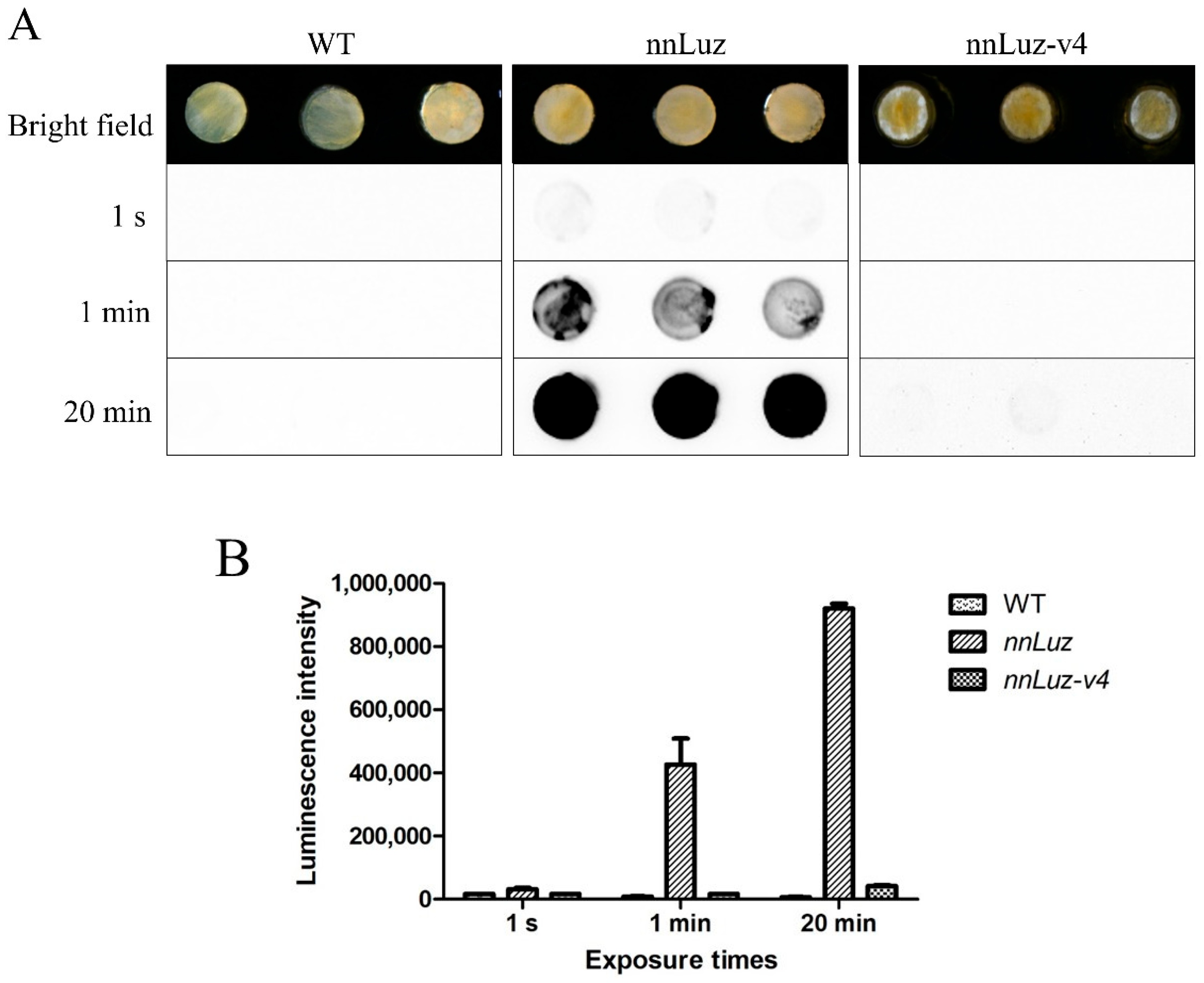
The luminescence signals in mycelial plugs of wild-type and three independent transformants were detected using the Tanon 5200 automatic chemiluminescence image analysis system with varying exposure times in the dark. The luminescence signal of transformants containing the nnLuz gene could be detected with just a 1-s exposure. After a 1-min exposure, the luminescence signal on the entire mycelial surface could be clearly and stably detected. The signal became saturated after 20 min of exposure. In contrast, the wild-type H. marmoreus control strain still showed no luminescence signal even after 20 min of exposure. Interestingly, the previously published optimized luciferase gene version nnLuz-v4, despite significantly enhancing bioluminescence intensity in plants, yeast, and mammalian cells [7], performed much worse in H. marmoreus than the wild-type version nnLuz. Transformants carrying the nnLuz-v4 gene showed no signal after a 1-min exposure, and only a weak signal could be detected after 20 min of exposure (Figure 2A).
We used ImageJ software to quantify the luminescence intensity of the wild-type H. marmoreus, three independent nnLuz transformants, and three independent nnLuz-v4 transformants in images taken after the addition of luciferin. Then, we performed statistical analysis on the quantified data using GraphPad Prism 9 software. The results showed that the background signal of the wild-type strain was very low, that nnLuz-v4 transformants became detectable only after 20 min of exposure, and that the luminescence signal of nnLuz transformants was significantly stronger than that of nnLuz-v4 transformants. (Figure 2B).

4. Discussion

In this study, we report the first successful expression of a fungal luciferase gene—the nnLuz gene from the fungal bioluminescence pathway of N. nambi—in the edible mushroom H. marmoreus. Our results demonstrate that the expressed luciferase is enzymatically active and produces bioluminescence that is readily detectable using a CCD imaging system, with no background luminescence observed in control cultures. These findings establish the feasibility of deploying the fungal luciferase gene as a highly sensitive, autoluminescent reporter in cultivated edible fungi.
Unexpectedly, the wild-type nnLuz sequence consistently outperformed the optimized variant nnLuz-v4 in terms of luminescence intensity and signal yield under identical experimental conditions. This result implies that codon optimization may not confer benefit—and may even prove detrimental—when the host and donor organisms are phylogenetically closely related basidiomycete fungi. The native codon usage pattern may preserve co-translational folding pathways that are essential for the proper enzymatic function of the fungal luciferase.
Previous studies achieved auto-luminescence in plants by introducing all four genes of the fungal FBP. However, the substrate of the FBP, caffeic acid, is a product of lignin metabolism in plants. Edible mushrooms do not necessarily produce abundant caffeic acid in their metabolic repertoire. Therefore, even if all four FBP genes were transformed into edible mushrooms, auto-luminescence might not be realized.
Firefly luciferase is widely used in genetic research and also requires the exogenous addition of luciferin. However, its application in fungi has rarely been reported. This may be due to poor performance arising from large species differences or potential toxicity after transformation. As a reporter derived from basidiomycetes, the fungal luciferase gene should be more suitable for use in edible fungi. In this study, we transformed nnLuz and nnLuz-v4 into H. marmoreus and observed no growth differences between transformants and the wild-type strain.
The successful establishment of a luminescent reporter in H. marmoreus opens new avenues for genetic research in edible mushrooms. Unlike GFP-based reporters, this system requires no external excitation light source, generates no background luminescence, and can be coupled with simple, cost-efficient CCD detection. Potential applications include promoter characterization, real-time monitoring of gene expression during different developmental stages (mycelial growth, primordium formation, and fruiting body maturation), and the construction of biosensors responsive to environmental or nutritional cues. This work represents a foundational step towards the wider adoption of fungal luciferase gene-based genetic tools in mushroom science and may accelerate breeding programmes aimed at improving agronomically important traits such as yield, stress tolerance, and nutritional quality.

Author Contributions

Conceptualization: J.S.; Methodology, Formal analysis, and Validation: X.Z., Y.L., Y.W., R.C., L.T., C.Z. and J.W.; investigation and resources: X.Z., Y.L. and R.C.; writing—original draft preparation: J.S. and X.Z.; writing—review and editing, D.B., R.Y. and J.S.; supervision and project administration: D.B., R.Y. and J.S.; funding acquisition: J.S. All authors have read and agreed to the published version of the manuscript.

Funding

This study was supported by the Shanghai “Science and Technology Innovation Action Plan” International Science and Technology Cooperation Project (24390741800), the National Natural Science Foundation of China (32172649), and the Excellent Team Plan of Shanghai Academy of Agricultural Sciences [2022(014)].

Data Availability Statement

The original contributions presented in this study are included in the article. Further inquiries can be directed to the corresponding authors.

Conflicts of Interest

The authors declare no conflicts of interest.

References

  1. Airth, R.L.; McElroy, W.D. Light emission from extracts of luminous fungi. J. Bacteriol. 1959, 77, 249–250. [Google Scholar] [CrossRef] [PubMed]
  2. Kotlobay, A.A.; Sarkisyan, K.S.; Mokrushina, Y.A.; Marcet-Houben, M.; Serebrovskaya, E.O.; Markina, N.M.; Somermeyer, L.G.; Gorokhovatsky, A.Y.; Vvedensky, A.; Purtov, K.V.; et al. Genetically encodable bioluminescent system from fungi. Proc. Natl. Acad. Sci. USA 2018, 115, 12728–12732. [Google Scholar] [CrossRef]
  3. Mitiouchkina, T.; Mishin, A.S.; Somermeyer, L.G.; Markina, N.M.; Chepurnyh, T.V.; Guglya, E.B.; Karataeva, T.A.; Palkina, K.A.; Shakhova, E.S.; Fakhranurova, L.I.; et al. Plants with genetically encoded autoluminescence. Nat. Biotechnol. 2020, 38, 944–946. [Google Scholar] [CrossRef] [PubMed]
  4. Khakhar, A.; Starker, C.G.; Chamness, J.C.; Lee, N.; Stokke, S.; Wang, C.; Swanson, R.; Rizvi, F.; Imaizumi, T.; Voytas, D.F. Building customizable auto-luminescent luciferase-based reporters in plants. eLife 2020, 9, e52786. [Google Scholar] [CrossRef] [PubMed]
  5. Zheng, P.; Ge, J.; Ji, J.; Zhong, J.; Chen, H.; Luo, D.; Li, W.; Bi, B.; Ma, Y.; Tong, W.; et al. Metabolic engineering and mechanical investigation of enhanced plant autoluminescence. Plant Biotechnol. J. 2023, 21, 1671–1681. [Google Scholar] [CrossRef] [PubMed]
  6. Samson, D.; Thompson, N.S.; Sheri, V.R.; Rudrabhatla, S.V.; Curtis, W.R. Expression of a multigene mushroom luciferin biosynthesis pathway as a pseudo-polycistron in plants. Sci. Rep. 2025, 15, 25385. [Google Scholar] [CrossRef] [PubMed]
  7. Shakhova, E.S.; Karataeva, T.A.; Markina, N.M.; Mitiouchkina, T.; Palkina, K.A.; Perfilov, M.M.; Wood, M.G.; Hoang, T.T.; Hall, M.P.; Fakhranurova, L.I.; et al. An improved pathway for autonomous bioluminescence imaging in eukaryotes. Nat. Methods 2024, 21, 406–410. [Google Scholar] [CrossRef] [PubMed]
  8. Kakizaki, T.; Abe, H.; Kotouge, Y.; Matsubuchi, M.; Sugou, M.; Honma, C.; Tsukuta, K.; Satoh, S.; Shioya, T.; Nakamura, H.; et al. Live-cell imaging of septins and cell polarity proteins in the growing dikaryotic vegetative hypha of the model mushroom Coprinopsis cinerea. Sci. Rep. 2023, 13, 10132. [Google Scholar] [CrossRef] [PubMed]
  9. Li, L.; Liu, Y.; Wu, J.; Wen, N.; Song, Y.; Wang, X.; Li, Z.; Sun, H.; Fu, Y. Screening of Monokaryotic Strains of Ganoderma sichuanense for Gene Editing Using CRISPR/Cas9. J. Fungi 2025, 12, 25. [Google Scholar] [CrossRef] [PubMed]
  10. Sun, S.; Ni, Q.; Luo, D.; Hong, X.; Li, W.; Wang, T.; Lang, X.; Du, H. Development of an FBP-based bioluminescence reporter system for investigating transcriptional regulation in plants. Plant Commun. 2024, 6, 101143. [Google Scholar] [CrossRef] [PubMed]
  11. Li, Y.; Zhou, H.; Shang, J.; Zhou, C.; Wan, J.; Li, J.; Li, W.; Bao, D.; Wu, Y. Genome-Wide SSR Markers Reveal Genetic Diversity and Establish a Core Collection for Commercial Hypsizygus marmoreus Germplasm. J. Fungi 2025, 11, 842. [Google Scholar] [CrossRef] [PubMed]
  12. Ma, R.; Li, W.; Miao, Y.; Yang, R.; Shao, Y.; Shang, J.; Li, Y.; Gao, Y.; Bao, D.; Wu, Y. Mitochondrial Graph-Based Pan-Genome Analysis of Hypsizygus marmoreus: Structural Variation, Adaptive Evolution, and Its Implications for Germplasm Resource Improvement. Int. J. Mol. Sci. 2026, 27, 3129. [Google Scholar] [CrossRef] [PubMed]
  13. Bao, D.; Huang, Z.; Li, Y.; Zhou, C.; Wan, J.; Tang, L.; Mao, W.; Wang, Y.; Gong, M.; Zou, G.; et al. Agrobacterium-mediated transformation of arthroconidia obtained from the edible mushroom Hypsizygus marmoreus. J. Microbiol. Methods 2020, 171, 105878. [Google Scholar] [CrossRef] [PubMed]
  14. Cao, W.; Zhou, X.; Yang, R.; Wu, Y.; Li, Y.; Zhou, C.; Wan, J.; Li, R.; Luo, X.; Shen, Z.; et al. Agrobacterium-Mediated Genetic Transformation of the Edible and Medicinal Cauliflower Mushroom Sparassis latifolia. J. Fungi 2026, 12, 255. [Google Scholar] [CrossRef] [PubMed]
  15. Shang, J.; Li, Y.; Yang, R.; Wang, Y.; Mao, W.; Tang, L.; Wu, Y.; Nakazawa, T.; Honda, Y.; Bao, D. Efficient transformation of Pleurotus eryngii with a safe selective marker mutated from the Pesdi1 gene. J. Microbiol. Methods 2018, 152, 7–9. [Google Scholar] [CrossRef] [PubMed]
Figure 1. The binary vectors containing the wild-type fungal luciferase gene nnLuz or the optimized luciferase gene nnLuz-v4 were separately transformed into H. marmoreus. (A) The T-DNA region (between LB and RB) contains the PeCbxR and nnLuz/nnLuz-v4 expression cassettes. The P. eryngii-derived carboxin resistance gene (PeCbxR) was driven by its native promoter, and the nnLuz or nnLuz-v4 gene was driven by the constitutive H. marmoreus GPD promoter. (B) PCR detection results of three independent nnLuz transformants and three independent nnLuz-v4 transformants confirmed successful integration of the exogenous gene into the H. marmoreus genome. Genomic DNA from different transformed strains was used as template. Lane M: DNA molecular weight marker; lane WT: negative control PCR using wild-type H. marmoreus genomic DNA as template.
Jof 12 00417 g001
Figure 2. Fungal luciferase activity in transformed H. marmoreus. (A) Luminescence signals in mycelial plugs of wild-type and three independent transformants detected using the Tanon 5200 system with varying exposure times in the dark. First row: bright-field images of different strains. Rows 2–4: images after luciferin addition with exposure times of 1 s, 1 min, and 20 min, respectively. (B) Quantification of luminescence intensity using ImageJ and statistical analysis using GraphPad Prism 9. The wild-type background signal was very low; nnLuz-v4 transformants showed detectable signal only after 20 min of exposure; nnLuz transformants exhibited significantly stronger luminescence than nnLuz-v4 transformants.
Jof 12 00417 g002
Disclaimer/Publisher’s Note: The statements, opinions and data contained in all publications are solely those of the individual author(s) and contributor(s) and not of MDPI and/or the editor(s). MDPI and/or the editor(s) disclaim responsibility for any injury to people or property resulting from any ideas, methods, instructions or products referred to in the content.