
Heat Shock Proteins in Medically Relevant Fungal Pathogens: From Molecular Chaperones to Virulence Factors and Therapeutic Targets



Abstract
1. Introduction
2. Fungal Infections
3. Canonical Function of Fungal HSPs
3.1. The 110 kDa Heat Shock Protein
3.2. The 90 kDa Heat Shock Protein
3.3. The 70 kDa Heat Shock Protein
3.4. The 60 kDa Heat Shock Protein
3.5. The 40 kDa Heat Shock Protein
4. Function of HSPs as Virulence Factors in Pathogenic Fungi
4.1. Hsp110
4.2. Hsp90
4.3. Hsp70
4.4. Hsp60
4.5. Hsp40

| HSP | Species | Function/Role | Citation |
|---|---|---|---|
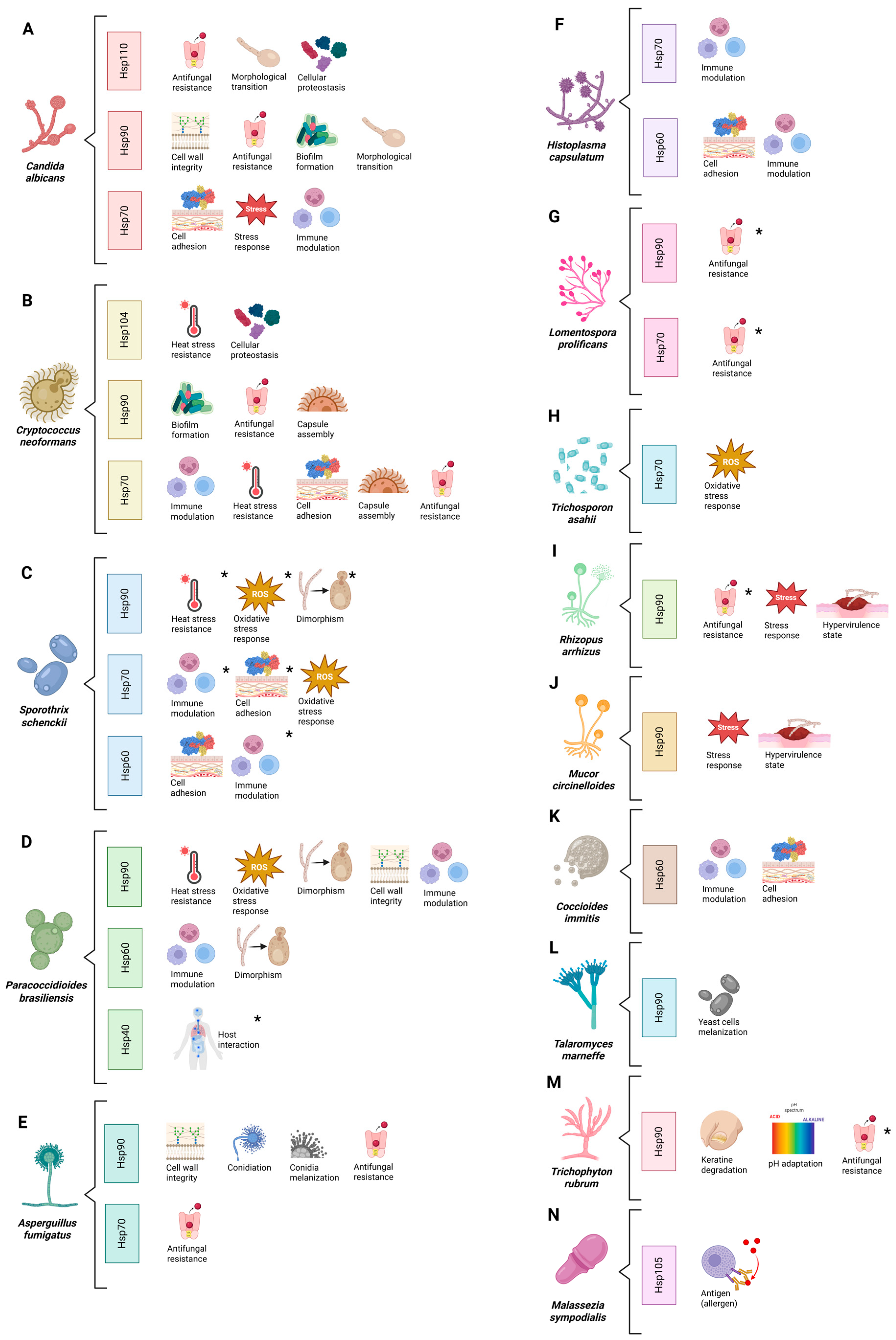
| Hsp110 (Msi3p) | Candida albicans | Holdase activity (prevents protein aggregates), co-chaperone of Hsp70/Hsp90, cell growth regulation, fluconazole resistance via calcineurin pathway | [36,52,53,54] |
| Hsp105 | Malassezia sympodialis | RHsp105 binding to human IgE in sera of AEDS patients | [32] |
| Hsp104 (Hsp100/Clp) | Cryptococcus neoformans | Overexpression under thermal stress >55 °C, part of the regulatory network for survival at high temperatures | [55] |
| Hsp90 | C. albicans, Candida auris | Regulation of morphogenesis, stress adaptation, antifungal resistance, immunomodulation, biofilm formation | [57,58,66,68,69,70] |
| Aspergillus fumigatus | Morphogenesis, cell wall development and stability, β-1,3-glucan formation, melanization, conidiation | [62] | |
| C. neoformans | GXM capsule formation, biofilm development, virulence, immunomodulation | [56,63,64] | |
| Paracoccidioides brasiliensis | Immunomodulation, protective effect via monoclonal antibodies | [71] | |
| Rhizopus arrhizus | Triazole drug resistance via the calcineurin pathway, transition to hypervirulent state in response to mechanical stress | [21] | |
| Mucor circinelloides | Transition to hypervirulent state in response to mechanical stress | [21] | |
| Lamentospora prolificans | Triazol drug resistance via the calcineurin pathway | [19,21] | |
| Talaromyces marneffei | Synthesis of DOPA-melanin in yeast cells | [24] | |
| Trichophyton rubrum | Regulates expression of PacC virulence factor, pH adaptation, keratin degradation, and resistance to itraconazole and micafungin | [30,31] | |
| Hsp70 (Ssa1) | C. albicans | Adhesion to epithelial/endothelial cells, mediates endocytosis, immune evasion | [78,79,80,87] |
| C. neoformans | Thermotolerance, GXM capsule development, adhesion to epithelial cells | [56,81,88] | |
| A. fumigatus | Hsp70-StiA-Hsp90 complex, caspofungin resistance via calcineurin pathway, maintains cell wall integrity | [82] | |
| Aspergillus terreus | Overexpression under amphotericin B, antifungal resistance | [83] | |
| Sporothrix schenckii | Oxidative stress response, potential adhesin and immunomodulator | [73,85] | |
| Histoplasma capsulatum | Immunomodulation, interaction with the host immune system, T cell proliferation | [86,89] | |
| L. prolificans | Upregulated in response to drug resistance to Voriconazole | [19,84] | |
| Trichosporon asahii | Upregulated in adaptation to oxidative stress | [20] | |
| Hsp80/Hsp87 | H. capsulatum/P. brasiliensis | Host interaction; upregulated under thermal stress | [90,91] |
| Hsp60 | H. capsulatum | Adhesin, immunomodulation, protective immunity in murine models, induces IL-12, IFN-γ, and IL-10 | [18,92,93] |
| S. schenckii | RHsp60 multispecific adhesin (fibrinogen, laminin, elastin, fibronectin), protection in the Galleria mellonella model | [73] | |
| Coccidioides immitis | Adhesion to host components, induces Th2 immune profile (IL-4, IL-5, and IL-10) | [18,92,93] | |
| Hsp40 (Ydj1p/Mdj1) | Saccharomyces cerevisiae/P. brasiliensis | Hsp70 co-chaperone; potential moonlighting function in cell wall, virulence, or host interaction | [95,96] |
5. Drugs with the Ability to Inhibit HSPs
5.1. Targeting the Hsp90 NTD
- Geldanamycin
- 2′,4′-Dihydroxychalcone
- 5′-N-Ethylcarboxamidoadenosine
- Artesunate (ART)
- Ganetespib
- Luteolin and Rutin
5.2. Targeting the CTD
- Green tea catechin
- [3,4-b]Pyridine (2H)
| Inhibitor | Fungal Species Tested | Observations | Citation |
|---|---|---|---|
| Targeting the Hsp90 N-terminal domain | |||
| Geldanamycin | Candida albicans | Inhibits Hsp90 function; synergizes with azoles and echinocandins; reduces antifungal resistance | [39] |
| Aspergillus fumigatus | Inhibits Hsp90-dependent signaling and stress adaptation; synergizes with antifungal drugs | [62] | |
| Sporothrix schenckii | Inhibits dimorphic transition at elevated temperature | [39] | |
| Lamentospora prolificans | Inhibits calcineurin/Hsp90 pathway; increases azole susceptibility and induces ROS-associated apoptosis | [19] | |
| Rizopus arrhizus | Inhibits calcineurin/Hsp90 pathway; promotes drug hypersensitivity and apoptosis | [19,21] | |
| Talaromyces marneffei | Impairs DOPA-melanin synthesis and melanization | [24] | |
| 17-AAG/17-DMGA/IPI-493/IPI-504 | — | Similar mechanism to Geldanamycin; developed for improved solubility and reduced toxicity | [39,62] |
| (Geldanamycin derivatives) | |||
| 2′,4′-Dihydroxychalcone (2′,4′-DHC) | A. fumigatus | Moderate fungicidal activity; inhibits biofilm formation and mycelial growth; affects β-1,3-glucan synthesis and melanin production; synergistic with itraconazole and caspofungin | [98] |
| 5′-N-Ethylcarboxamidoadenosine | Yeast (Hsp82); | Inhibits ATPase activity; cross-species inhibition of Hsp90 family members | [99] |
| bacteria (HtpG); mammals (Hsp90α) | |||
| Artesunate (ART) | A. fumigatus | Antifungal and anti-inflammatory activity; disrupts cell wall and plasma membrane; reduces adhesion and biofilm formation; synergistic with amphotericin B; decreases IL-1β, TNF-α, and IL-6 | [99] |
| Cryptococcus neoformans | |||
| Cryptococcus gattii | |||
| Ganetespib | C. albicans | Inhibits C. albicans growth synergistically with fluconazole; blocks biofilm formation via adhesin gene suppression; no effect on C. auris or C. glabrata | [58] |
| Candida auris | |||
| Candida glabrata | |||
| Luteolin and Rutin | Trichophyton rubrum | Antifungal activity at concentrations of 250 and 500 µg, comparable to the activity of amphotericin B at 1.5 and 3 µg | [30] |
| Targeting the Hsp90 C-terminal domain | |||
| Green tea catechin | C. albicans | Inhibits growth in a species-dependent manner; strongest inhibition in C. glabrata and C. krusei (IC50 = 0.82–5.3 µM); weaker in C. albicans and C. tropicalis | [39] |
| Candida glabrata | |||
| Candida tropicalis | |||
| Candida krusei | |||
| [3,4-b]Pyridine (2H) | C. albicans | Reduces substrate affinity; inhibits holdase function; causes protein aggregation and cytotoxicity under thermal stress; fungicidal effect | [52,100] |
| C. auris | |||
| C. neoformans | |||
6. Conclusions
Author Contributions
Funding
Data Availability Statement
Conflicts of Interest
References
- Jacob, P.; Hirt, H.; Bendahmane, A. The heat-shock protein/chaperone network and multiple stress resistance. Plant Biotechnol. J. 2017, 15, 405–414. [Google Scholar] [CrossRef] [PubMed]
- Kim, Y.E.; Hipp, M.S.; Bracher, A.; Hayer-Hartl, M.; Ulrich Hartl, F. Molecular chaperone functions in protein folding and proteostasis. Annu. Rev. Biochem. 2013, 82, 323–355. [Google Scholar] [CrossRef] [PubMed]
- Ryabova, N.A.; Marchenkov, V.V.; Marchenkova, S.Y.; Kotova, N.V.; Semisotnov, G.V. Molecular chaperone GroEL/ES: Unfolding and refolding processes. Biochemistry 2013, 78, 1405–1414. [Google Scholar] [CrossRef]
- Kadibalban, A.S.; Bogumil, D.; Landan, G.; Dagan, T. DnaK-dependent accelerated evolutionary rate in prokaryotes. Genome Biol. Evol. 2016, 8, 1590–1599. [Google Scholar] [CrossRef]
- Kravats, A.N.; Doyle, S.M.; Hoskins, J.R.; Genest, O.; Doody, E.; Wickner, S. Interaction of E. coli Hsp90 with DnaK Involves the DnaJ Binding Region of DnaK. J. Mol. Biol. 2017, 429, 858–872. [Google Scholar] [CrossRef] [PubMed]
- Lund, P.A. Multiple chaperonins in bacteria—Why so many?: Review article. FEMS Microbiol. Rev. 2009, 33, 785–800. [Google Scholar] [CrossRef]
- Mangla, N.; Singh, R.; Agarwal, N. HtpG Is a Metal-Dependent Chaperone Which Assists the DnaK/DnaJ/GrpE Chaperone System of Mycobacterium tuberculosis via Direct Association with DnaJ2. Microbiol. Spectr. 2023, 11, e0031223. [Google Scholar] [CrossRef]
- Thomas, J.G.; Baneyx, F. ClpB and HtpG facilitate de novo protein folding in stressed Escherichia coli cells. Mol. Microbiol. 2000, 36, 1360–1370. [Google Scholar] [CrossRef]
- Amstrup, A.B.; Bæk, I.; Loeschcke, V.; Givskov Sørensen, J. A functional study of the role of Turandot genes in Drosophila melanogaster: An emerging candidate mechanism for inducible heat tolerance. J. Insect Physiol. 2022, 143, 104456. [Google Scholar] [CrossRef]
- Huang, X.; Liu, Y.; Yu, X.; Cai, Y.; Hou, L.; Zhang, J.; Yang, H. Genome-Wide Identification and Evolution-Profiling Analysis of Heat Shock Protein Gene Family in Poaceae Barnhart. Int. J. Mol. Sci. 2025, 26, 4269. [Google Scholar] [CrossRef]
- Lopez-Matas, M.A.; Nuñez, P.; Soto, A.; Allona, I.; Casado, R.; Collada, C.; Guevara, M.-A.; Aragoncillo, C.; Gomez, L. Protein cryoprotective activity of a cytosolic small heat shock protein that accumulates constitutively in chestnut stems and is up-regulated by low and high temperatures. Plant Physiol. 2004, 134, 1708–1717. [Google Scholar] [CrossRef] [PubMed]
- Zhao, Q.; Liu, C. Chloroplast chaperonin: An intricate protein folding machine for photosynthesis. Front. Mol. Biosci. 2018, 4, 98. [Google Scholar] [CrossRef]
- Hoter, A.; El-Sabban, M.E.; Naim, H.Y. The HSP90 family: Structure, regulation, function, and implications in health and disease. Int. J. Mol. Sci. 2018, 19, 2560. [Google Scholar] [CrossRef]
- Marino Gammazza, A.; Restivo, V.; Baschi, R.; Caruso Bavisotto, C.; Cefalù, A.B.; Accardi, G.; Conway de Macario, E.; Macario, A.J.L.; Cappello, F.; Monastero, R. Circulating Molecular Chaperones in Subjects with Amnestic Mild Cognitive Impairment and Alzheimer’s Disease: Data from the Zabùt Aging Project. J. Alzheimer’s Dis. 2022, 87, 161–172. [Google Scholar] [CrossRef]
- Ciurea, C.N.; Kosovski, I.B.; Mare, A.D.; Toma, F.; Pintea-Simon, I.A.; Man, A. Candida and candidiasis—Opportunism versus pathogenicity: A review of the virulence traits. Microorganisms 2020, 8, 857. [Google Scholar] [CrossRef]
- Rocha, M.C.; Minari, K.; Fabri, J.H.T.M.; Kerkaert, J.D.; Gava, L.M.; da Cunha, A.F.; Cramer, R.A.; Borges, J.C.; Malavazi, I. Aspergillus fumigatus Hsp90 interacts with the main components of the cell wall integrity pathway and cooperates in heat shock and cell wall stress adaptation. Cell Microbiol. 2021, 23, e13273. [Google Scholar] [CrossRef]
- Eastman, A.J.; He, X.; Qiu, Y.; Davis, M.J.; Vedula, P.; Lyons, D.M.; Park, Y.-D.; E Hardison, S.; Malachowski, A.N.; Osterholzer, J.J.; et al. Cryptococcal Heat Shock Protein 70 Homolog Ssa1 Contributes to Pulmonary Expansion of Cryptococcus neoformans during the Afferent Phase of the Immune Response by Promoting Macrophage M2 Polarization. J. Immunol. 2015, 194, 5999–6010. [Google Scholar] [CrossRef] [PubMed]
- Cleare, L.G.; Zamith-Miranda, D.; Nosanchuk, J.D. Heat shock proteins in Histoplasma and Paracoccidioides. Clin. Vaccine Immunol. 2017, 24, e00221-17. [Google Scholar] [CrossRef]
- Shirazi, F.; Kontoyiannis, D.P. Heat shock protein 90 and calcineurin pathway inhibitors enhance the efficacy of triazoles against Scedosporium prolificans via induction of apoptosis. Microb. Cell 2014, 1, 179–188. [Google Scholar] [CrossRef]
- Sidra Ilyas, S.I.; Abdul Rehman, A.R.; Varela, A.C.; Sheehan, D. Redox Proteomics Changes in the Fungal Pathogen Trichosporon asahiion Arsenic Exposure: Identification of Protein Responses to Metal-Induced Oxidative Stress in an Environmentally-Sampled Isolate. PLoS ONE 2014, 9, e102340. [Google Scholar]
- Wurster, S.; Tatara, A.M.; Albert, N.D.; Ibrahim, A.S.; Heitman, J.; Lee, S.C.; Shetty, A.C.; McCracken, C.; Graf, K.T.; Mikos, A.G.; et al. Tornadic shear stress induces a transient, calcineurindependent hypervirulent phenotype in mucorales molds. mBio 2020, 11, e01414–e01420. [Google Scholar] [CrossRef]
- Ribeiro, A.M.; Bocca, A.L.; Amaral, A.C.; Faccioli, L.H.; Galetti, F.C.S.; Zárate-Bladés, C.R.; Figueiredo, F.; Silva, C.L.; Felipe, M.S.S. DNAhsp65 vaccination induces protection in mice against Paracoccidioides brasiliensis infection. Vaccine 2009, 27, 606–613. [Google Scholar] [CrossRef]
- Li, K.; Yu, J.J.; Hung, C.Y.; Lehmann, P.F.; Cole, G.T. Recombinant urease and urease DNA of Coccidioides immitis elicit an immunoprotective response against coccidioidomycosis in mice. Infect. Immun. 2001, 69, 2878–2887. [Google Scholar] [CrossRef] [PubMed]
- He, X.; Liu, D.; Chen, Q. Proteomic analysis on the regulation of DOPA-melanin synthesis in Talaromyces marneffei. Microb. Pathog. 2021, 150, 104701. [Google Scholar] [CrossRef]
- López-Romero, E.; Reyes-Montes, M.D.R.; Pérez-Torres, A.; Ruiz-Baca, E.; Villagómez-Castro, J.C.; Mora-Montes, A.; Flores-Carreón, H.M.; Toriello, C. Sporothrix schenckii complex and sporotrichosis, an emerging health problem. Future Microbiol. 2011, 6, 85–102. [Google Scholar] [CrossRef] [PubMed]
- Lopes-Bezerra, L.M. Sporothrix schenckii cell wall peptidorhamnomannans. Front. Microbiol. 2011, 2, 16636. [Google Scholar] [CrossRef] [PubMed]
- de Beer, Z.W.; Duong, T.A.; Wingfield, M.J. The divorce of Sporothrix and Ophiostoma: Solution to a problematic relationship. Stud. Mycol. 2016, 83, 165–191. [Google Scholar] [CrossRef]
- Lopes-Bezerra, L.M.; Mora-Montes, H.M.; Zhang, Y.; Nino-Vega, G.; Rodrigues, A.M.; De Camargo, Z.P.; De Hoog, S. Sporotrichosis between 1898 and 2017: The evolution of knowledge on a changeable disease and on emerging etiological agents. Med. Mycol. 2018, 56, S126–S143. [Google Scholar] [CrossRef]
- Siqueira, I.M.; Ribeiro, A.M.; de Medeiros Nóbrega, Y.K.; Simon, K.S.; Souza, A.C.O.; Jerônimo, M.S.; Neto, F.F.C.; Silva, C.L.; Felipe, M.S.S.; Bocca, A.L. DNA-hsp65 Vaccine as Therapeutic Strategy to Treat Experimental Chromoblastomycosis Caused by Fonsecaea pedrosoi. Mycopathologia 2013, 175, 463–475. [Google Scholar] [CrossRef] [PubMed]
- Gaziano, R.; Campione, E.; Iacovelli, F.; Marino, D.; Pica, F.; Di Francesco, P.; Aquaro, S.; Menichini, F.; Falconi, M.; Bianchi, L. Antifungal activity of Cardiospermum halicacabum L. (Sapindaceae) against Trichophyton rubrum occurs through molecular interaction with fungal Hsp90. Drug Des. Dev. Ther. 2018, 12, 2185–2193. [Google Scholar] [CrossRef] [PubMed] [PubMed Central]
- Jacob, T.R.; Peres, N.T.A.; Martins, M.P.; Lang, E.A.S.; Sanches, P.R.; Rossi, A.; Martinez-Rossi, N.M. Heat shock protein 90 (Hsp90) as a molecular target for the development of novel drugs against the dermatophyte Trichophyton rubrum. Front. Microbiol. 2015, 6, 1241. [Google Scholar] [CrossRef]
- Andersson, A.; Rasool, O.; Schmidt, M.; Kodrius, R.; Flückiger, S.; Zargari, A.; Crameri, R.; Scheynius, A. Cloning, expression and characterization of two new IgE-binding proteins from the yeast Malassezia sympodialis with sequence similarities to heat shock proteins and manganese superoxide dismutase. Eur. J. Biochem. 2004, 271, 1885–1894. [Google Scholar] [CrossRef]
- Jha, M.P.; Kumar, V.; Ghosh, A.; Mapa, K. Sse1, Hsp110 chaperone of yeast, controls the cellular fate during endoplasmic reticulum stress. G3 Genes Genomes Genet. 2024, 14, jkae075. [Google Scholar] [CrossRef] [PubMed]
- Kaimal, J.M.; Kandasamy, G.; Gasser, F.; Andréasson, C. Coordinated Hsp110 and Hsp104 Activities Power Protein Disaggregation in Saccharomyces cerevisiae. Mol. Cell. Biol. 2017, 37, e00027-17. [Google Scholar] [CrossRef]
- Sztangierska, W.; Wyszkowski, H.; Pokornowska, M.; Kochanowicz, K.; Rychłowski, M.; Liberek, K.; Kłosowska, A. Early steps of protein disaggregation by Hsp70 chaperone and class B J-domain proteins are shaped by Hsp110. Elife 2024, 13, RP94795. [Google Scholar] [CrossRef]
- Yakubu, U.M.; Morano, K.A. Roles of the nucleotide exchange factor and chaperone Hsp110 in cellular proteostasis and diseases of protein misfolding. Biol. Chem. 2018, 399, 1215–1221. [Google Scholar] [CrossRef] [PubMed]
- Backe, S.J.; Mollapour, M.; Woodford, M.R. Saccharomyces cerevisiae as a tool for deciphering Hsp90 molecular chaperone function. Essays Biochem. 2023, 67, 781–796. [Google Scholar] [CrossRef]
- Kolhe, J.A.; Babu, N.L.; Freeman, B.C. The Hsp90 molecular chaperone governs client proteins by targeting intrinsically disordered regions. Mol. Cell 2023, 83, 2035–2044.e7. [Google Scholar] [CrossRef]
- Rouges, C.; Asad, M.; Laurent, A.D.; Marchand, P.; Le Pape, P. Is the C-Terminal Domain an Effective and Selective Target for the Design of Hsp90 Inhibitors against Candida Yeast? Microorganisms 2023, 11, 2837. [Google Scholar] [CrossRef] [PubMed]
- Doyle, S.M.; Hoskins, J.R.; Kravats, A.N.; Heffner, A.L.; Garikapati, S.; Wickner, S. Intermolecular Interactions between Hsp90 and Hsp70. J. Mol. Biol. 2019, 431, 2729–2746. [Google Scholar] [CrossRef]
- Millson, S.H.; Truman, A.W.; Piper, P.W. Hsp90 and phosphorylation of the Slt2(Mpk1) MAP kinase activation loop are essential for catalytic, but not non-catalytic, Slt2-mediated transcription in yeast. Cell Stress Chaperones 2022, 27, 295–304. [Google Scholar] [CrossRef]
- Mandal, A.K.; Nillegoda, N.B.; Chen, J.A.; Caplan, A.J. Ydj1 Protects Nascent Protein Kinases from Degradation and Controls the Rate of Their Maturation. Mol. Cell Biol. 2008, 28, 4434–4444. [Google Scholar] [CrossRef] [PubMed]
- Kampinga, H.H.; Craig, E.A. The HSP70 chaperone machinery: J proteins as drivers of functional specificity. Nat. Rev. Mol. Cell Biol. 2010, 11, 579–592. [Google Scholar] [CrossRef]
- Zhang, H.; Hu, H.; Wu, S.; Perrett, S. Effect of evolution of the C-terminal region on chaperone activity of Hsp70. Protein Sci. 2023, 32, e4549. [Google Scholar] [CrossRef]
- Duttagupta, R.; Vasudevan, S.; Wilusz, C.J.; Peltz, S.W. A Yeast Homologue of Hsp70, Ssa1p, Regulates Turnover of the MFA2 Transcript through Its AU-Rich 3′ Untranslated Region. Mol. Cell Biol. 2003, 23, 2623–2632. [Google Scholar] [CrossRef] [PubMed]
- Zhang, S.; Hacham, M.; Panepinto, J.; Hu, G.; Shin, S.; Zhu, X.; Williamson, P.R. The Hsp70 member, Ssa1, acts as a DNA-binding transcriptional co-activator of laccase in Cryptococcus neoformans. Mol. Microbiol. 2006, 62, 1090–1101. [Google Scholar] [CrossRef] [PubMed]
- Böttinger, L.; Oeljeklaus, S.; Guiard, B.; Rospert, S.; Warscheid, B.; Becker, T. Mitochondrial heat shock protein (Hsp) 70 and Hsp10 cooperate in the formation of Hsp60 complexes. J. Biol. Chem. 2015, 290, 11611–11622. [Google Scholar] [CrossRef]
- Cabiscol, E.; Bellí, G.; Tamarit, J.; Echave, P.; Herrero, E.; Ros, J. Mitochondrial Hsp60, resistance to oxidative stress, and the labile iron pool are closely connected in Saccharomyces cerevisiae. J. Biol. Chem. 2002, 277, 44531–44538. [Google Scholar] [CrossRef]
- Kalderon, B.; Kogan, G.; Bubis, E.; Pines, O. Cytosolic Hsp60 can modulate proteasome activity in yeast. J. Biol. Chem. 2015, 290, 3542–3551. [Google Scholar] [CrossRef]
- Omkar, S.; Mitchem, M.M.; Hoskins, J.R.; Shrader, C.; Kline, J.T.; Nitika; Fornelli, L.; Wickner, S.; Truman, A.W. Acetylation of the yeast Hsp40 chaperone protein Ydj1 fine-tunes proteostasis and translational fidelity. PLoS Genet. 2024, 20, e1011338. [Google Scholar] [CrossRef]
- Liou, S.T.; Cheng, M.Y.; Wang, C. SGT2 and MDY2 interact with molecular chaperone YDJ1 in Saccharomyces cerevisiae. Cell Stress Chaperones 2007, 12, 59–70. [Google Scholar] [CrossRef] [PubMed]
- Sun, C.; Li, Y.; Kidd, J.M.; Han, J.; Ding, L.; May, A.E.; Zhou, L.; Liu, Q. Characterization of a New Hsp110 Inhibitor as a Potential Antifungal. J. Fungi 2024, 10, 732. [Google Scholar] [CrossRef]
- Wang, Y.; Li, H.; Sun, C.; Liu, Q.; Zhou, L.; Liu, Q. Purification and biochemical characterization of Msi3, an essential Hsp110 molecular chaperone in Candida albicans. Cell Stress Chaperones 2021, 26, 695–704. [Google Scholar] [CrossRef]
- Nagao, J.I.; Cho, T.; Uno, J.; Ueno, K.; Imayoshi, R.; Nakayama, H.; Chibana, H.; Kaminishi, H. Candida albicans Msi3p, a homolog of the Saccharomyces cerevisiae Sse1p of the Hsp70 family, is involved in cell growth and fluconazole tolerance. FEMS Yeast Res. 2012, 12, 728–737. [Google Scholar] [CrossRef]
- Yang, D.H.; Jung, K.W.; Bang, S.; Lee, J.W.; Song, M.H.; Floyd-Averette, A.; A Festa, R.; Ianiri, G.; Idnurm, A.; Thiele, D.J.; et al. Rewiring of signaling networks modulating thermotolerance in the human pathogen Cryptococcus neoformans. Genetics 2017, 205, 201–219. [Google Scholar] [CrossRef]
- Fu, C.; Beattie, S.R.; Jezewski, A.J.; Robbins, N.; Whitesell, L.; Krysan, D.J.; E Cowen, J. Genetic analysis of Hsp90 function in Cryptococcus neoformans highlights key roles in stress tolerance and virulence. Genetics 2022, 220, iyab164. [Google Scholar] [CrossRef]
- Fang, T.; Xiong, J.; Huang, X.; Fang, X.; Shen, X.; Jiang, Y.; Lu, H. Extracellular Hsp90 of Candida albicans contributes to the virulence of the pathogen by activating the NF-κB signaling pathway and inducing macrophage pyroptosis. Microbiol. Res. 2025, 290, 127964. [Google Scholar] [CrossRef]
- Yuan, R.; Tu, J.; Sheng, C.; Chen, X.; Liu, N. Effects of Hsp90 Inhibitor Ganetespib on Inhibition of Azole-Resistant Candida albicans. Front. Microbiol. 2021, 12, 680382. [Google Scholar]
- Nicola, A.M.; Andrade, R.V.; Dantas, A.S.; Andrade, P.A.; Arraes, F.B.M.; Fernandes, L.; Silva-Pereira, I.; Felipe, M.S.S. The stress responsive and morphologically regulated hsp90 gene from Paracoccidioides brasiliensis is essential to cell viability. BMC Microbiol. 2008, 8, 158. [Google Scholar] [CrossRef] [PubMed]
- Rodriguez-Caban, J.; Gonzalez-Velazquez, W.; Perez-Sanchez, L.; Gonzalez-Mendez, R.; Valle, N.R.D. Calcium/calmodulin kinase1 and its relation to thermotolerance and HSP90 in Sporothrix schenckii: An RNAi and yeast two-hybrid study. BMC Microbiol. 2011, 11, 162. [Google Scholar] [CrossRef] [PubMed]
- Shapiro, R.S.; Sellam, A.; Tebbji, F.; Whiteway, M.; Nantel, A.; Cowen, L.E. Pho85, Pcl1, and hms1 signaling governs Candida albicans morphogenesis induced by high temperature or Hsp90 compromise. Curr. Biol. 2012, 22, 461–470. [Google Scholar] [CrossRef] [PubMed]
- Lamoth, F.; Juvvadi, P.R.; Fortwendel, J.R.; Steinbach, W.J. Heat shock protein 90 is required for conidiation and cell wall integrity in Aspergillus fumigatus. Eukaryot. Cell 2012, 11, 1324–1332. [Google Scholar] [CrossRef] [PubMed]
- Chatterjee, S.; Tatu, U. Heat shock protein 90 localizes to the surface and augments virulence factors of Cryptococcus neoformans. PLoS Negl. Trop. Dis. 2017, 11, e0005836. [Google Scholar] [CrossRef]
- Cordeiro, R.A.; Evangelista, A.J.J.; Serpa, R.; Marques, F.J.F.; Melo, C.V.S.; Oliveira, J.S.; Franco, J.d.S.; de Alencar, L.P.; Bandeira, T.d.J.P.G.; Brilhante, R.S.N.; et al. Inhibition of heat-shock protein 90 enhances the susceptibility to antifungals and reduces the virulence of Cryptococcus neoformans/Cryptococcus gattii species complex. Microbiology 2016, 162, 309–317. [Google Scholar] [CrossRef]
- Cowen, L.E.; Singh, S.D.; Kö Hler, B.J.R.; Collins, C.; Zaas, A.K.; Schell, W.A.; Aziz, H.; Mylonakis, E.; Perfect, J.R.; Whitesell, L.; et al. Harnessing Hsp90 Function as a Powerful, Broadly Effective Therapeutic Strategy for Fungal Infectious Disease. Available online: https://pubmed.ncbi.nlm.nih.gov/19196973/ (accessed on 1 December 2025).
- Singh, S.D.; Robbins, N.; Zaas, A.K.; Schell, W.A.; Perfect, J.R.; Cowen, L.E. Hsp90 governs echinocandin resistance in the pathogenic yeast Candida albicans via calcineurin. PLoS Pathog. 2009, 5, e1000532. [Google Scholar] [CrossRef]
- Rajendran, R.; Mowat, E.; Jones, B.; Williams, C.; Ramage, G. Prior in vitro exposure to voriconazole confers resistance to amphotericin B in Aspergillus fumigatus biofilms. Int. J. Antimicrob. Agents 2015, 46, 342–345. [Google Scholar] [CrossRef]
- Kim, S.H.; Iyer, K.R.; Pardeshi, L.; Muñoz, J.F.; Robbins, N.; Cuomo, C.A.; Wong, K.H.; Cowen, L.E. Genetic Analysis of Candida auris Implicates Hsp90 in Morphogenesis and Azole Tolerance and Cdr1 in Azole Resistance. MBio 2019, 10, e02529-18. [Google Scholar] [CrossRef]
- Matthews, R.C.; Burnie, J.P.; Howat, D.; Rowland, T.; Walton, F. Autoantibody to heat-shock protein 90 can mediate protection against systemic candidosis. Immunology 1991, 74, 20. [Google Scholar] [PubMed]
- Wellington, M.; Koselny, K.; Sutterwala, F.S.; Krysan, D.J. Candida albicans triggers NLRP3-mediated pyroptosis in macrophages. Eukaryot. Cell 2014, 13, 329–340. [Google Scholar] [CrossRef] [PubMed]
- Moura, Á.N.D.; de Oliveira, D.S.L.; Paredes, V.; Rocha, L.B.; de Oliveira, F.F.M.; Lessa, G.M.; Riasco-Palacios, J.F.; Casadevall, A.; Albuquerque, P.; Felipe, M.S.S.; et al. Paracoccidioides hsp90 can be found in the cell surface and is a target for antibodies with therapeutic potential. J. Fungi 2020, 6, 193. [Google Scholar] [CrossRef]
- Arvizu-Rubio, V.J.; García-Carnero, L.C.; Mora-Montes, H.M. Moonlighting proteins in medically relevant fungi. PeerJ 2022, 10, e14001. [Google Scholar] [CrossRef] [PubMed]
- García-Carnero, L.C.; Salinas-Marín, R.; Lozoya-Pérez, N.E.; Wrobel, K.; Wrobel, K.; Martínez-Duncker, I.; Niño-Vega, G.A.; Mora-Montes, H.M. The heat shock protein 60 and pap1 participate in the Sporothrix schenckii-host interaction. J. Fungi 2021, 7, 960. [Google Scholar] [CrossRef]
- López-Ramírez, L.A.; Martínez-Álvarez, J.A.; Martínez-Duncker, I.; Lozoya-Pérez, N.E.; Mora-Montes, H.M. Silencing of Sporothrix schenckii GP70 Reveals Its Contribution to Fungal Adhesion, Virulence, and the Host–Fungus Interaction. J. Fungi 2024, 10, 302. [Google Scholar] [CrossRef]
- Padró-Villegas, L.; Gómez-Gaviria, M.; Martínez-Duncker, I.; López-Ramírez, L.A.; Martínez-Álvarez, J.A.; Niño-Vega, G.A.; Mora-Montes, H.M. Sporothrix brasiliensis Gp70 is a cell wall protein required for adhesion, proper interaction with innate immune cells, and virulence. Cell Surf. 2025, 13, 100139. [Google Scholar] [CrossRef] [PubMed]
- Santana, D.J.; Anku, J.A.E.; Zhao, G.; Zarnowski, R.; Johnson, C.J.; Hautau, H.; Visser, N.D.; Ibrahim, A.S.; Andes, D.; Nett, J.E.; et al. A Candida auris–specific adhesin, Scf1, governs surface association, colonization, and virulence. Science 2023, 381, 1461–1467. [Google Scholar] [CrossRef]
- Satala, D.; Zelazna, A.; Satala, G.; Bukowski, M.; Zawrotniak, M.; Rapala-Kozik, M.; Kozik, A. Towards understanding the novel adhesin function of Candida albicans phosphoglycerate mutase at the pathogen cell surface: Some structural analysis of the interactions with human host extracellular matrix proteins. Acta Biochim. Pol. 2021, 68, 515–525. [Google Scholar] [CrossRef]
- Phan, Q.T.; Solis, N.V.; Cravener, M.V.; Swidergall, M.; Lin, J.; Huang, M.Y.; Liu, H.; Singh, S.; Ibrahim, A.S.; Mazzone, M.; et al. Candida albicans stimulates formation of a multi-receptor complex that mediates epithelial cell invasion during oropharyngeal infection. PLoS Pathog. 2023, 19, e1011579. [Google Scholar] [CrossRef] [PubMed]
- Qiu, X.R.; Shen, C.R.; Jiang, L.W.; Ji, P.; Zhang, Y.; Hou, W.T.; Zhang, W.; Shen, H.; An, M.-M. Ssa1-targeted antibody prevents host invasion by Candida albicans. Front. Microbiol. 2023, 14, 1182914. [Google Scholar] [CrossRef]
- Sun, J.N.; Solis, N.V.; Phan, Q.T.; Bajwa, J.S.; Kashleva, H.; Thompson, A.; Liu, Y.; Dongari-Bagtzoglou, A.; Edgerton, M.; Filler, S.G. Host cell invasion and virulence mediated by Candida albicans Ssa1. PLoS Pathog. 2010, 6, e1001181. [Google Scholar] [CrossRef]
- Silveira, C.P.; Piffer, A.C.; Kmetzsch, L.; Fonseca, F.L.; Soares, D.A.; Staats, C.C.; Rodrigues, M.L.; Schrank, A.; Vainstein, M.H. The heat shock protein (Hsp) 70 of Cryptococcus neoformans is associated with the fungal cell surface and influences the interaction between yeast and host cells. Fungal Genet. Biol. 2013, 60, 53–63. [Google Scholar] [CrossRef]
- Lamoth, F.; Juvvadi, P.R.; Soderblom, E.J.; Moseley, M.A.; Steinbach, W.J. Hsp70 and the cochaperone StiA (hop) orchestrate Hsp90-mediated caspofungin tolerance in Aspergillus fumigatus. Antimicrob. Agents Chemother. 2015, 59, 4727–4733. [Google Scholar] [CrossRef]
- Blatzer, M.; Blum, G.; Jukic, E.; Posch, W.; Gruber, P.; Nagl, M.; Binder, U.; Maurer, E.; Sarg, B.; Lindner, H.; et al. Blocking Hsp70 enhances the efficiency of amphotericin B treatment against resistant Aspergillus terreus strains. Antimicrob. Agents Chemother. 2015, 59, 3778–3788. [Google Scholar] [CrossRef]
- Pellon, A.; Andoni, R.G.; Idoia, B.; Aitziber, A.; Aitor, R.; Fernando, L.H. Molecular and cellular responses of the pathogenic fungus Lomentospora prolificans to the antifungal drug voriconazole. PLoS ONE 2017, 12, e0174885. [Google Scholar] [CrossRef]
- Ruiz-Baca, E.; Leyva-Sánchez, H.; Calderón-Barraza, B.; Esquivel-Naranjo, U.; López-Romero, E.; López-Rodríguez, A.; Cuéllar-Cruz, M. Identification of proteins in Sporothrix schenckii sensu stricto in response to oxidative stress induced by hydrogen peroxide. Rev. Iberoam. Micol. 2019, 36, 17–23. [Google Scholar] [CrossRef]
- Borges, T.J.; Wieten, L.; Van Herwijnen, M.J.C.; Broere, F.; Van derZee, R.; Bonorino, C.; van Eden, W. The anti-inflammatory mechanisms of Hsp70. Front. Immunol. 2012, 3, 95. [Google Scholar] [CrossRef]
- Teng, W.; Subsomwong, P.; Narita, K.; Nakane, A.; Asano, K. Heat Shock Protein SSA1 Enriched in Hypoxic Secretome of Candida albicans Exerts an Immunomodulatory Effect via Regulating Macrophage Function. Cells 2024, 13, 127. [Google Scholar] [CrossRef]
- Kakeya, H.; Udono, H.; Maesaki, S.; Sasaki, E.; Kawamura, S.; Hossain, M.A.; Yamamoto, Y.; Sawai, T.; Fukuda, M.; Mitsutake, K.; et al. Heat shock protein 70 (hsp70) as a major target of the antibody response in patients with pulmonary cryptococcosis. Clin. Exp. Immunol. 1999, 115, 485–490. [Google Scholar] [CrossRef]
- Allendoerfer, R.; Maresca, B.; Deepe, G.S. Cellular Immune Responses to Recombinant Heat Shock Protein 70 from Histoplasma capsulatum. Infect. Immun. 1996, 64, 4123–4128. [Google Scholar] [CrossRef]
- Díez, S.; Gómez, B.L.; Restrepo, A.; Hay, R.J.; Hamilton, A.J. Paracoccidioides brasiliensis 87-kilodalton antigen, a heat shock protein useful in diagnosis: Characterization, purification, and detection in biopsy material via immunohistochemistry. J. Clin. Microbiol. 2002, 40, 359–365. [Google Scholar] [CrossRef]
- Jeavons, L.; Hunt, L.; Hamilton, A. Immunochemical studies of heat-shock protein 80 of Histoplasma capsulatum. J. Med. Vet. Mycol. 1994, 32, 47–57. [Google Scholar] [CrossRef]
- Long, K.H.; Gomez, F.J.; Morris, R.E.; Newman, S.L. Identification of Heat Shock Protein 60 as the Ligand on Histoplasma capsulatum That Mediates Binding to CD18 Receptors on Human Macrophages. J. Immunol. 2003, 170, 487–494. [Google Scholar] [CrossRef]
- Deepe, G.S.; Gibbons, R.S. Cellular and molecular regulation of vaccination with heat shock protein 60 from Histoplasma capsulatum. Infect. Immun. 2002, 70, 3759–3767. [Google Scholar] [CrossRef]
- Fernandes, F.F.; Pitangui, N.S.; Peron, G.; Valim, C.X.R.; Mazucato, V.M.; Oliveira, A.F.; da Silva, T.A.; Roque-Barreira, M.-C.; Panunto-Castelo, A. Expression of hsp60 and its cell location in Paracoccidioides brasiliensis. Rev. Inst. Med. Trop. Sao Paulo 2020, 62, e29. [Google Scholar] [CrossRef]
- Caplans, A.J.; Tsais, J.; Caseyt, P.J.; Douglasst, M.G. Farnesylation of YDJlp Is Required for Function at Elevated Growth Temperatures in Saccharomyces cereuisiae. J. Biol. Chem. 1992, 267, 18890–18895. [Google Scholar] [CrossRef]
- Batista, W.L.; Matsuo, A.L.; Ganiko, L.; Barros, T.F.; Veiga, T.R.; Freymüller, E.; Puccia, R. The PbMDJ1 gene belongs to a conserved MDJ1/LON locus in thermodimorphic pathogenic fungi and encodes a heat shock protein that localizes to both the mitochondria and cell wall of Paracoccidioides brasiliensis. Eukaryot. Cell 2006, 5, 379–390. [Google Scholar] [CrossRef]
- Niño-Vega, G.A.; Padró-Villegas, L.; López-Romero, E. New Ground in Antifungal Discovery and Therapy for Invasive Fungal Infections: Innovations, Challenges, and Future Directions. J. Fungi 2024, 10, 871. [Google Scholar] [CrossRef]
- Seo, Y.H.; Kim, S.S.; Shin, K.S. In vitro antifungal activity and mode of action of 2’,4’-dihydroxychalcone against Aspergillus fumigatus. Mycobiology 2015, 43, 150–156. [Google Scholar] [CrossRef]
- Liu, S.; Street, T.O. 5′-N-ethylcarboxamidoadenosine is not a paralog-specific Hsp90 inhibitor. Protein Sci. 2016, 25, 2209–2215. [Google Scholar] [CrossRef]
- Hu, L.; Sun, C.; Kidd, J.M.; Han, J.; Fang, X.; Li, H.; Liu, Q.; May, A.E.; Li, Q.; Zhou, L.; et al. A first-in-class inhibitor of Hsp110 molecular chaperones of pathogenic fungi. Nat. Commun. 2023, 14, 2745. [Google Scholar] [CrossRef]

Disclaimer/Publisher’s Note: The statements, opinions and data contained in all publications are solely those of the individual author(s) and contributor(s) and not of MDPI and/or the editor(s). MDPI and/or the editor(s) disclaim responsibility for any injury to people or property resulting from any ideas, methods, instructions or products referred to in the content. |
© 2026 by the authors. Licensee MDPI, Basel, Switzerland. This article is an open access article distributed under the terms and conditions of the Creative Commons Attribution (CC BY) license.
Share and Cite
Padró-Villegas, L.; Mora-Montes, H.M. Heat Shock Proteins in Medically Relevant Fungal Pathogens: From Molecular Chaperones to Virulence Factors and Therapeutic Targets. J. Fungi 2026, 12, 414. https://doi.org/10.3390/jof12060414
Padró-Villegas L, Mora-Montes HM. Heat Shock Proteins in Medically Relevant Fungal Pathogens: From Molecular Chaperones to Virulence Factors and Therapeutic Targets. Journal of Fungi. 2026; 12(6):414. https://doi.org/10.3390/jof12060414
Chicago/Turabian StylePadró-Villegas, Leonardo, and Héctor M. Mora-Montes. 2026. "Heat Shock Proteins in Medically Relevant Fungal Pathogens: From Molecular Chaperones to Virulence Factors and Therapeutic Targets" Journal of Fungi 12, no. 6: 414. https://doi.org/10.3390/jof12060414
APA StylePadró-Villegas, L., & Mora-Montes, H. M. (2026). Heat Shock Proteins in Medically Relevant Fungal Pathogens: From Molecular Chaperones to Virulence Factors and Therapeutic Targets. Journal of Fungi, 12(6), 414. https://doi.org/10.3390/jof12060414