
Review

Biological Control of Tomato Root Rot Caused by Rhizoctonia solani Using Microorganisms

1
School of Light Industry Science and Engineering, Beijing Technology and Business University, Beijing 100048, China
2
State Key Laboratory for Biology of Plant Diseases and Insect Pests, Institute of Plant Protection, Chinese Academy of Agricultural Sciences, Beijing 100193, China
*
Authors to whom correspondence should be addressed.
J. Fungi 2026, 12(5), 313; https://doi.org/10.3390/jof12050313
Submission received: 1 March 2026 / Revised: 7 April 2026 / Accepted: 21 April 2026 / Published: 24 April 2026
(This article belongs to the Section Fungal Pathogenesis and Disease Control)

Abstract

Rhizoctonia solani is the main pathogen that causes tomato root rot, which is a soilborne disease that seriously affects tomato production, leading to huge economic losses. Biocontrol is an excellent control method for suppressing plant disease, as it is environmentally friendly, safe, and sustainable. Currently, reviews of the biocontrol of tomato root rot caused by R. solani are scarce. In this review, biocontrol agents, including bacteria and fungi, that can control tomato root rot caused by R. solani are discussed in depth, as well as their control effects. Moreover, this review systematically analyzes the potential control mechanisms of biocontrol agents, including the production of cell-wall-degrading enzymes, the production of metabolites, mycoparasitism, the induction of plant systemic resistance, and competition. Considerations for the practical application of biocontrol agents, including their formulation, reproducibility under field conditions, environmental variability, regulatory considerations for some microbial agents, and limitations, are also highlighted and discussed. Finally, further research suggestions are made for the future control of tomato root rot caused by R. solani. This review provides a basis for the field application of biocontrol agents to control tomato root rot caused by R. solani.

1. Introduction

Tomatoes (Solanum lycopersicum, belonging to Solanaceae) are economically important vegetable crops that are extensively cultivated and consumed worldwide, either fresh or after processing [1,2]. Tomatoes are rich in nutrients and bioactive compounds—such as vitamins A, C, and E; amino acids; ferulic acid; ascorbic acid; folate; minerals; lycopene; β-carotene; dietary fiber; flavonoids; and α-tomatine—which exert beneficial effects on human health through their antioxidant, anti-inflammatory, cardioprotective, and antimicrobial activities [3,4,5,6].
Numerous factors can affect the growth and production of tomatoes, including abiotic stresses such as temperature, water availability, light, and growing media [7,8,9,10]. Additionally, the diseases caused by bacteria, fungi, viruses, and nematodes are some of the most serious biotic stresses that can significantly influence the growth and production of tomatoes, causing huge economic and production losses. Common tomato diseases mainly consist of bacterial diseases, such as bacterial spot, wilt, speck, and canker [11,12,13]; fungal diseases, such as root rot, gray mold, early blight, late blight, Fusarium wilt, and Verticillium wilt; nematode diseases, such as root-knot nematodes; and viral diseases, such as spotted wilt, Pepino mosaic virus, and yellow leaf curl virus [14,15,16,17,18,19,20,21,22,23,24]. Among these plant diseases, root rot diseases are a significant concern because of the threat they pose to tomato productivity worldwide.
Tomato root rot diseases can be caused by different types of fungal plant pathogens, such as Rhizoctonia solani, Fusarium solani, Pythium aphanidermatum, and Pythium ultimum [25,26,27,28]. Any of these pathogens can cause root rot disease in tomato, leading to huge economic and yield losses. Tomato root rot caused by Rhizoctonia solani, also known as Rhizoctonia root rot, is a major limiter of the growth and production of tomato. The growth parameters of tomato plants, such as shoot and root fresh weights, shoot and root length, and yield, are influenced after infection by R. solani. Solanki et al. reported that the total yield of tomato (healthy control of 116.04 q ha−1) was significantly reduced by R. solani infection (38.3 q ha−1) under field conditions [29]. Similarly, in another study by Solanki et al., the yield of tomato was dramatically reduced by R. solani infection (28.89 q ha−1) compared to that of healthy plants (168.89 q ha−1) [30]. Thus, this is highlighted and discussed in this review.
The pathogen R. solani belongs to the phylum Basidiomycota, family Ceratobasidiaceae, and genus Rhizoctonia [31]. R. solani species can be classified into different anastomosis groups (AGs); different AGs of R. solani vary in their morphological characteristics and pathogenic virulence [32,33]. R. solani has a wide range of hosts and can infect the plant families of Linaceae, Araceae, Poaceae, Fabaceae, Malvaceae, Solanaceae, Amaranthaceae, Rubiaceae, Brassicaceae, Asteraceae, and Moraceae, affecting nearly 250 plant species [34,35,36]. R. solani can cause root rot, crown rot, seed rot, stem rot, pod rot, limb rot, hypocotyl rot, head rot, bottom rot, pre-emergence and post-emergence damping off, black scurf, blights, and cankers in different host plant species [34,35,36]. R. solani can also exhibit strong competition with other saprophytes [34].
A notable property of R. solani is that it can produce sclerotia, which are formed from undifferentiated hyphae or monilioid cells [36]. Sclerotia are formed in three development stages: the initiation, development, and maturation stages [36]. The sclerotia of R. solani can resist harsh environmental conditions and persist in soil or plant debris for many years. Under appropriate conditions, such as warm and high-humidity environments, sclerotia can germinate into mycelia and infect the plant roots, thereby leading to disease symptoms and even causing plant death [34]. Sclerotia can form again on the infected plant debris. Sclerotia in the soil and plant debris can act as an inoculum source for the further infection of host plants [34].
Different control strategies are applied to manage Rhizoctonia root rot, with the commonly used methods being chemical and biological control (biocontrol). Chemical fungicides are commonly used to control plant diseases because they offer rapid efficacy and a wide control spectrum; however, they pose a threat to the environment, can induce pathogen resistance, and can affect food safety, seriously limiting their application [37,38,39]. Compared with chemical control, biocontrol has the advantages of being green, environmentally friendly, safe, and suitable for sustainable application; thus, it has drawn much attention [40,41,42]. Biocontrol usually refers to the management of plant diseases through the application of useful microorganisms, including bacteria and fungi. Bacteria such as Bacillus species, Pseudomonas fluorescens, and Streptomyces species and fungi such as Trichoderma species, Clonostachys rosea, and Coniothyrium minitans are commonly used as biocontrol agents to manage plant diseases [43,44,45,46,47,48]. The biocontrol mechanism involves the secretion of cell-wall-degrading enzymes, the production of metabolites, the induction of plant systemic resistance, and competition for nutrients and space [49,50,51,52]. To date, several biocontrol microorganisms comprising bacteria (e.g., Bacillus, Pseudomonas, Streptomyces) and fungi (e.g., Trichoderma, Paecilomyces) have been reported to be effective in controlling tomato root rot caused by R. solani [30,53,54,55]. Although there are many reviews about R. solani and tomatoes, comprehensive reviews about the biocontrol of Rhizoctonia root rot in tomato using biocontrol microorganisms, along with their biocontrol mechanisms, remain scarce.
“Tomato root rot” and “Rhizoctonia solani” were used as keywords to search the Web of Science and PubMed databases for all types of studies for this review. Studies about the biological characters, pathogenicity, and damage caused by R. solani were included, as well as all studies related to the control of tomato root rot caused by R. solani using biocontrol microorganisms across various experimental scales such as in plate, greenhouse, and field conditions.
This review provides a comprehensive summary and analysis of the management of tomato root rot caused by R. solani through the use of biocontrol methods. Bacterial and fungal biocontrol agents that can control tomato Rhizoctonia root rot are discussed in detail, and their potential biocontrol mechanisms are explored. Finally, future perspectives on the biocontrol of tomato Rhizoctonia root rot are presented. This review provides useful information for the biocontrol of tomato root rot caused by R. solani.

2. Biocontrol Bacteria in Management of Tomato Root Rot Caused by R. solani

Several bacterial agents, such as Bacillus, Pseudomonas, Streptomyces, Enterobacter, Alcaligenes, Paenebacillus, and Acinetobacter, have been used to control tomato root rot caused by R. solani (Table 1).
Numerous Bacillus species, including B. subtillis, B. thuriengiensis, B. megaterium, B. amyloliquefaciens, and B. velezensis, have exhibited excellent efficacy in controlling Rhizoctonia root rot in tomato, as well as in promoting tomato growth. Rashad et al. found that B. subtilis SR22, isolated from faba bean stem, could significantly reduce the severity of root rot in R. solani-infected tomato plants compared with that in R. solani-infected controls. Moreover, growth parameters, namely, shoot length, root length, shoot dry weight, and root dry weight, remarkably increased after the application of SR22 in Rhizoctonia root-rot-infected tomato plants [56]. B. subtilis strains MB14 and MB99 isolated from tomato rhizosphere soil, which can produce the cell-wall-degrading enzymes chitinase, β-1,3-glucanase, β-1,4-glucanase, and protease, exhibited excellent effects in suppressing tomato root rot caused by R. solani under greenhouse conditions. The field-scale condition showed that MB14 could significantly reduce the disease index of root rot in tomatoes, as well as increase the number of fruits/plants and yield, compared with R. solani-infected controls [30]. Moreover, another study found that four genes related to antibiotic production in MB14 were amplified and exhibited similarity to surfactin synthetase, ilutrin A synthetase, fengycin synthetase, and mycosubtilin synthase subunit B, which might be an important mechanism of MB14 in suppressing tomato root rot caused by R. solani [57].
B. subtilis B10 significantly reduced the disease index of root rot caused by R. solani in two tomato cultivars, namely, Marmande and Rio Grande, over two years compared with a fungicide. B10 also improved the growth parameters of the two tomato cultivars, namely, plant height, aerial part fresh weight, and root growth [58]. El-Gamal et al. reported that a B. subtilis strain isolated from biocompost rice straw significantly suppressed the disease incidence of root rot in R. solani-infected tomatoes compared with R. solani-infected controls under greenhouse conditions [59].
In addition to B. subtilis, other Bacillus species have also been found to suppress tomato root rot caused by R. solani. The application of B. velezensis strains significantly reduced the incidence of tomato Rhizoctonia root rot. Moreover, tomato plants treated with B. velezensis showed increases in growth parameters, namely, root and shoot fresh weight, root dry weight, and the number of fruits, compared with R. solani-infected controls [60]. Two endophytic bacteria, B. velezensis L1 and B. megaterium L2, isolated from strawberry plants, effectively controlled tomato root rot disease caused by R. solani in pots maintained in greenhouse conditions [61]. A B. megaterium strain, MB3, also effectively controlled tomato root rot caused by R. solani under greenhouse conditions. B. amyloliquefaciens MB101 significantly reduced the disease index of tomato root rot caused by R. solani under both greenhouse and field conditions [30]. B. thuringiensis B2 also exhibited a dual effect on two tomato cultivars over two years by suppressing the disease index of Rhizoctonia root rot and promoting tomato growth parameters [58].
P. fluorescens and P. aeruginosa are the two main Pseudomonas species that suppress the incidence of tomato root rot caused by R. solani. In addition, some Pseudomonas species promote tomato growth. The application of P. fluorescens A6RI to R. solani-infected tomato plants significantly reduced both the external hyphae appressed to epidermal cells and the intraradical infection caused by R. solani on tomato roots. Tomatoes treated with A6RI also exhibited remarkably increased growth parameters, including fresh root and shoot weights, and root morphogenetic parameters, including total root length, root branching degree, and the number of root tips, compared with R. solani-infected controls [62]. P. fluorescens MPF47 showed high growth inhibition against R. solani, and it significantly reduced the disease index of tomato root rot caused by R. solani compared with infected controls under glasshouse conditions. Moreover, MPF47 also increased the root and shoot lengths, total fruit numbers, and yield of tomato compared with R. solani-infected controls [29]. Other P. fluorescens strains in different reports also exhibited excellent effects in reducing the incidence of tomato root rot caused by R. solani [59,63].
P. aeruginosa MPF14 and MB123, isolated from tomato rhizosphere soil, can inhibit the growth of R. solani. An experiment conducted under glasshouse conditions showed that the disease index of Rhizoctonia root rot was significantly reduced in tomatoes treated with MPF14 and MB123 compared with R. solani-infected controls. A further study revealed that both strains could produce cell-wall-degrading enzymes, including chitinase, β-1,3-glucanase, and protease. MPF14 and MB123 also increased tomato growth parameters, namely, root and shoot lengths, total fruit numbers, and yield [29]. The application of P. aeruginosa IE-6 could reduce the infection of tomato root rot caused by R. solani, as well as promote tomato growth in terms of plant height and shoot weight [55]. Similarly, P. aeruginosa PGPR11 could also control tomato root rot caused by R. solani and promote tomato plant growth [64]. A Pseudomonas strain EFP-47 isolated from Digera muricata root showed a promising effect in suppressing tomato root rot caused by R. solani [53,65]. Moreover, Pseudomonas strains of MRFP-205, MRFP-206, MRFP-212 and EFP-171 were reported having the ability to reduce the infection of R. solani in tomato plant [53,66]. Solanki et al. reported two strains producing cell-wall-degrading enzymes, Pseudomonas sp. M10A and MB65, which showed dual effects of suppressing tomato Rhizoctonia root rot and promoting plant growth [29].
In addition to Bacillus and Pseudomonas, Streptomyces is also an important biocontrol agent in the control of plant diseases [67,68,69,70,71]. S. atrovirens N23 significantly reduced the disease index of tomato root rot caused by R. solani under field conditions. Moreover, the application of N23 notably increased the plant growth parameters of R. solani-infected tomato plants, namely, root length, plant height, plant biomass, fruits per plant, and fruit biomass per plant. Further study revealed that the activities of plant-defense-related enzymes, including chitinase, β-1,3-glucanase, phenylalanine ammonia lyase, polyphenol oxidase, and peroxidase, increased in R. solani-infected tomato plants treated with N23 compared with R. solani-infected controls [54]. A Streptomyces species, S. vinaceusdrappus S5MW2, which was isolated from Chilika lake and could produce chitinase, inhibited the growth of R. solani in a dual-culture plate, and it showed excellent effects in suppressing tomato root rot caused by R. solani under greenhouse conditions. Tomatoes treated with S5MW2 also exhibited improvements in growth parameters, namely, root and shoot lengths and plant fresh weight, compared with R. solani-infected controls. SEM observation showed that the R. solani mycelia had been destructed by the application of S5MW2 [72].
Other bacterial agents, namely, Enterobacter cloacae B16, Alcaligenes faecalis MUN1 and MB21, Alcaligenes sp. MPF37, Enterobacter sp. MPM1 isolated from tomato rhizosphere soils, and Herpaspirillum huttiense S7 isolated from strawberry plants, as well as Bradyrhizobium japonicum KUCC 569 and Acinetobacter pittii, exhibited effects in reducing the infection of tomato root rot caused by R. solani. Many of these strains also promoted the growth of tomato plants [29,58,60,61,64]. In addition, the application of S7 significantly increased the activities of antioxidant enzymes [61]. Similarly, the activities of antioxidant defense enzymes in R. solani-infected tomato plants also increased after the application of Acinetobacter pittii [60].
Although experimental factors such as the inoculum concentrations of biocontrol microorganisms and R. solani, soil types, experimental scale, and environmental conditions vary, along with diverse disease evaluation indicators, the reported microorganisms effectively control tomato root rot caused by R. solani.
The biocontrol ability of several Bacillus strains, Pseudomonas strains, and a Streptomyces atrovirens strain against tomato root rot caused by R. solani was evaluated under field conditions. Among these biocontrol bacteria, P. aeruginosa IE-6 exhibited an excellent control ability, being able to completely inhibit tomato root rot caused by R. solani at 30 and 60 d [55]. In addition, B. amyloliquefaciens MB101, Pseudomonas sp. MRFP-205, and EFP-47, as well as Streptomyces atrovirens N23, strongly suppressed tomato root rot caused by R. solani. Compared with an R. solani infection control, the disease index was reduced from 65.83% to 29.17% by using MB101 and reduced from 68.23% to 33.00% by using N23 [30,54]. The infection value was reduced from 31.2% to 6.2% with the application of both MRFP-205 and EFP-47 [53].
More Bacillus and Pseudomonas strains exhibited control capacities in suppressing tomato root rot caused by R. solani under greenhouse/glasshouse/screen house scales. The disease severity was reduced from 65.0% (R. solani infection control) to 30.0% by using B. subtilis SR22 [56]. Similarly, B. velezensis L1 and B. megaterium L2 could reduce the disease index from 85% (R. solani infection control) to 22.5% and 27.5%, respectively [61]. P. aeruginosa PGPR11 could completely prevent the infection of tomato by R. solani [64]. P. aeruginosa MB123 and P. fluorescens MPF47 also exhibited high control effects against tomato root rot caused by R. solani, with the disease index reduced from 71.54% (R. solani infection control) to 28.31% and 18.62% after the application of MB123 and MPF47, respectively [29]. Besides Bacillus and Pseudomonas, Bradyrhizobium japonicum KUCC 569 and Herpaspirillum huttiense S7 could effectively suppress tomato root rot caused by R. solani. KUCC 569 could completely prevent R. solani’s infection of tomato plants, and S7 could reduce the disease index from 85% (R. solani infection control) to 25% [61,64].
Table 1. Overview of biocontrol bacterial agents showing control ability against tomato root rot.
Biocontrol BacteriaStrain NameIsolation SourceApplication Scale1 Disease Indicators (%)2 Disease Indicators (%)
Bacillus     
B. subtillisMB14 [30]Tomato rhizospheric soilField65.83 (Disease index)37.50 (Disease index)
B. amyloliquefaciensMB101 [30]Tomato rhizospheric soilField65.83 (Disease index)29.17 (Disease index)
B. thuriengiensisB2 [58]Tomato rhizospheric soilGreenhouse100 (Disease incidence)80 (Disease incidence)
B. subtillisB10 [58]Tomato rhizospheric soilGreenhouse100 (Disease incidence)66.66 (Disease incidence)
B. subtilisSR22 [56]Faba bean stemGreenhouse65.0 (Disease severity)30.0 (Disease severity)
B. subtillisMB99 [30]Tomato rhizospheric soilGreenhouse71.94 (Disease index)48.89 (Disease index)
B. subtilis- [59]Biocompost rice strawGreenhouse52.0 (Disease incidence)24.0 (Disease incidence)
B. megateriumMB3 [30]Tomato rhizospheric soilGreenhouse71.94 (Disease index)41.67 (Disease index)
B. velezensisL1 [61]strawberryGreenhouse85 (Disease index)22.5 (Disease index)
B. megateriumL2 [61]strawberryGreenhouse85 (Disease index)27.5 (Disease index)
Pseudomonas     
P. aeruginosaIE-6 [55]Sunflower rootField58 (Infection)0 (Infection)
Pseudomonas sp.MRFP-205 [53]-Field31.2 (Infection)6.2 (Infection)
Pseudomonas sp.MRFP-206 [53]-Field31.2 (Infection)18.7 (Infection)
Pseudomonas sp.MRFP-212 [53]-Field31.2 (Infection)18.7 (Infection)
Pseudomonas sp.EFP-47 [53]Digera muricata rootField31.2 (Infection)6.2 (Infection)
P. fluorescens- [63]-Greenhouse86.7 (Disease severity)50.7 (Disease severity)
Pseudomonas sp.M10A [29]Tomato rhizosphere soilGlasshouse71.54 (Disease index)43.53 (Disease index)
Pseudomonas sp.MB65 [29]Tomato rhizosphere soilGlasshouse71.54 (Disease index)46.03 (Disease index)
P. aeruginosaMB123 [29]Tomato rhizosphere soilGlasshouse71.54 (Disease index)28.31 (Disease index)
P. aeruginosaMPF14 [29]Tomato rhizosphere soilGlasshouse71.54 (Disease index)48.18 (Disease index)
P. fluorescensMPF47 [29]Tomato rhizosphere soilGlasshouse71.54 (Disease index)18.62 (Disease index)
P. fluorescens- [59]Biocompost rice strawGreenhouse52.0 (Disease incidence)22.0 (Disease incidence)
Pseudomonas sp.EFP-171 [66]-Screen house31.2 (Infection)18.7 (Infection)
P. aeruginosaPGPR11 [64]Ficus carica L. rootsScreen house37.5 (Infection)0 (Infection)
Enterobacter     
E. cloacaeB16 [58]Tomato rhizospheric soilGreenhouse100 (Disease incidence)53.33 (Disease incidence)
Enterobacter sp.MPM1 [29]Tomato rhizosphere soilGlasshouse71.54 (Disease index)50.32 (Disease index)
Alcaligenes     
A. faecalisMB21 [29]Tomato rhizosphere soilGlasshouse71.54 (Disease index)48.69 (Disease index)
A. faecalisMUN1 [29]Tomato rhizosphere soilGlasshouse71.54 (Disease index)43.53 (Disease index)
Alcaligenes sp.MPF37 [29]Tomato rhizosphere soilGlasshouse71.54 (Disease index)48.18 (Disease index)
Other Microorganisms     
Streptomyces atrovirensN23 [54]-Field68.23 (Disease index)33.00 (Disease index)
Herpaspirillum huttienseS7 [61]strawberryGreenhouse85 (Disease index)25 (Disease index)
Bradyrhizobium japonicumKUCC 569 [64]-Screen house37.5 (Infection)0 (Infection)
Note: “-” represents not available. 1 Disease indicators (%) and 2 Disease indicators (%) mean disease indicators in CK group (infected) and treatment group (application of biocontrol agents). Biocontrol bacteria with disease indicator values were listed.

3. Biocontrol Fungi in Management of Tomato Root Rot Caused by R. solani

Fungal biocontrol agents such as Trichoderma, Paecilomyces, Penicillium, Pythium, and Muscodor have been found to decrease the incidence of tomato root rot caused by R. solani (Table 2). Among these, Trichoderma strains are the most frequently reported with regard to the control of tomato Rhizoctonia root rot.
Three T. harzianum strains, T1, T2, and T4, isolated from the rhizosphere, together with another T. harzianum strain, T-22, exhibited significant effects in reducing the incidence of tomato root rot caused by R. solani [73]. Two T. harzianum strains, ET-6 isolated from Lantana camara leaf and ET-9 isolated from Leucas aspera root, reduced the infection of tomato root rot caused by R. solani under field conditions at 45 days of treatment in two consecutive years [53].
An endophytic strain, T. viride ET-4, isolated from Euphorbia hirta root, exhibited a dual effect on tomato plants by reducing the infection of root rot caused by R. solani and increasing the shoot and root lengths and weights [66]. A T. viride strain had a dual effect of disease control and plant growth promotion. T. viride effectively inhibited the mycelial growth of R. solani and remarkably reduced the severity of tomato root rot caused by R. solani under greenhouse conditions. Additionally, the T. viride strain had a positive effect on tomato growth by increasing the root and shoot dry weights. Further study revealed that the chitinase activity induced by T. viride against R. solani was significantly higher than in the control, which might be an important mechanism underlying the effects of T. viride against R. solani [63]. In addition, six biocontrol agents, namely, T. hamatum (NAIMCC-F-01721), H. lixii (NAIMCC-F-01735), H. lixii (NAIMCC-F-01760), T. asperellum (NAIMCC-F-01763), H. virens (NAIMCC-F-01775), and H. lixii (NAIMCC-F-01809), capable of producing cell-wall-degrading enzymes (chitinase, β-1,3 glucanase, and protease), exhibited effects in decreasing the index of tomato root rot caused by R. solani under greenhouse conditions. Moreover, the six biocontrol agents promoted tomato growth in terms of the length and dry weight of both the root and shoot. Furthermore, the activities of defense enzymes, including peroxidase, polyphenol oxidase, and phenylalanine ammonia lyase, also increased in R. solani-infected tomato plants treated with the six biocontrol agents [74]. Meanwhile, some of the above strains could also exhibit control ability in salt stress conditions under greenhouse conditions [75].
In addition to the abovementioned strains, T. pubescens, T. asperelloides, and T. polysporum also exhibited effects in controlling tomato root rot caused by R. solani. T. pubescens Tp21, isolated from rhizospheric soil, exhibited inhibition effects on R. solani in vitro and significantly reduced the disease index of tomato root rot caused by R. solani in vivo compared with a control. Further study revealed that the application of Tp21 also notably increased the activities of superoxide dismutase, polyphenol oxidase, peroxidase, and catalase. HPLC analysis found that the application of Tp21 increased the contents of polyphenolic compounds of tomato [76]. T. asperelloides Ta41 also significantly reduced the disease index of tomato root rot caused by R. solani compared with the infection control. A microscopic observation found that penetration structures, such as penetration peg, formed in the Ta41 hyperparasite of R. solani, and then Ta41 coiled around the cell wall of R. solani and penetrated R. solani hyphae. Further study revealed that the expression levels of defense-related genes, namely PR-1, PR-2, PR-3, and CHS, encoding pathogenesis-related protein-1, endoglucanase, chitinase, and chalcone synthase, respectively, remarkably improved after the application of Ta41 compared with the control [77]. An endophytic strain, T. polysporum ET-19, isolated from Tradescantia pallida stem, reduced the infection of tomato root rot caused by R. solani [66].
Paecilomyces formosus ED isolated from tomato root exhibited high biocontrol efficacy in suppressing tomato root rot caused by R. solani. The activities of antioxidant enzymes such as peroxidase and polyphenol oxidase improved after the application of high concentrations of ED spores. Histopathological analysis found that the cell wall of the tomato was broken after R. solani infection and that it was restored after applying ED. Moreover, the plant height, total number of leaves/plants, and biomass (wet weight) of tomato were significantly increased after the application of ED at high inoculum concentrations [78]. Siddiqui et al. reported that a Paecilomyces species, P. lilacinus PI, had a notable effect on suppressing tomato root infection caused by R. solani at 60 days [55].
Other biocontrol fungi, such as Pythium oligandrum, Glomus mosseae, Acrophialophora jodhpurensis, Muscodor cinnamomic, and Penicillium, exhibited excellent effects in controlling tomato root rot disease caused by R. solani. P. oligandrum Po37 was isolated from the grapevine rhizosphere and exhibited effects in reducing the incidence of Rhizoctonia root rot in two tomato cultivars. In addition to suppressing Rhizoctonia root rot, Po37 also improved tomato plant growth parameters, including root fresh weight, plant height, and aerial part fresh weight [79]. The application of Glomus mosseae BEG12 notably affected the rate of R. solani infecting tomato roots by reducing the intraradical infection and the external hyphae appressed to epidermal cells by R. solani. Moreover, the fresh root and shoot weights, together with the total root length and number of root tips, significantly increased in Rhizoctonia root rot tomato plants treated with BEG12 compared with R. solani-infected controls [62]. Acrophialophora jodhpurensis significantly reduced the disease index of tomato plants infected by R. solani. A light microscopic observation found deformation of the hyphae and cytoplasm lysis of R. solani mycelia after the application of A. jodhpurensis. SEM showed that the mycelia of R. solani were dense with a rough surface and severely distorted after using A. jodhpurensis. TEM showed that, compared with no A. jodhpurensis treatment, the hyphal cells of R. solani were clearly altered after using A. jodhpurensis. The activities of antioxidant enzymes, including guaiacol peroxidase, catalase, and ascorbate peroxidase, were higher in tomato plants treated with A. jodhpurensis than in R. solani-infected controls [80]. The Penicillium strain Pen1-R, isolated from potato, exhibited a dual effect on tomato plants by reducing the root rot infected by R. solani under field conditions and promoting growth parameters [53]. The endophytic fungus Muscodor cinnamomi CMU-Cib461, obtained from Cinnamomum bejolghota (Buch.-Ham.) Sweet, completely suppressed the incidence of tomato root rot caused by R. solani. Moreover, CMU-Cib461 could produce indole-3-acetic acid and increase the shoot dry weight, root dry weight, and root length of tomato plants [81]. Eight fungi, including T. viride, T. harzianum, T. hamatum, Aspergillus versicolar, A. terreus, Talaromyces wortmanni, Chaetomium spp., and Epicoccum sp., exhibited antagonistic effects on the growth of R. solani [82].
Additionally, three endophytic yeast strains—Debaryomyces hansenii Y-17 and Y-34 isolated from Azadirachta indica, and Meyerozyma guilliermondii Y-62 isolated from Carica papaya—could reduce the infection of tomato plants caused by R. solani at both 45 and 90 d in a field plot experiment. All three yeast strains could improve the vegetative growth of tomato plants in terms of shoot and root length and shoot and root weight. The application of the three yeast strains could also improve the antioxidant activity and polyphenols compared with the control [83].
Trichoderma strains, together with three yeast strains and Penicillium sp. Pen1-R, exhibited excellent control effects on suppressing tomato root rot caused by R. solani under field conditions. Compared with R. solani infection control, T. harzianum ET-6 could reduce the infection value from 31.2% to 6.2%, and T. lixii NAIMCC-F-01760 could reduce the disease index from 68.23% to 28% [53,54]. Three yeast strains, Debaryomyces hansenii Y-17, Y-34 and Meyerozyma guilliermondii Y-62, could reduce the infection value from 87.5% (R. solani infection control) to 37.5%, 37.5%, and 25%, respectively [83]. Similarly, Penicillium sp. Pen1-R could also reduce the infection value from 31.2% (R. solani infection control) to 6.2% under the field condition [53].
Trichoderma strains are the most reported strains that can effectively inhibit tomato root rot caused by R. solani under greenhouse/climate room conditions. Four T. harzianum strains, T1, T2, T4, and T-22, could reduce the disease incidence from 50% (R. solani infection control) to 18.7%, 15.6%, 23.4%, and 17.2%, respectively [73]. Compared with the R. solani infection control, the disease index was reduced from 72.78% to 33.33% and 23.33% through the application of T. hamatum NAIMCC-F-01721 and T. asperellum NAIMCC-F-01763, respectively [74]. Similarly, the disease index was reduced from 78.67% to 16% by using T. pubescens Tp21, and reduced from 81% to 16% by using T. asperelloides Ta41 [76,77]. Moreover, three Hypocrea strains, H. lixii NAIMCC-F-01735, NAIMCC-F-01809, and H. virens NAIMCC-F-01775, could reduce the disease index from 72.78% (R. solani infection control) to 31.12%, 28.89%, and 26.11%, respectively [74].
Table 2. Overview of biocontrol fungal agents showing control ability against tomato root rot.
Biocontrol FungiStrain NameIsolation SourceApplication Scale1 Disease Indicators (%)2 Disease Indicators (%)
Trichoderma     
T. harzianumET-6 [53]Lantana camara leafField31.2 (Infection)6.2 (Infection)
T. harzianumET-9 [53]Leucas aspera rootField31.2 (Infection)18.7 (Infection)
T. harzianumT1 [73]RhizosphereClimate room50 (Disease incidence)18.7 (Disease incidence)
T. harzianumT2 [73]RhizosphereClimate room50 (Disease incidence)15.6 (Disease incidence)
T. harzianumT4 [73]RhizosphereClimate room50 (Disease incidence)23.4 (Disease incidence)
T. harzianumT-22 [73]-Climate room50 (Disease incidence)17.2 (Disease incidence)
T. lixiiNAIMCC-F-01760 [54]-Field68.23 (Disease index)28 (Disease index)
T. hamatumNAIMCC-F-01721 [74]-Greenhouse72.78 (Disease index)33.33 (Disease index)
T. asperellumNAIMCC-F-01763 [74]-Greenhouse72.78 (Disease index)23.33 (Disease index)
T. pubescensTp21 [76]Rhizospheric soilGreenhouse78.67 (Disease index)16 (Disease index)
T. asperelloidesTa41 [77]Rhizosphere soilGreenhouse81 (Disease index)16 (Disease index)
T. viride- [63]-Greenhouse86.7 (Disease severity)58.3 (Disease severity)
T. virideET-4 [66]Euphorbia hirta rootScreen house31.2 (Infection)25 (Infection)
T. polysporumET-19 [66]Tradescantia pallida stemScreen house31.2 (Infection)25 (Infection)
Hypocrea     
H. lixiiNAIMCC-F-01735 [74]-Greenhouse72.78 (Disease index)31.12 (Disease index)
H. lixiiNAIMCC-F-01809 [74]-Greenhouse72.78 (Disease index)28.89 (Disease index)
H. virensNAIMCC-F-01775 [74]-Greenhouse72.78 (Disease index)26.11 (Disease index)
Debaryomyces     
Debaryomyces hanseniiY-17 [83]Azadirachta indicaField plot87.5 (Infection)37.5 (Infection)
D. hanseniiY-34 [83]Azadirachta indicaField plot87.5 (Infection)37.5 (Infection)
Other Microorganisms     
Penicillium sp.Pen1-R [53]PotatoField31.2 (Infection)6.2 (Infection)
Paecilomyces lilacinusPI [55]-Field58 (Infection)33 (Infection)
Meyerozyma guilliermondiiY-62 [83]Carica papayaField plot87.5 (Infection)25 (Infection)
Pythium oligandrumPo37 [79]Grapevine rhizosphereGreenhouse100 (Disease incidence)67 (Disease incidence)
Note: “-” represents not available. 1 Disease indicators (%) and 2 Disease indicators (%) mean disease indicators in CK group (infected) and treatment group (application of biocontrol agents). Biocontrol fungi with disease indicator values were listed.

4. Biocontrol Mechanisms of Controlling Tomato Root Rot Caused by R. solani

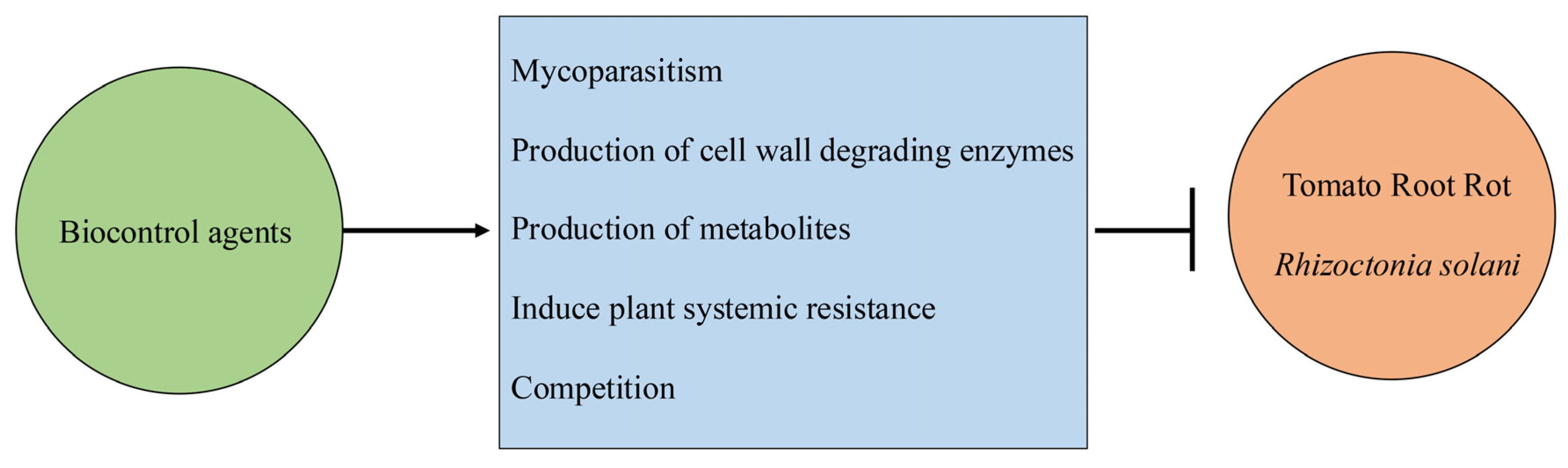
Understanding the biocontrol mechanisms involved is helpful for further enhancing the control efficacy of biocontrol agents against tomato root rot caused by R. solani. Biocontrol mechanisms commonly involve the secretion of cell-wall-degrading enzymes, the production of metabolites, mycoparasitism, the induction of plant systemic resistance, and competition (Figure 1).

4.1. Secretion of Cell-Wall-Degrading Enzymes

Cell-wall-degrading enzymes secreted by biocontrol agents can damage the cell wall of R. solani, thereby playing important roles in the control of tomato Rhizoctonia root rot. Nine bacteria, namely, Pseudomonas sp. M10A and MB65, P. aeruginosa MPF14 and MB123, P. fluorescens MPF47, Alcaligenes faecalis MUN1 and MB21, Alcaligenes sp. MPF37, and Enterobacter sp. MPM1, could produce the cell-wall-degrading enzymes chitinases, β-1,3-glucanases, and proteases and exhibited excellent control effects on tomato root rot [29]. Paecilomyces formosus ED, which can suppress tomato root rot, could produce chitinase, cellulase, and protease [78]. El-Gamal et al. found that both B. subtilis and P. fluorescens strains could produce β-1,3 glucanase, β-1,4 glucanase, and chitinase, which might play essential roles in their antagonistic activity [59].

4.2. Production of Metabolites

Biocontrol agents can also control tomato root rot by producing various metabolites. Rashad et al. found that metabolites with an antifungal background, such as chlorogenic acid, pyrrolo [1,2-a]pyrazine-1,4-dione, propyl thioglycolic acid, and phthalic acid, were produced by B. subtilis SR22 and might be associated with its antagonistic ability [56]. Daroodi et al. found that Acrophialophora jodhpurensis could produce volatile and non-volatile metabolites that inhibit the mycelial growth of R. solani [80].

4.3. Mycoparasitism

Mycoparasitism is another important mechanism of biocontrol agents in the management of tomato root rot. A microscopic observation found that P. oligandrum Po37 coiled around the hyphae of R. solani and that the infection pegs formed and penetrated R. solani cells [79]. An SEM observation showed that H. lixii NAIMCC-F-01760 coiled and deformed the mycelia of R. solani [84].

4.4. Induction of Plant Systemic Resistance

The induction of plant systemic resistance is an important mechanism by which biocontrol agents inhibit root rot in tomato plants. The expression levels of several defense-related genes and the activities of antioxidant enzymes were increased after applying biocontrol agents against tomato root rot, which might be associated with the activation of plant systemic resistance. Behiry et al. found that the application of T. pubescens Tp21 to tomato could significantly reduce the disease index of root rot disease caused by R. solani. Meanwhile, the expression levels of the defense-related genes PAL, CHS, and HQT, which encode phenylalanine ammonia-lyase, chalcone synthase, and hydroxycinnamoyl Co A quinate hydroxycinnamoyl transferase, respectively, as well as the activities of the antioxidant enzymes polyphenol oxidase, peroxidase, catalase, and superoxide dismutase, were significantly improved when using Tp21 against R. solani compared with R. solani infection only [76]. Similarly, Rashad et al. found that the disease incidence of tomato root rot caused by R. solani was dramatically reduced by using B. subtilis SR22. Deep study found that the expression levels of the defense response genes JERF3 (encoding jasmonate and ethylene-responsive factor 3), POD (encoding peroxidase), and PR1 (encoding pathogenesis-related protein 1) and the activities of the antioxidant enzymes polyphenol oxidase and peroxidase notably increased after the application of B. subtilis SR22 to tomato roots infected by R. solani [56].

4.5. Competition

Competition for nutrients or space is also an important mechanism by which biocontrol microorganisms act against plant pathogens. Solanki et al. investigated the role of the nutrient competition of three biocontrol agents B. amyloliquefaciens MB101, S. atrovirens N23 and T. lixii NAIMCC-F-01760 against the tomato root rot pathogen R. solani, and found that nutrient supplementation could influence the antagonistic ability of the biocontrol microorganisms; moreover, nutrient competition could also improve the production of cell-wall-degrading enzymes [84].

5. Conclusions and Prospects

Tomato Rhizoctonia root rot is a soilborne disease caused by R. solani; it can seriously affect tomato production and lead to huge economic losses. Biocontrol has received considerable attention because it is green, safe, and sustainable. This review mainly discusses the biocontrol agents that can control tomato root rot caused by R. solani, including bacterial agents, such as Bacillus, Pseudomonas, Streptomyces, Enterobacter, Alcaligenes, Paenebacillus, and Acinetobacter, and fungal agents, such as Trichoderma, Paecilomyces, Penicillium, Pythium, and Muscodor, as well as their potential biocontrol mechanisms. This review provides a basis for further field application of biocontrol agents to suppress tomato root rot caused by R. solani.
The most important method for controlling tomato root rot caused by R. solani is the practical application of biocontrol microorganisms, which necessitates the consideration of their formulation, reproducibility under field conditions, environmental variability, regulatory considerations for some microbial agents, and limitations. Different formulations of biocontrol agents are important for applications in various field conditions, as well as agent stability and shelf life. The commonly used microbial formulations are liquid formulations, powder formulations, and granule formulations, etc., with liquid formulations being the most reported for the management of tomato root rot caused by R. solani [29,54].
Reproducibility under field conditions is also a crucial factor for the practical application and commercialization of biocontrol microorganisms. Reproducibility could ensure the stable and reliable effects of biocontrol agents against plant pathogens, as factors such as weather, season, soil type, and other environmental parameters vary. Zehra et al. investigated the ability of several biocontrol microorganisms to manage the infection of tomato plants by R. solani under field conditions over two years. The results showed that Pseudomonas MRFP-205, MRFP-206, MRFP-212, EFP-47, Penicillium Pen1-R, Trichoderma ET-6 and ET-9 exhibited effective control ability in two years [53]. In addition, regulatory considerations for some microbial agents are necessary for practical application of biocontrol agents, mainly including safety, environmental risk, and manufacturing quality.
Some limitations exist in the current application of biocontrol microorganisms against tomato root rot caused by R. solani. Field assays are necessary to verify the control effects of biocontrol agents and for their further commercialization; however, the control efficacy of most current biocontrol agents that are capable of controlling tomato root rot caused by R. solani is investigated under greenhouse or plate antagonism conditions. In addition, commercial microbial products are rare, and the formulations of microbial agents are insufficient. Li et al. investigated the control effect of commercial T. harzianum T-22 (KRL-AG2) in the management of tomato root rot caused by R. solani, and found that it could significantly reduce the disease incidence (from 50% to 17.2%). Moreover, the current studies mainly focus on screening biocontrol agents for controlling tomato root rot caused by R. solani, but do not deeply investigate the underlying molecular mechanisms.
In addition, several principal barriers limit the translation of biocontrol microorganisms from experimental success to reliable field performance and commercial implementation. The first is that the varying environmental conditions in the field cause the unstable performance of biocontrol microorganisms and lead to variable control efficacy. Second, formulations with long shelf lives and stable survival rates are lacking, which influences the commercial implementation of biocontrol agents.
For further effective control of tomato Rhizoctonia root rot through biocontrol agents, the following suggestions are made:
(1)
Screen more biocontrol agents against tomato Rhizoctonia root rot. Currently, the number of biocontrol agents reported to be able to suppress tomato Rhizoctonia root remains limited. Multiple isolation and screening strategies should be used to identify more suitable biocontrol agents.
(2)
Clearly identify the molecular mechanism of biocontrol agents in suppressing tomato Rhizoctonia root rot. By combining omics methods, including genomics, transcriptomics, proteomics, and metabolomics, a multi-level regulatory network can be constructed. An interaction network among biocontrol agents, R. solani, and tomato plants can be established, and then the molecular mechanisms of biocontrol agents in controlling tomato Rhizoctonia root rot can be comprehensively analyzed.
(3)
Screen biocontrol-related genes. Biocontrol-related genes could be screened through multi-omics analysis, and their roles in controlling tomato Rhizoctonia root rot could be examined through gene function analyses, such as gene knockout, gene silencing, and gene overexpression analyses.
(4)
Improve the control efficacy of biocontrol agents against tomato Rhizoctonia root rot. Numerous methods could be used to enhance the control efficacy of biocontrol agents. First, the culture and inoculation conditions of biocontrol agents should be optimized. Second, mutation breeding could be used to screen biocontrol agents highly effective in suppressing tomato Rhizoctonia root rot. Finally, effective biocontrol genes can be transferred into biocontrol agents to construct genetically modified strains, thereby improving the control efficacy of tomato Rhizoctonia root rot.
(5)
Construct complex biocontrol microorganisms. The use of a single biocontrol microorganism can sometimes have limited effectiveness in controlling tomato Rhizoctonia root rot and may face challenges associated with multiple plant diseases. Therefore, different types of biocontrol agents, such as bacteria and fungi, as well as those from different environmental sources, such as endophytic microorganisms from various plants and soil-derived microorganisms, could be used to construct complex biocontrol microorganisms in order to achieve synergistic effects in disease control, plant growth promotion, stress resistance, and other multiple functions.
(6)
Develop biocontrol commercial products. Currently, there are few commercial biocontrol products on the market for controlling tomato Rhizoctonia root rot. Biocontrol agents that exhibit excellent efficacy in controlling tomato Rhizoctonia root rot under field conditions could be used to develop more commercial products. Developing more commercial biocontrol products, as well as various formulations, and improving their stability are of great significance for the large-scale application of biocontrol agents to control tomato Rhizoctonia root rot.

Author Contributions

Conceptualization, H.-X.P. and M.-H.S.; investigation, Z.-B.S. and X.-F.L.; data curation, X.-R.P., X.-P.W. and Z.Z.; writing—original draft preparation, Z.-B.S.; writing—review and editing, H.-X.P. and M.-H.S.; supervision, H.-X.P. and M.-H.S.; funding acquisition, M.-H.S. All authors have read and agreed to the published version of the manuscript.

Funding

This work was supported by the funding of the National Key Research and Development Program of China (2023YFD1401200), China Agriculture Research System of MOF and MARA (CARS-23-C04).

Institutional Review Board Statement

Not applicable.

Informed Consent Statement

Not applicable.

Data Availability Statement

No new data were created or analyzed in this study. Data sharing is not applicable.

Conflicts of Interest

The authors declare no conflicts of interest.

References

  1. Li, Y.; Zhang, R.; Zhang, C.; Li, Q.; Nie, L.; Wang, C.; Wang, X.X. Integrative approaches to nutrient management in tomato cultivation for improved sustainability and productivity. Front. Plant Sci. 2025, 16, 1626136. [Google Scholar] [CrossRef]
  2. Du, M.; Sun, C.; Deng, L.; Zhou, M.; Li, J.; Du, Y.; Ye, Z.; Huang, S.; Li, T.; Yu, J.; et al. Molecular breeding of tomato: Advances and challenges. J. Integr. Plant Biol. 2025, 67, 669–721. [Google Scholar] [CrossRef]
  3. Chaudhary, P.; Sharma, A.; Singh, B.; Nagpal, A.K. Bioactivities of phytochemicals present in tomato. J. Food Sci. Technol. 2018, 55, 2833–2849. [Google Scholar] [CrossRef] [PubMed]
  4. Collins, E.J.; Bowyer, C.; Tsouza, A.; Chopra, M. Tomatoes: An extensive review of the associated health impacts of tomatoes and factors that can affect their cultivation. Biology 2022, 11, 239. [Google Scholar] [CrossRef] [PubMed]
  5. ElShamey, E.; Zeng, Y.; Ding, Y.; Yang, J. Functional phytochemicals in tomatoes: Biosynthesis, gene. regulation, and human health implications. Front. Plant Sci. 2025, 16, 1662388. [Google Scholar] [CrossRef] [PubMed]
  6. Szabo, K.; Varvara, R.A.; Ciont, C.; Macri, A.M.; Vodnar, D.C. An updated overview on the revalorization of bioactive compounds derived from tomato production and processing by-products. J. Clean. Prod. 2025, 497, 145151. [Google Scholar] [CrossRef]
  7. Onyeneke, R.U.; Agyarko, F.F.; Onyeneke, C.J.; Osuji, E.E.; Ibeneme, P.A.; Esfahani, I.J. How does climate change affect tomato and okra production? evidence from Nigeria. Plants 2023, 12, 3477. [Google Scholar] [CrossRef]
  8. Kalaitzoglou, P.; van Ieperen, W.; Harbinson, J.; van der Meer, M.; Martinakos, S.; Weerheim, K.; Nicole, C.C.S.; Marcelis, L.F.M. Effects of continuous or end-of-day far-red light on tomato plant growth, morphology, light absorption, and fruit production. Front. Plant Sci. 2019, 10, 322. [Google Scholar] [CrossRef]
  9. Chand, J.B.; Hewa, G.; Hassanli, A.; Myers, B. Deficit irrigation on tomato production in a greenhouse environment: A review. J. Irrig. Drain. Eng. 2020, 147, 04020041. [Google Scholar] [CrossRef]
  10. Weisser, M.; Mattner, S.W.; Southam-Rogers, L.; Hepworth, G.; Arioli, T. Effect of a fortified biostimulant extract on tomato plant productivity, physiology, and growing media properties. Plants 2024, 13, 4. [Google Scholar] [CrossRef]
  11. Modiba, M.P.; Bell, T.; Glick, B.; Babalola, O.O. Ralstonia solanacearum and Xanthomonas perforans as causal agents of bacterial disease of tomato. Microbiologyopen 2025, 14, e70195. [Google Scholar] [CrossRef]
  12. Peritore-Galve, F.C.; Tancos, M.A.; Smart, C.D. Bacterial canker of tomato: Revisiting a global and economically damaging seedborne pathogen. Plant Dis. 2021, 105, 1581–1595. [Google Scholar] [CrossRef]
  13. El-Fatah, B.E.S.A.; Imran, M.; Abo-Elyousr, K.A.M.; Mahmoud, A.F. Isolation of Pseudomonas syringae pv. Tomato strains causing bacterial speck disease of tomato and marker-based monitoring for their virulence. Mol. Biol. Rep. 2023, 50, 4917–4930. [Google Scholar] [CrossRef] [PubMed]
  14. Ma, M.; Taylor, P.W.J.; Chen, D.; Vaghefi, N.; He, J.Z. Major soilborne pathogens of field processing tomatoes and management strategies. Microorganisms 2023, 11, 263. [Google Scholar] [CrossRef]
  15. Williamson-Benavides, B.A.; Dhingra, A. Understanding root rot disease in agricultural crops. Horticulturae 2021, 7, 33. [Google Scholar] [CrossRef]
  16. Chen, D.; Yue, D.; Li, G.; Zhang, Z.; Zhou, L.; Xu, H.; Liu, D.; Wang, X. Isolation and characterization of new antagonistic bacteria P10-7 and evaluation of its biocontrol potential against tomato gray mold. Front. Microbiol. 2025, 16, 1668865. [Google Scholar] [CrossRef]
  17. Abebe, B.B.; Demissie, A.G.; Felatie, H.B.; Tesema, A.A.; Wodajo, B.; Shiferaw, W.A.; Hailu, S.G. Evaluation of Pseudomonas fluorescens for biocontrol of early blight (Alternaria solani) in tomato in North Wollo, Ethiopia. PLoS ONE 2026, 21, e0341442. [Google Scholar] [CrossRef] [PubMed]
  18. Park, J.H.; Han, J.W.; Kim, B.; Park, S.U.; Choi, G.J.; Kim, H. Suppression of rice blast and tomato late blight by Paraboeremia adianticola producing vulculic acid. Pest Manag. Sci. 2025, 81, 5052–5061. [Google Scholar] [CrossRef]
  19. Zhang, K.; Wang, H.; Xie, W.; Niu, T.; Fu, W.; Zhang, X.; Hao, Z.; Chen, B. Arbuscular mycorrhizal fungi and Trichoderma harzianum alter salicylic acid-jasmonic acid balance to suppress Fusarium wilt in tomato. Front. Plant Sci. 2025, 16, 1714648. [Google Scholar] [CrossRef]
  20. Retief, E.; Lamprecht, S.; McLeod, A. Characterisation and pathogenicity of Verticillium dahliae isolates associated with Verticillium wilt of tomato in the Limpopo Province of South Africa. J. Plant Pathol. 2023, 105, 1465–1481. [Google Scholar] [CrossRef]
  21. Nagachandrabose, S.; Shanthi, M.; Shanmugam, S.P.; Elaiyabharathi, T.; Sharmila, R.; Devrajan, K.; Manickam, R.; Srinivasan, R. Integrating grafting and bio-inputs for sustainable management of root knot nematode, Meloidogyne incognita, in tomato cultivation. Front. Plant Sci. 2025, 16, 1623444. [Google Scholar] [CrossRef]
  22. Qi, S.; Shen, Y.; Wang, X.; Zhang, S.; Li, Y.; Islam, M.M.; Wang, J.; Zhao, P.; Zhan, X.; Zhang, F.; et al. A new NLR gene for resistance to Tomato spotted wilt virus in tomato (Solanum lycopersicum). Theor. Appl. Genet. 2022, 135, 1493–1509. [Google Scholar] [CrossRef]
  23. Nowakowska, M.; Minicka, J.; Nowicki, M.; Szczechura, W.; Hasiów-Jaroszewska, B. Pepino Mosaic virus in tomato: Challenges, control strategies, and future prospects for resistance breeding. Int. J. Mol. Sci. 2025, 26, 11749. [Google Scholar] [CrossRef] [PubMed]
  24. Cao, X.; Huang, M.; Wang, S.; Li, T.; Huang, Y. Tomato yellow leaf curl virus: Characteristics, influence, and regulation mechanism. Plant Physiol. Biochem. 2024, 213, 108812. [Google Scholar] [CrossRef] [PubMed]
  25. Hassanisaadi, M.; Bonjar, G.H.S.; Hosseinipour, A.; Abdolshahi, R.; Barka, E.A.; Saadoun, I. Biological control of Pythium aphanidermatum, the causal agent of tomato root rot by two Streptomyces root symbionts. Agronomy 2021, 11, 846. [Google Scholar] [CrossRef]
  26. Gravel, V.; Martinez, C.; Antoun, H.; Tweddell, R.J. Control of greenhouse tomato root rot [Pythium ultimum] in hydroponic systems, using plant-growth-promoting microorganisms. Can. J. Plant Pathol. 2006, 8, 475–483. [Google Scholar] [CrossRef]
  27. Righini, H.; Francioso, O.; Quintana, A.M.; Pinchetti, J.L.G.; Zuffi, V.; Cappelletti, E.; Roberti, R. New insight on tomato seed priming with Anabaena minutissima phycobiliproteins in relation to Rhizoctonia solani root rot resistance and seedling growth promotion. Phytoparasitica 2023, 51, 763–781. [Google Scholar] [CrossRef]
  28. Abd-Ellatif, S.; Ibrahim, A.A.; Safhi, F.A.; Abdel Razik, E.S.; Kabeil, S.S.A.; Aloufi, S.; Alyamani, A.A.; Basuoni, M.M.; ALshamrani, S.M.; Elshafie, H.S. Green Synthesized of Thymus vulgaris chitosan nanoparticles induce relative WRKY-genes expression in Solanum lycopersicum against Fusarium solani, the causal agent of root rot disease. Plants 2022, 11, 3129. [Google Scholar] [CrossRef]
  29. Solanki, M.K.; Singh, R.K.; Srivastava, S.; Kumar, S.; Kashyap, P.L.; Srivastava, A.K.; Arora, D.K. Isolation and characterization of siderophore producing antagonistic rhizobacteria against Rhizoctonia solani. J. Basic Microbiol. 2014, 54, 585–597. [Google Scholar] [CrossRef]
  30. Solanki, M.K.; Kumar, S.; Pandey, A.K.; Srivastava, S.; Singh, R.K.; Kashyap, P.L.; Srivastava, A.K.; Arora, D.K. Diversity and antagonistic potential of Bacillus spp. associated to the rhizosphere of tomato for the management of Rhizoctonia solani. Biocontrol Sci. Technol. 2012, 22, 203–217. [Google Scholar] [CrossRef]
  31. Datta, S.; Sarkar, M.; Chowdhury, A.; Rakwal, R.; Agrawal, G.K.; Sarkar, A. A comprehensive insight into the biology of Rhizoctonia solani AG1-IA Kühn, the causal organism of the sheath blight disease of rice. J. Plant Pathol. 2022, 104, 79–98. [Google Scholar] [CrossRef]
  32. Singh, P.; Mazumdar, P.; Harikrishna, J.A.; Babu, S. Sheath blight of rice: A review and identification of priorities for future research. Planta 2019, 250, 1387–1407. [Google Scholar] [CrossRef] [PubMed]
  33. Dubey, S.C. Diversity, diagnostics, epidemiology and management of diseases in pulse crops caused by Rhizoctonia solani. Indian Phytopathol. 2025, 78, 519–527. [Google Scholar] [CrossRef]
  34. Akber, M.A.; Mubeen, M.; Sohail, M.A.; Khan, S.W.; Solanki, M.K.; Khalid, R.; Abbas, A.; Divvela, P.K.; Zhou, L. Global distribution, traditional and modern detection, diagnostic, and management approaches of Rhizoctonia solani associated with legume crops. Front. Microbiol. 2023, 13, 1091288. [Google Scholar] [CrossRef]
  35. Senapati, M.; Tiwari, A.; Sharma, N.; Chandra, P.; Bashyal, B.M.; Ellur, R.K.; Bhowmick, P.K.; Bollinedi, H.; Vinod, K.K.; Singh, A.K.; et al. Rhizoctonia solani Kühn pathophysiology: Status and prospects of sheath blight disease management in rice. Front. Plant Sci. 2022, 13, 881116. [Google Scholar] [CrossRef]
  36. Akber, M.A.; Fang, X. Research progress on diseases caused by the soil-borne fungal pathogen Rhizoctonia solani in Alfalfa. Agronomy 2024, 14, 1483. [Google Scholar] [CrossRef]
  37. Behiry, S.I.; Al-Askar, A.A.; Soliman, S.A.; Alotibi, F.O.; Basile, A.; Abdelkhalek, A.; Elsharkawy, M.M.; Salem, M.Z.M.; Hafez, E.E.; Heflish, A.A. Plantago lagopus extract as a green fungicide induces systemic resistance against Rhizoctonia root rot disease in tomato plants. Front. Plant Sci. 2022, 13, 966929. [Google Scholar] [CrossRef] [PubMed]
  38. Mogazy, A.M.; Abdallah, W.E.; Mohamed, H.I.; Omran, A.A.A. The efficacy of chemical inducers and fungicides in controlling tomato root rot disease caused by Rhizoctonia solani. Plant Physiol. Biochem. 2024, 210, 108669. [Google Scholar] [CrossRef]
  39. Peng, Y.; Li, S.J.; Yan, J.; Tang, Y.; Cheng, J.P.; Gao, A.J.; Yao, X.; Ruan, J.J.; Xu, B.L. Research progress on phytopathogenic fungi and their role as biocontrol agents. Front. Microbiol. 2021, 12, 670135. [Google Scholar] [CrossRef]
  40. Sun, Z.B.; Song, H.J.; Liu, Y.Q.; Ren, Q.; Wang, Q.Y.; Li, X.F.; Pan, H.X.; Huang, X.Q. The potential of microorganisms for the control of grape downy mildew—A review. J. Fungi 2024, 10, 702. [Google Scholar] [CrossRef] [PubMed]
  41. Yu, S.F.; Wang, C.L.; Hu, Y.F.; Wen, Y.C.; Sun, Z.B. Biocontrol of three severe diseases in soybean. Agriculture 2022, 12, 1391. [Google Scholar] [CrossRef]
  42. Sun, Z.B.; Yu, S.F.; Hu, Y.F.; Wen, Y.C. Biological control of the cucumber downy mildew pathogen Pseudoperonospora cubensis. Horticulturae 2022, 8, 410. [Google Scholar] [CrossRef]
  43. Karačić, V.; Miljaković, D.; Marinković, J.; Ignjatov, M.; Milošević, D.; Tamindžić, G.; Ivanović, M. Bacillus species: Excellent biocontrol agents against tomato diseases. Microorganisms 2024, 12, 457. [Google Scholar] [CrossRef]
  44. Wallace, R.L.; Hirkala, D.L.; Nelson, L.M. Efficacy of Pseudomonas fluorescens for control of Mucor rot of apple during commercial storage and potential modes of action. Can. J. Microbiol. 2018, 64, 420–431. [Google Scholar] [CrossRef]
  45. Kovaleski, M.; Maurer, T.R.; Banfi, M.; Remor, M.; Restelatto, M.; Rieder, R.; Deuner, C.C.; Colla, L.M. Biocontrol of plant pathogens by actinomycetes: A bibliometric analysis and systematic review. World J. Microbiol. Biotechnol. 2025, 41, 243. [Google Scholar] [CrossRef]
  46. Olowe, O.M.; Nicola, L.; Asemoloye, M.D.; Akanmu, A.O.; Babalola, O.O. Trichoderma: Potential bio-resource for the management of tomato root rot diseases in Africa. Microbiol. Res. 2022, 57, 126978. [Google Scholar] [CrossRef]
  47. Sun, Z.B.; Li, S.D.; Ren, Q.; Xu, J.L.; Lu, X.; Sun, M.H. Biology and applications of Clonostachys rosea. J. Appl. Microbiol. 2020, 129, 486–495. [Google Scholar] [CrossRef]
  48. Wang, H.; Zhao, H.; Zhu, Z.; Lin, Y.; Xie, J.; Cheng, J.; Jiang, D.; Fu, Y. The function of chitinases. CmCH1 and CmCH10 in the interaction of Coniothyrium minitans and Sclerotinia sclerotiorum. Int. J. Mol. Sci. 2025, 26, 8706. [Google Scholar] [CrossRef]
  49. Mapuranga, J.; Yang, W. Harnessing biological control and advanced technologies for sustainable wheat rust management: An integrated approach. Pestic. Biochem. Physiol. 2026, 218, 106931. [Google Scholar] [CrossRef]
  50. Hashem, A.; Tabassum, B.; Abd-Allah, E.F. Bacillus subtilis: A plant-growth promoting rhizobacterium that also impacts biotic stress. Saudi J. Biol. Sci. 2019, 26, 1291–1297. [Google Scholar] [CrossRef] [PubMed]
  51. Keshmirshekan, A.; de Souza Mesquita, L.M.; Ventura, S.P.M. Biocontrol manufacturing and agricultural applications of Bacillus velezensis. Trends Biotechnol. 2024, 42, 986–1001. [Google Scholar] [CrossRef]
  52. Fróes, A.; Macrae, A.; Rosa, J.; Franco, M.; Souza, R.; Soares, R.; Coelho, R. Selection of a Streptomyces strain able to produce cell wall degrading enzymes and active against Sclerotinia sclerotiorum. J. Microbiol. 2012, 50, 798–806. [Google Scholar] [CrossRef]
  53. Zehra, R.; Moin, S.; Shafique, H.A.; Zaidi, S.; Ehteshamul-Haque, S. Efficacy of plant growth promoting microbes in inducing systemic resistance to root rot and physiochemical proteins of tomato fruit. Pak. J. Bot. 2024, 56, 1177–1185. [Google Scholar] [CrossRef]
  54. Solanki, M.K.; Yandigeri, M.S.; Kumar, S.; Singh, R.K.; Srivastava, A.K. Co-inoculation of different antagonists can enhance the biocontrol activity against Rhizoctonia solani in tomato. Antonie Leeuwenhoek 2019, 112, 1633–1644. [Google Scholar] [CrossRef]
  55. Siddiqui, I.A.; Qureshi, S.A.; Sultana, V.; Ehteshamul-Haque, S.; Ghaffar, A. Biological control of root rot-root knot disease complex of tomato. Plant Soil 2000, 227, 163–169. [Google Scholar] [CrossRef]
  56. Rashad, Y.M.; Abdalla, S.A.; Sleem, M.M. Endophytic Bacillus subtilis SR22 triggers defense responses in tomato against Rhizoctonia root rot. Plants 2022, 11, 2051. [Google Scholar] [CrossRef]
  57. Solanki, M.K.; Singh, R.K.; Srivastava, S.; Kumar, S.; Kashyap, P.L.; Srivastava, A.K. Characterization of antagonistic-potential of two Bacillus strains and their biocontrol activity against Rhizoctonia solani in tomato. J. Basic Microbiol. 2015, 55, 82–90. [Google Scholar] [CrossRef] [PubMed]
  58. Abdeljalil, N.O.B.; Renault, D.; Gerbore, J.; Vallance, J.; Rey, P.; Daami-Remadi, M. Comparative efficacy of three tomato-associated rhizobacteria used singly or in combination in suppressing rhizoctonia root rot and enhancing tomato growth. J. Microb. Biochem. Technol. 2016, 8, 110–119. [Google Scholar]
  59. El-Gamal, N.G.; Shehata, A.N.; Hamed, E.R.; Shehata, H.S. Improvement of lytic enzymes producing Pseudomonas fluorescens and Bacillus subtilis isolates for enhancing their biocontrol potential against root rot disease in tomato plants. Res. J. Pharm. Biol. Chem. Sci. 2016, 7, 1393–1400. [Google Scholar]
  60. Shah, Z.M.; Naz, R.; Naz, S.; Zahoor, S.; Nosheen, A.; Shahid, M.; Anwar, Z.; Keyani, R. Incorporation of zinc sulfide nanoparticles, Acinetobacter pittii and Bacillus velezensis to improve tomato plant growth, biochemical attributes and resistance against Rhizoctonia solani. Plant Physiol. Biochem. 2023, 202, 107909. [Google Scholar] [CrossRef]
  61. Abbas, M.M.; Ismael, W.H.; Mahfouz, A.Y.; Daigham, G.E.; Attia, M.S. Efficacy of endophytic bacteria as promising inducers for enhancing the immune responses in tomato plants and managing Rhizoctonia root-rot disease. Sci. Rep. 2024, 14, 1331. [Google Scholar] [CrossRef]
  62. Berta, G.; Sampo, S.; Gamalero, E.; Massa, N.; Lemanceau, P. Suppression of Rhizoctonia root-rot of tomato by Glomus mossae BEG12 and Pseudomonas fluorescens A6RI is associated with their effect on the pathogen growth and on the root morphogenesis. Eur. J. Plant Pathol. 2005, 111, 279–288. [Google Scholar] [CrossRef]
  63. Naglaa, A.S.M.; Essa, T.A.; Manal, A.H.E.; Kamel, S.M. Efficacy of free and formulated arbuscular mycorrhiza, Trichoderma viride and Pseudomonas fluorescens on controlling tomato root rot diseases. Egypt. J. Biol. Pest Control 2016, 26, 477–486. [Google Scholar]
  64. Parveen, G.; Ehteshamul-Haque, S.; Sultana, V.; Ara, J.; Athar, M. Suppression of root pathogens of tomato by Rhizobia, Pseudomonas aeruginosa, and mineral fertilizers. Int. J. Veg. Sci. 2008, 14, 205–215. [Google Scholar] [CrossRef]
  65. Moin, S.; Ali, S.A.; Hasan, K.A.; Tariq, A.; Sultana, V.; Ara, J.; Ehteshamul-Haque, S. Managing the root rot disease of sunflower with endophytic fluorescent Pseudomonas associated with healthy plants. Crop Prot. 2020, 130, 105066. [Google Scholar] [CrossRef]
  66. Moin, S.; Rahman, A.; Parveen, G.; Korejo, F.; Shafique, H.A.; Zehra, R.; Sultana, V.; Ehteshamul-Haque, S. Amelioration of systemic resistance in tomato against root rotting fungi by endophytic Trichoderma species. Pak. J. Bot. 2021, 53, 322–327. [Google Scholar] [CrossRef]
  67. Wang, M.; Li, H.; Li, J.; Zhang, W.; Zhang, J. Streptomyces strains and their metabolites for biocontrol of phytopathogens in agriculture. J. Agric. Food Chem. 2024, 72, 2077–2088. [Google Scholar] [CrossRef]
  68. Vurukonda, S.S.K.P.; Giovanardi, D.; Stefani, E. Plant growth promoting and biocontrol activity of Streptomyces spp. as endophytes. Int. J. Mol. Sci. 2018, 19, 952. [Google Scholar] [CrossRef]
  69. Kaari, M.; Joseph, J.; Manikkam, R.; Sreenivasan, A.; Venugopal, G.; Alexander, B.; Krishnan, S. Biocontrol Streptomyces induces resistance to bacterial wilt by increasing defense-related enzyme activity in Solanum melongena L. Curr. Microbiol. 2022, 79, 146. [Google Scholar] [CrossRef]
  70. Khan, S.; Srivastava, S.; Karnwal, A.; Malik, T. Streptomyces as a promising biological control agents for plant pathogens. Front. Microbiol. 2023, 14, 1285543. [Google Scholar] [CrossRef]
  71. Le, K.D.; Yu, N.H.; Park, A.R.; Park, D.J.; Kim, C.J.; Kim, J.C. Streptomyces sp. AN090126 as a biocontrol agent against bacterial and fungal plant diseases. Microorganisms 2022, 10, 791. [Google Scholar] [CrossRef]
  72. Yandigeri, M.S.; Malviya, N.; Solanki, M.K.; Shrivastava, P.; Sivakumar, G. Chitinolytic Streptomyces vinaceusdrappus S5MW2 isolated from Chilika lake, India enhances plant growth and biocontrol efficacy through chitin supplementation against Rhizoctonia solani. World J. Microbiol. Biotechnol. 2015, 31, 1217–1225. [Google Scholar] [CrossRef] [PubMed]
  73. Yücel, S.; Karaçanci, S.; Ay, T. Activity and bioformulation of Trichoderma harzianum for management of tomato diseases caused by soilborne pathogens. Acta Hortic. 2017, 1164, 339–344. [Google Scholar] [CrossRef]
  74. Solanki, M.K.; Singh, N.; Singh, R.K.; Singh, P.; Srivastava, A.K.; Kumar, S.; Kashyap, P.L.; Arora, D.K. Plant defense activation and management of tomato root rot by a chitin-fortified Trichoderma/Hypocrea formulation. Phytoparasitica 2011, 39, 471–481. [Google Scholar] [CrossRef]
  75. Kashyap, P.L.; Solanki, M.K.; Kushwaha, P.; Kumar, S.; Srivastava, A.K. Biocontrol potential of salt-tolerant Trichoderma and Hypocrea isolates for the management of tomato root rot under saline environment. J. Soil Sci. Plant Nutr. 2020, 20, 160–176. [Google Scholar] [CrossRef]
  76. Behiry, S.; Soliman, S.A.; Massoud, M.A.; Abdelbary, M.; Kordy, A.M.; Abdelkhalek, A.; Heflish, A. Trichoderma pubescens elicit induced systemic resistance in tomato challenged by Rhizoctonia solani. J. Fungi 2023, 9, 167. [Google Scholar] [CrossRef]
  77. Heflish, A.A.; Abdelkhalek, A.; Al-Askar, A.A.; Behiry, S.I. Protective and curative effects of Trichoderma asperelloides Ta41 on tomato root rot caused by Rhizoctonia solani Rs33. Agronomy 2021, 11, 1162. [Google Scholar] [CrossRef]
  78. Arasu, M.V.; Al-Dhabi, N.A. Biological control of root rot disease-causing Rhizoctonia solani in tomato plant by an endophytic fungus and analysis of growth promoting activities in greenhouse and field. Physiol. Mol. Plant Pathol. 2023, 127, 102080. [Google Scholar] [CrossRef]
  79. Abdeljalil, N.O.B.; Vallance, J.; Gerbore, J.; Yacoub, A.; Daami-Remadi, M.; Rey, P. Combining potential oomycete and bacterial biocontrol agents as a tool to fight tomato Rhizoctonia root rot. Biol. Control 2021, 155, 104521. [Google Scholar] [CrossRef]
  80. Daroodi, Z.; Taheri, P.; Tarighi, S. Direct antagonistic activity and tomato resistance induction of the endophytic fungus Acrophialophora jodhpurensis against Rhizoctonia solani. Biol. Control 2021, 160, 104696. [Google Scholar] [CrossRef]
  81. Suwannarach, N.; Kumla, J.; Matsui, K.; Lumyong, S. Characterization and efficacy of Muscodor cinnamomi in promoting plant growth and controlling Rhizoctonia root rot in tomatoes. Biol. Control 2015, 90, 25–33. [Google Scholar] [CrossRef]
  82. Elgorban, A.M.; Bahkali, A.H.; Al-Sum, B.A. Biological control of root rots and stems canker of tomato plants caused by Rhizoctonia solani in Saudi Arabia. J. Pure Appl. Microbiol. 2013, 7, 819–826. [Google Scholar]
  83. Jamal, A.; Farhat, H.; Urooj, F.; Rahman, A.; Irfan, M.; Ehteshamul-Haque, S. Characterization of endophytic yeast and its suppressive effect on root rotting fungi of tomato under neem cake soil amendment. Egypt. J. Biol. Pest Control 2021, 31, 152. [Google Scholar] [CrossRef]
  84. Solanki, M.K.; Kumar, S.; Yandigeri, M.S.; Singh, R.K.; Srivastava, A.K. Nutrient competition mediated antagonism of microbes against Rhizoctonia solani. Not. Sci. Biol. 2018, 10, 392–399. [Google Scholar] [CrossRef]
Figure 1. Mechanisms of biocontrol agents against tomato root rot caused by Rhizoctonia solani.
Jof 12 00313 g001
Disclaimer/Publisher’s Note: The statements, opinions and data contained in all publications are solely those of the individual author(s) and contributor(s) and not of MDPI and/or the editor(s). MDPI and/or the editor(s) disclaim responsibility for any injury to people or property resulting from any ideas, methods, instructions or products referred to in the content.