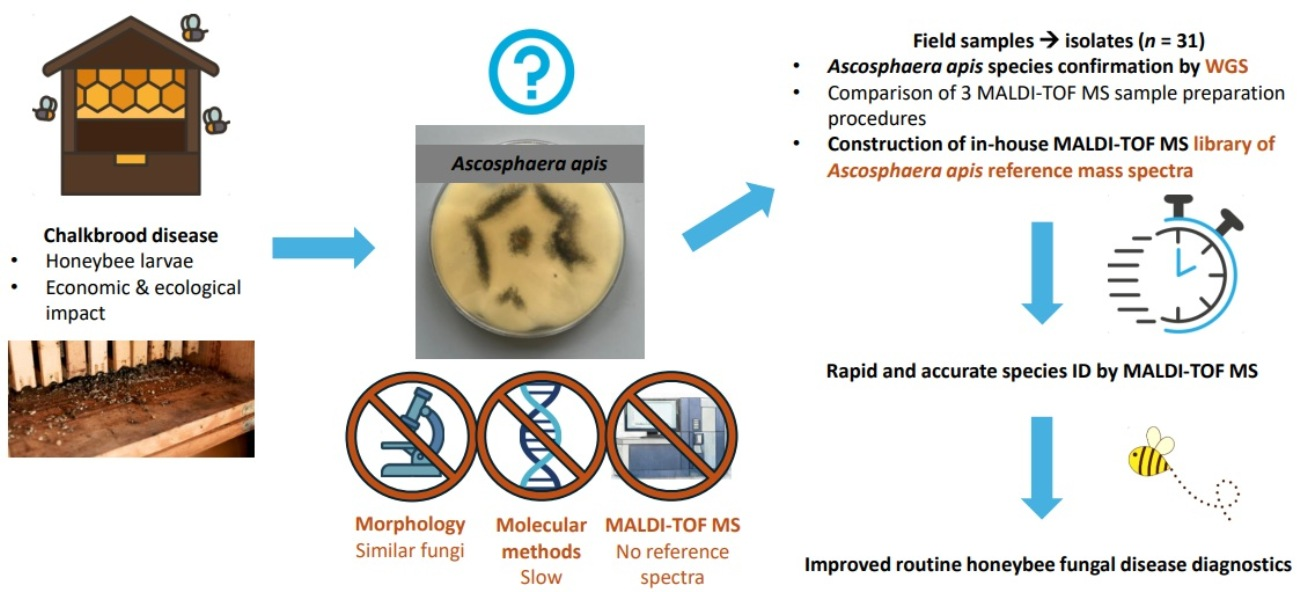

Rapid MALDI-TOF Mass Spectrometry Identification of the Chalkbrood Pathogen Ascosphaera apis



Abstract
1. Introduction
2. Materials and Methods
2.1. Reference Strains and Clinical Isolates
2.2. Cultivation of Ascosphaera Strains and MALDI-TOF MS Identification
2.2.1. Liquid Cultivation Method
2.2.2. Formic Acid–Ethanol Extraction Method
2.2.3. Extended Direct Transfer Method
2.3. Validation of the In-House Library and Identification of Isolates
2.4. WGS of Reference Strains and Clinical Isolates
2.5. Statistical Analysis
3. Results
4. Discussion
5. Conclusions
Supplementary Materials
Author Contributions
Funding
Institutional Review Board Statement
Informed Consent Statement
Data Availability Statement
Conflicts of Interest
References
- Wynns, A.A.; Jensen, A.B.; Eilenberg, J. Ascosphaera callicarpa, a new species of bee-loving fungus, with a key to the genus for Europe. PLoS ONE 2013, 8, e73419. [Google Scholar] [CrossRef] [PubMed]
- Spiltoir, C.F.; Olive, L.S. A reclassification of the genus Pericystis Betts. Mycologia 1955, 47, 238–244. [Google Scholar] [CrossRef]
- Zaghloul, O.A.; Mourad, A.K.; El Kady, M.B.; Nemat, F.M.; Morsy, M.E. Assessment of losses in honey yield due to chalkbrood disease, with reference to the determination of its economic injury levels in Egypt. Commun. Agric. Appl. Biol. Sci. 2005, 70, 703–714. [Google Scholar] [PubMed]
- Maassen, A. Die Krankheit der Bienenbrut, hervorgerufen durch Pericystis apis. Arb. Kaiserl. Biol. Anst. Land-Forstwirtsch. 1913, 11, 1–16. [Google Scholar]
- Jensen, A.B.; Aronstein, K.; Flores, J.M.; Vojvodic, S.; Palacio, M.A.; Spivak, M. Standard methods for fungal brood disease research. J. Apic. Res. 2013, 52, 1–20. [Google Scholar] [CrossRef]
- Spiltoir, C.F. Life Cycle of Ascosphaera apis (Pericystis apis). Am. J. Bot. 1955, 42, 501–508. [Google Scholar] [CrossRef]
- Bissett, J. Contribution toward a monograph of the genus Ascosphaera. Can. J. Bot. 1988, 66, 2541–2560. [Google Scholar] [CrossRef]
- James, R.R.; Skinner, J.S. PCR diagnostic methods for Ascosphaera infections in bees. J. Invertebr. Pathol. 2005, 90, 98–103. [Google Scholar] [CrossRef]
- Becker, P.T.; de Bel, A.; Martiny, D.; Ranque, S.; Piarroux, R.; Cassagne, C.; Detandt, M.; Hendrickx, M. Identification of filamentous fungi isolates by MALDI-TOF mass spectrometry: Clinical evaluation of an extended reference spectra library. Med. Mycol. 2014, 52, 826–834. [Google Scholar] [CrossRef]
- Hou, T.-Y.; Chiang-Ni, C.; Teng, S.-H. Current status of MALDI-TOF mass spectrometry in clinical microbiology. J. Food Drug Anal. 2019, 27, 404–414. [Google Scholar] [CrossRef]
- Gómez-Velásquez, J.C.; Loaiza-Díaz, N.; Hernández, G.N.; Lima, N.; Mesa-Arango, A.C. Development and validation of an in-house library for filamentous fungi identification by MALDI-TOF MS in a Clinical Laboratory in Medellin (Colombia). Microorganisms 2020, 8, 1362. [Google Scholar] [CrossRef]
- Welham, K.J.; Domin, M.A.; Johnson, K.; Jones, L.; Ashton, D.S. Characterization of fungal spores by laser desorption/ionization time-of-flight mass spectrometry. Rapid Commun. Mass Spectrom. 2000, 14, 307–310. [Google Scholar] [CrossRef]
- Bruker Daltonics. Standard Operating Procedure: Cultivation and Sample Preparation for Filamentous Fungi; Revision E; Bruker Daltonics: Bremen, Germany, 2019. [Google Scholar]
- Jeraldine, D.V.M.; Wim, L.; Ellen, V.E. A comparative study for optimization of MALDI-TOF MS identification of filamentous fungi. Eur. J. Clin. Microbiol. Infect. Dis. 2023, 42, 1153–1161. [Google Scholar] [CrossRef] [PubMed]
- Chen, S. Ultrafast one-pass FASTQ data preprocessing, quality control, and deduplication using fastp. iMeta 2023, 2, e107. [Google Scholar] [CrossRef] [PubMed]
- Prjibelski, A.; Antipov, D.; Meleshko, D.; Lapidus, A.; Korobeynikov, A. Using SPAdes de novo assembler. Curr. Protoc. Bioinform. 2020, 70, e102. [Google Scholar] [CrossRef]
- Manni, M.; Berkeley, M.R.; Seppey, M.; Simão, F.A.; Zdobnov, E.M. BUSCO update: Novel and streamlined workflows along with broader and deeper phylogenetic coverage for scoring of eukaryotic, prokaryotic, and viral genomes. Mol. Biol. Evol. 2021, 38, 4647–4654. [Google Scholar] [CrossRef]
- Mikheenko, A.; Saveliev, V.; Hirsch, P.; Gurevich, A. WebQUAST: Online evaluation of genome assemblies. Nucleic Acids Res. 2023, 51, W601–W606. [Google Scholar] [CrossRef]
- Borowiec, M.L. AMAS: A fast tool for alignment manipulation and computing of summary statistics. PeerJ 2016, 4, e1660. [Google Scholar] [CrossRef]
- Minh, B.Q.; Schmidt, H.A.; Chernomor, O.; Schrempf, D.; Woodhams, M.D.; von Haeseler, A.; Lanfear, R. IQ-TREE 2: New models and efficient methods for phylogenetic inference in the genomic era. Mol. Biol. Evol. 2020, 37, 1530–1534. [Google Scholar] [CrossRef]
- R Core Team. R: A Language and Environment for Statistical Computing; R Foundation for Statistical Computing: Vienna, Austria, 2023; Available online: https://www.R-project.org/ (accessed on 12 December 2025).
- Cassagne, C.; Ranque, S.; Normand, A.-C.; Fourquet, P.; Thiebault, S.; Planard, C.; Hendrickx, M.; Piarroux, R. Mould routine identification in the clinical laboratory by matrix-assisted laser desorption ionization time-of-flight mass spectrometry. PLoS ONE 2011, 6, e28425. [Google Scholar] [CrossRef]
- Normand, A.-C.; Cassagne, C.; Ranque, S.; L’Ollivier, C.; Fourquet, P.; Roesems, S.; Hendrickx, M.; Piarroux, R. Assessment of various parameters to improve MALDI-TOF MS reference spectra libraries constructed for the routine identification of filamentous fungi. BMC Microbiol. 2013, 13, 76. [Google Scholar] [CrossRef]
- Li, Z.; Heng, H.; Qin, Q.; Chen, L.; Wang, Y.; Zhou, Z. Physicochemical properties, molecular structure, antioxidant activity, and biological function of extracellular melanin from Ascosphaera apis. J. Zhejiang Univ. Sci. B 2022, 23, 365–381. [Google Scholar] [CrossRef]
- Buskirk, A.D.; Hettick, J.M.; Chipinda, I.; Law, B.F.; Siegel, P.D.; Slaven, J.E.; Green, B.J.; Beezhold, D.H. Fungal pigments inhibit the matrix-assisted laser desorption/ionization time-of-flight mass spectrometry analysis of darkly pigmented fungi. Anal. Biochem. 2011, 411, 122–128. [Google Scholar] [CrossRef] [PubMed]
- Aronstein, K.A.; Murray, K.D.; de León, J.H.; Qin, X.; Weinstock, G.M. High mobility group (HMG-box) genes in the honeybee fungal pathogen Ascosphaera apis. Mycologia 2007, 99, 553–561. [Google Scholar] [CrossRef] [PubMed]
- Lau, A.F.; Drake, S.K.; Calhoun, L.B.; Henderson, C.M.; Zelazny, A.M. Development of a clinically comprehensive database and a simple procedure for identification of molds from solid media by matrix-assisted laser desorption ionization time-of-flight mass spectrometry. J. Clin. Microbiol. 2013, 51, 828–834. [Google Scholar] [CrossRef] [PubMed]
- Coulibaly, O.; Marinach-Patrice, C.; Cassagne, C.; Piarroux, R.; Mazier, D.; Ranque, S. Pseudallescheria/Scedosporium complex species identification by matrix-assisted laser desorption ionization time-of-flight mass spectrometry. Med. Mycol. 2011, 49, 621–626. [Google Scholar] [CrossRef]
- Reeve, M.A.; Bachmann, D. A method for filamentous fungal growth and sample preparation aimed at more consistent MALDI-TOF MS spectra despite variations in growth rates and/or incubation times. Biol. Methods Protoc. 2019, 4, bpz003. [Google Scholar] [CrossRef]
- Honsig, C.; Selitsch, B.; Hollenstein, M.; Vossen, M.G.; Spettel, K.; Willinger, B. Identification of filamentous fungi by MALDI-TOF mass spectrometry: Evaluation of three different sample preparation methods and validation of an in-house species cutoff. J. Fungi 2022, 8, 383. [Google Scholar] [CrossRef]



| Ascosphaera Species | ARSEF Number | Origin |
|---|---|---|
| A. apis | 7405 * | USA, Texas |
| A. apis | 7406 | USA, Texas |
| A. apis | 691 | USA, Oregon |
| A. apis | 692 | USA, Oregon |
| A. atra | 693 * | USA, Oregon |
| A. major | 694 * | Denmark |
| A. proliperda | 695 * | Denmark |
| A. larvis | 7945 * | Canada, Saskatchewan |
| A. flava | 5144 * | Australia, Western Australia |
| A. duoformis | 5151 * | / |
| Extraction Method | |||
|---|---|---|---|
| Identification Result | Liquid Cultivation Method | Formic Acid–Ethanol Extraction Method | Extended Direct Transfer Method |
| High confidence (log ≥ 2.0) | 31/31 (100%) | 31/31 (100%) | 14/31 (45.2%) |
| Low confidence (log 1.7–1.99) | 0/31 (0%) | 0/31 (0%) | 12/31 (38.7%) |
| Not identified (log < 1.7) | 0/31 (0%) | 0/31 (0%) | 5/31 (16.1%) |
| Sensitivity | 100% | 100% | 83.9% |
| Specificity | 100% | 100% | 100% |
Disclaimer/Publisher’s Note: The statements, opinions and data contained in all publications are solely those of the individual author(s) and contributor(s) and not of MDPI and/or the editor(s). MDPI and/or the editor(s) disclaim responsibility for any injury to people or property resulting from any ideas, methods, instructions or products referred to in the content. |
© 2026 by the authors. Licensee MDPI, Basel, Switzerland. This article is an open access article distributed under the terms and conditions of the Creative Commons Attribution (CC BY) license.
Share and Cite
Hočevar, B.; Kušar, D.; Gruntar, I.; Gostinčar, C.; Zdovc, I. Rapid MALDI-TOF Mass Spectrometry Identification of the Chalkbrood Pathogen Ascosphaera apis. J. Fungi 2026, 12, 311. https://doi.org/10.3390/jof12050311
Hočevar B, Kušar D, Gruntar I, Gostinčar C, Zdovc I. Rapid MALDI-TOF Mass Spectrometry Identification of the Chalkbrood Pathogen Ascosphaera apis. Journal of Fungi. 2026; 12(5):311. https://doi.org/10.3390/jof12050311
Chicago/Turabian StyleHočevar, Barbara, Darja Kušar, Igor Gruntar, Cene Gostinčar, and Irena Zdovc. 2026. "Rapid MALDI-TOF Mass Spectrometry Identification of the Chalkbrood Pathogen Ascosphaera apis" Journal of Fungi 12, no. 5: 311. https://doi.org/10.3390/jof12050311
APA StyleHočevar, B., Kušar, D., Gruntar, I., Gostinčar, C., & Zdovc, I. (2026). Rapid MALDI-TOF Mass Spectrometry Identification of the Chalkbrood Pathogen Ascosphaera apis. Journal of Fungi, 12(5), 311. https://doi.org/10.3390/jof12050311