

Regional Cultivation Forms of Hericium erinaceus Across China’s Climatic Zones: A Scoping Review and Analytical Lens for Climate-Adaptive Production


Abstract
1. Introduction: Global Demand, Chinese Expertise, and the Knowledge Barrier
2. Review Scope and Synthesis Methodology
3. Climate-Zone-Specific Cultivation Systems: A Synthesis of Empirical Protocols
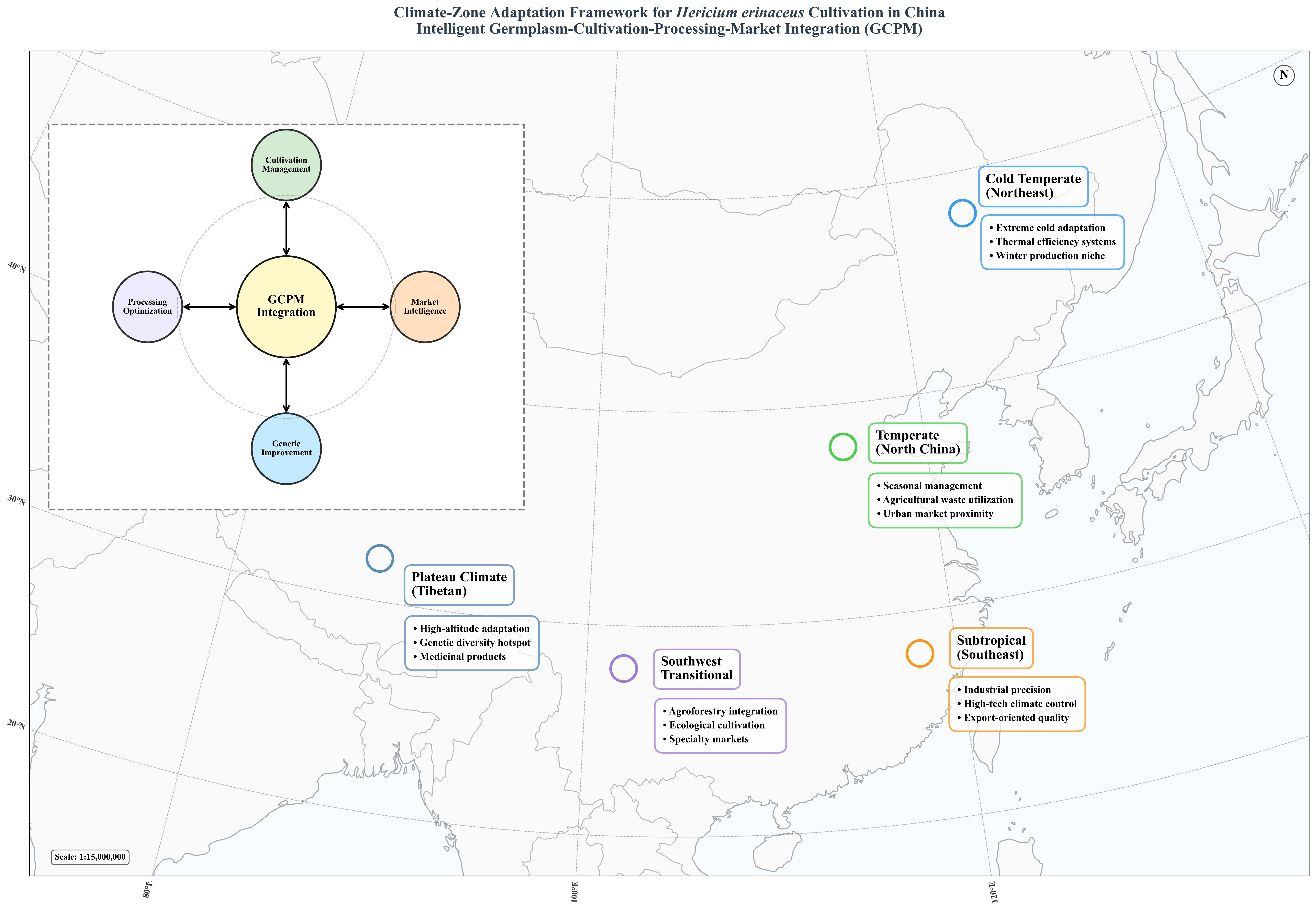
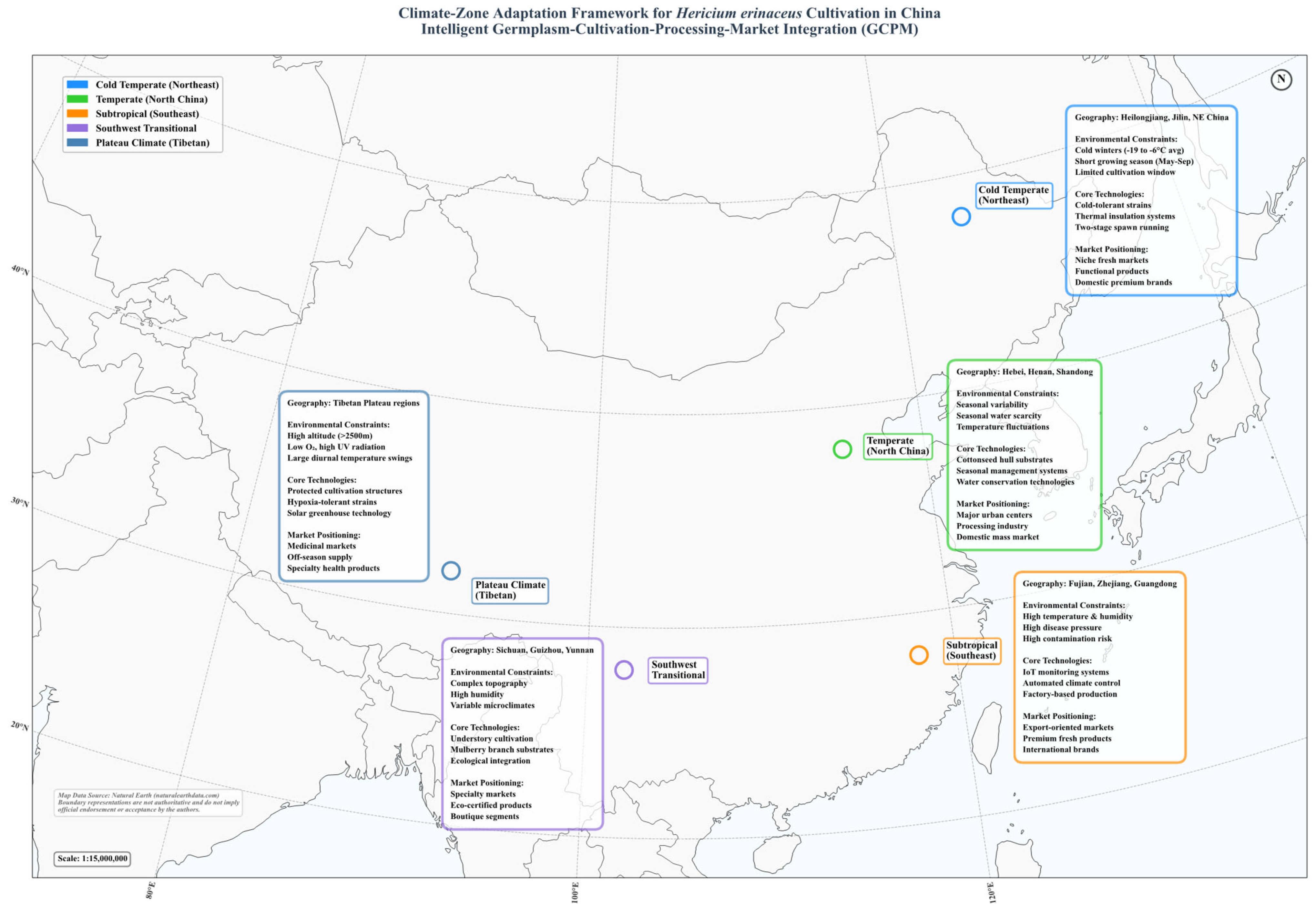
3.1. Cold Temperate Zones: Thermal Efficiency Strategies
3.2. Temperate Zones: The Dynamics of Seasonal Management
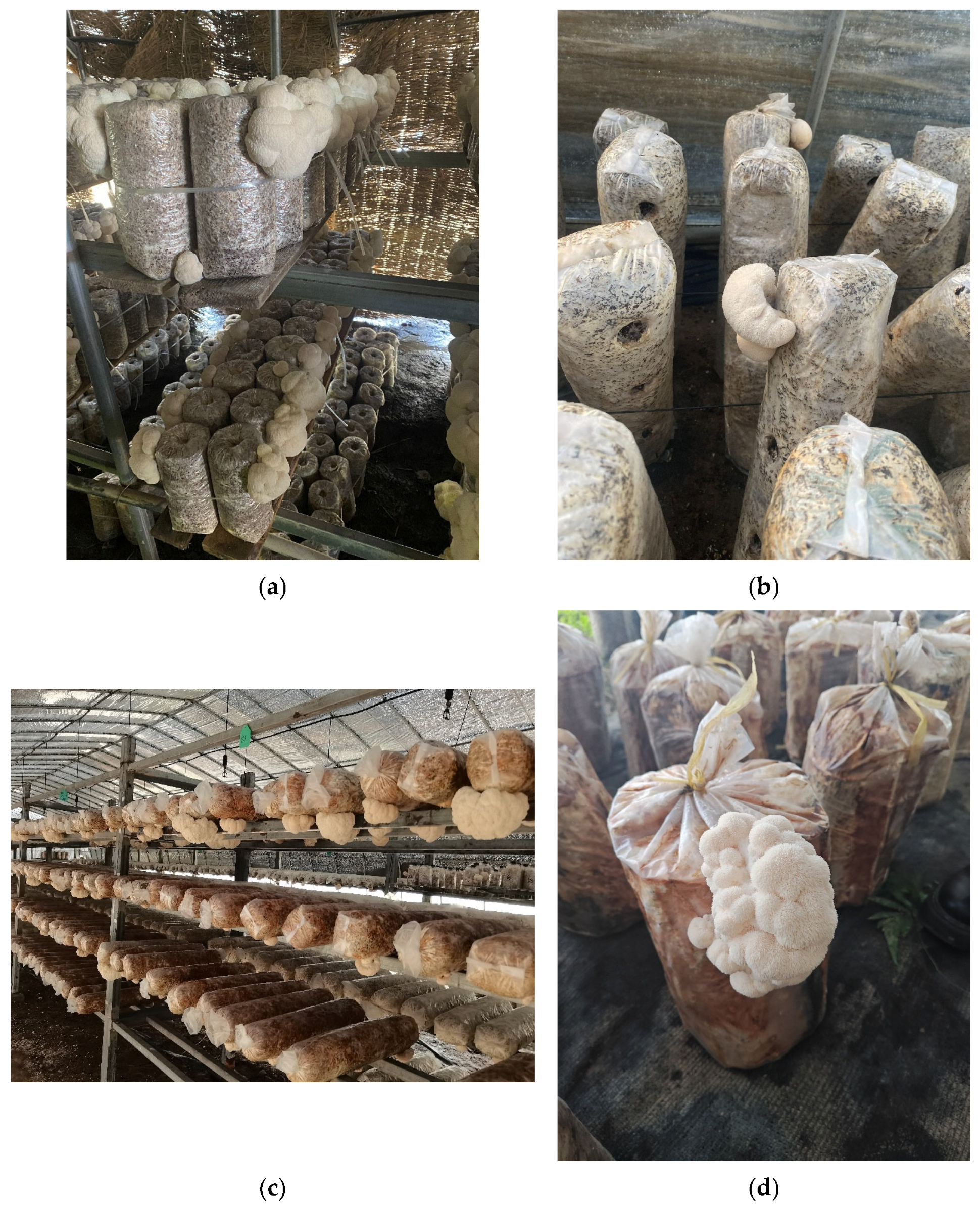
3.3. Subtropical Zones: Industrial Precision, Market Proximity, and the Value Chain Imperative
3.4. Southwest Transitional Zones: Integrated Cultivation and Ecological Value Addition
3.5. Plateau Climate Zones: Niche Exploitation and the Sanctuary of Genetic Diversity
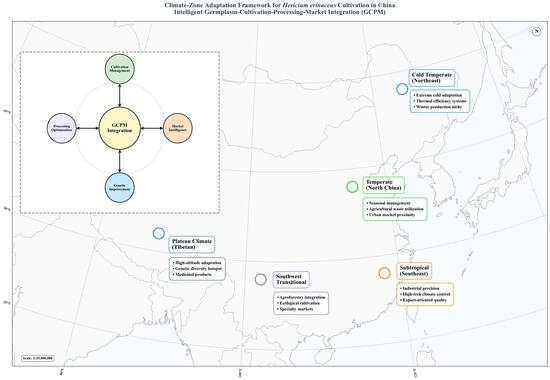
3.6. Synthesis: From Chinese Practice to a Conceptual Climate-Adaptation Framework for Global Reference
- Germplasm-Level: Directed Domestication under Pressure. The starting point is the targeted selection and domestication of varieties for core environmental stressors (e.g., extreme cold, hypoxia, or thermotolerance). This creates a tailored biological foundation.
- Cultivation-Level: Ecological Niche Construction with Local Capital. Systems are built by engineering growth media and microclimates from locally abundant, often underutilized resources (e.g., sawdust, crop residues, forest canopy), turning constraints into circular economy advantages.
- System-Level: Spatiotemporal Optimization of Climate Endowments. The entire production calendar and infrastructure are configured to exploit comparative climatic advantages (e.g., cool summers for counter-season supply, distinct seasons for staggered production).
4. Emerging Innovations and Inherent Trade-offs: A GCPM Perspective
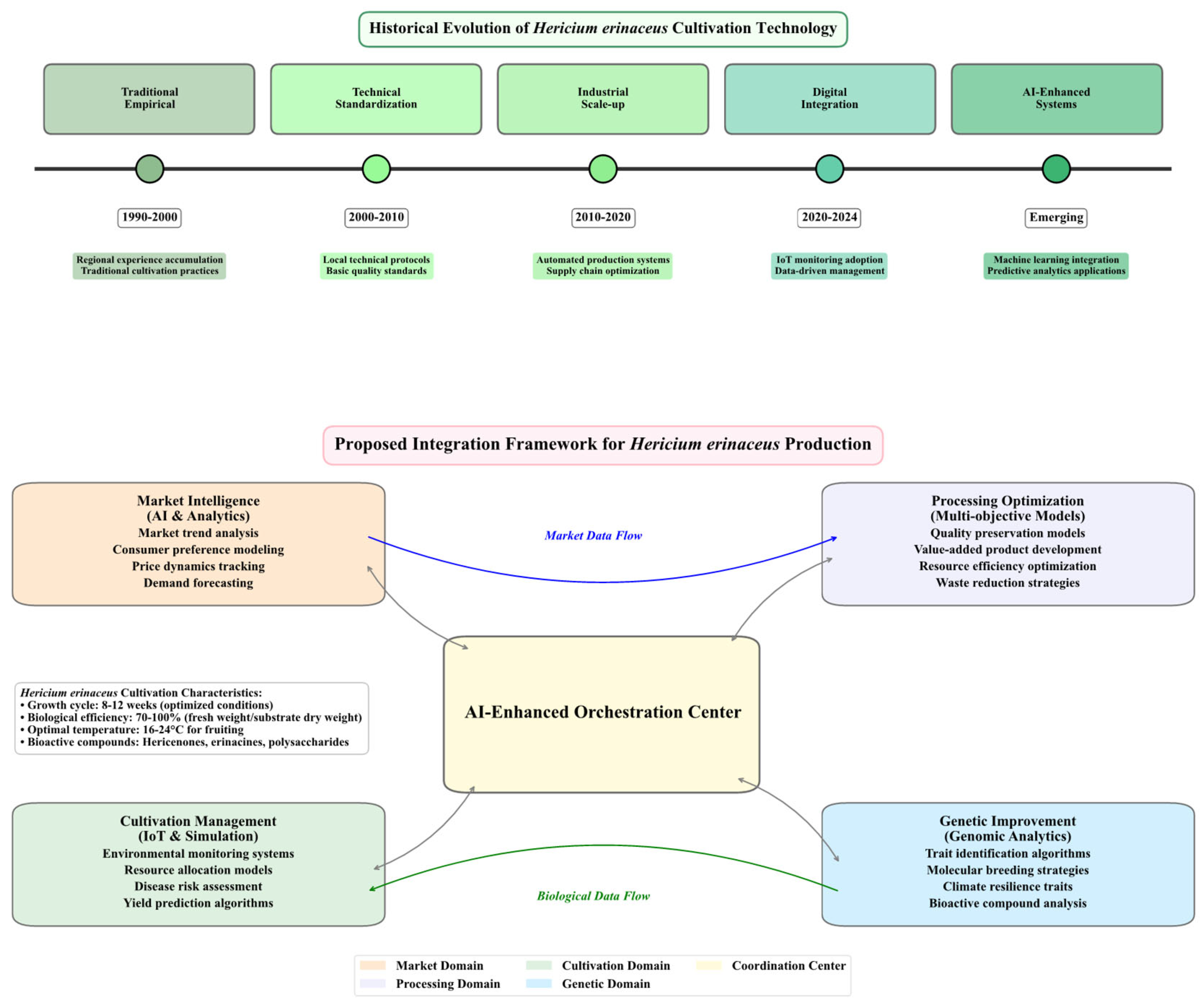
4.1. Digital Intelligence in Data-Driven Cultivation
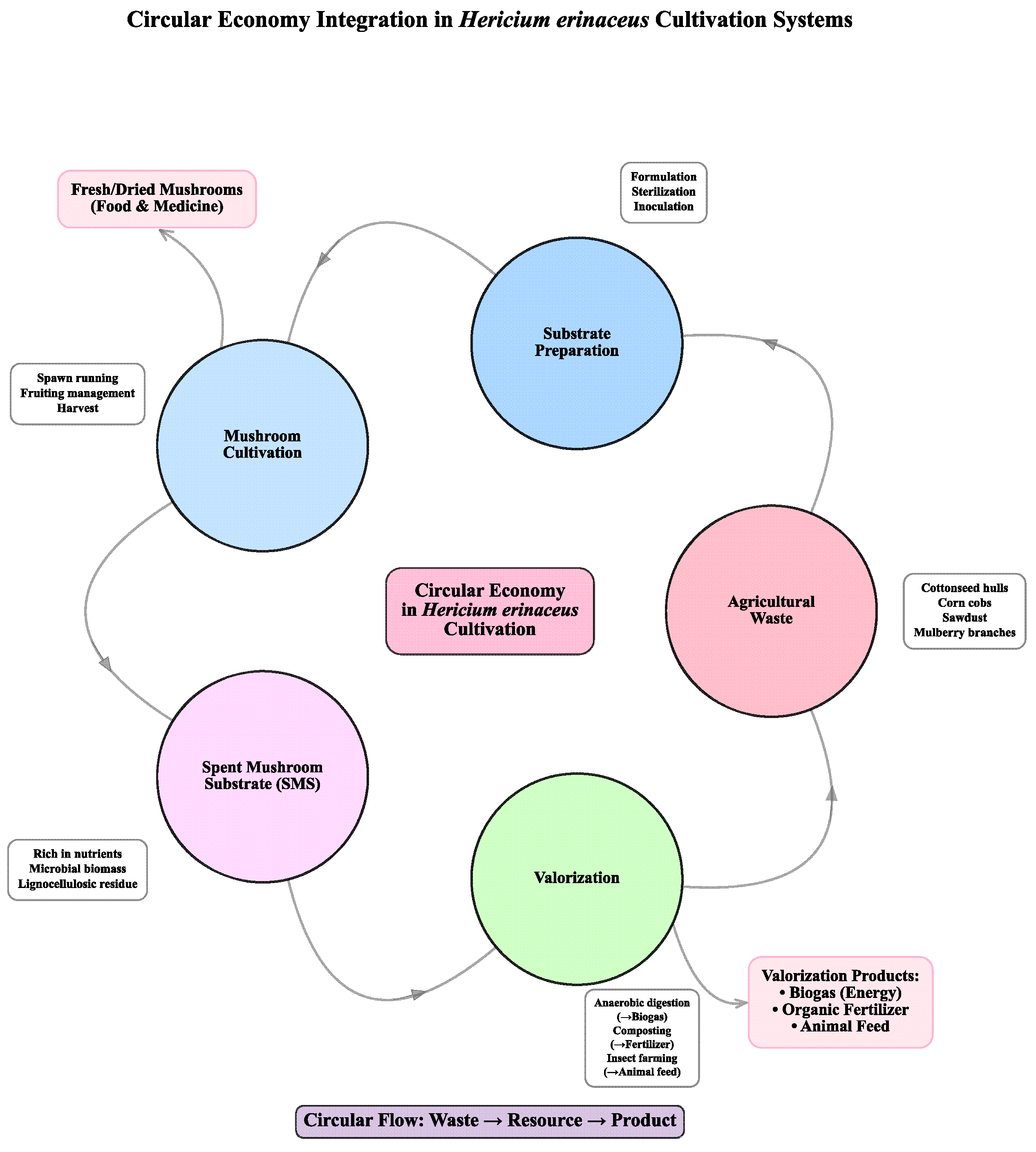
4.2. Circular Resource Integration and Valorization
4.3. Germplasm Innovation: Expanding Biological and Market Frontiers
4.4. Bioactive Compound Valorization: Bridging Cultivation and Nutraceuticals
5. Towards Predictive Cultivation: An Integrated Roadmap for Climate Resilience and System Intelligence
5.1. Pillar One: Building Climate-Resilient Systems Through Intelligent Integration
5.2. Pillar Two: Deciphering Substantial Interactions for Predictive Integration
5.3. Conclusion: From Empirical Practice to Predictive Design Science
Author Contributions
Funding
Institutional Review Board Statement
Informed Consent Statement
Data Availability Statement
Acknowledgments
Conflicts of Interest
References
- Łysakowska, P.; Sobota, A.; Wirkijowska, A. Medicinal Mushrooms: Their Bioactive Components, Nutritional Value and Application in Functional Food Production—A Review. Molecules 2023, 28, 5393. [Google Scholar] [CrossRef]
- Guo, X.; Xu, J. Impacts of Global Climate Change on Mushroom Productions: Challenges and Opportunities. Agric. Commun. 2025, 3, 100091. [Google Scholar] [CrossRef]
- Ndondo, J.T.K. Review of the Food and Agriculture Organisation (Fao) Strategic Priorities on Food Safety 2023. In Food Safety-New Insights; IntechOpen: London, UK, 2023. [Google Scholar]
- Contato, A.G.; Conte-Junior, C.A. Lion’s Mane Mushroom (Hericium erinaceus): A Neuroprotective Fungus with Antioxidant, Anti-Inflammatory, and Antimicrobial Potential—A Narrative Review. Nutrients 2025, 17, 1307. [Google Scholar] [CrossRef] [PubMed]
- Liu, J.; Wang, W.; Hu, Q.; Wu, X.; Xu, H.; Su, A.; Xie, M.; Yang, W. Bioactivities and Molecular Mechanisms of Polysaccharides from Hericium erinaceus. J. Future Foods 2022, 2, 103–111. [Google Scholar] [CrossRef]
- Spangenberg, E.; Moneypenny, A.; Bozzo, G.; Perreault, M.L. Unveiling the Role of Erinacines in the Neuroprotective Effects of Hericium erinaceus: A Systematic Review in Preclinical Models. Front. Pharmacol. 2025, 16, 1582081. [Google Scholar] [CrossRef]
- Szućko-Kociuba, I.; Trzeciak-Ryczek, A.; Kupnicka, P.; Chlubek, D. Neurotrophic and Neuroprotective Effects of Hericium erinaceus. Int. J. Mol. Sci. 2023, 24, 15960. [Google Scholar] [CrossRef]
- Wang, W.; Han, T.; Du, H.; Xu, H.; Liu, J.; Su, A.; Xie, M.; Hu, Q.; Yang, W. Research on the Immunological Activity of a Bioavailable Active Peptide Ksply from Hericium erinaceus under Different Immune Scenarios. Chem. Eng. J. 2025, 521, 166675. [Google Scholar] [CrossRef]
- Li, C.; Xu, S. Edible Mushroom Industry in China: Current State and Perspectives. Appl. Microbiol. Biotechnol. 2022, 106, 3949–3955. [Google Scholar] [CrossRef]
- Yang, D.; Li, L.; Zheng, Q. Research Progress on Processing Quality Traits and Suitable Varieties Selection of Edible Mushrooms. J. Agric. Food Res. 2025, 21, 101877. [Google Scholar] [CrossRef]
- Wong, K.H.; Sabaratnam, V.; Abdullah, N.; Kuppusamy, U.R.; Naidu, M. Effects of Cultivation Techniques and Processing on Antimicrobial and Antioxidant activities of Hericium erinaceus (Bull.: Fr.) Pers. Extracts. Food Technol. Biotechnol. 2009, 47, 47–55. [Google Scholar]
- Li, Y.; Cai, J.; Li, X.; Hu, X.; Zhang, J.; Wu, X.; Fu, J. Domestication Cultivation and Nutritional Analysis of Hericium coralloides. J. Fungi 2025, 11, 785. [Google Scholar] [CrossRef] [PubMed]
- Lu, Z.; Yang, Y.; Hu, S.; Ma, Y.-K.; Ren, Z.-M.; Wang, Y.; Yang, Y.-K.; Ji, S.-J.; Wang, H.; Huang, X. The Agronomic Traits Differences in Hericium erinaceus Cultivated with Different Straw Formulations by Replacing Wood with Straw. Horticulturae 2025, 11, 1220. [Google Scholar] [CrossRef]
- Lu, Z.; Liu, L.; Ren, Z.; Hu, S.; Wang, Y.; Ji, S.; Wang, X.; Du, Z.; Liu, Y.; Yang, Y.; et al. Optimization of Substrate Formulation for Hericium erinaceus by replacing wood by straw and their effect on enzyme activities. Front. Plant Sci. 2024, 15, 1436385. [Google Scholar] [CrossRef] [PubMed]
- Zhong, Y.; Liu, Z.; Yu, J.; Cui, Y.; Bai, J.; Mubeen, H.M.; Dang, B.; Li, M. Systems Biology Approach Reveals Key Molecular Players in the Browning of Postharvest Hericium erinaceus: Proteomic and Metabolomic Perspectives. Postharvest Biol. Technol. 2026, 231, 113942. [Google Scholar] [CrossRef]
- Silva, M.; Vida, M.; Ramos, A.C.; Lidon, F.J.; Reboredo, F.H.; Gonçalves, E.M. Storage Temperature Effect on Quality and Shelf-Life of Hericium erinaceus Mushroom. Horticulturae 2025, 11, 158. [Google Scholar] [CrossRef]
- Jaeger, J.; Masselot, C.; Greshake Tzovaras, B.; Senabre Hidalgo, E.; Haklay, M.; Santolini, M. An Epistemology for Democratic Citizen Science. R. Soc. Open Sci. 2023, 10, 231100. [Google Scholar] [CrossRef]
- Paez, A. Gray literature: An Important Resource in Systematic Reviews. J. Evid. Based Med. 2017, 10, 233–240. [Google Scholar] [CrossRef]
- Maaß, L.; Badino, M.; Iyamu, I.; Holl, F. Assessing the Digital Advancement of Public Health Systems Using Indicators Published in Gray Literature: Narrative Review. JMIR Public Health Surveill. 2024, 10, e63031. [Google Scholar] [CrossRef]
- Peters, M.D.; Godfrey, C.; McInerney, P.; Munn, Z.; Tricco, A.C.; Khalil, H. Scoping Reviews. JBI Man. Evid. Synth. 2024, 417–476. Available online: https://presencial.moodle.ufsc.br/pluginfile.php/1310067/mod_resource/content/0/JBI%20Manual%20for%20Evidence%20Synthesis%202024.pdf (accessed on 21 March 2026).
- Tricco, A.C.; Lillie, E.; Zarin, W.; O’Brien, K.K.; Colquhoun, H.; Levac, D.; Moher, D.; Peters, M.D.; Horsley, T.; Weeks, L. PRISMA Extension for Scoping Reviews (PRISMA-ScR): Checklist and Explanation. Ann. Intern. Med. 2018, 169, 467–473. [Google Scholar] [CrossRef]
- DB2310/T 053—2020; Cultivation Technical Regulations for the Geographical Indication Product ‘Hailin Hericium erinaceus’. Mudanjiang Municipal Administration for Market Regulation: Mudanjiang, China, 2020.
- Mieno, T.; Foster, T.; Kakimoto, S.; Brozović, N. Aquifer Depletion Exacerbates Agricultural Drought Losses in the US High Plains. Nat. Water 2024, 2, 41–51. [Google Scholar] [CrossRef]
- Gołasa, P.; Wysokiński, M.; Bieńkowska-Gołasa, W.; Gradziuk, P.; Golonko, M.; Gradziuk, B.; Siedlecka, A.; Gromada, A. Sources of Greenhouse Gas Emissions in Agriculture, with Particular Emphasis on Emissions from Energy Used. Energies 2021, 14, 3784. [Google Scholar] [CrossRef]
- Veltmeyer, H.; Ezquerro-Cañete, A. Agro-Extractivism. J. Peasant Stud. 2023, 50, 1673–1686. [Google Scholar] [CrossRef]
- Bebber, D.P.; Chaloner, T.M. Specialists, Generalists and the Shape of the Ecological Niche in Fungi. New Phytol. 2022, 234, 345. [Google Scholar] [CrossRef]
- Hernandez, D.J.; Kiesewetter, K.N.; Almeida, B.K.; Revillini, D.; Afkhami, M.E. Multidimensional Specialization and Generalization are Pervasive in Soil Prokaryotes. Nat. Ecol. Evol. 2023, 7, 1408–1418. [Google Scholar] [CrossRef] [PubMed]
- DB41/T 1332—2016; Cultivation Technical Regulations for Hericium erinaceus. Henan Provincial Bureau of Quality and Technical Supervision: Zhengzhou, China, 2016.
- DB13/T 2774—2018; Cultivation Technical Regulations for Hericium erinaceus. Hebei Provincial Bureau of Quality and Technical Supervision: Shijiazhuang, China, 2018.
- Aboah, J.; Wilson, M.M.J.; Bicknell, K.; Rich, K.M. Identifying the Precursors of Vulnerability in Agricultural Value Chains: A System Dynamics Approach. Int. J. Prod. Res. 2021, 59, 683–701. [Google Scholar] [CrossRef]
- Ravindran, S.; Ramlan, N.H.; Shah, A.S.M.; Yudin, A.S.M.; Rahman, R.A.; Faudzi, A.A.M. Enhancing Mushroom Cultivation Through IoT-Based Monitoring of Evaporative Cooling and Ventilation Systems. In Proceedings of the 2025 IEEE 8th International Conference on Electrical, Control and Computer Engineering (InECCE), Pahang, Malaysia, 27–28 August 2025; pp. 326–331. [Google Scholar]
- Caitano, C.E.C.; Vieira Júnior, W.G.; Soares, D.M.M.; Alves, L.D.S.; Nóbrega, B.D.B.; Pardo-Giménez, A.; Stevani, C.V.; Zied, D.C. Management of Water Supply in the Cultivation of Different Agaricus bisporus Strains. Agronomy 2023, 13, 2626. [Google Scholar] [CrossRef]
- Toromade, A.S.; Soyombo, D.A.; Kupa, E.; Ijomah, T.I. Reviewing the Impact of Climate Change on Global Food Security: Challenges and Solutions. Int. J. Appl. Res. Soc. Sci. 2024, 6, 1403–1416. [Google Scholar] [CrossRef]
- DB35/T 789—2023; Technical Specification for Cultivation of Hericium erinaceus. Fujian Provincial Administration for Market Regulation: Fuzhou, China, 2023.
- DB33/T 1314—2023; Technical Specification for Green Production of Hericium erinaceus. Zhejiang Provincial Administration for Market Regulation: Hangzhou, China, 2023.
- Yao, H.; Wang, Y.; Ma, X.; Li, M.; Fan, F. An Investigation on Daylight in Pv Greenhouse for Mushroom Vertical Cultivation in Kunming, China. Sol. Energy 2025, 291, 113414. [Google Scholar] [CrossRef]
- Shams, S.; Hassanein, A.; Mohsen, S.; Izadi, A. A new Solar-IoT Based Method for Mushroom Cultivation. J. Electr. Syst. 2024, 20, 7791–7810. [Google Scholar]
- Kang, J.-C.; Liang, C. Preliminary Exploration of Information Communication on Political Consumption of Agricultural Products: A Case Study of Media Professionals’ Response to Ractopamine-Containing Beef and Pork Imports. J. Educ. Media Libr. Sci. 2024, 61, 57–84. [Google Scholar]
- Konoplyannikova, M.; Radkevych, L.; Netreba, M.; Bilan, M.; Lorvi, I.; Nahorna, O. Digital Marketing and Communication Strategies of Agri-Food Enterprises on Social Media Platforms. Agron. Res. 2024, 22, 444–463. [Google Scholar]
- Ningsih, G.M.; Rasyid, H.; Ningsih, N.; Pujotomo, D.; Suseno, G.P. Agricultural Marketing Strategies in the Digital Era: Improving the Competitiveness of Local Products. J. Soc. Sci. (JoSS) 2024, 3, 1756–1764. [Google Scholar] [CrossRef]
- Kanellos, N.; Karountzos, P.; Giannakopoulos, N.T.; Terzi, M.C.; Sakas, D.P. Digital Marketing Strategies and Profitability in the Agri-Food Industry: Resource Efficiency and Value Chains. Sustainability 2024, 16, 5889. [Google Scholar] [CrossRef]
- DB51/T 1214—2019; Production Technical Regulations for Hericium erinaceus. Sichuan Provincial Administration for Market Regulation: Chengdu, China, 2019.
- DB5226/T 240—2022; Technical Regulations for Production of Hericium erinaceus Under Pine Forest. Qiandongnan Prefecture Administration for Market Regulation: Kaili, China, 2022.
- Olagunju, K.O.; Angioloni, S.; Canavari, M. Niche Markets for Sustainable Agri-Food Systems: A Systematic Review. Heliyon 2025, 11, e42346. [Google Scholar] [CrossRef]
- Zhang, M.; Yu, Y.; Liu, M.; Liu, J. Opportunities for China’s Agricultural Heritage Systems under the “Digital Nomadism” Trend—A Stakeholder-Weighted Approach. Sustainability 2024, 16, 2918. [Google Scholar] [CrossRef]
- Caviedes, J.; Ibarra, J.T.; Calvet-Mir, L.; Álvarez-Fernández, S.; Junqueira, A.B. Indigenous and Local Knowledge on Social-Ecological Changes Is Positively Associated with Livelihood Resilience in a Globally Important Agricultural Heritage System. Agric. Syst. 2024, 216, 103885. [Google Scholar] [CrossRef]
- Jia, F.; Shahzadi, G.; Bourlakis, M.; John, A. Promoting Resilient and Sustainable Food Systems: A Systematic Literature Review on Short Food Supply Chains. J. Clean. Prod. 2024, 435, 140364. [Google Scholar] [CrossRef]
- DB54/T 0407—2024; Production Technical Regulations for Hericium erinaceus. Tibet Autonomous Region Administration for Market Regulation: Lhasa, China, 2024.
- Meng, Q.; Xie, Z.; Xu, H.; Guo, J.; Tang, Y.; Ma, T.; Peng, Q.; Wang, B.; Mao, Y.; Yan, S. Out of the Qinghai-Tibetan plateau: Origin, evolution and historical biogeography of Morchella (both Elata and Esculenta clades). Front. Microbiol. 2022, 13, 1078663. [Google Scholar] [CrossRef]
- Kaiser, J.; Haase, D.; Krueger, T. Payments for Ecosystem Services: A Review of Definitions, the Role of Spatial Scales, and Critique. Ecol. Soc. 2021, 26, 12. [Google Scholar] [CrossRef]
- Cortés, A.J.; López-Hernández, F. Harnessing Crop Wild Diversity for Climate Change Adaptation. Genes 2021, 12, 783. [Google Scholar] [CrossRef]
- Nasirahmadi, A.; Hensel, O. Toward the Next Generation of Digitalization in Agriculture based on Digital Twin Paradigm. Sensors 2022, 22, 498. [Google Scholar] [CrossRef]
- Saikia, A.P.; Daimary, N.; Kalita, A.; Jafarov, O.; Jafarova, J. Digital Twins in Agroforestry: Ai, Iot, and Remote Sensing for Real-Time Decision Support. Reliab. Theory Appl. 2025, 20, 405–413. [Google Scholar]
- Singh, B.; Kaunert, C.; Lal, S.; Arora, M.K.K.; Chandra, S. Precision Agroforestry: Technical Innovations Shaping the Future of Land Management. In Agroforestry for a Climate-Smart Future; IGI Global Scientific Publishing: Palmdale, PA, USA, 2025; pp. 397–414. [Google Scholar]
- Cesco, S.; Sambo, P.; Borin, M.; Basso, B.; Orzes, G.; Mazzetto, F. Smart Agriculture and Digital Twins: Applications and Challenges in a Vision of Sustainability. Eur. J. Agron. 2023, 146, 126809. [Google Scholar] [CrossRef]
- Sujatanagarjuna, A.; Kia, S.; Briechle, D.F.; Leiding, B. Mushr: A Smart, Automated, and Scalable Indoor Harvesting System for Gourmet Mushrooms. Agriculture 2023, 13, 1533. [Google Scholar] [CrossRef]
- Tanveer, U.; Hoang, T.G.; Ishaq, S.; Khalid, R.U. Public-Private Partnerships as Catalysts for Digital Transformation and Circular Economy: Insights from Developing Countries. Technol. Forecast. Soc. Change 2025, 219, 124270. [Google Scholar] [CrossRef]
- Hackfort, S. Patterns of Inequalities in Digital Agriculture: A Systematic Literature Review. Sustainability 2021, 13, 12345. [Google Scholar] [CrossRef]
- Bampasidou, M.; Goldgaber, D.; Gentimis, T.; Mandalika, A. Overcoming ‘Digital Divides’: Leveraging Higher Education to Develop Next Generation Digital Agriculture Professionals. Comput. Electron. Agric. 2024, 224, 109181. [Google Scholar] [CrossRef]
- Marshall, A.; Turner, K.; Richards, C.; Foth, M.; Dezuanni, M. Critical Factors of Digital Agtech Adoption on Australian Farms: From Digital to Data Divide. Inf. Commun. Soc. 2022, 25, 868–886. [Google Scholar] [CrossRef]
- Ruiz, D.; San Miguel, G.; Rojo, J.; Teriús-Padrón, J.; Gaeta, E.; Arredondo, M.; Hernández, J.; Pérez, J. Life Cycle Inventory and Carbon Footprint Assessment of Wireless ICT networks for six demographic areas. Resour. Conserv. Recycl. 2022, 176, 105951. [Google Scholar] [CrossRef]
- La Rocca, P.; Guennebaud, G.; Bugeau, A.; Ligozat, A.L. Estimating the Carbon Footprint of Digital Agriculture Deployment: A parametric Bottom-Up Modeling Approach. J. Ind. Ecol. 2024, 28, 1801–1815. [Google Scholar] [CrossRef]
- Jain, M.; Kumar, D.; Chaudhary, J.; Kumar, S.; Sharma, S.; Verma, A.S. Review on E-Waste Management and its Impact on the Environment and Society. Waste Manag. Bull. 2023, 1, 34–44. [Google Scholar] [CrossRef]
- Steinke, J.; Ortiz-Crespo, B.; van Etten, J.; Müller, A. Participatory Design of Digital Innovation in Agricultural Research-For-Development: Insights from Practice. Agric. Syst. 2022, 195, 103313. [Google Scholar] [CrossRef]
- Bijon, N.; Wassenaar, T.; Junqua, G.; Dechesne, M. Towards a Sustainable Bioeconomy Through Industrial Symbiosis: Current Situation and Perspectives. Sustainability 2022, 14, 1605. [Google Scholar] [CrossRef]
- Fagerström, M. Assessment of oyster mushroom production employing urban-based materials in Stockholm Stad. Sustainable development, Environmental science and Engineering, School of Architecture and the Built Environment (ABE), KTH, 2023. Available online: https://www.diva-portal.org/smash/record.jsf?pid=diva2%3A1814166&dswid=-5489 (accessed on 21 March 2026).
- Li, T.; Zhang, C.; Che, P.; Ma, Y.; Zang, L. Recycling of Spent Mushroom Substrate and Food Waste: Utilisation as Feed Materials for Black Soldier Fly (Hermetia illucens (L.) Diptera: Stratiomyidae). J. Insects Food Feed 2021, 7, 409–418. [Google Scholar] [CrossRef]
- Mishra, A.; Suthar, S. Cow Dung Biochar Amendment Affects the Bioconversion of Spent Mushroom Substrate and Fruit Waste by Black Soldier Fly (Diptera: Stratiomyidae) Larvae. J. Environ. Manag. 2025, 392, 126763. [Google Scholar] [CrossRef]
- Ab Rhaman, S.M.S.; Naher, L.; Siddiquee, S. Mushroom Quality Related with Various Substrates’ Bioaccumulation and Translocation of Heavy Metals. J. Fungi 2021, 8, 42. [Google Scholar] [CrossRef]
- Ali, S.; Vasudev, L.; Kumar, D. Mushrooms as Bioindicators of Environmental Toxins. In Mushroom Magic; CRC Press: Boca Raton, FL, USA, 2024; pp. 292–306. [Google Scholar]
- Malcolm, Z.; Macaulay, B.; Todd, M. Towards a Circular Economy and Just Transition to Net-Zero in Rural Scotland: Resident Perspectives on Policy and Practice. J. Rural Stud. 2024, 108, 103300. [Google Scholar] [CrossRef]
- Thapa, K.; Vermeulen, W.J.; De Waal, M.M.; Deutz, P.; Nguyễn, H.Q. Towards a Just Circular Economy Transition: The Case of European Plastic Waste Trade to Vietnam for Recycling. Circ. Econ. Sustain. 2024, 4, 851–876. [Google Scholar] [CrossRef]
- Palmgren, M.; Shabala, S. Adapting Crops for Climate Change: Regaining Lost Abiotic Stress Tolerance in Crops. Front. Sci. 2024, 2, 1416023. [Google Scholar] [CrossRef]
- Vincent, H.; Hole, D.; Maxted, N. Congruence between Global Crop Wild Relative Hotspots and Biodiversity Hotspots. Biol. Conserv. 2022, 265, 109432. [Google Scholar] [CrossRef]
- Bohra, A.; Kilian, B.; Sivasankar, S.; Caccamo, M.; Mba, C.; McCouch, S.R.; Varshney, R.K. Reap the Crop Wild Relatives for Breeding Future Crops. Trends Biotechnol. 2022, 40, 412–431. [Google Scholar] [CrossRef]
- Jun, W.; Tolgor, B.; Gao, G.X. Hericium erinaceus Strains with Inter-Retrotransposon Amplified Polymorphism in China. J. Northeast. For. Univ. 2012, 40, 68–70. Available online: https://www.cabidigitallibrary.org/doi/full/10.5555/20123273644 (accessed on 21 March 2026). [CrossRef]
- Gong, W.; Wang, Y.; Xie, C.; Zhou, Y.; Zhu, Z.; Peng, Y. Whole Genome Sequence of an Edible and Medicinal Mushroom, Hericium erinaceus (Basidiomycota, Fungi). Genomics 2020, 112, 2393–2399. [Google Scholar] [CrossRef] [PubMed]
- Senguttuvel, P.; Padmavathi, G.; Jasmine, C.; Neeraja, C.N.; Jaldhani, V.; Beulah, P.; Gobinath, R.; Sai Prasad, S.V.; Subba Rao, L.V.; Hariprasad, A.S. Rice Biofortification: Breeding and Genomic Approaches for Genetic Enhancement of Grain Zinc and Iron Contents. Front. Plant Sci. 2023, 14, 1138408. [Google Scholar] [CrossRef] [PubMed]
- Manikandan, A.; Muthusamy, S.; Wang, E.S.; Ivarson, E.; Manickam, S.; Sivakami, R.; Narayanan, M.B.; Zhu, L.-H.; Rajasekaran, R.; Kanagarajan, S. Breeding and Biotechnology Approaches to Enhance the Nutritional Quality of Rapeseed Byproducts for Sustainable Alternative Protein Sources—A Critical Review. Front. Plant Sci. 2024, 15, 1468675. [Google Scholar] [CrossRef] [PubMed]
- Bhardwaj, R.L.; Parashar, A.; Parewa, H.P.; Vyas, L. An Alarming Decline in the Nutritional Quality of Foods: The Biggest Challenge for Future Generations’ Health. Foods 2024, 13, 877. [Google Scholar] [CrossRef]
- Stranieri, S.; Orsi, L.; Zilia, F.; De Noni, I.; Olper, A. Terroir Takes on Technology: Geographical indications, Agri-Food Innovation, and Regional Competitiveness in Europe. J. Rural Stud. 2024, 110, 103368. [Google Scholar] [CrossRef]
- Marques, C.; Dinis, L.-T.; Santos, M.J.; Mota, J.; Vilela, A. Beyond the bottle: Exploring Health-Promoting Compounds in Wine and Wine-Related Products—Extraction, Detection, Quantification, Aroma Properties, and Terroir Effects. Foods 2023, 12, 4277. [Google Scholar] [CrossRef]
- Irlinger, F.; Mariadassou, M.; Dugat-Bony, E.; Rué, O.; Neuvéglise, C.; Renault, P.; Rifa, E.; Theil, S.; Loux, V.; Cruaud, C. A Comprehensive, Large-Scale Analysis of “Terroir” Cheese and Milk Microbiota Reveals Profiles Strongly Shaped by Both Geographical and Human Factors. ISME Commun. 2024, 4, ycae095. [Google Scholar] [CrossRef]
- Williams, S.D.; Barkla, B.J.; Rose, T.J.; Liu, L. Does Coffee Have Terroir and How Should It Be Assessed? Foods 2022, 11, 1907. [Google Scholar] [CrossRef]
- Ho, K.F.X.; Liu, F.; Tarabashkina, L. A Closer Look at Geographical Indicators: How Food Labels Influence Product Values, Authenticity and Willingness to Pay Premium Prices. Asia Pac. J. Mark. Logist. 2024, 36, 837–861. [Google Scholar] [CrossRef]
- Castle, S.E.; Miller, D.C.; Ordonez, P.J.; Baylis, K.; Hughes, K. The Impacts of Agroforestry Interventions on Agricultural Productivity, Ecosystem Services, and Human Well-Being in Low-and Middle-Income Countries: A Systematic Review. Campbell Syst. Rev. 2021, 17, e1167. [Google Scholar] [CrossRef] [PubMed]
- Kalenius, R. Mushroom cultivation in Temperate Agroforestry. Swedish University of Agricultural Sciences, 2022. Available online: https://stud.epsilon.slu.se/17866/ (accessed on 21 March 2026).
- Mori, G.O.; Grover, E.C. Research and Development of Specialty Crops for Agroforestry Systems in the Midwest: The Long Haul for Small Farm Sustainability. In Integrating Landscapes: Agroforestry for Biodiversity Conservation and Food Sovereignty; Springer: Berlin/Heidelberg, Germany, 2024; pp. 247–303. [Google Scholar]
- Zhang, Q.; Miao, R.; Feng, R.; Yan, J.; Wang, T.; Gan, Y.; Zhao, J.; Lin, J.; Gan, B. Application of Atmospheric and Room-Temperature Plasma (Artp) to Microbial Breeding. Curr. Issues Mol. Biol. 2023, 45, 6466–6484. [Google Scholar] [CrossRef] [PubMed]
- Pan, J.; Zhang, J.; Wei, H.; Liu, Q.; Xu, W.; Bao, Y. Optimizing Mycelial Protein Yield in Pleurotus Djamor Via Artp Mutagenesis and Hybridization Strategies. J. Biotechnol. 2024, 386, 64–71. [Google Scholar] [CrossRef] [PubMed]
- Gong, M.; Zhang, H.; Wu, D.; Zhang, Z.; Zhang, J.; Bao, D.; Yang, Y. Key Metabolism Pathways and Regulatory Mechanisms of High Polysaccharide Yielding in Hericium erinaceus. BMC Genom. 2021, 22, 160. [Google Scholar] [CrossRef]
- Smith, S.; Nickson, T.E.; Challender, M. Germplasm Exchange Is Critical to Conservation of Biodiversity and Global Food Security. Agron. J. 2021, 113, 2969–2979. [Google Scholar] [CrossRef]
- Ebert, A.W.; Engels, J.M.; Schafleitner, R.; Hintum, T.v.; Mwila, G. Critical Review of the Increasing Complexity of Access and Benefit-Sharing Policies of Genetic Resources for Genebank Curators and Plant Breeders—A Public and Private Sector Perspective. Plants 2023, 12, 2992. [Google Scholar] [CrossRef]
- Khoury, C.K.; Brush, S.; Costich, D.E.; Curry, H.A.; De Haan, S.; Engels, J.M.; Guarino, L.; Hoban, S.; Mercer, K.L.; Miller, A.J. Crop Genetic Erosion: Understanding and Responding to Loss of Crop Diversity. New Phytol. 2022, 233, 84–118. [Google Scholar] [CrossRef]
- Jacob, A.M. Betting on Biodiversity: Rethinking Agriculture Beyond Hybrid Horizons. In Impact of Societal Development and Infrastructure on Biodiversity Decline; IGI Global Scientific Publishing: Palmdale, PA, USA, 2024; pp. 14–22. [Google Scholar]
- Ashraf, M.V.; Khan, S.; Misri, S.; Gaira, K.S.; Rawat, S.; Rawat, B.; Khan, M.H.; Shah, A.A.; Asgher, M.; Ahmad, S. High-Altitude Medicinal Plants as Promising Source of Phytochemical Antioxidants to Combat Lifestyle-Associated Oxidative Stress-Induced Disorders. Pharmaceuticals 2024, 17, 975. [Google Scholar] [CrossRef]
- Ljubej, V.; Karalija, E.; Salopek-Sondi, B.; Šamec, D. Effects of Short-Term Exposure to Low Temperatures on Proline, Pigments, and Phytochemicals Level in Kale (Brassica oleracea var. acephala). Horticulturae 2021, 7, 341. [Google Scholar] [CrossRef]
- Alhaithloul, H.A.; Galal, F.H.; Seufi, A.M. Effect of Extreme Temperature Changes on Phenolic, Flavonoid Contents and Antioxidant Activity of Tomato Seedlings (Solanum lycopersicum L.). PeerJ 2021, 9, e11193. [Google Scholar] [CrossRef] [PubMed]
- Zhao, Y.; Li, S.-L.; Chen, H.-Y.; Zou, Y.; Zheng, Q.-W.; Guo, L.-Q.; Wu, G.-H.; Lu, J.; Lin, J.-F.; Ye, Z.-W. Enhancement of Carotenoid Production and Its Regulation in Edible Mushroom Cordyceps Militaris by Abiotic Stresses. Enzym. Microb. Technol. 2021, 148, 109808. [Google Scholar] [CrossRef] [PubMed]
- Hu, Y.-R.; Wang, Y.; Chen, Y.-J.; Chai, Q.-Q.; Dong, H.-Z.; Shen, J.-W.; Qi, Y.-C.; Wang, F.-Q.; Wen, Q. Salicylic Acid Enhances Heat Stress Resistance of Pleurotus ostreatus (Jacq.) P. Kumm through Metabolic Rearrangement. Antioxidants 2022, 11, 968. [Google Scholar] [CrossRef]
- Zhou, R.; Yang, H.; Lu, T.; Zhao, Y.; Zheng, W. Ultraviolet Radiation Promotes the Production of Hispidin Polyphenols by Medicinal Mushroom Inonotus obliquus. Fungal Biol. 2022, 126, 775–785. [Google Scholar] [CrossRef]
- Rifna, E.; Misra, N.; Dwivedi, M. Recent Advances in Extraction Technologies for Recovery of Bioactive Compounds Derived from Fruit and Vegetable Waste Peels: A Review. Crit. Rev. Food Sci. Nutr. 2023, 63, 719–752. [Google Scholar] [CrossRef]
- Chaturvedi, S.; Khan, S.; Bhunia, R.K.; Kaur, K.; Tiwari, S. Metabolic Engineering in Food Crops to Enhance Ascorbic Acid Production: Crop Biofortification Perspectives for Human Health. Physiol. Mol. Biol. Plants 2022, 28, 871–884. [Google Scholar] [CrossRef]
- Mandal, S. Shaping the Plant Specialized Metabolites Through Modern Breeding Technique. Mol. Biotechnol. 2025, 68, 1127–1147. [Google Scholar] [CrossRef]
- Marone, D.; Mastrangelo, A.M.; Borrelli, G.M.; Mores, A.; Laidò, G.; Russo, M.A.; Ficco, D.B.M. Specialized Metabolites: Physiological and Biochemical Role in Stress Resistance, Strategies to Improve Their Accumulation, and New Applications in Crop Breeding and Management. Plant Physiol. Biochem. 2022, 172, 48–55. [Google Scholar] [CrossRef]
- Darko, D.; Kwekutsu, E.; Idoko, I.P. Synergistic Effects of Phytochemicals in Combating Chronic Diseases with Insights into Molecular Mechanisms and Nutraceutical Development. Int. J. Innov. Sci. Res. Technol 2025, 10, 1865–1883. [Google Scholar]
- Haushofer, L. Nutritionism, Revisited. Gastron. J. Food Cult. 2025, 25, 55–61. [Google Scholar] [CrossRef]
- Fardet, A.; Rock, E. Exclusive Reductionism, Chronic Diseases and Nutritional Confusion: The Degree of Processing as a Lever for Improving Public Health. Crit. Rev. Food Sci. Nutr. 2022, 62, 2784–2799. [Google Scholar] [CrossRef] [PubMed]
- Boateng, I.D. Mechanisms, Capabilities, Limitations, and Economic Stability Outlook for Extracting Phenolics from Agro-Byproducts Using Emerging Thermal Extraction Technologies and Their Combinative Effects. Food Bioprocess Technol. 2024, 17, 1109–1140. [Google Scholar] [CrossRef]
- Priyadarshini, A.; Tiwari, B.K.; Rajauria, G. Assessing the Environmental and Economic Sustainability of Functional Food Ingredient Production Process. Processes 2022, 10, 445. [Google Scholar] [CrossRef]
- Nagar, H.; Machavaram, R. Climate-Intelligent Agriculture: Robotic and UAV Approaches for Resilient Crop Systems. In Innovations in Climate Resilient Agriculture; Springer: Berlin/Heidelberg, Germany, 2025; pp. 391–416. [Google Scholar]
- Gill, T.; Gill, S.K.; Saini, D.K.; Chopra, Y.; de Koff, J.P.; Sandhu, K.S. A Comprehensive Review of High Throughput Phenotyping and Machine Learning for Plant Stress Phenotyping. Phenomics 2022, 2, 156–183. [Google Scholar] [CrossRef]
- Schneider, H.M. Characterization, Costs, Cues and Future Perspectives of Phenotypic Plasticity. Ann. Bot. 2022, 130, 131–148. [Google Scholar] [CrossRef]
- Zhang, J.; Liu, C.; Liu, Y.; Chen, T.; Li, X.; Sui, Y.; Zhang, L.; Dang, J.; Yu, H. Early Identification of Heat and Uv-B Stress in Wheat Based on The Combination Of Hyperspectral Technology and Gas Detection Method. Comput. Electron. Agric. 2025, 231, 109971. [Google Scholar] [CrossRef]
- Lu, Y.; Guo, Z.; Ke, B.; Zheng, H.; Zeng, Z.; Cai, Z.; Zeng, H.; Liao, J.; Chen, M. Genome-Wide Association Study and Transcriptome Analysis Provide Candidate Genes for Agronomic Traits of Agaricus bisporus. Horticulturae 2024, 10, 691. [Google Scholar] [CrossRef]
- Rosillon, D.J.; Jago, A.; Huart, J.P.; Bogaert, P.; Journée, M.; Dandrifosse, S.; Planchon, V. Near Real-Time Spatial Interpolation of Hourly Air Temperature and Humidity for Agricultural Decision Support Systems. Comput. Electron. Agric. 2024, 223, 109093. [Google Scholar] [CrossRef]
- Dibbern, T.; Romani, L.A.S.; Massruhá, S.M.F.S. Main Drivers and Barriers to the Adoption of Digital Agriculture Technologies. Smart Agric. Technol. 2024, 8, 100459. [Google Scholar] [CrossRef]
- Dong, L. Toward Resilient Agriculture Value Chains: Challenges and Opportunities. Prod. Oper. Manag. 2021, 30, 666–675. [Google Scholar] [CrossRef]
- Thompson, W.J.; Varma, V.; Joerin, J.; Bonilla-Duarte, S.; Bebber, D.P.; Blaser-Hart, W.; Kopainsky, B.; Späth, L.; Curcio, B.; Six, J. Smallholder Farmer Resilience to Extreme Weather Events in a Global Food Value Chain. Clim. Change 2023, 176, 152. [Google Scholar] [CrossRef]
- Hirth, S.; Morgan, E.; Kaptan, G.; Crastes dit Sourd, R.; Tallontire, A.; Young, W.; Winter, M. Restoring Food System Resilience in a Turbulent World: Supply Chain Actors’ Shared Responsibility. Bus. Strategy Environ. 2025, 34, 6007–6023. [Google Scholar] [CrossRef]
- Yu, T.; Ma, X.; Zhang, J.; Cao, S.; Li, W.; Yang, G.; He, C. Progress in Transcriptomics and Metabolomics in Plant Responses to Abiotic Stresses. Curr. Issues Mol. Biol. 2025, 47, 421. [Google Scholar] [CrossRef] [PubMed]
- Anwar, K.; Kansal, S.; Bahuguna, R.N.; Raghuvanshi, S.; Singla-Pareek, S.L.; Sharma, R.A.; Pareek, A. Transcriptional Dynamics of Rice under Individual, Combined, and Sequential Abiotic Stresses: Insights across Stress Severity and Recovery in Contrasting Genotypes. Plant Cell Environ. 2025. [Google Scholar] [CrossRef] [PubMed]
- Lu, F.; Sun, X.; Dai, X.; Zhang, P.; Ma, Y.; Xu, Y.; Wang, L.; Zhang, J. Integrated Multi-Omics Analysis to Investigate the Molecular Mechanisms Underlying the Response of Auricularia heimuer to High-Temperature Stress. J. Fungi 2025, 11, 167. [Google Scholar] [CrossRef]
- Liu, D.; Wang, Y.; Zhang, P.; Yu, F.; Perez-Moreno, J. Macrofungi Cultivation in Shady Forest Areas Significantly Increases Microbiome Diversity, Abundance and Functional Capacity in Soil Furrows. J. Fungi 2021, 7, 775. [Google Scholar] [CrossRef]
- Baldrian, P. Forest Microbiome: Diversity, Complexity and Dynamics. FEMS Microbiol. Rev. 2017, 41, 109–130. [Google Scholar] [CrossRef]
- Zhao, J.-L.; Shao, Y.-Y.; Liu, B. Microbiome Dynamics in Four Different Casing Materials Used for Milky Mushroom (Calocybe indica) Cultivation. Horticulturae 2025, 11, 667. [Google Scholar] [CrossRef]
- Chan, A.M.; Pay, M.L.; Christensen, J.; He, F.; Roden, L.C.; Ahmed, H.; Foo, M. Red, Blue or Mix: Choice of Optimal Light Qualities for Enhanced Plant Growth and Development Through in Silico Analysis. Silico Plants 2024, 6, diae008. [Google Scholar] [CrossRef]
- Imran, H.; Gul, A.; Unal, B.T.; Ozturk, M. In Silico Approaches for Green Agriculture. In Allelopathy; Apple Academic Press: Palm Bay, FL, USA, 2025; pp. 283–321. [Google Scholar]
- Justino, L.F.; Battisti, R.; Stone, L.F.; Heinemann, A.B. In Silico Assessment of Sowing Dates and Nitrogen Management in Common Bean Crops. Eur. J. Agron. 2022, 133, 126434. [Google Scholar] [CrossRef]
- Skobelev, P.; Tabachinskiy, A.; Simonova, E.; Lee, T.-R.; Zhilyaev, A.; Laryukhin, V. Digital Twin of Rice as a Decision-Making Service for Precise Farming, Based on Environmental Datasets from the Fields. In Proceedings of the 2021 International Conference on Information Technology and Nanotechnology (ITNT), Samara, Russia, 20–24 September 2021; pp. 1–8. [Google Scholar]
- Zomer, R.; Xu, J.; Spano, D.; Trabucco, A. Nature-Based Solutions: Evaluating the Global Carbon Sequestration Potential of Agroforestry and Increased Tree Cover on Agricultural Land. In Proceedings of the European Geosciences Union General Assembly 2024 (EGU24), Vienna, Austria, 14–19 April 2024; p. 6018. [Google Scholar]
- Nabuurs, G.-J.; Mrabet, R.; Abu Hatab, A.; Bustamante, M.; Clark, H.; Havlík, P.; House, J.; Mbow, C.; Ninan, K.N.; Popp, A. Agriculture, Forestry and Other Land Uses (Chapter 7). In IPCC 2022: Climate Change 2022: Mitigation of Climate Change. Contribution of Working Group III to the Sixth Assessment Report of the Intergovernmental Panel on Climate Change; Cambridge University Press: New York, NY, USA, 2023; pp. 747–860. [Google Scholar]



| Technical Report (Source) | Region & Climate Zone | Cultivation Model | Key Substrate Formula (s) | Sterilization Key Parameters | Spawn Running Temp. (°C) | Fruiting Management Key Parameters | Primary Pest/Disease Control Strategy |
|---|---|---|---|---|---|---|---|
| Hailin Municipal Administration for Market Regulation, 2020 | Hailin, Heilongjiang (Cold Temperate) | Facility-based (Mushroom House) | 1. Spring Formula: Sawdust 81%, Wheat bran 15%, Corn meal 3% 2. Autumn Formula: Sawdust 83%, Wheat bran 15%, Corn meal 1% | High-pressure: 125 °C, 3 h Atmospheric: 100 °C, 8 h + 8 h steaming | 18–25 | Temp.: 18–22 °C RH: 60–85% Light: 100–200 Lux Key Practice: Two-stage spawn running; semi-underground, insulated houses. | Emphasis on agricultural & physical methods. Chemical control as supplement only; no pesticides during fruiting. |
| Fujian Provincial Department of Agriculture and Rural Affairs, 2023 | Fujian (Subtropical) | Seasonal & Factory-based | 1. Cottonseed Hull-based: Cottonseed hulls 76%, Sawdust 10%, Wheat bran 10%, Corn meal 2% 2. Sawdust-based: Sawdust 78%, Wheat bran 20%, Gypsum 1% | High-pressure: 121 °C, 0.10 MPa, 1.5–2 h Atmospheric: 100 °C, 24 h | 22–26 | Temp.: Primordia 12–18 °C, Fruit body 15–20 °C RH: Primordia 80–85%, Fruit body 85–95% CO2: <0.08% Light: 200–600 Lux Key Practice: IoT sensors; automated ventilation & cooling. | Integrated management. Chemicals comply with NY/T 393; emphasis on environmental control. |
| Zhejiang Provincial Department of Agriculture and Rural Affairs, 2023 | Zhejiang (Subtropical) | Green Production, Facility-based | 1. High Cottonseed Hull: Cottonseed hulls 70%, Sawdust 15%, Wheat bran 14% 2. Mixed Substrate: Cottonseed hulls 39%, Sawdust 39%, Corn cobs 8%, Wheat bran 13% | Atmospheric: 100 °C (reach in 4 h, maintain 16–18 h) | 20–24 | Temp.: 14–18 °C RH: Induction 80–85%, Fruit body 85–90% CO2: <0.07% Light: 200–400 Lux Key Practice: Standardized workflow; resource efficiency focus. | “Prevention first, comprehensive control”. Priority to non-chemical methods. |
| Qiandongnan Prefecture Market Supervision Administration, 2022 | Qiandongnan, Guizhou (Southwest Transitional) | Understory (Pine Forest) | 1. Complex Formula: Sawdust 60%, Cottonseed hulls 20%, Wheat bran 15%, Rice bran 3%, Calcium superphosphate 1%, Gypsum 1% 2. Simple Formula: Sawdust 78%, Wheat bran 20%, Gypsum 1% | Atmospheric: 100 °C, ≥18 h High-pressure: 120 °C, 0.15 MPa, 4 h | 20–25 | Temp.: 18–22 °C (forest environment) RH: 85–90% Key Practice: Utilizes forest canopy (density 0.6–0.8); natural climate control. | “Prevention first”. Physical methods primary (e.g., sticky boards, nets); no chemical pesticides during fruiting. |
| Henan Provincial Department of Agriculture and Rural Affairs, 2016 | Henan (Temperate) | Facility-based (Various shed types) | 1. Sawdust-based: Sawdust 79%, Wheat bran 18%, Corn meal 1.2%, Soybean meal 0.8%, Gypsum 1% 2. Corn Cob-based: Sawdust 49%, Corn cobs 30%, Wheat bran 20%, Gypsum 1% | High-pressure: 0.14–0.15 MPa, 1.5–2 h Atmospheric: 100 °C, 12–15 h + steaming > 8 h | 23–25 (early) 21–23 (late) | Temp.: 16–20 °C RH: 85–95% Light: 200–400 Lux CO2: <0.1% Key Practice: Seasonal scheduling (spring/autumn). | Integrated methods. Pesticide use prohibited during fruiting; complies with GB/T 8321. |
| Sichuan Provincial Market Supervision Administration, 2019 | Sichuan (Southwest Transitional) | Seasonal Bag Cultivation | 1. Balanced Mix: Sawdust 30%, Cottonseed hulls 48%, Wheat bran 15% 2. Sawdust Dominant: Sawdust 78%, Wheat bran 20%, Gypsum 1% | Atmospheric: 100 °C, 12–15 h High-pressure: 121 °C, 1.5–2 h | 22–25 (max ≤ 30) | Temp.: 16–20 °C RH: 90–95% Light: Primordia 50–150 Lux, Differentiation 200–400 Lux Key Practice: Utilizes agricultural by-products. | Prevention-focused. Chemical control complies with GB/T 8321; prohibited during fruiting. |
| Hebei Provincial Department of Agriculture and Rural Affairs, 2018 | Hebei (Temperate) | Seasonal Bag Cultivation | 1. Cottonseed Hull Dominant: Cottonseed hulls 90%, Wheat bran 9% 2. Cotton-Corn Mix: Cottonseed hulls 59%, Corn cobs 30%, Wheat bran 10% | Atmospheric: 100 °C, >12 h High-pressure: 0.14–0.15 MPa, 2–2.5 h | 20–25 | Temp.: 15–20 °C RH: 80–90% Light: 200–500 Lux CO2: ~0.03% (≤0.1%) Key Practice: Adapted to temperate fluctuations; uses local crop residues. | “Prevention first, comprehensive control”. Chemical as last resort. |
| Tibet Autonomous Region Market Supervision Administration, 2024 | Tibet (Plateau) | Protected Agriculture (Greenhouse) | 1. High Cottonseed Hull: Cottonseed hulls 88%, Wheat bran 10%, Quicklime 1%, Gypsum 1% 2. Wood-Cotton Mix: Broadleaf wood dust 44%, Cottonseed hulls 44%, Wheat bran 10%, Gypsum 1% | High-pressure: 0.12–0.14 MPa, 121–126 °C, 2–3 h | 20–25 | Temp.: 15–20 °C RH: 80–90% Key Practice: Protected cultivation (greenhouses) to buffer extreme plateau conditions; wall-style stacking. | “Prevention first, comprehensive control”. Agricultural & physical methods prioritized; chemical pesticides prohibited during fruiting. |
Disclaimer/Publisher’s Note: The statements, opinions and data contained in all publications are solely those of the individual author(s) and contributor(s) and not of MDPI and/or the editor(s). MDPI and/or the editor(s) disclaim responsibility for any injury to people or property resulting from any ideas, methods, instructions or products referred to in the content. |
© 2026 by the authors. Licensee MDPI, Basel, Switzerland. This article is an open access article distributed under the terms and conditions of the Creative Commons Attribution (CC BY) license.
Share and Cite
Yang, D.; Zhu, L.; Zheng, Q. Regional Cultivation Forms of Hericium erinaceus Across China’s Climatic Zones: A Scoping Review and Analytical Lens for Climate-Adaptive Production. J. Fungi 2026, 12, 285. https://doi.org/10.3390/jof12040285
Yang D, Zhu L, Zheng Q. Regional Cultivation Forms of Hericium erinaceus Across China’s Climatic Zones: A Scoping Review and Analytical Lens for Climate-Adaptive Production. Journal of Fungi. 2026; 12(4):285. https://doi.org/10.3390/jof12040285
Chicago/Turabian StyleYang, Dongting, Lin Zhu, and Qiaoping Zheng. 2026. "Regional Cultivation Forms of Hericium erinaceus Across China’s Climatic Zones: A Scoping Review and Analytical Lens for Climate-Adaptive Production" Journal of Fungi 12, no. 4: 285. https://doi.org/10.3390/jof12040285
APA StyleYang, D., Zhu, L., & Zheng, Q. (2026). Regional Cultivation Forms of Hericium erinaceus Across China’s Climatic Zones: A Scoping Review and Analytical Lens for Climate-Adaptive Production. Journal of Fungi, 12(4), 285. https://doi.org/10.3390/jof12040285