
Article

Resistance Characterization of Plasmopara viticola to Metalaxyl, Cymoxanil, and Cyazofamid in China

1
College of Plant Protection, Shandong Agricultural University, Taian 271018, China
2
State Key Laboratory for Biology of Plant Diseases and Insect Pests, Institute of Plant Protection, Chinese Academy of Agricultural Sciences, Beijing 100193, China
*
Authors to whom correspondence should be addressed.
These authors contributed equally to this work.
J. Fungi 2026, 12(3), 180; https://doi.org/10.3390/jof12030180
Submission received: 8 February 2026 / Revised: 26 February 2026 / Accepted: 28 February 2026 / Published: 3 March 2026
(This article belongs to the Section Fungi in Agriculture and Biotechnology)

Abstract

Downy mildew, caused by Plasmopara viticola, is a devastating disease that threatens global grape production, with chemical control remaining the most effective management strategy. However, the repeated application of fungicides has led to widespread resistance in P. viticola populations, while data on the resistance of P. viticola to metalaxyl (MET), cymoxanil (CYM), and cyazofamid (CYA) in China remain limited. In this study, the resistance status of P. viticola to these three fungicides was evaluated across 9 major grape-growing regions in China using leaf-disc bioassays, and potential cross- and multi-resistance patterns were assessed. The majority of isolates (127/233) exhibited either lower resistance (33.48%) or moderate resistance (21.03%) to MET based on the minimum inhibitory concentration (MIC) of 10 μg/mL and 100 μg/mL. Baseline sensitivity profiles for CYM and CYA were established as 8.69 ± 0.64 μg/mL and 0.42 ± 0.05 μg/mL, respectively, using 170 and 137 isolates. The total resistance frequency of P. viticola to CYM was 29.42% (21.18% low resistance, 8.24% moderate resistance), while that to CYA was 28.47% (18.25% low resistance, 9.49% moderate resistance, 0.73% high resistance). A weak but significant positive correlation was detected between CYM and CYA sensitivities (r = 0.193, p = 0.0196), and 13 isolates exhibited resistance to both fungicides, indicating potential multi-resistance risk. Significant regional differences in resistance profiles were observed among populations (p < 0.05), and no overall fitness penalties were detected. These findings highlight the necessity of region-specific and integrated resistance management strategies for sustainable control of grape downy mildew in China.

1. Introduction

Grape (Vitis vinifera L.) is one of the oldest cultivated fruit crops globally, widely grown due to its high consumption and substantial economic value [1]. As a major grape-producing country, China plays a crucial role in the global viticulture industry. In 2022, China’s vineyard area reached 705, 113 hectares with an annual output of 15.38 million metric tons, making grape cultivation a vital component of the national agricultural economy and rural development [2].
Downy mildew, caused by Plasmopara viticola, is one of the most devastating diseases affecting grapevines worldwide, severely threatening grape production [3]. Originally from eastern North America, the pathogen was introduced to Europe in the 1870s and has since become a persistent global challenge for viticulture [4]. In China, P. viticola was first reported in the 1980s and has since posed a serious threat, particularly in major grape-growing regions [5]. Most commercial grape cultivars remain highly susceptible to this pathogen, making disease control critical for sustainable viticulture. The management of grapevine downy mildew primarily relies on integrated strategies, including the cultivation of resistant varieties, agronomic practices, biological control, and chemical applications. Although progress has been made in breeding and cultural management, chemical control remains the most effective and widely adopted strategy—especially under favourable environmental conditions for disease outbreaks [6]. Several systemic fungicides have been proven effective against P. viticola, including Carboxylic Acid Amide (CAA) fungicides, Quinone outside inhibitor (QoIs) fungicides, metalaxyl (MET), cymoxanil (CYM), and cyazofamid (CYA) [7,8]. However, the resistance of CAA and QoI fungicides has become relatively widespread, particularly in China [9,10], while limited research has been conducted on P. viticola resistance to MET, CYM, and CYA.
Metalaxyl (MET), the first phenylamide fungicide introduced in 1977, revolutionized oomycete disease management [11]. As a systemic fungicide, it is readily absorbed and interferes with RNA polymerase I, thereby inhibiting rRNA synthesis [12]. Cymoxanil (CYM), a synthetic acetamide fungicide also introduced in the late 1970s, is mainly used as a foliar spray and exhibits efficacy against Phytophthora infestans, tomato blight, and grapevine downy mildew [13,14,15]. Despite a long and extensive history of application, the precise mode of action of CYM remains unknown [16]. According to some authors, CYM acts as a pro-fungicide and undergoes biotransformation by fungi into one (or several) fungitoxic metabolite(s) [17,18]. CYM seems to affect several biochemical processes, such as the synthesis of nucleic acids and/or amino acids in Botrytis cinerea Pers [18]. Cyazofamid (CYA), a relatively new fungicide, demonstrates strong efficacy against grape downy mildew and other oomycete diseases, including potato powdery scab, P. infestans, and Phytophthora root rot and wilt [19,20,21,22]. It acts by selectively binding to cytochrome b, disrupting mitochondrial electron transport in complex III [23].
The repeated and widespread use of fungicides has led to the development of resistance in numerous pathogen populations. Resistance to MET was first detected in P. viticola populations in France in 1981 [24,25] and has since spread to most Atlantic coastal regions with frequent fungicide use [26]. Long-term monitoring data from countries with systematic sensitivity testing (e.g., France, Switzerland, Spain, Germany) showed that the proportion of resistant isolates has stabilized at a high level (50–80%) for an extended period [27]. Continuous sensitivity surveillance, including data from 2017/2018, has validated the persistence of this resistance profile [28]. The resistance mechanism may involve one (or two) major gene(s) and potentially several minor genes. The target gene and the site of mutation(s) in the genome have not been mapped so far [28]. Resistance to CYM was first reported in P. viticola populations in northern Italy in the 1990s [29] and has since been documented across Europe and India [30,31,32]. In contrast, reports on P. viticola resistance to CYA remain scarce. Early studies focused on Phytophthora capsica [33,34], but recent studies have detected P. viticola populations with reduced sensitivity to CYA in French vineyards [35,36]. Moreover, it has been found that the resistance of these strains may be associated with a point mutation (L201S) and insertions (E203-DE-V204, E203-VE-V204) in the CYTB gene [36].
Despite the global prevalence of fungicide resistance, data regarding the resistance of P. viticola to MET, CYM, and CYA remain scarce in China. Elucidating the current resistance status of this pathogen is therefore critical to optimizing the management of grape downy mildew. This study aims to evaluate the resistance status of P. viticola to MET, CYM, and CYA in major grape-growing regions of China. The specific objectives are as follows: (1) to assess the sensitivity of isolates to the three fungicides using the leaf disc assay, and to establish baseline sensitivity profiles for CYM and CYA for evaluating the potential risk of resistance evolution; (2) to determine the frequency and geographic distribution of fungicide-resistant populations; (3) to compare the fitness of wild-type and resistant isolates by analyzing key biological traits (infection frequency, lesion area, and sporulation capacity). The Findings will contribute to formulating effective fungicide resistance management strategies and provide a scientific basis for the sustainable control of grape downy mildew in China.

2. Materials and Methods

2.1. Fungicides

Metalaxyl (MET, 87% active ingredient [a.i.]), cymoxanil (CYM, 98.2% a.i.), and cyazofamid (CYA, 95% a.i.) were provided by the Institute of Plant Protection, Chinese Academy of Agricultural Sciences (CAAS), Beijing, China. MET was dissolved in methanol to prepare a 50 mg/mL stock solution. CYM (0.1018 g) was dissolved in 10 mL of methanol to prepare a 10 mg/mL stock solution. CYA (0.1053 g) was dissolved in 10 mL of acetone to prepare a 10 mg/mL stock solution. All stock solutions were stored at 4 °C for subsequent use.

2.2. Isolates

During the 2017–2018 growing seasons, P. viticola samples were collected from 9 grape-producing regions across China. Isolation and purification were performed using the single-sporangiophore method described by Zhang et al. [37]. Briefly, infected leaves were placed in Petri dishes lined with moist filter paper, sprayed with sterile water, and incubated in an artificial climate chamber (21 °C, 16 h light/8 h dark photoperiod) to induce sporulation. A single sporangiophore was isolated under a stereomicroscope and transferred to the abaxial surface of sterilized grape leaf discs (15 mm diameter) placed on 1% water agar. After 24 h of dark incubation at 21 °C, excess moisture was removed, and discs were incubated under the same light/dark cycle for 6 days until dense sporulation appeared. Sporangia were harvested, suspended in sterile deionized water, and adjusted to 1 × 10⁵ sporangia/mL to inoculate new leaf discs for pure isolate propagation. A total of 233 single-sporangiophore P. viticola isolates were obtained (Table 1). Among these, 233 were tested for MET sensitivity, 170 for CYM sensitivity, and 137 for CYA sensitivity. Leaf discs with single sporangia and sporangiophores were collected and stored in liquid nitrogen.

2.3. Sensitivity Assay

2.3.1. Metalaxyl (MET)

The sensitivity of P. viticola to MET was determined by using the leaf disc method. Discriminatory concentrations of 10 μg/mL and 100 μg/mL were selected based on published baseline sensitivity distributions and resistance monitoring protocols, ensuring consistency with established surveillance studies and enabling meaningful comparison across datasets [38,39,40]. Leaf discs (15 mm diameter) from V. vinifera cv. Rizamat seedlings (3rd–5th leaves from the shoot tip) were floated abaxially up on fungicide solutions in beakers. Leaf discs treated with sterile water served as controls. After 24 h, discs were transferred to RAP agar medium (1.5% agar, 30 mg/mL rifampicin, 150 mg/mL sodium ampicillin, 5 mg/mL pimaricin) and inoculated with 10 μL of sporangial suspension (1 × 10⁵ sporangia/mL). Each treatment included 10 leaf discs with three replicates. Lesion incidence was visually assessed at 7 days post-inoculation (dpi). Isolates were classified as: (1) sensitive (S): no pathogenicity at 10 μg/mL (control showed disease); (2) low-level resistant (LR): pathogenicity at 10 μg/mL but not at 100 μg/mL (resistance factor [RF] = 100); (3) resistant (R): pathogenicity at 100 μg/mL (RF ≥ 1000) [38,41].

2.3.2. Cymoxanil (CYM) and Cyazofamid (CYA)

For CYM and CYA, the sensitivity of P. viticola was also determined by using the leaf disc method [38]. Five concentrations were tested for each fungicide: 1, 10, 20, 40, 60 μg/mL for CYM; 0.1, 0.5, 2, 8, 16 μg/mL for CYA. Sterile water plus solvent served as controls. Leaf disc preparation and incubation followed the procedures described above. Disease severity was rated at 7 dpi using a 0–9 scale [42]: 0 = no lesions; 1 = lesion area < 5%; 3 = 6–25%; 5 = 26–50%; 7 = 51–75%; 9 = >75%.
The disease index (DI) was calculated as:
DI = 100 × ∑(Number of leaf discs at each grade × Grade value)/(Total leaf discs assessed × Maximum grade value)
The inhibition rate (%) was determined by:
Inhibition rate = 100 × (DIcontrol − DItreatment)/DI control
EC50 values (effective concentration inhibiting 50% of disease development) were calculated using probit analysis. Baseline sensitivity was defined as the mean EC50 value of isolates with a unimodal EC50 frequency distribution [43]. Resistance factors (RFs) were calculated as the ratio of the EC50 of a test isolate to the mean EC50 of the baseline population. Isolates were classified based on RF values [44]: sensitive (S, RF ≤ 3), low resistance (LR, 3 < RF ≤ 10), moderate resistance (MR, 10 < RF < 100), and high resistance (HR, RF ≥ 100).

2.4. Fitness Determination

According to the method established by Liu et al. [45], the fitness of resistant and sensitive isolates was evaluated by assaying three key traits: infection frequency, lesion area, and sporulation capacity. Tested isolates were randomly selected. Resistant isolates were selected to represent the resistance spectrum observed in the population. Specifically, MET-resistant (R) isolates included 63 strains (34 LR and 29 MR) and were compared with 96 MET-sensitive (S) isolates. For CYM, 13 resistant isolates (5 LR and 8 MR) and 15 sensitive isolates were tested. For CYA, 11 resistant isolates (5 LR, 5 MR and 1 HR) and 13 sensitive isolates were included. No highly resistant isolates were available for MET and CYM. LR MR and HR isolates were analyzed collectively as R for fitness comparison. Leaf discs were inoculated with 20 μL of sporangial suspension (1 × 10⁵ sporangia/mL) and incubated as described in Section 2.3. At 7 dpi, the following parameters were measured:
Infection frequency (%): (number of infected discs/Total number of discs) × 100
Lesion area (cm2/leaf disc): Average diseased area per isolate
For the determination of sporulation capacity, 1 mL of sterile water was used to rinse the sporangia from the sporangia-producing leaf discs into a centrifuge tube. The sporangial suspension was adjusted to a final volume of 1 mL, shaken thoroughly to homogenize, and 10 μL of the suspension was aspirated with a pipette and loaded onto a hemocytometer. Sporangia were counted under a light microscope, with three replicates performed for each isolate. Sporulation capacity (SC) was defined as the number of sporangia produced per unit volume (mL) per unit leaf disc area (cm2).
Subsequently, the overall fitness of resistant and sensitive P. viticola isolates to the three fungicides was evaluated using a composite fitness index (CFI), calculated as:
CFI = Disease incidence × Lesion area × Sporulation capacity

2.5. Data Analysis

To quantify and compare the resistance differences among P. viticola populations from different regions, two evaluation indices were established in this study: the methodology described by Zhou [46] was used to calculate the Resistance Frequency (RFr) and Resistance Level Index (RLI), with some modifications. RFr was defined as the proportion of resistant isolates in the population, categorized into three grades: low (<20%), moderate (20~60%), and high (>60%). To assess the overall resistance level of each population, strain phenotypes were converted into corresponding numerical values (susceptible = 0, low resistance = 1, moderate resistance = 2, high resistance = 3), and the weighted RLI was calculated using the formula: RLI = 100 × ∑(resistance level value × number of strains at that level)/(maximum resistance level value × total number of strains). The grading standard for RLI was consistent with that of RFr (low < 20, moderate 20~60, high > 60). Furthermore, to measure cross-resistance between CYM and CYA, Pearson correlation coefficients (r) between EC50 values of different isolates under different treatments were calculated.
Differences in resistance profiles among regions were quantified using the Bray–Curtis distance matrix, and principal coordinate analysis (PCoA) was performed to visualize regional variations in resistance characteristics. All resistance-related statistical analyses were conducted in R software (v4.4.2) using the vegan package (2.6-8): pairwise Adonis analysis was applied to test the significance of inter-regional resistance differences, and permutational multivariate analysis of variance (PERMANOVA) with 999 permutations was used to determine the contributions of intra-regional isolate resistance frequency and level to inter-regional variations in resistance profiles.
Independent samples t-tests and one-way analysis of variance (ANOVA) were also conducted in R software (v4.4.2) to compare fitness-related parameters between resistant and sensitive isolates, with Fisher’s protected least significant difference (LSD) test for post hoc comparisons. Differences were considered significant at p < 0.05.

3. Results

3.1. Baseline Sensitivity of P. viticola to Cymoxanil and Cyazofamid

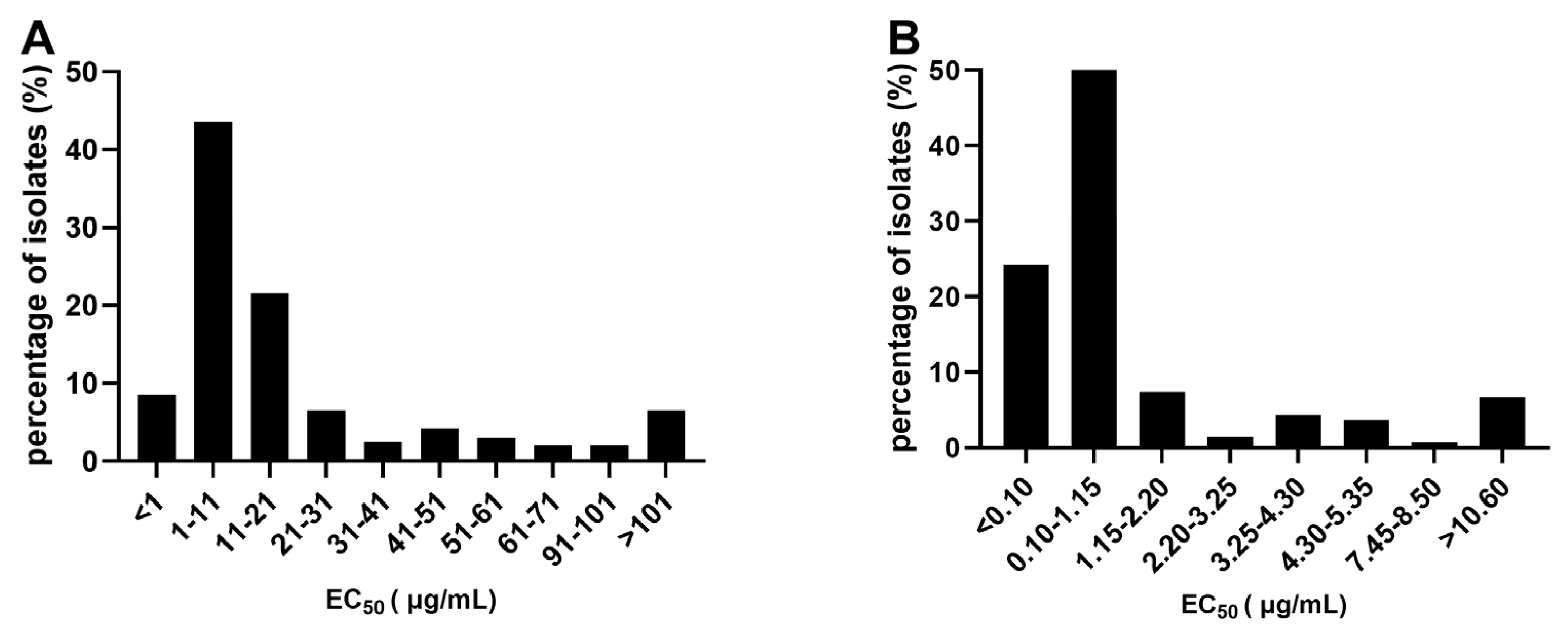
The sensitivity of P. viticola to cymoxanil (CYM) and cyazofamid (CYA) was tested by leaf disc assay. The EC50 values of all isolates to CYM ranged from 0.01 to 691.39 μg/mL, with a mean value of 36.44 μg/mL and were separated by a factor of 69,139 (Table 2). Regardless of the relatively wide EC50 range, most EC50 values (79.4%) were below 31 μg/mL, with a mean value of 8.69 ± 0.64 μg/mL, and their frequency distribution presented a unimodal curve (Figure 1A), which could be used as the baseline sensitivity of P. viticola to CYM. The EC50 values for CYA ranged from 0.01 to 60.39 μg/mL and thus were separated by a factor of 6039 (Table 2). A total of 113 isolates (82.5%) showed EC50 values lower than 2.2 μg/mL, and the frequency distribution of the EC50 values showed a unimodal curve with a mean value of 0.42 ± 0.05 μg/mL (Figure 1B), which could be used as the baseline sensitivity of P. viticola to CYA.

3.2. Resistance Characteristics of P. viticola to Metalaxyl, Cymoxanil, and Cyazofamid

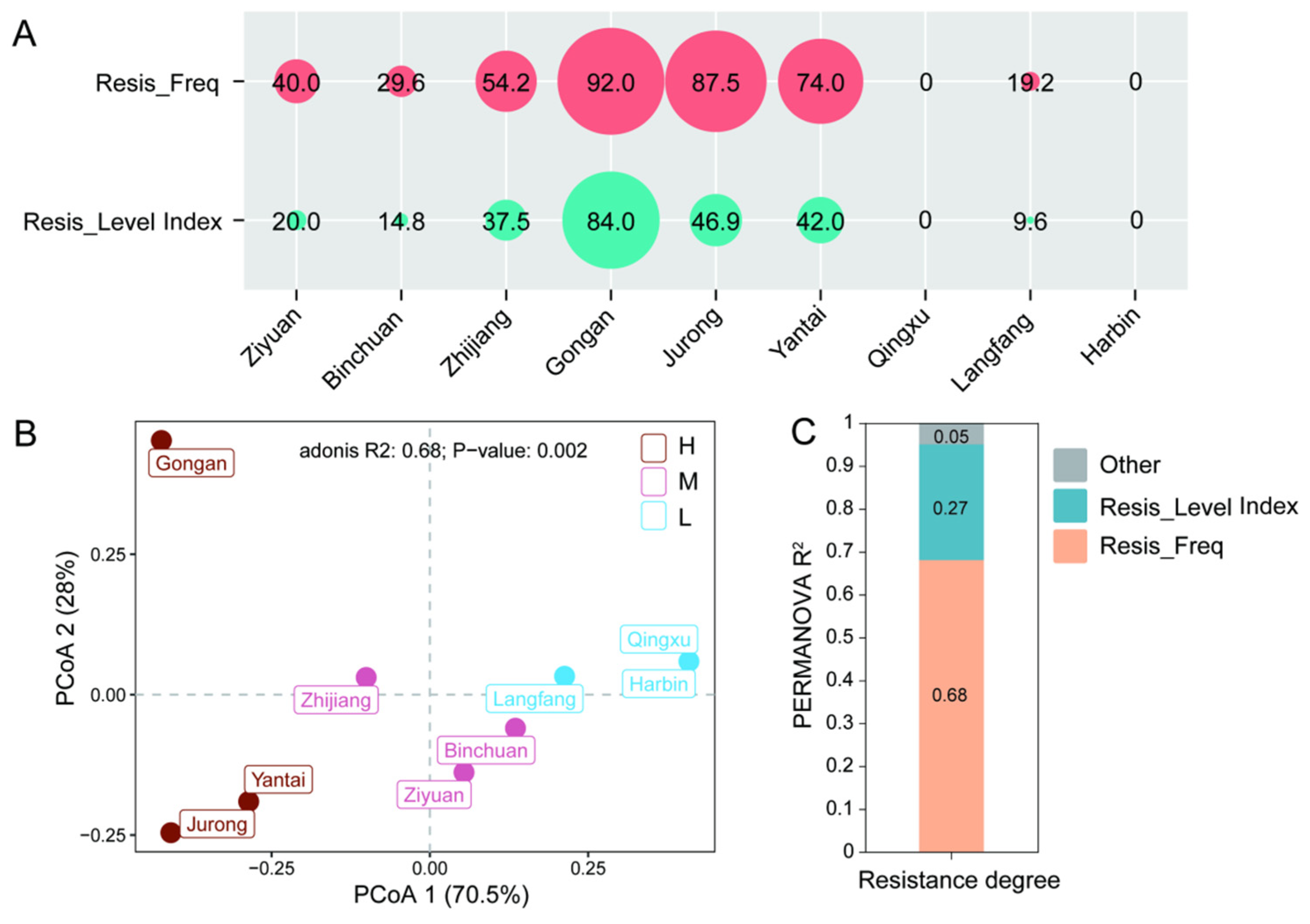
The resistance frequency and resistance levels of P. viticola isolates collected from different regions to MET, CYM and CYA were determined based on the minimum inhibitory concentration (MIC) of MET and the median effective concentration (EC50) of CYM and CYA. Of 233 tested P. viticola isolates, 45.49% were sensitive to MET, with a total resistance frequency of 54.51% (33.48% low-level resistance, 21.03% resistance). Overall, the isolates showed relatively low-level resistance, predominantly sensitive and low-level resistant types (Table S1). PCoA based on the Bray–Curtis distance revealed significant spatial structural differences in the resistance of P. viticola populations to MET among the nine regions (Figure 2). This analysis further identified two core factors driving inter-regional variations: the first principal coordinate axis (PCoA1) primarily reflected differences in the resistance frequency (RFr) of pathogen populations, while the second principal coordinate axis (PCoA2) represented differences in resistance levels. These results indicated that populations with high resistance frequency (Gong’an, Jurong and Yantai) were significantly separated from those with moderate resistance (Ziyuan, Binchuan, and Zhijiang) and low resistance (Qingxu, Harbin, and Langfang), suggesting that the prevalence of resistant isolates is the primary factor distinguishing inter-regional resistance differences. In addition, although Gong’an and Jurong exhibited similar resistance frequencies, they were still significantly separated along PCoA2, indicating that there were also statistical differences in their resistance levels (Figure 2B). PERMANOVA (adonis) statistical analysis further validated these observations, confirming that the resistance profiles among different regions exhibited significant differences (p < 0.05). The variance partitioning results showed that resistance frequency contributed the most to the total variation, followed by resistance level (Figure 2C).
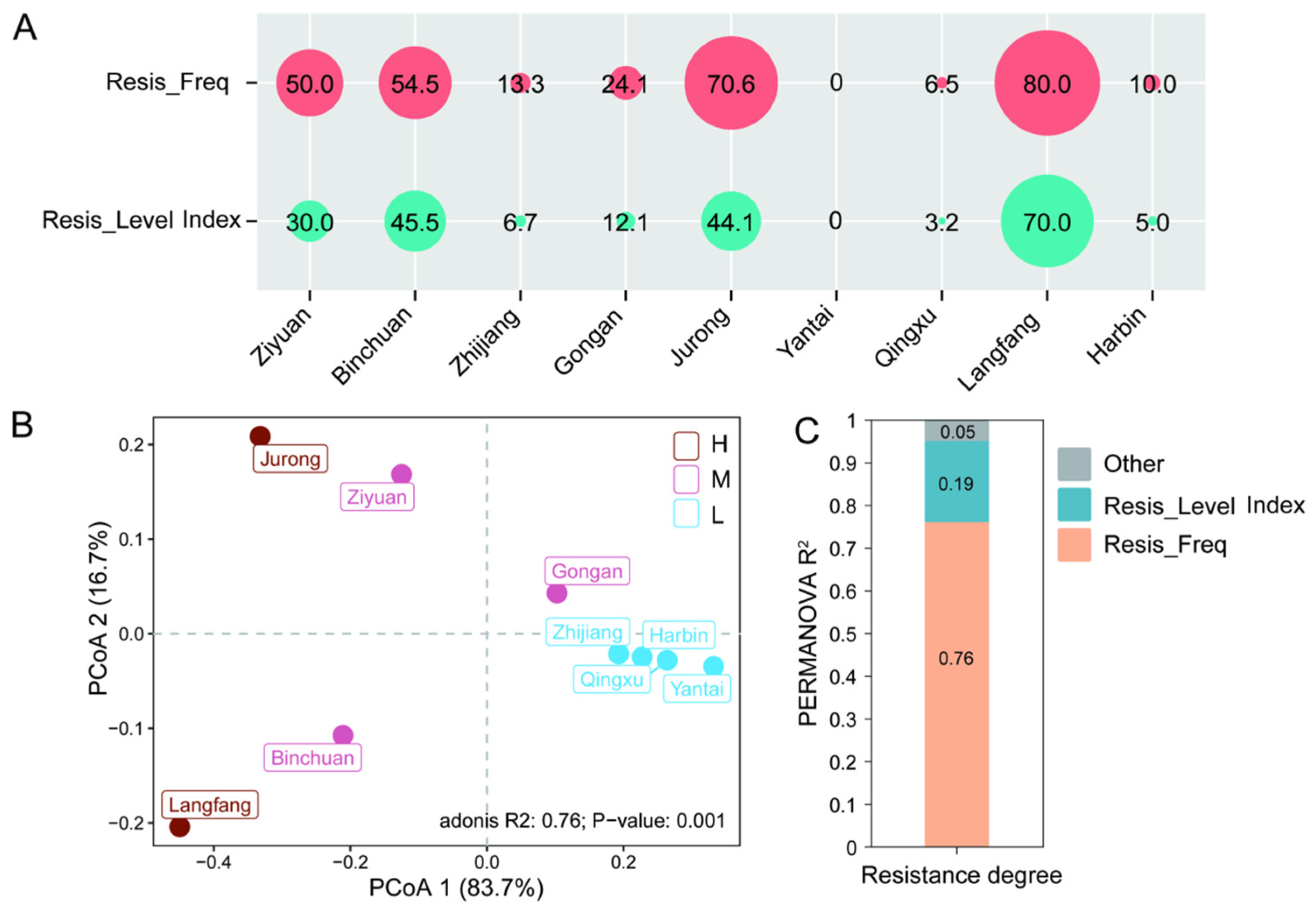
For CYM resistance, 70.59% (120/170) of the isolates were sensitive, 21.18% (36/170) exhibited low resistance, and 8.24% (14/170) exhibited moderate resistance; no isolates met the criteria for high resistance at the individual level (Table S1). PCA analysis revealed significant differences in the CYM-resistance profiles among P. viticola populations from different regions. Based on population-level resistance metrics, the entire pathogen population could be clustered into three distinct subgroups reflecting relative resistance status across regions. Strains from Jurong and Langfang were classified into the high-resistance subgroup, those from Binchuan, Ziyuan, and Gong’an belonged to the moderate-resistance subgroup, and strains from Zhijiang, Harbin, Yantai, and Qingxu were assigned to the low-resistance subgroup (Figure 3B). Further analysis indicated that resistance frequency was the most prominent factor influencing the overall CYM resistance of the population (Figure 3C). Notably, some regions (e.g., Langfang and Jurong) exhibited a severe resistance pattern characterized by high resistance frequency and level. The results indicated that there were significant differences in CYM resistance among P. viticola populations from different regions, with some regions exhibiting a severe resistance pattern characterized by both high resistance frequency and high resistance level.
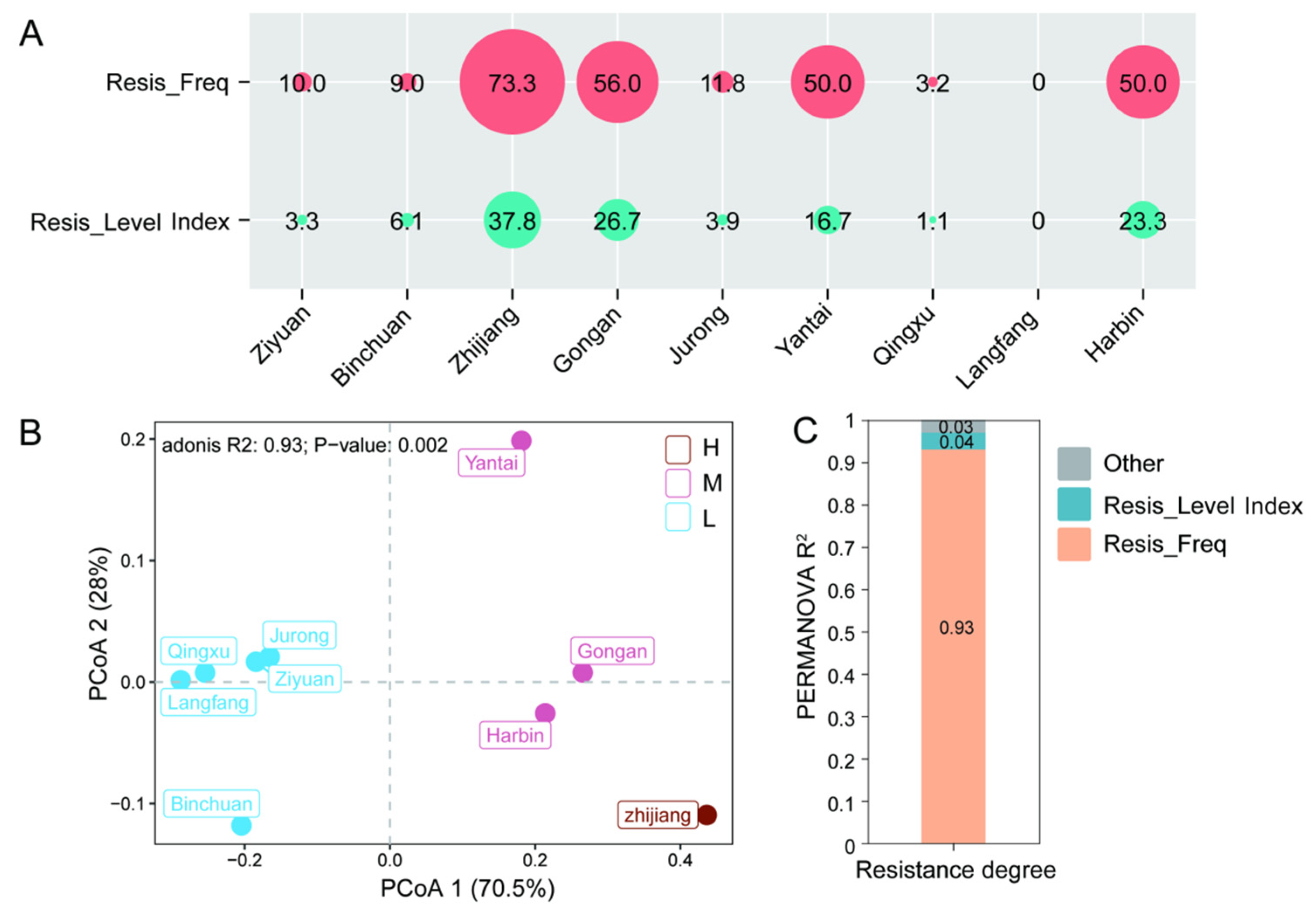
For CYA resistance (137 isolates tested), 71.53% (98/137) were sensitive, 18.25% (25/137) were low-resistant, 9.49% (13/137) were moderate-resistant, and 0.73% (1/137) were high-resistant (Table S1). Significant regional differences in the CYA-resistance profiles were also confirmed by PCA analysis (Figure 4B). The entire pathogen population could be clustered into three distinct subgroups: strains from Zhijiang were classified into the high-resistance subgroup, those from Gong’an, Harbin, and Yantai belonged to the moderate-resistance subgroup, and strains from Jurong, Ziyuan, Binchuan, Langfang, and Qingxu were assigned to the low-resistance subgroup (Figure 4B). Overall, the resistance level of the pathogen population was relatively low, and resistance frequency exerted the most significant contribution to the overall resistance of the population. These observations were further validated by PERMANOVA (adonis) statistical analysis, confirming that inter-regional differences in CYA resistance were statistically significant and that such variations were primarily attributed to differences in resistance frequency (Figure 4C).

3.3. Cross- and Multi-Resistance Patterns

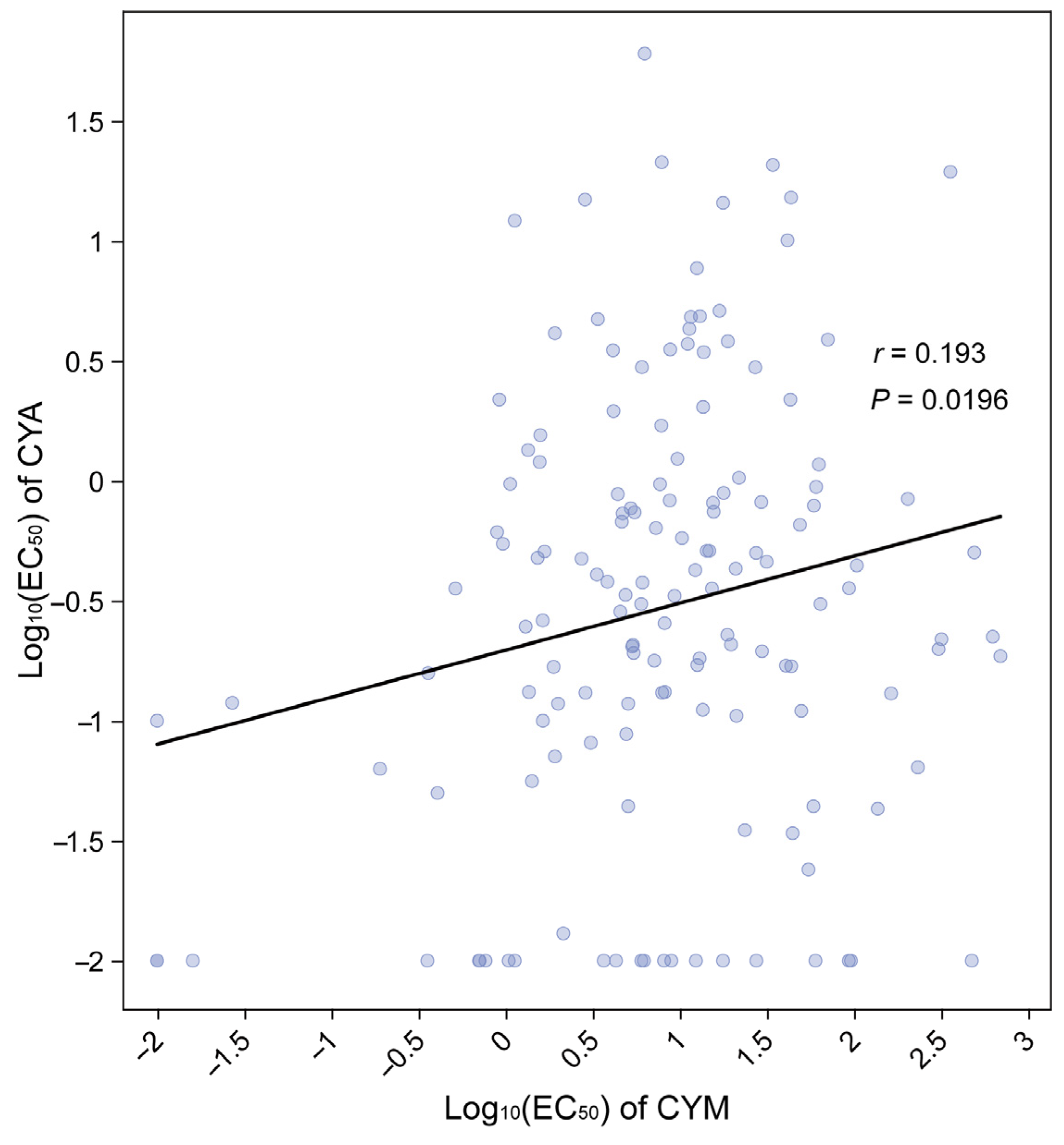
To clarify whether there is cross-resistance between CYM and CYA, log-transformed EC50 values were analyzed by establishing correlation and linear regression. The Pearson correlation test revealed there was a weakly positive correlation between resistance to CYM and to CYA (r = 0.193, p= 0.0196; Figure 5). Furthermore, there are 13 isolates exhibit resistance to both CYM and CYA (Table S2).

3.4. Fitness of P. viticola to Metalaxyl, Cymoxanil, and Cyazofamid

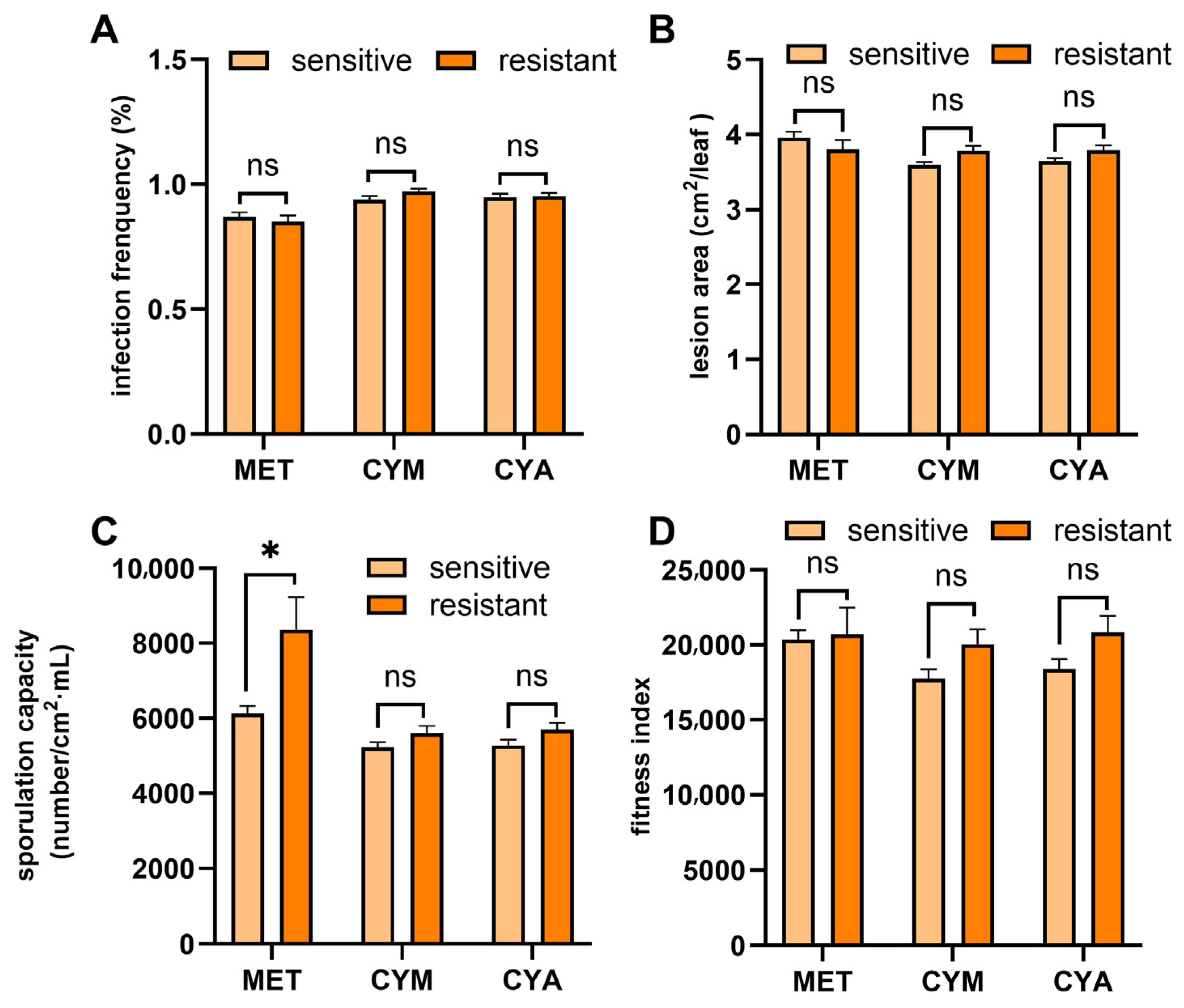
For MET, the sporulation capacity of resistant strains was significantly higher than that of sensitive strains (p < 0.05, Figure 6C), while no significant differences were observed in infectivity, lesion area, or composite fitness index between the two strain types (Figure 6A,B,D). In contrast, resistant and sensitive strains showed no significant variations in all the aforementioned fitness-related traits for CYM and CYA (Figure 6). Collectively, these results indicate that the fitness of resistant P. viticola to the three fungicides did not change significantly.

4. Discussion

This study systematically investigated P. viticola resistance to metalaxyl (MET), cymoxanil (CYM), and cyazofamid (CYA) in 9 major Chinese grape-producing regions, established CYM/CYA sensitivity baselines and compared resistant/sensitive strain fitness. The results provide a critical scientific basis for downy mildew chemical control and resistance management.
The overall MET resistance frequency of P. viticola in China was 54.51% (33.48% low-level, 21.03% high-level), which aligns with the global evolutionary trend of MET resistance. In recent years, sensitivity analyses conducted in countries including France, Switzerland, Spain, and Germany have confirmed that the proportion of MET-resistant P. viticola isolates remains high (50–80%) and relatively stable [27]. Sensitivity monitoring data from 2017/2018 (consistent with the sampling period of this study) further confirmed this global resistance pattern [28]. The relatively high MET resistance frequency observed in China may be associated with the early extensive use of MET for downy mildew control. Significant regional differences in MET resistance among P.viticola populations were observed in China (p < 0.05). For instance, strains from Gong’an and Jurong exhibited high resistance frequency and high resistance level, while those from Qingxu, Harbin, and Langfang showed extremely low resistance. Notably, all strains from Qingxu and Harbin were sensitive. This is likely related to local downy mildew incidence and fungicide use. Severe MET resistance is mainly distributed in central and southern China, where rainy and humid conditions cause severe downy mildew outbreaks and higher fungicide application frequencies—presumably the primary driver of high pathogen resistance.
Based on the established sensitivity baseline of CYM against P. viticola (8.69 ± 0.64 μg/mL, EC50), our analysis of isolates from 9 Chinese grape-growing regions revealed that 70.59% remained sensitive to CYM, with resistant isolates mainly being low-resistance biotypes. This resistance profile aligns with Toffolatti et al. [47], who reported a low proportion of CYM-resistant P. viticola populations in Italy. This consistency is presumably attributed to the common field application of CYM as mixed formulations, which have been proven to delay pathogen resistance evolution [31]. Notably, distinct resistance differentiation was observed across regions. Isolates from Langfang and Jurong showed high resistance frequencies (80% and 70.6%, respectively) and considerable moderate-resistance proportions (60% and 17.6%), indicating a high CYM resistance risk in these areas. This phenomenon is likely associated with local intensive fungicide use, emphasizing the necessity of targeted management strategies. For regions with severe resistance, strict restrictions on CYM application are imperative. In areas with moderate resistance, CYM should be applied as a mixed formulation component or rotated with fungicides of different modes of action to mitigate selection pressure and delay resistance development.
To the best of our knowledge, this is the first study to establish the sensitivity baseline of P. viticola to CYA, with an EC50 value of 0.42 ± 0.05 μg/mL, and systematically clarify its resistance status in major grape-producing areas of China. Overall, P. viticola exhibited a high level of sensitivity to CYA, with a resistance frequency of only 28.47%, and the majority of resistant strains were classified as low-resistance isolates. This relatively low resistance frequency is likely attributable to the prevalent application of CYA in combination with therapeutic fungicides in agricultural production, rather than its sole use as a single agent. Currently, there are limited reports on CYA resistance worldwide, and most of these studies have focused on Phytophthora spp. Previous studies have indicated that the resistance of Phytophthora to CYA exhibits an increasing trend [33,34,48], which is consistent with the resistance trend observed in P. viticola. Notably, relatively high resistance frequencies, including a certain proportion of moderate and high-resistance strains, have been detected in regions such as Zhijiang and Gongan in China, indicating a potential risk of P. viticola developing resistance to CYA. Therefore, it is crucial to strengthen long-term resistance monitoring and implement rational fungicide rotation strategies in subsequent agricultural practices. Recent studies have reported that CYA resistance in French P. viticola populations is associated with mutations in the cytb gene [36]; future work will verify this mechanism in domestic strains and develop rapid detection techniques to support CYA resistance management and grape downy mildew control in China.
In addition to single-fungicide resistance, the potential emergence of multi-resistance should be considered within an evolutionary framework. Although only a weak but statistically significant correlation was detected between CYM and CYA sensitivities, and no strong cross-resistance was evident, the coexistence of isolates resistant to both fungicides indicates that resistance traits may accumulate within regional populations under sustained selection pressure. Such patterns are consistent with a stepwise selection model, in which independent resistance mutations arise and are sequentially enriched through repeated fungicide exposure.
Fitness changes in fungicide-resistant pathogen populations are critical to understanding field resistance dynamics, as resistance mutations inherently incur fitness costs as an evolutionary trade-off [49]. Here, we found that P. viticola resistant strains to those three fungicides (MET, CYM, and CYA) did not exhibit significant overall fitness disadvantages. Notably, metalaxyl-resistant strains showed significantly enhanced spore production compared to sensitive strains, while no statistical differences were observed in infectivity, lesion area, or comprehensive fitness index between resistant and sensitive strains for all three fungicides. This result is consistent with the findings of Genet and Jaworska [31] that there was no significant difference in fitness between resistant and susceptible strains of P. viticola to cymoxanil. Similar results were also observed when comparing the fitness of P. viticola resistant and susceptible strains to other fungicides, e.g., dimethomorph and azoxystrobin [50,51]; however, some azoxystrobin-resistant strains exhibited a fitness cost [52]. This may be attributed, on the one hand, to the differences in the modes of action of different fungicides, and on the other hand, to the fact that laboratory conditions may be more conducive to the growth of the pathogen. Therefore, additional field experiments are required for further verification in subsequent studies.
As a major global grape producer, sustainable control of grape downy mildew is critical for industrial development. Previous data on P. viticola resistance to MET, CYM, and CYA in China were scarce. This study systematically investigated resistance status in 9 major producing regions, established CYM and CYA sensitivity baselines, and clarified resistance distribution, cross-resistance relationships, and resistant strain fitness characteristics, filling relevant research gaps. Targeted control suggestions based on the results are as follows: (1) Regional precision application: Develop differentiated schemes based on local resistance. Use MET rationally in sensitive regions (e.g., Qingxu, Harbin) and prioritize CYA in sensitive regions (e.g., Langfang, Xing’an); avoid sole use in high-resistance regions. (2) Scientific rotation: Alternate CYM and CYA (no obvious cross-resistance) and rotate with MET (sensitive regions) or other mechanism fungicides to avoid long-term sole use. (3) Strengthen resistance monitoring: Establish a long-term system to track resistance changes, update application strategies in a timely manner for early detection and control. (4) Promote integrated control: Combine disease-resistant varieties, agronomic measures, and biological control to reduce chemical pesticide dependence and resistance pressure.

Supplementary Materials

The following supporting information can be downloaded at: https://www.mdpi.com/article/10.3390/jof12030180/s1, Figure S1: Resistance levels of P. viticola from different regions to three fungicides (A) Metalaxyl; (B) Cymoxanil; (C) Cyazofamid (S = Sensitive, R = Resistant, LR = Low resistant, MR = Moderately resistant, HR = Highly resistant). Table S1: Resistance frequency of P. viticola to Metalaxyl, cymoxanil and cyazofamid. Table S2: Summary of P. viticola isolate resistance to both CYM and CYA.

Author Contributions

Conceptualization: K.Q. and X.-Q.H.; methodology: M.-Z.Y., L.-Z.Z. and X.-Q.H.; formal analysis: M.-Z.Y., L.-Z.Z. and Y.-Q.L.; investigation: S.-W.C., F.-F.K. and R.-J.G.; data curation: M.-Z.Y. and Z.-Y.W.; writing—original draft preparation: M.-Z.Y. and L.-Z.Z.; writing—review and editing: M.-Z.Y., S.-D.L. and X.-Q.H.; supervision: K.Q. and X.-Q.H.; project administration: X.-Q.H. All authors have read and agreed to the published version of the manuscript.

Funding

This study was funded by the National Key Research and Development Program of China (2023YFD1401405); the China Agricultural Research System (CARS-29).

Institutional Review Board Statement

Not applicable.

Informed Consent Statement

Not applicable.

Data Availability Statement

The original contributions presented in the study are included in the article, further inquiries can be directed to the corresponding authors.

Conflicts of Interest

The authors declare no conflicts of interest.

References

  1. Granato, D.; Carrapeiro, M.M.; Fogliano, V.; van Ruth, S.M. Effects of geographical origin, varietal and farming system on the chemical composition and functional properties of purple grape juices: A review. Trends Food Sci. Technol. 2016, 52, 31–48. [Google Scholar] [CrossRef]
  2. Cui, S.W.; Zhou, L.Z.; Fang, Q.D.; Xiao, H.J.; Jin, D.C.; Liu, Y.Q. Growth period and variety together drive the succession of phyllosphere microbial communities of grapevine. Sci. Total Environ. 2024, 950, 175334. [Google Scholar] [CrossRef]
  3. Nanni, I.M.; Oggiano, I.; Laricchia, M.; Cempini, M.; Collina, M. Monitoring and tracking changes in sensitivity to zoxamide fungicide in Plasmopara viticola in Italy. J. Plant Dis. Prot. 2024, 131, 1211–1216. [Google Scholar] [CrossRef]
  4. Schumacher, S.; Mertes, C.; Kaltenbach, T.; Bleyer, G.; Fuchs, R. A method for phenotypic evaluation of grapevine resistance in relation to phenological development. Sci. Rep. 2024, 14, 915. [Google Scholar] [CrossRef] [PubMed]
  5. Li, X.L.; Yin, L.; Ma, L.J.; Zhang, Y.L.; An, Y.H.; Lu, J. Pathogenicity Variation and Population Genetic Structure of Plasmopara viticola in China. J. Phytopathol. 2016, 164, 863–873. [Google Scholar] [CrossRef]
  6. Massi, F.; Torriani, S.F.F.; Borghi, L.; Toffolatti, S.L. Fungicide resistance evolution and detection in plant pathogens: Plasmopara viticola as a case study. Microorganisms 2021, 9, 119. [Google Scholar] [CrossRef]
  7. Brunelli, A.; Pirondi, A.; Portillo, I.; Collina, M. Anti-Sporulation Activity of Some Fungicides on Grape Downy Mildew (Plasmopara viticola). In Proceedings of the Giornate Fitopatologiche 2012, Bologna, Italy, 13–16 March 2012; pp. 413–417. [Google Scholar]
  8. Pavelková, J.; Lebeda, A.; Sedláková, B. Efficacy of fosetyl-Al, propamocarb, dimethomorph, cymoxanil, metalaxyl and metalaxyl-M in Czech Pseudoperonospora cubensis populations during the years 2005 through 2010. Crop Prot. 2014, 60, 9–19. [Google Scholar] [CrossRef]
  9. Huang, X.Q.; Wang, X.N.; Kong, F.F.; van der Lee, T.; Wang, Z.Y.; Zhang, H. Detection and characterization of carboxylic acid amide-resistant Plasmopara viticola in China using a TaqMan-MGB real-time PCR. Plant Dis. 2020, 104, 2338–2345. [Google Scholar] [CrossRef]
  10. Huang, X.Q.; Wang, X.N.; Zhou, L.Z.; Kong, F.F.; Liu, Y.Q.; Wang, Z.Y.; Zhang, H. TaqMan-MGB PCR method for rapid detection of QoI fungicide resistance in Chinese populations of Plasmopara viticola. Plant Dis. 2023, 107, 3007–3013. [Google Scholar] [CrossRef]
  11. Leadbeater, A.J. Plant Health Management: Fungicides and Antibiotics. In Encyclopedia of Agriculture and Food Systems; Van Alfen, N.K., Ed.; Elsevier: Oxford, UK, 2014; Volume 4, pp. 408–424. [Google Scholar]
  12. Lee, T.Y.; Mizubuti, E.S.; Fry, W.E. Genetics of metalaxyl resistance in Phytophthora infestans. Fungal Genet. Biol. 1999, 26, 118–130. [Google Scholar] [CrossRef]
  13. Gisi, U.; Binder, H.; Rimbach, E. Synergistic interactions of fungicides with different modes of action. Trans. Br. Mycol. Soc. 1985, 85, 299–306. [Google Scholar] [CrossRef]
  14. Yoon, J.Y.; Kim, J.E.; Song, H.J.; Oh, K.B.; Jo, J.W.; Yang, Y.H.; Lee, S.H.; Kang, G.; Kim, H.J.; Choi, Y.-K. Assessment of adsorptive behaviors and properties of grape pomace-derived biochar as adsorbent for removal of cymoxanil pesticide. Environ. Technol. Innov. 2021, 21, 101242. [Google Scholar] [CrossRef]
  15. Kazmirchuk, T.D.D.; Burnside, D.J.; Wang, J.; Jagadeesan, S.K.; Al-gafari, M.; Silva, E.; Potter, T.; Bradbury-Jost, C.; Ramessur, N.B.; Ellis, B.; et al. Cymoxanil disrupts RNA synthesis through inhibiting the activity of dihydrofolate reductase. Sci. Rep. 2024, 14, 11695. [Google Scholar] [CrossRef]
  16. Mendes, F.; Santos-Pereira, C.; Vieira, T.F. The fungicide cymoxanil impairs respiration in Saccharomyces cerevisiae via cytochrome c. FEBS Lett. 2024, 598, 1655–1666. [Google Scholar] [CrossRef]
  17. Tellier, F.; Fritz, R.; Kerhoas, L.; Ducrot, P.H.; Einhorn, J.; Carlin-Sinclair, A.; Leroux, P. Characterization of metabolites of fungicidal cymoxanil in a sensitive strain of Botrytis cinerea. J. Agric. Food Chem. 2008, 56, 8050–8057. [Google Scholar] [CrossRef] [PubMed]
  18. Tellier, F.; Fritz, R.; Kerhoas, L.; Ducrot, P.-H.; Carlin-Sinclair, A.; Einhorn, J.; Leroux, P. Metabolism of fungicidal cyanooximes, cymoxanil and analogues in various strains of Botrytis cinerea. Pest. Manag. Sci. 2009, 65, 129–136. [Google Scholar] [CrossRef]
  19. González-Álvarez, M.; González-Barreiro, C.; Cancho-Grande, B.; Simal-Gándara, J. Impact of phytosanitary treatments with fungicides (cyazofamid, famoxadone, mandipropamid and valifenalate) on aroma compounds of Godello white wines. Food Chem. 2012, 131, 826–836. [Google Scholar] [CrossRef]
  20. Fukamachi, K.; Konishi, Y.; Nomura, T. Disease control of Phytophthora infestans using cyazofamid encapsulated in poly(lactic-co-glycolic acid) (PLGA) nanoparticles. Colloids Surf. A Physicochem. Eng. Asp. 2019, 577, 315–322. [Google Scholar] [CrossRef]
  21. Sapkota, S.; Burlakoti, R.R.; Punja, Z.K.; Gerbrandt, E.M. Influence of cultivar, environmental conditions, and fungicides on development of Phytophthora root rot and wilt on red raspberry. Crop Prot. 2023, 172, 106347. [Google Scholar] [CrossRef]
  22. Mao, L.G.; Shi, H.J.; Sial, M.U.; Zhang, L.; Zhu, L.Z.; Wu, C.; Liu, X.G. Control of potato powdery scab with fluazinam, cyazofamid or bupirimate under field conditions in China. Crop Prot. 2024, 184, 106877. [Google Scholar] [CrossRef]
  23. Mitani, S.; Araki, S.; Takii, Y.; Ohshima, T.; Matsuo, N.; Miyoshi, H. The biochemical mode of action of the novel selective fungicide cyazofamid: Specific inhibition of mitochondrial complex III in Pythium spinosum. Pestic. Biochem. Physiol. 2001, 71, 107–115. [Google Scholar] [CrossRef]
  24. Staub, T.; Sozzi, D. Résistance au Métalaxyl en pratique et les conséquences pour son utilisation. Phytiatr.-Phytopharm. 1981, 30, 283–291. [Google Scholar]
  25. Clerjeau, M.; Simone, J. Apparition en France de souches de mildiou (Plasmopara viticola) résistantes aux fongicides de la famille des anilides (métalaxyl, milfuram). Prog. Agric. Vitic. 1982, 99, 59–61. [Google Scholar]
  26. Gisi, U.; Sierotzki, H.; Cook, A.; McCaffery, A. Mechanisms influencing the evolution of resistance to Qo inhibitor fungicides. Pest. Manag. Sci. 2002, 58, 859–867. [Google Scholar] [CrossRef]
  27. Gisi, U.; Sierotzki, H. Fungicide modes of action and resistance in downy mildews. Eur. J. Plant Pathol. 2008, 122, 157–167. [Google Scholar] [CrossRef]
  28. FRAC. Phenylamides Expert Forum. Available online: https://www.frac.info/frac-teams/expert-fora/phenylamides/ (accessed on 4 February 2026).
  29. Gullino, M.L.; Mescalchin, E.; Mezzalama, M. Sensitivity to cymoxanil in populations of Plasmopara viticola in northern Italy. Plant Pathol. 1997, 46, 729–736. [Google Scholar] [CrossRef]
  30. Corio-Costet, M.F. Fungicide Resistance in Plasmopara viticola in France and Anti-Resistance Measures. CABI Rev. 2012, 7, 1–12. [Google Scholar]
  31. Genet, J.L.; Jaworska, G. Characterization of European Plasmopara viticola isolates with reduced sensitivity to cymoxanil. Eur. J. Plant Pathol. 2013, 135, 383–393. [Google Scholar] [CrossRef]
  32. Ghule, M.R.; Sawant, I.; Sawant, S.; Saha, S. Resistance of Plasmopara viticola to multiple fungicides in vineyards of Maharashtra, India. J. Environ. Biol. 2020, 41, 1026–1033. [Google Scholar] [CrossRef]
  33. Kousik, C.S.; Keinath, A.P. First report of insensitivity to cyazofamid among isolates of Phytophthora capsici from the southeastern United States. Plant Dis. 2008, 92, 979. [Google Scholar] [CrossRef]
  34. Jackson, K.L.; Yin, J.; Ji, P. Sensitivity of Phytophthora capsici on vegetable crops in Georgia to mandipropamid, dimethomorph, and cyazofamid. Plant Dis. 2012, 96, 1337–1342. [Google Scholar] [CrossRef] [PubMed]
  35. Cherrad, S.; Hernandez, C.; Steva, H.; Vacher, S. Resistance of Plasmopara viticola to complex III inhibitors: A point on the phenotypic and genotypic characterization of strains. In Proceedings of the 12e Conference Internationale sur les Maladies des Plantes, Tours, France, 11–12 December 2018; AFPP: Paris, France, 2018; pp. 449–459. [Google Scholar]
  36. Cherrad, S.; Gillet, B.; Dellinger, J.; Bellaton, L.; Roux, P.; Hernandez, C.; Steva, H.; Perrier, L.; Vacher, S.; Hughes, S. New insights from short and long reads sequencing to explore cytochrome b variants in Plasmopara viticola populations collected from vineyards and related to resistance to complex III inhibitors. PLoS ONE 2023, 18, e0287315. [Google Scholar] [CrossRef]
  37. Zhang, H.; Kong, F.; Wang, X.; Liang, L.; Schoen, C.D.; Feng, J.; Wang, Z. Tetra-primer ARMS PCR for rapid detection and characterisation of Plasmopara viticola phenotypes resistant to carboxylic acid amidefungicides. Pest. Manag. Sci. 2017, 73, 1655–1660. [Google Scholar] [CrossRef] [PubMed]
  38. Fourie, P.H. Metalaxyl sensitivity status of downy mildew populations in Western Cape vineyards. S. Afr. J. Enol. Vitic. 2004, 25, 19–22. [Google Scholar] [CrossRef][Green Version]
  39. Pharate, S.; Saha, S. Sensitivity Assessment of Plasmopara viticola Against Mefenoxam Under In Vitro Conditions. Plant Arch. 2025, 25, 1123–1130. [Google Scholar]
  40. BenchChem Technical Support Team. The Fungicidal Efficacy of (R)-Metalaxyl: A Technical Guide for Researchers; BenchChem: Austin, TX, USA, 2025. [Google Scholar]
  41. Sun, H.Y.; Wang, H.C.; Stammler, G.; Zhou, M.G. Sensitivity of Chinese Isolates of Plasmopara viticola to Metalaxyl and Dimethomorph. J. Phytopathol. 2010, 158, 450–452. [Google Scholar] [CrossRef]
  42. Genet, J.L.; Vincent, O. Sensitivity of European Plasmopara viticola populations to cymoxanil. Pest. Manag. Sci. 1997, 55, 129–136. [Google Scholar] [CrossRef]
  43. Song, Y.; Zhang, Z.; Chen, L.; He, L.; Lu, H.; Ren, Y.; Mu, W.; Liu, F. Baseline sensitivity of Botrytis cinerea to the succinate dehydroge-nase inhibitor isopyrazam and efficacy of this fungicide. Plant Dis. 2016, 100, 1314–1320. [Google Scholar] [CrossRef]
  44. Veloukas, T.; Markoglou, A.N.; Karaoglanidis, G.S. Differential effect of sdhB gene mutations on the sensitivity to SDHI fungicides in Botrytis cinerea. Plant Dis. 2013, 97, 118–122. [Google Scholar] [CrossRef]
  45. Liu, X.H.; Zhou, L.Z.; Kong, F.F.; Wang, Z.Y.; Huang, X.Q.; Zhang, H. Resistance and Fitness of Plasmopara viticola Populations to Dimethomorph in Four Provinces of China. Plant Prot. 2023, 49, 172–178. [Google Scholar]
  46. Zhou, L.Z. Detection of Resistance to Five Major Fungicides in Plasmopara viticola Populations from Major Grape-Growing Regions of China. Master’s Thesis, Chinese Academy of Agricultural Sciences, Beijing, China, 2019. [Google Scholar]
  47. Toffolatti, S.L.; Venturini, G.; Campia, P.; Mendes, F.; Santos-Pereira, C.; Vieira, T.F. Sensitivity to Cymoxanil in Italian Populations of Plasmopara viticola Oospores. Pest. Manag. Sci. 2015, 71, 1182–1188. [Google Scholar]
  48. Gao, X.; Li, W.; Wang, S.; Xie, B.; Peng, Q.; Zhang, C.; Miao, J.; Dai, T.; Liu, X. Attributes of Cyazofamid-Resistant Phytophthora litchii Mutants and Its Impact on Quality of Litchi Fruits. J. Agric. Food Chem. 2024, 72, 219–229. [Google Scholar] [CrossRef]
  49. Hawkins, N.J.; Fraaije, B.A. Fitness Penalties in the Evolution of Fungicide Resistance. Annu. Rev. Phytopathol. 2018, 56, 339–360. [Google Scholar] [CrossRef] [PubMed]
  50. Delmas, C.E.L.; Dussert, Y.; Delière, L.; Couture, C.; Mazet, I.D.; Richart-Cervera, S.; Delmotte, F. Soft Selective Sweeps in Fungicide Resistance Evolution: Recurrent Mutations without Fitness Costs in Grapevine Downy Mildew. J. Fungi 2024, 10, 1936–1951. [Google Scholar] [CrossRef] [PubMed]
  51. Corio-Costet, M.F.; Dufour, M.-C.; Cigna, J.; Abadie, P.P.; Chen, W.-J. Diversity and fitness of Plasmopara viticola isolates resistant to QoI fungicides. Eur. J. Plant Pathol. 2011, 129, 315–329. [Google Scholar] [CrossRef]
  52. Toffolatti, S.; Vercesi, A. QoI resistance in Plasmopara viticola in Italy: Evolution and management strategies. In Fungicide Resistance in Crop Protection: Risk and Management; Springer: New York, NY, USA, 2011; pp. 172–183. [Google Scholar]
Figure 1. Frequency distributions of 50% effective concentrations (EC50 values) for (A) cymoxanil (CYM) and (B) cyazofamid (CYA) against P. viticola isolates collected from vineyards in China (based on leaf disc assays).
Jof 12 00180 g001
Figure 2. Differences in resistance grades of P. viticola to metalaxyl (MET) among nine regions. (A) Resistance frequency and resistance level values of the isolates from nine regions. Note: Resis_Freq = Resistance frequency, Resis_Level Index = Resistance level index; (B) Principal coordinate analysis (PCoA) of resistance grades among nine regions based on Bray–Curtis distance (n = 9), where H, M and L represent high, medium and low resistance grades, respectively; (C) Contribution of resistance frequency and resistance level to the differences in resistance grades among regions was evaluated by permutational multivariate analysis of variance (PERMANOVA).
Jof 12 00180 g002
Figure 3. Differences in resistance grades of P. viticola to cymoxanil (CYM) among nine regions. (A) Resistance frequency and resistance level values of the isolates from nine regions. Note: Resis_Freq = Resistance frequency, Resis_Level Index = Resistance level index; (B) Principal coordinate analysis (PCoA) of resistance grades among nine regions based on Bray–Curtis distance (n = 9), where H, M and L represent high, medium and low resistance grades, respectively; (C) Contribution of resistance frequency and resistance level to the differences in resistance grades among regions was evaluated by permutational multivariate analysis of variance (PERMANOVA).
Jof 12 00180 g003
Figure 4. Differences in resistance grades of P. viticola to cyazofamid (CYA) among nine regions. (A) Resistance frequency and resistance level values of the isolates from nine regions. Note: Resis_Freq = Resistance frequency, Resis_Level Index = Resistance level index; (B) Principal coordinate analysis (PCoA) of resistance grades among nine regions based on Bray–Curtis distance (n = 9), where H, M and L represent high, medium and low resistance grades, respectively; (C) Contribution of resistance frequency and resistance level to the differences in resistance grades among regions was evaluated by permutational multivariate analysis of variance (PERMANOVA).
Jof 12 00180 g004
Figure 5. Relationship between CYM and CYA sensitivity in P. viticola isolates. Log10-transformed EC50 values of CYM were plotted against Log10-transformed EC50 values of CYA. Each point represents an individual isolate.
Jof 12 00180 g005
Figure 6. Fitness comparison between fungicide-resistant and sensitive isolates of P. viticola to metalaxyl (MET), cymoxanil (CYM) and cyazofamid (CYA). (A) Infection frequency; (B) Lesion area; (C) Sporulation capacity; (D) Fitness index. * indicates a significant difference (p < 0.05), and ns indicates no significant difference (p ≥ 0.05).
Jof 12 00180 g006
Table 1. Information of P. viticola isolates used in this study.
ProvinceCollecting SitesNo. of Isolates for MET
Sensitivity 1
No. of Isolates for CYM Sensitivity 2No. of Isolates for CYA Sensitivity 3
GuangxiZiyuan101010
YunnanBinchuan271111
HunanZhijiang241515
HubeiGong’an505825
JiangsuJurong161717
ShandongYantai5088
ShanxiQingxu203131
HebeiLangfang261010
HeilongjiangHarbin101010
Total 233170137
1 MET: metalaxyl; 2 CYM: cymoxanil; 3 CYA: cyazofamid.
Table 2. Distribution of EC50 values of P. viticola to cymoxanil and cyazofamid.
FungicideNumber of IsolatesEC50 (μg/mL)
RangeMeanStandard ErrorVariation Factor 1
Cymoxanil1700.01–691.3936.447.3869,139
Cyazofamid1370.01–60.392.150.566039
1 Variation factor: the highest EC50 value divided by the lowest EC50 value.
Disclaimer/Publisher’s Note: The statements, opinions and data contained in all publications are solely those of the individual author(s) and contributor(s) and not of MDPI and/or the editor(s). MDPI and/or the editor(s) disclaim responsibility for any injury to people or property resulting from any ideas, methods, instructions or products referred to in the content.