Article

Hgt17-Adr1 Relationship in Candida albicans Citrate Utilization

by
Amelia M. White
and
Aaron P. Mitchell
*
Department of Microbiology, University of Georgia, Athens, GA 30602, USA
*
Author to whom correspondence should be addressed.
Current address: Department of Microbiology and Immunology, Stony Brook University, Stony Brook, NY 11794, USA.
J. Fungi 2025, 11(12), 889; https://doi.org/10.3390/jof11120889
Submission received: 3 November 2025 / Revised: 27 November 2025 / Accepted: 5 December 2025 / Published: 17 December 2025
(This article belongs to the Section Fungal Cell Biology, Metabolism and Physiology)

Abstract

The fungal pathogen Candida albicans can infect diverse tissues, a reflection of its broad metabolic repertoire. The transcription factor Adr1 is required for utilization of several citric acid cycle intermediates that are found in tissue. Many Adr1-activated genes encode enzymes with well-defined roles in citrate metabolism or gluconeogenesis. Here, we focus on HGT17 (C4_01070W, orf19.4682), an Adr1-activated gene that encodes a possible citrate transporter. We provide two lines of evidence that HGT17 is a key functional target of Adr1. First, forced expression of HGT17 in an adr1Δ/Δ mutant improves growth on citrate as a carbon source. Second, hgt17Δ/Δ and adr1Δ/Δ mutants incubated in citrate medium present similar gene expression defects compared to the wild type. Noteworthy is down-regulation in both mutants of citric acid cycle genes, glycolysis/gluconeogenesis genes, and ergosterol synthesis genes. These common features may reflect a specific effect of citrate as an inducer of citric acid cycle enzymes or a global effect of carbon and energy limitation. In either case, the results argue that reduced HGT17 expression contributes substantially to the impact of an adr1Δ/Δ mutation on growth and gene expression.

1. Introduction

Candida albicans can survive and proliferate in a broad range of body sites as either a pathogen or a commensal [1,2,3,4]. Metabolic flexibility is critical for both pathogenic and commensal states [1,2,5,6]. This metabolic flexibility is coordinated by nutrient sensors and transcriptional regulatory networks [7,8].
Our focus here is the transcriptional control of citrate utilization. We recently found that the transcription factor Adr1, previously established to be a positive regulator of ergosterol biosynthetic genes [9], is required for growth on citrate and other citric acid cycle intermediates as sole sources of carbon [10]. RNA-sequencing (RNA-seq) data showed that many predicted citrate metabolic genes are downregulated in an adr1Δ/Δ mutant [10]. Adr1 may be part of a broad regulatory network that connects metabolism and virulence because epistasis analysis indicates that Adr1 may act downstream of virulence regulator Eed1 to govern citrate utilization [10,11].
One of the genes most dependent on Adr1 for expression is HGT17 (C4_01070W, orf19.4682). It encodes a major facilitator superfamily member initially annotated as a glucose transporter [12]. Hgt17 lacks a precise ortholog in Saccharomyces cerevisiae [12], which cannot use citrate as a carbon source [13]. An hgt17Δ/Δ mutant is unable to grow on citrate but is capable of growth on other citric acid cycle intermediates [10]. We proposed that Hgt17 is a citrate transporter to account for these observations [10].
Given the strong dependence of HGT17 expression on Adr1, we considered the possibility that reduced HGT17 expression may be a pivotal determinant of adr1Δ/Δ mutant phenotypes in citrate growth medium. Here, we have taken two approaches to make an appraisal of that idea. Our findings indicate that HGT17 expression has strong impact on the adr1Δ/Δ phenotype and suggest that citrate levels are critical for Adr1 function.

2. Materials and Methods

2.1. Media and Culture Conditions

Strains (Table S2) were maintained in 15% glycerol stocks and stored at −80 °C. For use, strains were streaked on YPD agar plates (2% dextrose, 2% Bacto peptone, 1% yeast extract, 2% Bacto Agar [all from ThermoFisher, Waltham, MA, USA]). Single colonies were transferred to 18 h overnight cultures at 30 °C with agitation. Overnight cultures were grown in filter-sterilized 0.67% yeast nitrogen base without amino acids (ThermoFisher, Waltham, MA, USA) + 1% sodium acetate (VWR, Radnor, PA, USA) liquid medium. For the experiment using BPS in growth tests, overnight cultures included 50 µM BPS (Sigma-Aldrich, St. Louis, MO, USA), and plates included 50 or 100 µM BPS as indicated; BPS increases RBT5 promoter activity [14].
Gene expression experiments were conducted with filter-sterilized YNB containing 1% sodium citrate (VWR, Radnor, PA, USA). All C. albicans transformants were selected as described [10] on Complete Supplement Mixture lacking histidine (CSM-HIS; 0.67% yeast nitrogen base without amino acids, 0.079% CSM-HIS supplement mixture [ThermoFisher, Waltham, MA, USA], and 2% dextrose) for His+ isolates or on YPD+NAT (2% Bacto peptone, 2% dextrose, 1% yeast extract, and 400 μg/mL nourseothricin [GoldBio, St. Louis, MO, USA]) for nourseothricin-resistant isolates.

2.2. Strain Construction

C. albicans genetic manipulations were conducted as previously described [10,15,16], starting with SC5314 derivative MC5 [17]. Plasmids [14,15,16,18,19] and primer sequences are listed in Table S2. Mutants were constructed in the SC5314 strain background. The HGT17 overexpression mutants were constructed in a background that had been made sensitive to nourseothricin by recycling the NAT1 marker at the his1Δ/Δ locus simultaneously with the deletion of ADR1 using HIS1, following the procedure of Huang and Mitchell [19]. The HGT17 overexpression strains were then constructed by replacing the native promoter with the inducible RBT5 promoter. The promoter cassette was amplified using primers with 80 bp of homology upstream or downstream to the native HGT17 promoter region. The addition of adapter sequences to these 80 bp primers allowed the amplification of the RBT5 promoter cassette with an attached NAT resistance marker from plasmid pTH10 [14]. Note that both RBT5-HGT17 strains are heterozygous for the promoter replacement (genotype: HGT17/NAT-RBT5-HGT17).
The Nat-sensitive adr1Δ/Δ cells were transformed with 1 μg of CaCas9 DNA, 1 μg of an sgRNA targeted to the HGT17 promoter region, and 3 μg of the NAT1+RBT5 promoter cassette PCR product as repair template. Transformants were plated on YPD+NAT (2% Bacto peptone, 2% dextrose, 1% yeast extract, and 400 mg/mL nourseothricin) plates for 48 h. Candidates were genotyped by PCR using primers “HGT17 far up check /F” and “NAT1 check int /R” for the presence of the NAT1+RBT5 promoter construct and primers “HGT17 check up /F” and “HGT17 check int /R” for the absence of the HGT17 promoter region.

2.3. Agar Plate Growth Assays

Strains were grown overnight in YNB + 1% acetate + 50 µM BPS for 18 h at 30 °C with agitation. Strains were washed twice with autoclaved ddH2O, then diluted to an OD600 of 3 in ddH2O. Five-fold serial dilutions were spotted on appropriate media using a multichannel pipette. Plates were incubated at 37 °C for 96 h and imaged.

2.4. RNA-Seq

Our RNA-seq workflow was as described previously [10]. In brief, YNB + 1% sodium acetate overnight cultures were used to inoculate prewarmed 125 mL flasks with 25 mL YNB + 1% sodium citrate to an OD600 of 0.2. Cultures were grown for 4 h at 37 °C with agitation, and three biological replicates were used for sequencing. Cells were harvested via vacuum filtration, frozen (−80 °C), and RNA was extracted as described [10,20]. Novogene conducted mRNA sequencing and basic bioinformatic analyses with 1 μg RNA per sample. Sequencing reads were aligned to the C. albicans reference genome (Assembly 22) using Hisat2 v2.0.5. Differential expression analysis between 2 groups (3 biological replicates per group) was performed using the DESeq2 v1.40.2 R package using alpha = 0.05 [10,21].

2.5. Data Interpretation

Interpretations and hypotheses were always guided by the comprehensive information at the Candida Genome Database [22], FungiDB [23], and the KEGG database [24]. GO term enrichments were determined with the GO Termfinder tool at the Candida Genome Database.

2.6. Data Availability

Strains and plasmids are available upon request. The authors affirm that all data necessary for confirming the conclusions of the article are present within the article, figures, and tables. RNA-seq data have been deposited in the NCBI Gene Expression Omnibus with accession number GSE287330.

3. Results

3.1. Impact of HGT17 on the adr1Δ/Δ Mutant Growth Phenotype

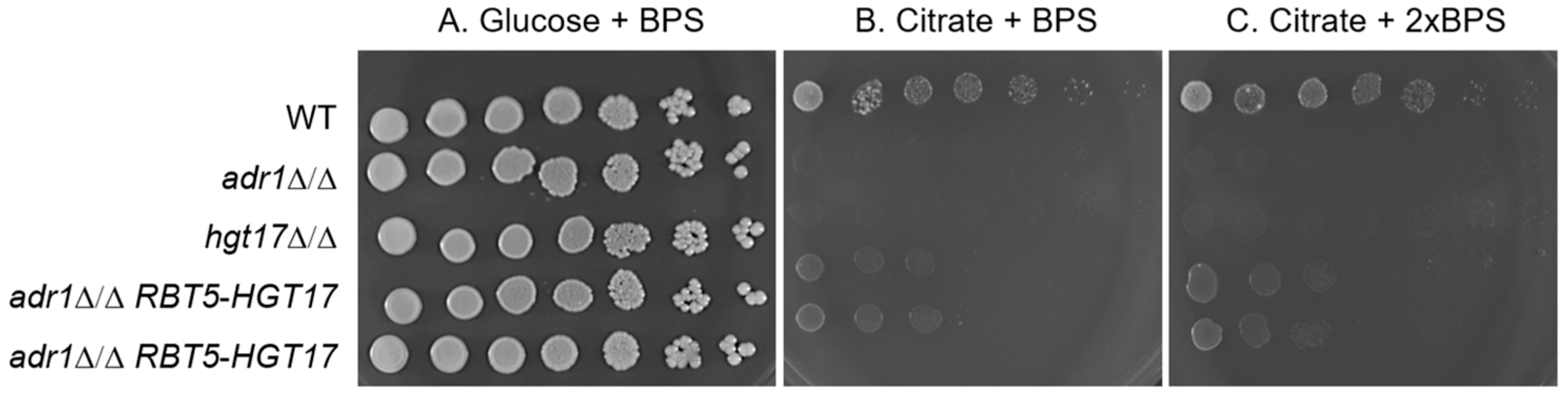
HGT17 is among the most highly Adr1-dependent genes. We reasoned that reduced HGT17 expression may contribute to the adr1Δ/Δ growth defect on citrate. To test that idea, we asked whether increased HGT17 expression may improve growth of an adr1Δ/Δ mutant on citrate medium. We fused the HGT17 coding region to the iron-repressed RBT5 promoter [14] in an adr1Δ/Δ mutant and tested its growth on media supplemented with bathophenanthrolinedisulfonate (BPS), an iron chelator that increases RBT5 promoter activity. On glucose medium (Figure 1A), the three control strains (wild type, adr1Δ/Δ, and hgt17Δ/Δ) grew equally well, and two independent adr1Δ/Δ RBT5-HGT17 strains grew comparably to the controls. On citrate medium (Figure 1B,C), the wild type grew much better than the adr1Δ/Δ and hgt17Δ/Δ mutants, as expected [10]. The two independent adr1Δ/Δ RBT5-HGT17 strains grew better than the adr1Δ/Δ strain, though not as well as the wild type. Similar observations were made with 50 µM BPS (Figure 1B) or 100 µM BPS (Figure 1C). This result argues that HGT17 is a key functional Adr1 target for growth on citrate, because increased HGT17 expression can partially compensate for the absence of Adr1.

3.2. Hgt17-Dependent Gene Expression

Reduced HGT17 expression may contribute not only to the adr1Δ/Δ growth defect but also to its regulatory impact. To explore that idea, we conducted RNA-seq analysis of the hgt17Δ/Δ mutant and wild-type strain on citrate medium. Under these conditions, 2676 genes had altered RNA levels (1360 downregulated, 1316 upregulated) in the hgt17Δ/Δ strain compared to the wild type (using conventional cutoffs of Log2 Fold Change [LFC] <−1 or >1 and an adjusted p-value < 0.05 [Table S1]). Upregulated genes were enriched for functions related to ribosome biogenesis; downregulated genes were enriched for diverse metabolic functions, including amino acid biosynthesis, ergosterol biosynthesis, and the citric acid cycle (Table S1). These results indicate that Hgt17, like Adr1, has global impact on gene expression in citrate medium. The growth defect of the hgt17Δ/Δ mutant is likely to be a driver of its gene expression impact.
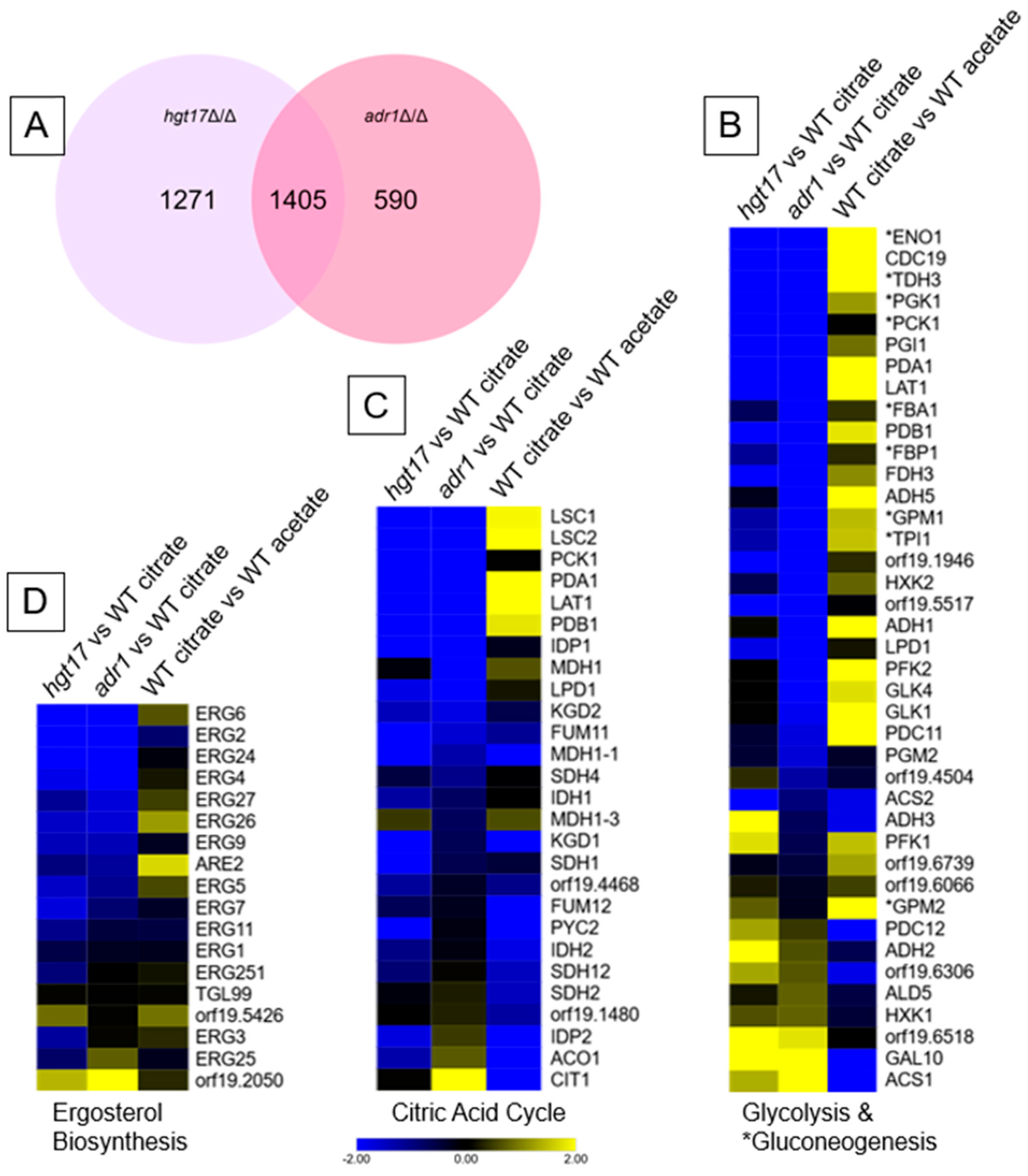
There was considerable overlap between the genes affected by the hgt17Δ/Δ mutation and those previously reported [10] for the adr1Δ/Δ mutation (Figure 2A). The functionally relevant citric acid cycle genes and glycolytic/gluconeogenic genes showed similar but not identical expression changes in response to each mutation (Figure 2B,C; R2 = 0.55−0.63 between LFC values). Many of the genes most strongly downregulated in the hgt17Δ/Δ and adr1Δ/Δ mutants were also strongly induced in citrate medium compared to acetate medium (Figure 2B,C). A correlation between impact of hgt17Δ/Δ and adr1Δ/Δ was also evident among ergosterol biosynthesis genes (Figure 2D; R2 = 0.55), many of which are direct Adr1 targets [9]. The similarity between hgt17Δ/Δ and adr1Δ/Δ gene expression changes stands in contrast to the considerable upregulation of ADR1 RNA levels in the hgt17Δ/Δ mutant (Table S1), a possible indication that Adr1 is inactive in citrate medium in the absence of Hgt17. We note that a few amino acid transporter genes (GAP2, GAP5, GAP6, HIP1, MUP1) were downregulated in the hgt17Δ/Δ mutant and not in the adr1Δ/Δ mutant. There could be something interesting with those transporters, so, overall, these results show that adr1Δ/Δ and hgt17Δ/Δ mutations have similar impact on a range of gene sets and argue that reduced HGT17 expression contributes to the gene expression impact of an adr1Δ/Δ mutation.

4. Discussion

Our study here was driven by the finding that HGT17 is among the most downregulated genes in an adr1Δ/Δ mutant compared to the wild type [10], prompting the idea that the HGT17 expression defect may account for a portion of the adr1Δ/Δ mutant phenotype. While we acknowledge that the molecular function of Hgt17 is not entirely established, we interpret our results in view of the hypothesis that Hgt17 transports citrate.
Adr1 positively regulates numerous citric acid cycle and gluconeogenic genes [10]. How could it be then that overexpression of one target gene, HGT17, can improve growth on citrate? We interpret the result to indicate that the adr1Δ/Δ citrate growth defect is an aggregate effect of (i) diminished citrate uptake and (ii) diminished citrate metabolism capability. Overcoming either of these factors would thus improve citrate growth. However, both factors would have to be remedied to fully restore growth on citrate to wild-type levels. In fact, there is the suggestion in the literature that HGT17 expression may be limiting even for ADR1+/+ strains to grow on citrate: an eed1Δ/Δ mutation improves growth on citrate, and HGT17 is among the most highly upregulated genes in that mutant [11].
Why would citrate uptake need to be regulated? The reason may be that citrate accumulation can inhibit glycolysis. In S. cerevisiae, metabolic flux analysis and biochemical assays show that internal citrate accumulation causes severe inhibition of pyruvate kinase (Cdc19) [25]. Therefore, internal citrate accumulation can impede growth on substrates that enter glycolysis upstream of phosphoenolpyruvate. If C. albicans citrate uptake were constitutive, then external citrate could enter the cell and inhibit pyruvate kinase, blocking use of hexoses and glycerol. Tight control of HGT17 expression thus enables cells to consume preferred energy sources in the presence of citrate.
Hgt17 has a prominent effect on gene expression in citrate medium. For that reason, one might consider that Hgt17 has a direct role in citrate signaling. Glucose transporter homologs that function as signaling receptors include C. albicans Hgt4 and S. cerevisiae Snf3 and Rgt2 [26]. We consider such a role for Hgt17 unlikely for two reasons. First, the signaling receptors have a large C-terminal domain not shared with transporters [26], and Hgt17 lacks that domain. Second, the signaling receptors are expressed at low levels, an early clue that they could not transport sufficient substrate for growth [27]. However, HGT17 has RNA levels comparable to bona fide transporter genes HGT8 and HGT7 and ~80-fold higher RNA levels than signaling receptor gene HGT4 [10].
How then does Hgt17 have such strong impact on gene expression? We suggest two simple explanations. One possibility is that the gene expression changes represent the effects of carbon starvation. That is, citrate is the only carbon source in the medium, and if it cannot be taken up, then cells may use only endogenous carbon reserves. A second possibility, admittedly an entirely speculative one, is that citrate may promote transcriptional activation by Adr1. For example, citrate or a derived metabolite may be an allosteric effector that stimulates Adr1 binding to DNA. (This latter explanation is analogous to inducer exclusion in the lac operon system [28]). These explanations are not mutually exclusive, so both concepts may contribute to the hgt17Δ/Δ gene expression defect. We hope that future investigators will test some of the ideas we have generated through this now unfunded and unstaffed project.

Supplementary Materials

The following supporting information can be downloaded at https://www.mdpi.com/article/10.3390/jof11120889/s1, Table S1: RNA sequencing data sets; Table S2: Strains oligos plasmids.

Author Contributions

A.M.W. conducted experiments, interpreted results, and prepared figures and the manuscript draft. A.P.M. supervised experiments, obtained funding, and edited the manuscript. All authors have read and agreed to the published version of the manuscript.

Funding

This work was supported by NIH grant 5R01AI146103 to APM and by a Distinguished Research Professorship from the University of Georgia.

Institutional Review Board Statement

Not applicable.

Informed Consent Statement

Not applicable.

Data Availability Statement

The data presented in this study are openly available in NCBI GEO at https://www.ncbi.nlm.nih.gov/geo/, reference number GSE287330, accessed on 16 December 2025.

Acknowledgments

We thank Katharina Goerlich, Eunsoo Do, Anupam Sharma, Yinhe Mao, Liping Xiong, Min-Ju Kim, Max Cravener, and Fred Lanni for their continued interest in this project. We thank Vinny Starai, Michelle Momany, and Zachary Lewis for many helpful discussions, and Max Kuhr for outstanding laboratory management.

Conflicts of Interest

The authors declare no conflicts of interest.

References

  1. Witchley, J.N.; Penumetcha, P.; Abon, N.V.; Woolford, C.A.; Mitchell, A.P.; Noble, S.M. Candida albicans Morphogenesis Programs Control the Balance between Gut Commensalism and Invasive Infection. Cell Host Microbe 2019, 25, 432–443.e436. [Google Scholar] [CrossRef]
  2. Brown, A.J.; Brown, G.D.; Netea, M.G.; Gow, N.A. Metabolism impacts upon Candida immunogenicity and pathogenicity at multiple levels. Trends Microbiol. 2014, 22, 614–622. [Google Scholar] [CrossRef]
  3. Brown, G.D.; Denning, D.W.; Gow, N.A.; Levitz, S.M.; Netea, M.G.; White, T.C. Hidden killers: Human fungal infections. Sci. Transl. Med. 2012, 4, 165rv113. [Google Scholar] [CrossRef]
  4. Pfaller, M.A.; Diekema, D.J. Epidemiology of invasive candidiasis: A persistent public health problem. Clin. Microbiol. Rev. 2007, 20, 133–163. [Google Scholar] [CrossRef]
  5. Ramirez, M.A.; Lorenz, M.C. Mutations in alternative carbon utilization pathways in Candida albicans attenuate virulence and confer pleiotropic phenotypes. Eukaryot. Cell 2007, 6, 280–290. [Google Scholar] [CrossRef]
  6. Childers, D.S.; Raziunaite, I.; Mol Avelar, G.; Mackie, J.; Budge, S.; Stead, D.; Gow, N.A.; Lenardon, M.D.; Ballou, E.R.; MacCallum, D.M.; et al. The Rewiring of Ubiquitination Targets in a Pathogenic Yeast Promotes Metabolic Flexibility, Host Colonization and Virulence. PLoS Pathog. 2016, 12, e1005566. [Google Scholar] [CrossRef] [PubMed]
  7. Rai, L.S.; Wijlick, L.V.; Bougnoux, M.E.; Bachellier-Bassi, S.; d’Enfert, C. Regulators of commensal and pathogenic life-styles of an opportunistic fungus-Candida albicans. Yeast 2021, 38, 243–250. [Google Scholar] [CrossRef] [PubMed]
  8. Ries, L.N.A.; Beattie, S.; Cramer, R.A.; Goldman, G.H. Overview of carbon and nitrogen catabolite metabolism in the virulence of human pathogenic fungi. Mol. Microbiol. 2018, 107, 277–297. [Google Scholar] [CrossRef] [PubMed]
  9. Shrivastava, M.; Kouyoumdjian, G.S.; Kirbizakis, E.; Ruiz, D.; Henry, M.; Vincent, A.T.; Sellam, A.; Whiteway, M. The Adr1 transcription factor directs regulation of the ergosterol pathway and azole resistance in Candida albicans. mBio 2023, 14, e01807–e01823. [Google Scholar] [CrossRef]
  10. White, A.M.; Mitchell, A.P. Control of citrate utilization by Candida albicans Adr1. mSphere 2025, 10, e0031125. [Google Scholar] [CrossRef]
  11. Dunker, C.; Polke, M.; Schulze-Richter, B.; Schubert, K.; Rudolphi, S.; Gressler, A.E.; Pawlik, T.; Prada Salcedo, J.P.; Niemiec, M.J.; Slesiona-Kunzel, S.; et al. Rapid proliferation due to better metabolic adaptation results in full virulence of a filament-deficient Candida albicans strain. Nat. Commun. 2021, 12, 3899. [Google Scholar] [CrossRef]
  12. Fan, J.; Chaturvedi, V.; Shen, S.-H. Identification and Phylogenetic Analysis of a Glucose Transporter Gene Family from the Human Pathogenic Yeast Candida albicans. J. Mol. Evol. 2002, 55, 336–346. [Google Scholar] [CrossRef]
  13. Barnett, J.A.; Kornberg, H.L. The utilization by yeasts of acids of the tricarboxylic acid cycle. J. Gen. Microbiol. 1960, 23, 65–82. [Google Scholar] [CrossRef]
  14. Mao, Y.; Solis, N.V.; Sharma, A.; Cravener, M.V.; Filler, S.G.; Mitchell, A.P. Use of the Iron-Responsive RBT5 Promoter for Regulated Expression in Candida albicans. mSphere 2022, 7, e0030522. [Google Scholar] [CrossRef]
  15. Min, K.; Ichikawa, Y.; Woolford, C.A.; Mitchell, A.P. Candida albicans Gene Deletion with a Transient CRISPR-Cas9 System. mSphere 2016, 1, e00130-16. [Google Scholar] [CrossRef]
  16. Vyas, V.K.; Barrasa, M.I.; Fink, G.R. A Candida albicans CRISPR system permits genetic engineering of essential genes and gene families. Sci. Adv. 2015, 1, e1500248. [Google Scholar] [CrossRef]
  17. Huang, M.Y.; Woolford, C.A.; May, G.; McManus, C.J.; Mitchell, A.P. Circuit diversification in a biofilm regulatory network. PLoS. Pathog. 2019, 15, e1007787. [Google Scholar] [CrossRef] [PubMed]
  18. Noble, S.M.; Johnson, A.D. Strains and strategies for large-scale gene deletion studies of the diploid human fungal pathogen Candida albicans. Eukaryot. Cell. 2005, 4, 298–309. [Google Scholar] [CrossRef] [PubMed]
  19. Huang, M.Y.; Mitchell, A.P. Marker Recycling in Candida albicans through CRISPR-Cas9-Induced Marker Excision. mSphere 2017, 2, e00050-17. [Google Scholar] [CrossRef]
  20. Cravener, M.V.; Do, E.; May, G.; Zarnowski, R.; Andes, D.R.; McManus, C.J.; Mitchell, A.P. Reinforcement amid genetic diversity in the Candida albicans biofilm regulatory network. PLoS Pathog. 2023, 19, e1011109. [Google Scholar] [CrossRef] [PubMed]
  21. Love, M.I.; Huber, W.; Anders, S. Moderated estimation of fold change and dispersion for RNA-seq data with DESeq2. Genome Biol. 2014, 15, 550. [Google Scholar] [CrossRef] [PubMed]
  22. Skrzypek, M.S.; Binkley, J.; Binkley, G.; Miyasato, S.R.; Simison, M.; Sherlock, G. The Candida Genome Database (CGD): Incorporation of Assembly 22, systematic identifiers and visualization of high throughput sequencing data. Nucleic Acids Res. 2017, 45, D592–D596. [Google Scholar] [CrossRef]
  23. Basenko, E.Y.; Shanmugasundram, A.; Bohme, U.; Starns, D.; Wilkinson, P.A.; Davison, H.R.; Crouch, K.; Maslen, G.; Harb, O.S.; Amos, B.; et al. What is new in FungiDB: A web-based bioinformatics platform for omics-scale data analysis for fungal and oomycete species. Genetics 2024, 227, iyae035. [Google Scholar] [CrossRef]
  24. Kanehisa, M.; Furumichi, M.; Sato, Y.; Kawashima, M.; Ishiguro-Watanabe, M. KEGG for taxonomy-based analysis of pathways and genomes. Nucleic Acids Res. 2023, 51, D587–D592. [Google Scholar] [CrossRef]
  25. Hackett, S.R.; Zanotelli, V.R.; Xu, W.; Goya, J.; Park, J.O.; Perlman, D.H.; Gibney, P.A.; Botstein, D.; Storey, J.D.; Rabinowitz, J.D. Systems-level analysis of mechanisms regulating yeast metabolic flux. Science 2016, 354, aaf2786. [Google Scholar] [CrossRef]
  26. Van Ende, M.; Wijnants, S.; Van Dijck, P. Sugar Sensing and Signaling in Candida albicans and Candida glabrata. Front. Microbiol. 2019, 10, 99. [Google Scholar] [CrossRef] [PubMed]
  27. Ozcan, S.; Johnston, M. Function and regulation of yeast hexose transporters. Microbiol. Mol. Biol. Rev. 1999, 63, 554–569. [Google Scholar] [CrossRef] [PubMed]
  28. Magasanik, B. Glucose effects: Inducer exlusion and repression. In The Lactose Operon; Beckwith, J., Zipser, D., Eds.; Cold Spring Harbor Laboratory: Cold Spring Harbor, NY, USA, 1970; Volume 1, pp. 189–219. [Google Scholar]
Figure 1. Growth properties of adr1Δ/Δ and adr1Δ/Δ RBT5-HGT17 strains. The indicated strains were grown overnight in YNB plus 1% sodium acetate + 50 µM bathophenanthrolinedisulfonate (BPS) broth cultures, then five-fold serial dilutions were spotted on (A) YNB + 2% glucose + 50 µM BPS, (B) YNB + 1% sodium citrate + 50 µM BPS, and (C) YNB + 1% sodium citrate + 100 µM BPS. Plates were imaged after 96 h at 37 °C. We used acetate as the carbon source in overnight cultures because it is permissive for the wild type, the adr1 mutant, and the hgt17 mutant [10]. Strains used were MC22 (WT), AW10 (adr1Δ/Δ), AW157 (hgt17Δ/Δ), AW313 and AW315 (adr1Δ/Δ RBT5-HGT17).
Jof 11 00889 g001
Figure 2. Gene expression changes in hgt17Δ/Δ vs. wild type comparison. (A) Venn diagram depicting significantly regulated genes (Log2Fold change <−1 or >1, padj < 0.05) in citrate-grown hgt17Δ/Δ vs. WT and adr1Δ/Δ vs. WT RNA-seq datasets. (BD) Heat maps depicting LFC gene expression changes in selected biochemical pathways. (B) Glycolytic/Gluconeogenic genes; asterisks (*) denote Gluconeogenic genes. (C) Citric Acid Cycle genes. (D) Ergosterol Biosynthesis genes. A scale bar at the bottom shows the color scale for all three heatmaps. Datasets used are hgt17Δ/Δ vs. WT in citrate medium (this study), adr1Δ/Δ vs. WT in citrate medium [10], and WT in citrate medium vs. WT in acetate medium [10]. Gene sets were obtained from the KEGG database [24] entries at https://www.kegg.jp/entry/cal00100, https://www.kegg.jp/entry/cal00020, and https://www.kegg.jp/entry/cal00010, all accessed on 23 November, 2025.
Jof 11 00889 g002
Disclaimer/Publisher’s Note: The statements, opinions and data contained in all publications are solely those of the individual author(s) and contributor(s) and not of MDPI and/or the editor(s). MDPI and/or the editor(s) disclaim responsibility for any injury to people or property resulting from any ideas, methods, instructions or products referred to in the content.